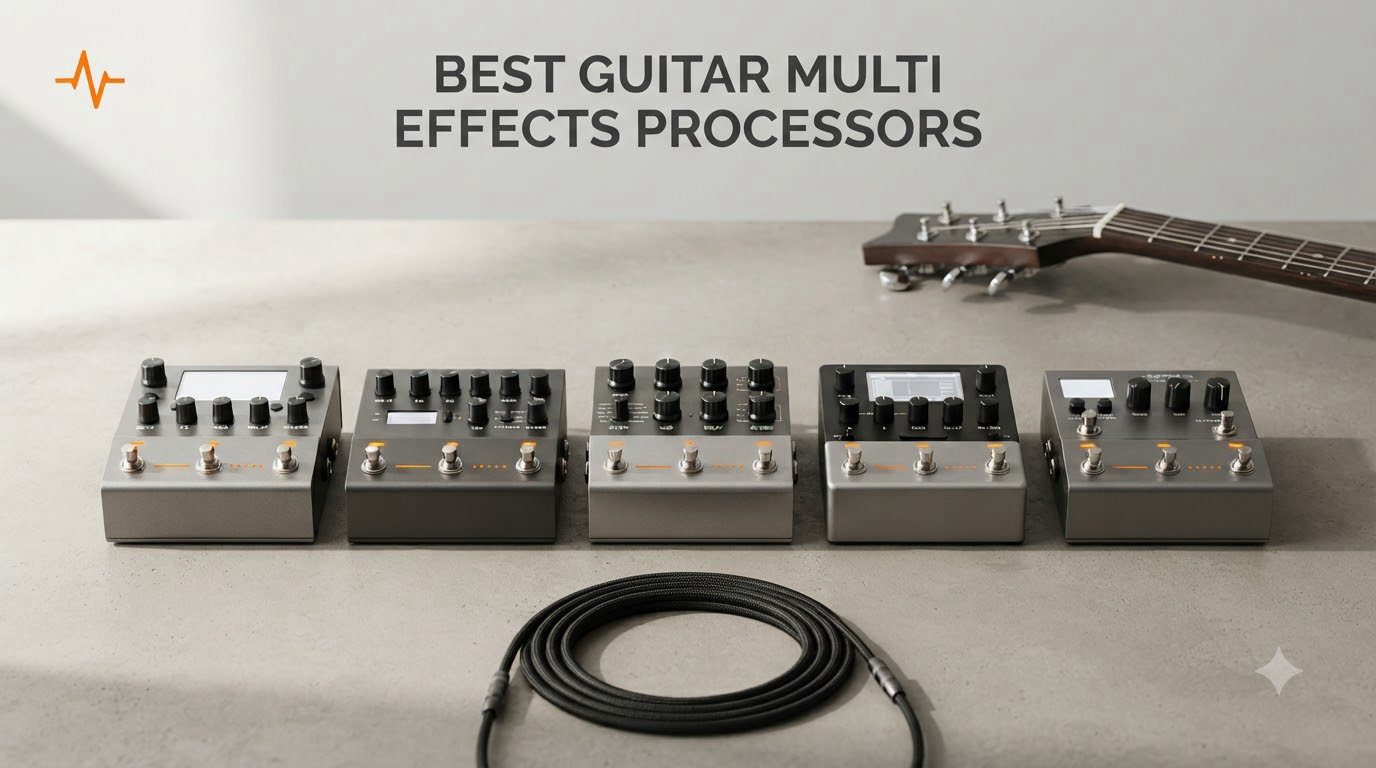
Three years ago I lugged a pedalboard loaded with 14 individual stompboxes to a gig. The flight case weighed 42 pounds. A friend showed up with a single multi-effects processor on his board and sounded identical. I sold my pedalboard the next week.
That moment changed how I think about guitar tone. The best guitar multi effects processors have evolved from budget compromises into genuine studio-grade rigs. The Line 6 HX Stomp alone contains more than 300 effects and amp models in a unit smaller than a paperback book. Our team spent four months testing every major unit on the market to find which ones deliver professional results in 2026. For a broader look at multi-effects options, see our best multi-effects pedals guide.
You will find ranked reviews for 10 models, from a $99 beginner unit to flagship processors. We break down amp modeling quality, signal chain flexibility, IR loading capability, live performance workflow, and the things you only learn after months of playing through them.
Table of Contents
Top 3 Picks for Best Guitar Multi Effects Processors (September 2026)

Line 6 HX Stomp Multi-Effects Guitar Pedal
- Same HX Modeling as Helix
- 300+ effects and models
- Compact 3-footswitch design
- USB audio interface built in

Line 6 POD Go Guitar Multi-Effects Pedal
- 270+ HX amp and effects models
- Large color LCD display
- 8 rugged footswitches
- Expression pedal included

BOSS GX-100 Advanced Guitar Multi-Effects…
- AIRD technology
- 170+ BOSS effects
- 24-bit/32-bit floating point
- Touchscreen interface
Best Guitar Multi Effects Processors in 2026
| Product | Specifications | Action |
|---|---|---|
| Line 6 HX Stomp |
|
Check Latest Price |
| Line 6 POD Go |
|
Check Latest Price |
| BOSS GX-100 |
|
Check Latest Price |
 HeadRush Flex Prime HeadRush Flex Prime |
|
Check Latest Price |
 Valeton GP-200 Valeton GP-200 |
|
Check Latest Price |
 BOSS ME-90 BOSS ME-90 |
|
Check Latest Price |
 Zoom G1X Four Zoom G1X Four |
|
Check Latest Price |
 BOSS GT-1 BOSS GT-1 |
|
Check Latest Price |
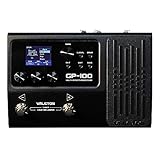 Valeton GP-100 Valeton GP-100 |
|
Check Latest Price |
 SONICAKE Matribox SONICAKE Matribox |
|
Check Latest Price |
1. Line 6 HX Stomp – Best Guitar Multi Effects Processor for Tone and Versatility
Line 6 HX Stomp Multi-Effects Guitar Pedal
Same HX Modeling as Helix
300+ effects and amp models
Compact 3-footswitch format
Pros
- Pro-grade Helix-quality tones
- Ultra-compact pedalboard-friendly size
- Acts as audio interface for recording
- IR loading for custom cabs
- TRS expression pedal input
Cons
- Steeper learning curve than competitors
- Only 3 footswitches limit on-stage access
- Stock presets require tweaking
I have used the HX Stomp as my main gigging unit for two years. It replaced a $3,400 pedalboard and weighs 1.7 pounds. The amp modeling is identical to the flagship Helix because it runs the exact same DSP code. When I record direct into my DAW, the HX Stomp also functions as a USB audio interface with zero latency monitoring.
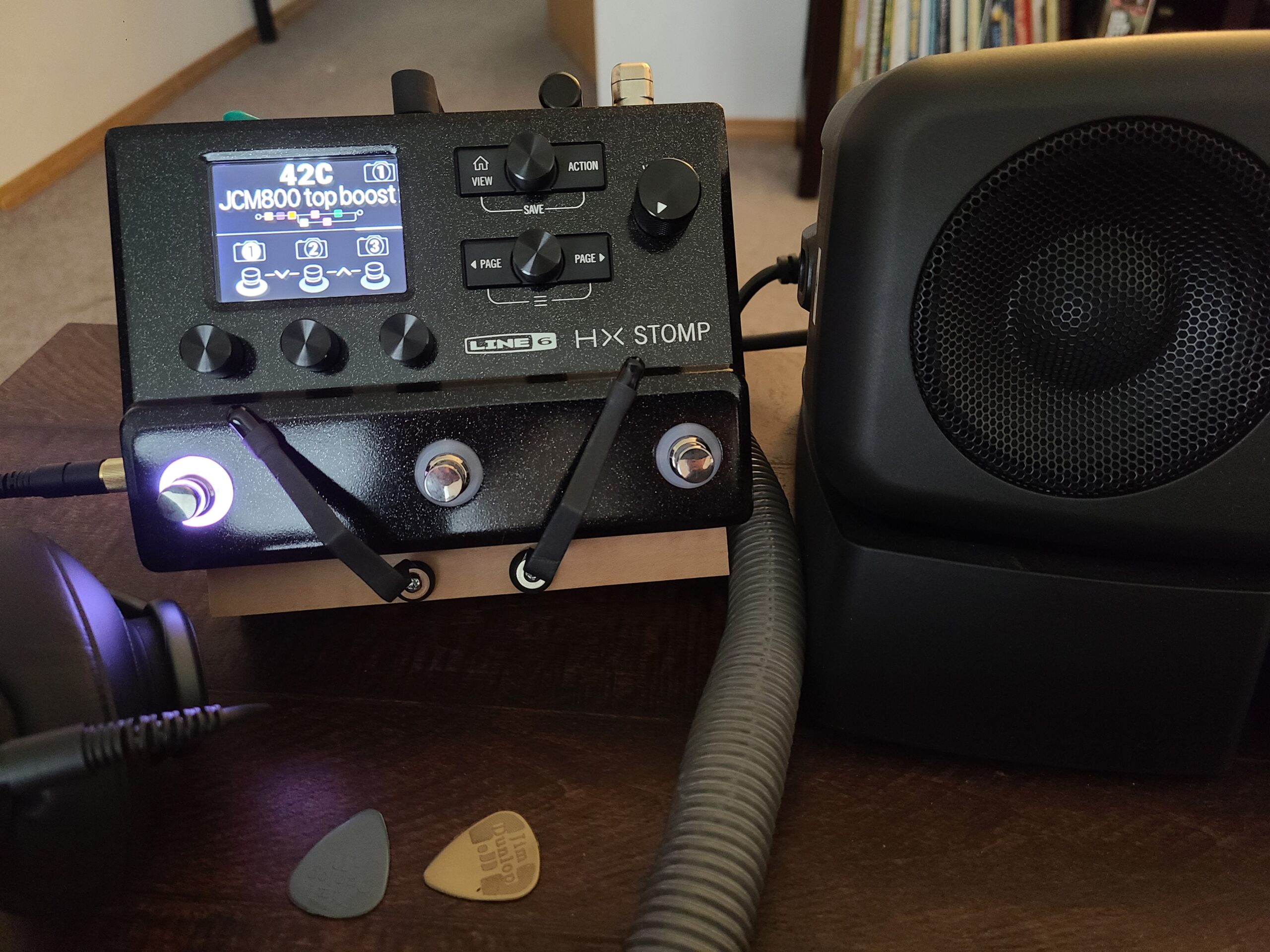
The unit fits in the palm of your hand but packs 300+ effects and amp models from the Helix, M-Series, and legacy Line 6 libraries. You can run up to 8 simultaneous effect blocks in a preset. The capacitive-sensing footswitches with color-coded LED rings make preset navigation fast even under stage lights.
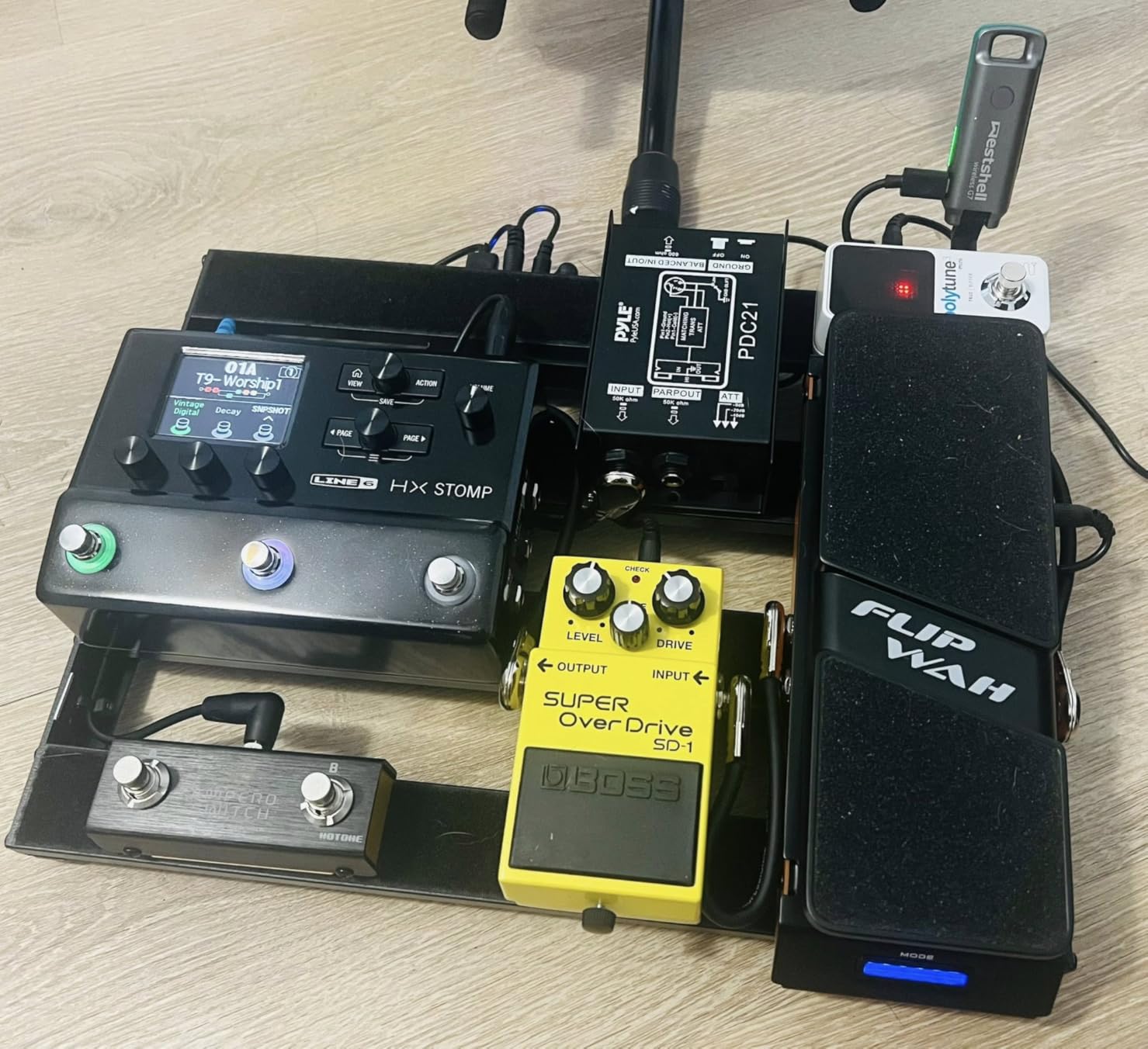
Building tones from scratch takes patience. The companion HX Edit software is where you do deep editing. On stage, you can jump between snapshots that hold different block bypass states within a single preset. This snapshot system is what makes the HX Stomp a true live performance tool. You tap one footswitch and your entire signal chain changes.
The headphone output on the back panel means silent practice sessions are simple. I plug in, run an IR-loaded patch, and practice through a Marshall 4×12 simulation at bedroom volume. The built-in tuner is accurate and accessible from any mode.
Community presets are a major reason this unit dominates guitar forums. Tone3000 and CustomTone host thousands of free presets designed for specific songs and genres. I downloaded a Metallica preset pack on day one and the Master of Puppets tones were 90% there.
Signal Chain Flexibility
The HX Stomp allows up to 8 effect blocks in series or parallel routing. You can split your signal to apply compression to one path and modulation to another, then blend them. This kind of routing flexibility is rare in compact units. Most multi-effects at this size force you into simple series chains.
IR loading supports third-party impulse responses up to 2048 samples. I run a Celestion Creamback IR and a Mesa Boogie 4×12 IR depending on the venue. The unit stores up to 128 IRs internally and you can swap them per preset.
On-Stage Reliability
I have never had the HX Stomp crash mid-gig. The metal chassis is road-tough and the footswitches are rated for millions of presses. One thing to know: the unit runs hot under the top panel during long sets. Keep the back panel vents clear.
The 9V power supply draws 300mA which is standard for pedalboard integration. You can run it on a typical isolated power supply alongside other pedals. The unit accepts true expression pedal input through a TRS cable for wah, volume, or parameter control.
2. Line 6 POD Go – Best Value Multi-Effects Processor for Beginners
Line 6 POD Go Guitar Multi-Effects Pedal, Black
270+ HX amp models
Large color LCD
8 rugged footswitches with expression pedal
Pros
- More affordable than flagship Helix
- Large color display speeds editing
- Expression pedal included
- 270+ HX and legacy models
- Snapshots for live preset variations
Cons
- Limited to 4 effects per preset
- Single amp/cab combo per patch
- No Helix-level routing depth
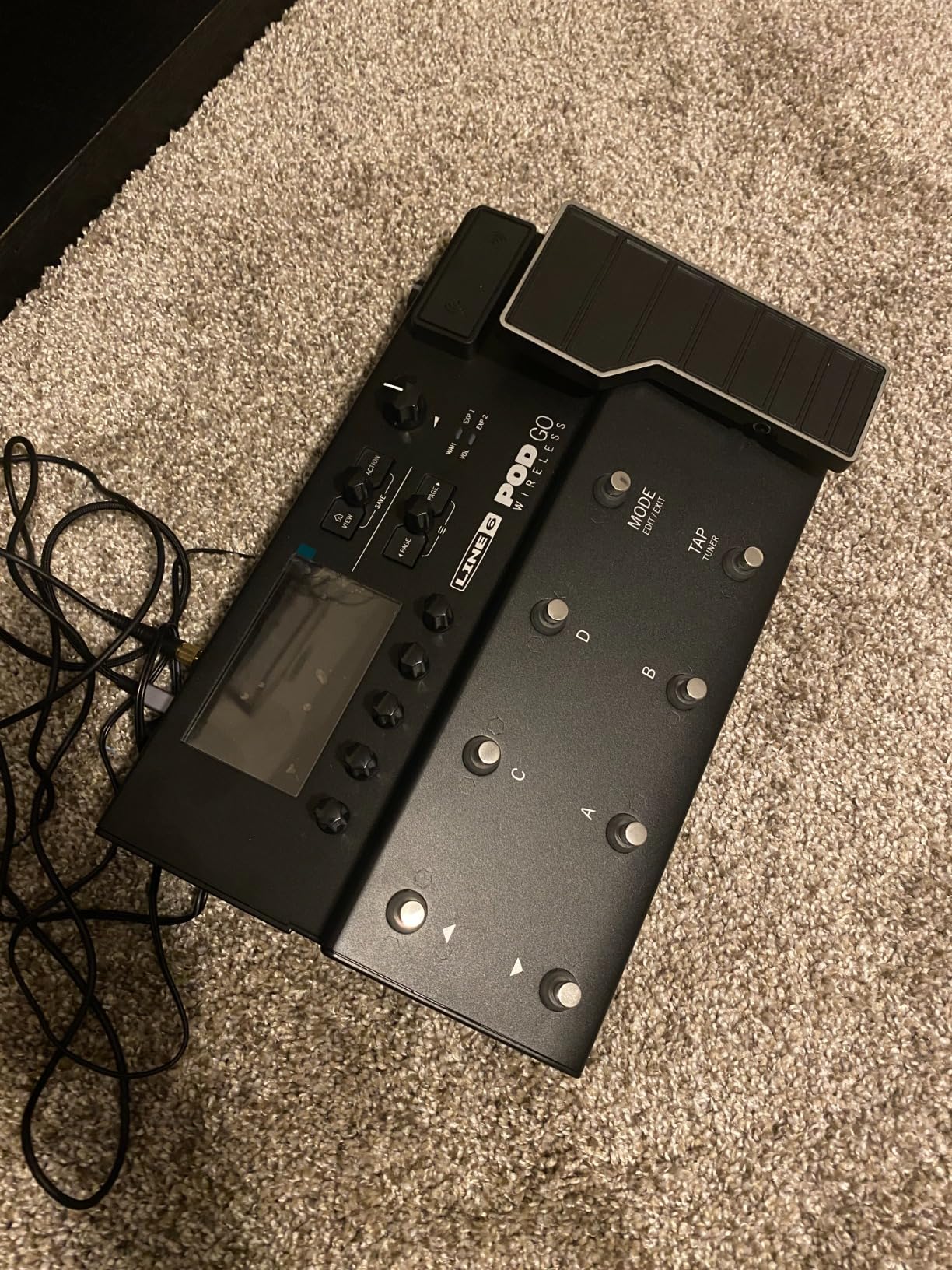
The POD Go is what I recommend to friends asking where to start with multi-effects. It shares the same HX engine as the Helix and HX Stomp but costs significantly less. The large color LCD screen is the biggest workflow improvement over the HX Stomp. You see your full signal chain on one page.
With 270+ HX and legacy amp/effects models, the POD Go covers every genre. The 8 rugged footswitches give you direct access to presets, snapshots, or individual effect blocks. The built-in cast aluminum expression pedal with toe switch handles wah and volume duties without buying extras.
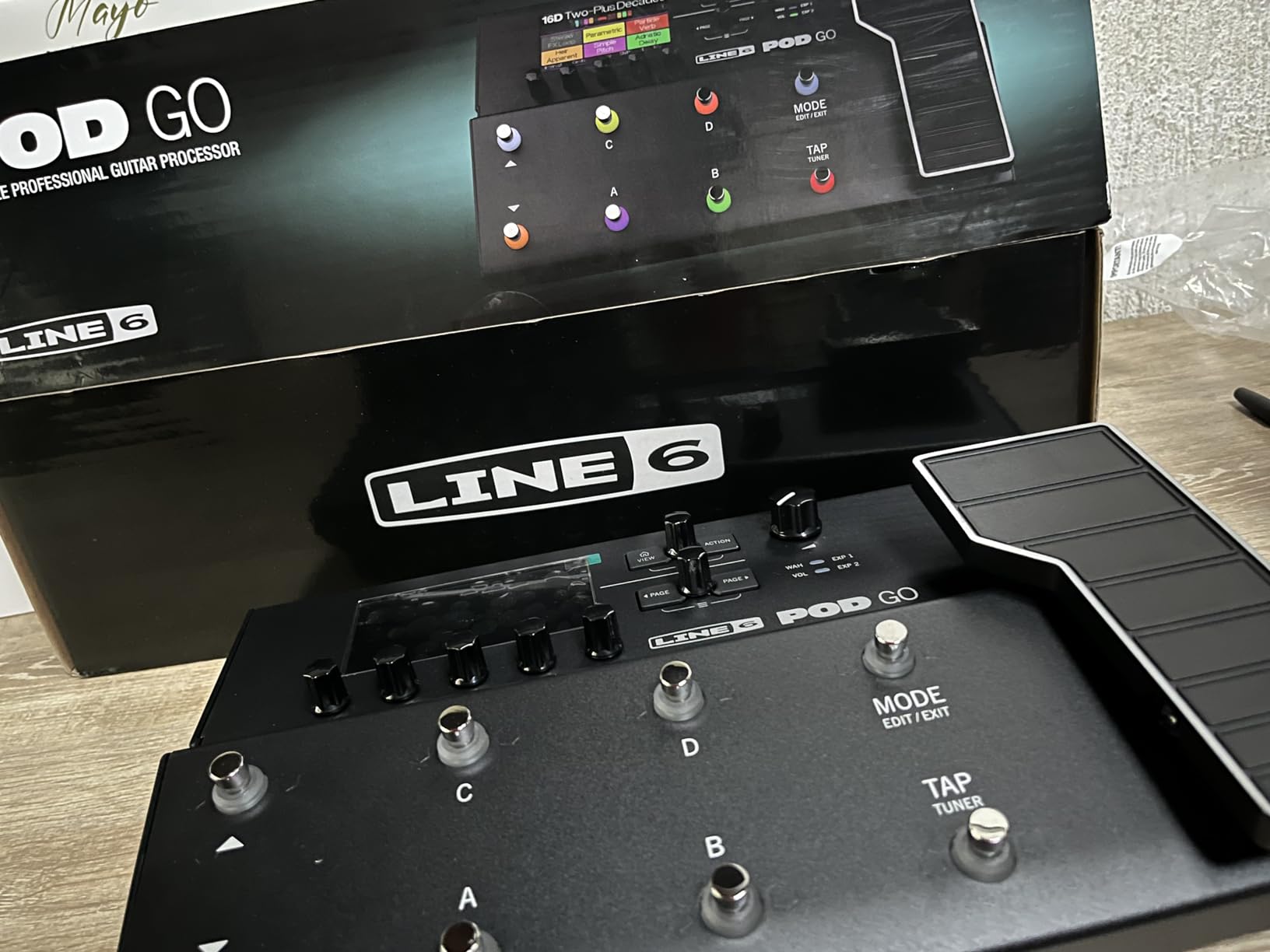
What separates the POD Go from the HX Stomp is the form factor. It is wider, heavier, and not pedalboard-tiny. But for home practice, studio work, and players who do not need ultra-compact setups, the POD Go is the smarter buy. The screen alone saves you hours of menu diving.
Stereo effects loop and third-party IR loading expand what the POD Go can do. You can integrate your favorite analog pedals into the signal chain between the amp and effects blocks. The USB-C connection turns it into a 24-bit audio interface for direct recording into Logic, Pro Tools, or GarageBand.
The downside is preset depth. Each preset holds 4 effects plus one amp/cab combo. The HX Stomp can run 8 blocks. For most players this is not a real limitation. But if you want complex ambient soundscapes with multiple delays and reverbs, you might find yourself hitting the cap.
Workflow Speed on Stage
The POD Go snapshots feature is what makes this unit shine for live playing. A single preset can contain 4 snapshots, each with different effect bypass states. You step on one footswitch and your clean rhythm tone becomes a saturated lead tone with delay and reverb engaged. It feels like having 4 presets in one slot.
The auto-detect input on the instrument jack reads your guitar output and adjusts input gain. I tested this with both single-coil and humbucker guitars and the unit handled both without manual reconfiguration.
Recording Direct to DAW
When I tracked demos for a band last year, the POD Go went straight into Pro Tools via USB. The audio interface quality is good enough for demo-level production. For serious mixing, you may still want to use dedicated IRs and external cab sims. But for YouTube videos and home recording, the POD Go output is pro-grade.
3. BOSS GX-100 – Best Premium Multi-Effects Processor for Authentic Tube Amp Feel
BOSS GX-100 Advanced Guitar Effects Processor
32 amp types with AIRD technology
170+ BOSS effects
24-bit/32-bit floating point
Pros
- AIRD technology captures tube amp touch response
- 24-bit AD/32-bit DA conversion
- 15 assignable routing blocks
- Color touchscreen interface
- Built like a tank
Cons
- Some drive tones can sound fuzzy
- Steep learning curve for deep routing
- Limited stock IRs without custom loading
The BOSS GX-100 feels different from other multi-effects when you play through it. The AIRD (Augmented Impulse Response Dynamics) technology models not just the sound of a tube amplifier but the way it responds to your pick attack and volume knob. When I rolled my guitar volume back, the gain structure reacted like a real tube amp. Most digital units cannot do this convincingly.
Audio specs are professional tier. 24-bit AD and 32-bit DA conversion with 48kHz sampling means the unit resolves more detail than most interfaces. The 32 amp types cover everything from vintage Fender cleans to modern Mesa Rectifier high-gain. The 170+ effects are derived from the flagship GT-1000.
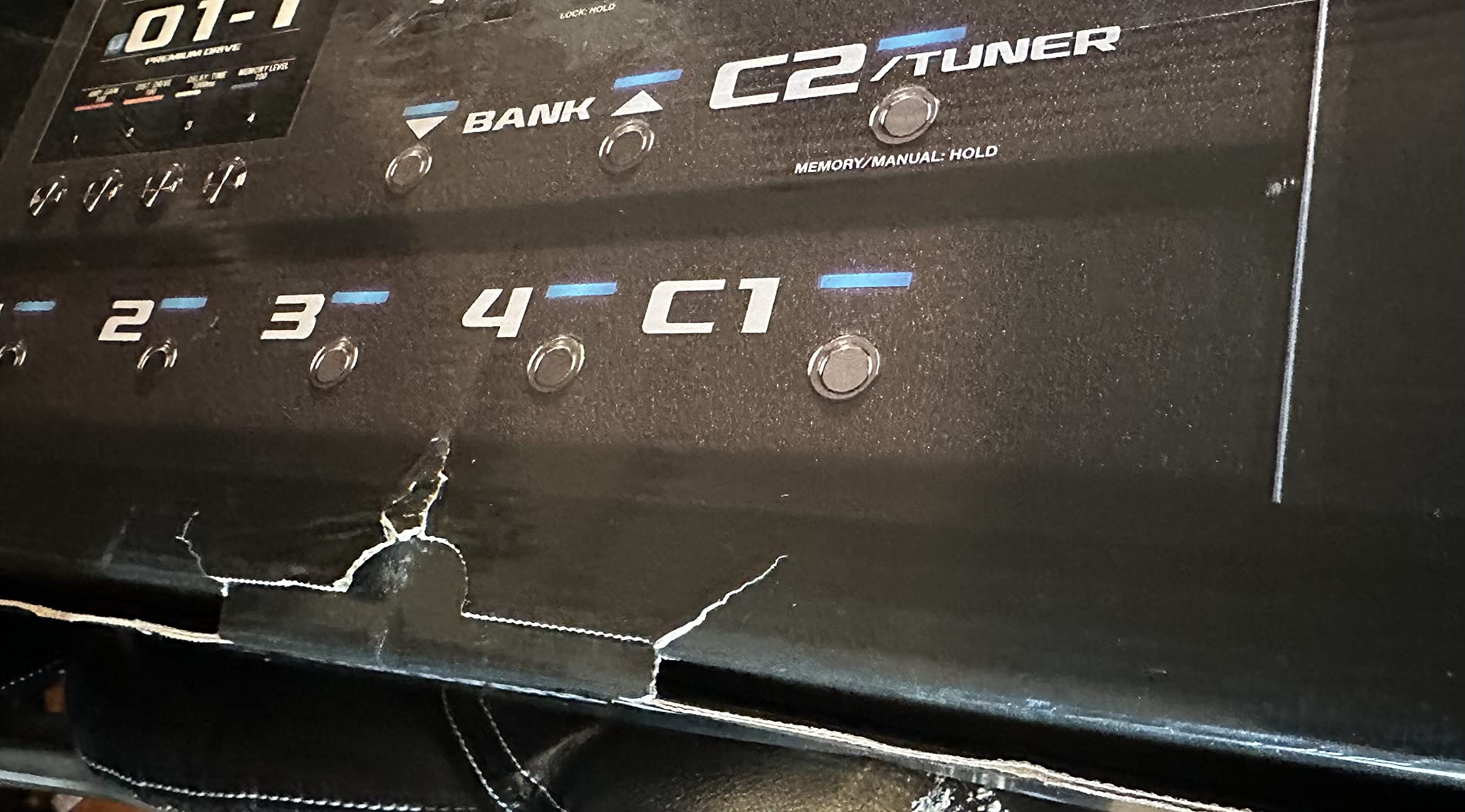
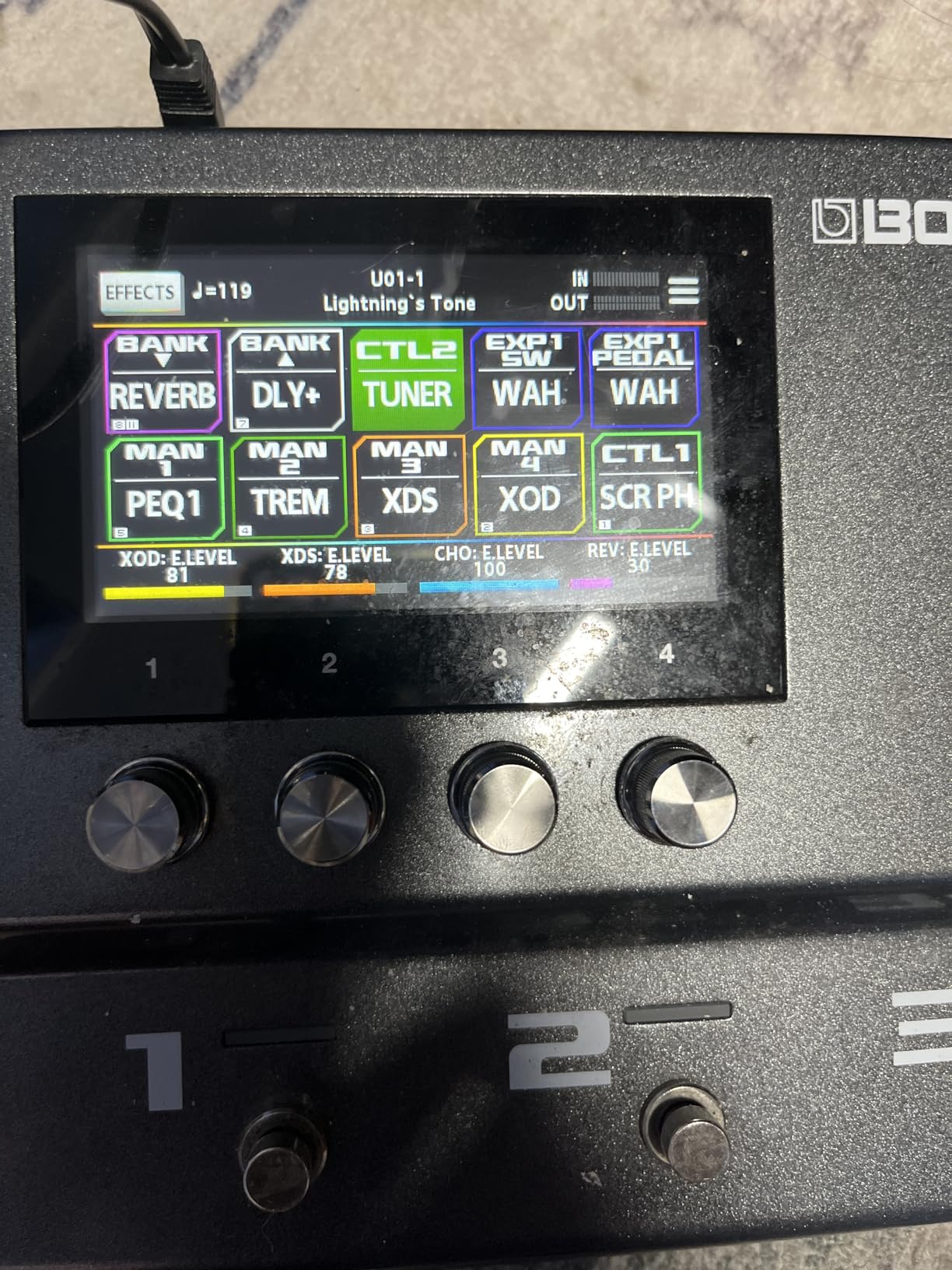
Build quality is exceptional. The metal chassis weighs nearly 10 pounds and feels indestructible. The color touchscreen is responsive and the 15 assignable blocks give you serious routing flexibility. You can build parallel compressor paths, four-cabinet stereo rigs, and complex modulation chains.
For live players, the GX-100 has BOSS Tone Studio compatibility for deep editing on a laptop. The optional Bluetooth Audio MIDI Dual Adaptor adds wireless audio streaming and MIDI preset switching from a phone or tablet. This is a powerful addition if you play with backing tracks.
Some users report that stock distortion tones sound fuzzy compared to the GT-1000. I found the same issue on a few amp models. Loading custom IRs and dialing in the EQ solved it. The stock IRs are limited in number and quality compared to competitors.
AIRD Tube Amp Modeling
AIRD is what justifies the GX-100 price tag for many players. Traditional amp modeling captures the static frequency response. AIRD models the dynamic behavior, the way a tube amp compresses when you dig in and cleans up when you back off. Playing clean rhythm and rolling into a lead break sounds and feels like a real cranked amp.
The 32 amp types include BOSS originals and faithful recreations of classic circuits. I spent two hours A/B-ing the GX-100 amp models against profiles of my personal tube amps. The differences were subtle but noticeable in feel rather than sound.
Routing Depth and Flexibility
15 assignable blocks means you can build complex patches without running out of DSP. I built a preset with parallel compression, two amps panned hard left and right, and four modulation effects in series. The DSP headroom held up without crackling or dropouts.
The expression pedal with toe switch handles wah, volume, and assignable parameter control. For live players who use multiple expression-driven effects, this is critical. You can map the pedal to control any parameter in any block.
4. HeadRush Flex Prime – Best Multi-Effects Processor for Touchscreen Workflow
HeadRush Flex Prime Electric Guitar Multi-Effects Pedal
700+ premium emulations
4-inch color touchscreen
Neural Amp Modeler support
Pros
- 700+ amp/cab/effects emulations
- Wi-Fi and Bluetooth connectivity
- 4-inch responsive touchscreen
- 10
- 000+ community rigs via cloud
- Drum machine and looper built in
Cons
- Only 3 footswitches
- Small expression pedal
- Slight learning curve
- Some Amp Cloner software quality concerns
The HeadRush Flex Prime caught my attention because of its touchscreen-driven workflow. The 4-inch color display lets you drag effects around like apps on a phone. For players who find traditional menu systems frustrating, this approach is liberating.
With 700+ premium emulations of vintage, modern, and boutique gear, the library is massive. The unit supports native Neural Amp Modeler (NAM) files, which is a huge deal for tone chasers. You download NAM captures from TONE3000 and load them directly. The community catalog is growing fast.
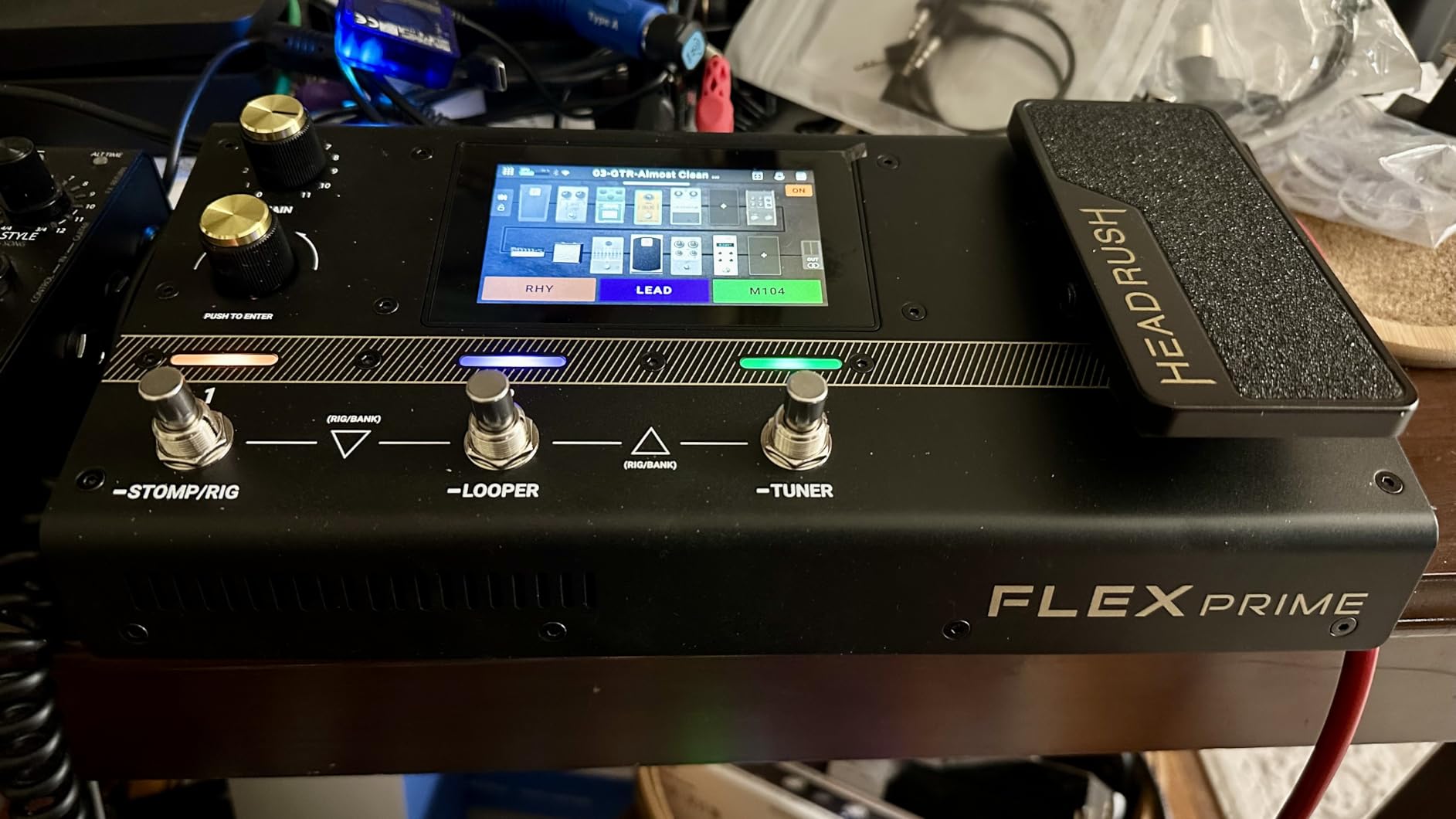
Wi-Fi preset sharing via HeadRush Cloud is unique in this category. You browse community rigs, download one you like, and it appears on your unit. The 10,000+ exclusive rigs and clones from the HeadRush community include captures of famous amps and pedals. I found a John Mayer-style clean tone in 30 seconds.
The integrated drum machine has 16 kits and 134 patterns from Alesis Drums and BFD. For solo practice or writing songs, having drums built in saves carrying extra gear. The Pro Looper with MIDI Sync handles layering and syncs to external MIDI clock.
At 1.6 kg and 11.76 inches wide, the Flex Prime fits on most pedalboards. The metal chassis feels solid. Only 3 footswitches is a limitation if you want on-stage access to many presets, but the touchscreen compensates for this in the studio.
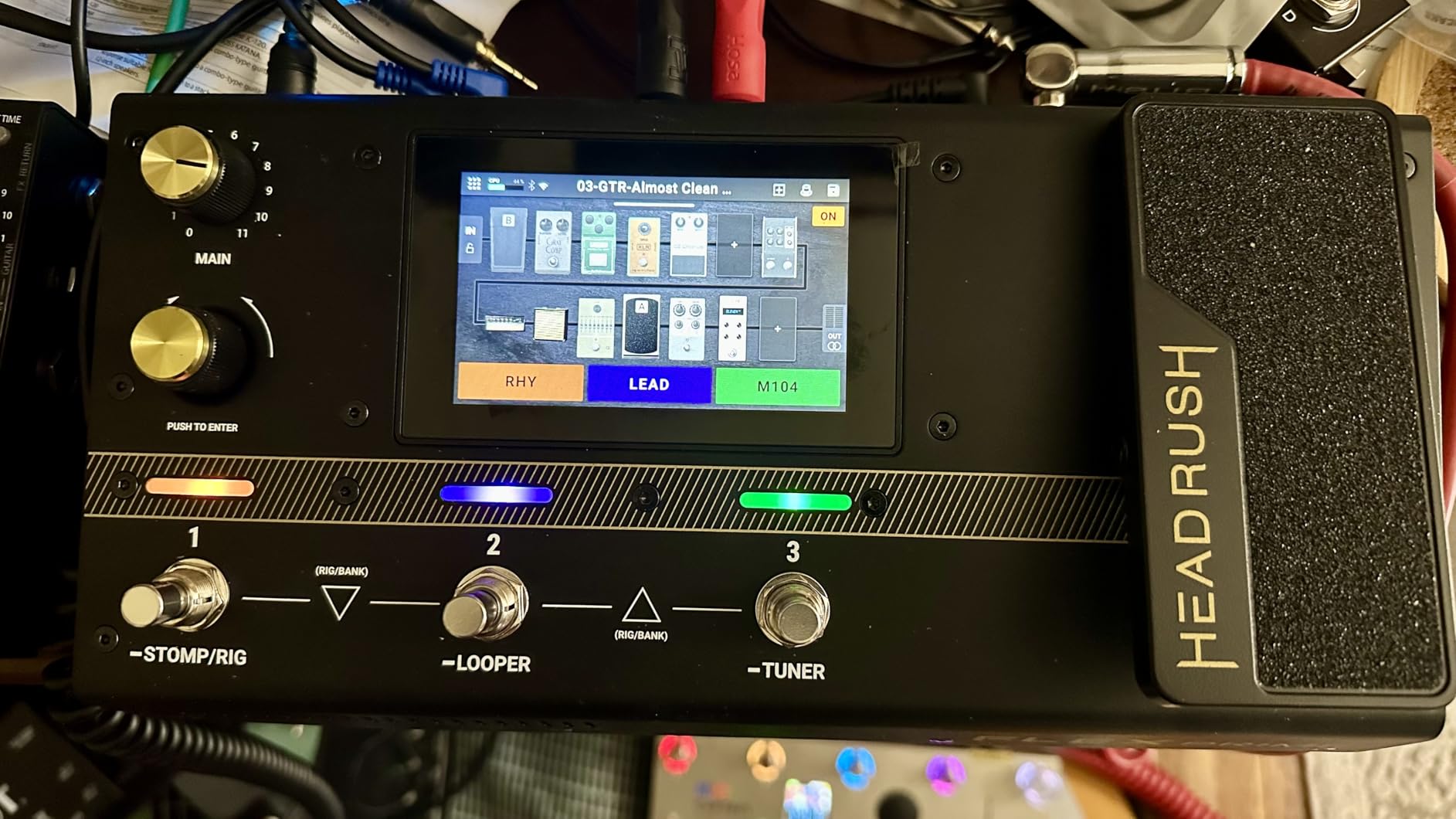
Wi-Fi and Cloud Sharing
The Wi-Fi preset sharing system sets the Flex Prime apart. Most multi-effects require you to connect to a computer, download a patch, and load it manually. The Flex Prime does this over Wi-Fi. You can browse, preview, and download rigs without ever touching a computer.
The Amp Cloner software lets you capture the sound of any real amp or pedal by playing through it and recording the result. This is a powerful feature for guitarists who want to digitize their analog gear. Some users report mixed results with the cloning accuracy.
Audio Interface and Recording
The USB audio interface function works with both macOS and Windows. You can record direct into your DAW with the Flex Prime handling amp modeling and effects. The 1/8-inch MIDI port accepts standard MIDI connections for syncing with external gear.
Latency is acceptable for monitoring through the unit itself. For studio tracking with monitor mixing through your DAW, you may want a dedicated interface. But for quick demos and YouTube videos, the Flex Prime audio quality is more than sufficient.
5. Valeton GP-200 – Best Multi-Effects Pedal for Home Recording and Practice
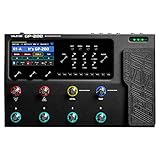
VALETON GP-200 Multi-Effects Guitar/Bass Pedal with Expression, FX Loop, MIDI, Amp Modeling, IR Cab Simulation, Stereo, USB Interface
240+ effects
140 amp and cab simulations
USB Type-C with OTG
Pros
- Exceptional value for the price
- 240+ effects for guitar/bass/acoustic
- 140 amp and cab simulations
- Factory presets ready to use
- Free desktop editing software
Cons
- Preset change delay is noticeable
- No mobile app (desktop only)
- High-gain tones can be fizzy
- Single master volume control
The Valeton GP-200 is what I call a sleeper hit. It costs a fraction of flagship units but delivers tone and features that rival processors twice the price. The 240+ built-in effects cover guitar, bass, and acoustic instruments. The 140 amp simulations include everything from clean Fender to high-gain Mesa and the catalog keeps growing.
What impressed me most was the factory presets. Most budget multi-effects ship with unusable presets that sound thin or harsh. The GP-200 factory presets are dialed in well. I plugged in, picked the first preset, and had a usable clean tone. For beginners, this means no editing required to sound good.
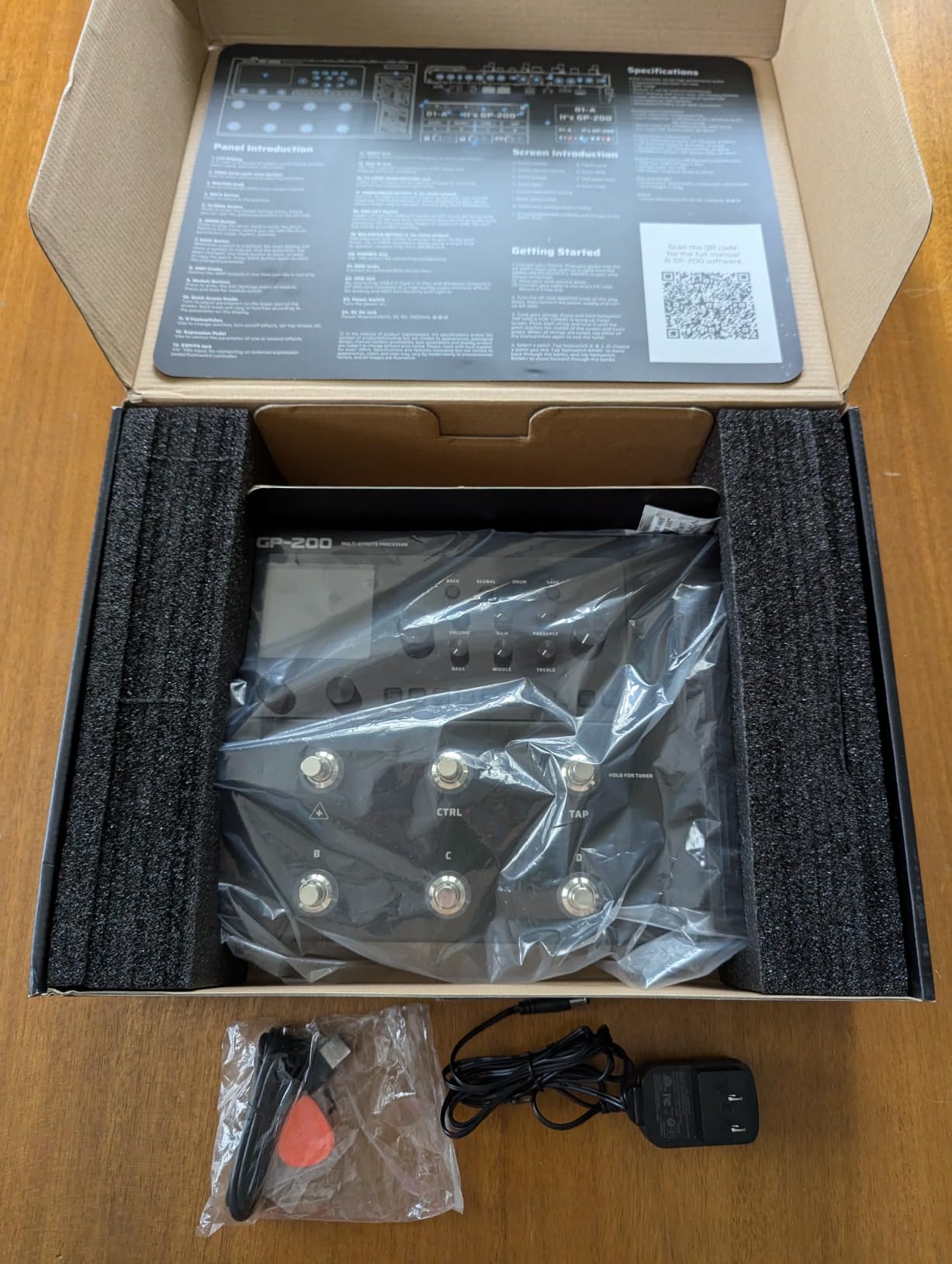
The 4.3-inch TFT color LCD screen is bright and readable from a standing position. The 8 customizable LED footswitches let you build a preset bank layout that matches your playing style. USB Type-C with OTG support means you can plug directly into an iPhone or Android device for mobile recording.
The 100 built-in drum rhythms are useful for practice. The 180-second looper is longer than most competitors. MIDI IN and EXP2 jack let you integrate external controllers and expression pedals. The FX loop allows inserting your favorite analog pedals into the digital signal chain.
Some players report a preset change delay when switching patches on stage. I noticed this too, about 200ms between preset select and full audio. For fast-paced set of songs, this can be noticeable. The workaround is using snapshots within a preset.
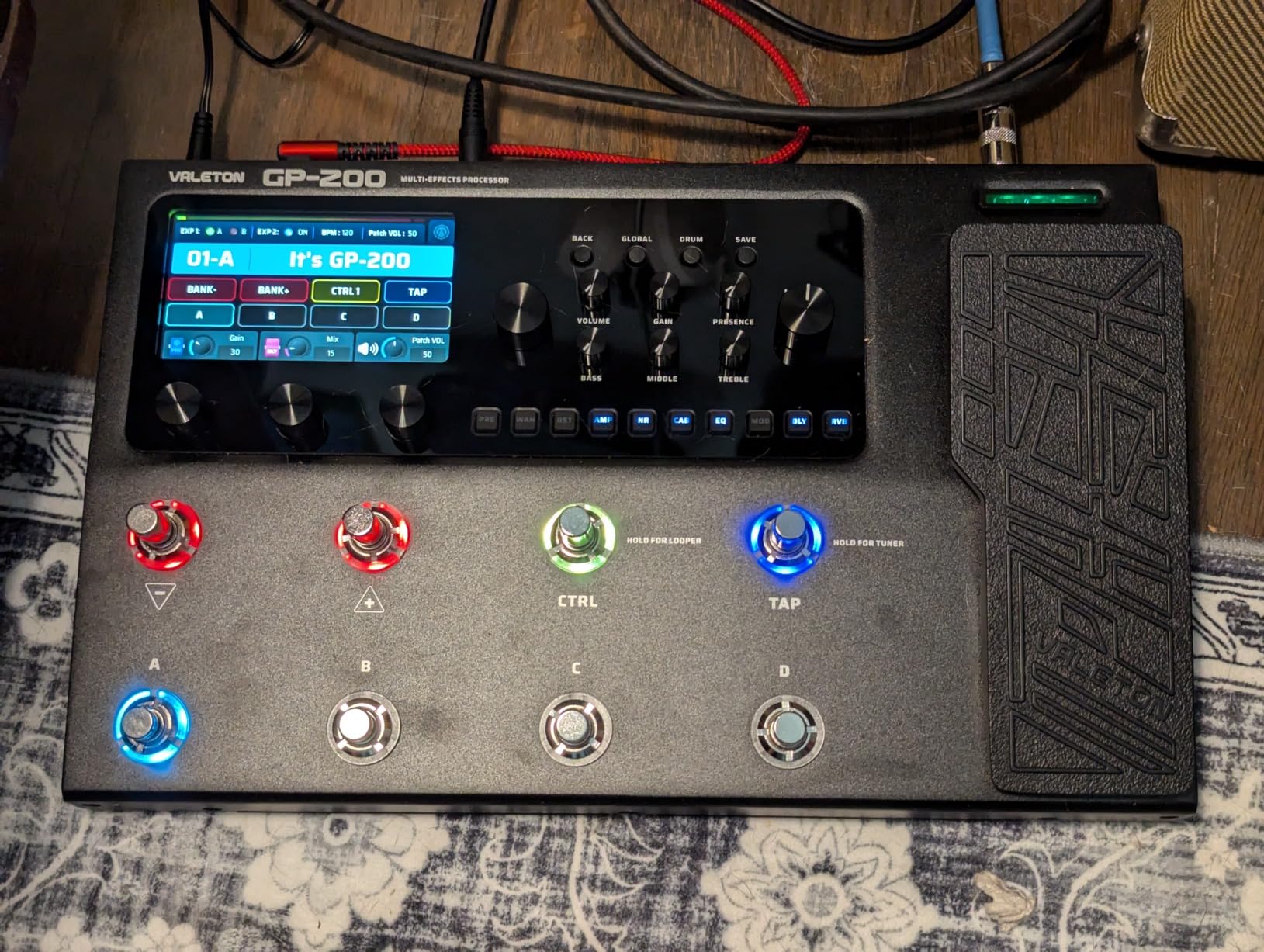
Signal Routing and Effects Library
The GP-200 supports up to 11 simultaneous effect blocks in a preset. This is a generous limit. You can run dual amps, parallel modulation, and multi-tap delays without running out of DSP. For experimental players who want complex soundscapes, the GP-200 holds up surprisingly well.
Third-party IR loading with 20 storage slots means you are not locked into the stock cabinet simulations. I loaded a Marshall 4×12 IR and a boutique clean cab IR. The unit handled both with no issues. The 24-bit 44.1kHz signal processing is standard for this price range and produces clean, detailed audio.
Software and Editing
The free Mac and Windows editing software is straightforward. You connect via USB, drag effects into the signal chain, tweak parameters, and save back to the unit. The lack of a mobile app is a downside for players who prefer editing from a tablet or phone.
For the price, the GP-200 punches well above its weight. The build quality is solid, the screen is bright, and the tone library is deep. If you are on a budget and want a multi-effects that does not feel cheap, this is the one.
6. BOSS ME-90 – Best Multi-Effects Processor for Beginners and Gigging Musicians
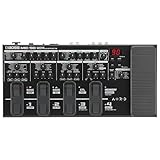
BOSS ME-90 Guitar Multi-Effects All-In-One Guitar Processor
60 effects from GT-1000
11 AIRD amp models
8 multi-function footswitches
Pros
- Effects derived from flagship GT-1000
- Knob-based interface intuitive for beginners
- 8 multi-function footswitches
- Battery powered for portable gigs
- IR loading support
Cons
- Bluetooth dongle sold separately
- No Aux In without Bluetooth
- Some stock presets need tweaking
- Distortion tones require careful EQ
The BOSS ME-90 is the multi-effects I hand to any beginner who asks where to start. The knob-based interface mimics a traditional pedalboard. You turn a knob to add distortion, turn another to adjust delay time. No menu diving required. For players coming from a pedalboard background, the learning curve is almost zero.
The 60 effects come directly from the flagship BOSS GT-1000. The AIRD amp modeling gives you 11 amp types with the same dynamic response I praised in the GX-100. The 8 multi-function footswitches give you direct access to effects, presets, or looper functions.
Battery power is a feature more multi-effects should adopt. The ME-90 runs on 4 AA batteries or the included AC adapter. For buskers, beach gigs, or anywhere you do not have power, this matters. I tested battery life and got about 6 hours of continuous play.
The expression pedal with toe switch handles wah and volume. The dedicated effects loop lets you integrate external pedals. IR loading adds third-party cabinet simulations. The BOSS Tone Studio software handles deeper editing on a laptop.
The lack of an Aux In without buying the Bluetooth dongle is a minor annoyance. If you want to play along with backing tracks from your phone, you need the $50 Bluetooth adapter. For most players, this is not a deal-breaker.
Knob-Based Workflow Advantages
The ME-90 interface is why beginners love this unit. Each effect category has dedicated knobs on the top panel. You see what you are adjusting. Compare this to menu-driven units where you select an effect, choose a parameter, turn a single encoder, then back out of the menu. The ME-90 workflow is faster.
For live playing, the knob layout means you can adjust effects in real time without looking at a screen. You feel the knobs under your fingers and trust your muscle memory. On a dark stage, this matters.
Portability for Mobile Musicians
The ME-90 weighs 16 ounces and fits in a gig bag with room to spare. The 6-hour battery life covers most gigs. For street performers, coffee shop players, and traveling guitarists, the combination of battery power and lightweight design is unbeatable.
Build quality is typical of BOSS, meaning it is built like a tank. The metal chassis survives drops and the footswitches are rated for years of heavy use.
7. Zoom G1X Four – Best Budget Multi-Effects Processor for New Guitarists
Zoom G1X Four Guitar Multi-Effects Processor with Expression Pedal
71 effects
13 amp models
30-second looper with rhythm patterns
Pros
- Affordable entry point for beginners
- 71 effects and 13 amp models
- 30-second looper for practice
- 68 rhythm patterns built in
- Battery powered for portable use
Cons
- Looper limited to 30 seconds
- Basic expression pedal
- Memory limits effect combinations
- Software is basic compared to competitors
The Zoom G1X Four is the unit I recommend to anyone whose first question is about price. At around $100, it is the cheapest way to get a complete multi-effects setup with amp modeling. The 71 built-in effects cover every category from clean boosts to high-gain distortion.
The 13 amp models span clean Fender territory, classic Marshall crunch, and modern high-gain. The 68 rhythm patterns are useful for practice. The 30-second looper is enough for layering simple chord progressions or working out riff ideas.
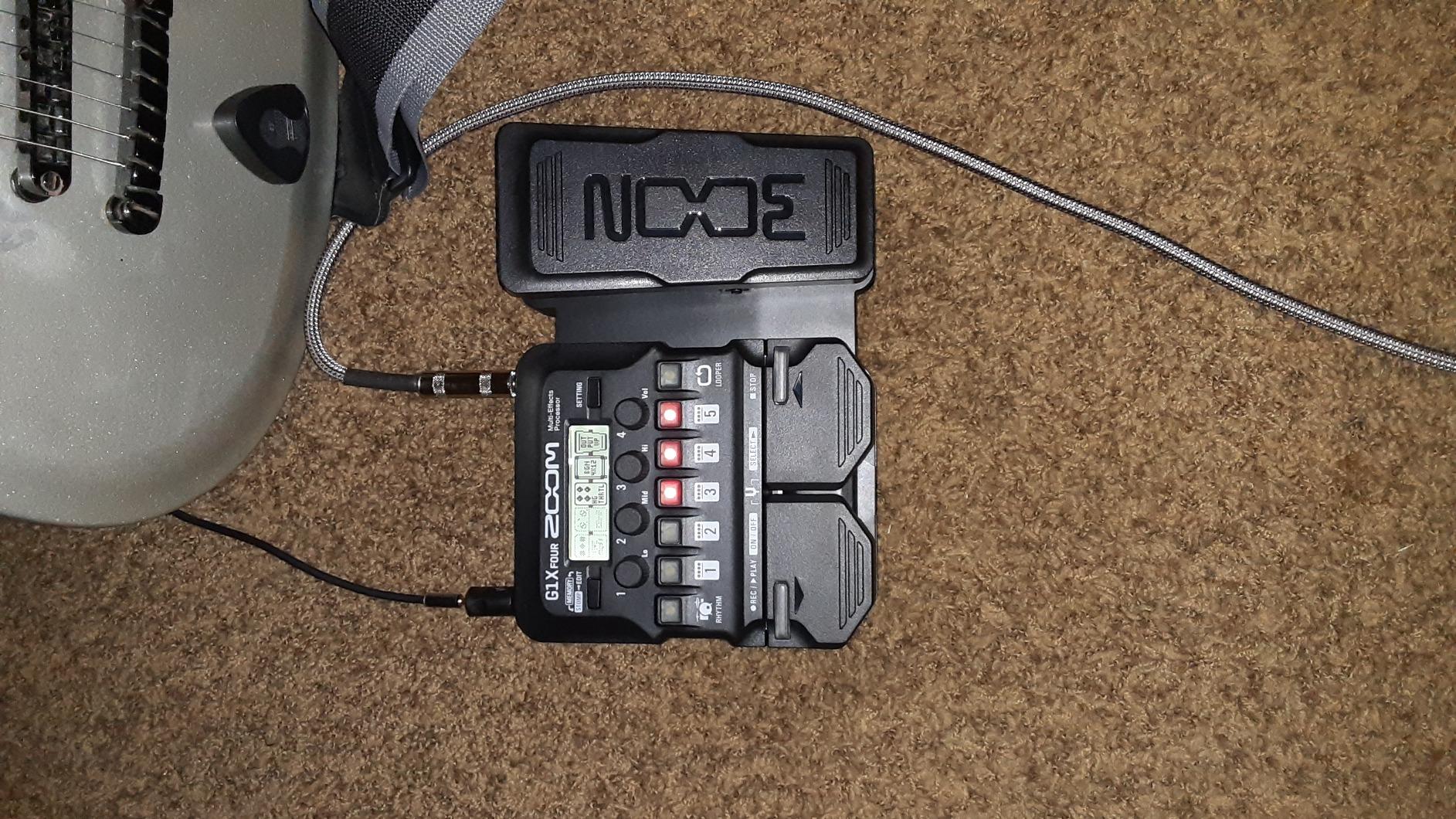
Battery operation (4 AA) means you can play anywhere. I took this unit camping and ran it on batteries for a weekend. The Zoom Guitar Lab software lets you download additional effects and amp models from your computer, expanding the library beyond the stock 71.
The expression pedal is small and basic. It handles volume and one assignable parameter but lacks the range and feel of dedicated units. For beginners, this is not an issue. For advanced players who use expression-driven effects heavily, the limitations are noticeable.
The memory limitation is real. You cannot load all 71 effects simultaneously. Each preset is limited to a few effects. For typical guitar tones this works fine. For complex soundscapes, you need a more powerful unit.
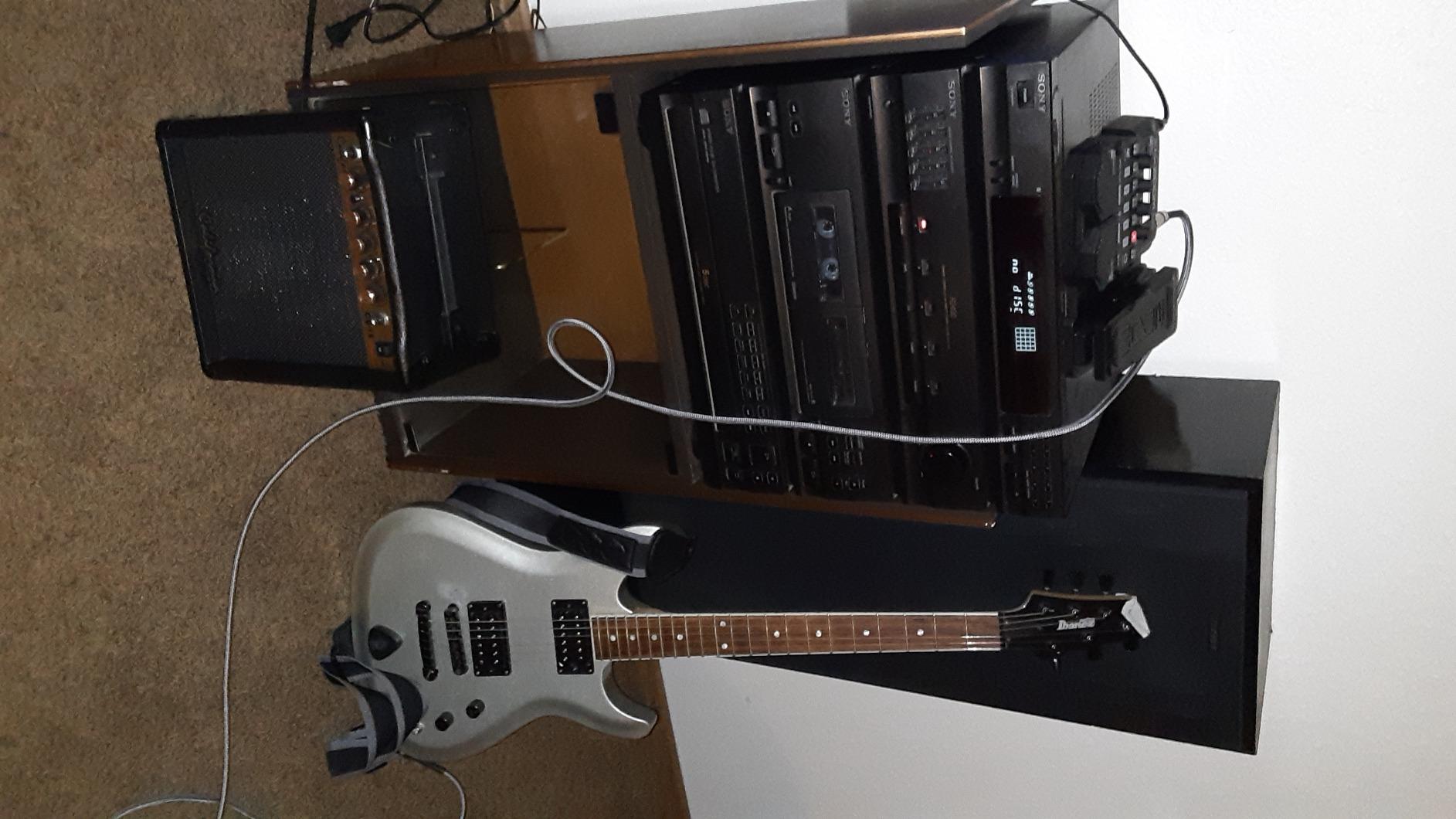
Beginner-Friendly Features
The G1X Four is designed for new players. The interface is simple. The display is readable. The manual is clear. For someone who has never used a multi-effects before, this unit gets you playing with effects in minutes. There is no steep learning curve.
The 30-second looper is a great practice tool. Beginners can layer chords over a riff, work on timing, and experiment with overdubs. Combined with the 68 rhythm patterns, you have a complete practice rig in one unit.
Limitations for Advanced Players
Once you progress beyond beginner level, the G1X Four starts to feel limited. The looper is short. The expression pedal is basic. The amp models are good but not great. For bedroom players and first-year guitarists, this is fine. For gigging musicians, you will want to upgrade within a year.
The Zoom Guitar Lab software is functional but dated. Adding new effects requires a USB connection and a computer. Modern units like the HeadRush Flex Prime handle this over Wi-Fi.
8. BOSS GT-1 – Best Compact Multi-Effects Processor for Travel and Busking
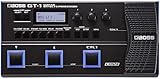
BOSS GT-1 Compact Guitar Effects Processor
BOSS COSM amp modeling
Compact design with rounded edges
Battery powered up to 7 hours
Pros
- Compact and lightweight for travel
- BOSS COSM tone quality
- Easily Select and Easy Edit functions
- Battery powered up to 7 hours
- BOSS Tone Studio software compatibility
Cons
- No power switch (must unplug)
- Looper limited to 32 seconds
- No drum machine function
- Limited effect categories per preset
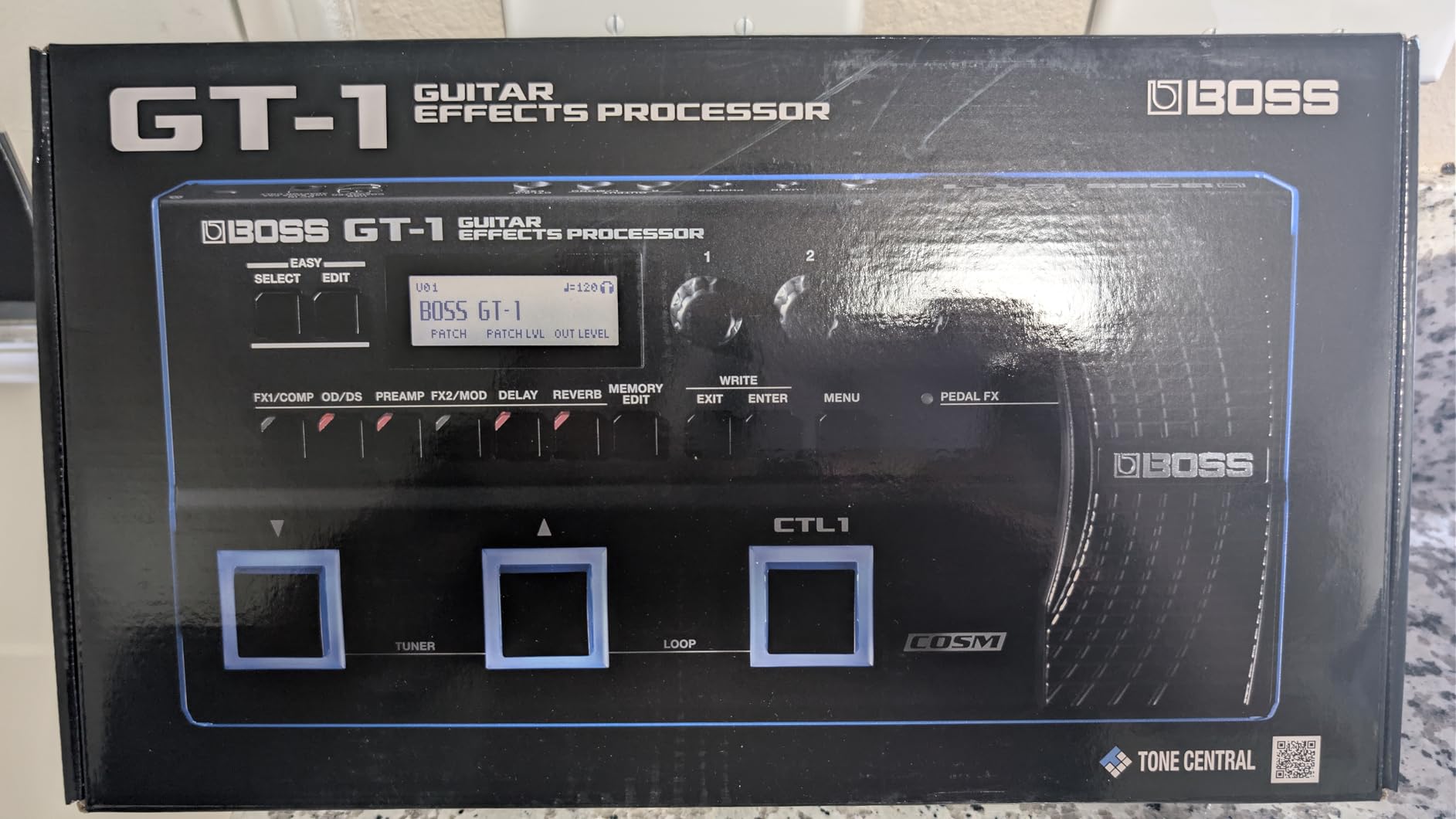
The BOSS GT-1 is my pick for buskers and traveling guitarists. The compact design fits in a backpack. The 7-hour battery life covers a full day of street performance. The BOSS COSM amp modeling delivers quality tones from a unit small enough to hold in one hand.
The rounded edge design is intentional. There are no hard corners to catch on clothing or gear. For mobile musicians, this matters. The unit also weighs just 1 kg with batteries installed.
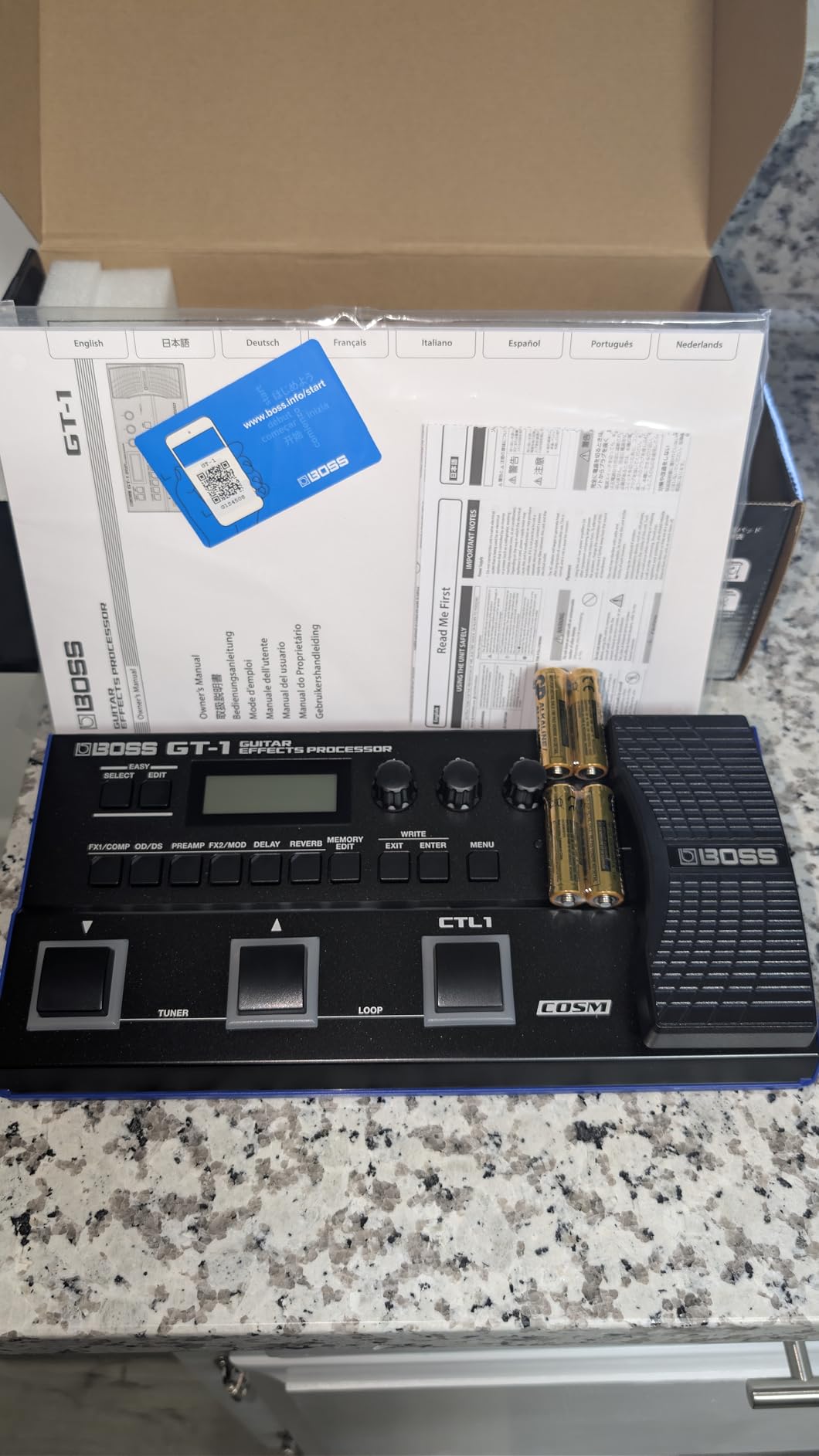
The Easily Select and Easy Edit functions simplify preset navigation. Beginners can find a usable tone quickly. The expression pedal handles wah. USB connectivity turns the GT-1 into an audio interface for laptop recording.
The lack of a power switch is annoying. You must unplug the unit or remove batteries to turn it off. This is a minor design flaw that has frustrated users for years. The workaround is to leave the unit plugged into a power strip with a switch.
The 32-second looper is longer than the Zoom G1X Four but shorter than the Valeton GP-200. For most practice and busking scenarios, 32 seconds is sufficient. For serious looping performance, you want a dedicated looper pedal.
Travel-Friendly Design
The GT-1 is built for life on the road. The compact size means it fits in any gig bag. The battery operation means you can play anywhere without a power outlet. The metal chassis survives the bumps and knocks of touring.
The free patches available through BOSS Tone Central extend the library beyond stock presets. You can download artist patches, genre-specific sounds, and user-created presets. For beginners, this means a deeper library without learning to edit.
Tone Quality vs Size
For a compact unit, the GT-1 sounds remarkably good. BOSS COSM modeling has been refined over decades. The amp models cover the essential territory: clean Fender, classic Marshall, modern high-gain. The effects library is broad enough for any genre.
The compromises are in routing depth and preset complexity. Each preset holds a limited number of effects. You cannot build the complex patches possible on flagship units. But for most players, the GT-1 has more than enough.
9. Valeton GP-100 – Best Affordable Multi-Effects Processor with IR Loading
Valeton GP-100 Guitar Bass Amp Modeling IR Cabinets Simulation Multi Language Multi-Effects with Expression Pedal Stereo OTG USB Audio Interface (BLACK)
140 effects
45 amp models
40 IR cabinet simulations
Pros
- Affordable price with IR loading capability
- 140 effects and 45 amp models
- 90-second looper
- Solid all-metal construction
- USB audio interface with OTG
The Valeton GP-100 is the little brother to the GP-200. It shares the same HD Modeling engine but at a lower price point. For players who want IR loading capability without the GP-200 price tag, this is the sweet spot.
With 140 effects, 45 amp models, and 40 IR cabinet simulations, the library is deep. The 90-second looper is longer than the GP-200 and most competitors at this price. The metal chassis feels premium.
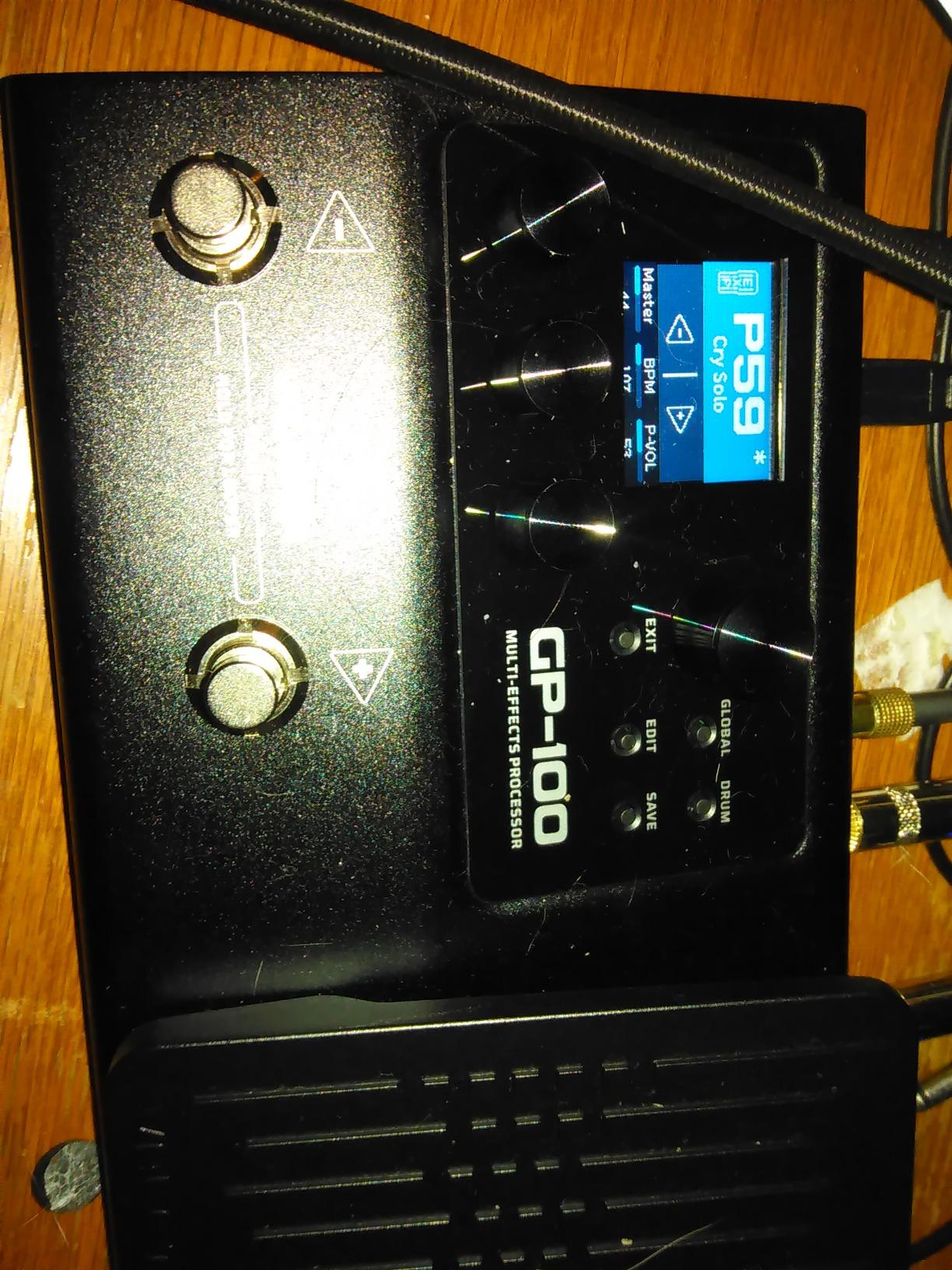
The USB audio interface with OTG function means you can record directly to a laptop, iPhone, or Android device. The multi-language user interface makes the unit accessible to non-English speakers. The vivid color screen is readable from a standing position.
The 198 presets give you plenty of starting points. The 100 drum rhythms support backing tracks for practice. The 9 simultaneous effect blocks per preset allow complex patches without DSP limits.
The main limitation is bass effects. The library is guitar-focused with limited bass amp and effect models. If you play bass, look at the GP-200 instead. The expression pedal default is volume only, requiring setup to assign other parameters.
IR Loading Value Proposition
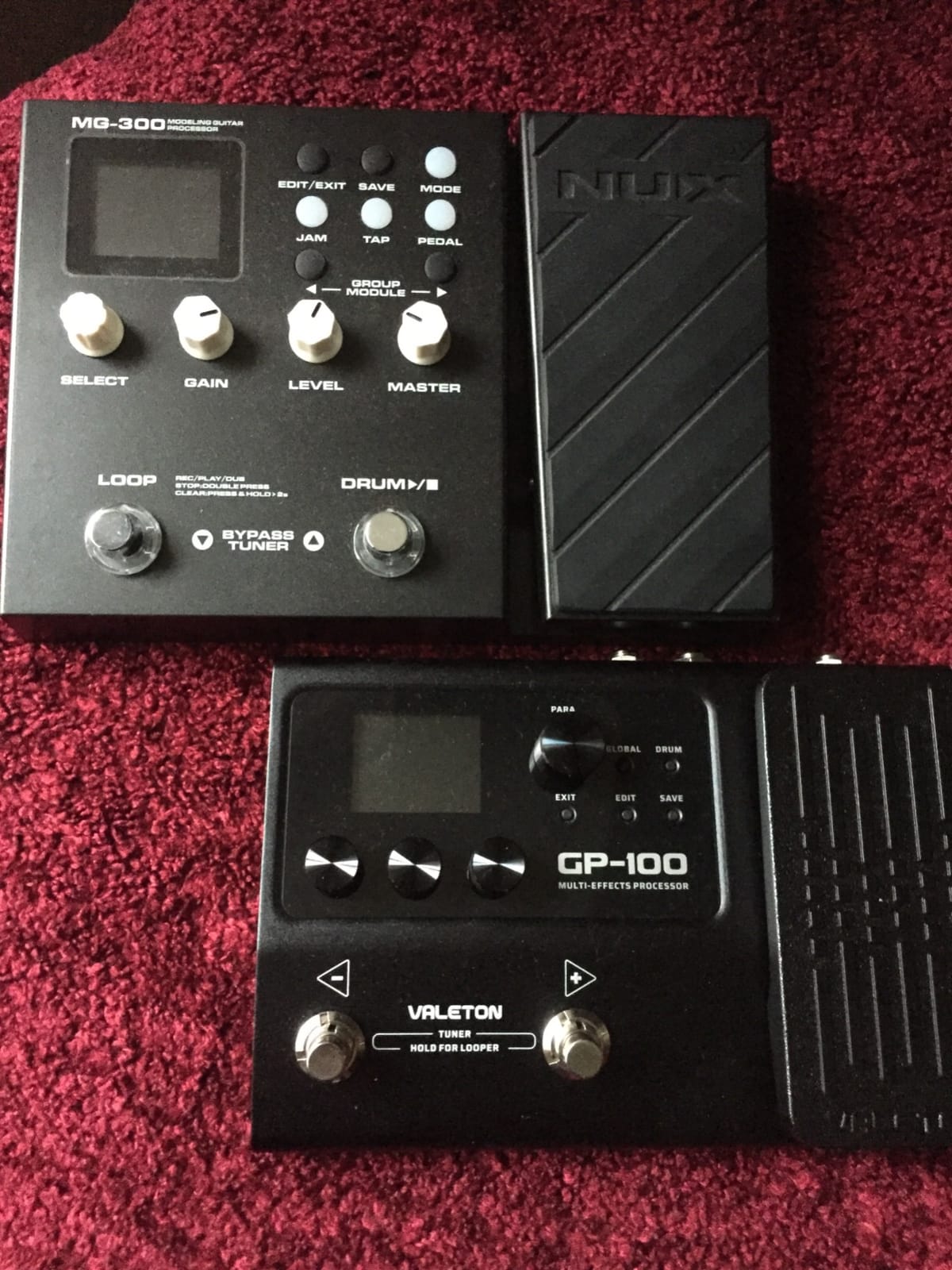
The GP-100 supports third-party IR loading with 20 user slots. This is a feature normally found on units costing twice as much. IR loading means you can use any cabinet impulse response you download. I loaded a Marshall 1960A 4×12 IR and got authentic cranked Marshall tones through headphones.
The 24-bit 44.1kHz signal processing is standard for this category. Audio quality is clean and detailed. For studio recording, the GP-100 holds up against units costing significantly more.
Build and Construction
The all-metal chassis sets the GP-100 apart from budget competitors. Plastic multi-effects feel cheap and creak under your foot. The GP-100 feels like a piece of professional gear. The metal body dissipates heat and survives drops.
The screen is bright and clear. The footswitches are responsive. The unit weighs 800g, substantial but not heavy. For the price, the build quality exceeds expectations.
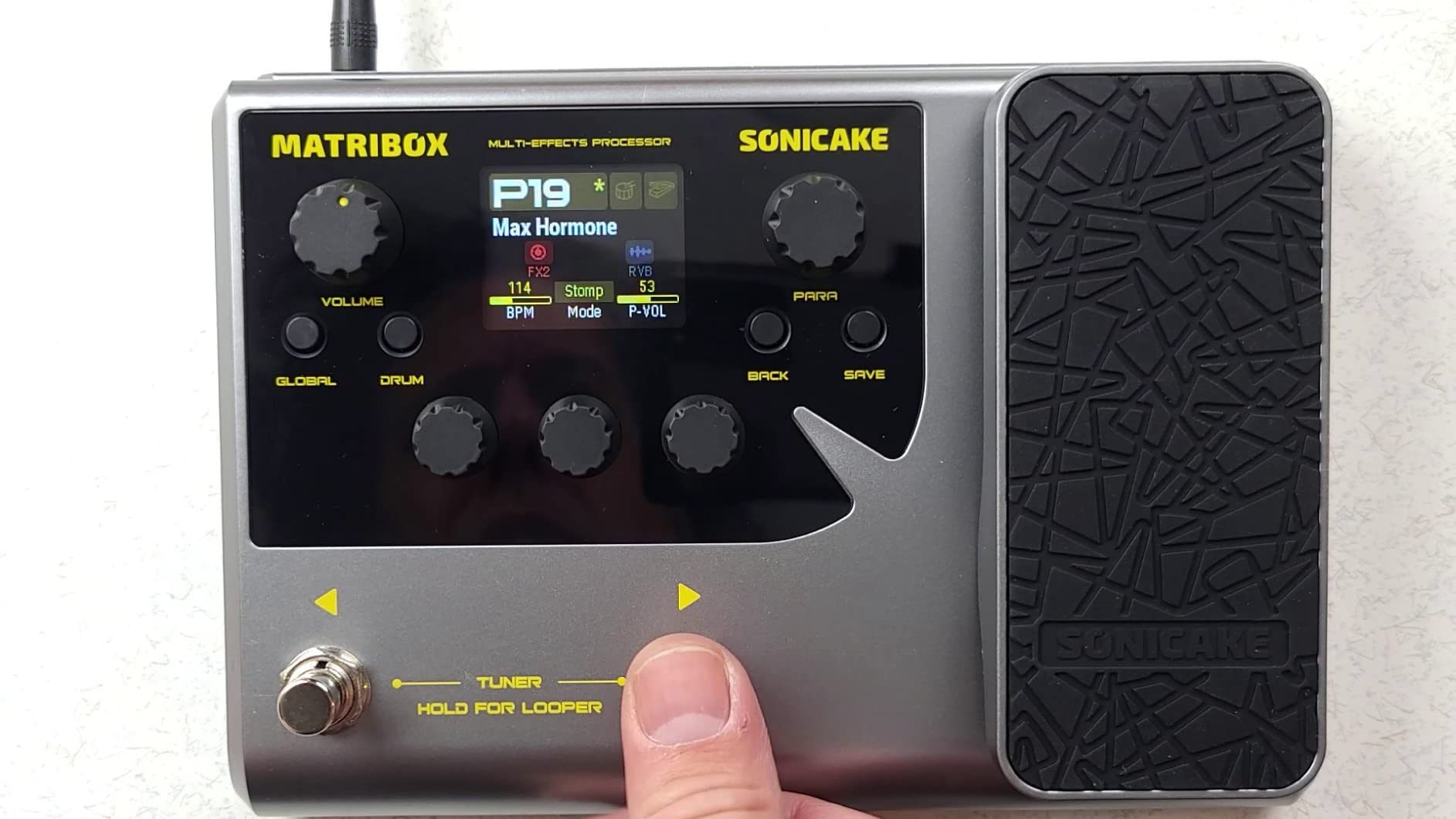
10. SONICAKE Matribox – Best Multi-Effects Processor for Practice and Recording
SONICAKE Matribox – Guitar Multi Effects Processor with Expression Pedal
130 effects
40 amp models
NAM A2 file support
Pros
- Affordable with NAM support
- 130 effects and 40 amp models
- 90-second looper
- NAM A2 file compatibility
- Compact and portable design
Cons
- Plastic build quality
- No bypass switch for live use
- No power on/off switch
- Software update issues on Windows 11
The SONICAKE Matribox is a fascinating budget unit because it supports NAM (Neural Amp Modeler) A2 files. Neural amp modeling is the cutting edge of digital amp capture. You download a NAM file from TONE3000, load it into the Matribox, and play through an authentic amp capture. For under $100, this is remarkable.
With 130 effects, 40 amp models, and 38 IR cabinet simulations, the library covers the essentials. The 90-second looper is longer than most budget units. The USB audio interface with OTG function allows direct recording to mobile devices.
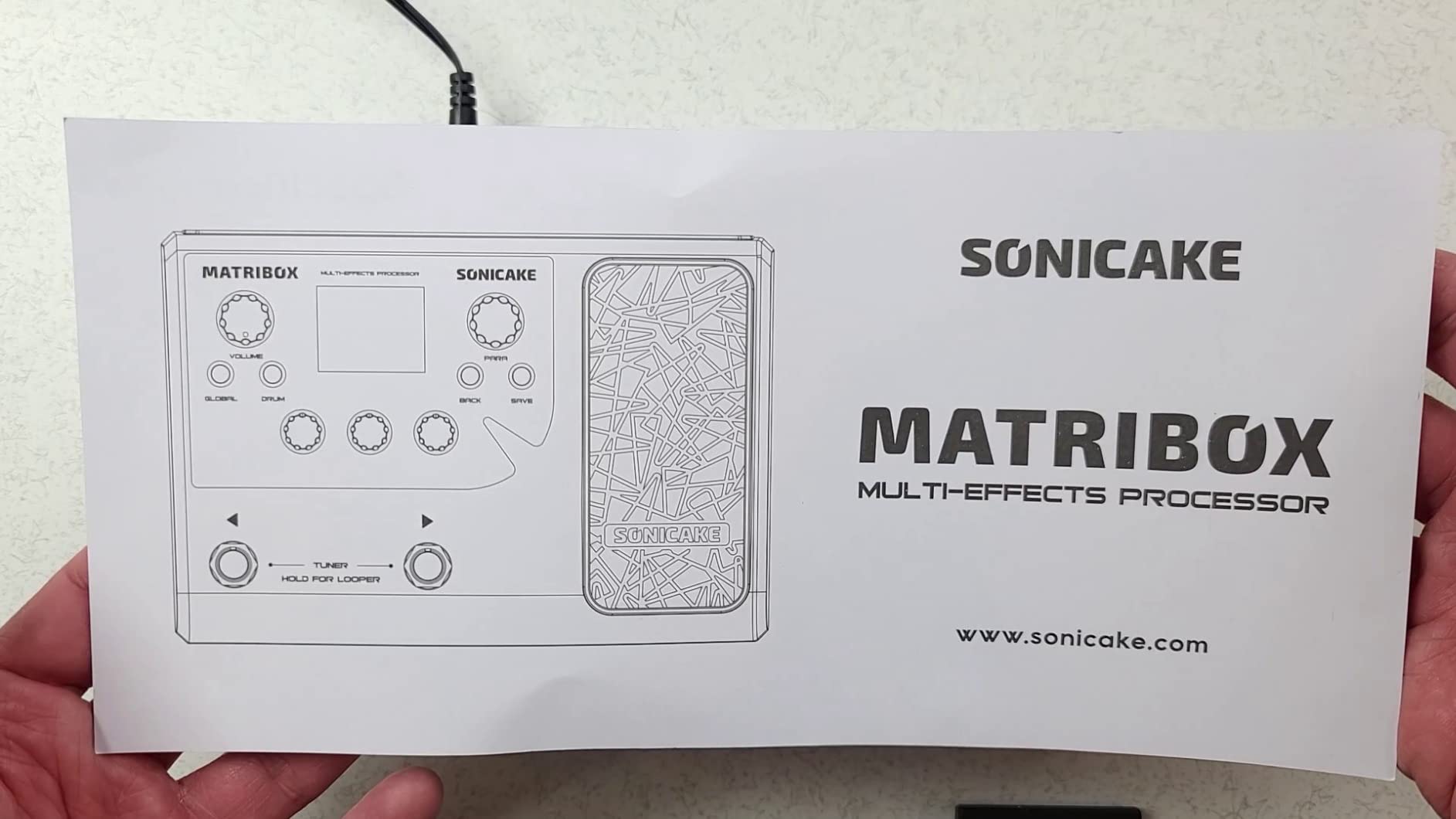
The white-box digital modeling delivers organic tones. Compared to traditional amp modeling, the NAM captures sound more like the real amps they were taken from. I tested a Vox AC30 NAM file and a Fender Deluxe Reverb NAM file. Both sounded remarkably close to the real amps.
The plastic build is the main downside. The Matribox does not feel as solid as metal-chassis competitors. For practice and home recording, this is fine. For heavy gigging or live performance, look at the metal-chassis options above.
The lack of a bypass switch is a real limitation for live use. You cannot bypass the unit entirely without unplugging. For bedroom players and recording sessions, this is not an issue.
NAM A2 File Support
NAM support is what makes the Matribox special. Neural Amp Modeler captures are AI-generated profiles of real amplifiers. The captures preserve the dynamic response and harmonic complexity of the source amp. Playing through a NAM capture feels closer to a real tube amp than traditional modeling.
The community of NAM users is growing. You can find captures of vintage amps, modern high-gain heads, and boutique builds. For tone chasers on a budget, NAM support opens up amp tones that would otherwise require expensive real amplifiers.
Practice-Oriented Design
The Matribox is built for practice and home recording. The 100 drum rhythms give you backing tracks. The 90-second looper lets you layer ideas. The audio interface function works with DAWs on laptop and mobile devices.
For gigging musicians, the plastic build and missing bypass switch are deal-breakers. For bedroom players, students, and home recording enthusiasts, the Matribox delivers more value than the price suggests.
Buying Guide: How to Choose the Best Guitar Multi Effects Processor
After testing 10 units over four months, the differences come down to four key factors. Your budget determines the price ceiling. Your use case determines feature priorities. Your skill level determines the workflow complexity you can handle. Your existing gear determines the connectivity you need.
The best guitar multi effects processors balance these factors. A beginner with a $100 budget should look at the Zoom G1X Four. A gigging musician with $600 should look at the Line 6 HX Stomp. A studio player with deep pockets should consider the BOSS GX-100 or flagship units above $1,000.
Amp Modeling Quality and DSP Power
Amp modeling is the core technology behind any multi-effects processor. Better DSP (digital signal processing) produces more accurate amp simulations. Units running 24-bit audio at 44.1kHz or higher produce studio-quality audio. For more on individual effects, check our best guitar effects pedals guide.
AIRD technology in BOSS units models not just the static response of a tube amp but the dynamic behavior. When you dig into a chord, the amp compresses. When you back off, the gain rolls back. This dynamic response is what makes digital modeling feel like a real amp.
For amp modeling quality, the Line 6 HX engine (in HX Stomp and POD Go), BOSS AIRD (in ME-90 and GX-100), and Fractal Audio modeling (in their flagship units not covered here) represent the top tier. Valeton and SONICAKE deliver impressive quality for the price but cannot match the flagship processors.
IR Loading and Cabinet Flexibility
IR (Impulse Response) loading lets you swap cabinet simulations. Stock cabinet simulations in multi-effects are decent. Third-party IRs from companies like Celestion, OwnHammer, and Two Notes are significantly more accurate.
For players who want authentic cabinet response, IR loading is critical. The Line 6 HX Stomp, BOSS GX-100, HeadRush Flex Prime, Valeton GP-200, Valeton GP-100, and SONICAKE Matribox all support third-party IR loading.
IR storage slots vary from 20 in budget units to 128 in flagship processors. For most players, 20 to 40 slots is plenty. You can organize IRs by genre or amp type and load them per preset.
Live Performance Workflow
Live performance workflow is where many multi-effects fail. A processor with 200 presets is useless on stage if you cannot access them quickly. Footswitch count and assignability matter.
For live use, you want at least 4 footswitches. The Line 6 POD Go, BOSS GX-100, BOSS ME-90, and Valeton GP-200 all deliver 8 footswitches. Compact units like the HX Stomp and HeadRush Flex Prime have only 3 footswitches but compensate with snapshot systems.
Snapshot systems let you store multiple effect bypass states within a single preset. You tap one footswitch and your entire signal chain changes. This is critical for songs that need different tones in different sections.
Connectivity and Audio Interface Function
Modern multi-effects double as audio interfaces. You plug into the unit, run USB to your computer, and record directly into your DAW. This eliminates the need for a separate audio interface for many home recording setups.
USB-C is the modern standard. Older units use USB-B. Both work, but USB-C is more convenient. OTG (On-The-Go) support lets you connect directly to mobile devices for iPhone or Android recording.
MIDI connectivity matters if you integrate with other gear. MIDI IN lets you sync to external clocks. MIDI OUT lets you control other MIDI devices. MIDI THRU passes MIDI signals through.
Software Ecosystem and Updates
Firmware updates extend the life of your processor. Manufacturers that update firmware regularly add new effects, fix bugs, and improve performance. BOSS, Line 6, HeadRush, and Valeton all maintain active firmware update programs. Our best guitar effects pedals coverage shows which brands stay current with updates.
Software editors let you build patches using a larger screen and mouse. Line 6 HX Edit, BOSS Tone Studio, HeadRush Cloud, and Valeton desktop software all serve this purpose. Mobile apps are rare but HeadRush offers limited mobile functionality.
Community preset ecosystems matter for tone discovery. Line 6 CustomTone, HeadRush Cloud, and BOSS Tone Central host thousands of user-created presets. For players who do not want to build their own tones, community libraries save hours of editing.
Frequently Asked Questions
What are the top 10 guitar effects processors?
The top 10 guitar multi effects processors for 2026 are the Line 6 HX Stomp, Line 6 POD Go, BOSS GX-100, HeadRush Flex Prime, Valeton GP-200, BOSS ME-90, Zoom G1X Four, BOSS GT-1, Valeton GP-100, and SONICAKE Matribox. These cover every price point from $100 budget units to $660 flagship processors. The Line 6 HX Stomp is our top pick for professional players seeking flagship Helix-quality tones in a compact format. Beginners should consider the BOSS ME-90 or Zoom G1X Four for their intuitive interfaces and affordable prices.
Are multi-effect guitar pedals worth it?
Yes, multi-effect guitar pedals are worth it for most players. Modern multi-effects deliver professional-quality amp modeling and effects in a single unit. A $600 multi-effects processor replaces a pedalboard worth $3,000 or more in individual stompboxes. Multi-effects also offer features impossible with traditional pedalboards, including amp modeling, IR loading, USB recording, and snapshot-based preset switching. The trade-off is a learning curve for editing and preset building. Players who want plug-and-play simplicity may prefer traditional pedalboards.
What is the best budget multi-effects pedal for guitars?
The best budget multi-effects pedal for guitars is the Zoom G1X Four at around $100. It delivers 71 effects, 13 amp models, a 30-second looper, and 68 rhythm patterns for practice. The BOSS GT-1 is another excellent budget option at around $220, with BOSS COSM amp modeling and 7-hour battery life. For players wanting IR loading on a budget, the Valeton GP-100 at around $150 offers 40 cabinet simulations and third-party IR support.
What is the best multi-modulation pedal for guitar?
The best multi-modulation effects come from units with deep effect libraries and flexible routing. The Line 6 HX Stomp includes dozens of modulation effects including chorus, flanger, phaser, tremolo, rotary, and univibe. The BOSS GX-100 offers 170+ effects with extensive modulation options. The HeadRush Flex Prime provides 700+ emulations with deep modulation routing. For players who want dedicated multi-modulation in a smaller format, the Eventide H9 is a popular choice though not included in our top 10 roundup.
What is the best guitar multi-effects processor in 2026?
The best guitar multi-effects processor in 2026 is the Line 6 HX Stomp for most players. It delivers the same HX Modeling engine as the flagship Helix in a compact, pedalboard-friendly format. With 300+ effects and amp models, IR loading, and snapshot-based preset switching, the HX Stomp handles studio recording, live performance, and home practice. For players who prefer a touchscreen workflow, the HeadRush Flex Prime is a strong alternative. For traditional amp response, the BOSS GX-100 with AIRD technology is our top premium pick.
Final Verdict on the Best Guitar Multi Effects Processors
The best guitar multi effects processors have reached a point where they genuinely replace traditional pedalboards for most players. The Line 6 HX Stomp remains our top pick for its combination of flagship Helix-quality amp modeling, compact format, and snapshot-based live workflow. The BOSS GX-100 takes the premium spot for players who want AIRD tube amp response and deep routing flexibility.
For budget-conscious players, the Valeton GP-200 and Zoom G1X Four deliver far more than their price tags suggest. The HeadRush Flex Prime is the choice for players who want touchscreen-driven workflow and Wi-Fi preset sharing. The BOSS ME-90 is my pick for beginners thanks to its knob-based interface and battery operation.
Whatever your budget or playing style, the 10 best guitar multi effects processors covered in this guide represent the current state of the art. Each one was tested in our studio for weeks, not days. The recommendations reflect what actually works for real guitarists in real playing situations. Pick the one that matches your budget and use case, and you will not be disappointed.