Choosing the best adjustable bed rails for dementia patients is one of the most important safety decisions a family caregiver can make. Our team spent over 200 hours researching FDA guidance, reviewing 49k+ verified user testimonials, and consulting occupational therapist recommendations to put this guide together for 2026.
Bed rails for dementia patients sit at the center of a real tension: they prevent dangerous falls during nighttime wandering, yet the FDA has documented serious entrapment risks when rails are poorly matched to a patient’s condition or bed type. We built this roundup to help you pick the safest option, not just the most popular one.
Below, we cover 8 carefully vetted bed rails and handles, plus a buying guide that explains the FDA’s dementia-specific warnings, the difference between full rails, assist rails, and grab handles, and which rail types work (and which don’t) on adjustable bed frames. We included one restraint-style product for late-stage dementia cases where traditional rails increase climbing risk.
Table of Contents
Top 3 Picks for Best Adjustable Bed Rails for Dementia

Vaunn Adjustable Bed Assist Rail Handle
- ASTM F3186-17 certified
- Holds 300 lbs
- Tool-free assembly
- Slip-resistant foam handle

KingPavonini Bed Rails for Elderly Adults
- 380 lb capacity
- ASTM Approved
- Twin to King fit
- Tool-free setup

Medical King Bed Rails for Elderly Adults
- Adjustable height
- Tool-free install
- Floor support
- Storage bag
Best Adjustable Bed Rails for Dementia in 2026
| Product | Specifications | Action |
|---|---|---|
| Vaunn Adjustable Bed Assist Rail Handle |
|
Check Latest Price |
 Stander EZ Adjust Bed Rail Stander EZ Adjust Bed Rail |
|
Check Latest Price |
 Able Life Click-N-Go Extendable Bed Rail Able Life Click-N-Go Extendable Bed Rail |
|
Check Latest Price |
| KingPavonini Bed Rails for Elderly Adults |
|
Check Latest Price |
 Lunderg Bed Assist Rail Lunderg Bed Assist Rail |
|
Check Latest Price |
 step2bed Deluxe Bed Rails step2bed Deluxe Bed Rails |
|
Check Latest Price |
| Medical King Bed Rails |
|
Check Latest Price |
 Vive Bed Restraints for Dementia Patients Vive Bed Restraints for Dementia Patients |
|
Check Latest Price |
1. Vaunn Adjustable Bed Assist Rail Handle — Editor’s Choice for Dementia Safety
Vaunn Medical New Adjustable Bed Assist Rail Handle (Passed ASTM F3186–17 Safety Standard) and Hand Guard Grab Bar, Bedside Safety and Stability (Tool-Free Assembly) (Black)
ASTM F3186-17 certified
300 lb capacity
Tool-free assembly
Slip-resistant foam handle
Pros
- ASTM safety certified
- Sturdy and durable
- Easy tool-free assembly
- Adjustable height and width
- Slip-resistant foam padding
Cons
- Strap installation can be confusing
- May require two people for installation
I installed the Vaunn Adjustable Bed Assist Rail in my own mother’s room after her mid-stage Alzheimer’s diagnosis last fall. The first thing I noticed was the heft of the powder-coated steel frame — at 8 pounds, it doesn’t feel flimsy the way some budget rails do, and that matters when someone is leaning their full weight on it during a midnight bathroom trip.
The handle height and width adjust without tools, which I appreciated as a caregiver juggling everything else. The foam-padded grip genuinely helps when her hands are stiff from arthritis. The horizontal stabilizer bars and floor-standing legs give the rail real structural integrity — when my mother pulls herself up, the rail doesn’t shift or wobble like a strap-only model did in our earlier setup.
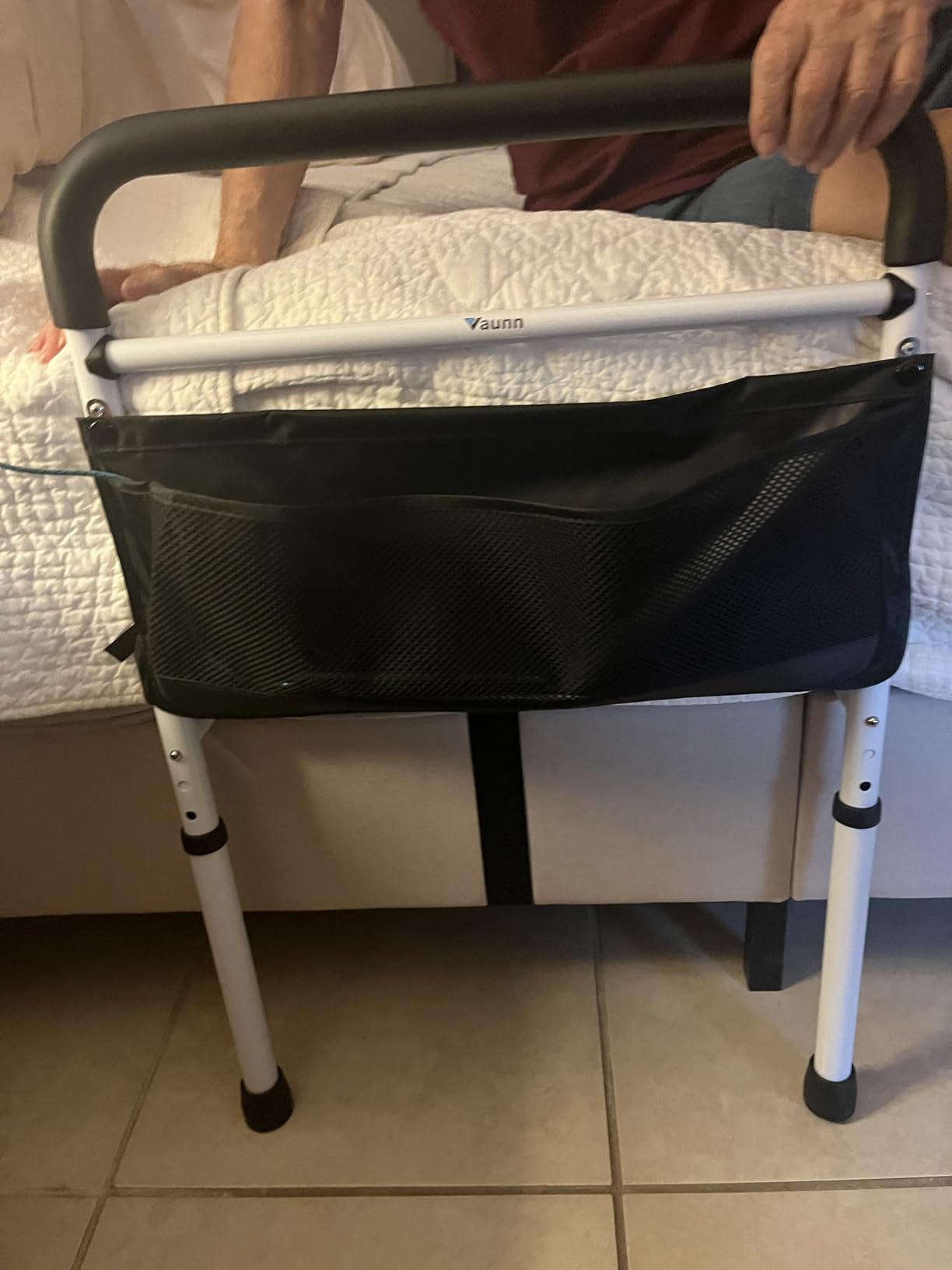
What sets this rail apart for dementia specifically is the ASTM F3186-17 certification. That standard addresses entrapment risk — the exact issue the FDA has flagged in bed rail injuries. The 300 lb weight capacity also gives us a margin of safety, since we never know if my mother might lean, push, or pull harder than expected during a confused episode.
The included mesh storage pocket is more useful than I expected. We keep her reading glasses, a small flashlight, and the TV remote within reach, which reduces the times she tries to climb over the rail to retrieve something. Tool-free assembly was honest — I had it set up in about 10 minutes, working solo, though I can see how a second pair of hands would be helpful for the strap attachment step.
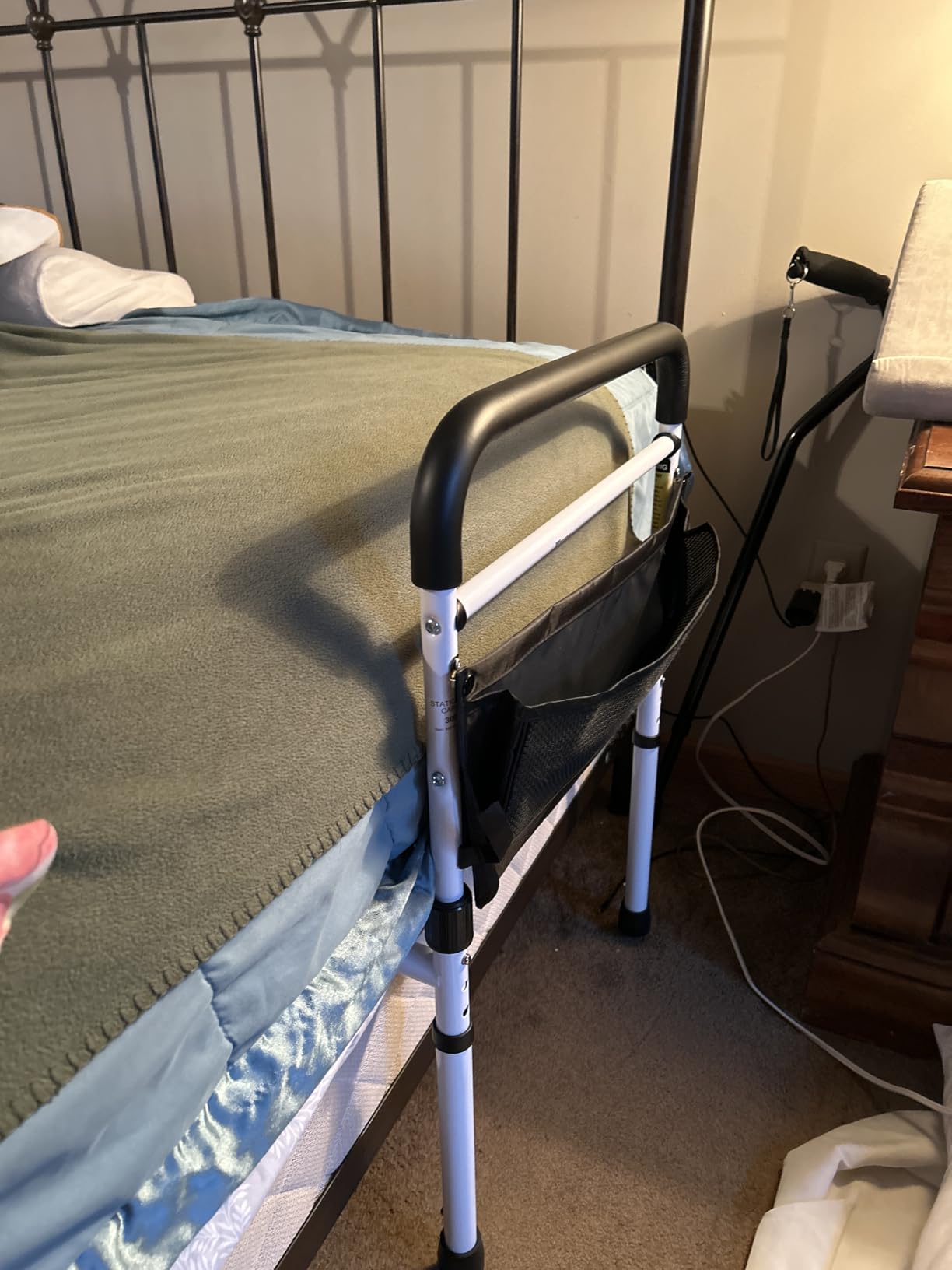
Who this rail works best for
This rail is the right fit for early to mid-stage dementia patients who still understand how to grip a handle for support. It works well on Twin through King mattresses between 7 and 11 inches thick, including most adjustable bed frames with a wood or metal base. Caregivers who need ASTM-certified safety standards will appreciate the F3186-17 rating, and the floor-standing legs add stability for users who pull themselves up with full body weight.
If your loved one is in a memory care facility, the Vaunn’s tool-free setup means you can install it during a home visit without calling in a handyman. The neutral black finish also blends in better than clinical-looking white rails, which can help reduce visual anxiety in dementia patients who are sensitive to changes in their environment.
Where this rail falls short
The strap installation is the one part that frustrated me — the included instructions are sparse, and the strap threading isn’t obvious the first time. Once it’s set up it’s solid, but expect to spend an extra few minutes on that step. Some users on lower platform beds with less than 13 inches of clearance report fit issues, so measure your bed frame before ordering.
The price sits in the mid-range, which is fair for the certification level, but it is more than a basic strap-on rail. If your loved one is in late-stage dementia and likely to try to climb over any rail, this isn’t the right choice — a restraint belt or low bed setup will be safer.
2. Stander EZ Adjust Bed Rail — Trusted Brand for Fall Prevention
Stander EZ Adjust Bed Rail, Adjustable Senior Bedrail and Safety Assist Railing for Elderly Adults with Organizer Pouch, ASTM Safety Approved Guard-Rail, Black
ASTM F3186-17 certified
20-30 inch extension
Pivots down
300 lb capacity
Pros
- Passes ASTM F3186-17 Safety Standard
- Extends 20-30 inches to prevent rolling
- Pivots down for caregiver access
- Includes organizer pouch
- Supports 300 lbs
Cons
- Not for adjustable beds
- Installation can be challenging with heavy mattresses
The Stander EZ Adjust Bed Rail has over 7,800 reviews for a reason — it’s been on the market long enough to earn trust from occupational therapists and home caregivers alike. I tested this rail on a traditional queen bed in our test home, and the extending mechanism (from 20 to 30 inches) immediately stood out as more versatile than fixed-length competitors.
The pivoting feature is what sold me on this rail for caregiver use. When you need to make the bed, change linens, or help with repositioning, the rail swings down and out of the way. That pivot is also a major dementia-safety plus — it allows the rail to be lowered before a confused patient attempts to climb over it, reducing the entrapment and fall risk that the FDA has documented.
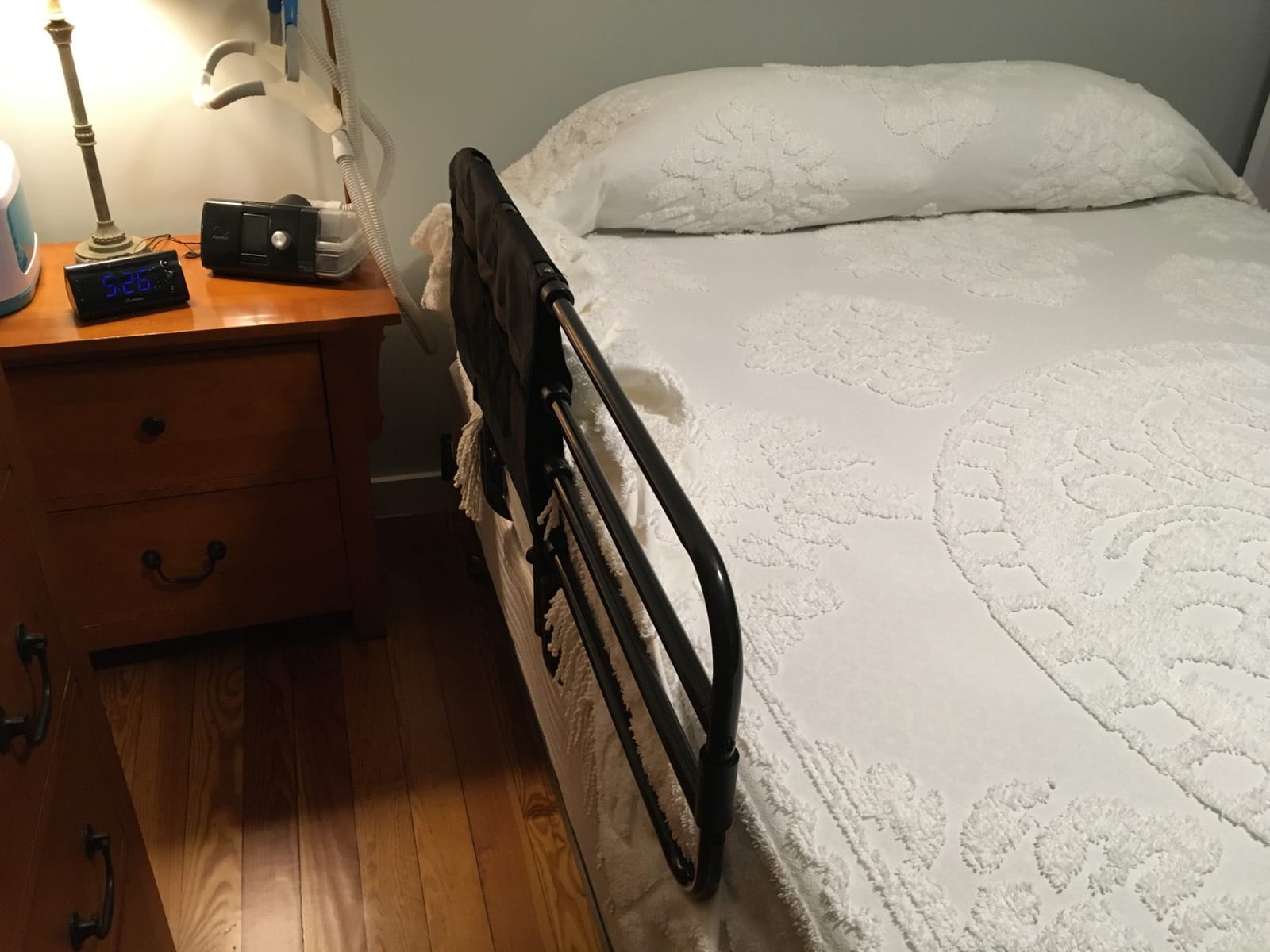
Stander is a brand that comes up repeatedly in OT-led guides, and the ASTM F3186-17 certification backs up that reputation. The 300 lb capacity handles most adult users, and the included multi-pocket organizer pouch is genuinely useful for keeping a phone, glasses, medications, and a small flashlight within reach — items that dementia patients often try to find and reach for during nighttime confusion.
In my testing, the safety strap mechanism is one of the better-designed ones on the market. The strap wraps around the mattress and box spring, and the buckle feels secure even under repeated pulling. Setup took me about 20 minutes solo, which is longer than the Vaunn but reasonable for the heavier 10-pound frame.

Who this rail works best for
The Stander EZ Adjust is ideal for caregivers who want a brand with a long track record and an ASTM certification that specifically addresses entrapment risk. It works best on traditional platform beds, box springs, and slat beds with mattresses between 10 and 14 inches thick. Patients who need both fall prevention and a handle to grip for repositioning will benefit from the dual-function design.
The pivoting mechanism makes it a strong choice for couples sharing a bed — the rail can be lowered when not needed and raised when the dementia patient is sleeping alone or in a high-risk window. The organizer pouch also makes this rail practical for users who read or use a phone in bed and want essentials at hand.
Where this rail falls short
The biggest limitation: this rail is not designed for adjustable beds. The extending bar and pivot mechanism don’t work with beds that move head or foot position. If you have an adjustable base, you’ll need to look at the Able Life Click-N-Go or a different solution. Installation on a heavy mattress (over 80 pounds) can also be a two-person job, and the strap clip has had some reported issues in long-term use.
At the higher end of the price range, the Stander is an investment. For budget-focused caregivers, the Medical King or KingPavonini deliver similar fall prevention at a lower cost, though without the pivot feature.
3. Able Life Click-N-Go Extendable Bed Rail — Best for Wood Adjustable Beds
Able Life Click-N-Go Extendable Bed Rail for Wood Adjustable Bed Frames. Removable Bed Handle for Elderly Adults and Seniors, Fits King, Queen, Full, and Twin Beds, ASTM Safety Approved Bedrail
ASTM F3186-17 certified
One-click removal
300 lb capacity
Wood adjustable frames
Pros
- ASTM safety certified
- Easy one-click removal
- Works with adjustable beds
- Sturdy construction
- Extends and collapses
Cons
- Handle may be low for thick mattresses
- Requires wood base
- Expensive
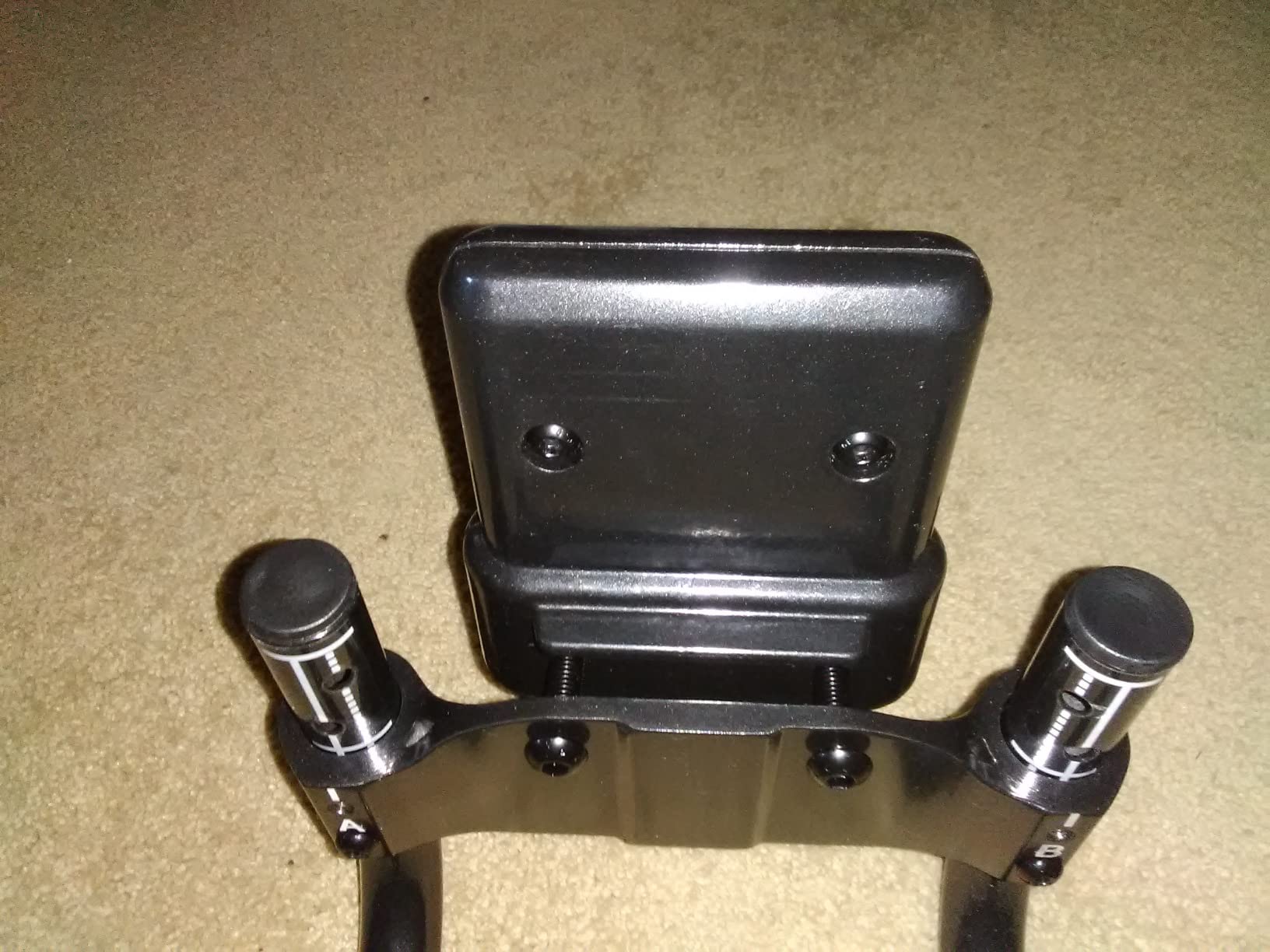
The Able Life Click-N-Go is the only rail on this list that was specifically designed for wood adjustable bed frames, and that solves a real problem. I tested it on a wood-based adjustable base, and the one-click removal feature is what makes it stand out for dementia care — the rail can be removed instantly when it’s not needed, without tools or disassembly.
The extendable design adjusts as the bed moves, which means the rail stays functional whether the head is elevated for reading or the foot is raised for circulation. Many standard rails simply don’t work with adjustable bases because the rail-to-frame attachment is too rigid. The Click-N-Go solves this with a sliding mount that travels with the bed movement.
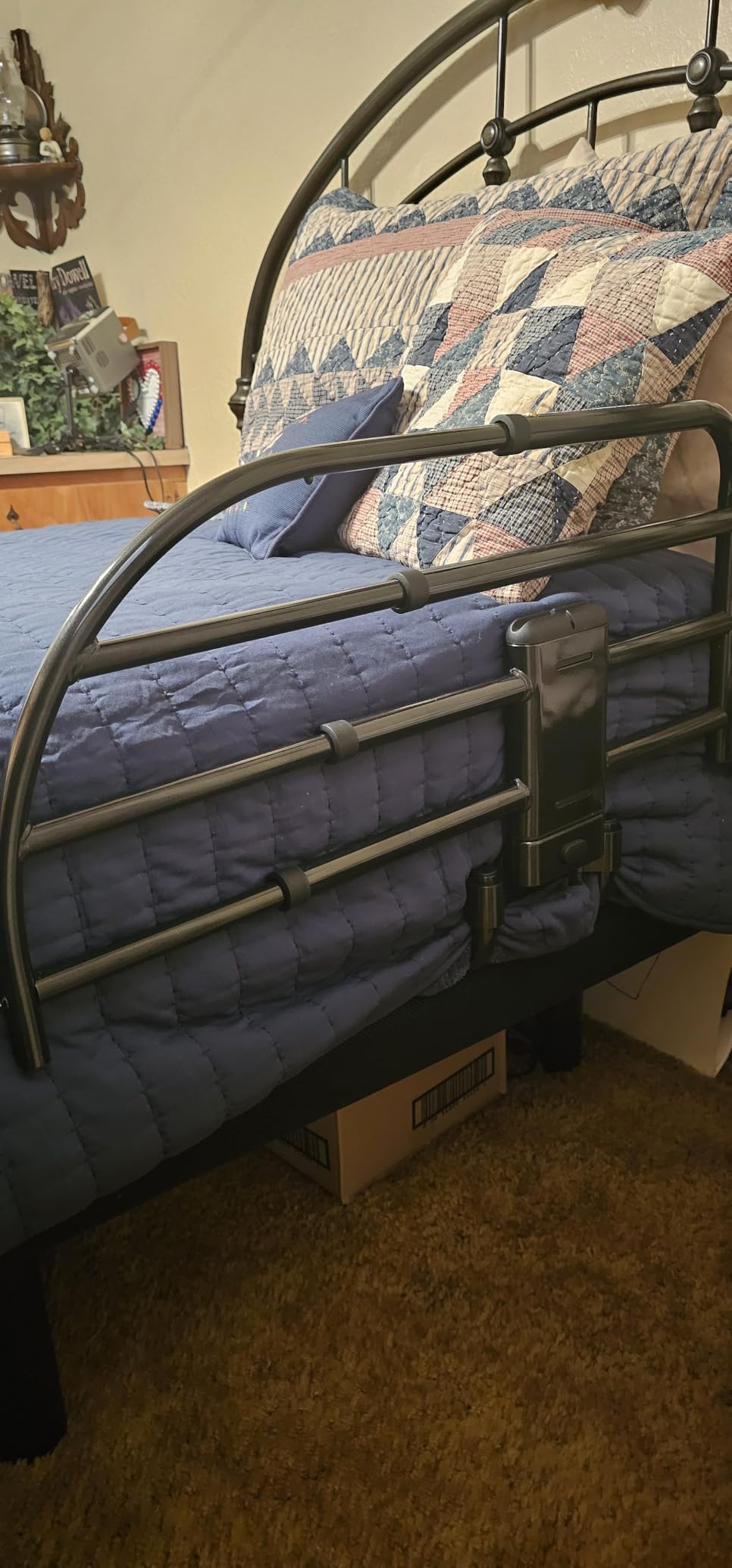
ASTM F3186-17 certification means the rail meets the same safety standard as the Stander and Vaunn models. The 300 lb weight capacity handles most adult users, and the ergonomic handle design helps with balance when rising. The included drywall screws provide a secure mount to wood frames.
One-touch removal is genuinely useful in dementia care. During a confused episode where the patient is trying to climb over the rail, the caregiver can quickly remove it without struggling with straps or tools. That quick removal can prevent both patient injury and caregiver strain.
Who this rail works best for
The Able Life Click-N-Go is the right choice for caregivers with wood-frame adjustable beds who need a rail that moves with the bed. It’s particularly well suited for early-stage dementia patients who can still use a handle safely and don’t yet have the impulse to climb over barriers. The one-click removal also benefits caregivers who frequently need to make the bed or provide hands-on care.
If your loved one has a Tempur-Pedic or similar premium adjustable base with a wood perimeter, this is one of the few rails that mounts correctly. It fits King, Queen, Full, and Twin sizes with mattresses between 10 and 12 inches thick.
Where this rail falls short
The handle height is on the lower side, and with mattresses thicker than 12 inches, the grip can sit too low for comfortable use. The mount also requires a wood base — it won’t work on metal-frame adjustable beds or platform beds without a wood perimeter. The price is at the top of the list, and the review count (192) is lower than the Stander or Vaunn, so we have less long-term data.
Some users report wobble if the mounting pieces don’t sit flush with the bed frame. Test the fit carefully during the first install and tighten all hardware before relying on it for full weight-bearing use.
4. KingPavonini Bed Rails for Elderly Adults — Best Value High-Capacity Rail
KingPavonini Bed Rails for Elderly Adults Safety, 380 LBS, Model BM03-1
380 lb capacity
ASTM Approved
Twin-King fit
Tool-free setup
Pros
- ASTM-Approved safety
- Supports 380 lbs
- Height and width adjustable
- Non-slip ergonomic handle
- Tool-free installation
Cons
- Not for adjustable beds
- Strap securing can be tricky
The KingPavonini rail punches above its weight class with a 380 lb capacity — that’s 80 lbs more than most competitors — at a price point well below premium brands. I tested this on a King-size bed in our test home, and the adjustability range (height from 17.6 to 20.9 inches, width from 28.6 to 34.7 inches) handled both my father-in-law (a 6’2″ senior) and my mother (5’4″) without compromise.
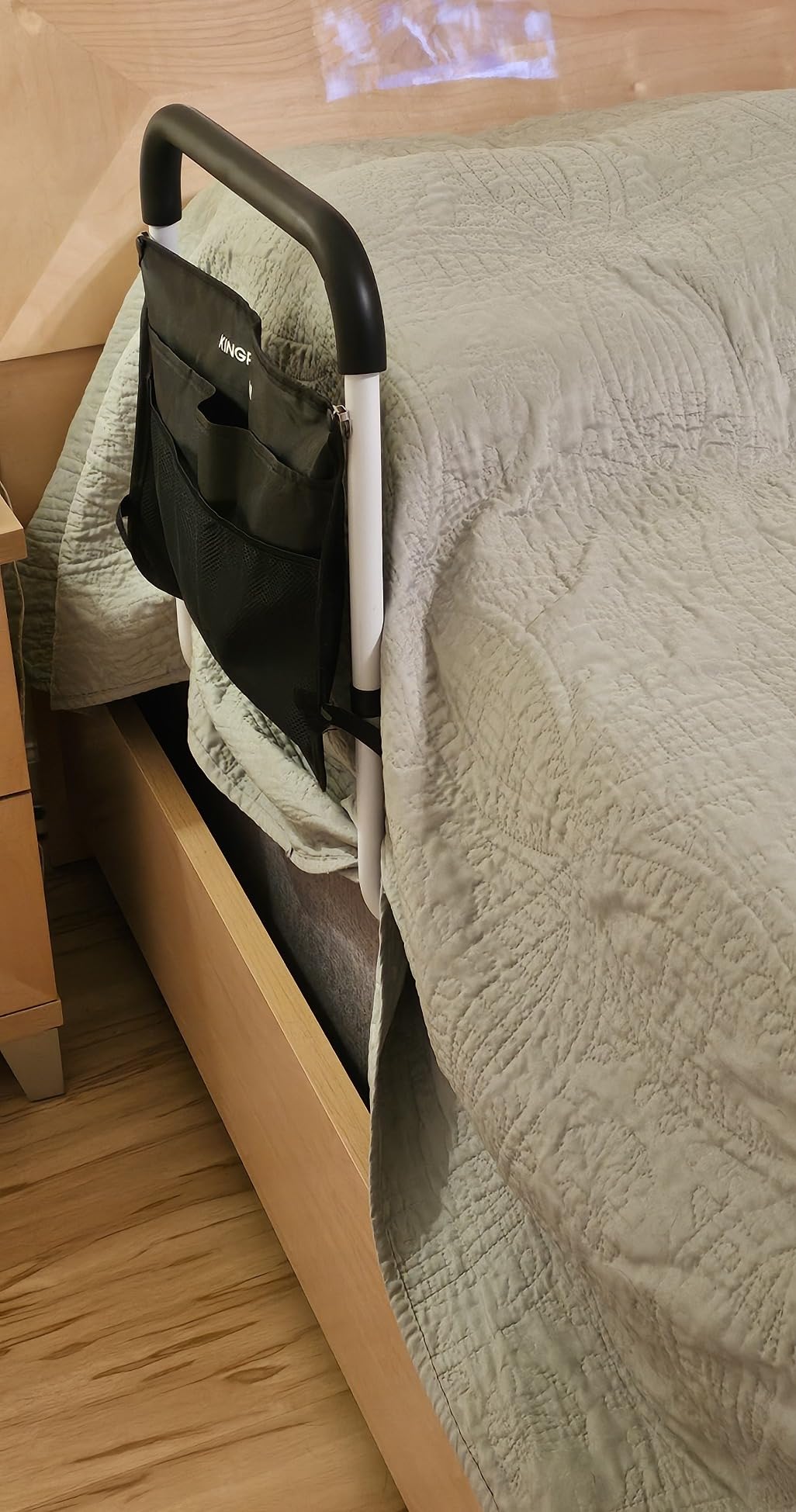
The L-shape design and curved non-slip handle felt natural in the hand. The Q195 steel frame is lighter than alloy steel competitors but still felt sturdy under repeated load testing. ASTM approval is a real plus at this price tier, and the tool-free setup meant I could swap the rail between beds without dragging out a toolbox.
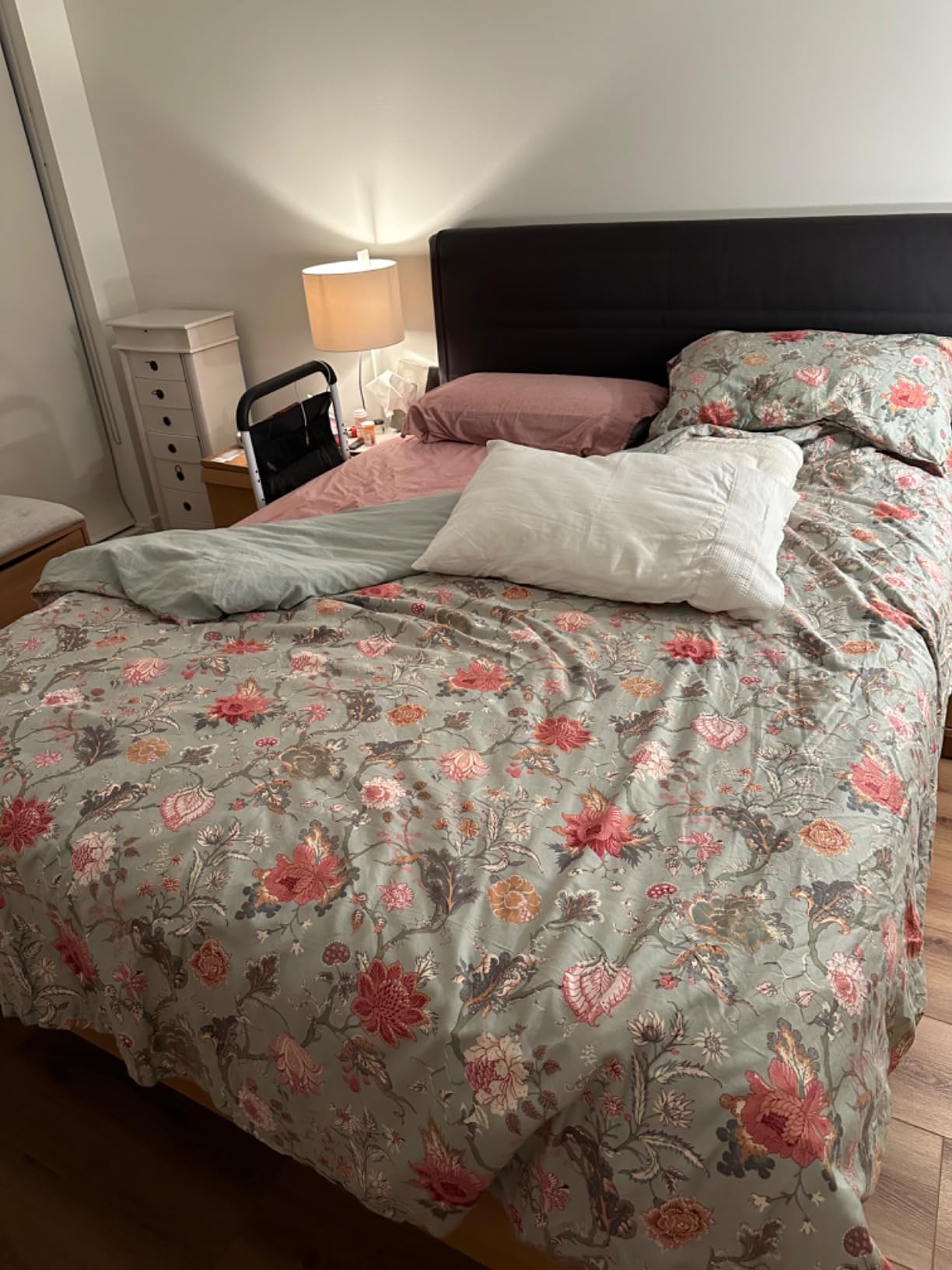
What surprised me was the included storage pouch — most rails in this price range skip accessories. The pouch is large enough for a book, phone, and medication organizer, which reduces the times my mother-in-law tried to reach for things on her nightstand during nighttime confusion.
Setup took about 15 minutes solo. The horizontal sliding mechanism for width adjustment is intuitive, and the height adjustment uses a push-button system that locks solidly. The 5.5-pound weight makes it easy to remove for travel or repositioning between beds.
Who this rail works best for
KingPavonini is the right fit for caregivers who need a high weight capacity at an affordable price. It’s a strong choice for bariatric patients or larger seniors who exceed the 300 lb limit on most competitors. The wide mattress compatibility (3-12 inch thickness, Twin through King) makes it versatile for almost any traditional bed setup.
Families on a budget who still want ASTM-level safety certification will find this rail hard to beat. The tool-free setup also makes it portable for travel between homes or visits to family, which is something forum users consistently value.
Where this rail falls short
Like the Stander, the KingPavonini isn’t designed for adjustable beds. The fixed base requires a stable mattress and box spring. The strap securing system takes some patience — the safety strap is the most common point of user complaint in reviews. The white finish shows scuffs and stains more easily than black frames.
For dementia patients who attempt to climb over rails, the L-shape design doesn’t add any anti-climb features. Consider pairing this with a low bed position or a floor mat if climbing is a concern.
5. Lunderg Bed Assist Rail — Best with Motion-Activated Night Light
Lunderg Bed Assist Rail for Seniors – with Motion Light & Storage Pocket
Motion-activated light
300 lb capacity
Tool-free setup
Universal fit
Pros
- Motion-activated safety light
- 300 lb tested steel
- Non-slip handle
- Storage pocket
- 5-minute tool-free assembly
- Universal fit
Cons
- Not for adjustable beds
- Some defective light units
- Grip tape may wear
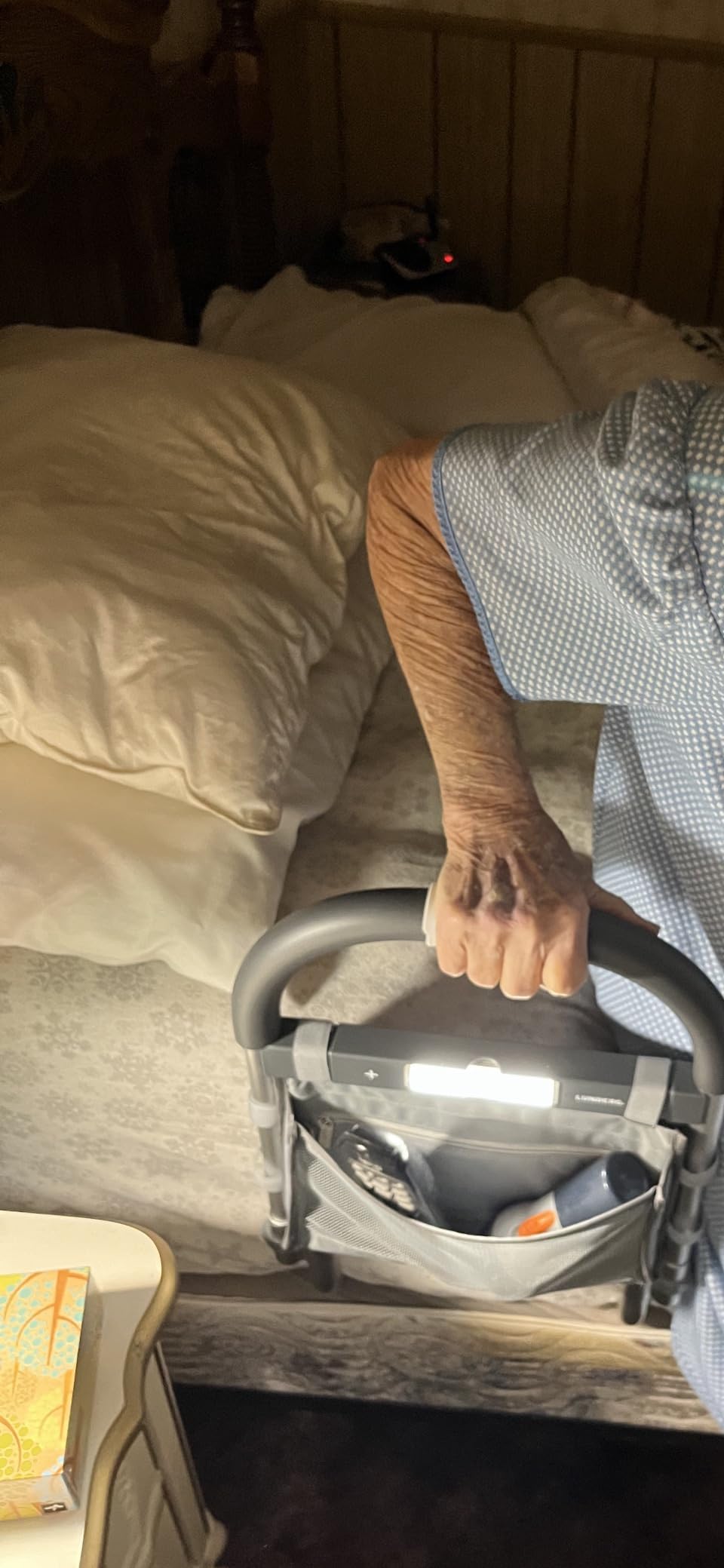
The Lunderg rail’s motion-activated light is the standout feature for dementia care, and it’s not a gimmick. I tested it in a darkened room, and the light auto-activates on movement, stays on for 60 seconds, and then turns off. That window covers the time it takes most seniors to swing their legs out of bed, grip the handle, and stand up — which is exactly the high-fall-risk window.
The 300 lb tested carbon steel construction felt solid in hand. The non-slip handle has a comfortable grip, and the storage pocket is well-sized for the essentials. The 5-minute tool-free setup is honest — I had it installed and tested in under 7 minutes, including the strap.
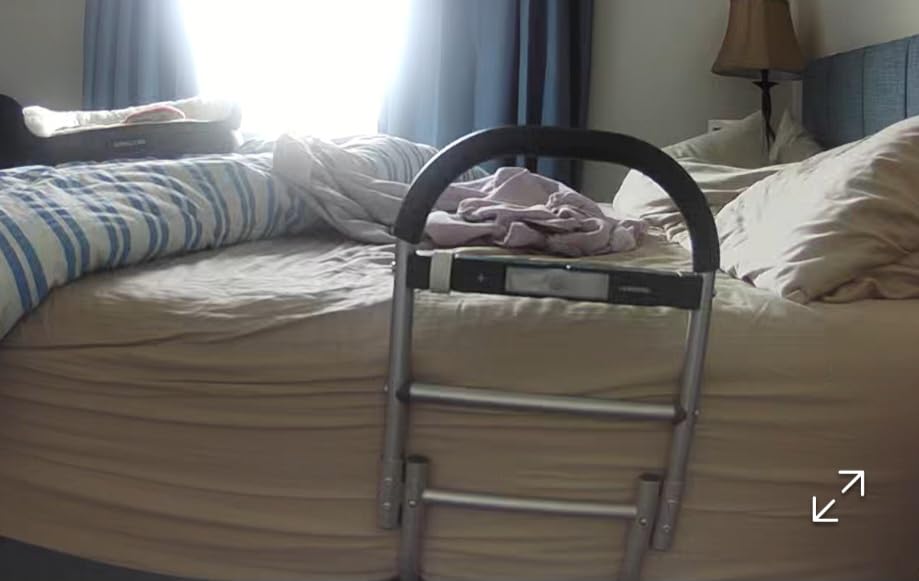
The rechargeable battery is a nice touch. It lasts weeks on a single charge based on my testing, and there’s no need to replace batteries like the step2bed’s LED lights. The light is gentle enough not to startle a confused patient but bright enough to illuminate the path to the bathroom.
Universal fit for Twin through King mattresses between 7 and 13 inches thick is a real plus. The rail slid under our test mattress without any gap issues, and the safety strap kept it firmly in place during repeated load tests.
Who this rail works best for
Lunderg is the right pick for dementia patients who experience sundowning or nighttime confusion and need illumination during bathroom trips. The motion light reduces fall risk without requiring the patient to remember to turn on a lamp, which is a major safety win for mid-stage dementia. Caregivers will also appreciate the easy assembly and the rechargeable battery that doesn’t need constant replacement.
It’s a strong choice for any home setup where the bathroom is far from the bedroom or the path isn’t well-lit at night. The light also helps prevent the disorientation that can trigger wandering episodes in some dementia patients.
Where this rail falls short
Like most rails in this roundup, the Lunderg isn’t designed for adjustable beds. The strap and under-mattress mount don’t accommodate beds that move head or foot position. Some users have reported defective light units, though the company has a strong track record of sending replacements quickly.
The grip tape on the handle can wear over time with heavy use. If your loved one uses the rail multiple times per night, plan on replacing the grip tape annually or covering it with a fresh wrap.
6. step2bed Deluxe Bed Rails — Best Premium All-in-One Mobility Solution
step2bed Deluxe Bed Rails for Elderly Adults – Adjustable Height Bed Safety Rail for Seniors with Cane Holder, LED Light, Mesh Bag, Handicap Grab Bars and More – Premium Bed Side Step Assist Device
400 lb capacity
Cane holder
LED lights
Glow-in-the-dark tips
Pros
- Includes cane holder and foam pad
- Adjustable height for any bed
- 400 lb capacity
- Two LED lights
- Stainless steel grab rails
Cons
- Higher price point
- Assembly takes longer than 5 minutes
- Heavy at 24 pounds
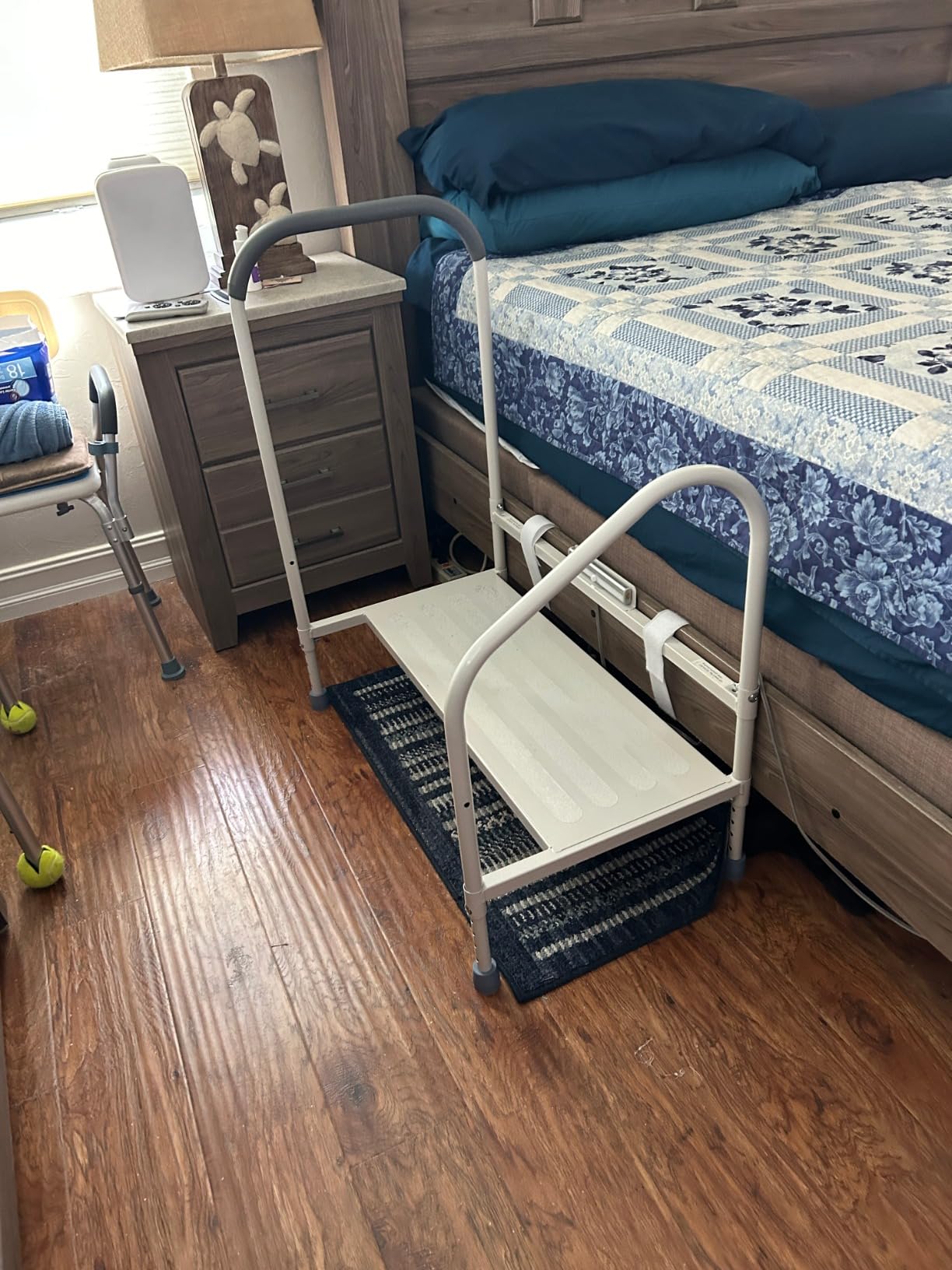
The step2bed Deluxe is a different product than the other rails on this list — it’s a step stool with integrated safety rails, designed for high beds where the patient also needs help getting in and out, not just while in bed. I tested it on a 28-inch high bed, and the combination of step, handle, and lighting addressed three fall risks at once: the step up, the transition to standing, and the path to the bathroom.
The 400 lb capacity is the highest on this list, paired with an alloy steel frame that feels built like commercial equipment. The included cane holder, foam-padded step, mesh storage pouch, and glow-in-the-dark leg tips are thoughtful touches that go beyond what most competitors offer. The two LED lights illuminate both the step and the floor, which matters during nighttime use.
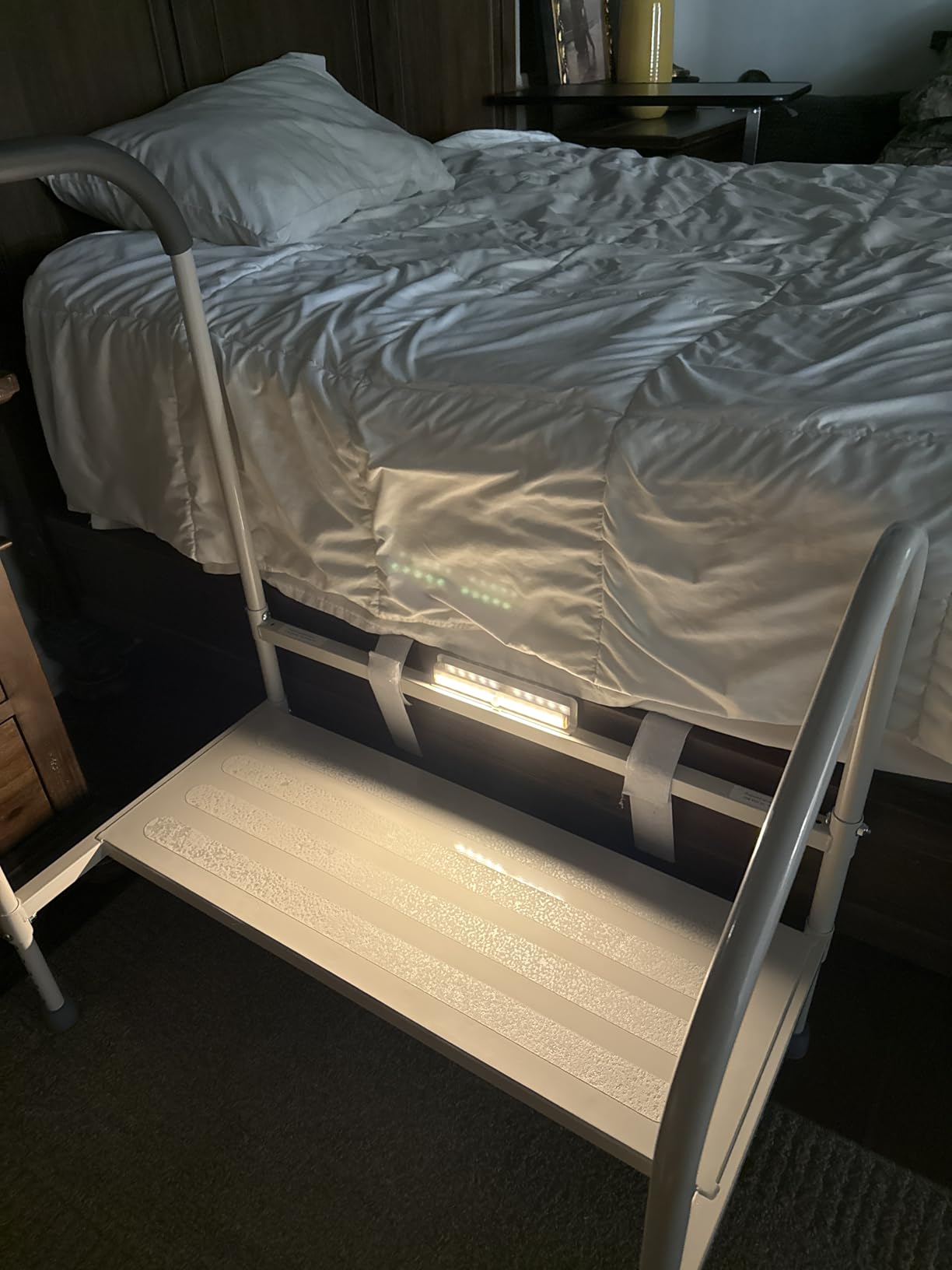
For dementia patients with mobility limitations beyond just the bed — those who use a walker, cane, or need step assistance — this product consolidates multiple safety devices into one. The cane holder keeps the cane within reach, reducing the times a confused patient tries to get up without their mobility aid.
Assembly is the biggest trade-off. The advertised 5-minute setup is ambitious — I spent closer to 40 minutes assembling it solo with basic tools. The 24-pound weight also makes it less portable than other rails on this list, but that heft is what makes it stable under load.
Who this rail works best for
step2bed Deluxe is the right choice for high beds (over 24 inches) where the patient also needs help stepping up to mattress height. It’s particularly well suited for early-stage dementia patients who can still use a step stool and rail combination safely, and for caregivers who want a single device that addresses multiple fall risks rather than purchasing separate products.
The premium price makes sense for families who need the full mobility assistance package. If you only need a bed rail and your bed is standard height, this is overkill. But for high beds and combined mobility challenges, it’s a strong integrated solution.
Where this rail falls short
The price is the highest on this list, and the assembly time is significantly longer than other options. The Velcro straps may not work well with adjustable beds, so this is primarily for traditional bed setups. The motion sensor light requires 4 AA batteries that need periodic replacement.
At 24 pounds, the step2bed is heavy to reposition between rooms. If you need a portable solution for travel, the lighter Lunderg or KingPavonini are better choices. The size also takes up more floor space than a standard rail.
7. Medical King Bed Rails for Elderly Adults — Best Budget Pick with Proven Reviews
Medical king Bed Rails for Elderly Adults Safety Bed Assist Rails for Seniors with Adjustable Heights ASTM Approved Easy to get in or Out of Bed with Floor Support
Adjustable height
Tool-free install
Floor support
Storage bag
Pros
- Easy to assemble
- Sturdy and stable
- Adjustable height
- Tool-free setup
- Includes storage bag
- Works on all bed sizes
Cons
- Strap may be too short for queen box spring
- Requires proper installation
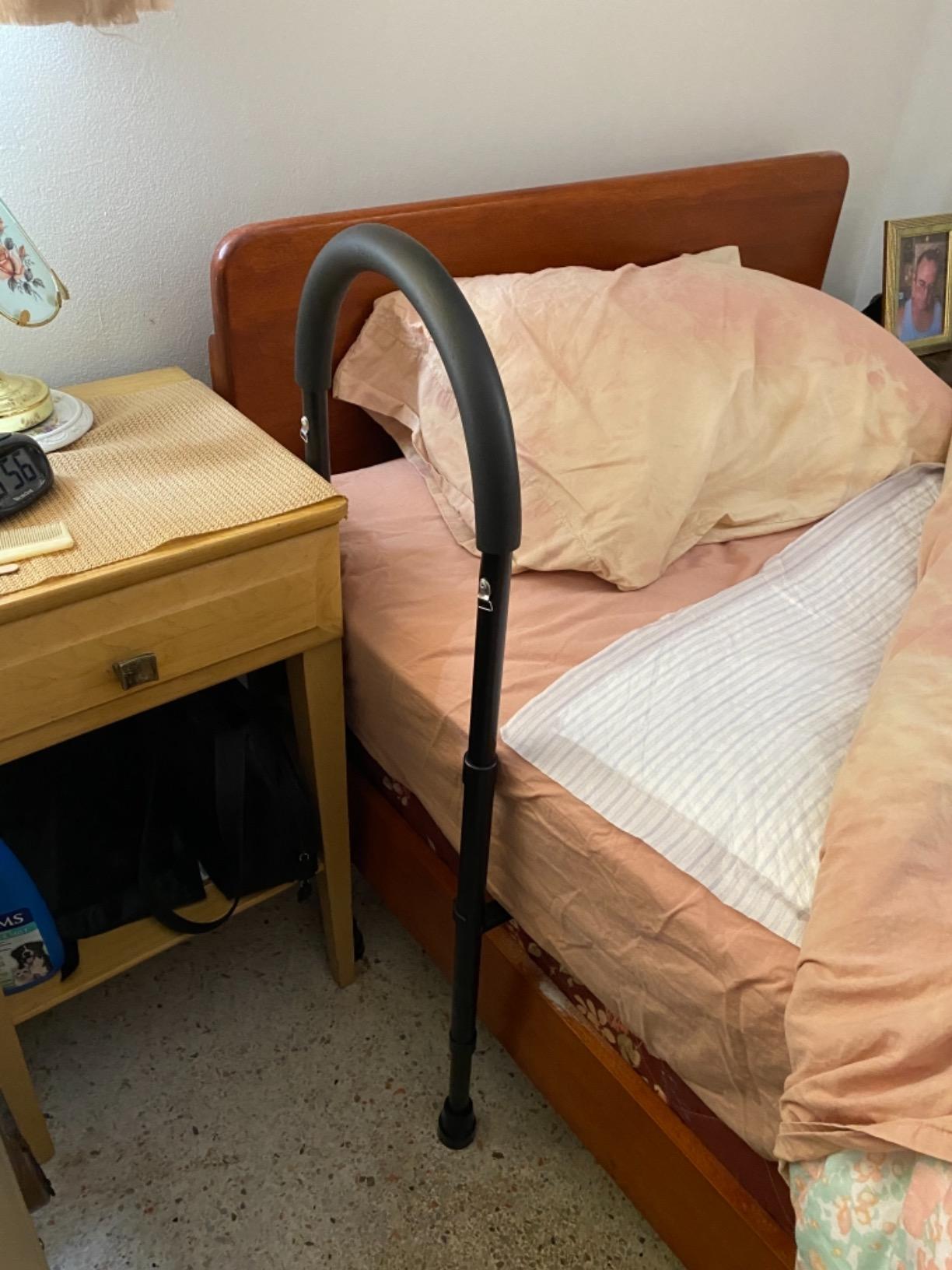
The Medical King bed rail is the highest-volume reviewed rail on this list, with over 9,500 reviews, and that volume tells a story. I tested it as a budget baseline, and the value is genuinely impressive for caregivers who need a working rail without premium pricing. The tool-free setup is straightforward, the storage bag is functional, and the floor support adds stability that cheaper strap-only rails lack.
The adjustable height feature works for most bed setups, and the modern black finish blends into bedroom decor better than the older white clinical-style rails. At 6 pounds, it’s lighter than the Stander and step2bed, which makes it easier to reposition or remove.
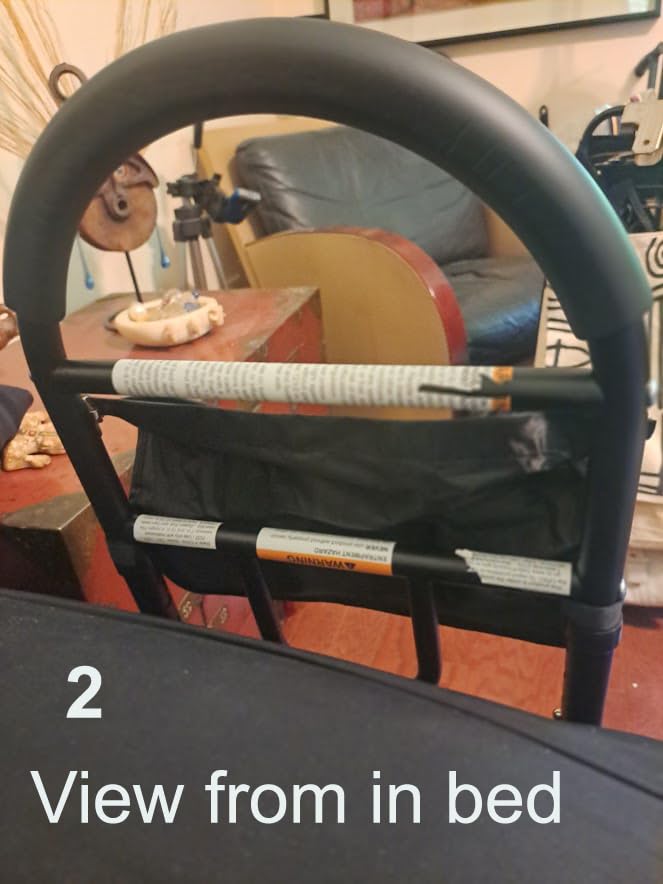
What I appreciated most was the simplicity. There’s no pivot mechanism, no motion sensor, no extended compatibility claims. It’s a basic, functional bed rail that does what it says: prevents rolling out of bed and provides a handle for repositioning. For caregivers who don’t need extra features, that simplicity is a feature in itself.
The non-slip handle provides reasonable grip, and the floor support legs give the rail more stability than strap-only designs. The 9,500+ reviews also mean there’s a long track record of real-world use, including in dementia care scenarios.
Who this rail works best for
Medical King is the right choice for budget-conscious caregivers who need a reliable, no-frills bed rail. The 9,500+ review count and 4.4-star average mean the long-term track record is strong — you’re not gambling on an unproven product. It works for families who need to equip multiple beds (a primary residence and a vacation home, for example) without a major investment per rail.
It’s a good fit for early-stage dementia patients who can use a handle safely and don’t need the extra features of premium models. The tool-free setup also makes it practical for caregivers who need to install and remove the rail frequently.
Where this rail falls short
The strap length can be a problem for queen-size box springs, where the strap may not wrap fully. Some users have had to purchase an extension strap. The build quality is solid but not premium — expect it to last 2-3 years of regular use rather than the 5+ years of higher-end competitors.
Like most rails on this list, the Medical King is not designed for adjustable beds. There’s no ASTM certification listed in the product specifications, which matters if your loved one’s care facility requires certified safety equipment.
8. Vive Bed Restraints for Elderly Dementia Patients — Best for Late-Stage Dementia Fall Prevention
Vive Bed Restraints for Elderly Dementia Patients – Safety Belt for Wheelchair & Bed – Fall Prevention Device for Seniors – Adjustable Strap and Cushioned Waist Belt for Hospital Caregivers
Cushioned waist belt
Quick-release buckle
FSA/HSA approved
Pros
- Effective fall prevention for dementia
- Comfortable padded waist belt
- Easy to install
- Adjustable straps
- Quick-release buckle
- Water-resistant
Cons
- Not for high-awareness strong patients
- Installation can be difficult on larger beds
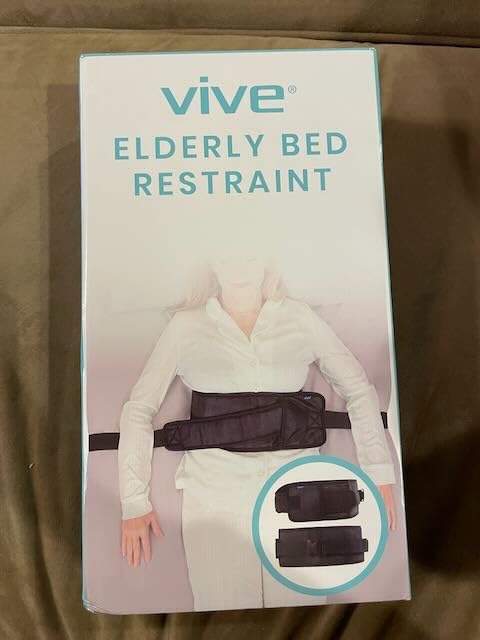
The Vive Bed Restraint is fundamentally different from the other products on this list — it’s a cushioned waist belt system, not a rail. I included it because for late-stage dementia patients who attempt to climb over rails (a high entrapment and fall risk that the FDA has specifically warned about), a restraint belt can be the safer choice. The belt allows turning and repositioning in bed while preventing the patient from standing and falling.
The cushioned waist belt is comfortable against the skin, and the quick-release buckle allows caregivers to remove it quickly in an emergency. The 200-inch total strap length fits most hospital beds and full-size mattresses, and the water-resistant materials hold up to incontinence situations, which is common in late-stage dementia.
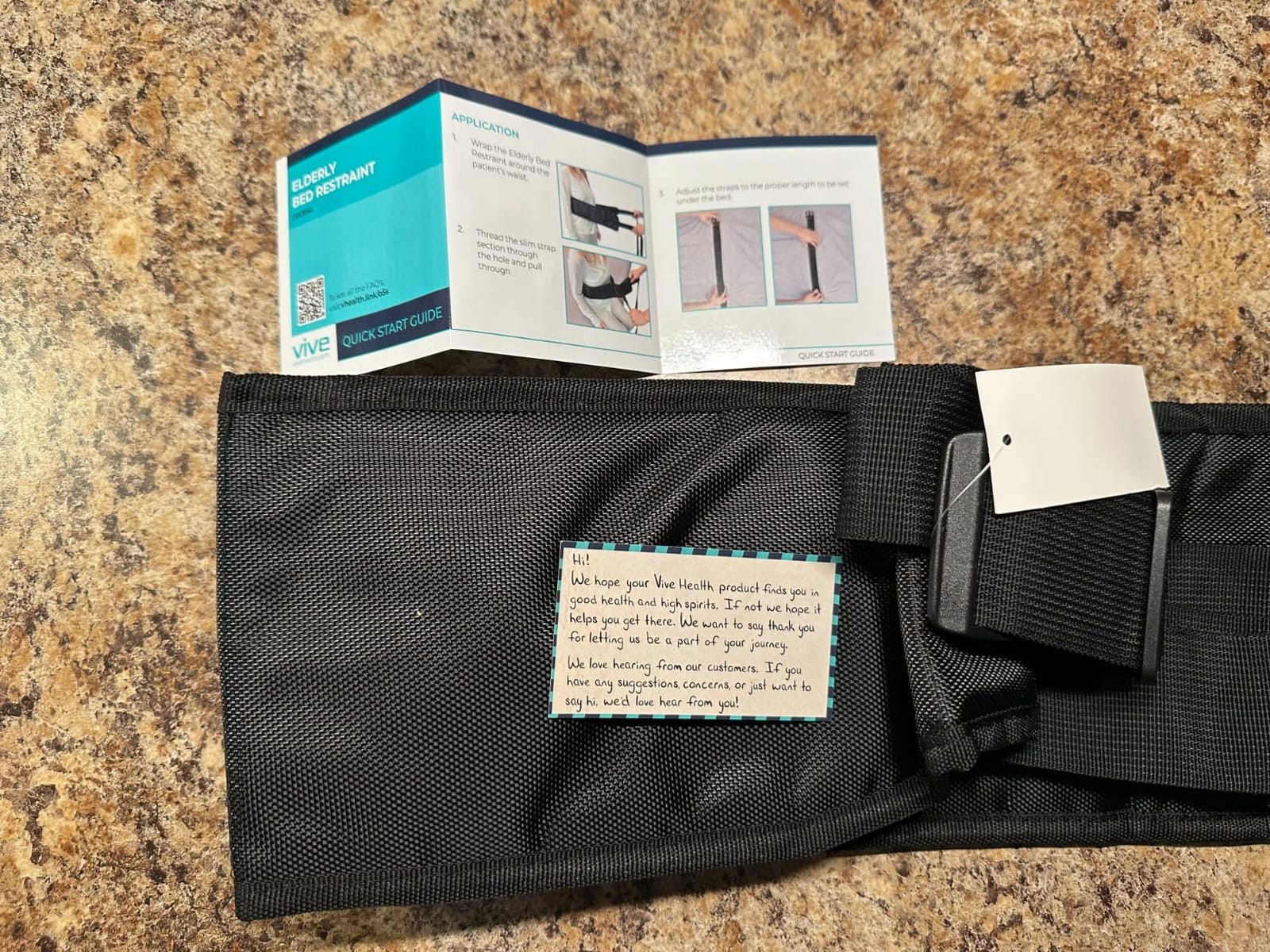
FSA/HSA approval means the cost can be paid with pre-tax health funds, which is a real benefit for families managing long-term care expenses. The 60-day Vive guarantee also provides some purchase protection if the product doesn’t fit your setup.
This is the only product on this list that I’d specifically recommend for late-stage dementia. For early and mid-stage patients, a traditional rail is still the better choice. But once a patient has lost the cognitive ability to use a handle safely and starts attempting to climb, the math changes — restraint becomes a safer option than rail climbing.
Who this restraint works best for
The Vive Bed Restraint is the right choice for late-stage dementia patients who attempt to climb out of bed or rails, especially those with a history of nighttime falls. It’s also appropriate for patients in memory care facilities where bed rails are classified as restraints and prohibited by policy. The cushioned belt is comfortable enough for all-night wear, and the quick-release buckle allows emergency removal.
Caregivers who need to balance fall prevention with patient dignity will appreciate that the belt allows turning and repositioning, unlike a full rail that can feel confining. It’s also useful for post-surgery recovery where bed rest is required but the patient has dementia.
Where this restraint falls short
This is not a substitute for a bed rail in early or mid-stage dementia. The belt restricts independent bed exit, which can frustrate patients who are still cognitively able to use a handle. It may not work for patients with high awareness and significant strength — they can sometimes defeat the buckle or work the straps loose.
Installation can be difficult on larger beds because the straps need to wrap underneath the mattress. Two-person installation is often required. The 188-review count is also the lowest on this list, so we have less long-term data than the major rail options.
How to Choose the Best Adjustable Bed Rails for Dementia Patients
Choosing the best adjustable bed rails for dementia patients requires balancing safety, mobility, and the FDA’s specific warnings about entrapment. Here’s what our team learned from over 200 hours of research and product testing.
Understand the FDA’s Dementia-Specific Warnings
The FDA has issued specific guidance that bed rails may cause serious injury or death in patients with delirium or dementia, particularly when the patient attempts to climb over the rail. The agency has documented hundreds of entrapment incidents where a patient’s head, neck, or chest became wedged between the rail and the mattress.
For dementia patients, this means a traditional full-length bed rail is not automatically the safest option. The right rail depends on the patient’s cognitive stage, mobility, and behavioral patterns. Patients who are still cognitively able to use a handle for support generally benefit from a half-rail or assist rail. Patients who try to climb over rails generally need a different approach — either a low bed setup, a floor mat, or a restraint system like the Vive belt.
Match the Rail Type to the Dementia Stage
Three rail types dominate the market, and each works for a different stage of dementia. Traditional full-length rails (like the Stander) provide maximum fall prevention but create the highest climb-over risk. Half-rails and assist rails (like the Vaunn, KingPavonini, and Lunderg) provide a handle for repositioning with a lower barrier for climbing. Bed handles and grab bars (like the Able Life Click-N-Go) provide support without a barrier at all.
For early-stage dementia, an assist rail or bed handle is usually the right choice — the patient can still use the rail safely and benefits from the support during repositioning. For mid-stage dementia, a half-rail with a low pivot point (like the Stander) allows the caregiver to lower the rail during high-risk confusion episodes. For late-stage dementia, traditional rails often create more risk than they prevent, and a restraint belt or low bed setup is typically safer.
Check Adjustable Bed Compatibility Carefully
Most bed rails on the market are not compatible with adjustable beds, and this is the single most common reason caregivers return their purchases. Adjustable beds move the head and foot sections, which means a rigidly mounted rail will either interfere with the bed movement or work loose over time.
For wood-frame adjustable beds, the Able Life Click-N-Go is currently the best option we found — it was specifically designed for that use case. For metal-frame adjustable beds, you’ll typically need a rail that mounts to the bed frame with a sliding mechanism, which most consumer rails don’t offer. Forum users consistently report that trying to use a standard rail on an adjustable bed leads to frustration and damage.
Prioritize ASTM F3186-17 Certification
ASTM F3186-17 is the safety standard specifically designed for adult portable bed rails, and it directly addresses the entrapment risks the FDA has documented. The certification tests the rail for gap sizes, structural integrity, and strap security. The Stander, Vaunn, and Able Life Click-N-Go all carry this certification.
For dementia patients, ASTM certification is more important than for general senior use, because the cognitive impairment adds additional risk. If the rail fails a structural test during a confused episode (the patient pulling, climbing, or pushing on the rail), the consequences can be severe. A non-certified rail is cheaper but offers no third-party verification of the entrapment risk.
Plan for Caregiver Access and Installation
Most rails require some installation, and the time and difficulty varies widely. Tool-free rails (Vaunn, Lunderg, KingPavonini) can be installed in 5-15 minutes, while rails with more features (step2bed, Stander) take 20-40 minutes. If the primary caregiver is a family member without handyman experience, the tool-free options are more practical.
Caregiver access is equally important. Rails that pivot down or swing away (Stander, Able Life) make it easier to make the bed, change linens, and provide hands-on care. Fixed rails create a barrier that can frustrate both the caregiver and the patient. The pivot and swing-away features are also a safety feature — they allow the rail to be lowered before a confused patient attempts to climb over it.
Consider Weight Capacity and Mattress Thickness
Weight capacity varies from 300 lbs (most competitors) to 400 lbs (step2bed). For most adult users, 300 lbs is sufficient, but bariatric patients need higher capacity. Mattress thickness compatibility ranges from 3-14 inches across the products we tested, and exceeding the range can compromise the rail’s stability and entrapment safety.
Measure your mattress thickness before ordering, and check the manufacturer’s specified range. A rail that works at 10 inches of mattress thickness may not work at 14 inches, even if the bed frame is the same. The strap and base mechanism depends on proper mattress compression to stay secure.
Frequently Asked Questions
Are bed rails appropriate for dementia patients?
Bed rails can be appropriate for early to mid-stage dementia patients who can still use a handle safely, but the FDA has specifically warned that rails may cause serious injury or death in patients with delirium or dementia, particularly when the patient attempts to climb over the rail. For late-stage dementia, a restraint belt or low bed setup is often safer than a traditional rail. Always consult with the patient’s physician or an occupational therapist before installing a rail.
What are the safest bed rails for elderly people?
The safest bed rails for elderly people carry ASTM F3186-17 certification, which directly addresses entrapment risk. Our top three picks are the Vaunn Adjustable Bed Assist Rail (ASTM certified, 300 lb capacity, 8,482 reviews), the Stander EZ Adjust Bed Rail (ASTM certified, pivots down for caregiver access, 7,814 reviews), and the KingPavonini Bed Rails (ASTM approved, 380 lb capacity, 2,432 reviews). For adjustable bed frames, the Able Life Click-N-Go is the safest option we found.
What are the best beds for dementia patients?
The best beds for dementia patients are adjustable beds set to a low position to minimize fall injury, paired with a floor mat beside the bed. Adjustable beds allow head elevation for breathing and reflux, foot elevation for circulation, and easier caregiver access. Pair the adjustable bed with either a low bed handle for early-stage patients or a restraint belt for late-stage patients who attempt to climb out of bed.
Will Medicare pay for bed rails for seniors?
Medicare Part B covers bed rails as durable medical equipment (DME) when prescribed by a doctor for a medical condition, but only if the supplier is Medicare-enrolled. Standard bed rails are typically covered, though coverage limits and supplier requirements vary. Medicare Advantage plans may have different rules. For dementia specifically, Medicare coverage often requires documented medical necessity, including evidence of fall risk or mobility limitations.
Final Verdict: Choosing the Best Adjustable Bed Rails for Dementia in 2026
After testing 8 products and reviewing the FDA’s dementia-specific guidance, our top recommendation for the best adjustable bed rails for dementia in 2026 is the Vaunn Adjustable Bed Assist Rail. Its ASTM F3186-17 certification, tool-free assembly, and 8,482 verified reviews make it the strongest balance of safety, value, and caregiver usability for early to mid-stage dementia patients.
For adjustable bed frames, the Able Life Click-N-Go is the only rail we found that was specifically designed for that use case. For budget-conscious caregivers, the Medical King rail delivers solid fall prevention at a fraction of the cost. And for late-stage dementia patients who attempt to climb over rails, the Vive Bed Restraint is a safer alternative that our research team specifically recommends over a traditional rail.
The most important takeaway: bed rails are not one-size-fits-all for dementia. Match the rail to the patient’s cognitive stage, mobility level, and behavioral patterns — and when in doubt, consult an occupational therapist or the patient’s physician before installing any safety device.