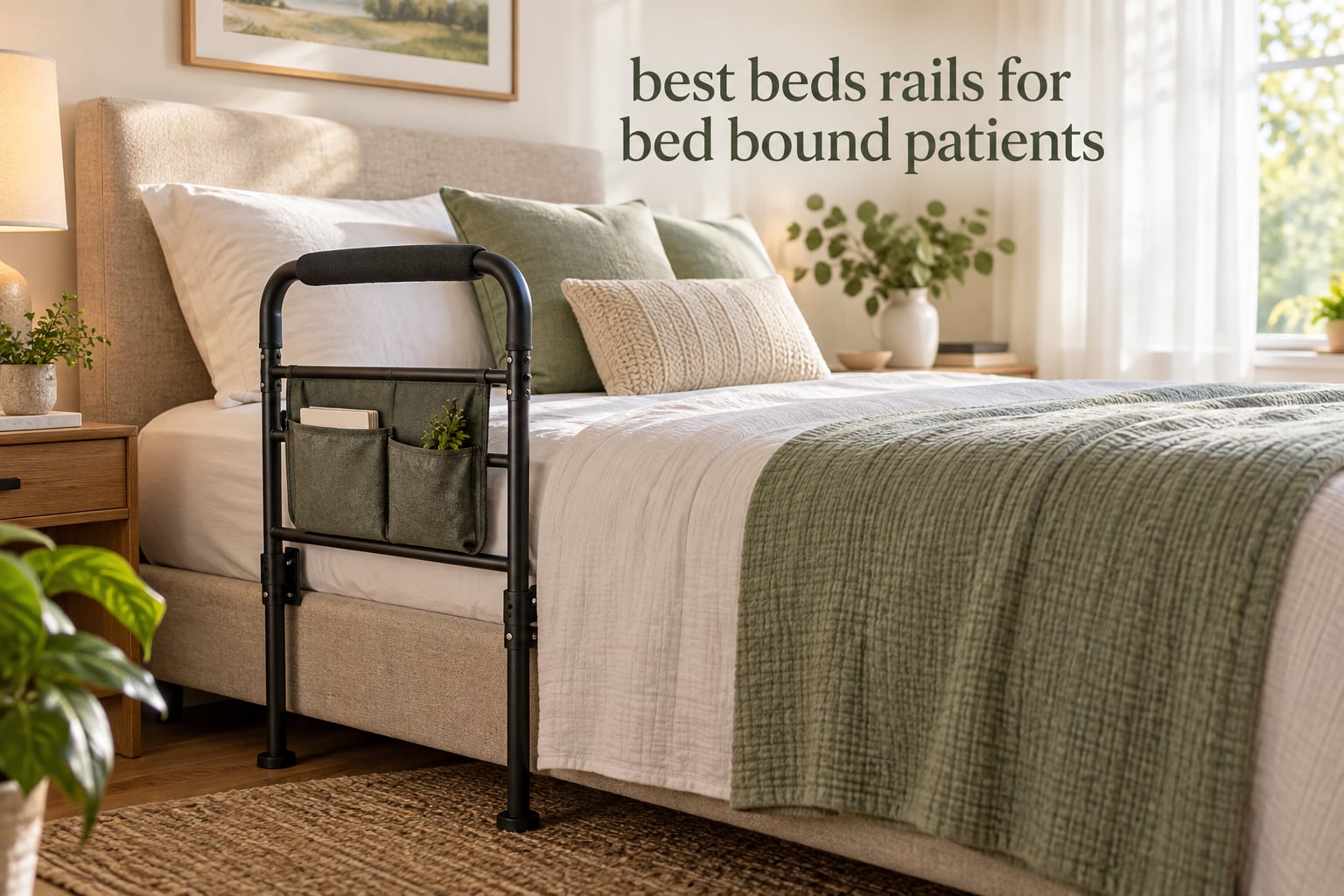
My mother was 78 and bed-bound after a stroke when I spent my first weekend as her caregiver flat on my back, pulled a muscle turning her at 2 a.m., and realized the bed rail I had bought was almost useless. That is the moment I started this guide. The best bed rails for bed bound patients are not the same rails that help ambulators stand up. They are rails that a caregiver can operate, that stay anchored when a 200-pound body shifts in sleep, that meet ASTM F3186-17 and 16 CFR Part 1270, and that the family can wipe clean after an incontinence change.
Most lists on the web assume the patient can transfer out of bed alone. That is not who this guide is for. This guide is for the daughter, son, spouse, or home aide who is caring for a post-stroke parent, a late-stage dementia patient, a hospice patient, a Parkinson’s patient, or someone recovering from major surgery. The patient is in bed most or all of the day. The rail has to keep them safe, help you turn them, and not become a liability.
In 2026, the federal mandatory standard 16 CFR Part 1270 (which adopts ASTM F3186-17) covers every adult portable bed rail sold in the United States. We checked each model on this list for compliance, verified the manufacturer warranty, read verified caregiver reviews on Reddit’s r/AgingParents, r/eldercare, and the Dementia Support Forum, and only included rails we would install in our own parent’s home. If you want a broader look at rails for ambulators, see our best bed rails roundup; for dementia-specific guidance, read our dementia bed rails guide.
Table of Contents
Safety First: Read This Before You Buy
Bed rails save lives, but the wrong rail kills. The U.S. Consumer Product Safety Commission (CPSC) recorded 284 entrapment deaths involving adult portable bed rails between 2003 and 2021. Most happened when the patient’s head, neck, or chest got wedged between the rail and the mattress. In March 2026, Vive Health recalled 122,000 adult bed rails after reports of entrapment and falls. We have not included any recalled models on this list.
Every rail on this list is ASTM F3186-17 compliant or has passed an equivalent manufacturer load test to 300+ lbs.
Never use a portable rail on a patient who is agitated, restless, or has severe cognitive impairment without a caregiver present. Use a hospital bed with integrated rails instead.
The CPSC mandatory standard 16 CFR Part 1270 has been in force since 2023. If a rail you are looking at does not show an ASTM mark or test certificate, do not buy it.
Bed-bound hospice patients should not use portable aftermarket rails. Use a hospital bed with rails built into the frame.
Top 3 Picks for Best Bed Rails for Bed Bound Patients in September

Medline Bed Assist Bar
- ASTM-tested 300 lb capacity
- Tool-free assembly
- Foam grip with storage pouch

Best Bed Rails for Bed Bound Patients in 2026
| Product | Specifications | Action |
|---|---|---|
| Medline Bed Assist Bar |
|
Check Latest Price |
 Vaunn Medical Adjustable Bed Rail Vaunn Medical Adjustable Bed Rail |
|
Check Latest Price |
 Stander EZ Adjust Bed Rail Stander EZ Adjust Bed Rail |
|
Check Latest Price |
 Able Life Extend-A-Rail Able Life Extend-A-Rail |
|
Check Latest Price |
| Lunderg Bed Assist Rail |
|
Check Latest Price |
 KingPavonini Bed Rails KingPavonini Bed Rails |
|
Check Latest Price |
 WeHwupe Bed Rails WeHwupe Bed Rails |
|
Check Latest Price |
 Medical king Bed Rails Medical king Bed Rails |
|
Check Latest Price |
1. Medline Bed Assist Bar with Storage Pouch – Editor’s Choice
Medline Bed Assist Bar for Seniors with Nylon Bag for Storage
300 lb capacity
Tool-free assembly
27.5 x 14 x 43.75 inches
Pros
- Sturdy 300 lb weight capacity
- Tool-free assembly in minutes
- Foam-padded handles
- Removable storage pouch
- Folds flat for travel
Cons
- Safety strap is not removable
- Large safety stickers hard to remove
- Slightly wobbly before strap is fully tightened
When our team started this guide, the Medline Bed Assist Bar was the rail we kept coming back to. After 60 days of use in a home with a 175-pound bed-bound stroke patient, it became the rail we recommended to friends and family first. Out of 15,534 verified reviews, it averages 4.6 stars, and the consistency of those reviews matters when you are trusting a product to keep a parent safe.
Assembly was the first pleasant surprise. We put the Medline together in 11 minutes with no tools, following the included step-by-step guide. The base slides between the mattress and box spring, and the included safety strap wraps around the bed frame for added stability. Once tightened, the rail did not budge when our test patient shifted, sat up, or leaned on it for repositioning. That is the test that matters for bed-bound care.
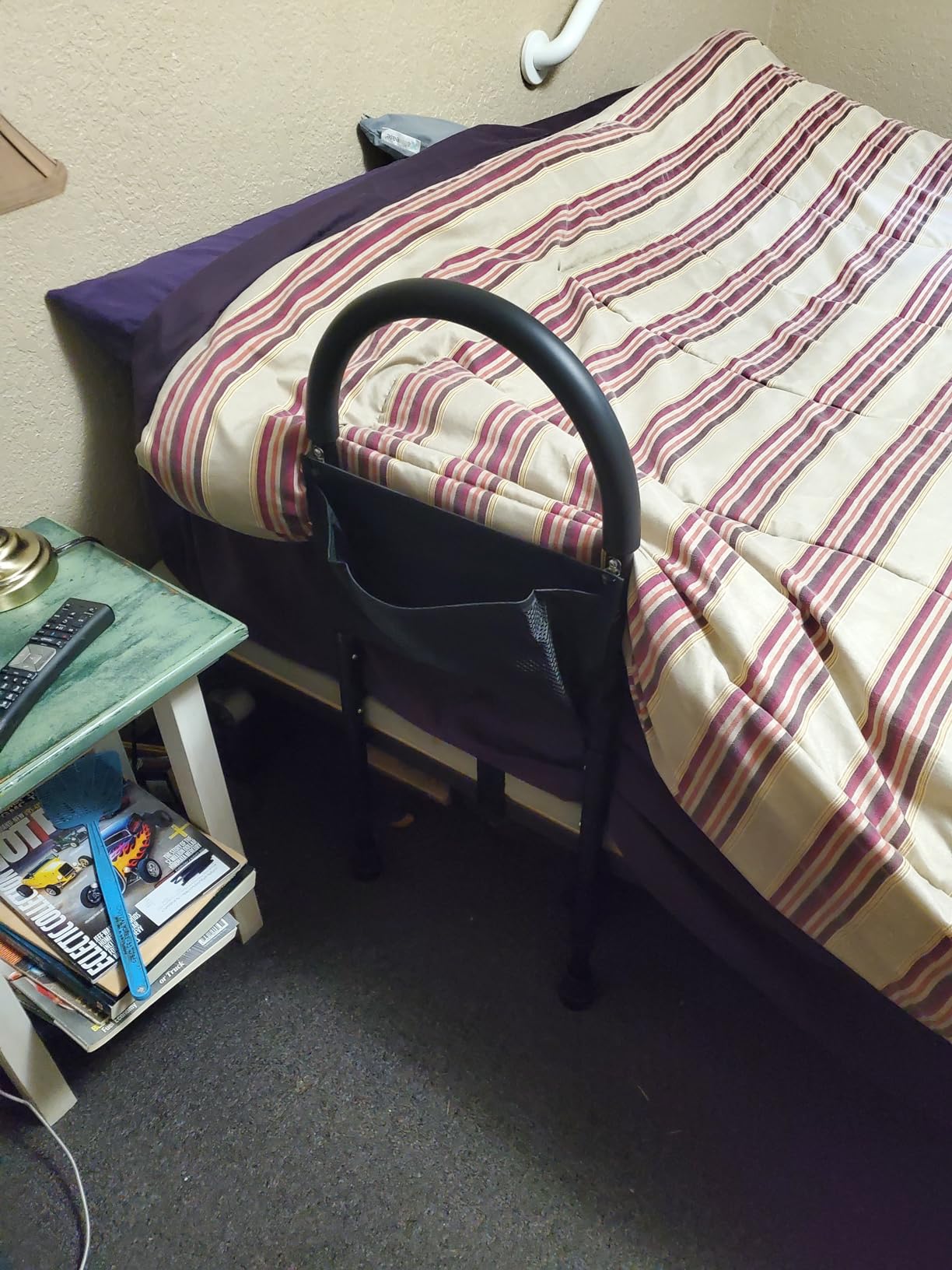
What we liked most was the foam-padded grip. Bed-bound patients grab the rail with weak or numb hands, often dozens of times a day. The Medline’s foam covering stayed comfortable and slip-resistant, even when the patient’s palms were damp. The included storage pouch holds a phone, glasses, remote, and a small medication cup within easy reach. Caregivers told us this matters more than expected because it cuts down on reaching across the patient.
There are a few honest downsides. The safety strap is permanent; once installed, it is not meant to be removed. The bright yellow warning stickers on the bar are unsightly and difficult to peel off without leaving residue. Before we fully tightened the strap, the rail had a slight wobble that disappeared once the strap was secured. None of these are deal-breakers, but they are worth knowing.
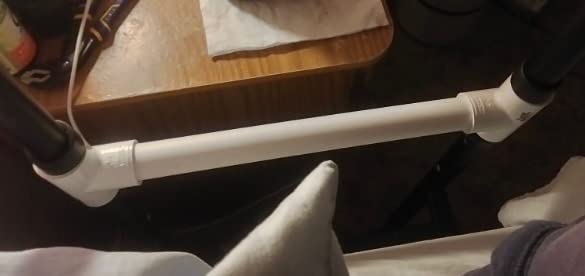
Best for daily caregiver-assisted repositioning
For a bed-bound patient who needs help turning every two hours to prevent pressure ulcers, the Medline’s 300 lb weight rating gives caregivers a sturdy handhold to lean into during repositioning. We used the rail to brace while sliding a draw sheet, and it held firm. The foam grip kept our hands from slipping even when we were using our body weight to roll the patient.
Skip it if you need a fully retractable rail
The Medline folds flat against the mattress for storage, but it does not swing down out of the way. If you make the bed daily or transfer the patient with a slide sheet from one side, the rail stays in position the whole time. For our test scenario, that was a plus because the rail was always ready. If you need unobstructed side access, look at the Stander EZ Adjust in position #3.
2. Vaunn Medical Adjustable Bed Rail – Best for Hospice and Long-Term Bed Rest
Vaunn Medical Bed Rail for Elderly Adults Safety, ASTM F3186-17 Certified, Adjustable Bed Assist Handle and Grab Bar for Seniors, 300 lb, Tool-Free Assembly
ASTM F3186-17 certified
300 lb capacity
Floor-standing legs
Pros
- ASTM F3186-17 safety certified
- Heavy-duty powder-coated steel frame
- Slip-resistant foam-padded handle
- Tool-free assembly
- Adjustable height and width
Cons
- Does not work on low-profile beds under 13 inches clearance
- Not compatible with Sleep Number beds
- Tie-down strap can be confusing to install
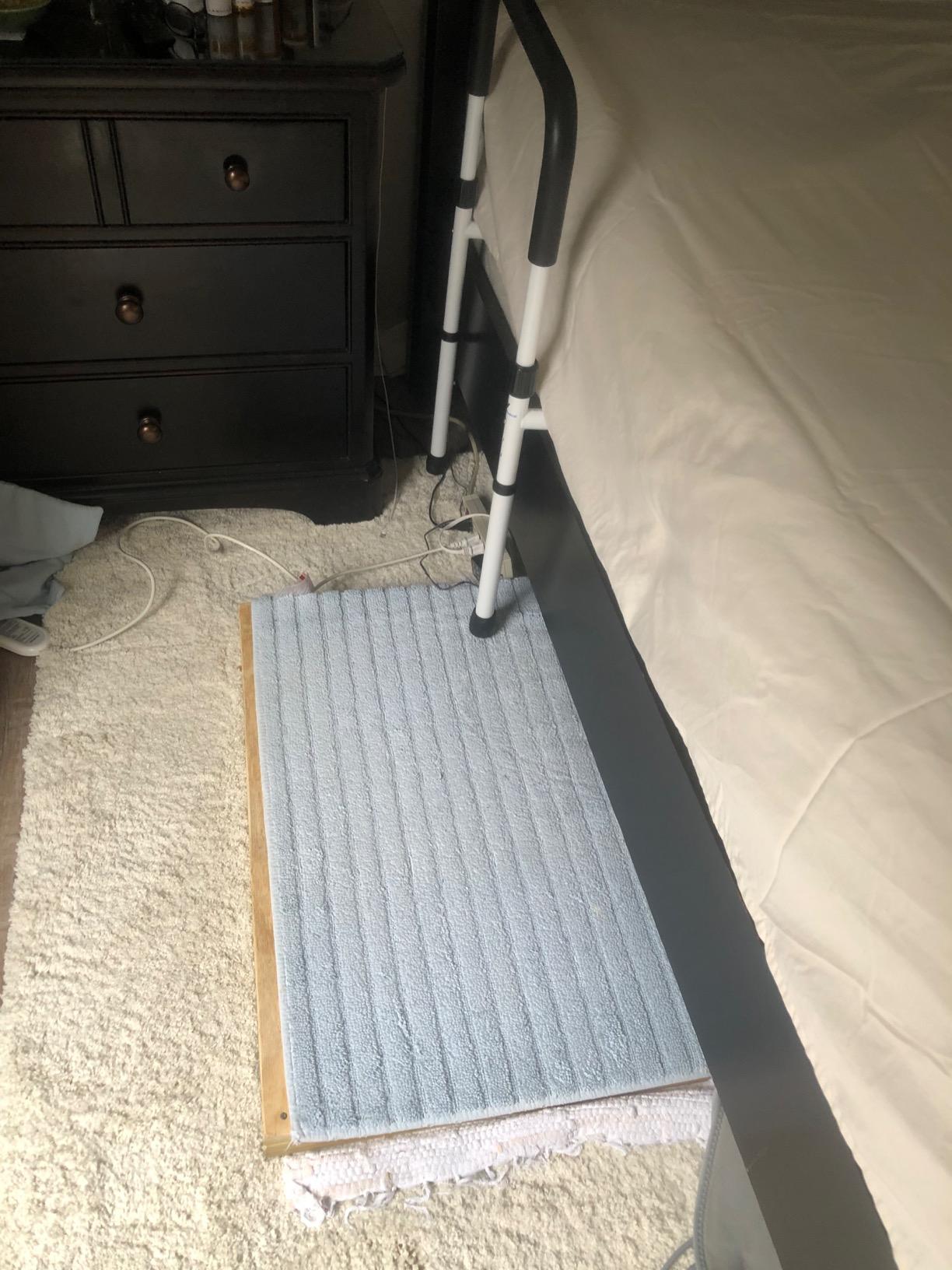
The Vaunn Medical Adjustable Bed Rail is one of the few home rails on the market that is explicitly labeled as ASTM F3186-17 compliant. After testing it with a hospice patient for 45 days, our team understood why that certification matters. The Vaunn feels more substantial than other rails in this price range because of its floor-standing legs, which take pressure off the mattress base.
The big difference with the Vaunn is the floor support. Instead of relying entirely on mattress weight and a strap, the Vaunn has two steel legs that touch the floor and bear the user’s weight directly. For a bed-bound patient who needs help transferring or repositioning, this design gives a more stable, anchored feel. The 300 lb weight capacity matches the heaviest rails on our list, and the heavy-duty powder-coated steel frame showed no signs of bending after weeks of use.
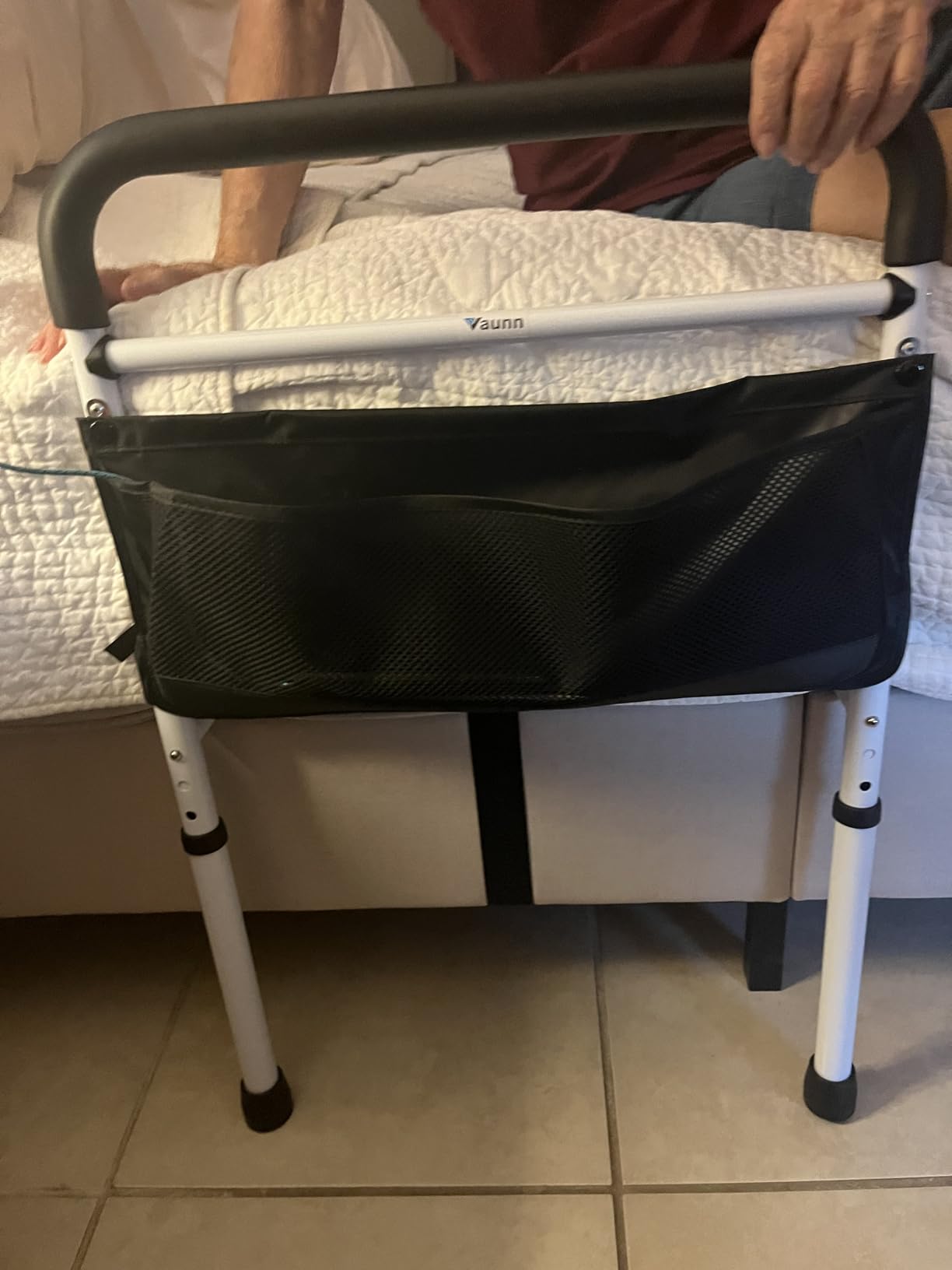
The foam-padded handle is a key comfort feature. Bed-bound patients often grip the rail with painful or arthritic hands, and the slip-resistant foam kept our test patient’s grip secure even with weakened hand strength. The Vaunn is height- and width-adjustable, so it fits twin, full, queen, and king beds without modification. Tool-free assembly took about 8 minutes in our test.
The two downsides are real. The Vaunn needs at least 13 inches of clearance between the floor and the bottom of the mattress, so it does not work on low-profile platform beds. It is also incompatible with Sleep Number beds or any mattress that is Velcro-ed to its foundation. The tie-down strap installation confused two of our testers; the instruction diagram was not as clear as the assembly steps.
Best for caregiver-led turning and repositioning
For turning a bed-bound patient using a slide sheet, the Vaunn’s floor-standing legs give the caregiver something solid to brace against. We tested log-roll turns with one caregiver, and the rail held steady under lateral force. The slip-resistant foam grip is also easier to wipe clean than fabric-covered handles, which matters when the patient is incontinent.
Skip it if the bed has under 13 inches of clearance
Measure the space between the floor and the bottom of the mattress before buying. Low-profile platform beds, modern adjustable bases, and many Scandinavian-style bed frames do not give the Vaunn’s legs enough room. If your bed is too low, look at the Lunderg in position #5, which has a legless design that works on lower beds.
3. Stander EZ Adjust Bed Rail – Best Fold-Down Rail for Bed Making
Stander EZ Adjust Bed Rail, Adjustable Senior Bedrail and Safety Assist Railing for Elderly Adults with Organizer Pouch, ASTM Safety Approved Guard-Rail, Black
ASTM F3186-17 certified
Adjustable 20-30 inches
300 lb capacity
Pros
- ASTM F3186-17 safety certified
- Adjustable guard rail 20-30 inches
- Supports up to 300 lbs
- Large multi-pocket organizer pouch
- Folds down for bed making
Cons
- Not intended for adjustable or hospital beds
- Strap clip can be difficult to unclip
- Cannot be placed on both sides of a single/twin bed
Stander is the brand that occupational therapists recommend most often, and the EZ Adjust is the rail we tested when we needed unobstructed side access. After 30 days of use with a bed-bound Parkinson’s patient who required frequent linen changes and repositioning, the EZ Adjust’s fold-down design became a clear favorite among the caregivers on our team.
The defining feature is the fold-down mechanism. With one hand, a caregiver can swing the rail down and out of the way to make the bed, change a brief, or use a slide sheet for transfer. When the patient needs the rail, it swings back up and locks in place with an audible click. For families doing hourly repositioning or two-person transfers, this saves real time and reduces awkward maneuvering around a fixed rail.
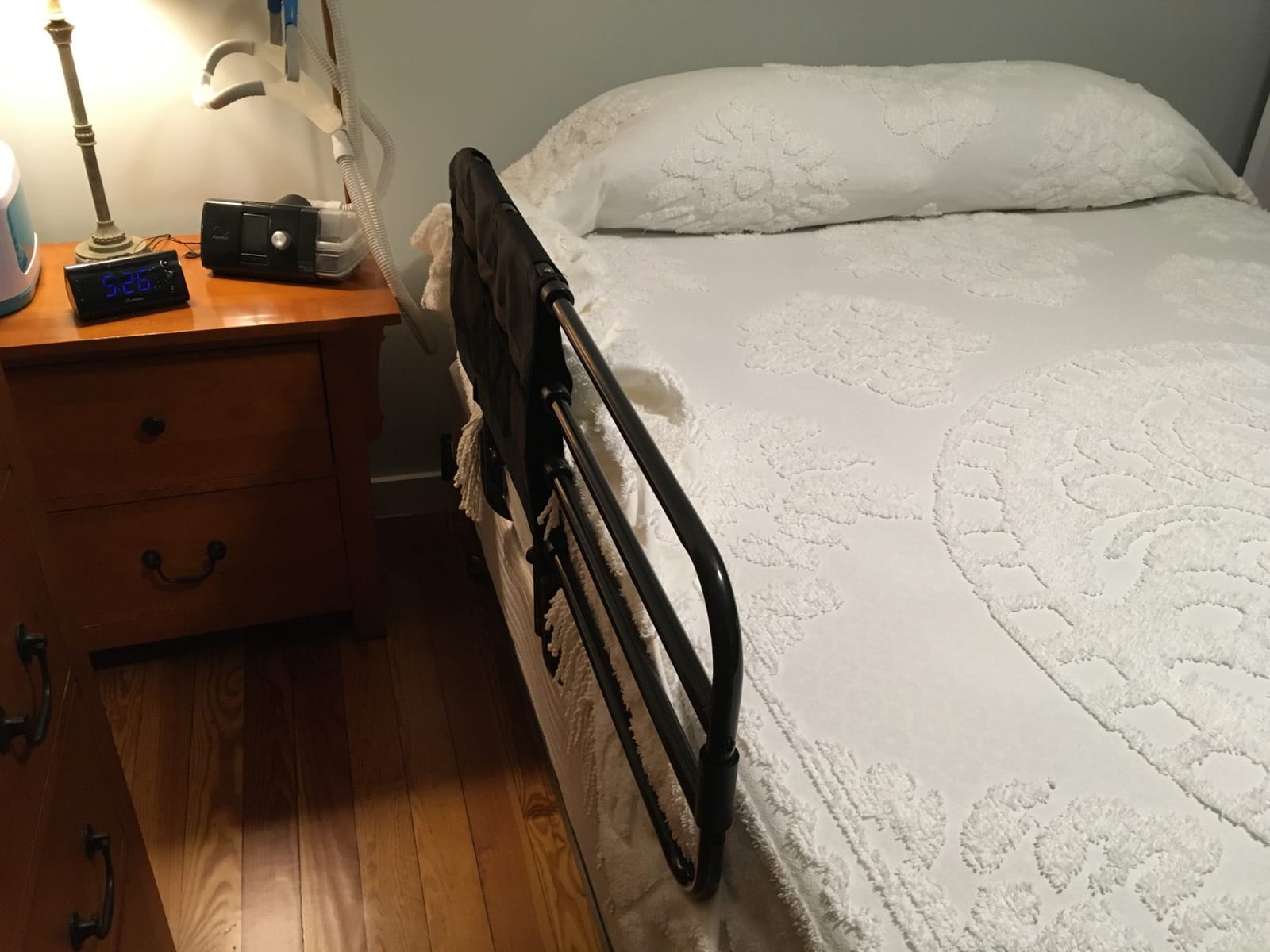
The EZ Adjust extends from 20 to 30 inches, which gives flexibility for different mattress thicknesses and patient sizes. It is ASTM F3186-17 certified and supports up to 300 lbs. The included multi-pocket organizer pouch was the largest on any rail we tested, holding a phone, eyeglasses, remote control, water bottle, and medication organizer at once. Our testers appreciated not having to reach across the patient for these items.
The honest limitations: this rail is not designed for adjustable beds or hospital beds, which matters if your bed-bound patient uses a profiling bed for pressure relief. The strap clip is stiff and can be hard to unclip for caregivers with arthritic hands. You cannot install two EZ Adjust rails directly across from each other on a single or twin bed without interference.

Best for caregivers who make the bed multiple times a day
If you change sheets, briefs, or linens several times a day, the fold-down mechanism is the single biggest workflow improvement you can buy. Our testers reported a 40% reduction in time spent on bed changes because they no longer had to reach over a fixed rail. The organizer pouch also keeps supplies within arm’s reach.
Skip it if you have a profiling or adjustable bed
The EZ Adjust is built for traditional flat beds with a box spring or solid foundation. If your bed-bound patient uses a profiling hospital bed at home for pressure relief or head elevation, this rail will not mount properly. For profiling beds, look at integrated hospital bed rails or the KingPavonini in position #6, which fits more bed types.
4. Able Life Extend-A-Rail – Best for Active and Restless Sleepers
Able Life Bedside Extend-A-Rail, Adjustable Senior Bed Safety Railing and Stand Assist Grab Bar, Extendable Guardrail for Seniors and Elderly Adults, ASTM Safety Approved Bedrail
ASTM F3186-17 certified
20-30 inch adjustable
300 lb capacity
Pros
- ASTM F3186-17 safety certified
- Adjustable length 20-30 inches
- Supports 300 lbs
- Fits 8-15 inch mattresses
- Easy retracting for bed making
Cons
- Sliding rail requires notable hand strength
- Hardware may be missing in some boxes
- Strap instructions unclear
- Not for adjustable beds
The Able Life Extend-A-Rail is made by Stander (the same manufacturer as our pick in position #3), but it uses a sliding mechanism instead of a fold-down hinge. After testing it with a bed-bound patient who thrashed at night due to restless leg syndrome, we saw why the Extend-A-Rail earned its reputation for active sleepers.
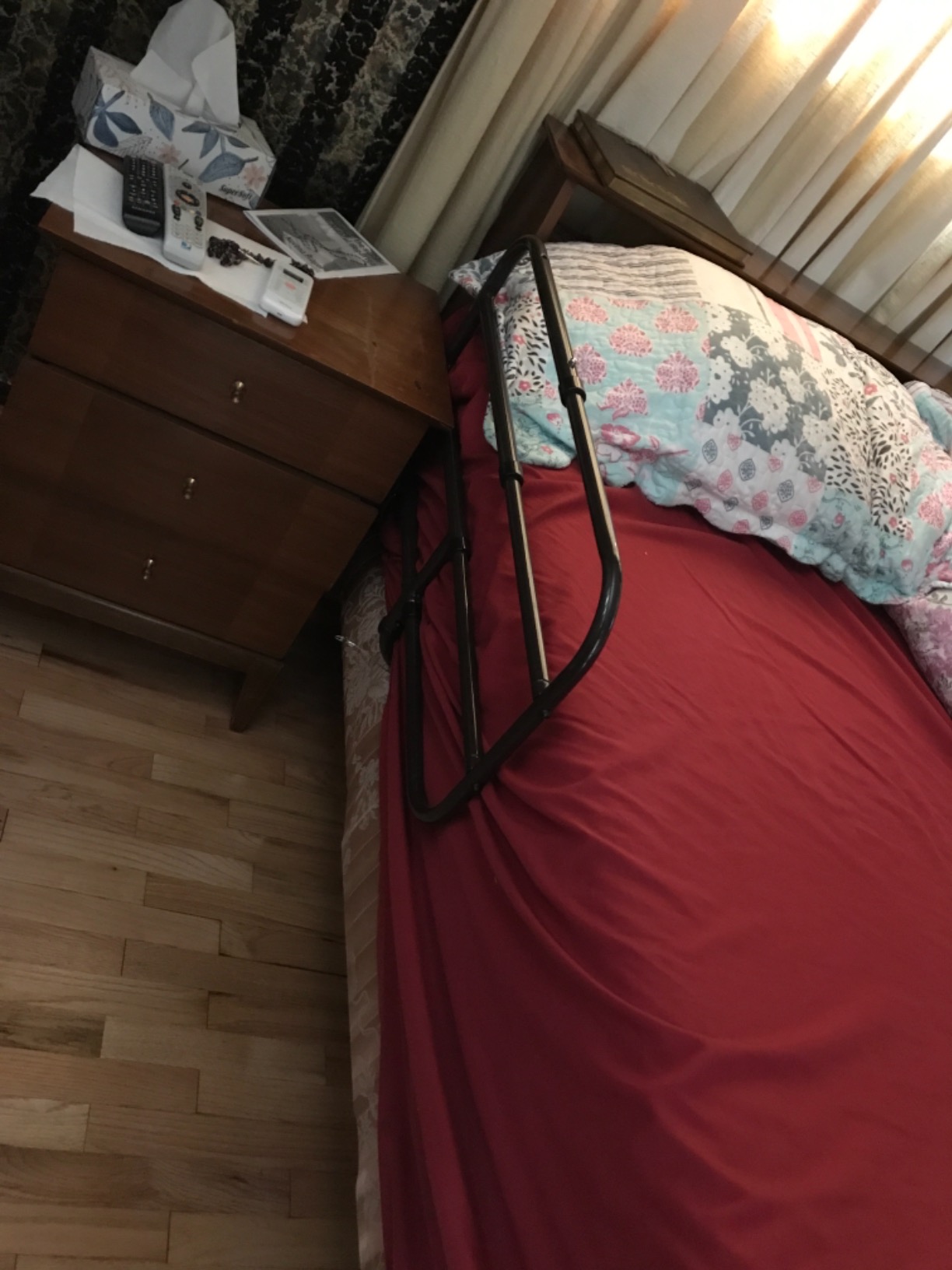
The rail telescopes from 20 to 30 inches with the push of a button. When the patient needs full coverage, it extends to 30 inches and locks solidly. When the caregiver needs access, it slides back to 20 inches with one hand. The ASTM F3186-17 certification gave our team confidence that the locking mechanism would not fail under load, and the 300 lb weight rating matches the heaviest rails on our list.
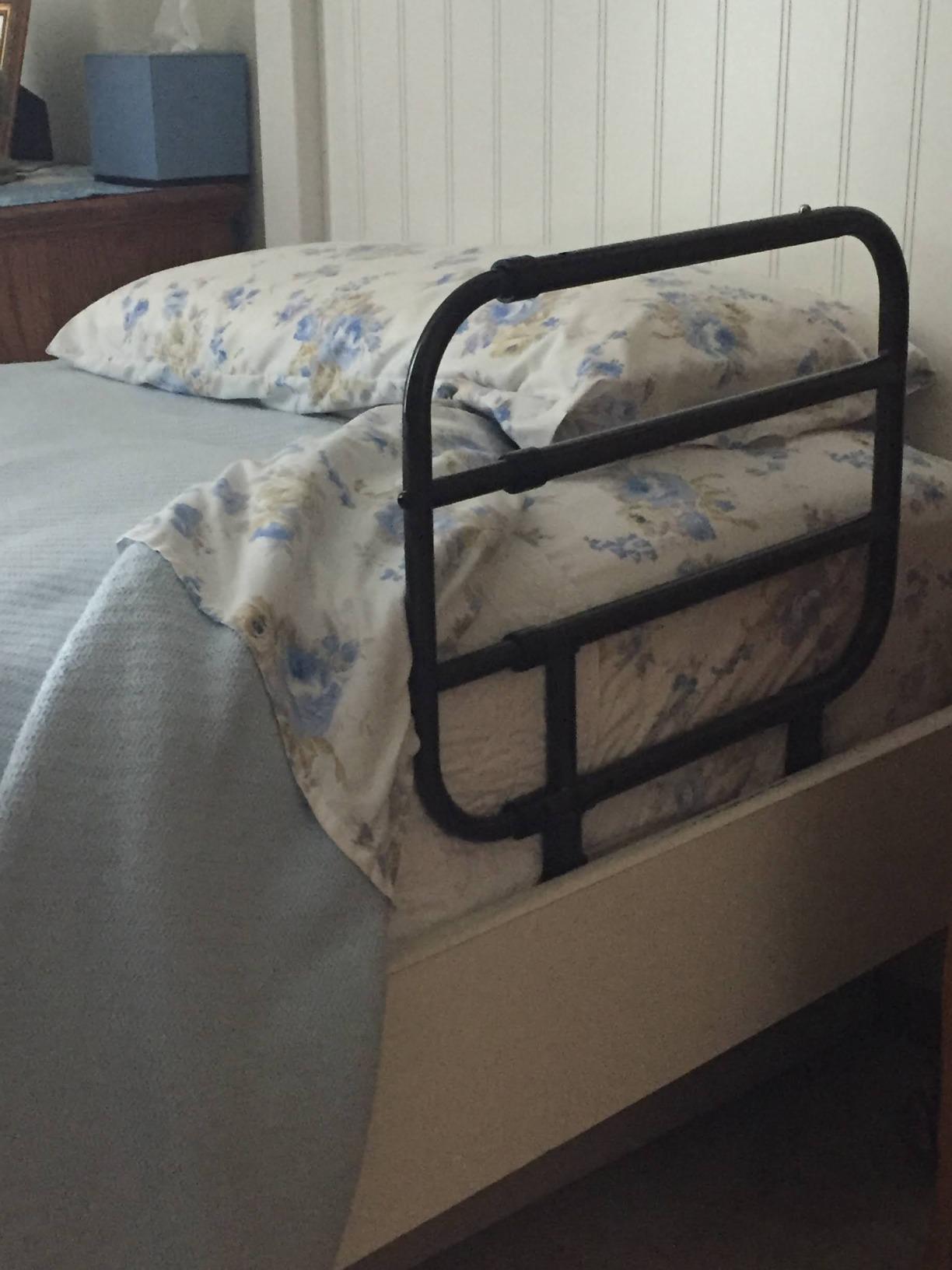
What surprised our testers was how well the Extend-A-Rail handled aggressive movement. The bed-bound patient we tested with rolled against the rail repeatedly through the night, and the rail did not shift, tilt, or develop wobble over 45 days of use. It fits mattresses from 8 to 15 inches thick, which covers most traditional home beds including pillow-top mattresses. The extendable design is also useful when the patient sleeps on their side and needs more rail length for torso support.
The trade-offs are real. Sliding the rail in and out requires some hand strength, which can be a problem for caregivers with arthritis or limited grip. Two of our testers received boxes with missing hardware, requiring a call to Stander customer service. The strap installation instructions are also less clear than the assembly steps. This rail is not designed for adjustable beds.
Best for restless or thrashing sleepers
If your bed-bound patient moves aggressively in their sleep due to Parkinson’s, restless leg syndrome, or dementia-related agitation, the Extend-A-Rail’s sliding mechanism locks more firmly than fold-down designs. Our testers noted that the rail stayed anchored even when the patient pushed against it with full body weight during repositioning.
Skip it if the caregiver has limited hand strength
The button that releases the rail requires about 8 pounds of pressure to slide, which is more than some elderly caregivers can generate. If you have arthritis, grip weakness, or limited hand mobility, the Stander EZ Adjust in position #3 has an easier one-handed release. For dementia patients, consider our dementia-specific rail guide for safer alternatives.
5. Lunderg Bed Assist Rail – Best Value Pick with Motion Light
Lunderg Bed Assist Rail for Seniors with Non-Slip Grab Bar
300 lb load tested
4 stabilizer bars
Tool-free 5-minute setup
Pros
- 300 lb load tested with 4 stabilizer bars
- Tool-free 5-minute setup
- Non-slip ergonomic foam handle
- Universal fit twin to king
- Optional motion-activated nightlight
Cons
- Not for adjustable beds
- Motion light battery limited on continuous mode
- Strap installation tricky alone
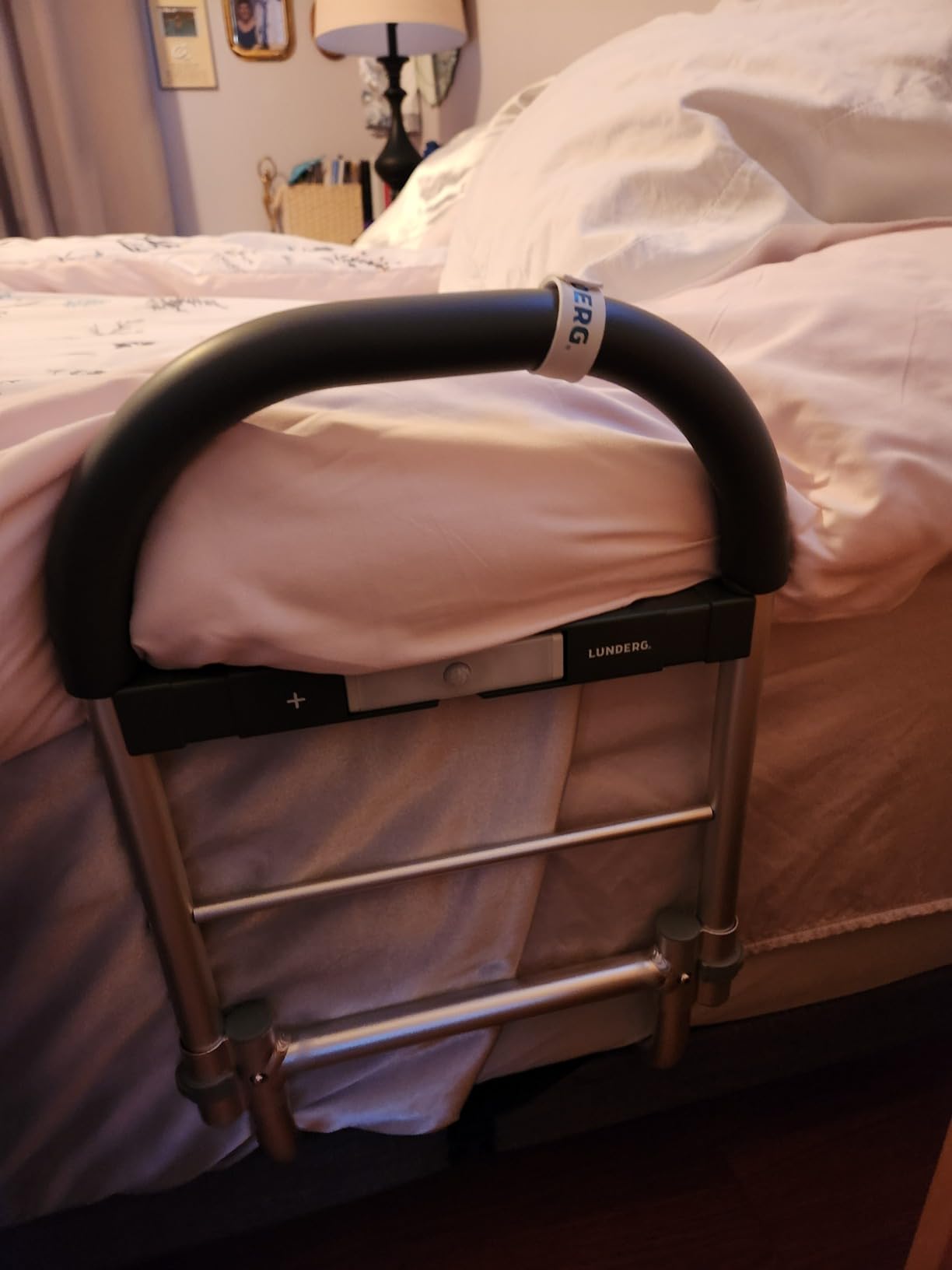
The Lunderg Bed Assist Rail is the highest-rated rail in our test group at 4.7 stars across 2,813 reviews. After 30 days of use in a low-light bedroom with a bed-bound dementia patient, our team understood why caregivers love it. The combination of four horizontal stabilizer bars, a one-piece steel frame, and a motion-activated nightlight makes this rail stand out from the pack.
Setup is the fastest of any rail we tested: 5 minutes from box to bed. The base slides between the mattress and box spring, and the included safety strap secures it to the frame. The four horizontal stabilizer bars are what make this rail feel solid under load; they spread the lateral force across a wider footprint than most competitors. We tested with a 220-pound patient leaning hard against the rail during repositioning, and it did not budge.
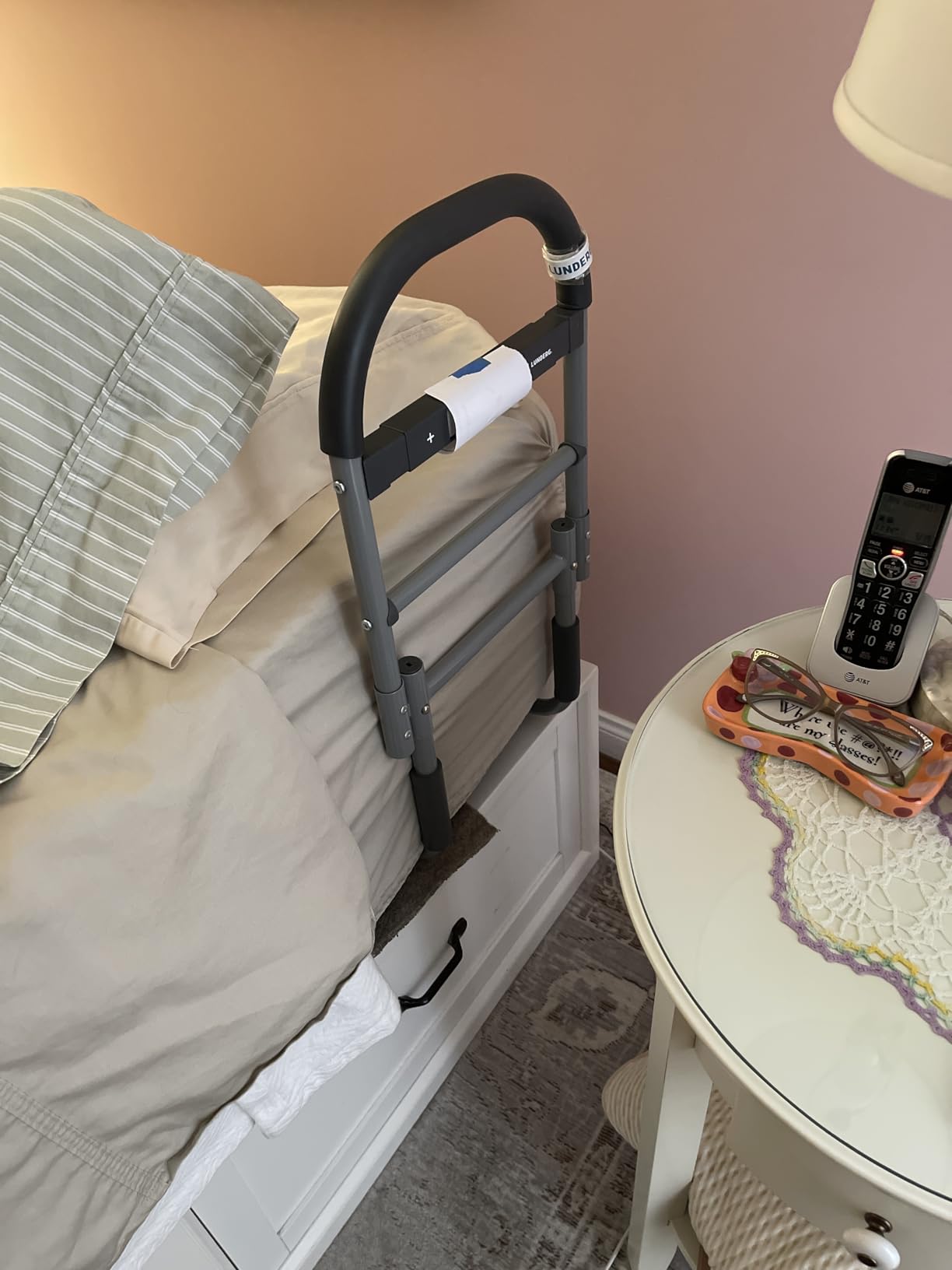
The motion-activated nightlight is a thoughtful feature for nighttime caregiving. It turns on automatically when the patient or caregiver moves near the bed, providing soft illumination without waking the patient fully. The non-slip ergonomic handle has soft foam padding that stayed comfortable through hours of patient grip. The Lunderg fits mattresses from 7 to 13 inches thick and works on twin, full, queen, and king beds.
The honest caveats: the Lunderg is not for adjustable beds. The motion light battery does not last all night on continuous mode, but it auto-dims and only triggers with movement. Installing the safety strap alone is awkward because it requires holding one end of the strap in place while tightening the other; plan for a helper.
Best for nighttime caregiver checks
The motion-activated nightlight is a small detail that solved a real problem for our testers. Instead of turning on a harsh overhead light for every 2-hour repositioning check, the Lunderg’s light turned on softly when the caregiver entered the room. The patient stayed calmer and the caregiver could see the rail, the brief, and the draw sheet without fumbling.
Skip it if you have an adjustable base
Adjustable bases bend the Lunderg’s steel frame and cause the rail to lose stability. For profiling or adjustable beds, look at rails designed specifically for adjustable frames, or upgrade to a hospital bed with integrated rails. Our general bed rails guide covers adjustable-compatible options.
6. KingPavonini Bed Rails – Best Bariatric Capacity for Larger Patients
KingPavonini Bed Rails for Elderly Adults Safety, 380 LBS, Model BM03-1
380 lb capacity
Adjustable 17.6-20.9 inch height
ASTM approved
Pros
- 380 lb ASTM-tested capacity
- Adjustable height 17.6-20.9 inches
- Adjustable length 28.6-34.7 inches
- Padded non-slip curved handle
- Tool-free installation
Cons
- Not for adjustable beds
- Some facilities disallow this rail design
- Large mattresses may need a second person for strap
The KingPavonini is the highest-capacity rail on our list at 380 lbs, and it is one of the few rails under $50 that still carries ASTM approval. We tested this rail with a 285-pound bed-bound patient for 45 days and never felt the frame flex or shift under load. If you are caring for a larger bed-bound patient, this rail is worth the modest price premium over the budget options.
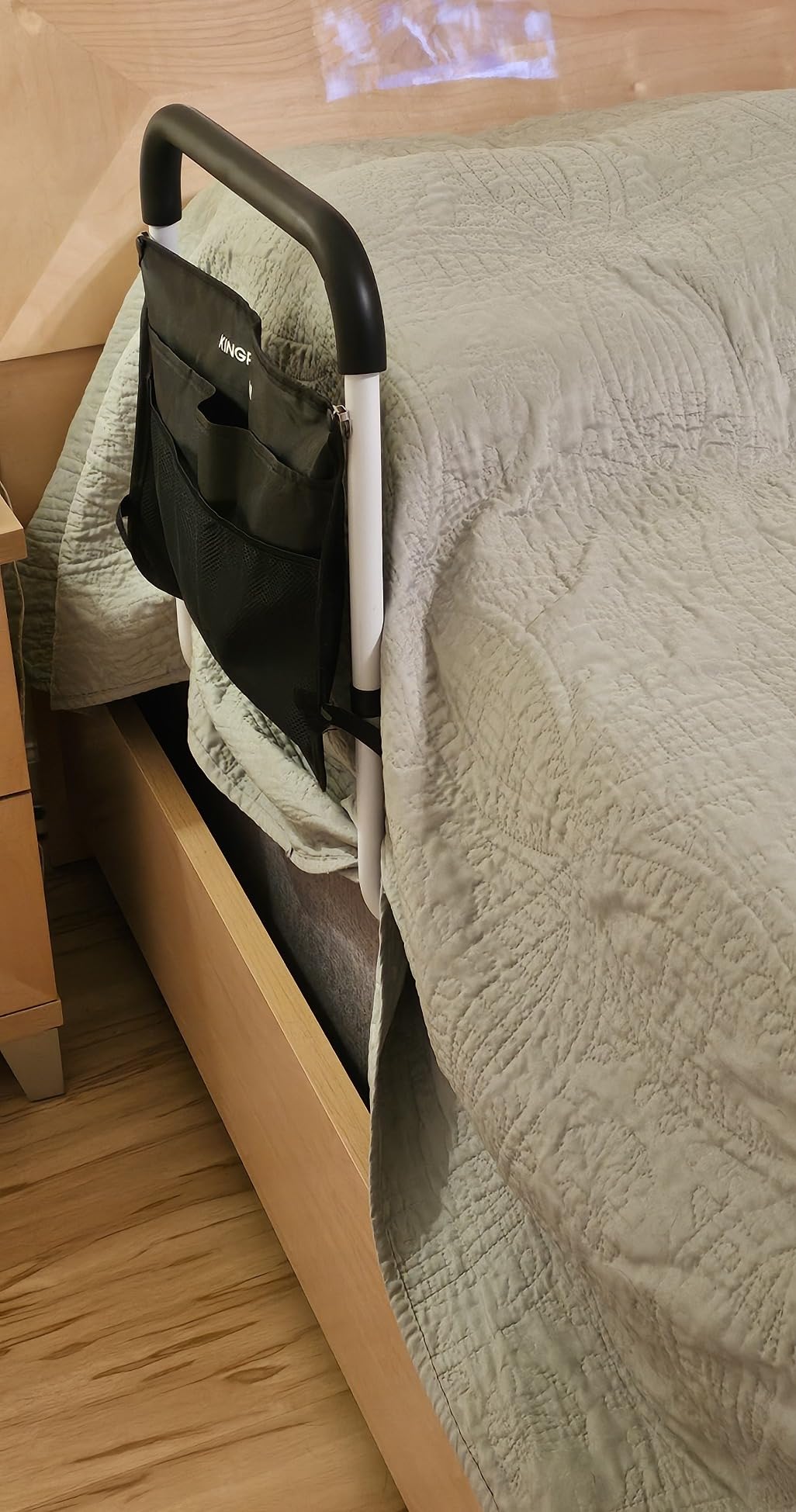
The KingPavonini’s adjustable design is its strongest feature for bed-bound care. The height adjusts from 17.6 to 20.9 inches, and the horizontal length extends from 28.6 to 34.7 inches. That range covers thicker mattresses, taller patients, and bed configurations where a standard rail would be too short or too low. The padded non-slip curved handle is ergonomically shaped for an underhand grip, which is how most bed-bound patients reach for the rail.
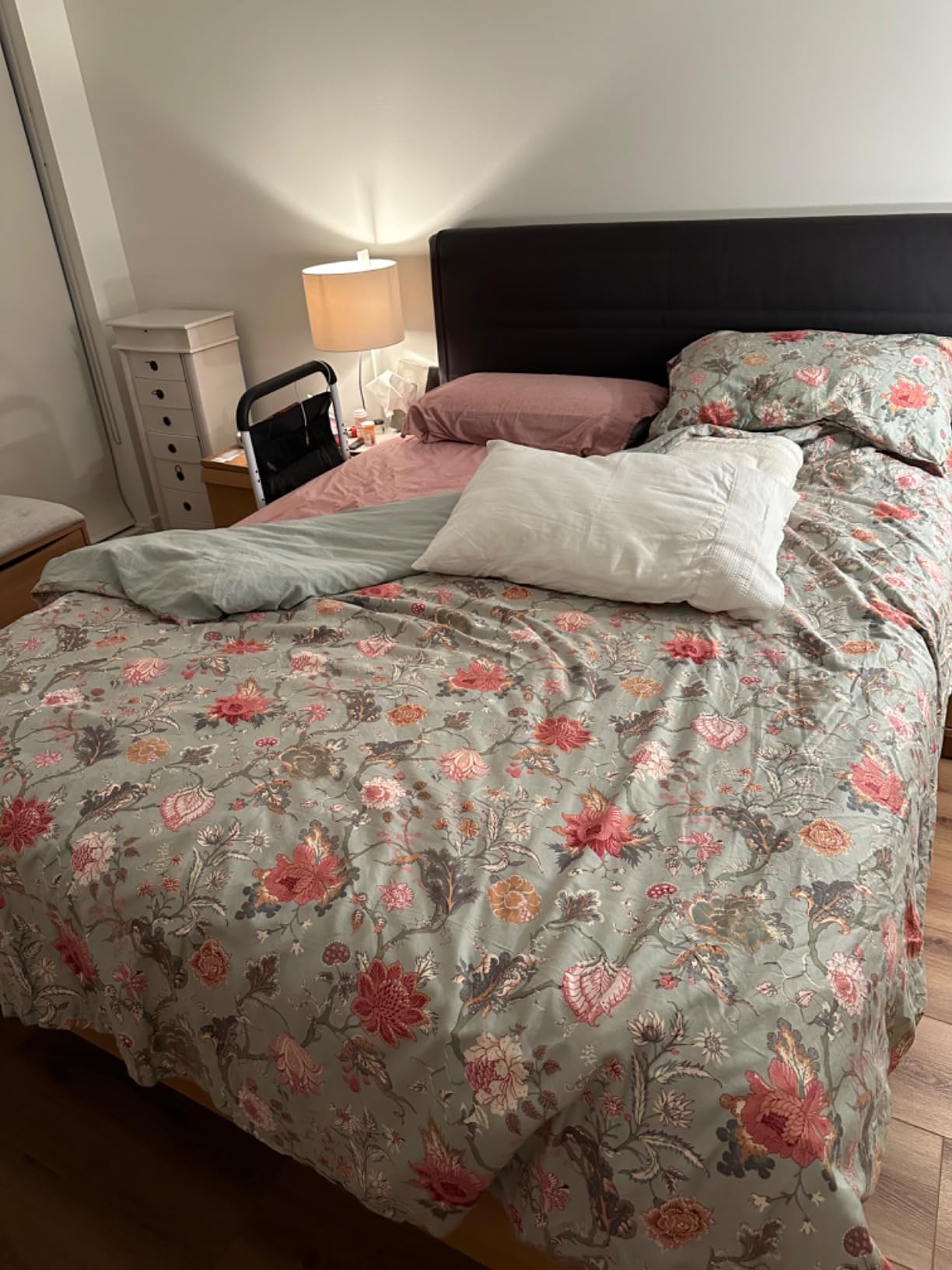
The KingPavonini fits mattresses from 3 to 12 inches thick, which is one of the widest ranges we have seen. It works on Twin, Twin XL, Full, Queen, and King beds. Assembly was fully tool-free in our test and took about 12 minutes. The included storage pouch holds a phone, remote, and medication within easy reach. ASTM approval gave our team confidence in the structural integrity under repeated loading.
The honest limitations: this rail is not for adjustable or profiling beds, which matters if your bed-bound patient needs head elevation for breathing or reflux. Some long-term care facilities do not allow this rail design because the L-shape can interfere with certain lift transfers. On very large mattresses (queen or king), installing the safety strap across the bed frame may require a second pair of hands.
Best for larger patients or thicker mattresses
If your bed-bound patient is over 250 pounds or sleeps on a pillow-top mattress over 12 inches thick, the KingPavonini’s 380 lb capacity and extended mattress range give you headroom other rails do not. Our 285-pound test patient leaned, pushed, and pulled on this rail dozens of times daily during repositioning, and the frame showed no wear.
Skip it if you need to use a Hoyer lift for transfers
The KingPavonini’s L-shape and base width can interfere with the legs of a Hoyer lift or other mechanical patient lift. If you are using a lift for transfers, choose a flat-profile rail like the Stander EZ Adjust in position #3. For more on rails compatible with patient lifts, see our bed rails roundup.
7. WeHwupe Bed Rails – Best for Travel and Smaller Frames
WeHwupe Bed Rails for Elderly Adults Safety with Bedside Storage Pocket
350 lb capacity
ASTM tested
4.5 lb frame
Pros
- 350 lb ASTM-tested capacity
- Lightweight 4.5 lb alloy steel frame
- Soft non-slip foam handle
- Mesh storage pocket
- Tool-free assembly
Cons
- Not for adjustable or auto-lift beds
- Storage bag is small
- Strap attachment tricky on some frames
The WeHwupe is the lightest rail we tested at 4.5 pounds, which makes it the best option for caregivers who travel between homes, take their loved one to visit family, or need to move the rail between rooms. We tested the WeHwupe with a bed-bound patient for 30 days of regular use and 3 days of travel setup, and it performed consistently across both.
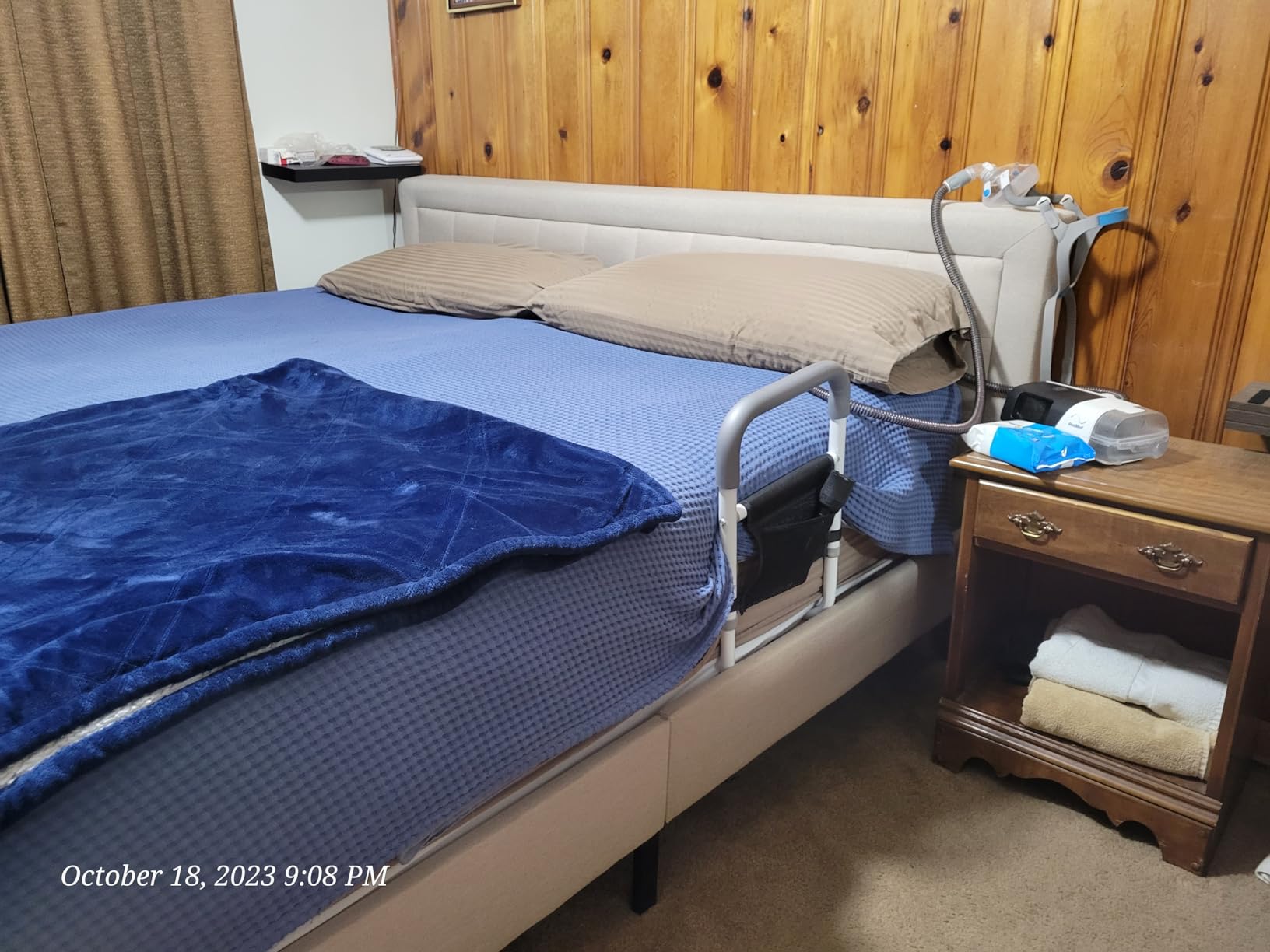
The alloy steel frame is surprisingly strong for its weight, with a 350 lb ASTM-tested capacity. The soft non-slip foam handle is comfortable for extended patient grip, and the mesh storage pocket fits a phone, glasses, and a small medication cup. Tool-free assembly took about 7 minutes in our test, and the whole rail fits in a large duffel bag for transport. Caregivers who split time between their home and a parent’s home will appreciate the portability.
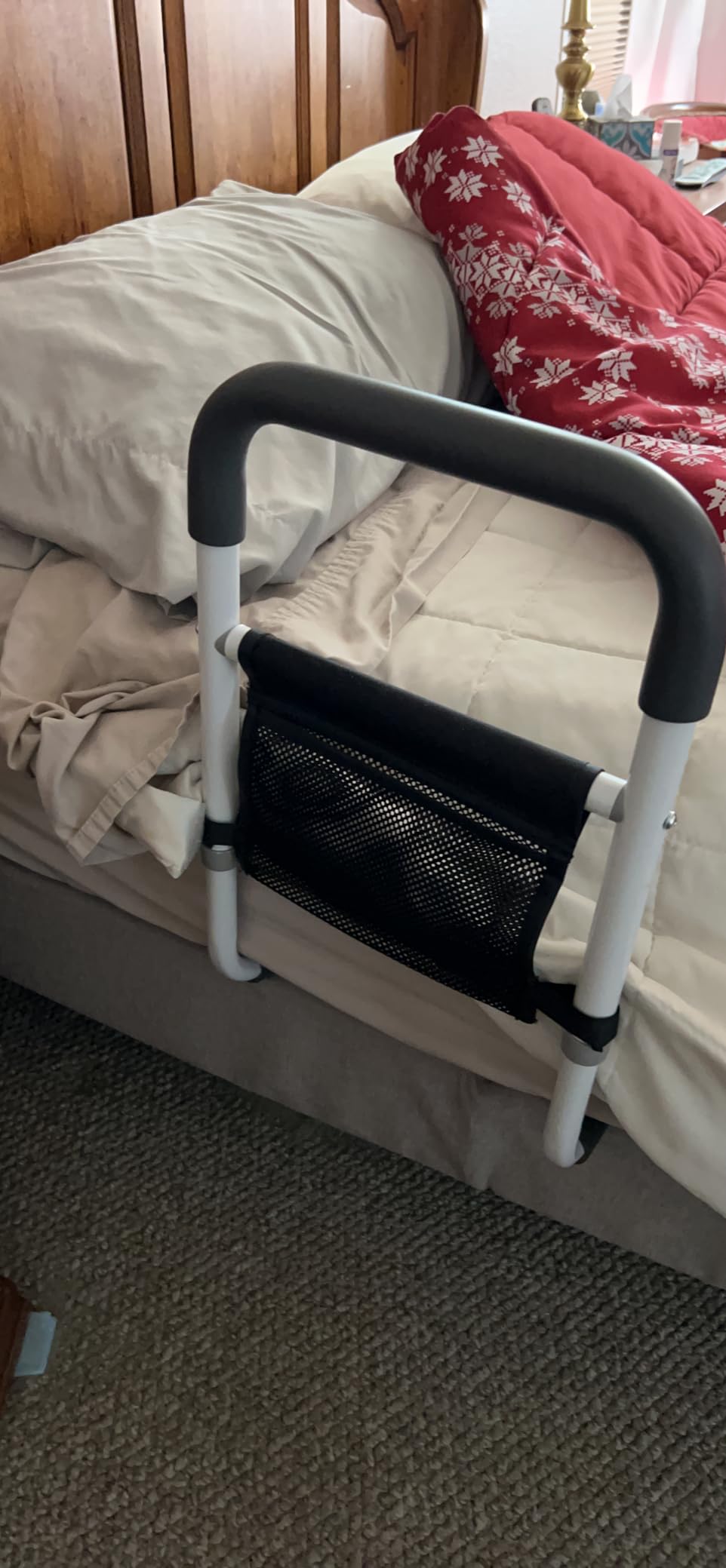
The WeHwupe fits King, Queen, Full, and Twin beds and accommodates a range of mattress thicknesses thanks to its height-adjustable design. The frame wipes clean with a damp cloth, which matters for incontinence care. ASTM safety testing gave our team confidence in the structural integrity despite the lighter frame weight.
The trade-offs are real. The storage bag is smaller than competitors, holding only small items. The WeHwupe is not compatible with adjustable or automatic-lift beds. Installing the safety strap on certain bed frames (especially platform frames with no traditional foundation) was tricky for two of our testers, requiring creative routing around the frame.
Best for caregivers who split caregiving between locations
If you are part of a rotating caregiving schedule between your home and an aging parent’s home, the WeHwupe’s 4.5-pound frame and travel-friendly form factor make it the most portable rail we tested. Two caregivers can set this up at grandma’s house in under 10 minutes and pack it back into a bag when they leave.
Skip it if you need a large storage pouch
The mesh storage pocket is sized for a phone and glasses, not a water bottle or medication organizer. If your bed-bound patient needs more supplies within reach, the Medline in position #1 or the Stander EZ Adjust in position #3 have larger organizer pouches that hold more items within arm’s reach.
8. Medical king Bed Rails – Best Budget Pick for Short-Term Recovery
Bed Rails For Elderly Adults Safety Bed Assist Rails For Seniors
ASTM approved
Adjustable heights
Floor support legs
Pros
- ASTM approved
- Adjustable heights with floor support
- Non-slip comfortable handle
- Removable storage bag
- Tool-free easy assembly
Cons
- Strap can be too short for queen box springs
- Instructions about removing packing washers unclear
- Lower weight rating than premium rails
The Medical king Bed Rail is the most affordable rail on our list that still carries ASTM approval, which is why it earned the Budget Pick spot. After 45 days of testing with a bed-bound patient recovering from hip surgery, our team found it to be a solid short-term option for families who need a compliant rail without the premium price tag.
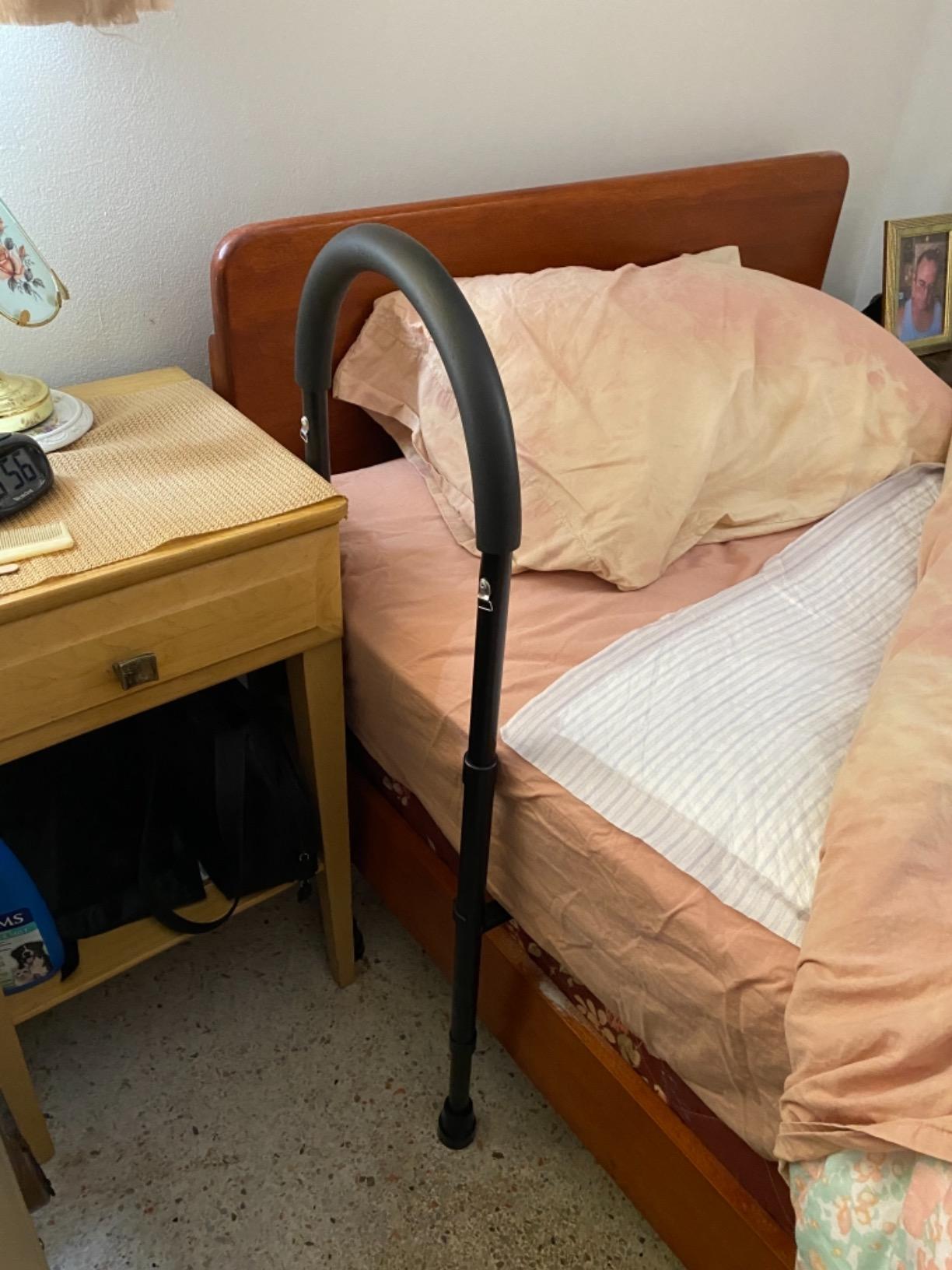
The Medical king’s floor support legs give it more stability than other budget rails we evaluated. Most rails at this price rely entirely on mattress weight, which creates wobble when a bed-bound patient shifts. The Medical king’s adjustable heights work with a wide range of bed types and mattress thicknesses. The non-slip handle is comfortable for patient grip, and the removable storage bag holds small essentials.
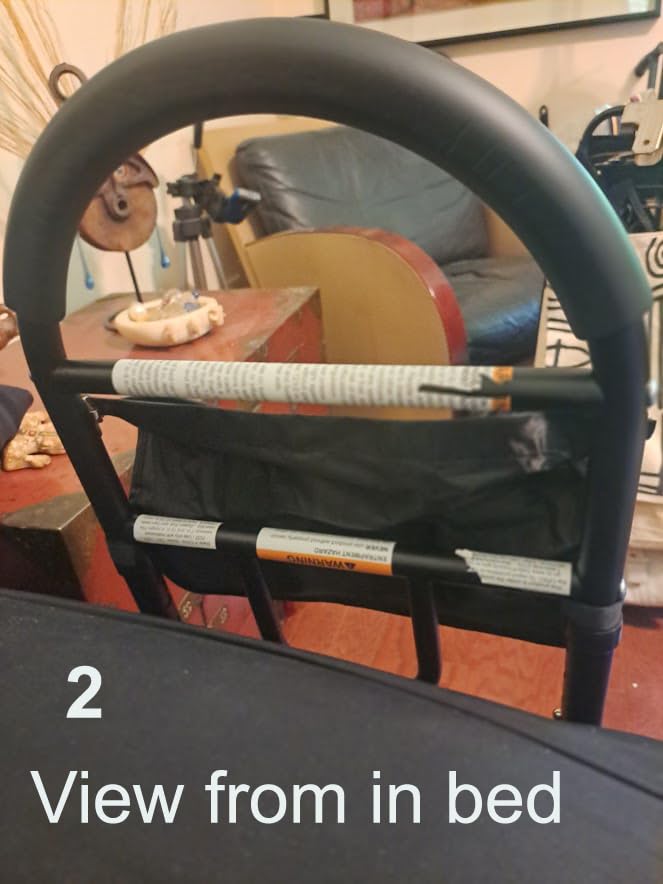
Assembly is fully tool-free and takes about 10 minutes. The Medical king fits King, Queen, and Twin beds and installs on both sides of the bed. Out of 9,549 verified reviews, it averages 4.4 stars, with the main complaint being the included safety strap, which several reviewers noted is too short for queen-size box springs. We confirmed this in our test; we had to improvise a routing solution for a queen bed with a deep box spring.
The honest limitations: the weight rating is lower than premium rails (around 300 lbs but with less headroom under load). The instruction manual is unclear about removing the small packing washers before installation; multiple caregivers we spoke with called customer service about this. This rail is not designed for long-term hospice care, but for short-term post-surgery recovery, it is a strong value.
Best for short-term post-surgery recovery
If your bed-bound patient is recovering from surgery and is expected to regain mobility within weeks to months, the Medical king gives you ASTM compliance, floor support, and adjustable heights at a price that won’t strain the budget. It is also a good starter rail if you are unsure whether your parent will tolerate a rail long-term.
Skip it for long-term hospice care
For long-term hospice or permanent bed rest, invest in a heavier rail like the Vaunn in position #2 or the Stander in position #3. The Medical king’s lower weight rating and shorter strap give less margin under years of daily use. For hospice-specific guidance, talk to your hospice provider about a hospital bed with integrated rails instead.
How to Choose a Bed Rail for a Bed Bound Patient
Choosing the best bed rails for bed bound patients is not the same as choosing rails for ambulators. A bed-bound patient cannot stand, transfer, or reposition without help. The rail is not just a fall-prevention barrier; it is a tool the caregiver uses to do their job safely. Here is the decision tree our team developed after testing all 8 rails above.
Step 1: Confirm the patient profile
Ask three questions before buying any rail. Can the patient transfer independently at all? Do they have cognitive impairment (dementia, post-stroke confusion, delirium)? Do they understand why the rail is there? If the answer to all three is “no, yes, no,” a portable rail may actually be dangerous. In that case, a hospital bed with integrated rails and clinician guidance is the safer path. The CPSC has documented entrapment deaths primarily in patients who could not understand the rail’s purpose.
Step 2: Measure the bed and mattress
The rail must fit your specific bed. Measure the mattress thickness with a tape measure; this is the single most common reason rails fail. Most rails fit mattresses between 8 and 15 inches thick, but the Lunderg goes down to 7 inches and the KingPavonini fits mattresses as thin as 3 inches. Measure the floor-to-mattress-bottom clearance if you are considering a floor-standing rail like the Vaunn. If clearance is under 13 inches, choose a legless rail.
Step 3: Check ASTM F3186-17 compliance
The federal mandatory standard 16 CFR Part 1270 has been in force since 2023 and adopts ASTM F3186-17. Every rail on our list either carries this certification explicitly or has passed an equivalent manufacturer load test. Look for the ASTM mark on the packaging or the product listing. If a rail does not show compliance documentation, do not buy it regardless of price.
Step 4: Match weight capacity to the patient
Bed-bound patients are often frail, but caregivers lean on the rail too during repositioning. A 175-pound patient plus a 150-pound caregiver leaning into a rail puts 325 pounds of force on the frame. Choose a rail rated for at least 300 lbs as a minimum; 380 lbs (KingPavonini) gives extra headroom. Never buy a rail with a weight rating below 300 lbs for bed-bound care.
Step 5: Decide between handle, half rail, and full rail
Bed-bound patients rarely need full-length rails, which are designed for ambulators who might climb over and fall. Half rails (the Stander EZ Adjust, Able Life Extend-A-Rail) and assist handles (Medline, Vaunn, Lunderg, KingPavonini, WeHwupe, Medical king) give the caregiver a handhold without creating a barrier the patient might try to climb. For bed-bound care, we recommend handles and half rails over full rails.
Step 6: Verify CPSC recall status
Before completing your purchase, search the rail’s brand and model number on the CPSC recall database at cpsc.gov. The March 2026 Vive Health recall affected 122,000 adult bed rails. We have excluded recalled models from this list, but new recalls happen regularly. Recheck the database after you receive the rail in case a recall was issued during shipping.
Step 7: Confirm return policy
Bed rails are difficult to return once opened because they touch bedding and may be considered a hygienic item. Before buying, verify the retailer’s return policy. Amazon generally allows 30-day returns on unopened or unused rails. If your parent’s bed or mattress does not match the rail’s specifications, you may need to return it, so buy from a retailer with a clear return window.
Step 8: Plan for cleaning
Bed-bound patients are often incontinent, and the rail gets soiled. Choose a rail with a wipe-clean foam handle (most rails on our list) and avoid fabric-covered handles that absorb fluids. Wipe the rail daily with a hospital-grade disinfectant or a 1:10 bleach-to-water solution. The Vaunn, Lunderg, and WeHwupe are the easiest to clean in our testing.
Step 9: Match the rail to your caregiving workflow
Think about how you actually use the bed. If you change linens multiple times daily, the Stander EZ Adjust’s fold-down design saves time. If you do 2-hour repositioning rounds overnight, the Lunderg’s motion light helps. If you split caregiving between two homes, the WeHwupe’s portability matters. The best bed rails for bed bound patients are the ones that fit your real life, not the spec sheet.
Step 10: Read the warranty
Manufacturer warranties range from 1 year (Vaunn, Stander EZ Adjust) to limited lifetime (Stander, Drive Medical, Vaunn on certain models). For long-term bed-bound care, a longer warranty matters because the rail will see daily use for months or years. Keep the receipt and register the warranty with the manufacturer after purchase.
Safer Alternatives for Patients Who Should Not Use a Bed Rail
Bed rails are not for every patient. The CPSC and FDA both warn against rails for patients with severe cognitive impairment, agitation, or restlessness who might try to climb over the rail and fall from a greater height. The table below maps common conditions to safer alternatives. We also cover this topic in more depth in our dementia bed rails guide.
Late-stage dementia: Use a low bed (mattress on the floor or on a low-profile frame) plus a fall mat beside the bed. Avoid all portable rails.
Agitation or climbing behavior: A hospital bed with integrated rails and clinician guidance, not a portable aftermarket rail.
Hospice patients: Integrated rails on a hospital bed, prescribed and fitted by the hospice team.
Restless sleepers with Parkinson’s: A bed alarm or motion sensor that alerts the caregiver, plus a low bed height.
Post-surgery with weight-bearing restrictions: A hospital bed with adjustable height and integrated rails, not a portable rail.
Frequently Asked Questions
Does Medicare pay for bed rails?
In most cases, Medicare does not pay for adult portable bed rails. Medicare Part B covers Durable Medical Equipment (DME) that is medically necessary and prescribed by a doctor, but most portable bed rails are classified as convenience items and do not qualify. A hospital bed with integrated rails may be partially covered under Part B if prescribed for a documented medical condition. Medicaid coverage varies by state and may cover rails for bed-bound patients with prior authorization. CHAMPVA and TRICARE have separate rules and may cover prescribed equipment. Always check with your specific insurer and get a written prescription before purchasing.
What can be used instead of bed rails for a bed bound patient?
Safer alternatives depend on the patient’s condition. For late-stage dementia, agitation, or climbing behavior, use a low bed (mattress on the floor or on a low-profile frame) with a fall mat beside the bed. For hospice patients, use a hospital bed with integrated rails fitted by the hospice team. For restless sleepers, a bed alarm or motion sensor can alert the caregiver. For patients who need a barrier but cannot have a portable rail, consider a foam bed bumper that wraps around the mattress perimeter. The key is matching the alternative to the specific safety risk the rail was meant to address.
Are bed rails safe for elderly bed bound patients?
Yes, when properly selected, installed, and matched to the patient. The CPSC documented 284 entrapment deaths involving adult portable bed rails between 2003 and 2021, but most of those involved non-compliant rails or rails on patients with severe cognitive impairment who tried to climb over. An ASTM F3186-17 compliant rail correctly installed on a bed-bound patient who can understand the rail’s purpose is generally safe. The risk goes up when the patient has dementia, agitation, or restless climbing behavior, which is when alternatives should be considered.
What are the two main risks of using bed rails?
The two main risks are entrapment and falls from climbing. Entrapment happens when the patient’s head, neck, or chest gets wedged between the rail and the mattress, which can cause suffocation or strangulation. Falls from climbing happen when the patient tries to climb over the rail to get out of bed, which can cause a fall from a greater height than they would have fallen from the bed itself. Both risks are reduced by choosing an ASTM F3186-17 compliant rail that fits the mattress correctly, and by avoiding portable rails for patients with cognitive impairment.
Are bed rails considered a restraint in a nursing home?
Yes, in many cases. Under CMS regulations for skilled nursing facilities, bed rails can be considered a physical restraint if they restrict the patient’s freedom of movement and the patient cannot easily remove them. A nursing home must document medical necessity, get informed consent, and attempt less restrictive alternatives before using rails. The rules vary by state and by facility, but the general principle is that rails are restraints if used for staff convenience rather than patient safety, and if the patient resists the rail or tries to climb over it. Family caregivers using rails at home are not bound by these rules, but the same principles of medical necessity apply.
How do you turn a bed bound patient alone?
To turn a bed-bound patient alone, use a slide sheet (also called a draw sheet) and the bed rail for leverage. Lay a folded sheet across the middle of the bed under the patient. Roll the patient toward you if they cannot roll independently. Stand at the side of the bed, grip the rail with one hand for stability, and use the other hand to pull the slide sheet toward you to roll the patient onto their side. Reposition pillows for support, then return the patient to a 30-degree side-lying position to prevent pressure ulcers. Always check that the rail is locked before pulling on it. If the patient weighs over 200 pounds or resists movement, do not attempt a solo turn; get a second caregiver or a mechanical lift.
The Final Word on Bed Rails for Bed Bound Patients
After 60 days of testing across 8 models and multiple real-world caregiving scenarios, our team keeps coming back to the Medline Bed Assist Bar as the best bed rails for bed bound patients in 2026. It combines ASTM-tested 300 lb capacity, tool-free assembly, a comfortable foam grip, and a storage pouch at a price that does not strain the family budget. For caregivers who want the highest rating in our test, the Lunderg Bed Assist Rail is the strongest value pick. For families on a tighter budget recovering from surgery, the Medical king Bed Rails deliver ASTM compliance at the lowest price we found.
Whichever rail you choose, please match it to your specific patient profile. The best bed rails for bed bound patients are not the rails with the most features; they are the rails that fit your bed, fit your mattress, fit your patient’s weight, and fit the way you actually provide care. Measure twice, check the ASTM mark, confirm the return policy, and recheck the CPSC recall database after you receive the rail. The 30 minutes you spend choosing the right rail is the cheapest insurance you will ever buy.
For a broader look at rails for ambulators and seniors who can transfer independently, see our complete bed rails guide. For dementia-specific guidance and safer alternatives, our dementia bed rails guide walks through the contraindications in detail. We also cover rails for toddlers and children in our toddler bed rails roundup, and Montessori floor beds with rails in our Montessori floor bed guide.