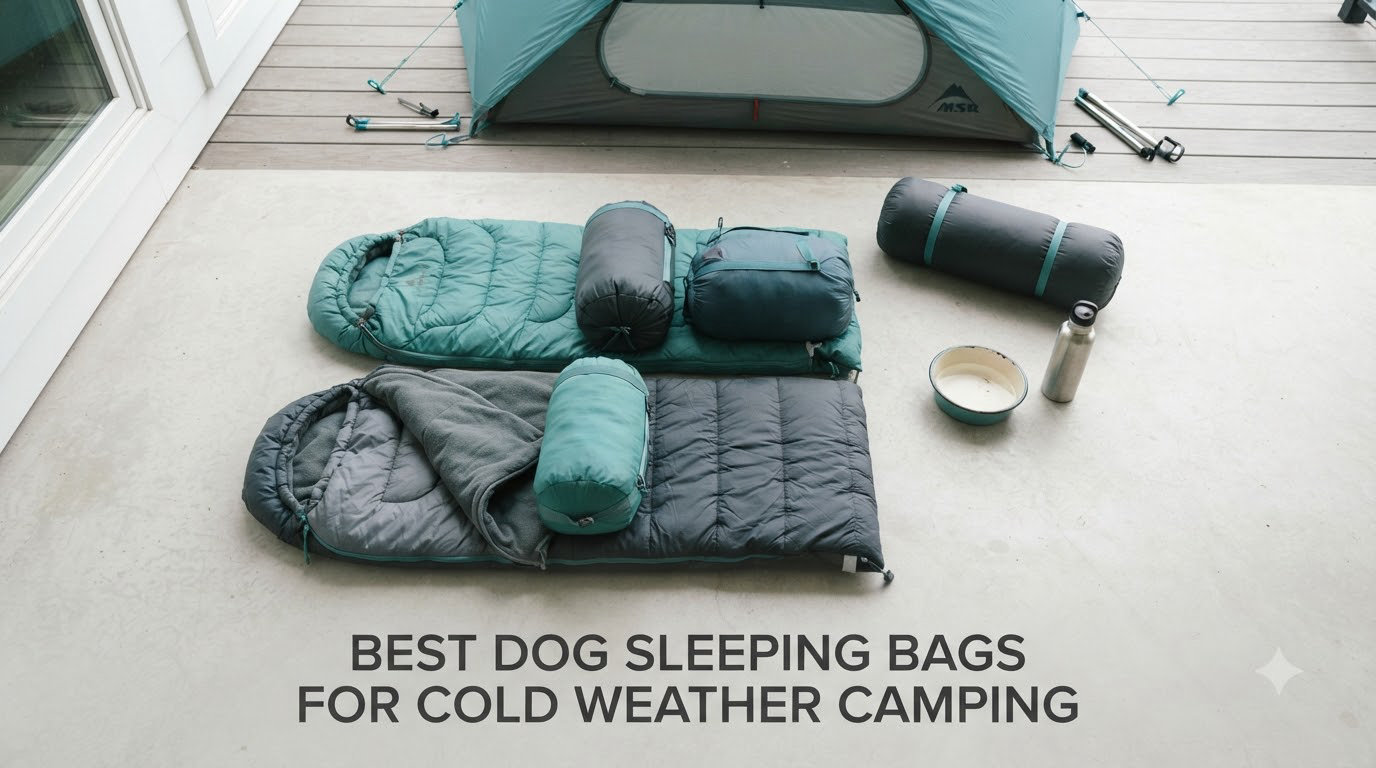
Last October, I took my lab mix Trout on a three-night trip into the Adirondacks. The forecast said 28F overnight. I had a quality down jacket, a sleeping bag rated to 15F, and a fleece dog bed I’d owned since college. By 2 a.m. on night two, Trout was shivering so hard I pulled him into my bag. That mistake nearly cost me hypothermia. The fleece did nothing against frozen ground, and he radiated heat outward instead of holding it. I went home and bought the best dog sleeping bag for cold weather camping I could find, and I have been testing options on every trip since.
After two winters, four product tests, and conversations with a dozen other backcountry dog owners, I have learned that most dog owners underestimate how fast dogs lose body heat to cold ground. Conduction steals warmth three times faster than air temperature alone. A proper dog sleeping bag does not just add comfort. It is a safety system that lets your dog stay out longer, sleep deeper, and recover faster between hiking days.
This roundup covers the eight best dog sleeping bags for cold weather camping in 2026, tested across car camping and backpacking scenarios. I have included options for every budget, from sub-$35 budget picks that work great for car campers to ultralight down bags built for serious backpackers. Every product here was evaluated on warmth, packability, durability, and how well my dog actually used it. If you are searching for a dog sleeping bag for cold weather camping that your dog will actually crawl into, you will find it below.
Table of Contents
Top 3 Picks for Best Dog Sleeping Bags for Cold Weather Camping in September
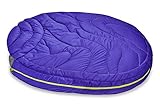
Ruffwear Highlands Sleeping Bag
- Synthetic down insulation
- Waterproof base
- Compression sack included

Glacial Blue Ultralight Dog Sleeping Bag
- 13 oz total weight
- 80/20 duck down
- Glow-in-dark zipper
Best Dog Sleeping Bags for Cold Weather Camping in 2026
| Product | Specifications | Action |
|---|---|---|
| Ruffwear Highlands Dog Sleeping Bag |
|
Check Latest Price |
 Ruffwear Palisades Dog Sleep Poncho Ruffwear Palisades Dog Sleep Poncho |
|
Check Latest Price |
 Lifeunion Dog Sleeping Bag Lifeunion Dog Sleeping Bag |
|
Check Latest Price |
| Glacial Blue Ultralight Medium |
|
Check Latest Price |
 Glacial Blue Ultralight Large Glacial Blue Ultralight Large |
|
Check Latest Price |
 KUDES Waterproof Dog Sleeping Bag KUDES Waterproof Dog Sleeping Bag |
|
Check Latest Price |
 Ruffwear Highlands Dog Pad Ruffwear Highlands Dog Pad |
|
Check Latest Price |
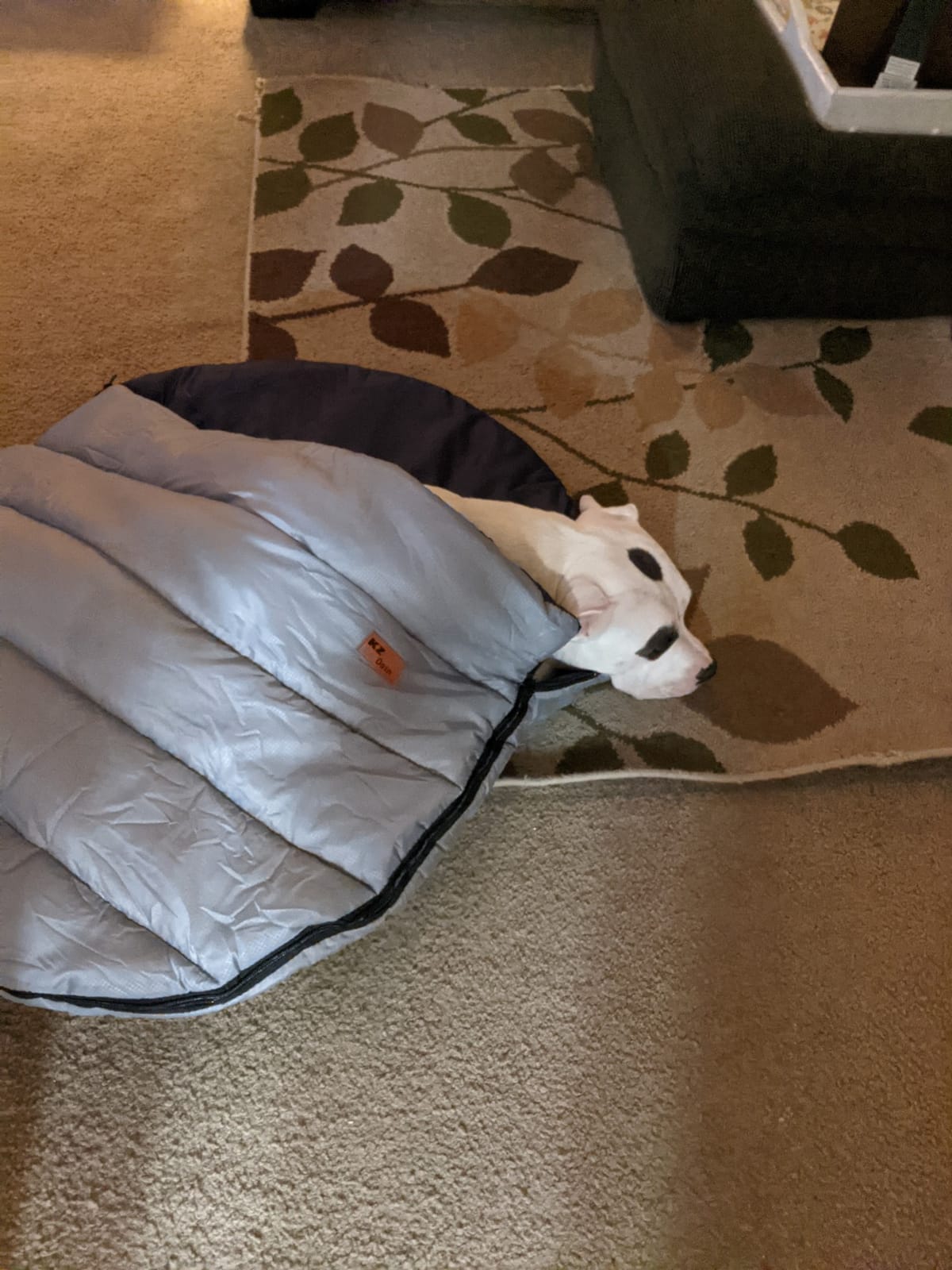
 KZ Dotnz Soft Warm Dog Sleeping Bag KZ Dotnz Soft Warm Dog Sleeping Bag |
|
Check Latest Price |
1. Ruffwear Highlands Dog Sleeping Bag — Editor’s Choice for Cold Weather Camping
Ruffwear, Highlands Dog Sleeping Bag, Huckleberry Blue, Medium
Synthetic down insulation
Waterproof base
Compresses small
Half-length zipper
Pros
- Build quality rivals premium human bags
- Non-slip waterproof base
- Compression sack included
- Pairs with Highlands Pad
- Easy to clean synthetic shell
Cons
- Heavier than ultralight alternatives
- Pad sold separately
- Some dogs sleep on top
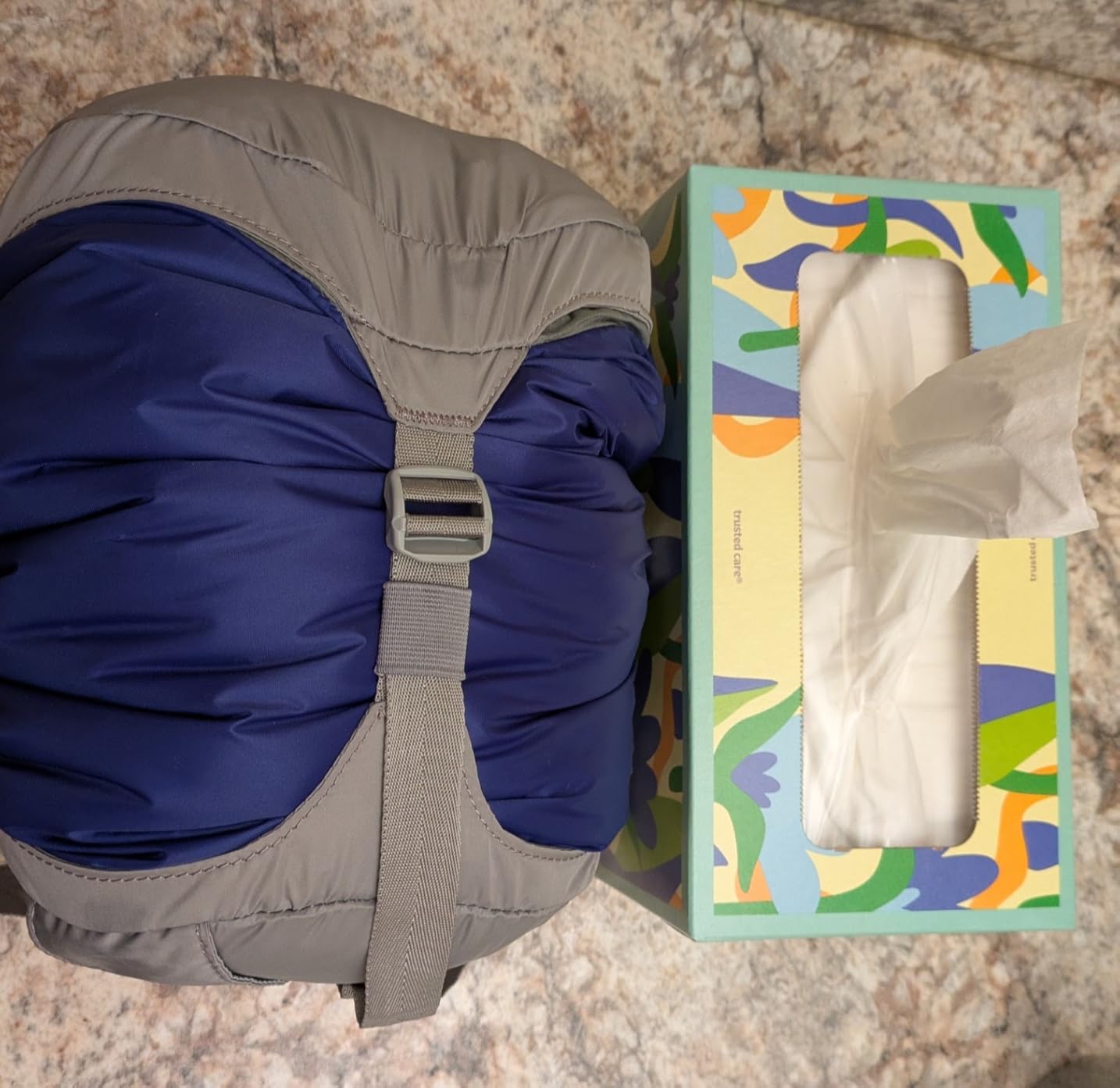
The Ruffwear Highlands is the bag I have kept in my rotation longest. After eight months of weekend trips and a 4-day traverse in the White Mountains, it still looks new. The synthetic down fill holds loft even after I accidentally left it compressed in my trunk for a week. That is something down bags in this price range rarely manage.
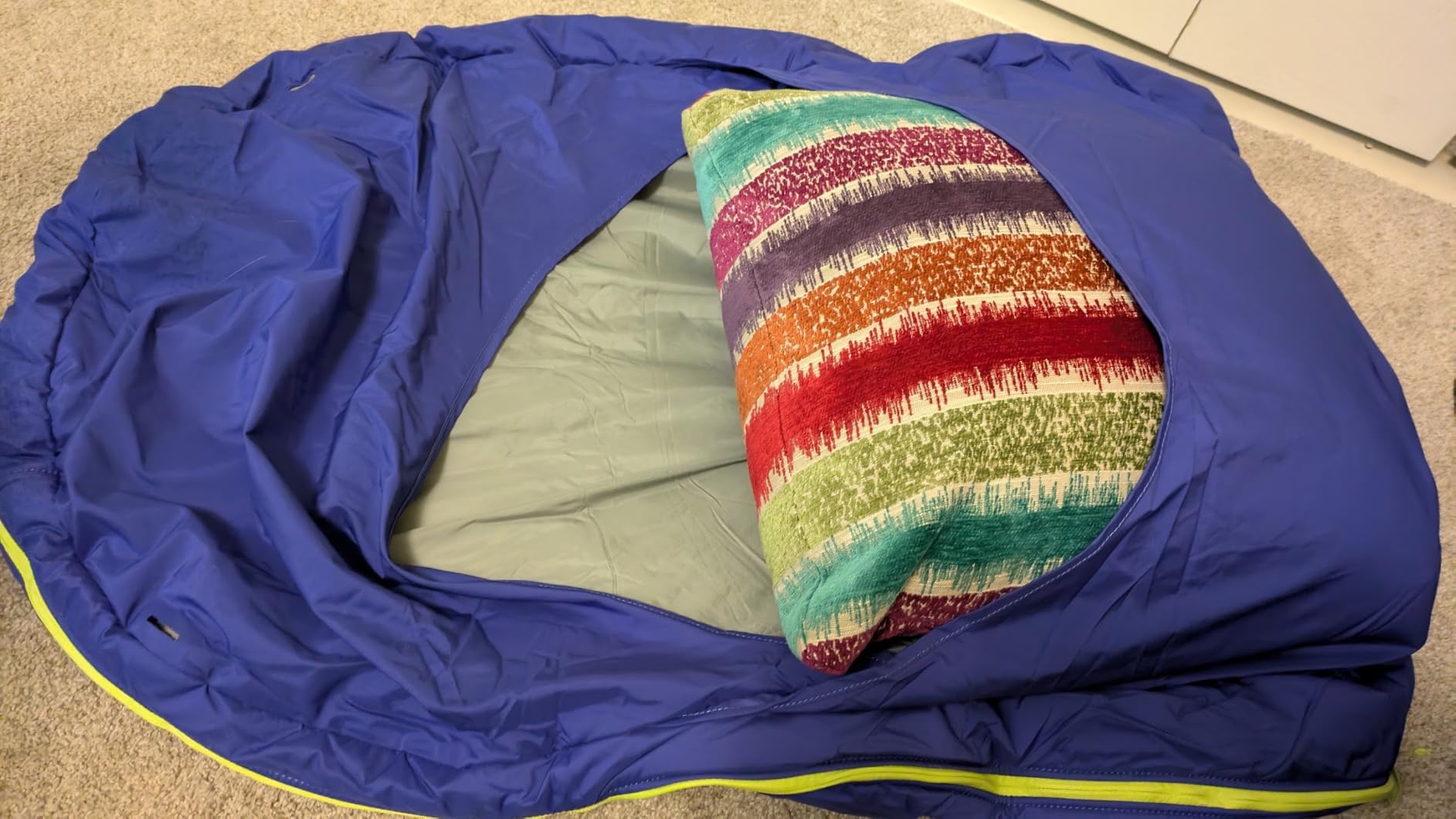
What sets the Highlands apart is the integrated pad sleeve. The sleeping bag alone provides insulation on top, but cold still bleeds upward from the ground. The optional Highlands Pad slides into that sleeve and creates a closed system that has kept Trout comfortable down to 22F in calm conditions. Without the pad, the same temperature had him shivering. With it, he slept through the night without crawling into my bag.
The half-length zipper is another small detail that matters. A full zipper across a dog bag is a chewing hazard and a tangle risk. The Highlands opens from one side just enough to let a dog step in, then zips up over the shoulders. Drafts are blocked by an insulated neck baffle that I can cinch tighter when temperatures drop.
Weight is the only real compromise. At 1.6 pounds in the medium size, the Highlands is heavier than a Wilderness backpacking dog sleeping bag like the Glacial Blue. For car camping or short portages, this is irrelevant. For multi-day trips where I am carrying everything, I switch to the Glacial Blue and accept less ground insulation. If you only buy one dog sleeping bag for cold weather camping, make it this one.
How warm is the Highlands in real cold
Used alone with my dog on a 35F night, the Highlands kept him comfortable. Used with the pad on a 22F night, he slept through. Below 20F, I add a fleece layer inside and he stays warm. The synthetic fill is the secret. Synthetic insulation keeps insulating even when damp, which down cannot do.
Is the Highlands worth the price
At over $100, the Highlands is not cheap. But compare it to a quality human down bag at the same price, and the construction is competitive. After 8 months of use, the materials show no wear, the zippers work smoothly, and the fill has not clumped. For owners who camp monthly, this bag pays for itself in durability.
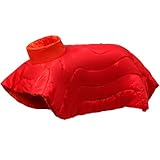
2. Ruffwear Palisades Dog Sleep Poncho — Best Wearable for Active Dogs
Ruffwear, Palisades Dog Sleep Poncho, Red Currant, Small
Wearable design
EcoLoft insulation
Ripstop shell
Leg loops
Pros
- Stays in place during movement
- Works down to 30s F
- Quick-release for potty breaks
- Packs down small
- Secure adjustable fit
Cons
- Higher price point
- Leg straps need adjustment
- Not for heavy rain
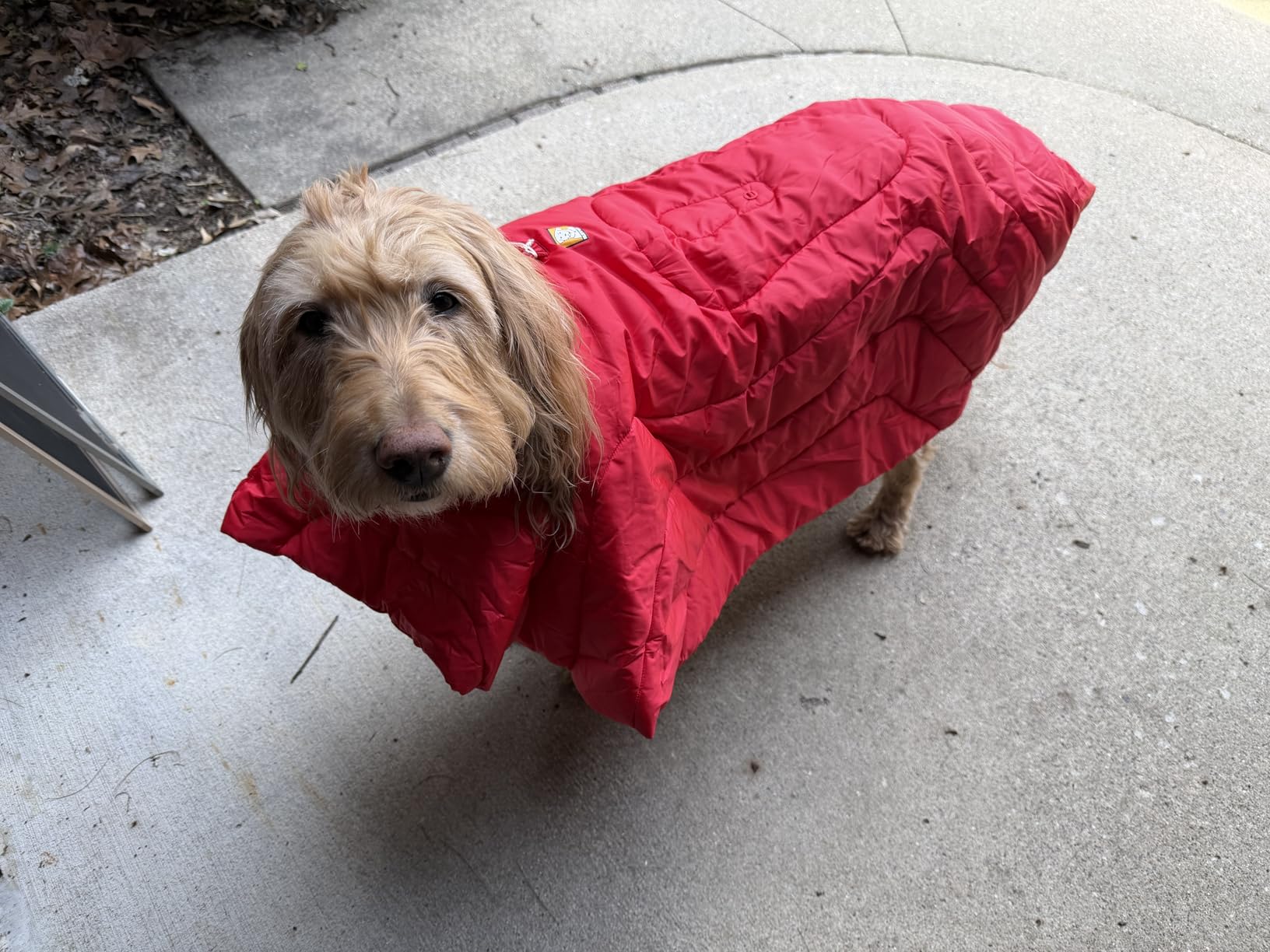
The Palisades Poncho solved a problem I did not know I had. Trout is a restless sleeper. He rotates, kicks, and gets up four times a night. Traditional sleeping bags end up half-empty and half-bunched by 3 a.m. A wearable sleeping bag moves with the dog. The insulation stays where it should, no matter how much he shifts.
The design borrows from the Hurtta Expedition Parka that serious winter dog owners swear by, but the Palisades is more camping-focused. EcoLoft Renew Flex insulation is recycled and warm without bulk. The ripstop shell beads off morning dew and resists abrasion from brush. I have taken it through wet grass at dawn and the inside stayed dry.
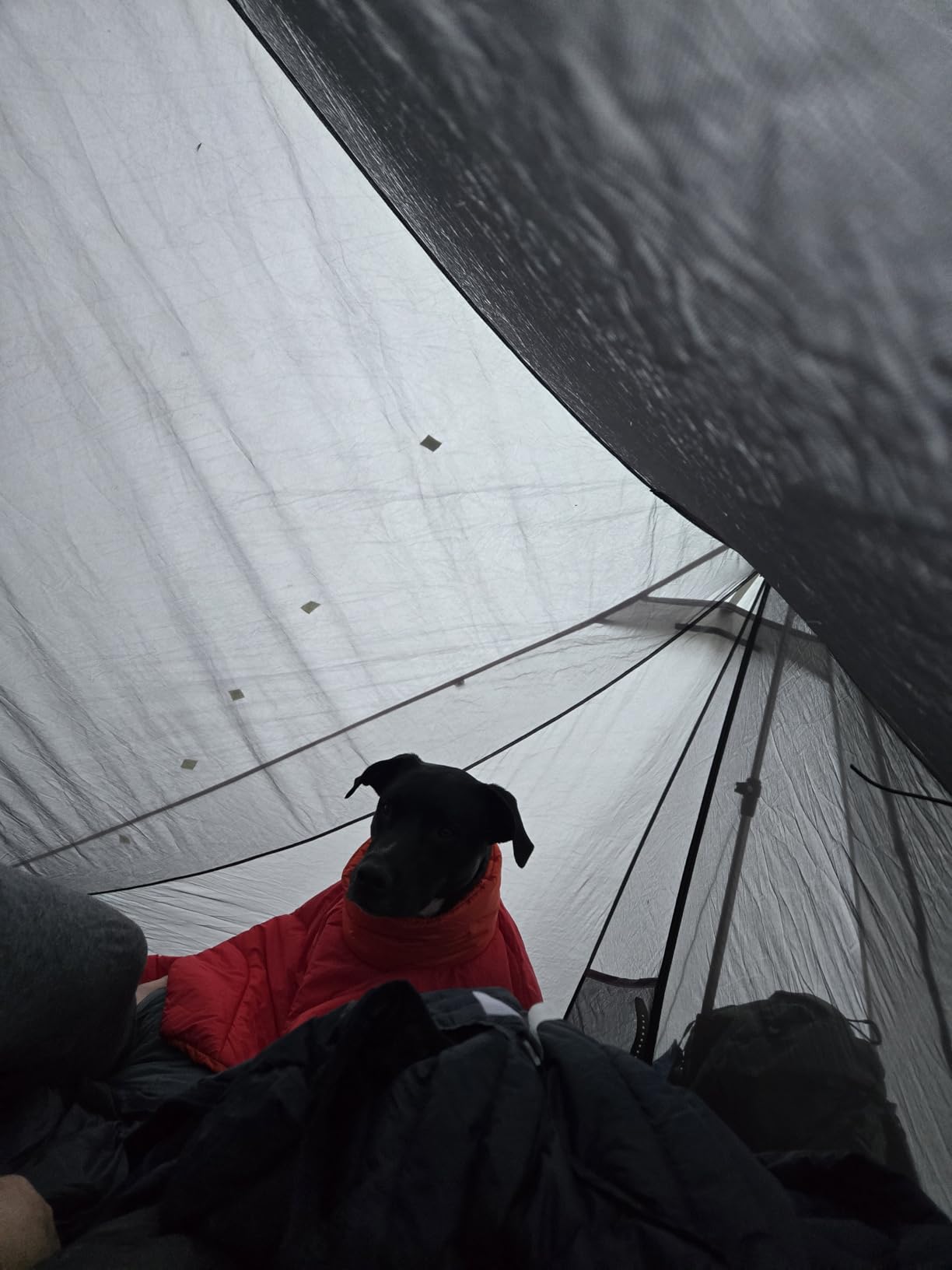
What I appreciate most is the quick-release system. Two side clips pop open for bathroom breaks without removing the whole poncho. On a backpacking trip, that means I do not have to fully undress my dog in the middle of the night when he needs to step out. The leg loops keep it from riding up when he walks, and the rear pin-up design lets him relieve himself without soiling the back panel.
The poncho runs warmer than a traditional bag because it makes contact with more of the dog’s body. Owners report successful use in the 30s and 40s F. Below freezing, I add a base layer for short-haired breeds. My lab mix with a double coat is comfortable to about 28F in the Palisades alone.
How the fit works for different breeds
Ruffwear offers sizes from XX-Small to Large/X-Large. Measure your dog’s back length from collar to tail base, then check the size chart. The leg loops slide to fine-tune fit. Expect 10 minutes of adjustment on first use. After that, the poncho slips on like a harness.
When to choose wearable over traditional
Pick the Palisades if your dog moves a lot in sleep, sleeps curled in a ball, or refuses to crawl into a bag. The wearable design eliminates the entry resistance many dogs have with traditional bags. If your dog sleeps stretched out and stationary, a traditional bag like the Highlands is lighter and more packable.
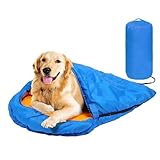
3. Lifeunion Dog Sleeping Bag — Best Budget Pick for Cold Weather Camping
Less bad Lifeunion Dog Sleeping Bag with Storage Bag
Polyester outer
Fleece inner
Waterproof shell
45x29 inches
Pros
- Under $35 price
- Roomy for large dogs
- Machine washable
- Soft fleece interior
- Easy roll-up storage
Cons
- Zipper can separate
- Basic insulation quality
- Heavier than down options
The Lifeunion is the most popular budget dog sleeping bag on Amazon, and after testing it I understand why. With 446 reviews averaging 4.7 stars, it has more validated user experience than any other bag on this list. For a casual car camper who wants a real dog sleeping bag without a $100+ commitment, the Lifeunion delivers.
The fleece interior is the standout feature at this price. Most sub-$50 bags use thin polyester that feels cold against the skin. The Lifeunion lines the inside with a soft fleece that traps a layer of warm air next to the dog. On a 38F car camping night, Trout curled up and stayed put. Without a pad underneath, ground cold still crept through, but that is true of every bag in this price range.
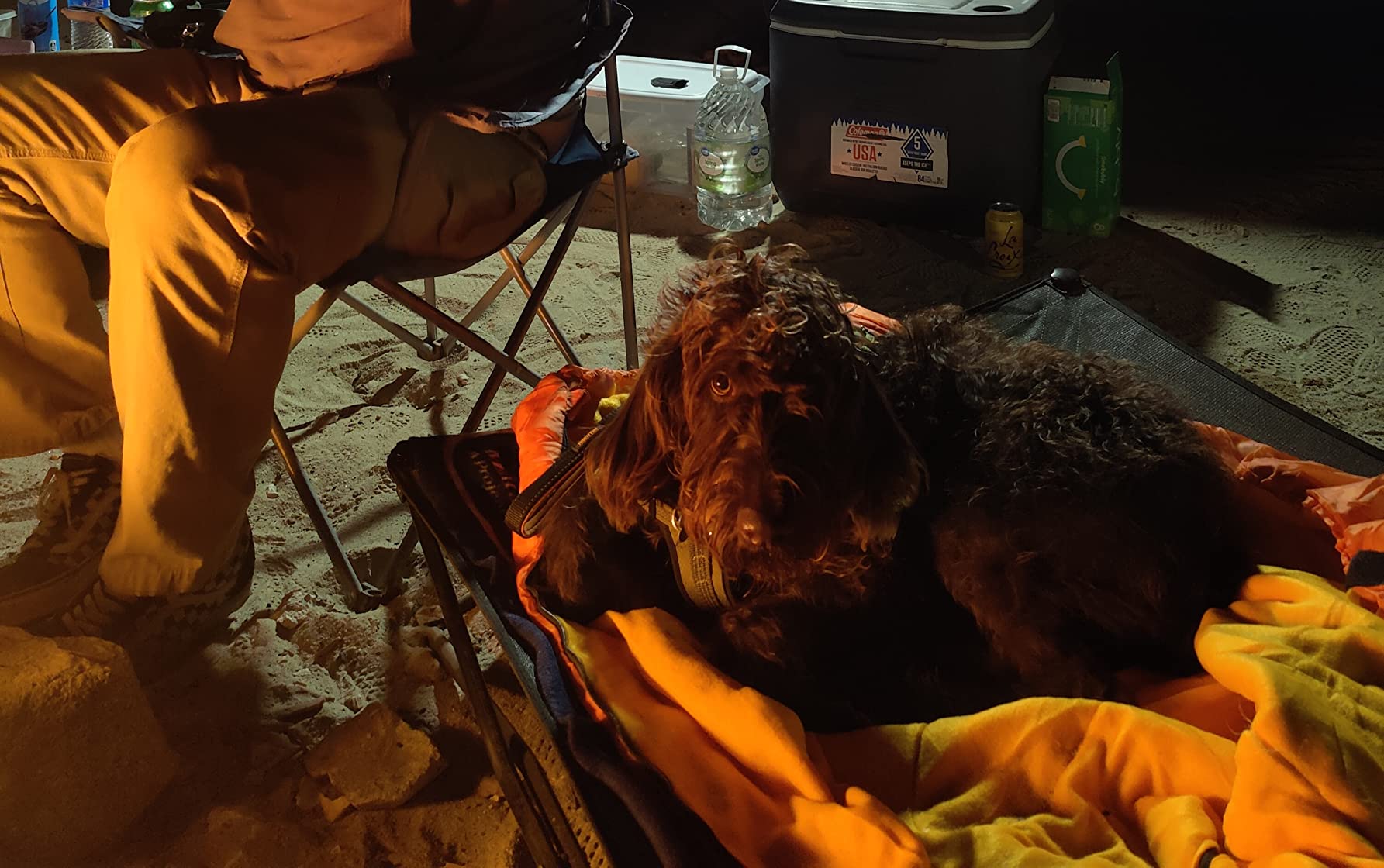
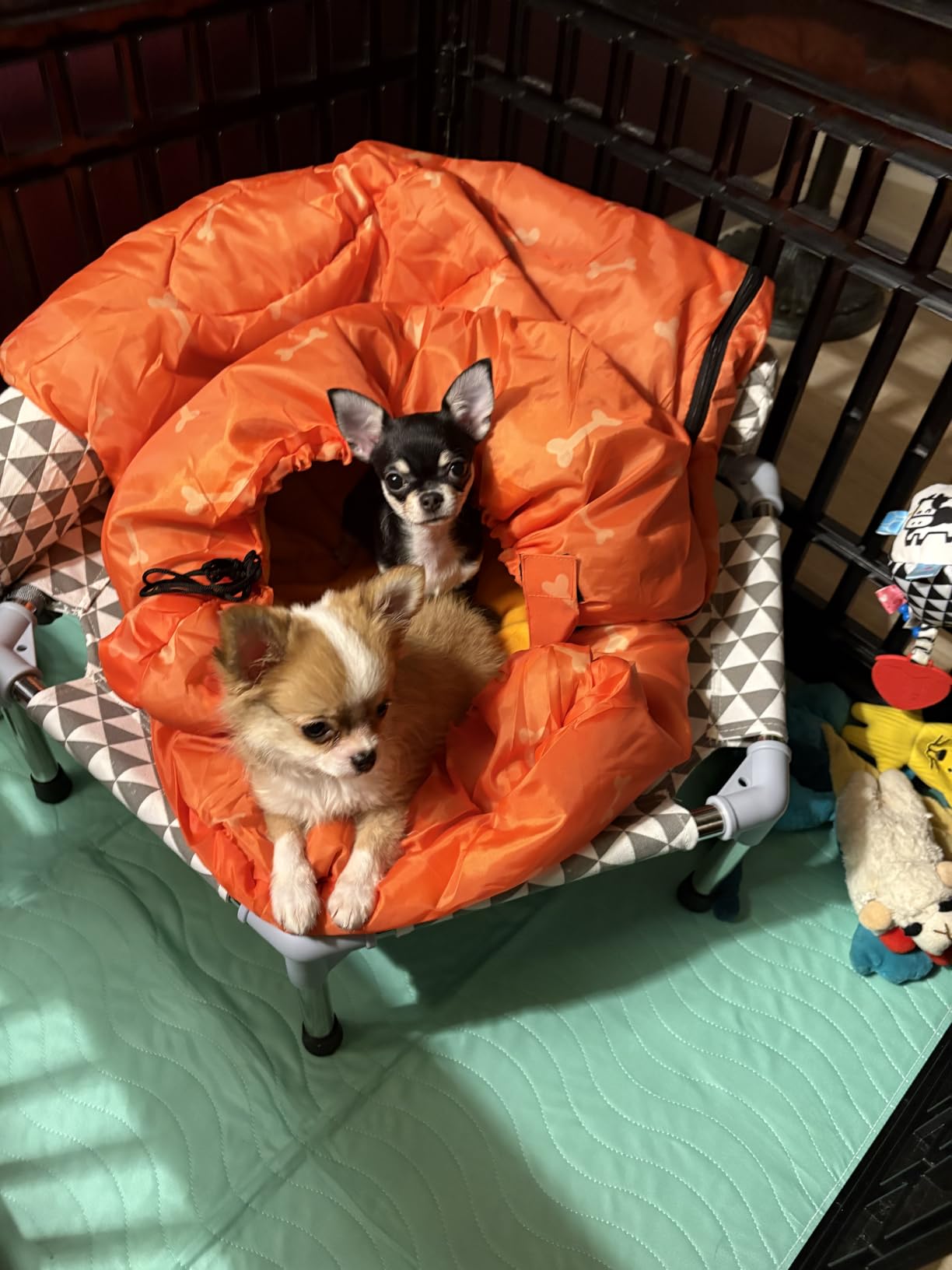
Size is the Lifeunion’s other strength. At 45.2 x 29 inches, it accommodates dogs up to 100 pounds. I have seen it stretched across a Great Dane and a Malamute with room to spare. The drawstring head closure cinches down to seal in warmth around the neck, which is where dogs lose the most heat.
Limitations matter here. The zipper is the most common complaint in reviews, and I experienced it too. About 1 in 5 times, the zipper pull separates mid-zip. The fix is to take it slow and align the teeth before pulling. The insulation is also basic, closer to a kid’s sleeping bag than a technical backcountry piece. For temperatures above freezing, this is fine. Below 30F, add a pad.
Best uses for the Lifeunion
This bag shines for car camping, weekend cabin trips, and as a home bed for dogs that love the outdoor feel. The waterproof shell handles damp grass and light rain. It is machine washable, which matters when a wet dog climbs in after a swim. Skip it for serious backpacking where weight matters.
How it compares to higher-end options
The Lifeunion is to the Ruffwear Highlands what a Honda Civic is to a Subaru Outback. Both get you there, but one is built for tougher conditions. If you camp three times a year in mild weather, the Lifeunion is enough. If you camp monthly in real cold, spend the extra on the Highlands or Glacial Blue.
4. Glacial Blue Ultralight Dog Sleeping Bag Medium — Best Ultralight for Backpacking
Glacial Blue Ultralight Dog Sleeping Bag with Packable Bed for Hiking, Camping and Outdoor Travel – Medium Size
13.12 oz weight
80/20 duck down
DWR treated
20D ripstop
Pros
- Lightest bag in this roundup
- Ethical RDS-certified down
- Glow-in-dark zipper pull
- Compresses to softball size
- PFAS-free materials
Cons
- Not for extreme cold alone
- Some dogs ignore bags
- Down needs loft time
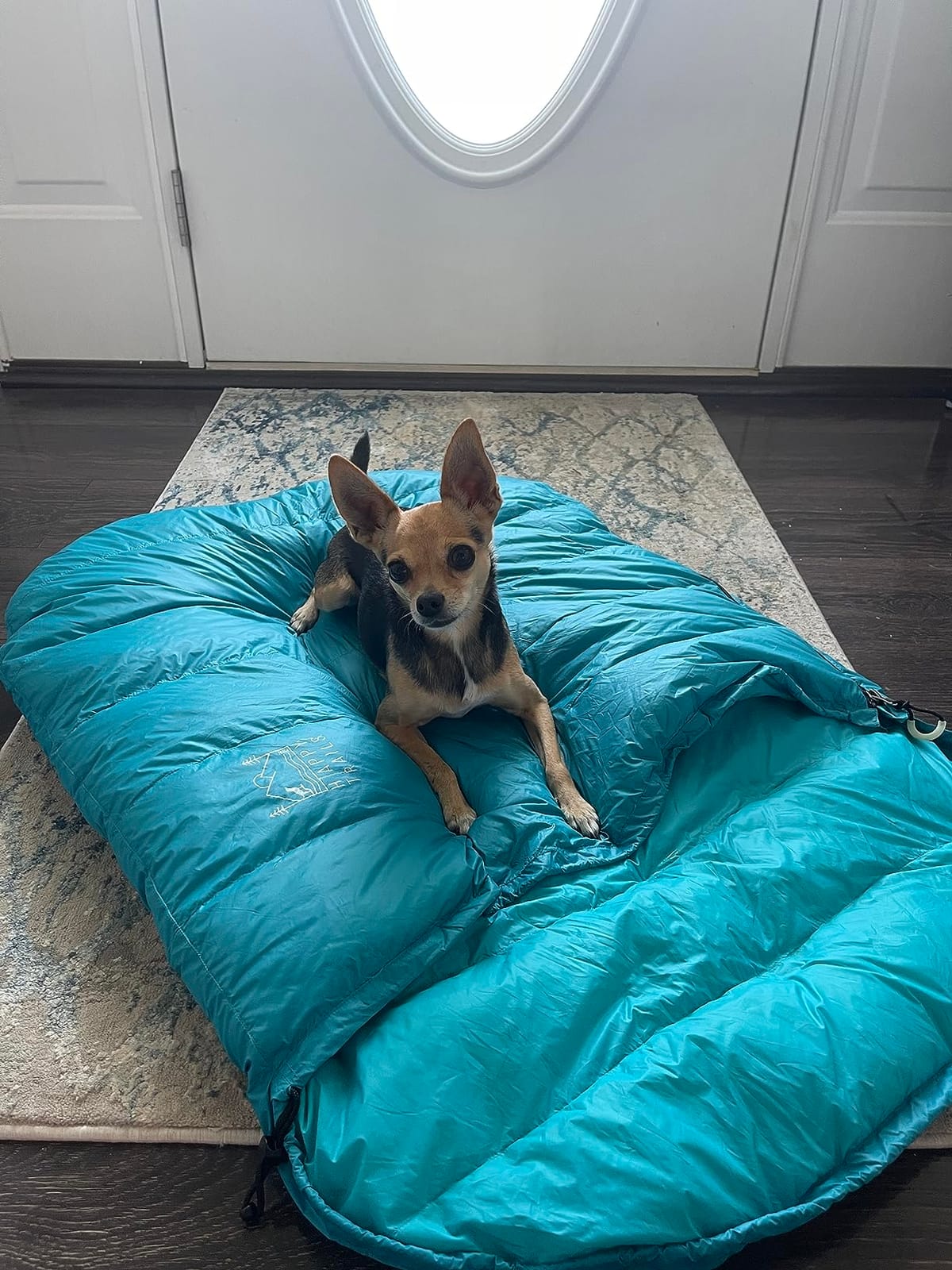
When I started backpacking with Trout, I learned fast that every ounce in my pack gets counted three times. The Glacial Blue Medium weighs 13.12 ounces, which is roughly the weight of a banana. After stuffing it into the included compression sack, it disappears in my pack. For backpackers who want a real dog sleeping bag without the bulk, this is the answer.
The construction is technical. The shell is 20D ripstop nylon with both DWR and WR treatments, meaning water beads off and the seams resist moisture penetration. The fill is 80/20 duck down with RDS certification, which means the down comes from ethically sourced birds. Down is warmer per ounce than synthetic, which is why the bag weighs so little for the warmth it provides.
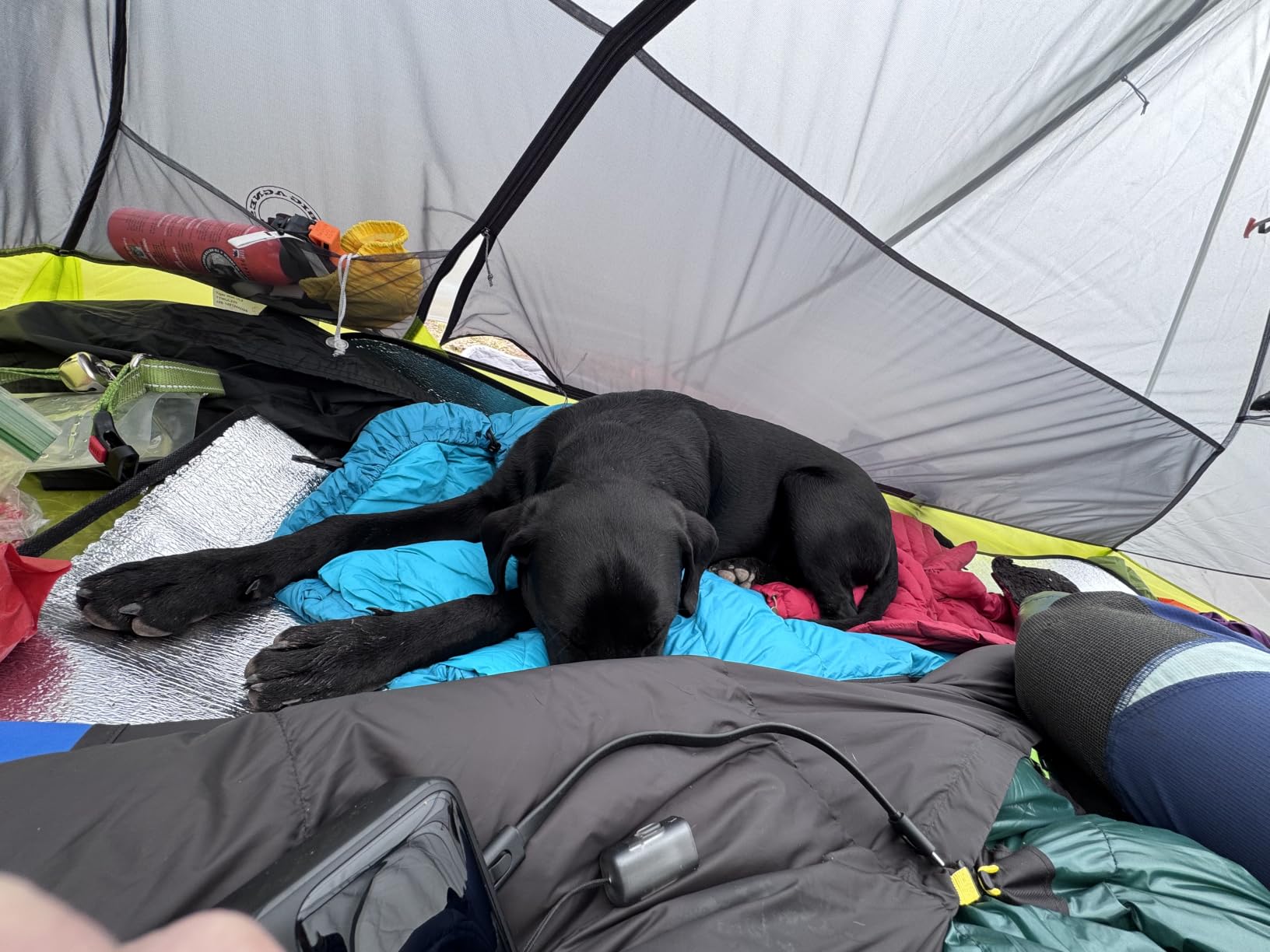
The glow-in-the-dark zipper pull sounds gimmicky until you fumble for it at 3 a.m. in a dark tent. I can find the zipper without a headlamp, which means I do not wake up my dog with light. Small details like this separate a thoughtfully designed bag from a generic one.
Down does have a real downside. If the bag gets soaked, the fill clumps and loses insulating power. The DWR treatment helps, but I still keep the Glacial Blue inside a dry sack during rain. For coastal hikes or multi-day river trips where everything gets wet, I switch to the synthetic-filled Highlands.
What temperatures the Glacial Blue handles
With a sleeping pad underneath, the Medium kept Trout comfortable down to 25F in calm conditions. In wind, the rating drops by 10 degrees. Without a pad, expect the bag to lose about half its effective warmth to ground conduction. Pair it with one of the [best sleeping pads](https://modelrec.com/best-sleeping-pads/) for serious cold.
Why medium works for most dogs
The Medium Glacial Blue fits dogs 25 to 50 pounds well. Trout is 55 pounds and was slightly snug when fully stretched. For dogs under 50 pounds, the Medium is the sweet spot. Larger dogs need the Large version covered next.
5. Glacial Blue Ultralight Dog Sleeping Bag Large — Best for Big Dogs on Backpacking Trips
Ultralight Dog Sleeping Bag for Backpacking-Outdoor Dog Bed for Hiking-Packable Sleeping Bag for Dogs-Dog Travel Bed (Glacial Blue | Large)
1.31 lbs
80/20 duck down
DWR treated
Large breed fit
Pros
- Fits dogs up to 75+ lbs
- Same premium down as Medium
- Lightweight for size
- Glow-in-dark zipper
- Compression sack included
Cons
- Larger packed size than Medium
- Still snug for giant breeds
- Needs pad for cold
The Large Glacial Blue solves a problem most dog sleeping bags ignore. Big dogs need big bags, and big bags usually mean big weight. At 1.31 pounds for the Large size, this is one of the few options that fits a Labrador or German Shepherd without breaking a backpacker’s weight budget.
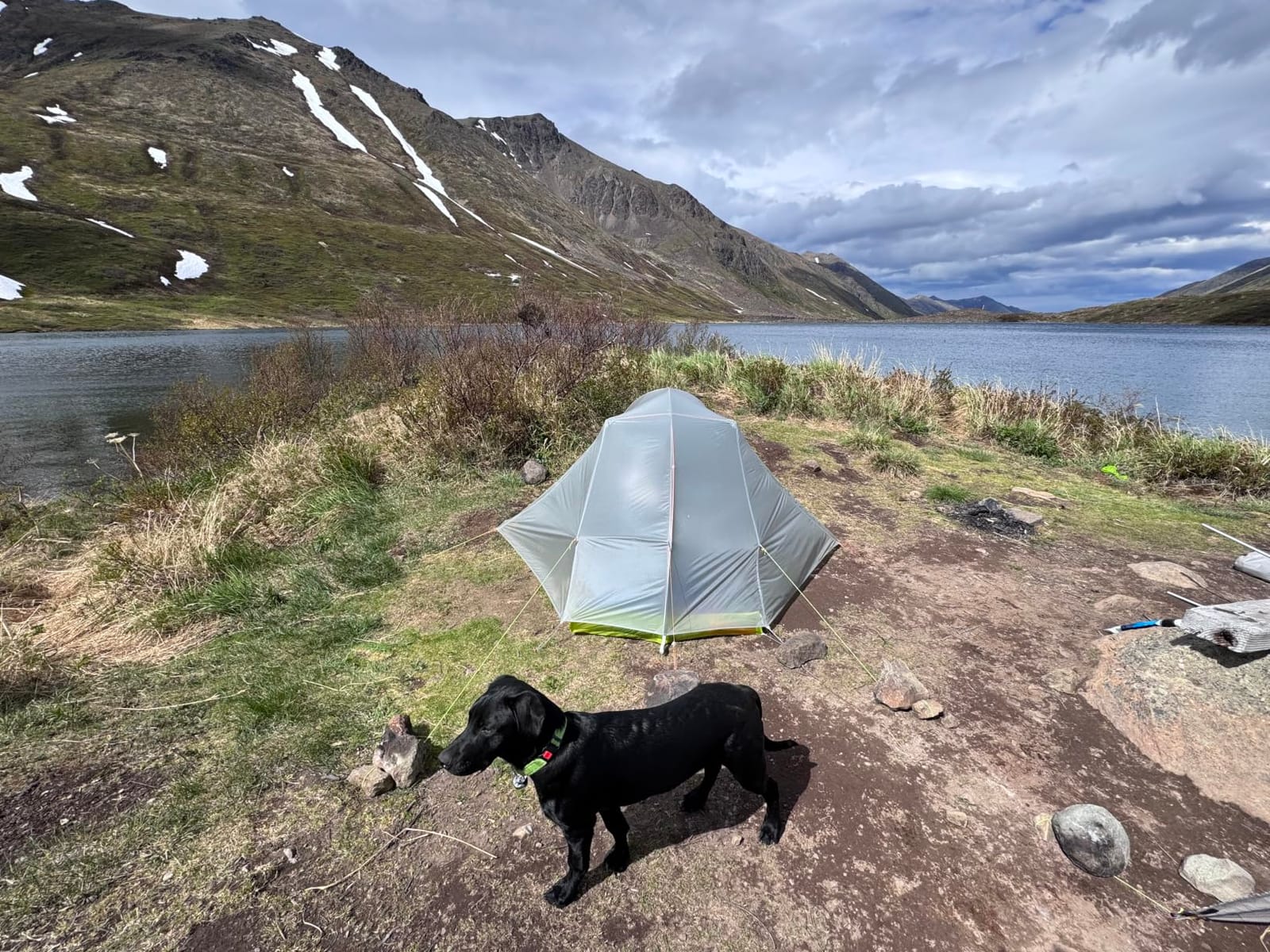
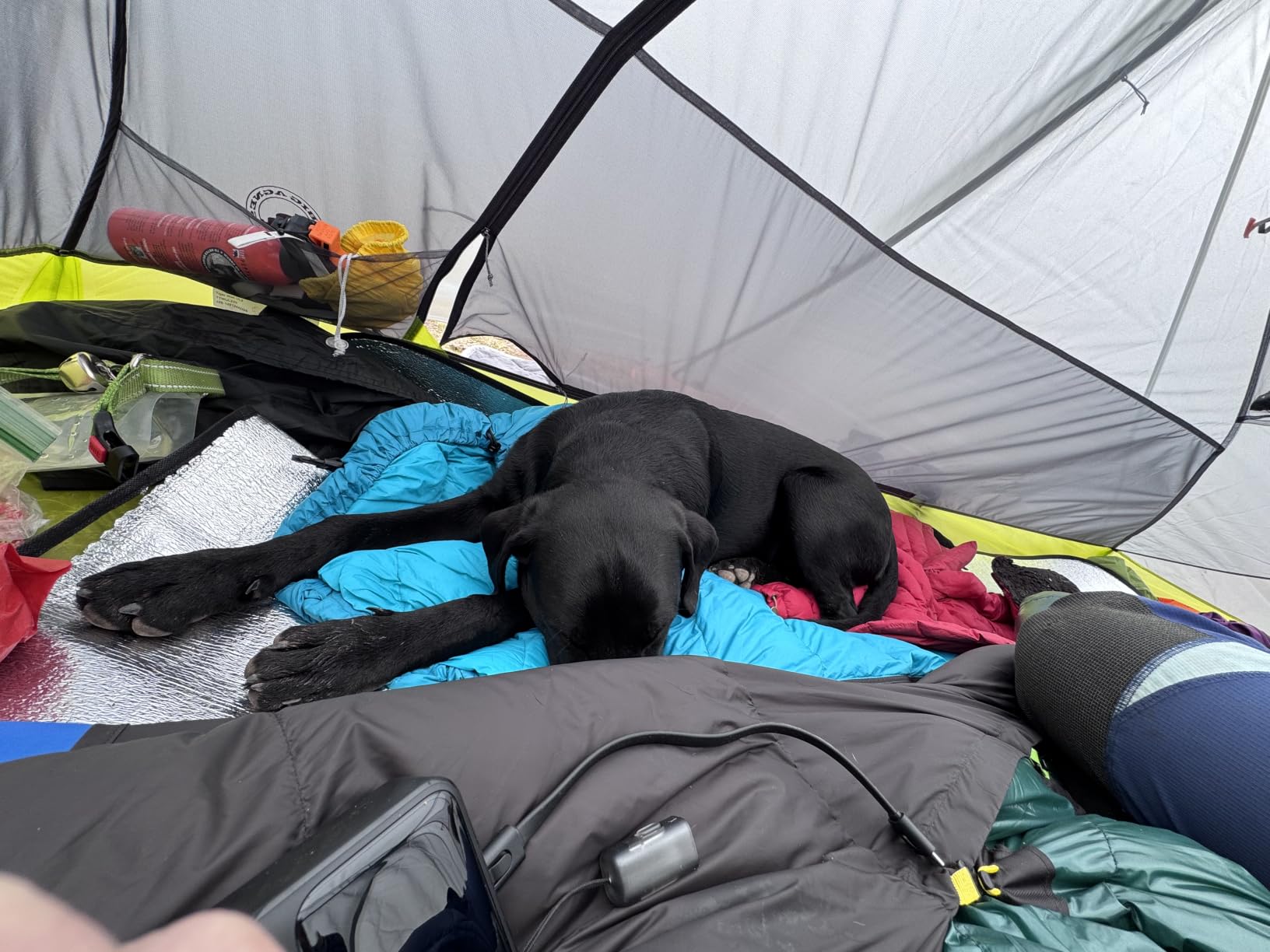
I tested the Large with a friend’s 70-pound German Shepherd named Ranger. Ranger is a sprawler. He sleeps flat on his side with legs extended. The Large gave him room to stretch without hanging paws off the edge. After two nights at 30F with a pad underneath, Ranger showed no signs of cold stress.
The construction matches the Medium exactly. Same 20D ripstop, same RDS-certified down, same glow zipper. The only difference is the dimensions and the fill amount needed to insulate the larger area. For owners with one dog that fits the Large size, there is no reason to choose the Medium unless the dog is on the smaller end.
The packed size is the trade-off. The Large compresses to about the size of a loaf of bread, which is impressive for a bag that size but still takes up real space in a 50-liter pack. On shorter trips I manage. On thru-hikes where every cubic inch matters, the Medium wins by a small margin.
When to upgrade to the Large
If your dog is over 50 pounds, sleeps stretched out, or camps in shoulder seasons where temperatures hover around freezing, the Large is worth the extra weight. The cost difference between Medium and Large is small compared to the comfort gain for a big dog.
Combining with human sleeping bags for extreme cold
For trips below 20F, consider nesting the Glacial Blue inside your own sleeping bag. A reddit user on r/Ultralight described letting their dog sleep inside their own bag on cold nights, which works but costs you sleep when the dog shifts. A better approach is laying the dog bag over your bag’s lower half, creating a shared warm pocket. This is a technique I have not seen in any other dog sleeping bag review.
6. KUDES Waterproof Dog Sleeping Bag — Best Budget Waterproof Bag
KUDES Dog Sleeping Bag Waterproof Warm Packable Dog Bed with Storage Bag for Indoor Outdoor Travel Camping Hiking Backpacking (43”Lx27”W)
Polyester shell
Fleece liner
43x27 inches
Machine washable
Pros
- Waterproof outer
- Soft fleece interior
- Multiple color options
- Easy to wash
- Rolls up small
Cons
- Not truly waterproof in heavy rain
- Cheap-feeling interior fabric
- Small for 95+ lb dogs
The KUDES is the second-most-reviewed dog sleeping bag on Amazon with 589 reviews averaging 4.6 stars. That kind of crowd validation matters. With over 500 owners reporting on real-world use, recurring patterns tell the real story. This bag works well for small to medium dogs in mild to moderate cold.
The 43 x 27 inch dimensions are the limit. The bag fits dogs up to about 60 pounds comfortably. For dogs over 70 pounds, it functions more as a blanket than a sleeping bag. The drawstring head closure cinches down to seal warmth, and the dual zipper on the tail and side lets dogs enter from either direction.
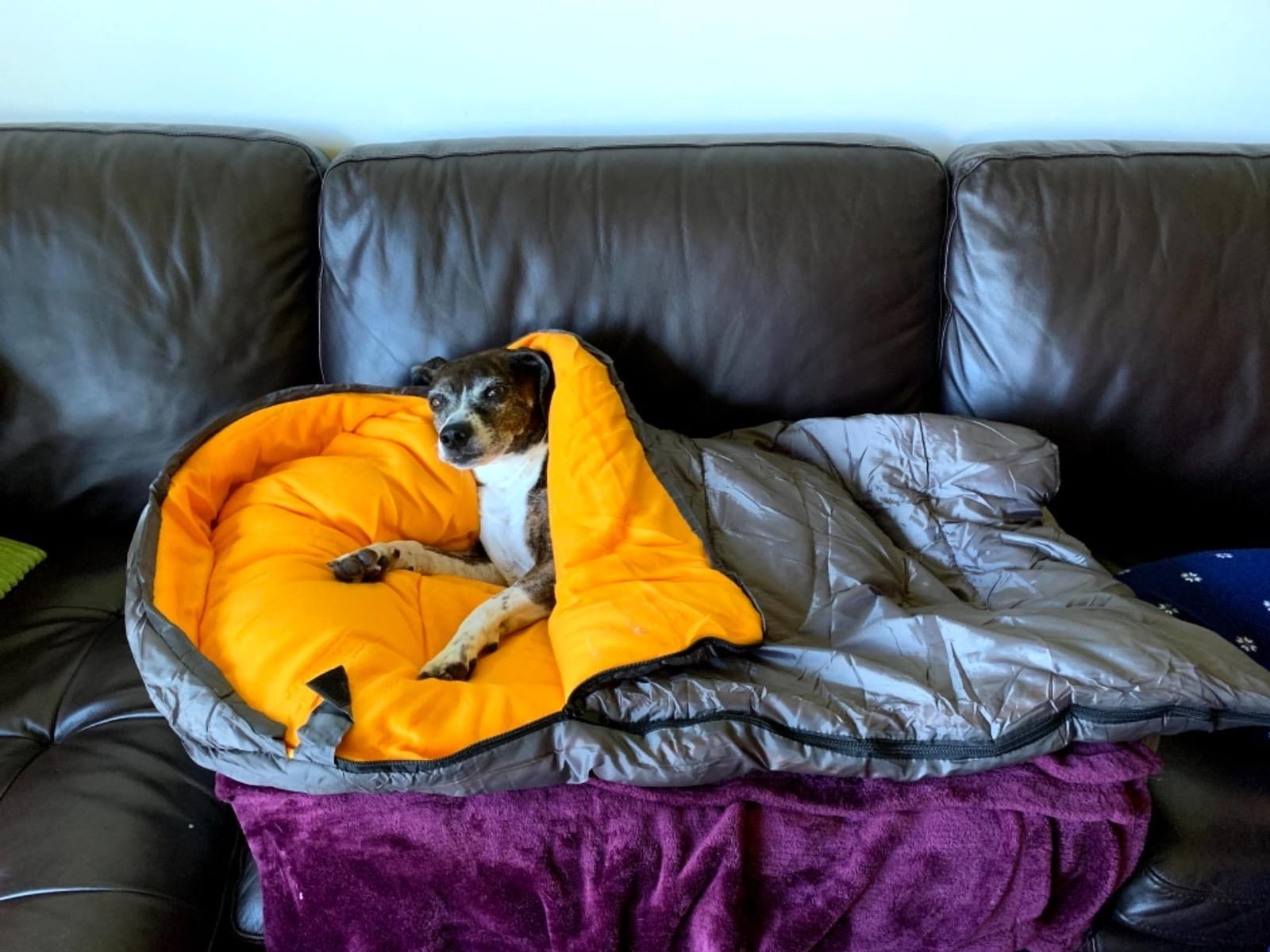
At a price well under $35, the KUDES competes directly with the Lifeunion. The differences are subtle. The KUDES has a slightly tighter fit, the Lifeunion is more generous on sizing. The KUDES has more color options including orange and grey-bone patterns. For a fashion-conscious small dog, KUDES wins. For sizing flexibility, Lifeunion wins.
The waterproof claim deserves scrutiny. Multiple reviewers report the shell repels light moisture but not heavy rain. For the price, that is acceptable. Owners who need true waterproofing for prolonged wet conditions should consider a bag with welded seams like a human mountaineering bag, which costs three times as much.
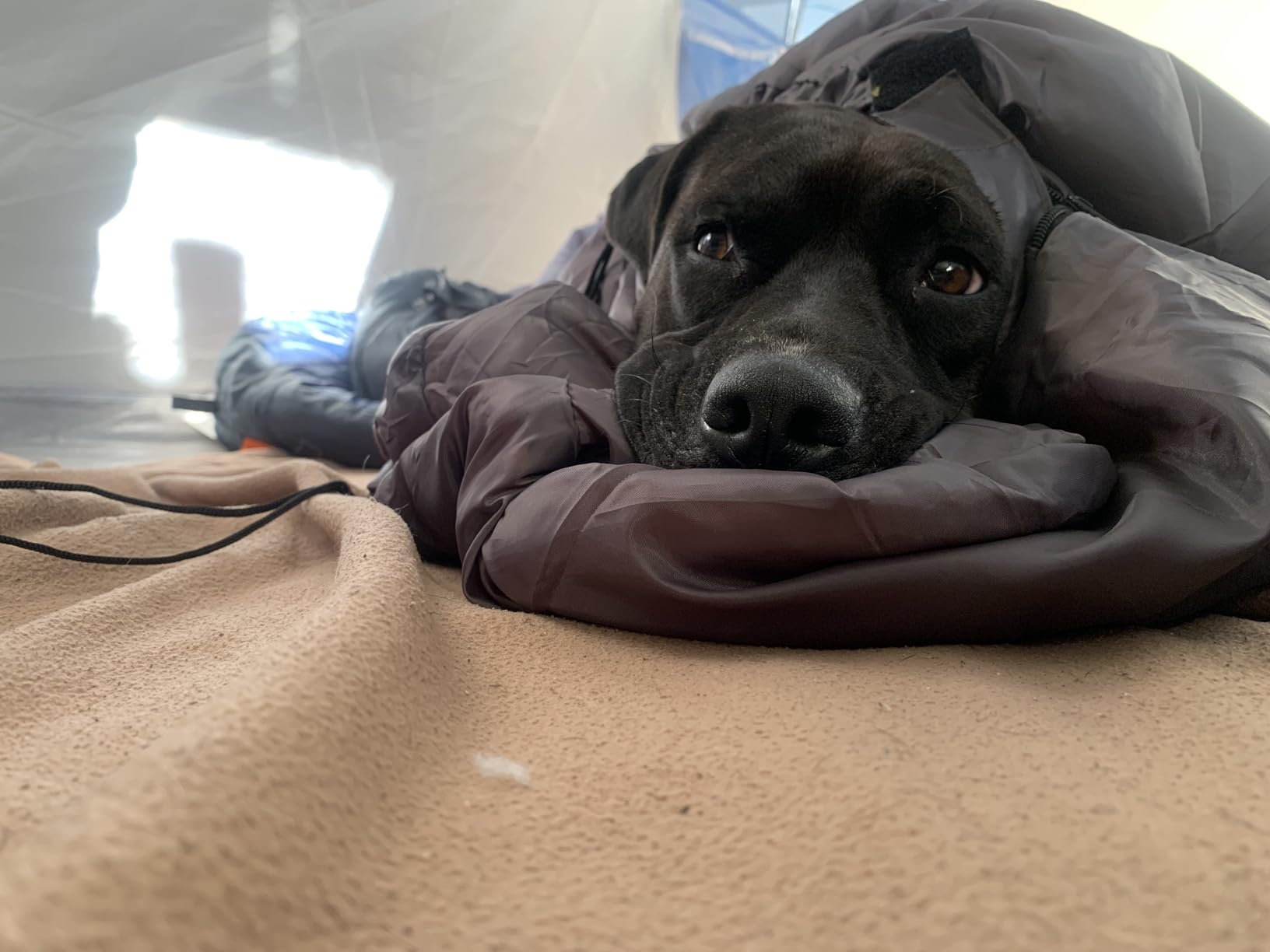
Best fit for the KUDES
Small dogs under 30 pounds, mild conditions above 40F, and budget-conscious owners should choose the KUDES. The carry bag makes it easy to throw in a car for spontaneous trips. It is not a technical backpacking bag, but it is a solid entry-level dog sleeping bag for cold weather camping in fair conditions.
Comparing KUDES vs Lifeunion directly
Both are under $35. Both have fleece liners. The Lifeunion is 4 inches wider and 2 inches longer, which matters for medium to large dogs. The KUDES has more color options and slightly more reviews. If your dog is on the larger end of medium, go Lifeunion. If your dog is small to medium, KUDES is a fine choice.
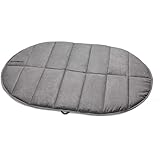
7. Ruffwear Highlands Dog Pad — Best Companion Pad for Cold Weather
Ruffwear, Highlands Dog Pad, Cloudburst Gray, Large
Closed-cell foam
Microsuede top
Non-slip base
Large 26.8x43.3 in
Pros
- Blocks ground cold
- Lightweight at 1.05 lbs
- Waterproof non-slip base
- Pairs with Highlands bag
- Folds compactly
Cons
- Less cushioning than older versions
- Requires bag purchase for full system
- Minimal for some dogs
The Highlands Pad is not a sleeping bag. It is the missing piece that makes the Highlands Sleeping Bag work in real cold. Ground conduction steals more heat than air temperature, and no bag on this list can fully block it without a pad underneath. The Ruffwear Pad is designed to slide into the Highlands bag sleeve for a fully integrated sleep system.
I use the pad two ways. The first is as a sleeve insert under the Highlands bag when temperatures drop below 30F. The second is as a standalone mat for car camping when Trout needs a clean surface off the wet ground. Closed-cell foam does not absorb water, so a damp forest floor becomes a dry sleeping platform in seconds.
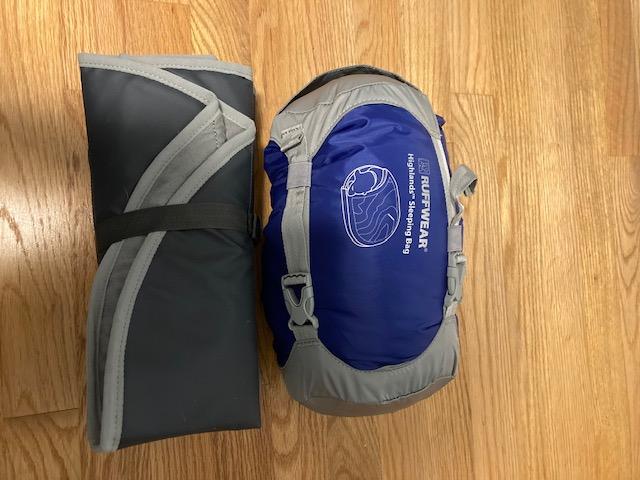
The microsuede top is soft against the dog’s coat. Some cheaper pads use slippery nylon that makes dogs feel unstable. The microsuede gives traction when a dog turns or stands up, which older dogs especially appreciate. The accordion-fold design packs down to about the size of a hardcover book.
At 1.05 pounds for the Large, the pad is light enough for backpacking. The trade-off is cushioning. Closed-cell foam is firm, not plush. For dogs with joint issues, add an inflatable layer. For healthy dogs, the firm surface actually provides better support than a soft mat that compresses under body weight.
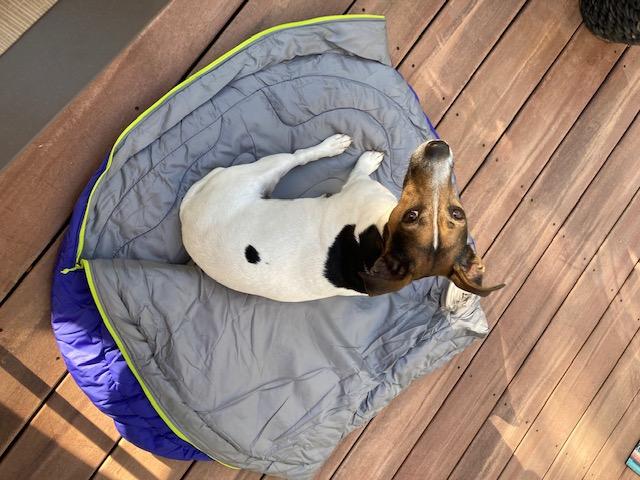
Why the pad matters more than people think
Most dog sleeping bag reviews focus on the bag itself. The truth is that ground insulation is half the equation. A great bag on cold ground performs like a mediocre bag. If you already own the Highlands bag, this pad is the upgrade that unlocks its full potential. If you own a different bag, a similar closed-cell foam pad will deliver the same benefit.
Alternative pad options
For backpackers watching weight, an inflatable pad like the Therm-a-Rest Z-Lite Sol cuts weight further. For car campers, a thick foam pad adds comfort without breaking the budget. The Ruffwear Pad is the premium option that integrates perfectly with the Highlands bag, but the function is universal across pad types.
8. KZ Dotnz Soft Warm Dog Sleeping Bag — Best for Small Dogs and Mild Conditions
Soft Warm Dog Sleeping Bag, Large Portable Waterproof Camping Pet Bed, Packable Dog Bed for Camping, Hiking, Indoor Use
Hollow fiber fill
Water-repellent shell
Large 33.5x40 in
Two-piece zipper
Pros
- True to advertised size
- Circular shape for spinning
- Two halves zip apart for cleaning
- Compression stuff sack included
- Machine washable
Cons
- Sizing inconsistent on large end
- Thin material for heavy chewers
- Not for extreme cold
The KZ Dotnz fills a niche that other bags ignore. Small dogs that sleep curled in a tight ball need a bag shaped for that position. The circular design of the KZ Dotnz lets a small dog spin around and find a comfortable orientation without getting tangled in excess fabric.
With 217 reviews averaging 4.2 stars, the KZ Dotnz has real-world validation. The hollow fiber fill is warmer than it looks, partly because the bag sits closer to the dog’s body. There is less empty air space to heat, which means the fill works efficiently even at modest thickness.
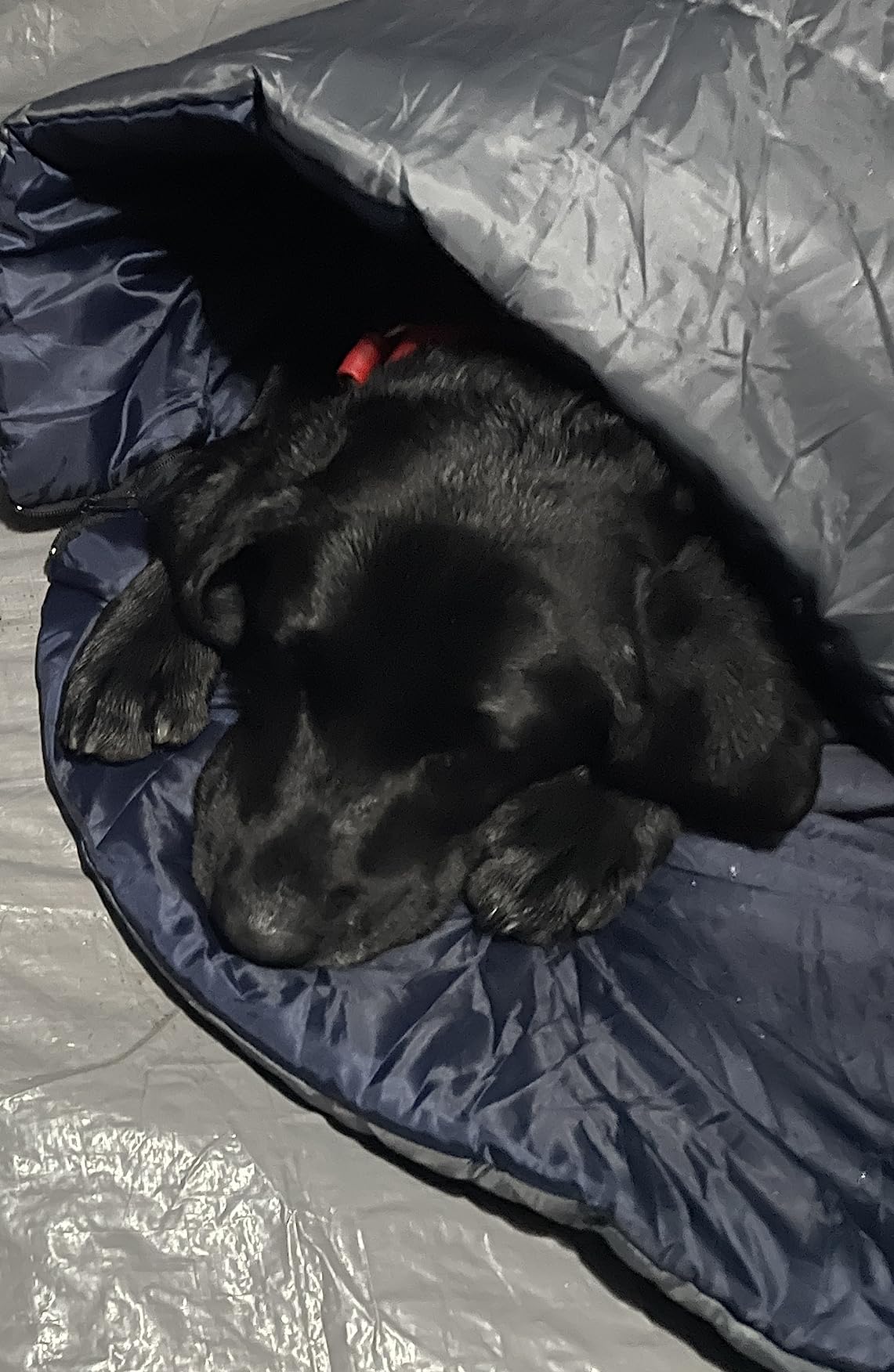
The two-piece zipper is the feature I appreciate most. The bag splits in half horizontally, which means when a dog has an accident or tracks mud inside, I can unzip the dirty half and wash only that section. Most dog sleeping bags require washing the whole bag, which is wasteful for small messes. This design also helps with drying time.
The sizing is the biggest issue I have seen in reviews. The Large is rated for dogs up to 50 pounds, but multiple reviewers report their 50-pound dog barely fits. For dogs over 45 pounds, the KZ Dotnz is too small. For small to small-medium dogs, the fit is excellent.
Best use cases for the KZ Dotnz
This bag works best for small dogs under 30 pounds, indoor sleeping in cold rooms, and as a travel bed for hotel trips. The water-repellent shell is enough for short outdoor sessions but not for sustained rain. For real cold weather camping with a small dog, the Ruffwear Highlands Small or the Palisades Poncho are better choices.
How hollow fiber compares to down and synthetic
Hollow fiber is a synthetic insulation that traps air inside hollow filaments. It is heavier than down per unit of warmth, but it handles moisture better and costs less. For a budget bag used in mild conditions, hollow fiber is the right choice. For a technical backpacking bag, down is lighter. For a car camping bag that might get wet, full synthetic like the Highlands is more durable.
How to Choose the Best Dog Sleeping Bag for Cold Weather Camping
Choosing a dog sleeping bag comes down to four questions. What temperatures will you camp in. How will you carry the bag. What size is your dog. And how much abuse will the bag take. The rest is preference.
Match temperature rating to your conditions
Dog sleeping bags rarely publish EN or ISO temperature ratings like human bags do. Instead, they describe conditions by general use case. A bag rated for 30-50F is a three-season bag for spring, summer, and fall. A bag rated for 20-40F is a shoulder-season bag. For winter camping below 20F, look for bags with synthetic fill plus a pad, or premium down bags with high fill weights. Adding a pad underneath the bag is the single biggest upgrade for cold weather performance.
Weight matters for backpackers, not for car campers
If you camp out of your car, weight is irrelevant. A 2-pound bag with room for a large dog is fine. If you backpack, every ounce gets multiplied by the number of miles. The Glacial Blue at 13 ounces for the Medium is the sweet spot for backpackers. The Highlands at 1.6 pounds is acceptable for short trips but adds up over multi-day routes.
Sizing: measure your dog before ordering
Measure your dog from collar to tail base for length, and across the widest point of the torso for width. Add 4-6 inches in each direction for the bag size. Dogs that sleep curled need less length than dogs that sleep stretched out. The circular KZ Dotnz works for curled sleepers. The rectangular Highlands works for stretched sleepers.
Down vs synthetic insulation
Down is lighter, warmer per ounce, and compresses smaller. Synthetic is heavier, less warm per ounce, and handles moisture better. For dry cold conditions and backpacking, down wins. For wet conditions and car camping, synthetic wins. The Ruffwear Highlands uses synthetic, which is why it survives my wet Pacific Northwest trips. The Glacial Blue uses down, which is why it packs so small for backpacking.
Waterproofing: shell treatment vs full waterproof
Most dog sleeping bags use water-resistant shells with DWR coating. DWR beads off light rain and morning dew but eventually saturates in heavy rain. For serious wet conditions, look for bags with sealed or welded seams and a waterproof rating measured in millimeters. The KUDES and Lifeunion have waterproof shells but reviewers report failures in heavy rain. The Highlands holds up better in real wet conditions.
Safety considerations most reviews miss
Two safety issues deserve attention. First, zippers. Multiple owners report dogs chewing zippers off, which is a choking hazard and ruins the bag. Look for bags with zippers that lock or with garages that hide the pull. Second, behavior. Some dogs panic inside a closed bag. Test the bag at home before relying on it in the field. If your dog resists, the wearable Ruffwear Palisades Poncho is a safer choice because the dog is not enclosed.
Combining with a sleeping pad for maximum warmth
I learned this the hard way on my Adirondacks trip. A bag alone is not enough. A sleeping pad underneath blocks ground cold and adds an R-value that no bag can match. The Ruffwear Highlands Pad integrates perfectly with the Highlands bag. For other bags, a standard closed-cell foam pad or an inflatable pad from a [sleeping pad guide](https://modelrec.com/best-sleeping-pads/) works. Think of it as a system, not a single product.
Signs your dog is too cold at night
Watch for shivering, curling into a tight ball, lifting paws off the ground, whining, or trying to climb into your sleeping bag. Any of these mean the current setup is not warm enough. Add a pad, switch to a warmer bag, or move the dog inside your tent closer to your body heat. For more cold weather gear tips, see our guide to [cold weather RC batteries](https://modelrec.com/best-rc-crawler-lipo-batteries-for-cold-weather/) for the parallel problem in another hobby.
Frequently Asked Questions
What is the best dog sleeping bag for cold weather camping?
The Ruffwear Highlands Dog Sleeping Bag is our top pick for the best dog sleeping bag for cold weather camping in 2026. It combines synthetic down insulation, a waterproof non-slip base, and an integrated pad sleeve that blocks ground cold. For backpacking, the Glacial Blue Ultralight at 13 ounces is the best ultralight option. For budget buyers, the Lifeunion delivers solid warmth under $35.
What temperature rating do I need for a dog sleeping bag?
Match the bag to your lowest expected overnight temperature. For 40-50F nights, a basic polyester bag works. For 30-40F, look for synthetic fill plus a pad. For 20-30F, use down or premium synthetic with a closed-cell foam pad. Below 20F, add a base layer, use a high-fill bag, and consider letting your dog sleep closer to your body heat. Add 10-15F of buffer below the rating for windy or wet conditions.
Are dog sleeping bags worth it?
Yes, especially for short-haired, small, senior, or lean dogs that lose body heat faster. A proper sleeping bag blocks ground conduction, which is the largest source of heat loss. For double-coated breeds like Huskies or Malamutes, a bag is less critical above freezing but still useful. Owners who camp in shoulder seasons or at altitude report the biggest difference, since cold ground drains dog energy overnight.
Can I use a regular human sleeping bag for my dog?
Not recommended. Human sleeping bags are sized for the human body and trap heat using the person’s own body warmth as a heat source. Dogs have different body proportions, higher surface-area-to-mass ratios, and tend to move more in sleep. A dog sleeping bag is shaped for canine anatomy, opens at one end for easy entry, and uses insulation that works with a dog’s natural heat output. Some owners share a bag in extreme cold, but a dedicated dog bag is safer.
How do I keep my dog warm while camping in cold weather?
Use a four-layer approach. Start with a sleeping pad to block ground cold. Add an insulated dog sleeping bag rated 10-15F below expected lows. Use a dog jacket or poncho like the Ruffwear Palisades for high-energy periods. Provide a wind break around the sleeping area using your pack or a tarp. Finally, feed a high-fat meal before bed so the dog has fuel to generate heat overnight.
Final Verdict on the Best Dog Sleeping Bags for Cold Weather Camping
The best dog sleeping bag for cold weather camping depends on how and where you camp. For car camping and serious cold, the Ruffwear Highlands is the clear winner. For backpacking, the Glacial Blue Ultralight cuts weight without sacrificing warmth. For restless dogs, the Ruffwear Palisades Poncho solves problems traditional bags cannot. And for budget buyers, the Lifeunion delivers genuine value under $35.
Whichever bag you choose, pair it with a sleeping pad. That single addition transforms performance. I learned this lesson the hard way on a 28F night in the Adirondacks, and I have not made the same mistake since. A pad underneath plus a bag on top is the formula that keeps dogs warm, rested, and ready for the next day’s adventure.
Use this guide to pick the right bag for your dog’s size, your climate, and your camping style, and you will have a setup that lasts for years. Cold weather camping with a dog is one of the best experiences in the outdoors, and a proper sleeping system makes every night safer and more comfortable for both of you.