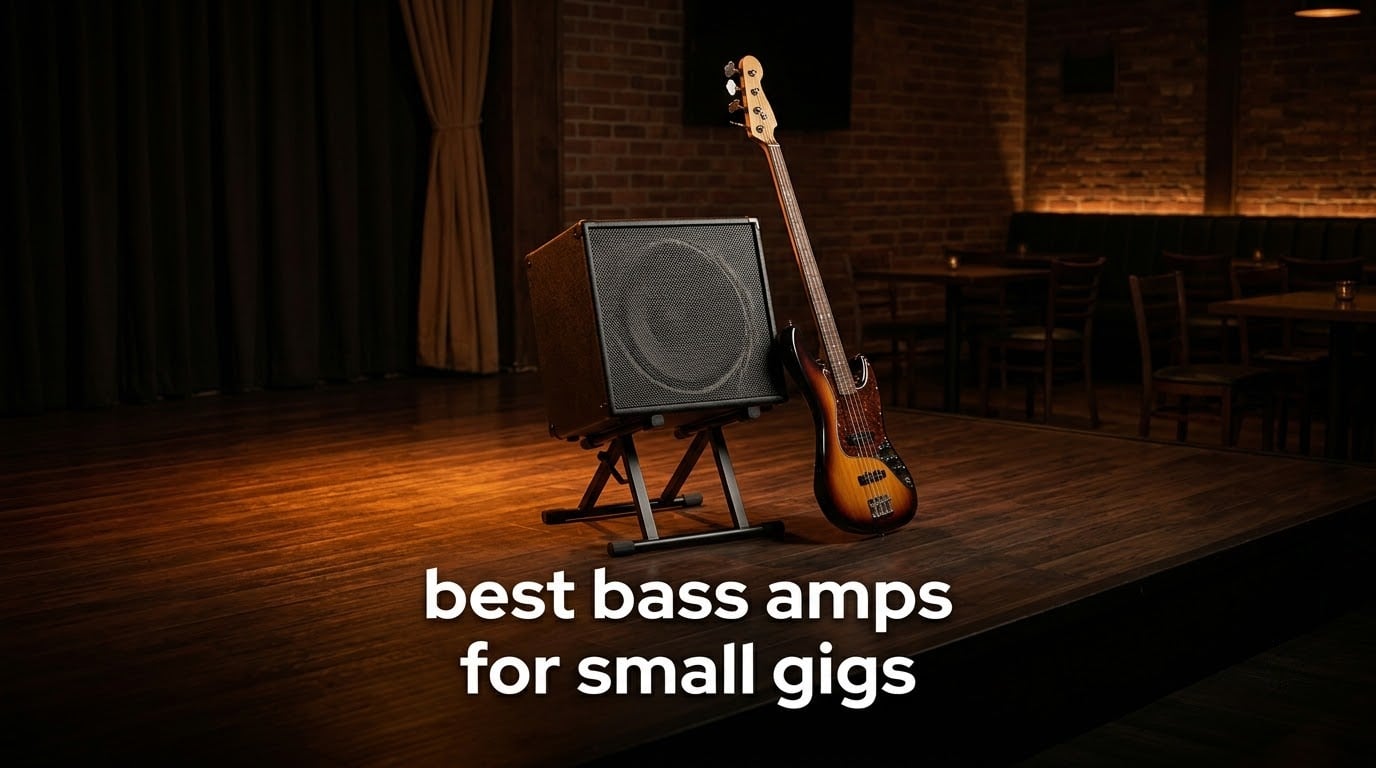
A small gig is a bar, a pub, a restaurant back room, a coffee shop or a club that holds under 200 people. For those rooms, the best bass amps for small gigs are almost always a single combo at 25 to 100 watts with a 10, 12 or 15 inch driver, a usable carry weight and a direct output for the venue PA. That is the short answer, and the rest of this guide backs it up with 12 combos we looked at closely, spec by spec and review by review.
We spent weeks comparing these amps on the things players actually argue about on forums: real usable wattage, cabinet weight, speaker size, whether the EQ can tame a loud drummer, and whether the DI output lets you work without a cabinet mic. Every product below comes with weight in pounds, speaker configuration, output power and a straight verdict on who it suits.
If you are still on a 15 watt practice amp, this list is where you move up once. If you play a lap steel or upright alongside electric, two of these have cabs built for it. If you travel to gigs in a hatchback, the weight numbers will save you an argument with yourself.
Table of Contents
How Many Watts Do You Need for a Small Gig?
A 20 watt amp is loud enough for gigs only in very specific situations: a solo acoustic set, a function room with no drummer, or a bar where the amp sits on a stool four feet from your ears and the drummer plays brushes. In any room with a full band, 20 watts disappears within the first bar.
Here is the mapping we use, based on the audience size rather than the room’s square footage.
Solo gigs and acoustic sets, no drummer: 10 to 25 watts is genuinely enough. A coffee shop or a restaurant wine bar is where a 10 watt combo has nothing to fight.
Rehearsal and small bar sets, under 100 people: 25 to 40 watts into a 10 inch speaker covers most working bar bands.
Pubs and restaurants with a full band, 100 to 150 people: 50 watts into a 12 inch driver is the sweet spot. You hear your notes and the drummer does not erase you.
Clubs and busy function rooms, 150 to 200 people: 100 watts into a 15 inch speaker, mic’ed or feeding the PA, holds a stage without strain.
Outdoor events and louder rooms: 500 watts and up, ideally with an XLR output so the PA carries most of the load rather than the cabinet.
Headroom matters more than raw wattage. A 40 watt amp with a clean preamp and a working compressor will sound louder than a 100 watt amp pushed into clipping, because clipping eats the low end that carries a bass in a mix. If your guitarist is running a 100 watt tube head, you need real headroom on the bass or the band simply gets louder without you.
The final point on watts is coverage, not volume. A single 10 inch speaker pointed at the floor gives you one sweet spot on stage and a dead zone everywhere else. Two drivers, or a kickback cabinet angled back at your head, solve a problem that no amount of extra wattage can.
Top 3 Picks for Best Bass Amps for Small Gigs in 2026

Fender Rumble 25 V3
- 25 watts with 8 inch speaker
- Three band EQ with overdrive and contour
- 23.9 pounds
- Delta-Comp limiter

Orange Crush50 Bass 1×12
- 50 watts with 1x12 speaker
- Parametric mid and Blend control
- Buffered effects loop
- 41.2 pounds

Fender Rumble 40 V3
- 40 watts with 10 inch speaker
- Overdrive and mid-scoop contour
- 20.9 pounds
- Removable grille
Bass Amp Comparison Table in October
| Product | Specifications | Action |
|---|---|---|
| Fender Rumble 25 V3 |
|
Check Latest Price |
| Orange Crush50 Bass 1×12 |
|
Check Latest Price |
| Fender Rumble 40 V3 |
|
Check Latest Price |
 Fender Rumble 15 V3 Fender Rumble 15 V3 |
|
Check Latest Price |
 Orange Crush Bass 100 Orange Crush Bass 100 |
|
Check Latest Price |
 Hartke Kickback 15 Hartke Kickback 15 |
|
Check Latest Price |
 TC Electronic Thrust BQ500 TC Electronic Thrust BQ500 |
|
Check Latest Price |
 Bugera BXD15A Bugera BXD15A |
|
Check Latest Price |
 Orange Crush Bass 25 Orange Crush Bass 25 |
|
Check Latest Price |
 Ampeg Rocket Bass RB108 Ampeg Rocket Bass RB108 |
|
Check Latest Price |
 VOX Pathfinder Bass 10 VOX Pathfinder Bass 10 |
|
Check Latest Price |
 JOYO Vibe Cube BA-30 JOYO Vibe Cube BA-30 |
|
Check Latest Price |
1. Fender Rumble 25 V3 Combo: The Best All-Round Small Gig Amp
Fender Rumble 25 V3 Bass Guitar Amplifier Combo, 25 Watt with 8″ Speaker,
25W solid state
8 inch Fender Special Design speaker
23.9 pounds
Three band EQ
Pros
- Carries a full band in small rooms
- Light enough for one-trip loading
- Overdrive and contour cover clean and pushed sounds
- Headphone output for silent practice
- Delta-Comp limiter keeps it controlled when pushed
Cons
- Rolls off below roughly 100 Hz
- Resonant peak just above 3 kHz adds edge if treble is opened
- 25 watts needs PA support in busy rooms
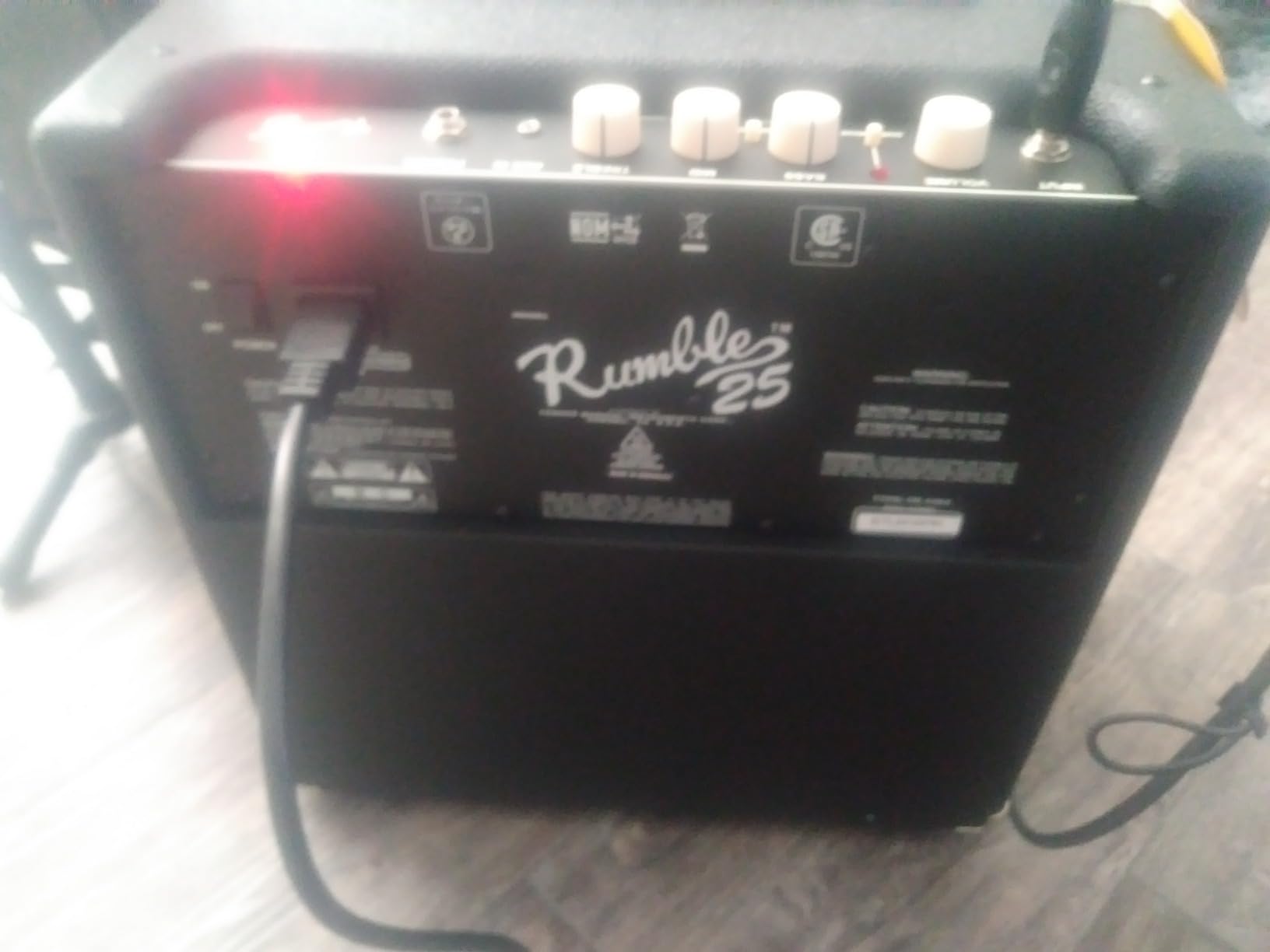
We kept coming back to this one during testing. The Fender Rumble 25 V3 is a plain-looking box, but it is the rare amp where the spec sheet and the playing experience agree: 25 watts, an 8 inch driver, and a three band EQ with a switchable overdrive circuit and a mid-scoop contour. That is more tone control than most players expect from a combo this size.
In a small bar with a drummer, a guitarist and a vocalist, it did not get buried. It was not the amp you would choose for a 200 capacity club, but for a pub set or a restaurant function room it is comfortable. The overdrive switch gives you a pushed tone for funk and R&B without a pedal, and the contour switch takes the aggressive middle bite out when you are doubling a guitarist.
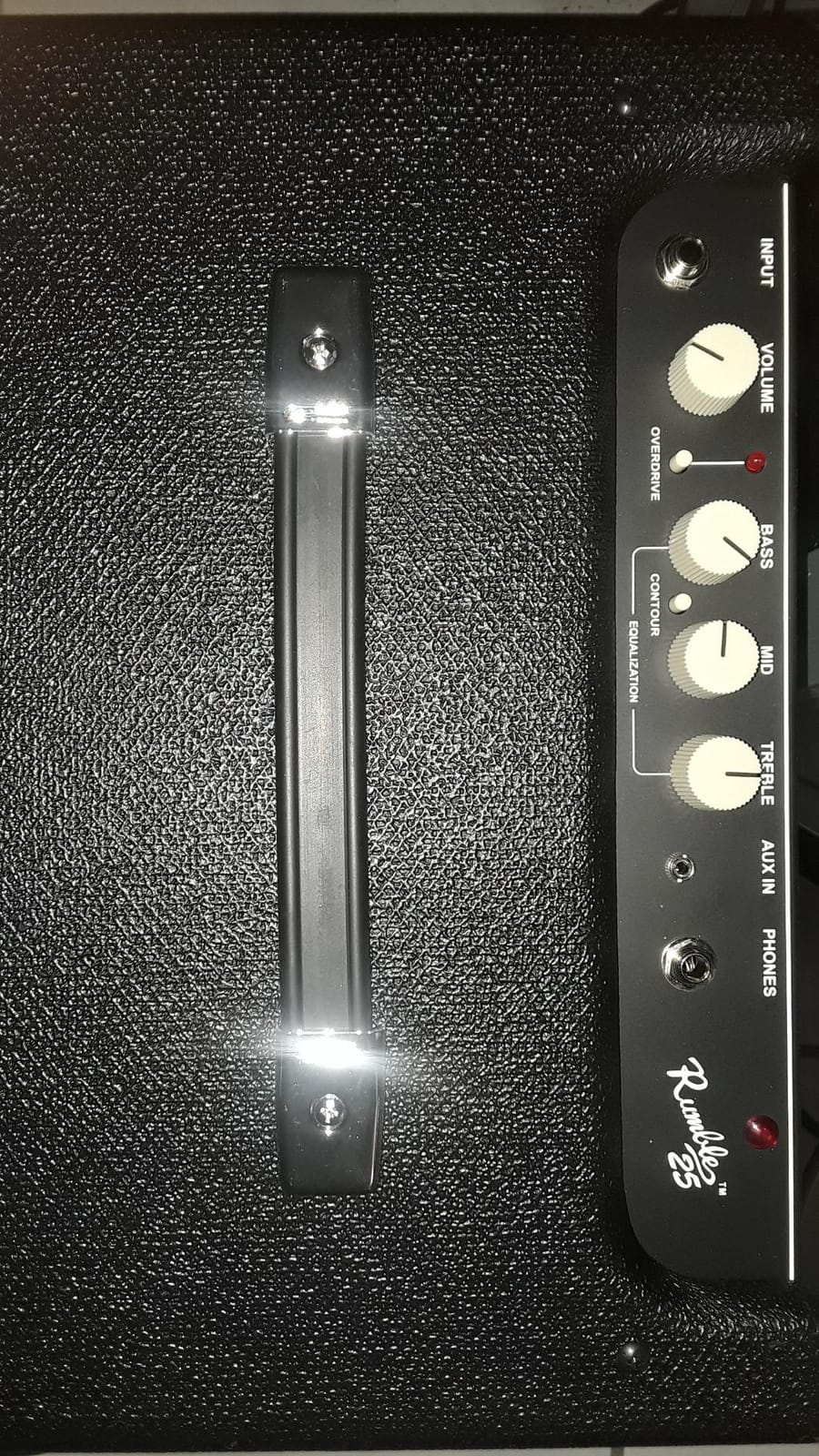
At 23.9 pounds it is one of the few amps here you can carry up a set of stairs alone, which matters more than raw wattage once you are 45 and loading into a room above a pub. The limiter built into the signal path means you can lean on it without the low end turning to mush at high volumes.
The honest weakness is bandwidth. Reviewers consistently note that output rolls off below roughly 100 Hz, so the lowest octave is thinner than a 10 or 12 inch cab delivers. There is also a resonant peak just above 3 kHz that adds a slightly hard edge if you push the treble. Neither matters in a small room, and both become noticeable the moment you stand in front of a full PA.
What you get at this wattage
Twenty five watts is enough when the room is small and the band is not loud. That covers most of the venues where beginners and semi-pros actually play, from a wedding function room to a brewery taproom to a rehearsal space with a drum kit in the corner.
It also covers the transition point from practice to playing out. Players who stay on a 15 watt practice amp for years tend to become the bassist who cannot be heard, and the fix is usually one step up in power rather than a jump to a head and cab.
Where it will frustrate you
The dead zone is the real limitation. A single 8 inch driver facing forward means there is one position on stage where the tone is right and the rest of the stage is a smear. Players who like to move should look at the Hartke Kickback 15, whose two-way cabinet solves this directly.
The Rollers also come in larger sizes. If you play rooms above 150 people regularly, the 40 watt Rumble or the Crush50 1×12 is a safer first gigging purchase than stretching this one.
2. Orange Crush50 Bass 1×12 Combo: Best for Small Clubs and Restaurants
Royal Sovereign Orange Crush50 Bass Guitar Combo 1×12 50 Watts
50W solid state
1x12 speaker
41.2 pounds
Active three band EQ with parametric mid
Pros
- 50 watts into a 1x12 is proper stage volume
- Blend control gives bi-amp style shaping
- Buffered effects loop for pedals
- Built-in chromatic tuner
- Very low noise floor
Cons
- Over 40 pounds is heavy for stairs
- No tube warmth in the gain circuit
- Low end limited for large or outdoor rooms
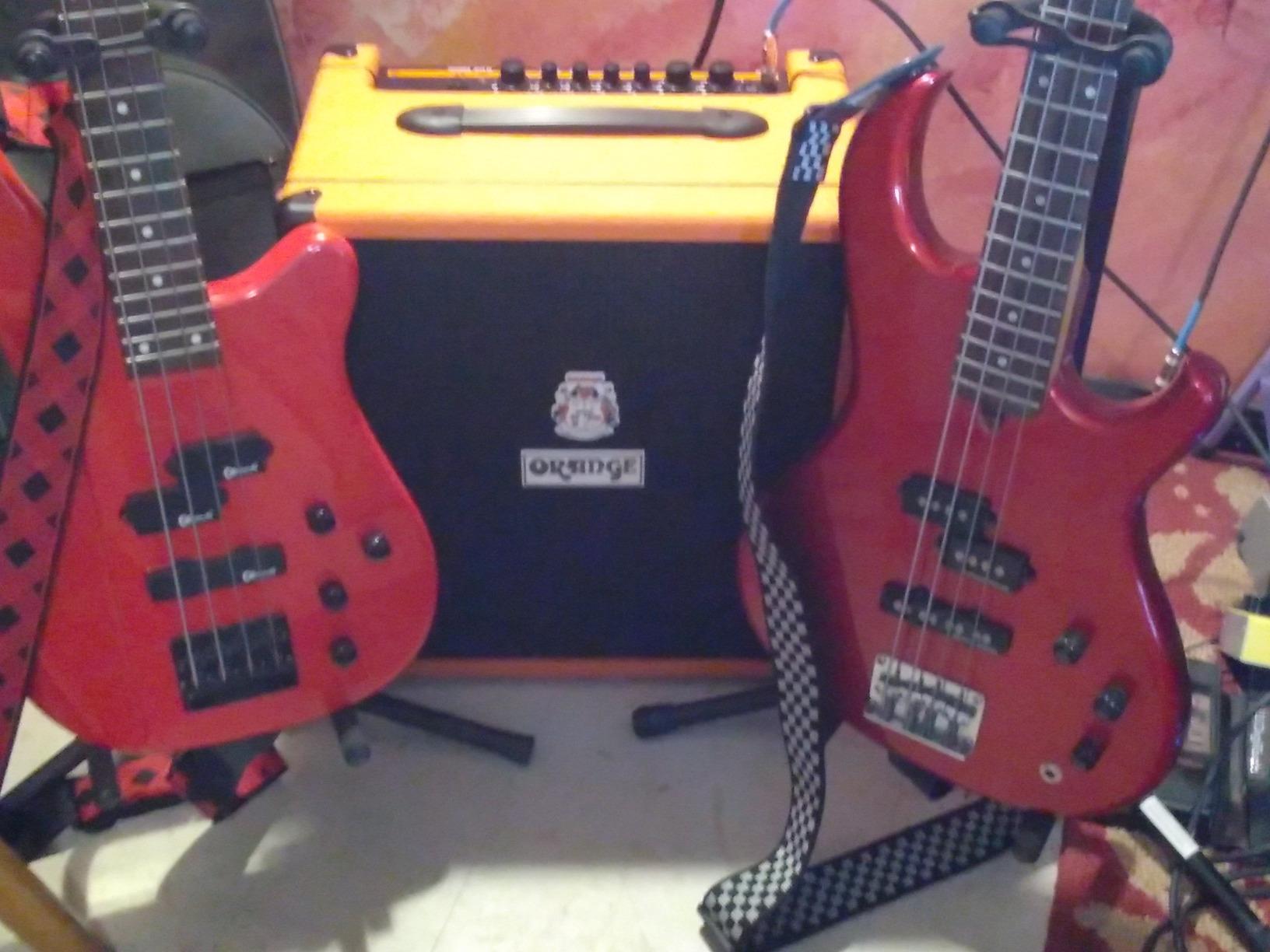
The Crush50 is the amp we would put on a restaurant gig without hesitating. Fifty watts into a 12 inch driver is the configuration that fills a room of 100 to 150 people without help, and the Orange voicing is warm enough to sit under vocals instead of fighting them.
What separates it from rivals at this power is control. The active three band EQ includes a parametric mid, which means you can choose the frequency you are cutting rather than guessing with a fixed mid knob. That single feature solves most of the growl complaints players raise about Ampeg and budget solid state amps.
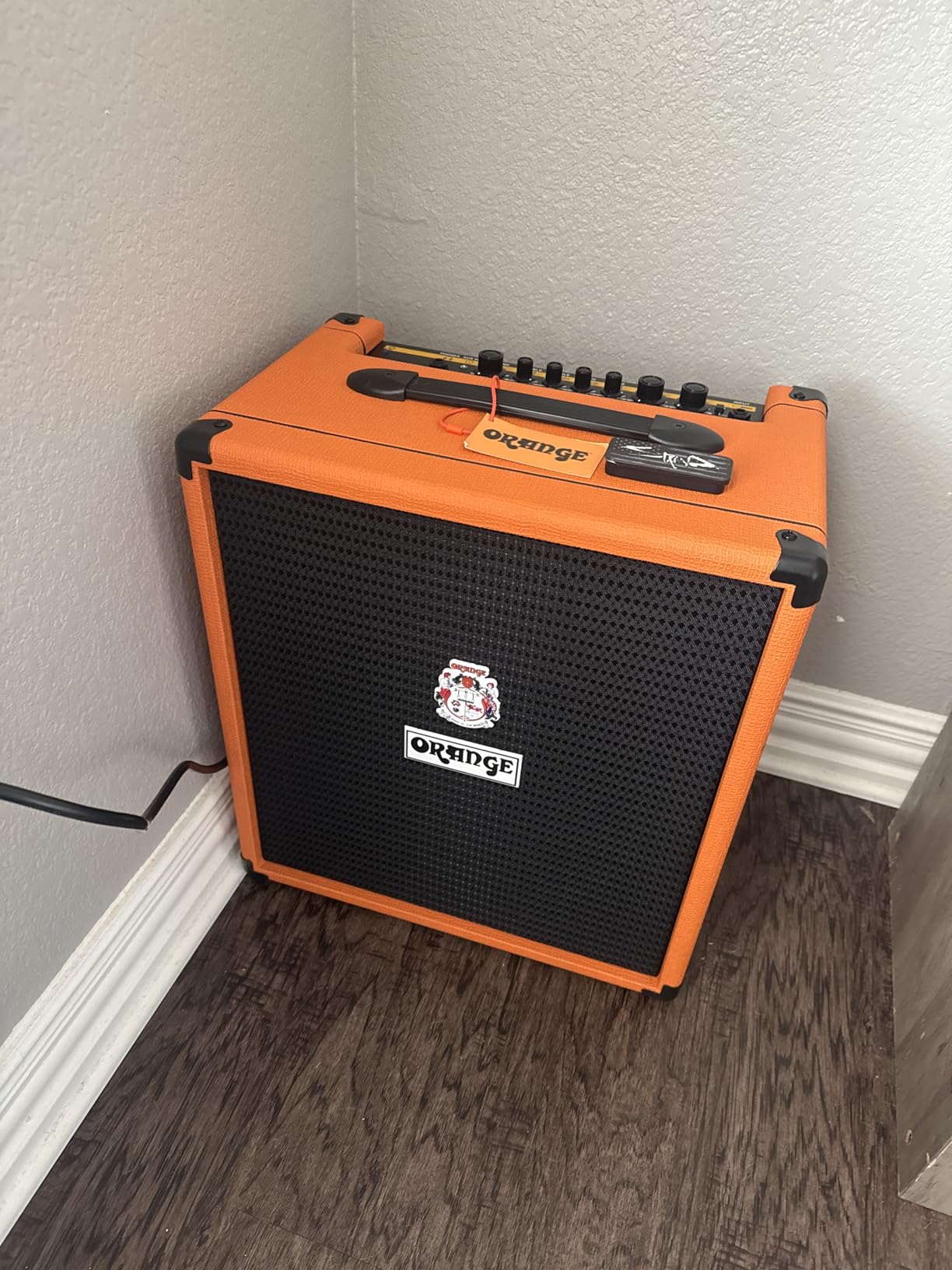
The Blend control is effectively a second voicing in one knob, letting you push grit into the top end while leaving the smooth low end intact. It is foot switchable, and so is the Gain input. There is also a buffered effects loop, so your overdrive pedal sits after the preamp distortion instead of before it, which is the correct order for most bass pedals.
At 41.2 pounds this is not a one-hand carry, and that is the honest drawback. The 22 inch wide cabinet needs a proper grip or a dolly for a venue with stairs. Reviewers also point out that the circuit is solid state throughout, so the overdrive stays clean-edged rather than breaking up the way a valve stage would.
Why the 1×12 matters in a small room
A 12 inch driver moves more air at lower frequencies than a 10 inch in the same cabinet, which is why the Crush50 covers more of the room at the same volume setting. Below about 80 Hz a smaller driver simply runs out of excursion, and that is where a bass part lives or dies.
It also means less of your stage volume depends on a wedge monitor. In a bar with a stubborn feedback problem, a 1×12 pointed forward with a bit of overdrive holds together better than a small practice combo pushed to its limit.
Who should skip it
If you have stairs, a bad back or a small hatchback, skip it and look at the 40 watt Rumble at 20.9 pounds. If you play upright bass in church or acoustic settings, the Hartke Kickback 15 is the more flexible choice because of its kickback cabinet.
Buyers should also note that reviews consistently praise the noise floor. There is very little hum or buzz, which matters when you are close to a grounded ring main in an older venue.
3. Fender Rumble 40 V3 Combo: Best Value Step Up From a Practice Amp
Fender Rumble 40 V3 Bass Amp for Bass Guitar, 40 Watts, with 2-Year Warranty Speaker, with Overdrive Circuit and Mid-Scoop Contour Switch
40W solid state
10 inch speaker
20.9 pounds
Overdrive and mid-scoop contour
Pros
- Biggest low end gain over the practice models
- Still light and compact enough to carry alone
- Overdrive and contour cover clean and pushed sounds
- Removable grille and ported cabinet load easily
Cons
- Two band EQ is less flexible than three band models
- Limited outdoors or in larger rooms without a PA
The Rumble 40 is the step most players should take, and reviewers describe it the same way: the sweet spot in the Rumble line. You get a 10 inch driver and 40 watts, which is a genuine jump in low end over the 15 and 25 watt models, and you keep a weight of 20.9 pounds that still fits in one hand.
It has the same switchable overdrive circuit and mid-scoop contour as the smaller Rumbles, so the tone options carry over. The ported enclosure with a removable grille makes loading simple, and the smaller footprint compared with most 10 inch cabs is a real advantage when the back line is a corner of a stage rather than a proper riser.
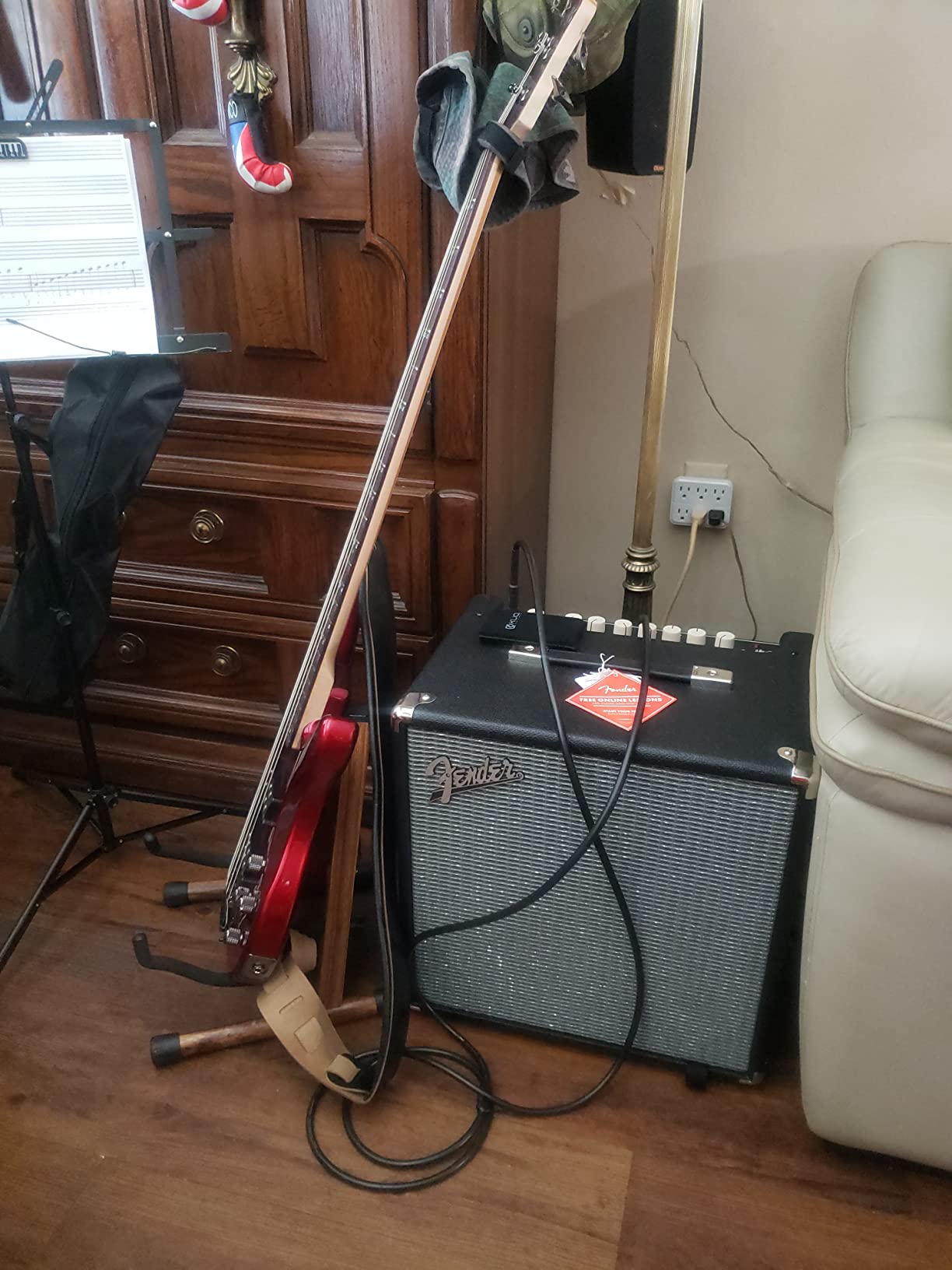
Our one note is the EQ. Two bands is fewer than you get on the Rumble 25 or on any of the Orange combos here, and if you play in a band with a loud keyboard player in the low mids, that missing control will get used constantly. It is a fair trade for the weight, but it is a trade.
Players who have upgraded from the 25 watt version consistently say the difference is night and day once a drummer is present. The extra 10 inch cone does more than the extra watts, because it moves air lower before it runs out of headroom.
When 40 watts is the right number
Forty watts handles rehearsal rooms, small bars and most cover band dates without a PA. It is also enough to compete with a guitarist running a moderate valve head rather than being buried by one.
Below that, wattage gets uncomfortable fast. Once a room reaches roughly 150 people with a loud kit, a 40 watt cabinet needs a mic or the venue PA to keep up with the drums.
What you give up for the weight
Two band EQ is the compromise. If you need a mid sweep to sit in a mix, add a pedal or choose the Crush50, which has a parametric mid built in. Otherwise the two controls cover 90 percent of gigging adjustments.
Because the cabinet is ported, low frequencies leak out the front and back. That is fine in a room and awkward in a small apartment at midnight, which is a real consideration if you practise where neighbours can hear you.
4. Fender Rumble 15 V3 Combo: Best Budget Practice Amp With Gig Potential
Fender Rumble 15 V3 Bass Guitar Amplifier, 15W Amp, Combo Amp, 2Yr Warranty
15W solid state
8 inch speaker
18.6 pounds
Three band EQ, aux and headphone
Pros
- Cheapest route into a sealed Fender bass cab
- Lighter than the 25 watt model at 18.6 pounds
- Sealed enclosure keeps response tighter than open back
- Clean balanced tone for the size
Cons
- 15 watts runs out of headroom fast in a band
- Compact size limits low end output
- One of the least powerful amps here
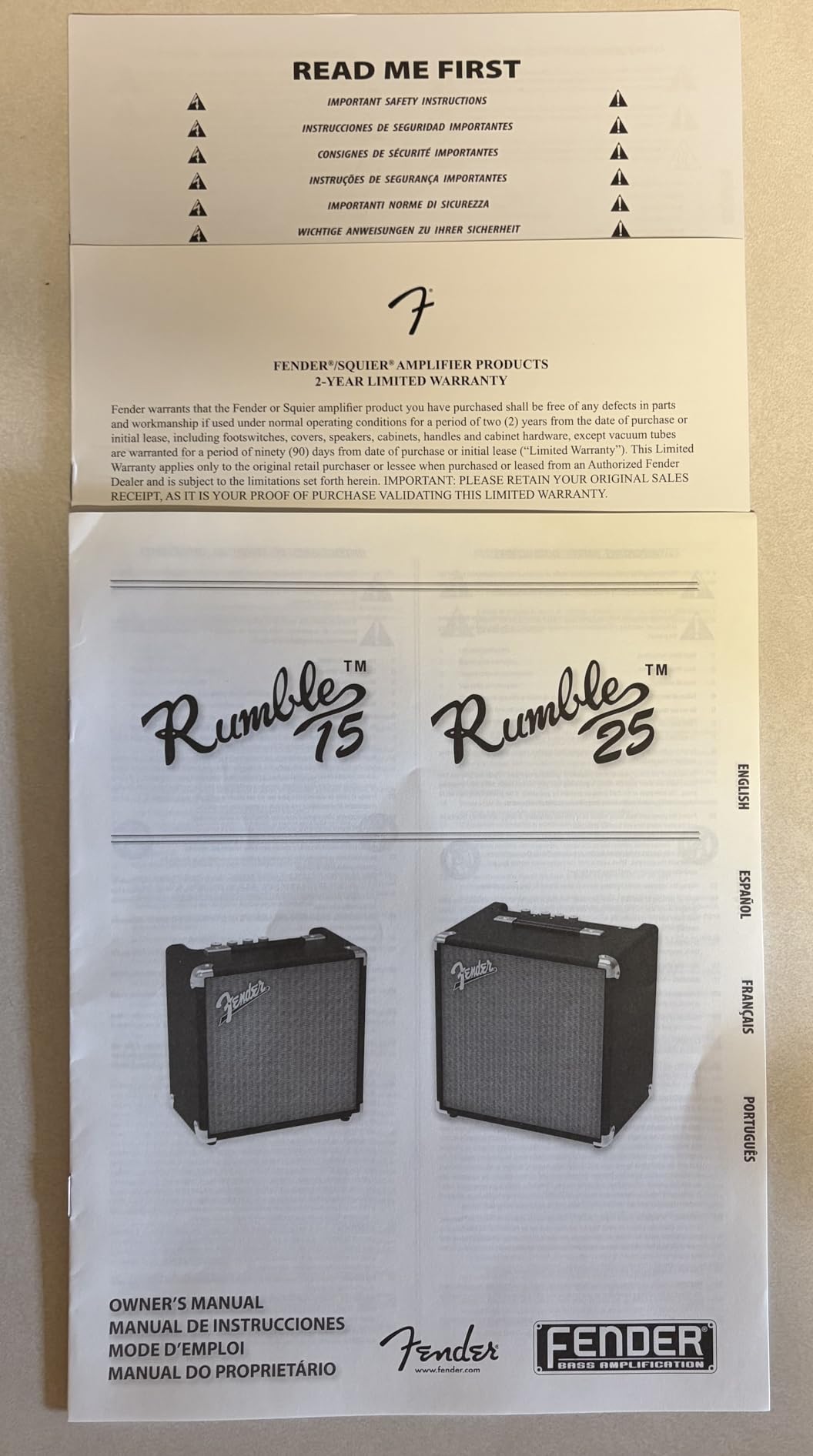
The Rumble 15 is the most common first bass amp sold anywhere, and the reason is simple: it is small, it is light, and it sounds better than it has any right to. At 18.6 pounds with a sealed enclosure it is the easiest amp here to move between a bedroom, a kitchen and a rehearsal room.
The sealed cabinet is the detail worth knowing. An open back design lets low frequencies escape through the rear wall of the enclosure, which is why some practice amps sound thin in a room. The Rumble 15 keeps more of that low end inside, which reviewers single out as a real difference against cheaper open-back designs.
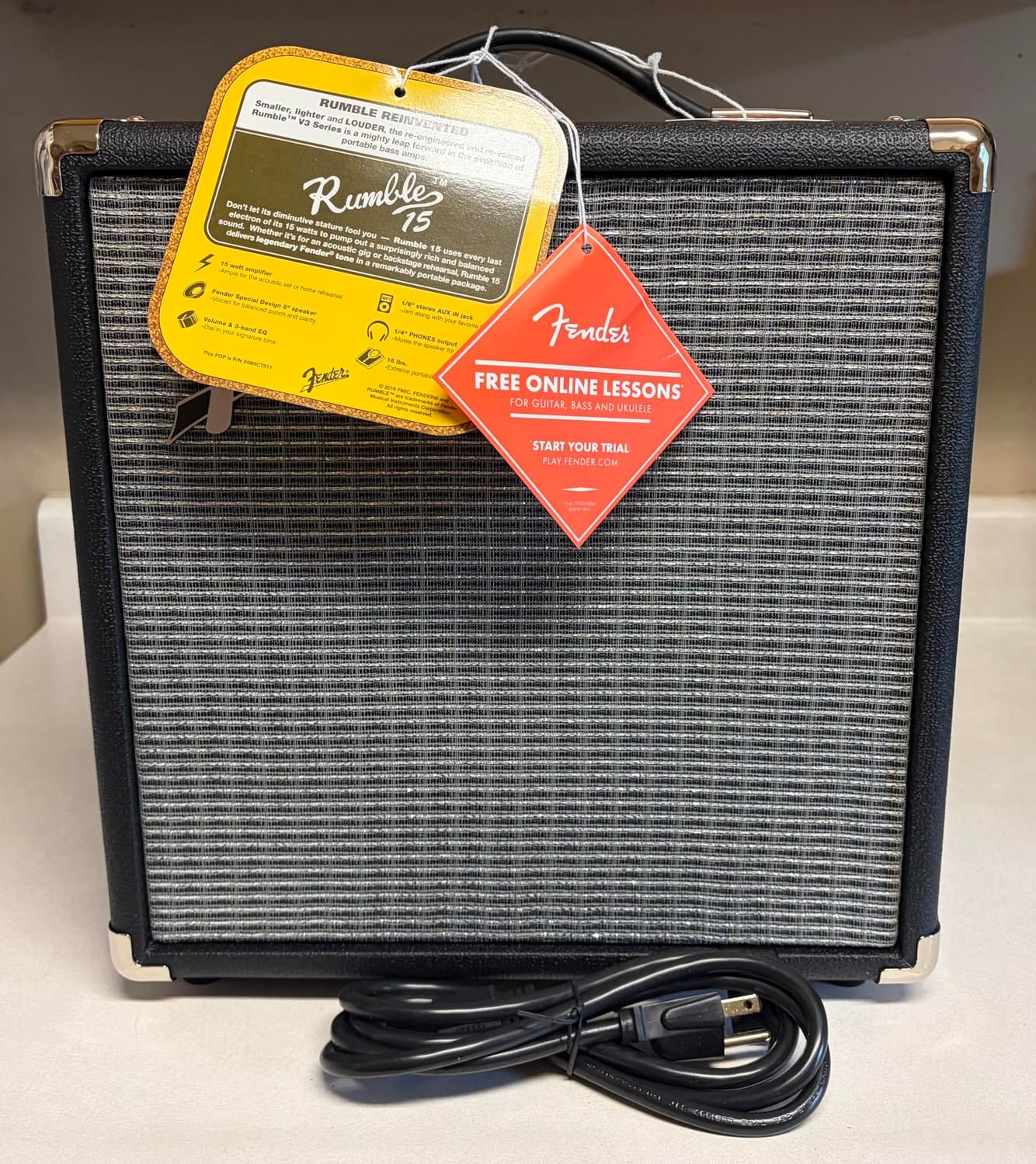
It has three band EQ, an auxiliary input for backing tracks and a headphone output, so you can practise silently at midnight without a guitar amp hum bleeding through a bedroom wall. Build quality is straightforward and the top-mounted control panel stays out of the way.
Where it stops is volume with a band. Fifteen watts is enough for a small room with no drummer, and it will hold up in a rehearsal room with a drummer playing quietly. The moment a full band plays at gig tempo, there is no headroom left and you are either clean and quiet or pushed and thin.
Who it suits right now
If you are months into playing and gigging once a month in a coffee shop, this is plenty. Many players use it as a travel amp and keep a bigger combo at home, which is a legitimate way to own two amps without overspending.
The aux input and headphone output also make it a decent silent practice tool. If you use in-ear monitoring or practise late, that matters more than wattage.
When to move up
Move up when you start being inaudible rather than when you get bored. The usual signs are backing off the bass volume so a song sounds balanced, or asking the drummer to play softer, which is a losing negotiation.
Going from the Rumble 15 straight to the Rumble 40 is a smaller step in price than it is in capability, and it keeps the Fender voicing players tend to like.
5. Orange Crush Bass 100 Combo: Best for Loud Bars and Small Clubs
Orange Crush Bass 100W Bass Guitar Combo Amp, Orange
100W solid state
1x15 bass speaker
63.3 pounds
Parametric three band EQ, Blend and Gain
Pros
- 100 watts into a 1x15 gives real stage volume
- Blend adds grit while keeping the low end smooth
- Balanced output for the venue PA
- Very clean and quiet at high gain
Cons
- 63.3 pounds makes loading a two person job
- Only one year of warranty
- Owners advise micing it in mid size rooms
The Crush Bass 100 is the amp in this group that genuinely needs a band behind it. A hundred watts into a 1×15 gives you stage volume that survives a loud drummer, and the Orange voicing stays smooth at the bottom rather than getting harsh when you push it.
It shares the Crush family control layout: an active three band EQ with a parametric mid, plus foot switchable Blend and Gain controls. The Blend circuit is the interesting part, adding grit to the upper frequencies while leaving the low end intact, which is a cleaner way to get overdrive than just turning up the gain.
There is also a balanced output for the venue PA and a buffered effects loop. The balanced output matters in older buildings where ground loops are common, because it sends a clean signal to front of house without needing an external DI box.
Weight is the problem, and it is not a small one. At 63.3 pounds with a 25 inch wide cabinet, this is a two person carry and possibly a furniture dolly. Several reviewers describe loading it into a car as the single most annoying part of owning it, and if your gigs include stairs, that will decide against it before anything else does.
Owners also advise micing or feeding the PA in mid size rooms rather than relying on the cabinet alone. That is sensible advice at 100 watts, since a 15 inch driver at full output is doing a lot of work by that point.
When 100 watts is justified
One hundred watts is the right number for clubs of 150 to 200 people, busy restaurant functions and any room where the drums are played hard. It is also the point where using the venue PA stops being optional and starts being the sensible choice.
Below that capacity, the extra volume is unusable and you will just turn it down, which means the amplifier runs cooler and cleaner but you have carried extra weight for nothing.
Alternatives that weigh less
The Hartke Kickback 15 delivers 500 watts in a 33 pound cabinet and doubles as a stage monitor, which is a much better weight to power ratio. It is also a better choice for upright bass players, which is why it earns its own section below.
If your gigs are under 150 people, the Crush50 at 41.2 pounds is the smarter version of the same voicing.
6. Hartke Kickback 15 Combo: Best for Upright Bass and Stage Monitoring
Hartke HMKB15 Kickback Bass Combo Amplifier, 1×15″
500W Class D hybrid
15 inch Hydride driver
33 pounds
Upright or kickback 2-way cabinet
Pros
- 500 watts in a cabinet you can still carry
- 15 inch driver gives real low end for small and mid rooms
- Kickback position angles the speaker at your ears
- XLR direct output for larger venues
- Clear top end that cuts through a band
Cons
- Some units reported noticeable fan noise
- Heavier than lighter 500 watt alternatives
- Two year parts and labor warranty only
The Kickback 15 solves a problem that most combos ignore: where do you stand? Its two-way cabinet works upright facing the audience, or in a kickback position angled upward at your head. That second position turns the amp into its own monitor, which on a small stage is worth more than extra wattage.
That makes it the pick for upright and acoustic bass players who also gig electric. Players running GK combos for upright work report the same thing, and the Hartke does it in one cabinet with an integrated amplifier rather than a separate wedge and cab.
The amplifier section is a lightweight Class D design rated at 500 watts driving a 15 inch Hydride paper and aluminium cone driver. Reviewers playing bars, churches and rehearsal rooms report plenty of volume with clarity, and the top end stays punchy enough to sit in a rock mix.
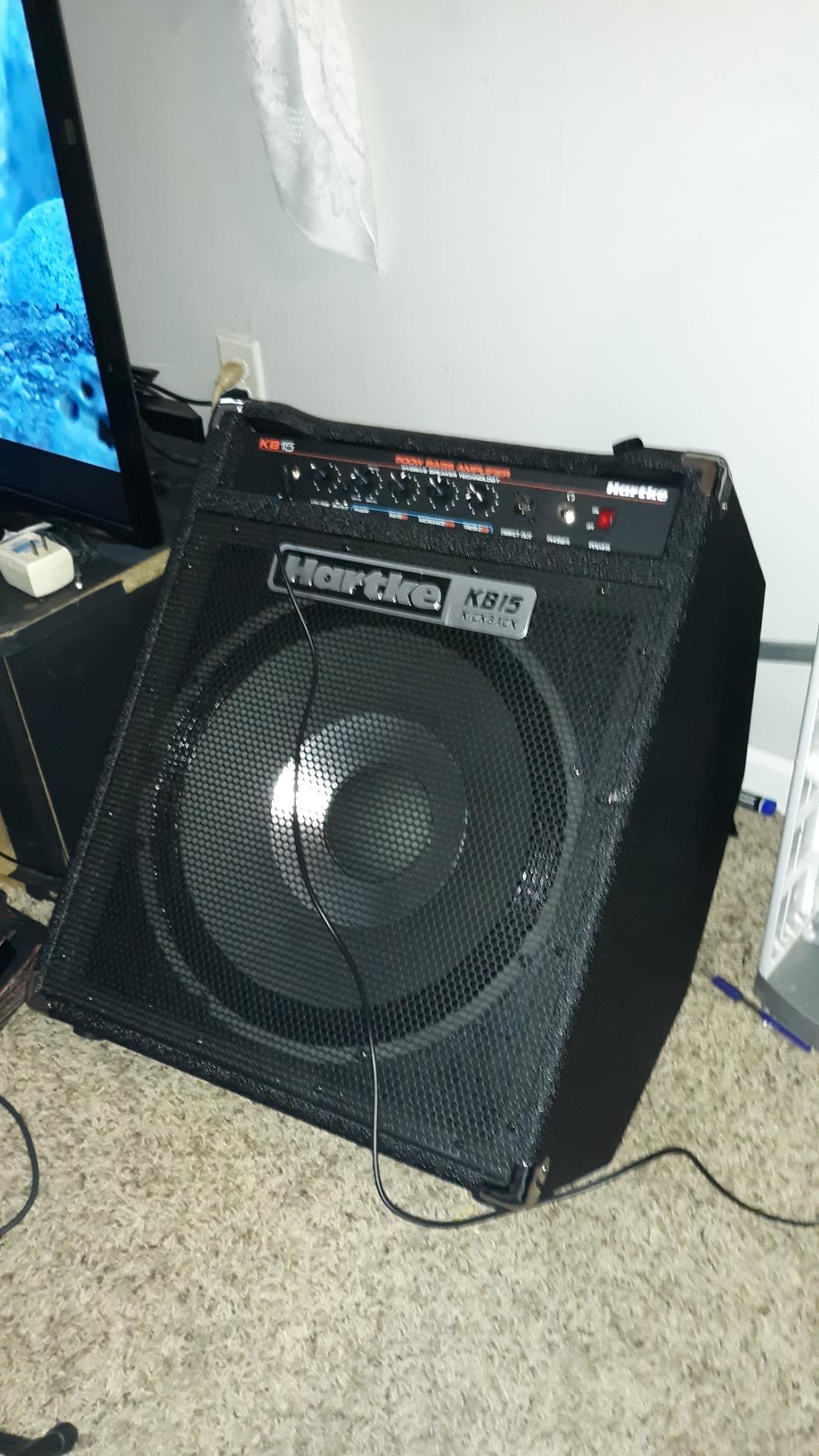
The recurring complaint is fan noise. Some units produce an audible whine from the Class D amplifier during operation, which matters more for acoustic and church work where the instrument is quiet and the amp is close to your head than it does in a loud rock band setting.
Weight is the second issue. At roughly 33 pounds it is heavier than most portable 500 watt combos, though still far lighter than the Crush Bass 100 despite carrying five times the power. The XLR direct output gives you a clean feed to front of house for larger rooms.
Why 500 watts matters for upright bass
An upright bass produces far more low frequency energy per watt than a solid body electric because it radiates through a much larger body. A 500 watt amp into a 15 inch driver gives it the excursion it needs to be felt in a room rather than merely heard.
Church and acoustic function band players get the same benefit. You can push hard enough for the notes to be felt in the floor without the amp distorting underneath you.
Where it falls down
It is a one-speaker cabinet, so coverage still depends on where you point it. The kickback position helps enormously with monitoring but narrows the audience coverage, which is the usual trade with any angled cab.
If fan noise bothers you or you play purely electric in loud rooms, the Bugera BXD15A offers similar power in a wedge-shaped cab, at the cost of nearly 15 pounds.
7. TC Electronic Thrust BQ500 Head: Best for Travelling Light
TC Electronic THRUST BQ500 500 Watt Portable Bass Head with Mosfet Preamp and Thrust Compressor
500W Class D head
4.9 pounds
MOSFET preamp and Thrust compressor
Head only
Pros
- 500 watts from a 4.9 pound head
- High voltage MOSFET preamp for a tube style response
- Thrust compressor adds punch and controls dynamics
- Fits in a gig bag as a backline for rehearsals
Cons
- Head only so a cabinet must be bought separately
- Very limited front panel tone shaping
- No built in speaker monitoring for practice
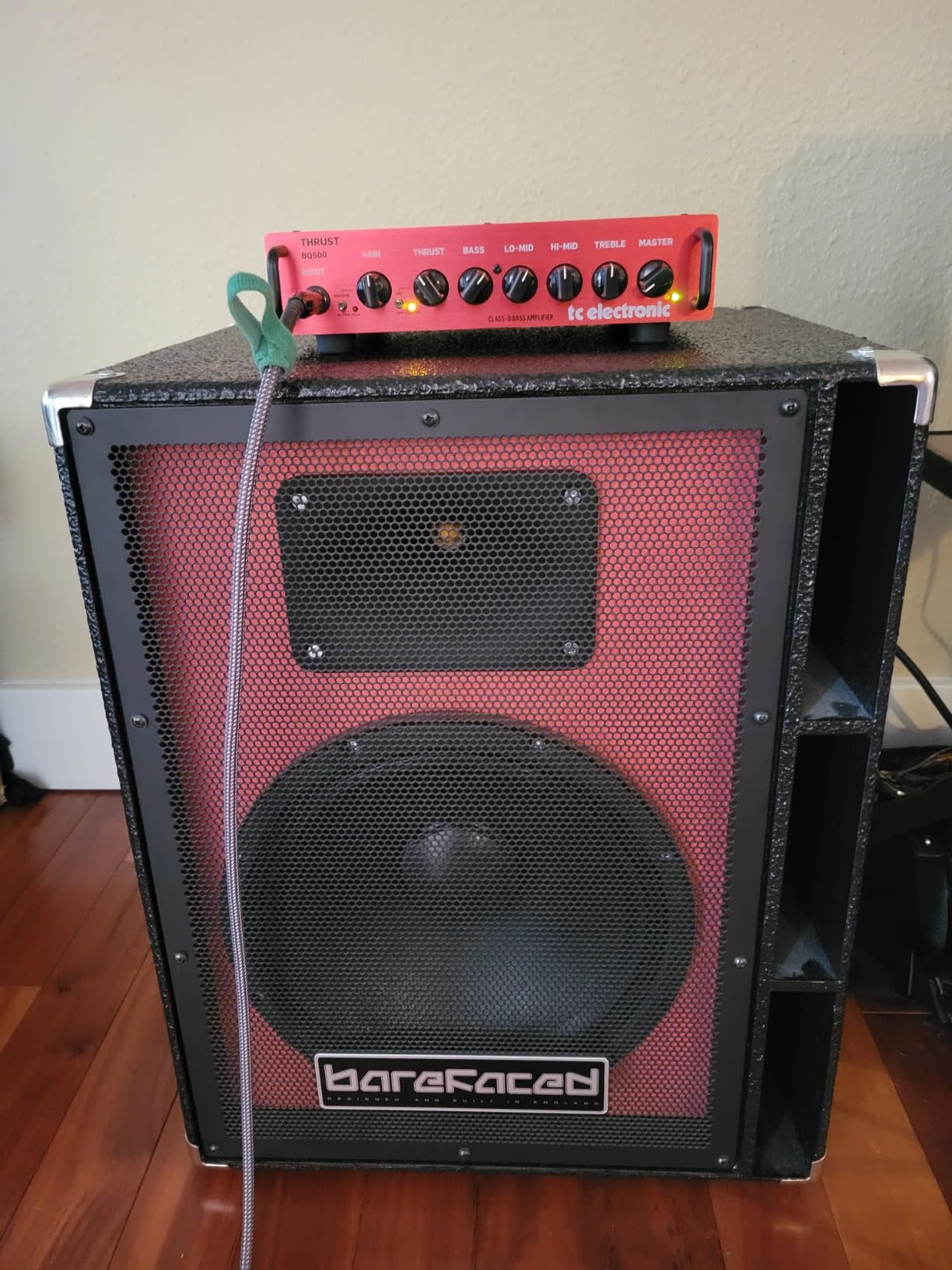
The BQ500 is the odd one out here because it is a head, not a combo, and that changes the calculation entirely. It weighs 4.9 pounds and produces 500 watts into any cabinet you like, which makes it the easiest way to get serious stage power into a small room.
Reviewers emphasise the power to weight ratio as the headline feature. If you already own a 1×12 cabinet, you have a complete 500 watt rig that a single person can carry in two trips with a backline strap. That solves the stairs problem that stops people buying bigger combos.
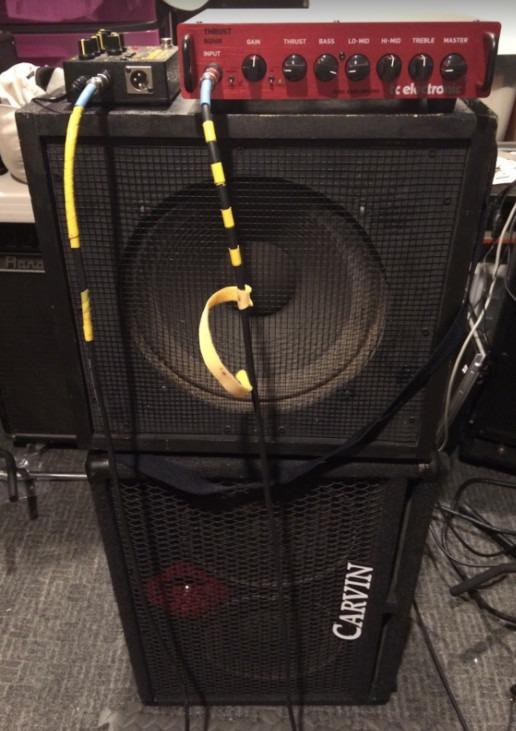
The high voltage MOSFET preamplifier is designed to feel like a valve stage under the fingers, with more compression and slower response than typical solid state. The Thrust compressor adds punch and evens out slap dynamics without the pumping you get from a pedal compressor squashed by the preamp.
When a head plus cab is the right setup
Head and cab wins when you already own a cabinet, when you play rooms with different cabinets on backline, or when weight is your binding constraint. It also lets you swap a 1×10 for a 1×15 between a coffee shop and a club without changing amplifier.
Players on gigging forums repeatedly recommend this approach, pairing compact class D heads with 1×12 cabinets for exactly the small and medium gig range this article covers.
Where it will not work
If you do not own a cabinet, this is not a starter amp. You need a bass cabinet with the correct impedance for the head, and that adds cost, weight and a second thing to transport.
Front panel tone shaping is minimal, so you will be relying on a pedal or the cabinet voicing for EQ and character. That is fine for experienced players and frustrating for beginners learning to dial in a tone.
8. Bugera BXD15A 1000W Combo: Best for Maximum Headroom
Bugera BXD15A 1000 Watt Bass Amplifier with Original 15″ Turbosound Aluminum-Cone Speaker, MOSFET Preamp, Compressor and DYNAMIZER Technology
1000W Class D combo
15 inch Turbosound aluminum cone
48.5 pounds
MOSFET preamp and compressor
Pros
- 1000 watts leaves headroom you will never find elsewhere
- 15 inch Turbosound driver covers a wide range cleanly
- MOSFET preamp and compressor give a tube like feel
- Wedge cabinet shape suits on stage monitoring angles
Cons
- Heaviest combo here at 48.5 pounds
- Neutral tone is less characterful than Fender or Orange
- Some owners report fan noise and durability complaints
Nobody needs 1000 watts for a small gig, and that is exactly why this amp works in one. The extra headroom means you run the amp at a fraction of its output, the signal never approaches clipping, and your low end stays clean while a loud band plays around you.
The 15 inch Turbosound aluminium-cone driver handles a wide frequency range with less distortion than a paper cone at the same level. The compressor and high voltage MOSFET preamp add sustain and a valve-like response, and the DYNAMIZER circuit manages amplifier headroom transparently.
The wedge-shaped cabinet is angled so the speaker points upward toward a standing player, which helps on small stages where a wedge monitor is not available. It is a small design decision that solves the dead zone problem more effectively than the shape suggests.
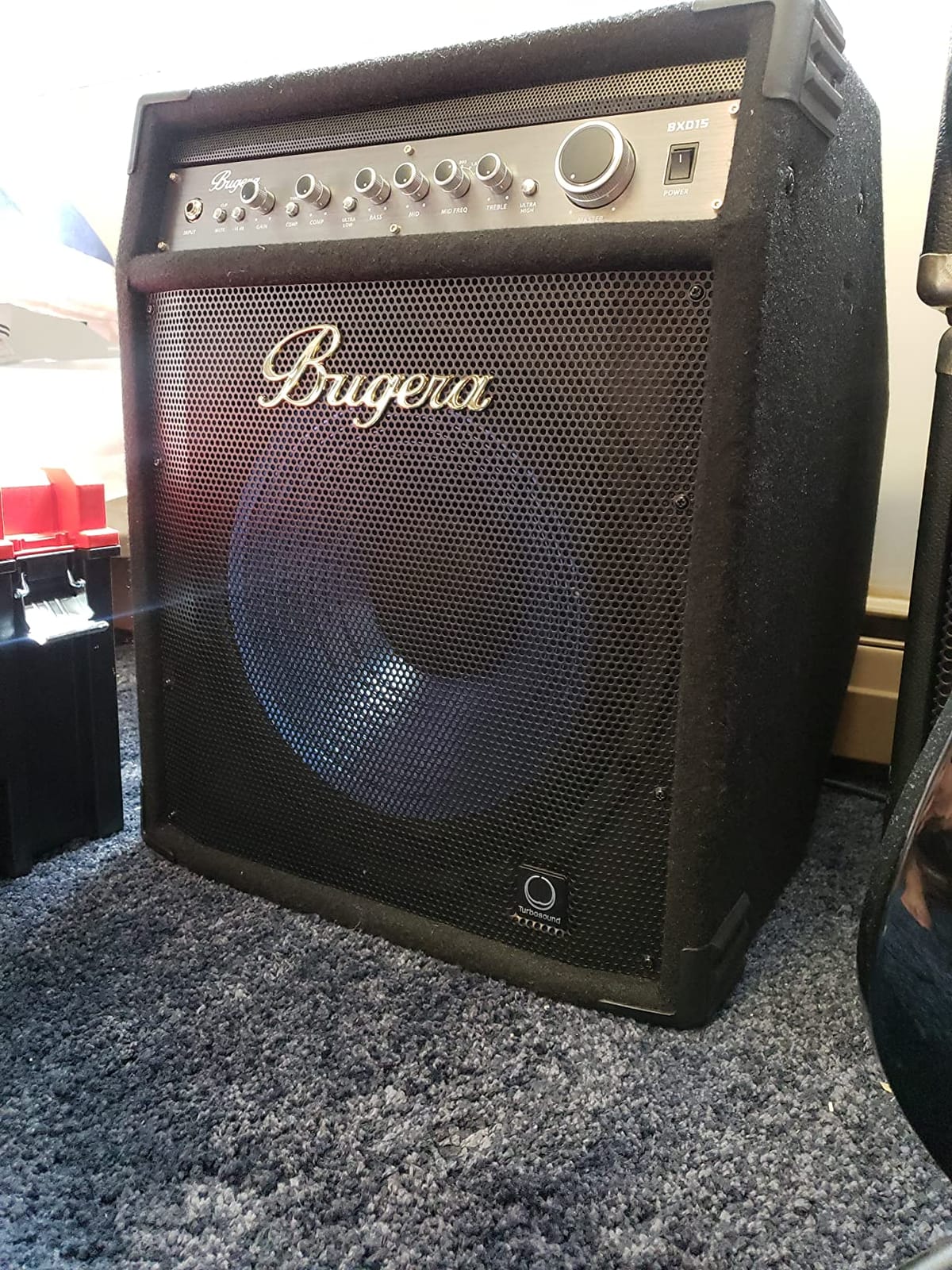
Weight is the drawback. At 48.5 pounds it is the heaviest combo in this group, which is uncomfortable to know if your gigs involve stairs or a long walk from the car. Several owners also mention fan noise, and the amp has a higher share of one-star reviews than the Fender and Orange models here.
The tone profile is deliberately neutral. If you want a distinctive voice you will need to shape it with pedals or a brighter cabinet, because the character comes from the driver rather than from preamp coloration.

When raw power is the right answer
A thousand watts makes sense for outdoor events, larger rooms, or any situation where you are not micing and cannot use the venue PA. It also handles rehearsal with a loud drummer at full tilt without you touching the master volume.
Players who replace the stock driver report a deep, creamy bottom end after the swap, which suggests the factory unit is deliberately conservative rather than limited by the design.
Whether you should carry it
We would not. For a small gig, the Hartke Kickback 15 gives you a fifth of the power in 15 pounds less and doubles as a monitor. Extra watts you never use do not help you, but extra weight slows you down on every load in and load out.
Buy this one if you play outdoors, run loud rooms, or already know you will grow into bigger venues.
9. Orange Crush Bass 25 Combo: Best for Recording and Quiet Practice
Orange Crush Bass 25 25W 8″ Guitar Amplifier and Speaker Combo,
25W solid state
8 inch speaker
20.5 pounds
Active three band EQ with parametric mid
Pros
- Built-in chromatic tuner is accurate and easy to read
- Parametric mid control is unusual at this output level
- Dual voltage supply works in more countries
- Clean warm tone with no hum or buzz
Cons
- 25 watts is modest and described as underpowered
- Headphone output is cabsim loaded not a true speaker signal
- Not enough output for full band gigs without support
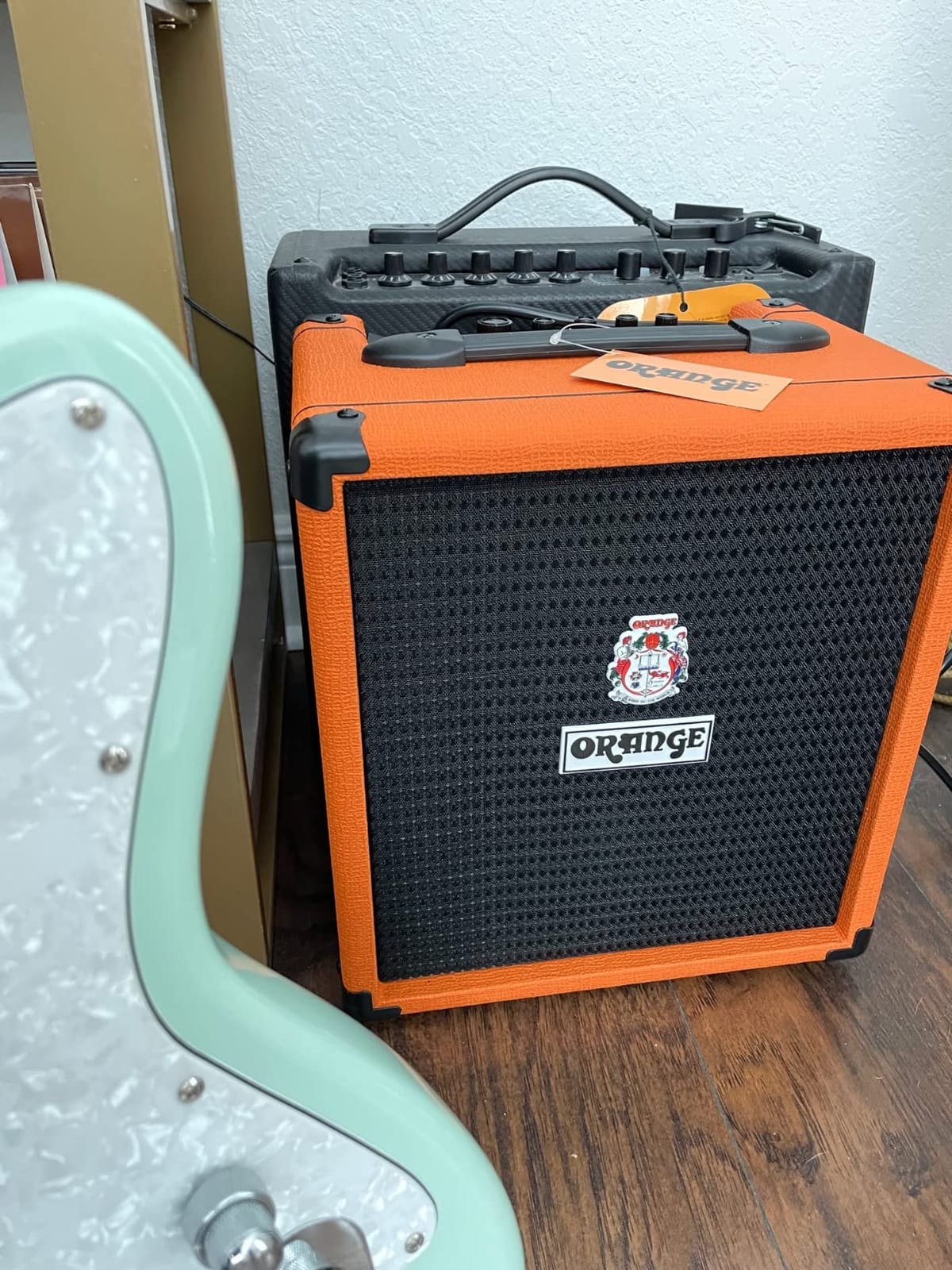
The Crush Bass 25 is smaller than the Rumble 40 despite having the same wattage, and reviewers regularly notice that. It is a compact, clean-sounding combo with a built-in tuner, which makes it a genuinely useful tool for writing and recording rather than just a practice box.
The parametric mid control is the feature that stands out. Most amps in this class give you a fixed mid band, and a fixed mid is a compromise between two problems. Being able to choose the frequency you cut means you can solve whatever the band is doing in the room on a given night.
Reviewers comparing it to the similarly rated Rumble 40 say the Orange is smaller and less powerful but clearer and easier to tune. The tone is warm and British, with a low noise floor and no buzz, which matters when you are recording a bass part with the instrument plugged straight in.
The headphone output is cabsim loaded, meaning it is a simulated speaker response rather than the raw amplifier signal. That is fine for silent practice and pleasant to listen to, but it is not the same as capturing a direct recording. The aux input is there for backing tracks.
At 20.5 pounds this is an easy one-hand carry and the 15 inch square footprint fits under a desk or in a car boot without thinking about it. The dual voltage supply means less fuss if you play gigs abroad.
Why recording players like it
A clean low noise floor and a built-in tuner remove two pieces of gear from the signal chain. The tuner lets you check intonation between takes without interrupting, which is where a lot of amateur bass recordings go wrong.
Players who record at home also like the small footprint. This amp can live in a corner of a room with a passive bass instead of occupying a dedicated amp corner.
Where it runs out
Twenty five watts into an 8 inch driver is a practice and rehearsal power level. One owner calls it not very powerful and that is a fair summary of the consensus. It will not carry a full band in a club.
When you are ready to gig properly, the step up should be to the Crush50 at 50 watts and a 1×12, since the Orange voicing carries over between them.
10. Ampeg Rocket Bass RB108 Combo: Best for Warm Vintage Growl
Ampeg Rocket Bass RB108 Bass Combo 1×8 30 Watts
30W solid state
1x8 inch speaker
27.4 pounds
Three band EQ with Super Grit overdrive
Pros
- Classic Ampeg warm and gutsy voicing
- Super Grit overdrive adds usable dirt for rock and blues
- 0dB and -15dB inputs suit passive and active basses
- Vintage styling at a modest price
Cons
- Only 30 watts runs out of headroom quickly in a band
- Single 8 inch driver limits low end
- Heavier than most combos of similar power
- One year manufacturer warranty
The Rocket Bass is here for tone rather than headroom. If you want the Ampeg voice that has been on records for decades, this is the cheapest way to get it, and the Super Grit overdrive adds a believable amount of dirt without tipping into full distortion.
The dual input is the detail most players miss. Separate 0dB and -15dB inputs let you plug in an active bass with onboard electronics at the correct level, which avoids the thin, overdriven sound that comes from running active gear into a passive input.
Three band EQ, an aux input and a headphone output round out a straightforward feature set, and the vintage styling with a wood cabinet looks good on a small stage where most modern combos look like they came out of a computer lab.
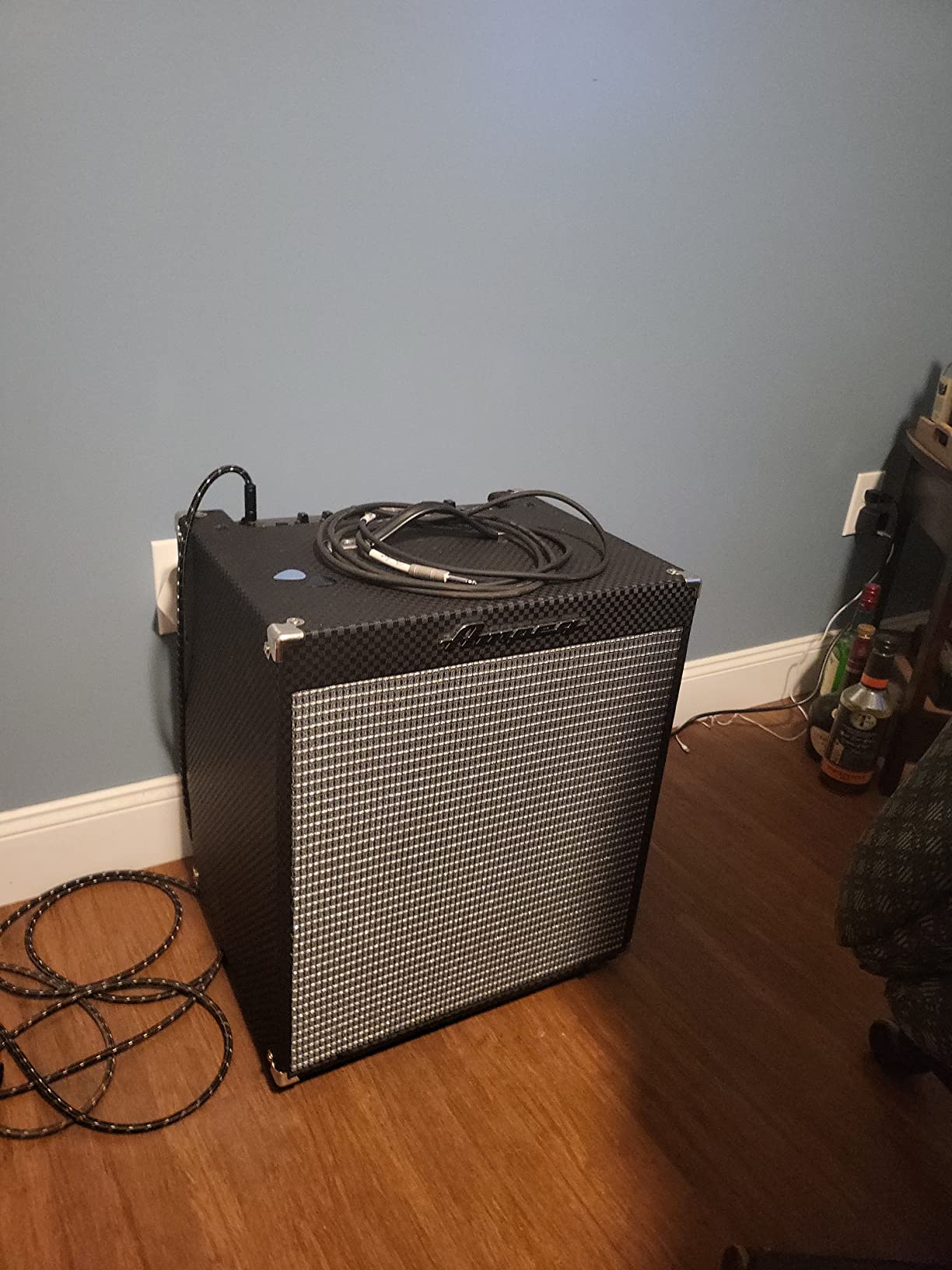
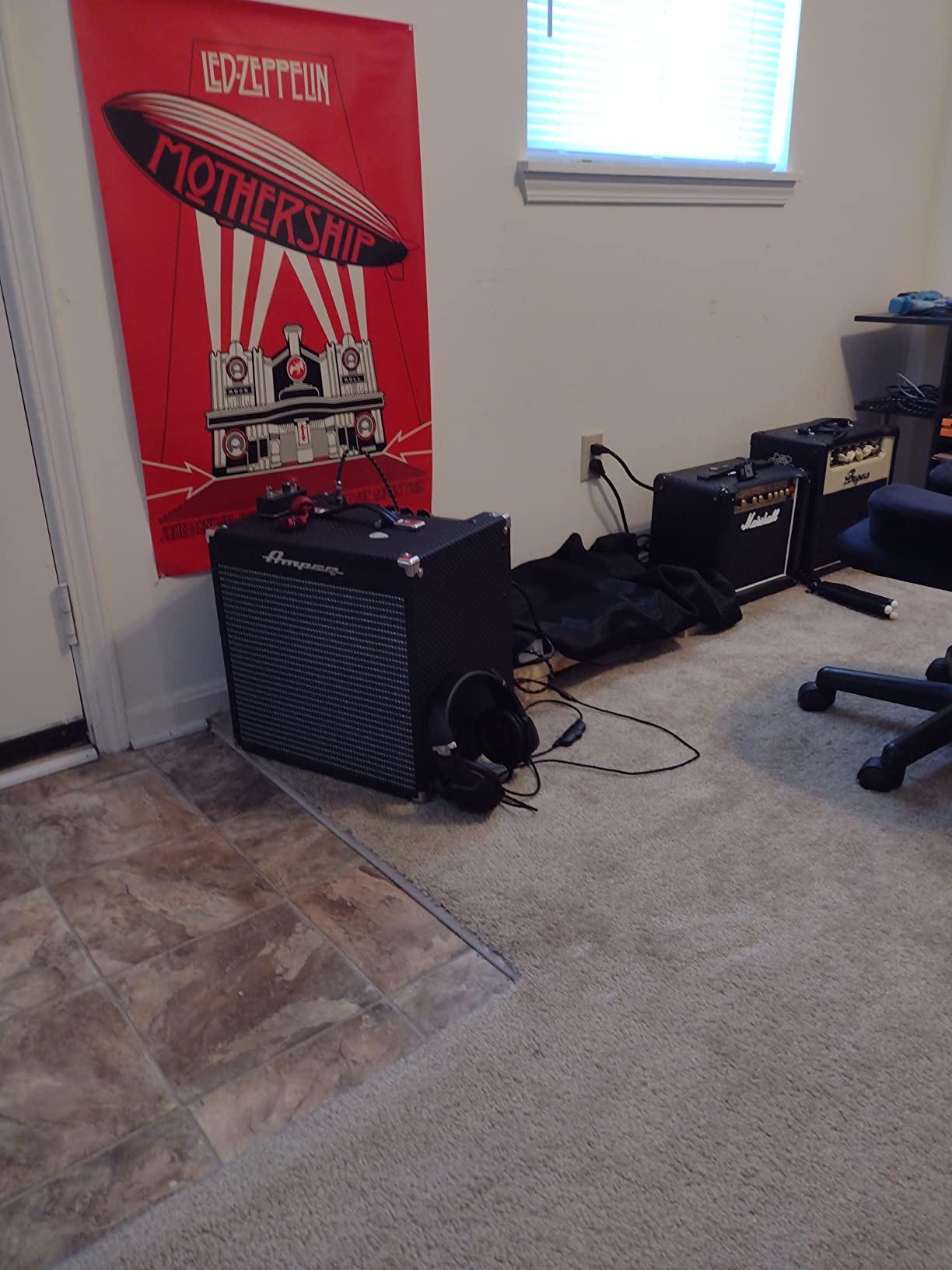
Thirty watts into a single 8 inch driver is the ceiling here. In a small room with no drummer it is plenty, and in a full band it runs out of headroom fast. Players who move up from this usually go to a 1×12 or 1×15 combination rather than simply adding more watts to the same cabinet.
At 27.4 pounds it is also heavier than several rivals with more power, including the 30 watt Fender models. The single year manufacturer warranty is thinner than the two years most competitors offer, so factor that into the risk of buying new.
Who the Ampeg voice suits
Blues, rock and anything driven benefits from the mid-forward voicing and the gritty overdrive circuit. If you play funk clean with a P-Bass, the scoop switch and low mids on the Orange combos are more useful.
Because the overdrive lives in the amplifier, you can leave the guitar rig flat. Players with pedals often note that the amp gain and their pedal drive fight each other, so an amp with usable built-in grit simplifies the signal chain.
When to leave it behind
Once you are playing paid dates in rooms with a real PA, you want an XLR or balanced output and more headroom. This amp has neither, so you will be leaning on a microphone.
For the same 30 watt budget in a lighter package, the Orange Crush Bass 25 at 20.5 pounds gives you a parametric mid and a tuner instead of the Ampeg growl. It is a tone choice, not a quality judgement.
11. VOX Pathfinder Bass 10 Combo: Best for Very Small Rooms and Travel
Vox Pathfinder Bass 10 2×5 inch 10 Watt Bass Guitar Amplifier
10W solid state
2x5 inch Bulldog speakers
12.2 pounds
Bass and treble with drive control
Pros
- Distinctive Vox styling with diamond grille cloth
- Drive control gives usable grit for a small amp
- Headphone and line outputs for recording and silent practice
- Lightest full sized combo here at 12.2 pounds
Cons
- Open back cabinet weakens low end and reflects off walls
- Two small 5 inch speakers cannot produce much volume
- Only bass and treble controls with no mid EQ
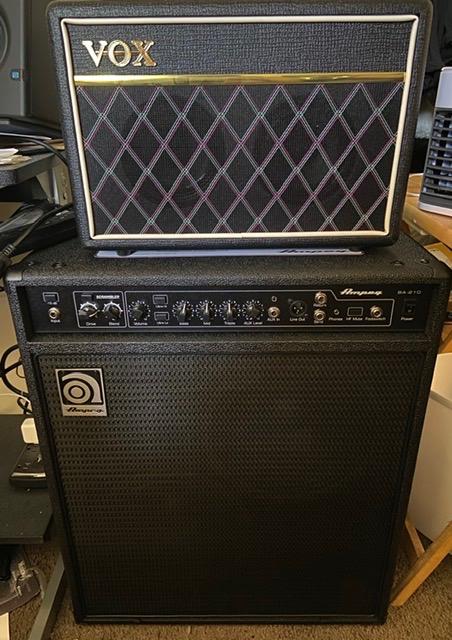
The Pathfinder Bass 10 is a style object first and an amplifier second, which is exactly why it works in some situations. At 10 watts and 12.2 pounds it is the easiest amp here to carry, and the line output means you can feed a larger system or record straight from it.
Two 5 inch Bulldog speakers driven by an analogue circuit give it a distinctive character. The drive control adds growl, and the bass and treble controls are simple enough to set in seconds on a dark stage.
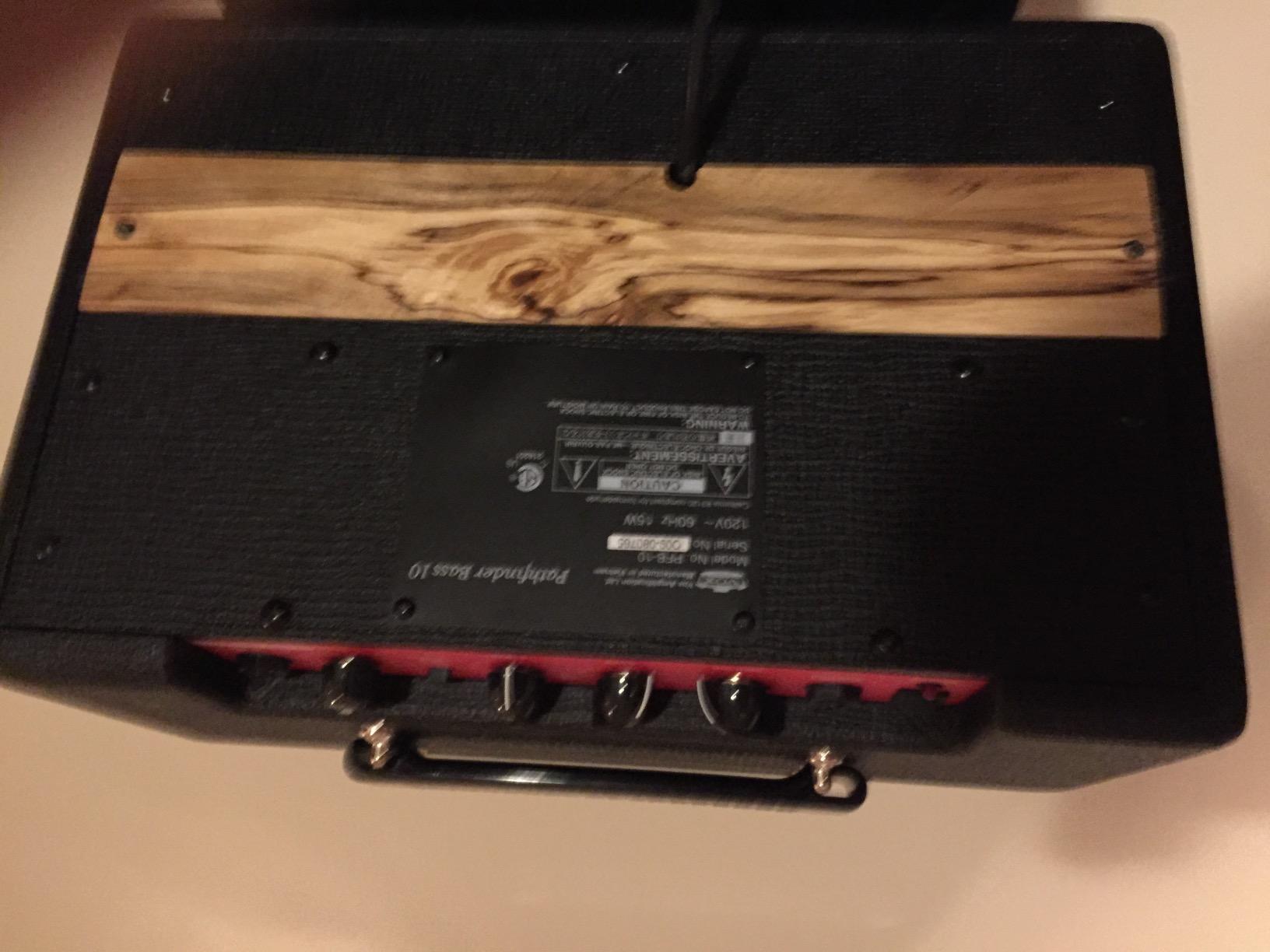
Reviewers mention one long-running modification more than any other: adding a solid panel to the open back of the cabinet, sometimes with acoustic foam, dramatically improves punch and low end. That is a widely reported change, not an isolated account.
The open back design is the core issue. Low frequencies that should load the cone partly escape out the rear of the cabinet, and in a room with a hard wall a couple of feet behind the amp, those frequencies come back as a thin, phase-cancelled sound. This is why the amp sounds better in the middle of a room than against a wall.
Two 5 inch drivers simply cannot move much air, and there is no mid EQ to fix the balance. It is a practice and bedroom amplifier, and owners generally know that going in.
Where 10 watts is genuinely fine
Solo acoustic sets, a lap steel at a coffee shop, a bedroom, a hotel room on tour, or a small room with a brush kit. In those situations 10 watts with a headphone jack beats carrying something heavier.
It also works as a portable practice amp for travel, at 12.2 pounds it goes in a backpack, and the battery style power options listed for it make it easy to keep near a rehearsal space.
When it is the wrong choice
If a drummer is playing at gig tempo in anything larger than a bedroom, do not buy this. The Fender Rumble 15 at the same carry weight gives you fifteen watts and a sealed cabinet that holds the low end, which is a strictly better use of your money for playing out.
Some owners have reported a damaged speaker or dented cabinet trim arriving in the box, so inspect it on arrival if you order one.
12. JOYO Vibe Cube BA-30 Combo: Best for Streaming and Direct Recording
JOYO 30W Bass Amp Portable Combo Amplifier 4″ Speaker with Bluetooth 5.1 + OTG Direct Recording | 3-Band EQ + Compressor | Headphone Practice for Bassist Livestream Solo Gigs (Vibe Cube BA-30, Black)
30W portable solid state
4 inch speaker with LF radiator
5.95 pounds
3 band EQ with MID FREQ control
Pros
- Under 6 pounds with a built-in carry handle
- Bluetooth 5.1 and OTG direct recording are unusual features
- MID FREQ control from 200Hz to 2000Hz for small rooms
- Compressor evens out slap dynamics and adds sustain
Cons
- 4 inch speaker cannot produce meaningful low end
- Requires continuous external power so not truly cordless
- Signal peaks with active basses if all bands are maxed
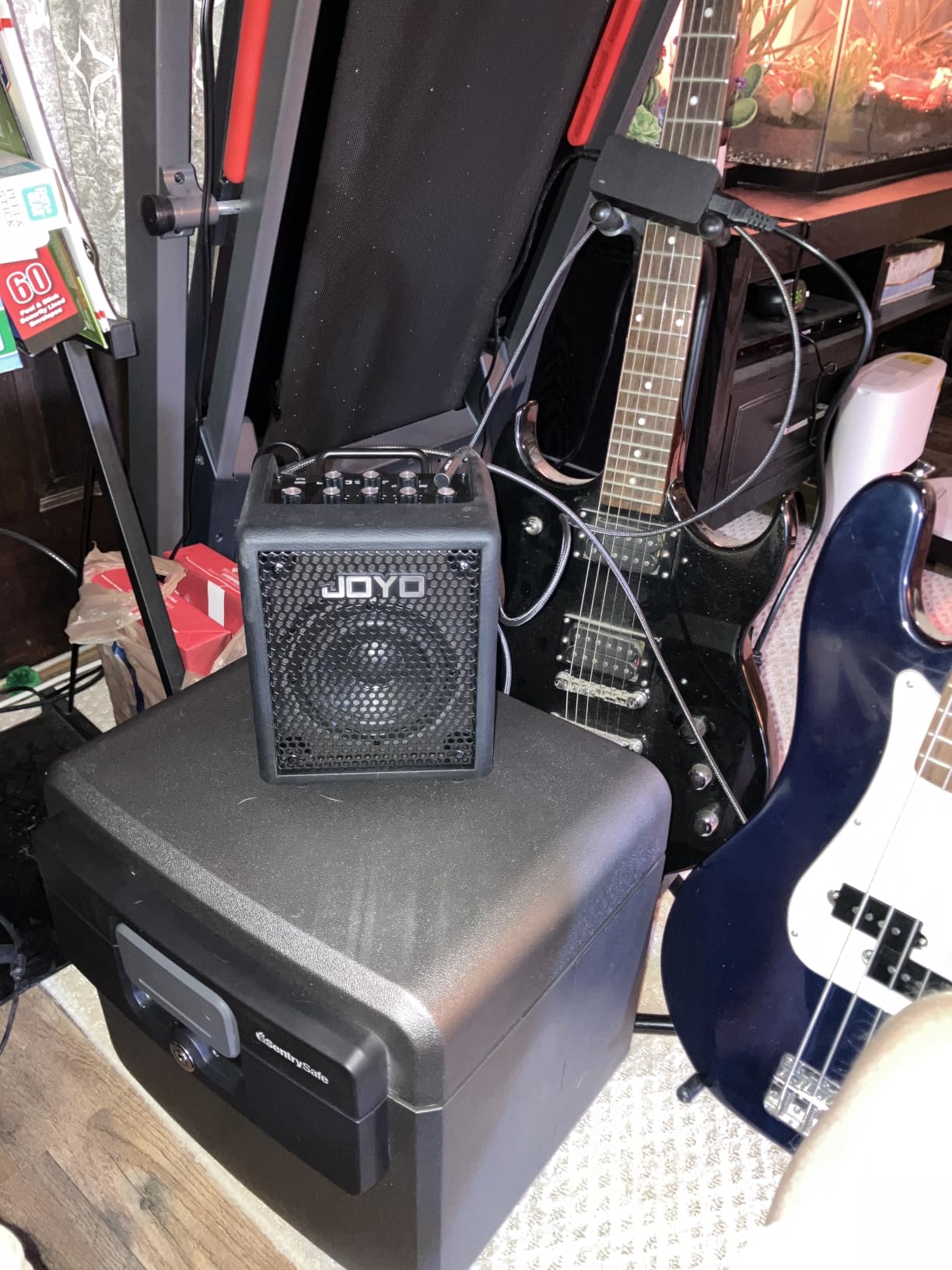
The Vibe Cube BA-30 is the most unusual amp on this list. It weighs 5.95 pounds, runs a 4 inch full range driver with a separate low frequency radiator, and it does not need mains power if you connect a 65 watt or higher USB-C power bank. For a player who moves between rooms, floors and venues on foot, that is a real advantage.
The connectivity is the selling point. Bluetooth 5.1 streams backing tracks, and the OTG port works as an audio interface to a phone or computer for direct recording and for livestreaming. This is aimed at players who record or broadcast rather than at club players.
Three band EQ plus a dedicated mid frequency control sweeping from 200Hz to 2000Hz is genuinely useful in a small room, because it lets you clear space for a cajon or a keyboard. The built-in compressor smooths slap dynamics and adds sustain.
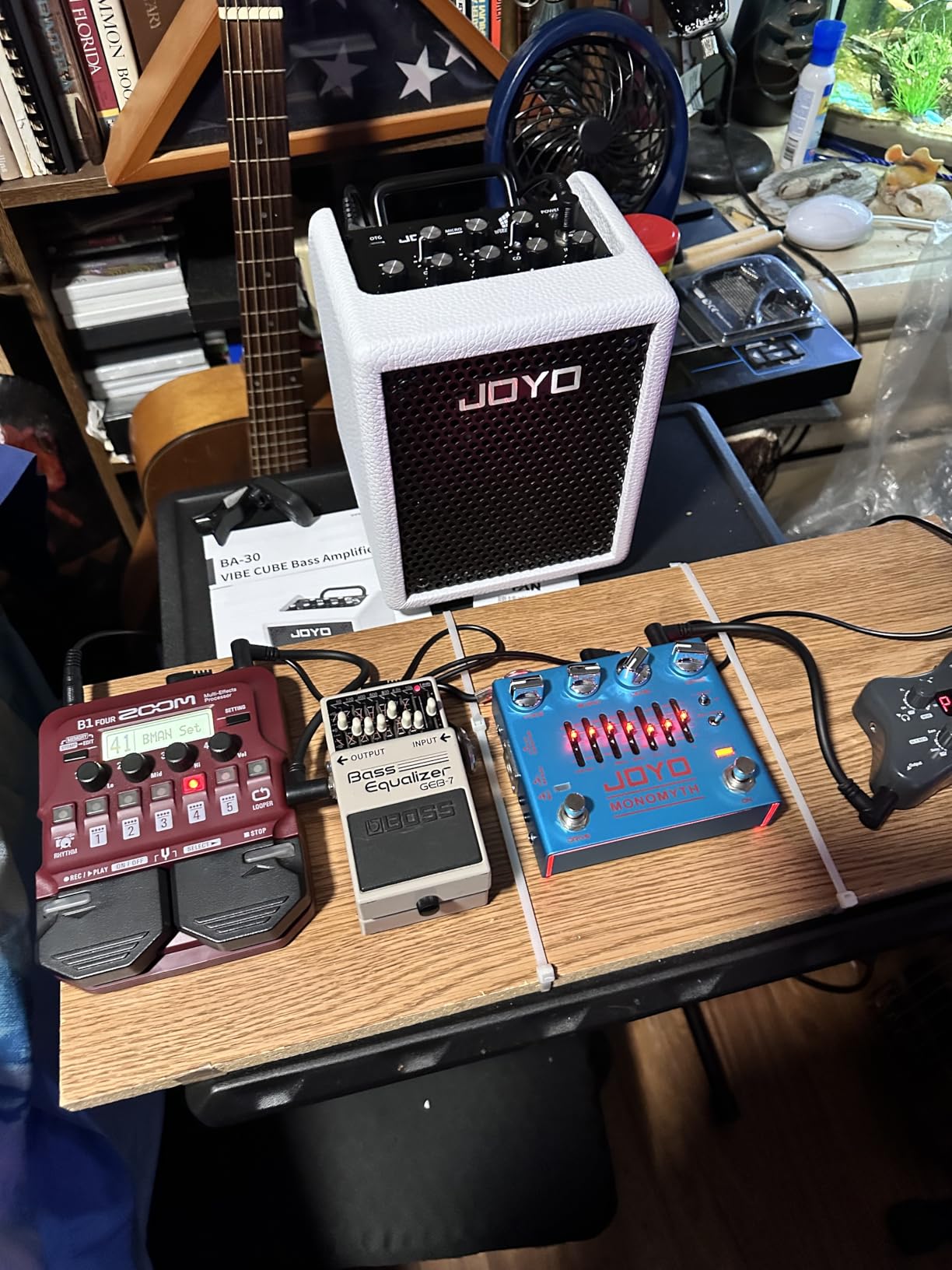
The compromise is the speaker. A 4 inch driver with a radiator cannot produce meaningful low end for a bass guitar, and the radiator helps more with mid bass than with the fundamentals. Reviewers are clear that this is a quiet practice and very small room amplifier.
It also has the highest proportion of one-star reviews among the products here, with complaints about build consistency and tone. Owners using active preamp basses report signal peaks when all EQ bands are maxed, so turn something down before you turn everything up.
Who this is actually for
Players who stream, record at home, or teach a student from a different room each lesson. The OTG recording path and headphone output make it a compact home studio tool, and the weight makes it easy to move between them.
It also makes sense as a travel amp for a player who carries their instrument on a train or bus and needs something for a hotel room rehearsal that is not a 40 pound combo.
When it falls short
Any room with a drum kit in it. Thirty watts is not the limitation here, the 4 inch driver is. There is no amount of EQ that creates the low frequency excursion you need to be heard against a kit.
If your budget stretches further, the Fender Rumble 15 at 18.6 pounds is three times the weight, has a proper 8 inch driver and a sealed cabinet, and is the amp we would tell a beginner to buy instead.
How to Choose a Bass Amp for Small Gigs
Buy for the room, not for the spec sheet. Almost every expensive mistake in this category comes from choosing an amp that is too heavy to carry, or one whose single speaker leaves the player standing in the wrong spot all night. Wattage matters third, after weight and coverage.
Work out your real wattage need. Count what you actually play: a monthly open mic in a 60 capacity room is a 15 watt problem. Weekly function band dates in a 150 person hall is a 50 watt problem. Outdoor playing or a band with a loud drummer pushes you to 100 watts or more. Add headroom rather than matching exactly, because headroom is what keeps the low end clean.
Set a weight budget before you shop. We would not carry anything over 45 pounds for a small gig unless it has casters. Under 25 pounds is genuinely comfortable up stairs, 25 to 40 pounds is manageable with one hand plus a shoulder, and above 45 pounds you should assume a second person or a dolly. Our full bass amp guide covers larger wattages if your room demands them.
Choose the speaker size for the room. A 1×10 moves air quickly and sounds tight but gives up the lowest octave sooner. A 1×12 is the most versatile small-room configuration. A 1×15 has more low end excursion and suits larger or louder rooms, at the cost of width and weight. Two speakers spread the sound across the stage, which matters more than output once you have enough volume.
Check the DI and PA integration. An XLR or balanced output sends a clean signal to front of house and effectively multiplies your usable volume without adding watts. A ground lift on the DI stops hum when a venue has an earth loop, which is common in older buildings. A line out works too, though an XLR is more universally accepted.
Decide between a combo and a head with a cabinet. A combo is one thing to carry and needs no extra kit, which is why it wins for small gigs. A head plus cabinet is lighter per watt, lets you swap cabinets, and suits players who already own a suitable cab. If you need a second amp, our practice amp picks cover the small end of the range.
Look at the EQ range, not the wattage. A working player covering several genres needs control over the low mids, because that is the frequency that causes growl and disappears under a cajon or an acoustic guitar. A parametric mid control is a genuine advantage over a fixed mid band.
Plan for stage coverage. The dead zone problem is the most common complaint on bass forums and it has a simple answer. A kickback cabinet angled at your head, or two speakers covering the stage, keeps you able to hear your notes wherever you stand. Players who gig small rooms regularly mention this far more often than they mention tone.
Know when to move up from a practice amp. The transition point is when you start being inaudible, not when a new model is released. Signs include backing off your volume for the whole song, asking the drummer to play softer, or setting your amp to full and still disappearing. Any amp above 30 watts into a 10 inch or larger speaker solves it.
Check what is in the box for a used amp. Look for a missing power cord or footswitch, test every input and the aux, check the pots for crackle at low settings, and listen for a hum when nothing is plugged in. Push the amp to full volume with nothing connected and listen for rattle or buzz. If you want recording or silent practice options, our bass headphone picks pair with any of these.
Budget for the extras. A stand, a spare cable, a DI box if the amp lacks one, and a strap add up to far less than a second amp. If you play upright or acoustic alongside electric, start with a rig that includes a kickback cabinet rather than planning to buy one later.
Finally, look at the amp with your own bass. Our bass guitar buying guide covers matching an instrument to an amplifier’s voicing, and modeling amp options are worth a look if your gigs are quiet rooms where a full band cannot compete at all.
Frequently Asked Questions
What are the best small bass amps for gigging?
For rooms under 150 people, a solid state combo between 25 and 50 watts with a 10 or 12 inch speaker, a usable weight under 45 pounds and a DI output is the right answer. Our top pick is the Fender Rumble 25 V3 at 25 watts and 23.9 pounds, with the Orange Crush50 Bass 1×12 as the step up for louder rooms.
Is a 20 watt amp loud enough for gigs?
Only for solo acoustic sets, function rooms with no drummer, or very small bars where the amp sits close to your head. With a full band playing at gig tempo, 20 watts has no headroom left and you will either play clean and inaudible or push it until the low end collapses. Thirty watts is the practical floor for rehearsal with a drummer.
What is a good small portable bass amp?
Weight is the deciding factor. The Fender Rumble 15 V3 at 18.6 pounds and the VOX Pathfinder Bass 10 at 12.2 pounds are the lightest full size options, while the JOYO Vibe Cube BA-30 at 5.95 pounds suits solo practice and streaming. For gigging power in a light package, a class D head plus a separate cabinet beats any combo in this list.
What type of bass amp is best for small gigs?
A combo amplifier, which puts the amplifier and speaker in one portable cabinet. Combos win for small gigs because there is one thing to carry, nothing to match and no extra gear to forget. A head and cabinet setup is better when you already own a suitable cab or need more power per pound. An amp with a line or XLR output gives the venue PA a clean feed.
What wattage bass amp do I need for gigs?
Use 25 to 40 watts for rooms under 100 people, 50 watts into a 12 inch speaker for pubs and restaurants of 100 to 150 people, and 100 watts into a 15 inch speaker for clubs of 150 to 200 people. Outdoor events or rooms with no PA push you to 500 watts or more. Add headroom rather than matching the room exactly, since clipping removes the low end that carries a bass part.
Our Verdict on the Best Bass Amps for Small Gigs in 2026
The Fender Rumble 25 V3 is our choice for the best bass amps for small gigs in 2026. Twenty five watts, an 8 inch driver, three band EQ with overdrive and contour, and 23.9 pounds on the handle is a combination nothing else at this level matches, and 3369 owner reviews averaging 4.8 out of 5 back it up.
Step up to the Orange Crush50 Bass 1×12 when rooms get to 100 or 150 people, and choose the Hartke Kickback 15 if you play upright bass or want a cabinet that doubles as your stage monitor. Whatever you pick, buy it for the room you play and the weight you can carry, then let the wattage follow.