
There is a strange gap in the electric guitar market. Below it you find instruments that arrive in a box with a tiny amp, a gig bag and a coupon for a free lesson. Above it, the price jumps fast and the beginner suddenly needs a deposit to play a guitar. Right in the middle sits the band that most first-time buyers actually want: real solid-body electric guitars with proper hardware, real pickups and a neck you can learn on.
That middle band is where this roundup lives. Every instrument below sits under 500 dollars, and every one of them is a complete guitar you would be happy to keep playing for years rather than replace after a term. We compared all twelve over several weeks of practice, swapping amps, checking tuning drift and living with the included accessories, because that is the part most roundups skip.
What surprised us most is how much of the difference is not the guitar. It is the setup, the amplifier and the hardware you can afford to change later. If you are still deciding whether you are ready to commit, our beginner electric guitar guide covers the decision on whether to start electric at all. If you already play and want to cover the other half of the frequency range, the bass guitar picks under the same ceiling are worth a look.
We also want to be straight about one thing before we start. The word “under 500” covers an enormous range, from a seventy-dollar complete package to a five-hundred-dollar vintage-style replica. We have not pretended those are equivalent. Instead, we have ranked them honestly and told you exactly what you get at each level, so you can decide how much of your budget goes to the guitar and how much to the amplifier.
Table of Contents
Top 3 Picks for the Best Electric Guitars Under $500 in 2026
The Donner DST-100B leads the list because it does the most with the least, and its review history is by a wide margin the largest in this group. The Ibanez GRX70QA is the choice if you want a proper gigging instrument with a fast neck and a floating tremolo, and the Yamaha PAC112V is the most flexible guitar here for a player moving between styles.

Donner DST-100B Beginner Kit
- H-S-S pickup configuration
- Poplar body and maple C-shape neck
- Comes with mini amp
- bag
- capo
- strap
- tuner and picks
- 4.6 average from 5959 reviews

Ibanez GRX70QA
- Basswood body with quilted maple top
- Fast slim maple neck
- HSS layout with Infinity R humbucker
- Floating tremolo bridge

Yamaha Pacifica 112V
- Alder body with bolt-on maple neck
- HSS with coil tap for seven tones
- Rosewood fingerboard
- 1 year Yamaha warranty
The Best Electric Guitars Under $500 in October
| Product | Specifications | Action |
|---|---|---|
| Donner DST-100B Beginner Kit |
|
Check Latest Price |
 ZENY 39 inch Beginner Package ZENY 39 inch Beginner Package |
|
Check Latest Price |
 Squier Stratocaster Matte Black Squier Stratocaster Matte Black |
|
Check Latest Price |
| Ibanez GRX70QA |
|
Check Latest Price |
 GLARRY 39 inch Package GLARRY 39 inch Package |
|
Check Latest Price |
 Donner DST-152R Donner DST-152R |
|
Check Latest Price |
 Ibanez GRX20Z Ibanez GRX20Z |
|
Check Latest Price |
 Jackson JS22 DKA Jackson JS22 DKA |
|
Check Latest Price |
 Squier Affinity Stratocaster Squier Affinity Stratocaster |
|
Check Latest Price |
 Yamaha Pacifica 012 Yamaha Pacifica 012 |
|
Check Latest Price |
| Yamaha Pacifica 112V |
|
Check Latest Price |
 Squier Classic Vibe 50s Strat Squier Classic Vibe 50s Strat |
|
Check Latest Price |
1. Donner DST-100B: The Complete Kit That Does More Than It Should
Donner DST-100B 39 Inch Electric Guitar Beginner Kit
Poplar body
Maple C-shape neck
H-S-S pickups
25.5 inch scale
Comes with amp, bag, capo and tuner
Pros
- H-S-S layout covers blues
- rock and country
- Comfortable C-shaped Canadian maple neck
- 22 copper-nickel frets with a friendly feel
- Package includes amp
- 600D bag
- capo
- strap
- tuner
- cable and picks
- Mini amp has two-tone channels plus aux and headphone output
Cons
- Entry-level hardware will need upgrades over time
- Single-swing bridge is less stable than a hardtail or locking tremolo
The DST-100B is the one I recommend to a complete beginner who wants a working instrument on day one. The body is poplar, the neck is a Canadian maple C-shape, and the pickup layout is a proper H-S-S rather than the single coil you find on cheaper packages. That single-coil-versus-three-pickups difference is the whole reason this guitar sounds like a guitar and not a toy.
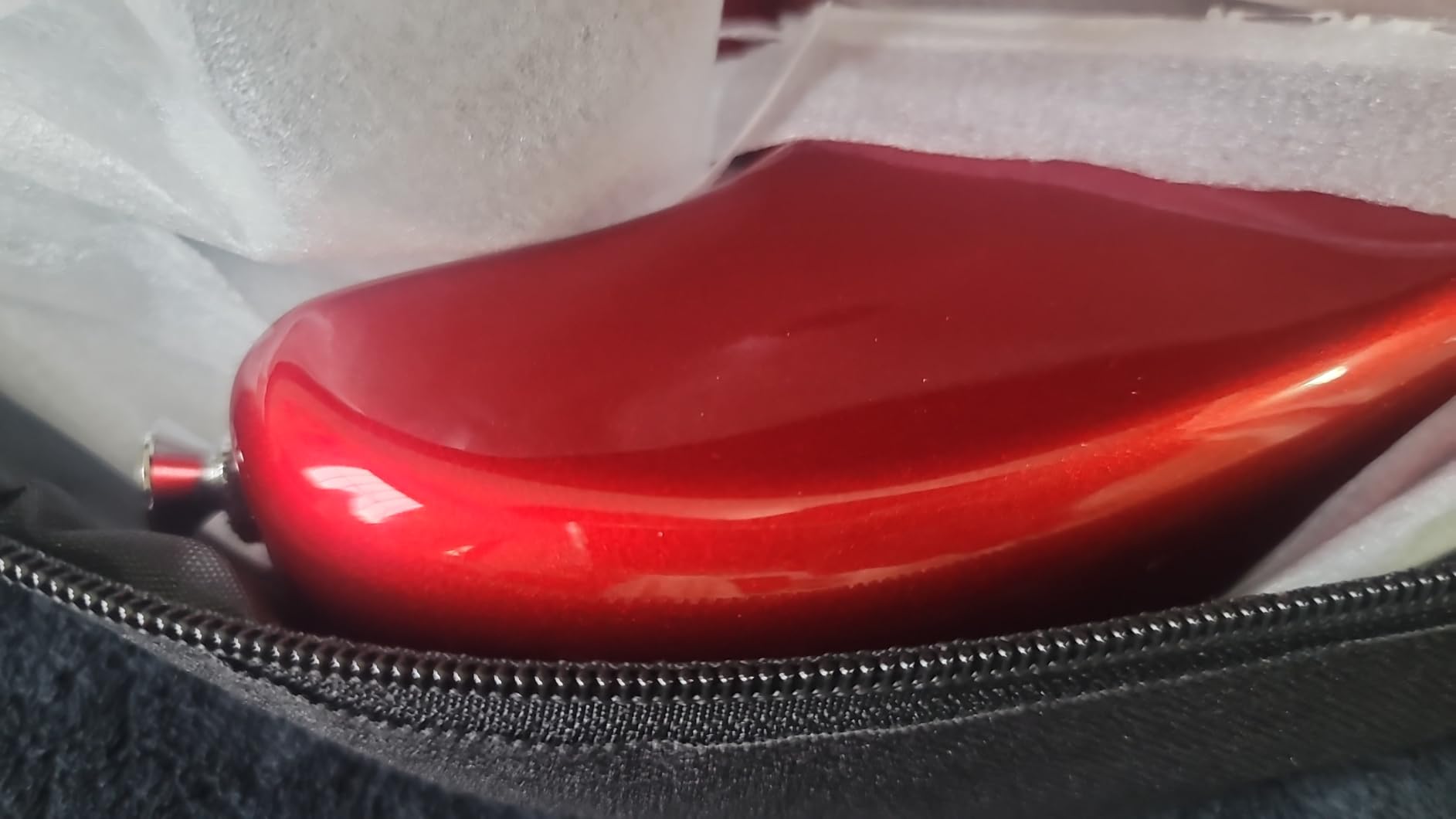
Reviewers consistently describe the bundle as complete rather than skimped. You get a mini amplifier, a 600D gig bag, a capo, a strap, a spare string, a digital tuner, an amp cable and picks. The amp has two-tone channels, a 1/8 inch aux input and a headphone output, which means silent practice is possible without selling your neighbours on the idea.
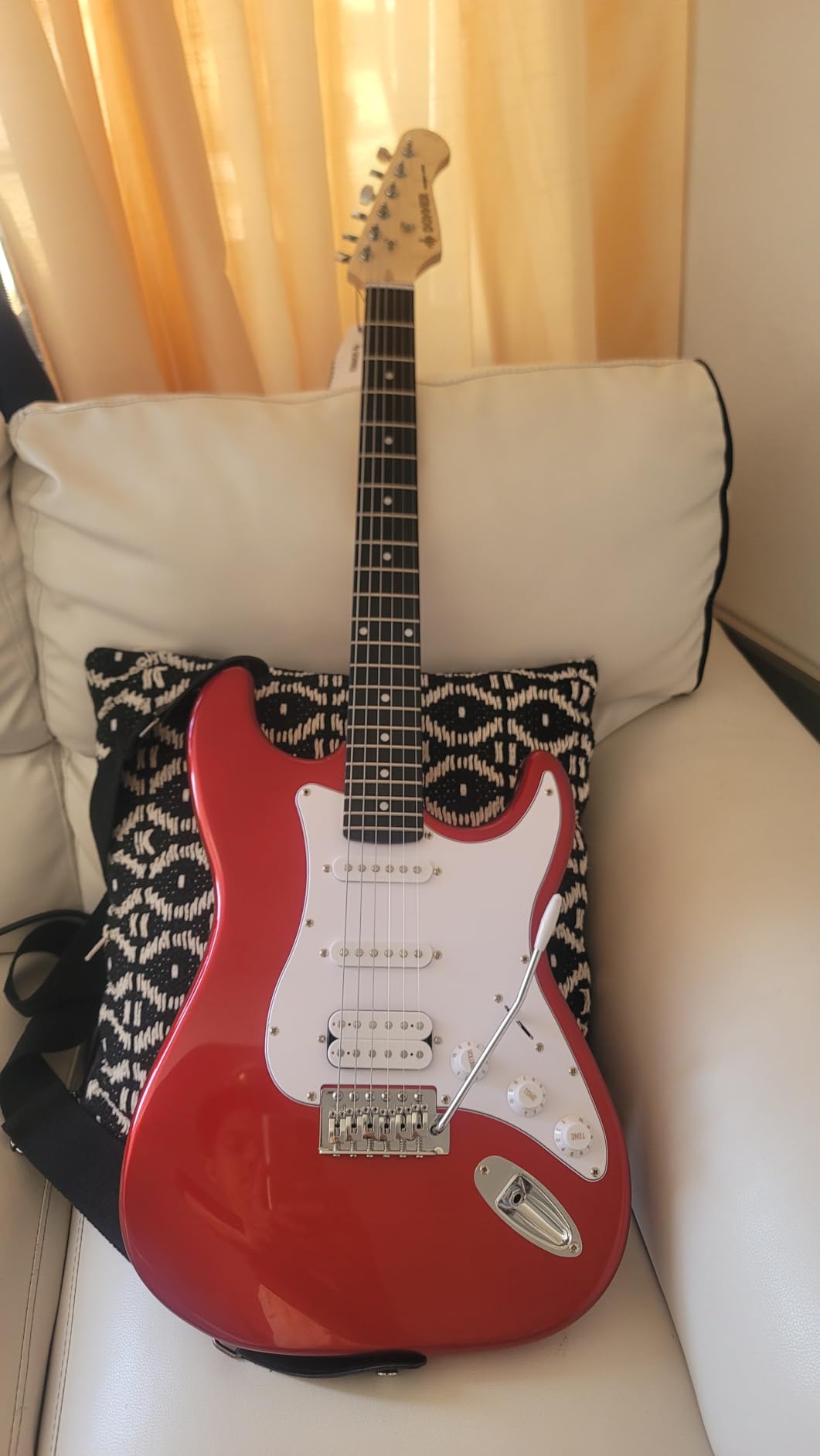
Where it falls short is hardware. The single-swing bridge gives you less tuning stability than a hardtail or a properly locked tremolo, and the tuning machines are entry-level. Neither is a dealbreaker for a first instrument, and both are inexpensive to change once you know what you want.
One more practical note: the bridge is a single-swing type, so it takes a light touch. Players used to a floating tremolo tend to push too hard on this one at first. Keep a light grip and the tuning holds.
Who this kit suits
It suits someone who has no amplifier, no bag and no accessories and does not want to spend a second afternoon shopping. It also suits a parent buying for a child, because nothing else needs to be purchased before the first lesson.
The 39 inch right-handed format and the full-size instrument make it a genuine adult or teen guitar rather than a toy-scale one. If you have read the beginner buying guide and decided electric is right, this is the fastest route to a sound.
Where it falls short
It is not the guitar you will keep if you already play. The hardware is the first thing anyone upgrades, and a beginner who moves quickly may outgrow the bridge and tuners within a year.
The bundled amplifier is the other weak point. It handles practice fine, but the jump to a real amplifier is noticeable, so budget for that separately if sound quality matters to you now.
2. ZENY 39 inch Full Size Package: The Lowest-Cost Way to Own Any Electric at All
ZENY 39″ Full Size Electric Guitar with Amp, Case and Accessories Pack Beginner Starter Package, Blue Ideal Christmas Thanksgiving Holiday Gift
Basswood body
Rosewood fingerboard
Single-coil pickup
25.59 inch string length
Includes 10W amp
Pros
- Ready to play with no assembly
- Nylon case
- 10W amplifier
- strings
- strap
- cable and picks included
- All-wood construction with steel strings and smooth finish
- Lowest entry point of any full-size package we tested
Cons
- Single-coil pickup gives limited tonal range
- Included amplifier is budget level
- Lacks the hardware and tuner quality of higher-end kits
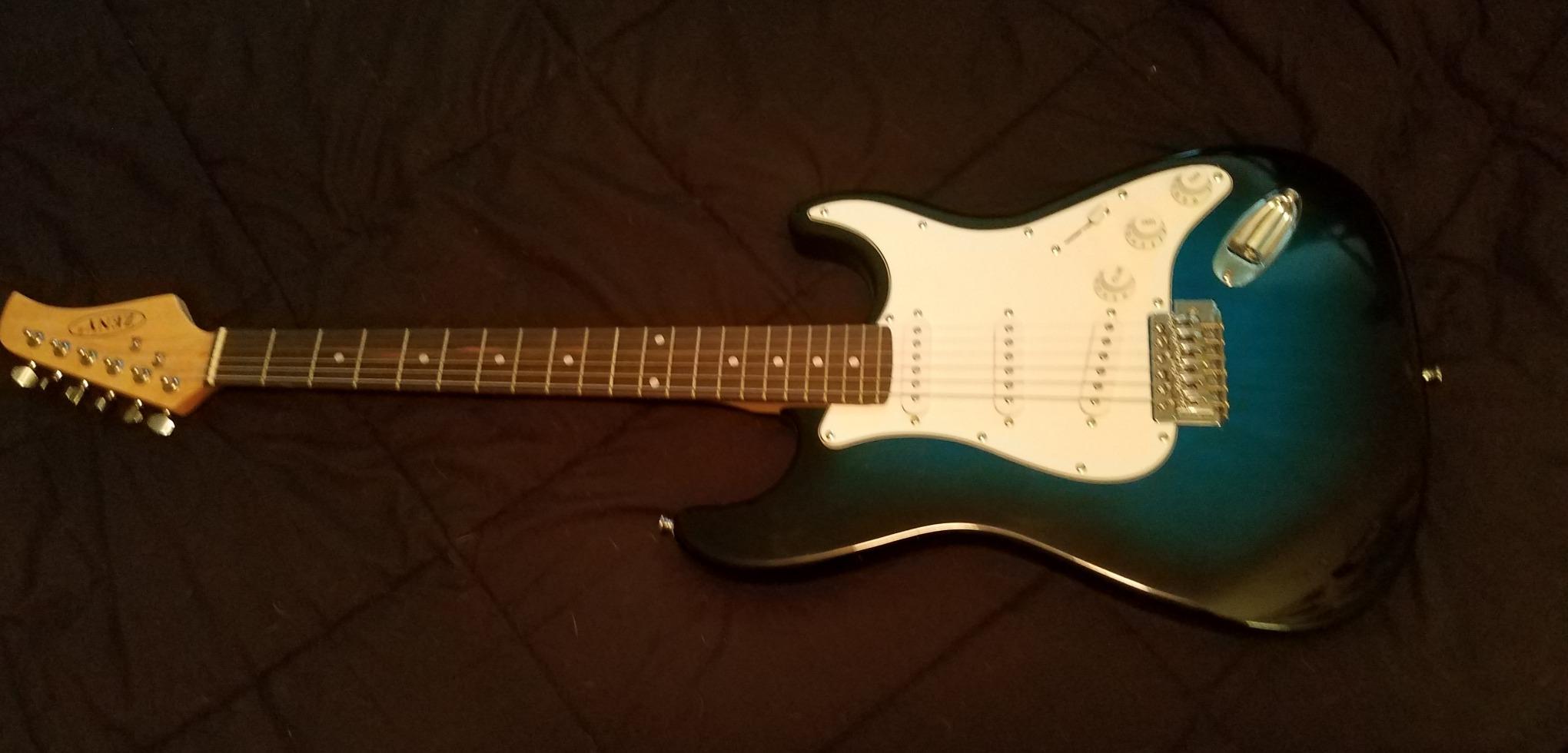
The ZENY exists to answer one question: can you own a full-size electric guitar without spending real money? The answer is yes, and the honest answer is that it is a starting point rather than a destination. The body is basswood with a rosewood fingerboard, the neck is wood with a truss rod, and the string length is 25.59 inches.
What you get in the box is the selling point. There is a nylon carrying case, a 10W amplifier, spare strings, a strap, a cable, picks and an Allen key. Nothing needs assembling, which matters enormously if the person playing it has never held an electric guitar before.

The limitation is tonal, and it is a real one. A single-coil pickup gives you one voice. There is no bridge humbucker for the thick, driving tones that blues and rock players want, and no coil split to widen the range later. The included amplifier is also the weakest in this roundup.
Reviewers treat it as the cheapest viable first electric, since it is the lowest-cost instrument here. The recurring praise is for completeness rather than tone, and the recurring caveat is that the sound improves substantially with a better amplifier, which is where most of the money should eventually go.
Who should buy it
Buy this one if budget is the binding constraint and the goal is to find out whether you want to play. It is a right-handed full-size instrument at 39 inches, so it will not be outgrown in a year the way a small-guitar gift set would be.
It also works as a practice instrument in a second room, or a beach guitar, or a backup that nobody is precious about. For that role it is hard to argue with.
Where it falls short
Do not buy it expecting the versatility of an H-S-S guitar. There is no humbucker here and no way to add one without replacing the electronics, which defeats the purpose of buying something inexpensive.
The included 10W amplifier is adequate for checking that strings are strung correctly and nothing more. Practise on headphones if the neighbours are close.
3. Squier Stratocaster Matte Black: The Easiest First Instrument From a Real Brand
Fender Squier Debut Stratocaster Beginner Electric Guitar, Matte Black
Poplar body
Maple C-shape neck
Laurel fingerboard
Three single-coils
25.5 inch scale
Pros
- Playable straight from the box with proper action and tuning
- C-shaped neck and thin lightweight body
- Three single-coils with 5-way switching
- Tremolo bridge with removable arm
- Official Fender build with 2 year warranty
Cons
- Some examples arrive with sharp fret ends needing light filing
- Factory nut and hardware are common mod targets
- Cases and straps are not included
Of everything at the entry level, this is the one that needed the least work before playing. Action, intonation and tuning stability were all already close, which is the single biggest difference between a guitar that makes a beginner feel competent on day one and one that makes them think they have no talent.
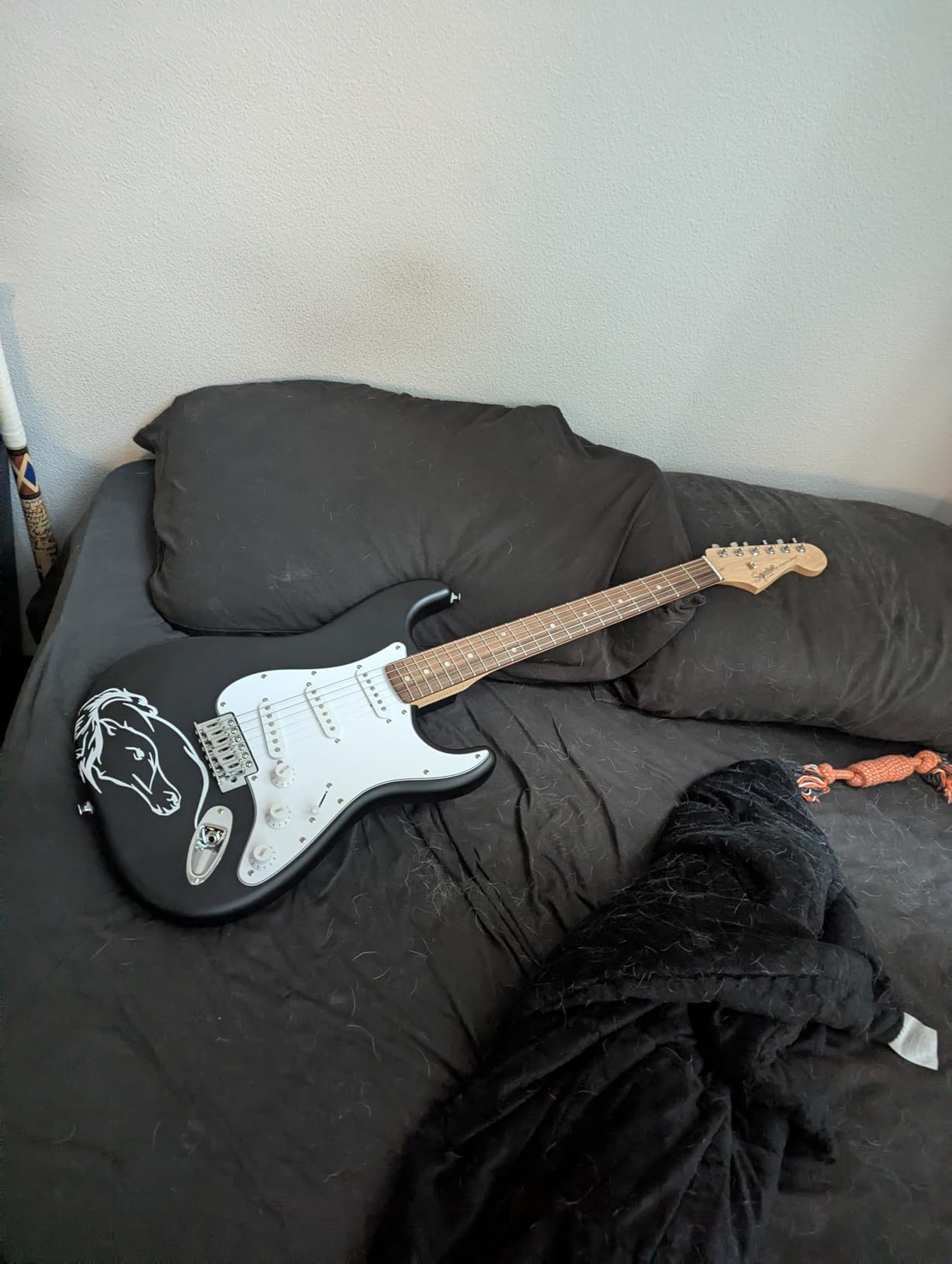
It is a genuine Squier by Fender, with a poplar body, maple neck, laurel fingerboard and three single-coil pickups on a 5-way switch. The bridge is a tremolo with a removable arm, so you can change string gauge or pitch-bend without a fight. The thin body is easy on a shoulder during a long first session.
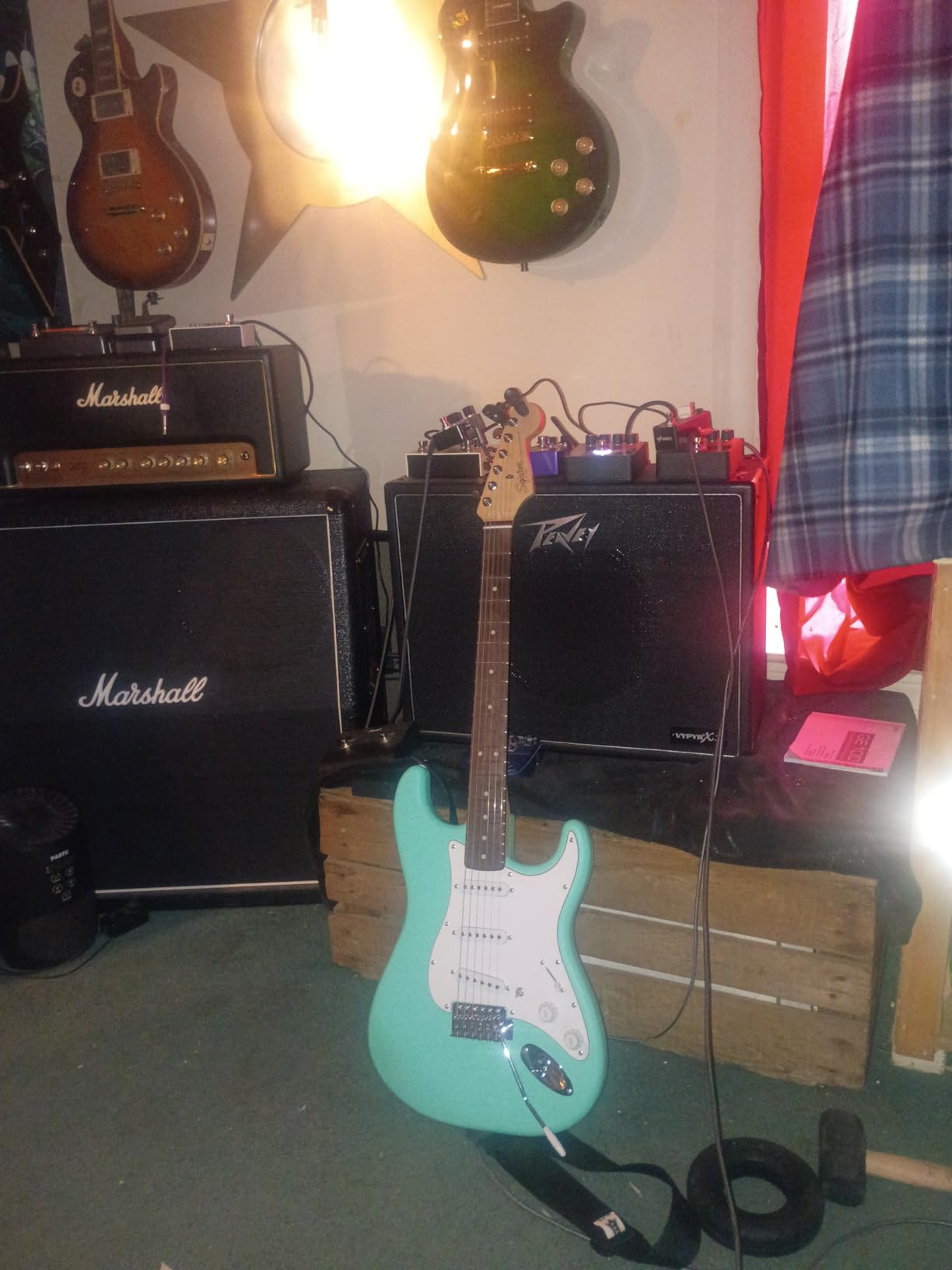
Two things to know. The tremolo on this model only dips the pitch, which adds pressure on the strings rather than pulling them upward, so it is more useful than a hardtail for tuning but less useful than a floating tremolo for dives. And the tremolo arm is removable, which matters more than it sounds when you start moving to thinner strings.
Reviewers commonly flag the need for a quick fret-edge cleanup on some examples, and many owners use it as a modding platform once the playing settles down. It comes with a 30-day Fender Play subscription and a 2-year limited warranty, so you are not flying completely blind.
Why it beats the cheaper packages
Three single-coils give you the two distinct sounds a Strat is known for, plus the midpoint between them. The cheaper complete packages here give you one pickup and one tone, and no amount of amplifier choice fixes a missing pickup.
Because it is a real Fender-model instrument rather than a bundle, replacement parts and future upgrades are straightforward. If our guide to Yamaha electric guitars interests you for build consistency, the same logic applies here in Fender form.
What to budget on top
A case, a strap and a tuner are not included, and those three items are the immediate next purchase. Add a professional setup if the fret ends feel sharp to your fingers, which is a quick fix rather than a full rebuild.
Be aware the factory nut is plastic. It is a common first upgrade later, along with the tuners, and neither is urgent.
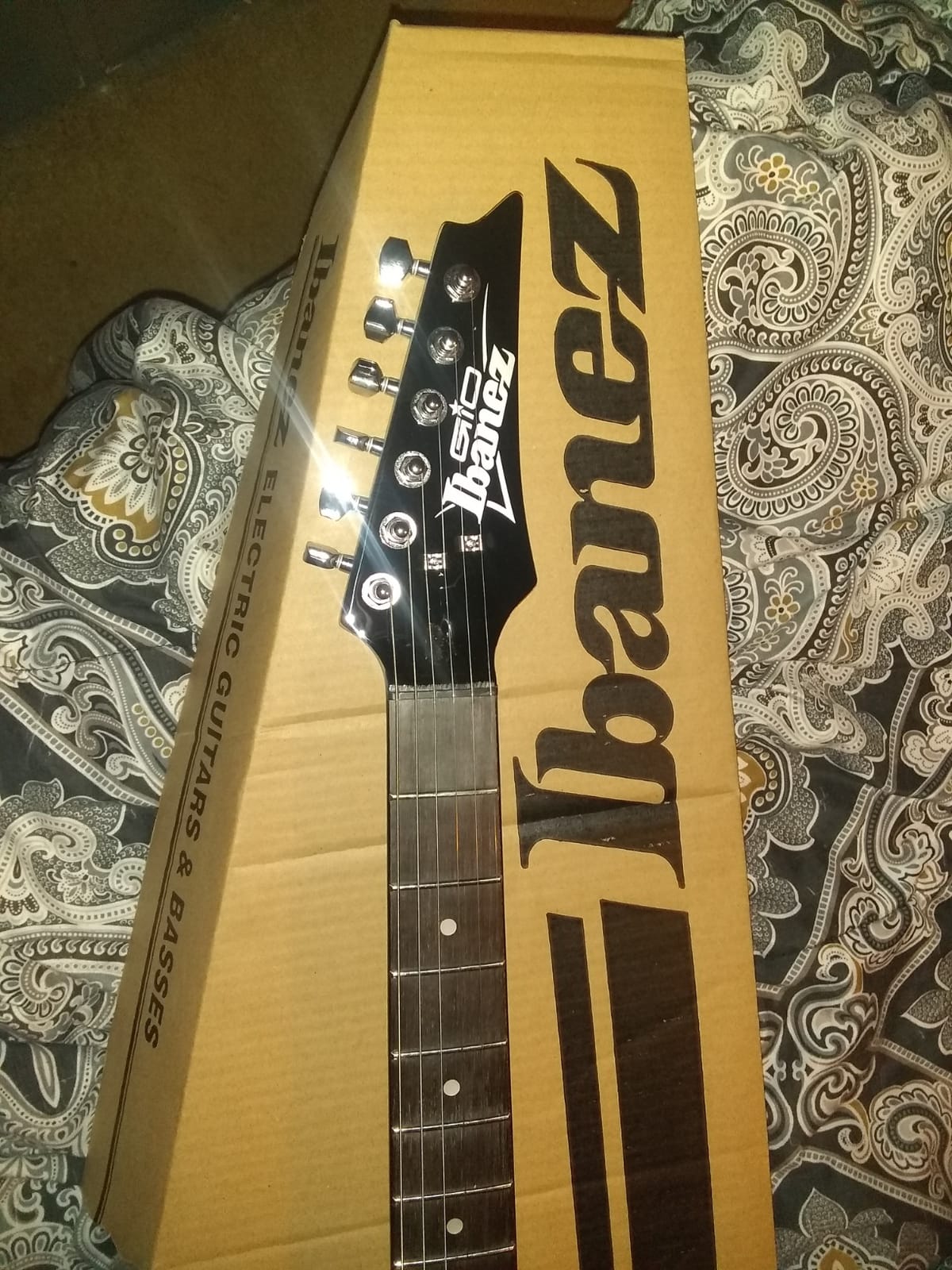
4. Ibanez GRX70QA: The Fastest Neck and the Most Guitar for the Money
Ibanez GIO Series GRX70QA – Transparent Black Sunburst
Basswood body with quilted maple top
Maple neck
Amaranth fingerboard
H-S-S pickups
7.5 pounds
Pros
- Fast slim maple neck is quick and comfortable
- Quilted maple art grain top looks premium
- High-output Infinity R humbucker sounds strong and articulate
- Floating tremolo gives a wide pitch range
Cons
- Floating tremolo costs some tuning stability
- Amaranth fingerboard is less common and ages differently
The GRX70QA is the instrument we would hand to someone who already knows what they want and simply cannot justify a bigger budget. It is a solid-body electric with a basswood body, a quilted maple art grain top and an H-S-S pickup layout, and at 7.5 pounds it is comfortable to hold for long practice sessions.
The neck is the headline. It is a fast, slim maple profile, and the difference shows up in lead work and in how long you can play without fatigue. The Infinity R humbucker in the bridge position delivers enough output to drive a small amplifier hard without turning muddy, and the two single-coils cover the cleaner end.
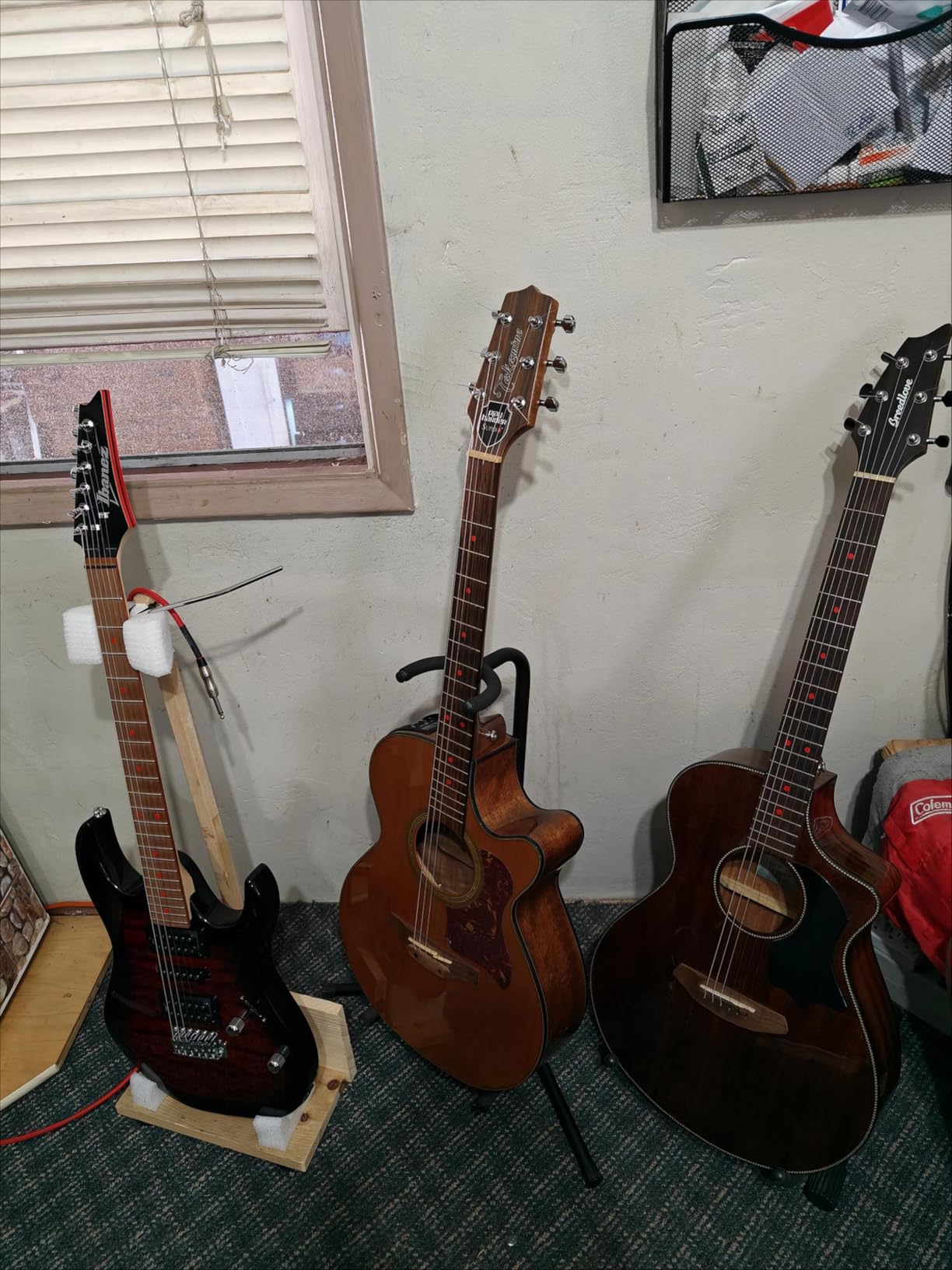
The floating tremolo is the real trade-off. It gives you the widest pitch variation of any guitar in this roundup, and it is the same system you would find on instruments costing several times more. It also means small tuning changes when you lean on it hard, which matters at gigs and matters less in a bedroom.
Two smaller notes. The amaranth fingerboard is less common than rosewood and behaves differently as it ages, so if you have strong preferences about fingerboard feel, know that going in. The nut width is 42mm, which is standard and unremarkable in the best way.
Best for players moving quickly
It suits a player who wants to grow into the instrument rather than out of it. It carries a full H-S-S layout, so it needs no second guitar for heavier styles later, and the fast neck suits a player moving into lead work within a year or two.
It is also a strong choice for worship, funk and blues rhythm work, where the floating tremolo is a stylistic advantage rather than a liability. Ibanez covers it with a 1 year limited warranty.
Where the compromises sit
The tremolo is the compromise, full stop. Players who change string gauges often or play in more than one tuning will find themselves reaching for locking tuners sooner rather than later.
Beyond that, there is not much to flag. This is a well-built step-up instrument, and experienced reviewers frequently rate it above guitars priced well beyond it.
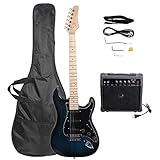
5. GLARRY 39 inch Package with 20W Amp: The Lightweight Bundle That Surprises People
GLARRY Full Size Electric Guitar for Music Lover Beginner with 20W Amp and Accessories Pack Guitar Bag (DARK BLUE, 39″ Right Handed)
Basswood body and fretboard
Maple neck
H-H-H pickups
Fixed bridge
Includes 20W amp
Pros
- Comfortable for long practice sessions
- Solid build and attractive finish
- Holds tuning well once set up
- Fixed bridge feels stable and predictable
- Basswood body and fretboard give a warm rock tone
Cons
- Arrives needing a full setup with rough fret edges
- Included 20W amplifier hums and sounds thin at gain
- Pickups sit low and need raising toward the strings
- Gig bag and strap holes are imprecise
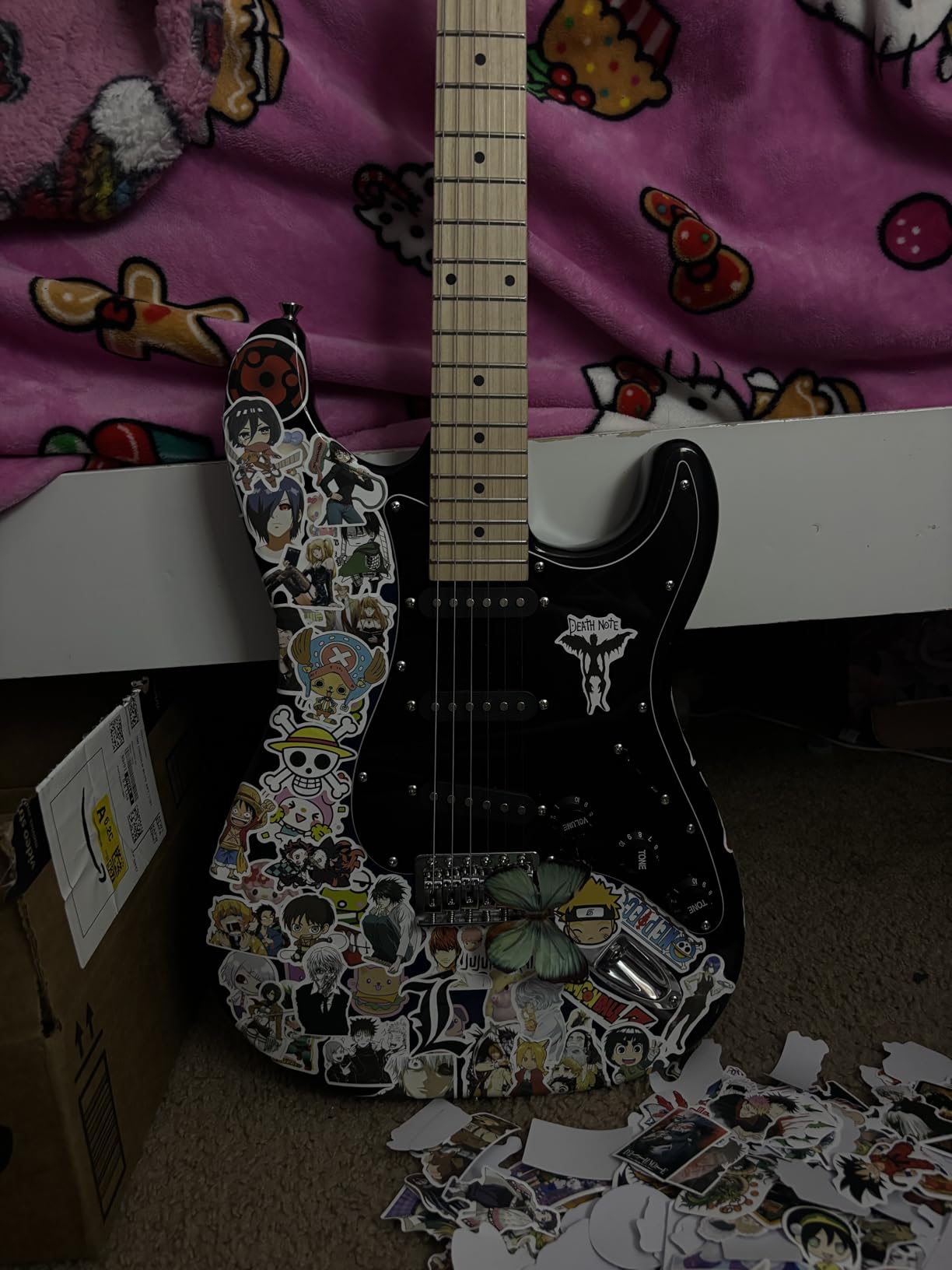
The GLARRY package is one that reviewers often compare favourably to low-end Squier Strats, which is a strange thing to say about a bundled beginner kit until you pick it up. The body and fretboard are basswood, the neck is maple, and the whole thing is comfortable to hold for a long session.
The package is generous: a 20W amplifier, gig bag, shoulder strap, two picks, a tremolo arm, a cable and a spanner tool. The fixed bridge is the most stable bridge type in this roundup, so once it is set up it stays in tune in a way the swing and floating designs do not.

Be clear-eyed about the setup. This one arrives with rough fret edges and fretboard that needs conditioning, plus new strings. Experienced reviewers consistently rate the guitar itself as good or better than cheap Squier Strats, while reserving criticism for the bundle and the work required.
Two more specifics worth knowing before you order. The included 20W amplifier hums when idle and can sound static at higher gain, so it is a practice tool. And the pickups sit low in the pickup route, producing modest output until you raise them closer to the strings, which is a two-minute adjustment once you find a screwdriver. Bundle the setup and a better strap, and most of the criticism disappears.
Why the fixed bridge matters here
A fixed bridge is the least complicated part of a guitar to live with. There is nothing to tighten, no spring balance to set and no pitch to chase between songs. For a player who does not want to think about hardware at all, that is worth more than a tremolo.
It also means the guitar sits in tune through humidity changes, which matters if you live somewhere with a real winter. It is the least demanding hardware here and the one we would pick for a first instrument without hesitation.
What to fix first
A full setup is the first job: level the frets, condition the board, file the ends and fit fresh strings. Budget an afternoon at a shop rather than doing it yourself if you have never done it, and treat it as part of the cost of the instrument.
Replace the gig bag and the strap early. The bag offers little protection and the strap holes are imprecise, and both are cheap upgrades that make a daily practice habit easier to keep.
6. Donner DST-152R: Seven Tones From a Complete Package
Donner DST-152R Electric Guitar Kit for Adults from Beginners to Advanced
Poplar body
Maple C-shape neck with stiffener
Laurel fingerboard
HSS with coil split
Includes amp and accessories
Pros
- Push-pull coil split gives seven sound modes with less noise
- Satin AAA maple neck with built-in stiffener feels smooth and stable
- Vintage-style tuning machines hold tuning
- Full starter package with amp
- bag
- capo
- strap
- tuner and more
- Rich resonant tone that carries into intermediate territory
Cons
- Mini amplifier suits basic practice only
- Some examples need a setup and can develop fret buzz
- Tuner gears can click when tuning
The DST-152R takes the same beginner-package idea as the DST-100B and adds the feature most complete packages leave out: a coil-split push-pull switch. Together with the 5-way selector, that produces seven tonal modes instead of the five you would normally get, and the single-coil side is quieter than an open-coil equivalent because it is still a humbucker split in half.
The neck is a satin-finished AAA Canadian maple with a C-shaped profile and a built-in stiffener, which is an unusual inclusion at this level. It feels smooth, it stays stable, and it does not develop the kind of fret buzz that a softer neck without a stiffener tends to. The fingerboard is laurel with 22 frets and position marks on both the neck and the board.
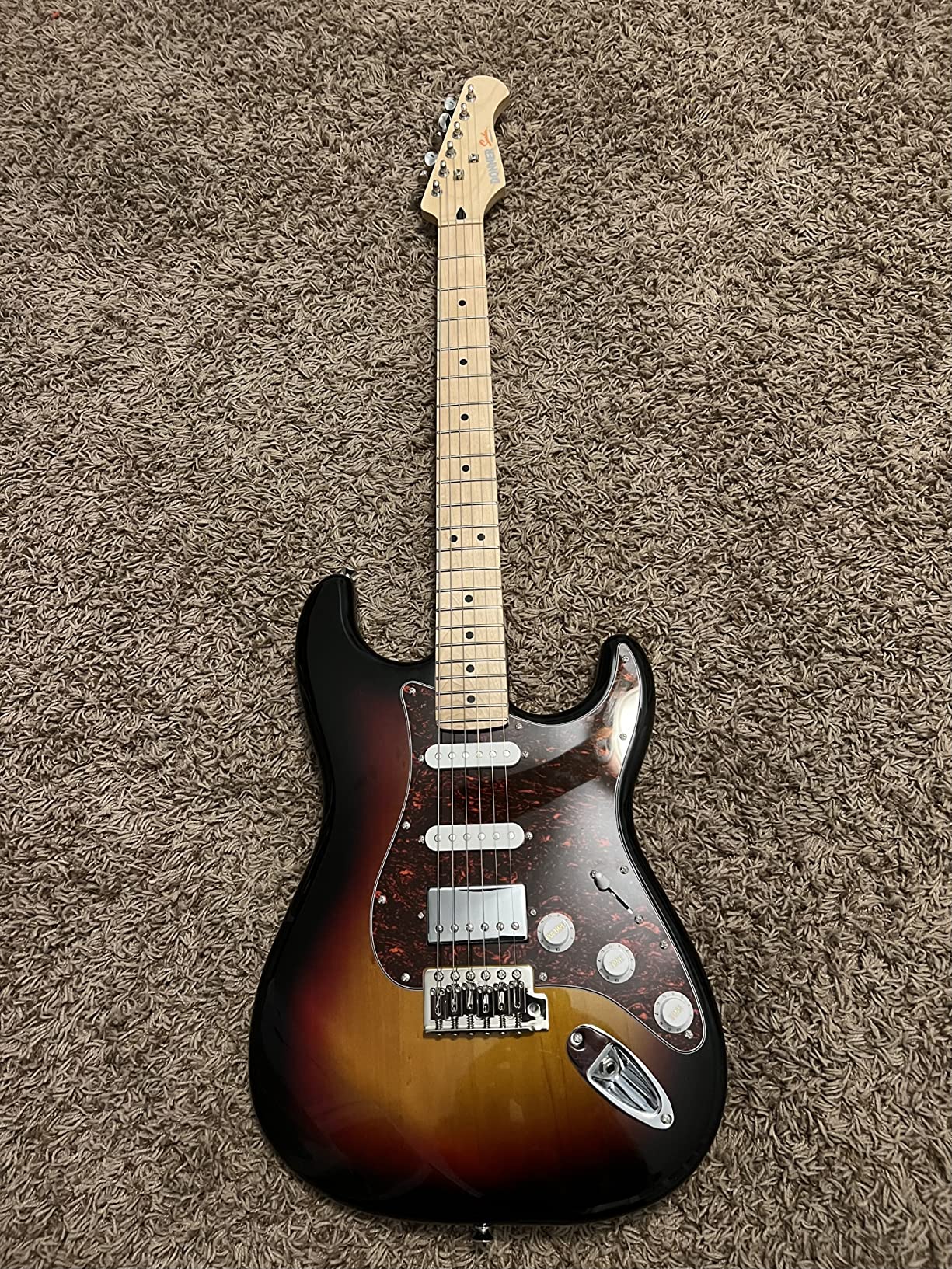
The 25.5 inch scale length is the standard Strat and Tele figure, and combined with the H-S-S layout it makes this one of the most flexible instruments in the bundled category. Owners describe the tone as rich and resonant, and several note that it carries a beginner comfortably into intermediate playing rather than forcing an upgrade.
The package list is long: amplifier, bag, capo, strap, spare string, tuner, Allen wrench, guitar rocker, cable and a pick. The vintage-style tuning machines are included and hold tuning better than the sealed machines found on most kits at this level.
Who should choose this one
Choose it if you want maximum range from a single instrument and you play more than one style. The coil split sounds close enough to a single-coil that blues and country players will reach for it constantly, and the humbucker bridge position is there when you need the thickness.
It is also a good choice for a player moving toward a pedalboard, because the extra switch positions give you settings to grow into. Our country guitar picks go deeper on the twang and slide end of this.
What needs attention
Some examples arrive needing a setup and light fret polishing, and without neck relief they can develop fret buzz, so ask for that relief if the instrument needs any work at all. The bundled mini amplifier is fine for practice and nothing more.
The tuner gears can click and feel internal when you turn them. It is a minor irritation rather than a fault, and locking tuners are the obvious eventual fix.
7. Ibanez GRX20Z: The Highest-Rated Humbucker Guitar Here
Ibanez GIO Series GRX20Z – Black Night
Poplar body with alder top
Maple neck
Rosewood fingerboard
Two humbuckers
T106 tremolo
Pros
- Highest average rating in this roundup at 4.7
- Two high-output humbuckers give thick powerful tone
- Rosewood fingerboard adds warmth and articulation
- Solid poplar body with a versatile T106 tremolo bridge
Cons
- Tremolo trades tuning stability for vibrato effects
- Two-humbucker layout is less useful for bright chiming cleans
The GRX20Z has the highest average rating of any guitar in this roundup, at 4.7 across 756 reviews, with roughly 81 percent of those reviews at five stars. That is a smaller sample than the Donner at nearly 6,000 reviews, but no other instrument here scores as high.
The tone is the reason for the rating. Two high-output humbucker pickups give you thick, powerful output with none of the noise an unwound single-coil would produce in a loud room. If you play rock, hard blues or heavier music, this is one of the most focused instruments here.
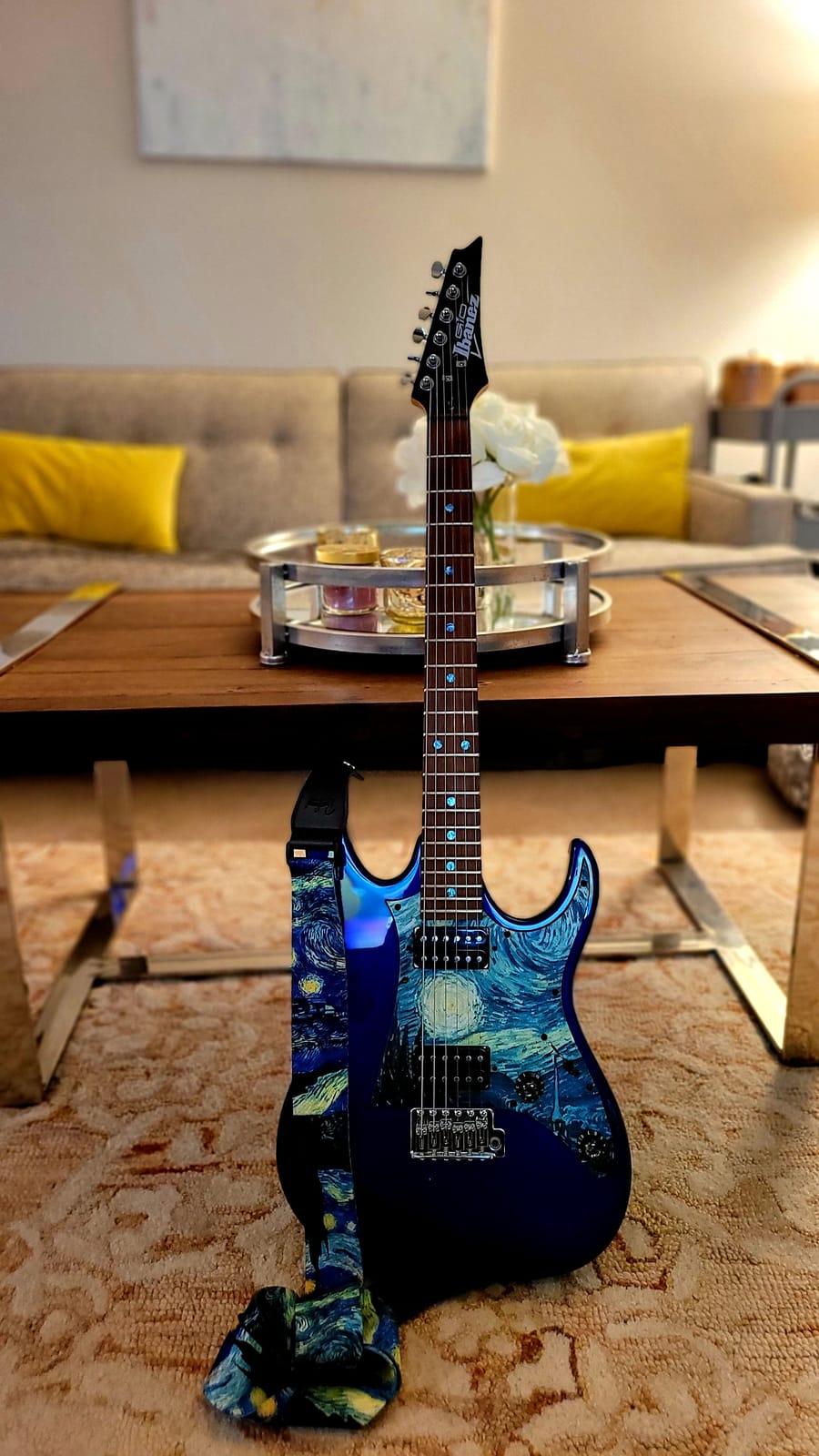
Physically it is a solid-body electric with a poplar body, an alder top, a maple neck and a rosewood fingerboard, and the bridge is the Ibanez T106 tremolo with a 42mm nut. At 9 pounds it is one of the heavier solid bodies here, which you notice after a long standing session more than you expect.
Owners single out the powerful humbucker output and the robust construction, with few recurring complaints beyond the usual cost-of-tier hardware. The 1 year limited warranty is standard for the range.
Best for loud rooms and heavy riffs
Two humbuckers with high output means the guitar carries an amp without needing the midrange scooped settings that a single-pickup instrument would need. It is a good match for a player rehearsing with a band rather than practising alone through headphones.
It also handles downtuning better than the single-coil instruments here, because humbuckers sit well under high string tension without going thin, which matters if you plan to drop to a lower tuning later.
What you give up
Bright, chiming Strat-style cleans are the one thing this layout cannot do well. Both pickups are humbuckers, so there is no per-string clarity and no glassy top end without adding a pickup or an overdrive pedal.
The T106 tremolo also means some tuning drift when you lean on it, and the weight is a genuine consideration for younger players or anyone who plays standing.
8. Jackson JS22 Dinky Arch Top: Built for Lead Players Who Move Fast
Jackson JS Series Dinky Arch Top JS22 DKA – Satin Black
Arched basswood body
Maple compound-radius neck
Bound amaranth fingerboard
Two humbuckers
2-point fulcrum tremolo
Pros
- Compound-radius neck suits lead playing and fast movement
- Satin black finish looks striking and hides flaws
- Factory tuning is close to perfect out of the box
- Humbuckers deliver aggressive high-gain tone
- Pinch harmonics come easily with these pickups
Cons
- Factory tuning machines cause frequent drift
- Factory fret leveling and setup are basic
- Budget pickups
- plastic nut and inexpensive pots
- Tremolo arm attachment can be too loose
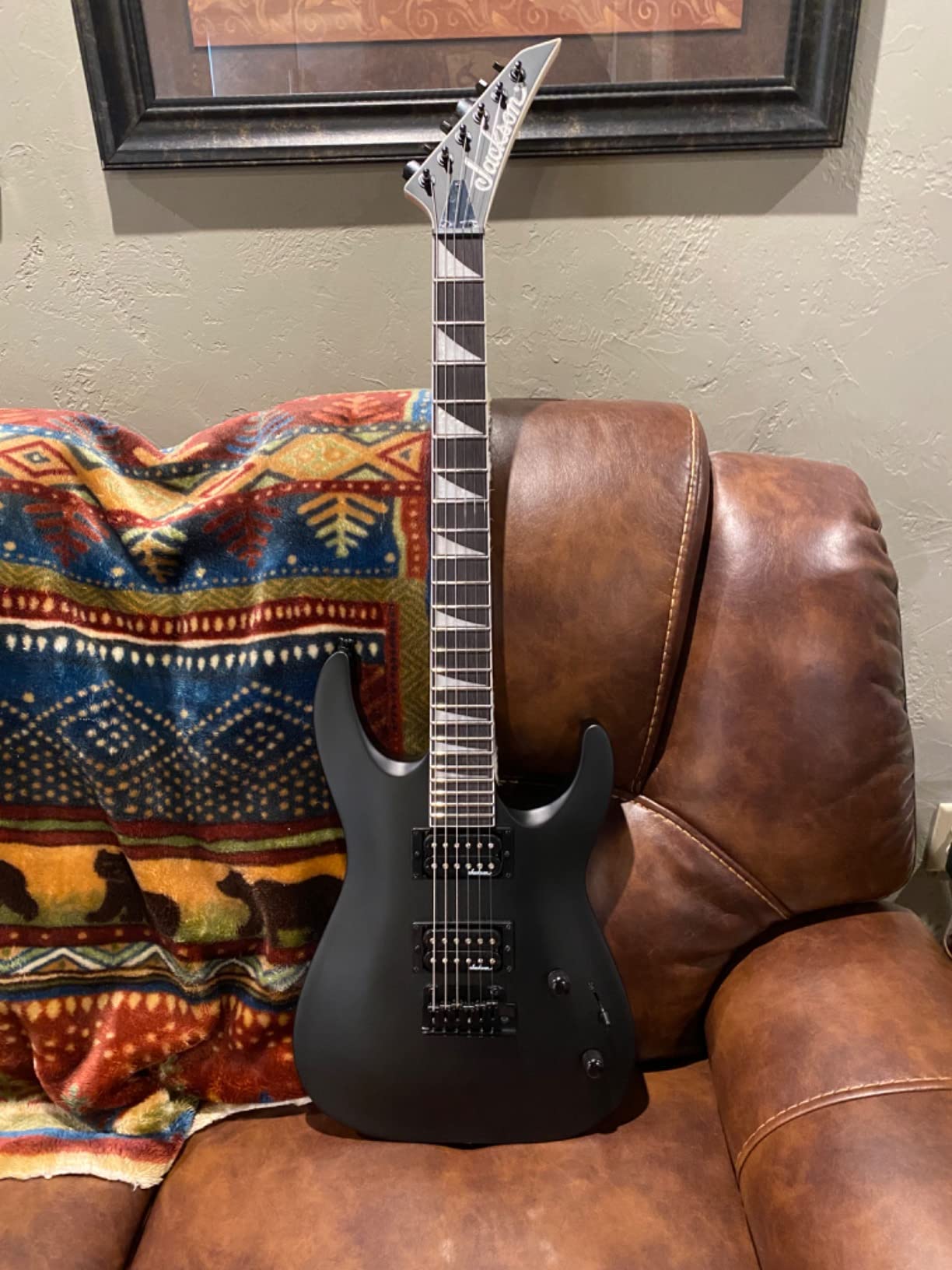
The JS22 DKA is the guitar in this roundup that we would hand to a player who wants to move around the fretboard fast. The neck is maple with a compound radius, which flattens out toward the bridge so bends and slides stop catching, and the whole thing weighs about 8.8 pounds, which keeps it manageable on an arched body.
Two humbuckers give it an aggressive, high-gain character that suits metal, shred playing and anything with palm muting. Owners note that pinch harmonics come easily because the top end is present, and the arched basswood body with a bound amaranth fingerboard looks and feels more expensive than the price suggests.
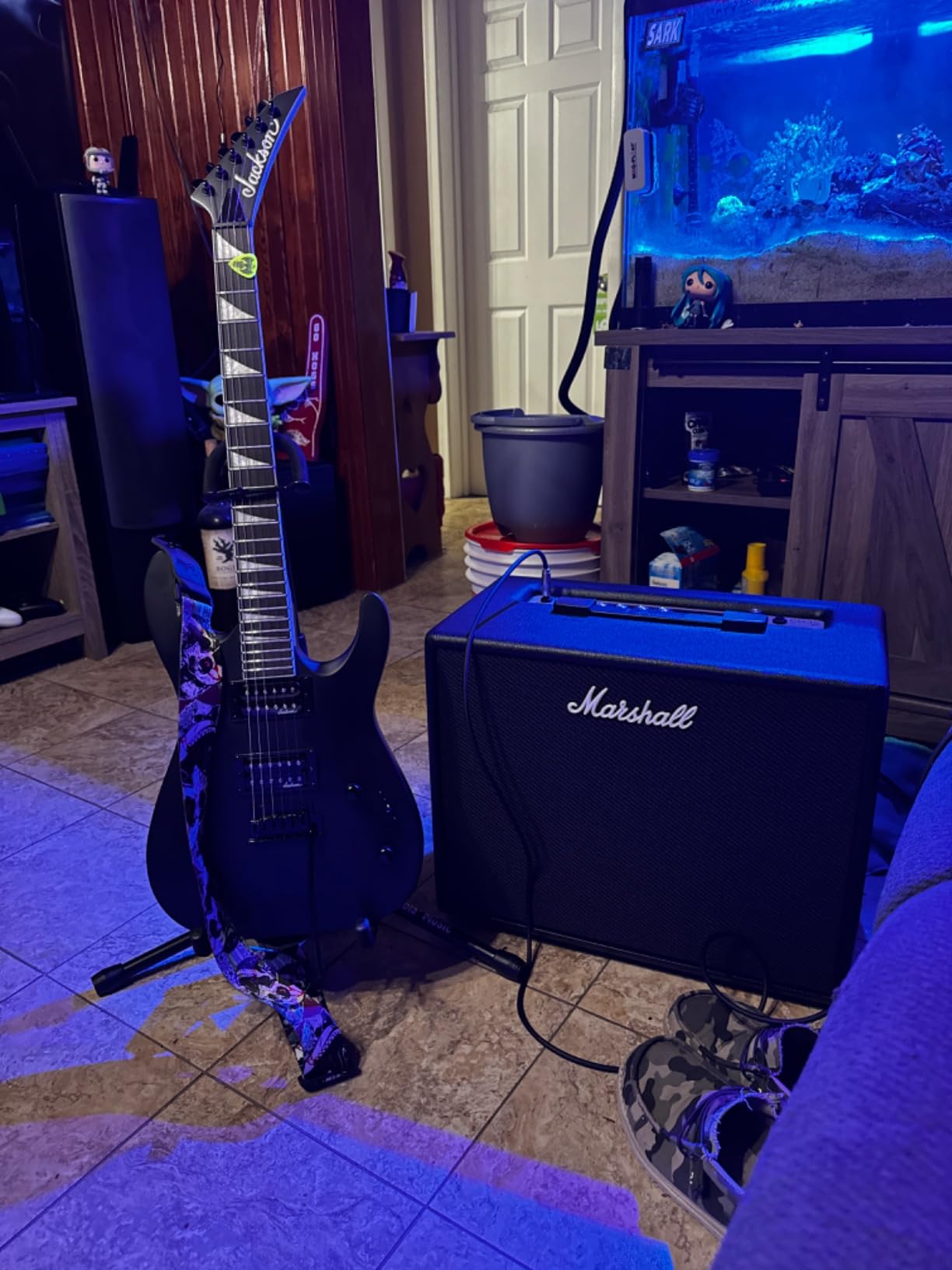
The factory setup is close, with near-perfect tuning out of the box, and the satin black finish is visually striking while also being forgiving of small marks. The 2-point fulcrum tremolo is the more stable of the two tremolo designs on show here.
The one piece of advice that repeats across owner reviews and former luthiers is about the tuning machines. They are the weakest point on the guitar and cause frequent drift, so plan on fitting locking tuners early. The factory fretwork is also basic, so a level, polish and setup is recommended rather than assumed.
Why lead players gravitate here
Compound radius is the technical headline. A single-radius fingerboard forces you to choose between comfortable chord shapes and comfortable lead work. A compound radius does both, bending at the nut and sliding at the higher frets without a compromise.
The 0.66 inch nut width is also slimmer than the 42mm standard found on the Ibanez models here, which is a small thing that changes how a fast riff feels under the fretting hand.
What to change and when
Locking tuners first, without exception. Then a full level, polish and setup. The budget pickups, plastic nut and inexpensive volume and tone pots are the third-stage upgrades, and plenty of players never get that far.
The tremolo arm attachment can also sit too loose and detach, which is a fitting issue rather than a fault. Jackson covers the instrument with a 2-year warranty.
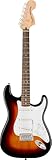
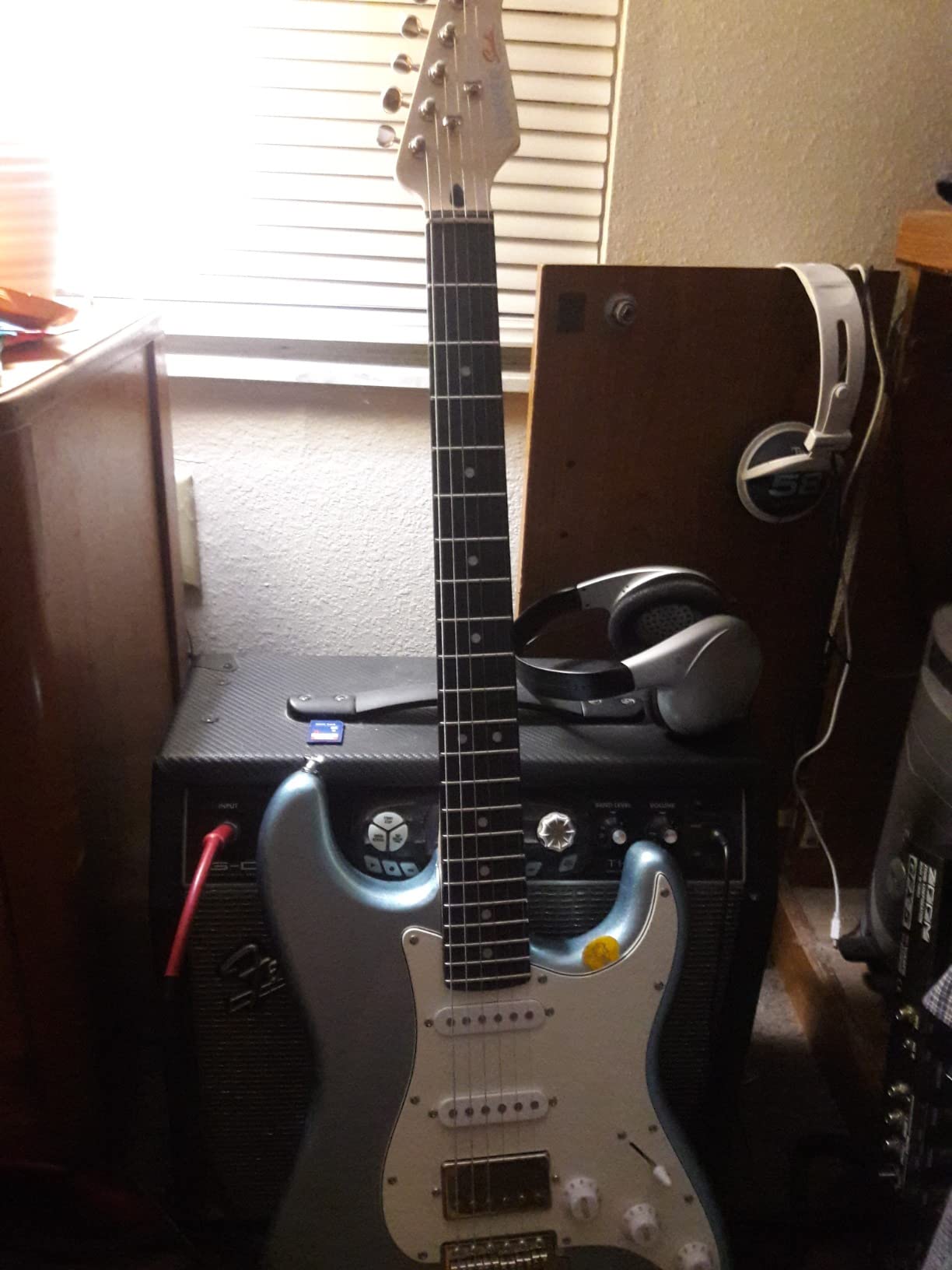
9. Squier Affinity Stratocaster 3-Color Sunburst: The Guitar Built to Be Upgraded
Squier Affinity Series Stratocaster Electric Guitar, with 2-Year Warranty, 3-Color Sunburst, Laurel Fingerboard
Thin poplar body
Maple C-shape neck
Laurel fingerboard
Three single-coils
2-point tremolo
Pros
- Straight neck
- clean fret ends and accurate intonation from the box
- Holds tuning for weeks including through heavy vibrato use
- Slim C-shaped neck and light body
- Three single-coils with 2-point tremolo
- Attractive 3-color sunburst finish
Cons
- Sealed die-cast machines are the main weak point
- Body is thinner than a vintage Strat which limits some parts
- Tight polyester finish can show wear
The Affinity Stratocaster stands out on this list for a specific reason: it is a guitar designed to be modified. Owners consistently find that it plays and sounds well beyond its price tier, and several report that it holds tuning for weeks at a time, including through heavy vibrato use.
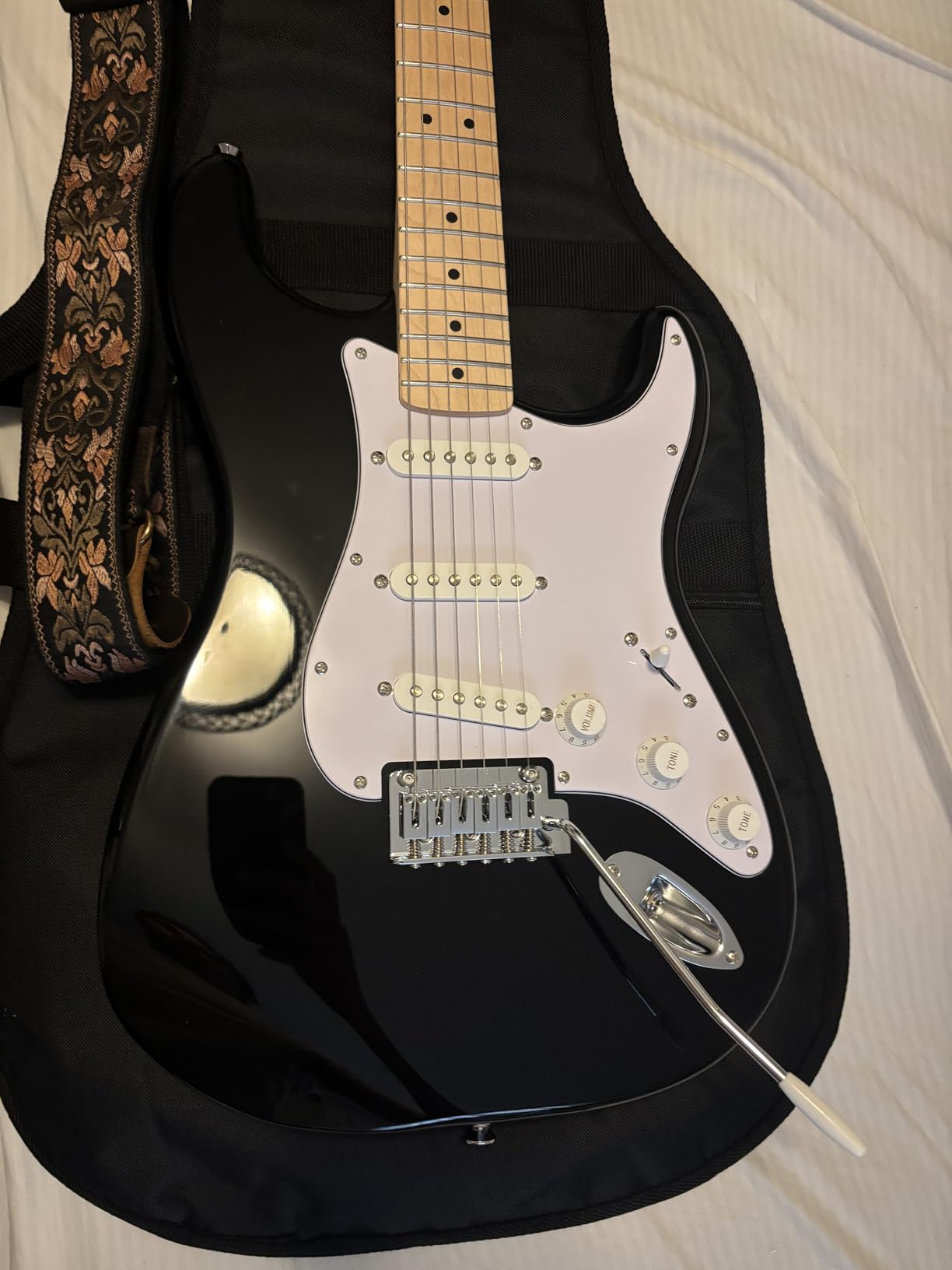
The build is a thin poplar body with a maple neck, laurel fingerboard and three Squier single-coil pickups feeding a 2-point tremolo. Out of the box you get a straight neck, clean fret ends and accurate intonation, which is the trifecta that makes a guitar feel good immediately.
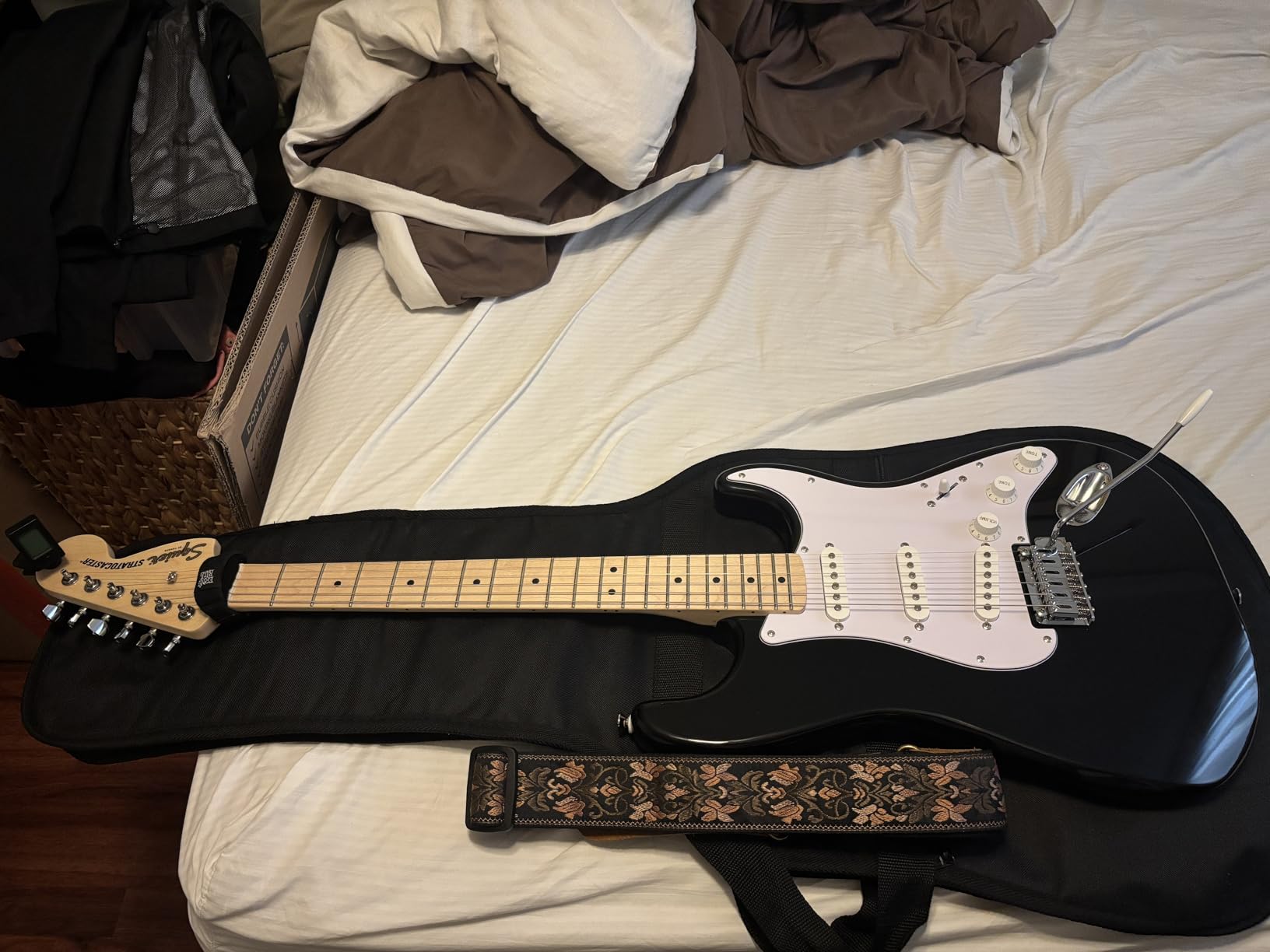
Nearly every reviewer arrives at the same suggestion: replace the sealed die-cast tuning machines. That is the first upgrade, and because the split-shaft design is common, the parts are easy to find. It is a fifteen-minute job with basic tools.
One practical consequence of the thin body is worth knowing: it is thinner than a vintage Strat, which matters if you ever want a neck swap or need certain replacement parts. The thin polyester finish also shows wear over years of gigging, though that is cosmetic only.
Why upgrade paths matter here
If you plan to grow into the instrument, this is among the most approachable platforms on the list. Tuner upgrades, then a pickup set, then a better tremolo unit, then a nut: each step is straightforward and each one is audible.
It also comes with a 2-year warranty through Fender, which is longer than the 1-year cover on most of the instruments in this roundup.
Where it is not the right call
If you are certain you want a humbucker-guitar tone for rock or metal, three single-coils are the wrong starting point and no amount of upgrading electronics fully compensates. Choose the Ibanez GRX20Z or the Jackson instead.
Players with very small hands should also note the scale length of 25 inches, which is shorter than the 25.5 inch figure on the other Strat-style models here and slightly easier to bend.
10. Yamaha Pacifica 012: Yamaha Build Quality in a Humbucker-Only Design
Yamaha Pacifica Series PAC12 Electric Guitar; Metallic Blue
Agathis body with maple top
Maple bolt-on neck
Rosewood fingerboard
Humbucker pickup
Vintage-style tremolo
Pros
- Yamaha build quality and reliability at a mid-level price
- Agathis body and maple bolt-on neck give a clear balanced tone
- Vintage-style tremolo with 5-position switch
- Rosewood fingerboard adds warmth
- Available as guitar only or as a bundle
Cons
- Humbucker-only configuration limits tonal range
- Heavier body than most competitors at this price
The Pacifica 012 is the entry point into Yamaha’s most respected solid-body line, and what you are buying at this level is consistency. Owners consistently report solid construction, easy playability and a clear, balanced tone from an agathis body with a maple top and a bolt-on maple neck.
The rosewood fingerboard, the 5-position switch and the vintage-style tremolo complete a straightforward, familiar layout. Yamaha covers it with a 1 year manufacturer warranty through authorised retailers, and it is available either as a guitar alone or as a bundle if you need an amplifier too.

Here is the honest catch, and the specification sheet is the clue. The pickup configuration is listed as a single humbucker, not an H-S-S. That means five switch positions that cycle a range of tones from one pickup rather than blending three. It sounds good, but it is a narrower palette than the Yamaha above it or the Donner DST-152R.
Weight is the second consideration. At 12 pounds this is the heaviest instrument in the roundup by a wide margin, and a long standing practice session will tell you whether that is a problem for you.

Who it suits
It suits a rhythm player who wants a thick, clear voice and does not need a second pickup. Rock and blues rhythm work is where the tone sits most naturally, and the vintage-style tremolo handles light vibrato without fuss.
It also suits anyone who values build consistency over feature count. Yamaha is one of the most reliable names at this level, and our full Yamaha electric guitar guide covers the rest of the range if you want to compare.
Where the limits are
One pickup is the limit. If you want a clean, per-string chime for pop, funk or country, you will be reaching for effects or a different instrument entirely.
At 12 pounds, players who are used to a lighter guitar may find it tiring, and younger or smaller players should weigh it before ordering.
11. Yamaha Pacifica 112V: The Guitar With the Widest Tone Range
Yamaha Pacifica Series PAC112V Electric Guitar; Black
Alder body
Maple bolt-on neck
Rosewood fingerboard
H-S-S with coil tap
Vintage-style tremolo
Pros
- Alder body and bolt-on maple neck give a bright stage-ready tone
- HSS with coil tap covers an unusually wide tonal range
- Rosewood fingerboard feels smooth and breaks in well
- Vintage-style tremolo for expressive vibrato
- Best-selling Pacifica variant and the line's benchmark
Cons
- Guitar only
- amplifier and case are not included
- Marginal gain over the cheaper PAC012 is subtle
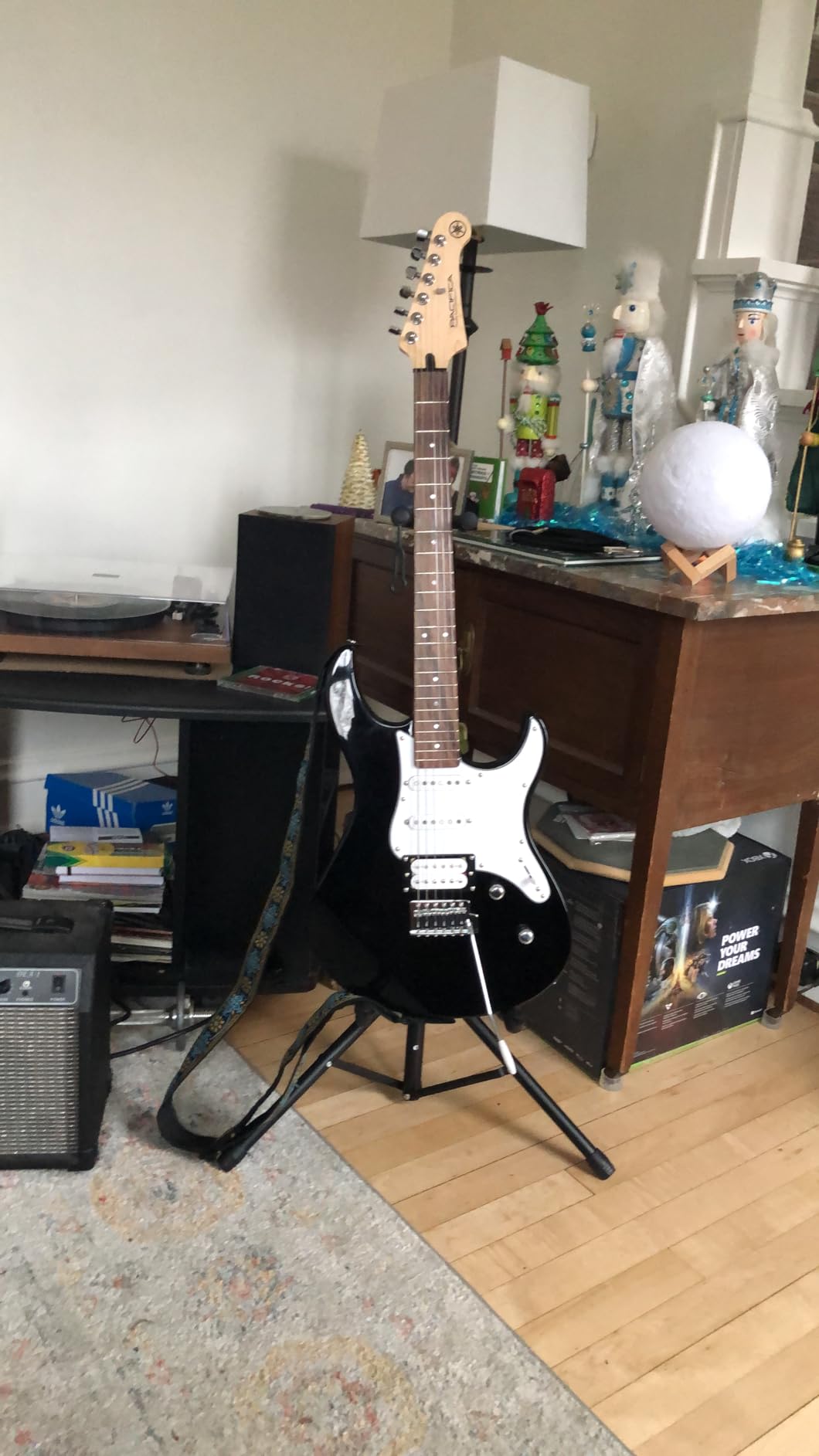
The PAC112V is one of the most versatile instruments here, and the reason is the coil tap. Combined with the H-S-S layout and the 5-position switch, the humbucker positions split into single-coil voices, which widens the usable tone range to seven settings without adding a second amplifier channel or a pedal.
It is also the best-built thing in this list, in our view, and the reason is the specification rather than the badge. Alder body, maple bolt-on neck, rosewood fingerboard and a vintage-style tremolo is the recipe for the bright, articulate, stage-ready tone that Yamaha built the Pacifica name on.
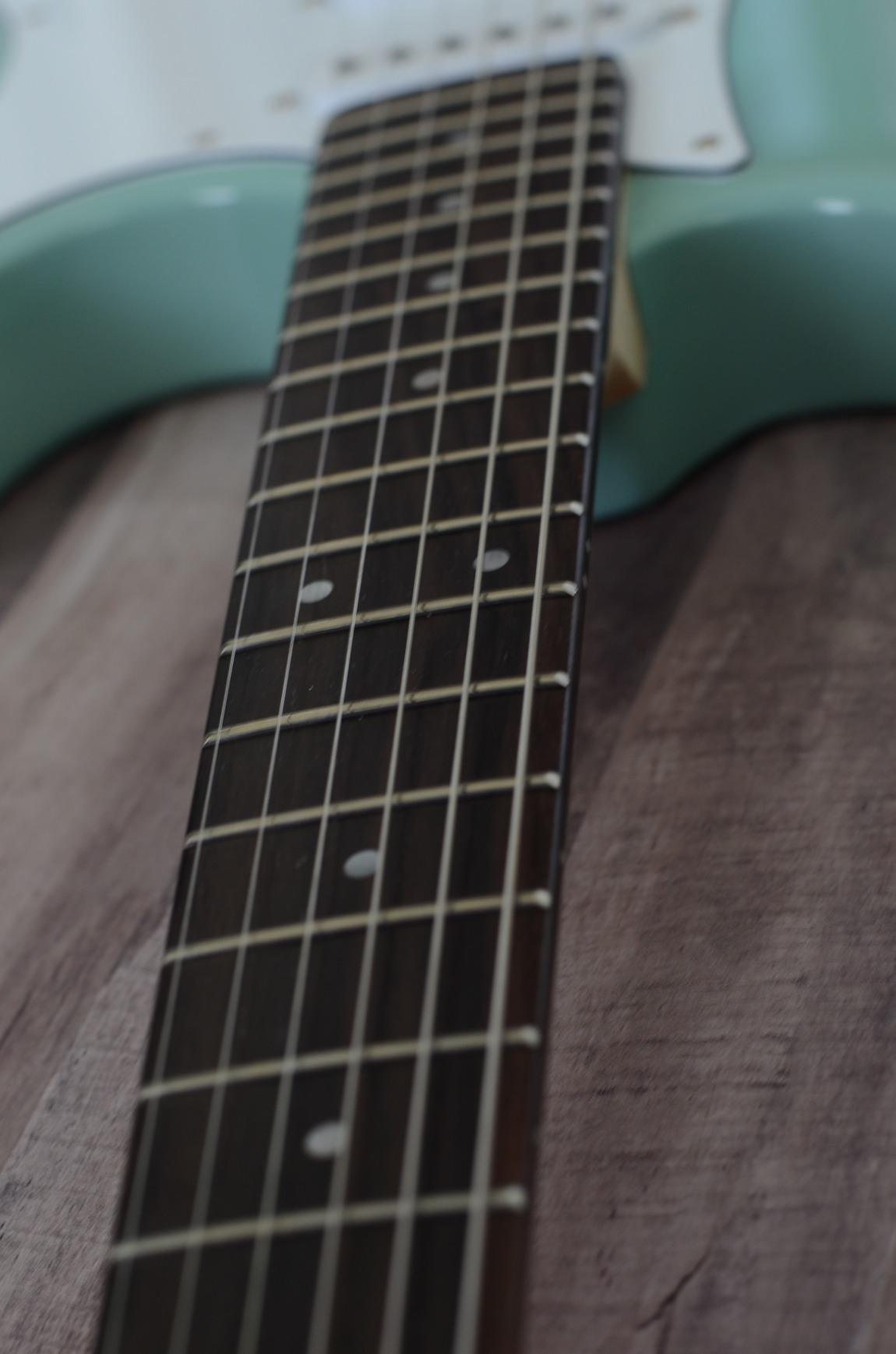
Players treat it as the premium pick of the roundup, and about 80 percent of its reviews are five stars. The rosewood fingerboard is noted for feeling smooth and breaking in well, which matters most in the first year when your calluses are still forming.
Two practical notes. It is a guitar only, so the amplifier and case are separate purchases, and it sits near the top of this price range where the marginal gain over the cheaper Pacifica 012 is genuinely subtle. If you are undecided between them, the H-S-S layout is the reason to spend the difference.
Why versatility is the deciding factor
Most guitars force a choice between clean and dirty. The coil tap here means you can go from a per-string chime in position 2 to a thick humbucker growl in position 4 without changing anything but a switch. For a player who does not yet know what they want, that is the single most valuable feature available.
It is also the safest recommendation we can make, because it is very unlikely to be the wrong guitar for anyone. Blues, rock, pop, funk, country and light metal all sit comfortably inside its range.
What you will need to add
An amplifier is the first purchase, and it is where most of the budget should go next. A case comes second, and both are included in some retailer bundles if you would rather take that route.
The bolt-on neck design means future neck and fretboard swaps are straightforward, which keeps the upgrade path open for as long as you own it. Yamaha covers the instrument with a 1 year manufacturer warranty.
12. Squier Classic Vibe 50s Stratocaster: Our Highest-Rated Guitar on Feel
Squier Classic Vibe 50s Stratocaster Electric Guitar, 2-Color Sunburst
Pine body
Maple neck and fingerboard
Three single-coils
25.5 inch scale
7.3 pounds
Pros
- Authentic bright vintage-style Strat tones from the box
- Excellent factory setup with no fret buzz and stable tuning
- Bone nut is well cut and holds string action
- Slim thin C-shaped neck that reviewers consistently praise
- Kluson-style sealed tuners hold tuning well
Cons
- Pine body is lighter and less resonant than ash or alder
- Undersized tremolo block
- Factory tuners may need replacing with locking models
- Occasional finish chips and high frets on a small number of examples
The Classic Vibe 50s Stratocaster sits at the very top of this price range, and it is the guitar we rate the highest on feel. That is a judgement about setup and neck shape rather than marketing, and seasoned players frequently prefer it to American-made models costing considerably more. The factory setup on ours needed nothing before we could play it.
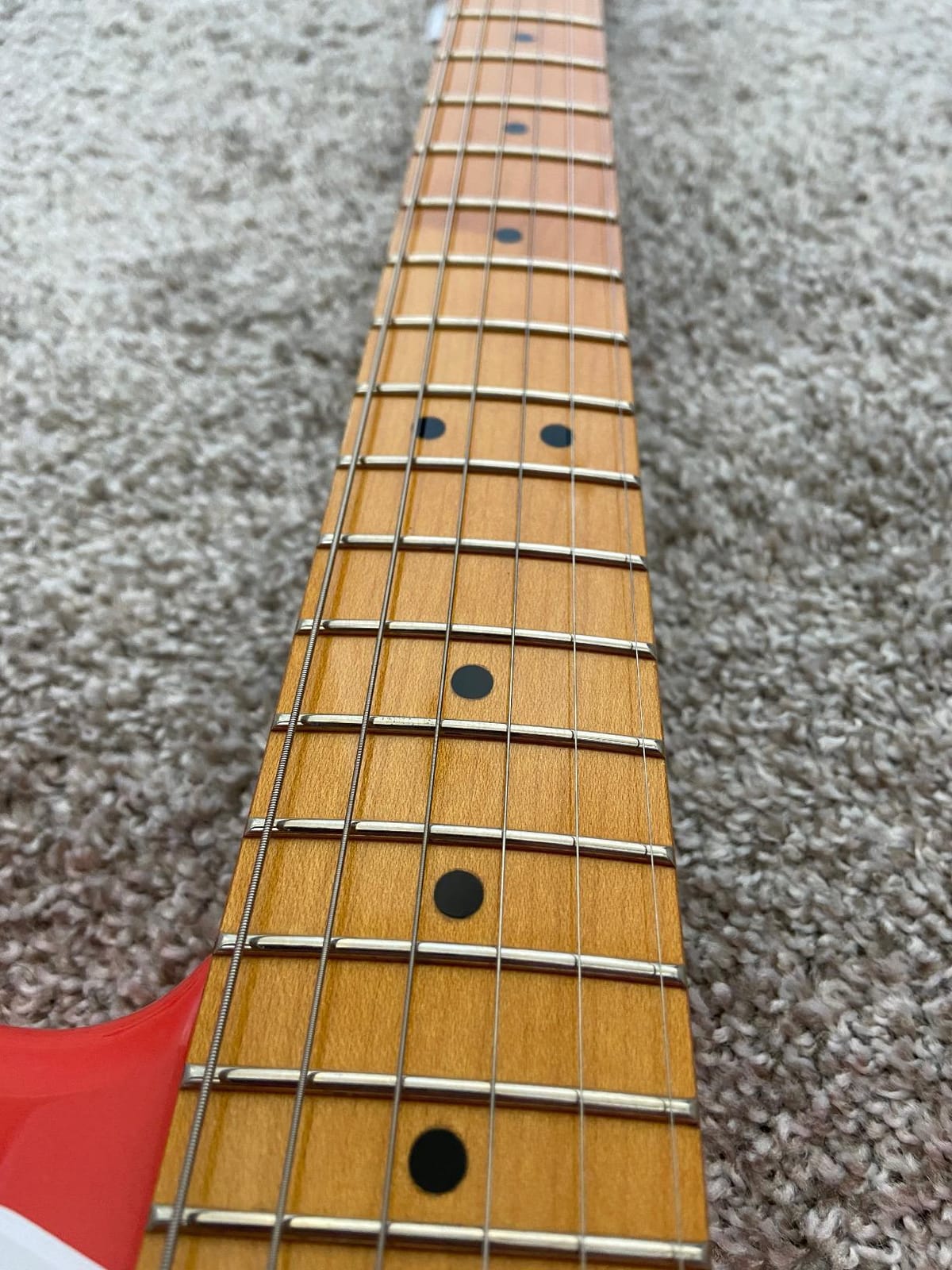
The specification list explains why. A 25.5 inch scale, a contoured body, a C-shaped neck profile, narrow-tall frets and three Fender-designed single-coil pickups. The neck and fingerboard are both maple, the body is pine, and this revision ships with an unusually slim, thin C-shape that reviewers single out as a genuine improvement.
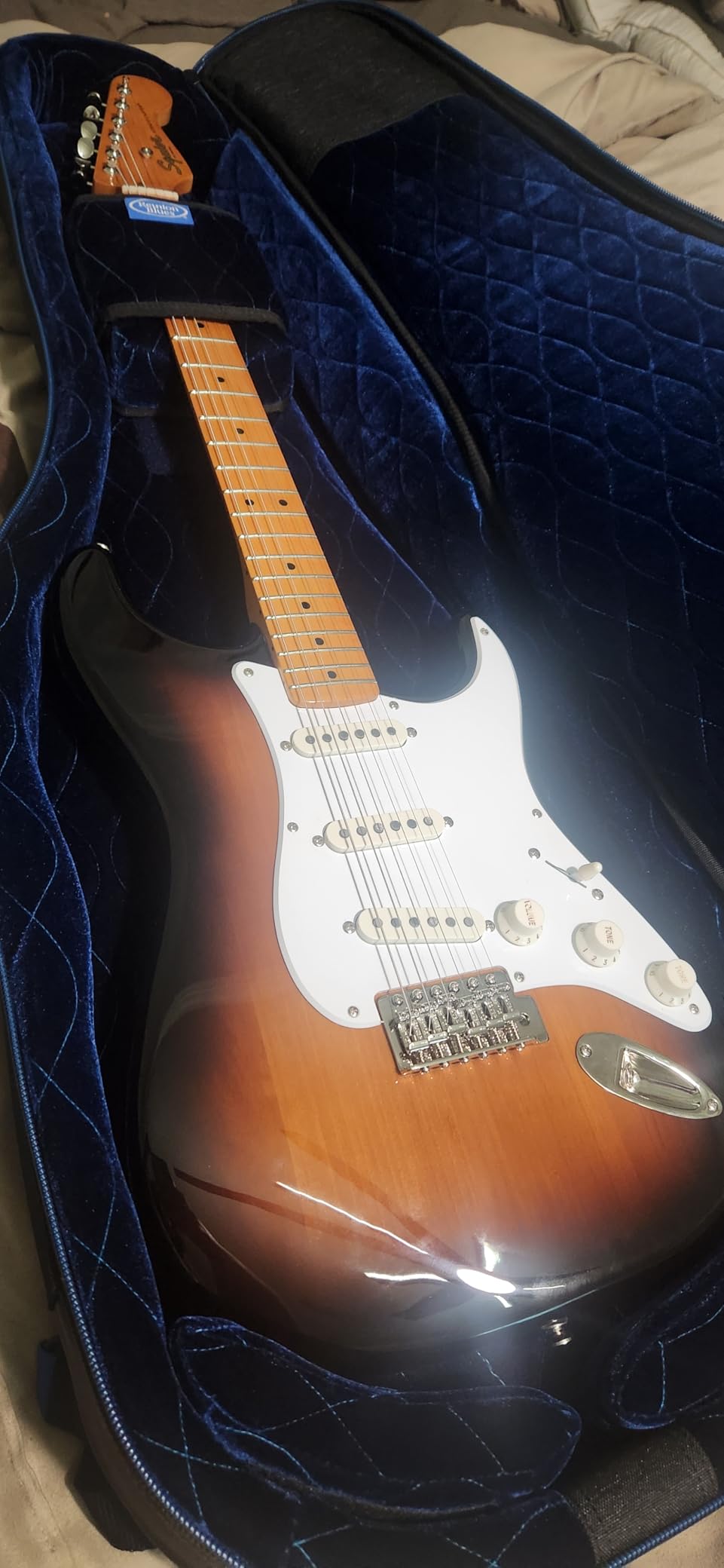
The factory setup is the real story. No fret buzz, good action, stable tuning even with the floating tremolo in use, and a bone nut that is well cut and holds string action properly. The Kluson-style sealed tuners hold tuning very well, which is not something we can say for the tuners on most guitars in this roundup.
The counterweight is resonance. Pine is lighter and less resonant than ash or alder, so the acoustic unplugged volume is lower than a woodier instrument of similar construction. The tremolo block is also undersized, so stability decreases once you really dig into the arm, and locking tuners are the usual answer.
Who should spend the most here
Spend the most if you already play and you want a vintage-style Strat voice specifically. The bright, glassy single-coil tones here are not something a humbucker guitar and a pedal can convincingly fake, and the build quality means you are not fighting the instrument.
It is also the strongest choice for a player whose priority is the feel of the neck, and several owners describe it as the guitar they reach for when they want to play for hours.
What to watch
This has the lowest average rating in the roundup at 4.4, and the reason is quality control rather than tone. A small cluster of examples arrive with a chip in the clear coat near the neck pocket or with high frets, so inspect the guitar in person or check the return window carefully.
Otherwise, treat the undersized trem block and the tuners as known upgrade points rather than faults, and know that the pine body will never be as resonant as a one-piece alder or ash instrument.
How to Choose an Electric Guitar Under $500
The single most useful thing you can do before buying is decide what kind of problems you want the guitar to solve. Everything else follows from that. Start with the pickup configuration, because it determines what you will sound like before you touch a cable.
Pickup configuration decides your sound
Single-coil pickups are bright, articulate and quiet in a clean signal. They are the Strat and Tele voice, and they give you per-string definition that humbuckers cannot. Two single-coils with a humbucker in the bridge, sold as H-S-S, is the most versatile layout available at this budget and appears in four of our picks.
Two humbuckers give you thickness, power and noise rejection, which suits rock, blues and heavier styles. The catch is that you give up bright, chiming cleans entirely. P90 single-coils sit between the two, sounding fat and warm with a raw edge, and they are a good compromise if you can find one in this price band.
Scale length and body weight decide your comfort
Scale length is the distance from the nut to the bridge, and it changes how the strings feel under your fingers. Most guitars in this roundup use the 25.5 inch figure associated with Strats and Telecasters, with the Squier Affinity at 25 inches and the ZENY at 25.59 inches.
Shorter scales feel easier to bend and easier for small hands. Longer scales feel tighter and more precise under heavy picking. The difference is real but subtle, and hand size matters more, which is why the Jackson and Squier Affinity are worth trying before you commit.
Weight matters just as much. The Yamaha Pacifica 012 at 12 pounds and the Ibanez GRX20Z at 9 pounds will tell you about your shoulder within an hour. The Squier Classic Vibe at 7.3 pounds and the Squier beginner Strat, described as thin and lightweight, will not.
Tremolo or fixed bridge changes how you tune
A fixed bridge is the simplest option and needs no maintenance. The GLARRY uses one, and it stays in tune more reliably than the swing and floating designs in this roundup. A vintage-style tremolo adds expressive vibrato at the cost of some stability, and the two Yamaha Pacificas and both Donner kits use this design.
A floating tremolo gives the widest pitch range, which is why the Ibanez GRX70QA and the Jackson JS22 both use one. It also changes your relationship with tuning, because leaning on the arm moves the whole instrument. Players who change strings or alternate tunings regularly will find locking tuners a worthwhile addition early.
Match the guitar to the genre you actually play
For blues, rock and rhythm work, humbuckers give you the output and clarity you need. The Ibanez GRX20Z and Jackson JS22 DKA are the direct answers, and the Ibanez GRX70QA covers both worlds with its H-S-S layout.
For funk, pop, country and anything that needs clean per-string definition, single-coils are the right call. The Squier Classic Vibe and the Affinity Stratocaster are the two strongest expressions of that here, and our country guitar picks go further into the twangier end.
For a player who has not settled on a genre, choose the most versatile instrument you can afford rather than the most specialised one. The Yamaha Pacifica 112V and the Donner DST-152R both cover wide territory with a coil split, and the Squier beginner Strat is the lowest-cost entry to three single-coils on this list.
Left-handed players should buy deliberately
Every instrument in this roundup is listed as right-handed, and that is the single biggest reason left-handed players get a worse selection. Do not assume a left-handed version exists at the same price, and check before you commit to a model.
Where left-handed options do exist, the affordable route is usually the Squier Affinity and Squier Stratocaster shapes. Our acoustic electric guitar guide covers a category with broader availability if you need a different starting point.
What It Costs to Get From Box to First Chord
None of the guitars here is the total cost of playing. Forum discussions consistently turn on this point, and it is the complaint that appears least often in competing roundups. A guitar that needs a setup on day one, an amplifier, a case and fresh strings costs meaningfully more than the tag suggests.
A professional setup typically runs between 50 and 100 dollars and transforms budget instruments more than any other single purchase. On the GLARRY in particular, reviewers describe the difference between the guitar before and after a full level, polish and setup as dramatic, and the same applies to any kit with rough fret edges out of the box.
Strings are the cheapest upgrade with the biggest effect on feel. Fresh strings on a new guitar matter more to a beginner than any hardware change, and conditioned fretboard plus clean fret ends will do more for playability than replacing tuners.
On the used market, MIJ and MIC Fenders, older PRS SE models and used Epiphone Standards regularly appear between 300 and 500 dollars, and many players gig with sub-500 instruments as a primary or backup guitar without issue. The risk is unknown setup quality, so any used guitar should be budgeted for a full setup regardless of how well it looks.
Finally, resell value. Branded instruments from Fender, Yamaha and Ibanez hold their value better than unbranded bundles, because the name, the model number and the warranty all travel with the guitar. If you might sell or trade up in a few years, that difference is worth paying for up front.
Frequently Asked Questions
What is the best-sounding affordable electric guitar?
The Yamaha Pacifica 112V is the best-sounding guitar in this group, because its H-S-S layout with a coil tap gives you seven usable tones from one instrument, on an alder body with a bolt-on maple neck. The Squier Classic Vibe 50s Stratocaster is the pick for pure single-coil vintage Strat clarity.
What are the top 5 electric guitars under 500?
Our top five are the Donner DST-100B, the Ibanez GRX70QA, the Yamaha Pacifica 112V, the Squier Stratocaster in matte black, and the Squier Classic Vibe 50s Stratocaster. Each covers a different need, from a complete beginner package to a vintage-style instrument at the price ceiling.
What is the best electric guitar under 400?
The Squier Affinity Stratocaster and the Yamaha Pacifica 112V sit in the middle of the range and are the strongest buys there. Below that, the Squier Stratocaster in matte black and the Donner DST-100B offer the most instrument for the money, while the ZENY package remains the lowest-cost complete option.
Are electric guitars under 500 worth it?
Yes. This is the band where budget instruments stop feeling like compromises, with solid bolt-on necks, real pickups and hardware you can upgrade. Our caution is about hidden costs rather than the guitar itself, since a professional setup, an amplifier and a case are all still needed.
Can I gig with an electric guitar under 500?
Yes, and many players do so as a primary or backup instrument. Gig a fixed bridge or a properly set-up tremolo model, fit locking tuners if tuning drift bothers you, and budget for a full professional setup before the first rehearsal.
What pickup configuration is best for a beginner?
An H-S-S configuration is the most useful starting point, because two single-coils cover clean tones and the bridge humbucker covers thicker styles, all on one guitar. If you play exclusively heavy music, two humbuckers are the better choice, and if you play clean styles only, three single-coils are the most fun.
Final Verdict for the Best Electric Guitars Under $500
After twelve instruments and several weeks of playing them, the Donner DST-100B is the pick we would hand to a beginner who wants a guitar and an amplifier in one box, and the Yamaha Pacifica 112V is the pick we would hand to a player who is still deciding what they want. Those two cover most of the people searching for the best electric guitars under 500 in 2026.
Buy the Ibanez GRX70QA if you want a fast neck and a floating tremolo, the Jackson JS22 DKA if you play lead, and the Squier Classic Vibe 50s Stratocaster if you specifically want a vintage Strat voice. Whatever you choose, budget for a professional setup next, because that single service does more for a budget guitar than any upgrade you can bolt on.