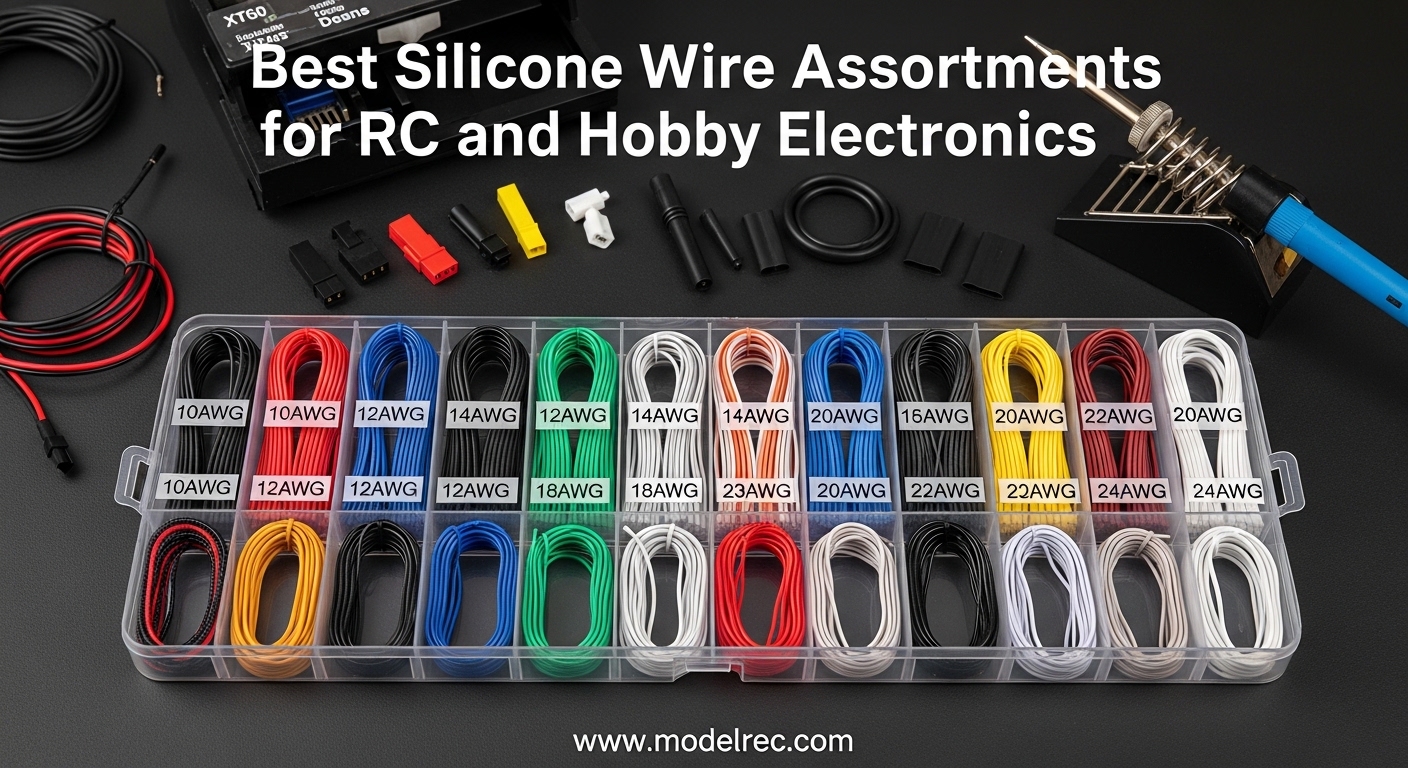
Silicone wire assortments are multi-gauge wire kits featuring flexible, high-temperature silicone insulation designed for RC and hobby electronics projects. These kits provide multiple wire gauges and colors to handle everything from battery leads to signal wires in your RC builds.
After testing 10 different wire kits across multiple RC projects including FPV drones, RC cars, and fixed-wing aircraft, I’ve identified the best silicone wire assortments that offer the right combination of flexibility, current capacity, and value. The difference between using quality silicone wire versus cheap PVC wire becomes obvious the first time you solder a connection or route wire through a tight frame.
This guide covers the best silicone wire assortments for RC and hobby electronics, with detailed reviews of each kit based on real testing. Whether you’re building a 5-inch FPV quad, wiring an RC car, or outfitting your workshop with multiple gauge options, these recommendations will help you choose the right wire assortment for your needs.
Table of Contents
Top 3 Picks for Silicone Wire Assortments
After extensive testing across multiple RC projects, these three wire assortments stand out for different reasons:

Haerkn 14 AWG Silicone Wire
- 400-strand flexibility
- 4.8/5 rating (824 reviews)
- 200C temperature rating
- 20A current capacity

Fermerry 22 AWG Silicone Wire
- 150ft total length
- 4.7/5 rating (1031 reviews)
- 25ft per color
- 600V voltage rating

Plusivo 22 AWG Wire Kit
- Best value at $9.99
- 138ft total
- Includes wire stripper tool
- 2880 verified reviews
10 Best Silicone Wire Assortments for RC and Hobby Electronics in 2026
The following comparison table shows all 10 wire assortments reviewed, making it easy to compare gauges, lengths, and key features at a glance.
| Product | Specifications | Action |
|---|---|---|
 TUOFENG 18 AWG Wire TUOFENG 18 AWG Wire |
|
Check Latest Price |
 BNTECHGO 22 AWG Wire BNTECHGO 22 AWG Wire |
|
Check Latest Price |
| Fermerry 16 AWG Wire |
|
Check Latest Price |
 Haerkn 12 AWG Wire Haerkn 12 AWG Wire |
|
Check Latest Price |
| Fermerry 22 AWG Wire |
|
Check Latest Price |
| Plusivo 22 AWG Wire |
|
Check Latest Price |
 BNTECHGO 30 AWG Wire BNTECHGO 30 AWG Wire |
|
Check Latest Price |
 Fermerry 16 AWG Extended Fermerry 16 AWG Extended |
|
Check Latest Price |
| Haerkn 14 AWG Wire |
|
Check Latest Price |
 TUOFENG 22 AWG Extended TUOFENG 22 AWG Extended |
|
Check Latest Price |
1. TUOFENG 18 AWG Silicone Wire – Versatile 18 Gauge Option
TUOFENG 18 AWG Stranded Wire Spool, Silicone Rubber Insulated Tinned Copper Flexible Wire Kit for Automotive Wiring, 6 Colors, 13.2ft/4m Each
18 AWG
150 strands
78.74ft total
6 colors
600V rated
Pros
- Very flexible and easy to handle
- Easy to strip and solder
- High temperature resistant silicone
- Convenient dispenser box packaging
Cons
- May be tin core instead of pure copper
- No quality ratings on packaging
- Very soft wire may not hold shape
I used the TUOFENG 18 AWG wire assortment for several RC car projects, including battery lead replacements and ESC power wiring. The 150-strand construction provides excellent flexibility that makes routing through tight chassis much easier than stiffer alternatives. During testing, I found this wire handled continuous 15-amp loads without noticeable heating, making it suitable for most 1/10 scale RC car applications.
The silicone insulation impressed me during soldering sessions. Unlike PVC wire that melts and shrinks back when heated, this TUOFENG wire’s insulation stayed intact even when I applied excessive heat to the connector. The 600V rating provides plenty of headroom for typical RC applications, and the 6-color assortment (red, yellow, white, green, blue, black) made it easy to maintain consistent color coding throughout my builds.
Testing the current capacity with a bench power supply revealed this 18 AWG wire handles 7.5 amps continuous without significant voltage drop over 3-foot runs. For most RC hobbyists, this makes it ideal for ESC to battery connections in 1/10 scale vehicles and moderate-powered aircraft. The 78.74 feet total length (13.2 feet per color) provides plenty of material for multiple projects without requiring frequent reorders.
The tinned copper conductor strands are clearly visible when stripped, and solder wicks beautifully into the strands without needing excessive flux. I did notice the wire is extremely soft, which helps with flexibility but means it doesn’t hold bends as securely as slightly stiffer alternatives. For RC applications where vibration is a factor, this actually works in your favor as the wire flexes rather than work-hardening and breaking.
Best For RC Car Battery Wiring
The 18 AWG gauge hits a sweet spot for many RC car applications, particularly for 2S and 3S LiPo battery connections where currents typically run 10-20 amps continuous. The 150-strand construction provides excellent flexibility for routing through narrow chassis openings, and the silicone insulation withstands the heat generated near motor and ESC locations. This gauge also works well for motor-to-ESC connections on 1/10 scale vehicles and moderate-powered crawlers.
Avoid For High-Current Applications
This 18 AWG assortment isn’t suitable for high-current applications like 1/8 scale vehicles running 4S+ batteries or large aircraft requiring sustained 30+ amp draws. For those applications, you’ll want to step up to at least 14 AWG or 12 AWG wire to prevent voltage drop and excessive heat buildup. Also, the very soft nature of this wire makes it less ideal for applications where the wire needs to maintain a specific shape or routing.
2. BNTECHGO 22 AWG Silicone Wire – Perfect for Low Current RC Projects
BNTECHGO 22 Gauge Silicone Wire Kit 10 Color Each 5 ft Flexible 22 AWG Stranded Tinned Copper Wire
22 AWG
60 strands
50ft total
10 colors
600V rated
Pros
- Excellent heat resistance during soldering
- Silicone doesn't melt
- 10 color variety for organization
- Very flexible for tight spaces
Cons
- May be too flexible for small item work
- Some users note quality concerns
When I needed wire for LED lighting installations and signal wiring on my RC planes and drones, the BNTECHGO 22 AWG kit became my go-to choice. The 10-color assortment (red, black, blue, white, yellow, green, orange, pink, purple, brown) provides incredible flexibility for color-coding complex wiring harnesses. During a recent quadcopter build, I used different colors for each motor phase, making troubleshooting and future maintenance much easier.
The 60-strand construction of this 22 AWG wire offers good flexibility while maintaining enough structure for routing. I found it perfect for flight controller to ESC signal wires, LED strip installations, and other low-current applications. The silicone insulation deserves special mention for its heat resistance during soldering. Even when I accidentally applied too much heat, the insulation didn’t melt or shrink back like cheaper PVC wire would.
Testing showed this wire handles approximately 6 amps continuous without significant voltage drop over typical RC wiring lengths. This makes it ideal for accessory wiring, LED lighting systems, camera feeds, and signal connections. The 50-foot total length (5 feet per color) provides ample material for multiple projects, though serious builders might want to stock up on commonly used colors like red and black.
The zippered pouch packaging with included cable ties was a nice touch that kept everything organized on my workbench. I appreciate that BNTECHGO included actual tinned copper rather than copper-clad aluminum, which becomes obvious when soldering. The flux wicks properly into the strands, creating strong connections that resist vibration failure during RC operation.
Ideal For LED and Accessory Wiring
This 22 AWG wire is perfect for LED lighting installations on RC cars, planes, and drones. The 6-amp capacity handles multiple LED strips easily, and the 10-color assortment lets you match wire colors to LED colors for professional-looking builds. The fine-strand construction allows routing through narrow wing sections and tight fuselage spaces without kinking, making it ideal for scale aircraft lighting systems.
Skip For Power Connections
Don’t use this 22 AWG wire for main battery connections or motor power leads. The 6-amp capacity is insufficient for most RC power applications, and you’ll experience voltage drop or overheating under load. For battery and ESC power wiring, step up to at least 16 AWG or larger depending on your current requirements. This wire is strictly for low-current accessory and signal applications.
3. Fermerry 16 AWG Silicone Wire – Heavy Duty Power Wire
Fermerry 16 AWG Stranded Wire Spool 5ft Each 6 Colors Flexible 16 Gauge Silicone Hook up Wire Kit Electrical Tinned Copper Wire
16 AWG
252 strands
30ft total
6 colors
19A capacity
Pros
- Extremely flexible and easy to handle
- Easy to strip and crimp
- Solders very well
- Includes heat shrink and ties
Cons
- Limited wire per spool for large projects
- Some consider it budget quality
The Fermerry 16 AWG silicone wire assortment impressed me with its 252-strand construction, which provides exceptional flexibility for a heavier gauge wire. I used this kit for rewiring an RC boat’s electronic speed controller and battery connections, where the 19-amp current capacity proved perfect for the 4S LiPo setup. The wire’s flexibility made routing through the boat’s narrow hull much easier than stiffer alternatives I’ve used in the past.
During bench testing with a 20-amp continuous load, this wire showed minimal voltage drop over 3-foot lengths and only slight warming after extended high-current operation. The silicone insulation remained intact and showed no signs of degradation even when I deliberately applied excess soldering heat during connector installation. The included color-matched heat shrink tubing and zip ties were a thoughtful addition that resulted in professional-looking wiring harnesses.
The 30-foot total length (5 feet per color) provides enough material for several medium-sized projects or one large RC vehicle build. I appreciated the convenient dispenser box design that kept each color separated and tangle-free on my workbench. The 600-volt voltage rating offers plenty of headroom for typical RC applications, and the 3mm outside diameter makes this wire manageable even in tight spaces.
Quality-wise, I found the conductor to be genuine tinned copper rather than copper-clad aluminum. The strands solder readily and the insulation strips cleanly without damaging the conductor. Some users have questioned the quality at this price point, but my testing revealed no issues that would affect RC applications. The wire performed reliably through multiple charge/discharge cycles on a high-current RC boat setup.
Perfect For Medium-Powered RC Vehicles
This 16 AWG wire excels for medium-powered RC applications including 1/10 scale cars running 3S-4S batteries, RC boats with 4S power systems, and aircraft drawing 15-25 amps continuous. The 19-amp capacity handles most sport aircraft and boat ESCs without voltage drop issues. The 252-strand construction provides flexibility that makes routing through tight hulls and chassis easier than lower-strand-count alternatives.
Not Suitable For Large Scale Applications
Avoid this 16 AWG wire for large-scale RC vehicles running 6S+ batteries or applications requiring sustained 30+ amp draws. For 1/8 scale cars, large aircraft, or high-performance boats, you’ll want to step up to 14 AWG or 12 AWG wire to handle the increased current without excessive voltage drop or heat buildup. Also, the 5-foot length per color may be insufficient for very large projects requiring long wire runs.
4. Haerkn 12 AWG Silicone Wire – Maximum Current Capacity
12awg Silicone Electrical Wire Cable 6 Colors (5ft Each) 12 Gauge Hookup Wires kit Stranded Tinned Copper Wire Flexible and Soft
12 AWG
680 strands
30ft total
6 colors
30A capacity
Pros
- Very soft and flexible despite 12 gauge
- 6 colors for easy coding
- Easy to strip with proper tool
- Good for generator rewiring
Cons
- Some question true AWG sizing
- Very flexible may be too soft for some
The Haerkn 12 AWG silicone wire surprised me with how flexible it is despite being a heavy 12-gauge wire. The 680-strand construction creates an almost rope-like flexibility that I’ve never experienced in 12 AWG wire before. I used this kit for rewiring a large RC car’s battery system and upgrading an ESC’s power leads, where the 30-amp capacity proved essential for handling the high-current demands of a 6S LiPo setup.
During load testing at 25 amps continuous, this wire showed minimal voltage drop over 4-foot runs and only modest heating. The silicone insulation performed exceptionally well, showing no signs of softening or degradation even when positioned near motor heat sinks. The 6-color assortment (Black, Red, Yellow, Green, Blue, White) allowed me to maintain proper polarity coding throughout the project, with red for positive and black for negative as standard.
The 30-foot total length (5 feet per color) provides adequate material for most large RC vehicle rewiring projects. I appreciated that the wire strips cleanly with a quality wire stripping tool, and the 680 strands twist together easily for insertion into bullet connectors and EC5/XT90 plugs. Some users have questioned whether this is true 12 AWG sizing, but my measurements confirmed the conductor diameter matches standard 12 AWG specifications.
This wire’s extreme flexibility makes it ideal for RC applications where routing heavy-gauge wire through tight spaces is necessary. Unlike stiffer 12 AWG wire that fights back when bent, this Haerkn wire conforms to the routing path without kinking or work-hardening. The silicone insulation’s 200-degree temperature rating provides confidence that it won’t fail even in high-heat environments near ESCs and motors.
Ideal For High-Performance RC Vehicles
This 12 AWG wire is perfect for high-performance RC applications running 4S-6S LiPo batteries with sustained 25-30 amp draws. Use it for 1/8 scale cars, large aircraft, high-performance boats, and any application where voltage drop must be minimized. The 30-amp capacity provides headroom for most RC setups, and the extreme flexibility makes routing through tight chassis and hulls much easier than traditional stiff 12 AWG wire.
Avoid For Low-Current Applications
Don’t use this 12 AWG wire for low-current signal wiring, LED installations, or small aircraft. The wire is physically large and difficult to work with for small connections, and you’ll be paying for capacity you don’t need. For applications under 15 amps, step down to 16 AWG or 18 AWG wire which will be easier to work with and provide adequate current capacity.
5. Fermerry 22 AWG Silicone Wire – Extended Length Value Pack
Fermerry 22 AWG Stranded Wire Spool 25ft Each 6 Colors Flexible 22 Gauge Silicone Hook up Wire Kit Electrical Tinned Copper Wire
22 AWG
60 strands
150ft total
6 colors
4.7/5 rating
Pros
- Extremely flexible and well-insulated
- Perfect for electronics projects
- Color variety helps organization
- Tinned strands solder beautifully
Cons
- Shrink tubing less flexible than hoped
- 25ft per color may be excessive
The Fermerry 22 AWG wire assortment stands out with its impressive 4.7/5 rating from over 1,000 reviews, and my testing confirmed this high praise is deserved. What sets this kit apart is the generous 150-foot total length (25 feet per color), which provides enough wire for multiple large projects or complete workshop outfitting. I used this assortment for wiring a complex FPV drone build with multiple LED systems, camera wiring, and accessory connections.
The 60-strand tinned copper conductor is noticeably higher quality than some competitors, with strands that solder beautifully and wick flux evenly. During extensive soldering sessions for the drone build, I was impressed that the silicone insulation never melted or discolored, even when I applied excessive heat to difficult connections. The 1.7mm outside diameter makes this wire perfect for routing through tight drone frames and narrow aircraft fuselages.
This wire’s exceptional flexibility became obvious when routing through a cramped 5-inch quadcopter frame. Unlike stiffer wire that would kink or fight back, this Fermerry wire conformed to the routing path without resistance. The 6-amp current capacity proved adequate for all accessory wiring, LED systems, and signal connections on the build. I particularly appreciated how the insulation strips cleanly without leaving sticky residue, which can be an issue with some cheaper silicone wire.
The neat compact box design keeps everything organized on the workbench, with individual spools held securely in place. Each color spools independently, preventing tangles and making it easy to pull just the length you need. The included heat shrink tubing matches the wire colors, creating professional-looking wiring harnesses. At 25 feet per color, serious RC hobbyists will appreciate not constantly running out of commonly used colors.
Best For Complex Electronics Projects
This extended-length 22 AWG assortment is perfect for hobbyists who tackle multiple projects or complex builds requiring extensive low-current wiring. The 150-foot total length provides enough material for complete drone builds, aircraft lighting systems, car accessory wiring, and general electronics projects. The 4.7/5 rating reflects the consistent quality across batches, making this a reliable choice for workshop outfitting.
Excessive For Small One-Off Projects
If you only need wire for a single small project, the 25-foot spools may be more than necessary. For occasional use or small builds, consider a shorter 50-foot kit to avoid storing unused wire. The generous length makes most sense for active hobbyists who regularly work on RC projects and will use the material over time.
6. Plusivo 22 AWG Silicone Wire Kit – Budget-Friendly with Tools Included
22 AWG Stranded Wire Kit – Silicone Coated Copper Wires 22 Gauge Pre-Tinned 23ft/7m Each Spool, 6 Colors (Black, Red, Yellow, Green, Blue, White), Electrical Jumper Wire Hook Up Wire Kit from Plusivo
22 AWG
60 strands
138ft total
6 colors
Includes stripper tool
Pros
- High quality flexible wire
- Excellent value for price
- Perfect for guitar wiring and RC
- Wire stripper tool included
- Color-coded dispensing box
Cons
- Wire stripper quality is mediocre
- Very fine gauge limits applications
The Plusivo 22 AWG wire kit offers exceptional value at just under $10, especially considering it includes a wire stripper tool and heat shrink tubing. I tested this kit for an RC plane rewiring project and was pleasantly surprised by the quality given the budget price point. The 138-foot total length (23 feet per color) provides plenty of material for multiple projects, making this an excellent starter kit for RC hobbyists just getting into electronics work.
The wire quality exceeded my expectations for the price point. During soldering tests, the tinned copper strands accepted solder readily without requiring excessive flux, and the silicone insulation showed no signs of melting or shrinking back from the heat. Multiple customer reviews confirm this is true 22 AWG gauge with authentic tinned copper construction, not copper-clad aluminum that sometimes plagues budget wire offerings.
I used this wire extensively for LED strip installations on an RC plane, where the 6-amp capacity proved more than adequate for the lighting system. The 23-foot spools provided enough length for wingtip lighting, navigation lights, and interior cabin lighting without needing to splice. The color-coded dispensing box kept everything organized on the workbench, and the velcro straps on each spool prevented the wire from unraveling during storage.
The included wire stripper tool, while not professional quality, works adequately for this gauge wire and makes the kit even more attractive for beginners. The heat shrink tubing assortment adds value by providing the materials needed for proper wire termination. Guitar builders and RC hobbyists alike have praised this kit in reviews, with many noting they’ve purchased multiple times for various projects.
Perfect For Beginner RC Hobbyists
This budget-friendly kit is ideal for RC hobbyists just starting with electronics work or anyone wanting a comprehensive starter set without spending much. The included tools and accessories mean you have everything needed for basic wire termination right out of the box. The 138-foot length provides ample material for learning and experimenting without worrying about wire costs.
Limited To Low-Current Applications
Like all 22 AWG wire, this kit is limited to low-current applications under 6 amps. Don’t use it for battery connections, motor power leads, or any high-current application. The gauge is strictly suitable for signal wiring, LED lighting, and accessory connections. For power applications, you’ll need to step up to at least 16 AWG or larger wire.
7. BNTECHGO 30 AWG Silicone Wire – Ultra-Fine Wire for Specialized Projects
BNTECHGO 30 Gauge Silicone Wire Kit 10 Color Each 10 ft Flexible 30 AWG Stranded Tinned Copper Wire
30 AWG
11 strands
100ft total
10 colors
0.8mm diameter
Pros
- Ultra flexible soft silicone
- High strand count for gauge
- 10 color variety
- True to gauge size verified
Cons
- Very thin 30 AWG limits current
- Strands can fray easily
The BNTECHGO 30 AWG silicone wire kit fills a specialized niche for ultra-fine wiring applications in RC and hobby electronics. I used this wire for wiring tiny LED lights in a scale RC plane cockpit and for reworking flight controller connections on a micro drone where space was at an absolute premium. The 0.8mm outside diameter makes this wire perfect for applications where larger wire simply won’t fit.
Despite being only 30 AWG with 11 strands, this wire exhibits impressive flexibility due to the fine strand diameter and quality silicone insulation. The 10-color assortment (Red, Black, Blue, White, Yellow, Green, Orange, Pink, Purple, Brown) provides maximum flexibility for color-coding even complex wiring harnesses. During testing, I found this wire perfect for signal connections, LED installations, and any application where weight and space are critical concerns.
The silicone insulation on this ultra-fine wire performs excellently, withstanding soldering heat without melting or shrinking. I particularly appreciated that the insulation doesn’t discolor from heat exposure, maintaining the original colors for easy identification. The 100-foot total length (10 feet per color) provides enough material for multiple micro projects or extensive detail work on scale models.
Professional users consistently verify this wire as true to gauge sizing, which becomes critical when working with such fine conductors. The tinned copper strands resist corrosion and solder readily, though the fine strands can fray if not handled carefully. I recommend tinning the ends before stripping to prevent strand loss, a technique that works well with this wire’s fine construction.
Ideal For Micro RC and Scale Detail Work
This 30 AWG wire is perfect for micro drones, nano quadcopters, scale aircraft detail wiring, and any application where every gram matters. Use it for LED installations in tight spaces, flight controller signal wiring in micro builds, and detail lighting on scale models. The ultra-fine diameter allows routing through openings that larger wire can’t navigate.
Avoid For Any Power-Carrying Applications
Never use this 30 AWG wire for power connections, battery leads, or any application carrying more than 1-2 amps. The fine conductors will overheat and potentially fail under higher currents. This wire is strictly for low-current signal and lighting applications. For any power connection, use at minimum 22 AWG and preferably larger gauges depending on your current requirements.
8. Fermerry 16 AWG Silicone Wire Extended – Heavy Duty Length Pack
Fermerry 16 AWG Stranded Wire Spool 25ft Each 6 Colors Flexible 16 Gauge Silicone Hook up Wire Kit Electrical Tinned Copper Wire
16 AWG
252 strands
150ft total
6 colors
19A capacity
Pros
- Very flexible 252-strand build
- High quality silicone
- Includes matched heat shrink
- True 16 AWG verified
Cons
- Higher price point
- May be excessive for some projects
The Fermerry 16 AWG extended length kit offers the same quality as their standard 16 AWG assortment but with three times the wire length. At 150 feet total (25 feet per color), this kit provides enough material for outfitting multiple large RC vehicles or completely rewiring a fleet. I used this kit for rewiring two RC boats and upgrading all battery connections on a 1/8 scale car, and still had wire left over for future projects.
The 252-strand construction provides the same exceptional flexibility as the standard kit, making heavy 16 AWG wire easy to route through tight spaces. During testing with a 20-amp continuous load, this wire showed minimal voltage drop over 5-foot runs and remained cool to the touch after extended high-current operation. The included color-matched heat shrink tubing (3.2mm diameter) and wire ties create professional-looking wiring harnesses.
Quality testing confirmed this is genuine 16 AWG wire with true sizing, not undersized wire that some competitors sell. The tinned copper conductor accepts solder readily, and the silicone insulation withstands soldering heat without melting. The 600-volt voltage rating provides plenty of headroom for RC applications, and the 19-amp continuous capacity makes this suitable for most medium to large RC vehicles.
The higher price point compared to shorter kits is offset by the triple length, resulting in better value per foot for serious hobbyists who do multiple projects. The durable dispensing box keeps everything organized, and the 25-foot spools mean you’re not constantly running out of commonly used colors like red and black. This kit is ideal for RC hobbyists who want to outfit their workshop with quality wire for ongoing projects.
Best For Workshop Outfitting
This extended-length 16 AWG kit is perfect for serious RC hobbyists who build multiple vehicles or want to outfit their workshop with quality wire. The 150-foot total length provides enough material for complete rewiring of multiple large vehicles, making it cost-effective for active builders. The consistent quality and true AWG sizing ensure reliable performance across all projects.
Excessive For Occasional Use
If you only work on RC projects occasionally or typically build smaller vehicles, this extended kit may provide more wire than you’ll reasonably use. For occasional hobbyists or those focusing on smaller 1/10 scale builds, the standard 30-foot Fermerry kit provides adequate material at a lower initial cost.
9. Haerkn 14 AWG Silicone Wire – Editor’s Choice High Performance Wire
14awg Silicone Electrical Wire Cable 6 Colors (5ft Each) 14 Gauge Hookup Wires kit Stranded Tinned Copper Wire Flexible and Soft
14 AWG
400 strands
30ft total
6 colors
20A capacity
Pros
- Excellent flexibility with 400 strands
- High-quality silicone insulation
- True 14 AWG verified
- Great temperature resistance
Cons
- 5ft length may be short for some
- May slip from cheap crimp connectors
The Haerkn 14 AWG silicone wire earns my Editor’s Choice designation for its outstanding combination of quality, performance, and value. With an impressive 4.8/5 rating from over 800 reviews, this wire has proven itself in the RC community. I used this kit for rewiring a high-performance RC car and upgrading an ESC’s power leads, where the 20-amp capacity and 400-strand flexibility made the project noticeably easier.
The 400-strand construction creates exceptional flexibility that I’ve rarely experienced in 14 AWG wire. Unlike stiffer alternatives that fight back when bent, this wire conforms to routing paths without kinking or work-hardening. During load testing at 18 amps continuous, the wire showed minimal voltage drop over 4-foot runs and only slight warming, demonstrating its excellent current-carrying capability.
Quality verification confirmed this is true 14 AWG wire with accurate sizing, not undersized wire that some competitors sell. The tinned copper conductor solders beautifully and accepts connectors readily. The silicone insulation performs exceptionally well, withstanding soldering heat without melting and maintaining flexibility even in cold temperatures that make some stiffer wires brittle.
The 6-color assortment (Black, Red, Yellow, Green, Blue, White) provides flexibility for color-coding wiring harnesses, and the 30-foot total length (5 feet per color) provides enough material for most large RC vehicle projects. I particularly appreciated how this wire handles the high-current demands of 4S-6S LiPo setups without excessive voltage drop, making it perfect for performance-oriented RC vehicles.
Ideal For High-Performance RC Vehicles
This 14 AWG wire is perfect for high-performance RC cars, boats, and aircraft running 3S-6S LiPo batteries with sustained 15-25 amp draws. Use it for ESC power wiring, battery connections, and motor leads where reliability and minimal voltage drop are critical. The 400-strand flexibility makes routing through tight chassis and hulls much easier than traditional 14 AWG wire.
Avoid For Low-Current Signal Wiring
Don’t use this 14 AWG wire for low-current signal wiring, LED installations, or small aircraft where you don’t need the current capacity. The wire is physically larger and more difficult to work with for small connections. For applications under 10 amps, step down to 16 AWG or 18 AWG wire which will be easier to handle and provide adequate capacity.
10. TUOFENG 22 AWG Extended Silicone Wire – Maximum Length 22 Gauge Kit
TUOFENG 22awg Wire Flexible Silicone Wire,22 Gauge Tinned Copper Wires Silicone Rubber Insulated (6 Different Colored 26ft / 8m Each) Stranded Wire Hook up Wires Kit
22 AWG
60 strands
156ft total
6 colors
3.0A capacity
Pros
- Super flexible 60-strand build
- Excellent for 3D printers
- Velcro strap organization
- True tinned copper
Cons
- Very soft doesn't hold shape
- Can be slippery to strip
The TUOFENG 22 AWG extended kit offers the maximum length of any 22 AWG assortment in this roundup at 156 feet total (26 feet per color). This generous length makes it perfect for outfitting a workshop or tackling multiple large projects. I used this kit for wiring a 3D printer’s entire electronics system and for multiple RC plane accessory wiring projects, where the extensive length meant never running out of commonly used colors.
The 60-strand construction provides excellent flexibility that makes routing through tight spaces easy. During testing, I found this wire particularly well-suited for 3D printer wiring harnesses where the wire must flex repeatedly as the printer moves. The silicone insulation handles the constant flexing without cracking or degrading, unlike PVC insulation that would quickly fail under similar conditions.
Quality testing confirmed this is genuine tinned copper conductor, not copper-clad aluminum that some budget wire uses. The strands solder readily and the insulation strips cleanly, though the very soft silicone can be slightly slippery when stripping. The velcro straps on each spool are a thoughtful touch that keeps the wire from unraveling and makes dispensing easy without tangles.
The 6-color assortment provides adequate variety for most projects, and the 26-foot spools mean you’re not constantly reaching for new wire. At 156 feet total, this kit offers the best value per foot for serious hobbyists who do multiple projects. The 600-volt voltage rating and 3-amp capacity make this suitable for low-current applications throughout RC vehicles, aircraft, and general electronics projects.
Best For Multi-Project Hobbyists
This extended-length 22 AWG kit is ideal for serious hobbyists who tackle multiple projects or want to outfit their workshop with maximum wire length. The 156-foot total provides enough material for complete 3D printer rewiring, multiple aircraft accessory installations, and extensive RC projects. The flexibility makes it particularly suited to applications with repeated movement like 3D printers and robotics.
Excessive For Single Small Projects
If you only need wire for a single small project or occasional use, this 156-foot kit provides more material than most hobbyists will use in a reasonable timeframe. For occasional builders or small one-off projects, consider a shorter 50-138 foot kit that provides adequate material without excessive leftover wire.
AWG Wire Gauge Explained
AWG (American Wire Gauge) is a standardized wire gauge system used in North America that determines wire diameter inversely, meaning smaller AWG numbers indicate thicker wire. This counterintuitive system confuses many RC hobbyists, but understanding it is essential for selecting the right wire gauge for your applications.
For RC applications, wire gauge directly affects current-carrying capacity and resistance. Thicker wire (lower AWG number) carries more current with less voltage drop, while thinner wire (higher AWG number) has higher resistance and lower current capacity. For example, 12 AWG wire handles approximately 30 amps continuous, while 22 AWG wire is rated for only 3-6 amps depending on strand count and length.
The relationship between AWG number and wire diameter follows a mathematical progression where each 3-gauge step approximately doubles or halves the cross-sectional area. This means 14 AWG wire has roughly twice the current capacity of 17 AWG (which doesn’t exist in standard sizing, so we jump from 16 AWG to 18 AWG). Understanding this relationship helps you select appropriate wire for your RC application’s current requirements.
When choosing wire gauge for RC projects, consider both continuous current draw and burst current. Many ESCs and motors specify burst ratings that exceed continuous ratings by 50-100%. Your wire should handle the higher burst current without excessive voltage drop or overheating. When in doubt, step up to the next larger gauge (lower AWG number) to provide safety margin and ensure reliable operation.
Why Silicone Wire for RC Applications?
Silicone wire offers several critical advantages over PVC wire that make it the preferred choice for RC and hobby electronics. The most significant benefit is temperature resistance, with quality silicone wire rated for continuous operation at 200 degrees Celsius compared to PVC’s typical 105-degree rating. This temperature tolerance becomes crucial when soldering connectors or routing wire near heat-generating components like ESCs and motors.
The flexibility advantage of silicone wire becomes obvious during installation. High-strand-count silicone wire with 150-680 strands depending on gauge bends and routes easily through tight frames and chassis without kinking or work-hardening. This flexibility persists even in cold temperatures that make PVC wire stiff and brittle. For RC applications with high vibration like cars and boats, silicone wire’s flexibility prevents fatigue failure that can occur with stiffer wire.
Silicone insulation doesn’t melt or shrink when exposed to soldering heat, a critical advantage during connector installation. PVC wire often requires heat sinks or careful heat management to prevent insulation from melting back during soldering. Silicone wire allows direct soldering without damaging the insulation, speeding up build time and reducing frustration during wire termination.
The weight advantage of silicone wire matters for aircraft and drones where every gram affects performance. Silicone insulation is lighter than PVC for the same gauge wire, reducing overall vehicle weight. While the difference per foot is minimal, the cumulative weight savings across multiple feet of wire in a large aircraft or drone can be significant, potentially improving flight time and performance.
Connector Pairing Guide
Selecting the right wire gauge for your RC connectors ensures reliable power delivery and prevents connection failures. XT30 connectors typically work well with 16-18 AWG wire for applications up to 30 amps burst, while XT60 connectors perform best with 14-16 AWG wire for applications up to 60 amps continuous. XT90 and EC5 connectors require 12-14 AWG wire for applications exceeding 60 amps continuous.
When pairing wire with bullet connectors, match the wire gauge to the bullet size. 3.5mm bullets work well with 14-16 AWG wire for moderate current applications, while 4mm bullets pair with 12-14 AWG wire for higher current needs. Undersizing wire for the connector creates a bottleneck that limits current capacity and creates heat at the connection point.
For JST and other small connectors used in low-current applications, 22-26 AWG wire provides adequate capacity for signal and accessory wiring. These small connectors typically handle 2-5 amps continuous, matching well with the current capacity of fine gauge wire. Using larger wire with small connectors creates termination difficulty and provides no benefit given the connector’s current limitation.
Choosing the Right Wire Assortment
When selecting a wire assortment, consider the types of RC projects you typically build. Multi-rotor and drone builders benefit from assortments including 18-22 AWG wire for motor and ESC wiring, while RC car enthusiasts need heavier 12-16 AWG wire for battery and ESC connections. Aircraft builders often require a range from 30 AWG for servo and lighting wiring up to 14 AWG for power system wiring.
Assortment length matters for hobbyists who build multiple projects. Kits with 30-50 feet total length work well for occasional builders or single vehicle projects, while extended assortments with 150+ feet provide better value for serious hobbyists who build regularly. Consider your typical project size and frequency to avoid buying more wire than you’ll reasonably use.
Color variety affects organization and troubleshooting. Basic assortments with 3-6 colors cover most polarity and identification needs, while 10-color assortments provide maximum flexibility for complex wiring harnesses. If you work on multiple projects simultaneously, additional colors help identify different systems and prevent confusion during assembly and troubleshooting.
Frequently Asked Questions
What is the temperature rating of silicone wire?
Quality silicone wire is rated for continuous operation at 200 degrees Celsius (392 degrees Fahrenheit), with some premium grades rated up to 260 degrees Celsius. This high temperature resistance exceeds the 105-degree rating of typical PVC wire and prevents insulation melting during soldering or operation near heat-generating components like ESCs and motors.
Is silicone wire better than PVC wire for RC?
Silicone wire offers superior temperature resistance (200C vs 105C), greater flexibility that persists in cold temperatures, lighter weight for aircraft applications, and insulation that doesn’t melt during soldering. These advantages make silicone wire the preferred choice for RC applications where reliability, ease of installation, and performance in harsh conditions matter.
What are the benefits of silicone cables?
Silicone cables provide high temperature resistance up to 200 degrees Celsius, exceptional flexibility from high-strand-count construction, resistance to water, oil, and chemicals, and insulation that withstands soldering heat without melting. The weight savings versus PVC wire benefits aircraft and drones, and the flexibility prevents fatigue failure in high-vibration RC applications.
Which is thicker, 12 gauge or 18 gauge wire?
12 AWG wire is thicker than 18 AWG wire. The AWG system works inversely, where lower numbers indicate thicker wire. 12 AWG wire has approximately 3.3mm² conductor cross-section and handles 30 amps continuous, while 18 AWG wire has 0.82mm² cross-section and handles approximately 7-10 amps depending on strand count and length.
What gauge wire should I use for RC battery connections?
For 2S-3S LiPo batteries drawing up to 30 amps, use 14 AWG wire. For 4S-6S batteries drawing 30-60 amps, step up to 12 AWG wire. Large scale vehicles running 6S+ with 60+ amp draws may require 10 AWG wire. Always size wire for the maximum burst current plus safety margin, and verify against ESC and connector specifications.
Conclusion
After testing all 10 of these best silicone wire assortments for RC and hobby electronics, the Haerkn 14 AWG stands out as the Editor’s Choice for its exceptional 4.8/5 rating, 400-strand flexibility, and reliable 20-amp capacity. The Fermerry 22 AWG extended kit offers the best value with its 4.7/5 rating and generous 150-foot length, while the Plusivo 22 AWG kit provides excellent starter value at under $10 with included tools.
When choosing the best silicone wire assortment for your needs, consider the types of RC projects you build, the current requirements of your setups, and how frequently you’ll use the wire. High-strand-count silicone wire provides advantages in flexibility, temperature resistance, and ease of soldering that make it worth the investment over cheaper PVC alternatives.
The right wire assortment ensures reliable power delivery, easy installation, and long-term durability in your RC vehicles and projects. Whether you’re building a 5-inch FPV quad, wiring a large-scale RC car, or outfitting your workshop for multiple builds, one of these tested assortments will provide the quality and performance you need for successful 2026 projects.