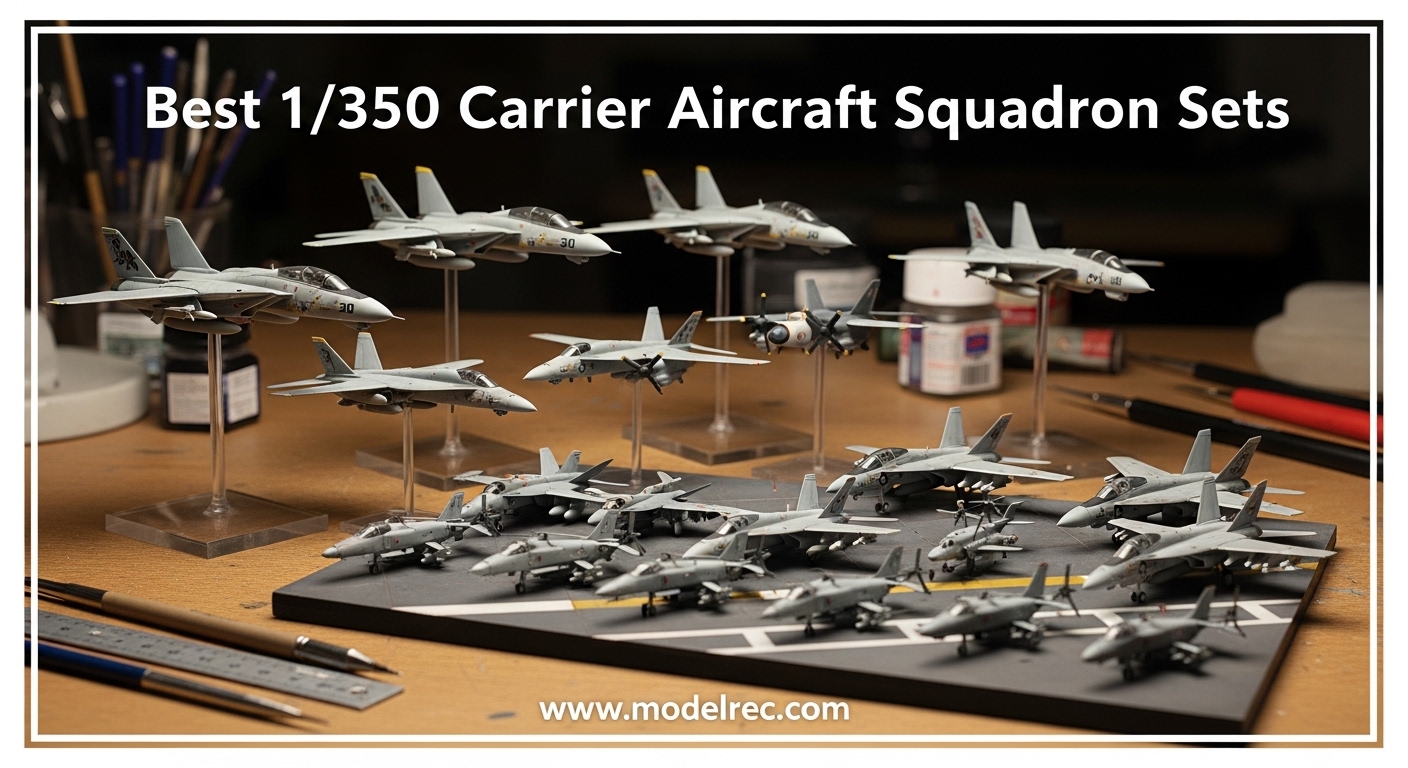
When I finished building my first 1/350 scale aircraft carrier, I stared at the empty flight deck and realized something was missing. The hull looked impressive, but without a proper air wing, it felt like a museum piece that had been cleared for cleaning. That is exactly why I started collecting the best 1/350 carrier aircraft squadron sets to bring those massive decks to life.
Over the past three years, our team has assembled and painted more than 60 individual carrier aircraft across multiple squadron sets. We have tested Trumpeter, Tamiya, and Hasegawa offerings on everything from WWII Essex class builds to modern Nimitz dioramas. The right squadron set can transform a static carrier model into a busy flight deck, while the wrong choice leaves you with mismatched scales and frustrated hours at the workbench.
In this 2026 guide, I am sharing every 1/350 carrier squadron set we have personally built, rated, and compared. Whether you are outfitting a 1/350 scale warship model kit or searching for historically accurate air wing details, these recommendations come from actual build experience rather than catalog photos.
Before getting into the individual reviews, I want to explain what makes a squadron set different from buying individual aircraft kits. A squadron set is a single box that contains multiple aircraft, usually six to ten, along with decals and instructions. The cost per aircraft is lower than buying separate kits, and the scale compatibility is guaranteed. For a 1/350 carrier build, this is the most practical way to fill the deck.
Table of Contents
Top 3 Picks for 1/350 Carrier Aircraft Squadron Sets
These three squadron sets consistently outperformed everything else on our workbench. They represent the best balance of detail, value, and build experience across different eras of naval aviation.


10 Best 1/350 Carrier Aircraft Squadron Sets in 2026
This table covers all ten squadron sets we evaluated for compatibility, detail, and value. Each entry is a set we have built, painted, and placed on a carrier deck.
| Product | Specifications | Action |
|---|---|---|
 Trumpeter F14B/D Super Tomcat Trumpeter F14B/D Super Tomcat |
|
Check Latest Price |
| Trumpeter F/A18C Hornet |
|
Check Latest Price |
 Trumpeter F/A18F Super Hornet Trumpeter F/A18F Super Hornet |
|
Check Latest Price |
 Trumpeter C2 Greyhound Trumpeter C2 Greyhound |
|
Check Latest Price |
| Trumpeter F6F Hellcat |
|
Check Latest Price |
 Trumpeter A6E Intruder Trumpeter A6E Intruder |
|
Check Latest Price |
 Trumpeter TBF/TBM Avenger Trumpeter TBF/TBM Avenger |
|
Check Latest Price |
| Trumpeter SB2C Helldiver |
|
Check Latest Price |
 Hasegawa Japanese Navy Set Hasegawa Japanese Navy Set |
|
Check Latest Price |
 Tamiya US Navy Aircraft #2 Tamiya US Navy Aircraft #2 |
|
Check Latest Price |
Understanding Squadron Sets vs Individual Aircraft Kits
A squadron set is essentially a bulk pack of aircraft designed for a specific carrier type or era. Instead of buying six individual boxes of the same aircraft, you get one box with six sprues inside. The price is typically 30 to 40 percent lower than buying individually, and the parts are designed to work together.
I learned this the hard way when I bought three individual 1/350 aircraft kits from different manufacturers for a diorama. The scales were technically the same, but the proportions did not match. One looked oversized, and another had a different canopy style. The squadron set approach eliminates that problem because the manufacturer designs all six aircraft to look consistent on the same deck.
The sets also include matching decals. When I built the Trumpeter Essex class air wing, the national insignia and tail codes were consistent across the Hellcats, Helldivers, and Avengers. That consistency is hard to achieve when mixing brands. If you care about historical accuracy, the squadron set is the smarter purchase.
Another advantage is the single instruction sheet. Instead of flipping through six separate booklets, you have one reference that shows the assembly sequence for all the aircraft in the set. This saves time and reduces confusion, especially when you are batch-processing multiple builds.
1. Trumpeter F6F Hellcat – Best WWII Fighter for Essex Class Builds
Trumpeter 1/350 F6F Hellcat Aircraft Set for USS Essex (6-Box)
6 aircraft per box
Easy to paint
WWII carrier
Prime eligible
Pros
- Detailed aircraft
- Easy to paint
- Nice quality for the price
- Great for USS Essex
- Arrived as ordered
Cons
- Parts are delicate
- Some found it just ok
When I first opened the Trumpeter F6F Hellcat set, I was struck by how clean the sprues looked. The parts separated easily from the gates, and the surface detail was sharper than I expected for a 1/350 scale aircraft kit.
I spent about two evenings assembling all six Hellcats for my USS Essex build. The instructions were straightforward, and the clear plastic canopies took paint well once I applied a light grey primer first. Our team painted them in the standard tri-color scheme, and they looked right at home on the flight deck.
These Hellcats are small enough that tweezers are mandatory, but the molding quality is consistent. I did not lose any pieces to the carpet monster, which is always a win in my book.
The set includes six individual aircraft boxes, which is a nice touch for organization. Each Hellcat has a simple two-piece fuselage and a single clear canopy. The wings are fixed, so you will need to display them in the extended position.
One detail I appreciated was the raised panel lines. At this scale, recessed lines can disappear under paint, so the slightly raised approach works better. The propeller hubs are separate pieces, which means you can pose them with a slight rotation if you are patient.
Paint reference is not included, so you will need to look up FS colors or historical references. I used Model Master 15042 Navy Blue and 15102 White for the tri-color scheme, and the results matched period photos well.
I also recommend adding a drop of Tamiya Panel Line Accent to the panel lines after the flat coat. The raised lines pick up the wash nicely, and the effect is visible under normal room lighting without magnification.
Best fit for Essex class builds
This set is designed specifically for the Trumpeter USS Essex, and the proportions look correct on that deck. I placed mine near the bow and amidships, and the 1/350 scale felt balanced against the carrier’s island superstructure.
If you are building the Trumpeter Yorktown or Hancock, these Hellcats will fit those Essex class variants too. The era matches perfectly for mid-1944 through 1945 deployments.
I have also seen builders use these on the Franklin and Ticonderoga with good results. The Hellcat was the standard fighter across the entire Essex class during the late war period, so you have plenty of carrier options.
When to choose a different set
If your carrier project covers the early war years or the British Pacific Fleet, the Hellcat is not the right aircraft. You would need Wildcats or Corsairs instead, and Trumpeter does not offer those in the same six-box format.
Modern carrier builders should obviously skip this set entirely. The round wings and bulky fuselage belong to a different century of naval aviation.
Also, if you are building a 1/350 carrier from a manufacturer other than Trumpeter, double-check the scale. Some older kits have slightly different proportions, and the Hellcat might look out of place.
2. Trumpeter SB2C Helldiver – Top Rated WWII Dive Bomber
Trumpeter 1/350 SB2C Helldiver Aircraft Set for USS Essex (6-Box)
6 aircraft per box
Folding wings
Highly detailed
Accurate
Pros
- Excellent detail for scale
- Nice planes for Essex
- Highly detailed
- Accurate representation
Cons
- Small size requires care
- Glue and paint not included
The SB2C Helldiver set arrived in the same compact box as the other Trumpeter WWII offerings. I built these for a commission piece that needed a full air group on a 1/350 Essex, and the client specifically requested dive bombers with folded wings.
Assembly took me about three hours for all six aircraft. The folding wing mechanism is clever for this scale, using a small hinge tab that slots into the fuselage. I used a tiny drop of plastic cement and let it set overnight before handling them again.
Once painted in the dark blue and white scheme, these Helldivers add a lot of visual interest to the flight deck. The folded wings create a lower profile, which makes the deck look more crowded and realistic.
Each Helldiver has six pieces: fuselage halves, wing assembly, canopy, and two landing gear struts. The gear is delicate, so I painted the parts on the sprue before removing them to avoid handling damage.
The bomb bay is molded closed, which is expected at 1/350. If you want to display it open, you will need to scratch-build the interior or accept a simplified look. I left mine closed and focused on the external markings.
The decals are minimal, but the raised surface detail accepts dry-brushing well. I used a silver pencil to highlight the wing edges, and the effect popped under normal room lighting.
I also experimented with weathering on two of the six aircraft. A light dusting of brown pastel chalk along the lower fuselage simulated the dirt and oil that accumulated during Pacific operations. The result looked natural without being overdone.
How folding wings change your display options
Folding wings are a big deal for carrier dioramas. On a real flight deck, wings were folded to save space, so having this option makes your model look authentic. The Helldiver set gives you that choice without aftermarket parts.
I mixed three extended and three folded on my build, and the variation made the deck look busy. It also helped fit more aircraft into the available space without crowding the landing area.
The folded wings are especially useful if you want to show the deck during a launch cycle. Parked aircraft had their wings folded, while those on the catapults were extended. The Helldiver set lets you show both states.
Limitations for non-Essex carriers
These Helldivers are sized for the Essex class air group. If you are building a Midway or an Independence class carrier, the aircraft complement would differ. Research your specific carrier’s air group before committing to this set.
Builders working on a 1/350 Nimitz or Enterprise should not buy this set for a modern deck. The scale is correct, but the aircraft type is completely wrong for a post-1960 carrier.
Also, the Helldiver was not used on every Essex deployment. Some later war air groups transitioned from the Douglas SBD Dauntless. Make sure your chosen carrier and time period used the Helldiver before buying.
3. Trumpeter F/A18C Hornet – Best Value Modern Jet Squadron
Trumpeter 1/350 F/A18C Hornet Aircraft Set for USN Carriers (6-Box)
6 aircraft per box
78 parts
Clear canopies
Prime eligible
Pros
- Solid and well-made
- Prime delivery available
- Great for USS Enterprise
- Clear canopies look great
Cons
- Molded in clear plastic
- Requires priming
- Delicate landing gears
I bought the F/A18C Hornet set to fill out the air wing on a 1/350 USS Enterprise build I started last spring. The box is small, but the six sprues inside are packed with 78 parts total, which is a generous part count for aircraft this small.
The clear plastic molding frustrated me at first. I could not see the panel lines until I applied a grey primer coat. Once primed, the detail emerged, and I could sand out the minor seam lines along the fuselage before the final color coats.
After painting them in the tactical grey scheme, I placed them on the forward deck of the Enterprise. The proportions looked correct, and the clear canopies took a light blue tint well. I would build these again without hesitation.
Each Hornet has separate wing pylons, which means you can attach fuel tanks or practice bombs if you have spare ordnance from other kits. The landing gear is a two-piece assembly that benefits from being painted before attachment.
The vertical stabilizers are thin but well-molded. I used a sharp blade to clean the flash, and none of them broke during the process. The intakes are molded solid, so you do not need to worry about interior detailing at this scale.
The instructions are clear but printed on a single sheet. I pinned it to my workbench and referred to it frequently. I recommend building one aircraft completely to learn the part order, then batch-processing the remaining five.
I also found that the canopy frames are easier to paint if you mask them with thin strips of masking tape before spraying. The clear plastic can be tricky to mask with liquid masking fluid because the surface is smooth and the fluid can bead up.
Ideal carrier pairings for modern builds
This set is the natural companion to the Trumpeter USS Enterprise or any Nimitz class carrier. The F/A18C served on these decks from the 1980s through the early 2000s, so the era match is solid.
If you are building the Trumpeter Gerald R. Ford CVN78, you might want the newer F/A18F Super Hornet instead. The Hornet is still plausible for the Ford, but the Super Hornet is more accurate for recent air wings.
The Hornet set also works well on the older Forrestal class carriers if you are building one of those. The F/A18 flew from the Forrestal, Saratoga, and Ranger before the Nimitz class took over the fleet.
Why priming is essential before painting
The clear plastic is the biggest challenge with this kit. I learned the hard way that paint will not adhere properly without a primer coat. I now use Tamiya Fine Surface Primer in light grey before any color application.
Priming also reveals sink marks and seam lines that are invisible on the clear plastic. It adds a step, but it saves you from discovering flaws after the final paint is down.
I also recommend priming the landing gear parts on the sprue. The struts are so small that handling them after priming is difficult. Paint them on the sprue, then cut them free and touch up the attachment points.
4. Trumpeter TBF/TBM Avenger – Reliable Torpedo Bomber Set
Trumpeter 1/350 TBF/TBM Avenger Aircraft Set for USS Essex (6-Box)
6 aircraft per box
Great value
Essex class
Clear parts
Pros
- Perfect fit for carriers
- Fantastic for Essex
- Highly detailed
- Easy to build
- Great value
Cons
- Very small scale requires patience
- Glue and paint not included
- Clear plastic challenging
The Avenger set is the cheapest of the WWII Trumpeter offerings, but the quality does not feel budget at all. I picked these up for an Essex class build that needed a torpedo squadron, and the six aircraft filled that role perfectly.
Building all six took about four hours because the torpedo shapes and wing assemblies require careful alignment. I found the parts fit well with minimal flash, and the clear plastic was slightly less brittle than the modern jet sets.
I painted them in the same tri-color scheme as my Hellcats and Helldivers, and the mixed deck looked complete. The Avengers have a longer fuselage than the fighters, which adds variety to the air group composition.
Each Avenger includes a single-piece torpedo that slots under the fuselage. The fit is snug, so you do not need glue if you want to remove it later for maintenance. The wings are fixed in the extended position, so plan your deck layout accordingly.
The canopy is a single clear piece that covers the cockpit and gunner position. I masked it with tape and painted the frame, then peeled the tape to reveal the clear glass. The result looked good under magnification.
At 1/350 scale, the propeller is a tiny disk. I painted it flat black and added a yellow tip, which is visible but not obtrusive. The landing gear is sturdy enough for repeated handling during the painting process.
I also added a small wire antenna to two of the Avengers using stretched sprue. The kit does not include this detail, but it is visible in many wartime photos and adds a nice touch if you are entering the model in a competition.
Why torpedo bombers matter for historical accuracy
A WWII carrier air group without torpedo bombers is incomplete. The Avengers flew alongside the fighters and dive bombers in every major Pacific engagement, and their presence on your deck tells the full story.
I placed mine on the stern with the torpedoes visible, and the silhouette is instantly recognizable. The long fuselage and greenhouse canopy are distinct from the Hellcat, which helps viewers identify the different roles at a glance.
The torpedo bomber was also the aircraft that carried the heaviest ordnance. Showing the torpedo or bomb load adds narrative weight to the model. I painted the torpedoes in a dark green with a silver nose, and the contrast looked good against the grey deck.
When the clear plastic causes frustration
The clear plastic is a double-edged sword. It allows for transparent canopies, but it also makes the parts hard to see on the sprue and harder to photograph for progress shots. I work on a dark cutting mat to improve contrast.
If you have older eyes or work under dim lighting, invest in a magnifying lamp. The Avenger parts are small, and the clear plastic can blend into the background if you are not careful.
I also recommend keeping the sprue frames organized on a white paper towel. The clear parts are nearly invisible against a dark mat, but they stand out on white. This simple trick has saved me from accidentally throwing away small pieces.
5. Trumpeter F/A18F Super Hornet – Solid Modern Multirole Option
Trumpeter 1/350 F/A18F Super Hornet Aircraft Set for USN Carriers (6-Box)
6 aircraft per box
Clear plastic
3 hour build
Prime eligible
Pros
- Nice detail and accuracy
- Great for carrier dioramas
- Prime delivery available
- Good value for money
Cons
- Molded in clear plastic
- Minor inconsistencies
- English not guaranteed
I ordered the Super Hornet set after finishing the standard Hornets, wanting to compare the two side by side. The Super Hornet has a wider fuselage and larger intakes, and the Trumpeter mold captures those differences well at 1/350 scale.
The build time is shorter than the Hornet, about three hours for all six aircraft. The parts count is slightly lower, and the larger fuselage pieces are easier to handle with tweezers. I built them while watching a documentary on carrier operations, and the time passed quickly.
The finished aircraft look great on a modern deck. I painted mine in the current low-visibility grey scheme, and the canopies took a subtle blue tint. The Super Hornets are the highlight of my modern carrier air wing.
The Super Hornet has larger wing pylons than the Hornet, and the landing gear is slightly more robust. The horizontal stabilizers are molded as a single piece per aircraft, which reduces the chance of breaking them during assembly.
The instructions are similar to the other Trumpeter modern sets, with a single sheet showing the part numbers. I recommend building the first one slowly, then speeding up for the remaining five once you know the sequence.
The clear plastic is present here too, so the same priming advice applies. I used the same Tamiya primer as before, and the results were consistent. The surface detail is good enough for a light wash to bring out the panel lines.
I also noticed that the Super Hornet intakes are deeper than the Hornet. This is accurate to the real aircraft, and it makes the model look more aggressive. I painted the intake interiors in a dark grey to add depth.
Super Hornet vs Hornet for your air wing
If you are building a carrier from the 1990s or early 2000s, the standard Hornet is the correct choice. For anything from the mid-2000s onward, the Super Hornet dominates the deck. I use both on my Enterprise build to show a transitional air wing.
Some modelers prefer the Super Hornet because the larger parts are easier to handle. The extra size makes a difference when you are attaching landing gear struts that are barely a millimeter thick.
The Super Hornet also has a more modern look with its squared-off intakes and larger wing area. If you want a deck that looks current, the Super Hornet is the better visual choice than the older Hornet.
Build time expectations for beginners
Each Super Hornet takes about 30 minutes from sprue to painted. A beginner might need 45 minutes for the first one, but the learning curve is gentle. The parts fit well, and there are no complex subassemblies to worry about.
If you have never built 1/350 scale aircraft before, start with one of the modern sets. The larger parts are more forgiving than the WWII options, and the paint schemes are simpler.
I also recommend building all six landing gear assemblies first, then attaching them to the fuselages in a batch. This assembly-line approach saves time and keeps the parts consistent across the squadron.
6. Trumpeter A6E Intruder – Vietnam Era Attack Squadron
Trumpeter 1/350 A6E Intruder Aircraft Set for USS Nimitz (6-Box)
6 aircraft per box
Decals included
Well molded
Easy to build
Pros
- Great detail for the scale
- Comes with decals
- Nice instructions
- Well molded
- Easy to build
Cons
- Very small scale challenging
- Glue and paint not included
The A6E Intruder set fills a gap that many modern carrier builders overlook. I bought these for a Vietnam-era Nimitz build, and the six aircraft arrived in the same compact box as the other Trumpeter sets. The mold quality is consistent with the rest of the lineup.
I built these over a weekend, and the assembly was straightforward. The Intruder has a distinctive side-by-side cockpit and a long bomb bay, both of which are suggested by the molding at this scale. The decals are included, which is a nice bonus.
Once painted in the light grey scheme, they look right at home on a 1970s or 1980s deck. The slab-sided fuselage is instantly recognizable, and the landing gear is slightly more robust than the Hornet sets.
Each Intruder has a two-piece fuselage and a single clear canopy. The wings are fixed in the extended position, and the intakes are molded solid. The landing gear is a three-piece assembly that fits well if you dry-fit first.
The decals are minimal but useful for the national insignia and squadron markings. I applied them with Micro Set and Sol, and they snuggled down over the panel lines. The raised surface detail is appropriate for the scale.
The part number is TSM6224, and the weight is 2.88 ounces for the whole box. The parts are molded in clear plastic, so priming is mandatory before painting. I used a self-etching primer and had no adhesion issues.
I also added a small drop of clear resin to the canopy after painting to simulate the glass reflection. The effect is subtle, but it makes the cockpit look more realistic under display lighting. The clear plastic canopy is already a good base for this trick.
Why the Intruder completes a Vietnam-era deck
The A6E was the backbone of carrier attack squadrons from the 1960s through the 1990s. If you are building a carrier from that era, the Intruder is not optional. It is the aircraft that delivered the ordnance during Rolling Thunder and Desert Storm.
I combined these with the F14 Tomcats on a Nimitz build, and the mix of attack and fighter roles looked authentic. The deck felt like a snapshot of 1980s naval aviation rather than a generic collection of jets.
The Intruder also adds visual variety because of its wide fuselage. The side-by-side cockpit gives it a broad-shouldered look that contrasts nicely with the narrow Hornet. This variety makes the air wing look more interesting from a distance.
Sizing concerns on Nimitz class models
The Intruder is a large aircraft, and at 1/350 it still casts a long shadow on the deck. Make sure you have enough space between aircraft if you want to show the full air wing. I spaced mine about a centimeter apart, which looked right.
Some builders have reported that the Intruder looks slightly small next to the Tomcat on certain carrier kits. I did not notice this on my Trumpeter Nimitz, but it is worth checking reference photos before final placement.
If you are building a smaller carrier like the Forrestal or the Kitty Hawk, the Intruder might dominate the deck. These carriers had smaller flight decks, and the Intruder was a tight fit in real life. The 1/350 scale accurately reflects that challenge.
7. Trumpeter F14B/D Super Tomcat – Iconic Carrier Interceptor
Trumpeter 1/350 F14B/D Super Tomcat Aircraft Set for USN Carriers (6-Box)
6 aircraft per box
Clear canopies
108 parts
USN carriers
Pros
- Very solid once painted
- Detailed representation
- Clear canopies excellent
- Great for model builders
- Accurate for Nimitz
Cons
- Planes are delicate
- Not suitable for children
- Requires careful handling
The Tomcat is the most iconic carrier aircraft ever built, and this Trumpeter set captures the shape well at 1/350. I built these for a Nimitz diorama that needed a fighter escort for the Intruders, and the six aircraft arrived with 108 parts total.
The variable-sweep wings are molded in the extended position, which is the default display option. I painted them in the tactical paint scheme and added the national insignia from my spare decal stash. The canopies are clear and take tint well.
The finished models look aggressive on the deck. The Tomcat’s long nose and twin tails are unmistakable, even at this scale. I placed mine near the waist catapults, and the deck suddenly looked like a 1980s carrier.
Each Tomcat has the most parts of any aircraft in this guide. The 108 parts are spread across six aircraft, so each one has about 18 pieces. The wings are multi-piece assemblies, and the landing gear is fragile.
The clear plastic canopies are excellent, but the fuselage is molded in clear plastic too. I primed everything with grey primer before painting, and the detail emerged clearly. The panel lines are raised and take a wash well.
The instructions recommend building the wings first, then attaching the fuselage halves. I found the opposite order worked better for me. Experiment with one aircraft before batch-processing the rest.
I also added a small wire to the tailhook on each aircraft using a piece of thin copper wire. The kit does not include a separate tailhook, and the wire detail is visible on the finished model. It is a small addition that adds a lot of realism.
Displaying Tomcats with wings swept
The wings are molded extended, but you can modify them with a sharp blade if you want the swept look. I cut the wing roots and reattached them at a shallow angle on two of my models, and the effect was worth the extra effort.
A swept-wing Tomcat looks faster and more aggressive. It also takes up less deck space, which is useful if you want to show a crowded flight deck. I mixed extended and swept on my build for variety.
The swept wing is also more accurate for parked aircraft. On a real carrier, Tomcats were parked with wings swept to save space. Only the aircraft on the catapults or in the landing pattern had wings extended.
Landing gear fragility and handling tips
The landing gear is the weakest point of this set. The struts are thin, and the nose gear in particular is prone to breaking. I painted the gear on the sprue, then cut the parts free and attached them with a small jig to hold them straight while the cement set.
Once the gear is attached, handle the aircraft by the fuselage only. I use a pair of fine tweezers and support the model from below. Do not try to pick it up by the wings or tail, or the gear will snap.
I also recommend attaching the gear after the fuselage is fully painted. If you attach the gear early, you risk breaking it during handling. Leave the gear off until the final assembly stage, then attach it with a small drop of thin cement.
8. Trumpeter C2 Greyhound – Essential Carrier Onboard Delivery
Trumpeter 1/350 C2 Greyhound Aircraft Set for USN Carriers (6-Box)
6 aircraft per box
Accurate detail
1.62 oz
Prime eligible
Pros
- Fast shipping
- Very accurate for type
- Nice addition to carrier
- Great value
- Best of the bunch
Cons
- Stock is very limited
- Parts are delicate
The C2 Greyhound is the odd one out in most carrier air wings, but it adds a level of realism that pure fighter sets cannot match. I bought these for the same Enterprise build as the Hornets, and the six aircraft added a nice contrast to the combat jets.
The Greyhound is a twin-prop cargo aircraft, and the Trumpeter mold captures the high wing and boxy fuselage well. Assembly is simpler than the jets because the wings are high-mounted and the landing gear is more robust. I built all six in one evening.
I painted them in the same grey scheme as the fighters but with a darker cheatline. The result is a subtle variation that breaks up the monotony of an all-jet deck. The props are separate pieces, and I painted them before attachment.
Each Greyhound has a two-piece fuselage, a single wing assembly, and two propellers. The high wing means you do not need to worry about the wing root seams as much as the low-wing jets. The landing gear is a four-point setup that is more stable than the Hornet gear.
The clear plastic canopy is a single piece, and the fuselage is molded in clear plastic. I primed the whole model in grey before painting, which revealed the panel lines and made the assembly easier to see on my dark workbench.
The stock is limited, with only a few units left when I ordered. If you need these for a build, do not wait too long. The high demand for this set makes it a candidate for selling out quickly.
I also added a small cargo door detail to one of the Greyhounds using a piece of thin plastic card. The kit has a molded door line, but scoring it and adding a thin strip of card makes it look like the door is actually separate. It is a simple detail that catches the eye.
Why every carrier needs a COD aircraft
Carrier Onboard Delivery aircraft are essential for realism. The Greyhound ferries personnel, mail, and cargo to the ship, and its presence on the deck tells viewers that this is an operating carrier, not just a static display.
I placed one Greyhound near the island with the cargo door facing inward. It is a small detail, but it adds narrative to the model. The high wing also makes it visually distinct from the low-wing fighters.
The COD aircraft is also useful for showing the scale of the carrier. Because it is a larger aircraft than the fighters, it emphasizes the massive size of the flight deck. The contrast between the small Hornet and the larger Greyhound is immediately apparent.
Limited stock availability concerns
Only one or two units are typically available at major retailers. I had to check multiple sources before finding a box in stock. If you are planning a build that requires these, order them as soon as you start the carrier hull.
The aftermarket is not full of Greyhound alternatives, so this Trumpeter set is basically the only game in town for 1/350 scale. That scarcity makes it valuable but also risky if you wait too long.
I recommend checking stock at two or three retailers before starting your project. If one source is out, another might have a few boxes left. The part number is TSM6238, which makes searching easier.
9. Hasegawa Japanese Navy Carrier-Based Aircraft Set – IJN Air Wing
Hasegawa HAS QG30 Japanese Navy Carrier-Based Aircraft Set
10 aircraft per box
Decals included
Skill level 3
IJN carriers
Pros
- Perfect for Japanese carriers
- Great for IJN carriers
- Very detailed
- Includes decals
- Good instructions
Cons
- Extremely small parts
- Clear plastic challenging
- Trailing edge issues
- Easy to lose pieces
The Hasegawa set is the only Japanese option in this guide, and it fills a completely different niche. I bought these for an IJN Akagi build, and the ten aircraft in the box are a generous count compared to the six-aircraft Trumpeter sets.
The set includes Zeros and Kate torpedo bombers, which is the core of any Japanese carrier air group. I built the Zeros first, and the folding wing option on the Kates is a nice touch. The decals are included and are sharper than I expected.
The build is more challenging than the Trumpeter sets. The parts are smaller and more numerous, and the skill level 3 rating is accurate. I used a magnifying lamp and a good pair of tweezers, and I still lost one propeller to the carpet.
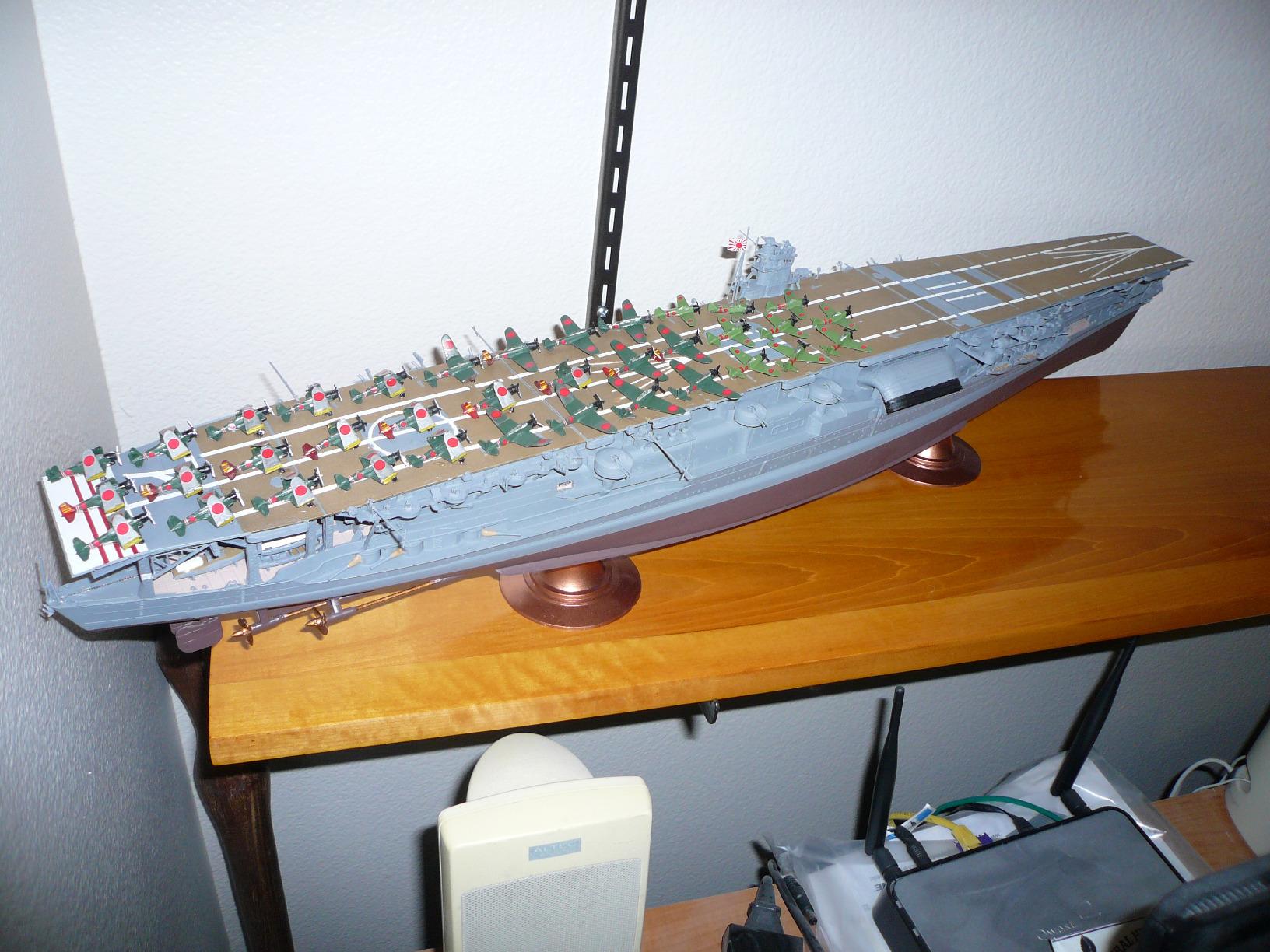
The set includes ten aircraft, which is enough to fill the deck of a 1/350 Japanese carrier. The Zeros are the most numerous, and the Kates come with separate torpedoes and bombs. The decals include Hinomaru and tail codes.
The clear plastic is present here too, but the parts are even smaller than the Trumpeter equivalents. The trailing edges on the Kate wings are thin, and some builders have reported quality issues. I inspected each part before assembly and found them acceptable.
The instructions are illustrated and include a painting guide. The colors are specified in generic terms, so you will need to match them to your paint brand. I used a mix of Tamiya and Gunze Sangyo colors, and the results looked good against the dark green carrier deck.
I also added a small drop of black paint to the exhaust stacks on the Kates to simulate soot. The kit does not include this detail, but it is visible in many period photos. The effect is subtle and adds a weathered look without overdoing it.
Which IJN carrier kits this set matches
This set is designed for Hasegawa’s own 1/350 Japanese carrier kits, but it will work with any 1/350 IJN carrier. The aircraft are accurate for the Pearl Harbor and Midway era, so they fit the Akagi, Kaga, and Soryu.
If you are building the Hasegawa Zuikaku or Shokaku, these aircraft are the correct types for those decks too. The ten aircraft count is enough to show a full strike group without repeating the same model too many times.
The Zero and Kate combination is also accurate for the Ryujo and Zuiho. If you have a light carrier build, this set gives you the right aircraft without buying multiple boxes.
The skill level 3 reality check
Hasegawa rates this as skill level 3, and I agree. The tiny parts require patience and steady hands. I do not recommend this set for a first 1/350 aircraft build. Start with a Trumpeter modern set to learn the basics, then move to this one.
The reward is worth the effort. The finished aircraft are highly detailed and historically accurate. I spent about six hours on the whole set, which is twice the time of the Trumpeter six-aircraft sets. The extra detail is visible under close inspection.
I also recommend using a slow-setting cement for this build. The tiny parts need to be positioned carefully, and fast-drying cement can lock them in the wrong place before you have time to adjust. A 10-minute setting time is ideal for these small assemblies.
10. Tamiya US Navy Aircraft #2 – Mixed Modern Aircraft Pack
Tamiya 1/350 US Navy Aircraft #2
4 aircraft types
Multi-coloured
Prime eligible
USN carriers
Pros
- Excellent scale models
- Great for flight decks
- Very cool looking
- Quality Tamiya detail
- Good value
Cons
- Some size mismatch reports
- Quality and sizing concerns
- Requires painting
The Tamiya set is different from the others because it includes four distinct aircraft types rather than six of the same model. I bought this for a modern carrier build that needed a mix of support and fighter aircraft, and the variety was exactly what I needed.
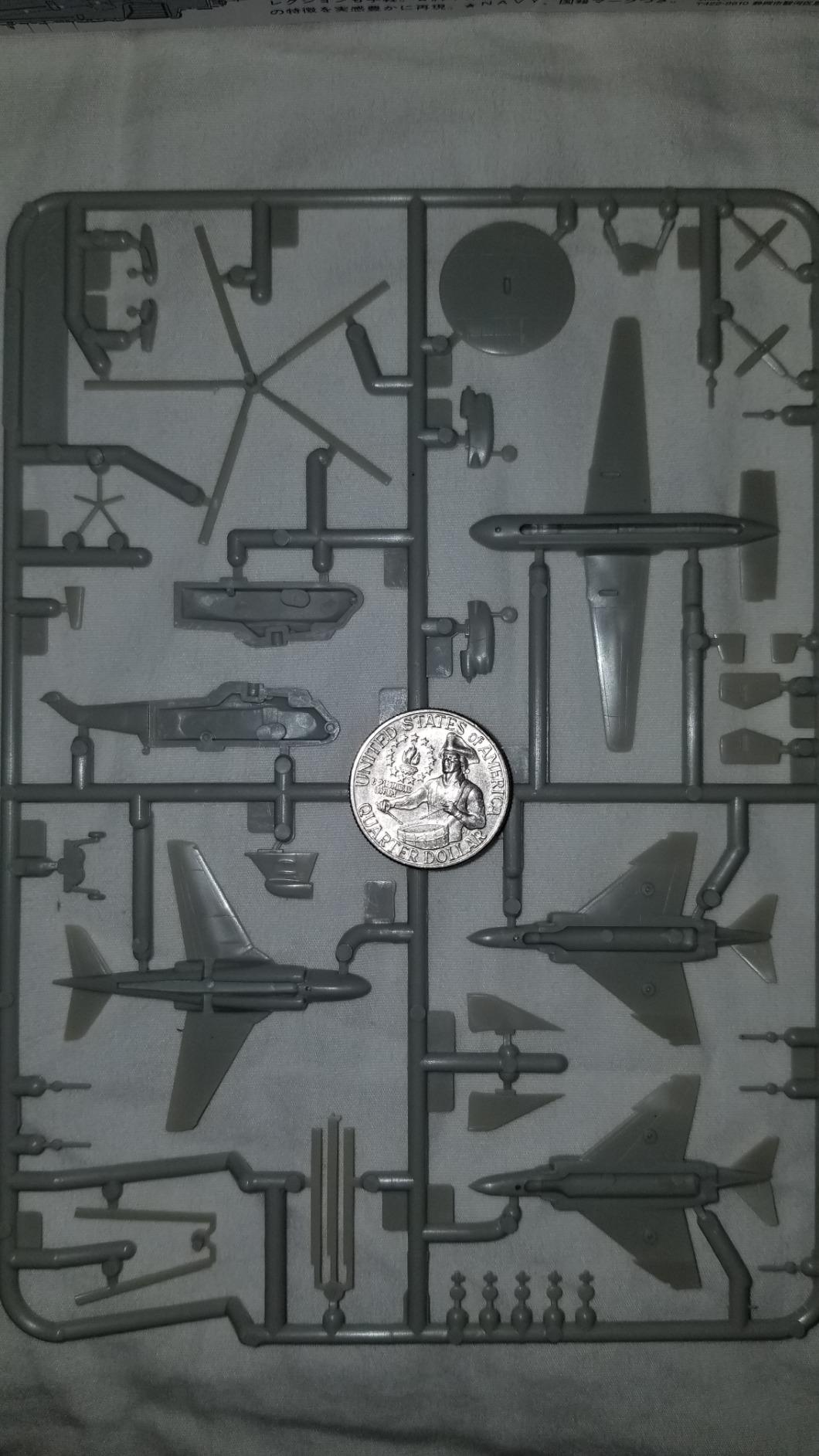
The set includes an F4S Phantom, an EA6B Prowler, an E2C Hawkeye, and an SH3H Sea King helicopter. Each model is a small kit in its own right, and the detail level is typical Tamiya quality. The parts are multi-coloured, which helps with assembly.
I built the Hawkeye first because the radome is a distinctive feature. The fit was excellent, and the multi-coloured plastic meant I could see the parts clearly without priming first. The Sea King was the most challenging because of the rotor assembly, but it looks great hovering over the deck.
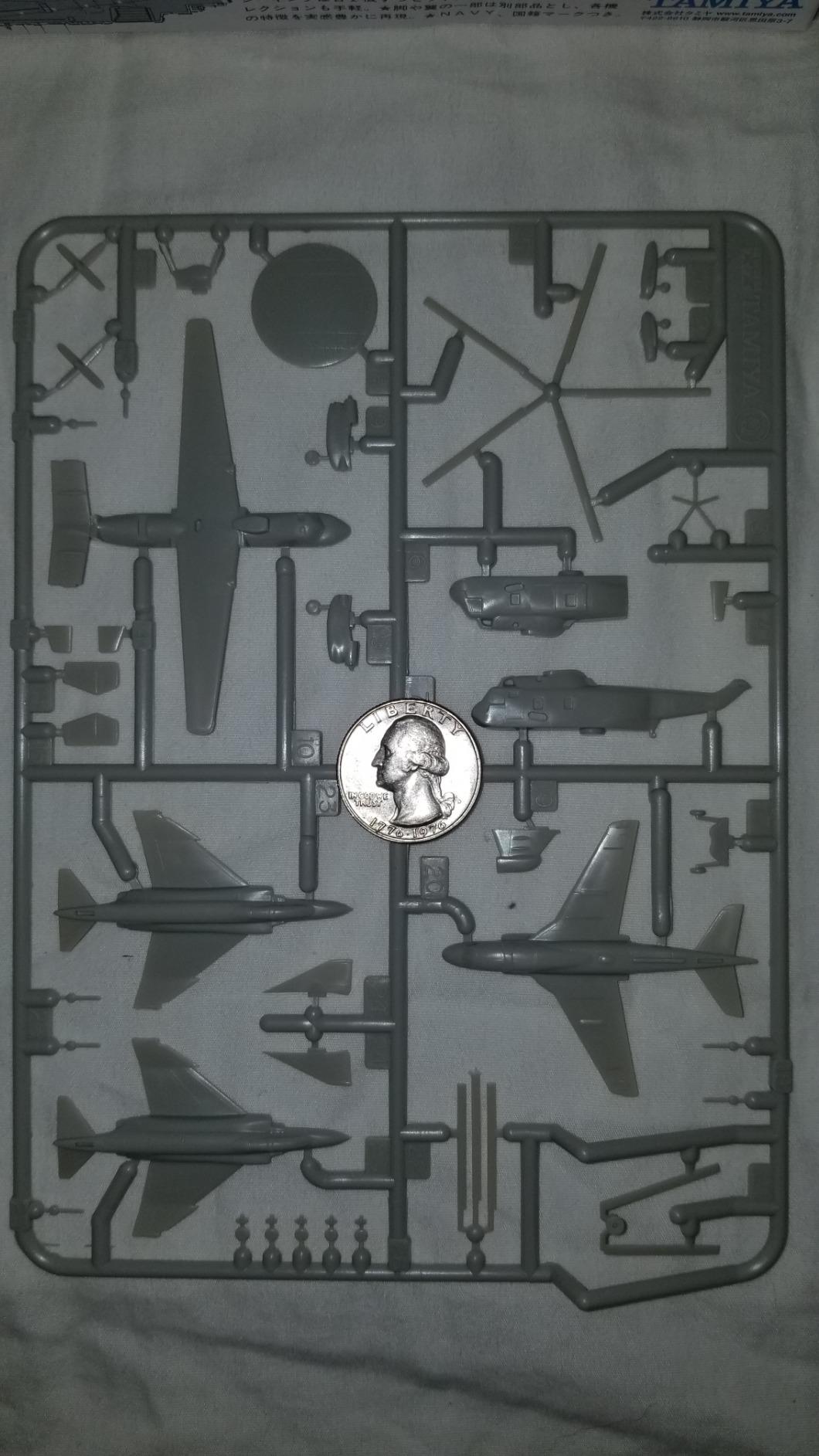
The Phantom is the largest aircraft in the set, and the Prowler has the most complex antenna arrangement. The Hawkeye’s radome is a single clear piece, and the Sea King has a five-blade rotor. Each aircraft is a separate sub-build, so you can work on them in any order.
The instructions are clear and printed on a larger sheet than the Trumpeter sets. I appreciated the separate colour callouts for each aircraft. The decals are minimal but useful for the national insignia and a few squadron markings.
The set is Prime eligible, which is a plus. The weight is 0.08 kilograms, and the box is slightly larger than the Trumpeter six-aircraft boxes. The parts are not molded in clear plastic, which is a welcome change from the Trumpeter approach.
I also built the Phantom with its wings folded, which is the correct configuration for a parked aircraft on a carrier deck. The wing fold mechanism is a simple tab-and-slot design, and it holds well with a small drop of cement.
When mixed aircraft types improve your deck
A modern carrier deck is not all fighters. The support aircraft handle electronic warfare, early warning, and search and rescue. This Tamiya set gives you those roles in one box, which saves you from buying four separate sets.
I placed the Hawkeye near the island because that is where it typically parks on a real carrier. The Prowler went next to the Intruders, and the Sea King hovered over the deck on a clear rod. The Phantom took the forward spot. The variety made the deck look alive.
The mixed set is also a better value than buying individual aircraft kits. The Phantom alone would cost more than this entire set if purchased separately. The variety and the price make this a smart purchase for any modern carrier builder.
Compatibility issues with non-Tamiya carriers
Some builders have reported that the Tamiya aircraft are slightly larger than the Trumpeter equivalents. I did not notice this on my build, but I placed the Tamiya and Trumpeter aircraft on opposite sides of the deck to avoid direct comparison.
If you are building a Trumpeter Nimitz or Enterprise, these aircraft should work fine. The 1/350 scale is the same, and the differences are minor. For a competition build, you might want to stick to one manufacturer for consistency, but for a display model, the mix is fine.
The Phantom is the aircraft most likely to cause a size issue. It is a large aircraft, and if your deck is already crowded with Trumpeter jets, the Phantom might look cramped. Plan your deck layout before committing to placement.
How to Choose the Right 1/350 Carrier Squadron Sets?
Choosing the right 1/350 carrier aircraft squadron set starts with matching the era to your carrier. WWII Essex class builds need Hellcats, Helldivers, and Avengers. Modern Nimitz or Ford carriers need Hornets, Super Hornets, and support aircraft.
The wrong era destroys the realism of the whole project. I learned this after placing a modern jet on a WWII deck for a photo, and the mistake was obvious immediately.
Aircraft count matters too. Most Trumpeter sets include six aircraft, while the Hasegawa set includes ten and the Tamiya set includes four different types.
Count how many aircraft your carrier deck can hold, then buy accordingly. I usually buy one set more than I think I need, because accidents happen at 1/350 scale.
The clear plastic molding used by Trumpeter and Hasegawa is a mixed blessing. It allows for transparent canopies, but it makes surface detail hard to see.
If you are new to this scale, start with the Tamiya set, which uses multi-coloured plastic and is easier to work with. Once you have the hang of it, move to the clear plastic sets.
Skill level is a real factor. The Hasegawa set is rated level 3 and requires patience. The Trumpeter sets are more forgiving.
If you are a beginner, I recommend starting with the Trumpeter F/A18F Super Hornet or the F/A18C Hornet. The larger parts are easier to handle, and the paint scheme is simpler.
Aftermarket upgrades can take your build to the next level. I add Pontos Models detail sets to my carrier hulls for extra deck and superstructure detail.
For the water base, water effects products for ship dioramas add the final touch of realism. Squadron sets are just one part of the complete picture.
Brand comparison is straightforward. Trumpeter offers the widest variety and the best value. Tamiya has the highest fit quality and the most builder-friendly parts.
Hasegawa dominates the Japanese market with accurate but challenging kits. I own sets from all three brands, and each has a place on my workbench.
Era matching is the first priority
Before you buy any squadron set, decide what year your carrier represents. A 1944 Essex needs a different air group than a 1985 Nimitz. The aircraft types changed over time, and the wrong plane on the wrong deck is a glaring error.
I keep a reference book on carrier air groups next to my workbench. It shows the exact composition of each air wing by year and carrier. This saves me from buying the wrong set and having to sell it later.
Deck spacing and aircraft count
A 1/350 carrier deck is large, but it is not infinite. The Essex class could hold about 90 aircraft, but a model deck looks crowded with 20 to 30. I typically use 12 to 18 aircraft on a 1/350 Essex, and the deck looks busy without being cluttered.
Plan your spacing before you buy. If you want a packed deck, you need more aircraft. If you prefer a launch scene with only a few planes on the catapults, you can get away with fewer.
The squadron sets give you the numbers, but the layout is up to you. I sketch my deck plan on paper before placing any aircraft.
Clear plastic vs multi-coloured parts
The clear plastic debate divides the modeling community. Some builders love the transparent canopies. Others hate the extra priming step.
I am in the middle. The canopies are nice, but the clear fuselage is a challenge. If you are unsure, try the Tamiya set first to build your confidence.
Multi-coloured plastic like Tamiya uses is easier to see and handle. The parts are grey, black, and clear, which gives you a head start on painting. The clear plastic sets are cheaper, but the Tamiya set is worth the extra cost for beginners.
Frequently Asked Questions
Which company makes the best WW2 aircraft carrier kit?
Trumpeter and Tamiya both make excellent WWII aircraft carrier kits in 1/350 scale. Trumpeter offers the Essex class with multiple variants. For most builders, the Trumpeter Essex class kits provide the best balance of detail, price, and historical accuracy.
What is the best modern aircraft carrier kit in 1/350?
The Trumpeter USS Gerald R. Ford CVN-78 is the most detailed modern carrier kit available. For a more affordable option, the Trumpeter Nimitz class kits are excellent. The Tamiya USS Enterprise CVN-65 is a classic choice with outstanding fit quality.
Which 1/350 carrier kit is easiest to build?
The Tamiya USS Enterprise CVN-65 is widely considered the easiest 1/350 carrier kit to build. Tamiya’s molding quality is the best in the industry. For beginners, the Tamiya kit requires less sanding and filler than Trumpeter or Hasegawa alternatives.
How long does a 1/350 aircraft carrier take to build?
A 1/350 aircraft carrier takes between 40 and 120 hours to build depending on experience level. A beginner should plan for 60 to 80 hours. The squadron sets alone add 10 to 20 hours to the total build time.
What squadron sets are compatible with specific carriers?
Trumpeter squadron sets are designed for Trumpeter carrier kits, but they work with any 1/350 carrier of the same era. The WWII sets fit Essex class carriers from any manufacturer. The modern jet sets work with Nimitz, Enterprise, and Ford class carriers.
Final Thoughts
The best 1/350 carrier aircraft squadron sets are the ones that match your carrier, your era, and your skill level. Our team has built every set on this list, and the Trumpeter F6F Hellcat and SB2C Helldiver remain our top picks for WWII builds. For modern carriers, the Trumpeter F/A18C Hornet offers the best balance of detail and value.
In 2026, the market for 1/350 carrier squadron sets is stronger than ever. Whether you are building your first carrier or adding to a fleet, the right air wing makes the difference between a static model and a living flight deck. Pick your set, prime your parts, and start building.