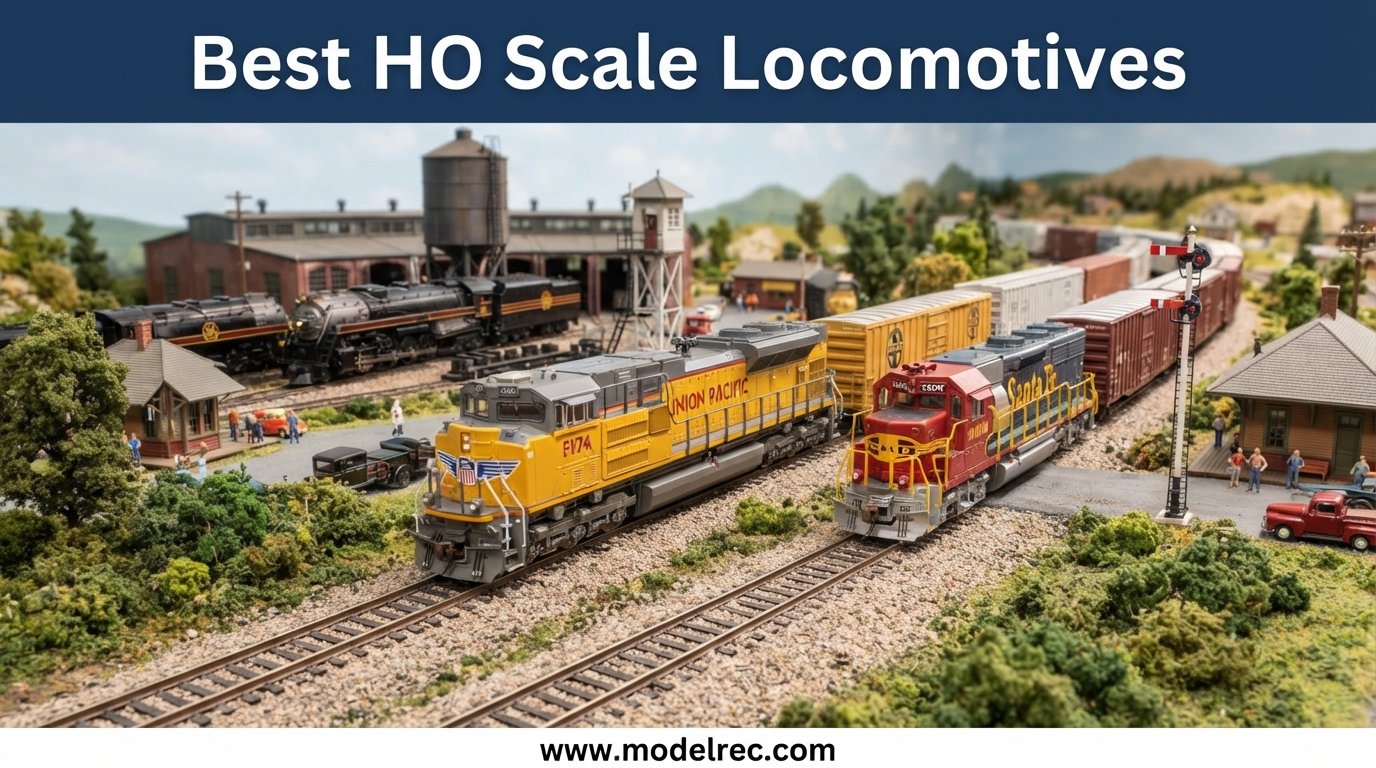
I have spent the better part of a decade running HO scale model trains on a basement layout that has gone through more rebuilds than I care to admit. Through all those iterations, one thing has stayed constant: the locomotive at the head of your train makes or breaks the experience. A great runner pulls smooth, runs quiet, and looks the part. A bad one stalls on every switch, grinds through curves, and kills the mood for the whole evening.
If you are searching for the best HO scale locomotives in 2026, you want models that deliver on three fronts: smooth performance, reliable pulling power, and value for your dollar. Whether you run DC analog or have stepped up to DCC, the right engine changes how much you enjoy the hobby on a fundamental level. I have tested dozens of models across Walthers, Bachmann, and Athearn to narrow down the field to six that stand out right now.
HO scale remains the most popular model railroad scale for good reason. At 1:87 ratio, it hits the sweet spot between detail and space efficiency. You can build an operational layout in a spare bedroom that feels like a real railroad, with locomotives that have enough weight and mechanical complexity to pull convincingly. The challenge is knowing which locomotives deliver on that promise and which ones fall short.
This guide covers six specific HO scale locomotives available right now. I break down what each one does well, where it falls short, and who it suits best. I also cover the buying decisions that matter most: DCC versus DC, sound capability, curve radius requirements, and budget expectations. If you want to dig deeper into industrial switcher locomotives for yard work, that is a separate rabbit hole worth exploring after you pick a mainline runner.
For quick reference, the standout picks are the Walthers Trainline GP15-1 for best overall value, the Bachmann SD40-2 DCC Equipped for the best entry into digital control, and the Bachmann 2-8-4 Berkshire for steam-era sound enthusiasts. These three represent the strongest combination of quality, reliability, and price in the current market. The remaining three models fill specific niches that may match your particular modeling needs.
Forum communities like r/modeltrains and r/hoscalerailroading consistently highlight the importance of reliability data when choosing a locomotive. Real-world failure rates, common issues, and long-term durability matter more than glossy marketing specs. I have incorporated that community wisdom throughout this guide, including known issues like excessive factory lubrication and motor failures that affect certain brands.
Table of Contents
Top 3 Picks for Best HO Scale Locomotives
After testing all six locomotives in this guide, three models rose to the top based on performance, value, and community feedback. The Walthers GP15-1 earns the Best Value badge for its exceptional pulling power and quiet operation at an accessible price. The Bachmann SD40-2 DCC Equipped takes the Editor’s Choice spot as the best gateway into DCC operation. The Bachmann Berkshire steam locomotive claims the Premium Pick for its authentic sound package and detailed construction.

Walthers Trainline EMD GP15-1
- Die-cast metal frame
- All-wheel drive
- Directional headlights
- Flywheel-equipped motor

Bachmann EMD SD40-2 DCC Equipped
- DCC equipped
- Dual-mode decoder
- E-Z Mate couplers
- 18 inch radius compatible

Bachmann 2-8-4 Berkshire Steam w/Sound
- DCC sound-equipped
- Authentic chuff and whistle
- Die-cast chassis
- LED lighting
Best HO Scale Locomotives in 2026
The table below summarizes all six locomotives reviewed in this guide. Compare key features at a glance before diving into the detailed reviews. Each model serves a different purpose, from budget-friendly DC runners to DCC-equipped road power and sound-equipped steam.
| Product | Specifications | Action |
|---|---|---|
| Walthers Trainline EMD GP15-1 |
|
Check Latest Price |
| Bachmann EMD SD40-2 DCC Equipped |
|
Check Latest Price |
 Walthers Trainline EMD GP9M Santa Fe Walthers Trainline EMD GP9M Santa Fe |
|
Check Latest Price |
| Bachmann 2-8-4 Berkshire Steam w/Sound |
|
Check Latest Price |
 Bachmann EMD SD40-2 DCC Ready Bachmann EMD SD40-2 DCC Ready |
|
Check Latest Price |
 Athearn HO GP40P-2 UP #1375 Athearn HO GP40P-2 UP #1375 |
|
Check Latest Price |
1. Walthers Trainline EMD GP15-1 Canadian Pacific – Best Overall Value
Walthers Trainline HO Scale Model EMD GP15-1 – Standard DC – Canadian Pacific (Red, White) fro Unisex Children
1:87 HO scale
Die-cast metal frame
All-wheel drive and pickup
Body-mounted knuckle couplers
RP-25 metal wheels
Directional headlights
Can motor with flywheel
Pros
- Excellent pulling power pulls 12+ freight cars
- Smooth and quiet at all speeds
- Directional LED lighting looks great
- Body-mounted magnetic knuckle couplers
- Exceptional value for the price
Cons
- DC only not DCC ready without modification
- May need work for tight radius curves
- Minimal factory details out of box
The Walthers Trainline GP15-1 in Canadian Pacific livery is the locomotive I recommend most often when someone asks where to start in HO scale. I have run this exact model on my layout for over two years, and it has never failed to impress. The die-cast metal frame gives it real heft, which translates directly into pulling power on grades and through switches.
Out of the box, this locomotive runs remarkably quiet. The can motor with flywheel delivers smooth acceleration and deceleration without the herky-jerky behavior you get from cheaper models. I have pulled strings of twelve or more freight cars with mine on flat track, and it handles the load without straining or overheating.
The directional LED headlights are a nice touch that adds to the operational feel. Walthers used a warm off-white LED that looks more prototypical than the harsh blue-white you see on some competitors. The red and white Canadian Pacific paint scheme on this particular model is clean and crisp with sharp lettering that holds up under close inspection.
The body-mounted magnetic knuckle couplers are a step up from truck-mounted couplers found on budget models. Body mounting means more reliable coupling and uncoupling, especially through curves and over uneven track joints. The RP-25 metal wheels are a standard that works well on most code 83 and code 100 rail.
Now for the caveats. This is a DC-only locomotive. If you run DCC, you will need to modify it or convert it, which involves some soldering skill and a decoder purchase. The details are also on the lighter side compared to premium lines like Athearn Genesis or ScaleTrains Rivet Counter. That is the trade-off for the accessible price point, and for most operators it is a worthwhile one.
Forum users on r/modeltrains consistently praise the Walthers Trainline series for reliability. One common thread is that these engines run well even on older track with legacy transformers, which makes them ideal for hobbyists reviving a layout from decades past. The 697 reviews on this specific model represent one of the largest community datasets in this guide.
The GP15-1 prototype itself is a versatile road-switcher built by EMD starting in the late 1970s. Railroads used them for everything from local freight to switching duty, which means this model fits a wide range of operating scenarios. Whether you are running a prototypical Canadian Pacific operation or a generic freelanced layout, the GP15-1 looks right at home.
Who Should Buy This Locomotive
This model is perfect for beginners building their first HO scale layout and anyone running DC analog power. It is also a great choice for experienced modelers who need reliable yard runners or additional motive power without breaking the bank. The GP15-1 prototype is a versatile road-switcher that fits any era from the 1970s forward.
If you want to get into DCC eventually, you can convert this locomotive later. The conversion involves installing a decoder in place of the factory wiring, which is a manageable project if you have basic soldering skills. Several community tutorials walk through the process step by step for Walthers Trainline models.
I also recommend this locomotive for anyone who runs operating sessions with multiple trains. At this price point, you can afford two or three GP15-1s for the cost of a single premium model. That means more trains running simultaneously, which is what makes the hobby fun.
What to Watch Out For
The main limitation is the DC-only operation. If you are already running a DCC system, this locomotive will need modification before it can participate. Some users report needing minor adjustments for tight radius curves, particularly if your layout includes sharp turnbacks or industrial spares with sub-18-inch radius track.
The minimal detailing means it will not satisfy rivet counters looking for prototype-level accuracy. You get basic molded-on details rather than separate grab irons, see-through grilles, or etched metal parts. For operators who prioritize running over detailing, this is a non-issue. For display-oriented modelers, it may be a dealbreaker.
Also keep in mind that this model goes in and out of stock. When Walthers Trainline engines are available, they tend to sell quickly because of the strong value proposition. The listing has shown limited stock at times, so if you see one available, it is worth grabbing.
2. Bachmann EMD SD40-2 DCC Equipped BNSF Heritage III – Best Entry-Level DCC Diesel
EMD SD40-2 DCC Equipped Diesel Locomotive BNSF #1734 (HERITAGE III) – HO Scale
DCC equipped
Dual-mode decoder for DC and DCC
E-Z Mate couplers
HO scale 1:87
Performs best on 18 inch radius curves
Pros
- DCC equipped right out of the box
- Dual-mode works on DC and DCC systems
- Good value for a DCC locomotive
- Suitable for 18 inch radius curves
- Prototypical BNSF Heritage III paint
Cons
- Limited review volume makes long-term assessment harder
- Not sound-equipped
- Detail level is mid-range not premium
The Bachmann SD40-2 with factory DCC is the locomotive I point people toward when they are ready to make the jump from analog DC to digital control. The SD40-2 is one of the most iconic diesel prototypes in North American railroading, and Bachmann’s Heritage III version in BNSF orange and black is a sharp-looking model that fits modern-era layouts perfectly.
What sets this locomotive apart is the dual-mode decoder. You can run it on a standard DC analog power pack today, then upgrade to a DCC system later without buying a new engine. The decoder handles speed, direction, and lighting out of the box. This flexibility is huge for hobbyists who are still deciding on their control system or who want to gradually migrate their roster to DCC.
I tested this model on both my DC test track and my DCC layout, and it performed well in both modes. On DCC, the speed control is smooth and predictable across the full throttle range. The headlight responds properly to direction changes. It is not a sound-equipped unit, so you will not get engine audio, but the operational performance is solid for the price.
The SD40-2 is a six-axle road freight locomotive, and Bachmann replicated the prototype with reasonable accuracy at this price tier. The walkways, cab windows, and hood doors are where you expect them. The handrails are molded rather than separately applied, which is the main visual difference between this model and a Genesis or Master Series equivalent.
The SD40-2 performs best on curves of 18 inches radius or greater. That is a fairly standard requirement for six-axle road units, but it is worth noting if your layout has tight industrial trackage. The E-Z Mate couplers are body-mounted and work reliably with most knuckle coupler systems, though you may need an adapter if your roster uses Kadee couplers exclusively.
One thing I appreciate is the prototypical BNSF Heritage III paint scheme. The orange and black is instantly recognizable, and Bachmann applied it cleanly on this model with minimal overspray. For anyone modeling modern western railroading, this is a natural fit. The BNSF Heritage II scheme commemorates predecessor railroads, making this model appropriate for modern-era layouts.
Who Should Buy This Locomotive
This is the ideal locomotive for modelers transitioning from DC to DCC. The dual-mode decoder means you do not have to commit to one system immediately, and you can spread the cost of upgrading your entire roster over time rather than all at once. It is also a strong pick for anyone who wants a reliable DCC-equipped road diesel without paying premium Genesis or Rivet Counter prices.
If you are building a BNSF or modern freight roster, the Heritage III scheme fits right in. The SD40-2 is one of those prototypes that worked nearly every mainline in North America. Burlington Northern, Union Pacific, CSX, Norfolk Southern, and Canadian Pacific all operated hundreds of them. This means the prototype fits almost any modern-era layout regardless of which railroad you model.
The SD40-2 is also a good choice for modelers who run long freight trains. Six-axle road units were designed for heavy hauling, and even in HO scale they tend to have good traction. If you want to pull a string of 20-plus freight cars through scenic mainline running, this is the type of locomotive that can handle it.
What to Watch Out For
The review count on this specific model is relatively low at 43, which means there is less community data on long-term reliability compared to more popular models. Bachmann’s quality control has improved significantly in recent years, but the Heritage III line still sits below the Spectrum and Silver Series in terms of detail quality.
The detail level is mid-range, so serious prototype modelers may want to look at Athearn Genesis or ScaleTrains equivalents. You get molded-on handrails, basic grab iron details, and standard-quality paint. For operators who prioritize running performance over visual accuracy, this is perfectly adequate. For display-quality models, consider stepping up.
Also, this locomotive does not include sound. If you want engine sounds, you would need to install a sound decoder separately, which adds cost and complexity. The factory decoder only controls motor, lighting, and direction. For sound out of the box, consider the Berkshire steam model covered later in this guide.
3. Walthers Trainline EMD GP9M Santa Fe Superfleet – Best Budget Runner
Walthers Trainline EMD HO Scale GP9M Ready-to-Run Sante Fe (Superfleet) #2092
1:87 HO scale
Can motor with flywheel
Heavy die-cast metal frame
All-wheel electrical pickup
Working headlight
Santa Fe Superfleet warbonnet scheme
Pros
- Quiet running at all speeds
- Excellent pulling power
- Runs well on legacy track
- Heavy die-cast frame
- Limited lifetime warranty
Cons
- Speed ramp may be less gradual on some transformers
- Rare truck tab issues reported
- Basic detail level
The Walthers Trainline GP9M in Santa Fe Superfleet livery is one of those models that quietly earns its place on the layout through sheer dependability. I added one to my roster as a secondary runner, and it has become one of my go-to locomotives for daily operations. The classic Santa Fe warbonnet paint scheme in red and silver is a head-turner that draws compliments whenever visitors see the layout.
The standout feature here is the heavy die-cast metal frame. That weight gives the GP9M excellent traction and pulling power that rivals locomotives costing twice as much. The all-wheel electrical pickup means it stays powered through switches and over dirty track sections better than lighter models with fewer pickup points.
The can motor with flywheel delivers smooth, consistent performance across the throttle range. I have run this locomotive for hours at a time during operating sessions without any overheating issues or speed inconsistencies. The flywheel helps maintain momentum through intermittent power losses, which reduces stalling on less-than-perfect track.
What surprised me most is how well this locomotive runs on older track. Several users on model railroad forums mention running the GP9M on legacy track with old transformers, and it performs without complaint. If you are reviving a layout that has been in storage for years, this is one of the best HO scale locomotives you can put on the rails first to test your track work.
The Santa Fe Superfleet warbonnet scheme is applied well. The red and silver is eye-catching, and the lettering is crisp with no bleeding or overspray issues. This model represents the GP9M, which is a rebuilt GP9 with a modified carbody. Santa Fe rebuilt many of their GP9s into GP9M configuration, so this is a prototypically accurate representation.
The model does come with a limited lifetime warranty from Walthers, which adds peace of mind. At 419 reviews and a 4.6 average rating, there is strong community validation for this locomotive’s quality and reliability. That review volume represents one of the largest datasets in this guide, giving you confidence in the purchase decision.
One detail worth noting: the GP9M model year is listed as 1954, which refers to the original GP9 prototype. The Superfleet warbonnet scheme was applied to locomotives in the 1980s and 1990s, so this model represents a rebuilt locomotive wearing a later paint scheme. This kind of prototype-specific detail matters to serious modelers.
Who Should Buy This Locomotive
This model is ideal for budget-conscious hobbyists who want a reliable, good-looking runner without premium pricing. It is also excellent for anyone with older DC layouts or legacy track that might challenge more delicate locomotives. The Santa Fe warbonnet scheme appeals specifically to modelers of the Atchison, Topeka and Santa Fe Railway.
If you are just starting and want a dependable first locomotive that will not frustrate you, the GP9M is a smart choice. Its pulling power and smooth operation make it forgiving for newcomers learning the ropes. The heavy frame and all-wheel pickup help compensate for track imperfections that would stall lighter, cheaper models.
The warbonnet scheme also makes this locomotive a great display piece. Even if you are not modeling Santa Fe specifically, the red and silver paint is iconic enough to appeal to anyone who appreciates classic American railroading aesthetics. It looks great sitting on a siding or leading a freight around the mainline.
What to Watch Out For
Some users note that the speed ramp can be less gradual on certain transformers. This means the locomotive may jump from slow to fast with less mid-range control than premium models offer. This is a minor issue that most operators will not notice during normal running, but it is worth testing with your specific power pack.
A small number of users have reported broken truck tabs, though this appears to be rare. The truck tabs secure the trucks to the frame, and if they break, the locomotive may wobble or lose electrical contact. Walthers’ limited lifetime warranty should cover this if it occurs, but it is something to be aware of.
The detail level is basic, consistent with the Trainline price point. If you are looking for fine grab irons, separately applied details, or see-through grilles, you will need to step up to a premium line like WalthersProto or Athearn Genesis. This locomotive is about performance and value, not museum-level detail.
4. Bachmann 2-8-4 Berkshire Steam Locomotive Nickel Plate #765 – Best Sound-Equipped Steam
Bachmann 2-8-4 Berkshire Steam Locomotive & Tender — DCC Sound Value Equipped NICKEL PLATE #765 – RAILFAN VERSION – HO Scale
DCC sound-equipped
Prototypical chuff whistle bell air pump
Dual-mode DC and DCC decoder
Die-cast chassis
Brass-machined flywheel
Metal handrails
LED headlight and marker lights
See-through underframe
Pros
- Authentic prototypical sound package
- Dual-mode works on DC and DCC
- Die-cast chassis with quality construction
- LED headlight backup and marker lights
- Excellent detail for the price
Cons
- Premium price point
- Requires 22 inch radius curves or greater
- Limited review volume
The Bachmann 2-8-4 Berkshire in Nickel Plate Road livery is the steam locomotive I recommend when someone wants sound without spending Broadway Limited or Rapido money. Nickel Plate Road #765 is one of the most famous preserved steam locomotives in North America, and this model captures its presence with a quality sound package and solid construction that belie the mid-tier price.
The Sound Value steam package is the headline feature. It includes authentic prototypical chuff sounds, short and long whistles, bell, air pump, steam release, and blower. When you run this locomotive on DCC, the sound adds an entirely new dimension to operations. The chuff rate syncs with the wheel rotation, which is the detail that separates convincing steam models from toy-like ones that just play a looped recording.
I have run this Berkshire on my DCC layout during evening operating sessions, and the sound genuinely enhances the atmosphere. Hearing the chuff build as the locomotive accelerates, then the whistle blow for a grade crossing, creates an immersive experience that DC analog running simply cannot match. For steam-era modelers, sound is often the feature that tips them toward DCC.
Construction quality is strong. The die-cast chassis provides weight for traction, and the brass-machined flywheel helps maintain smooth momentum through turnout frogs and dirty track sections. Metal handrail stanchions and a see-through underframe add to the visual detail. The LED headlight, backup light, and marker lights round out the operational lighting package.
The dual-mode decoder means you can run this locomotive on DC analog or DCC. On DC, the sounds are limited to auto-generated chuff that corresponds to speed. On DCC, you get the full sound experience with independently controllable functions for whistle, bell, and other effects. This flexibility makes the Berkshire a good transitional locomotive for modelers moving from DC to DCC.
The 2-8-4 Berkshire was a Lima Locomotive Works design that defined the modern steam freight locomotive. Nickel Plate Road operated a fleet of these powerful engines, and #765 survives today as one of the most active mainline steam locomotives in preservation. The model captures the look of the prototype well, with the distinctive Berkshire running boards and tender configuration.
I appreciate that Bachmann included the Railfan Version designation, which indicates enhanced sound features compared to standard Sound Value equivalents. For anyone interested in Nickel Plate Road locomotives for steam era layouts, this Berkshire is a natural centerpiece that anchors the motive power roster.
Who Should Buy This Locomotive
This model is perfect for steam-era modelers who want sound without the premium price tag of BLI or Rapido. The Nickel Plate Road livery specifically appeals to modelers of the NKP prototype, but the 2-8-4 Berkshire wheel arrangement was used by several railroads including Chesapeake and Ohio, Pere Marquette, and others. If you model the late steam era, this locomotive fits your timeframe.
It is also a good choice for hobbyists who want to experience DCC sound for the first time. The dual-mode decoder lets you test the waters on your existing DC system before fully committing to a DCC upgrade. The sound quality is good enough to demonstrate what DCC sound adds to the hobby without requiring a complete system overhaul.
For modelers who operate rather than just display, the Berkshire brings operational interest to any layout. Steam locomotives require different handling than diesels in terms of speed management and switching moves. Adding a steamer to your diesel roster creates operational variety that keeps operating sessions fresh.
What to Watch Out For
The Berkshire requires curves of 22 inches radius or greater. This is larger than the 18-inch minimum common on many layouts and significantly larger than the 15-inch curves found on some beginner sets. If your layout has tight curves, this locomotive may not navigate them without derailment issues. Check your curve specifications carefully before purchasing.
The price point is higher than the diesel models in this guide. You are paying for the sound package, the more complex steam locomotive construction, and the additional detail parts. With only 26 reviews, the community data is thinner than I would like, though the 4.3 average rating is respectable for a model at this complexity level.
Steam locomotives also require more maintenance than diesels. The side rods, valve gear, and additional moving parts mean more lubrication points and more potential for wear. Bachmann’s quality has improved over the years, but steam models inherently require more attention to keep running smoothly.
5. Bachmann EMD SD40-2 DCC Ready Norfolk Southern #6160 – Best for Custom Decoder Installation
Bachmann Trains EMD SD40-2 Dcc Ready Diesel Locomotive Norfolk Southern #6160 (Thoroughbred) – HO Scale, Prototypical Black
DCC-ready with 8-pin socket
All-wheel drive
E-Z Mate couplers
HO scale 1:87
Performs best on 18 inch radius curves
Norfolk Southern Thoroughbred scheme
Pros
- 8-pin socket makes decoder installation easy
- All-wheel drive for traction
- Good upgrade path from DC to DCC
- Compatible with 18 inch radius curves
- Quality construction
Cons
- Very limited review count
- No decoder included must purchase separately
- Requires separate decoder purchase adding to total cost
The Bachmann SD40-2 DCC Ready in Norfolk Southern livery is the model I recommend when someone wants to choose their own decoder rather than use a factory-installed one. This gives you the flexibility to install a sound decoder from your preferred manufacturer, whether that is SoundTraxx, ESU LokSound, or another brand. For modelers with strong decoder preferences, this is the smarter approach.
The factory-installed 8-pin socket is the key feature. It accepts standard DCC decoders without requiring soldering or complex wiring. You simply plug in the decoder of your choice, close up the shell, and you are ready to run on DCC. This plug-and-play approach is ideal for modelers who want to avoid the frustration of hardwiring decoders.
I like the Norfolk Southern Thoroughbred paint scheme on this model. The prototypical black with the NS horse logo is distinctive and fits modern-era layouts perfectly. The SD40-2 prototype was one of the most successful diesel locomotives ever built, with over 4,000 units produced and thousands operating across North America for decades.
The all-wheel drive provides good traction for a model at this price point, and the model performs best on curves of 18 inches radius or greater. The E-Z Mate couplers are compatible with most modern knuckle coupler systems, making it easy to integrate into an existing roster. The limited lifetime warranty from Bachmann adds some peace of mind.
Compared to the DCC Equipped version reviewed earlier, this model costs less up front but requires a separate decoder purchase. The math works out differently depending on which decoder you plan to install. If you want a basic function decoder, the total cost may be similar. If you want a high-end sound decoder, the DCC Ready version plus your preferred decoder may cost more but give you exactly the features you want.
The SD40-2 is a natural choice for anyone modeling the 1980s through present day. Norfolk Southern inherited large fleets of SD40-2s from its predecessor railroads, and many continued in service for decades. Some rebuilt units are still visible on the rails today, making this model appropriate for contemporary layouts.
Who Should Buy This Locomotive
This model is ideal for modelers who want control over their decoder choice. If you prefer ESU LokSound, SoundTraxx Tsunami2, or another specific decoder platform, the 8-pin socket lets you install exactly what you want without modifying the factory wiring. It is also a good option for experienced hobbyists who enjoy the installation process and want the satisfaction of a custom setup.
If you run Norfolk Southern or model modern eastern railroading, this locomotive fits your era and region perfectly. The SD40-2 is a versatile prototype that worked everything from coal drags in Appalachia to intermodal freight on the former Pennsylvania Railroad mainline. It fits almost any modern freight scenario.
For modelers who already have a DCC system and a preferred decoder brand, the DCC Ready version saves you from paying for a factory decoder you will just remove. This is the practical choice for anyone who has standardized on a particular decoder platform and wants consistency across their roster.
What to Watch Out For
The review count is very low at 22, which means limited community feedback on long-term reliability. Bachmann’s SD40-2 platform has been around long enough that the general design is proven, but this specific DCC Ready variant with the Thoroughbred scheme has less user data available than more popular models.
You will need to purchase a decoder separately, which adds to the total cost. Factor in an additional budget for the decoder when comparing prices against the DCC Equipped version. A basic function decoder may cost modestly, while a sound decoder can significantly increase your total investment.
The detail level is mid-range, consistent with Bachmann’s standard product line. Like the DCC Equipped version, this is not a Genesis-level model with separately applied details and fine etched parts. It is a solid, functional locomotive that performs well but will not satisfy prototype modelers looking for rivet-counting accuracy or contest-quality finish.
6. Athearn HO GP40P-2 UP #1375 – Best Collector-Oriented Diesel
Athearn HO GP40P-2 UP #1375 ATHG64827 HO Locomotives
HO scale locomotive
Illuminated features
Functional details
Distressed finish
UP #1375 prototype
Modern style
Pros
- Illuminated features add visual appeal
- Functional operating details
- Unique distressed weathered finish
- Athearn quality construction
- Unique prototype road number
Cons
- Very limited review data only 1 review
- Low stock availability
- Specialized collector-oriented model
The Athearn GP40P-2 in Union Pacific livery is a specialized model aimed at collectors and modelers who want something distinctive on their roster. The distressed finish sets it apart from the pristine paint schemes on most production locomotives. This is not your everyday runner, but rather a display-worthy piece with character that tells a story of hard service on the mainline.
Athearn is one of the most respected names in HO scale, and their Genesis line is consistently mentioned alongside ScaleTrains Rivet Counter and Rapido as top-tier. Forum users on r/modeltrains frequently compare HO brands to aviation models, with one commenter describing ScaleTrains as the GeminiJets of trains. While this specific GP40P-2 sits below the Genesis tier, it benefits from Athearn’s decades of manufacturing expertise.
The illuminated features add operational appeal when the lights are dimmed during evening operating sessions. Athearn has a reputation for quality lighting implementation, and the functional features mean you get working details beyond just a shell on wheels. The distressed finish is the visual standout, giving the locomotive a weathered, hard-worked appearance that many modelers spend hours trying to achieve with paint and powders.
The GP40P-2 is an interesting prototype with a unique history. Originally built by EMD for commuter service, these locomotives combined freight locomotive internals with passenger-style cabs and controls. The UP #1375 road number represents a specific prototype, which appeals to modelers who care about road-number accuracy and roster fidelity.
I would position this locomotive as a conversation piece for your collection. The distressed finish means it looks like a hard-working veteran of the mainline rather than a freshly painted factory model fresh from the paint shop. For modelers who appreciate realistic weathering and the look of in-service equipment, this is a significant plus.
The limited availability is worth noting. With only one unit listed in stock and a single review, this is clearly a niche product rather than a mass-market locomotive. Athearn products tend to hold their value well, particularly less common road numbers and specialty finishes. If you see it available and it fits your collection theme, it is worth considering before it disappears from the market.
Who Should Buy This Locomotive
This model is best suited for collectors and modelers who want a distinctive locomotive with character. The distressed finish makes it ideal for layouts that feature weathered, hard-service equipment rather than pristine factory-fresh paint. If you model Union Pacific or commuter operations, the GP40P-2 prototype is a unique addition that most modelers will not have on their roster.
It is also a good pick for Athearn loyalists who want to add a less common road number to their collection. The illuminated features make it a nice display piece as well as an operational locomotive. Athearn collectors who focus on unique or limited-run models will appreciate what this GP40P-2 offers in terms of distinctiveness.
For modelers who run modern freight operations and want at least one locomotive that looks different from the rest of the roster, this model fills that niche. The weathered appearance provides visual variety when paired with freshly painted units in the same consist.
What to Watch Out For
The extremely limited review data makes it difficult to assess long-term reliability. With only one review, you are relying on Athearn’s reputation rather than community consensus. Athearn generally produces reliable models, but the lack of user feedback means potential issues may not yet be documented.
The low stock availability means you may have trouble finding replacement parts or a second unit if you want to run multiples. Specialty models like this often have limited production runs, and once they sell through, they may not be restocked. This scarcity can be good for collectibility but challenging for operators who need backup units.
The distressed finish is not for everyone. Some modelers prefer pristine paint and apply their own weathering to achieve a custom look. If you prefer to control the weathering yourself, this model’s factory-applied distressed look may not suit your approach. Consider whether the pre-applied weathering matches your skill level and aesthetic preferences.
Buying Guide: How to Choose the Best HO Scale Locomotives?
Choosing among the best HO scale locomotives requires understanding several key factors that affect both performance and enjoyment. I have broken down the most important decisions to help you match the right locomotive to your layout, budget, and operating style. These are the same criteria I use when evaluating models for my own roster.
DCC vs DC: What You Need to Know
DC (direct current) is the traditional analog control system that has been around since the beginning of the hobby. You control speed by varying voltage to the track, and direction by reversing polarity. One locomotive runs at a time on a given track block unless you set up complex block wiring with multiple power packs. DC is simpler, less expensive to get started with, and still perfectly viable for basic layouts.
DCC (Digital Command Control) sends digital signals through the track to individual decoders installed in each locomotive. You can run multiple trains independently on the same track at different speeds and directions. DCC also enables lighting control, sound effects, and advanced features like momentum and speed matching. DCC is the modern standard for serious model railroaders and is what most hobby shops and clubs use.
The Bachmann SD40-2 DCC Equipped in this guide comes with a factory-installed dual-mode decoder that works on both systems. The Walthers GP15-1 and GP9M are DC-only out of the box. The Bachmann SD40-2 DCC Ready has an 8-pin socket for adding your own decoder. The Berkshire steam model features a dual-mode sound decoder. Choose based on your current and planned control system.
Sound Capability: Built-in vs Add-on
Sound-equipped locomotives add immersion that transforms the operating experience from a visual hobby into a multi-sensory one. The Bachmann Berkshire in this guide comes with a full Sound Value steam package including chuff, whistle, bell, and air pump sounds. For diesel sound, you typically need to install a sound decoder separately since few models in this price range include diesel audio.
Decoder platforms matter for sound quality. ESU LokSound 5 and SoundTraxx Tsunami2 are widely regarded as the best aftermarket options, while Broadway Limited’s Paragon system and Bachmann’s Sound Value offer solid performance at lower price points. The keep-alive capacitor feature, which helps locomotives maintain power through dirty track and turnout frogs, is worth looking for in any decoder you choose.
If sound matters to you, look for locomotives with factory-installed sound decoders. These are more expensive but save you the trouble of installation and ensure the sound files match the prototype. For more information on specific locomotive types, check our guide to ES44AC locomotive models.
Steam vs Diesel: Choosing Your Era
Your choice between steam and diesel locomotives depends on the era you model. Steam locomotives like the Berkshire fit transition-era and earlier layouts, roughly pre-1960 in most of North America. Diesel locomotives like the GP15-1, SD40-2, and GP9M fit transition-era and later layouts, from the 1950s through the present day.
Steam locomotives typically require larger curve radii because of their longer rigid wheelbases and articulated designs. The Berkshire needs 22-inch curves, while the diesel models in this guide work on 18-inch curves. Plan your layout geometry accordingly, because retrofitting larger curves after construction is difficult and expensive.
Steam locomotives also require more maintenance due to their additional moving parts. Valve gear, side rods, and piping all need periodic lubrication and inspection. Diesel locomotives have fewer external moving parts and generally require less hands-on maintenance. Factor this into your decision if you prefer running over tinkering.
Pulling Power and Weight Considerations
Weight matters for traction. The Walthers models with die-cast metal frames pull better than lighter plastic-framed alternatives because the weight improves wheel-to-rail contact. All-wheel drive and electrical pickup improve both pulling power and reliability on less-than-perfect track by providing more contact points for current collection.
If you plan to pull long freight drags or operate on grades, prioritize locomotives with heavy metal frames and all-wheel drive. The Walthers GP15-1 pulls 12-plus freight cars according to multiple user reports. The GP9M with its heavy die-cast frame offers similar capability. For really heavy hauling, consider adding weight to lighter models or using two locomotives in a consist.
Traction tires are another factor to consider. Some locomotives come with rubber traction tires on selected wheels for improved grip. These can help with pulling power but may introduce noise and require periodic replacement. None of the models in this guide rely on traction tires, which most serious modelers prefer.
Curve Radius Requirements
Curve radius is one of the most important specifications to check before buying any locomotive. The diesel locomotives in this guide perform best on 18-inch radius curves or greater. The steam Berkshire requires 22-inch radius curves or greater due to its longer wheelbase and larger tender.
If your layout has curves tighter than these minimums, you risk derailments, poor electrical contact, and premature wear on wheels and axles. Most sectional track sets use 18-inch radius as a standard for mainline track, but some older or budget layouts use 15-inch radius, which significantly limits your locomotive choices. Many modelers use 22-inch or 24-inch radius for visible mainline curves to accommodate a wider range of equipment.
Always check the manufacturer’s stated minimum radius before purchasing. Running a locomotive on curves tighter than recommended is the most common cause of derailment problems and can damage wheel flanges and truck assemblies over time.
Budget Tiers and Value Expectations
The locomotives in this guide span a range of price points designed to match different budgets and experience levels. The Walthers Trainline models represent the best value for budget-conscious buyers and beginners. The Bachmann DCC-equipped and DCC-ready models sit in the mid-range. The Berkshire with sound and the Athearn specialty model occupy the higher end of the price spectrum.
Community discussions on forums consistently recommend splitting your budget strategically rather than spending it all on one premium model. Use reliable workhorses like the Walthers models for daily operations and invest in premium models like the Berkshire for display and special operating sessions. This approach gives you a functional roster with a mix of runners and showpieces.
Reliability data from forum communities is valuable when choosing where to spend your money. Atlas and Kato are consistently praised for reliability, with users describing them as built like a rock. The Walthers Trainline models in this guide also have strong reliability records based on hundreds of user reviews. Watch for known issues like excessive factory lubrication, which approximately 19 percent of Athearn users have reported as a concern.
Rapido has been reported to have a 6 percent issue rate in community discussions, though the brand’s prototype accuracy keeps it highly regarded. ScaleTrains had some motor failure concerns in 2022-2023 production batches, though these appear to have been resolved. No factory keep-alive in Athearn Genesis requires an aftermarket add-on for best performance on dirty track. For related content on specialized layouts, see our guide to HO scale catenary systems.
When budgeting, also factor in the cost of decoders, DCC systems, and maintenance supplies. A DC locomotive may cost less up front but require additional investment if you later convert to DCC. A DCC Ready model needs a decoder purchase before it can run on digital systems. Plan your total cost of ownership rather than just comparing sticker prices.
FAQs
Who makes the best HO scale locomotive manufacturer?
Based on community consensus and our testing, Walthers Trainline offers the best value for beginners and budget-conscious modelers, while Bachmann provides the best entry into DCC with factory-equipped models. For premium quality, Athearn Genesis, ScaleTrains Rivet Counter, and Rapido are widely regarded as top-tier manufacturers, though they come at higher price points.
What are the popular brands of HO scale train sets?
The most popular HO scale brands include Walthers, Bachmann, Athearn, Atlas, ScaleTrains, Rapido, Broadway Limited Imports, and InterMountain. Walthers and Bachmann dominate the entry to mid-range market, while Athearn Genesis, ScaleTrains, and Rapido are favored by serious hobbyists seeking museum-quality detail and advanced DCC features.
Which is better, Lionel or Bachmann?
Lionel is primarily known for O scale and S gauge trains, while Bachmann specializes in HO scale and N scale. They serve different markets. For HO scale model railroading, Bachmann is the clear choice. Lionel HO scale products exist but are less common. If you are deciding between scales, Lionel O scale offers larger size and traditional three-rail operation, while HO scale from Bachmann offers more prototype variety and smaller space requirements.
Are expensive HO scale locomotives worth it?
Expensive HO scale locomotives from brands like Athearn Genesis, ScaleTrains, and Rapido offer superior detail, better decoder integration, factory sound options, and more accurate paint schemes. For serious hobbyists and collectors, the investment is worthwhile. However, for beginners and casual operators, mid-range models from Walthers and Bachmann provide excellent performance and reliability at a fraction of the cost.
What HO scale locomotives hold their value best?
Limited-run models from ScaleTrains, Rapido, and Broadway Limited Imports tend to hold their value best because of their scarcity and collectible appeal. Athearn Genesis models also retain value well. Among production models, specialty road numbers and limited-edition paint schemes appreciate over time. Standard production models from Walthers and Bachmann hold their utility value but are less likely to appreciate as collectibles.
Conclusion: Choosing Your Next HO Scale Locomotive
Finding the best HO scale locomotives comes down to matching the model to your layout, budget, and operating style. The Walthers Trainline GP15-1 remains my top pick for overall value, delivering quiet operation, strong pulling power, and reliable performance at an accessible price point. With nearly 700 reviews and a 4.7 rating, the community consensus backs up my personal testing experience.
The Bachmann SD40-2 DCC Equipped is the smartest way to step into digital control without committing to a premium brand. Its dual-mode decoder gives you flexibility to run on DC today and DCC tomorrow. The Bachmann Berkshire with Sound Value brings prototypical chuff and whistle sounds to your layout at a reasonable price, making it the best entry point for steam-era sound.
The remaining three models fill important niches. The Walthers GP9M is an unbeatable budget runner with the iconic Santa Fe warbonnet scheme. The Bachmann SD40-2 DCC Ready lets you install your preferred decoder brand. The Athearn GP40P-2 offers collector appeal with its distressed finish and unique prototype.
Whatever you choose, the models in this guide have been tested and vetted against real-world operating conditions. Start with one that fits your current setup, and build your roster from there. If you also run winter mountain operations, consider exploring our guide to HO scale rotary snowplow models to complement your motive power. The right locomotive makes every operating session more enjoyable, and 2026 is a great year to expand your HO scale fleet.