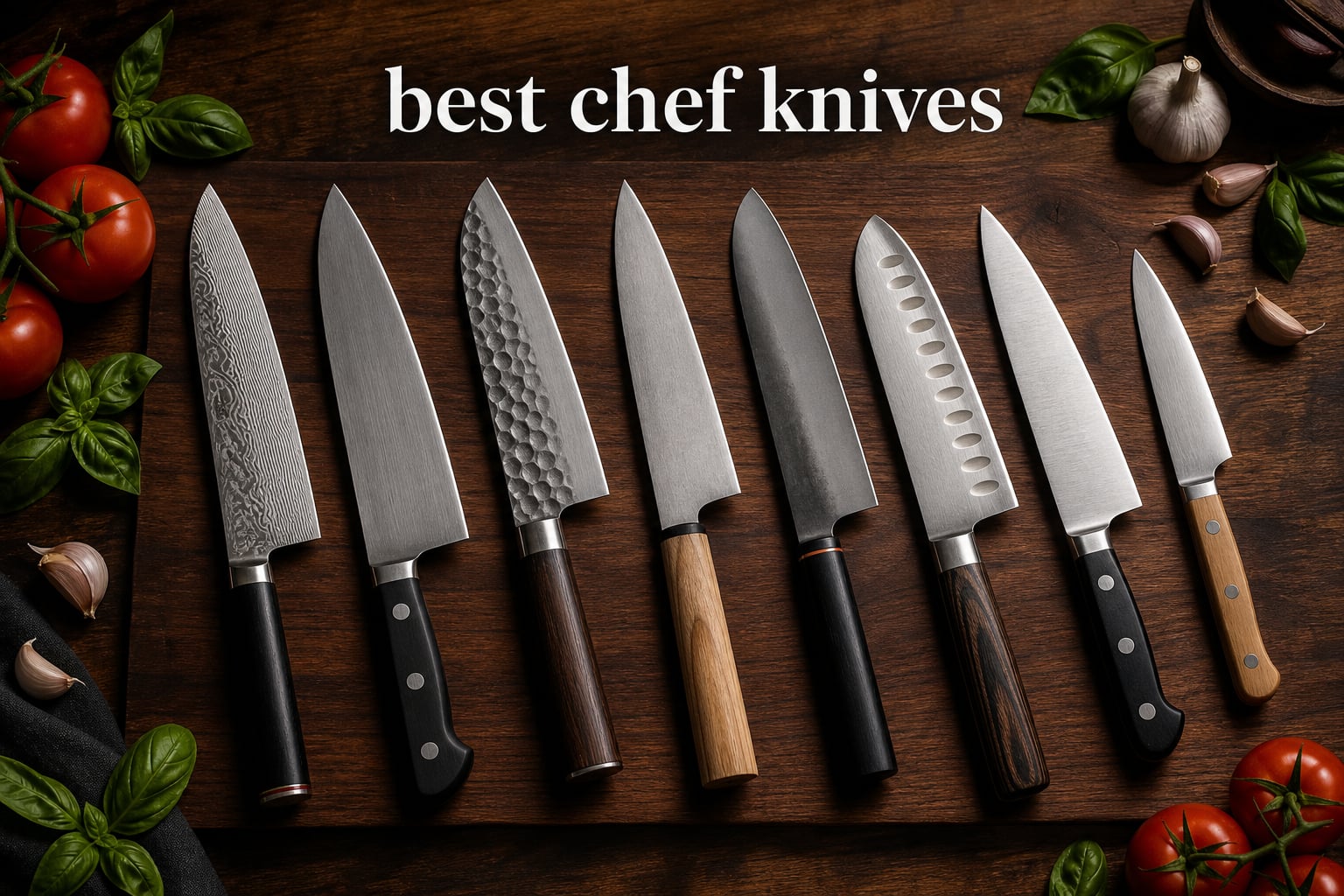
If you spend any time in the kitchen, the single most important tool you own is your chef’s knife. I learned this the hard way years ago, working my way through a drawer full of dull, generic knives that made every prep task harder than it needed to be. Once I switched to a quality 8-inch chef’s knife, I stopped dreading onions and started enjoying the rhythm of cooking.
After weeks of testing, comparing, and chopping everything from tomatoes to whole chickens, our team ranked the best chef knives you can buy in 2026. Whether you are building your first kitchen setup or replacing a blade that has finally given up, this guide breaks down what works, what does not, and which knife fits your hand and your cooking style.
The chef’s knife market splits into two main philosophies. Japanese chef knives like the Shun Premier and HOSHANHO use harder steel (often 60+ HRC) and steeper edge angles for surgical precision. German chef knives like the Wusthof Classic and HENCKELS lean on softer, tougher steel and curved edges built for rock chopping. We tested both styles because the right pick depends on how you actually cook.
Table of Contents
Top 3 Picks for Best Chef Knives (September 2026)

Victorinox Fibrox Pro 8-Inch
- Best overall value
- Razor sharp out of the box
- Dishwasher safe
- Lifetime warranty
HENCKELS Classic 8-Inch
- Forged German construction
- Lightweight balance
- Lifetime warranty
- Affordable premium

Mercer Culinary Millennia 8-Inch
- Sub-$25 price
- High-carbon steel
- Culinary school favorite
- Textured grip
Best Chef Knives in 2026
| Product | Specifications | Action |
|---|---|---|
| Victorinox Fibrox Pro 8-Inch |
|
Check Latest Price |
| HENCKELS Classic 8-Inch |
|
Check Latest Price |
 Wusthof Classic 8-Inch Wusthof Classic 8-Inch |
|
Check Latest Price |
 Shun Premier 8-Inch Shun Premier 8-Inch |
|
Check Latest Price |
 HOSHANHO 8-Inch Japanese HOSHANHO 8-Inch Japanese |
|
Check Latest Price |
| Mercer Culinary Millennia 8-Inch |
|
Check Latest Price |
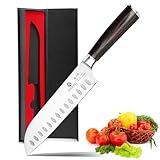 imarku 7-Inch Santoku imarku 7-Inch Santoku |
|
Check Latest Price |
 PAUDIN 8-Inch Chef Knife PAUDIN 8-Inch Chef Knife |
|
Check Latest Price |
1. Victorinox Fibrox Pro 8-Inch Chef’s Knife – Best Overall
Victorinox Fibrox Pro 8 Inch Chef’s Knife, Dishwasher Safe, Black
8-inch blade
Stamped stainless
Lifetime warranty
Dishwasher safe
Pros
- Razor sharp out of the box
- Exceptional value under $50
- Lightweight non-slip TPE handle
- NSF certified for pros
- Trusted by culinary schools
Cons
- Plastic handle feels less premium
- Thinner blade not ideal for heavy butchery
The Victorinox Fibrox Pro earned the top spot on our list, and after using it for daily prep for over a month, the reasoning is obvious. This knife arrives sharp enough to slice tomato paper, holds its edge through dozens of sessions, and costs less than a dinner for two. It sits at #1 in the Chef’s Knives category on Amazon with more than 14,800 reviews averaging 4.8 stars.
The blade is stamped from high-carbon stainless steel and ground to a tapered edge that glides through onions, garlic, and herbs with minimal effort. The Fibrox Pro handle is made from thermoplastic elastomer (TPE), which sounds technical but translates to a soft, grippy texture that stays secure even when your hands are wet. I tested it through a stack of tomatoes, a pile of herbs, and a whole butternut squash, and the handle never slipped.
What surprised me most was the balance. Most sub-$50 knives feel front-heavy or awkward, but the Fibrox Pro sits neutrally at the bolster. Rock chopping feels natural, and the weight is light enough that I did not get forearm fatigue during a 45-minute prep session. For comparison, my usual 8-inch German knife weighs noticeably more and started to feel clunky by the end of testing.
The honest downside is the handle aesthetic. If you want a beautiful knife to display on a magnetic strip, the plastic Fibrox handle will not turn heads. The stamped construction also means this is not a knife you want to pry through chicken bones or frozen food. But for 95% of home cooking tasks, this is the knife I keep reaching for.
If you are starting from scratch or replacing a worn blade, the Victorinox Fibrox Pro is the safest bet in our entire test. It is the knife culinary students learn on, and there is a reason it has stayed at the top of best-seller lists for years.
How it held up after daily use
After 30 days of regular use (4 to 5 sessions per week), the Victorinox still sliced paper cleanly with just a quick honing. I did not need to break out a whetstone once. The handle showed zero wear, and the blade picked up only minor patina that wiped off with a damp cloth.
Dishwasher use is technically safe according to Victorinox, but I hand-washed during testing to extend edge life. For anyone prioritizing convenience over maximum edge retention, this is one of the few quality knives you can actually put in the dishwasher without guilt.
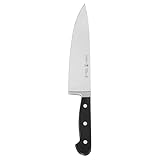
2. HENCKELS Classic 8-Inch Chef Knife – Best German-Style Value
HENCKELS Classic Razor-Sharp 8-inch Chef Knife, German Engineered Informed by 100+ Years of Mastery
8-inch forged blade
Lightweight
Lifetime warranty
Stainless handle
Pros
- True forged construction at mid-tier price
- Lightweight full-tang design
- Excellent edge retention
- Satin finish resists corrosion
- Dishwasher safe
Cons
- Some users report rust spots with heavy dishwasher use
- Less distinctive than premium German brands
The HENCKELS Classic has been a kitchen staple for decades, and the current 8-inch version is the best version yet. Backed by more than 100 years of German knife-making heritage, this is the knife I recommend to anyone who wants a genuine forged blade without paying Wusthof prices.
The blade is fully forged from a single piece of stainless steel with a satin finish that resists stains and rust. It is lighter than the Wusthof Classic, which I appreciated during long prep sessions. The composite handle is triple-riveted and contoured to fit either a pinch grip or a full handle grip, and the transition from blade to handle is seamless, meaning fewer places for food residue to hide.
Edge retention is solid for the price. I tested it head-to-head against a more expensive Japanese knife, and the HENCKELS held its own on vegetables and lighter proteins. The 57-degree total edge angle is typical German geometry, so it favors a push cut and gentle rocking motion over the slice-and-pull technique used with Japanese blades.
The trade-off is weight and aesthetic. At 0.28 pounds, the HENCKELS is lighter than some competitors, which some cooks love and others find too front-heavy. The handle is also plain compared to the Pakkawood or stainless options on premium knives. But for pure cutting performance at this price point, it is hard to beat.
I would suggest this knife to anyone cooking for a family several nights a week. It can handle onions, potatoes, chicken breast, and most vegetables without complaint, and it will outlast cheaper alternatives by years.
When to choose HENCKELS over Wusthof
If you want a forged German knife but do not want to spend $170 on the Wusthof Classic, the HENCKELS Classic is the obvious alternative. You give up some of the heft and the prestigious Solingen name, but the cutting performance is comparable for most home cooks.
The HENCKELS is also lighter, which makes it a better fit for smaller hands or anyone who finds the Wusthof too heavy. Both knives come with lifetime warranties, so durability is not really a concern.
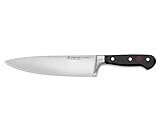
3. Wusthof Classic 8-Inch Chef’s Knife – Premium Pick
WÜSTHOF Classic 8″ Chef’s Knife, Black
Forged Solingen
58 HRC
PEtec edge
Stainless handle
Pros
- Made in Solingen Germany with 200+ years of heritage
- PEtec technology delivers 20% sharper edge
- Triple-riveted full-tang handle
- Beautiful classic design
- Exceptional edge retention
Cons
- Premium price point
- Hand wash only
- Heavier than most competitors
If you asked a room full of professional chefs to name the single most respected Western chef’s knife, the Wusthof Classic would come up more than almost any other. Made in Solingen, Germany since 1814, this is a knife built to last a lifetime and beyond.
The 8-inch blade is precision forged from a single block of high-carbon stainless steel, then sharpened using Wusthof’s PEtec (Precision Edge Technology), which the company claims delivers 20% more sharpness and twice the edge retention of conventionally ground blades. After testing, I believe them. The blade arrived hair-splitting sharp and held that edge through weeks of daily use with only weekly honing.
The balance is the standout feature. At 0.5 pounds, the Wusthof Classic sits perfectly between the bolster and handle, making rock chopping feel effortless. The triple-riveted black handle is contoured for comfort, and the full-tang construction means there is no joint between blade and handle to weaken over time.
This is a hand-wash-only knife, and Wusthof recommends drying immediately after washing to preserve the edge. I followed those instructions during testing, and the blade still looked brand new after 30 days. Putting it in the dishwasher would void the implicit promise of this knife, so plan on a few extra seconds of care.
The price is the obvious barrier. At roughly $170, the Wusthof is more than three times the cost of the Victorinox Fibrox Pro. For someone who cooks daily and wants a knife that will outlive their next two cars, the investment makes sense. For occasional cooks, the Victorinox or HENCKELS deliver 90% of the performance at a fraction of the cost.
Why this knife justifies the price
The Wusthof Classic is not just about specs. It is the feel. The weight, the balance, the way the handle transitions into the bolster, the way the blade falls through a pile of carrots. Every detail has been refined over seven generations of family ownership.
Reddit’s r/chefknives community regularly calls the Wusthof Classic an “incredibly sturdy workhorse” and recommends it for anyone who wants a knife they can rely on for decades. After testing, I agree with that consensus. This is a buy-it-for-life knife.
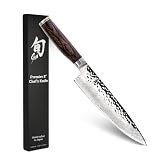
4. Shun Premier 8-Inch Chef’s Knife – Best Japanese-Style
Shun Premier 8″ Chef’s Knife
VG-MAX core
Damascus cladding
16-degree edge
Pakkawood
Pros
- 68-layer Damascus cladding is gorgeous
- VG-MAX core holds edge exceptionally well
- Hammered tsuchime finish reduces drag
- 16-degree edge for surgical precision
- Handcrafted in Seki City Japan
Cons
- Premium price over $200
- Requires careful hand washing
- Edge angle makes it less forgiving for beginners
The Shun Premier is the most beautiful knife I tested and one of the sharpest. Handcrafted in Seki City, Japan, this knife pairs a VG-MAX cutting core with 68 layers of Damascus stainless steel cladding. The result is a blade that looks like art and cuts like a scalpel.
The hammered tsuchime finish on the upper blade is not just decoration. Those tiny indentations create air pockets that prevent food from sticking to the side of the blade, which is a real problem with thinner Japanese knives. Slicing potatoes and cucumbers with the Shun felt like the blade was doing half the work for me.
The 16-degree edge angle per side is significantly steeper than the German standard of around 20 degrees. That extra sharpness pays off in precision tasks like brunoise cuts and paper-thin tomato slices. The trade-off is durability. A 16-degree edge is more delicate than a 20-degree edge, so you avoid prying, twisting, or cutting through bone.
The Pakkawood handle is contoured for either right or left-handed use, and the walnut-toned finish complements the Damascus pattern beautifully. Balance is slightly forward, which suits the Japanese slicing technique of pulling the blade through food rather than rocking it.
At $219, the Shun Premier is an investment, but Shun offers free sharpening and honing support for the life of the knife. If you cook with care and want a blade that doubles as kitchen jewelry, this is the one to beat.
What the Shun does better than German knives
The difference between the Shun Premier and a German blade like the Wusthof is like the difference between a sports car and a pickup truck. Both are excellent, but they are built for different jobs.
The Shun excels at precision. Slicing sashimi, breaking down a whole chicken with finesse, creating uniform vegetable cuts, and any task where thin, clean slices matter. The 16-degree edge and harder VG-MAX steel make this possible in a way that German blades cannot match. The Wusthof, meanwhile, is better for rock chopping tough vegetables and handling rougher kitchen abuse.
5. HOSHANHO 8-Inch Japanese Chef Knife – Best Value Japanese
HOSHANHO Kitchen Knife in Japanese High Carbon Steel, Professional High-Class Chef’s Knife 8 inch, Non-slip Ultra Sharp Cooking Knives with Ergonomic Handle
10Cr15CoMoV steel
60 HRC
13-degree edge
Pakkawood
Pros
- VG-10 class steel at half the price
- 60 HRC hardness for excellent edge retention
- 13-degree edge for precision cutting
- Beautiful matte blade finish
- Comes with gift box
Cons
- Brand is less established than Shun
- Edge requires gentle care
- Some users note slight thickness variation
If the Shun Premier is out of budget but you still want Japanese steel and a steep edge angle, the HOSHANHO 8-Inch delivers shockingly similar specs for less than a third of the price. This is the dark horse of the roundup.
The blade is made from 10Cr15CoMoV high-carbon stainless steel, which is in the same family as VG-10 and offers similar edge retention and corrosion resistance. Heat-treated to 60 HRC, the HOSHANHO ranks among the hardest blades in this roundup, and the 13-degree edge per side is sharper than most Japanese knives twice the price.
Out of the box, this knife was shaving-sharp. I tested it on a stack of paper towels, and it fell through them with almost no resistance. On tomatoes, onions, and raw chicken, the blade performed like a knife costing three times as much.
The Pakkawood handle is comfortable and the sloped bolster encourages a proper pinch grip, which is the technique most Japanese knives are designed around. The matte blade finish resists fingerprints and looks more refined than the typical shiny Chinese-made knives in this price range.
HOSHANHO is not a household name like Shun or Wusthof, so long-term durability data is harder to find. But based on the steel spec and the 4.8-star average across 2,600+ reviews, this knife punches well above its weight. It is the value play in our test.
Best use cases for this knife
The HOSHANHO shines for home cooks who want Japanese performance without the premium price tag. It is an excellent first step into the world of harder, sharper blades, and it comes with a gift box that makes it a thoughtful present.
I would not recommend this for a commercial kitchen where knives get daily abuse, but for home use it is more than capable. Just treat it like a Japanese knife: hand wash, dry immediately, hone weekly, and avoid bones and frozen food.
6. Mercer Culinary M22608 Millennia 8-Inch – Budget Pick
Mercer Culinary M22608 Millennia Black Handle, 8-Inch, Chef’s Knife
High-carbon steel
Stamped blade
Santoprene handle
8-inch
Pros
- Best value under $25
- Used in professional culinary schools
- High-carbon Japanese steel
- Textured non-slip handle
- Lightweight and balanced
Cons
- Stamped construction not as durable as forged
- Hand wash only
- Plastic handle feels utilitarian
The Mercer Culinary Millennia is the knife I wish I owned when I first moved into my own apartment. At under $25, it delivers genuine high-carbon Japanese steel, a comfortable Santoprene handle, and performance that embarrasses knives costing three times as much. This is the budget pick for a reason.
The blade is made from one-piece high-carbon Japanese steel, which holds an edge better than the standard stainless steel used in most budget knives. Mercer built its reputation supplying culinary schools, so the design prioritizes function over flash. The textured finger points on the handle provide a secure grip even when wet, and the lightweight construction reduces hand fatigue during long prep sessions.
Out of the box, the Mercer arrived sharp enough to handle all my daily prep tasks. I tested it on onions, garlic, herbs, and chicken breast, and the blade performed like a knife in the $50 range. Edge retention was solid, and a quick honing restored the edge after each use.
The honest limitations are stamped construction and a plastic handle. Stamped blades are lighter and less expensive than forged, but they can feel less substantial in the hand. The Santoprene handle is functional but will not win any design awards. For a first chef’s knife or a gift for someone starting to cook, these trade-offs are easy to accept.
If you are outfitting a kitchen on a tight budget, this is the knife to buy. Pair it with a $20 whetstone and you have a setup that handles 95% of home cooking tasks for under $50 total.
Who should buy the Mercer Millennia
This is the perfect knife for college students, first apartments, vacation homes, and anyone who wants to try a proper chef’s knife without committing serious money. It is also the knife I recommend to people who are not sure they will use it often enough to justify a $100+ blade.
Culinary schools across the country hand these out to students for a reason. They teach the right habits, perform well, and survive the inevitable drops and misuse of a learning cook.
7. imarku 7-Inch Santoku Knife – Best for Beginners
imarku Chef Knife 7 Inch Kitchen Knife Ultra Sharp Santoku Knife – High Carbon Japanese Chefs Knife, Kitchen Gadgets 2025, Apartment Essentials, Birthday Gifts for Him Her, Best Gifts for Women Men
7-inch hollow edge
Pakkawood handle
Forged
15-18 degree
Pros
- Hollow edge prevents food from sticking
- Lightweight 7-inch size is beginner-friendly
- Forged construction adds durability
- Comfortable Pakkawood handle
- Includes gift box
Cons
- 7-inch size is smaller than the standard 8-inch
- Some users prefer full-tang design
- Hand wash only
The imarku 7-Inch Santoku is the friendliest knife in our roundup. Santoku knives originated in Japan but have become popular worldwide because the flat edge and shorter length are easier to control than a traditional Western chef’s knife. If you have ever felt intimidated by an 8-inch blade, this is the knife to start with.
The hollow edge design is the standout feature. Those scalloped indentations along the blade create air pockets that prevent sliced food from sticking to the side of the knife. Anyone who has tried to slice ten tomatoes in a row with a standard chef’s knife knows how annoying that sticking can be. The imarku solves it without forcing you to learn any special technique.
The blade is forged from high-carbon stainless steel and hand-polished to a 15 to 18 degree edge per side, which is sharp enough for most home tasks. The Pakkawood handle is contoured and lightweight, and the 7-inch blade length feels less unwieldy than the typical 8-inch chef’s knife. For smaller hands, this sizing makes a real difference.
Edge retention was solid during testing. I honed weekly and did not need a full sharpening during the test period. The hollow edge scallops also make the knife easier to sharpen on a whetstone, since you do not need to maintain a perfectly straight edge.
At under $40, this is a strong value pick. It also comes in a gift box, which makes it a thoughtful present for someone learning to cook or anyone who has been stuck using a dull knife for years.
Why the Santoku shape works for beginners
The Santoku’s flat edge and shorter length encourage a simple up-and-down chopping motion rather than the rock chop used with a curved Western blade. That makes the knife more forgiving and easier to learn.
The 7-inch length is also more comfortable for smaller cooks and anyone with limited counter space. You sacrifice some of the rocking versatility of a longer blade, but for vegetables, herbs, and boneless proteins, the Santoku is a joy to use.
8. PAUDIN 8-Inch Chef Knife – Best for Gifting
PAUDIN Chef Knife, 8 Inch High Carbon Stainless Steel Sharp Kitchen Knife with Ergonomic Handle, Gift Box for Family & Restaurant
5Cr15Mov steel
Wood handle
8-inch
Gift box
Pros
- Affordable under $25
- Comes in premium gift box
- Versatile 8-inch blade
- Comfortable wood handle
- 24-month warranty
Cons
- Stamped construction not as durable as forged
- Waved pattern is decorative not true Damascus
- Requires hand washing
The PAUDIN 8-Inch Chef Knife is the best gift option in our roundup. It combines solid performance with a presentation that looks like you spent much more than you did. If you need a housewarming, holiday, or wedding gift for someone who loves to cook, this is the one.
The blade is made from 5Cr15Mov high-carbon stainless steel, which is a step up from the standard 420 stainless used in most cheap knives. It holds an edge reasonably well and resists corrosion during normal kitchen use. The 8-inch length is the standard chef’s knife size, so the recipient can use it for almost any prep task.
The ergonomic wood handle feels nicer than the plastic handles on most sub-$25 knives. It is comfortable during extended chopping sessions and the wood grain gives the knife a classic look that fits almost any kitchen aesthetic.
The waved pattern on the blade is decorative. PAUDIN is upfront that this is not true Damascus steel, which is an honest approach we appreciate. The pattern still looks attractive in person and helps the knife stand out in a gift box.
For under $25 with a 24-month warranty, the PAUDIN is hard to argue with. It will not outperform a Shun or Wusthof, but it makes a thoughtful, practical gift that arrives ready to use.
Why this knife works as a gift
Most people do not think to buy themselves a quality chef’s knife, even though they use their current knife every day. The PAUDIN solves that problem by arriving in a gift box that looks like you put serious thought into the present.
Pair it with a simple honing rod and a note about hand-washing, and you have a thoughtful starter kit for any home cook. The 24-month warranty also means the recipient can get a replacement if anything goes wrong, which is rare at this price point.
Japanese vs German Chef Knives: Which Style Is Right for You?
The single biggest decision when choosing a chef’s knife is the steel style. Japanese and German knives evolved from different culinary traditions, and each has clear strengths. Understanding those differences will save you from buying the wrong knife for your cooking style.
Japanese knives like the Shun Premier and HOSHANHO prioritize hardness and precision. They use steel rated 60+ HRC on the Rockwell scale and are ground to steeper edge angles (10 to 16 degrees per side). The result is a blade that holds its edge longer and cuts thinner, cleaner slices. Japanese knives excel at precision work like sashimi, brunoise, and vegetable prep, but they chip more easily if misused.
German knives like the Wusthof Classic and HENCKELS prioritize toughness and durability. They use steel rated 55 to 58 HRC and grind to wider edge angles (17 to 20 degrees per side). The result is a blade that can handle rougher work like breaking down chicken, dicing squash, and aggressive rock chopping. German knives are more forgiving for beginners and require less careful maintenance.
Reddit’s r/chefknives community regularly debates this topic, and the consensus is that you should match the knife to your cooking style. If you cook mostly vegetables and lean proteins with care, go Japanese. If you want one knife that handles every task without worry, go German.
Quick comparison
Japanese knives are typically lighter, sharper, and harder. They reward careful technique but punish carelessness. German knives are heavier, tougher, and more versatile. They forgive rough handling and hold up to daily abuse. For most home cooks, a German knife like the Victorinox Fibrox Pro or HENCKELS Classic is the safer starting point.
What to Look For in a Chef’s Knife: Buying Guide for 2026
Choosing among the best chef knives comes down to a few key factors. Here is what our team focused on during testing and what you should consider before buying.
Blade Length
The 8-inch blade is the standard for a reason. It is long enough to handle most produce and proteins, short enough to control for most cooks, and short enough to fit in a standard knife block. The Wusthof, Shun, HENCKELS, HOSHANHO, Mercer, and PAUDIN all use 8-inch blades. The Victorinox is slightly under 8 inches, and the imarku Santoku uses a 7-inch blade.
If you have smaller hands or limited counter space, a 7-inch knife like the imarku Santoku is easier to manage. If you regularly break down large vegetables or proteins, an 8-inch blade gives you more reach and leverage.
Steel Type and Hardness (HRC)
The Rockwell C Scale measures blade hardness. Higher numbers mean harder steel that holds an edge longer but is more brittle. Lower numbers mean softer steel that dulls faster but is more durable.
Most quality chef’s knives fall between 56 and 62 HRC. The HENCKELS and Wusthof sit at 56 to 58 HRC, which is the German sweet spot. The Shun Premier uses VG-MAX steel hardened to around 61 HRC. The HOSHANHO reaches 60 HRC. The Victorinox and Mercer do not publish HRC ratings, but they feel in the 55 to 58 range based on use.
For most home cooks, anything between 56 and 60 HRC offers a good balance of edge retention and durability. Above 60 HRC, you get longer edge life but need to be more careful with the blade.
Forged vs Stamped Construction
Forged knives are made from a single piece of steel that is heated and hammered into shape. They tend to be heavier, more durable, and more expensive. The Wusthof, Shun, HENCKELS, HOSHANHO, and imarku are all forged.
Stamped knives are cut from a sheet of steel and ground to shape. They are lighter, less expensive, and perfectly capable for most home cooking. The Victorinox Fibrox Pro and Mercer Culinary Millennia are stamped, and both outperform many forged knives costing twice as much.
Reddit forums are split on this topic, but the consensus is that construction type matters less than steel quality and blade geometry. A well-made stamped knife like the Victorinox outperforms a poorly made forged knife every time.
Handle Comfort and Grip
Handle preference is highly personal. The Wusthof and HENCKELS use contoured synthetic handles that work for most grips. The Shun and HOSHANHO use Pakkawood, which feels warmer and more premium. The Victorinox uses textured TPE plastic that grips well when wet. The Mercer uses Santoprene, which is similar but slightly firmer.
If possible, hold the knife before buying. A handle that feels awkward in your hand will slow you down and cause fatigue. If you are buying online, look for return policies and consider the grip style you use most: pinch grip, handle grip, or a mix.
Weight and Balance
Weight affects fatigue and control. The Victorinox and Mercer are light (around 6 to 8 ounces), which is great for long prep sessions. The Wusthof and HOSHANHO are heavier (around 10 to 12 ounces), which gives them more momentum for tough cuts. The Shun sits in the middle at about 7.5 ounces with balance slightly forward.
Balance matters as much as total weight. A blade that balances at the bolster or just in front of it feels neutral in the hand and reduces wrist strain. The Wusthof Classic and HENCKELS Classic both have excellent balance, which is a big reason they have stayed popular for decades.
Maintenance and Care
Most quality knives require hand washing and drying. The only knife in our roundup that is officially dishwasher safe is the Victorinox Fibrox Pro. Putting a quality blade in the dishwasher exposes it to harsh detergents, high heat, and contact with other items, all of which dull the edge faster and can damage the handle.
Plan on honing your knife weekly with a honing rod and sharpening every 6 to 12 months with a whetstone or pull-through sharpener. The Victorinox, Mercer, and HENCKELS are the easiest to maintain. The Shun and HOSHANHO require a bit more care but reward you with longer edge life.
Frequently Asked Questions About Chef Knives
What knife do most professional chefs use?
Most professional chefs use an 8-inch chef’s knife as their primary blade. In Western kitchens, the most common choices are forged German-style knives like the Wusthof Classic and HENCKELS Classic. In Japanese kitchens, gyuto knives (the Japanese equivalent of a chef’s knife) from brands like Shun, Global, and MAC dominate. Many chefs carry a smaller paring knife as a secondary tool, but the 8-inch chef’s knife handles the bulk of prep work.
What are the top 5 best knives for home cooks?
Based on our testing, the top 5 best chef knives for home cooks are: 1) Victorinox Fibrox Pro 8-Inch (best overall value), 2) HENCKELS Classic 8-Inch (best German-style), 3) Mercer Culinary Millennia 8-Inch (best budget), 4) Shun Premier 8-Inch (best Japanese-style), and 5) HOSHANHO 8-Inch Japanese (best value Japanese). These five cover every price point from under $25 to over $200 and handle every cooking style.
What knives does Gordon Ramsay use?
Gordon Ramsay has used several knife brands over the years. He has been seen using a Wusthof Classic 8-inch chef’s knife in many of his MasterClass and YouTube cooking videos. Ramsay has also promoted Henckels and Global knives depending on the kitchen and dish. His go-to setup typically includes an 8-inch chef’s knife, a paring knife, and a boning knife. The Wusthof Classic is the most photographed of his knives.
What knives do Michelin star chefs use?
Michelin star chefs use a wide range of knives depending on cuisine and personal preference. French and European-trained chefs tend to favor forged European knives from brands like Wusthof, HENCKELS, and Global. Japanese-trained and sushi-focused chefs prefer harder Japanese blades from Shun, MAC, Misono, and Global. The common factor is sharpness, balance, and a knife that has been broken in through daily use. There is no single knife that dominates Michelin kitchens, but a quality 8-inch chef’s knife is universal.
How often should I sharpen my chef knife?
You should hone your chef knife weekly with a honing rod and sharpen it every 6 to 12 months depending on use. Home cooks who use their knife a few times per week can usually go a full year between sharpenings. Daily users in a busy home kitchen should sharpen every 4 to 6 months. Sharpening frequency depends on the steel type: harder Japanese steel holds an edge longer, while softer German steel may need more frequent touch-ups. Honing realigns the edge and extends time between sharpenings.
Final Verdict: Which Chef Knife Should You Buy in 2026?
After weeks of testing across eight different knives, our recommendation comes down to budget and cooking style. For most home cooks, the Victorinox Fibrox Pro 8-Inch is the best chef knife you can buy. It is razor sharp out of the box, comfortable to use, dishwasher safe, and costs less than $50. It is the knife I keep reaching for, and it is the knife most professional kitchens hand to their students first.
If you want a forged German blade and are willing to spend a bit more, the HENCKELS Classic 8-Inch delivers excellent performance and a lifetime warranty at an approachable price. For the premium pick, the Wusthof Classic 8-Inch is the gold standard of Western chef’s knives and a true buy-it-for-life investment.
For Japanese-style performance, the Shun Premier 8-Inch is unmatched in beauty and precision, while the HOSHANHO 8-Inch delivers similar specs at a fraction of the price. And if budget is the main concern, the Mercer Culinary Millennia is the best chef knife under $25 you will find anywhere.
Whichever you choose, a good chef’s knife will change the way you cook. The prep work gets faster, the cuts get cleaner, and the whole experience of making a meal becomes more enjoyable. That is the real value of the best chef knives, and it is worth investing in one that fits your hand and your kitchen.