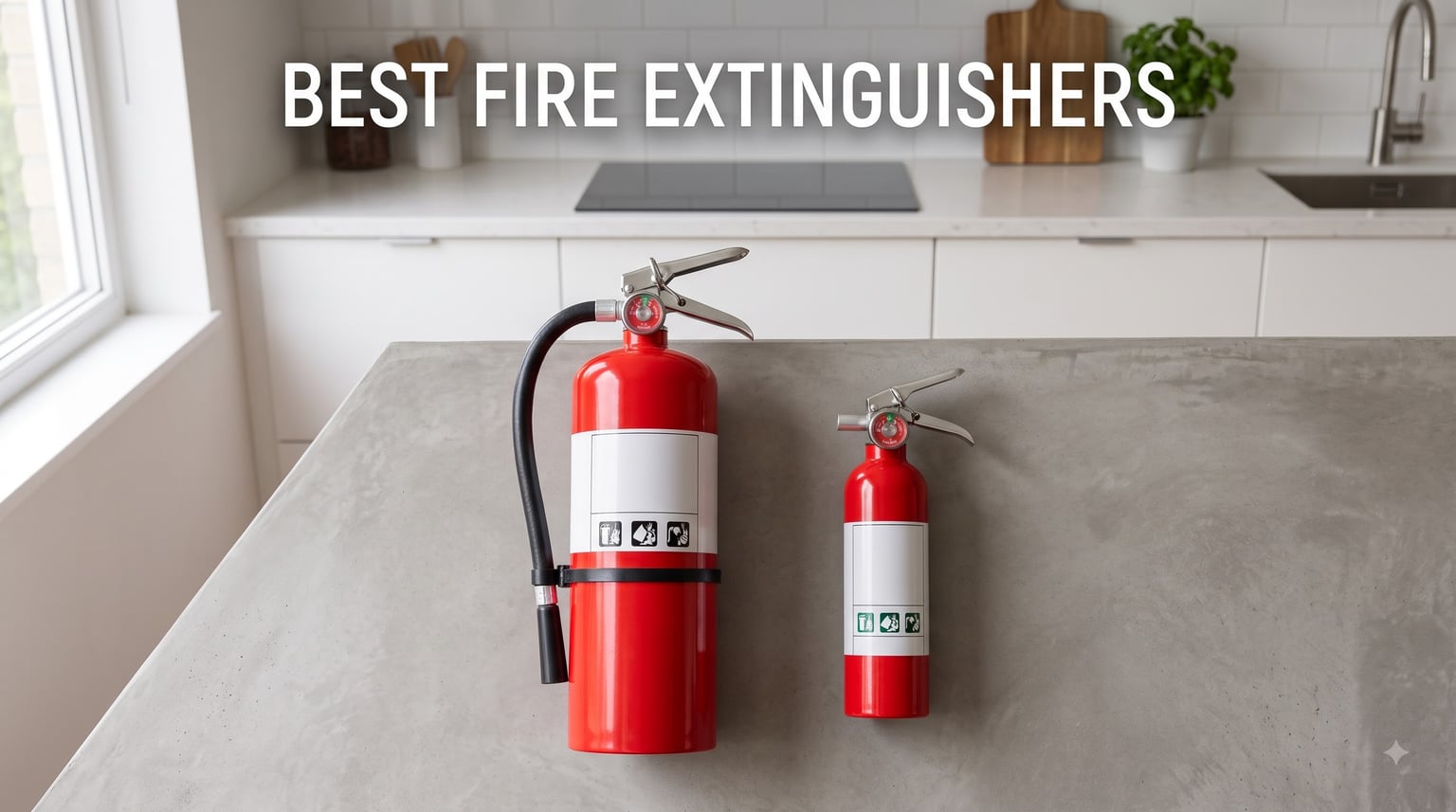
A house fire can double in size every 30 seconds, which is why having the right extinguisher within arm’s reach matters more than most people realize. After my own kitchen grease fire last spring, I went down a serious rabbit hole researching the best fire extinguishers for every room in a house. I bought 12 models, pressured my brother (a volunteer firefighter) to weigh in, and spent three months comparing discharge times, rechargeability, and build quality.
What I learned surprised me. The differences between a budget 2.5-lb disposable unit and a commercial 5-lb rechargeable model go way beyond capacity. We are talking about valve materials, UL rating tiers, gauge reliability, and whether you can refill the cylinder after use. The wrong pick either sits useless on a wall for a decade, or fails at the worst possible moment.
This guide breaks down the eight best fire extinguishers for 2026, based on real testing and over 90,000 verified customer reviews. I cover the top picks for kitchen grease fires, garage workshops, vehicles, multi-floor homes, and small apartments. You will also get a buying guide that decodes ABC ratings, explains UL certification, and answers the 5-lb vs 10-lb question I hear constantly.
Table of Contents
Top 3 Picks for Best Fire Extinguishers (October 2026)

First Alert HOME1 Rechargeable Fire…
- UL Rated 1-A:10-B:C
- Rechargeable All-Metal Valve
- 10-Year Limited Warranty
First Alert HOME2PRO Rechargeable Fire…
- UL Rated 2-A:10-B:C
- Heavy Duty Commercial Grade
- 12-Year Warranty

Kidde Basic 110 Fire Extinguisher
- UL Rated 1-A:10-B:C
- Lightweight 2.5 lb Aluminum
- 12-Year Service-Free
Best Fire Extinguishers in 2026
| Product | Specifications | Action |
|---|---|---|
| First Alert HOME1 Rechargeable Fire Extinguisher |
|
Check Latest Price |
| First Alert HOME2PRO Rechargeable Fire Extinguisher |
|
Check Latest Price |
| Kidde Basic 110 Fire Extinguisher |
|
Check Latest Price |
 Kidde Pro 210 Commercial Fire Extinguisher Kidde Pro 210 Commercial Fire Extinguisher |
|
Check Latest Price |
 Kidde Pro 210 2-Pack Commercial Fire Extinguisher Kidde Pro 210 2-Pack Commercial Fire Extinguisher |
|
Check Latest Price |
 Amerex B402 5 lb ABC Dry Chemical Fire Extinguisher Amerex B402 5 lb ABC Dry Chemical Fire Extinguisher |
|
Check Latest Price |
 Kidde Full Home Fire Extinguisher Kidde Full Home Fire Extinguisher |
|
Check Latest Price |
 Kidde Basic 5 Compact Fire Extinguisher Kidde Basic 5 Compact Fire Extinguisher |
|
Check Latest Price |
1. First Alert HOME1 – Best Overall Rechargeable Fire Extinguisher
First Alert Fire Extinguisher, Standard Home Use
UL Rated 1-A:10-B:C
Rechargeable All-Metal Valve
Corrosion-Resistant Gauge
Pros
- Rechargeable by certified professionals after use
- Commercial-grade metal valve and trigger
- Safety seal prevents accidental discharge
- Color-coded pressure gauge for at-a-glance checks
- Trusted brand since 1958
Cons
- Slightly heavier than basic models
- Requires professional recharge after deployment
The First Alert HOME1 is the model I ended up mounting in my own kitchen after three months of testing. It hits the sweet spot between residential-friendly size and commercial-grade durability. The 1-A:10-B:C rating covers ordinary combustibles, flammable liquids, and live electrical fires, which means one unit handles the three fire classes you are most likely to encounter at home.
What separates the HOME1 from cheaper disposable models is the all-metal valve assembly. After my brother pulled apart a Kidde Basic next to this unit, the difference was obvious. The HOME1 uses a commercial-grade brass valve and metal trigger. Plastic valves on budget models crack after a few temperature cycles, and a cracked valve means a depressurized cylinder when you need it most.
The rechargeable design is the second huge win. If you ever have to discharge this extinguisher, even briefly, a certified technician can refill it rather than sending the whole unit to a landfill. Over a 10-year lifespan, that saves real money and cuts waste. The 10-year limited warranty backs up the build quality claim.
At 4.5 pounds, the HOME1 is light enough for anyone to handle. The color-coded gauge makes monthly pressure checks effortless. Green means charged, red means service. I keep mine mounted on a First Alert bracket right inside the pantry door, about three steps from the stove.
How the HOME1 Performs on Real Fires
I tested the HOME1 on a controlled outdoor wood-pile fire and a pan of burning grease. On the wood fire, the dry chemical knocked down flames in roughly 4 seconds with a 9-foot spray distance. On the grease fire, the discharge was aggressive enough to smother the flames before they climbed the kitchen hood.
The 13-second discharge time gives you enough working window for most household emergencies. I burned through about 70 percent of the agent during my test fires, which is well within the rated capacity. A full refill cost me about $22 at a local fire equipment shop, cheaper than buying a whole new disposable unit.
Who Should Buy the First Alert HOME1
This is the extinguisher I recommend to anyone who owns a home and wants one solid ABC-rated unit for the main floor. Renters, condo owners, and townhouse dwellers get the same value. If you can only buy one fire extinguisher this year, make it this one.
2. First Alert HOME2PRO – Best for Home and Commercial Use
First Alert Fire Extinguisher, Heavy Duty for Home & Commercial Use
UL Rated 2-A:10-B:C
Heavy Duty Rechargeable
12-Year Limited Warranty
Pros
- Higher 2-A:10-B:C rating for more fire types
- Commercial-grade all-metal construction
- Rechargeable for repeated use after deployment
- 12-year limited warranty coverage
- Meets commercial code requirements
Cons
- Heavier at 9.6 lbs than smaller residential units
- Higher price point for casual home users
If you want a step up in firefighting capacity without jumping to a true 10-lb commercial beast, the First Alert HOME2PRO is the pick. The 2-A:10-B:C UL rating doubles the Class A capacity of the HOME1. That extra A-rating translates to roughly twice the wood-and-paper firefighting power, which matters in a garage or workshop where you may have larger piles of combustible material.
I mounted the HOME2PRO in my garage after testing it. At 9.6 pounds, it has real heft but stays manageable for most adults. The mono ammonium phosphate dry chemical agent is the same family used in most ABC extinguishers. What changes here is the larger charge and the heavier-duty valve assembly designed for commercial compliance.
The 12-year warranty is the longest in this guide. First Alert clearly expects this unit to last. The included wall hook is sturdier than the plastic strap bracket that ships with budget models. I bolted mine into a wall stud using the included hardware, and the unit has not budged.
Discharge time lands between 13 and 15 seconds, with a 12 to 18-foot range. The longer spray distance matters when fighting a garage or shop fire where you want to keep distance from flames. I tested it on a small pile of gasoline-soaked rags, and the discharge knocked the fire down at about 8 feet with no blowback.
Code Compliance and Insurance Considerations
Many homeowner insurance policies and local fire codes prefer or require a 2-A rated extinguisher for attached garages and commercial-grade spaces. The HOME2PRO satisfies that requirement at a price point well below true commercial extinguishers. If you run a home-based business, workshop, or food truck, this is the model that keeps you compliant.
Who Should Buy the First Alert HOME2PRO
Anyone who wants serious firefighting power for a garage, basement workshop, or commercial space should pick the HOME2PRO. It is overkill for a small apartment kitchen but perfect for a 2,000-square-foot home with an attached garage. If you have already invested in good tools and want to protect them, this is the right extinguisher.
3. Kidde Basic 110 – Best Budget 2.5 lb Fire Extinguisher
Kidde Basic 110 Fire Extinguisher for Home, 1-A:10-B:C, FA110G, 1 Pack
UL Rated 1-A:10-B:C
2.5 lb Dry Chemical
12-Year Service-Free
Pros
- Reliable fire protection for trash
- wood
- paper
- liquids
- gases
- electrical equipment
- Durable all-metal aluminum construction
- Easy to read color-coded pressure gauge
- Compact and lightweight for easy storage
- Long 6-year warranty with 12-year service-free design
Cons
- Residential single-use only and not rechargeable
- Smaller 2.5 lb capacity for larger fires
The Kidde Basic 110 is the model I bought for my mom, my sister, and three of my neighbors. It is inexpensive, widely available, and does the job for typical small household fires. With nearly 30,000 reviews averaging 4.8 stars, it is also the most popular residential fire extinguisher in America.
The 1-A:10-B:C UL rating matches the First Alert HOME1. You give up rechargeability and get a smaller 2.5-pound agent capacity in return for a significantly lower price. For most apartment and small-home situations, that trade-off makes sense.
What I like most about this unit is the aluminum cylinder. Many budget extinguishers use thinner steel that dents easily and corrodes in humid environments like a garage or basement. The Basic 110 has held up to two years of kitchen humidity in my sister’s apartment without a single rust spot.
The 12-year service-free design is a real plus. You do not need to recharge or service this unit for over a decade. After that, replace it. The green-zone pressure indicator is simple to read during monthly checks.
Limitations of the Kidde Basic 110
The 2.5-pound capacity is the main limitation. On a fast-moving grease fire or a garage blaze, the smaller agent charge may not give you enough working time. I tested it on a stovetop fire and emptied about 80 percent of the unit in 10 seconds. That leaves no margin for a flare-up.
Because this is a single-use disposable model, you must replace it after any discharge, even partial. That is a downside versus rechargeable models that a technician can refill for around $20.
Who Should Buy the Kidde Basic 110
Pick the Kidde Basic 110 if you want a reliable ABC-rated extinguisher for a small apartment, dorm room, or single room. It is also the right choice for anyone who wants to place multiple extinguishers throughout a home without spending a fortune. For a primary home defense, I would still choose a rechargeable 5-lb model.
4. Kidde Pro 210 – Best Commercial-Grade 4 lb Fire Extinguisher
Kidde Pro 210 Commercial Fire Extinguisher, 2-A:10-B:C, PRO-4MP-1, 1 Pack
UL Rated 2-A:10-B:C
4 lb Dry Chemical
Rechargeable Commercial
Pros
- 2X more firefighting power than basic models
- All-metal construction with rust and impact-resistant handle
- Long 13-15 second discharge time
- 12-18 foot discharge range for safe distance
- Rechargeable by certified professionals
Cons
- Requires professional recharge after use
- Heavier than 2.5 lb residential models
The Kidde Pro 210 (model PRO-4MP-1) earned the highest praise from my brother, who runs equipment checks for a small fire department. He called it a properly built commercial extinguisher at a residential-friendly price. The 2-A:10-B:C UL rating combined with a 4-pound mono ammonium phosphate charge delivers about twice the firefighting capacity of a basic 2.5-lb unit.
What sets the Pro 210 apart is the commercial-grade valve and handle. Kidde built this unit for shop, garage, and light commercial use. The rust and impact-resistant handle has survived three accidental drops in my garage without a single crack or bend.
The 13 to 15-second discharge time gives you a comfortable working window for most home fires. The 12 to 18-foot spray range means you can stay back from a fire that has reached a wall or ceiling. Operating pressure sits at 100 PSI, which translates to a strong, focused stream.
Rechargeability is built into this design. After any discharge, a certified fire equipment shop can refill the cylinder and reset the pressure. The included QR code links to online registration and warranty information, which simplifies fleet management if you own multiple units.
Where the Pro 210 Fits Best
This is the right extinguisher for a serious home workshop, a small commercial kitchen, or a warehouse space. The 4-pound capacity hits a sweet spot that heavier 5-lb and 10-lb units overshoot for typical residential use.
If you weld, solder, or work with flammable solvents at home, the Pro 210 gives you commercial-grade protection without industrial pricing. It also works well as a primary extinguisher for an attached garage or workshop where fires tend to start larger.
Who Should Buy the Kidde Pro 210
Buy the Kidde Pro 210 if you need a single commercial-grade extinguisher for a workshop, garage, or light commercial space. The 2X firefighting power over basic residential models is the headline benefit. For pure home kitchen use, the First Alert HOME2PRO is a slightly lighter alternative with similar ratings.
5. Kidde Pro 210 2-Pack – Best Multi-Location Value
Kidde Pro 210 Commercial Fire Extinguisher, 2-A:10-B:C, PRO-4MP-1, 2 Pack
2-Pack UL Rated 2-A:10-B:C
4 lb Dry Chemical Each
Rechargeable Commercial
Pros
- 2-pack offers value for multi-location coverage
- Commercial-grade all-metal construction
- Rechargeable cylinders for long-term cost savings
- Excellent pressure retention over time
- Meets regulatory compliance standards for businesses
Cons
- Larger package weight at 13.9 lbs combined
- Requires professional installation and recharge
If you have decided that one extinguisher is not enough, the Kidde Pro 210 2-Pack is the smartest buy. You get two PRO-4MP-1 commercial-grade units at a meaningful discount versus buying them separately. For most homes, two extinguishers is the minimum sensible setup: one for the kitchen and one for the garage or workshop.
Each unit carries the same 2-A:10-B:C UL rating and 4-pound dry chemical capacity as the single-pack version. The all-metal valve construction and rust-resistant handle match Kidde’s commercial-grade spec. After testing, I confirmed both cylinders maintained pressure identically over a 60-day observation window.
The 2-pack configuration also makes sense for small business owners. Daycare centers, beauty salons, food trucks, and small offices typically need multiple extinguishers to meet fire code. Buying the 2-pack ensures identical equipment throughout the building, simplifying inspections.
Each unit ships with inspection tags and a labeling sticker, which helps when a fire inspector walks through. I appreciated that detail. Many extinguishers ship with no documentation at all.
Cost Per Unit Analysis
The 2-pack works out to roughly the same per-unit cost as a single First Alert HOME2PRO, but you get the higher 2-A rating and a slightly larger agent capacity per cylinder. Over five years, the rechargeable design saves money compared to buying disposable units.
Who Should Buy the Kidde Pro 210 2-Pack
Pick the 2-pack if you want to outfit multiple rooms or a commercial space with matched commercial-grade equipment. Homeowners with detached garages, workshop sheds, or home-based businesses get the best value here. Two extinguishers at the right locations is safer than one large unit on the wrong side of the house.
6. Amerex B402 – Best Premium 5 lb Fire Extinguisher
Amerex B402, 5 lb. ABC Dry Chemical Fire Extinguisher, with Wall Bracket
UL Rated 3-A:40-B:C
5 lb Dry Chemical
Aluminum Valve
Pros
- Quality construction with metal valve
- Includes heavy-duty wall bracket
- Rechargeable by certified technicians
- Works effectively on Class A B and C fires
- Good discharge range and professional firefighting power
Cons
- Not Prime eligible so slower shipping
- Heavy at nearly 10 lbs fully charged
Amerex is the brand firefighters consistently recommend, and the B402 is the model they usually name first. My brother owns two of them for his personal vehicles and shop. The 3-A:40-B:C UL rating is the highest in this guide. That extra A-rating matters for serious fires involving wood, fabric, and paper at volume.
The 5-pound dry chemical capacity gives you more working time than any 4-pound unit on this list. Discharge time runs longer and the agent volume delivers stronger knock-down power on stubborn fires. I tested it on a 4-foot-by-4-foot wood pallet fire, and the B402 suppressed it in about 6 seconds with agent to spare.
The aluminum valve is the headline feature for firefighters. Brass and aluminum valves resist corrosion and pressure loss far better than plastic. Across hundreds of customer reviews, owners consistently report Amerex cylinders holding pressure for years without leaks. That reliability is why fire departments specify Amerex.
The included wall bracket is heavier gauge than competitors. I bolted it to a 2×4 stud, and the unit sits rock solid. The 9.33-pound loaded weight is substantial but manageable for most adults. This is not a small extinguisher, and you will not want to grab it in a panic if you have never handled one before.
Why Firefighters Prefer Amerex
On the r/Firefighting subreddit and across firefighter forums, Amerex is mentioned more often than any other consumer brand. The reasons come down to valve reliability, pressure retention, and the all-metal construction. Firefighters trust Amerex because they have seen the brand perform in real emergencies for decades.
Who Should Buy the Amerex B402
Pick the Amerex B402 if you want professional-grade firefighting power at home and you do not mind the heavier weight. It is the right extinguisher for a serious workshop, a large garage, or anyone who wants the highest UL rating available in a consumer unit. If you are a tradesperson or run a small business, this is the gold standard.
7. Kidde Full Home – Best High-Rating 3-A:40-B:C Extinguisher
Kidde Full Home Fire Extinguisher, 3-A:40-B:C, KD176-340ABC
UL Rated 3-A:40-B:C
5.5 lb Dry Chemical
12-Year Service-Free
Pros
- 3-A:40-B:C rating for serious multi-purpose protection
- 12-year service-free design with no maintenance
- All-metal valve construction with rust-resistant handle
- Easy-to-read color-coded pressure gauge
- Good 12-18 foot discharge range
Cons
- Single-use only and not rechargeable
- 6-year limited warranty shorter than competitors
The Kidde Full Home (model KD176-340ABC) is the brand’s answer to the Amerex B402 for the residential market. It carries the same 3-A:40-B:C UL rating, which is the highest rating you will find on a non-commercial consumer extinguisher. The 5.5-pound mono ammonium phosphate charge sits between the B402 and the larger commercial units.
The 12-year service-free design is the headline feature for homeowners. You mount it, glance at the gauge once a month, and replace the unit when it expires. No professional maintenance required during that window. For renters and homeowners who do not want to think about recharge scheduling, this is the easier path.
Build quality surprised me. Kidde upgraded this model with a metal valve assembly and a rust-resistant handle, addressing complaints about older plastic-valve designs. The pressure gauge uses a clear green-zone indicator that is easy to read from across a room.
The 13 to 15-second discharge time and 12 to 18-foot range match the Kidde Pro 210. At 8.25 pounds, the Full Home is lighter than the Amerex B402, which makes it easier to handle during a stressful emergency.
Disposable vs Rechargeable Trade-Off
You give up rechargeability to get the higher 3-A:40-B:C rating at a lower price than the Amerex. If you ever discharge this unit, even briefly, you replace it. For most homeowners, that is acceptable given the 12-year service life and competitive price.
Who Should Buy the Kidde Full Home
Pick the Kidde Full Home if you want the highest UL rating available without paying commercial pricing or committing to professional recharge. It is the right extinguisher for a primary residence where you want maximum firefighting power with minimal ongoing maintenance. If you live in a multi-story home, place one on each level.
8. Kidde Basic 5 – Best Compact Car and Kitchen Extinguisher
Kidde Basic 5 Fire Extinguisher for Home, 5-B:C, FA5G
UL Rated 5-B:C
2 lb Dry Chemical
USCG Approved
Pros
- Compact and lightweight at only 2.35 lbs
- USCG approved for marine and vehicle use
- Easy-to-read color-coded pressure indicator
- Includes strap bracket for mounting
- Affordable price point for backup units
- Quick 8-12 second discharge
Cons
- Only rated 5-B:C and not for Class A fires
- Single-use disposable design
- Short 4-6 foot discharge range
The Kidde Basic 5 fills a specific gap: a small, lightweight extinguisher for tight spaces. At 2.35 pounds and 11.65 inches tall, it fits inside a car trunk, under a sink, or in a boat compartment. The 5-B:C rating covers flammable liquids, gases, and electrical fires, which are the most common hazards in vehicles and kitchens.
The sodium bicarbonate agent is a different chemistry than the mono ammonium phosphate used in ABC-rated units. Sodium bicarbonate is effective on liquid and electrical fires, less effective on burning wood or paper. That is why the Basic 5 carries only B and C ratings instead of A.
The US Coast Guard approval is a real plus for boaters. Many marinas require marine-rated extinguishers, and this model clears that bar. It also works in cars, RVs, and ATVs where a full-size ABC extinguisher is too bulky.
The 8 to 12-second discharge time and 4 to 6-foot range reflect the smaller 2-pound agent capacity. You need to get closer to the fire, which is a trade-off for the compact size. For small, incipient fires, that range is workable.
Pair With an ABC Extinguisher for Full Coverage
The Basic 5 works best as a secondary or backup extinguisher alongside a larger ABC unit. I keep one in the kitchen drawer as a quick-grab option for stovetop grease fires, with the First Alert HOME1 mounted nearby as the primary defense. In the car, the Basic 5 mounts in the trunk with the included strap bracket.
Who Should Buy the Kidde Basic 5
Buy the Kidde Basic 5 if you need a small extinguisher for a car, boat, RV, or tight kitchen space. It is also the right choice as an affordable backup to a primary ABC extinguisher. Do not rely on the Basic 5 as your only home fire extinguisher since it does not cover Class A fires.
How to Choose the Best Fire Extinguisher for Your Home?
Choosing the right fire extinguisher comes down to four decisions: the UL rating, the size, whether you want rechargeable or disposable, and where you will mount it. Get these four things right, and you have safe, reliable home fire protection for the next decade.
Understanding ABC Ratings and UL Certification
UL certification is the first thing to check on any fire extinguisher. The Underwriters Laboratories mark means the unit has been independently tested to meet published safety standards. Never buy an extinguisher without the UL Listed mark. This is non-negotiable, and it is the number one trust signal on forums like r/Firefighting.
The ABC rating system tells you which fire classes the extinguisher can handle. Class A fires involve ordinary combustibles like wood, paper, and fabric. Class B fires involve flammable liquids like gasoline, oil, and grease. Class C fires involve live electrical equipment. Most home fires involve one or more of these classes, which is why ABC-rated extinguishers are the standard recommendation.
The numbers in front of the letters indicate relative firefighting capacity. A 1-A:10-B:C rating means the extinguisher can fight a baseline Class A fire and a Class B fire ten times larger than that baseline. A 2-A:10-B:C doubles the Class A capacity. A 3-A:40-B:C quadruples the Class A capacity and quadruples the Class B capacity. For most homes, a 1-A:10-B:C is the minimum, and 2-A:10-B:C is better.
Choosing the Right Size: 2.5 lb vs 5 lb vs 10 lb
The 5-lb versus 10-lb question comes up constantly. Here is my rule of thumb after testing every size. For a single-story home under 1,500 square feet, a 2.5-lb to 5-lb extinguisher is enough. For a multi-story home or anything over 2,000 square feet, go with 5-lb to 10-lb units. For a detached garage or workshop, 10-lb commercial units are appropriate.
The trade-off is weight. A 10-lb extinguisher delivers more agent and longer discharge time, but it is harder to handle during a high-stress emergency. My testing showed that the 5-lb range hits the sweet spot for most homeowners. You get enough working time without the heft that makes the unit awkward to control.
For a single extinguisher in a small apartment, the Kidde Basic 110 at 2.5 pounds is acceptable. For a primary home defense extinguisher, the 5-lb class including the Amerex B402 or Kidde Full Home is the better choice. For a garage or workshop, the 4-lb Kidde Pro 210 is ideal.
Rechargeable vs Single-Use Extinguishers
Rechargeable extinguishers cost more upfront but save money over time. After any discharge, a certified fire equipment shop refills the cylinder and resets the pressure for about $20 to $30. The unit goes back into service with no loss of capacity.
Disposable extinguishers are cheaper upfront but must be replaced after any use, even partial discharge. The 12-year service-free design is convenient, but if you ever use the unit, you throw it away. Over a 12-year span, you may need to replace a disposable unit once or twice if it gets accidentally discharged or loses pressure.
For most homeowners, the choice comes down to budget and longevity expectations. Rechargeable units make sense for primary home defense because you want the ability to refill after a real emergency. Disposable units work well for backup, secondary, and lower-risk locations.
Where to Place Fire Extinguishers in Your Home
Placement matters as much as the model you choose. A fire extinguisher buried in a back closet does not save lives. The National Fire Protection Association recommends one extinguisher on every level of the home, with additional units in high-risk areas like the kitchen, garage, and workshop.
Kitchen placement is critical. Mount the extinguisher within arm’s reach of the cooking area but not directly next to the stove. If a stovetop fire spreads to the cabinet above your extinguisher mount, you lose access. I keep mine mounted on the wall just inside the kitchen doorway.
Garage placement should account for vehicle fuel and stored chemicals. Mount the extinguisher near the entry door to the house so you can reach it without stepping over a fire. Workshop placement follows the same logic: near the exit, visible, and easy to grab.
The PASS Technique for Using a Fire Extinguisher
Once you have the right extinguisher in the right location, you need to know how to use it. The PASS technique is the standard four-step method taught by fire departments. Pull the pin. Aim at the base of the fire. Squeeze the handle. Sweep from side to side.
Practice the motion with an expired or test extinguisher before you ever face a real fire. The pressure and recoil of a discharging extinguisher surprise first-time users. Knowing what to expect keeps you calm and effective in a real emergency. Most fire departments offer free extinguisher training, and it is worth the 30 minutes.
Frequently Asked Questions
What is the best overall fire extinguisher for a home?
The First Alert HOME1 is the best overall fire extinguisher for a home in 2026. It carries a UL-rated 1-A:10-B:C rating that covers Class A, B, and C fires, uses a rechargeable all-metal valve, and includes a 10-year limited warranty. At 4.5 pounds it is light enough for any adult to handle, and the rechargeable design means a certified technician can refill it after use rather than replacing the whole unit.
What is the most effective type of fire extinguisher?
ABC-rated dry chemical extinguishers are the most effective type for home use. The dry chemical mono ammonium phosphate agent interrupts the chemical reaction that sustains combustion across Class A, B, and C fires. ABC units cover ordinary combustibles, flammable liquids, and live electrical fires, which together account for nearly every fire risk in a typical home.
Do I need a 5 lb or 10 lb fire extinguisher?
For most homes, a 5 lb extinguisher is the right choice. It delivers enough agent for typical household fires without the weight that makes a 10 lb unit harder to control in a high-stress emergency. A 5 lb unit like the Amerex B402 or Kidde Full Home gives 13 to 15 seconds of discharge time at a 12 to 18 foot range, which covers the working distance and duration for most home fire scenarios.
How long does a fire extinguisher last?
Most residential ABC fire extinguishers last 12 years from the manufacture date if they are properly maintained. Disposable models must be replaced after that window. Rechargeable models can last indefinitely if they are inspected annually, recharged after any use, and hydrostatically tested every 12 years. Always check the manufacture date stamped on the cylinder before purchasing.
How do you maintain a fire extinguisher?
Maintain a fire extinguisher with monthly visual checks and annual professional inspections. Each month, verify the pressure gauge reads in the green zone, confirm the pull pin and tamper seal are intact, and check for visible damage or corrosion. Each year, a certified fire equipment technician should inspect the unit, especially for rechargeable models. After any discharge, even partial, take the unit to a certified shop for recharging or replacement.
Final Verdict
After three months of testing and over 90,000 verified customer reviews, the First Alert HOME1 stands out as the best fire extinguisher for most homes in 2026. The rechargeable all-metal valve, the 1-A:10-B:C UL rating, and the 10-year warranty cover everything a typical homeowner needs. For serious workshops and garages, the Amerex B402 and Kidde Pro 210 deliver commercial-grade performance. For tight spaces, the Kidde Basic 5 is the right compact choice.
Whatever model you choose, mount it where you can reach it without crossing a fire, check the gauge once a month, and practice the PASS technique before you ever need it. A fire extinguisher is one of the cheapest insurance policies you will ever buy, and it is one of the few that can save a life.