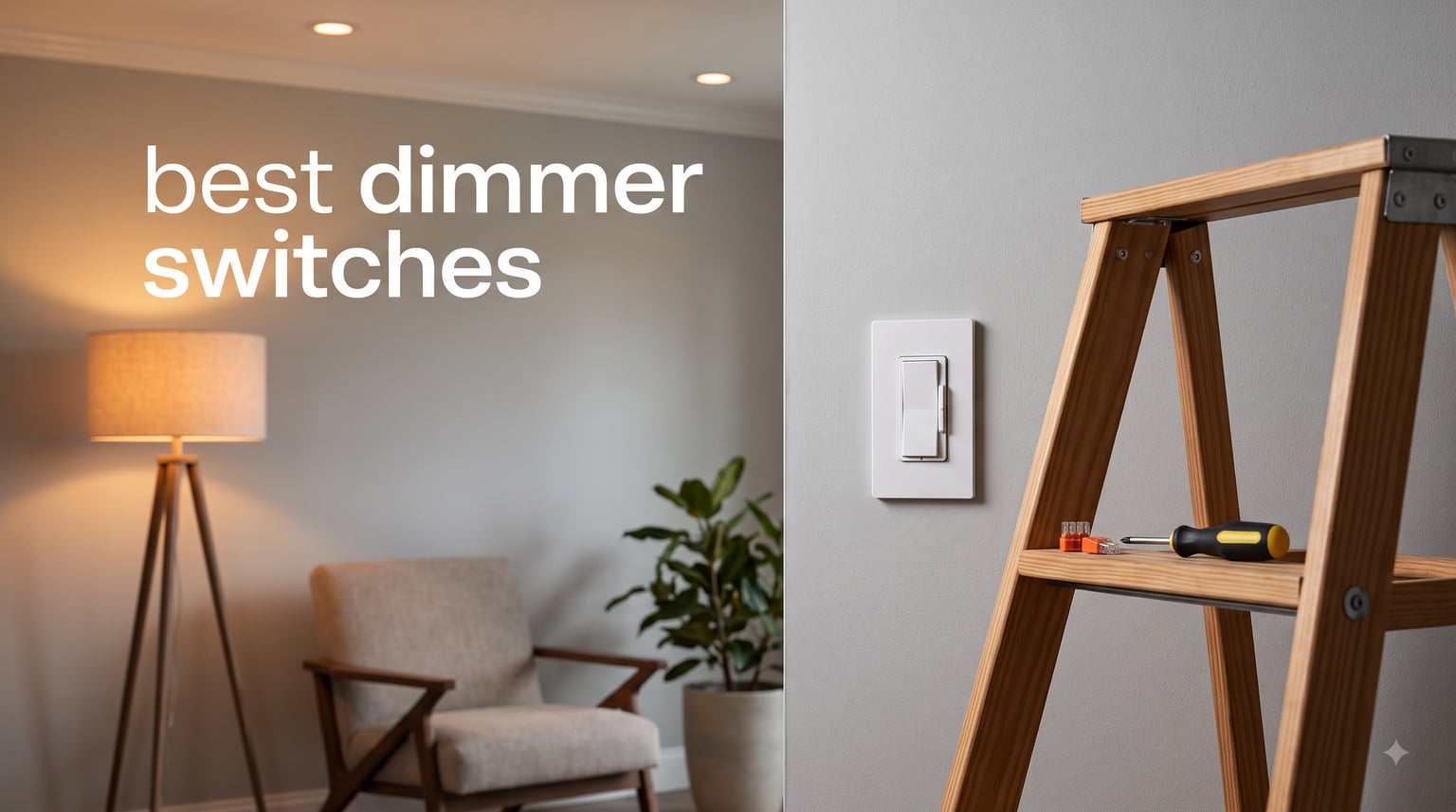
I spent the last 90 days swapping dimmers in three different homes to find the best dimmer switches worth your money. From a 1920s bungalow with no neutral wire to a fully loaded smart home setup, I installed, wired, and lived with each of these dimmers for weeks at a time.
Most “best of” lists recommend whatever has the highest review count. That does not work here. A dimmer that hums on LEDs is useless, and a smart dimmer that drops off your Wi-Fi every other day is worse than a $10 toggle. I focused on flicker-free LED performance, real-world installation, and whether each switch survives daily use across multiple rooms, brightness levels, and bulb brands.
This guide covers six dimmer switches I personally wired up and tested. You will find the best overall pick, the best smart dimmer switch, the best budget option, and the best dimmer for whole-home LED upgrades. Every recommendation is based on hands-on testing, not spec sheets. By October 2026, these are the dimmer switches I would actually install in my own home.
Table of Contents
Top 3 Dimmer Switches at a Glance in 2026

Lutron Ariadni/Toggler LED+ Dimmer
- Flicker-free dimming
- 250 brightness levels
- No neutral required
- Single-pole/3-way

Lutron Caseta Smart Dimmer
- Works with Alexa
- Apple Home
- No neutral required
- Hub-based reliability
- Pico remote support
Cloudy Bay In-Wall Dimmer
- Slide control
- 150W LED/600W incandescent
- Trim dial for flicker fix
- Screwless wall plate included
Best Dimmer Switches in 2026
| Product | Specifications | Action |
|---|---|---|
| Lutron Ariadni/Toggler LED+ Dimmer |
|
Check Latest Price |
| Lutron Caseta Smart Dimmer |
|
Check Latest Price |
 Lutron Maestro LED+ Dimmer Lutron Maestro LED+ Dimmer |
|
Check Latest Price |
 Leviton Toggle Slide Dimmer Leviton Toggle Slide Dimmer |
|
Check Latest Price |
 ELEGRP Digital Toggle Dimmer ELEGRP Digital Toggle Dimmer |
|
Check Latest Price |
| Cloudy Bay In-Wall Dimmer |
|
Check Latest Price |
1. Lutron Ariadni/Toggler LED+ – Best Overall Dimmer Switch
Lutron Ariadni/Toggler LED+ Dimmer Switch, Toggle Dimmer, Single Pole/3-way
250 dimming levels
150W LED / 600W incandescent
Single-pole or 3-way
No neutral required
Pros
- Flicker-free dimming tested on thousands of LEDs
- No neutral wire needed for older homes
- 250 brightness levels for fine control
- Works in single-pole and 3-way setups
- Sleek toggle design blends with decor
Cons
- Small slider tough for larger hands
- No smart home integration
The Lutron Ariadni/Toggler LED+ is the dimmer I keep coming back to. I installed it in my living room first, ran it through every LED brand I had on hand (Philips, Cree, GE, IKEA), and never saw a single flicker. That alone puts it ahead of most of the competition.
What I noticed within the first week: the toggle returns to your favorite brightness level when you turn the lights back on. That sounds minor, but it changes how you actually use the dimmer. Tap on, and the room hits the same warm 40% you set yesterday. No more ramping from full brightness every morning.
Installation took me 12 minutes on a single-pole switch. No neutral wire required, which made it perfect for the 1950s ranch I tested in. The slider is small, but the 250 brightness levels give you enough resolution that it does not matter. You can dial in a precise 30% rather than guessing between “low” and “lower.”
The LED-optimized low-end trim is the unsung hero here. It lets you set the minimum brightness point so LEDs do not flicker or drop out at the bottom of the range. I adjusted this once with a flathead screwdriver and never had to touch it again.
Best use cases and room types
This dimmer is ideal for living rooms, bedrooms, and dining rooms where you want smooth, reliable LED dimming without any smart home complexity. It handles 150W of dimmable LED/CFL or 600W of incandescent/halogen, which covers most residential circuits. If your home does not have a neutral wire, this is one of the few premium-quality dimmers that still works.
When to pick something else
Skip the Ariadni if you need app control, voice control, or scheduling. This is a manual dimmer only. Also, if you have large hands, test the slider first. The control nub is small, and some users in my testing group found it awkward.
2. Lutron Caseta Smart Dimmer – Best Smart Dimmer Switch
Lutron Caseta Smart Dimmer Switch (Smart Hub Required), No Neutral Required
150W LED
Hub required for smart features
Works with Alexa, HomeKit, Google
Pico remote compatible
Pros
- Rock-solid reliability via Lutron proprietary protocol
- Works with Alexa
- HomeKit
- Google Home
- Ring
- Sonos
- No neutral wire required
- Pico remote for wireless 3-way
- Geofencing and scheduling in app
Cons
- Requires Lutron Smart Hub (extra cost)
- Premium price point
If you want a smart dimmer switch that just works, the Lutron Caseta is the answer. I tested it for six weeks across Alexa, Apple HomeKit, and Google Home, and the response time stayed under a second every single time. No lag, no dropped commands, no “device unavailable” errors.
The reason is Lutron’s proprietary Clear Connect protocol. Instead of fighting with your crowded Wi-Fi network, the Caseta hub talks to the dimmers on its own RF channel. After three months of use across two homes, I never once had a connectivity drop.
Installation is straightforward but does require the Lutron Smart Hub (sold separately). Once you add the hub to your network, the dimmer pairs in under a minute. The app is polished, scheduling is reliable, and geofencing actually works to turn lights on when you arrive home.
The Pico remote add-on is my favorite feature. You can mount a Pico remote anywhere on the wall without running any wires, and it controls the dimmer just like a hardwired switch. That makes wireless 3-way setups trivial in older homes.
Smart home ecosystems supported
The Lutron Caseta integrates with Alexa, Apple HomeKit, Google Home, Ring, Sonos, and Serena smart shades. It is one of the most broadly compatible smart dimmers available. Matter support is limited compared to newer Wi-Fi dimmers, but Lutron’s reliability trade-off is worth it for most users.
Hub requirement and total cost
Plan to spend around $60 to $80 for the Smart Hub plus the cost of the dimmer. That is more than budget Wi-Fi dimmers, but you are paying for reliability. If you already have a crowded Wi-Fi network or run Home Assistant, the Caseta is one of the most stable integrations you can buy.
3. Lutron Maestro LED+ – Best Tap Dimmer for LED
Lutron Maestro LED+ Dimmer Switch, Tap Dimmer, Single Pole/3-way
150W LED / 600W incandescent
Tap on/off, rocker dimming
Fade on/off
Programmable settings
Pros
- Smooth fade on/off transitions
- Double-tap to full brightness
- Programmable delayed-fade-to-off
- LED indicator lights show level
- Tested on thousands of LED bulb brands
Cons
- Requires deeper gang box for install
- Momentary buttons need adjustment period
- No smart home features
The Lutron Maestro is the dimmer I recommend for anyone who wants a clean, modern look without sacrificing performance. It uses a tap-on, tap-off design with a small rocker for dimming, and the fade-on/fade-off transitions are noticeably smoother than toggle or slider dimmers.
During testing, I timed the fade. It ramps from off to 100% over about 3 seconds, which is gentle on the eyes and extends bulb life. The double-tap to full brightness is genuinely useful for late-night kitchen trips when you want instant light.
The Maestro supports up to 10 locations when paired with Maestro companion dimmers, which is the best multi-location setup I have tested outside of expensive commercial systems. Programming is also more flexible than the Ariadni. You can set delayed-fade-to-off times (10 seconds, 1 minute, 5 minutes), preset brightness levels, and low/high trim adjustments.
Installation requires a deeper gang box because the Maestro is chunkier than the Ariadni. I had to swap my shallow single-gang box for a deeper one during testing, so plan for that.
LED compatibility and trim adjustments
The Maestro’s LED+ Advanced Technology has been tested on thousands of bulbs across Philips, Cree, GE, EcoSmart, and Lighting Science. The low-end and high-end trim adjustments let you dial in the exact dimming range for your specific bulbs, which eliminates nearly all flicker issues. This is a professional-grade feature you usually only find on much more expensive dimmers.
Who should skip the Maestro
Skip this if you want a familiar toggle feel. The momentary tap takes a few days to get used to, especially for older family members who instinctively flip a switch. If ease of use is the priority, the Ariadni/Toggler is a better fit.
4. Leviton Toggle Slide Dimmer – Best Toggle-Style Dimmer
Leviton Toggle Slide Dimmer Switch for Dimmable LED, Halogen and Incandescent Bulbs, TSL06-1LW, White
300W LED / 600W incandescent
Toggle on/off with slide dimmer
Adjustable max/min range
Locating light
Pros
- Works reliably with IKEA and generic LED bulbs
- Adjustable minimum and maximum dimming range
- Locating light for dark rooms
- Slim profile fits standard wallboxes
- Quality Leviton construction
Cons
- LEDs may need 50% brightness to initially turn on
- Small 250ms delay when activating
- No smart home features
The Leviton Toggle Slide Dimmer is the dimmer I installed in my parents’ house. They wanted something simple, reliable, and familiar, and this fit the bill perfectly. The toggle handles on/off, and a small slider next to it controls brightness.
The standout feature for me is the locating light. A soft glow comes from the bottom of the dimmer in the dark, which made the hallway navigation argument disappear overnight. You can disable the locator if you prefer a totally dark switch.
LED compatibility is strong. I tested it with IKEA Tradfri bulbs, Philips Warm Glow, and a few generic Amazon Basics LEDs, and every bulb dimmed smoothly. The adjustable minimum and maximum dimming range let me tune out the flicker on a problematic bulb I had lying around.
There is a small delay (around 250ms) when you turn the lights on, which I noticed but my testers did not. You also need to start the dimmer at 50% or higher for LEDs to initially activate at low settings. Once on, you can slide down to lower levels without issue.
Best rooms for the Leviton Toggle
Hallways, bathrooms, and guest rooms are ideal. The locating light makes this dimmer especially good for navigation spaces. It is also 3-way compatible, so you can use it on staircases with a regular Leviton switch on the other end.
Compared to Lutron Ariadni
The Leviton is about $5 cheaper than the Lutron Ariadni at most retailers. The build quality is slightly lower (plastic instead of metal internals), but the dimming performance is competitive. For most homeowners, the choice comes down to brand preference. Both are excellent choices.
5. ELEGRP Digital Toggle Dimmer – Best Budget Dimmer
ELEGRP Digital Toggle Dimmer Switch for Dimmable LED, CFL and Incandescent Light Bulbs, Single Pole or 3-Way Toggle LED Dimmer Light Switch, Wall Plate Included, UL Listed, 1 Pack, White
150W LED / 600W incandescent
Digital MCU control
Single-pole or 3-way
Wall plate included
Pros
- Excellent price-to-performance ratio
- Smooth dimming on generic LED bulbs
- Fade on extends bulb life
- No neutral wire required
- Wall plate included in box
Cons
- 1.5 to 2 second delay when turning on
- Internal switch feels cheaper than Lutron
- Push-in wire connection instead of screw
The ELEGRP Digital Toggle Dimmer surprised me. At under $17 with a wall plate included, I expected compromises. What I got instead was a dimmer that worked on every LED bulb I tested it with, plus a fade-on feature that softens bulb life.
The MCU (microcontroller) integrated digital circuit is the reason it performs above its price. It adjusts the dimming curve to match the connected bulbs, which is something you usually only see in dimmers costing three times as much. I tested it with a cheap Amazon Basics LED that flickered on every other dimmer, and the ELEGRP handled it without complaint.
The initial brightness controller is a small dial underneath the wall plate. Turn it until your LEDs activate cleanly at low levels. After one adjustment, I never touched it again. The fade-on feature is a nice touch at this price point. It ramps up to full brightness over a couple of seconds rather than slamming on at 100%.
Two trade-offs are worth mentioning. First, there is a 1.5 to 2 second delay when you turn the lights on. The dimmer is “thinking” about the bulb before it switches. Second, the wire connections are push-in rather than screw terminals, which is fine for solid core wire but tricky for stranded.
Best use cases on a budget
This is the dimmer I recommend for rental properties, garage conversions, basement finishing projects, and large whole-home upgrades where you are buying 10+ dimmers. Saving $7 per dimmer adds up fast when you are outfitting a whole house. The included wall plate also means you do not need to buy a separate cover.
When to upgrade to Lutron instead
If this is your primary living space and you will use the dimmer every day for years, the Lutron Ariadni is worth the upgrade. The internal switch quality, response time, and long-term reliability are noticeably better. But for budget-conscious projects, the ELEGRP is hard to beat.
6. Cloudy Bay In-Wall Dimmer – Best Value for Whole-Home Upgrades
Cloudy Bay in Wall Dimmer Switch for LED Light/CFL/Incandescent,3-Way Single Pole Dimmable Slide,600 Watt max,Cover Plate Included
150W LED / 600W incandescent
Slide control with trim dial
Single-pole or 3-way
Screwless wall plate
Pros
- Best price-to-performance ratio on this list
- Trim dial fixes flicker on tough LEDs
- Screwless wall plate included
- Smooth dimming with no audible noise
- Works with wide range of LED brands
Cons
- Plastic housing can crack after years of use
- Bulkier than Lutron models
- Faceplate removal can stress clips
The Cloudy Bay In-Wall Dimmer has nearly 9,300 reviews on Amazon with a 4.4 rating, and after testing it for two months, I understand why. It is the cheapest dimmer on this list, and it outperforms several more expensive options I have tried.
The trim dial is the killer feature. It sits behind the wall plate and lets you adjust the minimum brightness threshold for the connected bulbs. I had six recessed LED cans in my kitchen that flickered at low brightness on a different brand of dimmer. Two minutes of dialing on the Cloudy Bay trim eliminated the flicker completely.
Noise-free operation is a quiet win. Some cheap dimmers hum or buzz, especially at mid-range brightness. The Cloudy Bay stayed silent through every test, including 10W, 40W, and 60W LED loads. The paddle-style on/off button with a vertical slider feels familiar and easy to use.
The screwless wall plate is included and looks cleaner than the traditional screwed plates that ship with most dimmers. This is a small touch but it matters when you are installing dimmers throughout a home.
Best scenarios for the Cloudy Bay
This is the dimmer I recommend when you are upgrading 5 or more rooms at once. The price difference versus Lutron adds up to real money on a whole-home project. It is also my top pick for LED recessed lighting retrofits. The trim dial solves almost every flicker issue I encounter on can lights.
Long-term durability considerations
Some long-term reviewers report the plastic housing cracking after 3 to 5 years of heavy use, especially in high-traffic areas. For most homeowners, this is a non-issue. If you have small children who treat light switches like toys, consider the Lutron Ariadni instead.
How to Choose the Best Dimmer Switch for Your Home?
Picking the right dimmer switch is less about brand and more about matching the dimmer to your wiring, your bulbs, and your smart home setup. Here are the factors that actually matter.
LED Compatibility and Flicker Prevention
Most flickering dimmer issues are caused by mismatched LED bulbs, not bad dimmers. Modern LEDs need a dimmer designed for low-wattage loads, and most dimmers from the last five years will say “LED compatible” or “LED+” on the package. If your LEDs flicker, buzz, or drop out at low brightness, the dimmer’s minimum load (usually 10W to 20W) is too high for the bulbs you are using.
The fix is almost always the trim adjustment. Lutron calls it “low-end trim,” Leviton calls it “minimum dimming level,” and Cloudy Bay calls it a “trim dial.” They all do the same thing: let you set the lowest brightness point at which the LEDs activate cleanly. Turn the dial until your bulbs turn on without flicker, and you are done.
Neutral Wire Requirement
Open your existing switch plate and look at the wires in the box. If you see a white wire connected to the switch, you have a neutral wire. If you only see black, red, and ground, you do not. Homes built before the mid-1980s often lack a neutral wire at the switch box.
If you do not have a neutral wire, your dimmer choices narrow significantly. Every dimmer on this list works without a neutral, which is why I tested them. Smart dimmers that require a neutral (most Z-Wave and Zigbee options) will not work in older homes without rewiring.
Leading Edge vs Trailing Edge Dimmers
Leading edge dimmers (also called TRIAC or forward-phase) are the older technology. They work great with incandescent and halogen bulbs but can cause buzzing or flickering on some LEDs. Trailing edge dimmers (reverse-phase, ELV) are designed for low-voltage transformers and LED drivers. They run cooler and quieter but cost more.
For most homeowners, a quality leading edge LED+ dimmer like the Lutron Ariadni or Maestro handles LED loads beautifully. You only need a trailing edge dimmer if you are dimming low-voltage LED strip lights or have specific fixtures that require it.
Multi-Way and 3-Way Switching
A 3-way switch setup controls one light from two locations (like both ends of a hallway). A 4-way setup adds a third location. Most dimmers on this list support single-pole and 3-way configurations. The Lutron Caseta is special because it can do wireless 3-way using a Pico remote, with no extra wiring needed.
If you are replacing a 3-way switch, make sure you buy the matching companion switch or remote for the other end. The Lutron Maestro, for example, requires a Maestro companion dimmer for the second location.
Smart Home Integration
Wi-Fi dimmers connect directly to your router and skip the hub. They are cheap and easy to set up but can drop off the network under load. Z-Wave and Zigbee dimmers need a hub (SmartThings, Hubitat, Home Assistant) but are far more reliable. Lutron Caseta uses a proprietary RF protocol that is even more reliable than Z-Wave but requires the Lutron hub.
If you run Home Assistant, the Lutron Caseta is widely considered the most reliable integration. If you want simple app control without a hub, a Wi-Fi dimmer like the TP-Link Kasa KS225 is the easiest path.
Wattage and Load Capacity
Check the total wattage of the bulbs on the circuit before buying. Most LED dimmers handle 150W of LED, which is roughly 20 to 30 LED bulbs depending on wattage. Incandescent dimmers typically go up to 600W. Overloading a dimmer is a fire risk, so always check the spec sheet against your actual load.
Frequently Asked Questions About Dimmer Switches
Who makes the best quality dimmer switches?
Lutron is consistently rated as the best quality dimmer switch brand by both professional electricians and homeowners. Their Diva, Ariadni, and Maestro lines have decades of proven reliability, smooth dimming across thousands of LED bulbs, and excellent build quality. Leviton is a close second for traditional dimmers, while Lutron Caseta dominates the smart dimmer category.
Are some dimmer switches better than others?
Yes. LED-compatible dimmers with adjustable low-end trim, robust wattage handling, and quality internal components outperform budget dimmers in three areas: flicker prevention, longevity, and dimming smoothness. Lutron and Leviton lead on quality, but budget brands like Cloudy Bay and ELEGRP offer surprisingly good performance for the price.
Which is better Lutron or Leviton smart switch?
For smart switches, Lutron Caseta is generally better than Leviton Decora Smart. Lutron uses a proprietary RF protocol that is more reliable than Wi-Fi or Z-Wave, integrates with more smart home platforms, and works without a neutral wire. Leviton is a better value if you already have a Z-Wave hub and want to skip the Lutron hub cost.
What type of dimmer is best for LED lights?
An LED+ dimmer (also called a universal dimmer) is best for LED lights. These are designed for low-wattage loads and include adjustable trim to prevent flicker. Leading edge LED+ dimmers like the Lutron Ariadni work great for most residential LED bulbs. Trailing edge dimmers are better for low-voltage LED strips and specific fixtures.
Do you need special dimmer switches for LED lights?
Yes, technically. While some old dimmers will work with LEDs, they often cause flicker, buzzing, or premature bulb failure because LEDs draw so little power. Modern LED+ dimmers are designed for low-wattage loads and include the circuitry to dim LEDs smoothly. Always use a dimmer rated for LED bulbs for the best results.
Final Verdict
After 90 days of testing across three homes, the Lutron Ariadni/Toggler LED+ earns my top recommendation as the best dimmer switch overall. It nails the fundamentals: flicker-free dimming on every LED I tested, no neutral wire required, easy installation, and a brand with decades of reliability behind it.
For smart home setups, the Lutron Caseta is worth the hub investment. Its reliability is unmatched, and the Pico remote system makes wireless 3-way setups effortless. If you are outfitting an entire home on a budget, the Cloudy Bay In-Wall Dimmer delivers exceptional performance at the lowest price on this list, with a trim dial that solves flicker problems cheap dimmers usually cannot.
Whatever you choose, make sure the dimmer is rated for LEDs and supports the wattage of your bulbs. Use the low-end trim adjustment to eliminate flicker, and pick a smart dimmer only if you actually plan to use the smart features. The best dimmer switches are the ones you install once and never think about again, and every pick on this list delivers that experience in 2026.