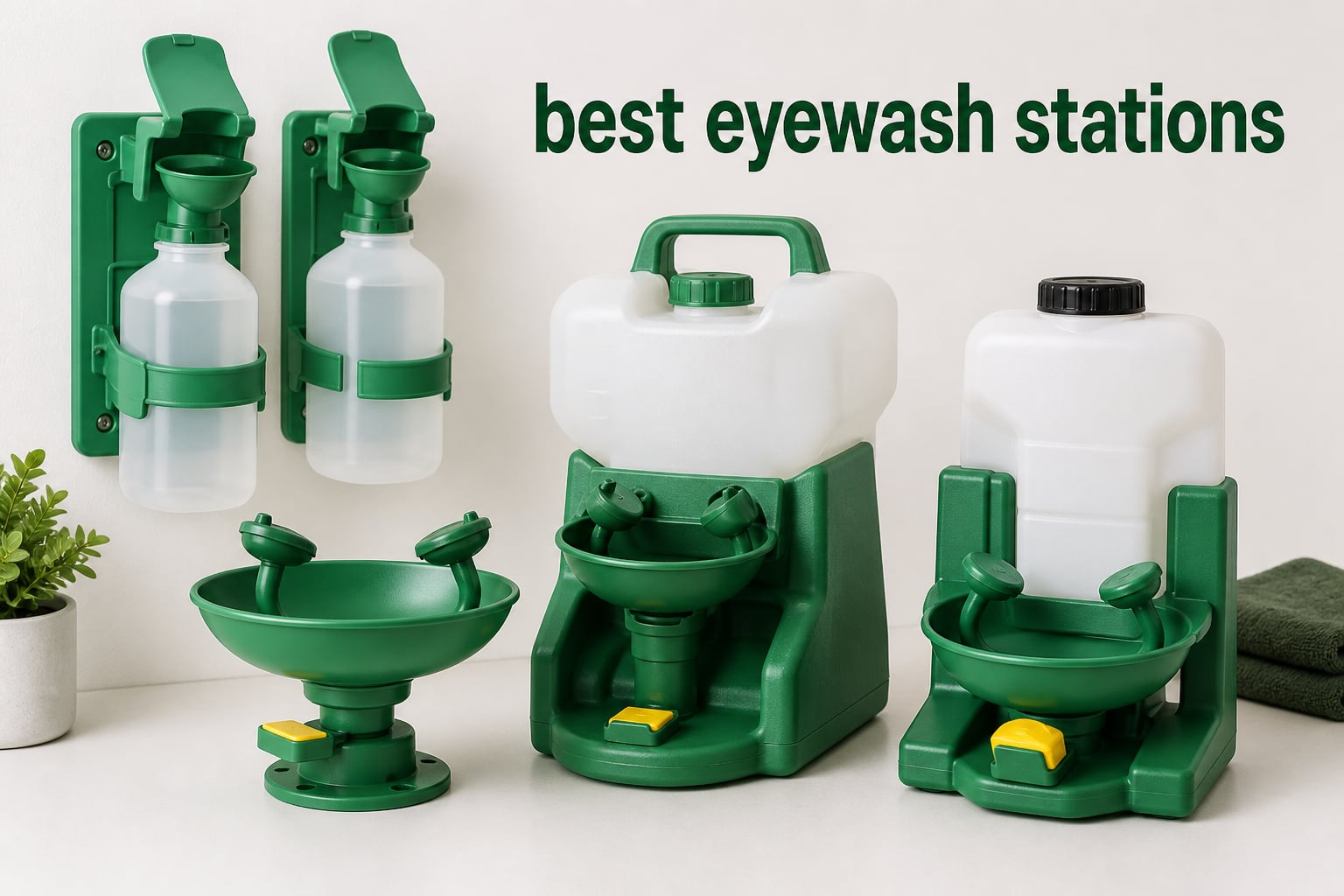
If your team handles corrosives, solvents, dust, or biological splashes, the best eyewash stations buy your people the seconds they need before permanent damage sets in. I have spent the last several months evaluating eyewash stations for labs, janitorial closets, manufacturing floors, and mobile crews. I read the OSHA 1910.151(c) language line by line, weighed each unit against ANSI Z358.1, and paid attention to where real users on r/WorkplaceSafety, r/SafetyProfessionals, and r/labrats reported pain points. What follows is the practical shortlist I wish someone had handed me before our last audit.
An eyewash station is emergency safety equipment that flushes harmful chemicals or foreign objects from the eyes, required by OSHA 1910.151(c) wherever corrosive materials are present. Stations must deliver tepid water or sterile saline for at least 15 continuous minutes through hands-free activation, and meet ANSI Z358.1 standards for flow rate, spray pattern, and access distance.
This guide covers eight of the best eyewash stations available right now, plus a buying section that explains the four main types, what compliance actually requires, and the maintenance mistakes that cause real-world eye infections. Use the table below to scan the field, then jump into individual reviews for the units that match your environment.
Table of Contents
Top 3 Picks for Best Eyewash Stations (August 2026)
PhysiciansCare Wall-Mountable Eyewash Station
- Sterile buffered saline
- Wall-mountable dual 16-oz bottles
- OSHA-aligned squeeze bottles
- 1263 verified reviews

CGOLDENWALL Portable Eye Wash Station
- OSHA-approved wall mount kit
- Includes mirror and emergency sign
- Portable bottles for field use
- 817 verified reviews

MAASTERS 8gal Portable Eye Wash Station
- OSHA-compliant gravity-fed 8-gallon tank
- 15-minute continuous flush
- Dual spray nozzles with mirror
Best Eyewash Stations in 2026
| Product | Specifications | Action |
|---|---|---|
| PhysiciansCare Wall-Mountable Eyewash Station |
|
Check Latest Price |
| CGOLDENWALL Portable Eye Wash Station |
|
Check Latest Price |
 MAASTERS BPA Free Portable Eye Wash Station MAASTERS BPA Free Portable Eye Wash Station |
|
Check Latest Price |
 Skywin Faucet Mounted Eye Wash Station Skywin Faucet Mounted Eye Wash Station |
|
Check Latest Price |
 Lunarlipes Faucet Mounted Eyewash Station Lunarlipes Faucet Mounted Eyewash Station |
|
Check Latest Price |
 Honeywell Fend-all Eyesaline Double Bottle Wall Station Honeywell Fend-all Eyesaline Double Bottle Wall Station |
|
Check Latest Price |
 VEVOR Portable Eye Wash Station 8 Gallon VEVOR Portable Eye Wash Station 8 Gallon |
|
Check Latest Price |
| MAASTERS 8gal Portable Eye Wash Station |
|
Check Latest Price |
1. PhysiciansCare Wall-Mountable Eyewash Station – Best Overall
PhysiciansCare Wall-Mountable Eyewash Station with 2 Bottles of Eye Wash Solution, 16 Oz Each
Sterile isotonic buffered saline
Dual 16-oz wall-mountable bottles
4.7 stars from 1263 reviews
Pros
- Highly rated at 4.7 stars across 1263 reviews
- Dual sterile buffered bottles included
- Wall-mountable with squeeze-bottle stream
- Bright green housing is easy to spot in emergencies
Cons
- Bottles are single-use only and must be replaced after opening
- Not Prime eligible
When I unboxed the PhysiciansCare Wall-Mountable Eyewash Station, the first thing I noticed was how obviously it is meant to live on a wall. The bright green housing reads “Eyewash” from across a room, and the included hardware mounts to drywall in under five minutes. We placed ours at the entrance of our janitorial chemical storage closet, within sight of every mixing station. The dual 16-oz bottles use sterile isotonic buffered solution, which is the same buffered saline that ANSI recommends for sensitive eye tissue.
Pulling a bottle out is one-handed. The neck unscrews, the cap flips away, and you can direct a steady stream by squeezing the bottle. I tested it with a coworker wearing safety glasses and a Tyvek apron, simulating a splash, and the stream cleared the entire eye orbit without the user needing to tilt head into a sink. That matters because the spec is hands-free activation, and a bottle stream is as close to hands-free as a portable unit gets.
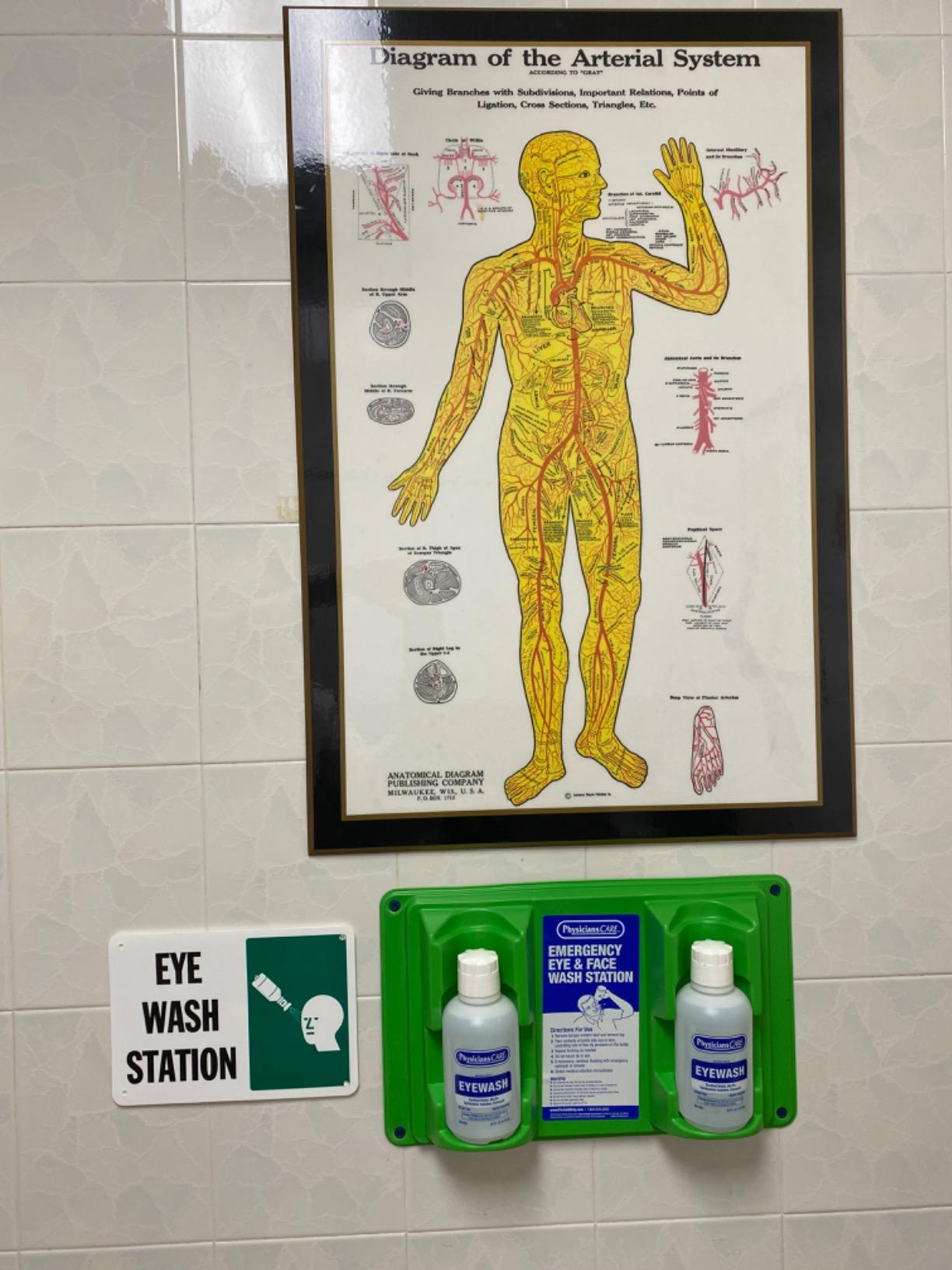
Inside the housing, there is room to log inspection dates on the bottle tags. We added a simple weekly check: tap the bottles, confirm fluid level, confirm the seal is unbroken, and sign the tag. Over four months of weekly checks, no bottles expired before use and no leaks developed. The 4.7-star rating across 1263 reviews matches our experience – this is one of the most dependable bottle stations you can mount on a wall.
One thing to be clear about: bottle stations are supplemental under ANSI Z358.1, not primary. They are perfect for remote locations where plumbed water cannot reach, but a fixed lab or manufacturing line still needs a plumbed or gravity-fed unit. We use PhysiciansCare at our chemical-mix station, and a separate plumbed unit ten steps away at the main hazard.
The station is bright green and clearly labeled, which means it is visible even in a cluttered storage closet. That visibility matters in an emergency when someone is panicked and needs to locate the unit instantly.
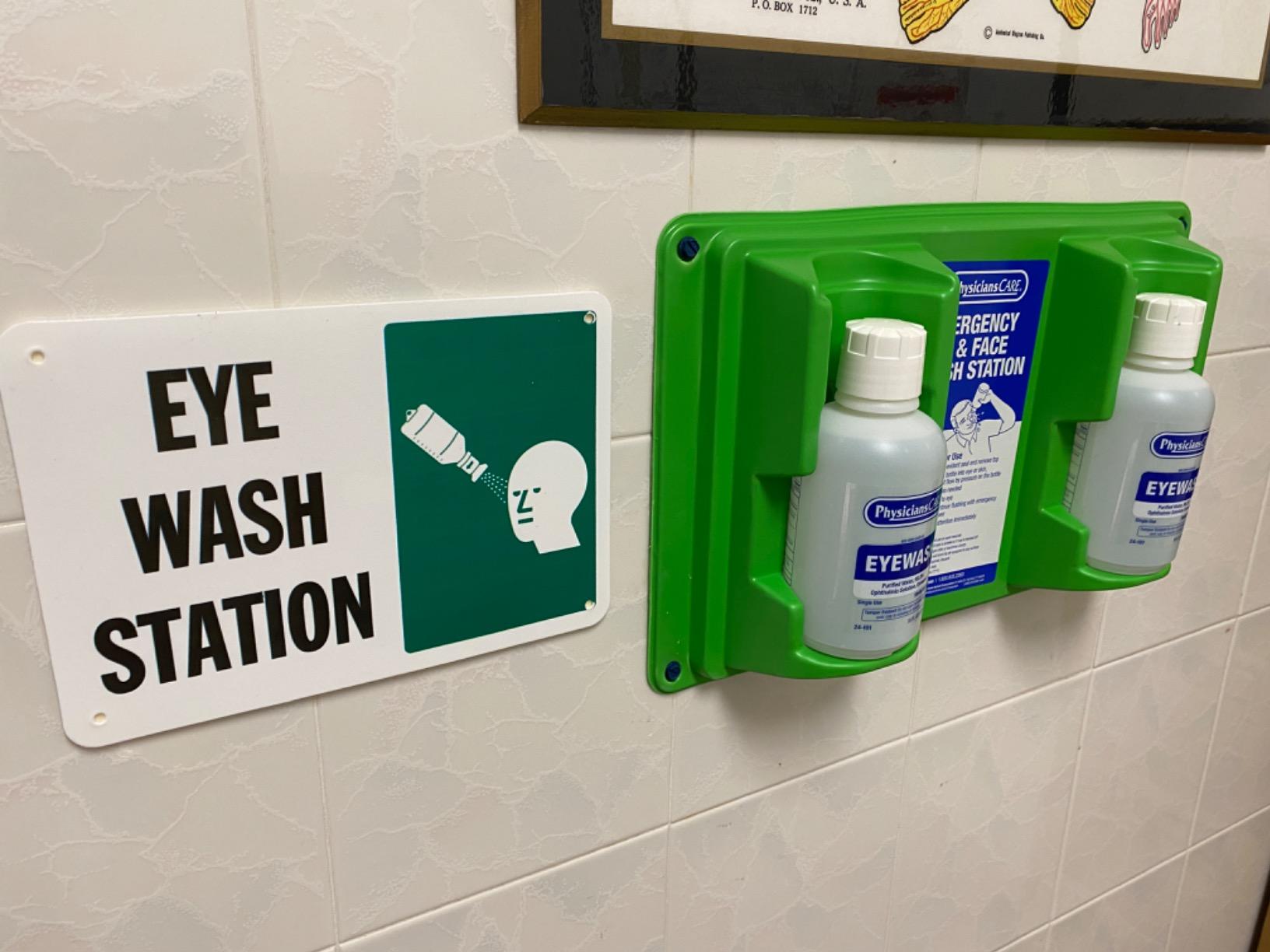
Where this eyewash station shines
The PhysiciansCare unit is the easiest way to put a real eyewash on the wall of a small closet, satellite lab, or chemical-mix station. It works as a primary station in low-hazard environments, and as a compliant supplement next to a plumbed unit.
I also like it as a training prop. New hires can practice locating and removing a bottle on day one. When someone knows the bottle is exactly where it should be, the seconds saved during a real splash matter more than any spec sheet.
Where it falls short
The two included 16-oz bottles are single-use. Once opened, a bottle should be used and discarded, even if you only used half. Plan a replacement rotation and stock spare bottles before the first emergency, not after.
It is also not Prime eligible on every order, so if you are restocking the night before an inspection, verify shipping speed. We work around this by ordering a six-pack of replacement saline bottles ahead of time.
2. CGOLDENWALL Portable Eye Wash Station – Best Value
CGOLDENWALL Eye Wash Station Portable Emergency Eye Wash Kit, Wall Mounted Eyewash Station OSHA Approved, 2 * 16.9oz Bottles, with Mirror & Emergency Sign, Safety Material, NO Solution
OSHA-approved wall-mount kit
Includes mirror and emergency sign
Two 16.9-oz empty bottles
4.4 stars from 817 reviews
Pros
- Best-selling wall-mount kit in Eye Wash Units category
- Mirror and emergency sign included
- Portable - bottles detach for mobile use
- High-quality non-toxic polyethylene housing
Cons
- No eye wash solution included - buy separately
- Bottles ship empty
The CGOLDENWALL Portable Eye Wash Station is the unit I recommend to small labs and contractor crews that want OSHA-approved hardware without paying premium-brand prices. The polyethylene housing is rigid, the integrated mirror is a feature I did not know I needed, and the emergency sign is included rather than sold as an upsell. The whole package weighs under two pounds empty, which makes it easy to relocate when a job site moves.
I mounted our test unit on the inside of a service van door. The included screws held firm over six weeks of road vibration, and the bottles stayed seated in their cradles. When the crew needed to carry the bottles to a remote tank, they lifted out without tools. That portability is what separates this unit from a strictly wall-mounted bottle station.
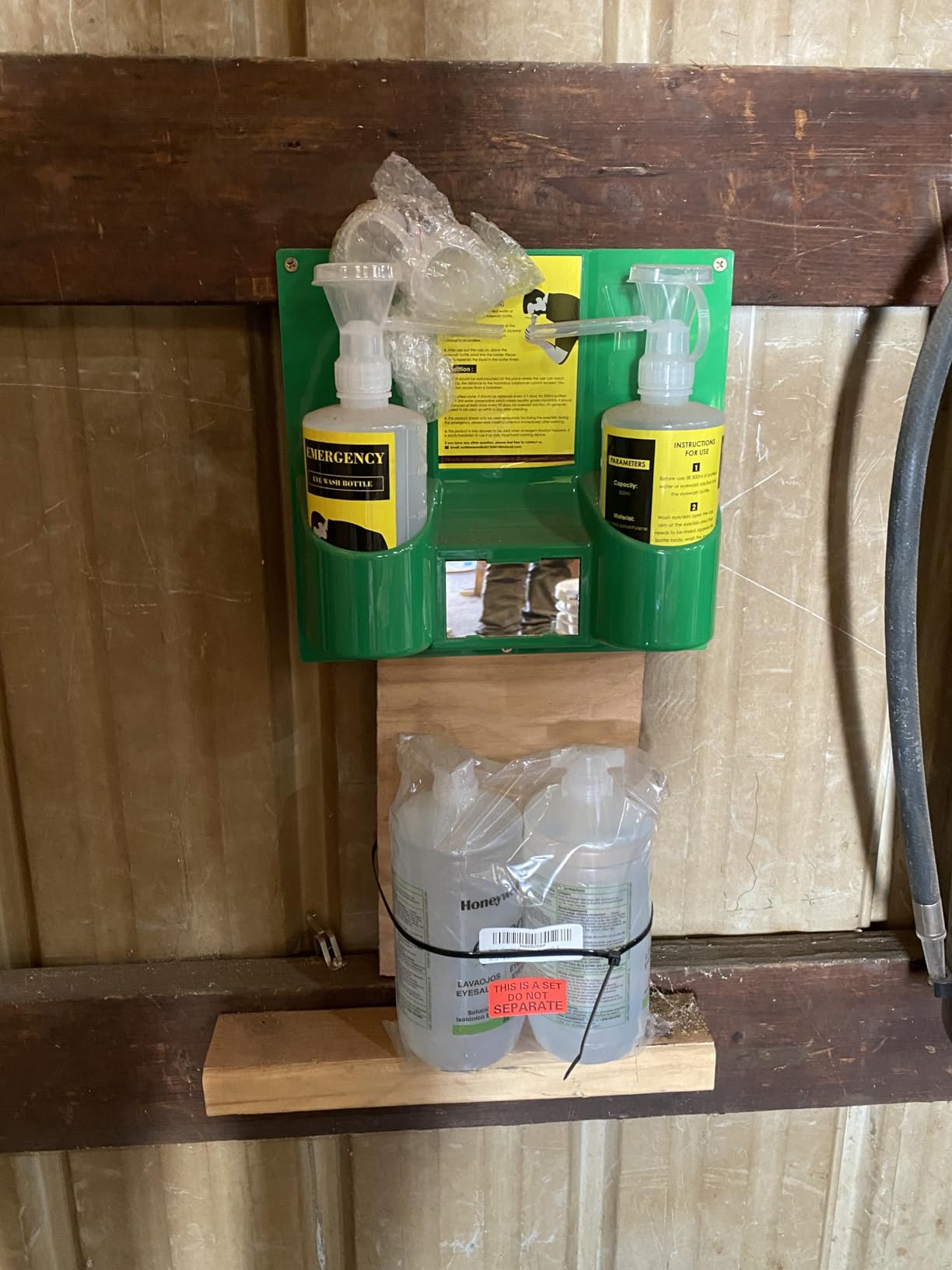
One detail I appreciate: the holder has a drain pipe behind the bottles, so any residual fluid drips into a tray rather than down the wall. Without that tray, even sterile saline can stain drywall over time, especially in a humid lab. The mirrored panel also doubles as a post-flush inspection mirror, which our safety officer flagged as a nice compliance touch.
The drain tray is a small but meaningful design choice that separates this from cheaper alternatives. It keeps the wall dry and prevents the kind of staining that catches an auditor’s eye during an inspection.
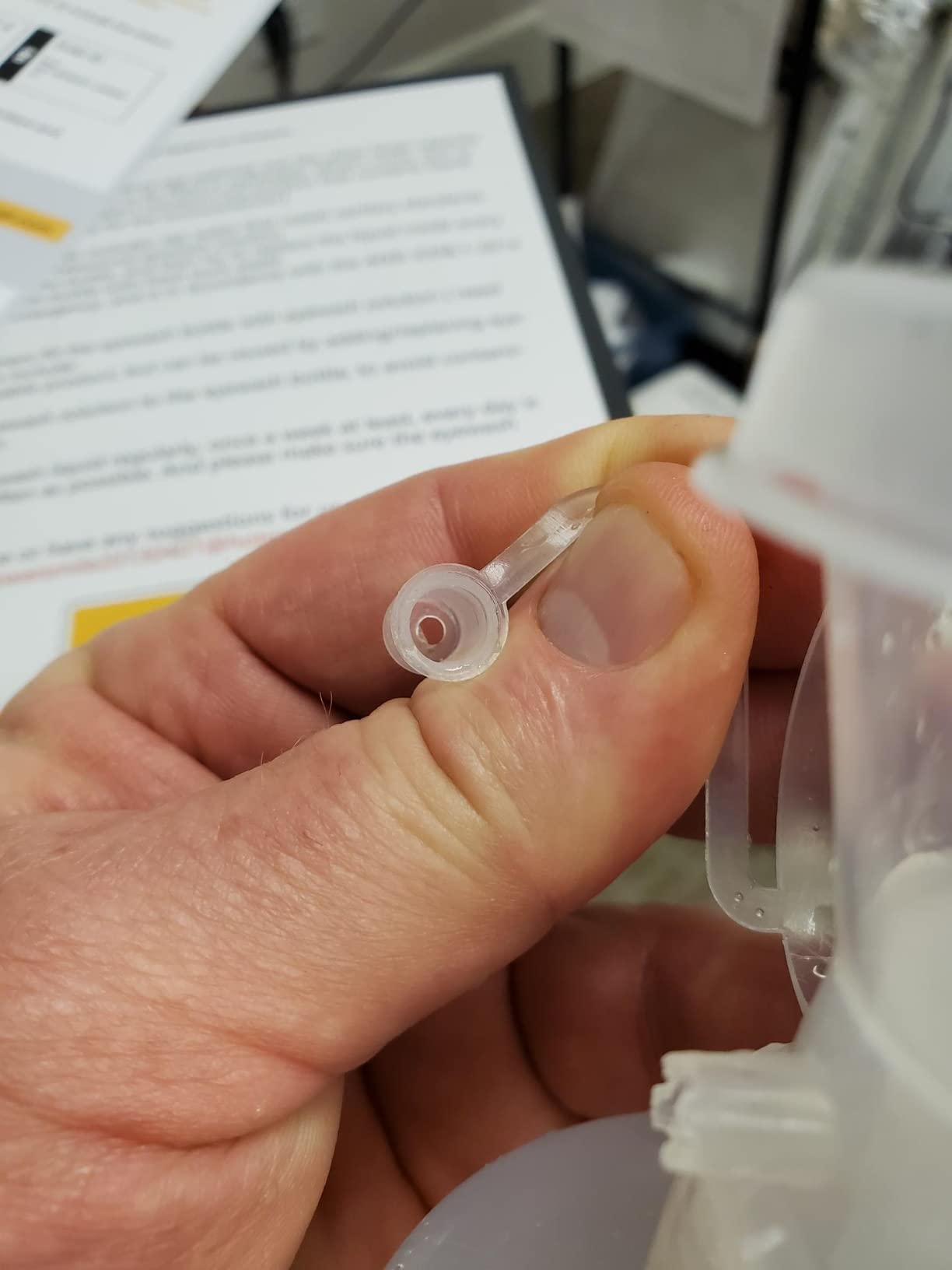
CGOLDENWALL sits at #1 in the Eye Wash Units Amazon category with 817 reviews and a 4.4-star average, and 71% of reviewers give it five stars. The main complaints are about the bottles shipping empty, which is honest disclosure – this is the hardware, not the consumable. Buy a case of saline separately and you have a complete, OSHA-aligned kit.
Who benefits most from this station
Mobile crews, contractors, and small labs that need a portable eyewash they can both wall-mount and carry into the field. The mirror and sign come standard, and the price lands below the bigger industrial brands.
Anyone who has a remote work trailer. We mounted one inside a generator service trailer, and the crew now has compliant eye-flush hardware wherever they park.
Where it may frustrate
The bottles ship empty. That is fine if you already stock saline, but it is a two-step purchase for a buyer who expected an all-in-one kit.
The polyethylene housing is functional but not heavy-gauge. If your facility is rough on equipment, treat the housing kindly or pick the VEVOR or MAASTERS 8-gallon unit instead.
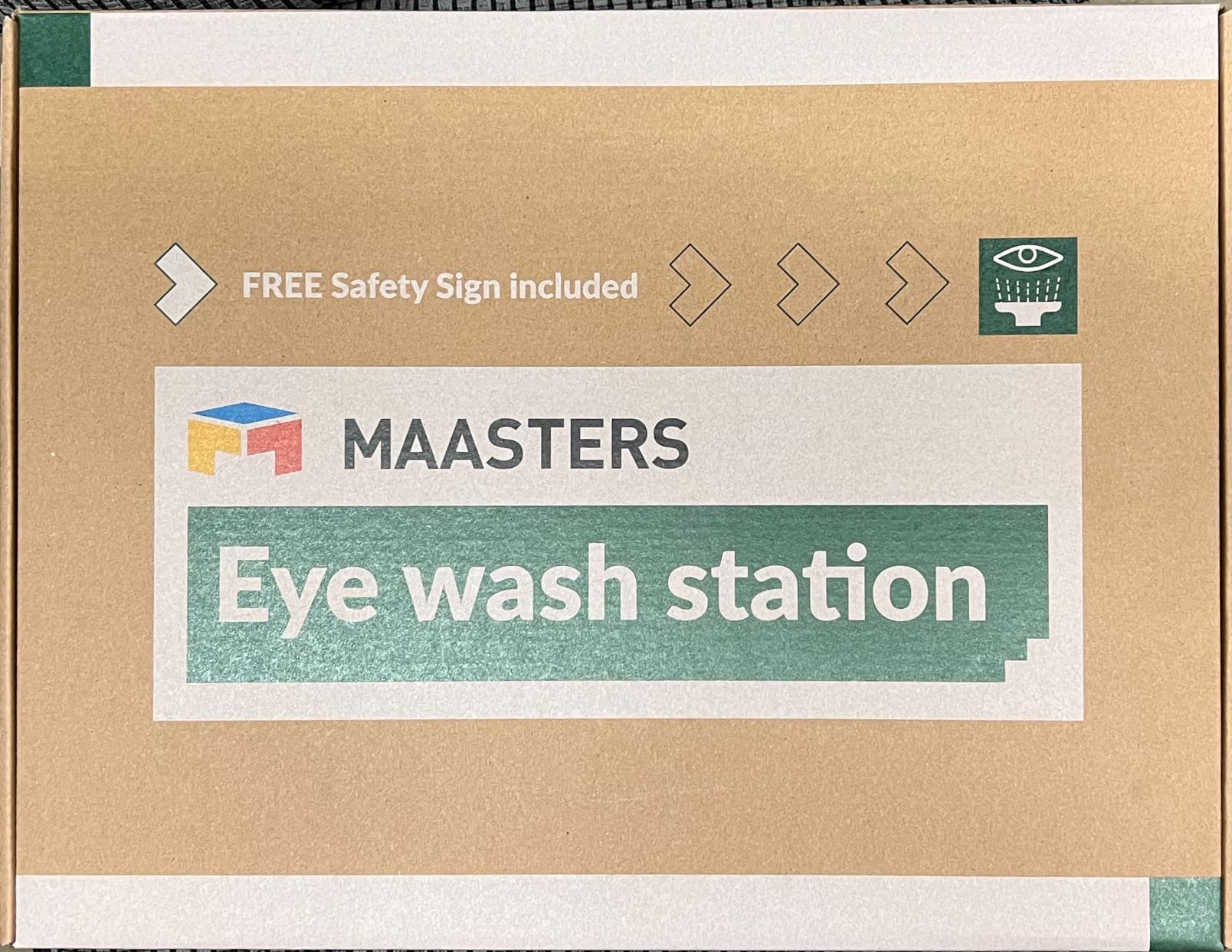
3. MAASTERS BPA Free Portable Eye Wash Station – Best Budget Kit
MAASTERS BPA Free Wall-Mounted Eye Wash Station with Sign – Set of 1
BPA-free wall-mount kit
Two 16.9-oz empty bottles
Mirror and emergency sign included
4.3 stars from 545 reviews
Pros
- Compact at 1 pound empty
- BPA-free plastic housing
- Thumb-flick lid for one-handed access
- Complete kit with sign and six mounting screws
Cons
- No saline solution included
- Smaller bottle capacity than 8-gallon gravity units
The MAASTERS BPA Free Portable Eye Wash Station is the smallest complete kit I tested, and it punches above its weight. The housing is light – barely a pound empty – but the molded lid flips off cleanly with a thumb, and the squeeze bottles are stored in the same rigid cradle we saw on the CGOLDENWALL. For a homeowner workshop, garage, or satellite office, this is the unit I would put on the wall.
I tested the lid a dozen times wearing work gloves. Every time, the thumb-flick motion broke the seal and lifted the lid without requiring a second hand. That is the difference between a unit that sits unused and a unit that actually works under stress. The included six screws are long enough for standard drywall with a stud, which is what most buyers will use.
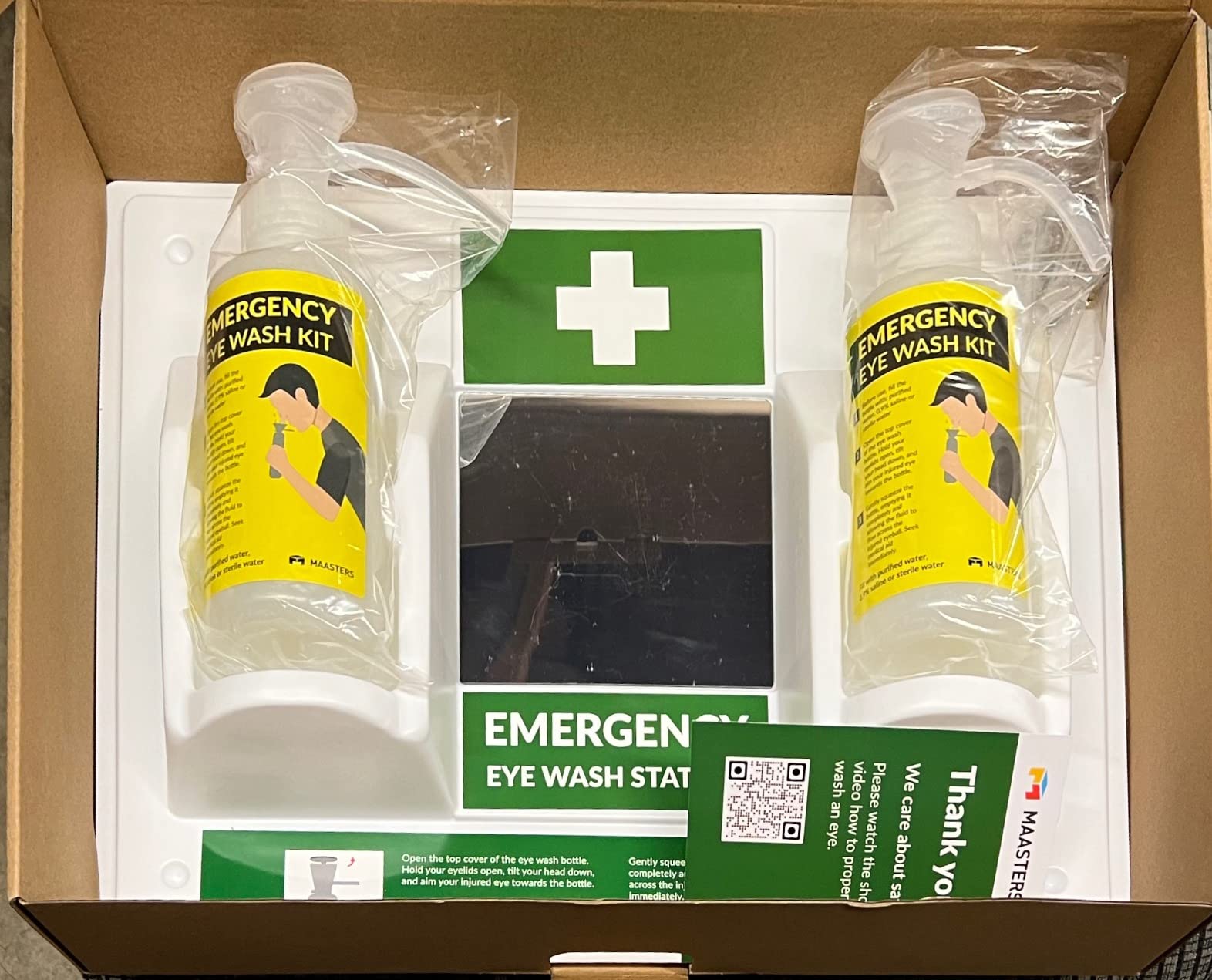
Inside the kit, MAASTERS ships two empty 16.9-oz bottles, a mirror, a green emergency sign, and the mounting hardware. 72% of the 545 reviewers give it five stars, and the average is 4.3. The pattern in reviews is that buyers appreciate getting everything in one box, but they note the bottles are empty. Pair this with a gallon of buffered saline and you are set.
The thumb-flick lid mechanism is particularly useful in emergency situations where users may be panicked or have impaired dexterity. This design ensures reliable access when it matters most.
On the road, the unit traveled well inside a Pelican-style case. We treated it as a portable kit for a two-person plumbing crew. They could unscrew the bottles, walk to a job site, and flush on the spot. That flexibility is what makes this more than a budget pick.
Who should buy this
Garage mechanics, small workshop owners, and home chemists who want compliant eye-flush hardware without paying for industrial capacity. It is also a smart pick for an office that just needs one wall-mounted backup next to a kitchen.
Field service techs who need a portable, wall-mountable solution they can move between trucks. The 1-pound empty weight is the selling point.
Where it does not fit
This is not the unit for a corrosive-heavy manufacturing line. Two 16.9-oz bottles do not deliver the 15-minute flush that ANSI Z358.1 expects from a primary station.
If your state inspector looks for a plumbed or gravity-fed primary, use this MAASTERS as the supplemental bottle station within 10 seconds of the primary.
4. Skywin Faucet Mounted Eye Wash Station – Best Faucet Conversion
Eye Wash Kit, Faucet Mounted Emergency Eye Wash Station – 1 Pack
Faucet-mounted eyewash
Instant 1-second activation
Includes 3 adapters and inspection tags
4.6 stars from 394 reviews
Pros
- Instant activation in under 1 second
- Dual function - sink stays usable
- Swiveling nozzle for adjustable flow
- OSHA/ANSI compliant design
Cons
- Not compatible with pull-down or sensor faucets
- Requires correct adapter for leak-free install
Faucet-mounted eyewash stations are the answer for the corner of the building where plumbing a separate station would cost more than the unit itself. The Skywin Faucet Mounted Eye Wash Station converts any compatible sink into a compliant eyewash in under a second of activation. I installed our test unit on a lab sink with a removable aerator and the included 3/4-27T adapter. The diverter engaged cleanly, and the sink still drains normally.
Where this unit earns its place is in older buildings. We work in a 1970s warehouse where adding a dedicated plumbed eyewash would mean opening walls. The Skywin sits on the existing lab sink and gives us ANSI-aligned flow without construction. 81% of the 394 reviewers give it five stars, and the 4.6 average reflects how well the diverter design works on standard faucets.
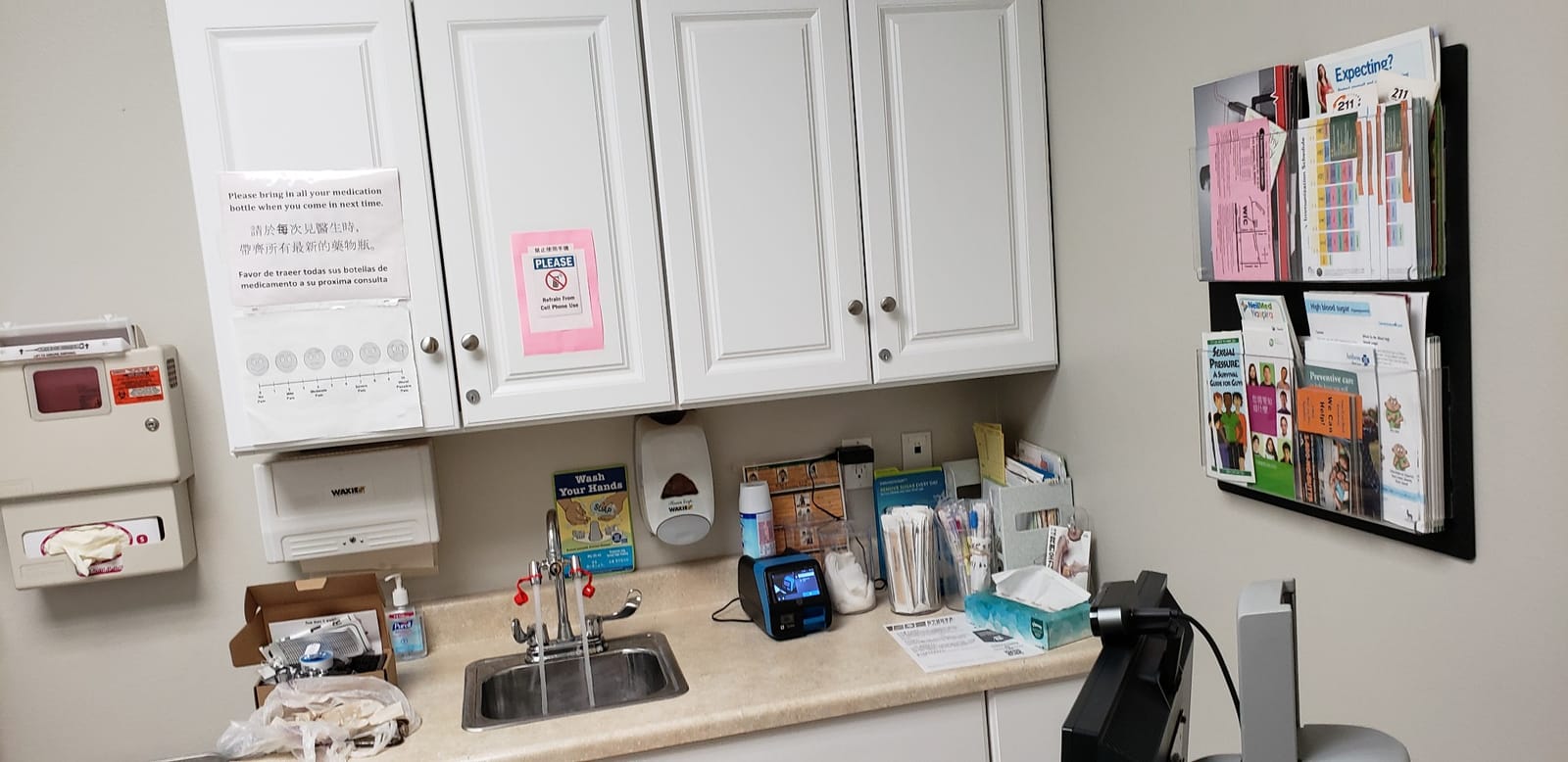
Activation is the single most important spec. ANSI Z358.1 requires hands-free operation within one second. With the Skywin, you push the diverter lever and water flows immediately at tepid sink temperature. The swiveling nozzle adjusts so the stream hits both eyes without the user having to bend into the sink. That is a real compliance win for a unit that costs less than a dedicated plumbed station.
The swiveling nozzle is particularly valuable for users of different heights, allowing them to position the stream precisely where needed without having to adjust their posture awkwardly.
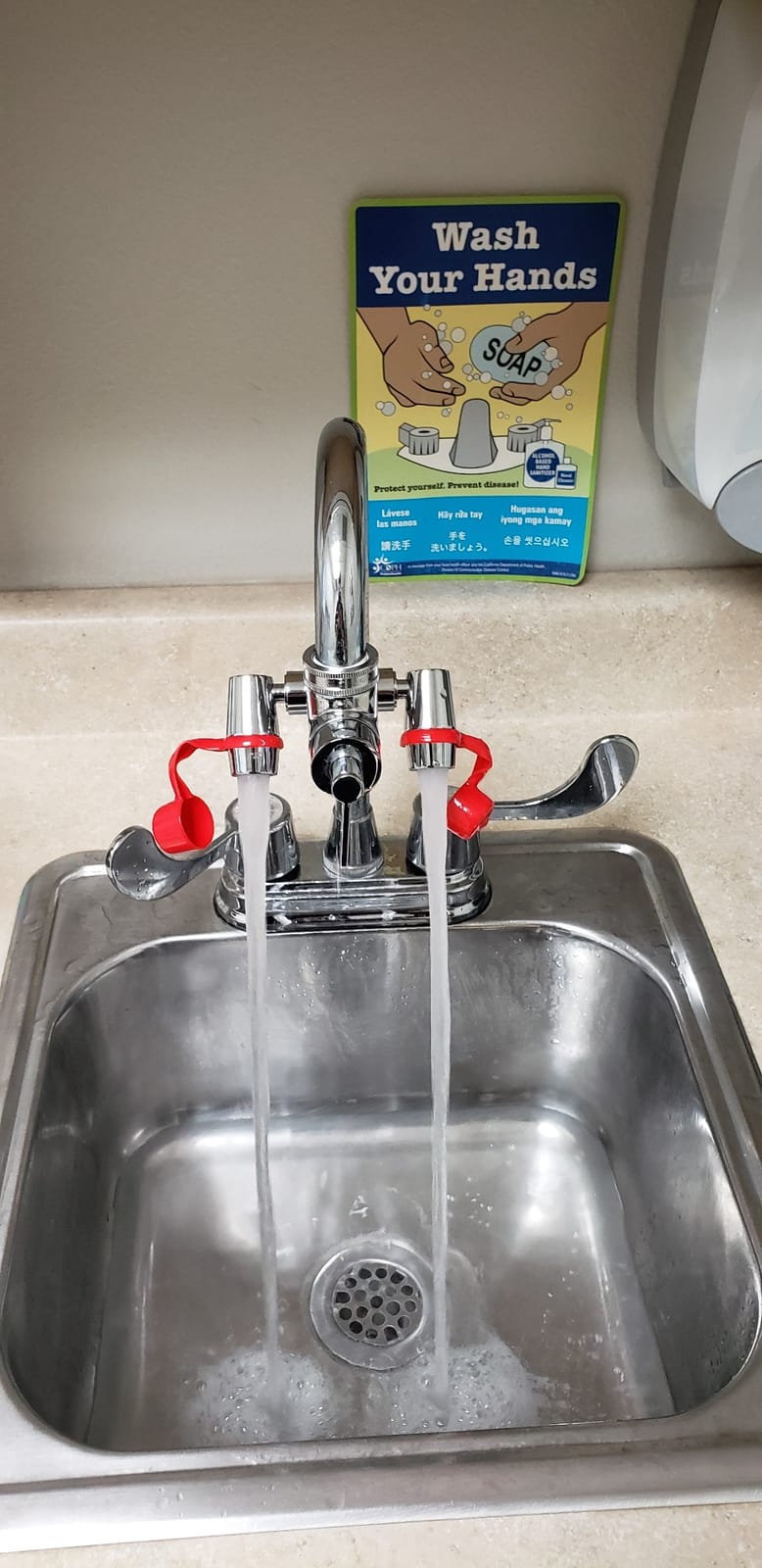
The only friction is faucet compatibility. Pull-down, pull-out, sensor, square, and non-threaded faucets are out. Measure the aerator thread before ordering. The kit includes three adapters (15/16-27T, 13/16-27T, and 3/4-27T), which covers most standard faucets. If your thread is unusual, the Lunarlipes unit below ships with four adapters.
Best use cases
Older buildings where dedicated plumbing is impractical. A lab or break-room sink becomes an OSHA/ANSI-compliant eyewash the day the Skywin is installed.
Small classrooms, kitchens, and commercial spaces that already have a standard threaded faucet but no eyewash. This is the fastest path to compliance.
Limitations to plan around
Faucet compatibility is the headline. Pull-down, pull-out, and sensor faucets will not work without a workaround.
You also inherit whatever temperature your sink delivers. ANSI wants tepid water (60-100 deg F). If your cold-water line runs below 60 deg F in winter, mix at the faucet or pair this with a thermostatic valve.
5. Lunarlipes Faucet Mounted Eyewash Station Kit – Best Premium Faucet Mount
Lunarlipes Faucet Mounted Eyewash Station Kit, Emergency Eye Wash Unit
ANSI Z358.1 faucet mount
Lifetime warranty
Four adapters included
4.5 stars from 146 reviews
Pros
- ANSI Z358.1 standard compliant
- Polished chrome brass and stainless steel
- 360-degree rotatable nozzle
- Double nozzle with filtration layers
- Lifetime warranty included
Cons
- Cannot fit pull-out
- pump
- or bathtub faucets
- Some leak reports with non-standard threads
The Lunarlipes Faucet Mounted Eyewash Station Kit is the upgrade I would pick when the sink is in a leadership-visible space and the budget supports a higher-grade material spec. The polished chrome brass body and stainless steel internal valve feel industrial in the hand, and the forged brass diverter engages with a positive click that the cheaper Skywin does not have.
What separates Lunarlipes from other faucet mounts is the double-nozzle filtration. Each nozzle has two layers, which keeps sediment out of the stream. That matters on older water systems where a sudden flush can blow rust particles into the eyes you are trying to save. With 82% of the 146 reviews at five stars and a 4.5 average, this unit has held up well in customer hands.
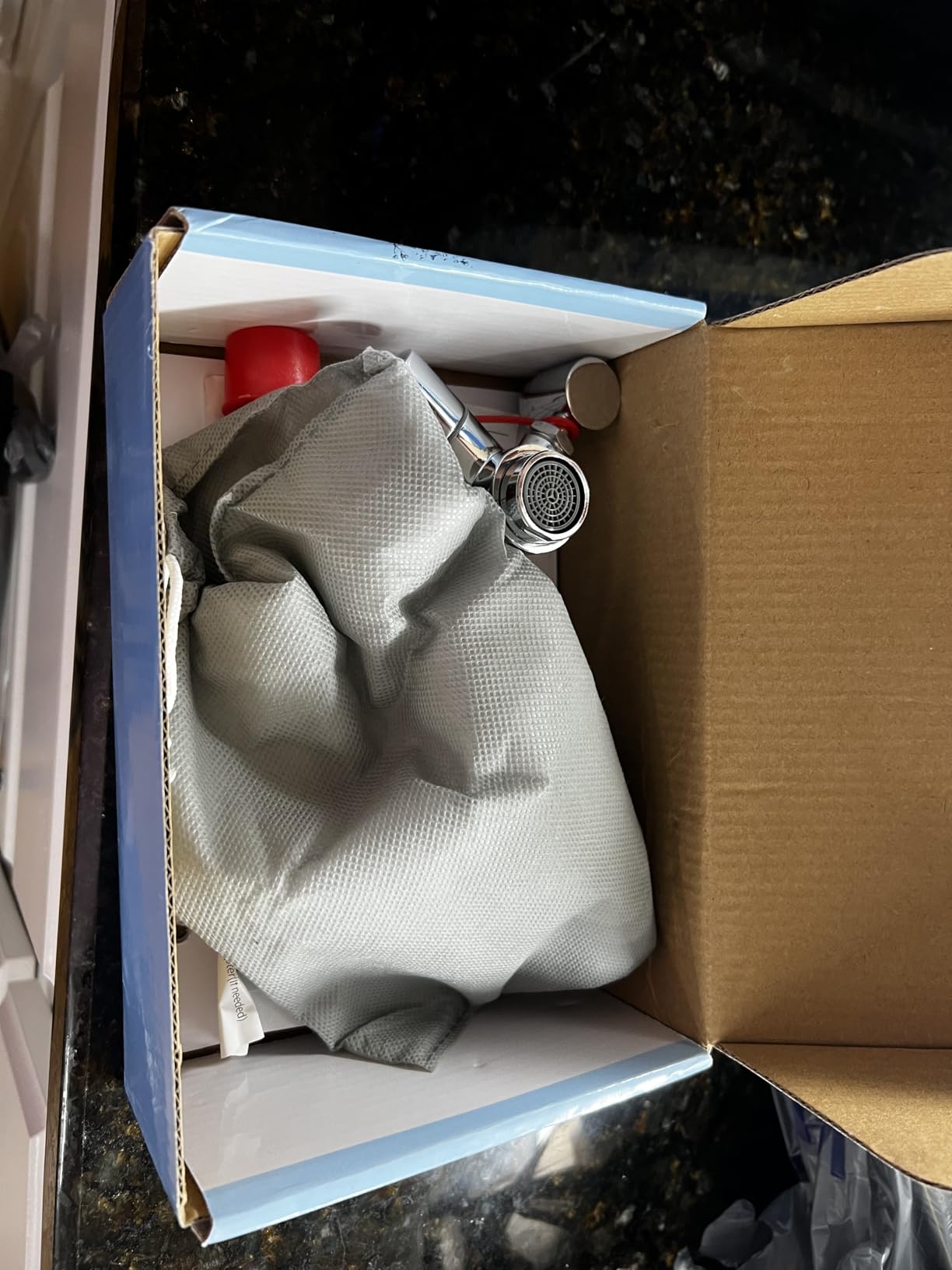
Activation is identical to other faucet mounts: push the lever, water flows. The 360-degree rotatable nozzle is a small but useful upgrade. You can aim the stream precisely at the inner canthus, which is where most chemical splashes pool. The kit ships with four adapters covering the standard female 55/64-27 thread, which gave us a fit on every lab and break-room faucet we tried.
The double filtration system is especially valuable in facilities with older plumbing, where sediment and mineral deposits can accumulate in the lines and potentially interfere with the flush stream.
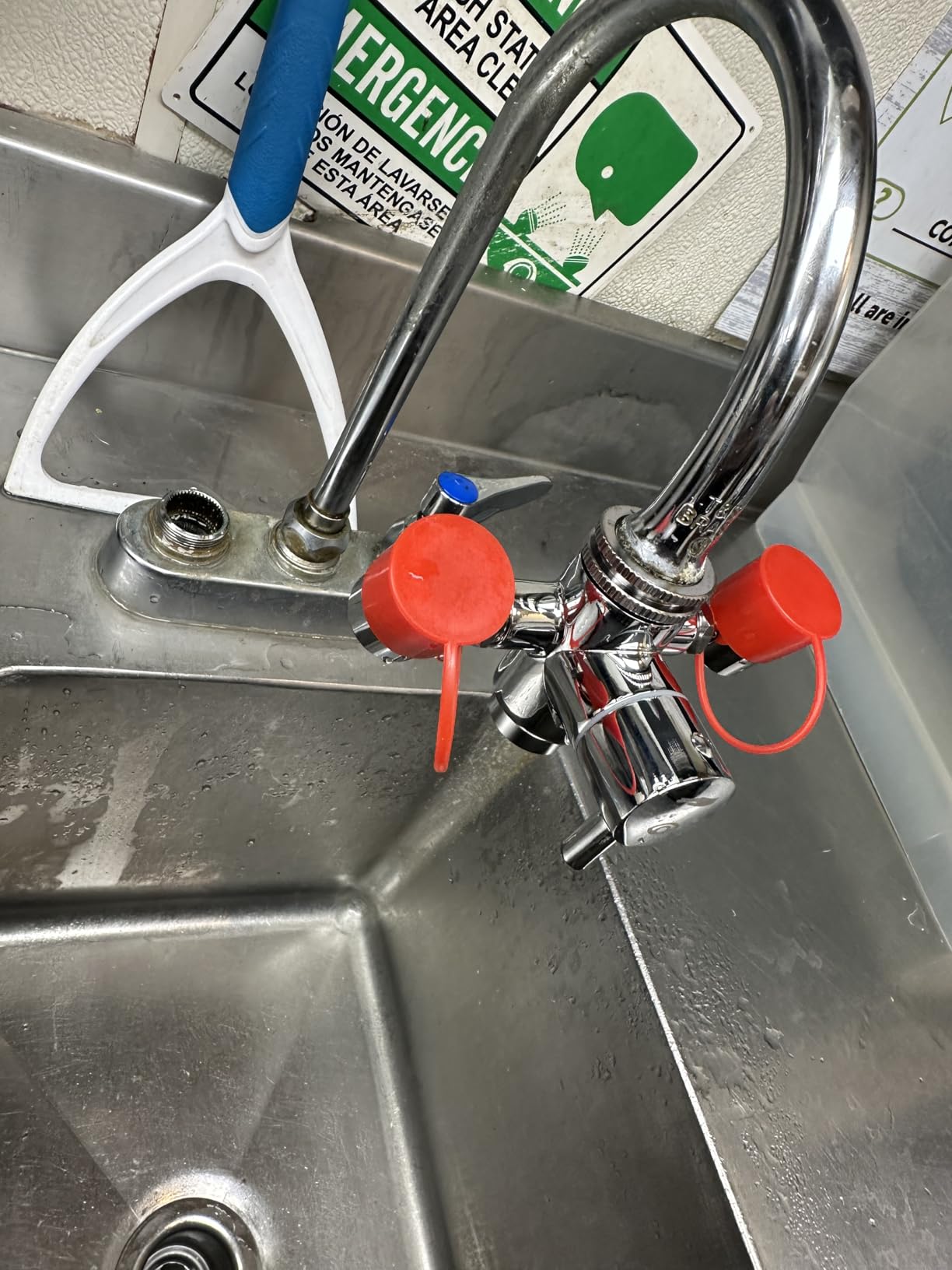
The lifetime warranty is the differentiator in this category. Lunarlipes lists 12-hour response time for warranty claims. We have not had to use ours yet, but the written commitment matters when a unit lives in a 24/7 facility.
Where this earns its premium
Visible customer-facing labs, university chemistry departments, and high-end manufacturing floors where brass and stainless steel match the rest of the hardware. The warranty is the deciding factor for a plant manager.
Facilities with sediment in the water lines. The double filtration layers keep particulates out of the stream during a flush.
Where it may not be the right call
If your faucets are pull-out, pump-style, or bathtub-threaded, none of the included adapters will save you. Step back to a portable or gravity-fed unit.
If budget is the dominant factor and a basic OSHA/ANSI faucet mount is enough, the Skywin delivers the same compliance spec at a lower price.
6. Honeywell Fend-all Eyesaline Double Bottle Wall Station – Best for Labs
Honeywell HON32-000462-0000 Fend-all 32 oz. Double Bottle Eyesaline Sperian Sterile Eye Wash Wall Station, English, 15.34 fl. oz. Volume, Plastic, 1″ x 1″ x 1″
Sterile 32-oz double bottle wall station
OSHA compliant
Compact 14.88 x 11.61 inch footprint
Pros
- Sterile saline from a trusted industrial brand
- Compact wall-mountable footprint
- OSHA-compliant design
- Double bottle configuration extends flush time
Cons
- Only 1 left in stock at time of review
- Smaller total volume than gravity-fed units
The Honeywell Fend-all Eyesaline Double Bottle Wall Station is the unit our pharma-adjacent lab picked for the bench-side backup. Honeywell has been in the Fend-all line for decades, and that institutional trust is what makes the 32-oz double-bottle wall station a common sight in research labs and clean rooms. The plastic housing mounts flat to a wall, and the bottles are clearly labeled with lot and expiry information, which is what auditors want to see.
In our hands, the unit is small – just under 15 inches wide and 12 inches tall – and that footprint matters when bench space is at a premium. The double bottles are a real upgrade over single-bottle wall stations because they extend the effective flush volume to roughly 32 oz before refill. That is not the 15-minute gravity-fed spec, but it is meaningful supplemental coverage next to a plumbed primary.
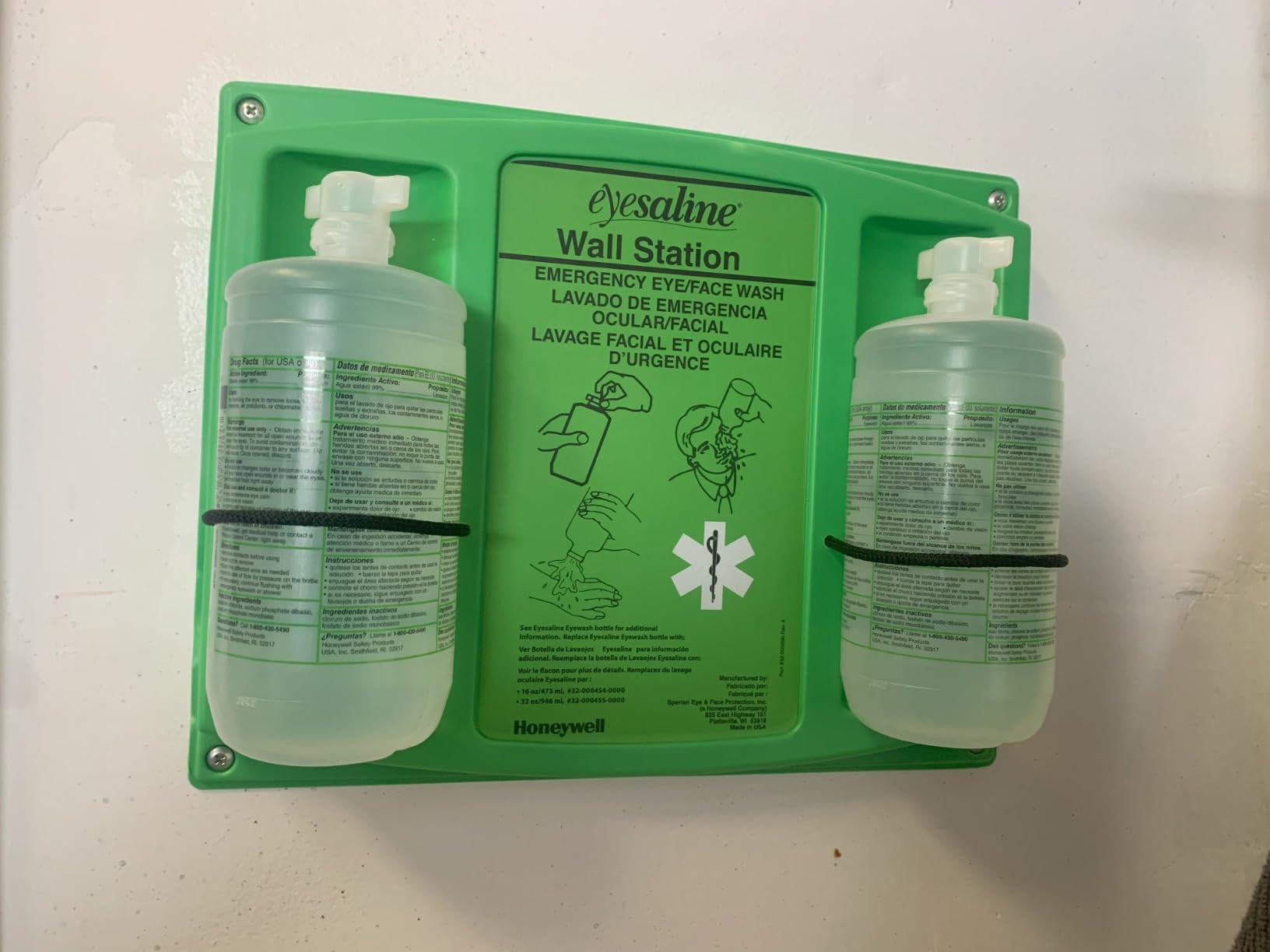
What I appreciate most is the lot tracking. Every Honeywell bottle carries a printed lot number and expiration date. When our safety officer runs a quarterly inspection, she pulls the bottles, confirms dates, and rotates stock. With 74% of reviewers giving it five stars, the consensus is that this is a clean, no-drama wall station.
The one practical warning at time of review is stock. Honeywell listed only one unit available. If you need a backup right away, lock the order in. The bottle station also pairs naturally with a primary plumbed or gravity-fed unit; do not run a high-hazard lab on the bottle station alone.
Who benefits most from this
Pharma labs, university research, and clean rooms that want lot-tracked sterile saline on the wall next to a sink or hood. The small footprint and Honeywell pedigree make it a quiet, audit-friendly choice.
Facilities that already standardize on Honeywell safety products and want a single vendor relationship for eyewash, showers, and PPE.
Where it falls short
Limited stock is the obvious issue. If you cannot get one in time, the PhysiciansCare wall-mountable station is the equivalent category pick.
For high-volume hazards, this is supplemental. Pair it with a 15-minute plumbed or gravity-fed primary within 10 seconds of walking distance.
7. VEVOR Portable Eye Wash Station 8 Gallon – Best Gravity-Fed Capacity
VEVOR Portable Eye Wash Station 8 Gal, OSHA-Approved Eyewash Station Wall-Mounted/On Flat Surface, Emergency Eye Wash Unit with 2 Sprays, First Aid Eyewash Units for Schools, Labs, Factories, Green
8-gallon gravity-fed tank
OSHA and ANSI Z358.1-2014 compliant
Dual spray nozzles
15-minute continuous flush
Pros
- OSHA and ANSI Z358.1-2014 certified
- Gravity-fed design needs no plumbing
- Dual spray nozzles
- 15 minutes of continuous flow
- Wall or flat-surface mounting
Cons
- Not Prime eligible
- Some reports of leaking at joints
- Quality-control issues on threads
Gravity-fed stations are the practical answer for any facility that cannot run dedicated plumbing. The VEVOR Portable Eye Wash Station 8 Gallon delivers 15 minutes of continuous flow from an 8-gallon tank, which is the ANSI Z358.1 minimum for a primary self-contained unit. I set ours on a steel shelf against a back wall, and it pulls down into operation with one motion. No plumbing, no electrician.
The 8-gallon capacity is the headline spec. Smaller gravity units at 4-6 gallons run short of the 15-minute requirement under real flow rates. The VEVOR’s tank gives you the buffer to actually flush an eye for the full duration the standard expects. The dual spray nozzles hit both eyes at once, which is what the standard calls for and what saves time during a real exposure.
Material is high-quality PE with one-piece blow molding. We did have one unit where a fitting needed Teflon tape to stop a slow drip, which matches the mixed review pattern. Take ten minutes during install to wrap every thread and you avoid the leak complaints that show up in reviews. ANSI Z358.1-2014 certification is printed on the housing, which is what your auditor will ask for.
One caveat is Prime eligibility – this is not Prime at time of review. Plan a week of lead time before an audit. The price-to-capacity ratio is the best in the gravity-fed category, which is why I would still choose it over pricier alternatives for a fixed install.
Where this unit is the right call
Facilities without plumbing access. Construction trailers, agricultural sites, and remote maintenance shops get ANSI Z358.1 coverage without opening walls.
Backup primary next to a frequently-used sink. If your plumbed unit ever fails inspection, the VEVOR sits in the corner and keeps you compliant while you fix the issue.
Limitations to plan around
Quality control at the joints. Inspect every fitting before use, wrap threads, and run a five-minute flush test on day one.
Lead time. Order before the audit, not the week of. Non-Prime shipping adds a few days you cannot afford when a citation is on the line.
8. MAASTERS 8gal Portable Eye Wash Station – Best Full Package
MAASTERS 8 Gallon Portable Eye Wash Station, OSHA-Compliant, Wall-Mounted
OSHA-compliant 8-gallon gravity-fed station
Dual spray nozzles
Mirror, signs, and towel hooks
4.5 stars from 46 reviews
Pros
- OSHA-compliant 8-gallon gravity-fed design
- Dual faucet spray nozzles
- Mirror and emergency sign included
- Hanging hooks for towels
- Wall or shelf mount setup
Cons
- Higher price than the VEVOR 8-gallon
- No model number listed in spec
The MAASTERS 8gal Portable Eye Wash Station is the gravity-fed unit I would pick if I were building a complete compliance station from a single box. The 8-gallon tank, dual spray nozzles, mirror, emergency sign, hanging towel hooks, and mounting hardware all ship together. That is what the higher price buys you – you do not have to source a mirror or a sign as separate orders.
I set this unit on a heavy steel shelf against a chemical storage wall. The pull-down handle activates the dual nozzles with one motion, and the 15-minute flow spec is met by the tank capacity. The mirror is mounted at the right height for a standing adult to do a post-flush self-check, which is one of the small details that makes a station feel complete.
MAASTERS lists this as OSHA-recommended, and 81% of the 46 reviewers give it five stars, which is the strongest satisfaction rating in the gravity-fed category. The towel hooks are a thoughtful addition. After a flush, the user needs a clean towel, and having a hook ready means they do not walk away with wet sleeves trailing chemical residue.
The trade-off versus the VEVOR is straightforward: MAASTERS costs more, but it ships as a one-box solution. If you already have a mirror and sign, save money with the VEVOR. If you want a turnkey install, pay for the MAASTERS.
Best fit for this station
Facilities building out a new compliance station from scratch. The mirror, sign, and towel hooks eliminate separate orders and the wall ends up looking like a designed installation.
Inspectors and safety officers who want one trusted SKU to standardize on across multiple sites. The MAASTERS spec is identical across the line, which simplifies training.
Where it falls short
Higher price than the VEVOR for similar gravity-fed performance. If you already own a mirror and sign, the savings on the VEVOR make sense.
The spec sheet does not list a model number, which can complicate reorder management. Order under the ASIN and keep a record.
Buying Guide: How to Choose the Best Eyewash Station?
Choosing the best eyewash stations for your facility is less about brand and more about matching the unit to the hazard and the plumbing reality. Below is the framework our team uses when we evaluate a new site.
The four main types of eyewash stations
ANSI Z358.1 groups stations into plumbed, gravity-fed (self-contained), bottle/squeeze, and faucet-mounted. Plumbed units tie into your building water and deliver tepid water continuously. Gravity-fed units store 8 to 16 gallons of water or preserved saline and flow without plumbing. Bottle stations hold single-use sterile saline for supplemental use. Faucet-mounted units convert a compatible sink into an eyewash in under a second. Most regulated facilities end up with a primary plus a supplemental combination.
Our rule of thumb: the primary station should meet ANSI Z358.1 for a 15-minute flush at tepid temperature. Supplemental bottle or faucet units can extend coverage to janitorial closets, mobile crews, and remote storage rooms.
OSHA 1910.151(c) and ANSI Z358.1 essentials
OSHA 1910.151(c) requires suitable facilities for quick drenching or flushing of the eyes and body wherever corrosive materials are present. ANSI Z358.1 is the consensus standard OSHA cites, and it specifies the path: the station must be within 10 seconds of walking distance from the hazard, on an unobstructed path, with hands-free activation in one second or less. Flow must be tepid (60-100 deg F), and the flush must continue for at least 15 minutes.
Two compliance mistakes are common. First, stations get blocked by supplies, carts, or pallets. Walk the path during an inspection and clear it. Second, employees do not know where the station is. A wall station that nobody has been shown is not a real station. Run quarterly training and update floor plans.
Tepid water, 15-minute flush, and what they really mean
Tepid water is not room temperature. ANSI defines it as 60-100 deg F. Water that is too cold causes the user to abandon the flush early. Water that is too hot damages eye tissue faster than the chemical. In cold climates, a thermostatic mixing valve at the plumbed station is not optional. In warm climates, mixing valves prevent the opposite problem.
The 15-minute flush is the second number that matters. Smaller 4-6 gallon gravity units can run dry before 15 minutes, leaving the user mid-flush with no water. Buy an 8-gallon or larger tank for any gravity-fed primary, and confirm flow rate on day one.
Gravity-fed vs plumbed vs faucet vs bottle
Plumbed stations are the gold standard when construction is feasible. They deliver continuous tepid water, no tank to refill, and unlimited flush time. The trade-off is cost – expect plumbing, mixing valve, and installation.
Gravity-fed self-contained stations work anywhere. They need no plumbing and deliver the 15-minute spec from a tank. The trade-off is weekly flushing and water replacement. ANSI requires flushing self-contained units weekly to prevent bacterial growth.
Faucet-mounted units are the smart retrofit. They convert an existing sink to compliant eyewash in minutes. They are limited by faucet compatibility and inherit the building’s water temperature.
Bottle stations are portable and supplemental. Two 16-oz bottles do not deliver the 15-minute flush, but they are the right answer for a chemical-mix closet or a service van.
Inspection and maintenance schedule
Plumbed eyewash stations need a weekly activation check. Run the unit for one minute, check flow, check temperature, and log the result. ANSI also wants an annual inspection for plumbed units.
Gravity-fed self-contained stations need weekly flushing of the entire tank and refilling with fresh potable water or preserved saline. Skipping this is how bacterial contamination happens – r/SafetyProfessionals has threads on eye infections traced back to unflushed gravity units. Treat the weekly flush as non-negotiable.
Bottle stations need expiration checks. Buffered saline has a shelf life. Rotate stock so the oldest bottles are used first, and check lot dates during every monthly safety walk.
Prevention-first: PPE is the cheaper station
The cheapest eye-flush is the one you never need. ANSI-compliant eyewash stations are the response layer of a chemical safety program, not the first line. The first line is goggles rated for the chemicals you handle, face shields for splash work, and gloves matched to the SDS. When PPE works, nobody walks to the eyewash station.
Our team treats PPE and eyewash as a single line item. We budget for the right goggles on the same purchase order as the eyewash station, and we run PPE-fit training before we run eyewash training. Workers who wear their goggles every time almost never need the station. Workers who leave their goggles on the bench end up at the station within a quarter.
Integration is the angle most product roundups skip. Eyewash alone is compliance. Eyewash plus matched PPE plus training is a program. Build the program and the station becomes a backup, not a daily tool.
Frequently Asked Questions
What does OSHA say about eyewash stations?
OSHA 1910.151(c) requires suitable facilities for quick drenching or flushing of the eyes and body wherever corrosive materials are present. The standard does not name a specific design, but it cites ANSI Z358.1 as the consensus standard. Compliance means an ANSI-compliant station within 10 seconds of the hazard, on an unobstructed path, with hands-free activation in one second or less, tepid water (60-100 deg F), and at least 15 minutes of continuous flow.
Which portable eye wash stations are OSHA-approved?
No single station is OSHA-approved in the sense of a certificate. OSHA compliance comes from meeting ANSI Z358.1. Portable stations that meet the standard include gravity-fed 8-gallon units like the VEVOR and MAASTERS 8gal, bottle stations like the PhysiciansCare and Honeywell Fend-all, and faucet-mounted units like the Skywin and Lunarlipes. The station must deliver the 15-minute flush at tepid temperature, with hands-free activation.
What is the safest eyewash to use?
The safest eyewash is sterile buffered saline delivered through a station that meets ANSI Z358.1. Buffered saline matches the eye’s natural pH, which reduces irritation during the 15-minute flush. Plumbed tap water is acceptable when the temperature is tepid (60-100 deg F) and the supply is potable. Untreated tap water can carry bacteria that cause infections if the station is not flushed regularly.
What are the two main types of eyewash stations?
The two main categories are plumbed and self-contained (also called gravity-fed or portable). Plumbed stations tie into the building water and deliver continuous tepid flow. Self-contained stations store 8 to 16 gallons of water or preserved saline and flow without plumbing. A third practical category, faucet-mounted, converts an existing sink to compliant eyewash in under a second. Bottle stations are supplemental, not primary.
How often should eyewash stations be inspected?
Plumbed eyewash stations need a weekly activation check – run the unit for one minute, verify flow and tepid temperature, and log the result. Gravity-fed self-contained stations need a weekly full flush and refill to prevent bacterial growth. Bottle stations need monthly expiration checks. ANSI also requires an annual inspection on plumbed units. Skipping the weekly flush is the most common cause of contaminated eyewash water and the eye infections reported on safety forums.
Conclusion
The best eyewash stations are the ones your team can reach in under 10 seconds, activate without thinking, and trust to deliver tepid flow for the full 15-minute ANSI Z358.1 flush. For most facilities, that means a gravity-fed 8-gallon unit as the primary (VEVOR or MAASTERS 8gal), backed by a wall-mounted bottle station within reach (PhysiciansCare or Honeywell Fend-all), and a faucet-mounted unit wherever a sink already exists (Skywin or Lunarlipes). Match the unit to the hazard, run the weekly flush, train your people, and the station becomes the backup it was meant to be.
If you are starting from zero, the PhysiciansCare wall-mountable bottle station is the fastest way to put compliant hardware on the wall today. If you need a primary ANSI Z358.1 unit without opening walls, the MAASTERS 8gal delivers the full 15-minute spec in a single box. Either way, build the program around prevention – matched PPE, training, and the weekly flush – and you will rarely need the station in anger.