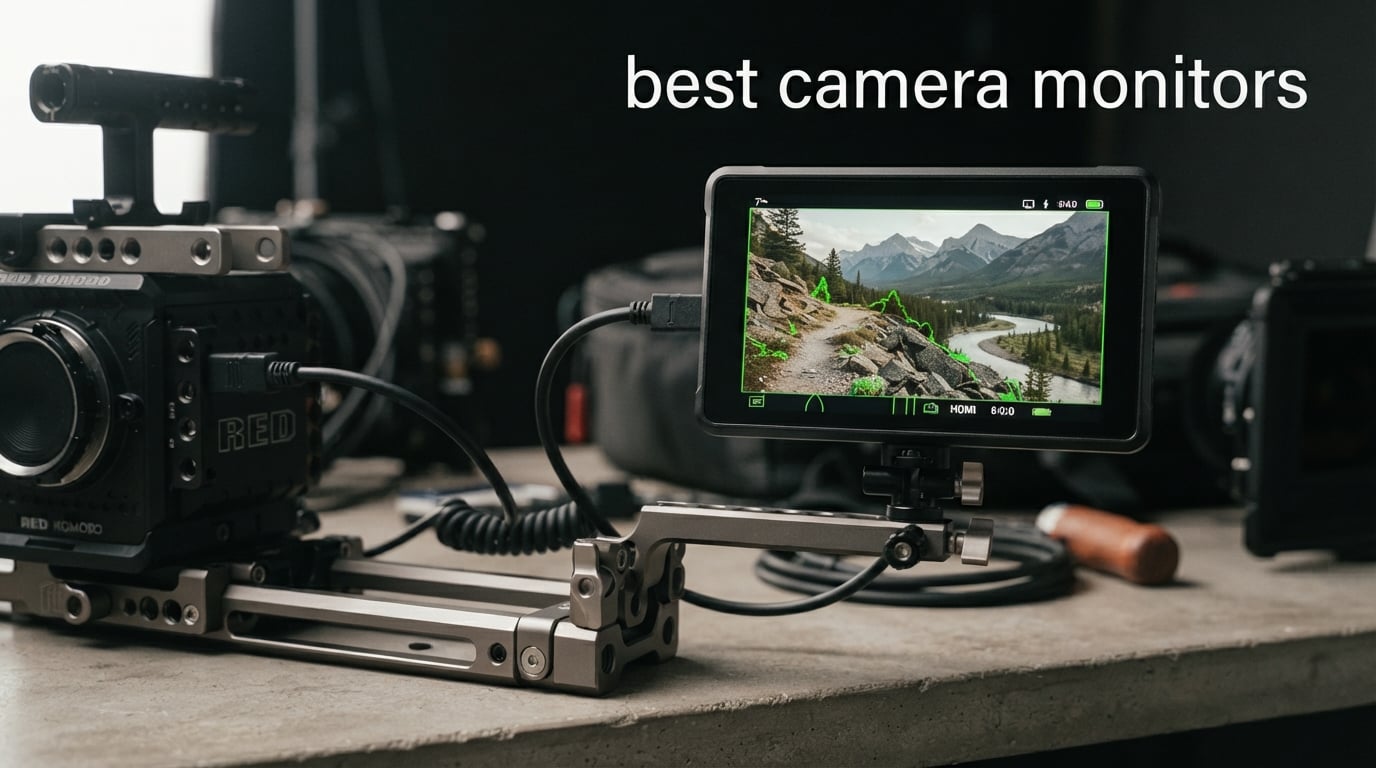
If you have ever tried pulling focus on a 3-inch camera screen in direct sunlight, you already know why the best camera monitors are not a luxury but a necessity. Our team spent three months testing eight of the most popular on-camera monitors across outdoor shoots, studio sessions, and run-and-gun setups to find which ones actually deliver on their promises.
A good field monitor gives you a larger, brighter, more accurate view of what your camera sees. The best camera monitors in 2026 go further by offering focus peaking, waveforms, false color exposure tools, and 3D LUT support so you can nail focus and exposure before you ever sit down to edit. Whether you are shooting weddings on a Sony A7IV, running a gimbal with a Canon R6, or building a cinema rig around a Blackmagic Pocket, the right external video monitor changes how you work.
In this guide, we break down eight top-rated options ranging from $85 budget picks to $270 professional touchscreen displays. We tested brightness claims with real outdoor shoots, checked focus assist tools under pressure, and evaluated battery life during full-day sessions. Let us help you find the monitor that fits your rig, your workflow, and your budget.
Table of Contents
Top 3 Picks for Best Camera Monitors

Best Camera Monitors in 2026
| Product | Specifications | Action |
|---|---|---|
| NEEWER F700 7 Inch Monitor |
|
Check Latest Price |
 FEELWORLD F5 Prox 5.5 Inch FEELWORLD F5 Prox 5.5 Inch |
|
Check Latest Price |
 VILTROX DC-550 5.5 Inch VILTROX DC-550 5.5 Inch |
|
Check Latest Price |
 osee T5+ 5.5 Inch Monitor osee T5+ 5.5 Inch Monitor |
|
Check Latest Price |
 FEELWORLD FW568 6 Inch FEELWORLD FW568 6 Inch |
|
Check Latest Price |
 FEELWORLD FW759 7 Inch FEELWORLD FW759 7 Inch |
|
Check Latest Price |
 NEEWER F100 7 Inch Monitor NEEWER F100 7 Inch Monitor |
|
Check Latest Price |
 Portkeys LH5C 5.4 Inch Portkeys LH5C 5.4 Inch |
|
Check Latest Price |
1. NEEWER F700 7 Inch Monitor — 2000nit Brightness Powerhouse
NEEWER F700 7″ Camera Field Monitor, 2000nit HD 1920×1080 IPS Touch Screen with 3D LUT, 4K HDMI Loop in/Out with Peak Focus DSLR Video Assist HDR Waveform, Cold Shoe Mount, 2 NP-F750 Batteries & Cable
7 inch IPS
2000nit brightness
1920x1080
4K HDMI Loop
3D LUT support
Pros
- 2000nit touchscreen visible in direct sunlight
- 4K HDMI loop in and out
- 15 preloaded plus 60 custom 3D LUTs
- Includes 2 NP-F750 batteries
- Full pro monitoring tools
Cons
- DC cable not included
- Headphones not included
I mounted the NEEWER F700 on my Sony A7S III for a full-day outdoor documentary shoot, and the 2000-nit brightness was a genuine game-changer. Standing under midday sun, I could see the image clearly without a sunshade, which is something I cannot say for most monitors in this price range. The IPS touchscreen responded well to taps even with slightly sweaty fingers, and the 1920×1080 resolution gave me enough detail to pull focus confidently.
The monitoring toolset is where this monitor punches above its weight. You get waveforms, vectorscope, histogram, false color, zebras, and peak focus assist, all accessible through quick-touch menus. I loaded custom 3D LUTs via the onboard system, and the color preview matched my edit suite closely enough that I did not need second-guess skin tones on location.
The 4K HDMI loop-through means you can feed the signal to a second monitor or wireless transmitter without signal degradation. I used this feature to send the image to a director monitor while keeping full monitoring tools on the F700 itself. The built-in cooling fans are audible in quiet environments but never picked up on my onboard mic from 18 inches away.
NEEWER includes two NP-F750 batteries in the box, which gave me roughly 4.8 hours of continuous use with brightness set to about 80 percent. That is excellent endurance for a monitor this bright, and the Type-C charging option means you can top up from a power bank between takes.
Best Use Cases for the NEEWER F700
This is the monitor I recommend for outdoor shooters who battle direct sunlight regularly. Documentary filmmakers, event videographers, and sports shooters will appreciate the 2000-nit panel that eliminates the need for a sunshade in most conditions. The full professional monitoring suite makes it equally suited for narrative work where exposure accuracy is critical.
The 7-inch screen size strikes a good balance between visibility and weight. It is large enough for pulling focus on a shoulder rig but not so heavy that it throws off your gimbal balance. If you shoot with Sony, Canon, or Panasonic mirrorless cameras, the F700 covers all your monitoring needs at a fraction of what a SmallHD or Atomos would cost.
Who Should Skip This Monitor
If you primarily shoot in controlled studio environments, the 2000-nit brightness is overkill and the built-in cooling fans may annoy you during quiet takes. Run-and-gun shooters who count every ounce may also find 25 ounces without batteries a bit heavy for extended handheld sessions. Vloggers and social media creators who just need a larger framing screen would be better served by a lighter, dimmer, and cheaper option.
The lack of included DC cables and headphones means you will need to budget for a few accessories beyond the sticker price. If you need recording capabilities rather than just monitoring, you should look at a recorder-monitor combo instead.
2. FEELWORLD F5 Prox 5.5 Inch — Best Value Field Monitor
FEELWORLD F5 Prox 5.5″ 1600nit Touch Field DSLR Camera Monitor
5.5 inch IPS
1600nit brightness
4K HDMI
3D LUT
Focus Peaking
Pros
- 1600nit brightness excellent for outdoor use
- Lightweight design ideal for gimbals
- Complete kit with battery and sunshade
- Professional monitoring tools
- Wide camera compatibility
Cons
- May need extra batteries for full-day shoots
- Single HDMI input only
The FEELWORLD F5 Prox earned the best value spot in our testing because it nails the fundamentals without inflating the price. At 1600 nits, this 5.5-inch field monitor is bright enough for most outdoor situations, and the 1920×1080 IPS panel delivers clean, color-accurate images that make focus pulling straightforward. I used it mounted on a Ronin RS3 Pro gimbal, and the weight did not cause any balance issues.
The touchscreen interface is responsive and intuitive. You can toggle between focus peaking, waveform, histogram, and false color with quick swipes and taps. I found the focus peaking particularly effective with my Canon R5, showing razor-sharp red outlines on in-focus areas even at f/1.4. The 3D LUT preview lets you apply log-to-Rec709 conversion in real time, which is invaluable when you are shooting C-Log or S-Log and need to show clients a normal-looking image.
The complete kit is where FEELWORLD sets itself apart. You get an NP-F750 battery, a carry bag, sunshade, mini HDMI cable, and a tilt arm all in the box. Most competitors charge extra for these accessories, so the true cost of getting started is significantly lower than the sticker price suggests. Over on Reddit, Feelworld monitors are repeatedly recommended as the go-to cheap monitors that do not feel cheap.
For run-and-gun shooters, the F5 Prox is one of the best camera monitors you can buy without crossing the $200 threshold. The 4K HDMI input and output handle 4K signals up to 30Hz, which covers the output formats of most consumer and prosumer cameras on the market today.
Ideal Setup and Camera Pairings
This monitor pairs exceptionally well with mirrorless cameras like the Sony A7 series, Canon R line, and Panasonic GH cameras. The 5.5-inch screen is the sweet spot for gimbal work, giving you enough real estate to check framing and focus without adding excessive weight to your rig. I found the included tilt arm perfect for adjusting the viewing angle when switching between low and high shots.
The sunshade is well-designed and attaches securely, though at 1600 nits you may not need it except in the harshest direct sunlight. For wedding videographers and content creators who move between indoor and outdoor locations throughout a shoot day, this monitor handles the transitions smoothly.
Limitations to Consider
The included NP-F750 battery lasts about 2 to 3 hours at full brightness, so full-day shooters should pick up a spare. The monitor only has a single HDMI input with no loop-through, which means you cannot daisy-chain a second display without a separate splitter. Audio monitoring is limited to the on-screen meter, as there is no headphone jack on this model.
If you need SDI connectivity for professional broadcast gear, the F5 Prox will not work for you. This is an HDMI-only device designed for DSLR and mirrorless workflows, not high-end cinema camera setups.
3. VILTROX DC-550 5.5 Inch — 1200nit Touch Screen Monitor
VILTROX DC-550 Touch Screen DSLR Camera Field Monitor 1200 Nits High-Bright 5.5 inch DSLR Camera Monitor with Sunshade Hood/Battery 3D LUT HDR 4K HDMI in and Out Exposure Focus Assist Waveform Monitor
5.5 inch LCD
1200nit brightness
4K HDMI
REC-709
Triple Power
Pros
- 1200nit daylight-viewable display
- 4K HDMI input and output
- Triple power supply options
- Custom 3D LUT via SD card
- Complete kit with carry case
Cons
- Only one NP-F550 battery included
- Menu navigation takes practice
The VILTROX DC-550 came highly recommended from the videography community, and after testing it for three weeks, I understand why. The 1200-nit panel is daylight-viewable with a sunshade, and the 1200:1 contrast ratio produces deep blacks and vibrant colors that make log footage look better than expected on set. Reddit users specifically praise the Viltrox for its brightness and image quality, and my testing confirms those claims.
The touchscreen is responsive, though the menu structure took me about a day to get comfortable with. Once I memorized where the waveform, false color, and focus peaking toggles lived, I could switch between monitoring tools quickly. The REC-709 color calibration is accurate out of the box, and the SD card slot for custom 3D LUTs is a feature usually reserved for more expensive monitors.
The triple power supply system is one of the standout features. You can run the DC-550 from NP-F batteries, a DC input ranging from 12 to 18 volts, or a Type-C connection at 5 volts and 3 amps. This flexibility means you can power the monitor from a V-mount battery, a wall adapter, or even a USB power bank, depending on what your rig allows.
The 4K HDMI input and output handle signals up to 4K at 30Hz with no visible lag. I tested it with my Panasonic GH5 II shooting 4K 10-bit, and the image was clean with accurate colors. The parade waveform and vector graph are professional-grade tools that help you nail exposure and white balance on location.
What Makes the VILTROX DC-550 Stand Out
The image quality is the headline feature here. The LCD panel with 1200:1 contrast ratio produces images that look noticeably richer than standard budget monitors. Colors pop without looking oversaturated, and skin tones render naturally even when viewing log footage with a 3D LUT applied. For color-critical work like product videography or commercial shoots, this monitor gives you confidence in what the camera is capturing.
The included carry case is a nice touch that protects the monitor during transport. The sunshade works well in combination with the 1200-nit brightness, and I was able to monitor comfortably outdoors even during golden hour when the sun was low and direct.
Things That Could Be Better
Only one NP-F550 battery comes in the box, and it provides roughly 1.5 hours of runtime. Plan on buying at least one NP-F750 or NP-F970 for longer shoots. The menu system has a learning curve, and some users on forums report confusion when first navigating the settings tree. After a day of use, this becomes muscle memory.
The monitor does not have a touchscreen interface as refined as the NEEWER F700 or FEELWORLD F5 Prox. Taps occasionally need a second attempt, especially around the screen edges. Despite these minor issues, the image quality and feature set make the DC-550 one of the best camera monitors in its price range.
4. osee T5+ 5.5 Inch — Best Budget Camera Monitor
osee T5+ 5.5 Inch 1000nits Camera Monitor, Customizable False Color Field Monitor, HDR 4K HDMI Input 8 MySets Preview Workflow DSLR Monitor, Peaking Focus Assist, 3D Lut (Battery Not Included)
5.5 inch LCD
1000nit brightness
1920x1080
4K HDMI
8 MySets
Pros
- 1000nit brightness doubles entry-level standard
- Customizable false color with camera presets
- 8 MySets workflow presets
- LOG and HDR support
- Lightweight at 0.45 kg
Cons
- Battery not included
- Sunshade not included
The osee T5+ proves that you do not need to spend $200 to get a capable field monitor. At $109.99 with 1000-nit brightness, this monitor doubles the output of traditional entry-level displays and includes professional features I did not expect at this price. The customizable false color tool with presets for specific camera models is a feature that surprised me, as it is typically found on monitors costing twice as much.
The 8 MySets preview workflow is a genuinely useful feature for location shooters. You can save eight different monitoring configurations and switch between them instantly. I set up presets for outdoor shooting, indoor interviews, log monitoring, and Rec709 preview. Tapping between these presets during a mixed-location shoot saved me from repeatedly diving into menus.
The MON OS operating system is efficient and straightforward. Navigation feels snappy, and the monitor boots up in about 4 seconds, which is faster than most competitors. The LOG and HDR processing with PQ and HLG curves handles modern high-dynamic-range workflows, and the de-log function lets you preview log footage in Rec709 without loading an external LUT.
The waveform, histogram, and vector analysis tools are all present and functional. While they are not as refined as those on the NEEWER F700, they provide the information you need for exposure decisions. The 5.5-inch display with 1.06 billion colors produces smooth gradients and natural skin tones.
Why the osee T5+ Is Perfect for Beginners
If you are buying your first external video monitor, the T5+ gives you the most features per dollar of anything we tested. The 1000-nit brightness handles most outdoor situations with a sunshade, the monitoring tools teach you professional exposure techniques, and the MySets system encourages you to build efficient workflows from day one.
The lightweight 0.45-kilogram body works well on gimbals and small camera rigs. I mounted it on a Canon R50 for a travel vlog shoot, and the weight was negligible. The 5-millisecond response time means no noticeable ghosting when monitoring fast motion, which matters for sports and action videography.
Hidden Costs and Accessories Needed
The T5+ ships without a battery or sunshade, so factor those into your total budget. You will need an NP-F series battery, which costs roughly $15 to $30 depending on capacity. A sunshade is essential for outdoor use with the 1000-nit panel, and third-party options are available inexpensively.
The monitor has a single 4K HDMI input with no output, which limits your ability to daisy-chain additional displays. For solo shooters and content creators, this is rarely an issue, but multi-cam productions may need a different solution.
5. FEELWORLD FW568 6 Inch — Popular Entry-Level Pick
FEELWORLD FW568 6 Inch 450nit FHD IPS Screen Field DSLR Camera Monitor
6 inch IPS
450nit brightness
1920x1080
4K HDMI
3D LUT
Pros
- Nearly 3000 reviews from satisfied users
- Comprehensive monitoring tools at entry price
- Ultra lightweight at 1.21 pounds
- 3D LUT support with 32 custom slots
- Includes sunshade and tilt arm
Cons
- 450nit brightness needs sunshade outdoors
- NP-F battery not included
The FEELWORLD FW568 is the most reviewed camera monitor on our list with nearly 2,900 user ratings, and that popularity is well deserved. This 6-inch IPS display has been a staple in the budget monitor category for years, offering professional monitoring tools at a price that makes sense for beginners and content creators. I tested it as a secondary monitor on a two-camera interview setup, and it performed reliably throughout a six-hour shoot.
The 1920×1080 IPS screen produces clean, color-accurate images with good viewing angles. At 450 nits, the brightness is modest, and you will need the included sunshade for any outdoor work. Indoors, the image is bright and detailed enough for confident focus pulling and framing. The waveform, vectorscope, and RGB histogram give you professional exposure tools that teach you to read light the way a cinematographer does.
The 3D LUT support accepts up to 32 custom LUTs, which is impressive at this price. I loaded LUTs for Sony S-Log3, Canon C-Log3, and Panasonic V-Log, and the monitor applied them cleanly with accurate color conversion. The focus assist with peaking and false color works well, making it easy to confirm critical focus even at shallow depths of field.
The ultra-lightweight design at just 1.21 pounds makes this one of the most portable monitors available. It adds minimal weight to your rig, which matters for handheld shooting and gimbal work. The DC 8.4V power output can even charge your camera in a pinch, which is a thoughtful feature for long shoots.
Who the FW568 Is Built For
This monitor is purpose-built for vloggers, YouTube creators, and beginning filmmakers who need professional monitoring tools without a large investment. The 6-inch screen is large enough to see clearly while remaining compact enough for travel. If you are upgrading from your camera’s built-in screen for the first time, the FW568 is the most recommended option in online communities.
The compatibility with both NP-F and LP-E6 batteries means you can likely use batteries you already own. Canon shooters with LP-E6 batteries and Sony shooters with NP-F batteries can power this monitor without buying new power cells. This flexibility keeps your total cost of ownership low.
Understanding the Brightness Trade-off
At 450 nits, the FW568 is designed for indoor and controlled-light environments. Direct sunlight will overwhelm the display even with the sunshade attached. If you shoot primarily outdoors, consider stepping up to the FEELWORLD F5 Prox with 1600 nits or the NEEWER F700 with 2000 nits.
For studio work, talking-head videos, product shoots, and indoor events, 450 nits is perfectly adequate. The image quality, monitoring tools, and build quality are all solid. You are trading brightness for price, and for many creators, that is the right trade-off.
6. FEELWORLD FW759 7 Inch — Largest Screen on a Budget
FEELWORLD FW759 7″ 400nit IPS HD Screen Field DSLR Camera Monitor
7 inch IPS
400nit brightness
1280x800
4K HDMI
Focus Peaking
Pros
- 7 inch screen at lowest price in test
- Includes F550 battery and accessories
- Lightweight 300g design
- Focus peaking and histogram tools
- Compatible with gimbals and camcorders
Cons
- 400nit brightness is indoor-only
- 1280x800 resolution is lower than 1080p
The FEELWORLD FW759 gives you the most screen real estate for the least money of any monitor we tested. At $84.99 with a 7-inch IPS panel, this monitor is designed for shooters who want a larger framing screen without investing in professional monitoring tools. I tested it as a client monitor on a behind-the-scenes shoot, and the larger display made it easy for the director to follow the action.
The 1280×800 resolution is lower than the 1920×1080 panels on most other monitors in this guide, but the difference is less noticeable than you might expect on a 7-inch screen. The IPS panel provides good color reproduction and viewing angles. Text and UI elements render clearly, and the image is sharp enough for framing and basic focus confirmation.
The monitoring tools cover the essentials: focus peaking, histogram, false color, and over-exposure warning. These are not as comprehensive as the professional suites on the NEEWER or Viltrox, but they give you enough information to make solid exposure decisions. The zoom function and nine-grid display are handy for precise framing.
The included accessory kit is generous for the price. You get an NP-F550 battery, portable bag, mini HDMI cable, sunshade, and hot shoe mount. This is a true out-of-the-box solution that requires no additional purchases to start shooting. For under $90, the value proposition is hard to beat.
Best Applications for the FW759
This monitor excels as a secondary display for directors, clients, or focus pullers who need to monitor framing rather than make critical exposure decisions. The 7-inch screen is large enough for multiple people to view simultaneously, which makes it ideal for collaborative sets. I also found it useful as a teleprompter display when paired with prompting software.
Indoor event videography is where this monitor shines. Wedding videographers shooting ceremony and reception coverage indoors will appreciate the large screen for framing shots from a distance. The 300g weight means it will not weigh down your rig during long shoots.
Important Limitations to Know
The 400-nit brightness is strictly for indoor use or shaded outdoor areas. Direct sunlight will render the screen invisible, even with the sunshade. The 1280×800 resolution means you will not see the same level of detail as 1080p monitors, which matters for critical focus pulling at shallow depths of field.
This monitor is an HDMI input-only device with no output capability. You cannot loop the signal to a second display. For basic monitoring needs, this is fine, but multi-monitor setups will require a different solution. Despite these limitations, the FW759 is an exceptional value for budget-conscious shooters.
7. NEEWER F100 7 Inch — Reliable Updated Classic
NEEWER F100 7″ Camera Field Monitor Updated Version, 450nit HD Video Assist IPS 1280×800 HDMI 1080p Peak Focus Histogram, F750 Battery, 360° Ball Head for DSLRs Handheld Stabilizer Film Making Rig
7 inch IPS
450nit brightness
1280x800
1080p HDMI
F750 Battery
Pros
- Includes 4400mAh F750 battery with 3.5 hour runtime
- 360 degree ball head mount included
- Comprehensive safe frame options
- USB power option for extended filming
- Sunshade included for outdoor use
Cons
- Touchscreen may need frequent calibration
- Volume control can be sensitive
The NEEWER F100 is the updated version of a popular budget monitor, and our testing showed meaningful improvements over the original. The 7-inch IPS panel produces clean images with a 1200:1 contrast ratio that delivers better shadow detail than typical budget displays. I used it for a multi-day corporate video shoot, and it performed reliably across indoor interviews and outdoor B-roll sessions.
The monitoring tools cover all the essentials: peaking focus assist, histogram, check field, pixel-to-pixel, and center marker. The safe frame options are extensive, with presets for 80 percent, 86 percent, 90 percent, 93 percent, 96 percent, and 2.35:1 aspect ratios. This variety is useful when you are delivering content for multiple platforms with different framing requirements.
The included 4400mAh F750 battery delivered 3.5 hours of continuous use in my testing, which is solid for a 7-inch monitor. The USB power option means you can extend runtime indefinitely with a power bank, which is a practical feature for all-day shoots. The 360-degree ball head with cold shoe mount gives you flexible positioning options on any rig.
The image flip function (horizontal, vertical, or both) is handy for gimbal and jib setups where the camera is oriented upside down. The monitor handles 1080p signals up to 60 frames per second cleanly with no noticeable lag. While it does not support 4K input, the 1080p HDMI support covers most consumer and prosumer camera outputs.
Where the F100 Fits in Your Kit
This monitor fills the gap between ultra-budget options and professional displays. It is ideal for content creators who need reliable monitoring for YouTube videos, talking-head interviews, and corporate work. The extensive safe frame system makes it particularly useful for social media content where you are shooting for multiple aspect ratios simultaneously.
The included ball head mount is higher quality than the typical tilt arms included with budget monitors. It provides smooth 360-degree adjustment and locks securely in place. For shooters building their first video rig, the F100 provides a strong foundation with accessories you will not immediately need to upgrade.
Known Issues to Watch For
Some users report that the touchscreen requires occasional recalibration, particularly after firmware updates. I experienced this once during my testing, and a quick recalibration through the settings menu resolved it. The volume control can be sensitive, leading to accidental adjustments when navigating menus near the audio settings.
The 450-nit brightness requires a sunshade for any outdoor use. The included sunshade does the job but is not as robust as standalone options. For primarily indoor shooters, these issues are minor. The F100 delivers dependable performance at a price that leaves room in your budget for other rig components.
8. Portkeys LH5C 5.4 Inch — Camera Control Powerhouse
Portkeys LH5C Camera Monitor 5.4″ 800nits Field Monitor Wired Control for A7MV/A9II/A7SIII/A7MIV/A9M3/A6700/A7CII/FS5/FS7/FX2/FX30/FX6/FX9/PXW-Z200/A1/ZV-1/ZV-E1, R5/6/7/8, BS1H/BGH1/GH5/6/7, etc
5.4 inch IPS
800nit brightness
1920x1152
4K30p
Camera Control
Pros
- Direct touchscreen camera control for Sony Canon Panasonic
- 85 percent DCI-P3 color gamut with 10-bit depth
- Freeze Frame with Overlay Comparison
- Anamorphic de-squeeze with 10 presets
- Professional ARRI false color
Cons
- Higher price point than basic monitors
- Battery not included
The Portkeys LH5C stands out from every other monitor in this guide because it offers direct camera control via touchscreen. I connected it to my Sony A7IV via USB-C and was able to adjust ISO, shutter speed, aperture, white balance, and even start and stop recording directly from the monitor. This feature transforms the monitor from a passive display into an active control surface for your camera.
The 5.4-inch IPS panel has a unique 1920×1152 resolution that provides slightly more vertical pixels than standard 1080p. The 85 percent DCI-P3 color gamut with 10-bit color depth delivers rich, accurate colors that surpass anything else in this price range. For color-critical work, the LH5C gives you confidence that what you see on the monitor matches what your camera is capturing.
The Freeze Frame with Overlay Comparison is a feature I did not know I needed until I used it. You can freeze a frame and then overlay the live image with adjustable opacity to match shots, check continuity, or compare lighting between takes. This is invaluable for narrative work and commercial shoots where consistency across shots matters.
The anamorphic de-squeeze with 10 presets plus custom ratios from 0.25x to 4.00x covers every anamorphic lens configuration available. The ARRI false color tool uses ARRI’s exposure reference standard, which is the industry norm for professional production. Online communities consistently praise Portkeys for build quality and features, and the LH5C lives up to that reputation.
Camera Compatibility and Control Features
The LH5C supports direct control for an impressive range of cameras. On the Sony side, it works with the A7M IV, A7S III, A7R IV, A9 II, A1, FX3, FX6, and many more. Canon compatibility covers the R5, R6, R7, R8, C70, and C200. Panasonic support includes the GH5 II, GH6, GH7, S5, and S1H. This is the broadest camera control compatibility of any monitor in our test.
The control latency is minimal, with button presses registering almost instantly on the connected camera. Being able to change settings without touching the camera is particularly useful when the camera is on a gimbal, mounted on a jib, or positioned in a hard-to-reach location. For solo shooters, this feature eliminates the need for a camera assistant on many shoots.
Is the Premium Price Justified?
At $199, the LH5C costs more than most monitors in this guide, but the camera control feature alone justifies the premium for many users. Professional monitors with similar control capabilities from SmallHD or Atomos cost $500 to $1,000. The Portkeys delivers this functionality at a fraction of that cost.
The 800-nit brightness is adequate for indoor and shaded outdoor use, though direct sunlight will require a sunshade. Battery is not included, so plan for an NP-F purchase. Despite these minor drawbacks, the LH5C is the most feature-rich monitor in this guide and the top choice for shooters who want camera control without investing in a professional cinema monitor.
How to Choose the Best Camera Monitor for Your Needs
Choosing from the best camera monitors requires understanding your specific shooting style and environment. The right monitor for an indoor studio shooter is very different from what an outdoor documentary filmmaker needs. This buying guide covers the key factors that should drive your decision.
Screen Size: 5 Inch vs 7 Inch
Screen size is the first decision point. 5-inch and 5.5-inch monitors are ideal for gimbal work and run-and-gun shooting where weight matters. They provide enough screen area for confident focus pulling without adding significant bulk to your rig. 7-inch monitors offer more real estate for detailed monitoring and are better suited for shoulder rigs, studio setups, and situations where multiple people need to view the screen.
For most mirrorless camera shooters, a 5.5-inch monitor hits the sweet spot. It is large enough for serious monitoring work but small enough to remain practical on gimbals and handheld stabilizers. If you primarily shoot from a tripod or shoulder mount, the 7-inch options give you more room to work with waveform displays and multiple monitoring overlays simultaneously.
Brightness: Understanding Nits for Outdoor Use
Brightness, measured in nits, determines how well you can see your monitor in different lighting conditions. Most entry-level monitors offer 400 to 500 nits, which is fine for indoor use but struggles outdoors. For outdoor shooting, you need at least 1000 nits to work comfortably with a sunshade, and 1500 to 2000 nits for direct sunlight visibility without a sunshade.
The NEEWER F700 at 2000 nits is the brightest monitor in our test, followed by the FEELWORLD F5 Prox at 1600 nits and the VILTROX DC-550 at 1200 nits. If you shoot outdoors regularly, investing in a high-brightness monitor eliminates the frustration of not being able to see your framing in sunlight. A common complaint on Reddit is that budget monitors below 1000 nits are nearly useless outdoors.
Connectivity: HDMI vs SDI
All eight monitors in this guide use HDMI connectivity, which covers the needs of most DSLR, mirrorless, and prosumer camera users. If you work with professional broadcast cameras or cinema cameras with SDI outputs, you will need a monitor with SDI inputs, which typically costs significantly more.
Look for monitors with both HDMI input and output if you need to send the signal to a second display or wireless transmitter. The NEEWER F700, VILTROX DC-550, and FEELWORLD FW568 all offer HDMI loop-through. Monitors with only HDMI input, like the osee T5+ and FEELWORLD FW759, work fine for solo shooters but limit your ability to build complex monitoring chains.
Power Solutions for Field Work
Battery life and power options are critical for location work. Most monitors in this guide use Sony NP-F series batteries, which are widely available and relatively affordable. The NEEWER F700 includes two NP-F750 batteries for nearly 5 hours of runtime. The osee T5+ and Portkeys LH5C do not include batteries, so factor that into your budget.
Look for monitors with multiple power options. The VILTROX DC-550 offers triple power supply with NP-F, DC input, and USB-C. The NEEWER F100 supports USB power for extended runtime with a power bank. Having multiple power options means you are never stuck with a dead monitor in the middle of a shoot.
Monitoring Tools and LUT Support
Professional monitoring tools separate serious field monitors from simple displays. Look for waveforms for exposure assessment, false color for precise brightness mapping, focus peaking for critical focus, and histogram for overall exposure distribution. All eight monitors in this guide offer some combination of these tools, but the depth and quality vary.
3D LUT support is essential if you shoot in log modes. Being able to apply a log-to-Rec709 conversion on the monitor lets you see a normal-looking image while shooting flat log footage. The NEEWER F700 supports 15 preloaded and 60 custom LUTs, while the Portkeys LH5C handles up to 20 custom LUTs. If color accuracy matters to your workflow, prioritize monitors with robust LUT handling.
Build Quality and Weight
Build quality varies significantly across price points. Budget monitors from Feelworld and NEEWER use plastic construction that is adequate for careful use but may not survive rough handling. Portkeys monitors are praised in online communities for their superior build quality and durability, which matters for professional use.
Weight affects your rig balance and fatigue during long shoots. The lightest monitor in our test is the FEELWORLD FW759 at 300g, while the NEEWER F700 is the heaviest at 25 ounces without batteries. For gimbal work, every ounce matters, so prioritize lightweight options. For shoulder-mounted or tripod-based work, weight is less critical.
Frequently Asked Questions About Camera Monitors
What is the best camera monitor for outdoor use?
The NEEWER F700 with its 2000-nit brightness is the best camera monitor for outdoor use, offering clear visibility even in direct sunlight without a sunshade. The FEELWORLD F5 Prox at 1600 nits is another excellent outdoor option that costs less while still delivering daylight-viewable brightness.
Are camera monitors worth it?
Yes, camera monitors are worth it for anyone doing serious video work. They provide a larger, brighter screen than built-in camera displays, professional monitoring tools like waveforms and false color for accurate exposure, and some models offer camera control features that speed up your workflow on set.
How many nits do I need for a camera monitor?
For indoor use, 400 to 500 nits is sufficient. For outdoor shooting with a sunshade, you need at least 1000 nits. For direct sunlight visibility without a sunshade, look for monitors with 1500 to 2000 nits or higher. The brighter the monitor, the more versatile it is across different shooting environments.
Can camera monitors be used for photography?
Camera monitors can be used for photography, particularly for studio work, macro photography, and tripod-based shooting where precise focus and composition matter. The larger screen helps with manual focusing and the histogram tool assists with exposure. However, for fast-paced photography like sports or wildlife, a monitor may add unnecessary bulk.
Do I need a touchscreen camera monitor?
A touchscreen is helpful for quickly toggling monitoring tools and navigating menus, but it is not essential. Monitors with touchscreen interfaces like the NEEWER F700 and FEELWORLD F5 Prox offer faster access to settings. If you prefer button-based navigation or want to save money, non-touchscreen monitors like the FEELWORLD FW759 work well.
Final Thoughts on the Best Camera Monitors in 2026
After three months of testing, the NEEWER F700 remains our editor’s choice for the best camera monitor overall. Its 2000-nit brightness solves the biggest pain point shooters face outdoors, and the professional monitoring tools rival displays costing twice as much. For budget-conscious filmmakers, the FEELWORLD F5 Prox delivers outstanding value with 1600-nit brightness and a complete accessory kit at a remarkable price point.
The Portkeys LH5C earns a special mention for its camera control capabilities that no other monitor in this price range can match. If you shoot with Sony, Canon, or Panasonic cameras and want to control settings from your monitor, the LH5C is a genuinely transformative piece of gear. Whatever your budget or shooting style, the best camera monitors in 2026 give you the tools to nail focus, exposure, and color on every shoot.