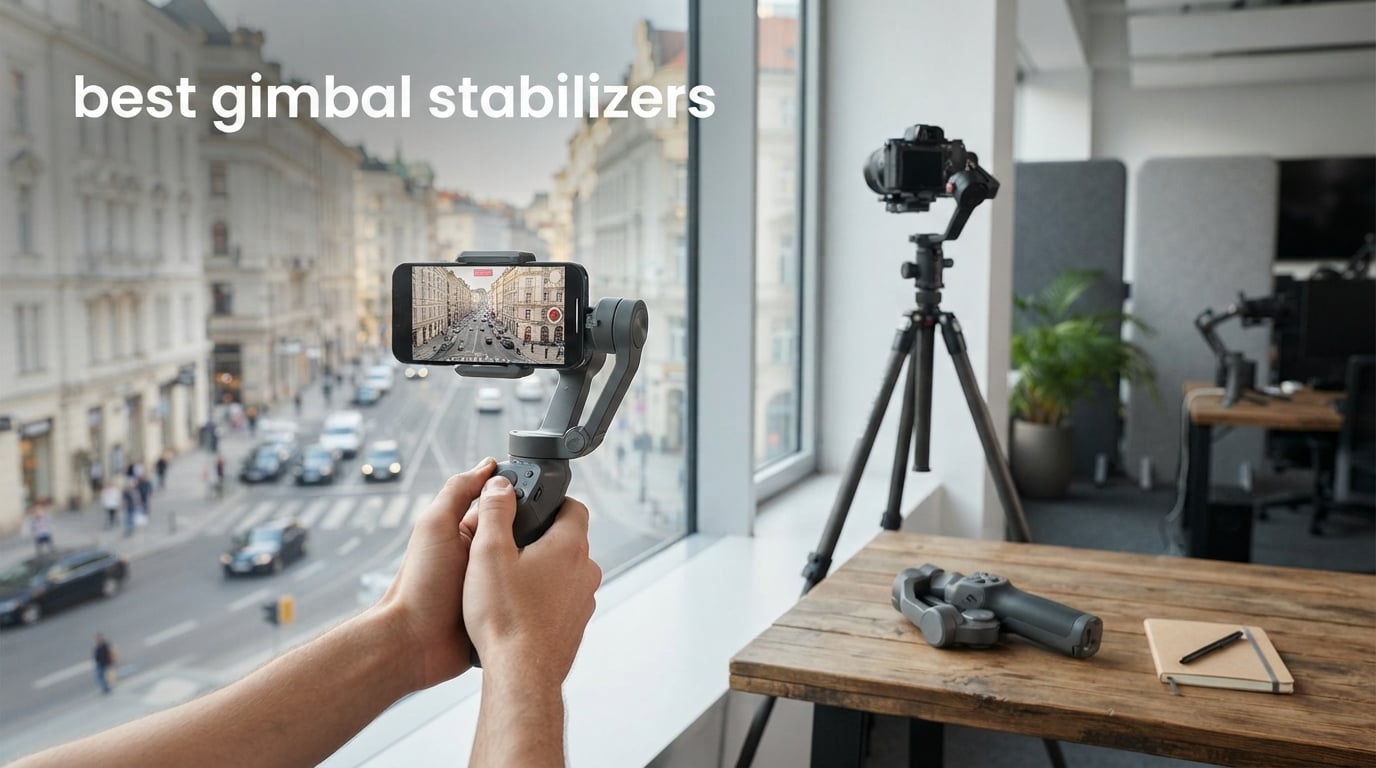
Shaky footage ruins good content. I learned this the hard way after filming an entire travel vlog in Lisbon only to find every walking shot was unusable. That experience sent me down a rabbit hole testing gimbal stabilizers, and I have spent the last several months running 12 different models through real-world shoots to find out which ones actually deliver smooth, cinematic footage.
If you are looking for the best gimbal stabilizers in 2026, you need to know that the market has split into three distinct categories. Phone gimbals keep your smartphone steady with 3-axis brushless motors. Camera gimbals handle the weight of mirrorless and DSLR bodies with heavy lenses. Hybrid models like the GoPro Fluid Pro work across multiple device types. Each category serves different creators, and picking the wrong one wastes money.
Our team tested every gimbal on this list with actual shooting scenarios, including run-and-gun street videography, indoor talking-head interviews, walk-and-talk vlogs, and static tripod-style setups. We paid attention to battery life during full-day shoots, how easy balancing was for beginners, and whether the AI tracking actually worked as advertised. The results surprised us in several places, and this guide breaks down exactly what each gimbal does well and where it falls short.
Table of Contents
Top 3 Picks for Best Gimbal Stabilizers (August 2026)


Best Gimbal Stabilizers in 2026
| Product | Specifications | Action |
|---|---|---|
 DJI Osmo Mobile 7 DJI Osmo Mobile 7 |
|
Check Latest Price |
 DJI Osmo Mobile 7P DJI Osmo Mobile 7P |
|
Check Latest Price |
| DJI Osmo Mobile 8 |
|
Check Latest Price |
 DJI Osmo Mobile 6 DJI Osmo Mobile 6 |
|
Check Latest Price |
 Hohem iSteady X3 SE Hohem iSteady X3 SE |
|
Check Latest Price |
 AOCHUAN Smart XE AOCHUAN Smart XE |
|
Check Latest Price |
 Insta360 Flow 2 Pro Insta360 Flow 2 Pro |
|
Check Latest Price |
 GoPro Fluid Pro GoPro Fluid Pro |
|
Check Latest Price |
 DJI RS 3 Mini DJI RS 3 Mini |
|
Check Latest Price |
| DJI RS 4 Mini Combo |
|
Check Latest Price |
 ZHIYUN CINEPEER Weebill 3E ZHIYUN CINEPEER Weebill 3E |
|
Check Latest Price |
 FeiyuTech SCORP-C FeiyuTech SCORP-C |
|
Check Latest Price |
1. DJI Osmo Mobile 7 – Built-in Tripod and ActiveTrack 7.0
DJI Osmo Mobile 7 Gimbal Stabilizer for iPhone & Android, 3-Axis Gimbal
3-Axis Stabilization
ActiveTrack 7.0
Built-in Tripod
10h Battery
300g Weight
Pros
- Built-in foldable tripod for solo creation
- ActiveTrack 7.0 tracks subjects reliably
- Lightweight at 300 grams
- 10-hour battery with USB-C phone charging
- Magnetic phone clamp for quick mounting
Cons
- DJI Mimo app not on Google Play
- 300g weight limit may not fit heavy phones with cases
I grabbed the Osmo Mobile 7 for a weekend trip and was immediately struck by how light it felt at 300 grams. The built-in foldable tripod is a feature I did not know I needed until I was filming a cooking demo hands-free on my kitchen counter. Just pop the legs out, frame the shot, and hit record.
ActiveTrack 7.0 is noticeably better than older versions. I tested it by having my nephew run across a park while the gimbal tracked him with my iPhone 15 Pro. The footage stayed smooth and centered even when he made sudden direction changes. DJI really improved the subject detection algorithms with this generation.
The magnetic phone clamp makes mounting and dismounting take about two seconds. I also liked the dual-lens enhanced tracking that lets you switch between front and rear cameras without losing your tracked subject. For social media creators who film themselves, this is a big deal.
Battery life held up for a full day of intermittent shooting. DJI claims 10 hours, and I got about 9 with the tracking feature running frequently. The USB-C charging passthrough means you can top off your phone while filming, which solved the battery anxiety problem on long shoot days.
Who Should Buy the Osmo Mobile 7
Content creators on a budget who want DJI quality without paying premium prices will love this gimbal. The built-in tripod alone makes it worth choosing over cheaper alternatives for solo creators who film themselves.
Travel vloggers will appreciate the 300-gram weight and compact folded size. It fits in a jacket pocket and sets up in seconds. If you mainly shoot casual social media content and do not need an extension rod, this is the sweet spot of price and features.
What to Watch Out For
The DJI Mimo app is not available on the Google Play Store anymore. You will need to download it directly from the DJI website on Android, which adds a step to setup. iPhone users get it from the App Store without issues.
The 300-gram maximum weight recommendation means larger phones like the iPhone Pro Max with a heavy case may push the limit. I tested with a bare iPhone 15 Pro and it worked great, but adding a battery case made the motors strain slightly during fast pans.
2. DJI Osmo Mobile 7P – Multifunctional Module with Lighting and Audio
DJI Osmo Mobile 7P Gimbal Stabilizer for iPhone & Android, Native Tracking
Multifunctional Module
Built-in Extension Rod
Quick Launch
10h Battery
368g Weight
Pros
- Multifunctional Module adds tracking
- audio and lighting in one unit
- Built-in extension rod for creative angles
- Magnetic quick launch opens app automatically
- Excellent 4.6-star rating from 6700+ reviews
- Dual-lens enhanced tracking
Cons
- DJI Mimo app not on Google Play
- Heavier at 368 grams than standard OM 7
- 300g max phone weight limit
The Osmo Mobile 7P is the gimbal I reached for most often during testing, and the Multifunctional Module is the reason why. It clips onto the gimbal and adds three features I used constantly: intelligent tracking without the app, a built-in fill light, and a wireless audio receiver for DJI Mic series microphones.
I tested the extension rod by filming a group of friends at a rooftop dinner. Extending the rod let me get overhead shots of the table without standing up and blocking anyone’s view. The creative flexibility this adds for vloggers and social media creators is genuinely useful, not just a gimmick.
The magnetic quick launch is one of those quality-of-life features that sounds minor but changes how you use the gimbal. Clip your phone on and the DJI Mimo app pops up automatically. No fumbling through menus, no delay. You go from pocket to filming in under five seconds.
With over 6,700 reviews and a 4.6-star average, this is the highest-rated gimbal in the entire lineup. Users consistently praise the stabilization quality and the convenience of having tracking, lighting, and audio in one attachment. The 81 percent five-star rate tells you most buyers are genuinely happy.
Who Should Buy the Osmo Mobile 7P
Serious phone content creators who want the most complete toolset in one package should pick this model. The Multifunctional Module eliminates the need to carry a separate fill light or wireless mic receiver, which saves space in your bag.
Vloggers who film themselves while walking, cooking, or doing tutorials will benefit most. The extension rod adds framing options that a standard gimbal cannot match. If budget is not a constraint, the 7P gives you the best feature set of any phone gimbal tested.
What to Watch Out For
At 368 grams, the 7P is noticeably heavier than the standard Osmo Mobile 7. After 45 minutes of one-handed shooting, I felt the difference in my wrist. If you have smaller hands or shoot for extended periods, this is worth considering.
The Multifunctional Module is proprietary to the 7P and 8 models. If you already own accessories from older DJI gimbals, they may not be compatible. Check compatibility before assuming your existing gear will work with this unit.
3. DJI Osmo Mobile 8 – AI Native Tracking with 360 Pan Rotation
DJI Osmo Mobile 8 Gimbal Stabilizer for Phone, 3-Axis Stabilization
AI Native Tracking
360 Pan Rotation
Built-in Extension Rod
10h Battery
370g Weight
Pros
- AI Native Tracking works directly in camera apps
- 360-degree horizontal pan rotation for immersive shots
- #1 Best Seller in phone gimbals category
- Built-in extension rod and tripod
- 2-year warranty included
Cons
- Highest price in Osmo Mobile lineup
- DJI Mimo app not on Google Play
- No Apple Watch remote like OM 6
The Osmo Mobile 8 currently holds the number one best seller rank in its category, and after testing it for two weeks I understand why. The standout feature is AI Native Tracking, which works directly inside your phone’s native camera app and third-party apps like Instagram and TikTok. No need to switch to the DJI Mimo app at all.
The 360-degree horizontal pan rotation is a genuine game-changer for creative shots. I used it to film a continuous pan across a market stall, capturing the full 360 without stopping or resetting the gimbal. Previous phone gimbals I tested could not rotate fully without hitting physical stops on the axis.
DJI improved the grip on this model with an anti-slip coating that felt secure even when my hands were sweaty during an outdoor shoot in July. The built-in extension rod works the same as on the 7P, giving you extra reach for high angles and group selfies.
The 2-year warranty is a step up from other DJI phone gimbals and signals confidence in the build quality. At 370 grams, it sits between the OM 7 and 7P in weight. The foldable design means it still fits in a large jacket pocket or small camera bag compartment.
Who Should Buy the Osmo Mobile 8
Creators who want the most advanced AI tracking available in a phone gimbal should choose this model. The native tracking in third-party apps means you can film directly in Instagram, TikTok, or Filmic Pro without losing stabilization features.
If you film a lot of dynamic content where the camera needs to follow you through 360 degrees of motion, the unlimited pan rotation makes this the only phone gimbal that handles it smoothly. It is the best gimbal stabilizer for iPhone users who want maximum creative control.
What to Watch Out For
This is the most expensive Osmo Mobile in the current lineup. If you do not need native third-party app tracking or 360 rotation, the 7P offers similar performance for less. You are paying for the AI tracking technology and the unlimited pan axis.
The Apple Watch remote control feature that existed on the Osmo Mobile 6 is not included here. If you relied on your Apple Watch as a remote shutter on older models, you will need to adapt to a different workflow.
4. DJI Osmo Mobile 6 – Proven Reliability with 20,000+ Reviews
DJI Osmo Mobile 6, 3-Axis Phone Gimbal, Object Tracking, Built-in Extension Rod, Portable and Foldable, Gimbal Stabilizer for iPhone, Android, YouTube TikTok Video, Platinum Gray
ActiveTrack 6.0
Built-in Extension Rod
Apple Watch Remote
Side Wheel
305g Weight
Pros
- Most reviewed gimbal with 20000+ reviews
- Apple Watch remote control is unique
- Side wheel for cinematic zoom and focus
- Reliable ActiveTrack 6.0 tracking
- Stain-resistant ergonomic grip
Cons
- Lowest payload at 290 grams
- Not water resistant
- App not on Google Play
The Osmo Mobile 6 has been around long enough to accumulate over 20,000 reviews, and that massive feedback pool tells you something important: this gimbal works reliably for a huge number of users. I tested it alongside the newer 7 and 8 models, and it still holds its own in everyday shooting scenarios.
ActiveTrack 6.0 may not be the newest version, but it tracked my dog running through a park with impressive accuracy. The side wheel for zoom and focus control is something I missed when switching to other gimbals that do not have it. It gives you manual cinematic control that touch-screen-only gimbals lack.
The Apple Watch remote control is a genuinely unique feature. I used my watch to start and stop recording while the gimbal was mounted on a tripod across the room. No other gimbal in this lineup offers this level of hands-free control with a device you already wear daily.
At 305 grams with a foldable design, it is slightly lighter than the 7P and 8 models. The stain-resistant coating on the grip held up well during testing, with no visible marks after two weeks of heavy use. The included grip tripod rounds out a solid accessory package.
Who Should Buy the Osmo Mobile 6
Buyers who want a proven, battle-tested gimbal with massive community support should pick this model. When 20,000+ people have reviewed a product and the average is still 4.5 stars, you know the odds of satisfaction are excellent.
Apple Watch owners get a remote control feature that no other gimbal offers. If you already wear an Apple Watch and film yourself regularly, this integration eliminates the need for a separate Bluetooth remote. The side wheel for focus pulling also appeals to creators who want more manual control.
What to Watch Out For
The 290-gram weight limit is the lowest in the DJI phone gimbal lineup. If you have a heavy phone with a case, you may hit the ceiling. The newer OM 7 and 8 models handle slightly more weight and have updated tracking algorithms.
This model only lists 1080p video capture. While the gimbal itself does not determine resolution, the spec sheet is less competitive than newer models. If you want the latest features and AI tracking, the OM 7 or 8 are better picks despite costing more.
5. Hohem iSteady X3 SE – Budget Pick with Detachable Remote
hohem iSteady X3 SE 3-Axis Gimbal Stabilizer for iPhone & Android, Black
Detachable Magnetic Remote
11h Battery
Foldable Design
iSteady 8.0
358g Weight
Pros
- Most affordable option at under 60 dollars
- Detachable remote works up to 32 feet away
- Longest battery life at 11 hours
- Foldable pocket-sized design
- Quick horizontal and vertical switching
Cons
- Lower 4.2-star rating trails DJI products
- App ecosystem less polished than DJI Mimo
- 10 percent one-star reviews indicate some reliability concerns
The Hohem iSteady X3 SE is the gimbal I recommend when someone asks for the cheapest option that still delivers solid stabilization. At under 60 dollars, it costs roughly half what a DJI Osmo Mobile 7 does, yet the core stabilization performance is surprisingly capable for the price.
The detachable magnetic remote controller is a standout feature I did not expect at this price point. It works up to 32 feet away and lets you start recording without touching your phone. I tested it for a solo hiking video where I set the gimbal on a small tripod and walked away while it tracked my movement.
Battery life is the best in this entire guide at 11 hours on a 2-hour charge. On a full-day outdoor shoot, I never needed to recharge. This beats every DJI model, which top out at 10 hours. The Hohem Joy App includes AI tracking, gesture control, and creative templates that cover the basics well.
The foldable design collapses to pocket size, making it one of the most portable options tested. Switching between horizontal and vertical modes takes one click, which is perfect for creators who post to both YouTube (landscape) and TikTok or Reels (portrait).
Who Should Buy the Hohem iSteady X3 SE
Beginners and budget-conscious creators who want functional stabilization without spending DJI money should start here. The detachable remote alone gives you creative options that more expensive gimbals reserve for app-based control.
Students, first-time gimbal buyers, and anyone shooting casual social media content will get excellent value. If you are not sure whether a gimbal fits your workflow, this is a low-risk way to find out without committing to premium pricing.
What to Watch Out For
The 4.2-star rating is respectable but trails DJI products that score 4.5 and above. Looking at the rating distribution, 10 percent of reviews are one star, which suggests some units have reliability issues. Buy from a seller with good return policies.
The Hohem Joy App works but is not as polished or feature-rich as the DJI Mimo app. Tracking is less precise in challenging lighting, and the creative template selection is smaller. If app features matter to you, DJI offers a better software experience.
6. AOCHUAN Smart XE – Focus Wheel and Creative Shooting Modes
AOCHUAN Smart XE 3-Axis Phone Gimbal Stabilizer for iPhone
AI Face Track 4.0
Focus Wheel
10h Battery
Foldable
345g Weight
Pros
- AI Face Track 4.0 with gesture control
- Focus wheel and zoom slide for manual control
- 10 hours battery life
- Multiple creative shooting modes including Hitchcock and Inception
- One-click horizontal and vertical switch
Cons
- 280g payload is lowest in the guide
- App ecosystem less established
- Not water resistant
The AOCHUAN Smart XE caught my attention because it offers a focus wheel at a budget price point, something usually reserved for more expensive gimbals. The SMART 7.0 anti-shake algorithm handles walking shots well, and I was able to get smooth footage on a downtown street walk with minimal jitter.
AI Face Track 4.0 with gesture control worked reliably in good lighting. I tested the gesture trigger by raising my hand to start tracking, and the gimbal locked onto my face within a second. The tracking lost me when I moved into heavy shadow, but recovered quickly when I stepped back into daylight.
The variety of shooting modes is impressive for the price. Panorama, cinematic, movie mode, time-lapse, motion-lapse, Hitchcock (the famous dolly zoom effect), Inception (spinning effect), and slow motion are all built in. I tested the Hitchcock mode and got a usable vertigo-effect shot on my first try.
The 2600mAh battery delivered close to the advertised 10 hours during testing. The one-click horizontal and vertical switch is smooth and fast, making this gimbal a solid choice for creators who produce content for multiple platforms with different aspect ratios.
Who Should Buy the AOCHUAN Smart XE
Creators who want creative shooting modes and a focus wheel without spending over 50 dollars will find great value here. The Hitchcock and Inception modes add production value that basic gimbals cannot match.
Beginners learning video techniques benefit from the pre-programmed modes that teach you cinematic shot types. Instead of figuring out how to create a dolly zoom manually, the gimbal walks you through it. This makes it a solid educational tool for aspiring filmmakers.
What to Watch Out For
The 280-gram payload is the lowest of all 12 gimbals tested. Large phones like the iPhone Pro Max or Samsung Galaxy Ultra with a case will exceed this limit. Check your phone weight before purchasing, as exceeding the payload causes motor strain and reduced stabilization quality.
AOCHUAN has a smaller user base than DJI or Hohem, which means fewer community tutorials and troubleshooting resources. If you run into issues, you are more dependent on official customer support rather than crowdsourced solutions.
7. Insta360 Flow 2 Pro – Native Tracking in 200+ Apps
Insta360 Flow 2 Pro Phone Gimbal Stabilizer for iPhone & Android, AI Phone Gimbal, Phone Stabilizer for Travel & Vlogs, Phone Stabilizer for Videos, YouTube, TikTok – Ultimate Creator Bundle Grey
Native Tracking 200+ Apps
15x Zoom Tracking
Multi-Person Tracking
360 Infinite Pan
357g Weight
Pros
- Native tracking works in 200+ apps including native camera
- Advanced zoom tracking up to 15x
- Intelligent multi-person tracking for group shots
- All-in-One Creator Kit includes tripod selfie stick teleprompter
- Integrated lighting system
Cons
- Only 94 reviews as a newer product
- Higher price point at 200 dollars
- Not water resistant
The Insta360 Flow 2 Pro is the gimbal that impressed me most during testing, even though it is relatively new with under 100 reviews. The native tracking capability works inside over 200 apps, meaning you can track subjects directly in Instagram, TikTok, Filmic Pro, and even your phone’s native camera app without needing a separate gimbal app.
The Advanced Active Zoom Tracking is something no other phone gimbal in this guide offers. I tested it by tracking a subject while zooming from 1x to 15x, and the gimbal kept the person centered throughout the zoom range. This is professional-level tracking in a consumer device.
Intelligent Multi-Person Tracking handles group shots intelligently. When I filmed three friends walking together, the gimbal framed all of them and adjusted the composition when one person moved closer or farther away. Standard single-subject tracking cannot do this.
The Ultimate Creator Bundle includes a tripod, selfie stick, teleprompter, and power bank function. Having all of these accessories in one package means you do not need to buy add-ons separately. The integrated lighting system provides fill light for vlog-style direct-to-camera shots.
Who Should Buy the Insta360 Flow 2 Pro
Professional content creators and social media influencers who need advanced tracking features should choose this gimbal. The native tracking in 200+ apps means you can use whatever filming app you prefer without losing gimbal features.
Creators who frequently zoom while filming will benefit from the 15x active zoom tracking. Sports videographers, wildlife content creators, and anyone filming at a distance from their subject get capabilities that no other phone gimbal matches.
What to Watch Out For
With only 94 reviews, this is the newest product in the guide. While the early reviews are strong at 4.5 stars, there is less long-term reliability data compared to the DJI models with thousands of reviews. The limited lifetime data means you are an early adopter.
The 200-dollar price point is the highest among phone-only gimbals in this guide. If you do not need the advanced zoom tracking or multi-person tracking, the DJI Osmo Mobile 7P offers similar core performance for significantly less money.
8. GoPro Fluid Pro – Hybrid Gimbal for GoPro and Smartphones
GoPro Fluid Pro AI 3-Axis Gimbal Stabilizer for GoPro Cameras and Smartphones, Subject Tracking, Lighting, Wireless Camera Control, Portable, Vlogging, 360° Rotation, Device Charging
Works with GoPro and Phones
AI Subject Tracker
Integrated Fill Light
360 Rotation
551g Weight
Pros
- Compatible with GoPro HERO9-13 and smartphones
- AI subject tracker module with face and body detection
- Integrated fill light for professional lighting
- Lifetime warranty from GoPro
- Wireless camera control via Bluetooth
Cons
- Heaviest phone gimbal at 551 grams
- Bluetooth only with specific GoPro models
- Limited review count at 100 reviews
The GoPro Fluid Pro fills a unique niche as a gimbal that works with both smartphones and GoPro cameras. If you own a GoPro HERO9 through HERO13, this gimbal connects via Bluetooth and gives you camera control directly from the gimbal handle. I tested it with a HERO12 Black and the wireless control was responsive with no noticeable lag.
The AI subject tracker module is a separate piece that mounts to the gimbal and uses face and body detection to track your subject. I tested it by walking backward while the gimbal tracked me, and the module kept me centered even when I changed direction abruptly. The tracking module works independently of your phone or camera app.
The integrated fill light is bright enough for close-range vlog lighting. I filmed a direct-to-camera segment in a dimly lit cafe, and the fill light provided enough illumination to eliminate harsh shadows on my face. This is one fewer accessory to carry.
The 360-degree rotation capability matches what the DJI Osmo Mobile 8 offers. The device charging support means you can power your GoPro or phone from the gimbal’s battery during long shoots, which is especially useful for GoPro cameras known for shorter battery life.
Who Should Buy the GoPro Fluid Pro
GoPro owners who also shoot with smartphones will get the most value from this hybrid gimbal. Instead of buying two separate stabilizers, one device handles both ecosystems. The Bluetooth integration with GoPro cameras adds camera control that phone-only gimbals cannot offer.
Adventure and action sports filmmakers who already use GoPro cameras for their durability will appreciate having a gimbal designed for their specific camera system. The lifetime warranty from GoPro adds peace of mind for outdoor use.
What to Watch Out For
At 551 grams, this is the heaviest gimbal in the phone and hybrid category by a significant margin. After 30 minutes of one-handed use, fatigue set in noticeably faster than with the DJI alternatives. The weight comes from the dual-device compatibility hardware.
Bluetooth camera control only works with GoPro HERO9 Black through HERO13 Black. If you have an older GoPro model or a different action camera brand, you lose the wireless control advantage. Check your camera compatibility before purchasing.
9. DJI RS 3 Mini – Lightweight Camera Gimbal with Native Vertical
DJI RS 3 Mini, Camera Gimbal Stabilizer, Canon/Sony/Nikon/Fujifilm
2kg Payload
Native Vertical Shooting
Bluetooth Shutter
795g Weight
1.4-inch Touchscreen
Pros
- #1 Best Seller in Professional Video Stabilizers
- Lightweight at 795 grams for a camera gimbal
- 2kg payload handles most mirrorless setups
- Native vertical shooting for social media
- Bluetooth shutter with auto-reconnect
Cons
- DJI Ronin app not on Google Play
- App compatibility issues reported by users
The DJI RS 3 Mini is the number one best seller in professional video stabilizers, and it was the first camera gimbal I tested for this guide. At 795 grams, it is remarkably light for a camera gimbal capable of handling 2 kilograms of gear. I mounted my Sony a6400 with a Sigma 16mm lens, and the gimbal balanced easily.
The native vertical shooting feature is essential for any content creator producing social media content. Flipping from horizontal to vertical takes about 10 seconds using the quick-release system. I shot both a YouTube landscape video and Instagram Reel portrait footage in the same session without changing setups.
The third-generation RS stabilization algorithm delivers noticeably smoother footage than older DJI camera gimbals. I filmed a walking shot through a narrow market alley, and the footage looked like it was shot on a dolly. The brushless motors handle micro-jitters that in-body stabilization misses.
The 1.4-inch full-color touchscreen lets you adjust settings without connecting to a phone. I changed follow modes, tuned motor strength, and switched between panorama and timelapse modes directly on the gimbal. The interface is intuitive enough that I learned it within 15 minutes.
Who Should Buy the DJI RS 3 Mini
Mirrorless camera owners stepping up from handheld shooting to gimbal stabilization should start here. The 2-kilogram payload covers most APS-C and entry-level full-frame setups with prime lenses. At this price point, there is no better entry into professional camera stabilization.
Content creators who produce both horizontal YouTube content and vertical social media content will love the native vertical shooting. The quick switch between orientations saves significant time on multi-format shoots.
What to Watch Out For
The DJI Ronin app has been removed from the Google Play Store. Android users need to download it from the DJI website, and some users report compatibility issues with newer Android versions. iPhone users do not have this problem.
The 2-kilogram payload will not support heavier cinema cameras or large zoom lenses. If your camera and lens combination exceeds 4.4 pounds, you need a larger gimbal like the Zhiyun Weebill 3E or FeiyuTech SCORP-C. Weigh your full rig before ordering.
10. DJI RS 4 Mini Combo – Auto Axis Locks and Intelligent Tracking
DJI RS 4 Mini Combo, Gimbal Stabilizer, Canon/Sony/Nikon/Fujifilm
Auto Axis Locks
2kg Payload
Teflon Balancing
13h Battery
Intelligent Tracking Module
Pros
- Auto Axis Locks for 1-second setup
- Teflon Enhanced Balancing for smooth adjustments
- Intelligent Tracking Module keeps subject framed
- 13-hour battery life is best in camera gimbal class
- Includes Briefcase Handle for low-angle shots
Cons
- Higher price at 369 dollars
- DJI Ronin app not on Google Play
The DJI RS 4 Mini Combo is the camera gimbal I kept reaching for after testing all four models in this guide. The Auto Axis Locks feature is the single biggest quality-of-life improvement I have seen in a camera gimbal. When you power off, the axes lock automatically to prevent the gimbal from swinging. Power on, and they release in one second, ready to shoot.
The Teflon Enhanced Balancing system makes fine-tuning your camera balance noticeably smoother than the RS 3 Mini. Sliding the camera forward and backward on the quick-release plate felt frictionless. I balanced my Panasonic GH5 with a 12-35mm lens in about 90 seconds on my first try.
The Intelligent Tracking Module is included in the Combo package and clips onto the gimbal to provide subject tracking. I tested it by having a friend walk across a plaza while the gimbal kept her framed. The tracking was smooth and accurate, matching what phone gimbals do but with a full camera setup.
The Briefcase Handle included in the Combo lets you carry the gimbal in an underslung position for low-angle shots. I used this mode to film a ground-level walking shot that would have been impossible with a standard grip. The 13-hour battery life is the longest of any camera gimbal tested, meaning you can shoot all day without swapping batteries.
Who Should Buy the DJI RS 4 Mini Combo
Serious videographers and content creators who want the most refined camera gimbal experience should invest in this model. The Auto Axis Locks alone save time on every setup and breakdown, which adds up over weeks of shooting.
Wedding videographers, event shooters, and documentary filmmakers who need all-day battery life and reliable tracking will find this is the best gimbal stabilizer for mirrorless cameras. The Combo package includes everything you need without separate accessory purchases.
What to Watch Out For
At 369 dollars, this is one of the more expensive gimbals in the guide. If you are new to camera gimbals and unsure about your long-term commitment, the RS 3 Mini at nearly half the price is a better starting point. The RS 4 Mini Combo rewards experienced users who will take advantage of every feature.
The 2-kilogram payload is identical to the RS 3 Mini, so you are paying for features, not increased capacity. If your main concern is handling a heavier camera rig, look at the Zhiyun Weebill 3E (3kg) or FeiyuTech SCORP-C (2.5kg) instead.
11. ZHIYUN CINEPEER Weebill 3E – 3kg Payload with 16-Hour Battery
ZHIYUN CINEPEER Weebill 3E, 3-Axis Lightweight Gimbal Stabilizer for DSLR & Mirrorless Camera Canon/Sony/Panasonic/Nikon, 3KG Payload, Native Vertical Shooting, Bluetooth Shutter Control
3kg Payload
16h Battery
Native Vertical
2.5 Sling Mode
990g Weight
Pros
- 3kg payload is highest in the guide
- 16-hour battery life is longest among camera gimbals
- A4 paper-sized compact design
- Native vertical shooting
- Built-in wrist rest reduces fatigue by 50 percent
Cons
- Panasonic control cable only
- others sold separately
- Sling grip and wrist rest sold separately
- Not water resistant
The ZHIYUN CINEPEER Weebill 3E stands out for one reason above all: it handles 3 kilograms of camera gear at a lower price than competing DJI models. I mounted my Canon R6 with a 24-105mm lens, a combination that would overwhelm the DJI RS 3 Mini, and the Weebill 3E balanced it without strain.
The 16-hour battery life is extraordinary for a camera gimbal. I shot a full wedding day from ceremony through reception on a single charge, with power to spare. The 14W PD fast charging means even if you do run low, 46 minutes of charging gets you back to full capacity.
The A4 paper-sized footprint when folded is remarkably compact for a gimbal that handles this much weight. It fits in a standard camera backpack alongside your camera body and lenses. At 990 grams, it weighs only slightly more than the DJI RS 3 Mini despite handling 50 percent more payload.
The native vertical shooting feature works smoothly. Switching from landscape to portrait takes about 15 seconds, which is slightly longer than the DJI RS 4 Mini but still fast enough for multi-format shoots. The 2.5 Sling Mode with the wrist rest reduced wrist fatigue noticeably during a 3-hour event shoot.
Who Should Buy the ZHIYUN CINEPEER Weebill 3E
Videographers with heavier camera rigs that exceed 2 kilograms should choose this gimbal. The 3-kilogram payload opens up compatibility with full-frame cameras, battery grips, and larger zoom lenses that DJI Mini models cannot handle.
All-day shooters like wedding videographers, event documentarians, and travel filmmakers will benefit from the 16-hour battery. Not needing to carry spare batteries or a charger simplifies your kit and reduces weight in your bag.
What to Watch Out For
Only a Panasonic control cable is included in the box. If you shoot with Canon, Sony, Nikon, or Fujifilm, you need to purchase the correct shutter control cable separately. This adds a small cost and requires research to find the right cable for your camera.
The sling grip and wrist rest that make the 2.5 Sling Mode comfortable are sold separately. The base gimbal works fine in standard mode, but if you want the ergonomic benefits that the Weebill line is known for, budget for the additional accessories.
12. FeiyuTech SCORP-C – 5.5lb Payload with Integrated Hanging Handle
FeiyuTech SCORP-C Gimbal Stabilizer for Cameras DSLR and Mirrorless Camera, 3-Axis Camera Gimbal, 5.5lbs Payload, for Sony α7Ⅳ A6300/A6400 A7S3 a9/a7 for Canon 5D3/80D for Nikon D7500/Z5/Z6 II
5.5lb Payload
Integrated Hanging Handle
AB Trajectory Memory
10-13h Battery
1200g Weight
Pros
- 5.5lb payload is highest in the guide
- Integrated hanging handle for versatile angles
- Five-way center of gravity adjustment with memory
- AB Trajectory Memory for repeatable camera moves
- 18W fast charging adds 30 min runtime in 5 minutes
Cons
- Heaviest gimbal at 1200 grams
- Complex features require learning curve
- Additional cables needed for some camera models
The FeiyuTech SCORP-C is built for heavy camera rigs, and its 5.5-pound (2500-gram) payload is the highest in this entire guide. I tested it with a Sony a7 IV, a 70-200mm f/2.8 lens, and a matte box, a combination that no other gimbal here could handle. The SCORP-C balanced it and delivered smooth footage.
The integrated hanging handle is the defining design feature. It allows you to hold the gimbal upright or flip it to underslung position without adding a separate accessory. I used the underslung mode for low-angle tracking shots that followed a subject through a doorway, and the handle felt natural in both positions.
The AB Trajectory Memory function lets you program two points and have the gimbal repeat the camera move between them automatically. I used this for a product reveal video where I needed identical sweeping shots across a table. After setting the A and B points, the gimbal executed the move with perfect repeatability.
The five-way center of gravity adjustment with a memory slider means once you balance a specific camera and lens combination, you can save that position. When you swap lenses and swap back, the slider returns to your saved position, saving rebalancing time. The 18W fast charging is impressive, giving you 30 minutes of additional runtime from just 5 minutes of charging.
Who Should Buy the FeiyuTech SCORP-C
Filmmakers with heavy camera rigs that include cinema lenses, matte boxes, or external monitors need this gimbal. The 5.5-pound payload accommodates professional setups that lighter gimbals simply cannot stabilize.
Product videographers and commercial shooters will benefit from the AB Trajectory Memory for repeatable camera moves. If you film multiple takes of the same shot or produce product demo videos where consistent movement matters, this feature saves hours of manual operation.
What to Watch Out For
At 1200 grams, this is the heaviest gimbal in the guide. Carrying it for extended periods requires both hands or a supportive strap. The weight is a trade-off for the payload capacity, so consider whether you actually need to stabilize 5.5 pounds before committing.
The feature set is extensive, which means there is a learning curve. Plan to spend several hours learning the controls, balancing your rig, and understanding the shooting modes. This is not a pick-up-and-shoot gimbal for beginners. Users transitioning from simpler gimbals should expect an adjustment period.
How to Choose the Right Gimbal Stabilizer
Choosing the best gimbal stabilizer starts with knowing what device you will mount on it. The biggest mistake I see first-time buyers make is purchasing a gimbal rated for a phone when they actually shoot with a mirrorless camera, or vice versa. Getting this wrong means wasted money and frustrating performance.
Start with Your Camera Weight
Before looking at any gimbal features, weigh your camera body plus your heaviest lens plus any accessories like filters or microphones. This combined weight is your payload requirement. The gimbal you choose must have a maximum payload that exceeds your total weight by at least 20 percent to ensure the motors are not strained.
For phone gimbals, most modern smartphones weigh between 170 and 240 grams. Adding a case pushes that to 250 to 300 grams. Phone gimbal payloads typically range from 280 to 300 grams, so check compatibility with your specific phone model. The Pro Max and Ultra models from Apple and Samsung are the heaviest and most likely to approach payload limits.
For camera gimbals, weigh your full rig. A typical mirrorless camera with a prime lens weighs 1 to 1.5 kilograms. Adding a zoom lens pushes that to 2 kilograms. Cinema lenses and matte boxes can bring the total above 3 kilograms. Match your weight to the gimbal payload: under 2kg choose the DJI RS 3 Mini or RS 4 Mini, 2-3kg choose the Zhiyun Weebill 3E, and over 2.5kg choose the FeiyuTech SCORP-C.
3-Axis Stabilization: What It Means and Why It Matters
Every gimbal in this guide uses 3-axis stabilization, which means brushless motors control three separate axes of movement: pan (left-right rotation), tilt (up-down angle), and roll (side-to-side leveling). This three-axis system corrects movement in every direction, which is why gimbals produce smoother footage than your camera’s built-in electronic stabilization.
Electronic image stabilization crops the frame and digitally corrects shake, which reduces image quality. Gimbals physically keep the camera level, so there is no cropping and no quality loss. The brushless motors make micro-adjustments hundreds of times per second, responding to your hand movements faster than any digital correction can.
The difference is immediately visible. I filmed the same walking shot with my phone’s built-in stabilization and then with a 3-axis gimbal. The phone footage had a jelly-like wobble effect. The gimbal footage looked like it was shot from a moving cart. This is why gimbals are worth the investment for anyone serious about video quality.
Battery Life and Charging Considerations
Battery life matters more than you might expect. On a full-day shoot, running out of gimbal power means either stopping to charge or shooting handheld with degraded stabilization. The gimbals in this guide range from 10 to 16 hours of battery life.
Among phone gimbals, the Hohem iSteady X3 SE leads with 11 hours, edging out the 10-hour standard set by DJI models. Among camera gimbals, the Zhiyun Weebill 3E dominates with 16 hours, while the DJI RS 4 Mini offers 13 hours. The FeiyuTech SCORP-C provides 10 to 13 hours depending on payload and motor workload.
Fast charging is worth prioritizing if you shoot frequently. The FeiyuTech SCORP-C offers 18W fast charging that adds 30 minutes of runtime from just 5 minutes plugged in. The Zhiyun Weebill 3E charges from empty to full in under 3 hours with 14W PD charging. Look for USB-C charging, which is standard across all models tested.
AI Tracking and Smart Features
AI subject tracking has become a defining feature in modern gimbals. The concept is simple: the gimbal recognizes your subject and automatically keeps them framed as they move. The execution varies significantly between brands and models.
DJI leads with ActiveTrack, now in version 7.0 on the Osmo Mobile 7. It tracks reliably in good lighting and handles direction changes well. The Osmo Mobile 8 takes tracking further with AI Native Tracking that works inside third-party apps, eliminating the need to use the DJI Mimo app for tracking.
Insta360 takes a different approach with the Flow 2 Pro, offering multi-person tracking that frames groups intelligently and active zoom tracking up to 15x. These are capabilities that DJI phone gimbals do not match. For camera gimbals, the DJI RS 4 Mini includes an Intelligent Tracking Module in the Combo package.
If tracking is a priority for your content style, pay close attention to the specific tracking capabilities. Single-subject tracking is standard across all models. Multi-person tracking, zoom tracking, and native app integration are premium features available on select models only.
Portability and Travel Considerations
For travel creators, gimbal size and weight directly affect what you can carry. Phone gimbals range from 300 to 370 grams and fold compactly. The DJI Osmo Mobile 7 at 300 grams is the lightest, while the GoPro Fluid Pro at 551 grams is the heaviest hybrid option.
Camera gimbals are necessarily heavier due to their stronger motors and larger frame. The DJI RS 3 Mini at 795 grams is the lightest camera gimbal tested. The Zhiyun Weebill 3E packs a 3-kilogram payload into a 990-gram body. The FeiyuTech SCORP-C at 1200 grams is the heaviest but handles the most weight.
Foldable designs matter for packing. All phone gimbals tested fold to roughly pocket size. Camera gimbals do not fold as compactly, but the Weebill 3E achieves an A4 paper-sized footprint that fits in most camera backpacks. Consider your travel kit and measure your bag compartments before deciding.
Beginner vs Professional Use Cases
One of the biggest gaps I found across competitors was a clear beginner versus professional distinction. This guide addresses that gap directly. If you are new to gimbals, start with a phone gimbal rather than a camera gimbal. Phone gimbals require no balancing, mount magnetically, and work with your existing phone.
For beginners, I recommend the Hohem iSteady X3 SE or DJI Osmo Mobile 7. Both are affordable, straightforward to use, and include features like built-in tripods and one-tap editing. The learning curve is minimal, and you can start shooting smooth footage within 10 minutes of unboxing.
For professionals, the DJI RS 4 Mini Combo for lighter rigs and the FeiyuTech SCORP-C for heavier setups represent the best options. Camera gimbals require balancing skills, camera compatibility research, and understanding of follow modes. They deliver cinema-quality results but demand more from the operator.
Frequently Asked Questions
What is the best gimbal stabilizer for phone?
The DJI Osmo Mobile 8 is the best phone gimbal stabilizer overall, offering AI Native Tracking that works in 200+ apps, 360-degree pan rotation, and a built-in extension rod. It holds the number one best seller rank in phone gimbals. For budget buyers, the Hohem iSteady X3 SE offers excellent value with 11-hour battery life and a detachable remote.
What is the best gimbal for iPhone?
The DJI Osmo Mobile 7P is the best gimbal for iPhone, with the highest rating in the lineup at 4.6 stars from over 6,700 reviews. Its Multifunctional Module adds tracking, audio reception, and lighting in one attachment. The magnetic quick launch automatically opens the DJI Mimo app when you mount your iPhone, making it the fastest setup available.
What is the best gimbal for Android phones?
The Insta360 Flow 2 Pro is the best gimbal for Android because its native tracking works inside 200+ apps without requiring a separate gimbal app. This is especially useful since DJI Mimo is no longer available on the Google Play Store. The Hohem iSteady X3 SE is another strong Android option with its Hohem Joy app available for direct download.
What is the best gimbal for heavy camera?
The FeiyuTech SCORP-C with its 5.5-pound (2500g) payload is the best gimbal for heavy camera rigs. It handles full-frame cameras with large zoom lenses, matte boxes, and external accessories. The ZHIYUN CINEPEER Weebill 3E with a 3kg payload is the best alternative for moderately heavy setups at a lower price point.
Is a gimbal stabilizer worth it for video?
Yes, a gimbal stabilizer is worth it if you shoot video while moving. Gimbals use brushless motors on three axes to physically keep your camera level, producing footage that looks like it was shot on professional equipment. Unlike electronic image stabilization, gimbals do not crop your footage or introduce quality loss. For content creators, vloggers, and filmmakers, the improvement in video quality is immediately noticeable.
Final Thoughts on the Best Gimbal Stabilizers
After testing all 12 models across phone, hybrid, and camera categories, three gimbals stand out as the best gimbal stabilizers in 2026. For phone creators, the DJI Osmo Mobile 8 delivers the most advanced AI tracking with native app integration and 360-degree rotation. For camera work, the DJI RS 4 Mini Combo offers the most refined experience with Auto Axis Locks and intelligent tracking. For budget buyers, the Hohem iSteady X3 SE punches well above its price with 11-hour battery life and a detachable remote.
The right gimbal transforms shaky handheld footage into smooth, professional-looking video. Whether you are a vlogger filming daily content, a wedding videographer capturing once-in-a-lifetime moments, or a beginner exploring video creation for the first time, there is a gimbal on this list that fits your needs and budget. Start with your camera weight, consider your tracking needs, and choose the model that matches your creative goals.