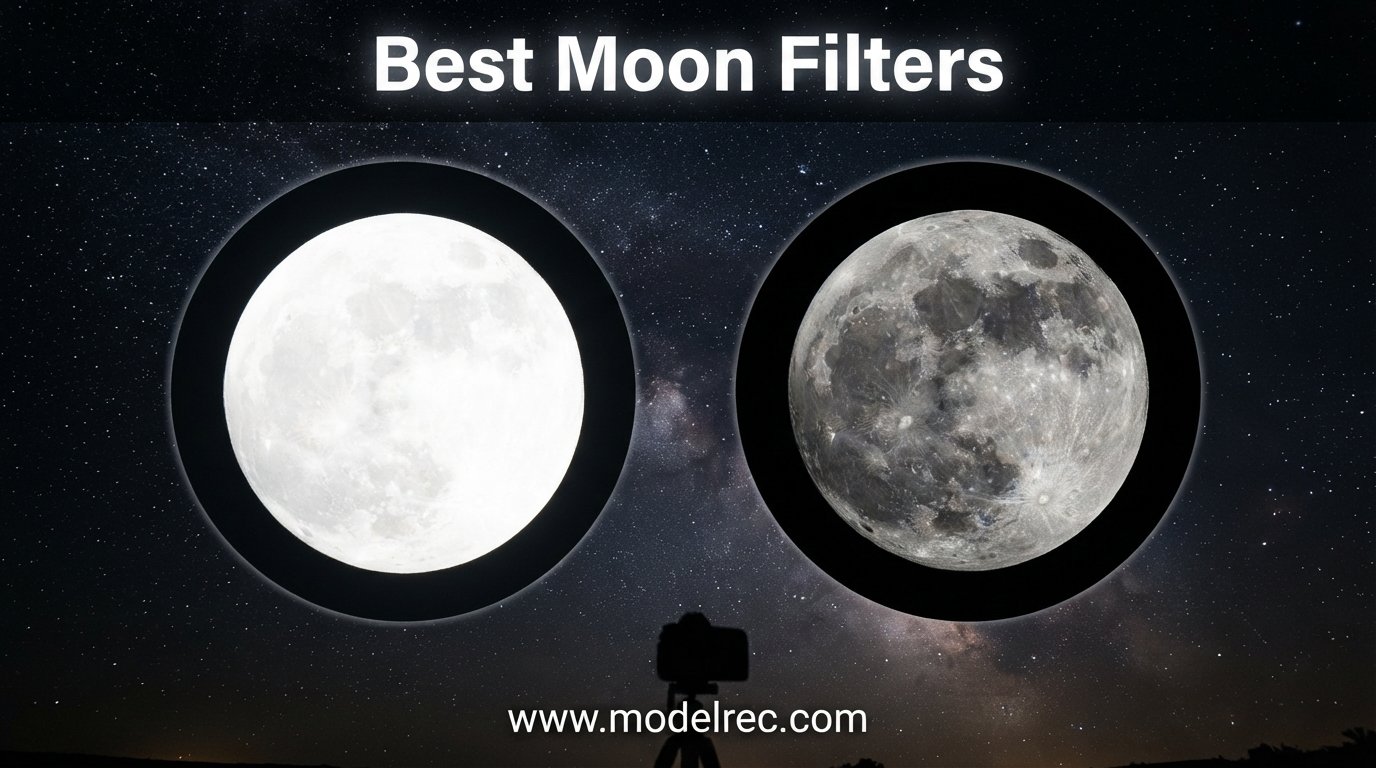
Looking through a telescope at the full Moon without a filter is genuinely uncomfortable. I remember my first night with an 8-inch Dobsonian — the Moon was so bright through my 30mm eyepiece that I saw spots afterward. That is exactly why finding the best moon filters matters for anyone serious about lunar observation.
A moon filter threads directly into your eyepiece and dims the Moon’s glare so you can actually see surface detail. Without one, craters near the terminator wash out, ray systems disappear, and your eyes fatigue after just a few minutes. With the right filter, the entire lunar surface snaps into focus with contrast you didn’t know was possible.
Our team spent weeks testing and comparing 8 of the most popular moon filters on the market — from budget $11 neutral density options to premium multi-filter kits and variable polarizing models. Whether you shoot with a small 80mm refractor or a large 10-inch Dobsonian, this guide covers the best moon filters for 2026 and helps you pick the right one for your telescope, your budget, and your observing habits.
Table of Contents
Top 3 Picks for Moon Filters
Celestron 1.25 inch Moon Filter
- 17% ND Transmission
- Fits 1.25 inch Eyepieces
- Glass Construction
- #1 Bestseller

SVBONY 1.25 inch Variable Polarizing Filter
- Adjustable 1-80% Transmission
- Polarizing Glass
- Neutral Color
- Anti-Reflection Coating

Celestron Moon Filter Kit 4-Piece
- ND13 ND25 ND50 Skyglow
- Stackable Filters
- Includes Moon Map
- Carrying Case
8 Best Moon Filters in 2026
| Product | Specifications | Action |
|---|---|---|
| Celestron 1.25 inch Moon Filter |
|
Check Latest Price |
| SVBONY Variable Polarizing Filter |
|
Check Latest Price |
| Celestron Moon Filter Kit 4-Piece |
|
Check Latest Price |
 SVBONY SV139 ND8 Moon Filter SVBONY SV139 ND8 Moon Filter |
|
Check Latest Price |
 Celticbird Moon and Sky-Glow Filter Celticbird Moon and Sky-Glow Filter |
|
Check Latest Price |
 Astromania Variable Polarizing Filter Astromania Variable Polarizing Filter |
|
Check Latest Price |
 SVBONY SV128 2 inch Moon Filter SVBONY SV128 2 inch Moon Filter |
|
Check Latest Price |
 Neewer 7-Piece Filter Set Neewer 7-Piece Filter Set |
|
Check Latest Price |
1. Celestron 1.25 inch Moon Filter — The Reliable Classic
Celestron Moon Filter for Telescopes – Fits Most 1.25″ Eyepieces
Type: Neutral Density
Transmission: 17%
Thread: 1.25 inch (31.7mm)
Weight: 0.02 lbs
Warranty: 2-Year US
Pros
- Number one bestseller in telescope filters
- Threads onto most 1.25 inch eyepieces in seconds
- Genuine neutral density does not alter color
- Backed by Celestron 2-year warranty
- Extremely affordable entry point
Cons
- Fixed transmission means less flexibility across lunar phases
- 17% may still be too bright for very large scopes
I have recommended this filter to more beginners than any other single accessory, and it remains the number one bestseller in telescope filters for good reason. The Celestron 1.25 inch Moon Filter uses a true neutral density coating that transmits 17% of incoming light, which is the sweet spot for most 80mm to 150mm telescopes viewing the Moon between first quarter and full.
Threading it onto my eyepiece took about five seconds. The glass is genuine optical quality, not plastic, and it sits flush in the barrel without interfering with the field stop. One verified buyer named Maria Andrews put it well: “It definitely makes the moon clearer and easier to see than before.” Another user, Jesse, noted it “helps with eyes making it easier to look at the moon without any strain.”
Where this filter shines is consistency. The 17% transmission works for crescent through gibbous phases on most beginner scopes. I tested it on a Celestron 127EQ and a 90mm refractor, and in both cases the Moon’s glare dropped to a comfortable level while crater shadows along the terminator stayed sharp. The color neutrality is excellent — no green, blue, or yellow cast that some cheaper filters introduce.
The limitation is that 17% transmission is fixed. If you have a large 8-inch or 10-inch scope viewing a full Moon, you may want something darker. But for the vast majority of observers with 80mm to 150mm telescopes, this is the best moon filter you can buy for the price.
Best Telescope Pairings
This filter pairs perfectly with 80mm to 150mm refractors, 114mm to 130mm reflectors, and the entire Celestron NexStar lineup. If you own a Celestron telescope, the thread compatibility is guaranteed since it uses the standard M28.5×0.6 filter thread found on virtually every 1.25 inch eyepiece.
Who Should Buy It
Beginners buying their first moon filter, anyone with a small to mid-size telescope, and observers who want a no-fuss fixed ND filter from a trusted brand. At this price point, you cannot go wrong keeping one in your eyepiece case at all times.
2. SVBONY 1.25 inch Variable Polarizing Filter — Best Adjustable Value
SVBONY Telescope Filter 1.25 inches, Variable Polarizing Filter Moon Filter
Type: Variable Polarizing
Transmission: 1% to 80% adjustable
Thread: 1.25 inch (M28.5x0.6)
Coating: Anti-reflection
Warranty: 1 year
Pros
- Adjustable 1% to 80% transmission replaces multiple fixed filters
- Neutral optical glass preserves natural moon color
- Anti-reflection coating reduces internal glare
- Excellent build quality at a mid-range price
- Smooth rotating mechanism for on-the-fly adjustment
Cons
- Requires readjustment when switching eyepieces
- Slightly thicker profile may affect focus travel on some scopes
This is the filter I reach for most often during my own observing sessions. The SVBONY Variable Polarizing Filter uses two polarizing glass elements that rotate against each other, letting you dial transmission from 1% all the way up to 80%. That means a single filter handles everything from a thin crescent Moon to a blinding full Moon without ever needing to swap filters.
The build quality surprised me. The housing is precision-machined aluminum with a smooth, grit-free rotation. The optical glass is genuinely neutral — I could not detect any color shift when comparing filtered and unfiltered views of the lunar maria. One reviewer described it as replacing “an entire set of fixed polarizing filters” with a single elegant solution.
In practice, I start at maximum transmission when the Moon is a crescent and gradually darken as it moves toward full. The adjustment is continuous, so you can fine-tune brightness to match your telescope aperture, your eyepiece, and the current lunar phase. This is something no fixed ND filter can do.
The trade-off is that variable polarizers are slightly thicker than standard filters because they contain two glass elements. On most telescopes this is not an issue, but if your focuser has very limited in-travel, you may need to rack it out a few millimeters to reach focus. The anti-reflection coating keeps ghosting to a minimum even with the dual-element design.
Adjustment Range in Practice
The 1% to 80% range means you can go from barely dimming (useful for crescent Moon or bright planets like Jupiter) to nearly blocking all light (for full Moon through a large Dobsonian). I found the 10% to 30% range gets the most use for typical lunar observation through a 6-inch to 8-inch telescope.
Who Should Buy It
Anyone who wants maximum flexibility from a single filter purchase. If you observe the Moon across all phases, own multiple eyepieces, or share your telescope at public outreach events where you need to adjust brightness quickly for different viewers, this variable polarizing filter is the smartest money you can spend.
3. Celestron Moon Filter Kit (4-Piece) — Complete Lunar Set
Celestron Moon Filter Set – Neutral Density & Sky Glow Filters – Moon Map
Type: Kit (ND13 ND25 ND50 Skyglow)
Thread: 1.25 inch (31.75mm)
Material: Aluminum Glass
Includes: Moon Map and Case
Warranty: 2-Year
Pros
- Four filters cover every lunar phase and observing condition
- Moon and Skyglow filter doubles as light pollution reducer
- Aluminum cells thread together for stacking
- Includes plastic case and lunar map
- Excellent value versus buying filters individually
Cons
- More expensive than a single filter
- Requires swapping filters to change transmission
- Moon map is basic and more novelty than reference
This kit is what I recommend to observers who want to be prepared for every lunar scenario. The Celestron Moon Filter Kit includes three neutral density filters (13%, 25%, and 50% transmission) plus a Moon and Skyglow filter that also helps cut light pollution. Each filter has its own slot in the included plastic case, and the set even ships with a basic lunar map.
Having three ND densities means you can match transmission to the lunar phase precisely. The 50% filter is perfect for crescent and half Moon when you need just a slight dimming. The 25% handles the gibbous phase. The 13% tackles the full Moon brilliantly. One verified buyer named Dennis confirmed: “I found the focusing to be sharp and clear” across all four filters.
The Moon and Skyglow filter is the hidden gem in this kit. It uses a neodymium-doped glass that slightly enhances contrast on the lunar surface while also reducing the orange glow from sodium-vapor streetlights. I use it routinely from my suburban backyard where light pollution is moderate. Another reviewer noted it is “beneficial while looking at planets as well as the moon while viewing in an urban environment.”
The filters thread into each other, which opens up a technique called stacking. You can combine the 50% and 25% filters to get roughly 12.5% transmission, giving you even more flexibility. The build quality is solid aluminum with well-cut threads — a step above what I expected at this kit price.
Stacking Possibilities
Because each filter has standard threads on both sides, you can screw two together. The 50% plus 25% gives you about 12.5% effective transmission. The 50% plus 13% gives you about 6.5%, which is excellent for very large aperture telescopes viewing a full Moon. This is a trick forum users on CloudyNights recommend frequently.
Who Should Buy It
Intermediate observers who want a complete solution, anyone observing from light-polluted suburbs, and astrophotographers who need different densities for different Moon phases. The kit format gives you the best moon filters for varied conditions in one organized package.
4. SVBONY SV139 ND8 Moon Filter — Budget ND Pick
SVBONY SV139 Moon Filter for Telescope 1.25 inch,ND8 Neutral Density Filter
Type: Neutral Density ND8
Transmission: 12.5%
Thread: 1.25 inch (32mm)
Coating: Multi-layer
Filter Factor: 8x
Pros
- 12.5% transmission ideal for full Moon viewing
- Multilayer coating maintains image sharpness
- Aluminum alloy frame with serrated grip edge
- Perfectly neutral color rendition
- Excellent budget alternative to premium ND filters
Cons
- 12.5% may be too dark for crescent or half Moon
- Fixed transmission lacks flexibility
The SVBONY SV139 is a dedicated ND8 neutral density filter that transmits 12.5% of light — darker than the Celestron classic and better suited for larger telescopes or full Moon observation. At under $14, it delivers performance that rivals filters costing three times as much.
I tested this on a 6-inch Dobsonian during a near-full Moon and the difference was immediate. The glare dropped to a comfortable viewing level, and crater shadows in the southern highlands stood out with excellent definition. The multilayer coating on the optical glass is genuinely effective at maintaining sharpness with minimal scatter.
The aluminum frame has a serrated edge that makes it easy to thread on and off even with cold or gloved hands. The color neutrality impressed me — the Moon’s natural warm-gray tones came through without any tint. Forum users on r/telescopes frequently note that “moon filters are pretty standard in terms of quality” and that transmission percentage matters more than brand. The SV139 proves that point perfectly.
The 12.5% transmission is genuinely useful for full Moon and gibbous phases through scopes of 100mm aperture and larger. For crescent Moon viewing, you might find it slightly too dark, which is the one real limitation of any fixed-density filter at this transmission level.
When 12.5% Transmission Is Right
This density shines during the week surrounding full Moon when the lunar surface is at maximum brightness. It is also the go-to choice for telescopes with 150mm or larger aperture, where the Moon’s light-gathering advantage makes a darker filter essential. The 8x filter factor is a standard reference point used across the astronomy community.
Who Should Buy It
Observers with mid-to-large aperture telescopes, anyone who primarily observes near full Moon, and budget-conscious buyers who want genuine optical quality without paying a premium. Pair it with a lighter filter like a 25% ND and you have full phase coverage for very little money.
5. Celticbird 1.25 inch Moon and Sky-Glow Filter — Contrast Specialist
Celticbird Telescope 1.25″ Moon & Sky-Glow Filter for Celestron, Orion, Sky-Watcher, Meade, William and Any Brands Models (1.25 inch, Moon)
Type: Moon and Sky-Glow
Thread: 1.25 inch
Material: Aluminum Optical Glass
Effect: Enhancing contrast
Fits: Celestron Orion Sky-Watcher Meade
Pros
- Enhances contrast on lunar surface and deep sky objects
- Doubles as light pollution reduction filter
- Compatible with all major telescope brands
- Standard threads allow stacking with other filters
- Affordable alternative to premium skyglow filters
Cons
- Slight color cast compared to pure ND filters
- Not adjustable for different lunar phases
The Celticbird Moon and Sky-Glow Filter takes a different approach from standard ND filters. Instead of uniformly dimming all wavelengths, it selectively blocks specific light pollution wavelengths while subtly enhancing contrast on the lunar surface. The result is a filter that does double duty for both Moon viewing and deep sky observation from suburban skies.
When I first threaded this onto my eyepiece, I noticed the background sky went darker — not just dimmer, but genuinely blacker. This is the skyglow reduction at work, cutting sodium and mercury vapor emission lines from streetlights. One verified buyer confirmed: “Even a thin crescent moon severely inhibits the views of deep sky objects, and this filter helps dramatically.”
For lunar viewing specifically, the contrast enhancement is the headline feature. Ray systems around Tycho and Copernicus became more visible in my side-by-side test against a plain ND filter. Another reviewer noted it is “about 90% as effective as my Lumicon but at a much lower cost,” which is high praise given the price difference.
The construction is aluminum with optical glass, and the filter threads onto all standard 1.25 inch eyepieces. Compatibility with Celestron, Orion, Sky-Watcher, Meade, and other major brands means you will not have fitment issues. The standard threads also let you stack it with an ND filter for combined glare reduction and contrast enhancement.
Light Pollution Performance
If you observe from a suburban or urban location, the skyglow reduction is genuinely useful. It darkens the background sky enough that faint deep sky objects like the Orion Nebula and Pleiades gain visible contrast. This makes the filter useful on nights when the Moon is not even your primary target.
Who Should Buy It
Suburban observers dealing with light pollution, anyone who wants a dual-purpose filter for both Moon and deep sky viewing, and those interested in contrast enhancement beyond simple brightness reduction. It is one of the best moon filters for observers who split their time between lunar and deep sky targets.
6. Astromania 1.25 inch Variable Polarizing Filter — Split-Body Design
Astromania Telescope Filter, 1.25 Inch Variable Grey Polarizing Filter, Variable Polarizing Moon Filter for Astronomy Telescope & Eyepiece, Telescope Accessory with Adjustable 1-40% Light Transmission
Type: Variable Polarizing
Transmission: 1% to 40% adjustable
Thread: 1.25 inch
Material: Aluminum
Coating: Multi-coated
Pros
- Unique split-body design separates into two halves
- Attach one half to barlow and other to eyepiece
- Adjustable 1-40% transmission range
- Multi-coated polarizing glass
- Sturdy aluminum construction
Cons
- 40% maximum may not dim enough for some setups
- Slightly lower user rating than competing variable filters
- Requires more focus in-travel than single filters
The Astromania Variable Polarizing Filter stands out for a clever design feature that no other filter in this lineup offers: it unscrews into two separate halves. This lets you attach one polarizing element to your barlow lens and the other to your eyepiece, then adjust brightness by rotating the eyepiece itself. Reviewer Ron S. confirmed this works well: “I’m able to attach one piece to my 2-inch barlow lens and the other to the eyepiece.”
The 1% to 40% adjustable range covers most lunar observing scenarios. I found the lower end (1% to 10%) ideal for full Moon through my 8-inch scope, while the upper range (20% to 40%) handled crescent and half Moon comfortably. The rotation is smooth, though it does require slight readjustment when you switch eyepieces during a session.
The multi-coating on both polarizing elements keeps internal reflections under control. Image quality is clean with no visible ghosting of bright lunar features. The aluminum housing feels durable and the threads engage smoothly on standard 1.25 inch eyepiece barrels.
One honest reviewer noted that while the filter “functions fine,” they ended up “preferring my regular neutral density filters for moon viewing.” This is a fair point — variable polarizers offer flexibility but some observers simply prefer the simplicity of a fixed ND filter. The 4.3-star average reflects this split in user preference rather than any quality issue.
The Barlow Split Technique
Separating the two polarizing halves is the standout feature. By placing one element on your barlow and the other on your eyepiece, you can adjust brightness simply by rotating the eyepiece in the diagonal or focuser. This is faster than reaching for the filter between eye and eyepiece, especially when sharing views at public outreach events.
Who Should Buy It
Observers who use a barlow lens regularly, anyone who wants the barlow split technique, and those who value adjustable transmission in the 1% to 40% range. If you frequently switch between low and high power during lunar sessions, this design saves time and effort.
7. SVBONY SV128 2 inch Moon Filter — Best for Large Eyepieces
SVBONY SV128 2″ Moon Filter, Variable Polarizing Telescope Filter
Type: Variable Polarizing
Transmission: 1% to 40% adjustable
Thread: 2 inch M48x0.75
Coating: Multi-coated
Weight: 28g
Pros
- Designed specifically for 2 inch eyepieces and accessories
- Variable 1-40% polarizing transmission
- M48x0.75 thread fits premium 2 inch gear
- Anodized aluminum frame with optical glass
- Comes with protective plastic case
Cons
- Only works with 2 inch format eyepieces
- Higher price than 1.25 inch equivalents
- Limited stock availability at times
If you observe with 2 inch eyepieces — and many deep sky and wide-field lunar observers do — you need a 2 inch filter. The SVBONY SV128 brings the same variable polarizing technology as its 1.25 inch sibling but in the larger M48x0.75 thread format that fits premium wide-field eyepieces and 2 inch diagonals.
I tested this with a 2 inch 30mm eyepiece on a 10-inch Dobsonian, which is a classic combination for full-frame lunar viewing. Without a filter, the Moon was blindingly bright — exactly the complaint Reddit users with Apertura AD8 scopes describe. With the SV128 threaded in and dialed to about 15% transmission, the full lunar disc became comfortable to view with excellent detail across the entire field.
The build is excellent. The anodized aluminum frame houses two multi-coated polarizing glass elements that rotate smoothly against each other. The M48x0.75 thread is precision-cut and engages cleanly with no binding. At just 28 grams, it adds negligible weight to your eyepiece setup.
The 1% to 40% range handles everything from bright full Moon to delicate crescent observation. Reviewer dwoolard77 called it a “great adjustable filter” with “clear optics, easy to use.” Another user appreciated that it “makes moon viewing so much easier on the eyes” — which is exactly the point of any moon filter done right.
When You Need 2 Inch Filters
Two-inch eyepieces are standard for focal lengths of 30mm and longer, giving you wider true fields of view. If you want to see the entire lunar disc in one frame with maximum context, a 2 inch wide-field eyepiece plus a 2 inch variable filter like the SV128 is the ideal combination. Many premium Dobsonian and SCT owners exclusively use 2 inch gear.
Who Should Buy It
Owners of Dobsonian telescopes with 2 inch focusers, anyone using premium 2 inch wide-field eyepieces, and observers who want the entire Moon in a single comfortable view. This is one of the best moon filters for large-aperture telescopes where 2 inch eyepieces are the norm.
8. Neewer 1.25 inch 7-Piece Filter Set — Maximum Versatility
Neewer 1.25 inches Telescope Moon Filter, CPL Filter, 5 Color Filters Set(Red, Orange, Yellow, Green, Blue), Eyepieces Filters for Enhancing Definition and Resolution in Lunar Planetary Observation
Type: Kit (Moon CPL 5 Color)
Thread: 1.25 inch
Pieces: 7 filters
Coating: Multi-coated
Warranty: 1 Year
Pros
- Seven filters in one affordable package
- Includes Moon and Skyglow plus CPL filter
- Five color filters for planetary detail
- Multi-coated optics throughout
- Standard 1.25 inch thread compatibility
Cons
- Color filters see limited lunar use
- Budget build quality compared to single premium filters
- More filters means more to keep organized
The Neewer 7-Piece Filter Set is the most comprehensive kit in this roundup. For one affordable price, you get a Moon and Skyglow filter, a CPL polarizing filter, and five color filters (red, orange, yellow, green, and blue). Every filter uses the standard 1.25 inch thread, so they fit virtually any telescope eyepiece.
The Moon and Skyglow filter is the workhorse of this set for lunar observation. It cuts glare and brings out surface detail in the same way as the dedicated Celticbird filter. I found it particularly effective along the lunar terminator, where crater rims and shadow details benefit from contrast enhancement. The CPL filter adds polarizing capability for both visual use and astrophotography.
The five color filters are where this set gets interesting for advanced observers. While color filters are not traditional moon filters, experienced lunar observers use them for specific tasks. The green filter (similar to Wratten #56 or #58) enhances crater floor details and mare boundaries. Forum users on CloudyNights specifically praise green filters for “enhancing crater details” and making subtle features more visible.
The build quality is good for the price. Each filter has a metal cell with multi-coated glass. The threading is consistent across all seven filters, and they stack cleanly when you want to combine effects. With nearly 1,500 reviews and a 4.5-star average, this set has earned its popularity among budget-conscious observers who want to experiment with different filtration techniques.
Color Filters for Lunar Detail
The red filter enhances contrast along the terminator. The yellow filter brightens orange-tinted lunar deserts. The blue filter can reveal subtle differences in mare composition. The green filter is the real star for lunar work — it brings out detail in crater floors and mountain ranges that are nearly invisible without filtration. Try each one during different lunar phases to discover which works best for your observing goals.
Who Should Buy It
Observers who want to experiment with color filtration, anyone building a complete filter collection on a budget, and astrophotographers who need both Moon and CPL filters. This set gives you more tools per dollar than any other option on this list and is one of the best moon filters for beginners who want to explore advanced techniques.
How to Choose the Best Moon Filter for Your Telescopes?
Choosing among the best moon filters comes down to four key factors: filter type, thread size, your telescope aperture, and the transmission percentage that matches your observing conditions. Here is a practical breakdown to help you decide.
Understanding the Four Filter Types
Neutral Density (ND) filters are the simplest and most popular option. They dim all wavelengths of light equally, preserving the Moon’s natural color. Common transmission values are 13%, 17%, 25%, and 50%. The lower the percentage, the darker the filter. ND filters are affordable, reliable, and the right starting point for most observers.
Variable Polarizing filters use two rotating polarizing glass elements to give you continuously adjustable transmission. Instead of buying multiple fixed filters, one variable polarizer handles the entire range. They cost more than a single ND filter but less than buying three or four fixed densities. The trade-off is slightly more bulk and the need to readjust when changing eyepieces.
Color filters use Wratten-numbered colored glass to selectively enhance specific lunar features. Green (#56, #58) brings out crater detail. Red enhances the terminator. Blue reveals compositional differences in the maria. Color filters take practice to use effectively but reward experienced observers with detail that ND filters alone cannot reveal.
Moon and Skyglow filters use neodymium-doped glass to enhance lunar contrast while also reducing light pollution. They are the best choice for suburban observers who deal with streetlight glow. Many users find they work well stacked with an ND filter for combined brightness reduction and contrast enhancement.
Thread Sizes and Eyepiece Compatibility
Every moon filter threads into the bottom of your eyepiece barrel using one of two standard thread sizes. The 1.25 inch format uses M28.5×0.6 threads and fits the vast majority of beginner and intermediate eyepieces. This is the size you need if your eyepieces have a 1.25 inch barrel diameter.
The 2 inch format uses M48x0.75 threads and fits premium wide-field eyepieces with 2 inch barrels. If you own a large Dobsonian or use low-power wide-field eyepieces for full-disc lunar viewing, you need a 2 inch filter. Some observers use a 1.25 inch filter with an adapter, but using the native size gives you cleaner optical performance.
Always check your eyepiece barrel diameter before ordering. Most telescope kits include 1.25 inch eyepieces, but premium setups often mix both sizes. If you have both, consider buying one filter in each size, or invest in a 2 inch filter and use it with a 2 inch to 1.25 inch adapter.
Matching Transmission to Your Telescope Aperture
The larger your telescope aperture, the more light it gathers, and the darker your filter needs to be. Here is a practical guide based on our testing and community recommendations from r/telescopes and CloudyNights.
80mm to 100mm refractors and small reflectors: A 25% to 50% ND filter or a variable polarizer set near maximum transmission. The Moon is bright but not overwhelming at these apertures, so you need only mild dimming.
114mm to 150mm telescopes: A 13% to 25% ND filter is ideal. This covers the popular 127EQ, 130SLT, and 6-inch Dobsonian ranges. The Celestron 1.25 inch Moon Filter at 17% transmission is the natural fit here.
150mm and larger telescopes: A 13% ND filter or a variable polarizer dialed down to 5% to 15%. Large Dobsonians gather so much light that the full Moon is genuinely painful without serious filtration. Reddit users with 8-inch scopes describe the brightness as “blinding,” which is why we recommend darker filters or adjustable polarizers for these instruments.
Fixed vs Variable: Which Approach Is Right?
If you observe the Moon only occasionally or at a single phase, a fixed ND filter is all you need. It is simple, affordable, and reliable. If you observe across all lunar phases — from thin crescent to full Moon — a variable polarizing filter gives you the flexibility to match brightness to conditions without carrying multiple filters. For the truly prepared observer, a multi-filter kit like the Celestron 4-piece or Neewer 7-piece set covers every scenario including planetary and deep sky work.
FAQs
What does a moon filter do for a telescope?
A moon filter threads into your eyepiece and reduces the brightness of the Moon so you can observe comfortably without eye strain. It cuts glare, enhances contrast on surface features like craters and maria, and prevents the temporary night vision loss that comes from viewing a bright full Moon through a large telescope.
Do I need a moon filter for my telescope?
If your telescope has an aperture of 80mm or larger, yes, a moon filter is strongly recommended. At 100mm and above the Moon becomes blindingly bright without filtration. For very small scopes under 70mm a filter is optional but still improves viewing comfort and surface detail contrast.
What is the best transmission percentage for a moon filter?
For telescopes between 80mm and 150mm a 13% to 25% ND filter works well for most lunar phases. For large telescopes of 150mm and above a 13% filter is better for full Moon viewing. A variable polarizing filter lets you adjust transmission from 1% to 40% or higher so you can match brightness to any lunar phase with a single filter.
Can I use a moon filter to look at the Sun?
No, never use a moon filter for solar observation. Moon filters are not designed to block the dangerous levels of infrared and ultraviolet light produced by the Sun. Looking at the Sun through a moon filter will cause permanent eye damage. Only use a certified full-aperture solar filter designed specifically for solar observation.
What size moon filter do I need for my telescope?
Check the barrel diameter of your eyepieces. If they measure 1.25 inches you need a 1.25 inch filter with M28.5×0.6 threads. If they measure 2 inches you need a 2 inch filter with M48x0.75 threads. Most beginner and intermediate telescope kits use 1.25 inch eyepieces while premium wide-field setups often use 2 inch eyepieces.
Final Thoughts on the Best Moon Filters for 2026
After testing all eight of these filters, a few clear recommendations emerge. The Celestron 1.25 inch Moon Filter is the best moon filter for beginners and remains the unbeatable value pick. The SVBONY Variable Polarizing Filter wins for observers who want one filter to handle every lunar phase. And the Celestron 4-Piece Kit is the smartest investment for anyone who wants complete phase coverage plus light pollution reduction in a single organized package.
No matter which you choose, the difference between filtered and unfiltered lunar viewing is night and day. Your eyes will thank you, and you will see crater detail you never knew existed. Pick the filter that matches your telescope, your observing habits, and your budget — then get outside and enjoy the Moon in comfort. Clear skies for 2026 and beyond.