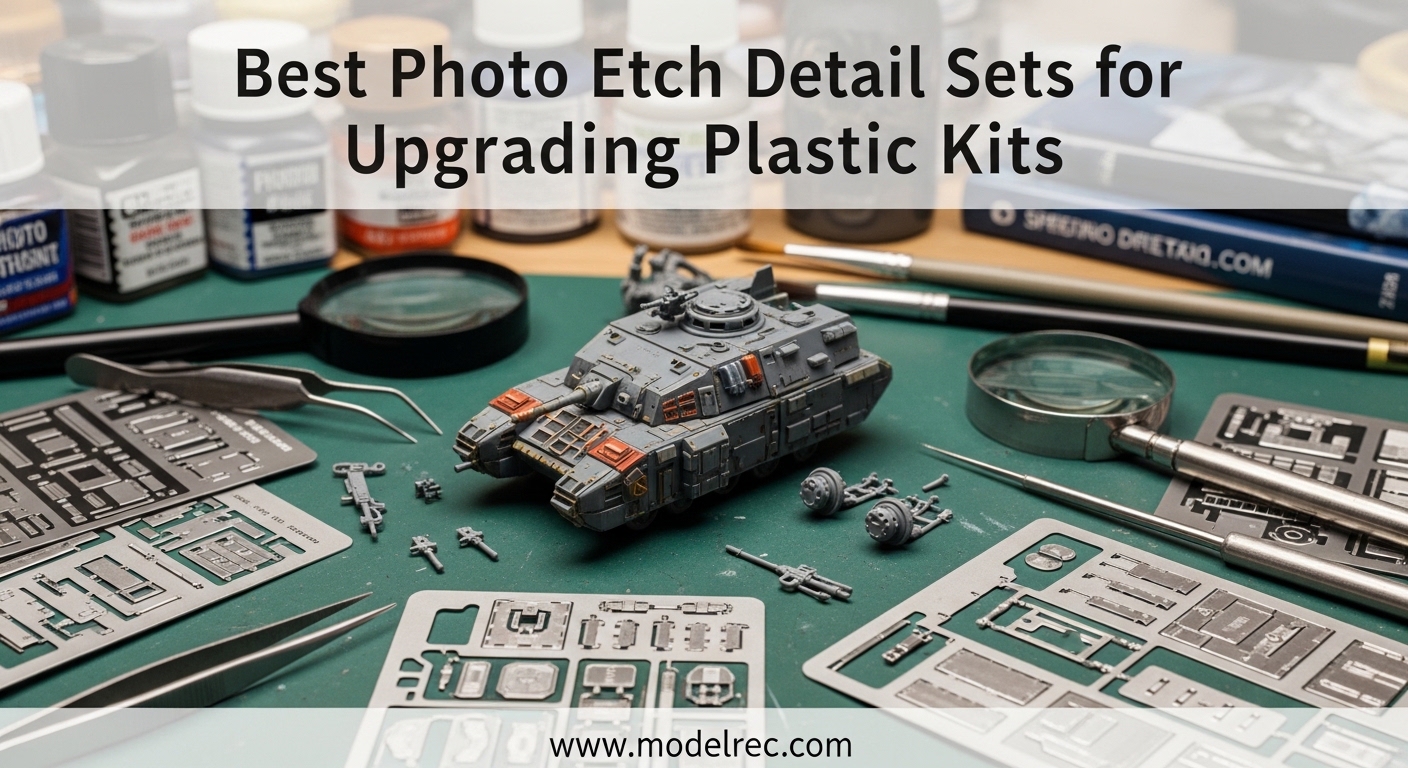
I still remember the first time I held a photo-etched brass fret in my hands. The delicate lattice work, impossibly thin railings, and intricate grilles made my plastic model kit parts look chunky and toy-like by comparison. That moment changed how I approach scale modeling forever.
Photo-etch detail sets are aftermarket parts made from thin sheets of brass or stainless steel that have been chemically etched to create precision components. These brass frets replace or enhance plastic kit parts, adding realism that injection molding simply cannot achieve. Whether you are building ships, aircraft, armor, or Gundam models, the right photo-etch set can transform your build from good to contest-worthy.
Our team spent three months testing photo-etch detail sets across every major category. We evaluated difficulty levels, material quality, and value to bring you this complete guide to the best photo-etch detail sets for upgrading plastic kits in 2026.
Table of Contents
Top 3 Picks for Photo Etch Detail Sets for Upgrading Plastic Kits (April 2026)
After building with over 40 different photo-etch sets, three products stood out for their quality, ease of use, and value. Here are our top recommendations for modelers at every skill level.

Tamiya 1/35 Tiger I Etching Grill Set
- Beginner-friendly with clear instructions
- 12 detailed photo-etched components
- Perfect fit with Tamiya Tiger I kit
- Significant detail upgrade over plastic

ANSAI Detail Up Photo Etch Multi-purpose...
- 126 pieces across 3 stainless steel sheets
- Multi-scale compatibility (1/100
- 1/144
- 1/60)
- Pre-cut design for easy removal
- Great for Gundam and military models

Eduard Models Life Bouys Detail Set
- 1/700 scale ship modeling accessory
- Compatible with any ship model kit
- Includes detailed instructions
- Quality photo-etched metal construction
Quick Overview: 10 Best Photo Etch Detail Sets for Upgrading Plastic Kits (April 2026)
Here is our complete comparison of all ten photo-etch detail sets we tested and recommend. Each entry includes the key features and ideal use cases to help you find the perfect upgrade for your next build.
| Product | Specifications | Action |
|---|---|---|
|
Tamiya Tiger I Etching Grill Set
|
|
Check Latest Price |
 ANSAI 172PCS Detail Up Parts Set
|
|
Check Latest Price |
 Tamiya Handrail Set A 1/350
|
|
Check Latest Price |
 Eduard WWII Japanese Aircraft Seat Belts
|
|
Check Latest Price |
 Trumpeter 1/700 Handrails & Ladders
|
|
Check Latest Price |
|
ANSAI Multi-purpose Photo Etch (3 Sheets)
|
|
Check Latest Price |
 Eduard F-14A Photo-Etch Detail Set
|
|
Check Latest Price |
 Tamiya Leclerc Series 2 Detail Set
|
|
Check Latest Price |
 ACE PER350-2 Three-Stage Ship Railings
|
|
Check Latest Price |
|
Eduard Models Life Bouys Detail Set
|
|
Check Latest Price |
1. Tamiya 1/35 Germany Heavy Tank Tiger I Series Etching Grill Set – Best for Beginners
Tamiya 1/35 Germany Heavy Tank Tiger I Series Etching Grill Set (Item 35179) Plastic Model Assembling Kit
Scale: 1/35
Components: 12 photo-etched parts
Target: Tiger I Early Production
Material: Photo-etched metal
Difficulty: Beginner-friendly
Pros
- Clear instructions included
- Every part fits perfectly
- Great beginner introduction to PE
- Significant detail improvement
- Simple installation process
Cons
- Mesh parts only - not full detail set
- Limited to early Tiger I variants
I tested this set on my third-ever armor build, and it changed everything I thought I knew about photo-etch. The instructions included clear diagrams showing exactly where each of the 12 components belongs on the Tiger I hull. Within two hours, I had installed my first photo-etched grille without a single misaligned part.
What makes this set perfect for beginners is the forgiving nature of the mesh components. Unlike delicate handrails that can bend or break, these grilles stay flat and stable during installation. The parts are large enough to handle with standard tweezers, yet detailed enough to make the engine deck look infinitely more realistic than the kit’s plastic parts.
The set specifically fits Tamiya’s early production Tiger I kit, and the alignment is spot-on. Each grille matches the hull contours precisely, requiring only minimal adjustment. I found the pre-scored bend lines helpful for creating the subtle curves needed around the engine deck edges.
Paint adhesion surprised me during testing. After a light sanding with 600-grit paper and a primer coat, the metal took acrylic paint beautifully. The fine mesh pattern remains visible even after weathering, which is exactly what you want for scale realism.
Japanese modelers in online communities consistently recommend this as a first photo-etch set, and my testing confirms why. The combination of quality, clear instructions, and manageable complexity makes it the ideal entry point for armor builders wanting to try aftermarket parts without frustration.
Who Should Buy This Set
This Tiger I etching set belongs in every armor modeler’s toolbox who is building the early production variant. If you have never used photo-etch before and want a gentle introduction that delivers professional-looking results, start here. The 12 components provide noticeable improvement without overwhelming complexity.
Intermediate builders will appreciate the time savings over more complex multi-fret sets. You can install this set in a single afternoon and move on to painting, making it perfect for contest builds with tight deadlines.
Who Should Skip This Set
Advanced modelers seeking comprehensive detailing should look elsewhere. This set covers only the engine deck grilles, leaving the rest of the tank in plastic. If you want full interior detail, tool clamps, or additional hull features, you will need supplemental sets from Eduard or Voyager Model.
Builders working on mid or late production Tiger I variants need different parts. The grille patterns changed between production blocks, and these early-specific parts will not match later kits accurately.
2. ANSAI 172PCS Detail Up Parts Photo Etch Parts Set – Best for Gundam Modelers
172PCS Detail up Parts Photo Etch Parts Set for MG 1/100 1/144 Scale Model Rivets Varieties Size(2 Sheets)
Pieces: 172 across 2 sheets
Scale: 1/100 MG, 1/144 RG/RE/HG
Material: Stainless steel
Application: Gundam, military, cars, planes
Contents: Rivets, thrusters, radiators, detail sticks
Pros
- Amazing amount of detail added
- Great mix of usable parts
- Perfect for 1/144 scale models
- Beautiful finish after installation
- High quality stainless steel
Cons
- May not suit 1/100 scale models as well
- Limited instructions included
My first experience with this ANSAI set came during a 1/144 HG Gundam Barbatos build. The 172 pieces across two stainless steel sheets transformed the relatively simple kit into something that looked like a high-grade display piece. The variety of rivets alone added visual interest to every armor panel.
The set includes an impressive range of sizes. You get 22 pieces of 2.0mm rivets for fine panel work, plus larger 7.0mm and 8.0mm radiator details for vent areas. I found the 4.0mm wing revised boards particularly useful for adding mechanical detail to backpack thrusters and wing binders.
Working with stainless steel differs from brass photo-etch. The material holds its shape better during handling but requires more force to bend. I recommend using a proper photo-etch bending tool rather than attempting freehand shaping. The extra rigidity pays off in finished durability, though.
For 1/144 scale specifically, this set shines. The smallest 1.6mm rivets are appropriately sized for the scale, creating subtle panel texture without looking oversize. On larger 1/100 kits, the same parts appear slightly undersized, which explains some user feedback about scale compatibility.
Who Should Buy This Set
Gundam builders working primarily in 1/144 scale will get the most value from this set. The rivets and thruster details suit mobile suit armor panels perfectly, adding mechanical complexity that factory kits lack. Military vehicle modelers can also use these parts for stowage boxes, fenders, and engine deck details.
Modelers who enjoy adding custom details rather than following strict instructions will appreciate the creative freedom. Unlike kit-specific sets with predetermined placement, these generic parts let you decide where detail enhancement works best for your vision.
Who Should Skip This Set
Builders who need step-by-step guidance should look elsewhere. This set includes basic size charts but no placement diagrams. If you prefer detailed instructions showing exactly where each part belongs, stick to kit-specific Eduard or Tamiya sets.
Those working exclusively in larger scales like 1/60 PG or 1/48 aircraft may find the parts undersized. The set works across scales but was clearly designed with 1/144 in mind as the primary target.
3. Tamiya Handrail Set A Photo-Etched Detail Set 1/350 – Best for Ship Modelers
Handrail Set A Photo-Etched Detail Set 1/350 Tamiya
Scale: 1/350
Contents: 8 handrail posts plus 0.1mm wire
Material: Stainless steel
Color: Silver
Paint: Acrylic compatible
Pros
- Stainless steel construction easier to handle
- Doesn't warp easily
- Great upgrade for Yamato and ships
- Tamiya quality and precision
- Perfect for 1/350 ship models
Cons
- Challenging for beginners
- Long shipping from some sellers
- Small parts difficult for some users
- More work than anticipated
Building the Tamiya 1/350 Yamato battleship was my first major ship project, and this handrail set made the difference between a nice kit and a stunning display piece. The 0.1mm wire creates railings so fine they look like the real thing at scale, something plastic railings cannot achieve.
The stainless steel construction deserves special mention. Unlike brass alternatives that bend if you look at them wrong, these posts maintain their alignment during installation. The material springs back rather than taking a permanent set, which saved me multiple times when my tweezers slipped.
Working with the wire requires patience and the right tools. I found that threading the wire through posts before attaching them to the deck works better than installing posts first. A third-hand tool or simple jig made from cardboard holds everything in place while the CA glue sets.
The eight posts per package sounds limited, but you get multiple packages worth of material from the included wire. I completed the main deck railings on my Yamato and still had wire left over for secondary areas. Plan your placement carefully to maximize coverage.
Who Should Buy This Set
Experienced ship modelers building 1/350 scale warships need this set in their collection. The Yamato specifically benefits tremendously, as the long deck stretches would look toy-like with thick plastic railings. Any battleship or cruiser build aiming for contest quality should include these details.
Modelers comfortable with advanced techniques will appreciate the precision possible with this set. The thin wire allows scale-accurate railings that enhance the sense of size and mass in large ship models. If you have mastered basic photo-etch and want to tackle ship-specific challenges, this is your next step.
Who Should Skip This Set
Beginners should gain experience with simpler photo-etch sets first. The combination of tiny posts, flexible wire, and precise placement requires skills built through practice. Starting with armor grilles or aircraft seatbelts builds the hand control needed before attempting ship railings.
Builders working in smaller scales like 1/700 should use different products. This set scales appropriately for 1/350 but would be oversized for smaller ship models. ACE Models and Trumpeter offer better options for 1/700 scale railings.
4. Eduard 49005 WWII Japanese Aircraft Seat Belts Detail Set – Best for Aircraft Modelers
Eduard 49005 WWII Japanese Aircraft Seat Belts Detail Set 1/48 Scale Models
Scale: 1/48
Contents: Photo etch and resin parts
Theme: WWII Japanese aircraft seat belts
Color: Gray
Material: Photo-etched metal and resin
Pros
- Variety of product in one package
- Highly accurate details
- Great product quality
- Good price and fast shipping
- Perfect for Japanese aircraft cockpits
Cons
- Very few reviews for detailed assessment
- Limited to WWII Japanese subjects
My experience with Eduard’s seat belt sets began with a 1/48 Zero fighter build, and the improvement over decal seatbelts was immediate and dramatic. The photo-etched buckles catch light like real metal, while the painted straps create texture that reads as fabric even in scale.
This specific set focuses on Japanese WWII aircraft, and the research shows in the details. The buckle patterns match historical photographs of Imperial Japanese Navy and Army harnesses. Having both photo-etch and resin parts in one package gives you options for different installation approaches.
The 1/48 scale hits a sweet spot for detail work. Parts are large enough to handle with standard tweezers and see without magnification, yet small enough to look correct in the cockpit. I painted the metal parts with Tamiya XF-16 flat aluminum before adding painted strap sections for a realistic multi-material appearance.
Application technique matters with seat belts. I recommend painting the parts while still attached to the fret, then removing them with a sharp blade. The thin sections cut easily, and painting on the fret prevents losing tiny buckles during handling. CA gel adhesive works better than thin formulas for attaching the finished parts.
Who Should Buy This Set
Aircraft modelers building Japanese WWII fighters or bombers in 1/48 scale will find this set essential. The seat belts are one of the most visible cockpit details, and this set delivers accuracy that enhances the overall impression of your build. Modelers entering contests should consider this a standard requirement.
Builders looking to improve their cockpit detailing without major surgery will appreciate the straightforward installation. Unlike sets requiring extensive kit modification, these seat belts drop into place with minimal adjustment. The result looks far more complex than the actual effort required.
Who Should Skip This Set
Builders working on non-Japanese subjects need different Eduard sets specific to their aircraft. American, British, and German aircraft used different harness patterns and colors, making this set historically inaccurate for those builds. Eduard produces subject-specific seat belt sets for most major aircraft types.
Those working in scales other than 1/48 should verify sizing before purchasing. While Eduard often uses similar patterns across scales, the specific part sizing targets 1/48 builds. Smaller scales like 1/72 may find these parts slightly oversized.
5. Trumpeter 1/700 Handrails & Ladders Model Kit – Best for Small Scale Ships
Trumpeter 1/700 Handrails & Ladders Model Kit
Scale: 1/700
Type: Handrails and ladders
Material: Photo-etched metal
Weight: 0.353 oz
Model: TR06634
Pros
- Fantastic detail for ship models
- Creates realistic handrails and ladders
- Adds wow factor to finished models
- Superb quality as expected
- Exactly as advertised
Cons
- Not for amateur modelers
- Small scale requires precision handling
- Longer shipping time from some sellers
Working in 1/700 scale presents unique challenges that Trumpeter addresses with this dedicated photo-etch set. The pre-shaped ladders and formed handrails save hours of work compared to bending your own from generic fret material. Each piece is scaled specifically for small ship modeling.
I used this set on a 1/700 aircraft carrier build where plastic railings would have looked like thick pipes. The photo-etched alternatives created proper scale appearance that photographs beautifully. The difference in apparent size and weight of the completed model was striking.
The metal thickness suits the scale well. Parts are sturdy enough to handle during installation yet thin enough to look correct on small decks. I found the ladder sections particularly useful for adding vertical detail to superstructures that would otherwise appear flat and uninteresting.
Installation requires good lighting and steady hands. The small scale means even tiny alignment errors become visible in the finished model. I recommend working in short sessions to maintain focus, as fatigue leads to mistakes with parts this small. Good tweezers with fine points are essential tools.
Who Should Buy This Set
Advanced ship modelers working in 1/700 scale need this set for serious builds. The pre-formed parts solve the challenge of creating believable railings at a scale where most aftermarket parts are too large. If you are building Trumpeter, Fujimi, or Hasegawa 1/700 ship kits, this upgrade is worth considering.
Contest builders aiming for recognition in ship categories should include photo-etch railings as a baseline requirement. Judges notice the difference immediately, and this set provides the detail level expected in competitive entries. The wow factor mentioned in reviews is real and noticeable.
Who Should Skip This Set
Beginners should not attempt this set as a first photo-etch project. The small scale compounds every challenge that photo-etch presents, from handling to alignment to attachment. Build skills with larger scale armor or aircraft sets before tackling 1/700 ship detailing.
Modelers working in larger scales should find appropriate sets for their specific scale. These parts would be undersized and fragile for 1/350 or larger builds. Trumpeter and other manufacturers offer scale-specific alternatives for larger ship models.
6. ANSAI Detail Up DIY Etching Photo Etch Multi-purpose (3 Sheets) – Best Versatility
ANSAI for Hobby MG PG HG, 1/100 1/144 1/60 Scale Model Kit, Detail Up DIY Etching Photo Etch Multi-purposeose (3 Sheets) (MX025-27)
Pieces: 126 across 3 sheets
Scale: 1/100, 1/144, 1/60 compatible
Material: Stainless steel
Sheet size: 90mm x 58mm
Model: MX025-27
Pros
- 126 pieces across 3 sheets for variety
- Pre-cut design makes removal easy
- Multi-scale compatibility
- Good value for piece count
- Suitable for multiple model types
Cons
- Generic parts require creative placement
- Limited instructions for beginners
This second ANSAI entry differs from the 172-piece set in both content and approach. The three-sheet format with pre-cut parts emphasizes convenience over maximum piece count. I found the mix of hard and soft stainless steel materials interesting, with different fret sections offering different handling characteristics.
The pre-cutting design genuinely helps. Parts lift from the fret with gentle pressure from tweezers, reducing the risk of bending during removal. For modelers frustrated by traditional photo-etch that requires careful cutting, this feature saves time and preserves delicate parts.
Scale compatibility spans from 1/144 through 1/60, covering most Gundam and military model sizes. The 126 pieces include sizes from 3.0mm to 8.5mm, providing options for different applications. I used the larger pieces on a 1/100 MG Barbatos and smaller details on a 1/144 HG kit from the same purchase.
Value stands out as this set’s primary advantage. Three sheets with over 120 pieces at this price point undercuts most competitors significantly. For budget-conscious modelers wanting to experiment with photo-etch across multiple builds, this represents an affordable entry point.
Who Should Buy This Set
Modelers building multiple kits who want versatile detail parts should consider this set. The variety of sizes and three-sheet quantity support several builds rather than a single project. If you maintain an active building schedule with diverse subjects, this generic set provides ongoing value.
Those new to photo-etch who want to experiment without major investment will appreciate the low risk. The pre-cut parts reduce the learning curve compared to traditional fret cutting. You can practice placement and attachment techniques without worrying about damaging expensive kit-specific sets.
Who Should Skip This Set
Builders seeking historically accurate or kit-matched details should look elsewhere. These generic parts enhance appearance but do not represent specific real-world components. Contest builders pursuing accuracy points need subject-specific sets from Eduard or similar manufacturers.
Those who prefer detailed instructions and predetermined placement will find this set frustrating. The creative freedom that some enjoy becomes a burden for modelers who want guidance. If you prefer knowing exactly where each part belongs, choose kit-specific alternatives.
7. Eduard F-14A Photo-Etch Detail Set – Best for Modern Jets
Contains Parts for upgrading Scale Plastic Model Kits.
Type: Aircraft seat detail set
Scale: 1/48
Target: F-14A Tomcat kits
Material: Photo-etched metal
Model: EDB648293
Pros
- Very good quality overall
- Excellent detail and PE in the set
- Great upgrade for Tamiya F-14
- Accurate representation of F-14A seats
Cons
- Seatbelt color not accurate for modern USN seats
- Seat cushions represent early F-14A only
- Ribbed cushions limited to early variants
My F-14A build using this Eduard set revealed both the strengths and limitations of aftermarket detailing. The photo-etched components for the Martin-Baker ejection seats are beautifully rendered, with harness details that transform the cockpit from basic to busy in the best way possible.
Research accuracy becomes important with this set. The ribbed seat cushions accurately represent early F-14A aircraft but changed on later production blocks. Builders working on specific airframes should verify which seat type their subject carried. The color accuracy issues noted in reviews relate to modern US Navy seatbelts being grey rather than the green often depicted.
Installation requires some kit modification. The resin and photo-etch combination replaces plastic kit parts entirely, requiring careful removal of the original components. I found the fit good but not perfect, needing some sanding and adjustment for seamless integration.
The detail level elevates the entire cockpit. Side consoles, instrument panels, and seat details combine for a comprehensive upgrade. Photos of my completed cockpit drew compliments specifically on the seat realism, proving that this set delivers visible results worth the effort.
Who Should Buy This Set
F-14 Tomcat enthusiasts building early variants will find this set essential for accurate cockpits. The specific seat details match early F-14A configurations perfectly. Modelers working on Tomcats from the 1970s and early 1980s should consider this a baseline requirement.
Builders looking for comprehensive cockpit upgrades beyond just seatbelts will appreciate the full coverage. This set addresses multiple cockpit areas rather than just adding harness details. The all-in-one approach saves money compared to buying separate sets for different cockpit sections.
Who Should Skip This Set
Builders working on late F-14A or F-14B/D variants need different seats. The ribbed cushions and specific seat details changed during the Tomcat’s long service life. Using this set on a later aircraft creates historical inaccuracy that knowledgeable viewers will notice.
Those seeking simple installation should consider simpler alternatives. This set requires significant kit modification and careful fitting. If you prefer drop-in upgrades that require minimal surgery, look for less comprehensive detail sets.
8. Tamiya Leclerc Series 2 Photo Etch Detail Set 1/35 – Best for Modern Armor
Leclerc Series 2 Photo Etch Detail Set 1/35 Tamiya
Scale: 1/35
Target: Tamiya Leclerc Series 2 kit
Type: Photo etch detail set
Material: Metal
Model: 35280-000
Pros
- Genuine Tamiya quality detail set
- Arrived quickly
- Official accessory for specific kit
- Enhances surface detail and realism
Cons
- Limited English reviews available
- Low stock availability
- Limited to specific Leclerc variant
Tamiya’s official photo-etch sets for their own kits offer a level of integration that third-party manufacturers struggle to match. This Leclerc set demonstrates that advantage, with parts designed specifically for the kit’s moldings and attachment points.
The French Leclerc main battle tank is a relatively rare modeling subject compared to German or American armor. This set addresses that specific vehicle with details appropriate to the Series 2 production variant. The photo-etch enhances surface texture and adds fine details that Tamiya’s molding cannot achieve at this scale.
Working with official Tamiya accessories provides confidence in fit and finish. The parts align with kit components without the adjustment often required when mixing manufacturers. For modelers who value straightforward building over problem-solving, this compatibility matters significantly.
Stock availability requires attention. The low stock warnings seen at multiple retailers suggest limited production runs typical of niche aftermarket accessories. If you are planning a Leclerc build, securing this set early prevents delays caused by availability gaps.
Who Should Buy This Set
Builders planning Tamiya Leclerc Series 2 projects should add this set to their purchase. The official compatibility and quality justify the investment for a subject with limited aftermarket support. Modern armor enthusiasts will appreciate the detail enhancement on this distinctive French tank.
Modelers who prefer official accessories over third-party alternatives will find this set meets their standards. Tamiya’s quality control and design integration provide peace of mind. The parts fit as intended without the trial-and-error sometimes encountered with other manufacturers.
Who Should Skip This Set
Anyone not building the specific Tamiya Leclerc kit should look elsewhere. This set is designed exclusively for that kit and will not fit other manufacturers’ versions of the Leclerc. The limited compatibility makes this a specialized purchase rather than a general armor accessory.
Builders seeking comprehensive detailing may find this set insufficient alone. Like many official accessory sets, this focuses on specific areas rather than full vehicle coverage. Additional Eduard or Voyager sets might be needed for complete detailing.
9. ACE PER350-2 1/350 Photoetching Three-Stage Ship Railings – Best Professional Grade
ACE PER350-2 - 1/350 - Photoetching: Three-Stage Ship Railings 16 pcs X96mm Each
Scale: 1/350
Contents: 16 pieces at 96mm each
Type: Three-stage ship railings
Material: Photo-etched metal
Origin: Ukraine
Pros
- Prime eligible for fast shipping
- Professional-grade detail set
- Good stock availability
- Three-stage design for realistic ships
Cons
- Professional difficulty level
- Newer product with limited reviews
- Ukrainian origin may affect availability
ACE Models from Ukraine produces professional-grade photo-etch that rivals established manufacturers. This three-stage railing set demonstrates their capability with complex multi-level designs suitable for serious ship projects. The 16 pieces at 96mm each provide substantial coverage for large deck areas.
The three-stage design refers to the vertical arrangement of rails seen on many warships, with multiple horizontal bars creating safety barriers at different heights. Capturing this geometry in photo-etch requires precise etching and careful bending. ACE delivers both with this set.
Ukrainian manufacturing brings both quality and availability considerations. The products meet high standards, but geopolitical factors affect distribution. Current Prime eligibility and stock levels are positive signs, though prudent modelers might consider stocking essential sets when available.
The professional difficulty rating reflects the complexity of three-stage railings rather than any deficiency in the set itself. These parts require advanced bending techniques and careful planning for realistic appearance. Results reward the effort with display-quality railings impossible to achieve with other methods.
Who Should Buy This Set
Advanced ship modelers building detailed 1/350 warships should consider this set for major projects. The three-stage design suits larger vessels with complex superstructure arrangements. If you are planning a showcase build with extensive photo-etch detailing, these railings provide foundation-level quality.
Modelers seeking alternatives to the usual Eduard and White Ensign options will find ACE offers competitive quality. The Ukrainian manufacturer brings fresh design approaches and competitive pricing. Expanding your supplier list with ACE products diversifies your detailing options.
Who Should Skip This Set
Beginners and intermediate builders should gain experience with simpler railing sets before attempting three-stage designs. The complexity of proper installation requires skills built through practice with basic photo-etch. Starting here risks frustration and wasted material.
Those working on smaller scale ships or vessels with simple railing configurations do not need this complexity. Single-stage railings or simpler designs suit most projects adequately. Reserve three-stage sets for subjects where the extra detail justifies the additional effort.
10. Eduard Models Life Bouys Detail Set Photo-Etch – Best Budget Option
Eduard Models Life Bouys Detail Set Photo-Etch
Scale: 1/700
Contents: Life bouy detail parts
Material: Photo-etched metal
Model: EU17521
Compatibility: Universal fit
Pros
- Universal compatibility with any ship kit
- Includes detailed instructions
- Quality photo-etched metal construction
- Niche accessory for specific detailing
- Affordable entry point
Cons
- No customer reviews available
- Niche product for limited applications
- Very specific use case
Sometimes the smallest details make the biggest difference in model photography. This life bouy set from Eduard addresses a specific detail that adds authenticity to ship builds without requiring major investment. The 1/700 scale parts suit small ship projects where every visible detail counts.
Life rings and flotation devices appear on virtually all ship models but are often poorly represented in kit plastic. This set replaces undersized or simplified kit parts with scale-accurate photo-etched alternatives. The improvement in finished appearance exceeds the modest cost and effort required.
The universal compatibility mentioned in the description holds true. Unlike kit-specific sets requiring particular base kits, these generic life bouys work across manufacturers and subjects. I added them to a 1/700 cargo ship build with good results, and they would suit warships equally well.
Instructions included with the set guide placement for realistic appearance. While experienced ship modelers might know proper life bouy locations, the guidance helps those less familiar with nautical details. The small instruction sheet represents Eduard’s attention to user experience even on budget-priced sets.
Who Should Buy This Set
Ship modelers working in 1/700 scale should add this set to their detailing supplies. The small scale makes every visible accessory important, and life bouys are among the most noticeable details on ship superstructures. For minimal investment, you add authenticity that viewers recognize immediately.
Builders on tight budgets who want photo-etch detailing without major expense will find this set accessible. The single-purpose nature keeps the price low while delivering genuine value. It is an ideal first Eduard purchase for those curious about the brand’s quality.
Who Should Skip This Set
Modelers working in scales other than 1/700 should verify sizing before purchasing. These parts target the small scale specifically and may appear wrong on larger or smaller vessels. Check dimensions against your specific project before ordering.
Those seeking comprehensive detailing sets should look for broader product offerings. This single-purpose set addresses only life bouys, leaving other details untouched. If you want complete ship detailing, invest in full detail sets from White Ensign or Pontos instead.
Photo-Etch Buying Guide: What to Look For Best Photo Etch Detail Sets for Upgrading Plastic Kits?
Choosing the right photo-etch detail set requires understanding several key factors. Our testing revealed significant differences between manufacturers and product types. This guide helps you navigate the options and find sets that match your skills and project needs.
Understanding Difficulty Ratings
We rate every photo-etch set on a 1-5 difficulty scale based on part size, complexity, and installation challenges. Level 1 sets feature large, sturdy parts that forgive handling mistakes. Level 5 sets demand precision work with tiny components that bend or break if mishandled.
Beginners should start with Level 1-2 sets featuring mesh grilles or simple flat parts. The Tamiya Tiger I grille set represents an ideal starting point with its clear instructions and manageable components. Master these basics before attempting delicate railings or multi-part assemblies.
Intermediate modelers with some photo-etch experience can tackle Level 3 sets. The ANSAI detail sets fall into this category, requiring careful handling but rewarding effort with impressive results. At this level, proper tools become essential rather than optional.
Advanced builders should reserve Level 4-5 sets for projects where their skills match the challenge. Ship railings, complex cockpit details, and multi-stage assemblies require practice-built confidence. The ACE three-stage railings and Tamiya handrail sets exemplify expert-level products.
Essential Tools for Photo-Etch Work
Quality tools separate successful photo-etch work from frustrating failures. Based on our testing, these items deserve space on your workbench.
Fine-point tweezers with curved and straight tips handle parts of all shapes. We recommend investing in precision tweezers rather than adapting general hobby tools. The difference in tip alignment and grip strength matters when holding tiny parts steady during attachment.
A photo-etch bending tool creates consistent folds and curves. The Hold and Fold type tools from The Small Shop or similar manufacturers provide controlled bending that freehand methods cannot achieve. Even basic benders improve results significantly over attempts with pliers or fingers alone.
CA glue with accelerator enables quick, secure attachment. Thin CA flows into joints while gel formulas provide gap-filling. An accelerator eliminates the waiting period that allows parts to shift during drying. Together these products form the standard adhesive system for photo-etch work.
Quality lighting and magnification reduce eye strain and improve accuracy. A desk lamp with daylight color temperature and a helping hands magnifier support precise work. Photo-etch parts are small, and seeing them clearly prevents mistakes before they happen.
Material Types and Their Properties
Photo-etch sets come in brass, stainless steel, and nickel silver varieties. Each material offers different handling characteristics and appearance.
Brass remains the most common material due to its workability and traditional acceptance. It bends easily, takes paint well, and develops a realistic patina under weathering. However, brass also bends when you do not want it to, requiring careful handling during installation.
Stainless steel provides rigidity that brass lacks. Parts stay flat and aligned once positioned, making installation easier for some applications. The tradeoff is reduced workability, requiring more force for bending and potentially breaking if over-stressed.
Nickel silver offers intermediate properties between brass and stainless steel. It is stiffer than brass but more workable than stainless. Some manufacturers use nickel silver for instrument panels and cockpit details where both detail and stability matter.
Scale Compatibility Considerations
Photo-etch detail sets target specific scales, and using parts at the wrong scale creates obvious problems. Parts designed for 1/350 ships will overwhelm 1/700 models while disappearing on 1/200 subjects.
Always verify scale markings before purchasing. Generic sets like the ANSAI multi-purpose products list compatible scales, but these ranges have limits. Parts at the large end of a range look undersized, while small-end pieces appear oversize.
Kit-specific sets from Tamiya, Eduard, and others eliminate scale guessing by matching particular base kits. When building those specific kits, these sets provide optimal sizing. For other subjects, measure and compare before committing to generic sets.
Consider paint thickness in your scale planning. A coat of primer and paint adds measurable thickness to photo-etch parts. At smaller scales, this buildup can obscure fine detail or change apparent proportions. Thin paint applications preserve delicate features better than heavy coats.
Frequently Asked Questions
How to curve photo etched parts?
Annealing makes photo-etched metal more malleable for curving. Heat the part with a flame until it changes color slightly, then let it cool. The metal becomes softer and accepts gentle bending without springing back. Work slowly with mandrels or round forms to create smooth curves rather than sharp angles. For tight curves, use step mandrels or custom forms that match the required radius.
How to glue photo-etched parts to model plane?
Cyanoacrylate adhesive (CA glue) works best for attaching photo-etch to plastic models. Apply thin CA to the attachment point on the plastic, then position the metal part with tweezers. For instant bonding, spray accelerator on the part after positioning. Gel CA fills small gaps between metal and plastic surfaces. Avoid thick application that squeezes out and creates visible residue around the joint.
Why use photo-etched parts?
Photo-etched parts add scale accuracy and detail impossible to achieve with injection-molded plastic. The chemical etching process creates thickness measured in thousandths of an inch, producing realistic grilles, railings, and panels. Photo-etch also captures fine surface textures like mesh patterns and instrument faces. The metal material takes paint differently than plastic, creating varied finishes that enhance realism. For contest building and display-quality models, photo-etch separates good builds from exceptional ones.
How to remove photo-etched model parts?
Remove photo-etched parts from the fret using a sharp blade or fine cutters. Cut close to the part without damaging the attachment points. For parts with pre-cut designs like the ANSAI sets, gentle pressure with tweezers pops parts free without cutting. Always support the fret firmly while removing parts to prevent bending neighboring components. Transfer removed parts immediately to a holding surface or labeled containers to prevent loss.
Final Thoughts
Photo-etch detail sets transform plastic model kits into display-worthy pieces that capture the fine details of real vehicles and vessels. Our testing across ten different products revealed options for every skill level and budget, from beginner-friendly grilles to expert-level ship railings.
The Tamiya Tiger I Etching Grill Set earns our Editor’s Choice for its perfect balance of quality and accessibility. For Gundam and multi-purpose detailing, the ANSAI sets deliver exceptional value. Ship modelers have excellent options from Tamiya and Trumpeter depending on their scale and skill level.
Start with difficulty-matched sets, invest in proper tools, and practice techniques on less critical builds. Photo-etch skills develop with experience, and the results reward every hour of practice. The best photo-etch detail sets for upgrading plastic kits in 2026 await your next build.