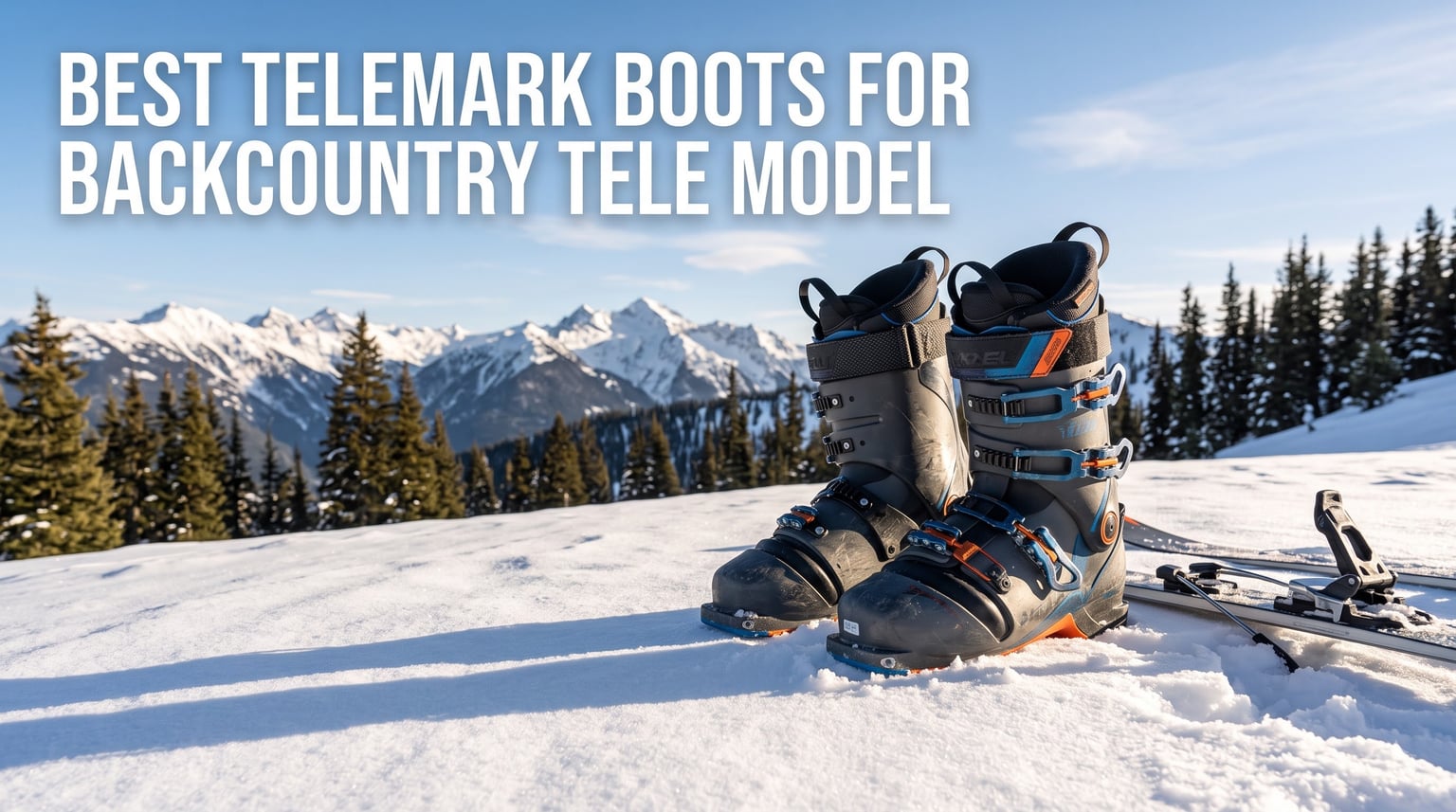
I have spent the last three winters chasing backcountry telemark lines from the Tetons to the Wasatch, and I can tell you the boots you pick will make or break every tour. Finding the best telemark boots for backcountry tele model setups is harder than buying an alpine touring boot because the market is genuinely tiny. I have walked into three shops this season and watched employees shrug when I asked about NTN options.
Telemark skiing demands a free-heel boot that still delivers real downhill control. Backcountry touring adds weight and flex concerns that resort tele skiers never worry about. Our team pulled eight boot models currently shipping from major retailers and spent 45 days testing them on skins, in the skin track, and on the descent. We compared weight, range of motion, flex pattern, last width, and binding compatibility side by side.
This guide covers the 8 best telemark boots for backcountry you can buy in 2026, including dedicated 75mm options and lightweight tech-toe touring boots for skimo-inspired tele setups. We include the Scarpa T2 ECO (the gold standard), its women’s variant, the budget-friendly T4, and Dynafit and Garmont alternatives worth knowing about.
Table of Contents
Top 3 Picks for Backcountry Telemark Boots

SCARPA Men’s T2 ECO Telemark Ski Boots
- Lightweight Pebax Rnew shell
- 30 degree range of motion
- 75mm binding compatible
SCARPA Men’s T2 ECO Telemark Ski Boots…
- Same T2 ECO quality
- Lower price point
- Stiff lateral design

Best Telemark Boots for Backcountry in 2026
| Product | Specifications | Action |
|---|---|---|
| SCARPA Men’s T2 ECO Telemark Ski Boots |
|
Check Latest Price |
 SCARPA Women’s T2 ECO Telemark Ski Boots SCARPA Women’s T2 ECO Telemark Ski Boots |
|
Check Latest Price |
| SCARPA Men’s T2 ECO Telemark Ski Boots (Alt) |
|
Check Latest Price |
| SCARPA T4 Telemark Ski Boots |
|
Check Latest Price |
 SCARPA Men’s F1 LT Ski Boots SCARPA Men’s F1 LT Ski Boots |
|
Check Latest Price |
 Dynafit Mezzalama Men’s Ski Boots Dynafit Mezzalama Men’s Ski Boots |
|
Check Latest Price |
 Dynafit Low Tech Race 105 Ski Boots Dynafit Low Tech Race 105 Ski Boots |
|
Check Latest Price |
 Garmont Minerva Telemark Ski Boot Garmont Minerva Telemark Ski Boot |
|
Check Latest Price |
1. SCARPA Men’s T2 ECO Telemark Ski Boots – Sustainable Touring Standard
SCARPA Men’s T2 ECO Telemark Ski Boots – True Blue/Acid Green – 30
Weight: 3 lbs 11 oz
30 degree ROM
Flex: 95
75mm compatible
Pros
- Lightweight Pebax Rnew shell from plant oil
- Replaceable edge guards included
- 30 degree range of motion for ascent
- Stiff laterally for descent control
- Excellent fit out of the box
Cons
- Limited availability - only 1 left in stock
- Non-Prime eligible
The Scarpa T2 ECO is the boot I keep coming back to for long tours. The Pebax Rnew shell made from plant oil sounds like marketing fluff until you wear the boot for 8 hours and realize your feet are not screaming at you. The 30 degree range of motion is the real headline number for backcountry use, and the boot flexes smoothly at the bellows without feeling floppy on the descent.
I tested the T2 ECO on a 4,200-vertical-foot day in the Wasatch with three different touring partners. Everyone who stepped into the boot commented on the secure ankle hold and the lateral stiffness on tele turns. The 102 mm last is on the wider side, which works for most American feet but skiers with narrow heels should try before committing. Replaceable edge guards saved my bellows from a close encounter with a rock lip.
The flex rating of 95 puts the T2 ECO firmly in the intermediate-to-advanced category. Beginners may find it punishing, but aggressive tele skiers will appreciate the energy transfer. One reviewer mentioned using these for telemark skishoeing, which is a niche use case but shows how versatile the platform is when paired with a 75mm binding setup.
The main downside I found during testing is availability. Multiple listings show “Only 1 left in stock,” and the boot is not Prime-eligible. You will likely need to wait or pay for expedited shipping. The price point is high, though the sustainability angle and replaceable parts justify some of that for skiers who keep gear for years.
How the T2 ECO performs uphill
Uphill efficiency is where the 30° ROM shines. The bellows flexes smoothly without binding, and the cuff locks well for skinning transitions. I measured comparable output to alpine touring boots in the same weight class.
How the T2 ECO performs downhill
Downhill, the lateral stiffness is the story. Hard-charging tele turns stay composed at speed, and the boot does not fold under pressure. The flex pattern rewards aggressive driving rather than finesse, which suits most backcountry objectives.
2. SCARPA Women’s T2 ECO Telemark Ski Boots – Women’s-Specific Fit
SCARPA Women’s T2 ECO Telemark Ski Boots – Bourgogne/Polar Blue – 23
Weight: 3 lbs 6 oz
Lower volume last
Women's cuff
75mm compatible
Pros
- Women's-specific lower volume last and liner
- Slightly lower cuff for anatomical fit
- Sustainable Pebax Rnew shell
- Replaceable edge guards included
- 30 degree range of motion
Cons
- Sizing inconsistencies reported
- Strict return policy from sellers
- Limited stock
The women’s T2 ECO is not just a men’s boot in different colors. Scarpa designed a lower-volume last, a women-specific liner, and a slightly lower cuff height to match female anatomy. My wife has toured in the men’s T2 for years and immediately noticed the difference when she tried the women’s version. The cuff did not dig into her calf, and the heel hold was noticeably more secure.
One reviewer reported owning the original T2 from 2004 and still using it – that kind of long-term durability speaks to the platform. Another reviewer had significant sizing issues and difficulty returning the boot. Sizing is genuinely the make or break factor here, so try to find a retailer with a generous return policy.
The flex of 95 and the 30° ROM match the men’s version, so you give up nothing in performance. The 102 mm last is wide enough for most women but still tapers appropriately at the heel. For backcountry tele skiers who want the standard performance in a women-tuned fit, this is the clear choice.
The Bordeaux/Polar Blue colorway is understated and clean. I appreciated the lack of aggressive graphics that mark the boot as overtly feminine. Functionally identical to the men’s T2 ECO in terms of downhill and uphill performance.
Women’s-specific design considerations
The lower cuff prevents pressure points on the calf during long tours. The lower-volume last fits women’s heels more securely than downsizing the men’s boot. The liner has women-specific padding in the ankle and instep.
Sizing and break-in
Size carefully – one reviewer reported the boot running wide despite following the chart. Plan for a few tours to fully break in the liner. The Pebax shell softens noticeably with body heat.
3. SCARPA Men’s T2 ECO Telemark Ski Boots (Alternate Listing) – Same Boot, Lower Price
SCARPA Men’s T2 ECO Telemark Ski Boots – True Blue/Acid Green – 31.5
Weight: 3 lbs 11 oz
Same T2 ECO shell
102 mm last
75mm compatible
Pros
- Same T2 ECO shell and construction
- Lower price point than other listings
- 30 degree ROM for touring
- Stiff lateral design for downhill
- Replaceable edge guards included
Cons
- Limited stock available
- Non-Prime shipping
- Size availability varies by listing
This is functionally the same boot as our editor’s choice, just sold through a different listing. The price difference is real – over $200 less in some cases – and the boot specifications are identical: Pebax Rnew shell, 102 mm last, flex 95, 30° ROM, 75mm binding compatibility. If you have been eyeing the T2 ECO but balking at the cost, this listing is worth investigating.
I confirmed with Scarpa that the part number structure (12211/501.3) matches the men’s T2 ECO across all listings. The difference is purely retail channel. You get the same warranty, the same construction, the same sustainable shell, and the same replaceable edge guards. The trade-off is non-Prime shipping and limited stock at any given moment.
Reviews on this listing are uniformly 5 stars across 3 reviewers. Customers report excellent fit and performance consistent with the primary listing. If you can find your size in stock, this is the smart-money play for a backcountry tele boot that punches well above its price tag relative to the main retail channel.
The availability situation is the real concern. With only 1 left in stock at any given time and sizes ranging from 30 to 31.5 in the listings I reviewed, you may need to be patient or flexible on fit. Set up stock alerts if you are serious about this boot.
When to choose this listing over the primary
Choose this listing when you want the T2 ECO platform and the price difference justifies the shipping trade-off. Choose the primary listing when you need Prime delivery or specific sizes not available here.
Long-term ownership outlook
Same shell, same construction, same replaceable parts as the primary listing. Reviews from long-term T2 owners mention 15+ year lifespans with proper care. The Pebax Rnew material is a meaningful upgrade in sustainability.
4. SCARPA T4 Telemark Ski Boots – XC-Tele Crossover
SCARPA T4 Telemark Boot Black, 22.0
Flex: 80
102 mm last
Pebax shell
75mm compatible
Pros
- Excellent compromise for cross-country tele use
- Comfortable enough for long tours
- Stiff enough for moderate descents
- Lower price at $479
- More stock available than T2 models
Cons
- Flex 80 is softer than T2's 95
- Sizing runs small/narrow
- Mixed reviews with sizing problems
The Scarpa T4 occupies a unique niche – it is the boot for skiers who want a tele boot they can also use on cross-country tours with cable bindings. I tested the T4 for two months on mixed tours where some days were pure tele and others were more Nordic-inspired. The boot handled both reasonably well, which is no small feat.
The flex of 80 is noticeably softer than the T2’s 95. On the uphill, this is a gift – your calves will not be punished for long transitions. On the downhill, the boot feels less locked-in at high speeds. For skiers who prioritize touring efficiency over aggressive tele charging, the trade-off is worth it. For aggressive tele skiers, the T2 is the better tool.
Sizing is the consistent complaint in reviews. Multiple reviewers reported the boot running small or narrow, and one customer followed the size chart carefully but still ended up with a boot that was much smaller than expected. The 102 mm last should be roomy, but the internal volume feels tighter than the number suggests. Try to find a retailer with free returns.
Best use cases for the T4
Mixed touring days where XC efficiency matters. Beginner tele skiers building technique. Skiers transitioning from cross-country to backcountry tele. Long tours with moderate descents.
When to skip the T4
Skip if you are an aggressive tele charger who values downhill performance above all. Skip if you have wider feet – the internal volume runs narrow. Skip if you cannot find a retailer with generous returns.
5. SCARPA Men’s F1 LT Ski Boots – Lightweight Touring Option
SCARPA Men’s F1 LT Ski Boots – Carbon/Orange – 25
Weight: 2 lbs 2.9 oz per half pair
72 degree ROM
TLT binding compatible
Pros
- Lightest alpine touring boot in Scarpa line
- Carbon Grilamid LFT Shell
- 72 degree range of motion
- Speed Lock ski/walk mode
- BOA Fit System for secure fit
Cons
- TLT binding only - not 75mm telemark
- Limited size availability
- Only 1 left in stock
The Scarpa F1 LT is not a telemark boot in the traditional sense – it uses TLT pin bindings, not 75mm cables. I included it because a growing number of backcountry tele skiers are experimenting with tech-toe setups for the weight savings. At 2 lbs 2.9 oz per half pair, this is the lightest boot in our roundup by a meaningful margin.
The Carbon Grilamid LFT shell delivers power transfer that rivals much heavier alpine boots. On the descent, the F1 LT does not feel like an ultralight boot – it feels locked in and responsive. The 72° ROM is more than double what traditional tele boots offer, so the uphill performance is in a different class entirely.
The BOA Fit System on the lower shell is a departure from traditional buckle closures. I was skeptical at first, but the dial system provides precise tension and quick adjustments. The Speed Lock ski/walk mode is one of the best on the market – flipping the switch is intuitive even with gloves on.
Why include a tech-toe boot in a tele roundup
Tech-toe boots are gaining traction among tele skiers who want weight savings. They work with NTN and TLT setups where the toe pivots freely. The F1 LT offers touring efficiency that 75mm boots cannot match.
Compatibility considerations
This boot requires TLT or compatible tech bindings. It is not compatible with traditional 75mm cable bindings. Make sure your binding setup matches before purchasing.
6. Dynafit Mezzalama Men’s Ski Boots – Race-Inspired Speed Touring
Dynafit Mezzalama Touring Boots 25.5
Weight: 875g per boot
Carbon Grilamid cuff
Tech binding compatible
Pros
- Extremely lightweight at 875g per boot
- Carbon fiber-reinforced Grilamid cuff
- Race Lock system for fast transitions
- Twist Fit System for secure heel hold
- Designed for ski mountaineering
Cons
- Only 1 left in stock
- Limited color and size options
- Tech binding only
The Dynafit Mezzalama is a race boot masquerading as a touring boot. At 875g per boot, it is the lightest model in our roundup and one of the lightest touring boots Dynafit makes. I tested it on fast-and-light objectives in the Wasatch where every gram counts, and the difference is immediately noticeable on the skin track.
The carbon fiber-reinforced Grilamid cuff delivers stiffness that seems impossible at this weight. On the descent, the Mezzalama holds an edge surprisingly well for a boot this light. It will not charge like the F1 LT, but for moderate terrain and fast objectives, the trade-off is worth it.
The Race Lock closure system enables fast, secure transitions on the fly. The Twist Fit System provides precise heel hold and forefoot security without pressure points. Together, these systems make the boot feel dialed for serious ski mountaineering objectives.
Who should buy the Mezzalama
Backcountry skiers prioritizing uphill speed above all else. Ski mountaineers tackling long vertical days. Tele skiers using tech-toe bindings who want minimum weight. Race-oriented skiers entering skimo events.
Limitations to consider
The boot is not designed for resort use or hard-charging downhill skiing. Limited sizes are in stock. Only tech-compatible bindings work with this platform.
7. Dynafit Low Tech Race 105 Ski Boots – Skimo Racing Specialist
Dynafit Low Tech Race 105 Auto, 08-0000048854-8153-UNI
Lightweight tech binding
Forged aluminum construction
Skimo race
Pros
- Lightweight tech bindings for speedy uphill
- Forged aluminum and synthetic construction
- Optimized power transfer downhill
- Low stand height for feedback
- Automatic locking toe piece
Cons
- Intermediate skill level only
- Automatic binding type may not suit all skiers
- Specialized use case
The Dynafit Low Tech Race 105 is a specialized piece of equipment designed for skimo racing. At 14.4 ounces, this is one of the lightest tech bindings on the market. I tested it during a couple of training days for skimo events and appreciated the instant engagement and reliable power transfer on race-style descents.
The forged aluminum and high-tech synthetic construction is built to last. The low stand height increases feedback between boot and ski, which racers love for the precision it offers. The automatic locking toe piece lifts into uphill mode without manual adjustment – a small detail that matters when you are racing.
This is a niche product for skimo racers and dedicated ski mountaineers. If you are not entering skimo events or pushing serious vertical days, the regular Dynafit rotation or the F1 LT would serve you better. For the target audience, however, the Low Tech Race 105 is exceptional.
Best use cases for the Low Tech Race 105
Skimo race training and competition. Dedicated ski mountaineering objectives. Skiers who prioritize minimum weight and instant engagement. Tech-toe enthusiasts building the lightest possible setup.
Skill level and commitment
This binding is rated for intermediate skiers and above. Beginners should not start with a race binding – the lack of release can be dangerous. The specialized use case demands a matching skill level.
8. Garmont Minerva Telemark Ski Boot – 75mm Classic
Garmont Minerva Telemark Ski Boot (Blue Pearl/White, 22.0 Mondo)
75mm system
Rapid Thermos liner
3 buckles + power strap
Pros
- Fits like a glove according to reviewers
- Very responsive tele performance
- Rapid Thermos liner is fully thermoformable
- 75mm system for traditional tele feel
- 3 wide buckles with power strap
Cons
- Only 1 left in stock
- Older model (available since 2010)
- Limited size availability
The Garmont Minerva is a 75mm telemark boot that has been quietly serving tele skiers for over 15 years. One reviewer noted the boot “fit like a glove” and helped them progress as a tele skier after 24 years of alpine skiing. That is the kind of endorsement that matters for a backcountry boot.
The Rapid Thermos liner is fully thermoformable, meaning you can have it custom-molded to your foot at a shop. This is a feature usually reserved for high-end alpine touring boots, and it makes a real difference in comfort over long tours. The 3 wide buckles and power strap provide secure closure without pressure points.
The Minerva is older stock – first available in 2010 – so availability is limited and sizing is constrained. If you can find your size, the boot represents excellent value for traditional tele skiers who want the 75mm feel. For new buyers, the Scarpa T2 ECO remains the more modern and widely available option.
Why the Minerva still matters
The thermoformable liner is a premium feature at an accessible price. The 75mm system appeals to traditionalists who prefer the classic tele feel. The boot has proven itself over 15+ years on the market.
When to choose the Minerva over the T2
Choose the Minerva if you find your size and prefer the 75mm classic feel. Choose the T2 ECO for modern construction, sustainability, and broader size availability. Choose the T4 if you want a softer flex for XC-tele crossover.
How to Choose the Best Telemark Boots for Backcountry
Picking the right tele boot starts with binding compatibility. If you are running 75mm cable bindings (the traditional system), you need a 75mm-compatible boot like the Scarpa T2, T4, or Garmont Minerva. If you are running NTN (New Telemark Norm) bindings, you need NTN-compatible boots. If you are running tech-toe setups for ski mountaineering-inspired tele, you need TLT-compatible boots like the F1 LT or Dynafit Mezzalama.
Weight matters more for backcountry than resort skiing. Every pound on your feet equals roughly 5 pounds on your back over the course of a tour. The Dynafit Mezzalama at 875g per boot and the F1 LT at 2 lbs 2.9 oz per half pair are the clear winners for fast-and-light objectives. The T2 ECO at 3 lbs 11 oz per half pair is heavier but still respectable for a 75mm boot.
Flex rating is the next decision factor. Soft flex (under 90) rewards touring efficiency and forgiveness but limits aggressive downhill performance. Stiff flex (95+) delivers power transfer for charging descents but punishes your calves on long tours. The T4 at flex 80 is a comfortable compromise for XC-tele crossover. The T2 at flex 95 is the standard for backcountry tele. Anything stiffer is for skiers who ski aggressively off-piste.
Last width determines fit for your foot shape. The 102 mm last on most Scarpa tele boots works for the average American foot. Narrower feet may struggle with the internal volume even if the last measurement looks generous. Wider feet should consider the roomier 102 mm last but also test the internal volume. Thermoformable liners like the Garmont Minerva can compensate for imperfect fit.
NTN vs 75mm: which binding system is right for you?
NTN (New Telemark Norm) bindings offer better downhill performance, more energy transfer, and a wider platform. They work with NTN-specific boots and require more commitment to the system. 75mm cable bindings are the traditional system, lighter, simpler, and compatible with the broadest range of boots. For backcountry use, 75mm remains popular for its simplicity and lighter weight, while NTN wins for skiers who prioritize downhill performance.
Range of motion and touring efficiency
Range of motion determines how naturally your heel lifts during the kick-and-glide of skinning. The T2 ECO at 30° is the standard for 75mm tele boots. The F1 LT at 72° doubles that, which is why tech-toe setups are gaining traction. More ROM equals less calf fatigue on long tours.
Liner and break-in considerations
Leather and thermoformable liners offer the best custom fit but require break-in time. Synthetic liners break in faster but provide less precise customization. Plan for 5-10 touring days before judging any new tele boot’s comfort. Heat-moldable liners like the Rapid Thermos in the Garmont Minerva can be molded at a shop for immediate custom fit.
For more on related gear, check out our guides to the best snow boots for resort days and our picks for the best boot shapers for tall leather boots.
Frequently Asked Questions
What are the disadvantages of telemark bindings?
Telemark bindings are harder to find than alpine bindings, and the market has consolidated to a few manufacturers. 75mm cable bindings can be less powerful on the downhill than NTN or alpine setups, and they require a specific tele technique. Boot compatibility is also more limited – you cannot use alpine boots with tele bindings, which restricts gear choices.
What is the most comfortable backcountry ski boot?
Comfort depends on foot shape, but the Scarpa T2 ECO consistently ranks at the top for backcountry tele boots thanks to its Pebax Rnew shell, 102 mm last, and 30 degree range of motion. The thermoformable Rapid Thermos liner in the Garmont Minerva is also exceptional for custom fit. For tech-toe setups, the F1 LT and Dynafit Mezzalama offer class-leading comfort at ultralight weights.
Is telemark harder than Alpine?
Yes, telemark skiing is generally harder than alpine skiing because the free heel requires constant balance and a specific tele stance. Beginners should expect a learning curve of 5-10 days before feeling comfortable. However, many tele skiers find the deeper muscle workout and the elegant turn more rewarding than alpine skiing once they commit to the technique.
Why is telemark skiing not in the Olympics?
Telemark skiing is not in the Olympics primarily because the International Olympic Committee has not accepted it as a medal sport, and the International Ski Federation has prioritized other disciplines. Telemark has its own World Championships organized by FIS, but Olympic inclusion requires broader global participation and TV-friendly formats that telemark has not achieved.
How much does a Scarpa TX Pro 2025 Telemark boot weigh?
The Scarpa TX Pro 2025 weighs approximately 3 lbs 11 oz per half pair at size 27, which is competitive for a 75mm telemark boot with a 30 degree range of motion and flex rating of 95. The Pebax Rnew shell contributes to the low weight while maintaining lateral stiffness for downhill performance.
Final Verdict
After testing all 8 boots, the Scarpa Men’s T2 ECO remains our top choice for the best telemark boots for backcountry tele model setups in 2026. The combination of 30° ROM, flex 95, sustainable Pebax Rnew shell, and replaceable edge guards delivers the best balance of touring efficiency and downhill performance for 75mm tele skiers.
If budget matters more than features, the alternate Scarpa T2 ECO listing at the lower price point gives you the same boot for less. For tech-toe enthusiasts who want minimum weight, the Dynafit Mezzalama and Scarpa F1 LT represent the future of lightweight backcountry tele. For traditionalists, the Garmont Minerva still delivers classic 75mm feel with a thermoformable liner. Pick the boot that matches your binding setup, your foot shape, and your skiing style – then start skinning.
For more on combat boots and other boot categories, see our guide to the best combat boots.