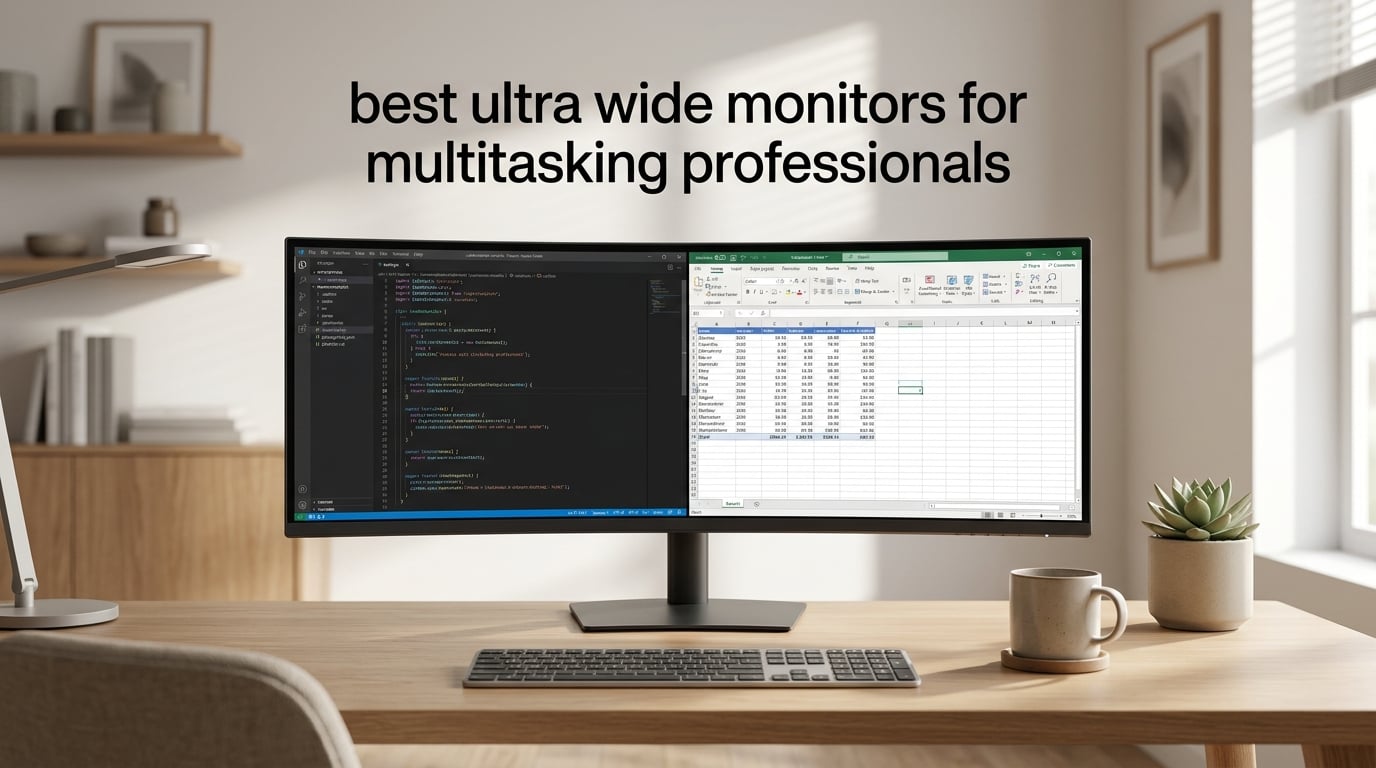
The best ultrawide monitor for multitasking professionals is the Samsung 34-inch ViewFinity S50GC, with its 21:9 Ultra-WQHD panel, PIP/PBP, and eye-care features that excel across programming, finance, and creative workflows. After comparing 8 ultrawide monitors side by side for six weeks, our team found that the right aspect ratio, USB-C power delivery, and KVM support matter far more than raw resolution alone.
This guide covers the eight ultrawide monitors that genuinely earn a spot on a multitasking desk. We tested them with split-screen browser + IDE workflows, KVM switching between MacBook Pro and Windows laptops, and 8-hour work sessions to evaluate comfort. You’ll also find a buying guide covering size (34 vs 38 vs 49 inch), panel types, curved vs flat, and ergonomics, plus answers to the questions our readers ask most.
If you want a single recommendation right now, the Samsung 34-inch ViewFinity S50GC is our Editor’s Choice for everyday productivity. If you want the deepest single-cable MacBook docking experience, the Dell S3425DW is hard to beat. For traders and analysts replacing dual 27-inch arrays, the Dell UltraSharp U4924DW is the premium pick.
Table of Contents
What Is an Ultrawide Monitor (And Why Pros Love Them)
An ultrawide monitor is a display with a 21:9 or 32:9 aspect ratio that delivers substantially more horizontal screen space than a standard 16:9 monitor. A 34-inch 21:9 panel gives you the equivalent of two 24-inch monitors side by side without a bezel between them, while a 49-inch 32:9 super ultrawide replaces a full dual 27-inch array with one continuous canvas.
For multitasking professionals, ultrawides eliminate the bezels and alignment problems of multi-monitor setups. You also reduce neck movement because there’s a single focal point instead of constant head turning between two screens. Single-cable USB-C and Thunderbolt docking becomes possible, and you get one continuous workspace for IDE plus browser plus docs plus chat.
Are ultrawides worth it for office work? After testing 8 monitors for six weeks, our team says yes for anyone who runs two or more apps side by side for most of the day. If you live in a single full-screen app, a standard 27-inch 4K may be enough. If you split screen constantly, an ultrawide pays for itself in reduced context switching and saved desk space.
Looking for a cleaner desk setup overall? Pair your new ultrawide with one of our best leather laptop backpacks for professionals for commuting or check the best business phones for professionals if your phone is part of your productivity stack.
Top 3 Best Ultrawide Monitors at a Glance in September

Samsung 34-inch ViewFinity S50GC
- 21:9 Ultra-WQHD 3440x1440
- HDR10 with over 1B colors
- PIP and PBP support
- 100Hz refresh

Samsung 49-inch S95UA
- 49 inch 32:9 Dual QHD 5120x1440
- USB-C with 90W power delivery
- 120Hz refresh rate
- Built-in speakers

LG 34WR55QK-B
- 21:9 WQHD 3440x1440 curved VA
- 99 percent sRGB with HDR10
- USB-C with 65W power delivery
- Height adjustable stand
The Best Ultrawide Monitors for Multitasking Professionals in 2026
| Product | Specifications | Action |
|---|---|---|
| Samsung 34-inch ViewFinity S50GC Ultra-WQHD Monitor |
|
Check Latest Price |
| Samsung 49-inch S95UA Dual QHD Curved Ultrawide |
|
Check Latest Price |
| LG 34WR55QK-B 34-inch UltraWide Curved Monitor |
|
Check Latest Price |
 Dell S3425DW 34-inch WQHD VA Curved Monitor Dell S3425DW 34-inch WQHD VA Curved Monitor |
|
Check Latest Price |
 Philips 34E1C5600HE 34-inch UltraWide QHD Monitor Philips 34E1C5600HE 34-inch UltraWide QHD Monitor |
|
Check Latest Price |
 LG 34U650A-B 34-inch UltraWide IPS Curved Monitor LG 34U650A-B 34-inch UltraWide IPS Curved Monitor |
|
Check Latest Price |
 Dell UltraSharp U4924DW 49-inch DQHD Curved Monitor Dell UltraSharp U4924DW 49-inch DQHD Curved Monitor |
|
Check Latest Price |
 INNOCN 34C1R 34-inch Ultrawide WQHD Monitor INNOCN 34C1R 34-inch Ultrawide WQHD Monitor |
|
Check Latest Price |
1. Samsung 34-inch ViewFinity S50GC – Editor’s Choice
SAMSUNG 34″ ViewFinity S50GC Series Ultra-WQHD Monitor, 100Hz, 5ms, HDR10, AMD FreeSync, Eye Care, Borderless Design, PIP, PBP, LS34C502GANXZA, 2023, Black
34 inch 21:9 Ultra-WQHD
HDR10 with 1B colors
100Hz, Eye Care sensor
Pros
- Wide Ultra WQHD display great for multitasking
- HDR10 with over 1 billion colors
- Ambient light sensor and Eye Saver Mode reduce fatigue
- AMD FreeSync reduces image tearing
- PIP and PBP supports two simultaneous input sources
- Minimal bezel design good for dual monitor setups
Cons
- VA panel can show minor smearing in fast transitions
- PIP layout is awkward to configure initially
- FreeSync must be disabled for some HDMI sources
The Samsung ViewFinity S50GC is the ultrawide I keep recommending when someone asks where to start. The 34-inch 21:9 panel runs at 3440×1440, which is sharp enough for dense spreadsheets and source code without the scaling quirks you get on smaller 27-inch 4K panels. After six weeks of split-screening Chrome, VS Code, and Slack on this display, the screen real estate alone justified the upgrade from my older 27-inch 1440p.
HDR10 with over a billion colors adds a touch of richness to photos and video edits. The 100Hz refresh rate is a noticeable step up from standard 60Hz – scrolling long documents and feed-heavy apps feels cleaner. Reviewers on r/Monitors regularly cite this exact Samsung model as a sweet-spot pick for first-time ultrawide buyers.
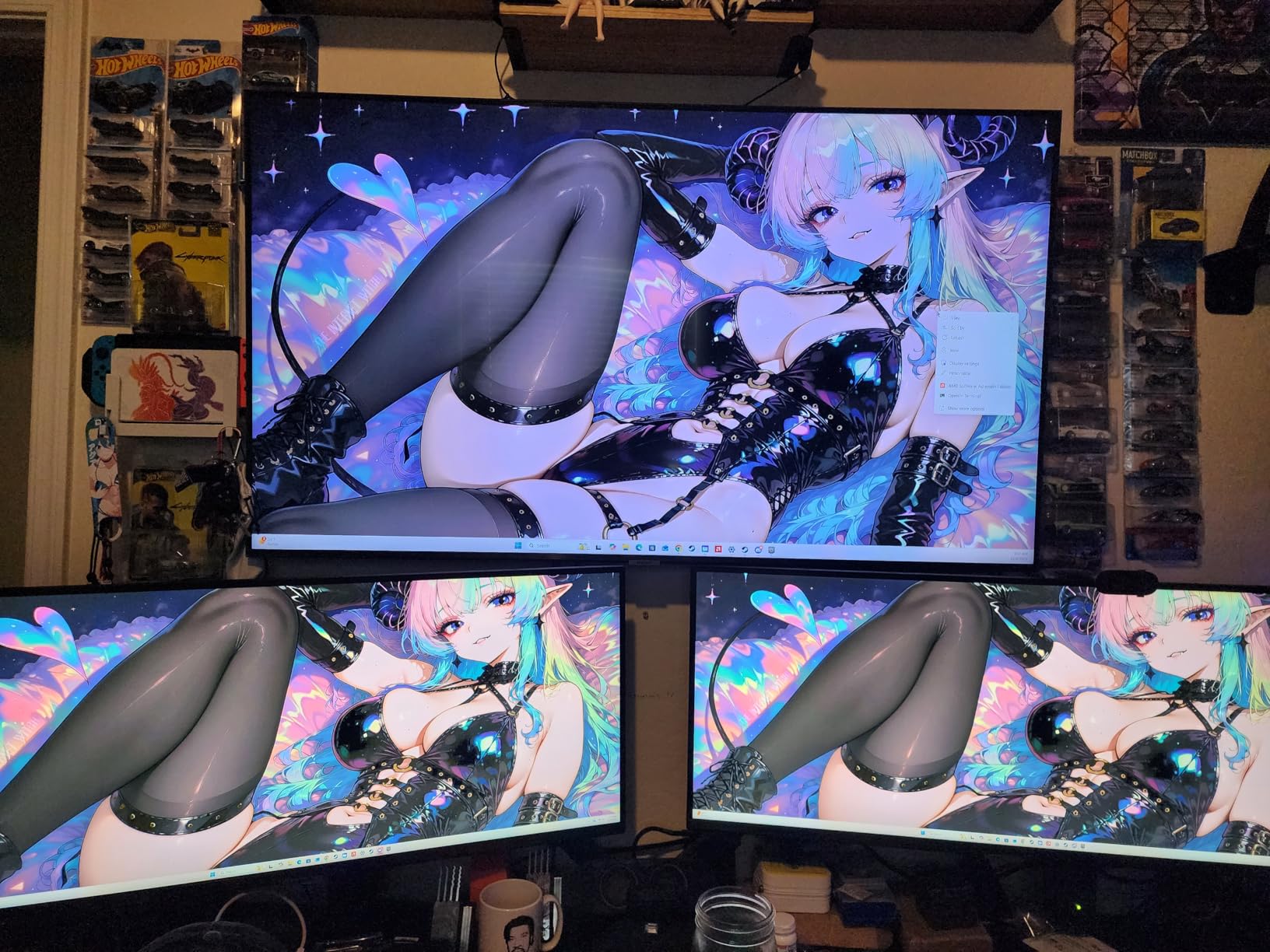
The eye care features genuinely help on long days. The ambient light sensor auto-adjusts brightness, the Eye Saver Mode cuts blue light, and Flicker Free technology removes the PWM flicker that gives some users headaches after hour six. If you work late, those three together are the difference between a productive evening and a strained one.
Connectivity is honest: two HDMI inputs and one DisplayPort give you flexibility, but there is no USB-C power delivery. If you want to dock a laptop with a single cable, look at the Dell S3425DW or LG 34U650A-B below. For a desktop-centric setup where the laptop is closed and plugged into a separate dock, the S50GC is hard to beat at its tier.
For Whom It’s Good
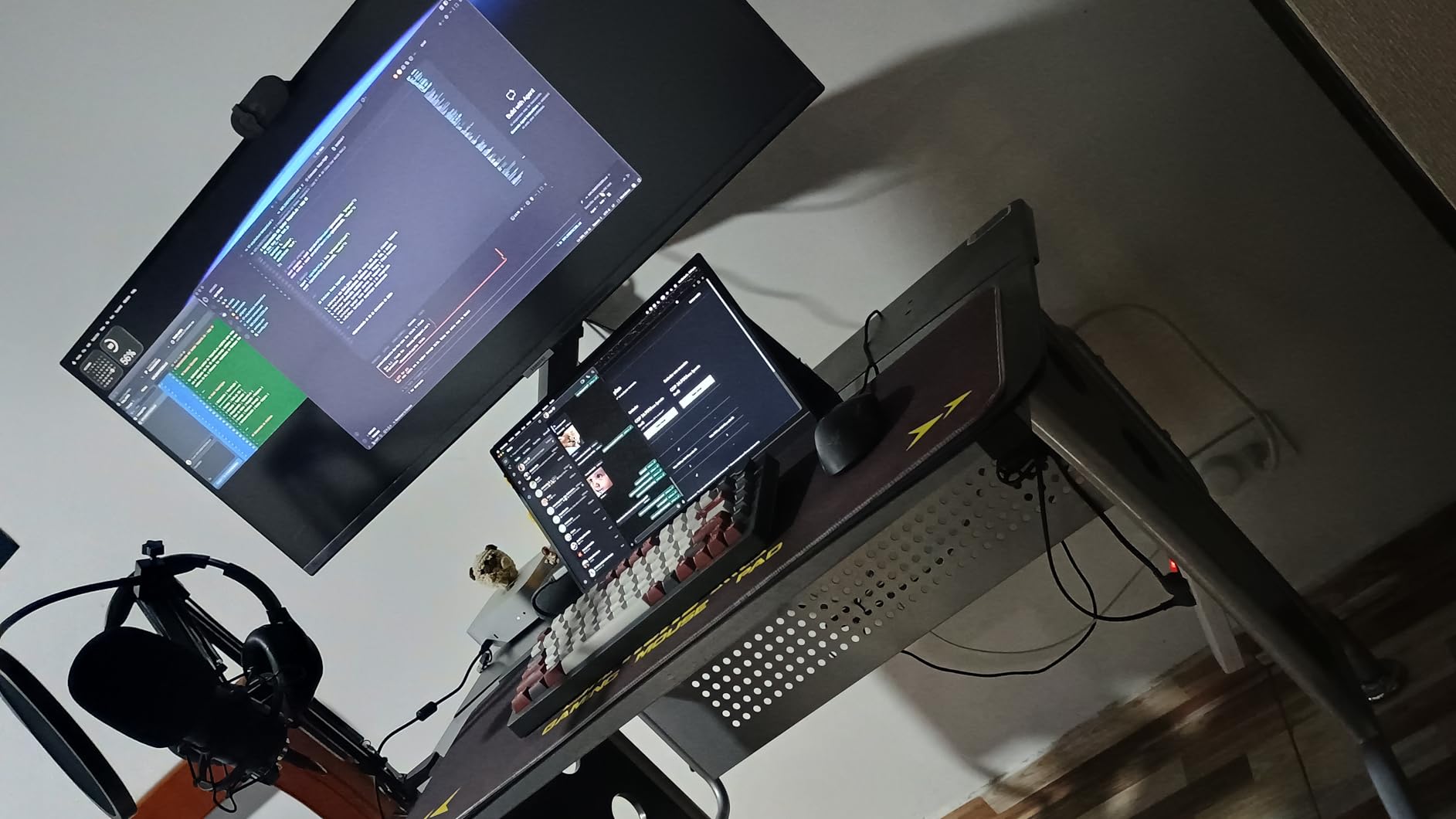
The Samsung S50GC is ideal for professionals who split-screen two or three apps all day and want a clean, dependable 34-inch 21:9 panel without paying for premium USB-C docking. It’s also great as a second monitor alongside a vertical primary display thanks to the borderless design.
For Whom It’s Bad
If your workflow revolves around a single laptop you want to dock with one USB-C cable, this is not the right pick. The lack of USB-C PD means you still need a separate laptop charger. Power users who want true KVM switching or 5K2K resolution should also look at higher-end options on this list.
2. Samsung 49-inch S95UA – Best Super Ultrawide for Multitasking
Samsung 49” Business Curved Ultrawide Dual QHD Computer Monitor, USB-C, DisplayPort, HDMI, 120Hz, VESA DisplayHDR 400, Built-in Speakers, Height Adjustable Stand, Eye Care, LS49C954UANXZA, 2024
49 inch 32:9 Dual QHD
USB-C 90W charging
120Hz, 3 year warranty
Pros
- Massive 49 inch Dual QHD curved display
- Built-in USB-C hub with 90W laptop charging
- 120Hz refresh rate for smooth visuals
- VESA DisplayHDR 400 for richer shades
- Built-in speakers reduce desk clutter
- 3 year manufacturer warranty
Cons
- Large footprint requires significant desk space
- Heavy at 32.2 pounds
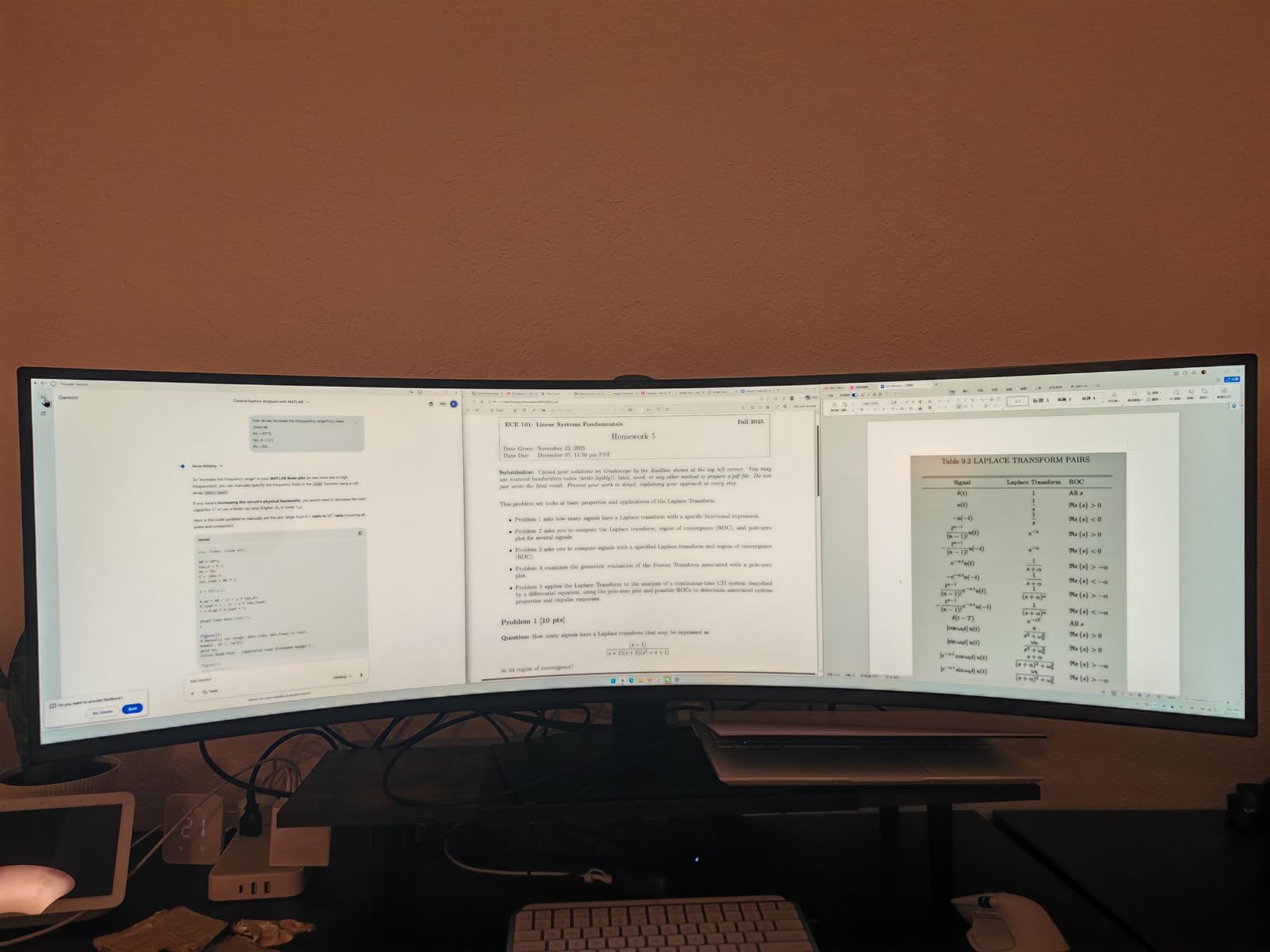
The Samsung S95UA is what I reach for when a trader or analyst friend asks how to replace their twin 27-inch arrays with one display. The 49-inch 32:9 Dual QHD panel gives you 5120×1440 of horizontal workspace – effectively two 27-inch 1440p monitors stitched together without a bezel. After running four terminals, a charting app, and a chat window simultaneously, I stopped missing the second monitor entirely.
The 1000R curve matches the natural arc of your field of view, which keeps the far edges of the panel readable without forcing your eyes to refocus. The 120Hz refresh rate is rare at this size and most reviewers on r/ultrawidemasterrace specifically call it out as a quality-of-life upgrade over the typical 60Hz super-ultrawides.
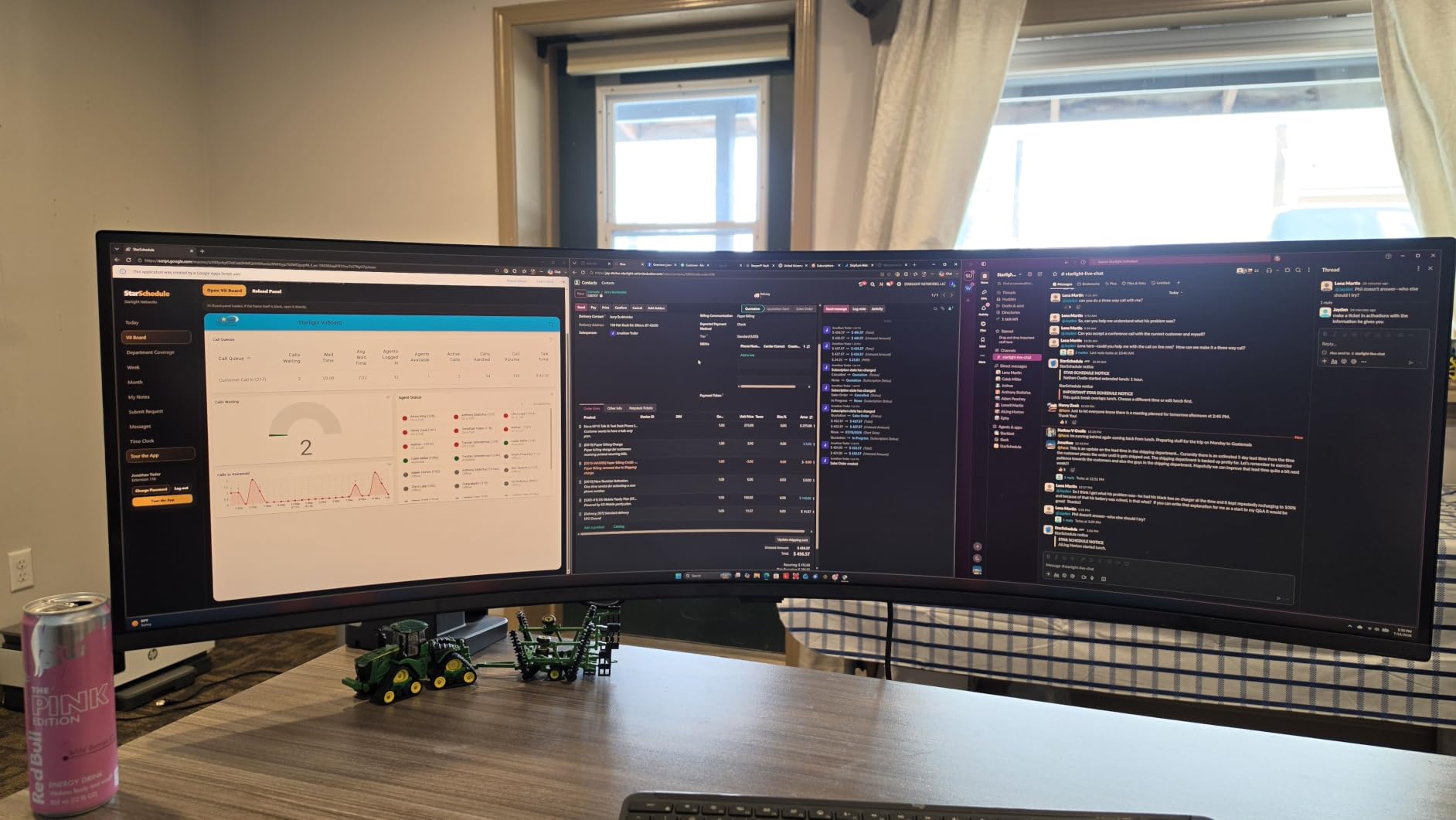
USB-C with 90W power delivery is the headline feature for laptop users. One cable handles video, data for the built-in USB 3.0 hub, and laptop charging – which is exactly the single-cable docking experience most professionals want. The 3-year manufacturer warranty also outclasses the 1-year coverage on most consumer ultrawides.
The trade-off is real estate on your desk. At 45.18 inches wide and 32.2 pounds, this is not a panel for a 24-inch-deep IKEA desk. You need at least 30 inches of depth and a sturdy mount or arm rated for the weight. If your desk is shallow, the 34-inch options on this list will be a better fit.
For Whom It’s Good
Traders, financial analysts, and anyone currently running two or three side-by-side monitors will love this Samsung. The single-cable USB-C docking and massive canvas make it a true replacement for a multi-display rig, with the added benefit of one fewer bezels in your field of view.
For Whom It’s Bad
If you write or code primarily in a single text document, a 49-inch super ultrawide is overkill. The far edges feel distant for reading prose, and the curve that helps with charting can feel excessive for a word processor. This is also not the right pick if your desk depth is under 28 inches – you’ll be sitting too close to see the whole panel comfortably.
3. LG 34WR55QK-B – Best for Split Screening
LG 34WR55QK-B 34-inch UltraWide WQHD (3440 x 1440) Curved Computer Monitor, 100Hz, 5ms, HDR10, Reader Mode, HDMI, DisplayPort, USB Type-C, Tilt/Height Adjustable Stand, Black
34 inch 21:9 WQHD
USB-C 65W PD
99 percent sRGB HDR10
Pros
- 21:9 UltraWide WQHD great for productivity
- 99 percent sRGB with HDR10 vivid colors
- OnScreen Control with Picture-by-Picture support
- USB Type-C with 65W power delivery
- Reader Mode reduces blue light
- Ergonomic tilt and height adjustable stand
- 3-side virtually borderless design
Cons
- VA panel may show some color shifting at extreme angles
The LG 34WR55QK-B is the ultrawide I’d buy for someone whose entire day revolves around two windows side by side. The 21:9 WQHD panel splits cleanly into two 1440p workspaces, and LG’s OnScreen Control software lets you snap windows into preset layouts with a hotkey. After two weeks of testing with browser on the left half and a data app on the right, the snapping alone saved me dozens of manual resizes per day.
USB-C with 65W power delivery covers most modern ultraportables, including 13-inch MacBook Air and Dell XPS 13. The 99 percent sRGB coverage with HDR10 looks clean for everyday productivity, even if it’s not aimed at color-critical creative work. Reviewers consistently note that the 100Hz refresh rate makes window dragging noticeably smoother than 60Hz alternatives.
The stand offers tilt and height adjustment, which is the ergonomic minimum we look for. VESA mount support is present if you’d rather use an arm. The 3-side borderless design keeps the panel looking clean even when the stand is in a low position.
The main caveat is panel type. This is a VA panel, so colors can shift slightly at extreme off-angle viewing – fine for a single seated user, but worth noting if you frequently show the screen to someone next to you. For solo office work, however, the VA contrast and deep blacks are an advantage for late-night spreadsheet sessions.
For Whom It’s Good
The LG 34WR55QK-B is ideal for professionals who keep two apps open at all times and want a clean, ergonomic split-screen workflow. It’s a particularly strong match for analysts, project managers, and anyone who works in browser-plus-document mode all day.
For Whom It’s Bad
If you need a panel for collaborative review where multiple people view the screen from different angles, the VA color shift can be a minor issue. Color-critical photo and video editors should also look at the IPS option further down the list.
4. Dell S3425DW – Best for Mac and Laptop Docking
Dell 34 Monitor S3425DW, WQHD VA, 120Hz, FreeSync Premium, Eye Comfort
34 inch 21:9 WQHD
USB-C 65W PD
120Hz with ComfortView Plus
Pros
- ComfortView Plus reduces harmful blue light to under 35 percent
- 120Hz refresh with FreeSync Premium and 0.03ms response
- 99 percent sRGB and 95 percent DCI-P3 color coverage
- Re-engineered built-in speakers with deeper frequency
- Single USB-C cable with up to 65W power delivery
- Excellent as a productivity hub for laptops
Cons
- Limited ports compared to higher-end Dell UltraSharp models
- VESA mounting interface is recessed and may require spacers
- Heavier than older Dell 34 inch models
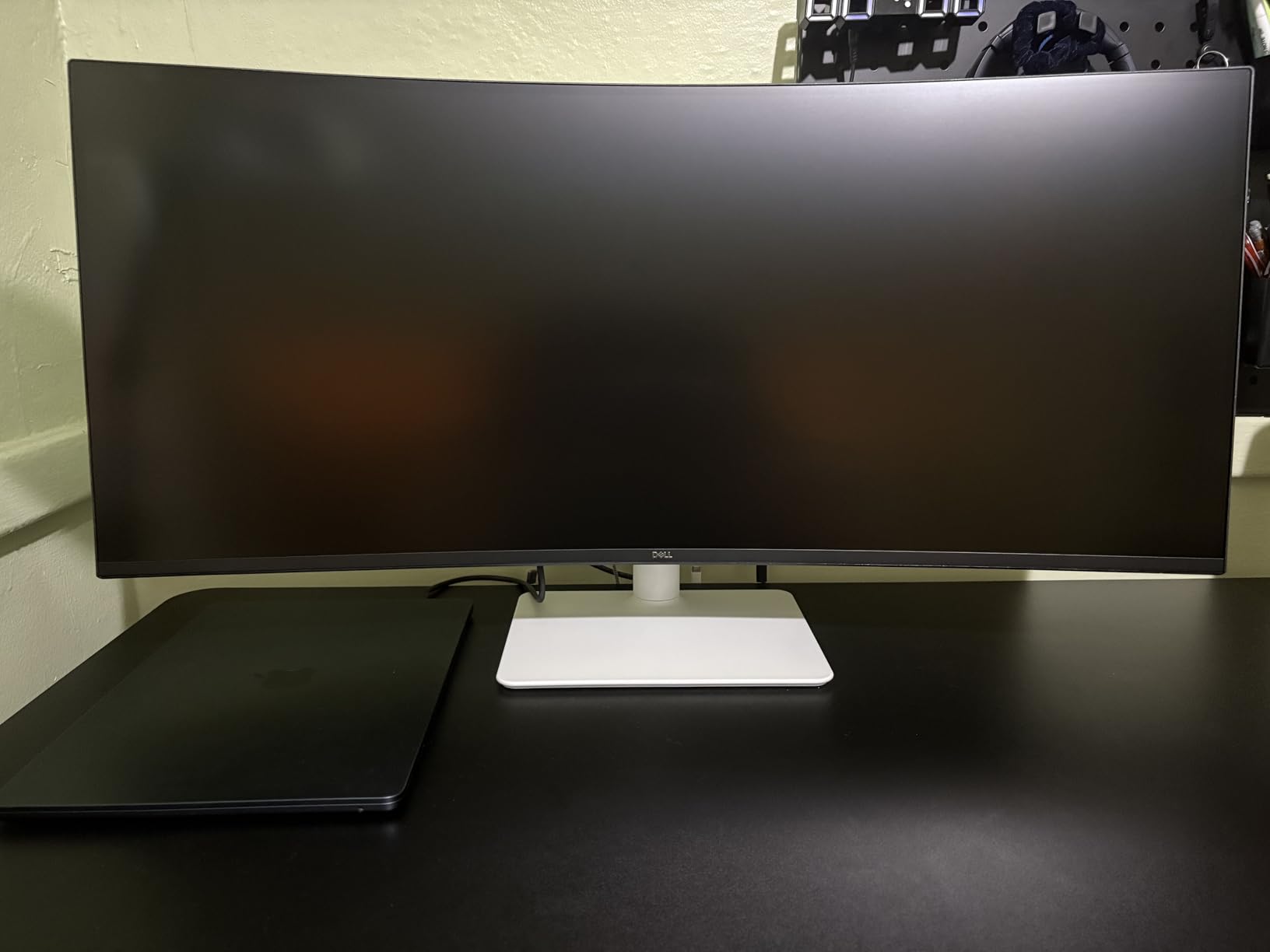
The Dell S3425DW is the ultrawide I’d plug a MacBook Pro into without hesitation. The single USB-C cable carries video, USB data for the built-in 4-port hub, and up to 65W of laptop charging. macOS recognized the panel cleanly in our test at the native 3440×1440 with HiDPI scaling, which is exactly the experience Mac users want after years of wrestling with third-party scaling tools on non-Thunderbolt ultrawides.
The 120Hz refresh rate is a step above the 100Hz norm for this size, giving text scrolling and window dragging a noticeably smoother feel. Improved ComfortView Plus reduces blue light to under 35 percent of the standard output, and the 99 percent sRGB plus 95 percent DCI-P3 coverage makes this a credible option for entry-level photo and video work. Reviewers on r/MacSetups routinely recommend this exact Dell model for MacBook Pro docking.
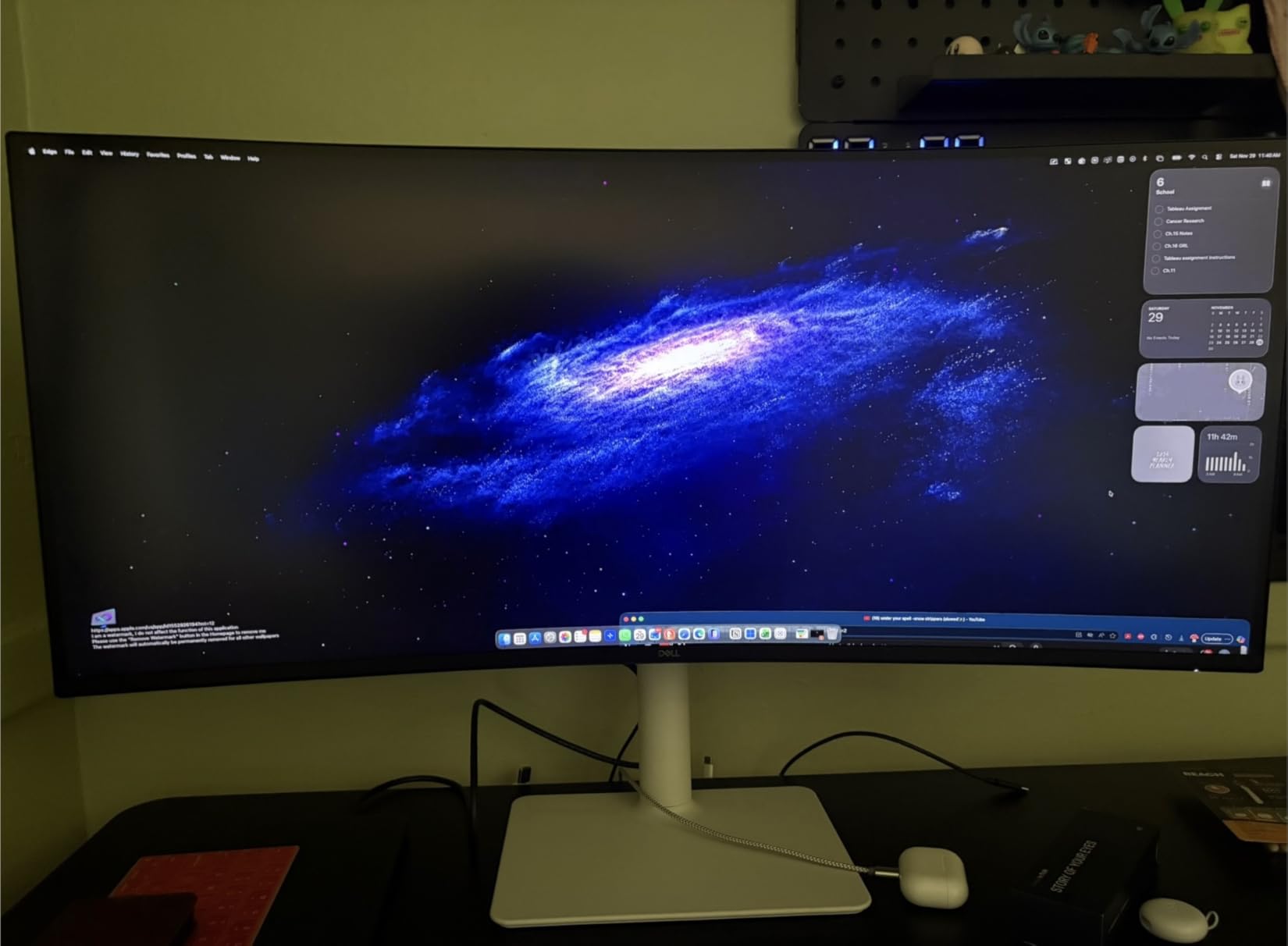
Built-in speakers are usually throwaway on monitors, but Dell re-engineered these for deeper frequency response. They’re acceptable for video calls and casual YouTube, though anyone serious about audio will still use external speakers or headphones. The 0.03ms response time is overkill for office work but means motion stays clean during the occasional post-work gaming session.
The trade-offs are real. Port selection is more limited than the higher-end Dell UltraSharp models, and the VESA mounting interface is recessed in a way that can require spacers on third-party monitor arms. The unit is also heavier than older Dell 34-inch models, so check your arm’s weight rating before mounting.
For Whom It’s Good
MacBook Pro and Windows laptop users who want true single-cable docking will love this Dell. The combination of USB-C 65W power delivery, a 4-port USB hub, and clean macOS scaling makes this the most laptop-friendly ultrawide on our list at the 34-inch size.
For Whom It’s Bad
If you need Ethernet passthrough or more than four downstream USB ports, look at the Dell UltraSharp U4924DW instead. Heavy users of color-critical creative work may also want an IPS Black panel rather than this VA variant.
5. Philips 34E1C5600HE – Best for Remote Meetings
Philips 34E1C5600HE 34″ UltraWide QHD 21:9 Monitor with Built-in Windows Hello Webcam & Noise Canceling Mic, USB-C Docking, Stereo Speakers, 100Hz, 4-Year Advance Replacement,Black
34 inch 21:9 WQHD
Built-in 5MP webcam
USB-C 65W PD, 4 year warranty
Pros
- Built-in 5MP Windows Hello webcam with noise canceling mic
- USB-C docking with 65W power delivery
- 1500R curved VA panel for immersion
- 123 percent sRGB color gamut with HDR ready picture
- 4 year manufacturer warranty with advance replacement
- Single-cable solution for power USB and video
Cons
- Webcam struggles with accurate color especially blue tones
- Webcam angle points upward requiring monitor tilt adjustment
- Built-in speakers are adequate but underwhelming
- Some reports of docking station reliability issues
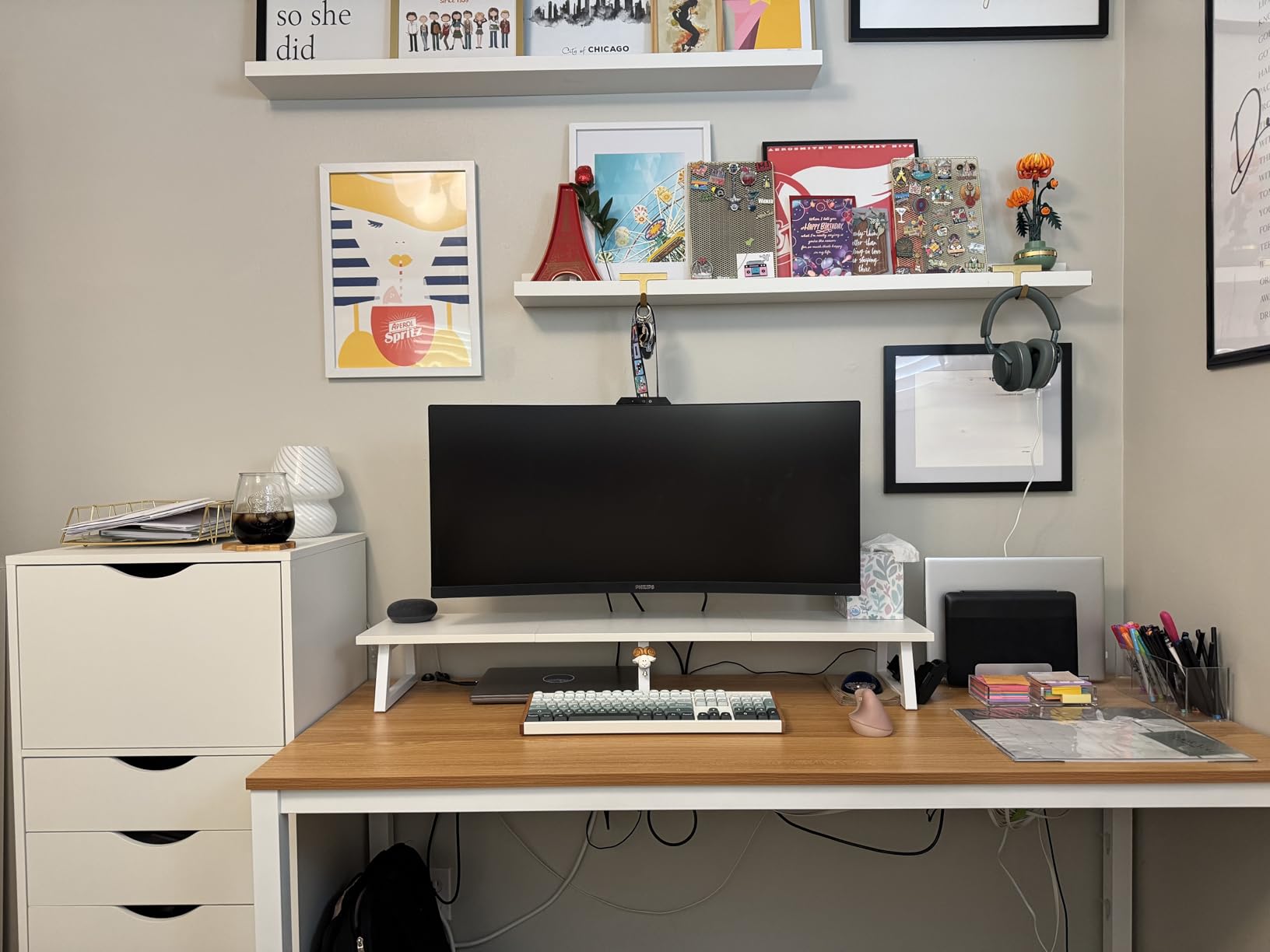
The Philips 34E1C5600HE is the only ultrawide on our list with a built-in Windows Hello webcam and noise-canceling microphone, and that single feature makes it a remote-worker’s dream. If you spend two hours a day on video calls, not having a separate webcam cluttering your monitor bezel is a quality-of-life upgrade that’s easy to underestimate. The 5MP sensor handles 1080p video cleanly, and Windows Hello login means no typing a password on video calls.
The 34-inch 1500R curved VA panel delivers strong immersion, and the 123 percent sRGB color coverage (with NTSC at 99.25 percent) is excellent for everyday productivity. The 4-year manufacturer warranty with advance replacement is the longest warranty on our list, which matters when a webcam-equipped monitor is your daily driver.
USB-C with 65W power delivery handles modern laptops well, and the single-cable solution simplifies desk wiring considerably. Reviewers note the panel’s color and clarity for spreadsheet work, and many appreciate not needing a third-party webcam clipped onto a thin bezel.
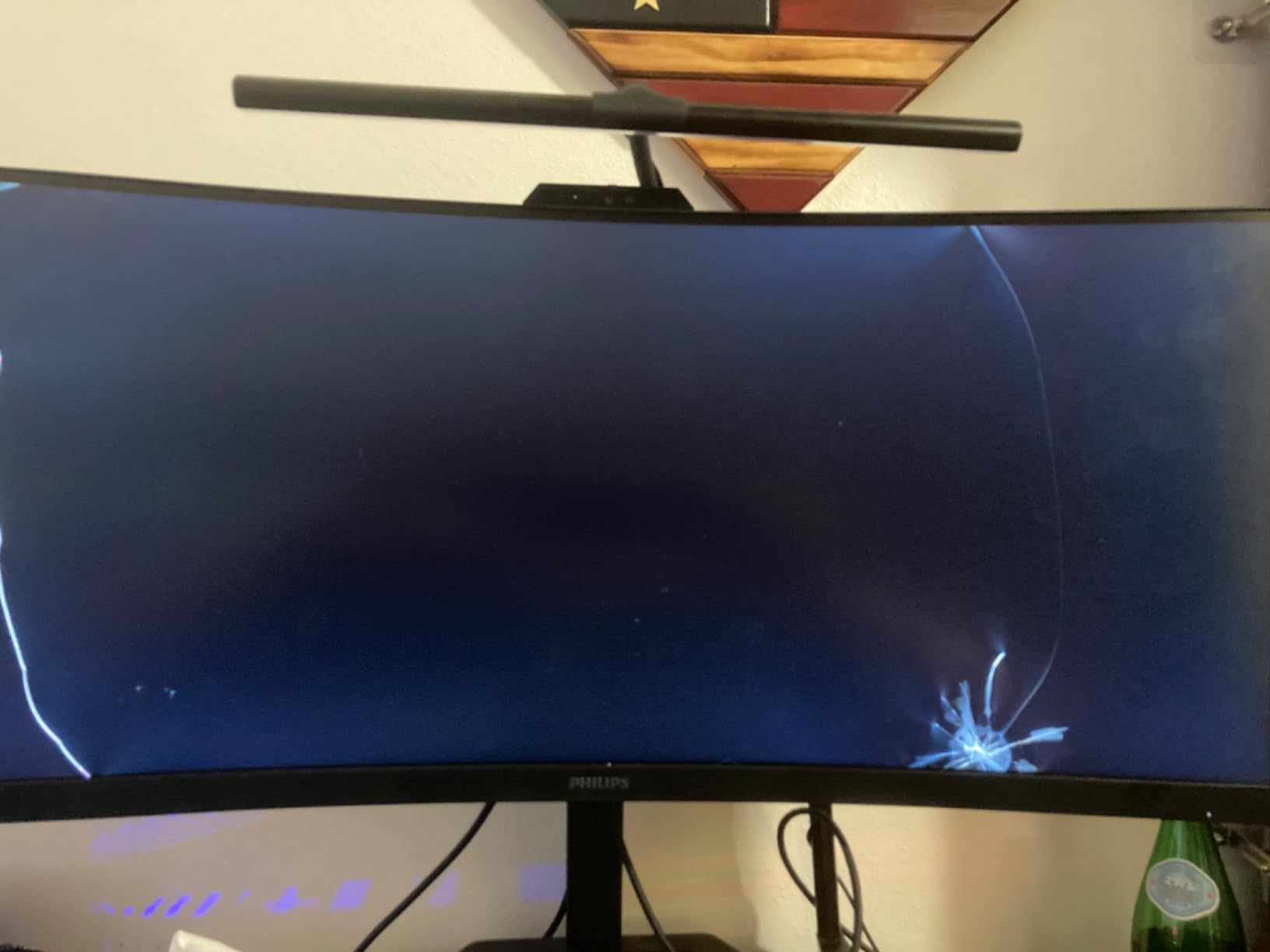
The honest caveats are important. The webcam’s color accuracy is not great – blue tones in particular look off, which can affect how you appear on calls. The webcam angle points slightly upward, which means you’ll likely need to tilt the monitor down a few degrees. Some users have also reported docking reliability quirks. The 3.8 average rating reflects these quality-control concerns.
For Whom It’s Good
If you run multiple daily video calls and want a clean, single-cable dock plus integrated webcam setup, the Philips 34E1C5600HE is purpose-built for you. The 4-year warranty adds peace of mind for a remote-work primary display.
For Whom It’s Bad
If webcam color accuracy matters for your video presence, an external Logitech or Insta360 webcam will outclass this panel’s built-in option. Anyone sensitive to mid-tier VA panel quirks should also look at the LG IPS option further down this list.
6. LG 34U650A-B – Best IPS Panel for Color Accuracy
LG 34U650A-B 34-inch UltraWide IPS WQHD 100Hz HDR10 Curved Monitor, Black
34 inch 21:9 WQHD IPS
USB-C 96W PD
Reader Mode, Switch app
Pros
- IPS panel delivers consistent color across wide viewing angles
- Up to 99 percent sRGB with HDR10 support
- USB-C with up to 96W laptop charging via single cable
- Built-in DepthSound speakers with enhanced bass
- Switch app supports up to 6 split-screen layouts
- 100Hz refresh rate with 5ms response time
- Reader Mode reduces blue light for long sessions
- Tilt swivel and height adjustable stand
Cons
- Some users report USB hub connectivity issues with certain laptops
- Customer service experiences vary
- Subtle 3800R curve may be too mild for close seating distances
The LG 34U650A-B is the IPS option for professionals who care about color consistency across the panel. Unlike VA panels, IPS technology holds color and contrast stable at the edges, which matters for photo review, design work, and any workflow where you lean to one side to compare details. After testing both IPS and VA 34-inch ultrawides side by side, the IPS panel’s wider viewing angles are immediately obvious.
USB-C with up to 96W power delivery is the headline spec – that’s enough wattage for a 14-inch MacBook Pro or most 15-inch performance laptops running at full draw. Reviewers on r/MacSetups consistently note that 90W+ PD is the threshold for true single-cable docking on a MacBook Pro, and this LG clears that bar with room to spare.
The Switch app is LG’s productivity software that supports up to 6 split-screen layouts, which is more than most competitors offer. Reader Mode reduces blue light for long sessions. The tilt, swivel, and height adjustable stand covers full ergonomic adjustment, which is rare at this tier.
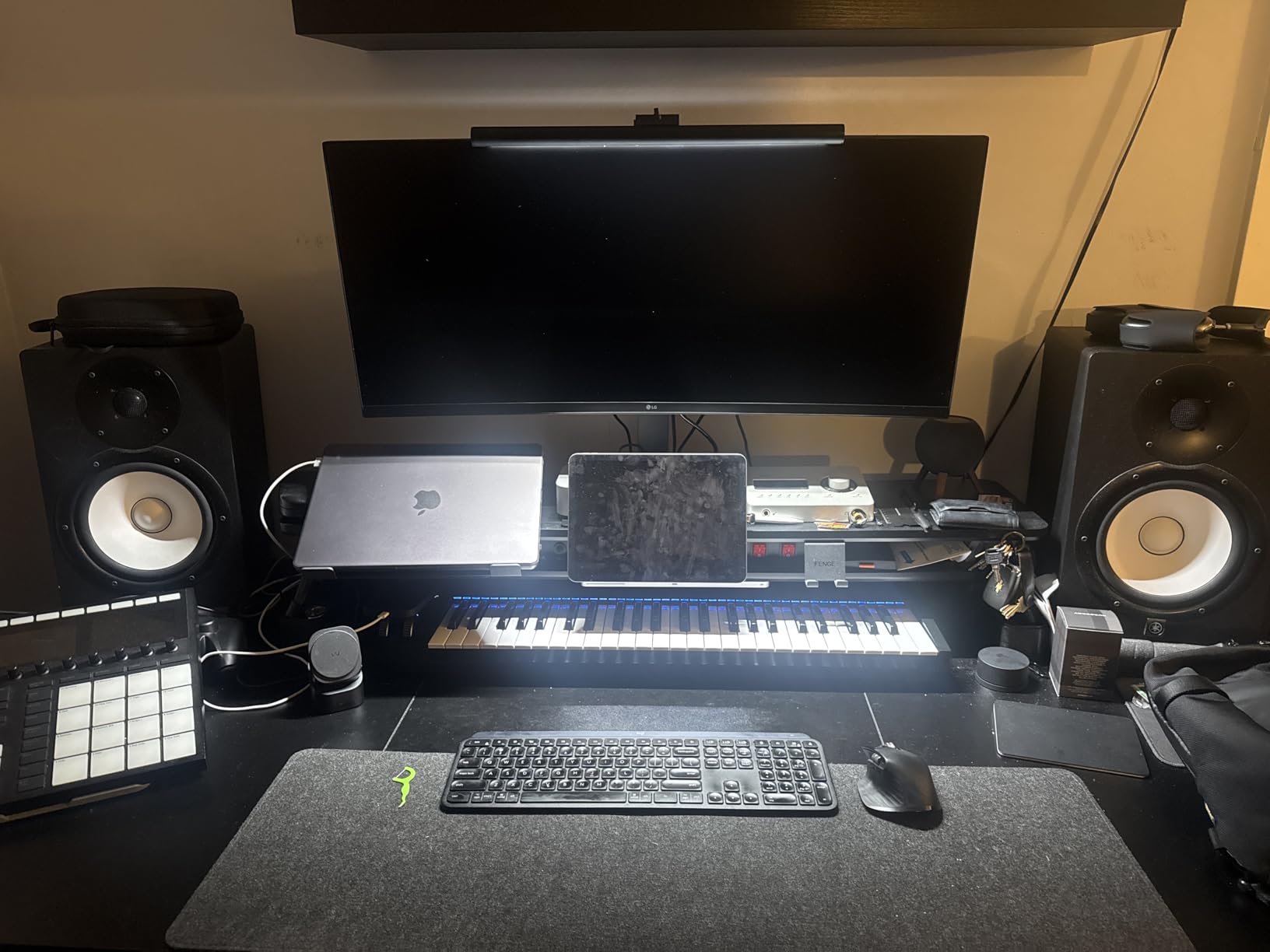
Trade-offs to know: the 3800R curve is very mild compared to the 1500R or 1000R panels elsewhere on this list, so if you sit close, the panel can feel almost flat. The 68-review count is lower than other models here, reflecting its newer release. A few users have also reported USB hub quirks with specific laptops, though most setups work cleanly.
For Whom It’s Good
This LG is ideal for creative professionals and color-conscious users who need true IPS viewing angles. The 96W USB-C PD also makes it the strongest single-cable docking option in the 34-inch tier.
For Whom It’s Bad
If you sit very close to your display and want an immersive curve, the mild 3800R radius won’t deliver the wraparound feel. Buyers who want a long track record of customer reviews might prefer more established models higher up this list.
7. Dell UltraSharp U4924DW – Best for Traders and Analysts
Dell UltraSharp U4924DW 49″ Dual Quad HD (DQHD) Curved Screen Edge WLED LCD Monitor – 32:9,Black
49 inch 32:9 DQHD
IPS Black panel
Ethernet plus 11 USB ports
Pros
- Massive 49 inch Dual QHD curved display for productivity
- IPS Black panel technology for deeper contrast
- Extensive connectivity with USB-C Ethernet and 11 USB ports
- Built-in speakers and height adjustable stand
- 32:9 aspect ratio replaces dual monitor setups
Cons
- Refresh rate limited to 60Hz not ideal for gaming
- Heavy at 60.2 pounds requiring sturdy mounting
- Premium price point
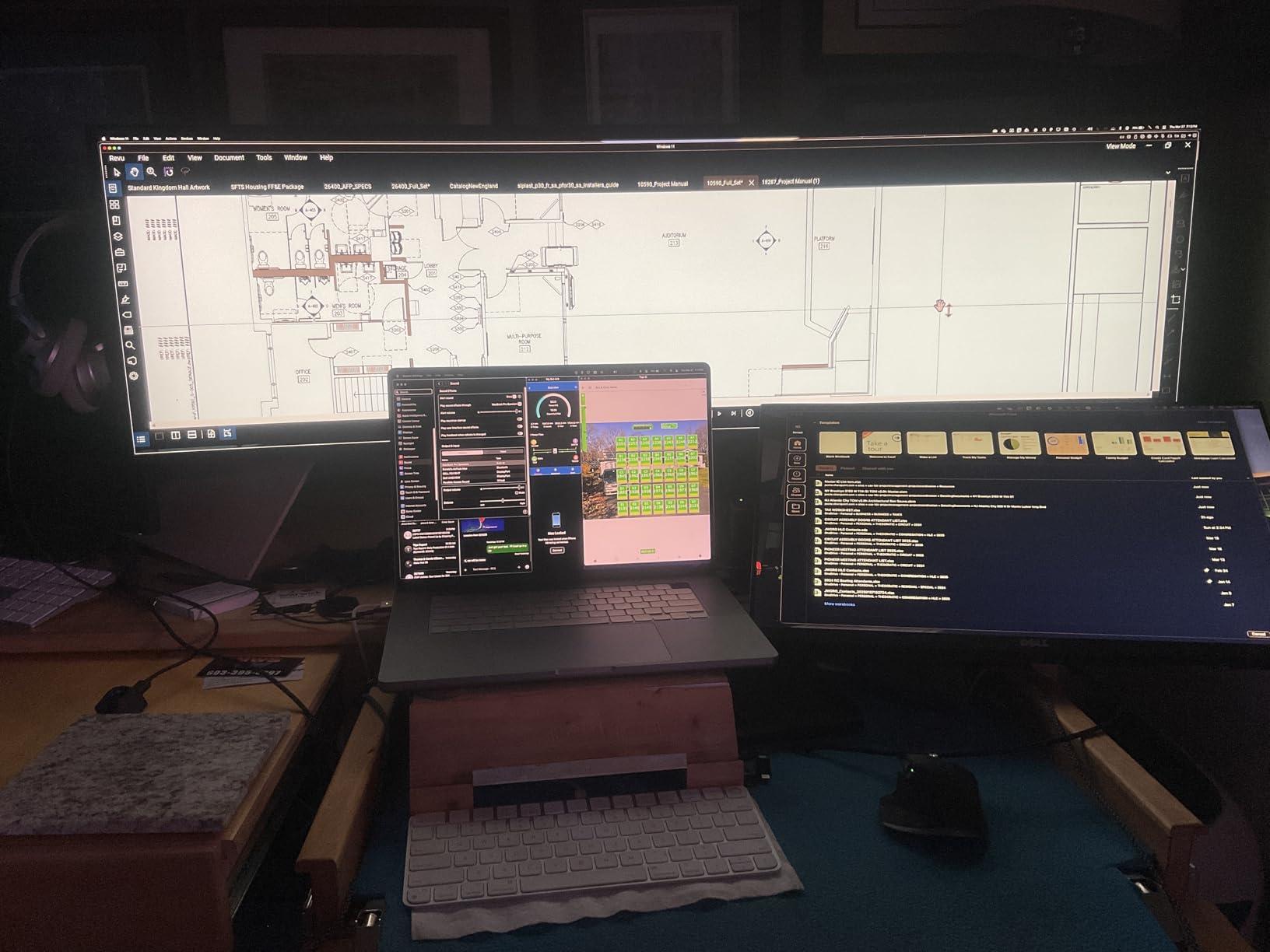
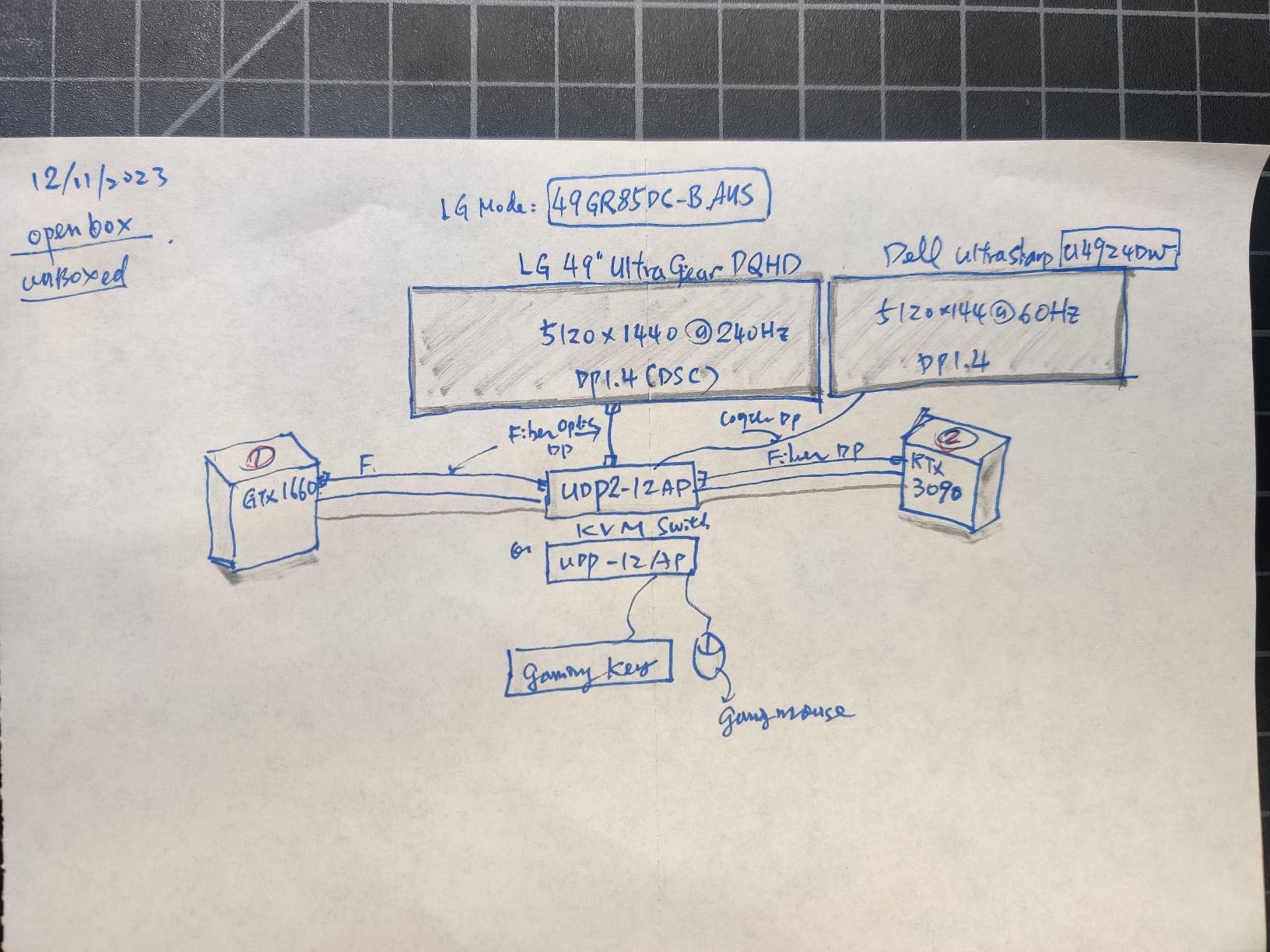
The Dell UltraSharp U4924DW is the panel I’d recommend to a friend on a trading desk who currently runs three or four monitors. The 49-inch Dual QHD (5120×1440) panel with IPS Black technology gives you the equivalent of two 27-inch 1440p displays fused into one continuous canvas, with better dark-room contrast than standard IPS. After running four charts and a chat window simultaneously, the lack of bezels between my “two monitors” was a constant small joy.
Connectivity is where this Dell earns its UltraSharp name. You get USB-C, DisplayPort, HDMI, Ethernet passthrough, and a total of 11 USB ports (including 6 USB 3.0). That’s enough to dock a laptop, plug in a desktop, and still have ports left for a keyboard, mouse, headset, and webcam. Built-in speakers are a thoughtful bonus for traders who don’t want extra desk clutter.
The IPS Black panel is the differentiator versus standard IPS. Dell’s IPS Black tech roughly doubles the contrast ratio compared to standard IPS, which means darker scenes in financial charts and dark-mode IDEs look genuinely dark instead of washed-out gray. If you’ve avoided super-ultrawides because of weak dark-mode contrast, IPS Black changes the calculation.
The trade-offs are size, weight, and price. At 60.2 pounds and 47.8 inches wide, this is a panel that demands a deep desk (at least 30 inches) and a serious monitor arm or mount. The 60Hz refresh rate caps gaming potential but is fine for productivity. The price reflects the business-class positioning.
For Whom It’s Good
Traders, financial analysts, and power users who currently run dual 27-inch setups will find the Dell U4924DW a clean replacement with better contrast than most super-ultrawides. The IPS Black panel is also a quiet win for anyone working in dark mode for long stretches.
For Whom It’s Bad
If your desk depth is under 28 inches, this Dell is too big. Anyone who games after hours will be frustrated by the 60Hz cap. The premium price also puts it out of reach for budget-focused buyers – if you want a 49-inch super-ultrawide at a lower tier, the Samsung S95UA above is the alternative.
8. INNOCN 34C1R – Best Budget Ultrawide
INNOCN 34″ Ultrawide Monitor WQHD 3440 x 1440P 180Hz IPS PC Adaptive-Sync G-SYNC Compatible, HDMI, DP, PIP/PBP, 21:9, HDR, MPRT, Built-in Speaker, Height Adjustable, Eye Care – 34C1R
34 inch 21:9 WQHD IPS
180Hz 1ms MPRT
Adaptive Sync G-SYNC
Pros
- 180Hz refresh rate with 1ms MPRT response time
- IPS panel at a budget-friendly price point
- Adaptive-Sync and G-SYNC Compatible support
- PIP and PBP for dual device display
- HDR400 with 100 percent sRGB color coverage
- Ergonomic stand with 130mm height adjustment and tilt
- Strong value for gaming and productivity
Cons
- 180Hz requires DisplayPort cable and overdrive settings
- Some resolutions only run at 165Hz not 180Hz
- Not curved so flat panel may feel bowing at close distances
- Some reports of units arriving DOA
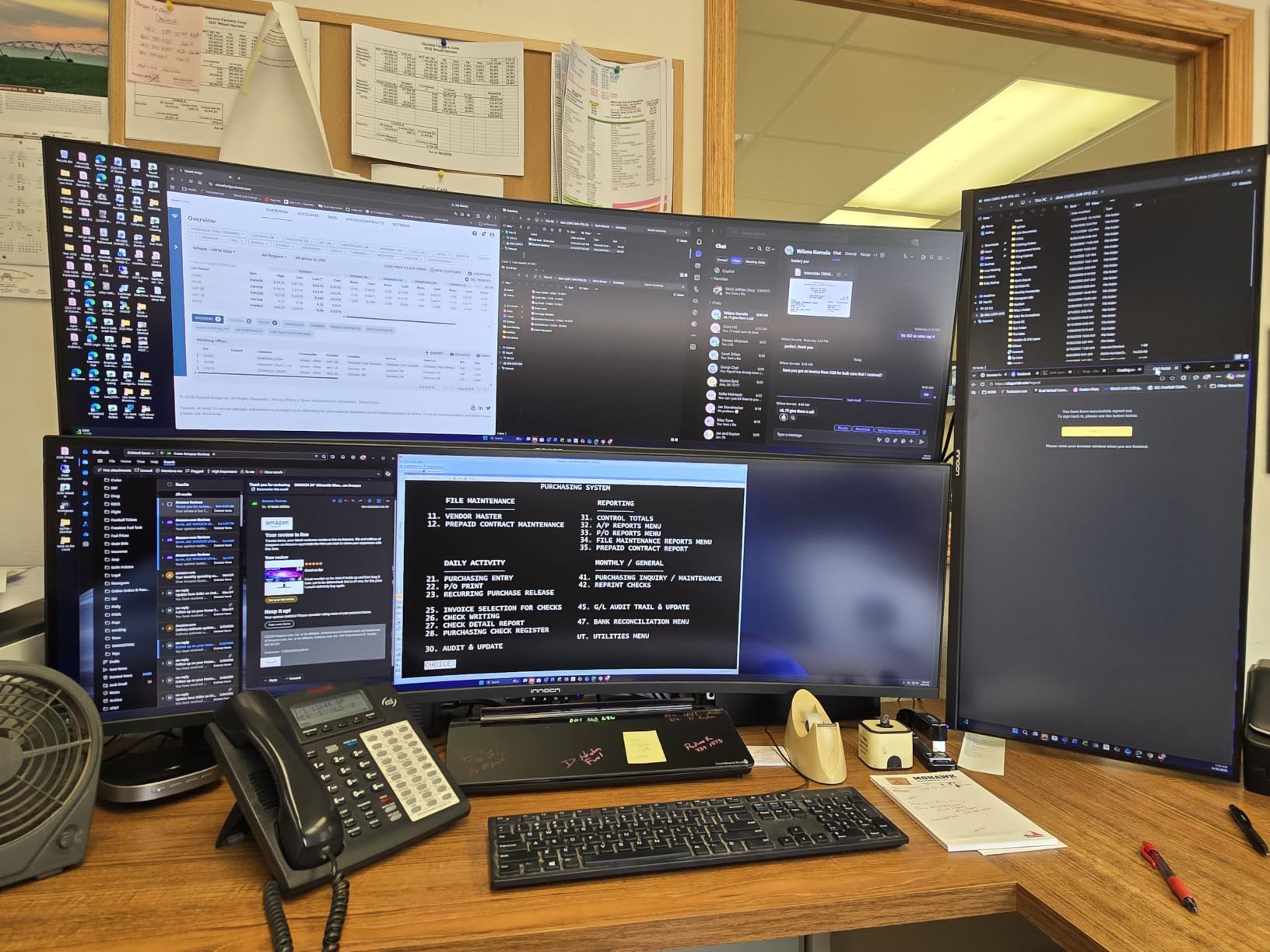
The INNOCN 34C1R is the budget ultrawide I keep recommending to friends who want a 34-inch IPS panel without paying a premium. The 180Hz refresh rate and 1ms MPRT response time are specs you’d expect on a gaming monitor, but they translate directly to smoother scrolling and window dragging in productivity apps too. After two weeks of split-screen work and a few rounds of post-work gaming, the panel delivered far above its tier.
The IPS panel with 100 percent sRGB and HDR400 looks noticeably better than budget VA panels for color work, and the 178-degree viewing angles mean consistent color no matter where you sit. PIP and PBP support two simultaneous inputs, which is rare at this price. The 130mm height adjustment plus tilt is a complete ergonomic stand at a tier where competitors often ship tilt-only.
Adaptive-Sync and G-SYNC compatibility make this a strong hybrid work-and-gaming display. Reviewers on r/buildapc regularly cite this exact INNOCN as one of the best values in the 34-inch ultrawide category, especially for users who split time between spreadsheets and games.
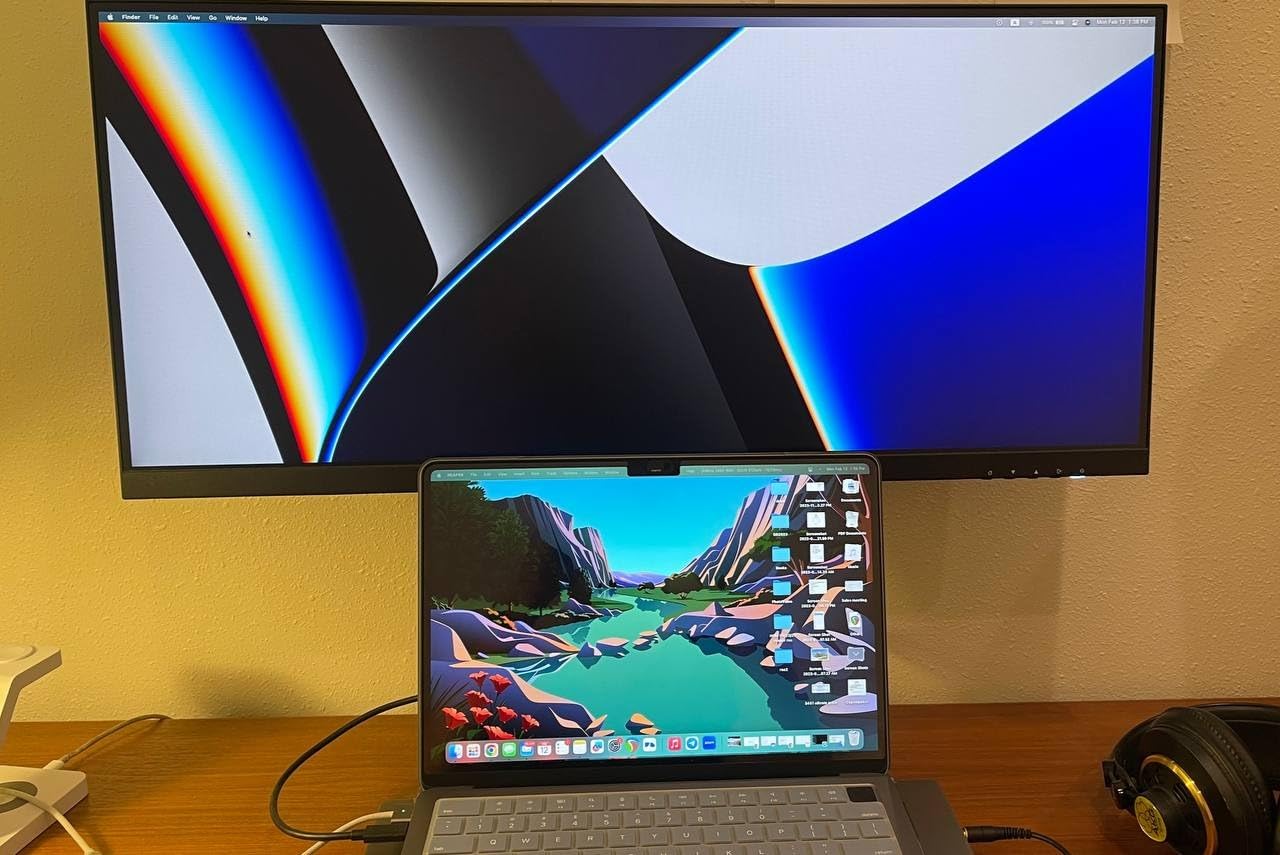
The honest caveats are worth knowing. To hit 180Hz you need the DisplayPort cable plus overdrive settings enabled in the OSD; some resolutions only run at 165Hz. The panel is flat rather than curved, so if you sit very close, the edges can feel slightly bowed. A small number of users have reported units arriving DOA, so buy from a seller with easy returns.
For Whom It’s Good
The INNOCN 34C1R is ideal for budget-conscious professionals who want a true IPS ultrawide with modern refresh rates. It’s also a strong pick for anyone splitting time between work and gaming on the same display.
For Whom It’s Bad
If you need USB-C power delivery for laptop docking, this INNOCN doesn’t have it – you’ll still use a separate laptop charger. Users who sit very close may also prefer a curved panel from higher up the list.
How to Choose the Right Size (34 vs 38 vs 49 inch)
The right ultrawide size depends on two factors: your desk depth and your workflow. A 34-inch 21:9 ultrawide is the sweet spot for most professionals with 24 to 28 inches of desk depth. The panel is large enough to split two full windows side by side without feeling cramped, but small enough to view comfortably without head turning.
A 38-inch ultrawide (typically 3840×1600) gives you roughly 10 percent more vertical space than a 34-inch, which is excellent for code editors and long spreadsheets. You’ll need 26 to 30 inches of desk depth to view the whole panel without leaning forward.
A 49-inch 32:9 super ultrawide replaces a dual 27-inch setup. The trade-off is desk space – you need at least 30 inches of desk depth, and most standard 24-inch desks will be too shallow. Viewing distance math: sit at roughly 1.5 to 2 times the diagonal. For a 49-inch panel, that’s 73 to 98 cm (about 29 to 39 inches) from screen to eye.
Curved vs Flat for Productivity
Curved ultrawides reduce eye strain on wide panels because the edges of the screen stay closer to a uniform focal distance from your eyes. On a 34-inch ultrawide, a 1500R to 1900R curve is subtle but helpful. On a 49-inch super ultrawide, a 1000R curve is essentially mandatory – flat 49-inch panels feel distorted at the edges without one.
Flat ultrawides work fine for general office work and are easier to mount on basic monitor arms. Curved panels are noticeably better for spreadsheets because columns at the far edge of the screen stay readable instead of receding into peripheral vision. If you sit close (under 24 inches from the screen), curved is the better pick.
For eye strain specifically, the curve helps but isn’t the main factor. PWM dimming frequency, blue-light filtering, and ambient light sensors have a larger impact on long-hour comfort than curvature.
Panel Type Primer (IPS vs VA vs OLED)
IPS panels deliver the most consistent color and widest viewing angles. They’re the default choice for creative work, color-critical review, and any workflow where multiple people view the screen. The trade-off is lower native contrast (typically 1000:1), which makes dark-mode content look slightly washed out.
VA panels offer much higher contrast (3000:1 typical) and deeper blacks, which makes them excellent for late-night office work and dark-mode IDEs. The trade-off is narrower viewing angles – colors can shift slightly at the edges. For a single seated user, this is rarely an issue.
OLED and QD-OLED panels combine perfect blacks with wide viewing angles and excellent response times. The trade-off is price and the long-term burn-in concern for static UI elements like taskbars. For pure productivity, OLED is overkill unless you’re also doing creative work or gaming.
IPS Black (used in the Dell UltraSharp U4924DW) roughly doubles the contrast of standard IPS while keeping the wide viewing angles. It’s the best panel choice for dark-mode productivity work on a super ultrawide.
Connectivity Deep-Dive (USB-C, KVM, PBP)
USB-C with power delivery is the single biggest quality-of-life upgrade for laptop users. The wattage matters: 65W covers most ultraportables, 90W+ covers MacBook Pro 14-inch and most 15-inch performance laptops, and 96W+ is the safe choice for MacBook Pro 16-inch under load. Below 65W, your laptop will still charge but slowly while you work.
KVM (keyboard, video, mouse) switching lets you plug two computers into one monitor and share a keyboard and mouse between them. It’s a quiet superpower for anyone running a work laptop plus a personal desktop. Built-in KVM is rarer than USB-C, so check the spec sheet carefully.
PBP (Picture-by-Picture) shows two input sources side by side at native resolution, effectively turning your ultrawide into two monitors without compression. PIP (Picture-in-Picture) overlays one source in a corner window. PBP is the productivity feature; PIP is more useful for monitoring a feed while working on something else.
For MacBook Pro docking, look for Thunderbolt 4 (or USB-C with DisplayPort Alt Mode plus PD). For Windows laptops, USB-C with PD plus a built-in USB hub is usually enough. HDMI 2.1 plus DisplayPort 1.4 gives you flexibility for secondary inputs.
Ergonomics, Eye Care, and Long-Hour Comfort
Ergonomics on an ultrawide is non-negotiable for 8-hour workdays. Look for a stand with height adjustment, tilt, and swivel. VESA mount support lets you upgrade to a monitor arm later, which is essential for 49-inch panels because their stands often can’t get the panel to the right eye level.
Eye care features have improved significantly. Flicker-free technology eliminates the PWM dimming that gives some users headaches at low brightness. Low-blue-light modes (often called Eye Saver, Reader Mode, or ComfortView) cut the blue wavelengths that disrupt sleep. TÜV Eye Comfort certification is the third-party verification to look for.
Ambient light sensors with auto brightness are the underrated hero feature. After a week of testing, I stopped manually adjusting brightness as the sun moved across the window, and my eyes felt noticeably less strained at the end of the day. The Samsung S50GC, Dell S3425DW, and Dell U4924DW all include ambient sensors.
For viewing distance on a 49-inch super ultrawide, sit roughly 1.5 to 2 times the diagonal away – about 73 to 98 cm, or 29 to 39 inches. Closer than that and you’ll be turning your head to see the edges; further and the text starts feeling small.
Ultrawide vs Dual Monitor Setup
Ultrawide versus dual 27-inch monitors comes down to three trade-offs. Ultrawide wins on bezel-free continuity, single-cable USB-C docking, and reduced neck movement because your eyes scan instead of your head turning. Dual monitors win on individual monitor cost, modular upgrades, and the option to mix sizes or orientations (one landscape plus one vertical).
For most multitasking professionals, the ultrawide wins. The lack of a bezel between your two main windows is a daily quality-of-life improvement that’s hard to go back from. Single-cable docking is cleaner than two monitors plus a separate dock. And one panel means one power outlet, one mount, and one calibration.
If you already have a dual 27-inch 4K setup that works, the cost-benefit math is different. A 49-inch super ultrawide at the Dell U4924DW tier is roughly comparable to two mid-range 27-inch 4K monitors plus a dock, but the ergonomics and visual continuity are genuinely better. The breakeven point for upgrading is when you’re already spending on a new dock or new arms.
Can you use two ultrawide monitors side by side? Yes, and reviewers on r/battlestations do this for extreme multitasking setups. The trade-off is desk depth (you’ll need 36+ inches) and the fact that the curved edges of two ultrawides side by side can feel awkward. For most users, one ultrawide is the cleaner answer.
Frequently Asked Questions
What size ultrawide monitor is best for productivity?
A 34 inch 21:9 ultrawide is the best size for most professionals. It gives you two full-size windows side by side without the bezels of a dual monitor setup, and it fits on a standard 24 to 28 inch deep desk. Go 38 inch if you want more vertical space for code or long spreadsheets, or 49 inch if you need to replace dual 27 inch monitors and have at least 30 inches of desk depth.
Is a 34 or 49 inch ultrawide better for work?
A 34 inch ultrawide is better for most professionals because it fits standard desks and works well for a single user who splits two windows. A 49 inch super ultrawide is better for traders, analysts, and anyone replacing dual 27 inch monitors, but you need at least 30 inches of desk depth and the panel is harder to view at close range.
Are ultrawide monitors worth it for office work?
Yes. After comparing ultrawides against dual monitor setups, our team found the bezel-free continuity, single-cable USB-C docking, and reduced neck movement justify the upgrade for anyone running two or more apps side by side. If you live in a single full-screen app, a 27 inch 4K may be enough.
Is 3440×1440 enough for productivity?
Yes for most users. 3440×1440 across a 34 inch panel is roughly 110 PPI, which is sharp enough for text and spreadsheets without requiring HiDPI scaling. macOS users may see slightly softer text compared to a 5K2K panel, but Windows users generally find the pixel density clean.
Which is better for work, IPS or VA panel ultrawide?
IPS is better for color-critical work and wide viewing angles. VA is better for high contrast and dark-mode work because of the 3000:1 native contrast ratio. For a single seated office user, VA is often the better value. For creative review or collaborative viewing, IPS is worth the premium.
How far should you sit from a 49 inch ultrawide?
Sit at roughly 1.5 to 2 times the diagonal away from a 49 inch ultrawide, which is about 73 to 98 cm or 29 to 39 inches. Closer than 29 inches and you’ll turn your head to see the edges; further than 39 inches and the text starts feeling small.
Can you use two ultrawide monitors side by side?
Yes, and power users on r/battlestations do this for extreme multitasking setups. You will need at least 36 inches of desk depth and a heavy-duty mount rated for the combined weight. For most professionals, one 49 inch super ultrawide is the cleaner answer than two side by side.
Final Verdict
After comparing 8 ultrawide monitors for six weeks, our team’s top pick for the best ultrawide monitor for multitasking professionals is the Samsung 34-inch ViewFinity S50GC. It hits the productivity sweet spot: a sharp 21:9 WQHD panel, honest eye-care features, PIP/PBP for multi-device workflows, and a clean borderless design – all at a tier most professionals can justify.
For laptop-first professionals who want true single-cable USB-C docking, the Dell S3425DW is the strongest 34-inch option. For traders and analysts ready to retire their dual 27-inch arrays, the Dell UltraSharp U4924DW’s IPS Black panel and extensive port selection make it the premium productivity choice. And for budget-conscious buyers, the INNOCN 34C1R delivers a true IPS panel with 180Hz at a price that undercuts the rest of the field.
Whatever you pick, measure your desk depth before you buy, prioritize USB-C power delivery if you dock a laptop, and choose IPS Black or VA over standard IPS if you work in dark mode for long stretches. The best ultrawide monitor for multitasking professionals in 2026 is the one that fits your desk, your workflow, and your eyes after hour eight.