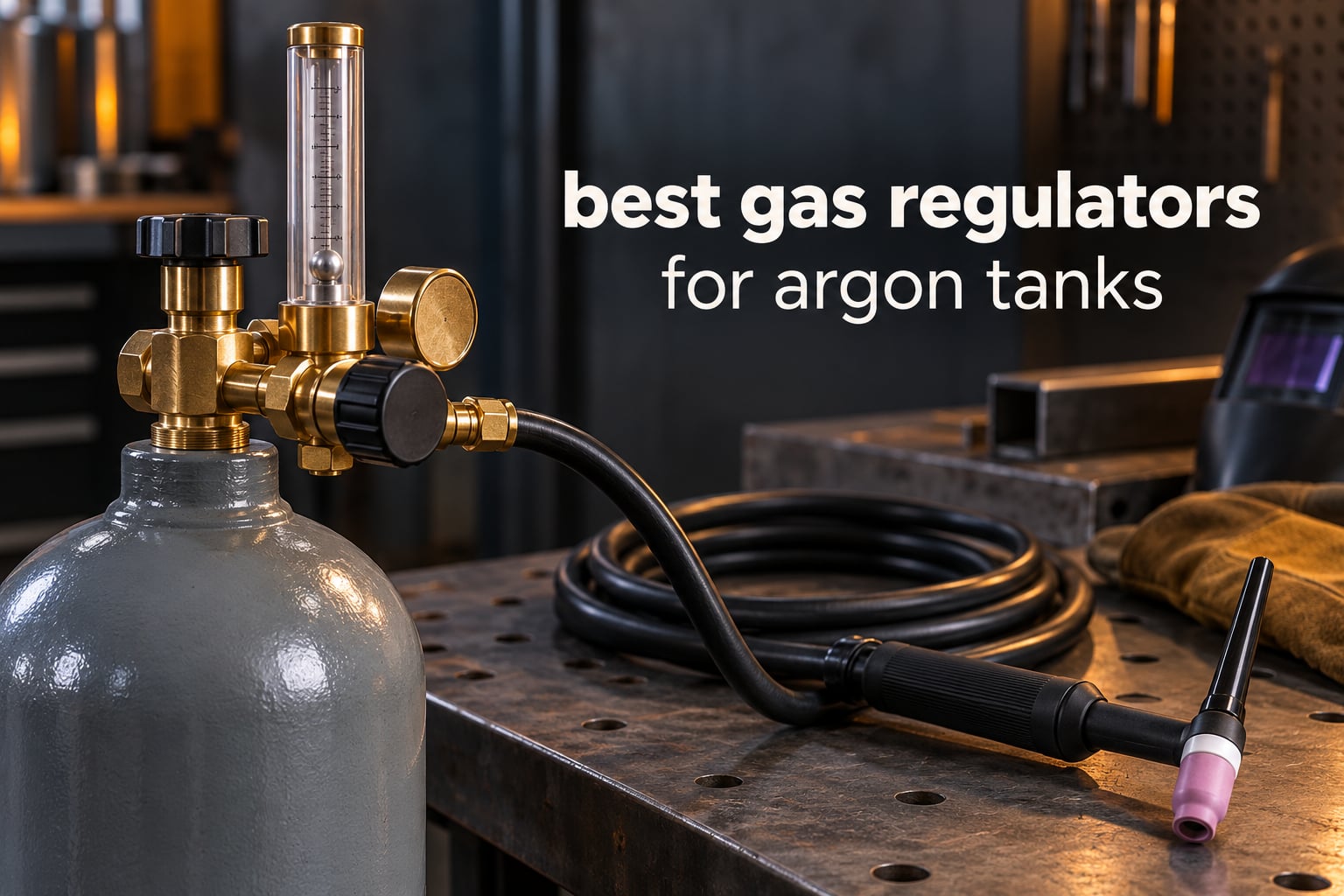
An argon regulator screws onto the CGA 580 outlet of your argon cylinder, drops tank pressure from thousands of PSI down to something a torch can use, and meters that gas as a readable flow rate in CFH. That CGA 580 inlet is the one spec you cannot compromise on: without it, nothing threads together, and there is no adapter that makes a CO2 fitting safe on an inert gas bottle.
Shielding gas coverage depends on how much gas volume actually reaches the weld pool, not on how hard the cylinder is pushing. Get it wrong at either end and you get porosity from too little flow, or a disturbed pool and a mounting gas bill from too much. The regulator is the only component that sits between a 3,000-plus PSI cylinder and your machine, so it is also the only place where a cheap fitting can cause real damage.
We spent weeks reading owner reports on welding forums alongside the spec sheets for the ten regulators below, focusing on the failure modes people actually complain about: cylinder-seat leaks, drifting delivery pressure, faint flow markings and outlets that do not match their torch. What follows is the buying guide we wanted before our own bench, plus a ranked list. If you also work with compressed gas for other reasons, our picks for CO2 regulators for draft beer systems and aquarium CO2 regulators cover a very different set of pressures and fittings, so do not cross-shop between them.
Table of Contents
Top 3 Best Gas Regulators for Argon Tanks in October

BETOOLL Flowmeter Regulator
- CGA-580 inlet
- 10-60 CFH floating ball tube
- 0-4000 PSI gauge
- brass body

RX WELD Regulator with Hose
- CGA-580 inlet
- 10-60 CFH flow gauge
- 6.6ft hose included
- brass body

SPARC Argon Regulator Flow Meter
- 0-65 CFH argon range
- CGA-580 inlet
- lifetime warranty
- 0-4000 PSI gauge
All 10 Argon Regulators Compared Side by Side in 2026
Every regulator below shares a CGA 580 inlet, so the column that separates them is flow range, outlet thread and what actually ships in the box. Check the outlet thread against your torch before you commit, because that is the number one reason a new regulator ends up sitting on a shelf.
| Product | Specifications | Action |
|---|---|---|
| BETOOLL Argon/CO2 Flowmeter Regulator |
|
Check Latest Price |
| RX WELD Regulator with 6.6ft Hose |
|
Check Latest Price |
| SPARC Argon Regulator and Flow Meter |
|
Check Latest Price |
 YESWELDER Flowmeter Regulator with Hose YESWELDER Flowmeter Regulator with Hose |
|
Check Latest Price |
 SÜA Industrial Argon Regulator SÜA Industrial Argon Regulator |
|
Check Latest Price |
 ARCCAPTAIN Regulator with Inlet Filter ARCCAPTAIN Regulator with Inlet Filter |
|
Check Latest Price |
 IVONNEY CGA580 Regulator IVONNEY CGA580 Regulator |
|
Check Latest Price |
 TOOLIOM Argon CO2 Flow Meter TOOLIOM Argon CO2 Flow Meter |
|
Check Latest Price |
 YESWELDER Dual Output Regulator YESWELDER Dual Output Regulator |
|
Check Latest Price |
 VIVOSUN Welding Gas Regulator VIVOSUN Welding Gas Regulator |
|
Check Latest Price |
1. BETOOLL Argon/CO2 Flowmeter Regulator – Best Overall Pick
BETOOLL Argon/CO2 Mig Tig Flow Meter Gas Regulator Gauge Welding Weld, CGA580 Inlet Connection
CGA-580 inlet
Flow tube 10-60 CFH
0-4000 PSI gauge
Brass body
Pros
- Largest review base on the list at 2833 ratings
- Direct ball flow reading
- Includes hose barb nut and clamp
- Solid brass body
Cons
- Flow markings can be faint in low light
- 0-4000 PSI gauge range is coarse for fine pressure work
This is the unit we keep coming back to because the review base is deep enough to trust. More than 2800 ratings at a 4.6 average is a lot of people running this thing on real cylinders, and the recurring note is that it simply stops leaking after the first tank change.
The floating ball in the clear flow tube is the part that matters day to day. It reads 10 to 60 CFH, which covers thin-wall TIG, stainless work and ordinary MIG passes on mild steel without running out of headroom at the top end.
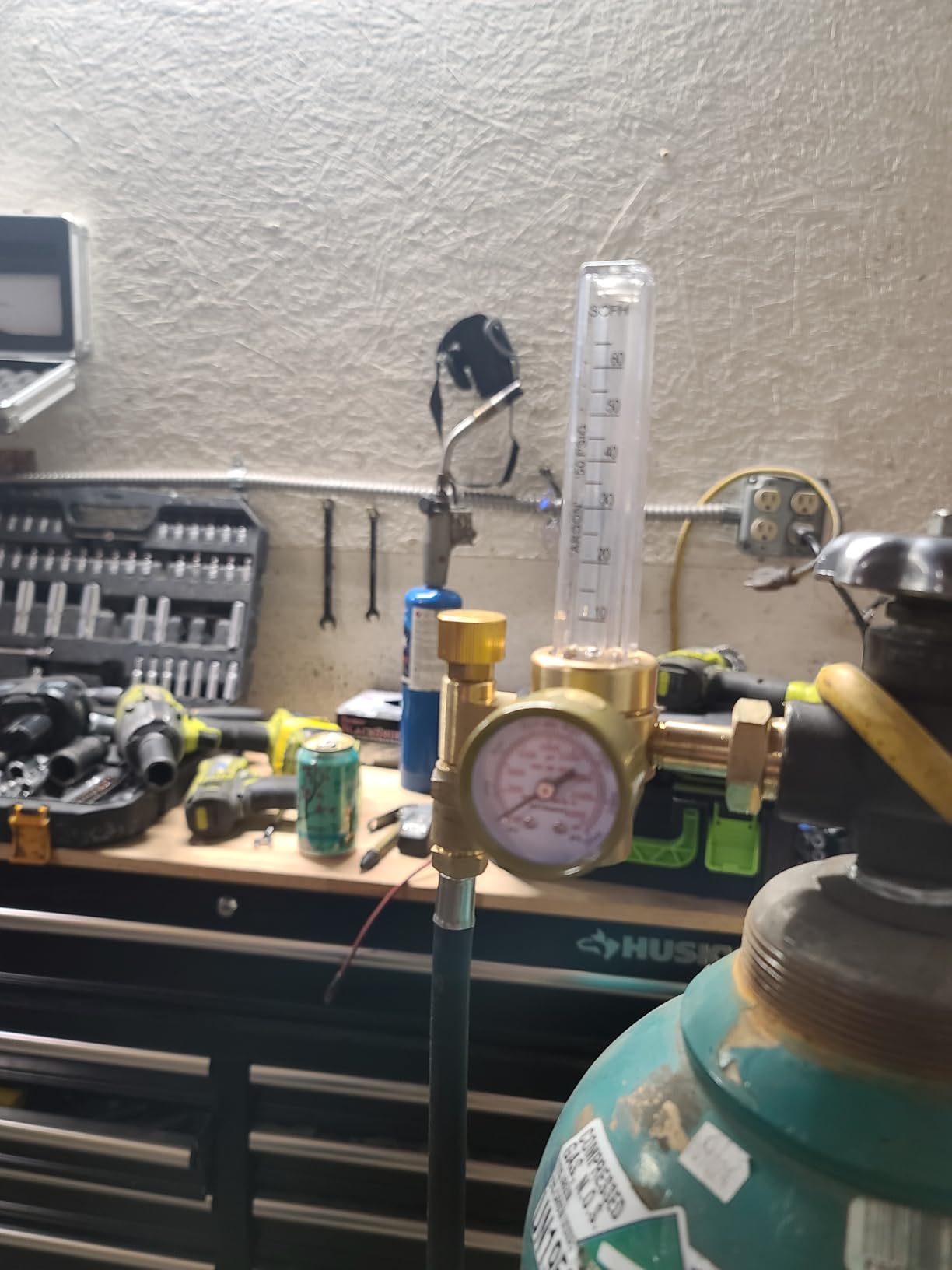
Owners rate the brass body as the part that holds up. It resists corrosion and takes the knocks of a shop floor, and the regulator weighs just 1.63 pounds so it is easy to hand up onto a cylinder yourself.
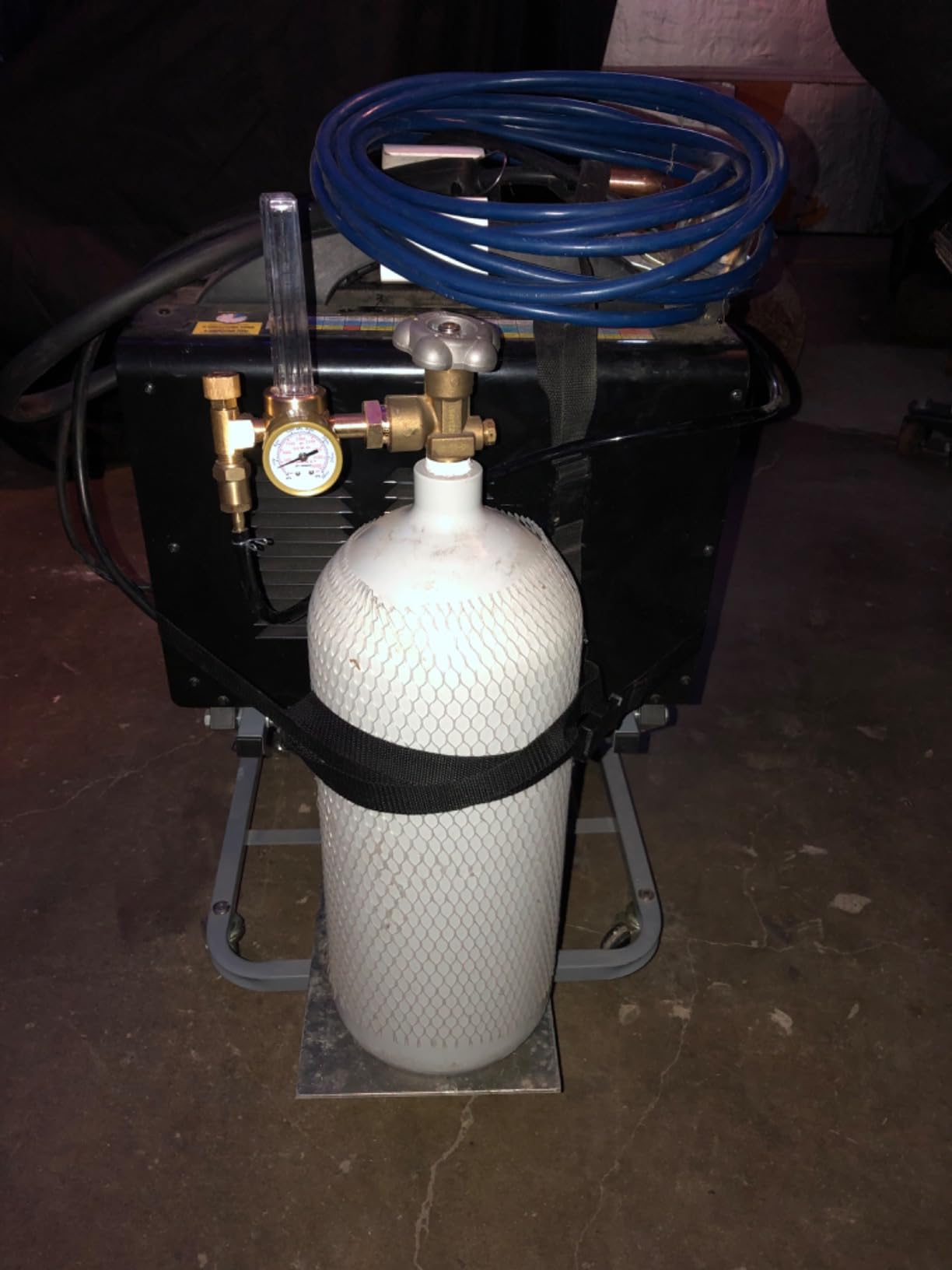
The package includes a quarter inch barbed fitting, a mounting nut and a hose clamp, so if you already own a torch line you can be running the same evening. A dedicated hose is not in the box, which is the one thing to plan for.
What you will notice in the first week
The ball settles quickly and reads steady once you stop adjusting it. Expect to purge the line for five to ten seconds before the reading means anything, because the tube fills with air first.
The high pressure gauge reads in the thousands, so a full cylinder sitting near the top of the dial tells you little about how much gas is left. Watch the needle fall rather than trying to read an absolute number off it.
Where buyers run into trouble
The most repeated complaint is that the CFH markings printed on the tube are thin and hard to read under a work light or through safety glasses. If you weld at night, tape a printed CFH scale alongside the tube on day one.
Because the pressure gauge spans 0 to 4000 PSI, it is too coarse to use as a fine delivery pressure reference. For MIG and TIG, read the flow ball and treat the gauge as a tank-level indicator only.
2. RX WELD Argon Regulator with 6.6ft Hose – Best Complete Kit
RX WELD Argon Regulator for MIG TIG Weld, CGA580, 6.6FT Hose
CGA-580 inlet
Flow gauge 10-60 CFH
6.6ft hose included
Brass construction
Pros
- Hose clamp nut and barb all included
- Number one category rank
- Adjusts to both common outlet threads
- Compact 3.5 by 4.9 by 6.3 inch body
Cons
- Regional thread standards can cause hose fitting mismatches
- Included hose clamp quality is unremarkable
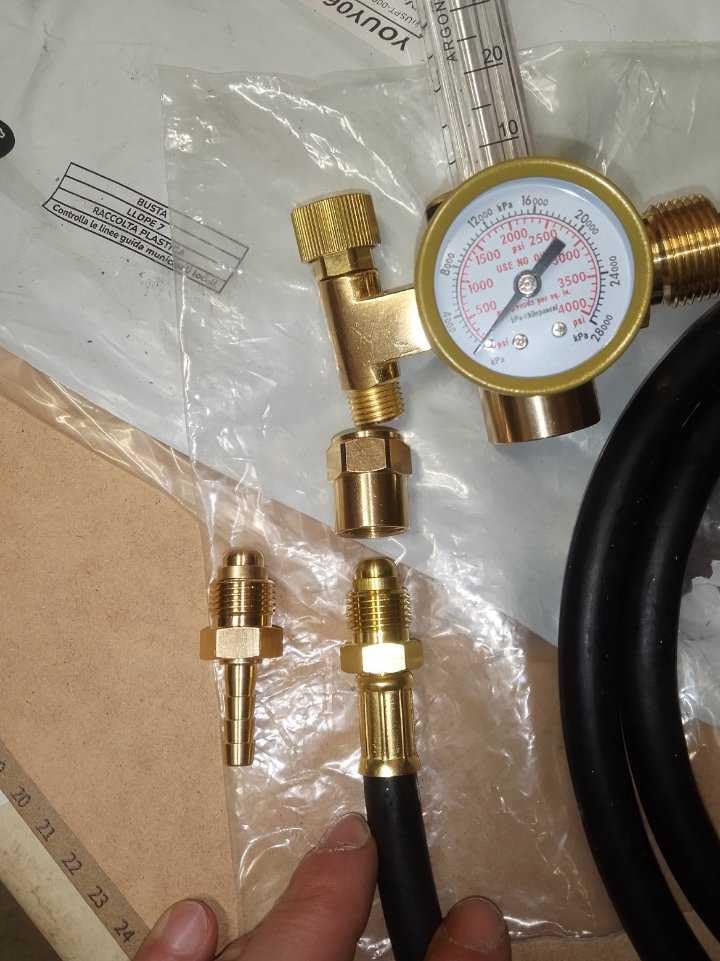
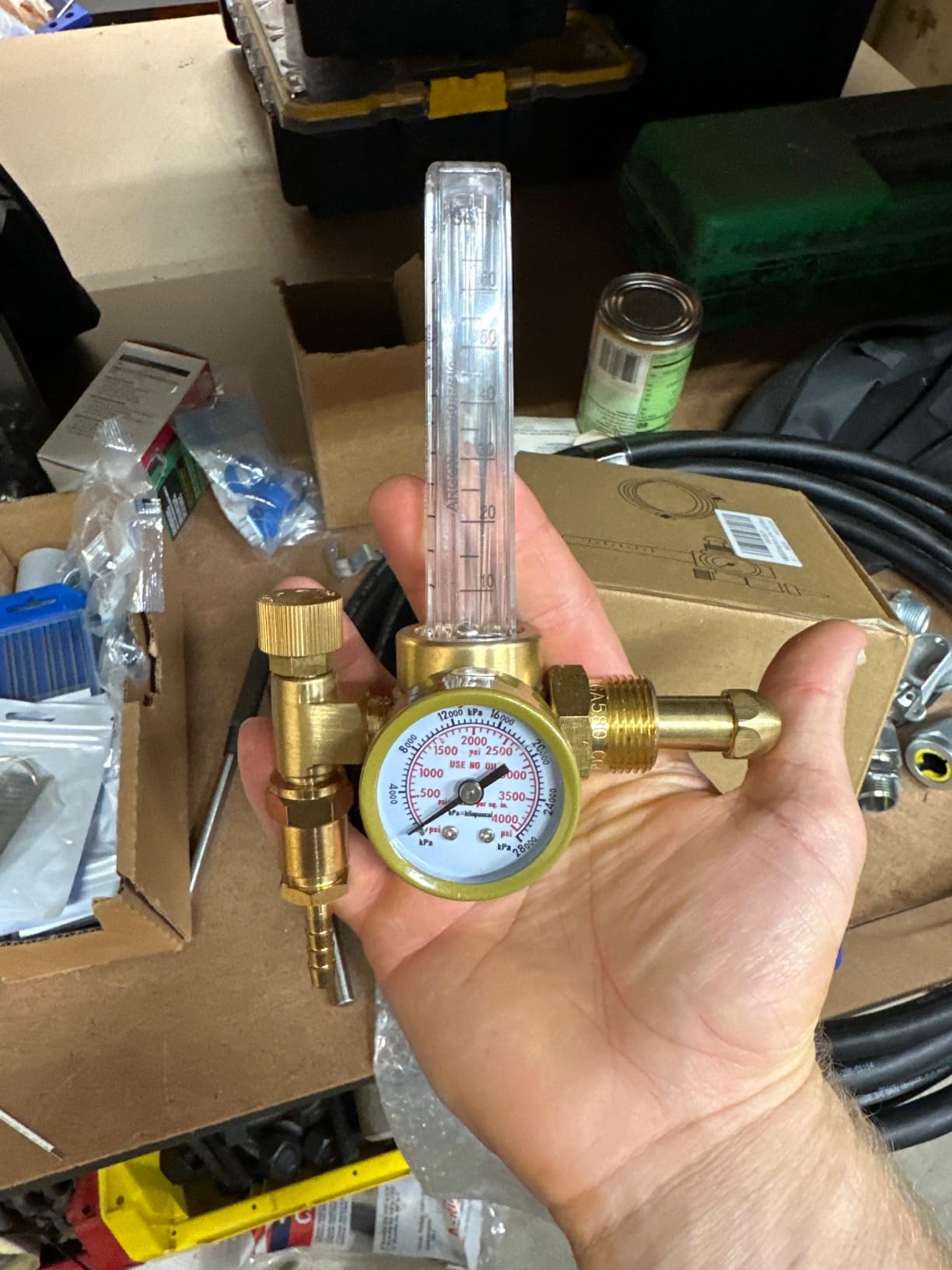
This is the one to buy if you want a working setup without a second order. The 6.6 foot hose, the clamp and the mounting nut all come in the box, and the outlet side accepts both the female 9/16 by 18 nut and the male 5/8 by 18 fitting.
It holds a 4.6 average across more than 2500 ratings and sits at the top of the welding gas regulator category, which tells you the volume of real-world setups behind those numbers. Leak-free operation after setup is the most common report.
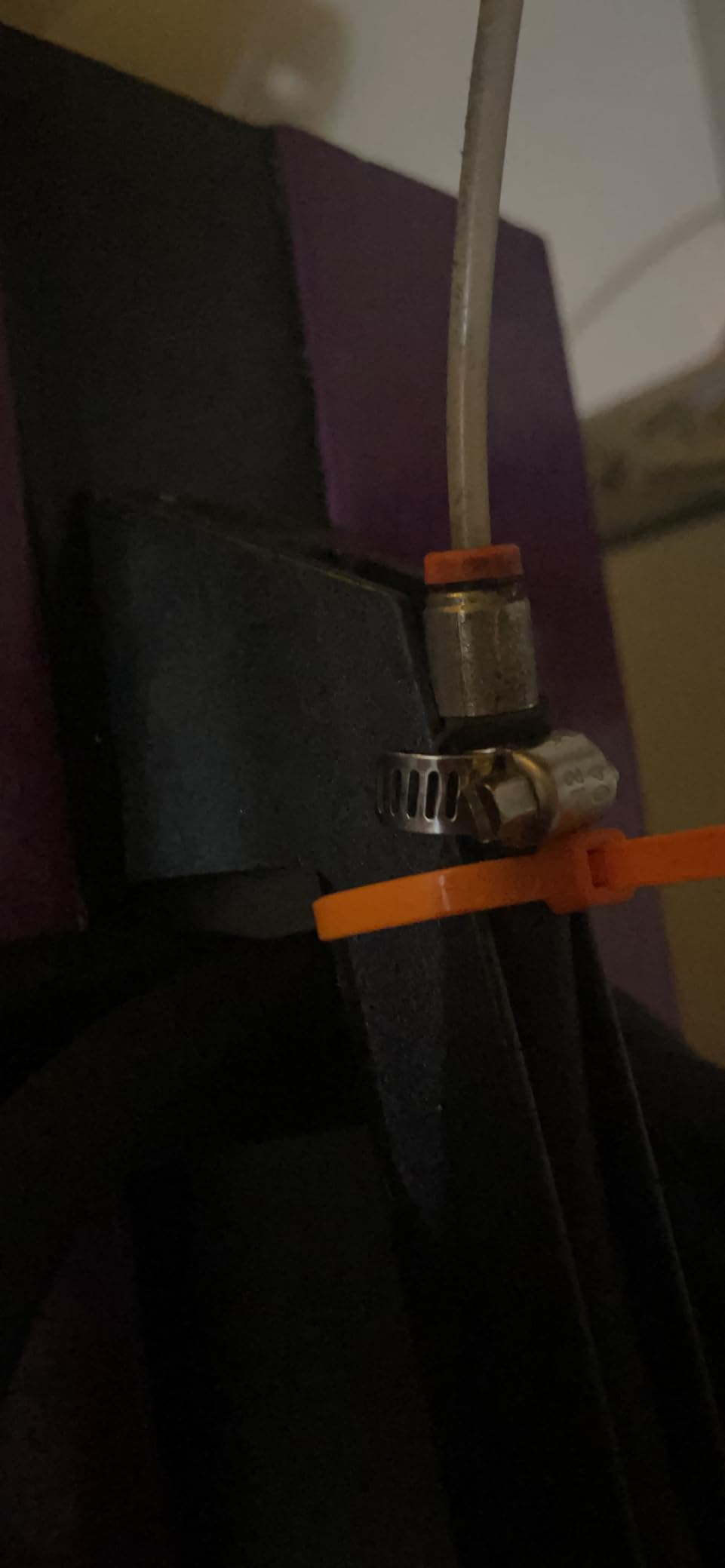
The flow gauge adjusts across 10 to 60 CFH with a ball indicator, the same working range as the higher review count leader above. For a home TIG rig or a single-station MIG, it is simply the shortest path from a new cylinder to a running torch.
At 2.1 pounds and with compact dimensions, it is easier to carry onto a cylinder than the larger brass regulators further down this list. That matters if you are swapping tanks rather than mounting a regulator permanently.
What you will notice in the first week
The included hose saves an entire step. Most first-time buyers otherwise order a regulator, realise they need a line, and lose an evening waiting for it.
Both outlet thread options are a genuine convenience. If your torch uses one and a future machine uses the other, you can move between them without buying an adapter.
Where buyers run into trouble
A small number of owners outside the US found the hose fittings did not match their local standard, since the line is built to US NPT conventions. Check the fitting on your side before you plan a weekend job.
The supplied hose clamp works but is not heavy duty. If your line runs over an edge or gets handled roughly, swap in a better clamp and crimp or tighten properly.
3. SPARC Argon Regulator and Flow Meter – Best Warranty Backed
SPARC Argon Regulator & Flow Meter – Gas Regulator for MIG/TIG Welding
CGA-580 inlet
0-65 CFH argon flow
0-4000 PSI gauge
Lifetime warranty
Pros
- Lifetime warranty with US support in Denver
- Factory calibrated with clear ball indicator
- Widest argon flow range here at 0-65 CFH
- Named compatibility with major welder brands
Cons
- Costs more than most competing flowmeters
- Single output only
This is the pick when support matters as much as the hardware. The lifetime warranty is unusual in this category, and it is backed by a US company rather than a marketplace listing.
The flow range is the technical headline. It reads to 65 CFH on argon and 70 CFH on an argon and CO2 blend, which gives more headroom for large nozzles and thicker material than most of the units here.
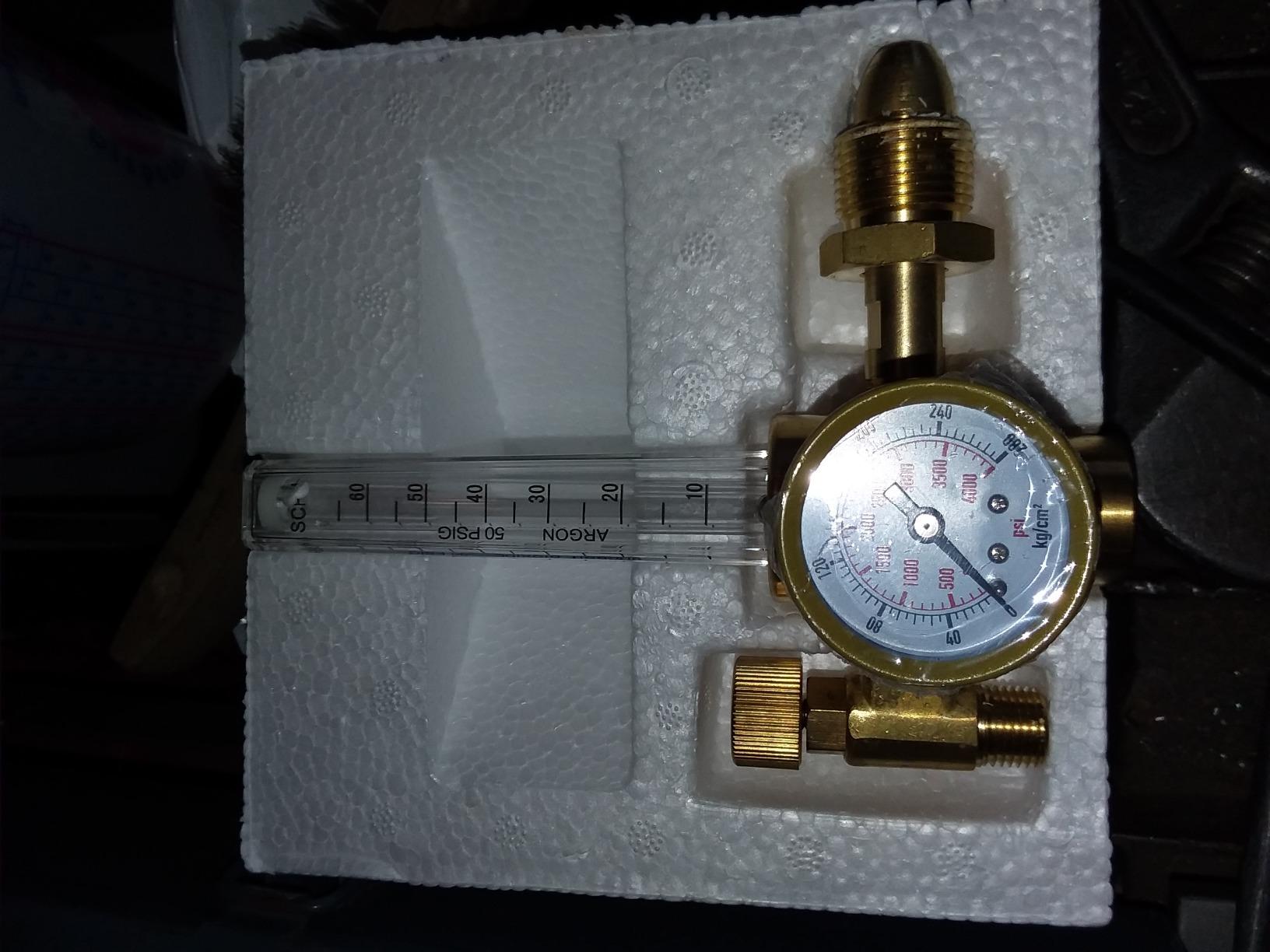
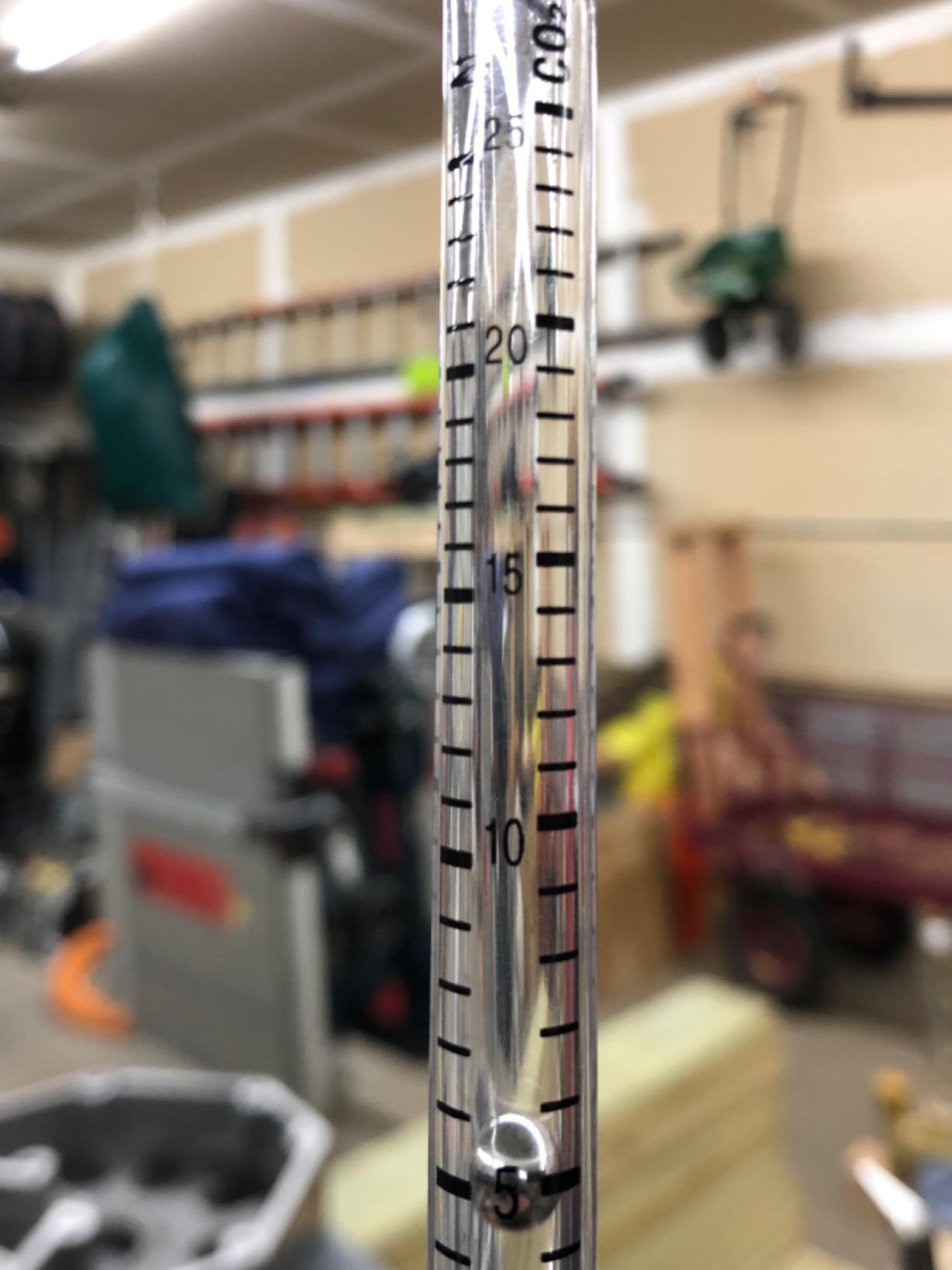
Owners single out the factory calibration and the clarity of the ball indicator as the reasons the reading is trustworthy. Calibration you can verify matters when you are chasing porosity and the flow number is the only variable left.
The outlet takes a barb adapter for 5/16 inch and quarter inch hose along with a 5/8 UNF-18RH nut, and the brand lists compatibility with Miller, Lincoln, Hobart, HTP, ESAB and Primeweld machines by name.
What you will notice in the first week
The 0 to 65 CFH span means you can push gas for a big stainless pass without running off the top of the scale. Most competing tubes stop around 60.
Because it is single output, plan on one hose and one torch. Shops running two stations should look at the dual output design further down this list instead.
Where buyers run into trouble
The higher price is the honest drawback. If you weld a few hours a month, the extra spend is hard to justify against a similarly rated unit with a 10 to 60 CFH tube.
No hose is included in the base configuration. Budget for the line and the fittings separately, and check which of the two barb sizes your torch hose actually takes.
4. YESWELDER Square Flow Tube Regulator – Best Square Tube Readability
YESWELDER Welding Gas Flowmeter with Gas Hose, Leak-Proof Argon CO2
CGA-580 inlet
Square 0-60 CFH tube
1.5 inch 0-4000 PSI gauge
8.2ft hose
Pros
- Square flow tube reads clearly and quickly
- 8.2ft hose and clamp included
- Large 1.5 inch pressure gauge
- Fits both common outlet thread types
Cons
- Gauge face is plastic rather than glass
- US CGA-580 standard does not fit UK BS 341 cylinders
The square flow tube is the reason this one is worth a look for anyone who wears safety glasses while welding. A round tube distorts your read at the edges, and the square profile keeps the ball in a readable plane.
It carries a 4.6 average on 870 ratings and sits at number two in the category. The integrated leak-proof design is what reviewers praise most often, along with an accurate flow reading straight out of the box.
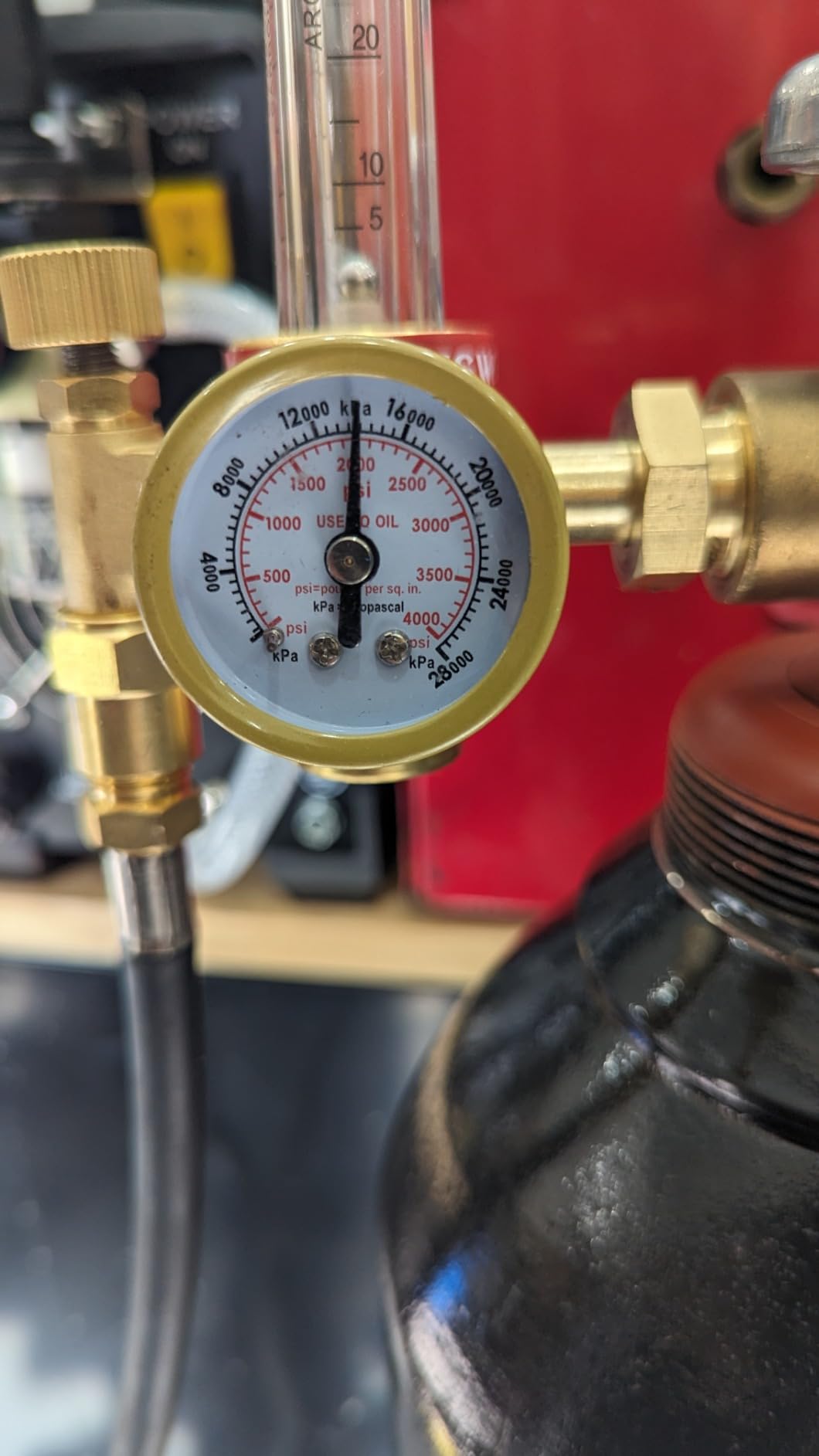
The 1.5 inch pressure gauge is physically larger than most regulators here, and that size matters when you are checking tank pressure in gloves under a welding hood.
The included 8.2 foot hose is one of the longer runs on the list, which is useful if your cylinder sits across the shop from where you weld. The package also includes a quarter inch barbed fitting and the mounting nut.
What you will notice in the first week
Reading the ball is genuinely easier than on a round tube, particularly at the low flows used for stainless TIG. That is the flow you will set most often if TIG is your main process.
The longer hose gives you freedom to mount the cylinder wherever there is floor space. Shorter lines tug on the seat fitting, and a longer one reduces that pull.
Where buyers run into trouble
The plastic gauge face is the main durability concern on an otherwise metal-heavy unit. It is fine for regular shop use but will not survive being dropped off a bench.
This is a US CGA-580 fitting and will not thread onto UK BS 341 cylinders or DIN 477 bottles. If you are outside the US, confirm your cylinder standard before ordering anything from this section.
5. SÜA Industrial Argon Regulator – Best Dual Gas Scale Readout
SÜA Argon Regulator Flowmeter for MIG/TIG Welding, CGA-580, Dual Gauge, No Hose
CGA-580 inlet
Dual scale 0-30 CFH argon
Inlet gauge 0-400 PSI
Three outlets
Pros
- Dual scale reads argon and CO2 on one dial
- 0-400 PSI inlet gauge gives finer low end resolution
- Three outlet connection options
- Established industrial welding brand
Cons
- Highest one-star rate on this list at 8 percent
- Inlet gauge maxes at 400 PSI so full tank pressure is off scale
- No hose in the base model
This is the only unit here with a genuinely dual scale flow gauge, reading argon to 30 CFH and CO2 to 20 CFH on the same dial. If you switch between bottles, you do not have to learn a second scale.
Its inlet gauge runs 0 to 400 PSI rather than 0 to 4000, which gives four times the resolution in the range where delivery pressure actually sits. That makes it the most useful unit here for judging working pressure accurately.
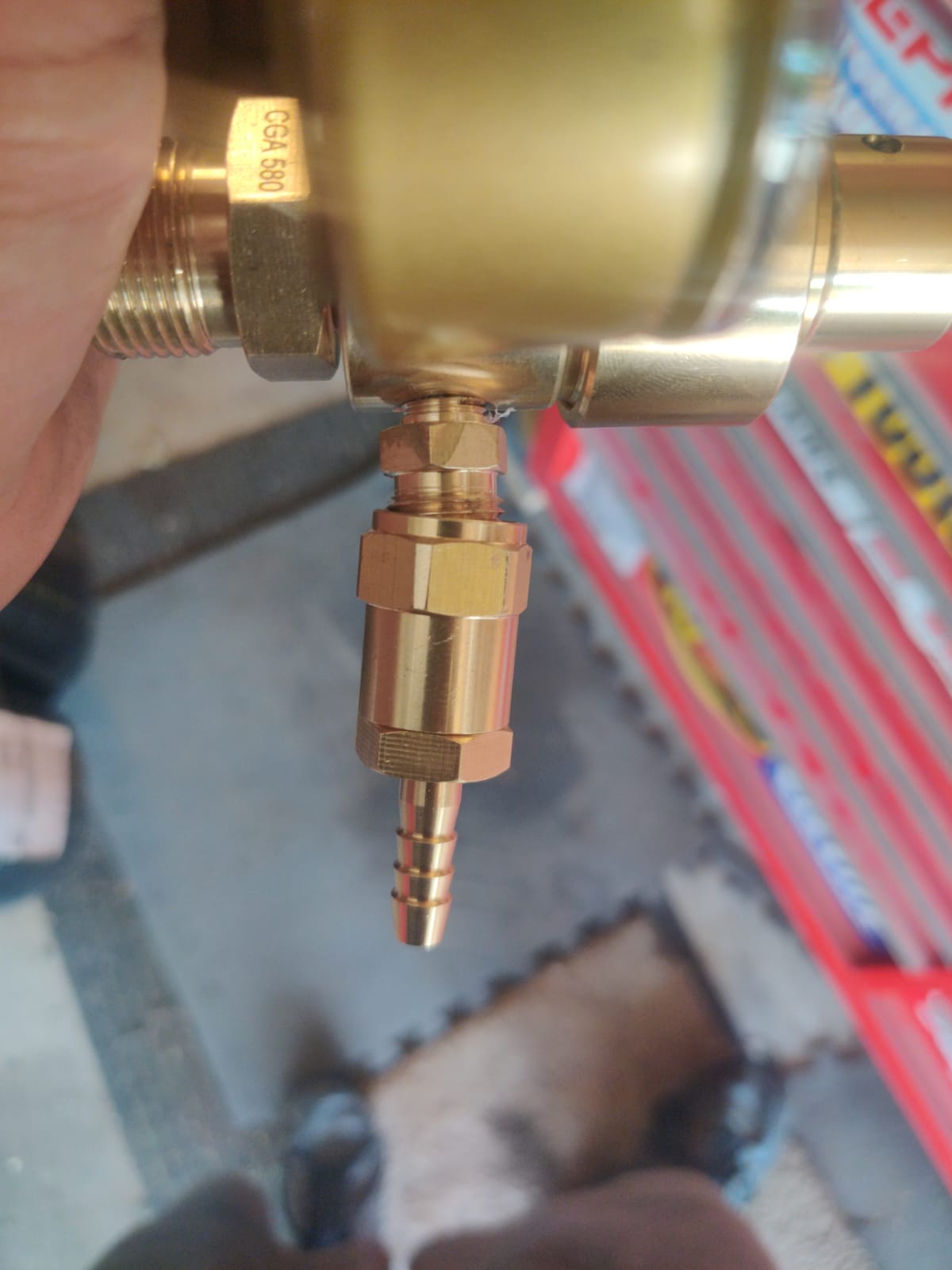
The brand is an established industrial welding supplier rather than a marketplace-only name, and the brass construction is consistent with that. Three outlet options cover a 9/16 inch male, a 5/8 inch female and a hose barb.
Hose variants in five foot and ten foot lengths are available, and the regulator sits in a compact 1.95 pound package that is easy to carry onto a cylinder.
What you will notice in the first week
The finer inlet gauge makes setting delivery pressure repeatable. On a 0 to 4000 dial you are guessing at the top of the range, here you are reading a real number.
The 0 to 30 CFH argon scale covers thin-gauge TIG and most MIG work comfortably. It runs out of scale if you need very high flow on large nozzles.
Where buyers run into trouble
The 400 PSI ceiling means you cannot watch full cylinder pressure on this gauge. That is a deliberate trade for resolution, but it can look like a fault at first glance.
It also carries the highest share of one-star ratings of anything on this list, and the base model does not include a hose. Both are worth factoring in against the readability win.
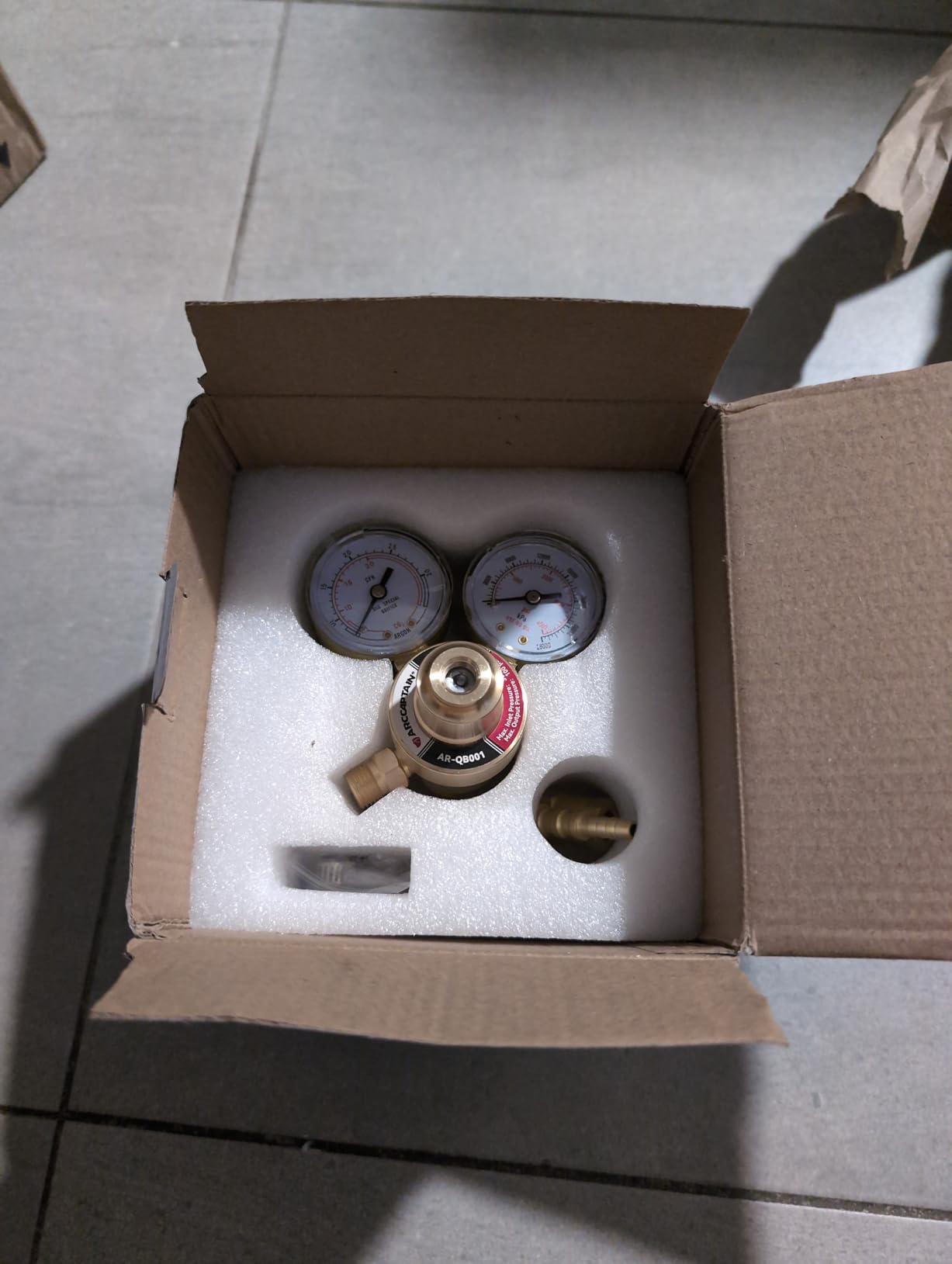
6. ARCCAPTAIN Argon Regulator with Inlet Filter – Best Safety Features
ARCCAPTAIN Argon/CO2/Helium Regulator with 8.2FT Inert Gas Welding Hose
CGA-580 inlet with filter
Inlet 0-4000 PSI
Relief valve
8.2ft hose
Pros
- Inlet filter traps impurities before they reach the gauge
- Pressure relief valve protects downstream equipment
- Includes hose plus two clamps
- One year warranty
Cons
- Newer design with less long term owner history
- Heaviest unit here at 2.7 pounds
- Fives percent one-star ratings
This one has the most complete safety package of the flowmeter regulators here. There is an inlet filter to trap particulates before they reach the gauge, plus a pressure relief valve to vent an overpressure event downstream.
The flow output is dual scale at 0 to 30 CFH on argon and 0 to 20 CFH on CO2, and the outlet covers a 9/16 inch external thread, a 5/8 inch internal thread and a quarter inch hose barb.
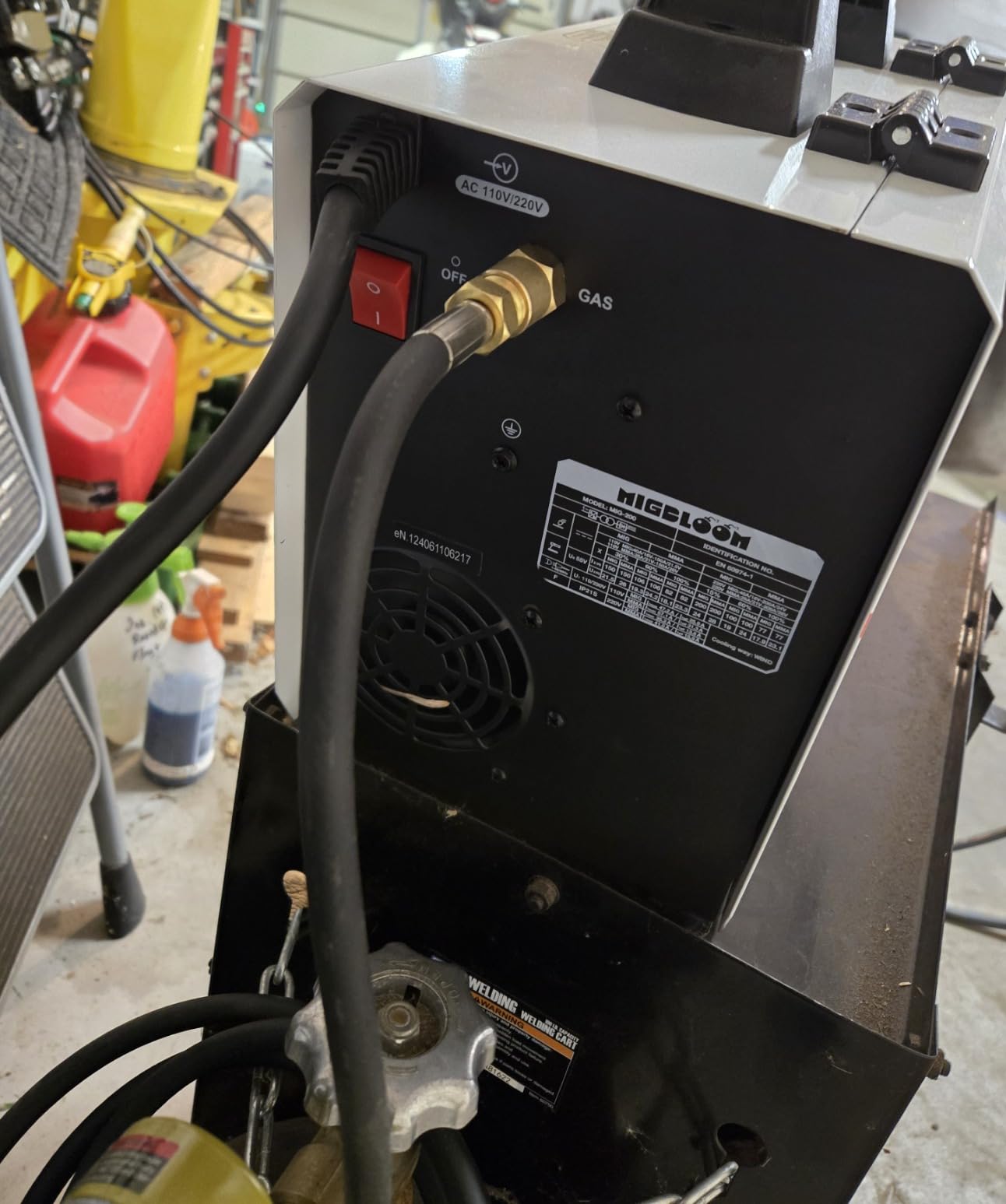
Owners credit the inlet filter with longer gauge life and steadier readings, which makes sense given how much particulate travels in an inert gas line from a shop compressor or filling service.
Two hose clamps and an 8.2 foot hose are included, so the installation is complete. It carries a one year warranty, which is longer than the 30 days offered by one of the units below.
What you will notice in the first week
The relief valve is invisible in normal use and that is the point. It only matters on the day something downstream gets stuck or fails.
The 0 to 30 CFH argon range is generous for TIG and light MIG. It will not cover the highest flows that large cup guns and thick stainless demand.
Where buyers run into trouble
The design is recent, so there is less long-term owner history behind it than the units with thousands of ratings. Nobody has yet reported how the inlet filter looks after a few years.
At 2.7 pounds it is the heaviest regulator on this list. That is not a problem if it stays mounted, and it is one if you carry it up and down stairs.
7. IVONNEY CGA580 Regulator – Widest Pressure Gauge Range
CGA580 Argon CO2 Regulators, Argon Gauges Gas Welding Regulator Compatible with Mig Tig Miller Lincoln Weld 0-4500PSI / 0-10BAR – CO2 Argon Regulator with 6.6Ft Hose
CGA-580 inlet
0-4500 PSI dual scale
T-handle adjustment
Auto pressure relief
Pros
- Highest gauge range at 0-4500 PSI with bar scale
- T-shaped handle is easy to adjust with gloves
- Built-in pressure overload degassing
- 6.6ft hose included
Cons
- Highest one-star rate here at 11 percent
- Polycarbonate tube rather than glass
- Thirty day warranty only
The gauge on this one reads to 4500 PSI on a dual PSI and bar scale, which is the widest range of anything we looked at. On higher service cylinders that extra headroom keeps the needle on the dial instead of pinned.
The T-shaped adjustment handle is a small thing that matters more than it sounds. You can set delivery pressure with a glove on without pinching the knob between two fingers.
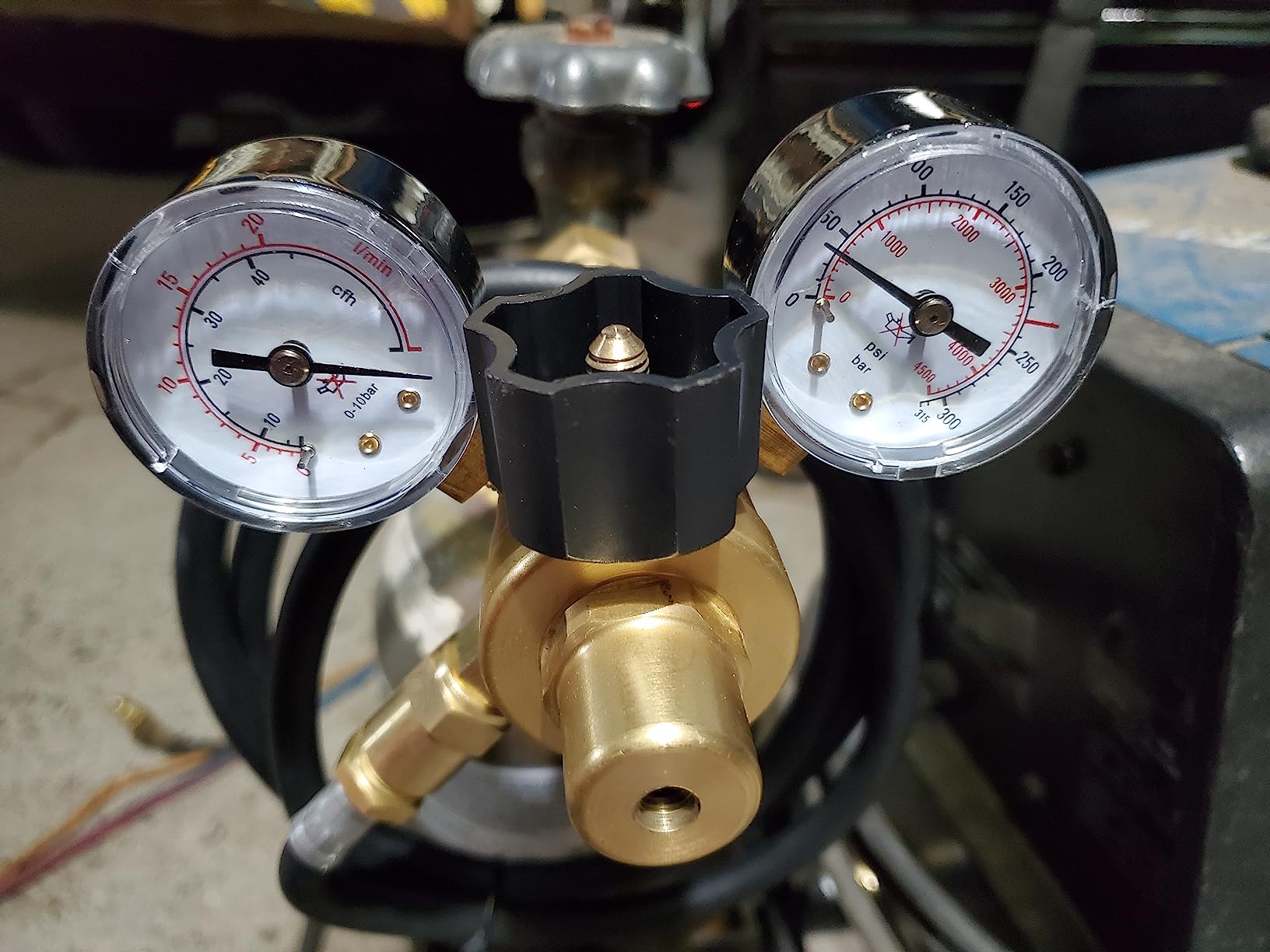
A built-in pressure overload device handles an overpressure condition by venting automatically, which is a reasonable safeguard on a budget unit where you may not know what the previous owner had fitted.
The outlet offers a 9/16 inch male thread and a 5/8 inch female thread, and a 6.6 foot hose is included. The polycarbonate flow tube with floating ball gives a 10 to 60 CFH style working range.
What you will notice in the first week
The bar scale is useful if you work from metric documentation. It saves converting every reading back to PSI while you are adjusting the machine.
The handle makes fine adjustments feel controlled rather than twitchy, which is a genuine improvement over a small plastic knob on a crowded cylinder neck.
Where buyers run into trouble
Its one-star share is the highest on this list at around 11 percent, and the 30 day warranty is the shortest. Budget for the possibility of an early replacement.
The polycarbonate tube and plastic adjustment knob are the two parts most likely to age badly. Neither affects function in year one, but both are worth watching in a shop that drops equipment.
8. TOOLIOM Argon CO2 Flow Meter Regulator – Best Long Included Hose
TOOLIOM Argon CO2 Flow Meter Gas Regulator with Hose
CGA-580 inlet
Square 0-60 CFH tube
8.2ft hose
Brass body
Pros
- Long 8.2ft hose included with the regulator
- Square flow tube is easy to read
- Brass body and brass fittings
- Matches both common outlet threads
Cons
- Newer design with a shorter owner history
- Category ranking is mid-tier
- Gas type variants need picking carefully
The 8.2 foot hose is the headline here, matched to the longest in the box on this list. If your cylinder lives in one corner and your work is at the other, that reach removes a real annoyance.
It holds a 4.6 average, though across a smaller review base than the leaders. Square flow tube, brass body and brass fittings are the same solid specification pattern as the better-reviewed regulators above.
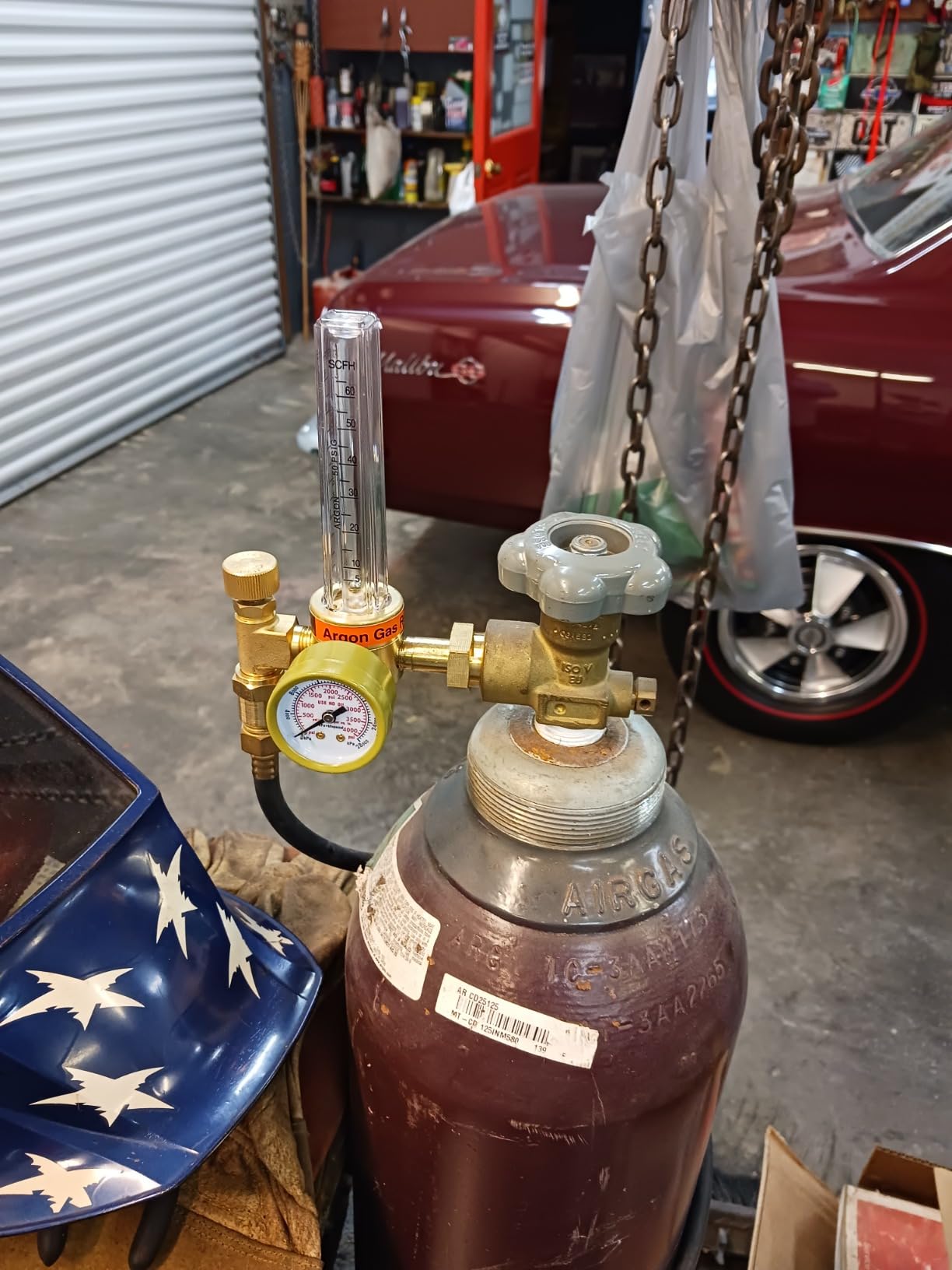
The outlet fits a male 5/8 by 18 and a female 9/16 by 18, so it covers both common torch connections without an adapter. The pressure gauge reads 0 to 4000 PSI.
Several gas variants exist for this model number, including nitrogen. Make sure the variant you add is the argon and CO2 blend version rather than a different gas on the same body.
What you will notice in the first week
The square tube reads cleanly at the flow rates most TIG work uses. You will not be squinting at a rounded edge with your hood down.
No separate hose order means you can test the machine the day the box arrives. That is the main practical argument for this one.
Where buyers run into trouble
The owner history is thinner than the top of this list, which means fewer long-term reports on how the seat fitting holds up. That is the exact part that causes trouble on budget units.
Because the same model covers several gases, a mix-up at ordering is easy. Verify the gas marking on the body matches the cylinder you actually own.
9. YESWELDER Dual Output Argon Regulator – Two Stations, One Tank
YESWELDER Dual Output Argon Regulator Flow Meter
Dual output
CGA-580 inlet
Three outlet types
0-4500 PSI gauge
Pros
- Runs two welding stations from one cylinder
- Three outlet connection types
- High accuracy 0-4500 PSI gauge
- Customer service repeatedly reported as responsive
Cons
- Some units arrived with deformed threads or missing outlets
- Flow adjustment valves reported sensitive
- About ten percent one-star ratings
This is the only regulator here with dual output, meaning two torches can run from the same cylinder at the same time. That is the whole reason to choose it, and for a two-station shop it removes a second cylinder from the equation.
The gauge reads 0 to 4500 PSI and the body is brass and copper construction. Three outlet types are offered: male 9/16 by 18, female 5/8 UNF-18RH and a quarter inch hose barb.
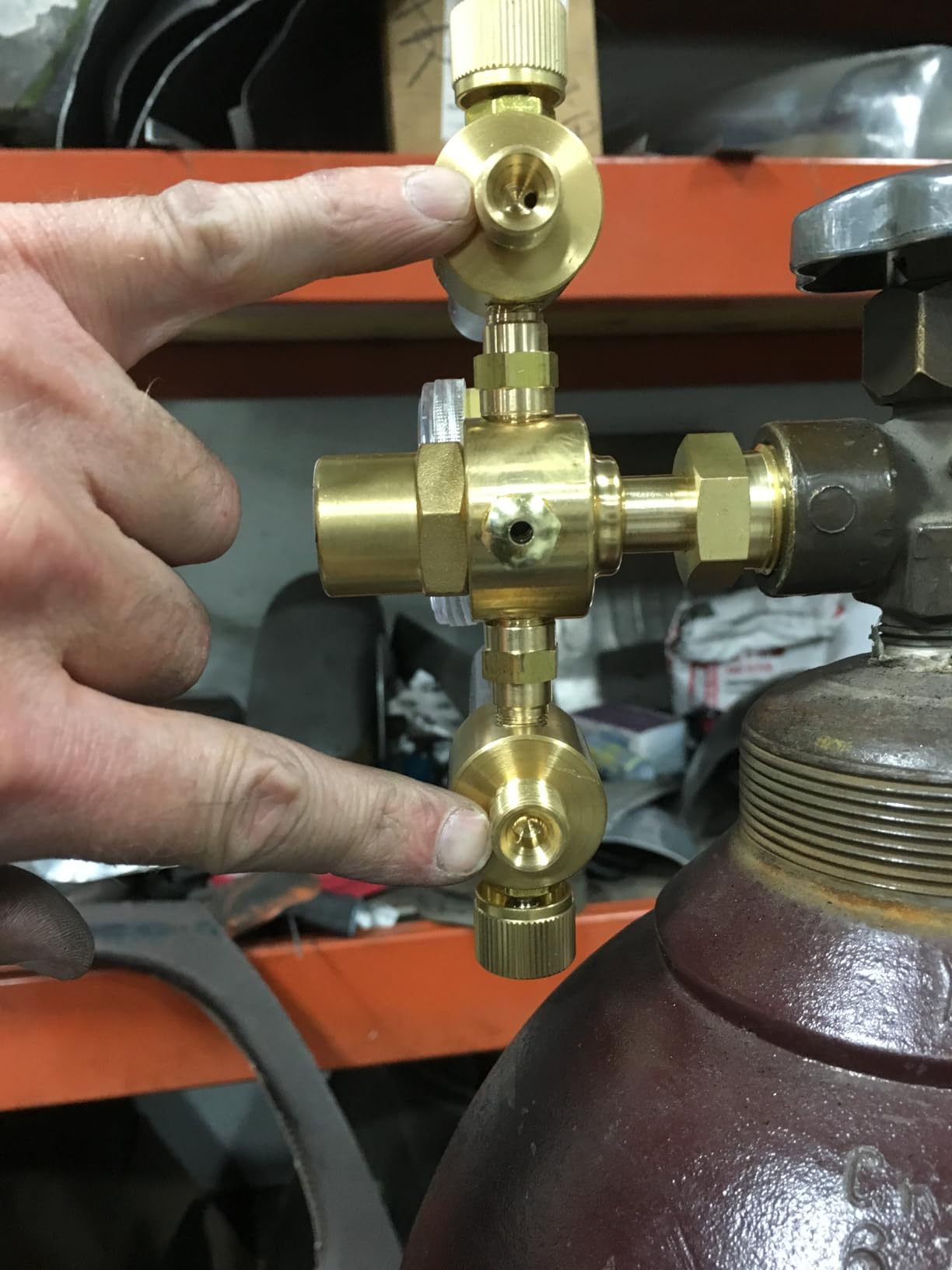
Owners report genuinely responsive customer service on this product, which matters given the quality questions below. If something arrives wrong, support appears to handle it.
At 2.66 pounds it is among the heavier units, and the package is sized for a component that stays mounted on a cylinder rather than one carried around.
What you will notice in the first week
Two hoses, two torches, one tank. If you have ever run a job waiting on a cylinder change, that alone changes the workflow.
Having all three outlet thread types available means you can leave one machine on each without hunting adapters.
Where buyers run into trouble
Quality control is the real concern here. Owners report regulators arriving with deformed threads and missing outlet pieces, plus leaks at the adjustment screws on some examples. Inspect everything on arrival.
The flow adjustment valves are described as sensitive or loose by several users, and the flow capacity may fall short for large welding cups. Test both stations at your highest flow before committing to a job.
10. VIVOSUN Welding Gas Regulator Flow Meter – Best Starter Unit
VIVOSUN Welding Gas Regulator Flow Meter, Argon/CO2 Regulator for MIG TIG
CGA-580 inlet
10-60 SCFH flow
0-4000 PSI gauge
Leak-proof brass body
Pros
- Lowest entry point on this list
- Leak-proof brass body
- Two outlet connection options included
- Compact 8.9 by 3.8 by 1 inch body
Cons
- Fewest ratings here at 137
- Ball indicator can be sticky at first
- Compact body may limit flow for heavy work
If you own a TIG machine and nothing else, this is the shortest route from a new cylinder to a first bead. It has a CGA-580 inlet, a leak-proof brass body and a 10 to 60 SCFH flow adjustment with a ball indicator.
The review base is the smallest on this list at 137 ratings, and the 4.5 average reflects fewer people putting it through long-term use. Treat it as a first regulator rather than a shop standard.
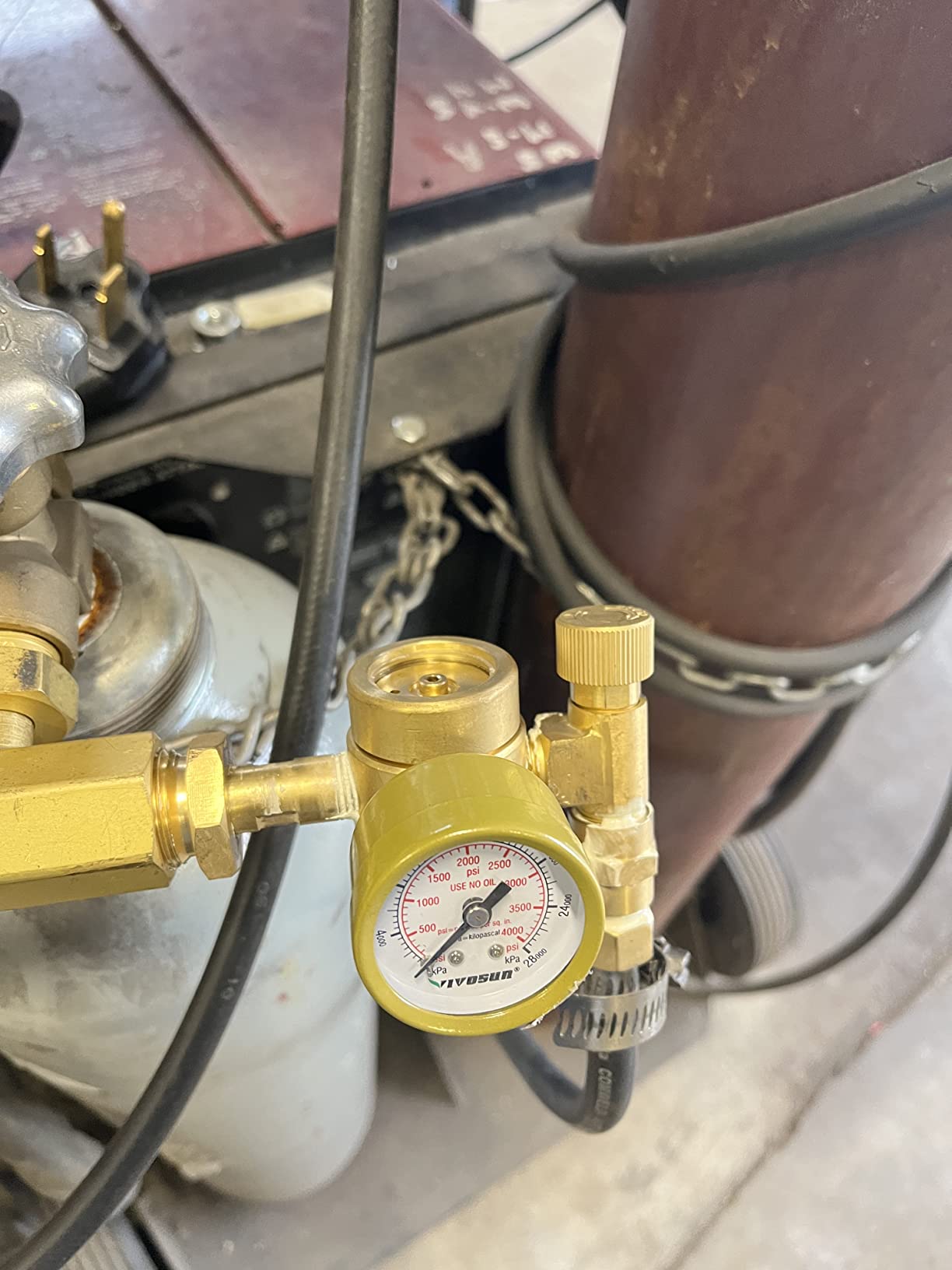
Two connection options are included, a female 5/8 by 18 outlet nut and a quarter inch barb adapter. The gauge reads 0 to 4000 PSI for tank level reference.
Argon and CO2 variants exist for this body. Confirm the gas marking before ordering, since the physical shape is identical between them.
What you will notice in the first week
The ball can stick slightly at first and then free up as the mechanism settles. Owners report it resolves on its own within a short period of use.
The body is compact, which is handy for a small bench or a portable setup that has to come apart after every job.
Where buyers run into trouble
The compact size can limit how much flow you can pull, so it is not the right choice for large cups or heavy stainless work. Match it to thin material and short passes.
Spare parts support is listed at one year in the EU. Beyond that, a failed part means replacing the regulator rather than repairing it.
Flowmeter vs Gauge Regulator: Which One Do You Need?
A flowmeter regulator shows gas volume in CFH; a pressure regulator shows delivery pressure in PSI. For MIG and TIG shielding gas you want a flowmeter, because coverage depends on how much gas reaches the pool, not on how much pressure the machine is fed.
A gauge reading on a regulator is still a pressure reading measured behind a calibrated orifice, which is why people misunderstand it. You can set a psi number on a machine and get consistent flow only because the orifice and the machine behave consistently, and neither is true when a regulator is swapped.
The exception is gas used as a pressure medium rather than shielding, such as plasma cutting and some fuel gas applications, where a delivery pressure gauge is the correct read. If you never touch those processes, the psi side of your regulator is really only a tank level indicator.
How to Choose the Right Argon Regulator in 8 Steps
The selection order below is deliberate. Fitting and safety come before convenience features, because the rest of the list is worthless if the regulator does not thread on or cannot be trusted under pressure.
Confirm a CGA 580 inlet. Argon, helium, nitrogen and argon blends all use it. If a listing does not state the standard, assume nothing and ask.
Pick flowmeter or gauge. Shielding gas means flowmeter. Pressure delivery means gauge.
Match flow range to your largest job. A 10 to 60 CFH tube covers most TIG and MIG work. Push past 60 and look at the wider ranges.
Check maximum inlet PSI. It must exceed your cylinder service pressure. A 3000 PSI gauge on a 3000 PSI cylinder spends its life pinned.
Verify the outlet thread. Check what your torch inlet actually accepts before ordering, and whether an adapter is included.
Look for a relief valve and an inlet filter. A relief valve protects your machine, and a filter protects the gauge.
Confirm what is in the box. Hose, clamp, barb and cylinder nut are the pieces people forget and then wait a week for.
Check warranty and parts support. Repairable construction with replaceable diaphragms outlasts disposable build over a decade.
Setting the Right Argon Flow Rate by Process
Start from the material and the nozzle, then adjust by ear and by bead. A clean TIG bead on stainless sits somewhere in the 10 to 20 CFH range, which is also where most regulators on this list operate most comfortably.
Too little flow gives you porosity, a grey or oxidised bead and a wide, unconvincing arc. Too much flow lifts the puddle protection, disturbs the pool and pushes gas around the work instead of over it. Neither failure announces itself clearly at first, which is why the flowmeter is worth owning.
Read the ball with the torch trigger pressed. An untriggered torch shows the pilot or leakage flow, not the shielding flow, which is the single most common reason people set gas too low.
Single Stage vs Two Stage Gas Saving Regulators
A single-stage regulator reduces cylinder pressure in one step, so delivery pressure drifts as the tank empties. A two-stage or gas-saving design reduces it twice, and delivery pressure holds steady from a full bottle down to nearly empty.
That drift is the pressure creep owners report on forums. A regulator set to 50 psi climbing to 65 or 70 psi as the cylinder runs down is exactly the single-stage behaviour, and it is why some welders periodically readjust during long jobs.
The gas-saving benefit is a real saving on long unattended TIG runs and in cold weather when gas density changes. For occasional hobby use on a small cylinder, the added cost and complexity of a two-stage design rarely pays back.
Outlet Threads, Cylinder Sizes and DIN 477
Outlet threads are where buyers most often get stuck. Common endings are a 9/16 by 18 male thread, a 5/8 by 18 female thread and a quarter inch hose barb. Check your torch inlet and hose size before choosing, because a 3/16 inch torch line will not seat on a quarter inch barb without a reducer.
Cylinder size does not require a size-specific regulator. A CGA 580 unit fitted to a 20, 40, 60, 80 or 330 scf bottle regulates the same way; the difference is how long the gas lasts and how far the pressure falls over a job.
If your bottle is European, check whether it is DIN 477 or a US CGA 580 pattern. The two look similar and do not interchange, and a regulator chosen for the wrong one will simply not fit.
Safety: Leak Testing and Cylinder Valve Discipline
Crack the cylinder valve before you attach the regulator. The shielding gas valve on the machine should be open to equalise pressure at the connection, and the cylinder valve is then opened slowly and fully with the outlet adjusted to its lowest setting.
Leak testing is done with soapy water in a hand sprayer. Coat the seat, the hose barb and the thread joints, then watch for bubbles. Never use a hydrocarbon propelled spray near oxygen cylinders, and never test with a flame.
When a leak is suspected, the practical diagnostic is to swap the hose and then the cylinder. Both a perished hose and a bad regulator seat produce the same hiss, and swapping isolates which one it is in under a minute.
Close the cylinder valve when you finish a job, not just the machine valve. Owners on welding forums report gas walking away from an open cylinder overnight more often than any regulator fault. If you want to know how a regulator compares to the rest of a gas setup, our scuba tank guide covers cylinder sizing that carries over to how much gas you actually own.
Maintenance, Lifespan and When to Replace
A quality brass regulator should last many years of shop use. There is no fixed lifespan number printed anywhere, and any honest answer is that it depends entirely on whether the diaphragm has been exposed to moisture or particulate.
Replace rather than repair when the seat leaks at the cylinder nut, when the relief valve weeps gas, when delivery pressure will not hold, or when the adjustment knob spins without changing output. Those are diaphragm and seal failures, and they are not fixable at the bench.
Before suspecting the regulator, always rule out the hose, the clamp and the torch. Swapping the cylinder isolates the seat in seconds and saves you from buying a new regulator that was never the problem.
For storage, keep regulators off the shelf when possible. On a shelf they are awkward and fragile, and a unit that has been knocked about will not seat properly when you next need it. If you want an idea of how the hardware side of a compressed gas system ages, our paintball tank roundup follows the same refill, storage and inspection logic.
Frequently Asked Questions
Which brand gas regulator is best?
For most welders the safest answer is a brass regulator from an established welding brand with a CGA 580 inlet and a flow range that covers your process, since the spec matters more than the badge. In our roundup the BETOOLL rated best overall on review depth, the RX WELD won on the included hose kit, and the SPARC took the warranty pick with lifetime coverage.
What are the different types of argon regulators?
There are two main types. A flowmeter regulator meters shielding gas volume in CFH through a calibrated orifice with a floating ball in a clear tube, and a pressure regulator reduces cylinder pressure to a set delivery pressure in PSI. MIG and TIG shielding gas calls for a flowmeter.
What is the lifespan of an argon regulator?
A solid brass regulator used for shop welding should last many years, and there is no fixed lifespan figure since it depends on moisture and particulate exposure. Replace it when it leaks at the cylinder seat, when the relief valve weeps, when delivery pressure will not hold, or when the adjustment knob spins without changing output.
What should my argon flow rate be for TIG welding?
Thin TIG work typically runs between 10 and 20 CFH, with heavier material and larger nozzles pushed higher. Read the floating ball with the torch trigger pressed, because an untriggered torch shows leakage flow rather than shielding flow.
Can I use a CO2 regulator on an argon tank?
No. CO2 cylinders use a CGA 320 connection and argon uses CGA 580, and the thread patterns are deliberately different so the two cannot be cross-connected. Attempting to force it risks damaging the cylinder valve seat, which is a serious safety problem.
Conclusion
For most home and shop welders, the BETOOLL flowmeter regulator is the best gas regulator for argon tanks on this list. It carries the deepest review base at a 4.6 average, a 10 to 60 CFH floating ball tube, a solid brass body and the fittings you need to connect it on day one.
Choose the RX WELD if you want the hose included, the SPARC if you want a lifetime warranty behind it, and the dual output unit if two stations need to run off one cylinder. Check the outlet thread against your torch before anything else, leak test with soapy water after every tank change, and close the cylinder valve when the job ends.
That covers the 2026 shortlist for anyone building or upgrading a MIG or TIG setup this year.