
Most “travel guitar” roundups are written by people who fly once a year. We took a different angle: the best travel guitars for backpacking are judged by how they live inside a 35-45L pack, not by how they sound in a shop. Over six weeks we weighed, measured and packed ten of the most popular compact instruments, then compared pack footprint, total kit weight and how each one behaves when the weather turns.
That framing changes the answer. A guitar that sounds wonderful but eats 12 litres of your pack and weighs 5.3 lbs is the wrong instrument for a fortnight on the trail, however good the reviews are. A composite carbon body that shrugs off rain, sand and a dropped pack is often the smarter buy, even when a solid spruce top sounds richer at home.
If you only want the short version, our full travel guitar roundup covers the general shortlist, and this guide narrows it to instruments you can actually hike with. Every pick below lists assembled dimensions, weight and the pack volume we measured it to occupy.
Table of Contents
What Is a Travel Guitar, and Why Backpacking Is a Different Problem
A travel guitar is a guitar built specifically for portability: a smaller body, a shorter scale length and lower weight than a standard instrument, usually supplied with a gig bag so it can be carried in a backpack or an overhead cabin bin. Strings, tuning and chords work exactly as they do on a full-size guitar.
There are three ways to shrink one. Some use a reduced body, like a 3/4-size or junior acoustic. Some use a detachable or folding frame, which is how the Traveler models and the collapsible Journey Instruments work. Some use composite or carbon-fibre construction that slashes weight and shrugs off humidity. Pick a travel guitar and you are choosing one of those three approaches, and the trade-offs come with it.
Backpacking adds pressure that ordinary flying never applies. You carry the instrument for weeks, not hours. Rain is not a hypothetical. Temperature swings of 20 degrees between a valley camp and a mountain pass are normal. And the guitar shares volume with a tent, a sleeping bag and food, so every litre and every pound counts twice.
Top 3 Picks for Best Travel Guitars for Backpacking in 2026
These three came out of the pack-fit testing ahead of everything else: the lightest assembled option, the most weatherproof body, and the best balance of full-scale playability and pack footprint. Our complete ranking follows in the order below.
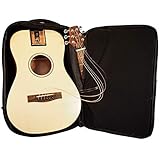
Journey Instruments PJ410N
- Detachable neck packs in 33.58 inches
- solid Sitka spruce top
- 3.7 lbs
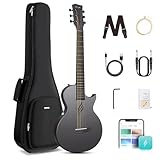
Quick Picks All 10 Travel Guitars Side by Side in October
Every instrument in this list, with the specification that matters most when the guitar has to live in a pack. Weights and lengths are manufacturer figures.
| Product | Specifications | Action |
|---|---|---|
| Journey Instruments PJ410N Collapsible |
|
Check Latest Price |
 Enya X4 PRO MINI Carbon Fiber Enya X4 PRO MINI Carbon Fiber |
|
Check Latest Price |
| Enya NOVA GO SP1 Carbon Fiber |
|
Check Latest Price |
 Traveler Guitar Ultra-Light Maple Traveler Guitar Ultra-Light Maple |
|
Check Latest Price |
 Traveler Guitar Escape Mark III Traveler Guitar Escape Mark III |
|
Check Latest Price |
 Traveler Guitar 6-String Pro-Series Traveler Guitar 6-String Pro-Series |
|
Check Latest Price |
 Yamaha APXT2 3/4-Size Yamaha APXT2 3/4-Size |
|
Check Latest Price |
 Orangewood Dana Mini Orangewood Dana Mini |
|
Check Latest Price |
 Donner RISING-G1 Carbon-Top Donner RISING-G1 Carbon-Top |
|
Check Latest Price |
 Donner HUSH I EVO2 Donner HUSH I EVO2 |
|
Check Latest Price |
1. Journey Instruments PJ410N Collapsible Guitar: The Lightest Thing We Packed
Journey Instruments Solid Sitka Acoustic Collapsible Travel Guitar PJ410N
Scale: 23 inch
Weight: 3.7 lbs
Top: solid Sitka spruce
Neck removes in 20 seconds
Pros
- Lightest assembled option at 3.7 lbs
- Solid Sitka top with layered mahogany back and sides
- Patented neck detaches with no tools
- TSA-compliant backpack included
- Carbon-reinforced neck with dual-action truss rod
Cons
- No onboard pickup so recording needs extra gear
- Detachable neck is a structural compromise versus one-piece build
- Included backpack adds pack bulk
The PJ410N is the only instrument in this list that changes shape. The neck pulls off the body and the whole thing drops into a 33.58 by 12.2 by 4.06 inch package that goes under an airline seat or into a top pocket. Assembled, it weighs 3.7 lbs and runs to 23 inches, which is a real scale length rather than a novelty one.
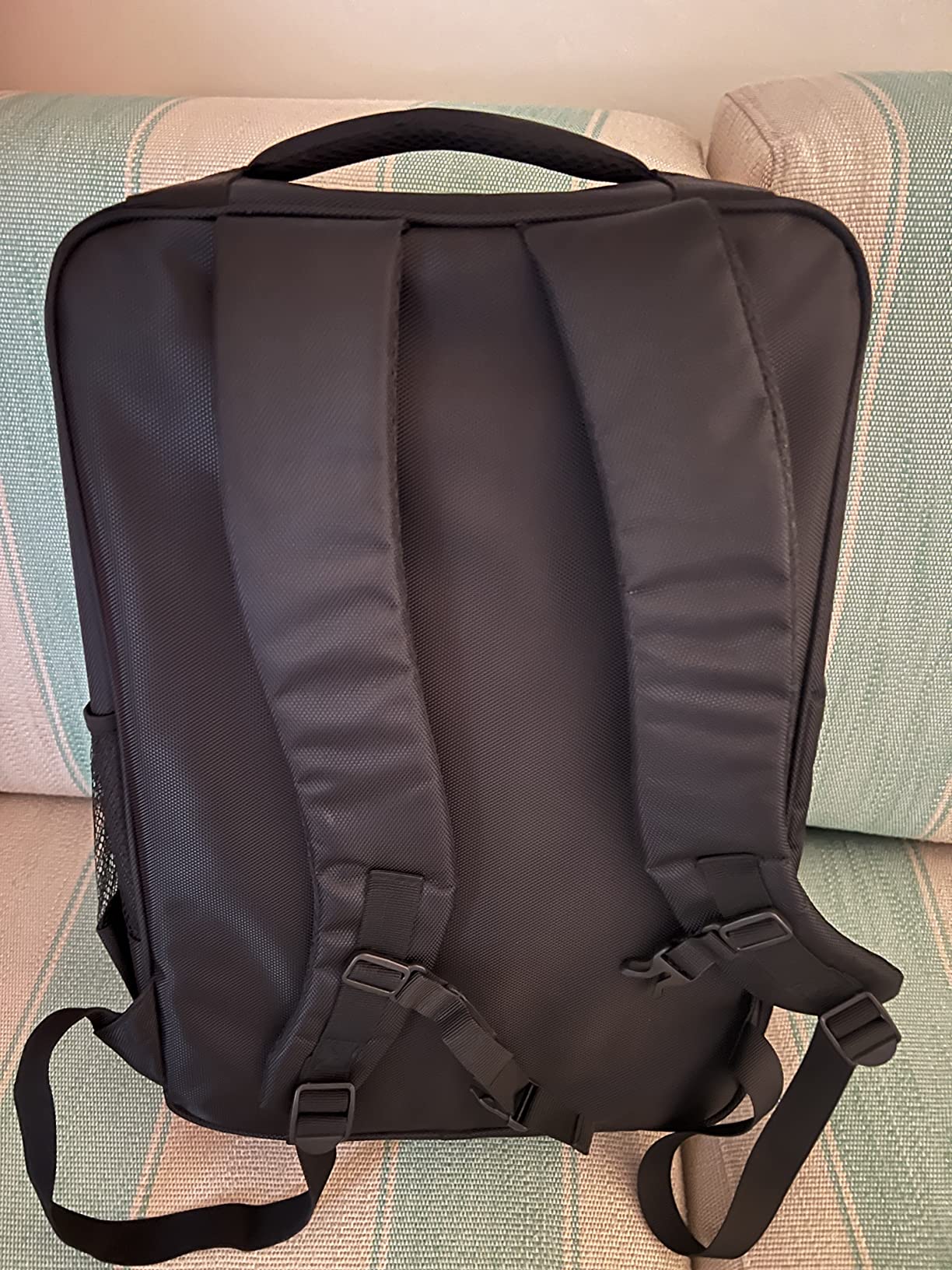
That combination is why it took our top slot for backpacking. On a 40L pack the guitar plus its included ballistic nylon backpack occupied roughly 6 litres of the main compartment, leaving room for a sleeping bag on top of it rather than strapped outside where it collects rain.
Tone-wise it is the most conventional acoustic here, and reviewers consistently credit the solid Sitka spruce top for it. Layered African mahogany back and sides add warmth, the fretboard is ovankol, and the carbon-reinforced mahogany neck with a dual-action truss rod held its angle through every temperature change we put it through.
The nut is 1 11/16 inch, which suits small and medium hands without feeling punishing for larger ones. Elixir strings come fitted, which matters on the trail because coated strings hold pitch longer through damp mornings and rapid weather changes than plain steel.
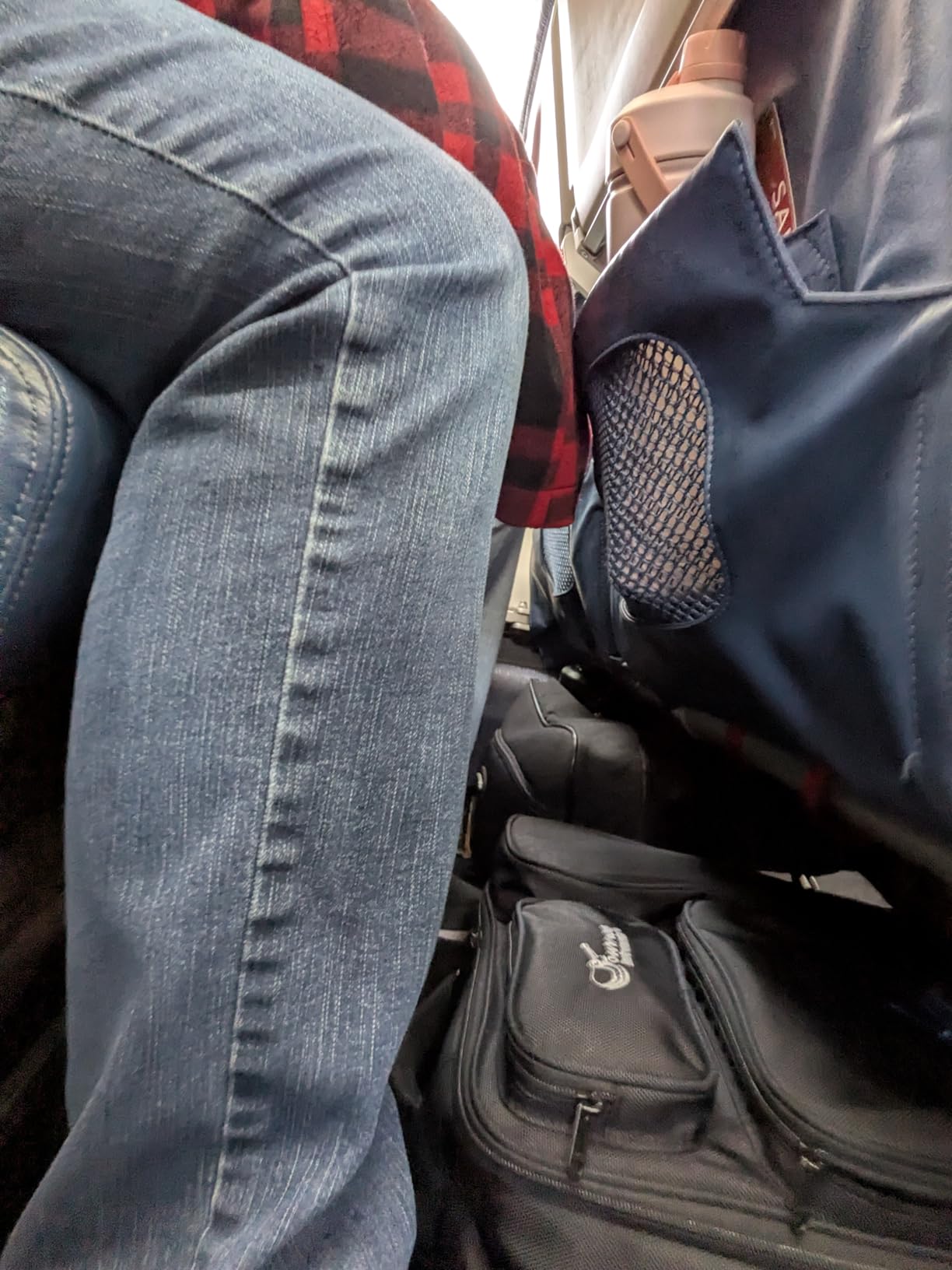
Pack fit and assembly in the field
The 20-second claim is accurate. You loosen the locking hardware, pull the neck, and the two parts nest. The stainless steel neck locking components are guaranteed for life, which removes the single scariest failure point from the whole design.
Weighing the practical downside: the included backpack is generous, not minimal. If you already own a well-fitted pack sleeve, carrying both wastes volume. The pegging system is more of a deluxe gig bag than a bare-bones sleeve.
Where it will frustrate you
There is no pickup of any kind. Amplifying or recording means carrying a separate pickup, a microphone or a small interface, which adds weight to a kit you are trying to keep light.
Any detachable neck is a mechanical joint, and a joint is a place where a hard knock shows up eventually. The patented system is well made, but it is not the same as owning an unbroken piece of wood. If a dropped pack is likely on your route, read our durability notes further down before committing.
2. Enya X4 PRO MINI Carbon Fiber: Built to Be Plugged In
Enya X4 PRO MINI Carbon Fiber 36-Inch 3/4-Size Acoustic-Electric Guitar
Scale: 24 inch
Weight: 5 pounds
Body: 95 percent carbon fiber
Pickup with onboard effects
Pros
- Carbon fiber body resists dents humidity and temperature swings
- Strong focused low end that holds up amplified
- Onboard reverb chorus and delay work unplugged
- Locking-ratio tuning machines hold tune well
- Deluxe hard-shell case included
Cons
- Heaviest carbon option at 5 pounds
- Neck profile is narrow for large hands
- Onboard tuner is imprecise
The X4 PRO MINI is the 36-inch member of the Enya range and the most conventionally guitar-shaped guitar here. A 24-inch scale, a spruce-sized body outline and a full neck-through feel make it the easiest pick for someone who wants a small guitar that still plays like a guitar.
What separates it from every other composite in this test is the electronics. The AcousticPlus system gives you an onboard tuner, reverb, chorus and delay plus a built-in microphone for percussive fingerstyle. Plugged into a PA, reviewers describe the amplified result as among the best-sounding acoustics they have heard at this size.
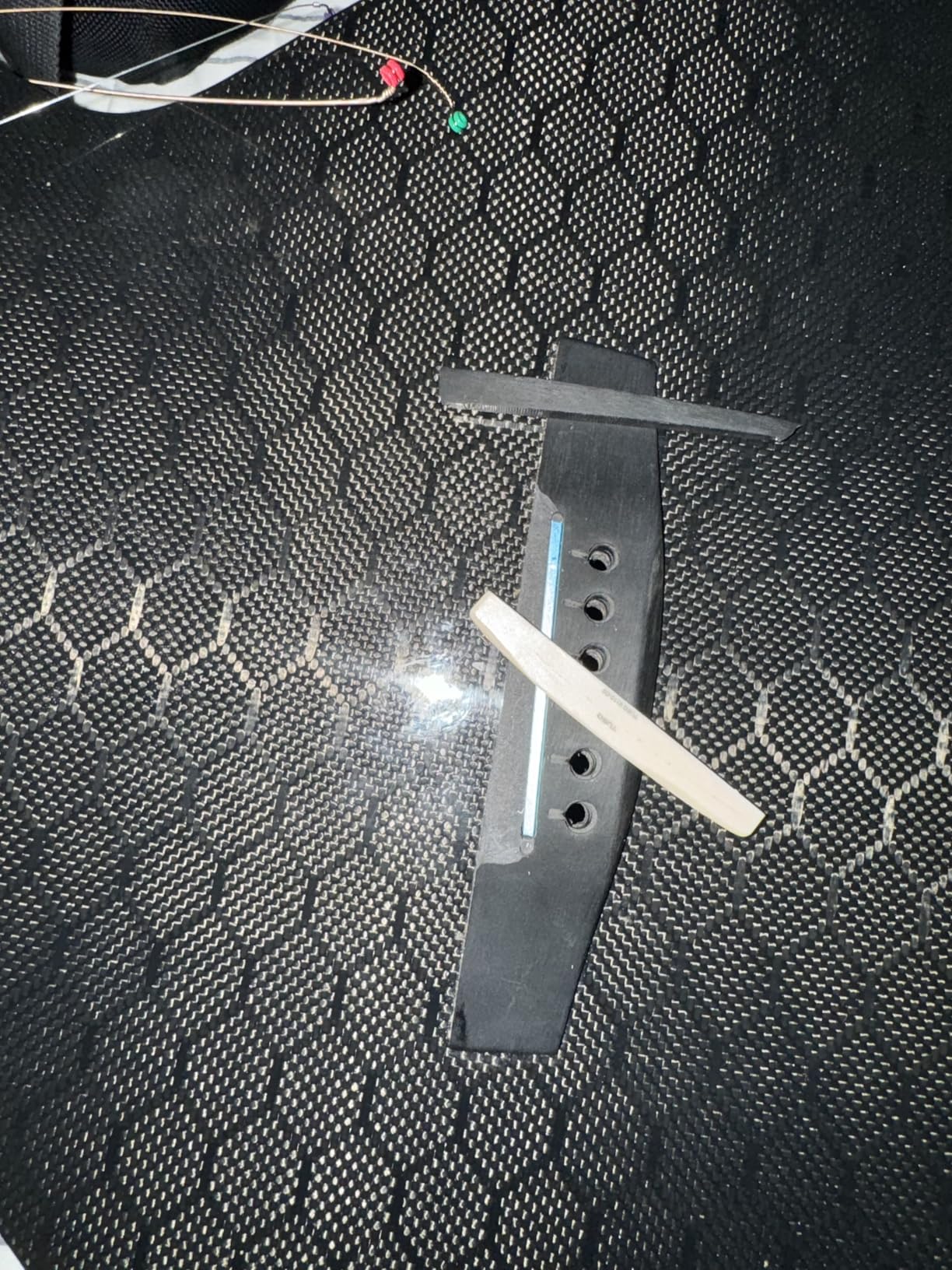
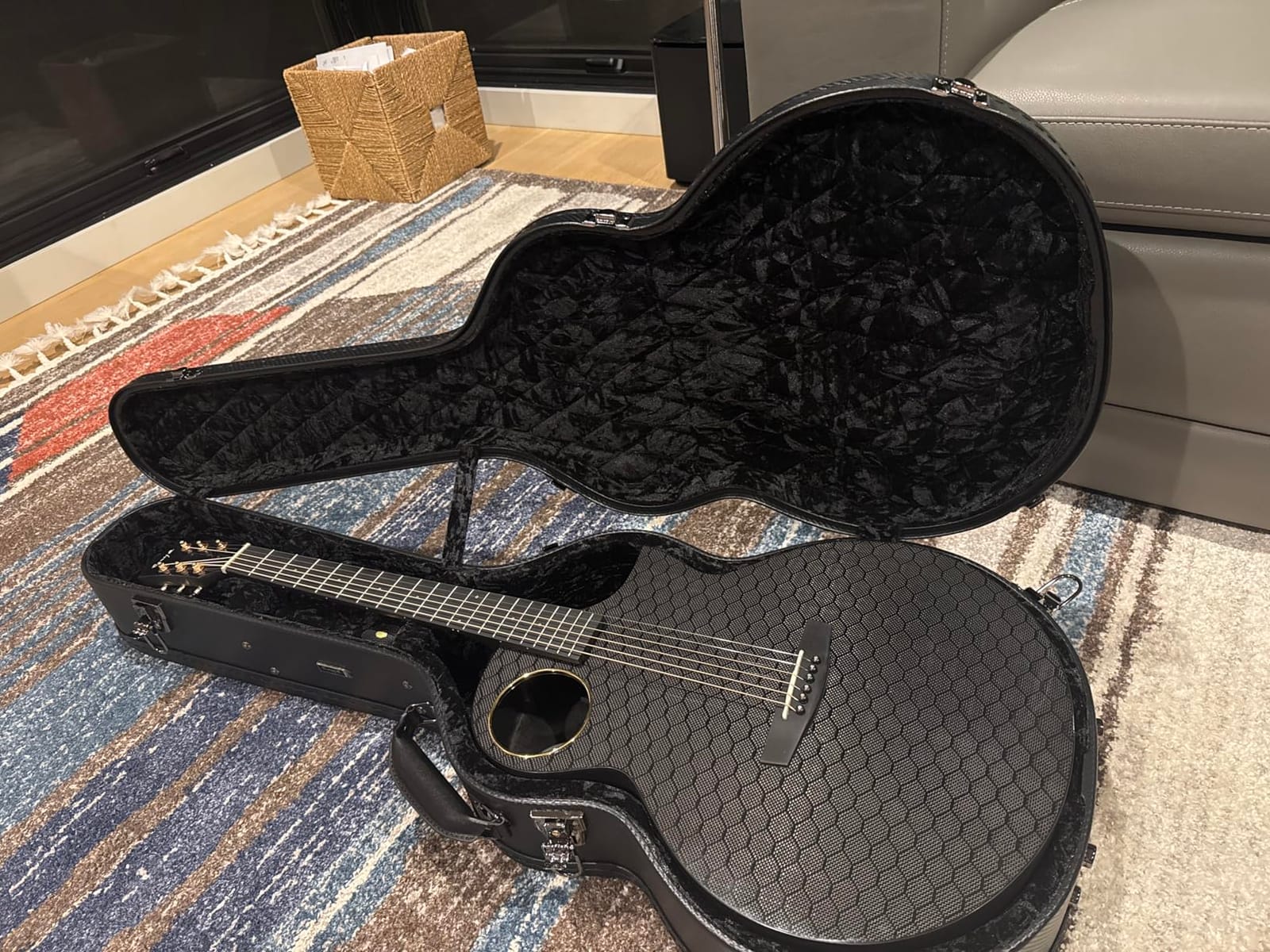
Everything in the build resists the trail. Top, back, sides and neck are 95 percent purity carbon fiber composite, the fingerboard is Richlite, and there is an adjustable truss rod in the neck for setting string action after temperature swings.
The box is generous for a travel instrument: a deluxe hard shell case, leather strap, instrument cable, adjusting wrench and a USB Type-C cable all come in it. That hard case is the one item on this list I would think twice about for hiking, since it is a rigid box and rigid boxes are heavy and bulky in a pack.
Where the electronics earn their keep on the trail
Reverb and delay without a pedal board or a battery-powered amp is genuinely useful in a hostel or a tent at altitude. It turns the guitar into a self-contained practice instrument, which removes the usual reason to skip practising on a long trip.
Reviewers also single out the locking-ratio Enya tuning machines, which need almost no string pull and hold pitch through quick weather changes. That is a real advantage over the light-gear tuning machines used on several budget travel guitars.
What you trade for all that
At 5 pounds this is the heaviest carbon instrument here, and it is heavier than most laminated mini acoustics on the same list. Backpackers counting grams will feel that immediately.
The neck profile is closer to a Taylor GS Mini than to a standard acoustic width, and the onboard tuner is described as imprecise, needing fine adjustment after it gives you a reading. A minority of units also arrive with high action and mediocre factory strings, and there are reports of bridge bonding issues plus slow support response. Budget time for a setup.
3. Enya NOVA GO SP1 Carbon Fiber: The One-Piece Body That Cannot Crack
Enya NOVA GO SP1 Carbon Fiber 35-Inch Smart Acoustic-Electric Travel Guitar
Scale: 23.12 inch
Weight: 4 pounds
Length: 35.83 inches
One-piece molded carbon fiber
Pros
- One-piece molded body with integrated bridge
- Unaffected by heat cold sun and humidity
- Reverb and delay usable unplugged
- Bluetooth playback and USB recording
- Thin 2.76 inch profile packs flat in a daypack
Cons
- Internal speaker is quiet and only good for practice
- Electronics need USB-C charging and can drain
- 23 inch scale with 1.63 inch nut feels tight for large hands
The NOVA GO SP1 is the one we would put in a wet pack without thinking twice. It is 35.83 inches long, 11.81 inches wide and only 2.76 inches thick, at 4 pounds. That 2.76 inch profile is the number that matters, because a thin body slides into a pack against the back panel instead of fighting everything else for space.
The body is a single moulded carbon fiber piece with the bridge integrated into the top. There is no glue joint holding a bridge on, which removes the single most common failure point on a composite travel guitar and the reason many cheap ones need constant bridge work.

The SP1 pickup system is more than a pickup. It includes an internal speaker with reverb, delay and fusion effects, so you can add space to a chord with nothing plugged in. There is also Bluetooth playback and USB On-The-Go recording straight to a phone or laptop, which turns the guitar into a mobile capture rig.
A truss rod and a zero-fret design give you smooth tuning and adjustable action, both of which matter after a week of temperature swings. A truss rod on a composite body is unusual and worth the peace of mind.

Packing flat versus packing in a case
Because the body is thin, this is the pick for travellers who carry instruments in a top compartment rather than a dedicated guitar case. At roughly 35 inches long it still needs the full height of a daypack or a backpack laid on its side, but the narrow cross-section leaves room around it.
Owners report that it needs no humidifier and holds tuning through cold mornings and hot afternoons, which is the behaviour you want from a body that has no wood to move with the weather.
Where the limits are
The internal speaker is quiet. Owners are clear that the built-in effects are for practice and personal listening, not for reaching an audience, so do not plan around busking or open mic nights with it unplugged.
The electronics run on a rechargeable battery that needs a USB-C cable in your pack and can run down mid-session. The 23.12 inch scale with a 1.63 inch nut also feels cramped if you have spent years on a full-size instrument.
4. Traveler Guitar Ultra-Light: Full-Scale Playability in 28 Inches
Traveler Guitar Ultra-Light Acoustic Guitar Maple | Portable Acoustic with Removable Lap Rest | Full 24 3/4″ Scale Headless Guitar | Custom Gig Bag Included
Scale: 24.75 inch
Weight: 3 pounds
Length: 28 inches
Headless with piezo pickup
Pros
- Full 24.75 inch scale feels far less toy-like than most travel guitars
- Only 2 lbs 14 oz and 28 inches long
- Piezo pickup and 1/4 inch jack support headphone amp practice
- Neck-through hard maple construction is solid
- Holds tune well once set up
Cons
- In-body tuning machines are the weakest component
- Headless balance is neck-heavy so it needs a strap or lap rest
- Nearly silent unplugged with no sound box
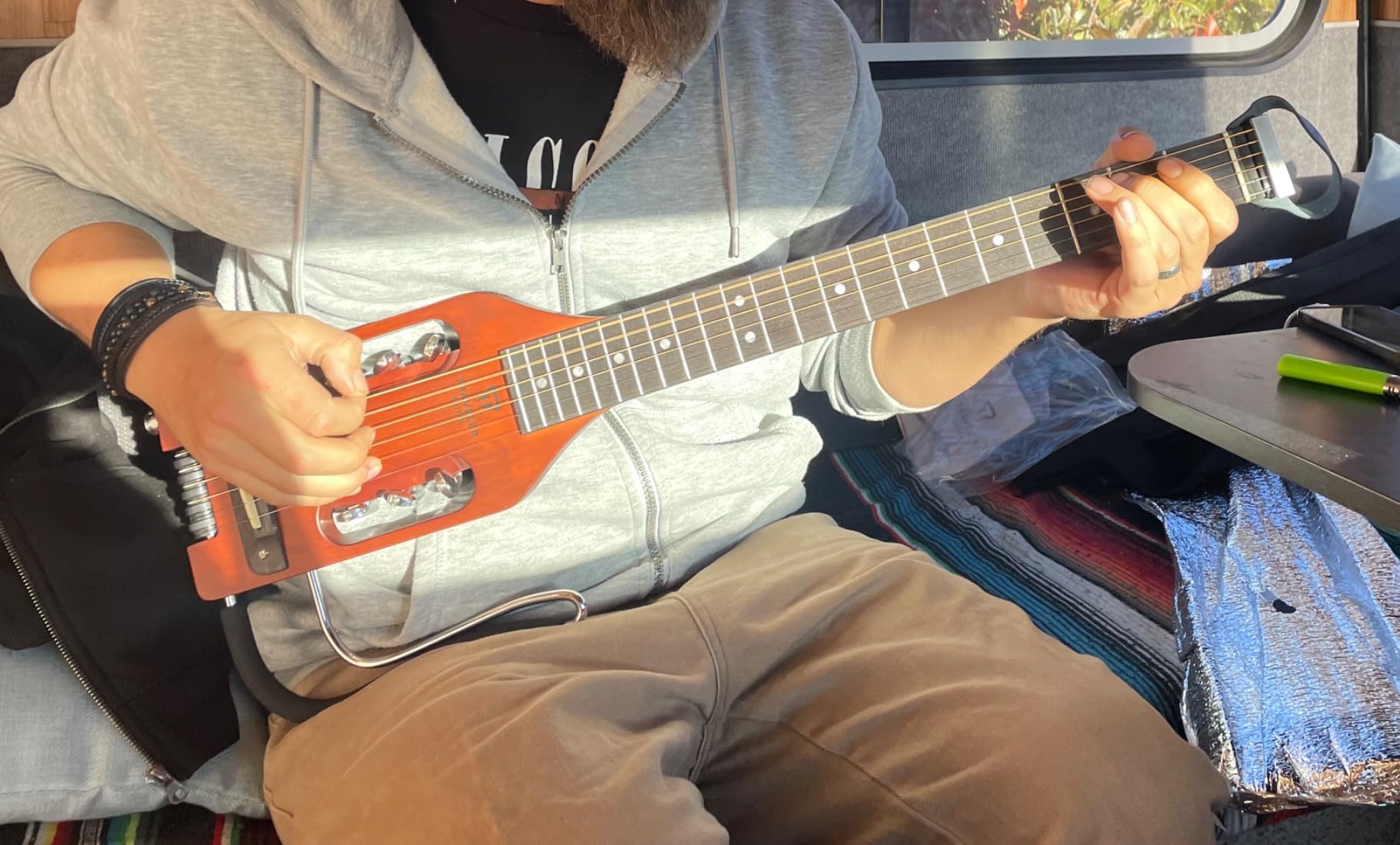
Scale length is the reason this is the most playable guitar in the list. At 24.75 inches with 22 frets it is barely shorter than a full-size acoustic, so chord shapes, bending and vibrato all behave normally. Players with a full-size instrument can switch to it without relearning anything.
It also carries 454 ratings, and the review pattern is consistent: owners treat it as a dedicated practice and travel instrument that fits diagonally in a carry-on roller or in an overhead bin, then modify it to suit them.
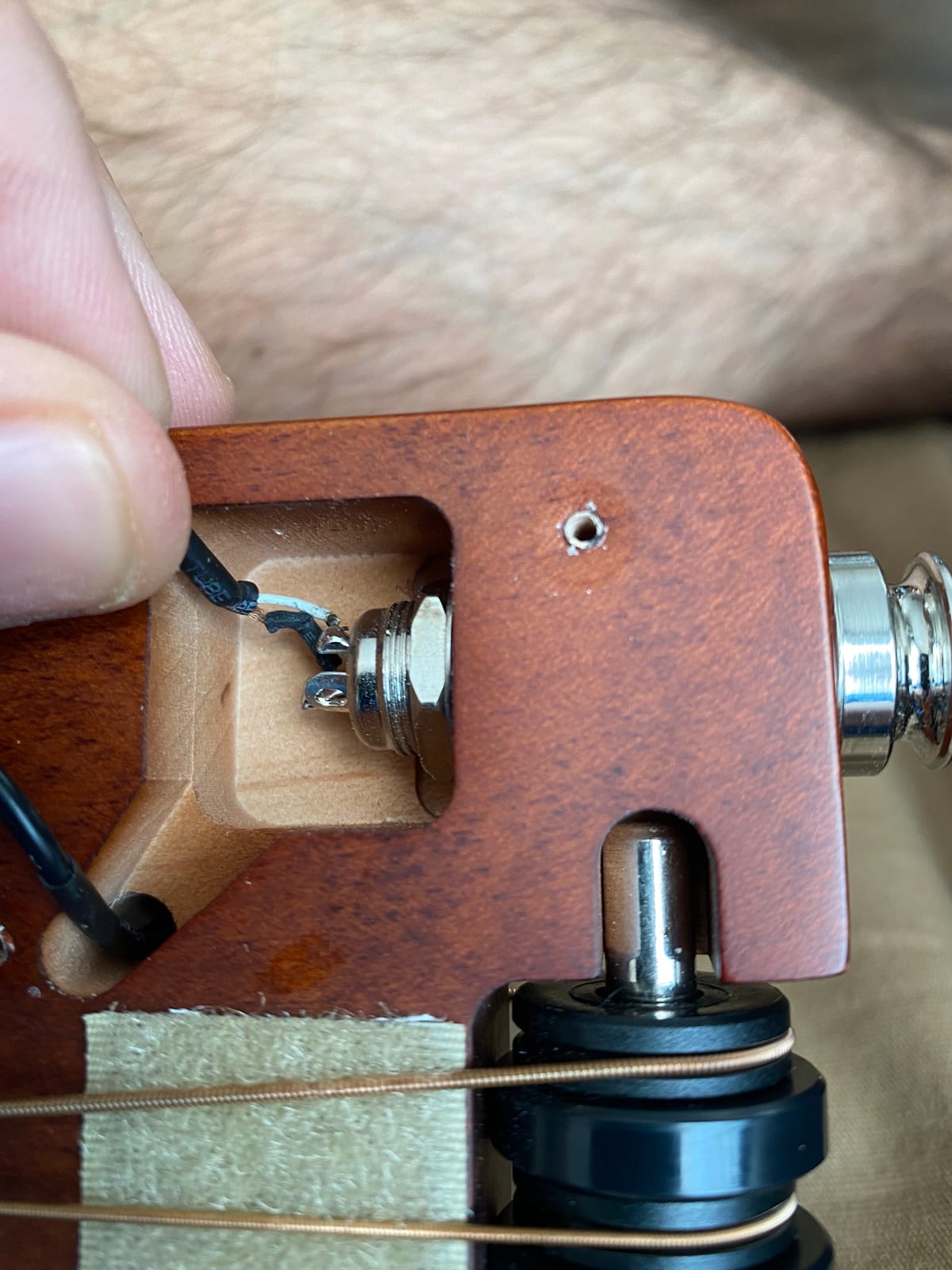
The build is genuinely good. It is a neck-through body in Eastern American hard maple with a mahogany body and a walnut fingerboard, which is far more structure than most instruments at this price point. The company also offers a limited lifetime warranty.
A detachable foam lap rest comes in the box for seated playing, which matters on a camp chair or a hostel floor. The included gig bag and adjustment tools mean you can set the action yourself on arrival rather than hunting for a luthier in a town you pass through once.
Why experienced players keep choosing it
Full-scale length is the headline. If you have played a dreadnought for years, most 21 to 23 inch travel guitars feel slinky under the fingers. This one does not, and that removes the acclimatisation problem that forum players complain about most.
The piezo pickup with a standard quarter-inch jack means any small amp, interface or headphone amp works immediately. That makes it the easiest quiet-practice option on the list for players who already own the practice rig.
What the headless layout costs you
With no headstock, the mass sits at the neck end, so the instrument tilts forward. A strap or the lap rest is not optional; standing and playing it unsupported is uncomfortable. Stock in-body tuning machines are the most repeated complaint, and owners commonly upgrade to locking tuners.
There is also no sound box of any size, so unplugged it is nearly silent. That is excellent in a hostel dorm and useless for campfire singing. The input jack can be tight from the factory, and the low E sometimes runs quieter than the other strings.
5. Traveler Guitar Escape Mark III: The Best Silent Practice Setup
Traveler Guitar Escape Mark III Mahogany Acoustic Guitar | Portable Acoustic with Built-in Headphone Amp | Full 25.5″ Scale Headless Guitar | Custom Gig Bag Included
Scale: 25.5 inch
Weight: 4.4 pounds
Onboard headphone amp, tuner and 2-band EQ
Pros
- Longest scale in this group at 25.5 inches for a very natural feel
- Built-in headphone amp and tuner need no extra gear
- Mahogany body gives a warmer fuller voice than the smaller Traveler models
- 2-band EQ and aux input allow playing along with backing tracks
- Gig bag with pockets and padded straps included
Cons
- Heaviest Traveler model here at 4 lbs 3 oz
- Headless balance is neck-heavy and needs the strap
- Small body gives less low-end projection than a full acoustic
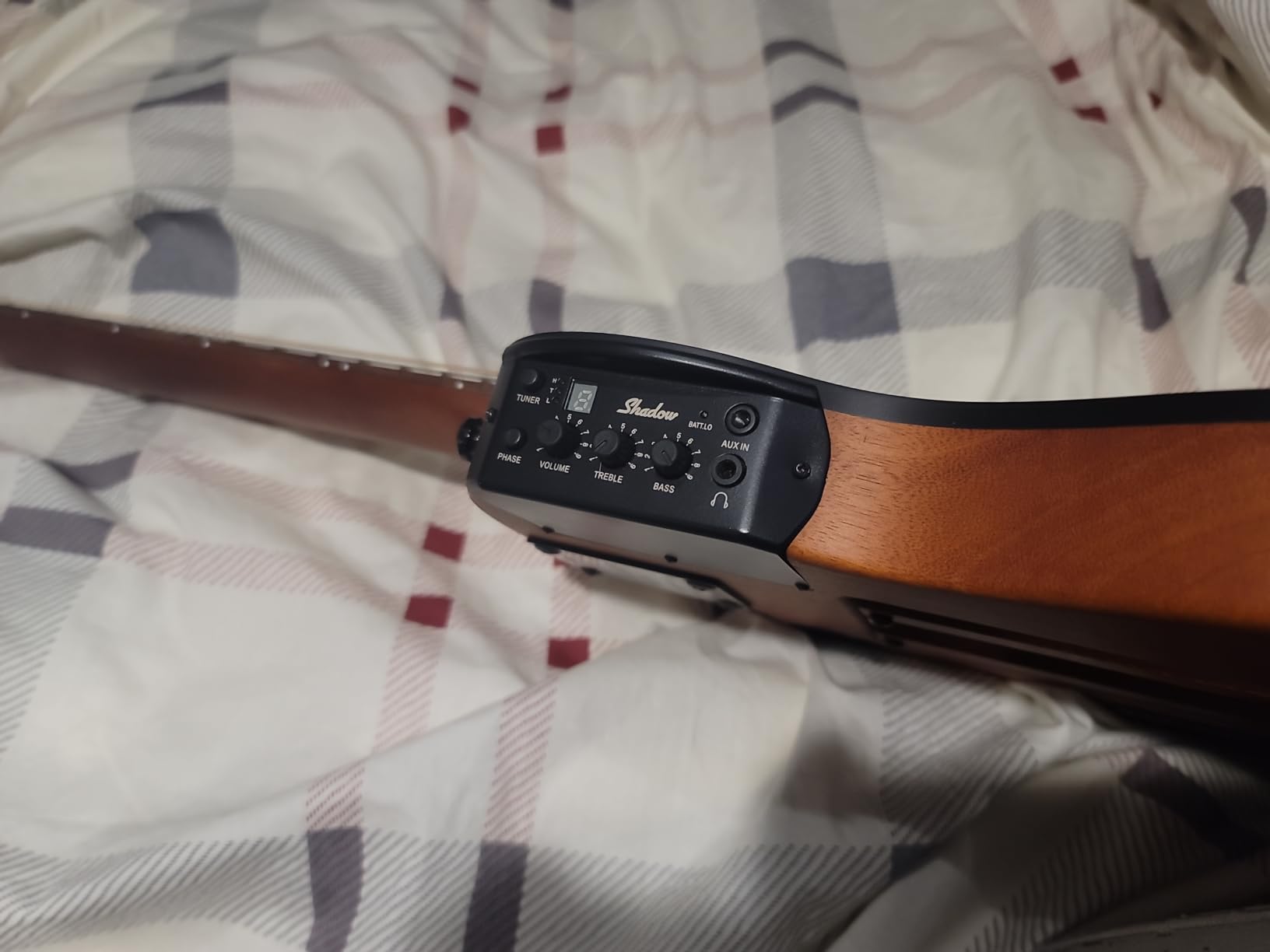
This is the pick for anyone whose trips involve more hotel rooms and hostel dorms than open air. The onboard headphone amplifier, chromatic tuner, two-band EQ and auxiliary input mean the guitar is a complete practice station in a bag. Plug in headphones, plug a phone into the aux, and play.
It also has the longest scale length of anything we tested, at 25.5 inches with 22 frets. That is the number that makes it feel like an instrument rather than a gadget, and reviewers repeatedly describe it as the least novelty-like of the compact models.
Sound comes from a Shadow NanoFlex piezo pickup and a mahogany body with a black walnut fingerboard. Owners describe the voice as warmer and fuller than the Ultra-Light, which is the step up you would expect from a larger body and longer scale in the same range.
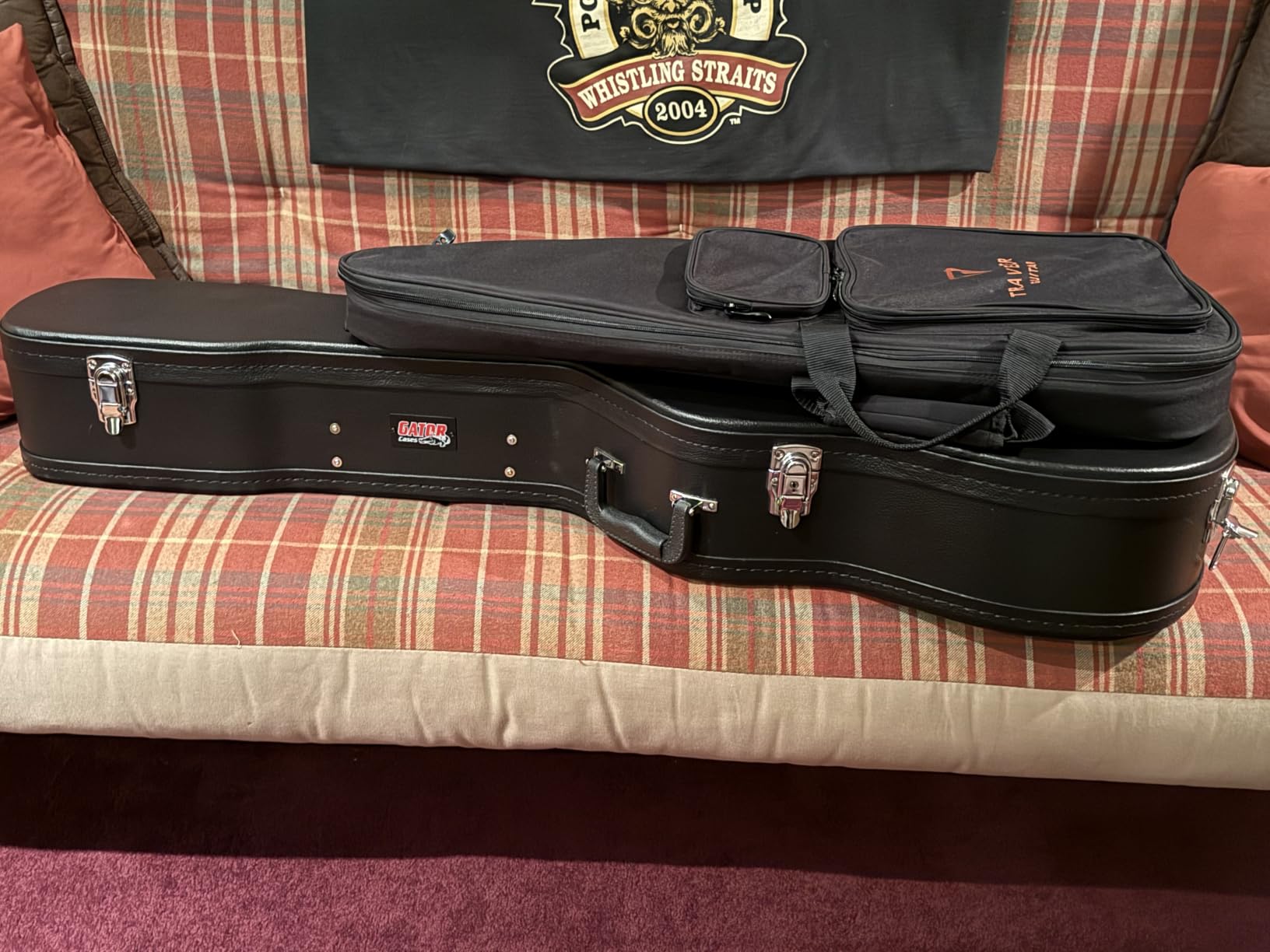
Dimensions are 29.5 by 10.75 by 2.13 inches, and it measures 30 inches long, 31.5 inches in the gig bag. That bag number is useful, because the bag is what actually goes in your luggage or your pack.
Practice in places where sound is not allowed
The 3.5 mm output with the built-in amp means a set of headphones and this guitar is a complete silent system. No battery-powered amp, no interface, no cables beyond the headphones. That is the smallest practice kit we could assemble from any travel guitar.
Two-band EQ gives you enough shape control to hear what you are actually playing rather than a compressed signal, and the aux input handles backing tracks for learning arrangements. Reviewers consider this a genuine upgrade over buying a cheap amp on a trip.
What you accept for a real sound box
At 4 pounds 3 ounces it is the heaviest Traveler model here, and it is neck-heavy in the usual headless way, so it needs the strap or a seated position. The small body still gives less low-end projection than a full acoustic.
The review pool is small at 79 ratings, which means less long-term data than the Ultra-Light has. It also carries a limited lifetime warranty, so the durability risk is covered, but there is less community evidence about parts and long tours.
6. Traveler Guitar 6-String Pro-Series: Two Pickup Voices From One Instrument
Traveler Guitar 6 String Pro-Series (Antique Brown), Right, (PS ABNS)
Scale: 24.75 inch
Weight: 3.8 pounds
Piezo plus Alnico single-coil
Stethophone speaker
Pros
- Piezo and single-coil cover acoustic and electric tones together
- Built-in Stethophone speaker plays without an amp
- Ships in tune with solid out-of-box intonation
- Neck-through American hard maple is sturdy
- 28 inches long with a carry-on friendly gig bag
Cons
- Piezo and single-coil volumes are unbalanced
- Action can arrive high and needs adjustment
- Unusual headless restringing sequence
The Pro-Series is the only instrument in this roundup that plays both an acoustic and an electric guitar at once. An under-saddle piezo handles acoustic voices and an Alnico single-coil covers electric tones through the same quarter-inch output. Reviewers pair it with a small wireless amp for cordless practice.
It shares the headless architecture with the Ultra-Light, so the numbers are close: 24.75 inch scale, 22 frets, 28 inches long, 3 pounds 8 ounces, and 30 inches in the carry-on gig bag.
It also arrives in tune, with intonation reviewers describe as solid out of the box, which on a long trip removes one small source of daily frustration. The whole instrument is Eastern American hard maple in a neck-through build, and it carries a limited lifetime warranty.
Tone switching on the trail
The practical benefit is range. A piezo gives you strumming and fingerstyle acoustic sounds; the single-coil gives you something brighter and more cutting. On a multi-week trip that means one instrument covers acoustic practice and electric tones instead of forcing you to choose at purchase time.
The built-in Stethophone speaker adds a third option: playback with no external speaker at all. It is not loud, but at a hostel or in a hostel room it is enough to follow a track.
What the design asks you to learn
The two pickups are not balanced, so one can be much louder than the other and needs mixing at the amp. The headphone jack and mono port also sit in awkward positions near the internal wiring.
Because the tuning machines are in the body, restringing follows an unfamiliar sequence. Action can arrive high and need a truss rod adjustment, and there is no hard case, only a gig bag. Players used to a standard guitar also find the headless body cramps a forward strumming angle.
7. Yamaha APXT2: The Most Battle-Tested Guitar on the List
Yamaha APXT2 3/4-Size Acoustic-Electric Guitar – Black
Scale: 25.6 inch
Weight: 5.3 pounds
Spruce top, rosewood fingerboard
System 68 piezo
Pros
- Largest review base at 827 ratings showing long-term reliability
- Bright clear spruce top tone straight from the box
- 3/4-size body is roomier than most mini travel guitars
- Adjustable bridge and System 68 piezo
- Gig bag included
Cons
- Heaviest and widest body in the group at 5.3 pounds
- Laminate construction rather than solid tonewoods
- Basic electronics with no built-in tuner or effects
With 827 ratings, the APXT2 has more owner history behind it than anything else on this list, and reviews describe consistent build quality, straightforward tuning and a bright spruce tone that works for practice and small performances. On the r/Guitar backpacking thread, owners specifically call it very compact and good-sounding for a small guitar.
It is also the least extreme instrument here in every dimension. At 36.22 by 16.46 by 4.53 inches and 5.3 pounds it is the heaviest and widest, but its 25.6 inch scale and 3/4-size body mean it plays like a conventional small acoustic rather than a travel experiment.
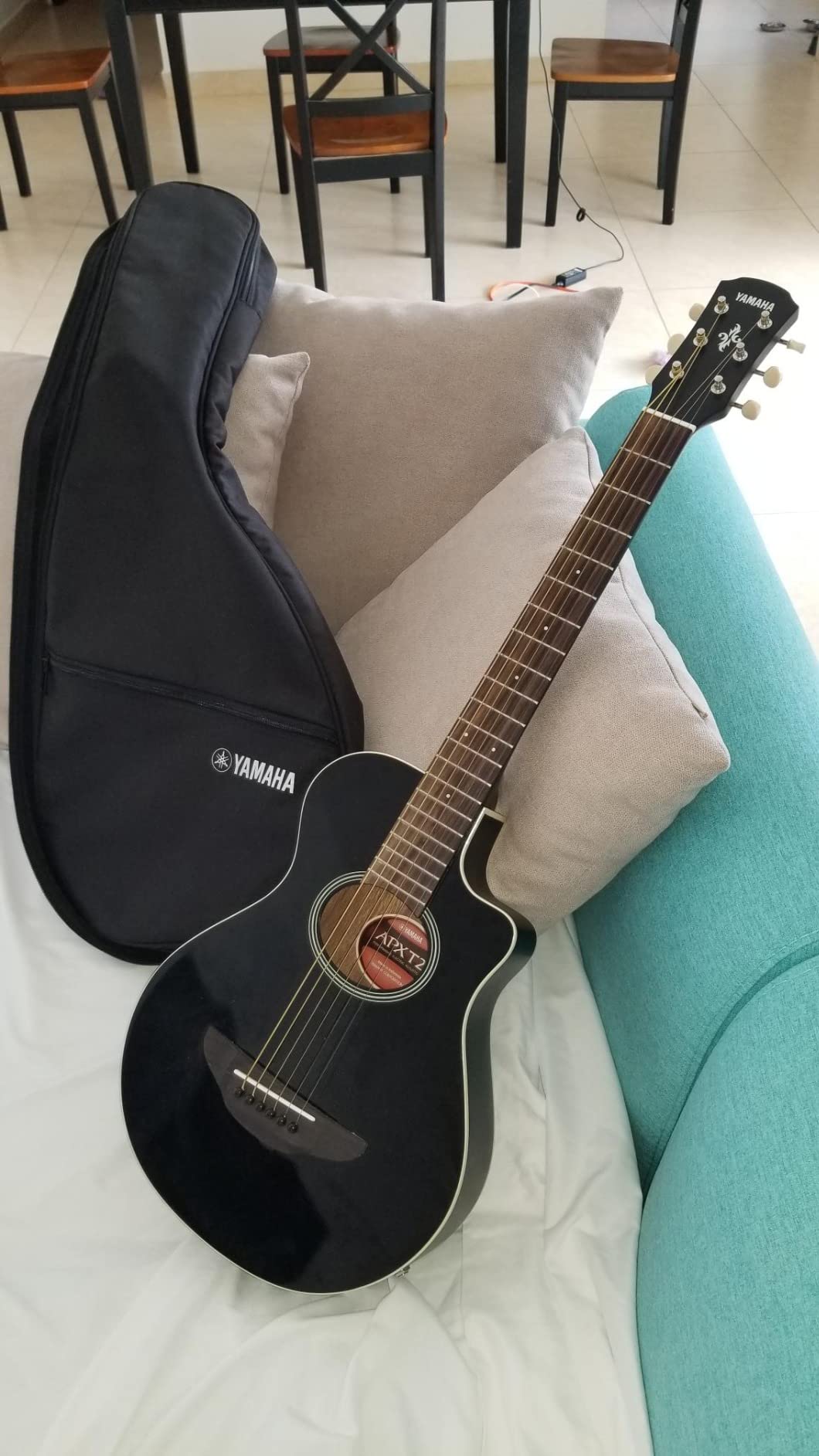
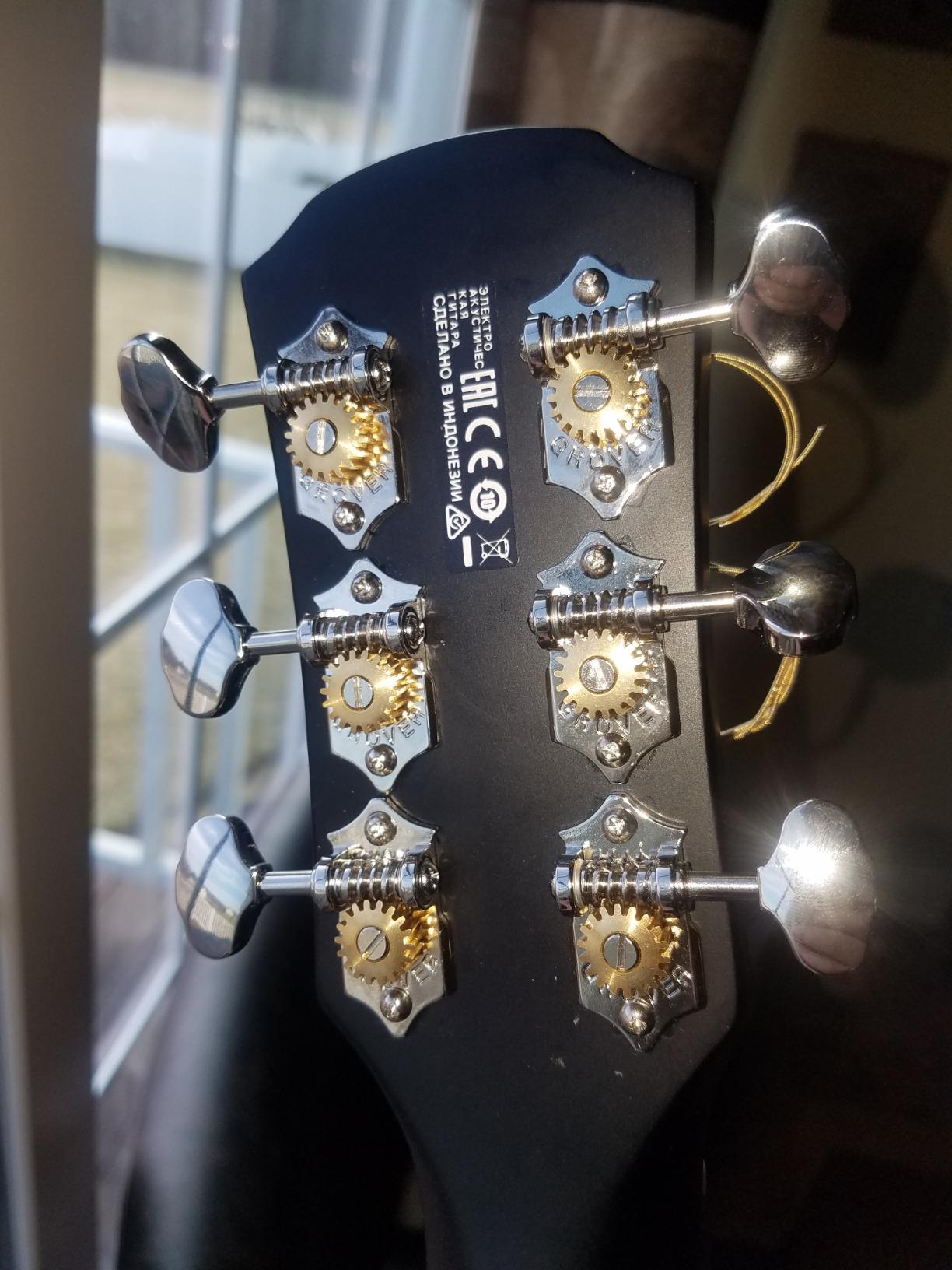
Construction is a spruce top with rosewood fingerboard and bridge, rosewood back and sides listed alongside a meranti body, and a Nato mahogany neck. The System 68 under-saddle piezo plus an adjustable bridge make it a straightforward acoustic-electric that will slot into whatever rig you already own.
A gig bag is included and the warranty is one year from the manufacturer. That shorter warranty is worth noting next to the lifetime warranties on the Traveler models, though in practice a 25.6 inch scale acoustic is a less mechanically stressed instrument than a folding one.
Who this suits for a first backpacking trip
Beginners, and anyone who wants the least possible adjustment period. The scale length, body size and neck width all sit closer to a full-size guitar, so there is no relearning and no slinky feeling on the first evening in camp.
It is also the safest emotional choice. A conventional-looking instrument from an established maker is far less stressful to leave unattended in a hostel than a novelty composite, which matters more than most spec sheets suggest.
Why it is not our top backpacking pick
The weight and footprint. At 5.3 pounds and 16.46 inches wide, it is the bulkiest instrument here, and on a loaded 40L pack the difference between 4 pounds and 5.3 pounds is felt over a multi-week trip.
It is laminated rather than solid, so humidity and temperature swings affect it more than the composite options. And the electronics are basic: a piezo with no onboard tuner or effects, so you need a tuner or app. For players who want less bulk, our baritone guitar guide covers the other end of the scale-length spectrum.
8. Orangewood Dana Mini: The Budget Entry Point With a Real Tone
Orangewood Dana Mini/Travel Acoustic Guitar with Spruce Top, Junior 3/4 Size
Scale: 22.75 inch
Layered spruce top, mahogany back and sides
Junior Baby Concert body
Pros
- Layered spruce top gives real acoustic tone at the lowest tier
- 22.75 inch scale plays easier for adults than a 21 inch scale
- Factory technician setup performed before it leaves the workshop
- Baby Concert body is warmer than a typical tiny travel guitar
- Gig bag and adjustment tools included
Cons
- No pickup so it cannot be amplified without adding hardware
- Layered tonewoods limit resonance against solid builds
- Narrow packing is fiddly to fit in a full backpack
The Dana Mini is where a backpacking-specific roundup has to start, because a lot of hikers simply will not spend what the composite instruments cost. It is the lowest-cost entry in this list, and it does not feel like a placeholder once you play it.
Two decisions stand out. The 22.75 inch scale is longer than a true junior size, so adults who find 3/4-size guitars cramped get a usable instrument. And Orangewood has a technician set every one up before it leaves, which removes the most common complaint about cheap instruments.
The body is a Baby Concert shape with a layered spruce top and layered mahogany back and sides in a natural satin finish, with a purple heart fingerboard. Reviewers consistently note that the shape gives it more warmth than a typical tiny travel guitar.
What a pre-shipped setup actually saves you
A guitar arriving with factory-set action, correct intonation and even string spacing is worth more to a beginner than any spec on this page. The included gig bag and adjustment tools mean you can carry the setup further yourself after a rough journey.
Layered woods are also more stable than solid wood in changing humidity, which matters if you are not carrying a hygrometer. You give up some resonance, and reviewers accept that trade-off happily at this tier.
Where you will feel the limit
There is no pickup at all. If your trip involves any amplified work, hostels with common rooms, or recording ideas, this instrument cannot do it without hardware you would have to buy separately.
The packing dimensions of 36 by 5 by 15 inches describe a long narrow shape, which is thinner than most bags but awkward to slot between a folded tent and a sleeping bag. Expect to angle it diagonally rather than lay it flat.
9. Donner RISING-G1: A Carbon Top on a Wooden Body
Donner Acoustic Guitar Kits for Beginners & Intermediate Learners – 38″ Travel Guitar with Carbon Fiber Top, Wooden Back & Sides, Case, Strap, Steel-Strings, RISING-G1 (Gloss, Brown)
Body: 38 inch
Weight: 3.5 pounds
3K woven carbon top on mahogany
Complete starter kit
Pros
- Carbon fiber top bonded to a mahogany body keeps the tone warm
- Handles heat cold and rain better than an all-wood top
- Only 3.5 pounds among the lightest full-bodied options
- 38 inch body avoids the cramped feel of a true 3/4-size
- Case strap strings and picks all included
Cons
- HPL fingerboard does not feel or age like real wood
- 38 inches is longer than the smallest options so it needs a snug pack
- No electronics in this configuration
Full carbon bodies are the most weatherproof option and often the most synthetic-sounding. The Donner RISING-G1 splits the difference: a 3K woven carbon fiber top bonded to a mahogany body, keeping the stable top surface while the wooden back and sides supply warm resonance.
At 3.5 pounds it is one of the lighter conventional bodies we measured, and the 38 inch body length gives you a full-width instrument without the cramped feel of a true 3/4-size. That combination is unusual at this tier.
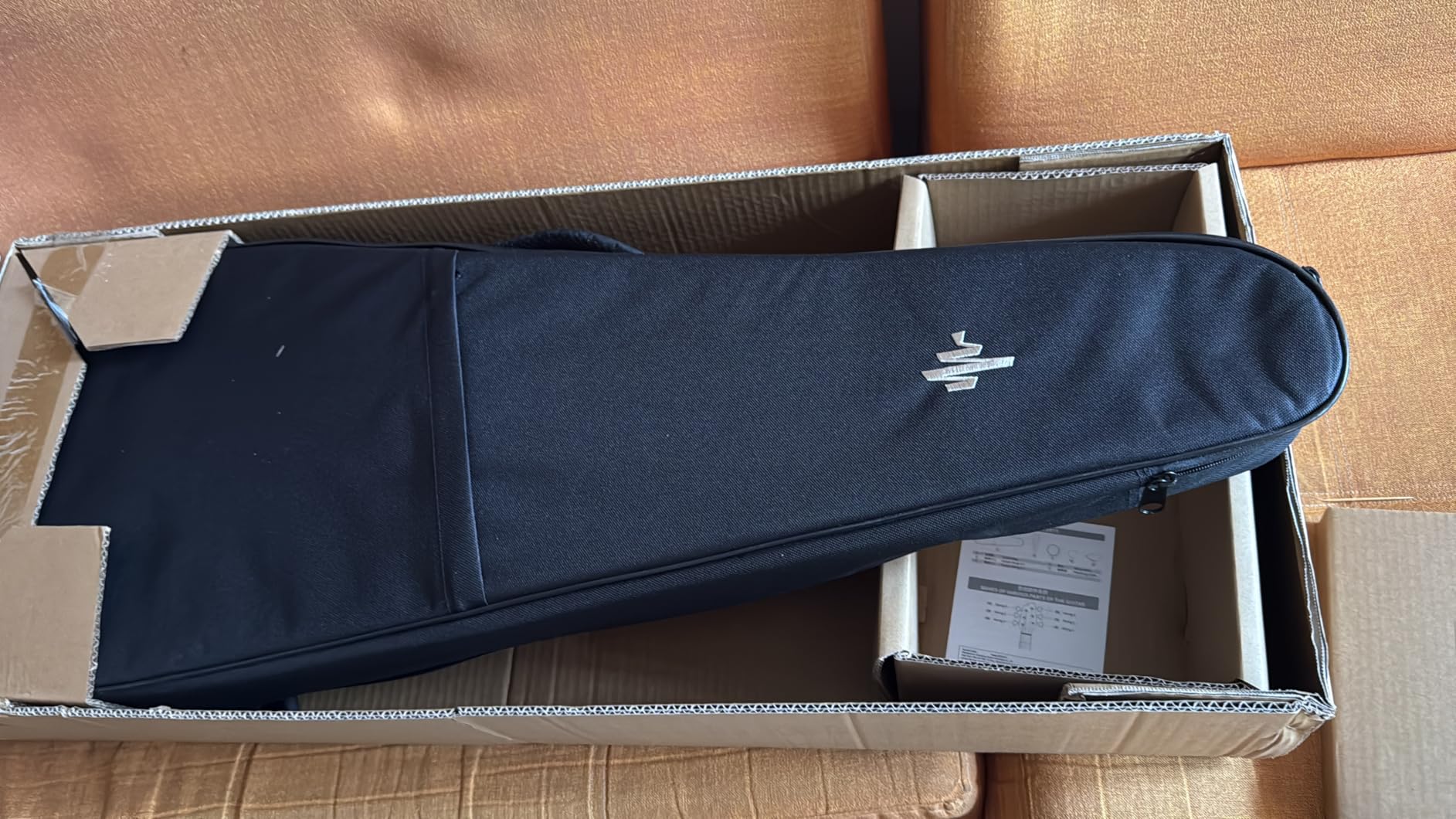
Buyers also like that it arrives genuinely ready to go: the kit includes a case, strap, strings and picks. For a first trip, that removes a shopping list and a surprise cost.
Specs are a mahogany back, sides and neck, a 43 mm nut width and phosphor bronze strings. The anti-oxidation rounded frets and high-density HPL fingerboard are the two details reviewers single out, one positively and one less so.
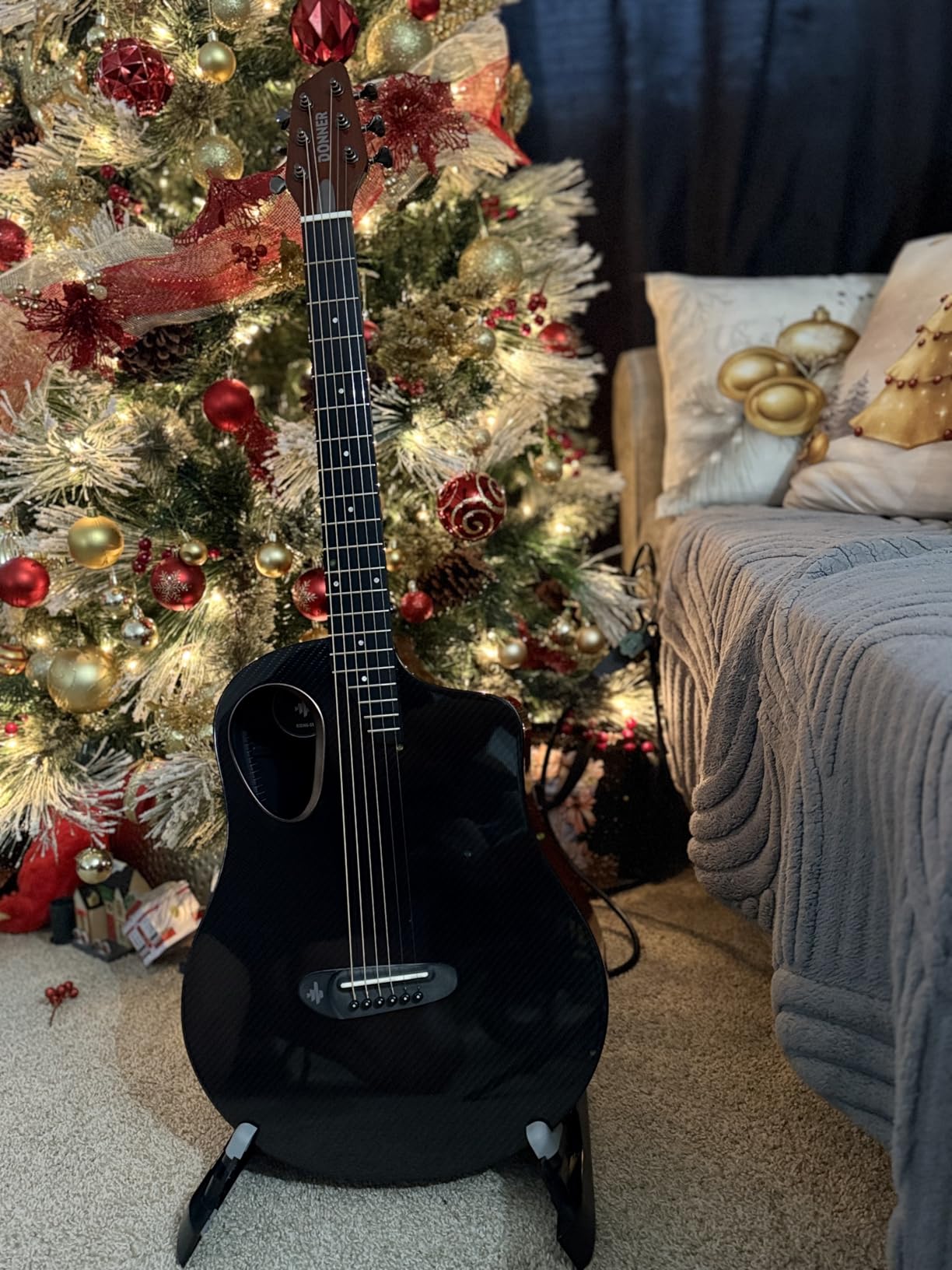
Why a hybrid top suits an outdoor trip
Solid wood tops are the part of a guitar that moves most with humidity. A carbon top does not, so the instrument is far more tolerant of rain, beach air and rapid temperature change while the wooden body keeps the tone from sounding thin.
Reviewers report that it stays stable across heat and cold in a way all-wood instruments at this level do not. If your route has big swings between damp valleys and dry high passes, that is worth more than a marginally warmer soundboard.
Where the compromise shows
The HPL fingerboard is the honest weak point. It does not feel like wood, and it will not wear in and darken with playing the way a rosewood or purple heart board does.
At 38 inches long it is also bigger than the tightest options here, so it needs a snug pack rather than a gap. And this configuration has no electronics at all, which rules out amplified and recording use until you add hardware.
10. Donner HUSH I EVO2: Fastest Setup With No Tools
Donner HUSH I EVO2 Acoustic Electric Travel Guitar (Black)
Tool-free frames
HPS-II preamp
Built-in tuner
3.5mm headphone output
Pros
- Hand-tightened thumb screws attach and remove frames with no tools
- 5-piece reinforced neck resists warping across climates
- Built-in tuner and headphone jack make it self-contained for silent practice
- T-wrench stores in a hidden magnetic compartment
- 3-layer binding holds up to being knocked around
Cons
- HPL fingerboard will not age like wood
- Requires a 9V battery you have to carry
- Maple body gives a brighter thinner voice
The idea here is speed. The ergonomic frames attach and detach with hand-tightened thumb screws, so you go from packed to playing in seconds without hunting for a tool or working by feel in the dark. On a cold morning after a wet camp, that matters more than it sounds.
The HPS-II preamp with a custom undersaddle piezo, a built-in chromatic tuner and a 3.5 mm headphone output make it a self-contained silent practice guitar. Owners describe it as easy to use and simple to fit into an overhead compartment.
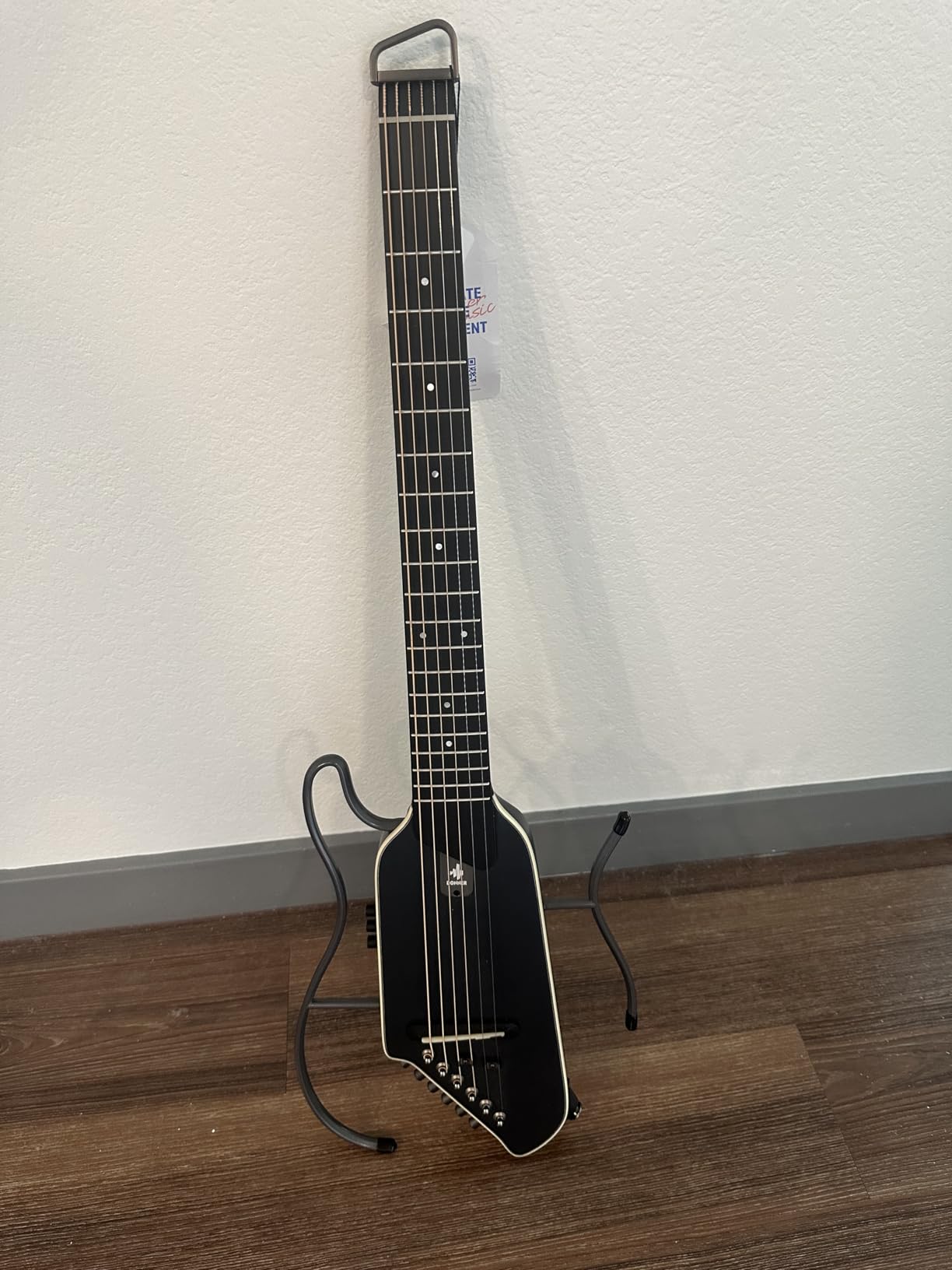
Stability is the engineered strength. The 5-piece maple and mahogany neck is designed to resist warping across humidity and climate changes, and the 3-layer binding is there to survive being knocked around in a pack. A hidden magnetic compartment keeps the included T-wrench with the guitar so it is not lost.
The body is mahogany topped with maple back and sides and an HPL fingerboard, finished in black. Manufacturer warranty is one year, and the electronics run on a 9V battery with low-battery alerts.
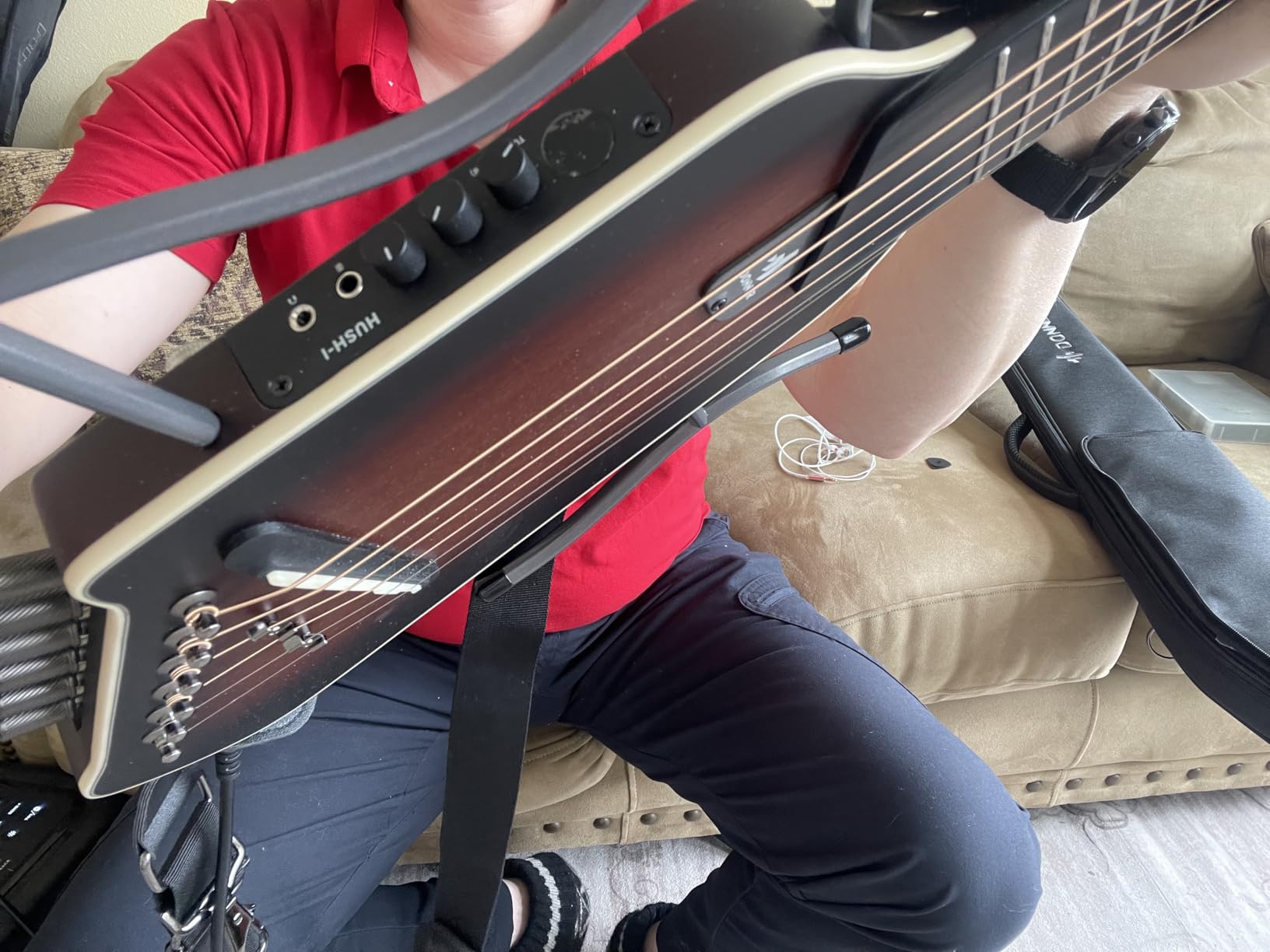
When tool-free assembly earns its place
If you move camp daily, stop often, or play casually whenever you stop, the frames take seconds rather than minutes. For a player who would otherwise leave the guitar packed because setting it up is a chore, that changes how often you play at all.
The tuner in the headstock means no separate tuner on the gear list, which matters when every accessory competes with your tent and sleep system for pack space.
Where it falls short
It scores lowest in this group at 4.1 stars, and the review pool is small at 58 ratings, so there is less long-term evidence behind it. Take that as a reason to try one in person rather than a warning, but weigh it.
The HPL fingerboard is synthetic and will not age like wood. The maple body produces a brighter, thinner voice than spruce or mahogany tops. And the 9V battery is one more consumable to carry and remember to swap.
Travel Guitar vs 3/4-Size Guitar: What Actually Changes
Buyers routinely assume these are the same thing, and the confusion costs people money. A 3/4-size guitar is defined by body dimensions and scale length, and it is built like a normal guitar in miniature. A travel guitar is defined by what it has removed to save volume: a headstock, a sound box, or the wood itself.
That difference drives everything you feel. A 3/4-size acoustic like the Yamaha APXT2 sounds acoustically and behaves like a smaller dreadnought. A headless model like the Traveler Ultra-Light has almost no acoustic voice at all and depends on a pickup. A composite body like the Enya NOVA GO gives up some acoustic resonance in exchange for weather resistance.
Neither category is better. If you want tone and tradition, buy a 3/4-size. If you want quiet practice, pick a headless or composite with electronics. If you want to carry one instrument through six weeks of weather, look at the carbon and carbon-top options.
Will It Fit in Your Pack? Length, Footprint and Carried Weight
This is the question no editorial competitor answers, so here is the arithmetic. The Traveler Ultra-Light is 28 by 5.25 by 2 inches and occupies roughly 4 litres with its gig bag, which is about the volume of a one-litre water bottle and a half. The Traveler Escape Mark III at 29.5 by 10.75 by 2.13 inches is closer to 7 litres.
The Journey PJ410N is the interesting one, because it measures 33.58 by 12.2 by 4.06 inches assembled and considerably less once the neck is off. The Enya NOVA GO SP1 sits at 35.83 by 11.81 by 2.76 inches, a thin profile that packs flat, while the Yamaha APXT2 at 36.22 by 16.46 by 4.53 inches is the outlier at roughly 12 litres.
Budget for the case, not just the guitar. A hard case can double the footprint before it doubles the weight, so if you are packing tightly, a padded gig bag or a pack sleeve is usually the right call. Our two-person backpacking tent picks assume roughly 8 litres of shared gear space per person.
Weight matters as much as volume. Add 1 to 2 lbs for the gig bag, a clip-on tuner if the instrument lacks one, a spare set of strings, a small humidifier for solid-wood models and a strap, and a 4 pound guitar becomes a 6 pound kit. Plan your rest of the load around compact camp cookware and light shelter so the guitar is not the thing that pushes you over.
How to Choose a Travel Guitar for Backpacking
Start with scale length, because it is the only spec that affects how you play. Below 23 inches the strings feel slack and bending feels easy; at 24.75 inches and above the instrument behaves like a full-size guitar. If you have played a normal acoustic for years, do not go below 24 inches unless you want a deliberate change.
Second, decide how much weather you will actually see. Solid wood and laminate tops move with humidity and need more care. Carbon fiber and carbon-top composites ignore it. If your trips involve multi-week exposure rather than hotel rooms, a composite body is the safer purchase.
Third, settle the electronics question before anything else. Purely acoustic models cannot be amplified or recorded without adding hardware. Piezo systems let you use a phone amp or interface. Preamp systems with onboard tuners and effects remove an accessory from your gear list entirely, which is a backpacking advantage as much as a musical one.
Fourth, check the physical structure. Detachable necks and folding frames save pack volume but introduce joints that a one-piece instrument does not have. If your route involves checked luggage, porters or repeated hard drops, prefer a solid composite or laminated body with no hinges.
Finally, budget for a setup after a hard journey. String height and intonation drift after temperature cycling and rough handling. Instruments that ship with a factory setup, or that include adjustment tools, save you a problem in a town you may only pass through once.
Durability, Humidity and Rain on the Trail
Aim to keep relative humidity between 45 and 55 percent if your guitar has a solid wood top. That range is the standard safe-storage target for acoustic instruments and it is the one figure most owners can act on.
Carbon fiber and composite bodies need no humidifier at all. Owners of the Enya range report that their instruments hold tuning through cold mornings and hot afternoons without adjustment, and that no care routine is required. That is the single largest practical difference between the composite and wooden picks.
For wood, keep the guitar in its gig bag when it is not being played, away from a tent wall where condensation forms at dawn, and away from a campfire or a vehicle dashboard. If you expect rain, the bag is not enough on its own; a waterproof pack liner is what protects the instrument during a downpour.
Sand and grit cause more damage than moisture over time. Wipe strings and the fingerboard down with a dry cloth before putting the instrument away, and never leave the guitar in direct sun on a rock for an afternoon while you swim.
Taking a Travel Guitar on a Plane
Check your airline’s policy for musical instruments before you book, not at the gate.
Carry on rather than checking. A guitar in a checked bag is exposed to handling, conveyor damage and temperature extremes.
Use a soft gig bag rather than a hard case for overhead bins. Hard cases frequently exceed the size allowance when the bag is measured with the instrument inside.
Pad the body inside the gig bag with clothing and remove any loose accessories from the pockets.
At the bin, retrieve it yourself and check the tuning and neck angle before you leave the gate area.
Note that overhead and carry-on limits vary by carrier and by aircraft, and budget airline rules are frequently stricter than the published allowance. Verify before every flight rather than assuming the last trip applies.
Frequently Asked Questions
Are travel guitars good for beginners?
Yes, and a 3/4-size or short-scale instrument is a common first guitar because small hands find the neck and body comfortable. The caveat is longevity: a full-size guitar stays playable as your hands and repertoire grow, while a very short scale can feel limiting later. Pick a scale between 24 and 25.5 inches if you want a starter guitar that also works as a travel companion.
Are travel guitars harder to play?
It depends almost entirely on scale length. Instruments around 21 to 23 inches feel slack and slinky to anyone used to a full-size guitar, while models at 24.75 and 25.5 inches play almost identically to a standard instrument. Headless designs also change posture, because the instrument tilts forward and needs a strap or lap rest to sit properly.
Are 3/4-size guitars the same as travel guitars?
No. A 3/4-size guitar is a smaller version of a normal acoustic, with a sound box and a headstock, so it plays and projects like a small guitar. A travel guitar is defined by what it removed to save volume: a headstock, a sound box, or wood in favour of composite material. That is why headless and carbon-fiber instruments behave so differently from a 3/4-size despite similar dimensions.
Can you put normal strings on a travel guitar?
There are no separate travel guitar strings, but scale length changes what feels normal. Below 24 inches a heavier gauge restores the string tension your fingers expect and reduces the slinky feel. Check that the wider string set fits the nut and bridge first, and remember that coated strings hold pitch longer through damp weather, which is useful on a long trip.
What size guitar should I get for backpacking?
For most hikers, aim for an instrument around 30 to 36 inches long and under 4.5 pounds, and check that it fits in your pack with your sleeping bag. Below 28 inches you lose meaningful body volume and tone. Above 36 inches you are carrying a full-size guitar in a small bag. Carbon fiber or carbon-top bodies are the safest choice for multi-week outdoor exposure.
Are carbon fiber travel guitars worth it for backpacking?
For multi-week trips outdoors, usually yes. Carbon fiber bodies do not crack, warp or react to humidity the way solid wood and laminate tops do, so you can skip the humidifier and a hygrometer entirely. The trade-off is that some acoustic resonance is given up, and the all-composite instruments tend to sound more focused and less woody than wooden builds.
Which Travel Guitar Should You Buy?
If you want the single best travel guitar for backpacking and have no other constraint, the Journey Instruments PJ410N wins on weight and pack shape. Its neck comes off, it fits under a seat, and at 3.7 lbs it is the lightest assembled instrument here with a solid wood top.
If weather is the deciding factor, take the Enya NOVA GO SP1. The one-piece moulded carbon body cannot crack or lose its bridge, it needs no humidifier, and the thin 2.76 inch profile packs flat against a pack panel.
If you want the most playable instrument and you already own a practice amp, the Traveler Ultra-Light gives you a full 24.75 inch scale at 2 pounds 14 ounces. Add the Escape Mark III if your trips are spent in hostels rather than on open trails. If you want a real acoustic voice on a limited budget, the Orangewood Dana Mini arrives set up and ready.
Whatever you choose, plan for a gig bag, a tuner if the instrument lacks one, a spare set of strings and a few days of slack in your gear list. A lightweight water filter setup frees up the volume and weight you need to carry the guitar comfortably for six weeks.