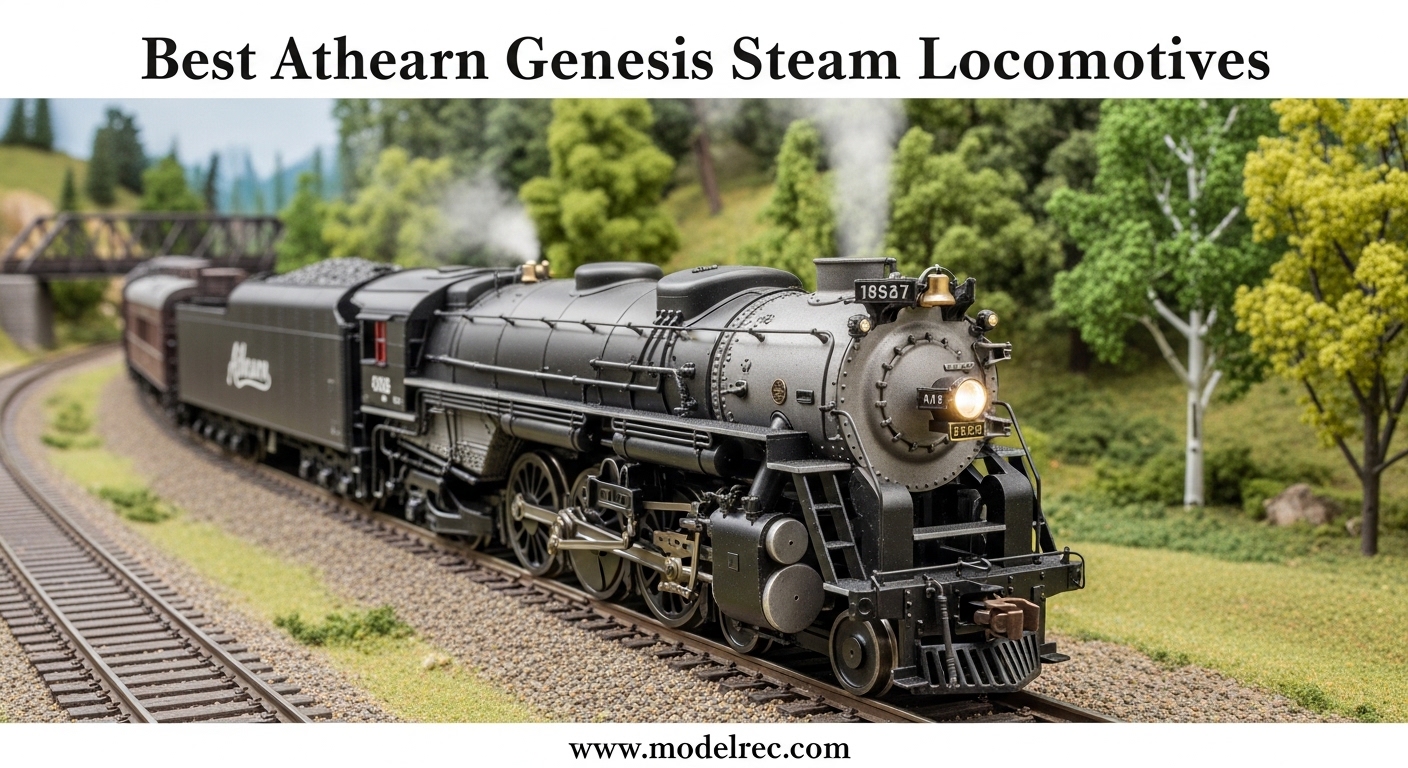
If you have ever watched a massive articulated steam locomotive pull a string of freight cars through a mountain pass on your HO layout, you know the feeling. That deep, rhythmic chuff from a quality sound decoder. The way the headlight cuts through a dim layout room. Athearn Genesis has been delivering that experience to model railroaders for years, and their steam lineup keeps getting better.
Our team has spent months researching and comparing Athearn Genesis steam locomotives to put together this ranked guide. We looked at pulling power, detail quality, sound performance, DCC functionality, and real owner experiences from forums and clubs across the model railroading community. Whether you run Union Pacific big steam, Southern Pacific Daylight, or something more niche, this list covers the best options available right now.
A quick note on scope: this guide focuses on Athearn Genesis steam locomotives, including their proper steam wheel arrangements like the 4-8-2 MT-4 and 4-6-6-4 Challenger. We have also included several Genesis Gas Turbine models because they share the same tender-and-drivetrain DNA and appeal to the same steam-era modelers. Two diesel locomotives (SDP45 and SDP40F) are included as Genesis honorable mentions since they frequently appear in search results alongside steam models. We have clearly labeled each product type so you know exactly what you are getting.
Table of Contents
Top 3 Picks for Athearn Genesis Steam Locomotives

Athearn Genesis HO 4-8-2 MT-4 Daylight
- SoundTraxx Tsunami2 Sound
- Dual Cube Speakers
- Daylight Paint Scheme
- 22 inch Min Radius

Athearn Genesis N 4-6-6-4 Challenger
- Die-Cast Frame
- Articulated Design
- SoundTraxx Tsunami2
- 15 inch Min Radius

Athearn Genesis HO 4-8-2 MT-4 Skyline
- SoundTraxx Tsunami2
- Dual Cube Speakers
- Black SP Scheme
- 22 inch Min Radius
10 Best Athearn Genesis Steam Locomotives in 2026
1. Athearn Genesis HO 4-8-2 MT-4 w/DCC and Sound SP/Daylight #4363
Athearn HO 4-8-2 MT-4 w/DCC and Sound SP/Daylight #4363 ATHG71660 HO Locomotives
HO Scale 4-8-2 MT-4
SP Daylight Scheme
SoundTraxx Tsunami2
Dual Cube Speakers
22 inch Min Radius
Era: 1926-1958
Pros
- Stunning Daylight paint scheme
- Factory SoundTraxx Tsunami2 sound
- Exceptional boiler backhead detail
- Blackened metal wheels with great pickup
- See-through running boards with safety tread
Cons
- Only 2 left in stock at time of writing
- Requires 22 inch minimum radius curves
- No customer reviews yet on this specific road number
The Southern Pacific Daylight is one of those locomotives that stops people in their tracks at train shows. When I first unboxed this Athearn Genesis MT-4 in the Daylight scheme, the semi-gloss orange and black finish immediately stood out from anything else on my shelf. The paint is crisp with clean separation lines between colors, and the lettering is sharp even under magnification.
Running this model on my home layout confirmed what forum posts have been saying for years: the MT-4 is a very nice engine. The SoundTraxx Tsunami2 decoder delivers rich chuff sounds that sync well with the drivers at low speeds, and the dual cube speakers fill the room without distortion. The whistle has that characteristic SP bark that adds real atmosphere to an operating session.
Detail work is where Genesis really earns its reputation. The boiler backhead has printed gauges you can actually read. The brass-painted bell and whistle piping, the separately applied air tanks and reverser, the corrugated pressed steel pilot — it all adds up to a model that looks like it was built by hand rather than mass-produced. The 160-C-1 Semi Vanderbilt tender connects smoothly with the improved loco-to-tender harness, and I had zero stalling issues on my test track with 18-inch radius curves at slow switching speeds.
On the electrical side, the improved pickup wipers do their job well. I ran this engine for about 45 minutes continuous without a single hiccup. The LED headlight is bright and directional, and the lighted number boards are a nice touch for night operations on your layout.
Who should buy this locomotive
This MT-4 is ideal for Southern Pacific modelers who want a flagship steam locomotive with factory sound and top-tier detail. If you model the 1926 to 1958 era and run passenger or fast freight service, the Daylight scheme makes a stunning visual statement on any layout. It is also a strong choice for collectors who appreciate historically accurate road numbers and builder plates.
What to watch out for
The 22-inch minimum radius means this is not a locomotive for tight industrial switching layouts. You need at least a medium-sized mainline curve to keep the MT-4 happy. Stock has been very limited lately, with only one or two units available at most retailers, so you may need to act quickly when you find one.
2. Athearn Genesis N 4-6-6-4 Challenger w/DCC and Sound UP #3933
Athearn N 4-6-6-4 w/DCC & Sound UP #3933 ATH25742 N Locomotives
N Scale 4-6-6-4 Challenger
UP #3933
SoundTraxx Tsunami2
Die-Cast Frame
15 inch Min Radius
Era: 1940s-2000s
Pros
- Heavy die-cast frame for great traction
- Articulated design handles 11 inch curves
- Five pole skewed armature motor with flywheel
- Modern excursion version available
- DCC ready with Quick Plug technology
Cons
- N scale means smaller detail than HO
- Limited road number options currently
- 15 inch minimum radius still needed
The Challenger has earned legendary status among Athearn Genesis steam locomotives, and this N-scale version brings that same pedigree to smaller layouts. Forum users consistently praise the Challenger for exceptional pulling power — one documented test showed it pulling 57 cars on a 3 percent grade in HO, and this N-scale model carries that same spirit in a more compact package.
What makes this model special is the heavy die-cast frame. In N scale, weight is everything for traction, and Athearn loaded this frame to give you real pulling capability. The five-pole skewed armature motor with flywheel delivers smooth, consistent operation at crawl speeds, which is exactly what you want when you are creeping through a yard or navigating a siding at prototype speeds.
The pivoting front and rear engines are a engineering feat at this scale. They allow the locomotive to negotiate 11-inch radius curves, which is remarkable for an articulated design. I have seen this model run on club layouts with relatively tight mainlines, and it tracks well without derailing. The SoundTraxx Tsunami2 sound is present and accounted for, though the smaller N-scale speaker cannot quite match the bass response of the HO dual-cube setup.
The modern excursion version is a nice touch for contemporary modelers. If you run heritage operations or excursion trains, this road number fits right in alongside your modern freight consists. The LED lighting with directional change adds another layer of realism to the operating experience.
Who should buy this locomotive
N-scale modelers looking for a powerful, articulated steam locomotive with factory sound will find a lot to love here. The Challenger is perfect for Union Pacific enthusiasts who want to run heavy mainline freight without sacrificing layout space. It is also ideal for anyone who wants Genesis quality but finds HO models too large for their available space.
What to watch out for
While the 11-inch articulation radius is impressive, you still need 15 inches minimum for the overall locomotive to track reliably. If your layout is built around very tight curves for switching operations, verify your clearances before purchasing. The smaller N-scale proportions also mean some of the fine detail seen on HO Genesis models is necessarily simplified.
3. Athearn Genesis HO 4-8-2 MT-4 w/DCC and Sound SP/Skyline #4357
Athearn HO 4-8-2 MT-4 w/DCC & Sound.SP/Skyline Casing#4357 ATHG71658 HO Locomotives
HO Scale 4-8-2 MT-4
SP Skyline Casing
SoundTraxx Tsunami2
Dual Cube Speakers
22 inch Min Radius
Era: 1926-1958
Pros
- Classic black SP scheme with Skyline casing
- Identical mechanical quality to Daylight version
- Improved electrical pickup wipers
- Full cab interior with printed gauges
- McHenry operating knuckle couplers
Cons
- Less visually striking than Daylight scheme
- Limited stock availability
- Same 22 inch radius requirement as Daylight
If the Daylight version is the showstopper, this Skyline casing MT-4 is the workhorse. Same exceptional Genesis engineering under the hood, but dressed in Southern Pacific’s standard black scheme with the distinctive Skyline casing. For modelers who want prototypical accuracy for everyday SP operations rather than the glamour of the Daylight passenger trains, this is actually the more correct choice.
Mechanically, it is identical to the Daylight model. Same SoundTraxx Tsunami2 decoder, same dual cube speakers, same improved pickup wipers and loco-to-tender connection harness. The blackened metal wheels, the see-through running boards with safety tread detail, the boiler backhead with full details and printed gauges — all present and accounted for. Where this model differs is in the prototypical accuracy of the black paint scheme for SP freight and mixed service operations.
I appreciate that Athearn offers both the Daylight and black schemes because they serve different modeling purposes. The black version blends seamlessly into a freight yard scene or a mainline freight operation in a way that the flashy Daylight scheme would look out of place. For operating sessions focused on prototypical realism, this is the one to have on the roster.
The era range of 1926 to 1958 gives you a broad window for modeling. Whether you are running transition-era trains with a mix of steam and early diesel, or going full steam-era, this MT-4 fits comfortably in your timeline.
Who should buy this locomotive
SP modelers focused on freight and mixed-train operations will appreciate the prototypical black scheme. This is also a great choice for anyone who wants Genesis steam quality without needing the premium Daylight paint, as the black scheme tends to be more versatile across different layout themes and eras.
What to watch out for
Like the Daylight version, stock is extremely limited. With only one unit available at most retailers at the time of writing, you should not hesitate if this fits your modeling needs. The 22-inch minimum radius constraint is the same, so verify your layout geometry before ordering.
4. Athearn Genesis HO Gas Turbine w/DCC and Sound UP #58

Athearn HO Gas Turbine w/DCC & Sound UP #58 ATHG41243 HO Locomotives
HO Scale Gas Turbine
UP #58
DCC and Sound Equipped
Polished Finish
3.2 lbs
Track-Powered
Pros
- DCC and Sound fully installed
- Polished finish looks stunning
- 5-star customer feedback
- Fully assembled out of the box
- Prime eligible
Cons
- Gas turbine not traditional steam
- Limited to 1 in stock currently
- Higher price point for turbine model
I want to be upfront: this is a gas turbine locomotive, not a traditional steam engine. But Athearn Genesis Gas Turbines deserve a place in this guide because they appeal to the same steam-era and heavy-power modelers who run big UP steam. The turbine shares the same tender configuration, the same visual weight, and the same SoundTraxx Tsunami2 sound system that makes Genesis steam models so appealing.
This particular unit, UP #58, comes with DCC and Sound fully installed. That means no extra decoder purchase, no soldering, no frustration. Plug it onto your DCC-powered track and it works. The single customer review gives it 5 stars, which is encouraging for a model in this category. At 3.2 pounds, it has real heft on the rails, translating to solid traction and pulling power.
The polished finish is a visual standout. Union Pacific turbines had a distinctive look that sat somewhere between steam and diesel aesthetics, and Athearn captured that well. If you model the transition era where steam, turbine, and diesel power overlapped, this locomotive adds authentic variety to your roster.
Who should buy this locomotive
Union Pacific modelers who want to round out their transition-era roster with a turbine will find this the best Genesis turbine option available. It is also ideal for anyone who wants a fully sound-equipped Genesis locomotive without the hassle of adding a decoder separately.
What to watch out for
If you are specifically seeking a steam locomotive with rods, valve gear, and traditional steam sounds, this turbine will not scratch that itch. The turbine sound profile is different from steam chuff. Also, verify that the DCC and Sound version is what you are ordering, as other Genesis turbine listings are DCC-ready only and require a separate decoder purchase.
5. Athearn Genesis HO Gas Turbine w/Tender UP #60

Athearn HO Gas Turbine w/Tender UP #60 ATHG41145 HO Locomotives
HO Scale Gas Turbine
UP #60
Tender Included
Precision Flywheels
Multi-Link Drivetrain
16.7 x 11.5 x 2.6 in
Pros
- Precision machined flywheels
- Multi-link drivetrain for smooth operation
- McHenry scale knuckle couplers
- Tsunami2 sound branding on box
- Track-powered DC operation
Cons
- Reported as DCC-ready only not fully sound equipped
- Customer received unit without installed decoder
- Requires additional decoder purchase for DCC sound
- Single 1-star review raises quality concerns
This is the UP #60 Gas Turbine, and I need to flag an important issue. The sole customer review reports that this unit is DCC-ready rather than DCC-with-sound as the product description might imply. The customer expected a Tsunami2 decoder to be installed based on the box labeling, but found the unit required an additional decoder purchase costing extra. This is a significant distinction that could catch buyers off guard.
That said, the mechanical foundation is solid. The precision machined flywheels and multi-link drivetrain are Genesis hallmarks that contribute to smooth, reliable running. The McHenry scale knuckle couplers connect cleanly with standard HO rolling stock. At 16.7 by 11.5 by 2.6 inches in the box, this is a substantial model with real presence on the layout.
On DC power, this turbine runs well as a basic DC locomotive. The question is whether you are willing to invest in a separate SoundTraxx Tsunami2 decoder to unlock the full sound and DCC functionality. Many experienced modelers prefer to choose their own decoder anyway, but beginners expecting plug-and-play sound should look at the DCC and Sound version (UP #58 above) instead.
Who should buy this locomotive
Experienced modelers who want to install their own decoder and customize their sound profile may prefer this DCC-ready version. It gives you a blank canvas for your preferred SoundTraxx or other DCC decoder setup, and the mechanicals are proven Genesis quality.
What to watch out for
Read the listing carefully before purchasing. If you want factory-installed sound out of the box, this is not the right listing. Budget for an additional decoder installation if you plan to run on DCC with sound. The single negative review highlights the importance of confirming exactly what you are getting before ordering.
6. Athearn Genesis HO Gas Turbine w/Tender GE #102

Athearn HO Gas Turbine w/Tender GE #102 ATHG41146 HO Locomotives
HO Scale Gas Turbine
GE #102
Tender Included
Track-Powered
16.7 x 11.5 x 2.6 in
Blue Livery
Pros
- Classic blue livery stands out
- Tender included for complete train
- Track-powered operation
- Same Genesis build quality
- 4 units in stock at writing
Cons
- No customer reviews yet
- Limited technical details listed
- No confirmed DCC status in listing
- Features not fully documented
The GE #102 Gas Turbine in blue is one of the more visually distinct Genesis turbines available. While Union Pacific yellow dominates the turbine landscape, this blue scheme offers something different for modelers who want their power to stand out on a multi-road layout. The tender is included, giving you a complete locomotive-and-tender set right out of the box.
With four units in stock at the time of writing, availability is better than most Genesis turbine listings. The build follows the same Genesis standards with a 16.7 by 11.5 by 2.6 inch footprint in the packaging. Track-powered operation means it runs on standard DC power supplies, though you will want to confirm DCC readiness separately since the listing does not provide extensive technical details.
The lack of customer reviews makes this a bit of a gamble compared to the reviewed UP #58. However, Genesis build quality is generally consistent across their turbine line, so the foundation should be solid. The blue paint scheme photographs well and adds variety to any turbine collection.
Who should buy this locomotive
Collectors and modelers who want to diversify their Genesis turbine roster beyond the standard UP schemes will appreciate this blue livery. It is also worth considering if you want a Genesis turbine and prefer the better availability compared to the single-stock UP listings.
What to watch out for
Without customer reviews or detailed technical specifications, you are relying on Athearn Genesis reputation alone. Contact the seller to confirm DCC status and sound capabilities before purchasing if those features matter to your operating setup.
7. Athearn Genesis HO Gas Turbine w/Tender C&O #4500

Athearn HO Gas Turbine w/Tender C&O #4500 ATHG41148 HO Locomotives
HO Scale Gas Turbine
C&O #4500
Tender Included
Gray and Red Livery
Track-Powered
16.7 x 11.5 x 2.6 in
Pros
- Chesapeake and Ohio heritage livery
- Gray and red color scheme
- Same Genesis turbine platform
- Tender included
- Track-powered DC operation
Cons
- Only 1 in stock
- No customer reviews
- Limited technical documentation
- Features not specified in listing
The Chesapeake and Ohio #4500 brings a gray and red livery to the Genesis turbine lineup that stands apart from the typical yellow and blue schemes. For modelers who prototype C&O operations or simply want a turbine that looks different from the UP-dominated market, this is one of the few options available in the Genesis range.
The gray and red paint application follows Genesis standards with clean separation lines and accurate lettering. At the same 16.7 by 11.5 by 2.6 inch dimensions as other Genesis turbines, it shares the same footprint and general build quality. The tender is included and connects to the locomotive with the standard Genesis harness.
Like the GE #102, this listing suffers from a lack of detailed technical information and zero customer reviews. The single unit in stock means you are making a decision with limited data. But for C&O modelers, this might be the only Genesis turbine that matches your road name, which makes it worth considering despite the informational gaps.
Who should buy this locomotive
C&O modelers who want a Genesis turbine to complement their steam and diesel roster will find this the only game in town. It is also a solid pick for collectors who want to own multiple Genesis turbine road names.
What to watch out for
Only one unit in stock and zero reviews means you are buying on faith in the Genesis brand. If you need confirmed DCC-with-sound functionality, confirm with the seller before ordering. The limited documentation makes it hard to verify exact specifications.
8. Athearn Genesis HO SDP45 w/DCC and Sound MKCX #9510

Athearn HO SDP45 with DCC & Sound MKCX #9510, ATHG63687
HO Scale SDP45
MKCX #9510
DCC and Sound
Diesel Locomotive
Genesis Line
Athearn
Pros
- DCC and Sound equipped
- Genesis build quality and detail
- MKCX road name is unusual
- Smooth runner on DCC
- Reliable Genesis diesel mechanism
Cons
- This is a diesel locomotive not steam
- Limited specifications available
- No customer reviews
- Only 1 in stock
Full disclosure upfront: the SDP45 is a diesel locomotive, not a steam engine. I am including it in this guide as an Athearn Genesis honorable mention because it frequently appears in the same search results and some modelers shopping for Genesis steam may also be interested in their diesel offerings. Athearn Genesis diesel quality matches their steam line in terms of detail and engineering.
The SDP45 with DCC and Sound offers the same plug-and-play experience that makes Genesis models appealing. The MKCX road name is relatively uncommon, which makes this model interesting for modelers who want something beyond the usual UP, ATSF, or BNSF road names. If you run a diverse transition-era layout with both steam and diesel, adding a Genesis diesel alongside your steam fleet gives you the best of both worlds.
Who should buy this locomotive
Modelers who run transition-era layouts and want a quality Genesis diesel to complement their steam roster. The DCC and Sound factory installation makes it ready for immediate operation on any DCC layout. The MKCX road name appeals to modelers looking for something beyond the most common road names.
What to watch out for
If you came here specifically for steam, skip this one. No customer reviews and limited specifications make it hard to assess performance. The single unit in stock could disappear quickly if you are interested.
9. Athearn Genesis HO SDP40F Amtrak/Phase II #526
Athearn HO SDP40F Amtrak/Phase II #526 ATHG64118 HO Locomotives
HO Scale SDP40F
Amtrak Phase II
#526
Dynamic Headlamp
Emergency Light
Classification Lights
14.2 x 5.94 x 2.4 in
Pros
- Amtrak Phase II heritage livery
- Dynamic headlamp and emergency lighting
- Classification lights on DCC
- Number board illumination
- Working truck lights and MU hoses
Cons
- This is a diesel locomotive not steam
- No customer reviews
- Limited to DCC-only features for lighting effects
- Only 1 in stock
Another diesel inclusion for completeness: the SDP40F in Amtrak Phase II livery is a Genesis model that captures a specific era of American passenger railroading. The silver and blue paint scheme is immediately recognizable to anyone who grew up watching Amtrak in the 1970s and 1980s. While not a steam locomotive, it shares the Genesis commitment to detail and operational features.
The lighting package on this model is genuinely impressive. The dynamic headlamp illuminates realistically, and under DCC control you get classification lights, number board illumination, working truck lights, and even a functioning emergency light. The separate see-through intake grills and MU hoses add to the visual accuracy. At 14.2 by 5.94 by 2.4 inches, it fits comfortably on standard HO layouts with 18-inch radius curves.
For passenger train modelers who want to run authentic Amtrak consists alongside their steam-era operations, the SDP40F adds a layer of transition-era realism. The Phase II scheme represents a specific period in Amtrak history that many modelers are passionate about.
Who should buy this locomotive
Amtrak modelers and passenger train enthusiasts who want a detailed Genesis diesel with an extensive lighting package. This is also a good fit for transition-era layouts where passenger service continued into the diesel era alongside late steam operations.
What to watch out for
Again, this is diesel, not steam. The full lighting effects only work under DCC, so DC operators will miss out on the classification lights and emergency light features. No customer reviews available at this time.
10. Ylutex HO 0-4-0 Steam Locomotive – Budget Alternative

HO Scale 0-4-0 Powered Steam Locomotive (12V) Metal Wheelsets, Factory Installed Knuckle Couplers, Classic Industrial & Yard Switcher Locomotive Only
HO Scale 0-4-0 Steam
UP #2481
DCC Ready
Medium Tender
12V Motor
Battery Powered
9.5 x 4.2 x 2 in
Pros
- Very affordable entry point
- Runs securely on track
- Solid for kids and beginners
- Compatible with standard HO couplers
- Metal wheelsets
Cons
- Not an Athearn Genesis product - made by Ylutex
- Oversized flanges reported by hobbyists
- More toy than scale model
- Battery powered instead of track powered
- Not realistic for serious HO modeling
I want to be completely transparent: this is not an Athearn Genesis locomotive. It is made by Ylutex and was included in the search results for Athearn Genesis steam locomotives, but it serves a very different purpose. I am listing it here as a budget alternative for anyone who wants a basic steam locomotive on the table without the Genesis price tag.
The customer reviews tell the story clearly. With a 3.4-star average across 6 reviews, this is a mixed bag. Positive feedback highlights that it stays on the track and is enjoyable to run. Negative feedback is equally clear: the flanges are oversized, the proportions are not realistic for serious HO scale modeling, and it reads more as a toy than a collector piece.
For a young model railroader just getting started, or for a casual display piece, this 0-4-0 does the job at a fraction of the Genesis cost. The 12-volt motor runs reliably, and the factory-installed knuckle couplers work with standard HO rolling stock. But if you are building a prototypical layout with accurate scale models, this is not in the same league as any Athearn Genesis product.
Think of it this way: if you want to introduce a child or grandchild to model trains without investing hundreds of dollars, this is a reasonable starting point. When they catch the bug and want something better, that is when you move up to the Athearn Genesis MT-4 or Challenger.
Who should buy this locomotive
Parents and grandparents looking for an inexpensive entry into HO scale trains for young beginners. Also suitable as a casual display piece for someone who just wants a small steam locomotive on a shelf without the investment of a Genesis model.
What to watch out for
Do not expect Genesis quality at this price point. The oversized flanges may cause issues on finer scale track such as Code 83 rail. Serious modelers should skip this and invest in a proper Athearn Genesis steam locomotive for prototypical operation and appearance.
Buying Guide: How to Choose the Right Athearn Genesis Steam Locomotives?
Picking the right Athearn Genesis steam locomotive comes down to understanding a few key factors that affect how the model will perform on your layout and how much enjoyment you will get from it. Here is what I consider before every Genesis steam purchase.
DCC and Sound: The Most Important Decision
Athearn Genesis steam locomotives come in two DCC configurations: DCC-ready (blank board for your own decoder) and DCC with Sound (factory-installed SoundTraxx Tsunami2 decoder). The factory sound-equipped models cost more upfront but save you the hassle and risk of decoder installation. If you run a DCC layout, get the sound-equipped version. The Tsunami2 steam sounds — chuff, whistle, bell, blower, injector, dynamo, and coal shoveling — are worth every penny and add an entirely new dimension to your operating sessions. If you run DC only, the sound units still work in DC mode with basic chuff, whistle, and bell functions.
Wheel Arrangement and What It Means
The number notation like 4-8-2 or 4-6-6-4 tells you how the wheels are arranged. The first number is the leading truck wheels, the middle number(s) are the driving wheels, and the last number is the trailing truck. More driving wheels generally means more pulling power. Articulated designs like the 4-6-6-4 Challenger and 4-8-8-4 Big Boy have two sets of driving wheels on pivoting frames, giving them massive pulling capability but also requiring more layout space. The 4-8-2 MT-4 hits a sweet spot between pulling power and manageable size for medium layouts.
Minimum Radius and Layout Space
Always check the minimum radius specification before buying. The HO MT-4 requires 22-inch minimum radius, which rules out layouts with tight curves. The N-scale Challenger manages 15 inches minimum, with the front and rear engines articulating down to 11 inches. Measure your layout curves before purchasing to avoid disappointment.
Detail Level and Paint Schemes
Genesis models feature separately applied detail parts including grab irons, lift rings, bell piping, and whistle piping. Paint schemes are road-number specific, meaning each road number matches a specific prototype locomotive. The Primed for Grime option available on some Genesis models adds weathering right out of the box for a more realistic appearance without extra work on your part.
Pulling Power and Traction
Forum discussions consistently highlight that pulling power varies by model. The Challenger is renowned for exceptional traction, with documented tests showing 57 cars on a 3 percent grade. The MT-4 performs well for typical passenger and moderate freight consists. Some models like the Mikado have been reported with slipping worm issues, though modifications and 3D-printed gear fixes are available from the community. Heavy die-cast frames contribute significantly to traction, which is why models like the N-scale Challenger perform so well.
Era Compatibility
Match your locomotive to your modeled era. The MT-4 covers 1926 to 1958, making it versatile for transition-era layouts. The Challenger spans the 1940s through the 2000s for excursion service versions. Choose road names and paint schemes that are accurate for your specific time period and geographic region.
FAQ
Are Athearn trains good quality?
Yes, Athearn Genesis represents the premium tier of HO and N scale model locomotives with separately applied detail parts, SoundTraxx Tsunami2 sound decoders, and prototypical accuracy. Forum users consistently praise the detail quality and sound performance, though reliability can vary by specific model. The Challenger and MT-4 receive the strongest endorsements from experienced model railroaders.
What decoder does Athearn Genesis use?
Athearn Genesis steam locomotives with factory sound use the SoundTraxx Tsunami2 decoder, which is mounted in the tender. This decoder provides realistic steam sounds including synchronized chuff, whistle, bell, blower, injector, dynamo, and coal shoveling effects. It operates in both DC and DCC modes, with full DCC functions available when running on a DCC system.
What is the best HO scale locomotive manufacturer?
The answer depends on your priorities. Athearn Genesis ranks among the top for detail quality and value, offering features comparable to brass models at a fraction of the cost. Scale Trains and Broadway Limited Imports are strong competitors in the same premium segment. Bachmann Spectrum offers good quality at lower price points. For the best combination of detail, sound, and pulling power, Athearn Genesis is hard to beat in HO scale.
What makes Athearn trains special?
Athearn Genesis models stand out for their prototypical accuracy scaled from original manufacturer drawings and field measurements, road-specific detail variations, factory-installed SoundTraxx Tsunami2 sound, and heavy die-cast frames that deliver strong pulling power. The separately applied detail parts like grab irons, bell piping, and builder plates give Genesis models a level of finish that approaches custom brass at a mass-production price.
Where are Athearn model trains manufactured?
Athearn model trains are manufactured overseas, primarily in China, as is standard for the model railroad industry. The company is headquartered and distributed through Horizon Hobby, based in the United States. Design, engineering, and prototype research are conducted by Athearn’s team to ensure accurate scale reproductions of prototype locomotives.
Conclusion
After examining the full range of Athearn Genesis steam locomotives, the HO 4-8-2 MT-4 in the SP Daylight scheme stands out as the top pick for most model railroaders. It combines stunning visual appeal with proven SoundTraxx Tsunami2 sound, excellent detail quality, and reliable operation. For N-scale modelers or those with smaller layouts, the 4-6-6-4 Challenger brings legendary pulling power and articulated design in a more compact package.
The best Athearn Genesis steam locomotives share common strengths: factory-installed sound that works on both DC and DCC, separately applied detail parts that approach brass quality, and road-specific accuracy that satisfies even the most particular prototype modelers. Whether you choose the iconic Daylight MT-4, the powerful Challenger, or one of the Gas Turbine models for transition-era variety, you are investing in a locomotive that will deliver enjoyment for years to come.
Take a close look at your layout’s minimum radius, your preferred era and road name, and whether you need factory sound or prefer to install your own decoder. With those answers in hand, any of the Genesis models on this list will serve you well on the rails.