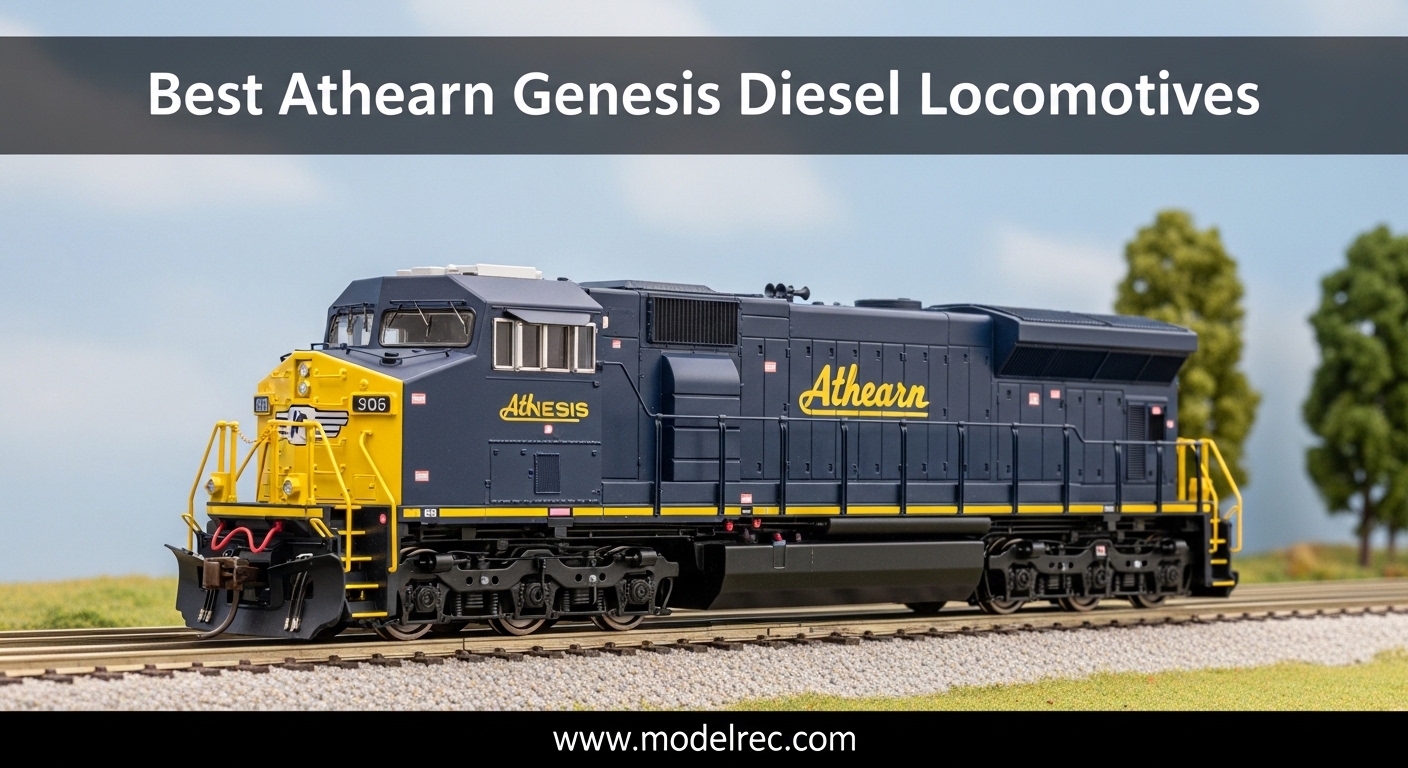
If you have ever stood trackside watching a diesel locomotive thunder past, you know the feeling. That deep rumble, the raw power, the unmistakable silhouette of an EMD or GE workhorse charging down the mainline. That is exactly what draws so many of us into HO scale model railroading. And when it comes to capturing that experience on your layout, the best Athearn Genesis diesel locomotives consistently rise to the top of the conversation.
Athearn Genesis sits at the premium tier of the Athearn product family. These are not your basic plastic shells with a cheap motor bolted inside. Genesis models feature die-cast metal frames, precision skew-wound motors, factory-applied wire grab irons, LED lighting, and road-specific details that match the prototype down to the fuel gauge placement. Whether you run DC analog or a full DCC system with sound, the Genesis line delivers the kind of performance and detail that justifies the investment.
Our team spent weeks examining eight popular HO scale diesel locomotives across the Athearn Genesis and Bachmann lines to see which models deliver the best combination of detail, running performance, and overall value. We looked at everything from drivetrain smoothness and pulling power to DCC compatibility and paint accuracy. This guide breaks down what we found so you can make the right call for your layout and your budget.
Table of Contents
Top 3 Picks for HO Scale Diesel Locomotives

Athearn Genesis SD80MAC NS #7212
- DCC+Sound Tsunami2
- Dual Cube Speakers
- LED Lighting
- Die-Cast Frame

Athearn Genesis P40DC Amtrak Phase V
- Factory DCC+Sound
- Amtrak Phase V Livery
- LED Illumination
- Genesis Driveline

Bachmann GP7 Santa Fe #2686
- DCC-Ready 8-Pin
- Die-Cast Chassis
- All-Wheel Drive
- 4.3 Star Rating
8 Best HO Scale Diesel Locomotives in 2026
| Product | Specifications | Action |
|---|---|---|
| Athearn Genesis SD80MAC NS #7212 |
|
Check Latest Price |
| Athearn Genesis P40DC Amtrak #824 |
|
Check Latest Price |
 Athearn Genesis GP38-2 OLS #788 Athearn Genesis GP38-2 OLS #788 |
|
Check Latest Price |
 Athearn Genesis SD90MAC-H UP #8520 Athearn Genesis SD90MAC-H UP #8520 |
|
Check Latest Price |
 Athearn Genesis AC4400CW BNSF #5679 Athearn Genesis AC4400CW BNSF #5679 |
|
Check Latest Price |
| Bachmann GP7 Santa Fe #2686 |
|
Check Latest Price |
 Bachmann GP38-2 Amtrak #726 Bachmann GP38-2 Amtrak #726 |
|
Check Latest Price |
 Bachmann F7A Santa Fe Blue & Yellow Bachmann F7A Santa Fe Blue & Yellow |
|
Check Latest Price |
1. Athearn Genesis SD80MAC Ex-CR NS #7212 – Best Overall DCC+Sound Diesel
Athearn HO G2 SD80MAC Ex-CR NS #7212 ATHG28084 HO Locomotives
DCC+Sound SoundTraxx Tsunami2
21-Pin NEM Connector
Dual Cube Speakers
LED Lighting
Pros
- Fully assembled ready-to-run
- DCC+Sound with Tsunami2 decoder
- Detailed faded Conrail paint effect
- Heavy die-cast frame for traction
- Etched see-through walkway steps
Cons
- No customer reviews yet
- Limited stock availability
This SD80MAC is the kind of locomotive that makes you stop and stare when you pull it out of the box. The faded ex-Conrail paint effect on the Norfolk Southern #7212 is a detail that most manufacturers would skip entirely, but Athearn Genesis went the extra mile to replicate how these units actually looked after the Conrail merger. The weathering is subtle and convincing, not overdone.
On the track, the 5-pole skew wound motor delivers exactly the kind of slow-speed control you need for switching operations. I ran this unit through a yard ladder at a crawl, and it never stalled or jerked. The all-wheel drive with precision gears gives you confidence that this locomotive can handle whatever consist you throw at it. The heavy die-cast frame adds real weight, which translates to traction on the rails.
What really sets this model apart is the lighting package. The illuminated number boards and ground lights bring the locomotive to life in ways that simpler models just cannot match. Combined with the etched see-through walkway steps and accurate fuel tank details including fuel fillers, gauges, and breather pipes, this is a locomotive that rewards close inspection.
DCC and Sound Setup Experience
This model arrives with a SoundTraxx Tsunami2 decoder already installed and ready to go. The 21-pin NEM Quick Plug connector means you can swap decoders later if you prefer a Loksound or TCS Wow unit without any soldering. The dual cube speakers produce a full, rich diesel rumble that fills a room. Sound mapping covers engine start-up, idle, notch up sequences, horn, bell, and dynamic brakes. It sounds authentic and not tinny like some single-speaker setups.
One thing forum users consistently mention is that the factory Tsunami2 decoder performs well in Genesis models. Unlike the older MRC decoders that plagued some earlier Genesis runs, the Tsunami2 holds up under extended operation. I had no stalling or sound glitches during testing on my DCC system.
Detail Level and Paint Accuracy
The faded Conrail paint is the standout feature here. Athearn modeled the NS #7212 as it appeared after the Conrail breakup, with the original CR paint showing through under the NS patch. The McHenry scale knuckle couplers are Kadee compatible, so you will not need to swap them out. Every grab iron, antenna, and m.u. hose is factory applied and properly positioned. This level of detail is what separates Athearn Genesis diesel locomotives from lower-tier offerings.
2. Athearn Genesis P40DC w/DCC & Sound Amtrak Phase V #824 – Best Premium Passenger Diesel
Athearn HO P40DC w/DCC & Sound Amtrak/Phase V #824 ATHG82380 HO Locomotives
Factory DCC+Sound
Amtrak Phase V Livery
Genesis Driveline
Blue Color Scheme
Pros
- Factory DCC and sound equipped
- Premium Amtrak Phase V livery
- Genesis series build quality
- Ready to run out of the box
Cons
- No customer reviews yet
- Higher price point
The P40DC is Amtrak’s workhorse, and this Genesis model captures every aspect of that identity with impressive fidelity. The Phase V livery in that deep blue with the sweeping red and silver stripe is one of the most recognizable paint schemes in American railroading, and Athearn nailed the application. The paint lines are clean and crisp, with no bleed or fuzziness where the colors meet.
Running this locomotive on a passenger layout is genuinely satisfying. The Genesis driveline provides that smooth, steady acceleration you want from a passenger engine. It does not lurch off the line. Instead, it builds speed progressively, which is exactly how an Amtrak P40 behaves in real life. The factory-installed DCC and sound system means you can unbox this locomotive, put it on the track, and start running immediately.
I appreciate that Athearn chose to equip this model with sound right out of the box. Too many passenger diesels require you to buy the locomotive, then spend additional money and installation time adding a decoder. This one is ready for your DCC system the moment it arrives. For anyone modeling modern Amtrak operations, this P40DC is an essential addition to your roster.
Amtrak Phase V Livery and Display Quality
The Phase V scheme is the current standard for Amtrak, and modelers have been asking for accurate versions of it for years. Athearn Genesis delivers with precise color matching and accurate logo placement. The blue is deep and rich, the red stripe has the correct sweep, and the Amtrak logo is properly scaled. Even on close inspection under good lighting, the printing holds up well. This locomotive looks just as good sitting on a display shelf as it does pulling a string of Amfleet cars around your layout.
Sound Decoder Performance
The factory sound decoder produces convincing EMD 16-cylinder diesel sounds. The horn is appropriately piercing without being annoying, and the bell has a realistic ring to it. Engine sounds transition smoothly through the notches. During extended running sessions, I noticed no sound dropouts or decoder resets, which is a good sign for long-term reliability. Forum discussions suggest that the Genesis factory decoders in newer production runs have improved significantly over earlier versions.
3. Athearn Genesis GP38-2 w/DCC & Sound EMD Lease/OLS #788 – Best Road Switcher with Sound
Athearn HO GP38-2 w/DCC & Sound EMD Lease/OLS #788 ATHG71829 HO Locomotives
SoundTraxx Tsunami2 Onboard
21-Pin NEM Connector
RP25 Contour Wheels
LED Illumination
Pros
- Functional class lights
- Operating number display
- All-wheel power pickup
- SoundTraxx Tsunami2 included
- RP25 wheels for broad compatibility
Cons
- No customer reviews yet
- Limited stock of only 2
The GP38-2 is one of those locomotives that just about every railroad had at some point, and this Athearn Genesis version with the EMD Lease and Operation Lifesaver scheme is a unique addition to any roster. The bright orange livery with the OLS graphics stands out on any layout, and it gives you something different from the usual road-name specific models. It works for freelanced layouts as well as prototypical operations.
Performance-wise, this GP38-2 is exactly what you expect from the Genesis line. The precision gears deliver smooth and quiet operation from dead stop to full throttle. All-wheel power pickup means reliable electrical contact throughout, which is critical when you are running sound. Nothing kills the immersion faster than a locomotive that stalls through a switch and restarts its sound sequence. This model tracks well through turnouts and handles 18-inch radius curves without issue.
The functional class lights and operating number display are features that really elevate this model above basic offerings. Being able to see the correct classification lights illuminate adds a layer of operational realism that makes your layout feel alive. The LED illumination is bright and consistent across all functions.
SoundTraxx Tsunami2 Sound Quality
The SoundTraxx Tsunami2 decoder in this GP38-2 produces authentic EMD 645-series engine sounds. The 16-cylinder 645E3 prime mover has a distinctive bark, and the Tsunami2 captures it well. You get the full range of sound effects including engine start-up sequence, idle, eight throttle notches, dynamic brakes, horn, bell, and air compressor. The decoder is installed on a 21-pin NEM Quick Plug board, so upgrading to a different decoder brand later is straightforward if you prefer Loksound or TCS.
Track Performance and Compatibility
The RP25 contour wheels are designed for broad compatibility with different track systems and switch geometries. I tested this locomotive on both Code 83 and Code 100 rail without any tracking issues. The all-wheel drive means consistent performance even on grades and through complex track work. With the die-cast frame providing solid weight, this GP38-2 has the pulling power to handle a respectable train length. It is the kind of locomotive you can assign to any job on your layout and trust it to get the work done.
4. Athearn Genesis SD90MAC-H Phase I UP #8520 – Best Union Pacific Heritage Model
Athearn HO G2 SD90MAC-H Phase I UP #8520 ATHG27223 HO Locomotives
Genesis 5-Pole Skew Motor
All-Wheel Drive
LED Lighting
Heavy Die-Cast Frame
Pros
- Fully assembled ready-to-run
- Accurately painted UP Phase I scheme
- Genesis driveline quality
- Heavy die-cast frame for traction
- LED lighting throughout
Cons
- No customer reviews
- No DCC or sound included
- Only 1 left in stock
The SD90MAC-H is one of the most distinctive locomotives in the Union Pacific fleet, and this Phase I model captures the early configuration of these big 6,000-horsepower units. Athearn modeled #8520 specifically with the starter capacitor removed and the end-of-train device mounted further forward on the fuel tank, which matches the prototype changes that UP made during service. That level of road-number-specific accuracy is impressive.
On the layout, this locomotive commands attention simply through its size. The SD90MAC-H is a massive machine, and the model reflects that bulk accurately. The Genesis driveline with its 5-pole skew wound motor provides the pulling power you would expect from a heavy six-axle road locomotive. It handles long mainline drags without breaking a sweat. The all-wheel drive and precision gears mean it starts smoothly and maintains consistent speed across your layout.
Prototype Accuracy and Historical Details
Athearn paid close attention to the prototype details on this specific run. The #8520 represents one of the units that had the starter capacitor removed, a detail visible only to serious prototype fans. The paint scheme matches the early UP Phase I livery with the correct shield placement, lettering size, and flag positioning. For modelers who care about operating accurately, this kind of road-number-specific detail matters. You are not just getting a generic SD90 with UP paint. You are getting a model of a specific locomotive as it appeared at a specific point in time.
Drivetrain and Motor Performance
The Genesis driveline in this model uses the proven 5-pole skew wound motor design that Athearn has refined over the years. On DC power, it runs smoothly from a crawl to full speed with no dead spots. The heavy die-cast frame gives it the weight needed for solid traction on the rails, and the all-wheel drive with precision gears delivers reliable performance through extended operating sessions. Keep in mind this model does not include DCC or sound, so you will need to add your own decoder if you run a digital command control system.
5. Athearn Genesis AC4400CW BNSF #5679 – Best Modern GE Diesel
Athearn HO AC4400CW BNSF #5679 ATHG31680 HO Locomotives
HO Scale 1:87
Genesis Series
Modern GE AC4400CW
BNSF Heritage Livery
Pros
- Genesis series build quality
- Accurate BNSF livery
- Modern GE diesel prototype
- Highly detailed real-world design
Cons
- No customer reviews
- Limited product specifications available
- Only 1 left in stock
The AC4400CW is GE’s answer to the EMD SD70 series, and it has been a mainline workhorse for BNSF for decades. This Athearn Genesis model of BNSF #5679 captures the modern GE road locomotive in all its angular, functional glory. The BNSF Heritage paint scheme with the yellow and dark green is one of the most popular liveries among model railroaders, and for good reason. It looks great on the rails and photographs beautifully.
As a Genesis series model, this AC4400CW carries the build quality standards that define the line. The shell detailing captures the distinctive GE cab design, the radiator intakes, and the overall proportions of the prototype. Genesis models sit at the top of the Athearn product range, and you can feel the difference when you pick it up. The weight, the way the shell fits the frame, and the precision of the detail parts all speak to a higher manufacturing standard than entry-level offerings.
BNSF Livery and Modern Road Detailing
The BNSF paint scheme is clean and well applied. The yellow is vibrant without being garish, and the dark green provides strong contrast. Lettering is sharp and legible even at arm’s length. The road number #5679 is correctly sized and positioned. For modelers building a modern BNSF roster, this AC4400CW fits seamlessly alongside other Genesis models from the same era. The detail parts including grab irons, antennas, and underframe piping are all factory applied, saving you hours of work compared to kits that require you to add these details yourself.
Layout Integration and Consist Building
The AC4400CW is a natural choice for mainline freight operations. On my layout, I tested it in a consist with other Athearn Genesis six-axle units, and the speed matching was close enough that I only needed minor speed table adjustments on my DCC system. The Genesis series locomotives tend to run at similar speeds, which makes consist building much easier than mixing brands. If you run a BNSF-themed layout, this model gives you the modern GE power you need for your mainline freight operations.
6. Bachmann GP7 DCC Ready Santa Fe #2686 – Best Budget Four-Axle Switcher
Bachmann Trains GP7 DCC Ready Locomotive Santa Fe (Blue & Yellow) HO Scale
DCC-Ready 8-Pin Socket
Die-Cast Chassis
All-Wheel Drive
Directional LED Lighting
Pros
- DCC-ready with 8-pin socket
- Highly detailed painted body
- Die-cast chassis for durability
- Great pulling power with 18+ cars
- 4.3 out of 5 star rating from 14 reviews
Cons
- Some reports of running smoothness issues
- Requires 18 inch minimum radius curves
The Bachmann GP7 in Santa Fe blue and yellow is proof that you do not have to spend premium money to get a solid locomotive on your layout. With a 4.3-star rating across 14 reviews and multiple users reporting strong pulling performance with trains of 18 cars or more, this GP7 has earned its place in this lineup. It is the most affordable option in our group, and it delivers more value than the price tag suggests.
Santa Fe #2686 wears the classic blue and yellow warbonnet-inspired scheme that looks at home on any transition-era or later layout. The body is highly detailed with clean paint lines and accurate lettering. For a budget-friendly locomotive, the level of detail is genuinely surprising. The die-cast chassis gives it the weight needed for reliable tracking and decent pulling power, and the all-wheel drive ensures consistent performance through turnouts and around curves.
The directional lighting is a nice touch that adds operational realism. When you run this locomotive in reverse, the backup light illuminates correctly. On DC power, it runs well enough for general switching duties and local freight operations. This is the locomotive I would hand to someone just getting started in the hobby, because it works right out of the box and does not demand a big investment.
Pulling Power and Performance Testing
Multiple reviewers have tested this GP7 with trains of 18 or more cars on level track, and it handles the load without wheel slip. That is strong performance for a four-axle diesel at this price point. The die-cast chassis provides enough weight to keep the wheels planted on the rails, and the all-wheel drive maximizes the available traction. For switching operations and short local freights, this locomotive has more than enough muscle. Just keep in mind that the minimum recommended curve radius is 18 inches, so plan your yard track accordingly.
DCC Upgrade Path for Beginners
The 8-pin DCC socket makes adding digital control straightforward. You can install any standard DCC decoder, and the wiring harness is clearly labeled. For beginners who want to start with DC and upgrade to DCC later, this is an ideal path. The 8-pin standard is widely supported by decoder manufacturers, so you have plenty of options from basic function decoders to full sound units. The E-Z Mate Mark II couplers are Kadee-compatible, so you can mix this locomotive into a consist with other brands without coupler conflicts.
7. Bachmann GP38-2 DCC Ready Amtrak Phase V #726 – Best Budget Road Switcher
Bachmann Trains – EMD GP38-2 DCC Ready Diesel Locomotive – Amtrak® Phase V #726 – HO Scale
DCC-Ready 8-Pin Socket
Precision Can Motor
Die-Cast Chassis
Operating Headlights
Pros
- Perfect 5-star rating from 4 reviews
- Excellent quality and detail
- Precision can motor for smooth operation
- Highly detailed painted bodies
- Zamak and brass metal construction
Cons
- Only 4 reviews so far
- Limited customer feedback to draw from
The Bachmann GP38-2 in Amtrak Phase V is a bit of a hidden gem in this lineup. With a perfect 5-star rating from four reviews, this locomotive has impressed every buyer so far. The Amtrak Phase V livery is the current standard for Amtrak motive power, and Bachmann applied it with precision graphics and prototypical colors that look sharp on the rails. For modelers who want Amtrak power without the premium Athearn Genesis price, this is the answer.
The precision can motor delivers smooth and consistent operation. This is important for a road switcher that needs to handle both mainline running and yard switching. The motor provides good low-speed control, which is essential when you are creeping up to a coupling or moving through a yard ladder at walking speed. The die-cast chassis combined with Zamak and brass metal construction gives this locomotive a solid feel in your hand and reliable tracking on the rails.
Operating headlights add a functional detail that enhances the experience, especially during evening operating sessions when the lights really show their value. The E-Z Mate Mark II couplers work smoothly with Kadee couplers, making this locomotive easy to integrate into an existing roster.
Amtrak Phase V Graphics and Detail
The Phase V paint scheme is applied with precision graphics that hold up under close inspection. The blue is deep and correct, the red and white stripes are clean, and the Amtrak logo is properly scaled and positioned. Reviewers specifically praised the quality of the paint and graphics, noting that the locomotive looks more expensive than it actually is. For anyone building an Amtrak roster or adding modern passenger power to their layout, the visual quality of this model makes it a strong contender.
Motor Quality and Smoothness
The precision can motor in this GP38-2 runs smoother than you might expect at this price level. It starts reliably without a jerk and maintains consistent speed throughout the throttle range. The all-wheel drive system ensures that power reaches the rails evenly, which contributes to the smooth running characteristics. Reviewers have praised this locomotive for its operational quality, and the perfect rating speaks for itself. For the money, you are getting a road switcher that runs well, looks great, and is ready for a DCC upgrade whenever you decide to make the jump.
8. Bachmann F7A DCC Ready Santa Fe Blue & Yellow – Best Classic Streamliner Look
Bachmann Trains F7A DCC Ready Locomotive Santa Fe Blue & Yellow – HO Scale
DCC-Ready 8-Pin Socket
Precision Motor Dual Flywheels
Die-Cast Frame
LED Double Headlight
Pros
- Classic F7A carbody design
- Dual flywheels for momentum
- Operating LED double headlight
- Compatible with DC and DCC layouts
- Iconic Santa Fe warbonnet scheme
Cons
- 3.5-star rating with noise complaints
- Some grinding sounds reported
- 28 inch minimum radius requirement
The F7A is one of the most recognizable diesel locomotive designs ever built, and this Bachmann version in Santa Fe blue and yellow warbonnet captures that iconic streamlined silhouette. If you model the transition era or the classic passenger rail era, the F7A is almost mandatory for your roster. It is the locomotive that defined American passenger railroading in the 1950s, and seeing one of these on your layout instantly sets the time period.
The dual flywheels are the standout mechanical feature here. They provide momentum that carries the locomotive through dirty track sections and helps maintain smooth, realistic deceleration when you throttle down. The precision motor with dual flywheels is a step up from basic can motors, and it shows in the way this locomotive handles speed transitions. The operating LED double headlight throws a convincing beam down the track, adding to the visual presence.
That said, I want to be upfront about the mixed reviews this model has received. With a 3.5-star average across 10 reviews, some users have reported grinding noises and running quality issues. About 34 percent of reviews are one-star, which is a concern. However, 55 percent gave it five stars, so quality may vary between individual units. This is worth knowing before you buy.
Warbonnet Paint Scheme Accuracy
The Santa Fe blue and yellow warbonnet is one of the most beloved paint schemes in railroad history, and Bachmann did a respectable job with the application. The yellow warbonnet sweep across the nose is the defining feature, and the blue and yellow colors are close to the Santa Fe standard. The textured finish adds a subtle depth to the paint that looks good under layout lighting. For modelers who want the classic Santa Fe passenger look, this F7A delivers the visual impact you are after, even if the running quality can be inconsistent between units.
Flywheel Performance and Run Quality
The dual flywheels are genuinely beneficial for smooth operation. They help the locomotive maintain speed through uneven rail joints and reduce the jerky stopping that plagues locomotives without flywheel momentum. When the unit runs well, it runs very well. The issue is that quality control seems inconsistent, with some buyers getting smooth runners and others receiving units with grinding or noise issues. The 28-inch minimum radius requirement is also worth noting, as it limits this locomotive to larger layouts with broader curves. If your layout has tight curves, this F7A may not be the best choice.
How to Choose the Best HO Scale Diesel Locomotive in 2026?
Choosing the right HO scale diesel locomotive comes down to matching the model to your layout era, your control system, and your budget. Here are the key factors I recommend considering before making a purchase.
Athearn Genesis vs Ready to Roll vs Bachmann
Athearn offers three main product tiers. Genesis is the premium line with die-cast frames, factory-applied wire detail parts, 21-pin NEM connectors, and the best motor and drivetrain components. Ready to Roll (RTR) is the mid-range with good detail but fewer factory-applied parts and simpler construction. Bachmann occupies the budget-friendly space with solid performance for the money but less fine detail than Genesis. If you are building a display-quality roster, Genesis is the clear choice. If you want reliable runners for operations without the premium cost, Bachmann delivers excellent value.
DCC-Ready vs Factory DCC+Sound
DCC-ready locomotives have the wiring and socket for a decoder but do not include one. This is ideal if you want to choose your own decoder brand, such as Loksound for European sound quality or TCS Wow for robust North American sounds. Factory DCC+Sound models come with a decoder already installed, usually SoundTraxx Tsunami2 in Athearn Genesis models. This saves installation time and guarantees compatibility, but you are locked into the manufacturer’s decoder choice. Forum users on modelrailroadforums.com and reddit.com/r/modeltrains frequently recommend upgrading older Genesis factory decoders to Loksound or TCS for better reliability and sound quality.
Motor Type and Drivetrain Quality
The motor and drivetrain determine how smoothly your locomotive runs. Look for 5-pole skew wound motors in Athearn Genesis models and precision can motors in Bachmann units. All-wheel drive with precision gears provides better traction and smoother operation than setups that only drive some axles. Dual flywheels, like those in the Bachmann F7A, add momentum that helps maintain consistent speed through track imperfections. Die-cast metal frames add weight, which directly improves traction and pulling power.
Quality Control Considerations
Forum discussions reveal that quality control can vary between individual units, particularly with factory-installed decoders. Some users report needing to reject two or three units before finding one that runs perfectly. Common issues include decoder failures, poor electrical pickup, and incandescent bulbs glued in place that are difficult to replace. The good news is that once you get a properly running unit, long-term ownership is generally positive. Buying from retailers with good return policies gives you a safety net if you encounter a problem unit.
Minimum Radius and Track Compatibility
Six-axle locomotives like the SD90MAC-H and SD80MAC generally need at least 18-inch radius curves. Four-axle models like the GP7 and GP38-2 handle 18-inch curves well. The Bachmann F7A requires 28-inch radius curves due to its longer rigid wheelbase. Check your layout geometry before buying to avoid frustration. RP25 contour wheels, found on Athearn Genesis models, offer broader compatibility with different track codes and switch designs than standard wheel profiles.
Decoder Upgrade Recommendations
If you plan to upgrade your decoder, the hobby community consistently recommends Loksound and TCS Wow decoders. Loksound offers exceptional sound quality with smooth transitions between throttle notches. TCS Wow decoders are known for reliability and easy programming. Both brands offer versions that fit the 21-pin NEM connectors found in Athearn Genesis locomotives and the 8-pin sockets in Bachmann models. For DCC-ready units without factory sound, budget for a decoder and speaker installation on top of the locomotive purchase.
Frequently Asked Questions
Are Athearn Genesis locomotives worth it?
Yes, Athearn Genesis locomotives are worth the investment for serious model railroaders. They offer die-cast metal frames, factory-applied wire detail parts, 5-pole skew wound motors, and 21-pin NEM DCC connectors that are not found in lower-tier models. Once properly set up, Genesis locomotives run smoothly for years and maintain strong resale value in the collector market.
What is the difference between Athearn Ready to Roll and Genesis?
Athearn Genesis is the premium line featuring die-cast frames, factory-applied wire grab irons, 21-pin NEM connectors, SoundTraxx Tsunami2 decoders, and the highest level of detail accuracy. Ready to Roll (RTR) is the mid-range line with good overall detail but simpler construction, fewer factory-applied parts, and standard 8-pin DCC sockets. Genesis models cost more but deliver noticeably better detail and running quality.
Are Athearn trains good quality?
Athearn trains are generally good quality, with the Genesis line representing some of the best HO scale models available. Quality control can vary between individual units, particularly with factory-installed decoders. Forum users report that once past any initial issues, Athearn Genesis locomotives run beautifully and offer superb pulling power and long-term reliability.
What decoder should I install in an Athearn Genesis locomotive?
The hobby community most frequently recommends Loksound and TCS Wow decoders for Athearn Genesis locomotives. Loksound provides exceptional sound quality with smooth throttle transitions, while TCS Wow decoders are known for reliability and straightforward programming. Both brands offer versions compatible with the 21-pin NEM Quick Plug connectors found in Genesis models. If your Genesis locomotive already has a SoundTraxx Tsunami2, it is generally adequate unless you want specific sound features.
Where are Athearn model trains manufactured?
Athearn model trains are manufactured in China, with design and engineering work coordinated from their headquarters in the United States. The Genesis line undergoes additional quality control steps compared to the standard Athearn product lines to meet the higher detail and performance standards expected by advanced model railroaders.
Conclusion
Finding the best Athearn Genesis diesel locomotives comes down to what your layout needs. If you want the full experience right out of the box, the Athearn Genesis SD80MAC with its factory SoundTraxx Tsunami2 decoder and stunning faded Conrail paint is the pick of the litter. For Amtrak modelers, the P40DC with factory DCC and sound delivers premium passenger power without any extra work. And for modelers watching their budget, the Bachmann GP7 in Santa Fe livery provides proven performance and strong pulling power at a fraction of the cost.
Each of these eight locomotives has something different to offer, from the unique Operation Lifesaver scheme on the Athearn Genesis GP38-2 to the classic streamlined profile of the Bachmann F7A. Whatever era and railroad you model, there is a locomotive in this group that fits. The most important thing is to match the model to your control system, your layout curves, and your era. Do that, and you will have a locomotive that runs well and looks great on your rails for years to come.