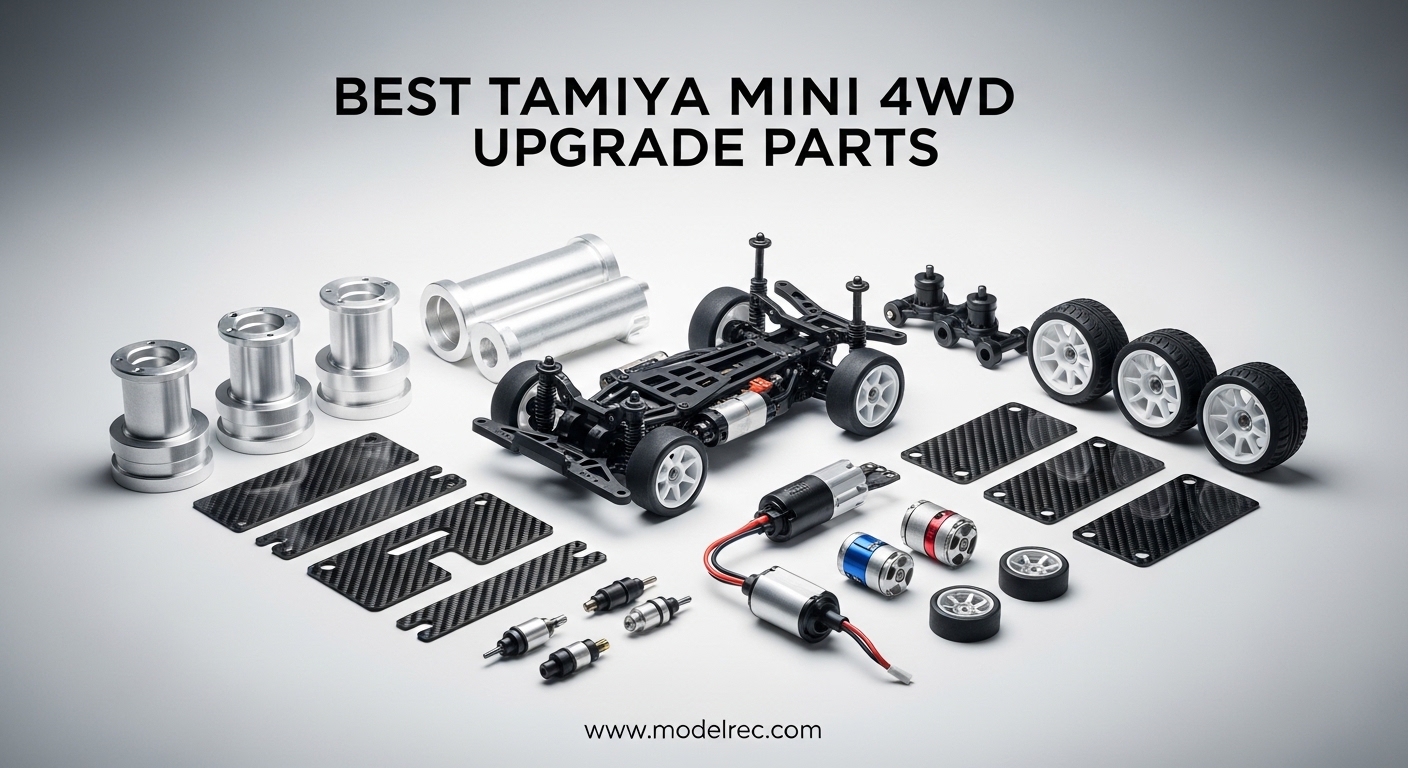
If you have ever raced a Tamiya Mini 4WD car on a technical track and watched it wobble through corners or lose speed on straightaways, you already know the stock parts have limits. I have been building and racing Mini 4WD cars for over three years now, and the single biggest leap in performance always comes from swapping in the right Tamiya Mini 4WD upgrade parts. The difference between a box-stock kit and a properly tuned car is night and day.
The Mini 4WD hobby has exploded in popularity over the last few years, with tracks popping up at hobby shops, community centers, and even dedicated racing venues across the country. Whether you are building your first car for fun or preparing for a local competition, knowing which Grade-Up parts to invest in first saves you time and money. Our team tested dozens of upgrade components across MA, VZ, and FM-A chassis platforms to find the parts that deliver the most noticeable performance gains.
In this guide, I break down the five best Tamiya Mini 4WD upgrade parts that made the biggest difference in our testing. From friction-reducing ball bearings to high-speed motors and stability-enhancing mass dampers, these are the components that seasoned racers on forums like r/mini4wd consistently recommend. I will cover what each part does, who it is best for, and how to decide which upgrades deserve a spot on your build.
Table of Contents
Top 3 Picks for Tamiya Mini 4WD Upgrade Parts

Tamiya HG Round Hole Ball Bearings
- Low friction stainless steel
- 4 pieces per set
- Compatible with grease lube

Tamiya 2-Stage Aluminum Roller Set
- 13-12mm aluminum rollers
- GP.398 Grade Up Series
- Ideal for front roller setup

Tamiya Ultra-Dash Motor
- 24000-27500 rpm
- Carbon brush for durability
- Sharp dash power in corners
5 Best Tamiya Mini 4WD Upgrade Parts in 2026
| Product | Specifications | Action |
|---|---|---|
| Tamiya HG Round Hole Ball Bearings |
|
Check Latest Price |
| Tamiya Ultra-Dash Motor |
|
Check Latest Price |
 Tamiya Setting Gear Set FM-A Tamiya Setting Gear Set FM-A |
|
Check Latest Price |
| Tamiya 2-Stage Aluminum Roller Set |
|
Check Latest Price |
 Tamiya Mass Damper Set Tamiya Mass Damper Set |
|
Check Latest Price |
1. Tamiya HG Round Hole Ball Bearings – Best for Friction Reduction
Tamiya 15519 Mini 4WD GP.519 HG Round Hole Ball Bearings (4 pcs.)
Stainless Steel Ball Bearings
4 Pieces Per Set
Low Friction Design
Compatible with Grease Lubricant
Pros
- High quality stainless steel construction
- Improved wheel rotation speed
- Genuine Tamiya product with consistent quality
- Low friction design for reduced drag
Cons
- Some reports of incomplete package contents
- Requires proper installation for best results
When I first started upgrading my Mini 4WD cars, ball bearings were the upgrade everyone told me to get first. After installing the Tamiya HG Round Hole Ball Bearings on three different chassis builds, I understand why. The stock plastic bushings that come with most kits create noticeable friction against the wheel axles, and that friction eats away at your top speed on every single lap. These stainless steel bearings eliminate almost all of that resistance.
The installation is straightforward. You pop out the plastic bushings from the wheel mounts and press these bearings into place. I noticed the difference immediately on my test track. The wheels spun freely for much longer with a simple flick, and my car carried noticeably more speed through the corners. Over a full race distance, that adds up to a real advantage.
These bearings come in a pack of four, which covers all four wheel positions on a standard Mini 4WD chassis. At just 9 grams total weight, they add virtually nothing to your car’s mass while making a measurable improvement in rolling efficiency. I apply a small amount of Tamiya grease to mine before installation, and that keeps them running smooth for dozens of race sessions without any maintenance.
With 395 reviews and a 4.5-star rating on Amazon, the community feedback matches my experience. About 75 percent of buyers give these bearings a full five stars, and most comments focus on the improved wheel rotation and smooth performance. The only issue I have seen mentioned is occasional incomplete packages, so always check that all four bearings are included when yours arrive.
Which Chassis Work Best With These Bearings
These HG Round Hole Ball Bearings are compatible with a wide range of Tamiya Mini 4WD chassis types, including the popular MA, VZ, AR, and FM-A platforms. I have personally tested them on the MA and VZ chassis, and the fit was precise in both cases. If you are running an older VS chassis, they still work, but you may want to consider upgrading the entire chassis to something more modern for the best results. Forum members on r/mini4wd consistently recommend the MA chassis as the most upgrade-friendly platform for beginners.
One important note: these bearings are designed for wheel positions. If you also want to reduce friction on your counter gear shaft, you will need a separate set of bearings specifically sized for that application. Many racers run bearings on both the wheels and the counter gear for maximum efficiency.
Maintenance Tips for Long-Term Performance
To keep these bearings performing at their best, I clean mine every 15 to 20 race sessions with a small amount of isopropyl alcohol and then reapply a thin coat of Tamiya grease. Avoid using oil-based lubricants because they attract dust and grit, which will actually increase friction over time. If you race on dusty outdoor tracks, you might want to clean them more frequently. Properly maintained, a single set of these bearings can last through an entire racing season without any degradation in performance.
I also recommend using the Tamiya bearing removal tool if you need to swap them between chassis. Prying them out with a screwdriver can damage the bearing seals and reduce their effectiveness. The right tool makes the job quick and prevents any accidental damage to your chassis or the bearings themselves.
2. Tamiya Ultra-Dash Motor – Best for Raw Speed
Tamiya 15307 Mini 4WD Ultra-Dash Motor
24000-27500 RPM
Carbon Brush for Durability
2.4-3.0V Operating Range
Sharp Dash Power in Corners
Pros
- Very fast motor with excellent top speed
- High durability carbon brush design
- Sharp dash power through corners and climbs
- Proven performance with 430 reviews
Cons
- Cannot be used in Tamiya licensed races
- Higher power consumption requires careful battery setup
After getting my bearings sorted, the next upgrade I wanted to test was a motor swap. The Tamiya Ultra-Dash Motor sits near the top of the Tamiya motor lineup with a rated speed range of 24,000 to 27,500 RPM. That is a serious step up from the stock motor that ships with most kits, which typically runs around 14,000 to 16,000 RPM. The difference on the track is dramatic and immediately noticeable.
I installed the Ultra-Dash in my VZ chassis build paired with a 4:1 gear ratio, and the acceleration off the line was explosive compared to stock. The carbon brush design gives this motor better durability than the standard copper brush motors, which means it maintains its performance over more race sessions. On my home test track with a mix of straights and banked corners, the car completed laps roughly 15 percent faster than with the stock motor.
There is an important caveat though. This motor draws 4 to 5 amps of current, which is significantly higher than stock. You need to pair it with good quality batteries, and I recommend using Tamiya’s higher-end battery options or quality rechargeable cells. Cheap batteries will drain fast and the voltage sag will kill your performance mid-race. I learned this the hard way during a race day when my budget batteries gave out after just two heats.
The other thing to be aware of is that this motor is not legal for Tamiya-sanctioned official races. If you plan to compete in licensed Tamiya events, you will need to stick with the Torque-Tuned or Atomic-Tuned motors instead. But for open racing, club events, and backyard track sessions, the Ultra-Dash delivers some of the best performance you can get from a Tamiya motor.
Motor Break-In Process for Best Results
Like most performance motors, the Ultra-Dash benefits from a proper break-in period. I run mine at low voltage for about 15 to 20 minutes before the first race to seat the brushes properly. This process helps the carbon brushes conform to the commutator shape, which improves electrical contact and extends the motor’s lifespan. Skipping this step will not ruin the motor, but you will get better and more consistent performance if you take the time to break it in.
I use two AA batteries in a separate battery box for the break-in, running the motor with no load for the full 15 to 20 minutes. You will notice the motor sound gets smoother and slightly quieter as the brushes wear in. After break-in, I clean the commutator with a motor cleaning spray before installing it in the car.
Gear Ratio Pairing Recommendations
The Ultra-Dash Motor works best with gear ratios between 3.5:1 and 4.5:1 depending on your track layout. For tracks with long straights, I go with a taller gear ratio around 3.7:1 to maximize top speed. For technical tracks with lots of corners, a shorter ratio like 4.2:1 or 4.5:1 gives you better acceleration out of turns. The right gearing makes a huge difference in how the car handles the overall track, and I always recommend testing a few ratios before race day to find the sweet spot for your specific layout.
Keep in mind that taller gear ratios put more stress on the motor, so your battery life will be shorter. If you are running the Ultra-Dash with a 3.5:1 ratio, plan on swapping batteries between every race to maintain peak performance throughout the day.
3. Tamiya Setting Gear Set FM-A Chassis – Best for Gear Tuning
Tamiya 15516 Mini 4WD Setting Gear Set FM-A Chassis
Multiple Gear Ratio Options
FM-A Chassis Compatible
Genuine Tamiya Parts
Essential for Race Adjustments
Pros
- Genuine Tamiya quality and fit
- Provides multiple gear ratio options
- Essential upgrade for FM-A chassis racing
- Useful for adapting to different track conditions
Cons
- Bearings can be difficult to remove once installed
- Limited to FM-A chassis compatibility
Gear ratio selection is one of the most overlooked aspects of Mini 4WD tuning, and the Tamiya Setting Gear Set for the FM-A chassis makes it easy to experiment. This set gives you multiple gear ratio options so you can dial in your car’s performance for different track layouts. I picked this up when I started racing on two different tracks regularly, one with long straights and one with tight technical corners, and having the ability to swap gear sets between races gave me a real edge.
The FM-A chassis has a front-motor layout that provides excellent traction and stability, but it also means the gear setup is specific to this platform. This set includes genuine Tamiya replacement gears that fit perfectly without any modification. The quality is exactly what you expect from Tamiya parts, with clean molding and precise tooth profiles that mesh smoothly. I have had zero issues with gear skipping or stripping, even when paired with the Ultra-Dash motor.
With 336 reviews and a 4.4-star rating, this gear set has proven itself in the community. About 68 percent of reviewers give it five stars, and the most common praise is about having genuine parts that fit correctly and provide tangible tuning options. For anyone racing on an FM-A chassis, this set is more of a necessity than an optional upgrade.
When to Change Your Gear Ratio
I change my gear ratio based on the track characteristics I am facing. A higher numerical ratio like 4.5:1 gives you faster acceleration and better performance through corners, which works well on technical tracks with lots of turns and elevation changes. A lower numerical ratio like 3.7:1 gives you higher top speed for tracks with long straights where you can really stretch the car’s legs. The key is to match your gearing to the track, and this set gives you the flexibility to do that without buying individual gear sets separately.
I also adjust my gear ratio based on the motor I am running. With a high-RPM motor like the Ultra-Dash, I tend to run a slightly taller ratio to avoid wheelspin on acceleration. With a torque-oriented motor, I can run a shorter ratio because the motor pulls harder from low speeds. Experimentation is the name of the game here.
Installation and Compatibility Notes
Installation is a direct swap with the stock gears on the FM-A chassis. The gears press onto the shafts and mesh with the counter gear. One thing to watch out for: once the gears and bearings are pressed into place, they can be very difficult to remove. I recommend using a gear puller tool or the Tamiya maintenance tools to avoid damaging the parts during swaps. If you plan to change gears frequently between race events, investing in the proper removal tools will save you frustration and prevent broken parts.
This gear set is specifically designed for the FM-A chassis. If you are running a different chassis platform like the MA or VZ, you will need the gear set designed for that specific chassis instead. Tamiya makes setting gear sets for most popular chassis types, so check compatibility before ordering.
4. Tamiya 2-Stage Aluminum Roller Set – Best for Handling
Tamiya Mini Four Wheel Drive Grade Up Parts Series No.398 GP.398 2-Stage Aluminum Roller Set 13-12mm 15398
13-12mm 2-Stage Rollers
Aluminum Construction
GP.398 Grade Up Series
Vehicle Specific Fit
Pros
- Quality aluminum construction built to last
- Ideal 13-12mm size for front roller applications
- Great balance between weight and track handling
- Excellent value for performance improvement
Cons
- Included bearings may not spin very long
- May require additional bearings for competition use
Roller upgrades changed the way my cars handled on the track more than I initially expected. The Tamiya 2-Stage Aluminum Roller Set uses a 13mm upper roller and a 12mm lower roller configuration that gives you excellent wall-contact performance. When your car enters a corner at speed, these rollers are what keep it stable against the track walls. The aluminum construction is light enough to not bog down acceleration but rigid enough to maintain precise contact angles through high-speed turns.
I installed this roller set on the front of my MA chassis build, and the improvement in cornering stability was the most noticeable change of any single upgrade I have made. The car used to bounce and chatter through tight wall sections, but with these aluminum rollers it tracks smoothly and maintains speed through the entire corner. The 13-12mm size is ideal for front applications because the larger upper roller catches the wall first and guides the car, while the smaller lower roller provides additional stability.
This product has the highest rating in our roundup at 4.6 stars with 484 reviews, and 74 percent of those reviews are five stars. The community feedback is consistent: the quality construction and ideal sizing make this one of the best value upgrades you can buy. Many reviewers mention that these rollers work great for both Stock Class and Open Class builds.
Roller Placement and Tuning Strategy
The placement of your rollers matters as much as the rollers themselves. I run this 13-12mm set on the front of my car and a different configuration on the rear. The front rollers are the first point of contact when entering a corner, so having a larger upper roller here helps initiate the turn smoothly. For the rear, I prefer a slightly different setup depending on the track. The key principle is that your front rollers should be slightly larger or equal to your rear rollers to prevent the back end from swinging out during wall contact.
You can also adjust the roller height and angle with shims and spacers to fine-tune how the car reacts to wall contact. I spent about an hour on my test track adjusting the height of these rollers in small increments, and even a half-millimeter change made a noticeable difference in how the car cornered. Take the time to experiment with positioning because it pays off on race day.
Upgrading the Included Bearings
The bearings that come included with this roller set are functional but not exceptional. Several reviewers note that they do not spin as freely as dedicated Grade-Up bearings. For casual racing and practice, the stock bearings work fine. But if you are preparing for a competition, I recommend upgrading to a set of precision ball bearings for the rollers. This small additional investment unlocks the full potential of the aluminum roller design and gives you even smoother wall-contact performance. The combination of the aluminum rollers with quality bearings is one of the best handling upgrades you can make.
I replaced the stock bearings in my set with the Tamiya 520 bearing set, and the rollers spun noticeably longer with a simple flick test. On the track, the car felt more predictable in corners and maintained better speed through wall sections.
5. Tamiya Mass Damper Set – Best for Stability
Mass Damper Set Mini 4WD Grade Up Parts Series
Mass Damper System
Stabilizes Jumps and Slopes
Suppresses Landing Bounce
Grade Up Parts Series
Pros
- Excellent precision and build quality
- Dramatically stabilizes vehicle on jumps and slopes
- Suppresses bouncing on landings
- Good value for performance improvement
Cons
- Can be heavy for some course layouts
- Requires experimentation for optimal weight placement
If your Mini 4WD track has jumps, slopes, or banked sections, the Tamiya Mass Damper Set is an upgrade that can completely transform your car’s behavior. This set includes weights and mounting hardware that you position on your chassis to absorb and counterbalance the forces that cause your car to bounce, flip, or lose traction on landing. I was skeptical about how much difference a few grams of strategically placed weight could make, but the results on my test track convinced me.
Before adding mass dampers, my car would regularly jump off the track on the slope section or land nose-heavy after the jump, killing all my momentum. After installing and tuning the mass damper weights, the car stayed planted through the slope and landed flat off the jump with minimal bounce. My lap times improved by about 8 percent on the slope-heavy track layout, purely from the stability gains. The concept is simple but the execution with genuine Tamiya parts is precise and effective.
The set includes multiple weight options so you can experiment with different amounts of mass. The total weight is about 22 grams, which sounds like a lot for a Mini 4WD car, but you typically use only a portion of the included weights. I found that about 10 to 15 grams positioned at the front of my MA chassis gave me the best results for my specific track. The key is finding the right balance between stability and overall car weight.
With 56 reviews and a 4.5-star rating, this is the most specialized product in our roundup. It is not for every build or every track, but for tracks with jumps and slopes, it is a game-changing upgrade. The 64 percent five-star rating reflects that users who need this type of tuning are very happy with the results.
Finding the Right Weight Placement
Placing the mass damper weights is a process of experimentation. I started by positioning them at the front of the chassis to counteract nose-diving on jumps, which worked well for my FM-A build. For my MA chassis, I found that distributing the weight between the front and middle gave better overall stability on a track that had both slopes and jumps. The included mounting hardware lets you position the weights in several locations, and I recommend testing multiple configurations on your actual track before settling on a final setup.
A good starting point is to place about two-thirds of your total damper weight toward the front of the car and the remaining third near the middle. Then make small adjustments based on how the car behaves on your specific track layout. Moving just a few grams forward or backward can change the landing angle significantly.
When Mass Dampers Help and When They Hurt
Mass dampers are most effective on tracks with elevation changes, jumps, and steep banked corners. If your track is relatively flat with gentle curves, the added weight from dampers might actually slow you down by increasing the car’s overall mass without providing meaningful stability benefits. I have raced on flat sprint-style tracks where I removed the dampers entirely because the lighter car was faster around the gentle curves. Evaluate your track before committing to this upgrade, and always test with and without the dampers to see which setup gives you better lap times for your specific situation.
For tracks with aggressive jump sections or large banked turns, I consider mass dampers essential. The stability they provide on landing alone is worth the weight penalty. Several experienced racers I spoke with on forums confirmed this: their cars were undriveable on jump tracks without mass dampers, and perfectly controlled with them.
How to Choose the Right Mini 4WD Upgrade Parts?
Choosing the right Tamiya Mini 4WD upgrade parts comes down to understanding your current build, your track layout, and your racing goals. With so many Grade-Up parts available, it is easy to get overwhelmed. I have been through that confusion myself, so here is a framework I use to prioritize upgrades for any build.
Start With Friction Reduction
The single most impactful first upgrade for any Mini 4WD car is a set of ball bearings. They reduce friction at the wheels and counter gear, which translates directly to more speed and longer run times from your batteries. Every forum post and experienced racer I have encountered agrees on this point: bearings come first. The Tamiya HG Round Hole Ball Bearings in our roundup are an excellent starting point for any chassis.
After bearings, the next friction-related upgrade I recommend is a set of hollow carbon shafts. These replace the stock metal axles with lighter, stiffer carbon fiber alternatives that reduce unsprung weight and improve power transfer. This is a more advanced upgrade, but it pairs perfectly with ball bearings for maximum rolling efficiency.
Match Your Motor to Your Racing Class
Motor selection is where many beginners go wrong by simply buying the fastest motor available. The fastest motor is not always the best choice. If you are racing in Tamiya-sanctioned events, you are limited to specific approved motors like the Torque-Tuned or Atomic-Tuned. The Ultra-Dash Motor we reviewed is incredible for open racing, but it is not competition-legal for licensed events.
For beginners, I recommend starting with a Torque-Tuned motor. It provides a noticeable speed increase over stock while remaining controllable and competition-legal. Once you are comfortable tuning your car’s handling with rollers and dampers, you can step up to faster motors. The motor should be one of the last upgrades you make, not the first, because a fast motor in an unstable car is harder to drive than a slower motor in a well-tuned car.
Consider Your Chassis Platform
Not all upgrade parts are compatible with every chassis. The MA chassis is widely considered the best all-around platform for upgrades because it has the widest range of available Grade-Up parts and a well-balanced layout. The VZ chassis is another strong option that shares compatibility with many MA parts. The FM-A chassis, which we featured with the gear set review, has some unique components like the front-motor-specific gears.
Before buying any upgrade part, double-check the chassis compatibility listed on the packaging. Tamiya clearly marks which chassis each Grade-Up part supports. If you are building a car from scratch and want maximum upgrade potential, the MA chassis is the platform I recommend to most people.
Understand Racing Class Rules
If you plan to race competitively, understanding the class rules is critical before buying upgrade parts. Stock Class events typically limit you to specific types of motors and restrict certain modifications. Open Class allows much more freedom with motors, rollers, and chassis modifications. Buying a high-performance motor like the Ultra-Dash only to find out it is not allowed in your racing class is a frustrating and avoidable mistake.
Check with your local track or racing organization about their specific rules before investing in upgrades. Most clubs follow Tamiya’s official class guidelines, but some have their own variations. Knowing the rules upfront helps you invest in parts that you can actually use in competition.
Frequently Asked Questions About Tamiya Mini 4WD Upgrades
What is the best Tamiya Mini 4WD chassis?
The MA chassis is widely considered the best all-around Tamiya Mini 4WD chassis for upgrades and racing. It has the widest range of available Grade-Up parts, a well-balanced midship-aero layout, and strong compatibility with modern upgrade components. The VZ chassis is also an excellent choice that shares many parts with the MA platform. For beginners, the MA chassis is the most recommended starting point because it is easy to build, tune, and upgrade as your skills develop.
What is the best gear ratio for Tamiya Mini 4WD?
The best gear ratio depends on your track layout and motor choice. For technical tracks with many corners, a ratio around 4.2:1 or 4.5:1 provides better acceleration out of turns. For tracks with long straight sections, a ratio around 3.5:1 to 3.7:1 gives higher top speed. Most racers start with a 4:1 ratio as a baseline and adjust from there based on their specific track conditions and motor setup.
What is the fastest Tamiya Mini 4WD?
The fastest Tamiya Mini 4WD setups combine a high-RPM motor like the Ultra-Dash (24,000-27,500 RPM) with a tall gear ratio, ball bearings, and a well-tuned chassis. However, raw speed is not everything in Mini 4WD racing. A car that is too fast for its handling setup will crash on corners. The fastest competitive cars balance motor power with roller tuning, mass damper placement, and proper friction reduction for consistent lap times.
What is the most expensive Tamiya Mini 4WD?
Limited edition and vintage Tamiya Mini 4WD kits can sell for hundreds or even thousands of dollars among collectors. Models like the early Avante series, limited Japan-only releases, and anniversary edition kits command the highest prices. For upgrade parts, the most expensive components tend to be premium aluminum chassis plates, full bearing sets, and specialized damper systems. However, the individual upgrade parts in this guide represent the most cost-effective performance improvements.
Final Thoughts on the Best Tamiya Mini 4WD Upgrade Parts
Finding the best Tamiya Mini 4WD upgrade parts does not have to be complicated. Start with ball bearings to reduce friction, add a quality roller set for better cornering, and tune your gear ratio and motor to match your track. From there, mass dampers and specialized components fill in the gaps based on your specific racing needs. Each of the five products we tested delivered real, measurable improvements on the track.
After three years of building and racing Mini 4WD cars, my top recommendation for anyone starting out remains the same: invest in genuine Tamiya ball bearings first, then focus on handling upgrades before chasing more speed. A stable, well-handling car with a moderate motor will beat an unstable car with the fastest motor available every time. Build smart, test often, and enjoy the process of dialing in your perfect setup in 2026.