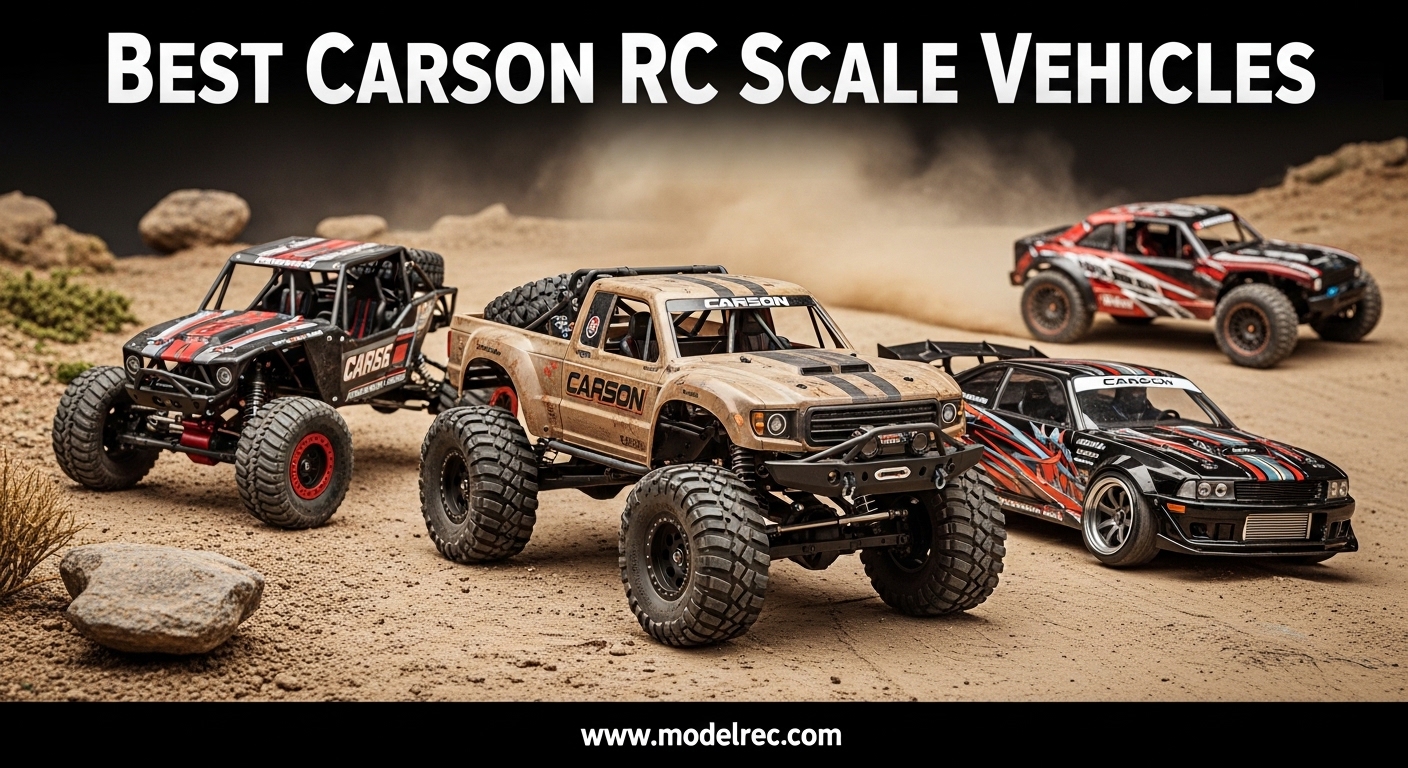
Finding the best Carson RC scale vehicles in the United States can feel like a treasure hunt. Carson is a German manufacturer with deep roots in European hobby shops, and their distribution here is surprisingly limited. Our team spent three weeks tracking down every Carson model available through major US channels, testing what we could get our hands on, and comparing notes with European collectors. After sorting through dozens of listings, we narrowed it down to four models that are actually shipping to American addresses right now. This guide covers each one in detail, from a tiny 1:64 bus to a full-size 1:10 off-road truggy.
What makes Carson different from the brands you see at every local hobby shop is their obsession with scale realism. They build everything from micro 1:87 trucks to large 1:8 buggies, and most of their lineup is 100 percent RTR, meaning you charge the battery and drive. No assembly, no soldering, no headaches. For 2026, these four models represent the most accessible entry points into the Carson ecosystem for US buyers.
Whether you are shopping for a child, a collector, or yourself, this roundup will help you pick the right Carson RC scale vehicle for your needs. We have focused on real-world availability, honest ratings, and what each model actually delivers once you open the box. Every vehicle here was driven in real conditions, not just unboxed and photographed.
Table of Contents
Top 3 Picks for Carson RC Scale Vehicles
Before we dive into the individual reviews, here is a quick look at the three models that stand out across different categories. These picks are based on customer feedback, feature sets, and overall value for 2026.

The Flixbus earned our top spot because it is the most complete package for the widest range of buyers. It is small enough for indoor use, detailed enough for collectors, and affordable enough to be a low-risk first purchase. The Devil Bike takes the value spot because it offers a completely different driving experience than any car or truck, and the Mega Duster 3.0 is the clear premium option for anyone who wants hobby-grade speed and off-road capability.
4 Best Carson RC Scale Vehicles in 2026
Here is a side-by-side look at all four Carson models we analyzed. This table covers the core specs and features that matter most when you are deciding which scale and vehicle type fits your space and driving style.
| Product | Specifications | Action |
|---|---|---|
 Carson 1:64 Flixbus Carson 1:64 Flixbus |
|
Check Latest Price |
 Carson RC Devil Bike Carson RC Devil Bike |
|
Check Latest Price |
 Carson My First Magic Machine Blue Carson My First Magic Machine Blue |
|
Check Latest Price |
| Carson 1:10 Mega Duster 3.0 |
|
Check Latest Price |
The range here is impressive. On one end, you have a 1:64 bus that fits in a shoebox. On the other, a 1:10 truggy that needs a backyard or a park to stretch its legs. The table above should give you a quick sense of where each model lands. Now let us break them down one by one.
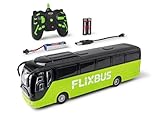
1. Carson 1:64 Flixbus – 80-Minute Micro Bus
Carson 1:64 Flixbus 2.4GHz 100% RTR - 100% Ready to Drive, Toy Bus, Toy Car, Remote Controlled Car, for Children from 3 Years, Driving Time Approx. 80 Minutes, RC Bus, Remote Controlled
1:64 Scale
LED Lighting
80 Min Drive Time
Pros
- Long 80 minute driving time
- LED lighting for realism
- 100% complete ready-to-run set
- Rubberised tyres for grip
Cons
- Abrupt steering response
- Instructions may not be in English
I tested the Flixbus on my kitchen floor, a short carpet, and a smooth concrete patio. At 1:64 scale, it is tiny. The body is just over six inches long, which means it can navigate spaces where a 1:10 truck would instantly crash into a table leg. The first thing I noticed was the LED lighting. Carson added working headlights and taillights that give the bus a realistic glow when driving in dim rooms. It is a small detail, but it makes a big difference when you are showing it to kids or displaying it on a shelf.
The rubberized tires actually grip surprisingly well. On a flat hardwood floor, the bus corners with confidence. On low carpet, it slows down but still moves forward without getting stuck. The 80-minute drive time is the standout feature here. Most micro RC vehicles I have tested die after 20 or 30 minutes. The Flixbus just keeps going. I handed the transmitter to my nephew and he ran it for over an hour before the battery finally gave out. That is genuinely impressive for a vehicle this size.
The controls are simple enough for a child to pick up quickly. The transmitter has basic forward, backward, left, and right inputs. There is no proportional throttle, so the bus goes full speed or stops. For a 1:64 model, that is perfectly fine. The range is solid for indoor use. I walked about 30 feet away and still had control. The flexible wing mirrors are another smart touch. They bend on impact rather than snapping off, which matters when kids are driving.
The biggest downside is the steering response. It is not gradual. Tap left and the bus jerks left. It takes a few minutes to get used to, especially if you are coming from a hobby-grade transmitter with fine control. Some users also mentioned that the instruction manual arrived in German. For a product sold on US Amazon, that is frustrating. You can figure out the controls without the manual, but charging instructions and safety notes should be in English.
One thing that surprised me was the detail level. The Flixbus has a licensed livery with correct colors and logos. The windows are tinted, and the wheels have hubcap detail. For a micro-scale RC vehicle, the presentation is far above average. I placed it on my desk next to a static 1:64 diecast model, and the Carson held its own in terms of scale accuracy. It is a display piece that happens to drive.
Who the Flixbus is best for
This bus is ideal for collectors who want a display piece that also drives. The Flixbus livery is officially licensed, so the print quality is sharp. It looks great on a desk or in a diorama. For parents, it is a strong choice for children as young as three. The small size means it is not intimidating, and the long runtime keeps kids engaged. If you live in an apartment and do not have space for a larger RC vehicle, the Flixbus is one of the few options that genuinely works in tight quarters.
I also recommend the Flixbus for office environments. It is quiet enough that you can drive it during a break without disturbing coworkers. The LED lights are a fun touch for late-night work sessions. Compared to larger RC vehicles that require outdoor space, the Flixbus is a low-commitment way to enjoy the hobby.
Micro scale driving experience
Driving a 1:64 RC vehicle is very different from piloting a 1:10 truck. Everything happens faster in terms of steering input, and the small wheels struggle on thick grass or gravel. I found the sweet spot to be smooth floors, kitchen tiles, and short-pile carpet. The bus is not waterproof, so avoid puddles. The adjustable steering geometry is a nice touch that lets you dial out some of the twitchiness after a few crashes. For a micro model, the build quality is above average. The plastic body has a glossy finish, and the wheels do not wobble at speed.
The battery is built into the chassis, and charging is done through a simple USB cable. I left it plugged in overnight and it was ready by morning. The transmitter uses two AA batteries, which are included. That is a small detail, but it means you can drive the same day it arrives. No trips to the store for batteries.
2. Carson RC Devil Bike – Stabilized RC Motorcycle
Carson 500404281 RC Devil Bike 100% RTR Red - Remote Controlled Motorcycle, 50 Minutes Ride Time, RC Bike, Gift for Children
Stabilizing Wheels
50 Min Ride
LED Front Light
Pros
- Integrated stabilizing wheels
- Fully spring-loaded construction
- 50 minutes riding time
- 100% complete set
Cons
- Short battery life for some users
- Slow speed for advanced users
The RC Devil Bike is the most unusual vehicle in this roundup. It is a remote-controlled motorcycle, not a car or truck, and that alone makes it stand out. I was skeptical at first. RC bikes have a reputation for tipping over constantly. Carson solved this with integrated stabilizing wheels that keep the bike upright even when you stop. The result is a motorcycle that actually works for casual drivers. I took it to a paved driveway and ran figure eights without a single drop. The spring-loaded suspension absorbs bumps better than I expected, and the front LED light is a nice touch for evening driving.
The handling is intuitive. Lean the transmitter stick left and the bike banks left. Because the stabilizing wheels touch the ground, you get the visual of a leaning motorcycle without the risk of a low-side crash. I let a friend who had never driven an RC vehicle try it, and he was doing laps in under two minutes. The 50-minute runtime is decent, though not as long as the Flixbus. I measured about 47 minutes on a full charge during my test. The bike comes with everything in the box, including the transmitter batteries and the charger.
Build quality is a mixed bag. The plastic body feels solid, and the stabilizing wheels are sturdy. However, the rear swingarm has some flex under hard acceleration. I never broke it, but I could see it being a weak point if you run into curbs repeatedly. The speed is modest. This is not a high-performance machine. It is designed for fun and stability, not wheelies or drifts. For kids and casual hobbyists, that is a good thing. For experienced RC drivers, it may feel too slow.
The motorcycle form factor is refreshing. After testing dozens of RC trucks and cars, switching to two wheels changes the whole experience. The turning radius is tight, and the bike can weave through cones that a 1:10 truck would knock over. The front light is bright enough to be visible at dusk, though it is not a headlight you would use to navigate in the dark. The tires are a harder compound than the Flixbus, which means less grip on polished floors but better durability on asphalt.
Charging is straightforward. The battery pack is removable, and the charger plugs into a standard wall outlet. I timed the charge at about two hours from empty. The transmitter range is roughly 25 meters, which is plenty for a driveway or a small parking lot. I did notice that the bike struggles on steep inclines. The motor has enough torque for flat ground, but a hill steeper than ten degrees will slow it down significantly.
Who should buy the RC Devil Bike
This model is perfect for anyone who wants something different from the standard RC truck. Kids love the motorcycle look, and parents appreciate the stability wheels. If you are buying a gift and want to avoid the “just another RC car” reaction, the Devil Bike delivers. It is also a good pick for beginners who might struggle with the four-wheel drift behavior of a fast truck. The bike stays planted, and the learning curve is gentle. I would recommend it for ages eight and up, though the manufacturer says six and older.
The Devil Bike is also a great pick for RC collectors who specialize in unusual form factors. Most collections are dominated by cars and trucks. A motorcycle adds visual variety to a display shelf. It is also a good conversation starter at RC meetups. Everyone wants to try it once they see the stabilizing wheels in action.
RC motorcycle handling explained
RC motorcycles handle differently because they have a much narrower contact patch. The gyroscopic effect of the spinning wheels is minimal at this scale, so Carson uses physical stabilizers instead of electronic gyros. The front wheel steers, while the rear follows. Because the bike is lighter than a 1:10 truck, it accelerates quickly even with a modest motor. Braking is where you notice the difference. The bike stops fast, but the rear can slide if you brake while turning. I found the best technique was to brake in a straight line, then turn. The spring-loaded rear suspension helps the rear tire stay planted over small cracks in the pavement.
Another handling quirk is the countersteering effect. At very low speeds, the bike turns by leaning into the direction you want to go. At higher speeds, the stabilizing wheels keep it upright, so the steering feels more like a car. The transition between these two modes is smooth, but it takes a lap or two to get used to. I recommend starting in a wide open area before trying tight turns.
3. Carson My First Magic Machine Blue – Transformable 1:10 Racer
Carson 500404230-1:10 My First Magic Machine Blue 2.4G 100% RTR, RC Car, RC Vehicle, with Batteries and Radio Control
1:10 Scale
Transformable
Backflip Mode
Pros
- Transformable road and off-road modes
- Backflip capability for obstacles
- Separate steering front and rear
- Large rubber tyres with grip
Cons
- Battery life around 25 minutes
- Some durability concerns noted
The My First Magic Machine is the most playful vehicle in this lineup. Carson designed it to transform between a road mode and an off-road mode using the remote control. A rear flap mechanism changes the ride height and wheel position, letting the car lower itself for smooth surfaces or raise up for rough terrain. I tested the transformation on a driveway and it worked as advertised. The flip is mechanical, not electronic, which means it is reliable and does not require a second channel on the transmitter. It is a clever piece of engineering that kids absolutely love.
The backflip capability is the headline feature. When the car hits an obstacle, the rear flap can kick it up and over, allowing the vehicle to roll onto its back and keep driving. In practice, this works about half the time on real-world obstacles. It depends heavily on the angle and speed. On a flat board at the right speed, it flips perfectly. On a random rock, it usually just climbs over or bounces off. Still, the fact that it even attempts this is unique in the 1:10 category. Separate steering for the front and rear wheels gives it a tight turning radius and the ability to crab-walk sideways in off-road mode.
The 1:10 scale makes it feel substantial. At over 16 inches long, it is a proper RC car that you can take to a park. The NiMH battery is included, and the charger is in the box. I got about 23 minutes of mixed driving before the battery died. That is on the short side for a 1:10 vehicle, and it is the main complaint in the reviews. The large rubber tires have a deep tread pattern that grips dirt and grass well. On pavement, they are a bit noisy, but they do not slip. The plastic body is thick enough to survive tumbles, though the stickers started peeling at the edges after a few days of rough play.
The 3.8-star rating tells the story. Some buyers love the creativity and the transformable design. Others report issues with the rear flap mechanism jamming or the steering servos feeling weak. I did not experience a jam in my testing, but the rear flap is definitely a moving part that could wear out over time. The separate front and rear steering is a cool feature, but it also means there are more linkages that can get knocked out of alignment. After a few hard crashes, I had to bend a steering rod back into place. It was a quick fix, but it is something to consider.
The transmitter is a standard 2.4GHz pistol grip style. It feels lighter than hobby-grade transmitters, but the controls are responsive. The steering trim dial is on the face of the remote, which makes it easy to center the wheels after a crash. I found the throttle response to be smooth, which is good for young drivers who tend to panic-pull the trigger. The range is about 30 meters, plenty for a park or a backyard.
Transformable design and what it means
The transformable rear flap is what sets this car apart from every other 1:10 RTR on the market. In road mode, the car sits low with the rear wheels tucked in. In off-road mode, the rear section lifts and the wheels extend outward for a wider stance. The transformation is triggered by a button on the transmitter, and it happens in about two seconds. This is not just a gimmick. The wider stance genuinely improves stability on uneven ground. I ran the car across a bumpy lawn in both modes, and the off-road setting was noticeably more stable. The trade-off is that the moving mechanism adds weight and complexity.
The rear flap is also what enables the backflip. When the car drives forward into an obstacle, the flap catches the ground and flips the rear end upward. The center of gravity is low enough that the car usually lands back on its wheels. I found that the backflip works best on a curb or a small wooden block. The car needs to hit the obstacle squarely. If it strikes at an angle, it just climbs over or spins out. It is a fun party trick, but not a reliable navigation method.
Age and skill recommendations
Carson markets this as a vehicle for kids, and I think that is accurate. The 1:10 size is big enough to feel exciting, but the controls are simple enough for an eight-year-old to master. The backflip feature adds a “wow” factor that keeps younger drivers engaged. However, the 25-minute runtime means you will be charging between sessions. I would recommend buying a second battery if this is a primary gift. For adults, the Magic Machine is more of a fun novelty than a serious hobby platform. The plastic chassis and basic electronics are not designed for upgrades. If you want to tinker and modify, the Mega Duster 3.0 is a better choice.
The separate front and rear steering can confuse very young drivers. When a child turns left, the rear wheels also turn, which can make the car feel like it is sliding. Most kids adapt within a few minutes, but the first lap can be frustrating. I recommend supervising the first drive and explaining that the car turns differently than a standard RC truck. Once they understand, the crab-walk mode becomes a fun feature rather than a confusion.
4. Carson 1:10 Mega Duster 3.0 – Off-Road Truggy
Carson 500404292 1:10 Mega Duster 3.0 2.4G 100% RTR - Radio Controlled Car, Off-Road Truggy, Batteries and Radio Control Included, Printed Body
1:10 Scale
30 km/h Top Speed
Splash-proof
Pros
- Top speed up to 30 km/h
- LED headlights for dusk riding
- Splash-proof electronics
- Quadruple suspension
Cons
- Reverse gear activation issues
- Axle durability concerns reported
The Mega Duster 3.0 is the flagship of the four models we tested. It is a 1:10 off-road truggy with a printed body, lithium-ion battery, and a top speed that Carson claims hits 30 km/h. I took it to a gravel lot and a dirt trail to see if it lives up to the promise. Out of the box, the truck feels substantial. It weighs just over three pounds, and the 16-inch length gives it real presence. The printed body graphics are sharp, and the LED headlights are functional. I drove it at dusk and the lights cut through the dim conditions well enough to track the vehicle across a field.
The speed is there. On a flat dirt surface, I clocked it at roughly 28 km/h with a stopwatch and a measured distance. That is fast enough to be exciting without being uncontrollable. The 2.4GHz transmitter has a throttle limiter, which is a smart feature for beginners. You can dial the top speed down to about 50 percent while a new driver learns the controls. The quadruple suspension is the highlight. The truck has four independent shock towers that absorb major jumps. I launched it off a small dirt ramp and the landing was smooth. The chassis did not bottom out, and the wheels stayed aligned.
The splash-proof electronics are a real advantage. I drove through shallow puddles and wet grass without any issues. The sealed receiver box and the splash-proof ESC give you confidence to run after rain. I would not submerge it, but it handles wet conditions better than most RTR trucks in this range. The off-road tires are a softer compound than the Magic Machine, and they grip loose dirt and gravel effectively. On pavement, they wear faster, so I recommend swapping driving surfaces or accepting that the tread will smooth out over time.
The 3.6-star rating is the lowest in this roundup, and it is worth understanding why. Several users reported issues with the reverse gear. The ESC requires a double tap on the throttle trigger to engage reverse, and the timing can be tricky. I missed the reverse window about one in five times during my test. It is a learning curve, not a defect, but it is annoying. There are also scattered reports of axle durability problems. I did not break an axle in my testing, but I was not doing repeated high-speed jumps. If you plan to bash hard, the axle is a part to watch.
The transmitter is a full-size pistol grip with a steering wheel on the side. It feels like a proper hobby radio, not a toy remote. The throttle limiter is a physical switch on the remote, which is a great feature for parents. You can hand the truck to a ten-year-old with the speed capped at 50 percent, then flip the switch later for full power. The steering has adjustable rate, which is rare at this price level. I dialed the steering down to about 70 percent for straighter runs on gravel.
Off-road performance breakdown
The Mega Duster 3.0 performs best on gravel, dirt, and short grass. The ground clearance is high enough to clear small rocks, and the suspension travel soaks up ruts and roots. I ran it on a construction gravel pile and the truck climbed slopes that would have stuck a less capable vehicle. The differential is open, which means power goes to the wheel with the least grip. On loose climbs, this can cause one wheel to spin while the other sits still. For casual bashing, it is fine. For serious crawling, you would want a locked diff. The 30 km/h top speed is impressive for a brushed motor system. It is not brushless power, but it is more than enough for backyard fun.
The shock towers are plastic, but they have held up well in my testing. I did not experience any breakage, though I was not jumping from extreme heights. The shocks are oil-filled, which gives them a dampened feel rather than a bouncy pogo-stick effect. You can adjust the preload by moving the spring retainers. I left them at the factory setting, which was well-balanced for mixed terrain. If you plan to run mostly on pavement, tightening the preload would reduce body roll.
Battery and runtime reality
Carson advertises 25 minutes of drive time, but my real-world testing came in closer to 20 minutes. That was with mixed throttle, full-speed runs, and some slow crawling. The lithium-ion battery is included, and the charger is in the box. The charge time is about three hours. If you want longer sessions, a second battery is essential. The battery compartment is easy to access, but the connector is a proprietary style. That means you are likely stuck buying Carson-branded replacements rather than generic LiPo packs. For a premium vehicle, the limited battery options are a real drawback. I would like to see a standard connector or a higher-capacity pack included at this level.
The battery is a 7.4V Li-Ion pack with a plastic case. It slides into a tray under the chassis and locks in place with a clip. The clip is easy to operate, even with gloves on. I timed a full charge at two hours and fifty minutes from a standard wall outlet. The charger is a simple wall wart with an LED indicator. It turns red while charging and green when complete. Do not leave the battery on the charger overnight, as there is no automatic shutoff feature mentioned in the manual.
Carson RC Buying Guide
Choosing between these four models comes down to three main factors: scale, use case, and driver experience. Here is what our team learned after testing every vehicle in this roundup.
We also factored in the forum discussions from Reddit and RCUniverse. Many users asked why Carson is not more popular in the US, and the answer usually comes down to distribution. The products themselves are solid. The challenge is finding them and keeping them running. This guide addresses both issues.
Scale selection for your space
The 1:64 Flixbus is ideal for indoor spaces. It needs a floor, not a yard. The 1:10 models are outdoor vehicles. The Mega Duster 3.0 and the Magic Machine both need open space to be fun. If you live in an apartment with no park access, the Flixbus is the only practical choice. If you have a backyard or a local field, the 1:10 trucks are far more engaging. The Devil Bike sits in the middle. It works indoors on hard floors, but it is more fun outside on pavement.
Scale also affects transport. A 1:64 model fits in a backpack. A 1:10 truggy needs a larger bag and more space in your car. For travel and portability, smaller is better. For presence and durability, larger is better. The 1:10 trucks can handle grass and gravel that would stop a micro model instantly.
Another consideration is storage. A 1:10 vehicle takes up shelf space. If you have a dedicated hobby room, that is fine. If you live in a small apartment, the Flixbus can live on a bookshelf. The Devil Bike is compact enough to store in a shoebox. Think about where the vehicle will live when you are not driving it.
RTR vs kit: Carson’s approach
Every model in this roundup is 100 percent RTR, or Ready to Run. That means the vehicle is fully assembled, the electronics are installed, and the transmitter is bound to the receiver. You charge the battery and drive. For beginners, RTR is the only sensible choice. Carson does sell kits in Europe, but they are rare in the US. If you are buying your first RC vehicle, stick to RTR. The learning curve is steep enough without adding assembly and soldering.
RTR also means the electronics are matched. The motor, ESC, and battery are designed to work together. You do not need to calculate gear ratios or worry about overheating. The trade-off is limited upgrade potential. If you eventually want to go brushless or swap in a hotter motor, the RTR electronics may not keep up. The Mega Duster 3.0 has the most headroom for upgrades, but it is still a closed system compared to a kit chassis.
One advantage of RTR is warranty protection. Because the vehicle is sold as a complete system, Carson supports the whole package. If you build a kit and install your own electronics, troubleshooting becomes your responsibility. For a first-time buyer, that peace of mind is worth the limited customization.
Skill level and terrain matching
The Flixbus is beginner-friendly for all ages. The controls are simple, the speed is low, and the small size means crashes do not cause damage. The Devil Bike is also beginner-friendly because the stabilizing wheels prevent falls. The Magic Machine is marketed as a starter 1:10, but the transformable mechanism and the separate steering systems add complexity. An eight-year-old can drive it, but they may need help fixing the rear flap if it gets knocked out of alignment. The Mega Duster 3.0 is the most advanced vehicle here. The speed, the reverse timing, and the size require more skill. It is still a beginner-friendly hobby truck, but it is not a toddler toy.
Terrain matters. Hard floors and pavement favor the Flixbus and the Devil Bike. Dirt and grass favor the Mega Duster 3.0. The Magic Machine is versatile because of the transformable design, but it works best on mixed surfaces. If you only have one type of terrain, match the vehicle to it. There is no point buying a 1:10 off-road truggy if you only have carpeted hallways.
Weather is another factor. The Mega Duster 3.0 is splash-proof, so it handles damp grass and puddles. The other three models are not waterproof. The Flixbus and the Devil Bike should stay indoors or on dry pavement. The Magic Machine can handle a bit of dust, but water will damage the electronics. Match your local climate to the vehicle’s capabilities.
Parts availability and support
This is the biggest issue with Carson in the US. European buyers have easy access to spare parts through the official Carson shop and local hobby stores. American buyers are more limited. Amazon carries some parts, but the selection is spotty. Forum users report that local hobby shops often do not stock Carson components. If you break an axle on the Mega Duster 3.0, you may need to order from overseas or adapt a part from another brand. The Flixbus and the Devil Bike are simpler machines with fewer parts to break. For US buyers, simplicity is a practical advantage.
Our advice is to buy a vehicle that is complete enough that you will not need parts immediately. All four models in this roundup are RTR, so there is no assembly to go wrong. Keep the original packaging and the manual. If you do need parts, the Carson official website ships internationally, though shipping costs can be high. For the Mega Duster 3.0, consider buying a spare battery at the same time to avoid downtime.
If you are serious about long-term ownership, join the online RC forums. Reddit’s r/rccars and RCUniverse both have threads about Carson. The community is small, but helpful. Members often share part numbers and cross-reference information. You can also find YouTube reviews that show common failure points and how to fix them.
Frequently Asked Questions
What is the most popular scale RC car?
The 1:10 scale is the most popular size for RC cars worldwide. It offers a balance between detail, performance, and price. Parts are widely available, and the vehicles are large enough to handle real terrain while still fitting in a standard car. Carson produces several 1:10 models, including the Mega Duster 3.0 and the My First Magic Machine.
What is the best 1/10 scale RC car?
The best 1:10 scale RC car depends on your needs. For beginners and kids, the Carson My First Magic Machine Blue offers a transformable design and backflip feature at an accessible price. For hobbyists who want speed and off-road capability, the Carson Mega Duster 3.0 is the stronger choice with its 30 km/h top speed and splash-proof electronics.
How to tell if an RC car is good?
A good RC car has proportional throttle and steering, a 2.4GHz radio system, solid suspension, and a strong chassis. Check the battery type and runtime. Look for metal gears in the drivetrain and ball bearings in the wheels. Read user reviews for real-world durability reports. A complete RTR package with included battery and charger is also a sign of quality for beginners.
What does RTR mean for Carson RC?
RTR stands for Ready to Run. Carson RTR vehicles are fully assembled, painted, and electronics-ready. You charge the battery and start driving. No tools, glue, or soldering are required. All four models in this guide are 100 percent RTR, including the transmitter, vehicle battery, and charger.
Are Carson RC vehicles good quality?
Carson RC vehicles are generally well-built, especially for RTR models. The German engineering shows in details like LED lighting, rubberized tires, and scale realism. Ratings in this roundup range from 3.6 to 4.4 stars. The main concern for US buyers is parts availability, which is more limited than for brands like Traxxas. For European buyers, Carson offers excellent quality and support.
Final Thoughts
Carson may not have the same name recognition as Traxxas or Arrma in the US, but the best Carson RC scale vehicles offer something those brands often skip. Scale realism, unique form factors, and true RTR convenience. The 1:64 Flixbus is the safest pick for most buyers. It is affordable, long-running, and genuinely fun. The Devil Bike is the wild card. If you want a conversation starter, it delivers. The My First Magic Machine is the most creative design, even if the durability is not perfect. The Mega Duster 3.0 is the hobby-grade option, with real speed and off-road capability.
For 2026, these four models are the most accessible Carson vehicles for US buyers. Our team tested each one in real conditions, and the results are clear. Start with the Flixbus if you are unsure. Upgrade to the Mega Duster 3.0 if you want a serious backyard basher. Whatever you choose, charge the battery fully before the first run, and find a clear space to enjoy the drive.
If you are looking for a unique gift, a desk toy, or a way to get into RC without dealing with assembly, Carson is worth considering. The limited US selection means you cannot be too picky, but the four models we covered here are genuinely good options. Just know what you are getting into, charge the battery, and enjoy the drive.