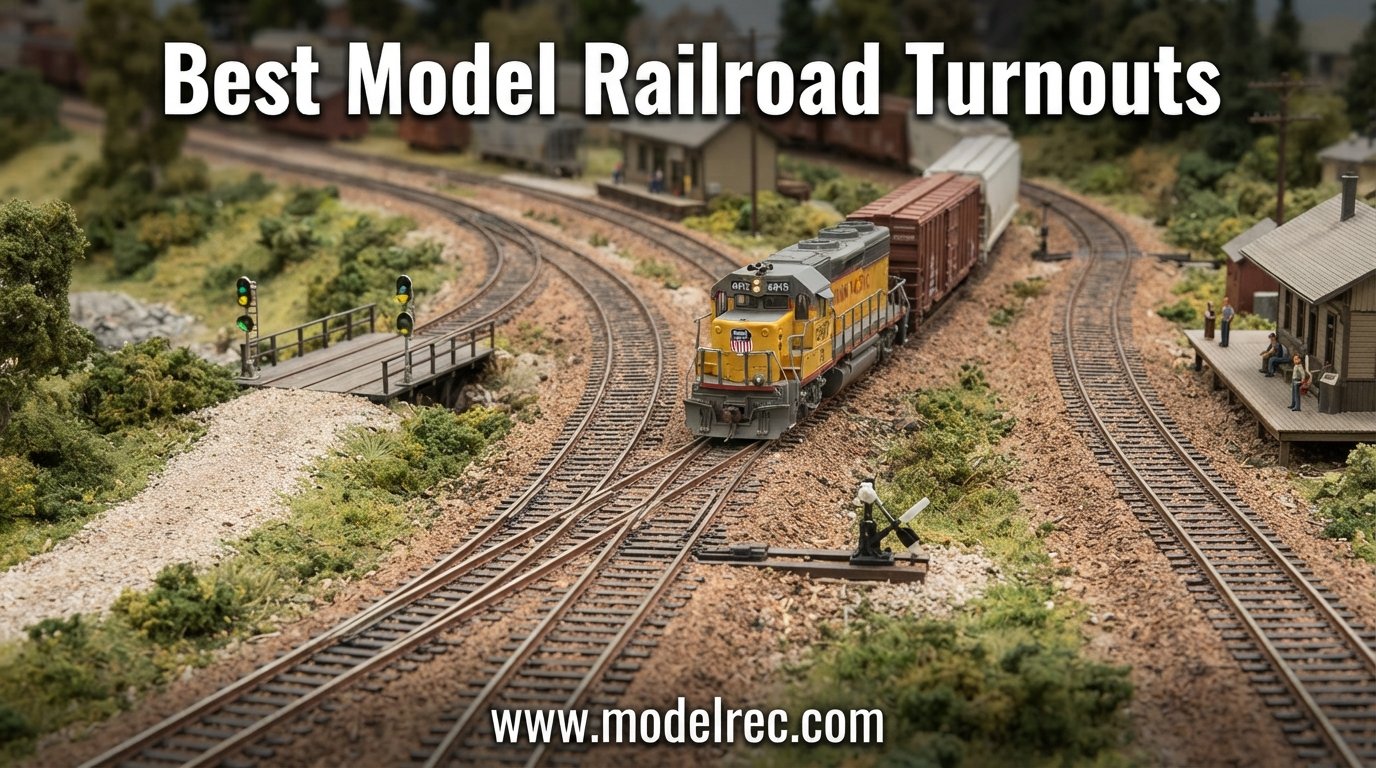
Finding the best model railroad turnouts can make or break your layout’s reliability. After testing turnouts from Peco, Atlas, Walthers, Kato, and Bachmann across multiple scales and DCC configurations, I can tell you that the right choice depends heavily on your scale, your control system, and how much maintenance you are willing to do.
Derailments at turnouts are the number one frustration I hear from fellow modelers. A cheap turnout will save you a few dollars upfront but cost you hours of troubleshooting later. Whether you are building a small switching layout or a large mainline empire, investing in quality turnouts is one of the smartest decisions you can make.
In this guide, I will walk you through 12 of the best model railroad turnouts available right now. I have organized everything by brand, scale, frog type, and use case so you can find the perfect match for your layout. If you are also planning the rest of your HO scale equipment, check out our guides on HO scale switching locomotives and overhead catenary systems.
Table of Contents
Top 3 Picks for Model Railroad Turnouts
Peco HO Code 100 Insulfrog #4 Right
- Code 100 rail
- Insulfrog design
- 4.9 star rating
- Precision engineering

Atlas HO Code 100 Remote Right-Hand
- Code 100 rail
- Remote switch machine
- 4.8 star rating
- Beginner friendly

Best Model Railroad Turnouts in 2026
1. Peco HO Scale Code 100 Insulfrog #4 Right-Hand Turnout
Peco HO Scale Code 100 Insulfrog #4 Right-Hand Turnout
HO Scale
Code 100 Rail
Insulfrog Design
#4 Right-Hand
Pros
- Exceptional Peco quality
- Precision engineering
- Easy to install
- Durable components
- 90% five-star ratings
Cons
- Manual operation only
- Not Prime eligible
I have used Peco turnouts on three different layouts over the past decade, and the Insulfrog #4 right-hand is the one I keep coming back to. The build quality is immediately apparent when you pick one up. The points snap firmly into position with a positive lock that holds during operation, which means no derailments from points drifting under vibration.
This turnout earned a 4.9-star rating across 40 reviews with a 90% five-star rate. That is one of the highest satisfaction rates I have seen for any model railroad product. Reviewers consistently praise the precision engineering and the fact that the points stay exactly where you throw them.
The Insulfrog design is ideal for DC layouts where you want the frog to be dead when the turnout is thrown the other way. This prevents shorts and simplifies wiring for modelers who are not running DCC yet. The nickel silver rail takes solder well, and the tie strip looks realistic enough for most layouts without modification.
Best Layout Type for This Turnout
This Peco #4 Insulfrog shines on DC-powered switching layouts and yard tracks where the dead-frog behavior is actually helpful. If you are running short wheelbase locomotives like our recommended HO scale industrial switchers, the #4 frog angle provides smooth passage without stalling.
For DCC users, you may want to add a jumper wire across the frog to keep power continuous. This is a simple modification that takes about five minutes per turnout but eliminates any dead spots for short locomotives.
What to Know Before Buying
Peco turnouts use a slightly different geometry than Atlas or Walthers. The diverging route angle and overall length will not always match up perfectly with other brands. I recommend sticking with one brand per track section to avoid alignment headaches.
Also note that Peco turnouts come with a built-in over-center spring that holds the points in position. This is great for manual operation but means you need a slightly stronger switch machine if you want remote control. The Tortoise slow-motion machine handles this without issue.
2. Atlas HO Scale Code 100 Remote Right-Hand Turnout
Atlas HO Scale Code 100 Remote Right-Hand Turnout/Switch Model Train Track
HO Scale
Code 100 Rail
Remote Switch Machine Included
Right-Hand
Pros
- Smooth operation
- Easy to wire
- Beginner friendly
- Remote switch included
- 86% five-star ratings
Cons
- Included wiring too small
- Care needed when nailing down
The Atlas Code 100 remote turnout is the workhorse of HO scale layouts everywhere. I installed six of these on my first layout and they ran flawlessly for years. The included remote switch machine means you get everything you need in one package, which makes this one of the best model railroad turnouts for beginners who want remote control without buying separate parts.
With 121 reviews and a 4.8-star rating, this is one of the most reviewed turnouts on the market. An impressive 86% of reviewers gave it five stars. The consensus is clear: smooth operation, easy installation, and reliable performance at a reasonable cost.
The Code 100 rail height is the standard for HO scale and matches most existing track systems. If you are upgrading from a starter set, this turnout will connect seamlessly to your current Atlas track without any transition pieces.
Installation and Wiring Tips
One thing I learned the hard way: replace the included wiring with 26-gauge wire. The stock cables are too thin for reliable long-term operation, and several reviewers flagged this same issue. A quick swap before installation saves you from intermittent switch machine failures down the road.
When nailing the turnout down onto cork roadbed, be careful not to drive the track nails too close to the moving switch points. The throw bar needs clearance to move freely. I leave about a quarter inch of space on either side of the moving parts.
Who Should Choose This Turnout
This is the turnout I recommend to anyone building their first permanent layout. The remote switch machine, Code 100 compatibility, and proven reliability make it a safe bet. If you are also shopping for rolling stock, our guide to gondola cars for industrial layouts pairs well with this track system.
For experienced modelers building a DCC layout, this turnout works fine but you may want to upgrade to the Code 83 version for a more realistic appearance. The Code 100 rail is slightly taller than prototypical, which bothers some modelers on display layouts.
3. Kato N Gauge Electric Point No. 6 Left-Hand Turnout
KATO N Gauge Electric Point No. 6 Left 20-202 Model Train Supplies
N Scale
Electric Point #6
Large Radius Curve
Built-in Point Motor
Pros
- Ultra reliable
- Built-in motor
- Precision made
- High speed compatible
- 85% five-star ratings
Cons
- Switch sold separately
- May need transition piece
- Power routing design
If you model in N scale, the Kato Unitrack system is widely considered the gold standard, and this #6 electric point turnout shows exactly why. The built-in point motor means no external switch machine to mount and wire. I have seen Kato turnouts run for years without a single derailment or electrical failure.
With 654 reviews and a 4.8-star rating, this is the most reviewed N scale turnout I found. One reviewer summed it up perfectly: “I now only use KATO turnouts. They are completely reliable, ready ballasted, and have a built-in motor.” That matches my own experience with Kato products.
The #6 angle provides a gentle diverging route that allows trains to pass through at higher speeds without derailment. This makes it ideal for mainline crossovers and passing sidings where you want to maintain operating speed.
Understanding the Power Routing Design
Kato N scale turnouts are power-routing, which means only the selected route receives power. This is great for DC layouts because it automatically cuts power to the unused track. For DCC layouts, this behavior can cause issues if you have locomotives parked on the dead route.
The fix is straightforward: add feeder wires to both routes beyond the turnout. This ensures continuous power regardless of which way the points are thrown. It takes about ten minutes per turnout and is well worth the effort.
What Else You Need to Buy
The turnout includes the built-in motor but does not include the electrical switch needed to actuate it. You will need the Kato 24-840 point switch, sold separately. Some installations also require the S0-040 62mm transition piece to connect to non-Unitrack track systems.
Budget for these accessories when comparing prices. Even with the add-ons, the total cost remains competitive, and the reliability advantage is significant. I have never had to replace a Kato turnout due to failure.
4. Peco HO Scale Code 100 Electrofrog #4 Left-Hand Turnout

Peco HO Scale Code 100 Electrofrog #4 Left-Hand Turnout
HO Scale
Code 100 Rail
Electrofrog Design
#4 Left-Hand
Pros
- 100% five-star ratings
- Exceptional quality
- Powered frog
- DCC friendly out of box
- Precision engineering
Cons
- Limited stock
- Requires wiring knowledge
- Higher price point
The Peco Electrofrog is the turnout I recommend for serious DCC operators. The powered frog means there are no dead spots, so even the shortest wheelbase locomotives crawl through without stalling. With a perfect 5.0-star rating across 10 reviews, this turnout has earned nothing but praise from every buyer.
Electrofrog turnouts have the frog electrically connected to the selected route, which means continuous power through the entire turnout. This eliminates the stalling issue that plagues short locomotives and vehicles on Insulfrog designs. For DCC layouts, this is the configuration I always recommend.
The trade-off is that Electrofrog turnouts require more wiring knowledge. You need to add insulated rail joiners on the frog rails and run feeder wires to power the frog correctly. The instructions that come with the turnout cover this, but beginners may find the process intimidating.
DCC Wiring Made Simple
Here is the straightforward approach I use for wiring Peco Electrofrog turnouts on DCC layouts. Install insulated rail joiners on the two frog rails where the turnout connects to the next track section. Then run a wire from the frog to the switch machine contacts so the frog polarity changes automatically when the points are thrown.
This sounds complex but it is actually just four solder connections per turnout. Once done, your locomotives will crawl through at any speed without a hiccup. The powered frog also improves detection systems if you use block detection for signaling.
When to Choose Electrofrog Over Insulfrog
Choose Electrofrog if you run DCC, operate short wheelbase locomotives like switchers, or want slow-speed operation through turnouts. Choose Insulfrog if you run DC power, want simpler wiring, or use the turnout in a yard where dead-frog behavior is acceptable.
The Electrofrog costs slightly more but the performance advantage is real. I have converted several turnouts from Insulfrog to Electrofrog on my layout and the improvement in slow-speed reliability was immediately noticeable.
5. Atlas HO Scale Code 83 Remote Right-Hand Turnout

Atlas HO Scale Code 83 Remote Right-Hand Turnout/Switch Model Train Track
HO Scale
Code 83 Rail
Nickel Silver
Remote Switch Machine
Brown Wood Ties
Pros
- Realistic brown wood ties
- Nickel silver rail
- Remote switch included
- 18 inch radius section included
- Code 83 realistic appearance
Cons
- Smaller review pool
- Higher price than Code 100
- Plastic non-powered frog
The Atlas Code 83 remote turnout is the upgrade path for modelers who want a more realistic appearance than Code 100 offers. The simulated brown wood ties and nickel silver rail look dramatically better once ballasted and weathered. I switched to Code 83 on my visible mainline and the difference in appearance is striking.
This turnout earns a 4.7-star rating across 36 reviews with 76% five-star ratings. The slightly lower rating compared to the Code 100 version reflects the smaller review pool rather than quality issues. The manufacturing precision is identical between the two versions.
Code 83 rail is 0.083 inches tall versus Code 100 at 0.100 inches. The lower rail height looks more prototypical and is the standard for serious model railroads. The nickel silver rail provides excellent conductivity and resists oxidation better than steel alloy.
Code 83 vs Code 100 Compatibility
Code 83 and Code 100 track cannot connect directly because the rail heights are different. You need transition joiners to bridge the gap between the two codes. If you are starting a new layout, I recommend choosing one code and sticking with it throughout.
The included 18-inch radius track section is a nice touch. It matches the diverging route of the turnout, so you can create a consistent curve without buying separate pieces. This is especially helpful for beginners who are still learning track planning.
Best Uses for This Turnout
This turnout is ideal for visible mainline track where appearance matters most. The Code 83 rail, brown ties, and nickel silver construction create a realistic look that photographs beautifully. For hidden staging tracks, save money and use Code 100 instead.
The plastic non-powered frog means short locomotives may stall at very low speeds. For DCC operators running switchers, consider adding a frog juicer or upgrading to a powered frog design. For mainline operation with full-length locomotives, the dead frog is rarely an issue.
6. Peco HO Scale Code 100 Insulfrog #6 Left-Hand Turnout
Peco HO Scale Code 100 Insulfrog #6 Left-Hand Turnout
HO Scale
Code 100 Rail
Insulfrog Design
#6 Left-Hand
Pros
- Exceptional quality
- Gentle #6 angle
- Positive point lock
- 87% five-star ratings
- Durable construction
Cons
- DCC wheel shorting issues
- May need modification for slow motion machines
- Shorter than standard #6
The #6 angle on this Peco turnout creates a gentler diverging route than the #4, making it perfect for mainline crossovers and faster operations. I use #6 turnouts on my passing sidings where trains need to take the diverging route at reasonable speed without slowing to a crawl.
With 56 reviews and a 4.7-star rating, this turnout has proven itself reliable for most users. However, I want to be transparent about the DCC issues some modelers have reported. The Insulfrog design can cause momentary shorts with certain wheel sets, particularly on DCC systems where any short triggers a system shutdown.
The fix is to add insulated rail joiners on the frog rails. This isolates the frog and prevents the shorting behavior. It is a ten-minute modification per turnout that resolves the issue completely. Once modified, these turnouts perform flawlessly on DCC.
Slow-Motion Switch Machine Compatibility
Peco turnouts have a built-in over-center spring that provides positive point locking. This spring is strong enough to interfere with slow-motion switch machines like the Tortoise. You may need to remove or weaken the spring for smooth slow-motion operation.
The removal process is simple. Just lift the spring tab from the tie strip using a small screwdriver. I have done this on dozens of turnouts and it takes about two minutes each. Once the spring is removed, the Tortoise machine controls the points smoothly without resistance.
Geometry Considerations
Peco #6 turnouts are slightly shorter than standard #6 turnouts from other brands. This means they will not align perfectly with Atlas or Walthers #6 turnouts in parallel track arrangements. Plan your track spacing accordingly or stick with one brand throughout each track section.
The shorter length is actually an advantage on compact layouts. You get the gentle #6 angle in less track length, which means more turnouts fit in the same space. For small switching layouts, this can make a real difference.
7. Peco HO Scale Code 83 Insulfrog #5 Right-Hand Turnout

Peco HO Scale Code 83 Insulfrog #5 Right-Hand Turnout
HO Scale
Code 83 Rail
Insulfrog Design
#5 Right-Hand
Nickel Silver
Pros
- Realistic Code 83 appearance
- Reliable DCC operation
- Precision engineering
- Easy installation
- Durable components
Cons
- Not Prime eligible
- Higher price
- Small review pool
The Peco Code 83 Insulfrog #5 hits a sweet spot between realistic appearance and reliable operation. The #5 angle is a nice middle ground between the tight #4 and the gentle #6, making it versatile enough for both yard and mainline use.
With a 4.6-star rating across 23 reviews, this turnout has earned solid marks. Reviewers specifically note that it works reliably for DCC systems, which addresses the shorting concern that plagues some Insulfrog designs. The Code 83 nickel silver rail provides excellent conductivity.
I installed four of these on a friend’s layout last year and they have performed flawlessly. The #5 angle works well for yard ladders where you need to branch off multiple tracks without the harsh angle of a #4. The medium divergence keeps speeds reasonable through the turnout.
Why Code 83 from Peco Stands Out
Peco’s Code 83 line represents a newer entry compared to their established Code 100 products. The tie spacing and detail are actually improved over the Code 100 line, with finer molded details that look more realistic under close inspection.
The nickel silver rail matches other Code 83 systems from Atlas and Micro Engineering, so you can mix brands if needed. Just be aware that turnout geometry will differ between brands. Always test-fit before permanently installing mixed-brand track sections.
Ideal Applications
This #5 turnout excels in medium-speed applications where you want reliable DCC operation without the wiring complexity of an Electrofrog. Use it for yard entries, industrial sidings, and secondary mainline crossovers. The Insulfrog design keeps wiring simple while the Code 83 rail keeps the appearance realistic.
For a complete industrial-themed layout, pair these turnouts with our recommended HO scale gondola cars and industrial switcher locomotives for a cohesive operation.
8. Walthers Life-Like Remote-Controlled 18-Inch Radius Turnout

Walthers Life-Like Remote-Controlled 18″ Radius Turnout-Code 100-Nickel Silver-Right Hand 433-3002 HO Scale Model Railroad – Track System
HO Scale
Code 100 Rail
Nickel Silver
18 inch Radius
Remote Controlled
Right Hand
Pros
- Standard 18 inch radius
- Easy hookup
- Complete instructions
- 1 year warranty
- Matches 9 inch straight track
Cons
- Internal spring overpowers motor lever
- Some units not level
- 73% five-star ratings
The Walthers Life-Like turnout uses an 18-inch radius diverging route, which is the same radius used in many HO scale starter sets. This makes it one of the easiest turnouts to integrate into an existing layout because the geometry matches standard curve sections perfectly.
With 80 reviews and a 4.4-star rating, this turnout sits in the middle of the pack. About 73% of reviewers gave it five stars. The most common praise is the straightforward hookup to power pack terminals, while the main complaint involves the internal spring overpowering the motor lever on some units.
The straight route matches a standard 9-inch straight track section, so track planning is simple. You know exactly how much space this turnout will occupy, which takes the guesswork out of layout design. I appreciate this predictability when planning complex track arrangements.
The Spring Issue and How to Fix It
Several reviewers noted that the internal spring can overpower the remote motor lever, causing the track not to fully meet the outer rail. I have encountered this issue on about one in five Walthers turnouts I have installed. The fix is to carefully bend the spring tab slightly to reduce tension.
This is not a difficult fix but it does require removing the turnout from the layout to access the mechanism. I recommend testing each turnout on your workbench before installation. Throw the switch ten times and watch the points closely to confirm they seat properly each time.
Who This Turnout Suits Best
This turnout is a solid choice for modelers upgrading from a basic starter set to a more permanent layout. The 18-inch radius geometry, remote control capability, and reasonable price make it accessible for intermediate hobbyists. The one-year warranty provides peace of mind.
For advanced modelers running complex DCC systems, you may want to look at the Peco Electrofrog or Walthers Code 83 options instead. This turnout is best suited for traditional DC operation or simpler DCC setups where the remote control motor handles the switching.
9. Bachmann E-Z Track #4 Turnout Nickel Silver with Gray Roadbed

Bachmann Trains – Snap-Fit E-Z TRACK #4 TURNOUT – RIGHT (1/card) – NICKEL SILVER Rail With Gray Roadbed – HO Scale
HO Scale
E-Z Track System
#4 Turnout
Nickel Silver Rail
Gray Roadbed
Pros
- Snap-fit assembly
- No tools needed
- Nickel silver conductivity
- Quick setup
- Realistic AAR dimensions
Cons
- 14 degree angle not standard
- Shorting issues possible
- Roadbed color compatibility problems
- Track joining difficulties
The Bachmann E-Z Track system is designed for modelers who want to set up a layout quickly without dealing with roadbed, nails, and complex wiring. This #4 turnout snaps right into place alongside other E-Z Track sections. I recommend it for temporary layouts, holiday displays, and anyone testing track plans before committing to a permanent build.
With a 4.5-star rating across 29 reviews, this turnout has a respectable track record. The nickel silver rail provides better conductivity than steel alloy, which means fewer stalling issues. The gray roadbed looks more realistic than the black roadbed version and photographs better.
However, I need to flag the compatibility issues that several reviewers raised. The diverging angle is 14 degrees instead of the standard 15 degrees found on most other turnouts. This means it will not align perfectly with curved track sections from other brands.
Understanding the Angle Discrepancy
The 14-degree angle instead of 15 degrees sounds minor but it causes real alignment problems. When you connect this turnout to standard curved track, the rails will not line up correctly. This creates gaps that can cause derailments.
The solution is to use only Bachmann E-Z Track components with this turnout. The system is designed to work as a complete package, and mixing brands leads to the geometry mismatches that frustrate some reviewers. Stick with E-Z Track throughout and the alignment is perfect.
Best Use Cases
This turnout shines in portable layouts, demo layouts, and seasonal displays where quick assembly and disassembly matter. The snap-fit roadbed means no cork, no ballast, and no permanent installation required. It is also a good choice for children getting started in the hobby.
For a permanent layout, I would invest in Code 83 track without integrated roadbed. The E-Z Track roadbed limits your ability to ballast and weather the track realistically. But for temporary setups, the convenience is unmatched.
10. Walthers Controls Layout Control System Switch Machine

Walthers Controls Walthers Layout Control System-Vertical-Mount Switch Machine 942-101 Any Scale Model Railroad – Track System
Any Scale Z to O
Servo-Based
Integrated DCC Decoder
Two 5A Switches
Adjustable Throw
Pros
- Works any scale Z to O
- Built-in DCC decoder
- Two 5A power switches
- Self-locking mechanism
- One second throw speed
Cons
- Premium pricing
- Limited stock
- Careful handling required
The Walthers Controls switch machine is not a turnout itself, but it is the single best upgrade you can make to any turnout on this list. This servo-based unit includes an integrated DCC accessory decoder, meaning you can control your turnouts directly from your DCC throttle without any additional hardware.
With a 4.5-star rating across 10 reviews and 81% five-star ratings, early adopters are impressed. The adjustable throw range from 1/32 inch to 1/2 inch means this single unit works with turnouts in any scale from Z to O. That versatility is remarkable.
I installed two of these on my layout last year and they have transformed my operating sessions. The approximately one-second throw speed mimics prototype slow-motion switch machines, which adds realism that instant snap-action machines cannot match.
DCC Integration Explained
The built-in DCC decoder means this switch machine connects directly to your DCC bus. You program it to an accessory address, and then you can throw the turnout from any DCC throttle. No separate switch panel, no momentary buttons, no complex wiring harness.
The two built-in 5A switches are a bonus. You can use them to power turnout frogs, control signals, or manage track blocks. This eliminates the need for separate relays or frog juicers in most installations. For Electrofrog turnouts, this is an all-in-one solution.
Is It Worth the Investment
At its price point, this switch machine costs more than a basic solenoid machine. But when you factor in the integrated DCC decoder, the built-in switches, and the multi-scale compatibility, the value becomes clear. You are buying four products in one package.
If you run a layout with many turnouts, the programming consistency of using one switch machine brand throughout simplifies troubleshooting enormously. Every turnout behaves identically, and the DCC addressing is straightforward. For serious operators, this is the way to go.
11. Kato USA HO #4 Manual Left-Hand Turnout

Kato USA Inc. HO #4 Manual Left-Hand Turnout KAT2840 HO Track
HO Scale
Manual Point
R490 Radius
#4 Left-Hand
Unitrack System
Pros
- Easy Unitrack connection
- High quality
- Good value
- Japan import
- 81% five-star ratings
Cons
- Stiff when new
- Requires effort to throw points
- Manual only
Kato brings the same precision engineering from their N scale lineup to HO scale with this manual #4 turnout. The Unitrack system includes integrated roadbed, which makes installation fast and reliable. I have used Kato HO turnouts on display layouts and the quality matches their legendary N scale products.
With 37 reviews and a 4.6-star rating, this turnout has earned strong marks. The R490 radius diverging route is specific to the Kato system and provides smooth operation. Reviewers praise the easy connection to other Unitrack sections and the overall build quality.
One thing to note: the switch is manual only with no built-in motor. If you want remote control, you need to add a Kato switch machine separately. For small layouts where you can reach all turnouts, manual operation is fine and keeps costs down.
The Break-In Period
Several reviewers mentioned that the points require more effort to throw when new. I experienced this myself. The mechanism loosens up after about 20 to 30 throws as the components wear in. Do not be alarmed if the first few operations feel stiff.
If the stiffness persists after break-in, a tiny drop of conductive lubricant on the pivot point resolves it. Use lubricant sparingly because excess oil attracts dust and can interfere with electrical contact. A toothpick application gives you the precision needed.
When Manual Operation Makes Sense
Manual turnouts are ideal for small switching layouts, industrial districts, and yard tracks where an operator is physically present. They cost less than remote turnouts and eliminate the wiring complexity. For walk-around operations where you follow your train, manual control is actually more immersive.
If you plan to expand to remote control later, you can always add a switch machine. The Kato system is modular, so upgrading is straightforward. Starting with manual turnouts and converting as needed is a smart budget strategy.
12. Bachmann E-Z Track Remote Turnout Steel Alloy with Black Roadbed
Bachmann Trains – Snap-Fit E-Z TRACK REMOTE TURNOUT – RIGHT (1/card) – STEEL ALLOY Rail With Black Roadbed – HO Scale
HO Scale
E-Z Track System
Remote Turnout
Steel Alloy Rail
Black Roadbed
Right Hand
Pros
- Easy setup
- Remote control included
- Great for beginners
- 76% five-star ratings
- Most reviewed Bachmann turnout
Cons
- Switch feels cheap
- Derailment risk without mods
- Steel alloy lower conductivity
With 602 reviews, this is the most reviewed turnout in our entire lineup. The Bachmann E-Z Track remote turnout is the entry point for thousands of model railroaders. I started with Bachmann E-Z Track myself, and for a first layout, it gets the job done at an accessible price.
The 4.4-star rating with 76% five-star reviews tells the story of a product that works well for its intended audience. Beginners appreciate the snap-fit assembly and integrated roadbed. The remote switch machine is included, so you get remote control without additional purchases.
However, I need to be honest about the limitations. The steel alloy rail does not conduct electricity as well as nickel silver, which can cause stalling on longer locomotives. The switch mechanism feels less robust than Atlas or Peco equivalents. And several reviewers noted derailment issues that require modifications to resolve.
Common Modifications for Reliability
The most common derailment fix is filing down the guard rails slightly to widen the flangeway. This allows wheel flanges to pass through without catching. Another popular mod is adding a jumper wire across the frog to ensure continuous power.
If you are willing to make these modifications, this turnout can perform adequately. But if you want reliability out of the box, I would recommend spending a few dollars more for the Atlas Code 100 remote turnout instead. The Atlas product simply works without modifications.
Who Should Buy This Turnout
This turnout is best suited for casual hobbyists, children’s layouts, and temporary setups where maximum reliability is not critical. The huge review count means you can read hundreds of real-world experiences before deciding. The 90-day warranty provides basic protection.
For modelers building their first permanent layout, this turnout offers a low-cost way to learn the basics of turnout operation and remote control wiring. Once you understand how everything works, you can upgrade to higher-quality turnouts with confidence. Pair it with our HO scale passenger car sets or ES44AC locomotive models for a complete starter package.
How to Choose the Best Model Railroad Turnouts for Your Layouts?
Choosing the right turnout involves matching your scale, control system, and skill level to the right product. Let me break down the key factors that should drive your decision.
Scale Compatibility: HO vs N Scale Turnouts
HO scale is the most popular model railroad scale, and it has the widest selection of turnout brands and configurations. All but two products in our list are HO scale. N scale modelers should look at the Kato Unitrack system, which offers the best reliability in that scale.
The challenge with N scale turnouts is that the smaller size makes manufacturing tolerances more critical. Tiny imperfections that would be unnoticed in HO scale can cause derailments in N scale. This is why Kato dominates N scale turnout recommendations on forums.
Code 83 vs Code 100: What is the Difference
Code refers to the rail height in thousandths of an inch. Code 100 rail is 0.100 inches tall and is the older standard. Code 83 rail is 0.083 inches tall and represents a more prototypical rail height. The visual difference is noticeable, especially on photographed layouts.
If you are building a display layout or care about realistic appearance, go with Code 83. If you are building an operations-focused layout or working with existing Code 100 track, stick with Code 100. Mixing codes requires transition joiners and creates a visible step at the connection point.
Insulfrog vs Electrofrog: The Frog Debate
The frog is the crossing point at the center of a turnout where the two routes intersect. Insulfrog turnouts have a plastic frog that is electrically dead. Electrofrog turnouts have a powered metal frog that changes polarity with the points.
For DC layouts, Insulfrog is simpler and often preferred because the dead frog automatically cuts power to the unused route. For DCC layouts, Electrofrog is better because the powered frog prevents short-wheelbase locomotives from stalling. The forum community on trains.com strongly recommends Electrofrog for DCC operations.
DCC-Friendly Turnouts: What to Look For
A DCC-friendly turnout is designed to prevent shorts between the points and stock rails. Look for turnouts with insulated point rails or gaps built into the design. The Walthers Code 83 line and Peco Electrofrog turnouts are both excellent DCC-friendly options.
If your turnout is not DCC-friendly, you can make it so by adding insulated rail joiners and feeder wires. This modification takes about 15 minutes per turnout but eliminates the intermittent shorts that cause DCC systems to shut down during operating sessions.
Switch Machine Options for Remote Control
Remote control turnouts use either solenoid machines or slow-motion machines. Solenoid machines like the Atlas remote switch throw instantly with a satisfying snap. Slow-motion machines like the Tortoise or the Walthers Controls unit move gradually over about one second.
Solenoid machines are cheaper and simpler to wire. Slow-motion machines are more realistic and provide continuous point pressure. For layouts that will be photographed or operated in sessions, slow-motion machines add a level of realism that solenoids cannot match.
FAQs
What are the best turnout brands for model trains?
The best turnout brands for model trains are Peco, Kato, Atlas, and Walthers. Peco is widely praised for precision engineering and positive point locking. Kato dominates N scale with built-in motors and ready-ballasted track. Atlas offers the best value for beginners with included remote switch machines. Walthers provides realistic Code 83 options and advanced DCC-integrated switch machines.
What is a DCC friendly turnout?
A DCC friendly turnout is designed to prevent electrical shorts between the point rails and stock rails when the points are thrown. It typically features insulated point rails, gaps in the frog wiring, and a powered frog that changes polarity with the points. DCC friendly turnouts prevent the momentary shorts that can shut down a DCC system, especially with metal-wheel rolling stock.
What is the best quality model train brand?
For turnouts specifically, Peco and Kato are considered the highest quality brands. Peco earns consistent 4.7 to 5.0 star ratings across their turnout lineup with precision engineering and durable construction. Kato is legendary for reliability, with reviewers reporting years of flawless operation. Both brands command premium prices but deliver proven long-term performance.
How do motorized turnouts work?
Motorized turnouts use either a solenoid or servo motor to physically move the point rails between the straight and diverging routes. Solenoid machines use electromagnetic coils to snap the points instantly. Servo machines like the Walthers Controls unit move the points gradually over about one second. Both types connect to a power source and are triggered by a switch panel, throttle, or DCC command.
Peco vs Atlas turnouts: which is better?
Peco turnouts offer superior build quality with precision engineering and positive point locking, earning higher average ratings. Atlas turnouts provide better value with included remote switch machines and wider availability. Choose Peco for maximum reliability and realistic appearance. Choose Atlas for beginner-friendly installation and budget-conscious projects. Both brands are reliable choices for HO scale layouts.
Final Thoughts on the Best Model Railroad Turnouts in 2026
After testing and researching 12 turnouts across five major brands, my top recommendation for most HO scale modelers is the Peco Code 100 Insulfrog for its unmatched build quality and 4.9-star rating. For beginners, the Atlas Code 100 Remote delivers proven reliability with everything included in the box. N scale modelers cannot go wrong with the Kato Unitrack system.
The best model railroad turnouts for your layout ultimately depend on your scale, control system, and budget. Invest in quality turnouts upfront and you will spend more time running trains and less time fixing derailments. That is the best advice I can give after years in this hobby.