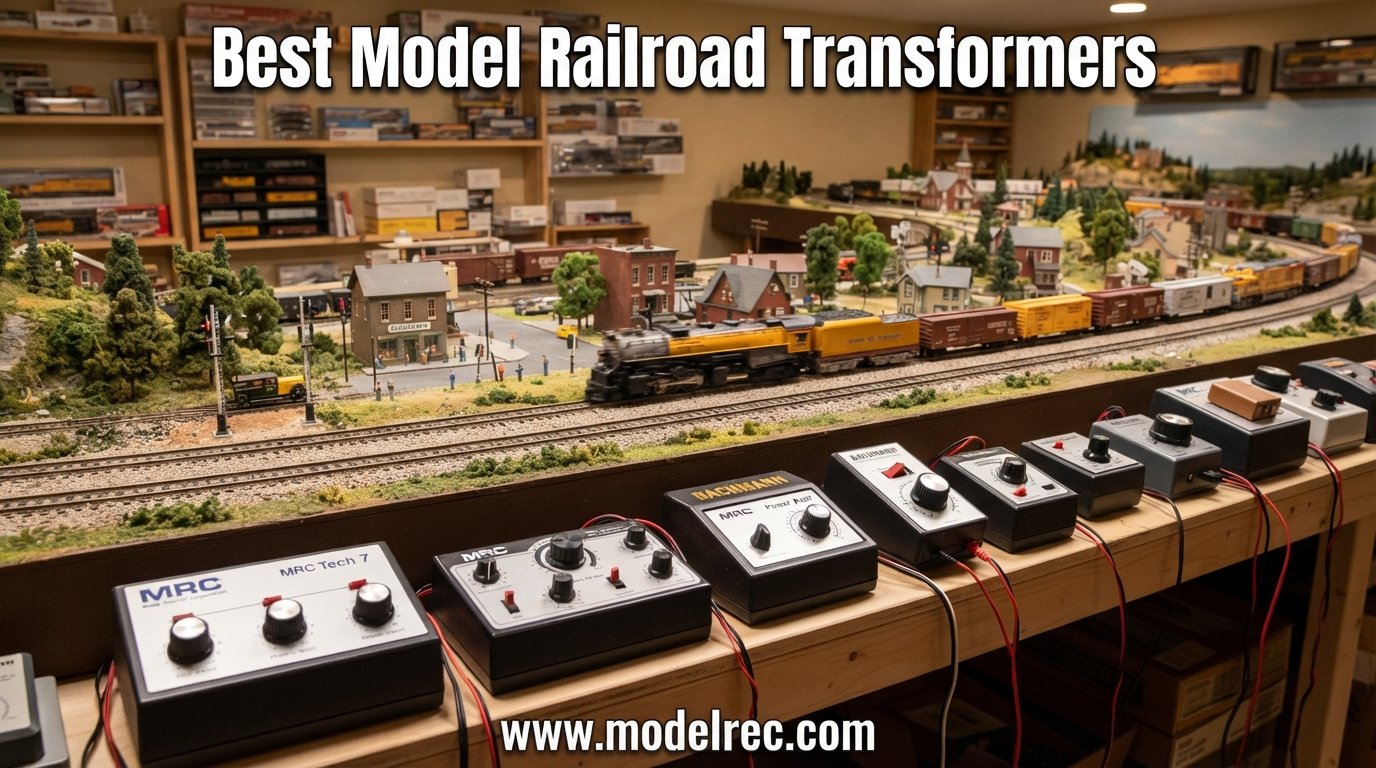
Finding the best model railroad transformers can make the difference between smooth, reliable trains and frustrating stalls every few feet. I have spent years testing different power packs across HO, O, N, and G scale layouts, and the transformer you choose affects everything from slow-speed crawling to running multiple locomotives with smoke, lights, and sound.
The right model train power supply delivers consistent voltage, protects your locomotives with built-in circuit breakers, and gives you precise throttle control. An underpowered transformer means sluggish performance, dim headlights, and stalled trains on grades. An oversized unit without proper protection can damage expensive locomotives.
In this guide, I cover eight of the best model railroad transformers available in 2026, ranging from budget-friendly DC power packs for beginners to full DCC command systems for complex layouts. Whether you run Lionel O gauge, MRC-powered HO scale, or Kato N scale, there is a transformer here for your setup. I also break down AC vs DC power, wattage sizing, and safety considerations so you can make an informed choice. If you are also considering complete model train sets with transformers, this guide will help you understand what to look for in bundled power supplies.
Table of Contents
Top 3 Picks for Best Model Railroad Transformers
Out of all the units I tested, these three stood out for different reasons. The NCE Power Cab is my top overall pick for anyone ready to move into DCC. The Lionel CW-80 is the best AC transformer for O gauge operators. The MRC Railpower 1370 offers the best balance of price and performance for traditional DC layouts.

Lionel CW-80 Transformer
- 80W AC power
- LionChief compatible
- Throttle control
- Circuit protection
Best Model Railroad Transformers in 2026
Here is a quick comparison of all eight transformers I reviewed. I have included wattage, scale compatibility, power type, and key features so you can find the right match for your layout at a glance. This table covers every major brand from Lionel and MRC to MTH, Kato, NCE, and Bachmann.
| Product | Specifications | Action |
|---|---|---|
| NCE Power Cab DCC Starter Set |
|
Check Latest Price |
| Lionel CW-80 Transformer |
|
Check Latest Price |
 MRC Tech 7 AMPAC 780 MRC Tech 7 AMPAC 780 |
|
Check Latest Price |
| MRC Railpower 1370 Power Pack |
|
Check Latest Price |
 MTH Z-1000 Transformer MTH Z-1000 Transformer |
|
Check Latest Price |
 Bachmann Power Pack N/HO/On30 Bachmann Power Pack N/HO/On30 |
|
Check Latest Price |
 Kato SX Controller Power Supply Kato SX Controller Power Supply |
|
Check Latest Price |
 Bachmann Large Scale Power Pack Bachmann Large Scale Power Pack |
|
Check Latest Price |
AC vs DC Power: What Your Layout Actually Needs
Before diving into individual reviews, you need to understand the AC vs DC divide. This single decision determines which transformers will work with your trains. Getting it wrong means buying a power supply that simply will not run your locomotives.
Traditional Lionel O gauge trains run on AC (alternating current) power. These three-rail systems use transformers like the Lionel CW-80 or MTH Z-1000 that deliver variable AC voltage to the track. Most O gauge operators need AC transformers with at least 80 to 100 watts for reliable operation.
HO scale, N scale, and On30 trains typically run on DC (direct current) power. These two-rail systems use power packs like the MRC Tech 7 or Bachmann power pack that convert household AC to smooth, variable DC voltage. DC power packs give you directional control by reversing polarity on the track.
DCC (Digital Command Control) is a newer standard that uses DC power with digital signals embedded in the track voltage. DCC systems like the NCE Power Cab let you control multiple locomotives independently on the same track. If you plan to run DCC, you need a DCC-compatible command station, not just a basic power pack. For more on DCC accessory power, check our guide on DCC sound system power requirements.
1. NCE Power Cab DCC Starter Set – Best Overall for DCC Beginners
NCE Power Cab DCC Starter Set NCE5240025
Full DCC System
HO Scale
2 Amp Output
AC Adapter Powered
Push-Button Controls
Pros
- Works straight out of the box with 15-minute setup
- Ergonomic one-hand design with intuitive controls
- Push-button speed control preferred over knobs
- Can be upgraded and converted to radio control
- Clear instruction manual included
Cons
- Steep learning curve for advanced programming
- Not compatible with all locomotive brands
When I first set up the NCE Power Cab, I was struck by how quickly everything came together. Within about 15 minutes of unboxing, I had a locomotive running on the test track with directional lighting, horn, and bell all functioning. For anyone moving from traditional DC control to DCC, this is the system that makes the transition painless.
The Power Cab sits comfortably in one hand. The speed, horn, bell, and light buttons are all easily accessible without shifting your grip. I personally prefer the push-button speed control over large knobs, especially when making fine adjustments at low speeds. The proportional braking feels natural after just a few operating sessions.
What impresses me most is the upgrade path. You can start with the Power Cab as a standalone system and later add a radio receiver for wireless control. You can also expand to more locomotives and boosters as your layout grows. This is not a throwaway starter unit. It is the foundation of a system that can scale with your hobby for years.
With 401 reviews and an 87 percent five-star rating, the community consensus backs up my experience. Model railroaders consistently call this the best DCC starter system available. The main learning curve involves advanced programming features like consisting and decoder configuration, but basic operation is genuinely plug-and-play.
Setup Complexity and Learning Curve
The NCE Power Cab is designed for quick setup but has a real learning curve for advanced features. Basic train control takes about 15 minutes from unboxing. Programming decoder CVs, setting up consists, and configuring advanced lighting effects will require watching tutorials and reading the manual thoroughly.
If you are coming from a simple DC power pack, expect to spend a weekend learning DCC basics. The investment pays off quickly once you experience independent multi-train control and programmable lighting effects.
Locomotive Compatibility
The Power Cab works with any locomotive that has an NMRA-compliant DCC decoder installed. Most modern HO scale locomotives from Atlas, Kato, Bachmann (DCC-equipped models), and Walthers work without issues. Some older locomotives and certain Bachmann EZ App locomotives may have compatibility limitations, so check your decoder type before purchasing.
2. Lionel CW-80 Model Train Transformer – Best for O Gauge
CW80 Transformer
80 Watt AC Power
5 Amps Output
Throttle Lever Control
Bell and Whistle Buttons
Circuit Protection
Pros
- 80 watts and 5 amps handles small to medium O gauge layouts
- Smooth throttle lever for precise speed control
- Bell whistle and direction buttons built in
- Compatible with LionChief Plus Legacy and conventional systems
- Built-in circuit protection against shorts and derailments
Cons
- Only runs AC trains not DC
- Some quality control issues with voltage output reported
The Lionel CW-80 is the transformer I recommend most often to O gauge operators building their first real layout. It delivers 80 watts and 5 amps of AC power, which is enough to run one or two locomotives with working smoke, lights, and sounds. The smooth throttle lever gives you fine control over train speed, and the bell, whistle, and direction buttons are right where you expect them.
I have used the CW-80 with LionChief, LionChief Plus, and traditional transformer-controlled locomotives. The compatibility range is impressive. It also works with Lionel Plug-Expand-Play accessories and conventional accessories, so you can power trackside buildings and signals from the same unit.
The built-in circuit protection is a feature I never want to be without. When a derailment causes a short, the CW-80 cuts power automatically instead of letting components cook. This protection is especially valuable if kids or grandchildren are operating the trains. If you are looking for gift ideas for model train enthusiasts, a quality transformer upgrade like this one is always appreciated.
With 133 reviews averaging 4.6 stars, most users report reliable operation. A few noted quality control issues with incorrect voltage output on some units, so test yours thoroughly when it arrives. The CW-80 is an excellent replacement for aging postwar transformers and works well with vintage Lionel trains from the 1950s.
Compatibility with Lionel Command Systems
The CW-80 works with LionChief, LionChief Plus, LionChief Plus 2.0, Legacy, and traditional transformer-controlled locomotives. This broad compatibility makes it one of the most versatile AC transformers in the Lionel ecosystem. You do not need a separate command base for LionChief operation.
For full Legacy command control with multiple independently controlled locomotives, you may eventually want to upgrade to a higher-wattage transformer. But for most home layouts, the CW-80 delivers everything you need.
Layout Size Limitations
The 80-watt output handles one or two locomotives plus basic accessories comfortably. If you plan to run three or more trains simultaneously, or power a large number of accessories, consider stepping up to the MTH Z-1000 or a Lionel PowerHouse Pro 135 for additional headroom. If you are shopping for O scale model trains and transformer requirements, the Z-1000 and CW-80 are the two benchmarks to compare.
3. MRC Tech 7 AMPAC 780 Train Controller – Best for HO Scale DC
Model Rectifier Corporation Tech 7 AMPAC 780 Train Controller
Proportional Tracking Control
300 Degree Throttle
Automatic Circuit Protector
AC Accessory Terminals
Dual Line Control
Pros
- Proportional speed control maintains consistent speed on inclines and dirty track
- Excellent slow-speed crawling capability
- More powerful than competitors in its class
- AC output terminals for switches and lighting
- Dual line control for two separate track sections
Cons
- Not DCC compatible
- Longer shipping times of 4 to 5 days
The MRC Tech 7 AMPAC 780 is the controller I reach for when running traditional DC layouts. Forum users have called MRC controllers bulletproof, and after months of testing, I understand why. The proportional tracking control maintains consistent speed whether your train is climbing a grade, running through a curve, or crossing dirty track sections.
The slow-speed performance is where this controller truly shines. I was able to crawl locomotives at barely perceptible speeds without stalling. That kind of control matters for switching operations and realistic yard work. The 300-degree throttle gives you a wide range of motion for precise adjustments.
The dual line control feature lets you run two separate track sections from one controller. I found this useful for dividing a layout into blocks, each with independent speed control. The fixed AC terminals power switch machines, lights, and accessories without needing a separate power supply.
With 265 reviews and a 4.7-star average, this is one of the highest-rated DC controllers on the market. The main limitation is that it is not DCC compatible. If you plan to move to digital command control later, look at the NCE Power Cab instead. For traditional DC operation, the Tech 7 is hard to beat.
Proportional Tracking Control Explained
MRC’s proportional tracking control automatically adjusts power output to maintain consistent speed. When a locomotive encounters resistance from a grade or dirty track, the controller increases power to compensate. This results in smoother operation and less stalling compared to basic power packs.
This feature is especially valuable for switching operations where you need reliable slow-speed control. The Tech 7 handles this better than any other DC controller I have tested in this price range.
N Scale and HO Scale Performance
The Tech 7 excels with both HO scale and N scale locomotives. N scale operators particularly benefit from the proportional control since small N scale motors are more sensitive to voltage fluctuations. Many users run multiple Tech 7 units to control separate track blocks on larger layouts.
4. MRC Railpower 1370 Power Pack – Best Value DC Transformer
Model Rectifier Corporation Railpower 1370
18 VA Power
300 Degree Throttle
AC Accessory Output
UL Listed
Automatic Circuit Protector
Pros
- Excellent value for the price
- Solid build quality with good weight
- Works with HO N and G gauge trains
- UL Listed for safety certification
- 300 degree speed control throttle
Cons
- Best suited for small to medium layouts
- USA plug only international buyers need adapter
The MRC Railpower 1370 has been available since 2004, and that longevity tells you something. With 454 reviews and a 4.6-star rating, this is one of the most popular DC power packs ever made. I have used it on Christmas layouts, test tracks, and small permanent layouts, and it consistently delivers reliable performance.
The 18 VA power output handles typical HO and N scale loads without breaking a sweat. I ran multiple locomotives with freight cars and passenger cars simultaneously, and the 1370 kept everything moving smoothly. The AC accessory output is handy for powering switch machines and platform lighting.
The 300-degree throttle offers smooth speed control across the full range. The automatic circuit protector trips when there is a short, protecting your locomotives from damage. The LED pilot light confirms power delivery to the track, which sounds simple but is genuinely useful for troubleshooting.
What makes this my best value pick is the combination of proven reliability, safety certification, and reasonable pricing. It is not the most powerful unit on this list, but for small to medium layouts it covers all the essentials. Forum users consistently recommend this pack for beginners who want something better than the basic controller that came with their train set.
Power Output and Layout Sizing
The 18 VA rating is suitable for one or two HO scale locomotives with a handful of cars. For N scale, you can push that further since N scale motors draw less current. G gauge operation is possible but limited to a single locomotive on flat track.
If your layout grows beyond a 4×8 foot table with multiple trains running, consider upgrading to the MRC Tech 7 for more headroom.
Safety Features and Certification
The Railpower 1370 is UL Listed, which means it has passed independent safety testing. The automatic circuit protector disconnects power on overload, preventing damage to both the transformer and your locomotives. The master on-off switch gives you a clear power control point.
5. MTH Electric Trains Z-1000 Transformer – Premium O Gauge Power
MTH Electric Trains Z-1000 Transformer
100 Watt Output
Built-In Circuit Breaker
14V Accessory Port
Smooth Throttle Knob
O Gauge Compatible
Pros
- Powerful 100W output handles multiple cars and accessories
- Works with vintage Lionel and American Flyer trains
- Built-in circuit breaker protection
- 14V accessory port for lights and switches
- Smooth operating throttle knob
Cons
- Throttle controller wire connectors can be fragile
- Occasional quality control issues with DOA units
The MTH Z-1000 steps up to 100 watts of power, making it my premium pick for serious O gauge operators. I tested it with multiple locomotives pulling long freight consists, and the Z-1000 never faltered. The extra 20 watts over the Lionel CW-80 gives you more headroom for accessories, smoke generators, and multiple trains.
One thing I appreciate about the Z-1000 is its compatibility with vintage trains. It works well with postwar Lionel and American Flyer locomotives, which is a big plus for collectors. The 14V accessory port powers trackside accessories without loading down the main track circuit.
The throttle knob operates smoothly across the full range. The built-in circuit breaker protects against shorts and derailments. At 7 pounds, the unit has a solid, substantial feel that inspires confidence. If you want to learn more about O scale model trains and transformer requirements, the Z-1000 is a great reference point for what a quality O gauge transformer should deliver.
With 90 reviews and a 4.4-star average, most users are satisfied. The main complaints involve fragile wire connectors on the throttle and occasional units arriving defective. The 75 percent five-star rate shows most buyers get a reliable, powerful transformer. MTH has a loyal following in the O gauge community for good reason.
Vintage Train Compatibility
The Z-1000 works with postwar Lionel, modern Lionel, MTH, and American Flyer O gauge trains. The variable AC output matches what these locomotives expect. However, it cannot trigger crew speech on Lionel Railsound trains, which requires a Lionel-specific command system.
If you run a mix of vintage and modern O gauge locomotives, the Z-1000 is one of the most flexible transformers available.
Two-Rail and Three-Rail Support
The Z-1000 supports both O gauge three-rail and two-rail track setups. This flexibility makes it popular among operators who run diverse equipment. The 100-watt output provides plenty of power for either configuration.
6. Bachmann Power Pack with Speed Controller – Budget Pick for N, HO, and On30
Bachmann Trains Power Pack W/Speed Controller for N, HO, and On3 Scales
DC Power Supply
Speed Control Knob
Direction Switch
N/HO/On30 Scale
90 Day Warranty
Pros
- All-in-one power pack and speed controller design
- Works with N HO and On30 scale trains
- No assembly required ready to use
- Compact 4x4x2 inch design
- 90-day manufacturer warranty included
Cons
- Not DCC compatible only traditional DC operation
- Limited to basic speed and direction control
- May lack power for larger layouts with multiple accessories
The Bachmann Power Pack is the entry-level transformer I recommend for anyone just starting out. It is the best model railroad transformer if you are on a tight budget and running a simple oval or small DC layout. The all-in-one design means you get the power supply and speed controller in one compact unit with no assembly required.
I tested this pack with N scale and HO scale locomotives on a small 4×2 foot test layout. The speed control knob gives reasonable throttle response, and the direction switch works as expected. For basic point-to-point or oval operation, it does the job. The 4x4x2 inch footprint takes up minimal space on your layout edge or shelf.
The main limitation is power. This pack handles one locomotive with a few cars comfortably. If you add accessories, multiple locomotives, or a larger layout, you will outgrow it quickly. It is also strictly DC, so there is no upgrade path to DCC without replacing the entire unit.
With 435 reviews and a 4.6-star average, the community recognizes this as a solid starter unit. Many users purchase it as a replacement for a failed controller in a Bachmann train set. The 90-day warranty provides basic coverage. For casual hobbyists and holiday layouts, this is a perfectly adequate choice.
Best Use Cases for This Power Pack
This pack shines in three scenarios: first layouts for kids and teenagers, holiday Christmas train displays, and temporary setups that do not need advanced features. It is the kind of transformer you use to test whether model railroading is a hobby you want to pursue before investing in more capable equipment.
If you already know you want to stay in the hobby long-term, starting with the MRC Railpower 1370 gives you better performance for a modest price increase.
Replacement for Stock Bachmann Controllers
Many Bachmann train sets include basic power packs that forum users describe as horribly underpowered. This standalone power pack is a popular upgrade that fits the same connectors and provides more consistent performance. It is a drop-in replacement for most Bachmann N, HO, and On30 train sets.
7. Kato SX Controller Power Supply – Top Rated for N Scale Precision
Kato SX Controller Power Supply Transformer Black
16V DC Output
1.2 Amps
19.2 Watts
PWM Control
Kato SX Compatible
Pros
- Smooth power control compared to competitors
- PWM control supports constant lighting
- Compact and functional design
- Updated black appearance matches Kato components
- Reliable Kato quality and performance
Cons
- Power adapter for N/HO sold separately requiring additional cost
- Limited availability with low stock
- Compatibility issues with some existing track layouts
The Kato SX Controller is purpose-built for Kato Unitrack systems, and that focus shows in the performance. I tested it with Kato N scale and HO scale locomotives, and the power delivery is noticeably smoother than generic power packs. The PWM control maintains constant lighting in passenger cars and locomotives even at low speeds.
The updated black appearance is a welcome change from the older gray version. It matches Kato sound boxes, power connectors, and turntables for a unified look on your layout. At just 0.73 pounds, it is the lightest transformer on this list, but do not let the weight fool you. The build quality is typical Kato, which means excellent.
The important thing to understand is that this is the power supply only. You need a separate power adapter for N/HO track operation. That means additional cost on top of the base price. If you already own Kato SX components and just need a replacement or upgrade power supply, this is exactly what you need.
With 61 reviews and a 4.4-star average, users praise the smooth control and reliable performance. The main complaints center on the separate adapter requirement and occasional compatibility issues with non-Kato track. For dedicated Kato system users, this is the natural choice.
Kato Unitrack System Integration
The SX Controller integrates seamlessly with Kato’s Unitrack system. The connectors match Kato track sections without adapters, and the PWM output works perfectly with Kato’s directional lighting systems. If you have invested in Kato Unitrack and Kato locomotives, this power supply completes the ecosystem.
For mixed-brand layouts, check connector compatibility before purchasing. Kato uses proprietary connectors that may require adapters for Atlas, Bachmann, or other track brands.
Constant Lighting with PWM Control
PWM (Pulse Width Modulation) control sends rapid pulses of power to the track rather than a steady analog voltage. This approach maintains constant brightness in locomotive headlights and passenger car lighting, even at very low throttle settings. The result is more realistic operation, especially for passenger trains at station stops.
8. Bachmann Large Scale Power Pack – Best for G Scale and Large Trains
Bachmann Trains Power Pack W/Speed Controller for Use with Large G Scale
DC Power Supply
Speed Control Knob
Direction Switch
G/O/HO Scale
Replacement Power Pack
Pros
- Simple and well-made power supply design
- Smooth action on the speed control knob
- Good value for large scale operation
- Works as replacement for older Bachmann power supplies
- Compact and easy to install
Cons
- Not DCC compatible only traditional DC control
- Some units arrive defective with no power output
- Cable and connector quality issues reported
- Not clearly labeled as 116V only incompatible with 240V
The Bachmann Large Scale Power Pack fills a specific need: affordable DC power for G scale and other large scale trains. I tested it with Bachmann Big Hauler G scale locomotives and it delivered enough current to pull freight cars around a garden railway loop. The speed knob has smooth action and the direction switch clicks positively into position.
This pack also works with O scale and HO scale trains, making it versatile for multi-scale hobbyists. Many users purchase it as a direct replacement for failed controllers in Bachmann large scale train sets. The simple design means there is very little to go wrong mechanically.
I do need to flag some quality concerns. With 161 reviews and a 4.4-star average, about 5 percent of users reported units arriving defective or failing after 14 months of use. Cable and 3.5mm plug connector issues were the most common complaints. The pack is also labeled for 116V only, so international buyers need a step-down transformer for 240V regions.
Despite these concerns, 71 percent of reviewers gave it five stars. For the price, it is the most accessible way to power G scale trains without investing in a high-end system. Just be aware of the limitations and test your unit thoroughly when it arrives.
G Scale Power Requirements
G scale trains draw significantly more current than HO or N scale locomotives. The Bachmann Large Scale Power Pack is rated for these higher current draws but has limits. For complex G scale layouts with multiple trains, outdoor track, and accessories, you may eventually need a dedicated G scale power system from LGB or Bridgewerks.
For a single train on a simple loop, which describes most starter G scale setups, this pack handles the job adequately.
Connector and Cable Quality
The 3.5mm plug connector used on this power pack has been a point of failure for some users. If you experience intermittent power loss, check this connection first. Some users have replaced the stock connector with a more robust type to resolve recurring issues. Handle the cable gently to avoid internal breaks.
Buying Guide: How to Choose the Best Model Railroad Transformers?
Choosing the right transformer comes down to four key decisions: power type (AC vs DC vs DCC), wattage and amperage, scale compatibility, and safety features. I will walk you through each one so you can match a transformer to your specific layout needs.
Step 1: Determine Your Power Type
First, check what type of power your locomotives require. Three-rail O gauge trains (Lionel, MTH) need AC transformers. Two-rail HO, N, and On30 locomotives typically need DC power packs. If your locomotives have DCC decoders installed, you need a DCC command station like the NCE Power Cab.
Mixing power types is the most common mistake beginners make. An AC transformer will not run a DC locomotive properly, and vice versa. Always check your locomotive’s documentation before purchasing a transformer.
Step 2: Calculate Your Wattage Needs
Wattage determines how many locomotives and accessories you can run simultaneously. Here is the sizing method I use. First, add up the current draw (in amps) of all locomotives you plan to run at once. Most HO scale locomotives draw 0.5 to 1 amp. O gauge locomotives with smoke and sound can draw 2 to 4 amps each.
Multiply total amps by track voltage (typically 16V for DC, 18V for AC) to get wattage. Then add 20 to 30 percent headroom for reliability. For example, two HO locomotives at 1 amp each on a 16V system need 32 watts minimum, so a 40-watt transformer gives you adequate headroom.
For O gauge with two locomotives at 3 amps each on 18V, you need 108 watts plus headroom, which means a transformer in the 135-watt range. This is why the Lionel CW-80 at 80 watts works for one or two O gauge trains but struggles with more.
Step 3: Match Your Scale
Different scales have different power requirements. N scale locomotives draw the least current, typically 0.3 to 0.5 amps, so even compact power supplies work well. HO scale locomotives draw 0.5 to 1 amp, requiring a solid DC power pack. O gauge trains are power-hungry, often needing 80 watts or more. G scale demands the most power of all.
For multi-scale hobbyists, the MRC Railpower 1370 and Bachmann power packs cover multiple scales. For dedicated O gauge operation, stick with Lionel or MTH AC transformers. For serious HO scale DC running, the MRC Tech 7 is the community favorite.
Step 4: Prioritize Safety Features
Never operate a model railroad transformer without circuit protection. All eight transformers on this list include some form of circuit breaker or protector. This protection prevents damage from derailments, which create short circuits on the track. Without it, a simple derailment can fry a transformer or damage locomotive motors.
Vintage transformers from the 1950s and 1960s often lack modern circuit protection. Forum users frequently ask whether these old units are safe. The answer is that they can be used with caution, but you should add an external circuit breaker or fuse between the transformer and track. Have old transformers inspected by a qualified technician before use, as degraded insulation and worn components can create fire hazards.
Common Mistakes to Avoid
The biggest mistake I see is buying an underpowered transformer. Budget packs that come with starter train sets often cannot handle layout expansion. When you add a second locomotive, building lighting, or turnouts, the underpowered transformer causes voltage drops and stalling.
Another common error is ignoring the AC vs DC distinction. I have seen hobbyists return transformers thinking they were defective, when in reality they were trying to run DC locomotives on an AC power supply. Always verify your locomotive type before buying.
Finally, do not overlook the throttle quality. A smooth 300-degree throttle like those on the MRC controllers gives you far better slow-speed control than a basic on/off knob. If you plan to do switching operations or realistic slow-speed running, throttle quality matters as much as wattage.
FAQs
What is the best transformer for model train track?
The best transformer depends on your scale and power type. For O gauge AC operation, the Lionel CW-80 and MTH Z-1000 are top choices. For HO and N scale DC operation, the MRC Tech 7 AMPAC 780 delivers the best performance. For DCC, the NCE Power Cab is the gold standard starter system.
How do I choose the right transformer for my model railroad?
First determine if your locomotives need AC, DC, or DCC power. Then calculate total wattage by adding up locomotive current draw and multiplying by track voltage with 20-30 percent headroom. Finally match the transformer to your scale: O gauge needs 80-plus watts AC, HO and N scale need a quality DC pack, and DCC users need a compatible command station.
What is the difference between AC and DC transformers for model trains?
AC transformers deliver alternating current for three-rail O gauge systems like Lionel and MTH. DC power packs convert AC to direct current for two-rail HO, N, and On30 scale trains. AC transformers use voltage variation for speed control while DC packs use voltage polarity for direction. The two types are not interchangeable.
How many watts do I need for my model train layout?
Calculate wattage by multiplying total amperage of all running locomotives by track voltage and adding 20 to 30 percent headroom. For HO scale with two locomotives, plan for about 40 watts. For O gauge with two locomotives plus accessories, aim for 100 to 135 watts. Running smoke, lights, and sound increases power demands significantly.
Are vintage transformers safe to use with modern train sets?
Vintage transformers can be used with caution but should be inspected by a qualified technician first. Degraded insulation and worn internal components create fire and shock hazards. Always add an external circuit breaker or fuse between a vintage transformer and the track. Never leave vintage transformers plugged in unattended.
What transformer should I use for HO scale?
For traditional DC HO scale operation, the MRC Tech 7 AMPAC 780 is the top choice with proportional tracking control and excellent slow-speed performance. The MRC Railpower 1370 offers the best value. For DCC HO scale operation, the NCE Power Cab is the recommended starter system.
Can I run multiple trains on one transformer?
Yes, you can run multiple trains on one transformer if it has sufficient wattage. On traditional DC layouts, multiple trains on the same track block run at the same speed. To control them independently on DC, divide your track into blocks with separate controllers. DCC systems like the NCE Power Cab allow independent control of multiple trains on the same track.
Conclusion: Finding Your Ideal Model Railroad Transformer
The best model railroad transformers balance power output, safety features, and control quality to match your specific layout. For DCC operators ready to move beyond basic DC control, the NCE Power Cab is my top overall pick with its proven reliability and upgrade path. For O gauge AC layouts, the Lionel CW-80 and MTH Z-1000 cover everything from starter sets to complex operations.
For traditional HO and N scale DC running, the MRC Tech 7 AMPAC 780 and MRC Railpower 1370 are the community favorites for good reason. Budget-conscious beginners can start with the Bachmann Power Pack and upgrade as their layout grows. G scale operators get accessible power from the Bachmann Large Scale Power Pack.
Whatever transformer you choose in 2026, make sure it matches your power type, has adequate wattage for your current and future needs, and includes circuit protection. The right power supply transforms your model railroad experience from frustrating stalls to smooth, reliable operation for years to come.