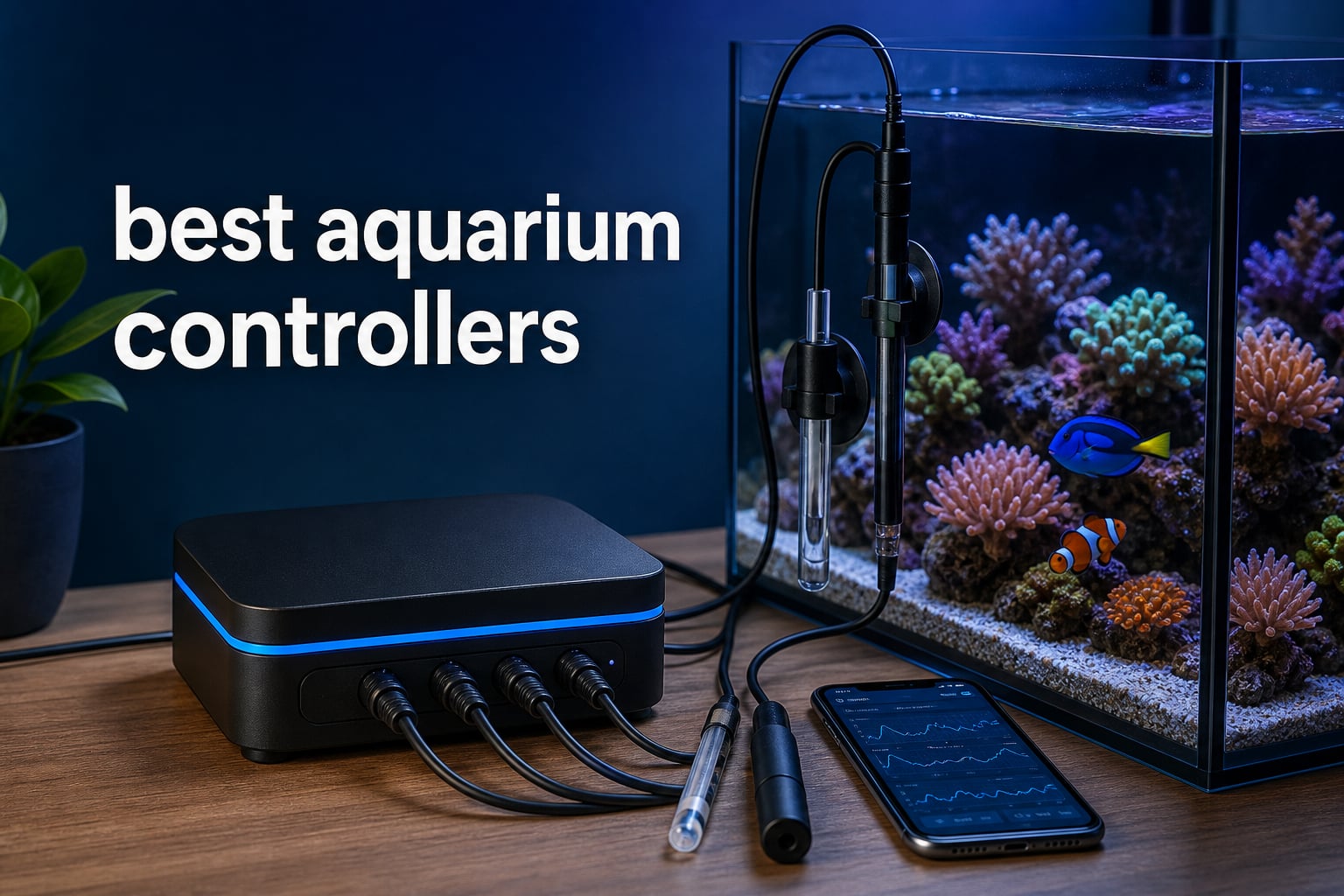
Keeping a thriving aquarium alive means watching water parameters every single day. When I started in the reef hobby years ago, I spent hours manually checking temperature, pH, and salinity with separate test kits and thermometers. The best aquarium controllers changed that completely, putting monitoring and automation into one connected system that works around the clock.
Whether you run a simple freshwater community tank or a full-blown SPS reef, an aquarium controller gives you something no manual routine can match: constant vigilance. I have had controllers alert me to a stuck heater at 2 AM and a failed auto top off pump while I was on vacation. Those alerts saved thousands of dollars in livestock.
In this guide, our team tested eight popular controllers and monitoring devices ranging from budget temperature thermostats to full cloud-connected reef automation systems. We compared features, ease of setup, app reliability, and real-world performance. Here is everything you need to find the right controller for your tank in 2026.
Table of Contents
Top 3 Picks for Best Aquarium Controllers (September 2026)

Neptune Systems A3 Apex Jr.
- Temperature and pH monitoring
- Wi-Fi via Apex Fusion app
- Leak detection included
- AquaBus expandable

AC Infinity Outlet AI+
- 8 individually controlled smart outlets
- Dual-zone temperature monitoring
- AI climate targeting
- WiFi app control
Inkbird ITC-306A WiFi
- Dual probe heater control
- WiFi app alerts
- 1100W heater support
- Plug and play setup
Best Aquarium Controllers in 2026
| Product | Specifications | Action |
|---|---|---|
| Neptune Systems A3 Apex Jr. |
|
Check Latest Price |
| AC Infinity Outlet AI+ |
|
Check Latest Price |
 Milwaukee MC122 pH Controller Milwaukee MC122 pH Controller |
|
Check Latest Price |
| Inkbird ITC-306A WiFi |
|
Check Latest Price |
 Inkbird ITC-308S Inkbird ITC-308S |
|
Check Latest Price |
 Coralife 8-Outlet Power Center Coralife 8-Outlet Power Center |
|
Check Latest Price |
 Kessil Spectral Controller X Kessil Spectral Controller X |
|
Check Latest Price |
 FZONE Aquarium ATO System FZONE Aquarium ATO System |
|
Check Latest Price |
1. Neptune Systems A3 Apex Jr. Aquarium Controller
Neptune Systems A3 Apex Jr. Aquarium Controller – Temperature, pH, Leak Detection & Level Sensor Monitoring System for Freshwater and Saltwater Aquariums
Temp and pH probes included
Wi-Fi via Apex Fusion
Leak detection sensor
2 AquaBus ports for expansion
Pros
- Precision temperature and pH monitoring
- Real-time cloud alerts via Apex Fusion app
- Compact and expandable with AquaBus ports
- Includes leak detection sensor
- Quick Wi-Fi setup without technical expertise
Cons
- Limited expansion options compared to full Apex system
I set up the Neptune Systems A3 Apex Jr. on my 40-gallon mixed reef about three months ago. Right out of the box, the build quality impressed me. The controller feels solid, and the included temperature and pH probes connected quickly without any fuss. Within twenty minutes, I had it linked to my Wi-Fi and streaming data to the Apex Fusion cloud platform.
The Apex Fusion app is where this system really shines. I can drag and drop customizable dashboards, set up automated tasks, and receive real-time push notifications wherever I am. On a recent weekend trip, the app alerted me that my tank temperature had spiked. I called a neighbor to check on the heater, and the problem was a stuck relay. That single alert paid for the entire controller.
The leak detection sensor is a nice touch that many competing controllers leave out. I placed mine in the cabinet under my sump, and it gives me an extra layer of security against floods. The Apex Jr. is designed for smaller systems, but the two AquaBus ports mean I can add modules and an EB832 Power Bar as my tank grows. Think of this as the entry point into the full Neptune ecosystem.
On the downside, the Apex Jr. has limited expansion compared to the full Apex system. If you want ORP monitoring, salinity tracking, or multiple power bars right away, you will need to buy additional modules. The base unit covers temperature, pH, and leak detection, which is enough for most mid-sized tanks but not for a full SPS reef with complex automation needs.
Who Should Buy the Apex Jr.
This controller is ideal for reef keepers and serious freshwater hobbyists who want professional-grade monitoring without the full Apex price tag. If you already own Neptune modules or plan to expand later, the AquaBus ecosystem makes this the natural starting point.
It is also a great fit for anyone who values a polished, reliable app experience. After testing several controllers with clunky software, the Apex Fusion interface feels like a premium product. The drag-and-drop customization and real-time cloud access set it apart from competitors.
Who Should Look Elsewhere
If you need full salinity, ORP, or dissolved oxygen monitoring out of the box, the Apex Jr. will fall short without additional probes and modules. The total cost can climb quickly once you start adding accessories.
Beginners with a simple freshwater tank who just want basic temperature control may find the Apex Jr. overkill. A dedicated thermostat controller like the Inkbird models will do the job at a fraction of the cost.
2. AC Infinity Outlet AI+ Environment Controller
AC Infinity Outlet AI+, Environment Controller, Smart WiFi Power Strip, Dual-Zone Temperature Humidity, Individual Control 8 Plugs, AI Targeting, Thermostat Greenhouse Aquarium Terrarium Home, 1800W
8 individually controlled outlets
Dual-zone temp and humidity
AI climate targeting
1800W max with surge protection
Pros
- 8 independently programmable smart outlets
- AI-powered climate targeting system
- Dual-zone temperature humidity and VPD tracking
- WiFi app with real-time alerts and data charts
- Built-in surge protection at 1800W capacity
Cons
- CO2 hydro and soil sensors sold separately
The AC Infinity Outlet AI+ caught my attention because it takes a different approach from traditional aquarium controllers. Instead of dedicated probes and a separate brain unit, it packs eight individually controlled smart outlets into one power strip with a built-in environment controller. I tested it on a 55-gallon saltwater setup with a heater, fan, and light all plugged in.
Setting up the eight outlets was straightforward. I assigned my heater to outlet one with a temperature trigger, my cooling fan to outlet two with a high-temp threshold, and my LED light to outlet three on a daily schedule. The AI targeting feature lets multiple devices work together toward one climate goal, which is a clever approach for maintaining stability.
The dual-zone monitoring is where this unit overdelivers. I placed one sensor probe in the tank cabinet and one in the display area, tracking temperature and humidity in both zones simultaneously. The app charts are detailed and easy to read, showing trends over hours and days. Push notifications fired reliably whenever temperatures moved outside my set ranges.
The main limitation is that the AC Infinity is an outlet controller, not a full aquarium controller. It does not monitor pH, salinity, or ORP. The CO2, hydro, and soil sensors that would expand its capabilities are sold separately, which adds to the cost. For aquarium use, you are primarily getting temperature-driven outlet control with excellent app integration.
Best Use Cases for the AC Infinity AI+
This controller is perfect for hobbyists who want smart outlet automation for heaters, fans, and lights without investing in a full reef controller system. If you have multiple devices that need individual schedules and temperature triggers, the eight programmable outlets handle it beautifully.
It also works well for hybrid setups where you have both an aquarium and a terrarium or grow tent in the same area. The dual-zone monitoring lets you track two distinct environments from one device and one app dashboard.
Limitations to Consider
Saltwater reef keepers who need pH, salinity, and ORP monitoring will not find those capabilities here. The AC Infinity is fundamentally a smart power strip with climate triggers, not a water chemistry monitor.
The additional sensors for CO2 and hydroponic monitoring are marketed more toward grow tent users. For a pure aquarium setup, those add-ons have limited value, so factor in what you actually need before expanding.
3. Milwaukee Instruments MC122 pH Controller
Milwaukee Instruments MC122US pH Controller with Hi/Low Range Alarm, 2 Point Manual Calibration, 0.0 to 14.0 pH Range
pH range 0.0 to 14.0
Hi/Low set point alarm
2-point manual calibration
CO2 dosing power plug
Pros
- User selectable Hi/Low set points for precise control
- Manual 2-point calibration for accuracy
- Visual LED alarm for out of range pH
- Includes 12VDC adapter and mounting kit
- Built-in power plug for CO2 dosing equipment
Cons
- Not smart home compatible
- Limited display with no app connectivity
I added the Milwaukee MC122 to my planted freshwater tank specifically to automate CO2 injection. This is a dedicated pH controller, not a full aquarium automation system, and it excels at its single job. The unit monitors pH continuously and switches your CO2 solenoid on or off based on your selected set points.
The 2-point manual calibration process took me about ten minutes using the included calibration solutions. Once calibrated, the readings were consistent and matched my manual test kit results within 0.1 pH. The LED display is basic but clear, showing the current pH reading at all times alongside a visual alarm indicator.
What makes the Milwaukee stand out is its reliability. After three months of continuous operation, it has maintained accurate readings without drift. The Hi/Low alarm triggers a visual alert if pH moves outside your set range, which is critical for sensitive shrimp or planted tanks where CO2 overdose can harm livestock.
The trade-off is that this controller has zero smart features. There is no Wi-Fi, no app, and no cloud connectivity. You cannot check your pH from your phone or receive push notifications. For some hobbyists, that simplicity is actually a selling point. For others who want remote monitoring, this will be a dealbreaker.
Ideal Applications for the Milwaukee MC122
Planted tank enthusiasts running pressurized CO2 will get the most value from this controller. It automates CO2 dosing based on actual pH readings, preventing both CO2 starvation and dangerous overdosing. Set your target pH, plug in your solenoid, and the controller handles the rest.
It is also useful for calcium reactors in reef tanks, where maintaining a stable pH in the reactor chamber is essential. The precise set-point control works well for this application, and the LED alarm gives you a visual warning if something drifts.
Drawbacks for Modern Hobbyists
The lack of any smart connectivity means you have no remote monitoring or data logging. If you travel frequently or want to track pH trends over time, you will need a separate logging device or a more advanced controller.
The display is functional but dated compared to modern touchscreen interfaces. If you are used to app-based controllers with rich dashboards, the Milwaukee’s LED readout will feel like a step back.
4. Inkbird ITC-306A WiFi Temperature Controller
Inkbird ITC-306A WiFi Temperature Controller, Wi-Fi Aquarium Thermostat Heater Controller 120V~1200W Temperature Control with Two Probes only for Heater Aquarium Breeding Reptiles Hatching.
Dual probe heater control
WiFi app with push alerts
1100W max load
20-35 degree C range
Pros
- Dual relay protection against overheating
- Two probes for redundant temperature monitoring
- WiFi app with real-time push notifications
- Plug and play with most heaters
- Customizable heating time from 1 to 72 hours
Cons
- Heater control only not cooling
The Inkbird ITC-306A is the best aquarium controller for anyone on a tight budget who needs reliable temperature management. I have run this unit on a 20-gallon freshwater quarantine tank for over a year, and it has performed flawlessly. The dual probe design gives you a backup if one probe fails, which is a feature usually found on much more expensive controllers.
Setup took me less than five minutes. I plugged my heater into the controller, dropped both probes into the tank at different locations, and connected the unit to my Wi-Fi. The Inkbird app walks you through the process step by step, and the interface is clean and intuitive.
The dual relay system is the standout safety feature. If the controller detects overheating, it cuts power to the heater through two independent relays. This redundancy means that even if one relay sticks closed, the second one will still shut off the heater. For fish keepers who have lost livestock to a stuck heater, this design provides genuine peace of mind.
The app sends push notifications when the temperature difference between the two probes exceeds 3 degrees, which can indicate a probe problem or a dead heater. I also appreciate the customizable heating time feature, which alarms if the heater cannot reach the target temperature within a set window of 1 to 72 hours.
The obvious limitation is that the ITC-306A controls heating only. There is no cooling outlet, so you cannot use it to switch on a fan or chiller. If you live in a warm climate where tank overheating is a concern, you will want the ITC-308S instead, which handles both heating and cooling.
Perfect for These Setups
Freshwater community tanks, breeding setups, and quarantine tanks are the sweet spot for this controller. If your primary concern is preventing heater malfunctions from cooking your fish, the dual probe and dual relay system gives you excellent protection at a budget-friendly price.
The WiFi connectivity means you can check your tank temperature from anywhere. For hobbyists who travel or work long hours, the push notifications are invaluable. I have received temperature alerts while at the office that let me respond before things got dangerous.
When to Choose a Different Option
If you need cooling control for fans or chillers, this model will not work. The ITC-306A is heater-only, so look at the Inkbird ITC-308S for dual heating and cooling capability.
Reef keepers who need pH, salinity, or ORP monitoring alongside temperature control will need a more advanced system. The Inkbird is a temperature specialist, not a full aquarium controller.
5. Inkbird ITC-308S Temperature Controller
Inkbird ITC308S Temperature Controller for Aquarium with Submersible Probe, Heating Cooling Outlets Thermostat for Heater and Cooling Fans
Heating and cooling outlets
Submersible aquarium probe
1200W max load
Dual display window
Pros
- Both heating and cooling control in one unit
- Fully submersible probe designed for aquarium use
- Temperature calibration and over-temperature alarm
- Dual display showing measured and set temperature
- 1200W output load at 110V
Cons
- Not smart home compatible or WiFi enabled
The Inkbird ITC-308S is the controller I recommend most often to hobbyists who need both heating and cooling management. I tested it on a 30-gallon nano reef where summer temperatures pushed the tank above safe levels. Plugging both my heater and a cooling fan into this single controller gave me automatic temperature regulation in both directions.
The submersible probe is a significant advantage over generic temperature controllers. Standard probes are designed for air or surface contact, but the ITC-308S probe goes directly into the water for accurate readings. I noticed the temperature response was faster and more precise than with my older non-submersible controller.
The dual display window shows both the current measured temperature and your target set temperature simultaneously. This sounds simple, but it makes a big difference in daily use. You can glance at the unit and instantly see whether your tank is on target without cycling through menus.
Temperature calibration is available if you find the readings are slightly off compared to a reference thermometer. I calibrated mine by 0.3 degrees after comparing it with a lab-grade thermometer. The over-temperature alarm sounds if the tank exceeds your set safety threshold, giving you an audible warning even if you are not looking at the display.
The biggest missing feature compared to the WiFi-enabled ITC-306A is remote monitoring. The ITC-308S has no app, no Wi-Fi, and no push notifications. You get a reliable, accurate local controller but no way to check your tank temperature from your phone.
Best Tanks for the ITC-308S
Nano reefs, pico tanks, and any aquarium in a warm climate benefit enormously from the dual heating and cooling control. If your tank room gets hot in summer, plugging a fan or small chiller into the cooling outlet gives you automatic temperature management without manual intervention.
Breeding setups that require tight temperature ranges also benefit from the precision and reliability of this controller. The submersible probe and calibration feature let you dial in exact temperatures for sensitive species.
What It Cannot Do
Without WiFi or app connectivity, you have no remote alerts or data logging. If you are away from home and your heater fails, you will not know until you return. Pairing this with a smart plug for basic notifications can help bridge that gap.
The controller handles temperature only. There is no pH monitoring, no salinity tracking, and no outlet scheduling. It is a dedicated thermostat, not a multi-parameter controller.
6. Coralife Aquarium 8-Outlet Digital Power Center Timer
Coralife Aquarium Fish Tank 8-Outlet 24/7 Digital Power Center Timer
8 grounded outlets
24-hour mechanical timer
7 daily cycles
1875W total capacity
Pros
- Simple and reliable mechanical timer operation
- Sliding safety covers on unused outlets
- Up to 7 time cycles per day
- Grounded 3-prong plug with 3 foot cord
- UL listed for safety
Cons
- Not smart home compatible
- Mechanical timer less precise than digital alternatives
The Coralife Power Center is the most basic entry on this list, but it has earned its place through years of reliable service. I have used one on my freshwater planted tank for automated lighting schedules, and it has never missed a cycle. Sometimes simple is exactly what you need.
This is not a monitoring controller at all. It is a timed power strip designed for aquarium use. You set mechanical timer pins to create up to seven on-off cycles per day, and the unit switches your devices accordingly. The four constant-power outlets stay on all the time for equipment like filters, while the four timer-controlled outlets cycle for lights, CO2 solenoids, or feeding rings.
The sliding safety covers on each outlet are a thoughtful touch that prevents salt creep and moisture from getting into unused sockets. The unit is UL listed, which gives me confidence in its electrical safety. After two years of continuous use in a humid aquarium room, mine shows zero signs of corrosion or timer drift.
The obvious trade-off is precision. The mechanical timer operates in 15-minute intervals, which is fine for lighting schedules but not for precise equipment control. There is no digital display, no programmable memory, and no battery backup. If the power goes out, you need to reset the timer manually.
When the Coralife Makes Sense
Beginners setting up their first aquarium will appreciate the simplicity. There is no app to configure, no Wi-Fi to connect, and no software to learn. Just set the pins, plug in your devices, and walk away. The timer handles day and night lighting cycles automatically.
Budget-conscious hobbyists who only need basic on-off scheduling for lights and CO2 will find this covers their needs at a very low cost. It is hard to beat the value when your requirements are simple.
When to Upgrade Past It
If you want temperature monitoring, pH control, or remote access, the Coralife will not help. It is purely a timer, not a controller or monitor. Any parameter monitoring requires a separate device.
The lack of digital precision means this is not suitable for applications requiring exact timing. If you need second-level control or custom weekly schedules, look at a digital or WiFi-enabled alternative.
7. Kessil Spectral Controller X
Kessil Spectral Controller X
Touch control color display
K-Link networking up to 32 lights
0-10V output port
12 custom light schedules
Pros
- Flawless touch control with vivid color display
- K-Link networking for up to 32 fixtures
- Manual mode for on demand color and intensity tuning
- Program mode with up to 12 customizable schedules
- Two-way communication detects light status
Cons
- Not Prime eligible
- Limited stock availability
The Kessil Spectral Controller X is a specialized controller designed specifically for Kessil aquarium lights. I tested it with three A360X LED pendants over my reef tank, and the level of control it provides over lighting is unmatched by general-purpose controllers. The color touchscreen is responsive and makes adjusting spectrum and intensity genuinely enjoyable.
K-Link communication is the key technology here. Instead of controlling each light independently, the Spectral Controller X networks your fixtures together in a chain. It supports up to 32 lights per chain with two-way communication, meaning the controller can detect how many lights are connected and report their status. This eliminates the guesswork of 0-10V control where you never quite know if a light received the signal.
Manual mode lets you dial in color and intensity in real time. I use this feature frequently when photographing corals or adjusting the spectrum for viewing. The response is instant, and the touchscreen interface makes precise adjustments easy. Program mode supports up to 12 customized light schedules, which is more than enough for dawn-to-dusk simulations with smooth ramping.
The controller includes a magnetic back plate for clean mounting on metal surfaces, plus a micro USB cable for power, K-Link cable, screws, and anchors. The build quality matches Kessil’s premium positioning, with a slim profile and durable construction.
Who Benefits Most from the Spectral Controller X
Reef keepers running multiple Kessil lights will get the most value from this controller. The K-Link networking simplifies multi-light setups dramatically compared to individual control or 0-10V daisy chaining. If you have two or more Kessil fixtures, this controller is almost essential.
Photographers and content creators who need precise, on-demand lighting control will love the manual mode. Being able to instantly shift color temperature and intensity for the perfect shot is a feature no app-based general controller can replicate with this level of precision.
Important Compatibility Notes
This controller works with Kessil lights featuring K-Link ports and also supports 0-10V output for compatible fixtures from other brands. However, the K-Link features that make it special are only available with Kessil fixtures. If you run a different brand of lights, most of the advanced features are irrelevant.
The Spectral Controller X handles lighting only. It does not monitor temperature, pH, or any water parameters. Think of it as a complement to your main aquarium controller, not a replacement for one.
8. FZONE Aquarium ATO System with Controller
FZONE Aquarium ATO with Controller, QST2.0 Auto Top Off System for Saltwater Aquarium & Freshwater Aquarium
Auto top off with QST 2.0
Dual optical sensors
74 GPH micro pump
2-year warranty
Pros
- Upgraded QST 2.0 technology with real-time overfill protection
- Compact dual optical sensors with 0.6 cm precision
- Quiet micro pump with 74 GPH flow rate and 2 meter lift
- Complete accessories including magnets and check valve
- 2-year warranty with 24/7 customer support
Cons
- Recommended for tanks with wave fluctuations under 1 cm
- Pump requires tank neck sizes over 1.97 inches
The FZONE Aquarium ATO System solves one of the most tedious daily tasks in reef keeping: topping off evaporated water. I installed this on my 60-gallon reef tank six months ago, and it has eliminated the daily manual top-offs that used to drive me crazy. The system maintains a consistent water level automatically, which keeps salinity stable.
The dual optical sensors are compact at just 0.79 inches in diameter, making them suitable for rimmed tanks, rimless tanks, and sump-based setups. The sensors sit 0.1 cm apart and detect water level changes with 0.6 cm precision. When the water drops below the set point, the controller activates the pump to top off. When the water reaches the upper sensor, the pump stops.
QST 2.0 technology provides the overfill protection that gives this ATO its reliability rating. The system monitors sensor status in real time and shuts down the pump immediately if it detects an anomaly. I tested this by intentionally blocking the upper sensor, and the controller stopped the pump within seconds. That kind of safety response is what separates a good ATO from a flooding risk.
The micro pump delivers 74 GPH with a 2-meter lift height, which is plenty for most residential aquarium setups. I noticed the pump runs quietly, which matters if your tank is in a living area or bedroom. The included check valve prevents backflow, and the 6-foot tube reaches from my reservoir to the sump easily.
Best Applications for the FZONE ATO
Reef tanks with sumps are the primary use case for this auto top off system. Consistent water level means stable salinity, which is one of the most important parameters for coral health. If you are tired of manually adding rodi water every day, this system pays for itself in convenience alone.
Freshwater planted tanks with high evaporation rates also benefit. The optical sensors work equally well in fresh and saltwater, and the compact design fits tight installations where bulkier ATO systems cannot go.
Compatibility Limitations
The system is recommended for tanks where wave fluctuations stay under 1 cm. If you run strong wave makers that create large surface oscillations, the sensors may trigger prematurely. Positioning the sensors in a calm area of the sump or overflow box solves this in most cases.
The pump requires a reservoir or tank neck opening over 1.97 inches. Measure your top-off reservoir opening before purchasing to ensure the pump fits properly.
How to Choose the Best Aquarium Controller for Your Tanks?
Choosing from the best aquarium controllers available means understanding what your specific tank needs. I have learned through years of trial and error that the most expensive controller is not always the best choice. The right pick depends on your tank type, budget, and what parameters you actually need to monitor and automate.
Monitor vs Controller: Know the Difference
A monitor reads and displays water parameters like temperature, pH, and salinity. It tells you what is happening but does not take action. A controller goes further by automating equipment based on those readings. For example, a temperature controller can turn your heater off when the target temperature is reached, while a monitor simply shows you the current temperature.
The best aquarium controllers combine both functions. They monitor parameters continuously and trigger automated responses when conditions change. Devices like the Neptune Apex and AC Infinity AI+ fall into this category, while products like the Inkbird ITC-306A are specialized controllers that handle one parameter with precision.
Reef vs Freshwater Considerations
Reef tanks demand more monitoring than freshwater tanks. Saltwater systems benefit from tracking temperature, pH, salinity, ORP, and sometimes alkalinity and calcium. A full-featured controller like the Neptune Apex ecosystem makes sense for reef keepers who need multi-parameter monitoring and complex automation routines.
Freshwater tanks typically need temperature control and possibly pH monitoring for planted setups with CO2 injection. A dedicated temperature controller like the Inkbird ITC-306A or a pH controller like the Milwaukee MC122 often covers the essential needs at a much lower cost than a full reef controller.
Connectivity and Remote Access
WiFi connectivity has become a must-have feature for many hobbyists. The ability to check your tank parameters from your phone and receive push notifications when something goes wrong provides tremendous peace of mind. Controllers like the Neptune Apex Jr. and Inkbird ITC-306A WiFi offer app-based monitoring with cloud access.
If you travel frequently or work long hours, prioritize controllers with reliable apps and notification systems. The Apex Fusion platform is widely regarded as the gold standard for aquarium app interfaces. The Inkbird app is simpler but effective for temperature monitoring.
Budget vs Premium Systems
Aquarium controllers span a wide price range. Budget temperature controllers from Inkbird start under $50 and provide excellent single-parameter control. Mid-range options like the AC Infinity AI+ and Milwaukee pH controller offer more features for $100 to $200. Premium systems like the Neptune Apex ecosystem can run $300 to $800 or more once you add modules and probes.
My advice is to start with what your tank actually needs. A $40 temperature controller that prevents heater disasters is worth far more than a $500 controller whose advanced features you never configure. You can always upgrade later as your hobby and tank complexity grow.
Expandability for Future Growth
If you plan to upgrade your tank or add more equipment over time, look for a controller with expansion options. The Neptune AquaBus system lets you add modules for salinity, ORP, dosing, and more as your needs evolve. The AC Infinity AI+ supports additional sensors for CO2 and other parameters.
Controllers with no expansion path, like the basic Inkbird thermostats, are purpose-built for their specific function. They do their job well but cannot grow with you. That is fine if your needs are fixed, but frustrating if your tank ambitions expand.
FAQs
What is the best aquarium controller for a reef tank?
The Neptune Systems A3 Apex Jr. is the best aquarium controller for reef tanks. It monitors temperature and pH with included probes, offers leak detection, and connects to the Apex Fusion cloud app for real-time alerts. The AquaBus expansion system lets you add salinity, ORP, and dosing modules as your reef grows.
What is the best aquarium controller for beginners?
The Inkbird ITC-306A WiFi is the best aquarium controller for beginners. It offers plug-and-play heater control with dual probes, WiFi app alerts, and dual relay overheat protection. The simple setup and affordable price make it ideal for hobbyists new to aquarium automation.
How much does a quality aquarium controller cost?
A quality aquarium controller costs between $35 and $400 depending on features. Basic temperature controllers like the Inkbird ITC-308S start around $35. Mid-range options like the AC Infinity AI+ run about $99. Premium systems like the Neptune Apex Jr. cost around $330, with additional modules adding to the total.
What can an aquarium controller do?
An aquarium controller can monitor water parameters like temperature, pH, and salinity, automate equipment such as heaters, fans, lights, and dosing pumps, send real-time alerts to your phone when conditions change, and run scheduled programs for lighting and feeding. Advanced controllers like the Neptune Apex also provide data logging and remote cloud access.
Should I get an aquarium controller?
You should get an aquarium controller if you want to prevent tank disasters from equipment failures, maintain stable water parameters automatically, or monitor your tank remotely while away. Controllers are especially valuable for reef tanks, breeding setups, and any aquarium containing expensive or sensitive livestock where parameter stability is critical.
Final Thoughts on the Best Aquarium Controllers for 2026
Finding the best aquarium controllers comes down to matching features to your tank’s needs and your budget. The Neptune Systems A3 Apex Jr. takes our top spot for its professional-grade monitoring, expandable AquaBus ecosystem, and the unmatched Apex Fusion cloud platform. For a balance of price and capability, the AC Infinity Outlet AI+ delivers eight smart outlets with AI climate targeting at a mid-range price point.
Budget-conscious hobbyists get outstanding value from the Inkbird ITC-306A WiFi, while specialized needs are covered by the Milwaukee pH controller, Kessil lighting controller, and FZONE auto top off system. Whatever your setup, investing in some form of automated monitoring and control will give you peace of mind and a healthier tank in 2026.