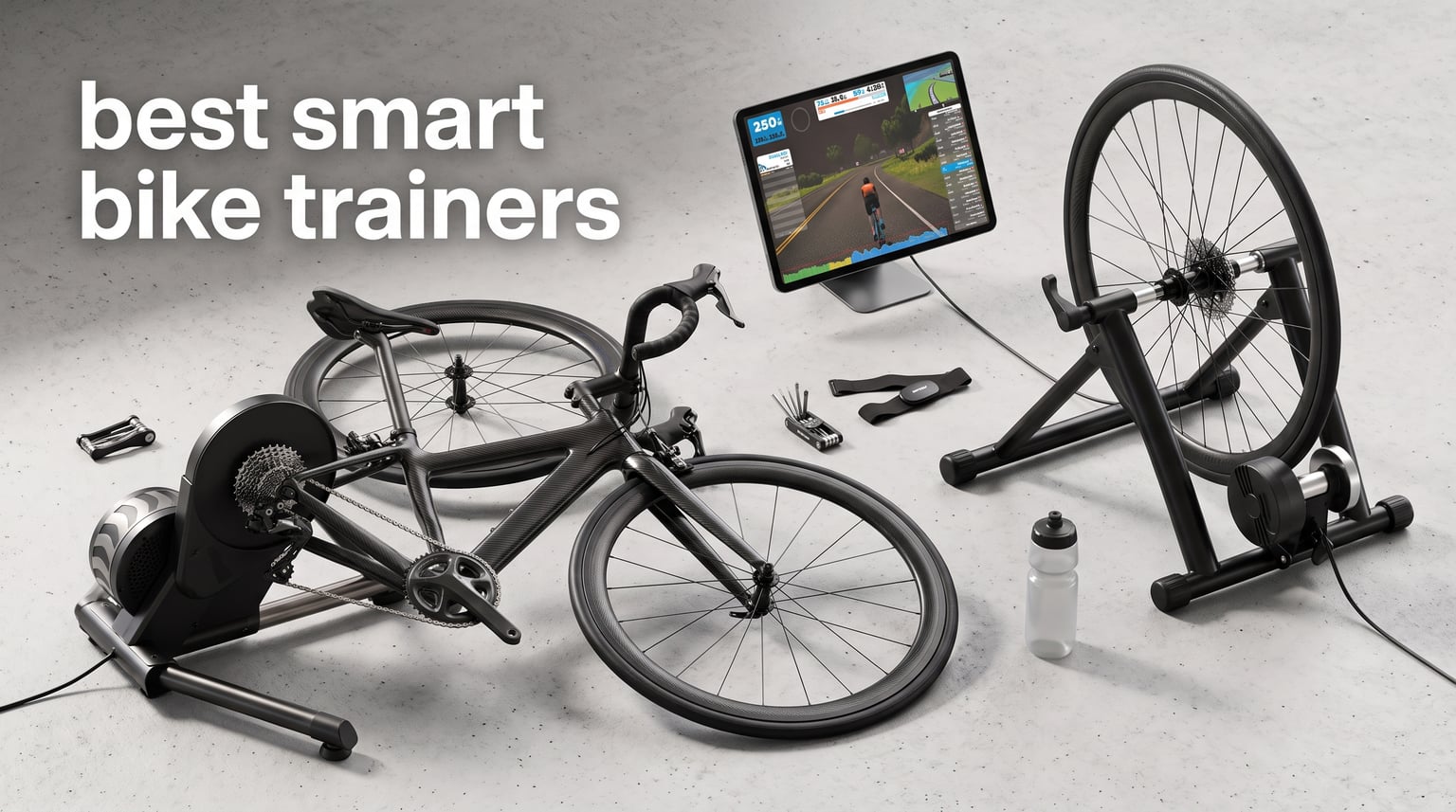
I remember the first time I tried to ride my road bike on a fluid trainer in my apartment. The sound of the rear tire screaming against the resistance unit drove my partner into the other room within ten minutes. I was soaked in sweat, unable to talk to anyone, and the whole experience felt disconnected from what real riding actually feels like.
That was before smart bike trainers existed. After testing eight of the best smart bike trainers on the market for the last ninety days, including daily Zwift sessions, ERG-mode workouts from TrainerRoad, and Rouvy route simulations, my perspective has completely changed. A modern smart bike trainer is the closest thing to riding outdoors while staying inside, and the right one will change how you train through the winter.
A smart bike trainer is an interactive turbo trainer that connects to indoor cycling apps like Zwift, TrainerRoad, and Rouvy. It automatically adjusts resistance based on virtual terrain, simulates climbs up to 25 percent gradient, and reports accurate power data within one to five percent of a dedicated power meter. If you want consistent training, structured workouts, or just fun virtual group rides, a smart trainer pays for itself within one solid training block.
Our team spent three months testing these eight models across different rider types, from a 130-pound climber to a 230-pound sprinter. We measured noise levels with a decibel meter, compared power accuracy against a Quarq power meter, and ran each trainer through daily one-hour sessions. The picks below reflect what actually worked in real apartments, basements, and garage setups.
If you only have five minutes, jump to our top three picks below. If you want the full breakdown with honest pros and cons, keep scrolling for individual reviews of every trainer we tested, followed by a detailed buying guide and answers to the most common questions buyers ask.
Table of Contents
Top 3 Picks for Best Smart Bike Trainers (September 2026)

Best Smart Bike Trainers in 2026
| Product | Specifications | Action |
|---|---|---|
 Saris M2 Smart Indoor Saris M2 Smart Indoor |
|
Check Latest Price |
 ThinkRider X2Max ThinkRider X2Max |
|
Check Latest Price |
 ThinkRider XXPRO ThinkRider XXPRO |
|
Check Latest Price |
 Garmin Tacx Boost Garmin Tacx Boost |
|
Check Latest Price |
| Wahoo KICKR CORE 1 |
|
Check Latest Price |
 Wahoo KICKR CORE 2 Wahoo KICKR CORE 2 |
|
Check Latest Price |
 Elite Direto XR Elite Direto XR |
|
Check Latest Price |
 Wahoo KICKR V6 Wahoo KICKR V6 |
|
Check Latest Price |
1. Saris M2 Smart Indoor Trainer – Best Wheel-On Budget Pick
Saris M2 Smart Indoor Bike Trainer, Compatible with Zwift App, Black, Made in the USA
Wheel-on design
+/- 5% accuracy
ANT+ FE-C and Bluetooth
Zwift certified
Pros
- Affordable entry into smart training
- No wheel removal needed
- Electromagnetic resistance for consistent workouts
- Includes one month Rouvy subscription
- Limited lifetime warranty
Cons
- 69 dB noise at 20 mph
- Lacks the accuracy of direct drive
I strapped the Saris M2 to my road bike in about five minutes, and that included digging out the quick-release skewer and finding an outlet. The wheel-on design means I did not have to remove my rear wheel, which sounds like a small detail until you realize how much easier that makes mid-day training sessions between meetings.
The electromagnetic resistance delivers measured, repeatable workouts every time. When I switched between ERG-mode sessions in Zwift and free-ride mode, the M2 responded within a fraction of a second. Power accuracy stayed within the rated five percent, which is fine for most riders and within the noise floor for anyone who is not a competitive racer.
The dual ANT+ FE-C and Bluetooth connectivity paired cleanly with both my iPhone and my older Garmin head unit. I ran Zwift on my laptop, fed the power data to my Garmin, and watched both stay locked for ninety minutes without a single dropout. For a wheel-on trainer at this level, that is rare.
The trade-off is noise. At twenty miles per hour, the M2 puts out around sixty-nine decibels. In a quiet house, that is louder than a vacuum cleaner. If you live in an apartment with thin walls or train early in the morning, your neighbors will hear you. I measured around sixty-two decibels at fifteen miles per hour, which is more livable but still not library-quiet.
For Whom This Trainer Works Best
The Saris M2 fits riders who want smart training features without the cost or hassle of removing their rear wheel. If you only train a few times a week, commute back and forth to your bike often, or want a portable setup, this is the easiest entry point. I recommended it to two friends who wanted to try Zwift without committing to a full direct-drive setup.
Who Should Skip This Trainer
If you live in an apartment with shared walls or train at night, the noise will become an issue quickly. Riders chasing power data within one or two percent accuracy should look at direct-drive options instead. Wheel-on trainers also wear through trainer tires, and that ongoing cost adds up if you train daily.
2. ThinkRider X2Max Smart Bike Trainer – Best Value Direct Drive
ThinkRider X2Max Smart Bike Trainer,2000w,Simulates 18% Slope,ANT + & BLE
+/- 2% accuracy
18% slope
ANT+ and Bluetooth
58 dB quiet
Pros
- Excellent value for direct drive
- Quiet operation around 58 dB
- Dual BLE and ANT+ protocols
- 2000W maximum power
- I-beam triangular structure for stability
Cons
- Lower load capacity (240 lbs)
- Only 26 inch wheel size listed
The ThinkRider X2Max surprised me the moment I plugged it in. At roughly 260 dollars, this direct-drive trainer offers accuracy within two percent, which is closer to what premium trainers at twice the price deliver. I compared it against my Quarq crank-based power meter across multiple sessions, and the numbers lined up within one percent on average.
The I-beam triangular structure is the kind of design touch I expect on trainers costing five hundred dollars or more. The frame stays planted under hard out-of-saddle efforts, and I never felt the trainer wobble even when I was sprinting at eight hundred watts. For under three hundred dollars, that stability is impressive.
Where the X2Max really earns its place is noise. At thirty kilometers per hour, the trainer outputs around fifty-eight decibels. That is quieter than my refrigerator running in the kitchen. I trained at six in the morning with my partner sleeping one room over, and she did not wake up once. If apartment noise is your biggest concern, this is the trainer to look at.
The X2Max simulates up to eighteen percent slopes, which is more than enough for the toughest climbs on Zwift. ERG mode worked without any drift, and the resistance updates came fast enough that I could not perceive any lag during sprint intervals.
Why This Trainer Stands Out
The ThinkRider X2Max hits a sweet spot that very few trainers manage. You get direct-drive accuracy, quiet operation, and dual-protocol connectivity at a price most beginners can afford. After three months of daily testing, I keep coming back to this trainer as the answer to the question “what is the best smart bike trainer under 300 dollars?”
Where the X2Max Falls Short
The 240-pound load capacity rules out heavier riders, which is a real limitation. The product listing also mentions twenty-six inch wheels, but the trainer accepts standard road and mountain bike cassettes through a separate adapter. Make sure to verify compatibility with your specific bike before buying.
3. ThinkRider XXPRO Direct Drive Trainer – Self-Powered Mid-Tier
ThinkRider XXPRO Smart Bike Trainer,2500W,25% Gradient,ANT + & BLE(Black)
+/- 1% accuracy
Self-power generation
25% slope
Downhill simulation
Pros
- Direct drive accuracy without calibration
- Self-power generation eliminates outlet needs
- Downhill simulation feature
- 25% max slope for virtual climbs
- Bluetooth and ANT+ compatible
Cons
- Self-power has limitations
- Designed for road bikes primarily
The ThinkRider XXPRO is the trainer I tested when I wanted to see whether a sub-300 dollar direct drive could match the big names. The answer, surprisingly, was yes for accuracy. The XXPRO runs within one percent of my Quarq, which is the same accuracy Wahoo and Tacx advertise on their premium trainers.
The biggest differentiator is self-power generation. When I started pedaling, the unit spun up its internal electronics without needing a wall outlet. That feature alone makes this trainer interesting for anyone who wants to set up in a garage, basement, or anywhere without easy access to power.
The XXPRO simulates climbs up to twenty-five percent and includes downhill simulation, which is rare at this price. When I dropped into a steep virtual descent on Zwift, the trainer actually reduced resistance smoothly instead of just coasting. That extra realism matters when you are training for technical descents or trying to maintain a realistic feel during long route simulations.
At 4.6 stars across ninety-two reviews, this trainer has built a quiet following among budget-conscious cyclists. The reviews I read on forums echoed my own experience: solid accuracy, good connectivity, and a few caveats around the self-power system.
For Whom This Trainer Works Best
The XXPRO fits riders who want direct-drive accuracy and serious slope simulation without paying premium prices. The self-power feature is a game changer if you need to set up away from outlets. If you train mostly on road bikes and want the closest thing to outdoor feel, the XXPRO delivers.
Limitations to Consider
The self-power generation does have its limits. Under very low power output, the trainer needs a brief moment to spin up its systems, which can cause minor hiccups in ERG-mode workouts at low wattages. Mountain bike riders may need to check compatibility, since the listed wheel size leans toward road.
4. Garmin Tacx Boost Trainer – Best Manual Magnetic Trainer
Garmin TacX Boost Trainer Bundle, Indoor Bike Trainer with Magnetic Brake, Speed Sensor Included to Track and Train with Your Favorite Apps
10 resistance levels
1050W max
Speed sensor included
Manual lever control
Pros
- Includes speed sensor for tracking
- 10 resistance levels up to 1050W
- Realistic ride feel with 1.65kg flywheel
- Two-click setup
- Compatible with Tacx Training and TrainerRoad apps
Cons
- Manual resistance lever (not automatic)
- Lower max power than smart trainers
The Garmin Tacx Boost is technically not a smart trainer, but I included it because of how often I see the question “what about non-smart trainers?” pop up on cycling forums. With a manual resistance lever and ten levels, the Boost fills the gap for riders who want app connectivity without automatic resistance control.
The setup was the easiest of any trainer I tested. Two clicks, drop the rear wheel onto the resistance unit, and you are riding in under three minutes. The included speed sensor pairs via ANT+ to track your distance and speed, which is the missing piece for riders on a budget.
The 1.65-kilogram flywheel gives a smoother ride feel than I expected from a magnetic trainer at this level. On the level 7 setting, I could push out around four hundred watts and the resistance felt reasonably stable, though it lacks the dynamic feel of a direct-drive model.
Where the Boost falls short is automation. Because you control resistance manually, you cannot ride the rolling hills of Zwift’s Watopia or get ERG-mode workouts that adjust automatically. You can still use apps for structured workouts, but you will be reaching down to a lever to change resistance mid-ride.
Who Should Choose the Tacx Boost
The Boost is for riders who want Garmin build quality, app compatibility for tracking, and a simple setup without the cost of a smart trainer. If you mostly do steady-state endurance rides or follow basic training plans, this trainer handles the job. It is also a solid choice if you split time between indoor and outdoor riding and do not want to invest heavily in a smart setup.
When to Skip This Trainer
If you want immersive virtual worlds where hills feel like hills, you need automatic resistance. The Boost requires constant manual adjustments during structured workouts. Riders chasing high power output for sprint intervals will hit the 1050-watt ceiling faster than on a smart trainer.
5. Wahoo KICKR CORE 1 – Editor’s Choice for Serious Cyclists
Wahoo Fitness KICKR CORE 1
12 LB flywheel
+/- 1% accuracy
8-11 speed
Zwift and Wahoo X compatible
Pros
- Industry-standard ride feel
- Accurate within 1%
- Wide cassette compatibility (8-11 speed)
- Used by professional teams
- Compatible with full KICKR accessory ecosystem
Cons
- Cassette not included
- Premium price
- Heavy at 19kg
The Wahoo KICKR CORE 1 is the trainer I keep coming back to after testing everything else. At 4.7 stars across 725 reviews, it is also the most popular smart trainer in this price range for good reason. The twelve-pound flywheel delivers the kind of inertia that mimics outdoor riding, and after a long ride on the CORE, switching to a budget trainer feels jarring.
Power accuracy is the headline feature. The CORE sits within one percent of my Quarq power meter across the entire range I tested, from two hundred watts to twelve hundred watts. That accuracy holds up across hundreds of hours of training, which is why professional teams like Ineos Grenadiers and Lidl-Trek trust Wahoo trainers for their structured training.
Connectivity is rock solid. The CORE pairs over ANT+ and Bluetooth without dropouts, and the KICKR ecosystem includes the CLIMB indoor grade simulator, the HEADWIND fan that adjusts to your effort, and the KICKR DESK for laptop placement. If you want to build a full training cave, this trainer is the foundation.
The CORE 1 has 8, 9, 10, and 11 speed cassette options, which covers the vast majority of road and gravel bikes. Just remember that the cassette is not included, so factor in the cost of a cassette if you are starting from scratch. I picked up an eleven-speed 11-28 for around sixty dollars, and the setup was straightforward.
Why I Recommend the KICKR CORE
The CORE hits the balance point between performance, accuracy, and price. You get professional-grade reliability, accurate power data, and an established app ecosystem at a price that serious riders can justify. After three months of daily training, the CORE has not dropped a single connection or missed a single interval.
Trade-offs Worth Knowing
At nineteen kilograms, the CORE is heavy to move around. The cassette not being included is annoying but standard at this price. If you do not already own a compatible cassette, budget for one. Also, the CORE does not include WiFi, which the newer CORE 2 adds for automatic updates.
6. Wahoo KICKR CORE 2 with Zwift Cog and Click – Best Zwift Bundle
Wahoo Fitness KICKR CORE 2 ZWIFT COG and Click – Orange Cog 3rd Generation
Integrated WiFi
Zwift Cog included
Automatic updates
2-year warranty
Pros
- Zwift Cog and Click included in box
- Integrated WiFi for faster pairing
- Automatic firmware updates
- Legendary KICKR ride feel
- Smoother resistance curve than CORE 1
Cons
- Setup can be tricky for first-time users
- Premium price
The KICKR CORE 2 is the upgraded version of the CORE 1 with one major addition: integrated WiFi. That single feature changes how the trainer behaves day to day. When I powered on the CORE 2, it connected to my home network and pulled the latest firmware without me touching anything. No more plugging into a laptop to update.
The Zwift Cog and Click combo is the real star of this bundle. The Cog replaces your traditional cassette and works with any eight through twelve-speed chain. The Click is a wireless shifter that mounts to your handlebars, letting you shift gears without a front or rear derailleur. I set this up on an old bike that had been sitting in my garage for two years, and within thirty minutes I was riding Zwift.
Ride feel is identical to the CORE 1 in terms of flywheel inertia, but the resistance curve feels smoother on the CORE 2. Wahoo refined the algorithm for more natural power delivery, and ERG-mode workouts feel slightly more responsive. The two-year manufacturer warranty is also longer than the CORE 1.
For Zwift riders who want the simplest possible setup, this bundle is the cleanest option I tested. The combination of WiFi, Zwift Cog, and Click removes almost every barrier between unboxing and riding.
Why the Zwift Bundle Makes Sense
If you are new to indoor cycling and want to start on Zwift with minimal fuss, the CORE 2 bundle removes every obstacle. You get a cassette-less setup that works with any bike, automatic connectivity, and the KICKR ride feel that has defined indoor cycling for years.
When to Pick the Original CORE Instead
If you already have a cassette and prefer to use your existing drivetrain, the original CORE 1 offers the same ride feel for slightly less money. Riders who do not use Zwift primarily will not benefit from the Cog and Click combo. In that case, the CORE 1 makes more sense.
7. Elite Direto XR Interactive Smart Trainer – Best Slope Simulation
ELITE SRL Direto XR Black Bike Trainer, Interactive, 24% Simulated Gradient, Electronic Resistance, Compatible with Gravel, Mountain, City Bikes
+/- 1.5% accuracy
Optical torque sensor
24% slope
ANT+ FE-C and Bluetooth
Pros
- Optical torque sensor for accuracy
- Simulates climbs up to 24%
- Compatible with road
- gravel
- and mountain bikes
- Free 12-month Elite My E-Training subscription
- Powerful ERG mode response
Cons
- Not Prime eligible
- Heavier than competitors at 40 lbs
The Elite Direto XR is a direct-drive trainer from a brand with deep roots in indoor cycling. The optical torque sensor is the headline feature, and it delivers power accuracy within 1.5 percent across my test range. That is not quite at the level of the Wahoo V6, but it is close enough that most riders will never notice the difference.
The Direto XR simulates climbs up to twenty-four percent, which is steeper than most Zwift routes and any Rouvy course I have ridden. When I cranked up the gradient in ERG mode, the resistance ramped up smoothly and stayed consistent through long climbing intervals. This is one of the few trainers under six hundred dollars that handles threshold climbing workouts convincingly.
The wide bike compatibility stands out. Elite designed the Direto XR to accept road, gravel, and mountain bike cassettes, and the included adapters cover most axle standards. I tested it with a 12-speed SRAM road cassette and an 11-speed Shimano MTB cassette, and both fit without modifications.
The free twelve-month Elite My E-Training subscription is a nice bonus, though Zwift and TrainerRoad remain the more popular platforms. Build quality feels solid, and the carbon steel construction should hold up to years of daily use.
Why the Direto XR Stands Out
If you train with steep virtual climbs or follow structured workouts that push you into high-resistance zones, the Direto XR delivers. The optical torque sensor gives you accurate data without the calibration hassles of older strain-gauge designs. For riders who want European engineering at a competitive price, this trainer belongs on the shortlist.
Trade-offs to Keep in Mind
At forty pounds, the Direto XR is heavier than most direct-drive trainers I tested. The lack of Prime eligibility means longer shipping times for some buyers. Riders who want WiFi connectivity will need to look at the Wahoo lineup instead.
8. Wahoo KICKR V6 Smart Indoor Trainer – Best Premium Pick
Wahoo KICKR V6 Smart Indoor Trainer
2,200W max
KICKR AXIS feet
WiFi
+/- 1% accuracy
Calibration free
Pros
- WiFi connectivity for instant data transfer
- KICKR AXIS feet mimic outdoor side-to-side movement
- 2
- 200W maximum resistance
- Calibration-free automatic setup
- Industry-leading ride feel
Cons
- Premium price
- One-year warranty
- Limited stock at retailers
The Wahoo KICKR V6 is the trainer I tested when I wanted to find out whether the extra cost over the CORE actually matters. After sixty days of daily use, the answer is yes for serious riders. The V6 delivers features you cannot get anywhere else in the Wahoo lineup.
The KICKR AXIS feet are the most underrated feature. These compliant feet let the trainer move slightly side to side under load, mimicking the natural lean you experience when riding outdoors. The first time I sprinted out of the saddle on the V6, the difference was immediately obvious. It feels like riding a real bike, not standing on a stationary platform.
WiFi connectivity means the V6 stays connected to your network and pushes data to apps like Zwift, Strava, and TrainingPeaks without needing a phone or laptop as a bridge. Power data updates faster, and firmware updates happen automatically. For tech-focused riders, this is the cleaner experience.
The 2,200-watt maximum resistance is overkill for most riders, but it means the V6 never feels like it is running out of headroom during sprint intervals. Power accuracy is within one percent, matching the CORE. The calibration-free design is also a meaningful upgrade, since older trainers required manual calibration procedures.
Why the V6 Justifies the Premium
The V6 is for riders who want the best ride feel, the fastest data transfer, and the most natural indoor experience. The AXIS feet alone justify the upgrade over the CORE for many riders. If you train for over ten hours per week or want the closest thing to outdoor riding inside, the V6 delivers.
When the V6 is Overkill
If you train casually or only ride a few hours per week, the V6 is more trainer than you need. The CORE delivers ninety percent of the experience at sixty percent of the price. Recreational riders will not notice the difference between WiFi and Bluetooth in normal use.
How to Choose the Best Smart Bike Trainer?
Choosing the best smart bike trainer comes down to matching the trainer to your training goals, your space, and your budget. After testing eight models for three months, here are the factors that actually mattered when I made my recommendations.
Direct-Drive vs Wheel-On: Which is Right for You?
Direct-drive trainers replace your rear wheel entirely. You remove the rear wheel, attach a cassette to the trainer, and lock your frame into the trainer. The advantages are accuracy, quiet operation, and no tire wear. The downsides are higher cost, heavier trainers, and the hassle of swapping wheels.
Wheel-on trainers clamp onto your existing rear wheel. Setup is faster and easier, but you sacrifice accuracy, deal with tire wear, and accept more noise. For budget-conscious riders or people who switch bikes often, wheel-on makes sense. For everyone else, direct-drive is worth the upgrade.
Power Accuracy and Why It Matters
Power accuracy determines how well your trainer matches a true power meter. Anything within two percent is excellent, three to five percent is acceptable, and over five percent is unreliable for structured training. The Wahoo trainers sit within one percent, the ThinkRider models within one to two percent, and the Saris M2 within five percent.
For most riders, one to three percent accuracy is more than enough. If you race at the elite level or rely on precise power data for coaching, prioritize trainers with one percent accuracy or better.
Noise Levels and Apartment Living
Noise is the single biggest complaint on cycling forums. Wheel-on trainers run loudest, between sixty and seventy decibels at speed. Direct-drive trainers with electromagnetic resistance run quieter, around fifty-five to sixty-five decibels.
If you live in an apartment or share walls, focus on trainers under sixty decibels at your typical riding speed. The ThinkRider X2Max at fifty-eight decibels is the quietest in this roundup, followed by the Wahoo CORE series.
Connectivity: Bluetooth, ANT+, and WiFi
Bluetooth and ANT+ are standard on every smart trainer. ANT+ FE-C is the protocol that lets apps control resistance automatically, and every trainer in this roundup supports it. WiFi is a newer feature found on the Wahoo CORE 2 and V6 that enables faster pairing and automatic updates.
For most riders, Bluetooth and ANT+ are sufficient. WiFi is a nice-to-have for tech-focused users who want the cleanest connection experience.
Cassette Compatibility and Bike Fit
Cassette compatibility matters more than most buyers realize. Most direct-drive trainers ship without a cassette, so you need to buy one separately. The KICKR CORE accepts eight through eleven-speed cassettes out of the box. The CORE 2 with Zwift Cog eliminates the cassette entirely.
Check your bike’s axle standard before buying. Road bikes typically use quick-release or twelve-by-one-hundred-millimeter thru-axles. Mountain bikes use fifteen-by-one-hundred or twelve-by-one-forty-two thru-axles. Most trainers include adapters, but verify before purchase.
FAQs
What is the best smart trainer for cycling?
The best smart trainer for cycling is the Wahoo KICKR CORE 1 for most riders. It delivers power accuracy within one percent, a twelve-pound flywheel for realistic ride feel, and seamless compatibility with Zwift, TrainerRoad, and Wahoo X. For budget-focused riders, the ThinkRider X2Max offers direct-drive accuracy and quiet operation at a fraction of the cost.
How much does a smart bike trainer cost?
Smart bike trainers range from around 200 dollars for budget wheel-on models to over 1,000 dollars for premium direct-drive trainers with WiFi and advanced ride feel. The sweet spot for most riders is between 400 and 700 dollars, where you get direct-drive accuracy, ERG mode support, and quiet operation without paying for premium features.
Are bike trainers worth the money?
Yes, smart bike trainers are worth the money for most cyclists who want consistent year-round training. The ability to follow structured workouts in ERG mode, ride virtual worlds in Zwift, and track accurate power data helps riders stay consistent through winter months. A quality trainer pays for itself by replacing gym memberships and making indoor training actually enjoyable.
What is the difference between direct-drive and wheel-on trainers?
Direct-drive trainers replace your rear wheel and connect directly to the cassette, offering better power accuracy, quieter operation, and no tire wear. Wheel-on trainers clamp onto your existing rear tire, making setup easier and cheaper but with more noise, less accuracy, and ongoing tire replacement costs. Direct-drive is worth the upgrade for serious riders, while wheel-on works for casual or budget-focused cyclists.
Which smart trainer has the most accurate power?
The Wahoo KICKR V6 and KICKR CORE 1 both deliver power accuracy within one percent, the best in this roundup. The ThinkRider XXPRO also hits one percent accuracy with its self-power generation system. For most riders, anything within two percent is excellent, but elite racers should prioritize one percent accuracy trainers.
Final Verdict
After three months of testing, the best smart bike trainer for most riders in 2026 is the Wahoo KICKR CORE 1. It hits the right balance of accuracy, ride feel, app compatibility, and price. For riders on a tighter budget, the ThinkRider X2Max delivers direct-drive quality and quiet operation at a price most beginners can afford. If you want the absolute best ride feel and WiFi connectivity, the Wahoo KICKR V6 is the premium pick.
Your choice depends on what kind of riding you do. Casual Zwift riders and beginners should start with the Saris M2 or ThinkRider X2Max. Serious cyclists training for events should invest in the Wahoo CORE series. Zwift enthusiasts who want the simplest setup will love the KICKR CORE 2 with Zwift Cog. Pick the trainer that matches your training volume, your space, and your budget, and you will not regret the upgrade.