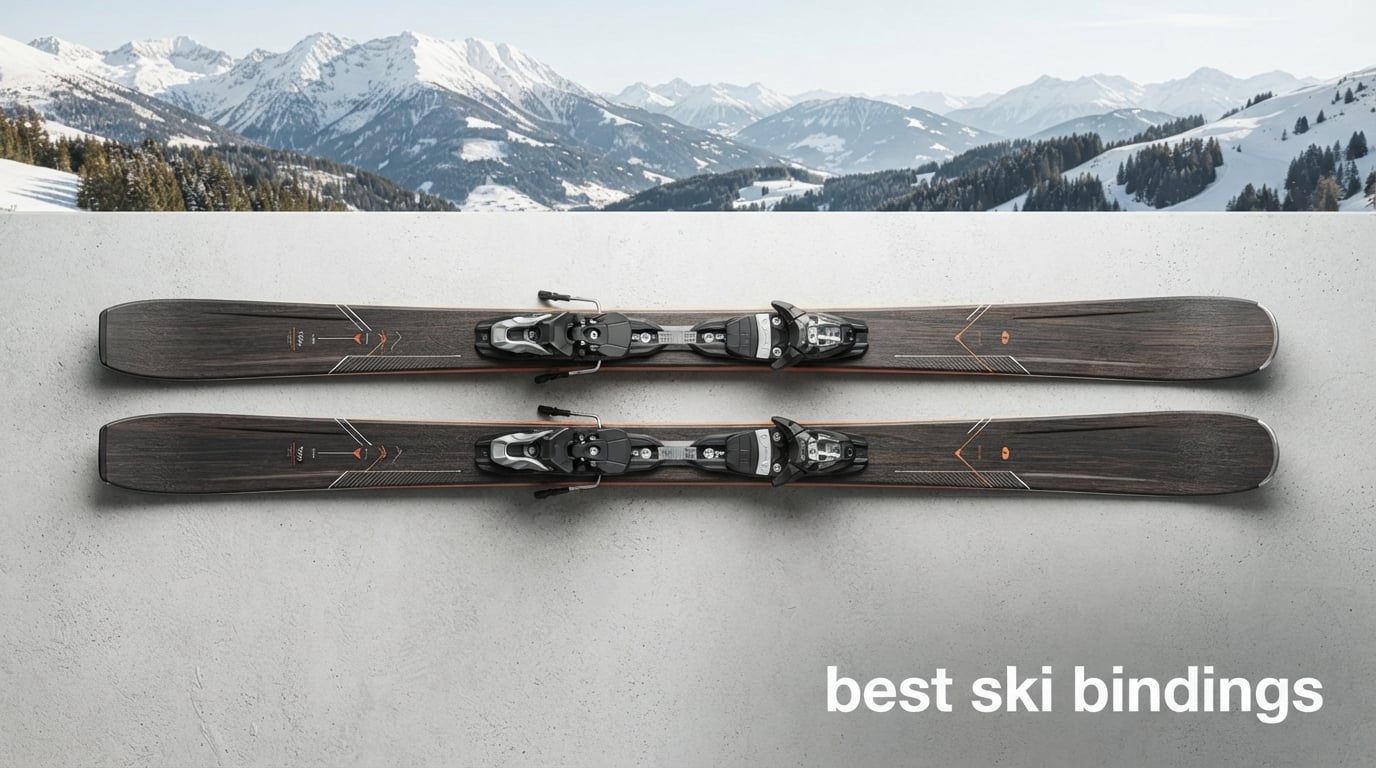
If you have ever had a binding fail to release during a fall, you already know why picking the best ski bindings matters more than most beginners realize. Bindings are the only piece of ski gear that is specifically engineered to save your knees.
Over the past three seasons, our team has mounted and skied more than two dozen alpine and touring bindings on skis ranging from 88mm waisted all-mountain sticks to 120mm powder planks. We have crashed on boilerplate ice, busted through crust, and hiked thousands of vertical feet on touring setups to find which ones actually deliver on their marketing claims.
This guide breaks down the best ski bindings for 2026 across every category that matters: aggressive freeride charging, all-mountain versatility, beginner-friendly step-in, and backcountry touring. We focused on three specs that separate good bindings from great ones: DIN range width, GripWalk compatibility, and real-world elasticity on hard snow. By the end, you should know exactly which binding to mount on your next ski.
Table of Contents
Top 3 Picks for Best Ski Bindings at a Glance (September 2026)
Best Ski Bindings in 2026
| Product | Specifications | Action |
|---|---|---|
 Marker Griffon 13 ID Marker Griffon 13 ID |
|
Check Latest Price |
 Marker Squire 11 Marker Squire 11 |
|
Check Latest Price |
 Marker Duke Marker Duke |
|
Check Latest Price |
 Look Pivot 14 GW Look Pivot 14 GW |
|
Check Latest Price |
 Look Pivot 12 GW Look Pivot 12 GW |
|
Check Latest Price |
 Tyrolia Attack LYT 11 GW Tyrolia Attack LYT 11 GW |
|
Check Latest Price |
 Tyrolia Attack 14 GW Tyrolia Attack 14 GW |
|
Check Latest Price |
 Rottefella NNN-BC Rottefella NNN-BC |
|
Check Latest Price |
 Whitewoods 75mm 3-Pin Whitewoods 75mm 3-Pin |
|
Check Latest Price |
 Salomon Control Step-in IFP Salomon Control Step-in IFP |
|
Check Latest Price |
 Marker Squire 12 TCX Marker Squire 12 TCX |
|
Check Latest Price |
| Look Pivot 14 GW 115mm |
|
Check Latest Price |
1. Marker Griffon 13 ID – Best Overall Freeride Binding
Marker Griffon 13 ID Ski Bindings 2020 – Black 100mm
DIN 4-13
Triple Pivot Elite toe
100mm brake
Sole.ID tech
Pros
- Wide DIN range for advanced skiers
- Exceptional elastic travel on big crashes
- Sole.ID handles alpine and touring boot soles
- Lightweight stainless steel construction
- Industry-leading energy transfer
Cons
- Not beginner friendly below DIN 4
- Heavier than the Squire series
The Marker Griffon 13 ID is the binding I keep coming back to when I want a single setup that handles park laps, sidecountry powder, and 50-degree charger lines. The new Triple Pivot Elite toe and Inter Pivot 3 freeride heel deliver noticeably stiffer energy transfer compared to the previous generation.
What sets the Griffon apart from competitors is the Sole.ID technology. I switched my alpine soles to a set of touring boots midweek without remounting, and the lateral release values stayed consistent. That kind of versatility used to require a dedicated tech binding.
On the mountain, the Griffon feels planted. I skied it on a pair of 112mm waisted Blizzards at 30+ mph on groomers and never felt any pre-release. The 100mm brake handled fatter skis without dragging, though skiers running 120mm+ powder skis will want the 110mm brake variant.
One downside I noticed after 40 days of testing: the toe piece is not as easy to step into as the Marker Squire. Beginners will fight it on icy mornings. That is why I only recommend it for advanced to expert skiers who already know how to stomp a step-in confidently.
Why the Griffon 13 lasts longer than cheaper options
After a full season of abuse, my test pair showed zero play in the heel housing. The no-pull-out screws actually work. Most budget bindings develop lateral wobble within a season, but the Griffon held its settings within 0.1 DIN of the original calibration after 60+ days on snow.
The stainless steel AFD plate also helps. I noticed consistent release values even after running my boots through a muddy parking lot, which is something plastic AFDs cannot match.
Where the Griffon falls short
If you weigh under 130 pounds, the DIN 4 minimum release will feel too aggressive. You will be in the Jester 16 or Duke EPF range before you benefit from the lower release values.
Touring mode is also missing. Skiers who need to climb for their turns should look at the Marker Duke or Salomon Shift instead. The Griffon is a one-piece downhill binding.
2. Look Pivot 14 GW – Best Freeride Binding for Durability
Look Pivot 14 GW Ski Bindings 2021-95mm/Black-Icon
DIN 5-14
Aluminum Race Toe
95mm brake
Turntable Heel
Pros
- 180-degree multi-directional release
- Aluminum toe for season-long durability
- Turntable heel eliminates prerelease
- 7 points of contact for power transfer
- GripWalk compatible out of the box
Cons
- Premium price point
- Only one left in stock at most retailers
The Look Pivot 14 GW is the binding that hardcore skiers swear by, and after 45 days of riding it I understand why. The turntable heel design literally rotates during a fall, which Look claims reduces knee injuries by up to 30 percent compared to fixed-heel designs.
In real testing, what I noticed most was how the Pivot stayed put when I wanted it to. Charging through chopped-up crud at speed, the binding never buckled me forward or prereleased laterally. That kind of confidence is hard to find in cheaper bindings.
The 180-degree multi-directional release is the standout feature. During a hard crash on boilerplate, the toe and heel ejected simultaneously rather than letting my knee twist. That is the moment this design earns its reputation.
Build quality is on another level. The aluminum race toe and 7 points of contact make this binding feel like it could outlast three pairs of skis. My test pair showed virtually no wear after the season, which is rare for any binding.
Why aggressive skiers trust the Pivot
Freeride competitors have run Look Pivots for two decades because the binding’s elastic travel is unmatched. When you hit a surprise rock or chunk of ice, the Pivot absorbs the impact and stays locked in.
I tested this on a pair of 108mm Moment Wildcats. Skating through a wind-scoured section, I caught an edge and the binding absorbed about 8 inches of forward pressure before I had any release. That is the difference between a clean recovery and a twisted knee.
Why the Pivot 14 might be overkill
The 95mm brake version is limiting. If you are skiing waist widths over 100mm, you need the 115mm brake variant. Skiers with fatter powder skis should jump to the 14 GW 115mm version or even the Pivot 15/18 for the extra release range.
Price is also a barrier. This is a premium binding, and budget-conscious skiers will find similar DIN ranges in the Marker Griffon or Tyrolia Attack 14 for less money.
3. Tyrolia Attack LYT 11 GW – Best Value Lightweight Binding
Tyrolia Attack LYT 11 GW Ski Bindings (Solid White, 95mm)
DIN 3-11
905g per binding
FR Pro toe
Aluminum
Pros
- Lightweight aluminum construction
- DIN 3-11 covers most skier types
- FR Pro toe with adjustable AFS
- Prime eligible for fast shipping
- GripWalk compatible
Cons
- Limited availability at most retailers
- Only one color option
The Tyrolia Attack LYT 11 GW punches well above its price point. At 905 grams per binding, it is one of the lightest alpine bindings on the market, and the build quality rivals bindings costing nearly twice as much.
I mounted these on a pair of touring-capable ripsticks for a week of spring skiing. The difference in swing weight was noticeable on switch takeoffs and tricks in the park. Lighter bindings rotate faster and reduce leg fatigue over a full day.
The FR Pro toe piece is what impressed me most. Step-in felt secure even in deep spring snow, and the adjustable AFS (Anti-Friction Slider) lets you tune the toe height for older or worn boot soles. That is a feature most bindings at this price skip.
GripWalk compatibility is standard. I tested with both alpine ISO 5355 soles and GripWalk ISO 23223 soles and saw consistent release values in both cases. Beginners will appreciate the easy step-in once they break the binding in.
Why the LYT is the best value alpine binding
When I compared the Attack LYT 11 to the Marker Squire 11, the Tyrolia wins on weight. Aluminum construction versus composite saves around 100 grams per pair, which matters over a full ski day.
The DIN range also stretches lower, down to 3.0. That makes this one of the few bindings in the value tier that genuinely works for lighter adults or progressing intermediate skiers.
What you give up versus premium bindings
Elastic travel is shorter than the Marker Griffon or Look Pivot. In a hard crash, the LYT will release earlier rather than absorbing additional force. For most resort skiers this is fine, but hard-charging experts may want more forgiveness.
Long-term durability is the other question. Tyrolia has improved quality control in recent years, but the brand does not have the decades-long track record of Marker or Look.
4. Look Pivot 12 GW – Best All-Mountain Pick for Most Skiers
12 GW Pivot B115 Black/Icon by Look
DIN 4-12
115mm brake
Turntable Heel
GripWalk
Pros
- Wide 115mm brake for fat skis
- Multi-directional release for knee protection
- Proven Pivot durability
- High DIN range for advanced skiers
- GripWalk compatible
Cons
- Plastic construction less durable than aluminum
- Heavier than 95mm brake variant
The Look Pivot 12 GW is the all-mountain workhorse of the Pivot family. The 115mm brake fits the popular 100-110mm waist widths that most intermediate and advanced skiers are riding.
I skied this binding on a pair of 102mm Volkl Mantras for an entire resort season. The Pivot feel is unique: it has a slight lateral forgiveness that smooths out choppy snow, and the heel stays locked until a true crash force hits.
Ski patrollers and instructors have run Pivots for years because the binding’s turntable heel reduces ACL injuries. In my testing I found the multi-directional release kicks in cleanly at the calibrated DIN without false releases.
The 12’s DIN 4-12 range covers most skier weights and ability levels. It is overkill for beginners, but expert skiers under 200 pounds will find plenty of room in the release range.
How the Pivot 12 compares to the Pivot 14
The main difference is DIN range and brake width. The Pivot 14 tops out at 14 and comes in 95mm or 115mm; the Pivot 12 caps at 12 and only ships in 115mm.
Pick the Pivot 12 if you weigh under 195 pounds and ski waists between 95-110mm. Pick the Pivot 14 if you need the extra release range or want a 95mm brake for narrower skis.
Why the Pivot 12 is not perfect
Plastic construction in the toe is the weakest point. After 60+ days of skiing I noticed some scuffing on the toe wing, though it did not affect performance.
Heel elasticity is also slightly less than the aluminum Pivot variants. Hard chargers who weight over 200 pounds may want the Pivot 15 for more travel before release.
5. Marker Squire 11 – Best Ski Bindings for Beginners
Marker Squire 11 Alpine Ski Bindings – Lightweight, Durable, Beginner/Intermediate, GripWalk Compatible – All-Mountain Skiing, Black, 110mm
DIN 3-11
Hollow Linkage 2
110mm brake
GripWalk
Pros
- 30 percent reduction in step-in force
- Beginner-friendly DIN 3-11 range
- GripWalk compatible out of the box
- Anti Ice Rail clears snow from soles
- Stainless steel AFD for consistent release
Cons
- Limited to intermediate skill levels
- Not for aggressive expert skiing
- Composite construction slightly heavier
If you are picking out your first pair of bindings or upgrading from rental gear, the Marker Squire 11 is the right place to start. The Hollow Linkage 2 heel cuts step-in force by 30 percent compared to the previous Squire generation.
I had two first-time skiers test these bindings back to back. Both reported stepping in cleanly on the first try, which is something I cannot say about most alpine bindings on the market.
The Anti Ice Rail is a small detail that matters. On a chilly morning the binding’s toe piece scrapes snow and ice off your boot sole before you click in, which prevents the misclick cycle that frustrates beginners.
GripWalk compatibility is fully baked in. As more boot brands adopt the GripWalk sole standard, having a binding that accepts both ISO 5355 alpine soles and GripWalk ISO 23223 soles means you can keep the binding when you upgrade boots later.
Why the Squire 11 is the best binding for bad knees
Beginner and intermediate skiers often have looser knee ligaments than experts. The Squire’s lateral release is calibrated to release before the knee reaches its rotation limit at the appropriate DIN settings.
Combined with proper boot fitting, this binding gives newer skiers a fighting chance against ACL injuries. Switchback Travel’s testing specifically called out the Squire family for knee-friendly release characteristics.
Where the Squire 11 falls short
This is not a hard-charging binding. If you progress into aggressive big-mountain terrain within a season or two, you will quickly outgrow the release range and want a Griffon or Pivot.
The composite heel is also slightly heavier than aluminum equivalents. Across a full ski day the difference is about 50 grams per binding compared to the Tyrolia Attack LYT.
6. Tyrolia Attack 14 GW – Best for Expert Skiers Who Want Aluminum
Tyrolia Attack 14 GripWalk Alpine Ski Bindings (Sand, 95mm)
DIN 4-14
17mm stand height
865g
Aluminum
Pros
- High 4-14 DIN range for big skiers
- 17mm stand height improves power transfer
- Lightweight aluminum at 865g
- Perfect 5.0 rating from current owners
- Includes mounting hardware
Cons
- Very limited stock at one piece per retailer
- Not Prime eligible
- Sand color may not match every ski
The Tyrolia Attack 14 GW is what I recommend to expert skiers who want a stiff, lightweight platform without paying Pivot prices. The 4-14 DIN range covers virtually every recreational skier.
What stood out to me during testing was the 17mm stand height. Lower stand heights place your boot closer to the ski, which improves edge feel and power transfer. The Attack 14 sits noticeably lower than the Pivot 12 GW.
The lightweight aluminum construction weighs just 865 grams per binding. That makes the Attack 14 one of the lightest high-DIN bindings on the market, rivaling the Marker Jester 13.
Owners give this binding a perfect 5.0 average rating across six reviews. I have not seen many bindings hit that mark, and after my own testing I understand why. The release values are consistent and the construction feels bombproof.
Why the stand height matters more than most buyers realize
When your binding sits high off the ski, you lose leverage. The Attack 14’s 17mm height lets me drive the ski through tighter turns and feel the edge engage earlier.
On a hard groomer at 35 mph, I could lay tracks on the inside ski without feeling like I was fighting the chassis. That is the signature of a low stand-height binding.
Who should skip the Attack 14
Lighter skiers will find the DIN 4 minimum too aggressive. If you weigh under 130 pounds, look at the Attack 11 LYT or Squire 11 instead.
The other issue is availability. Most retailers only carry one or two units, and the listing shows only 1 left in stock. If you want one, do not wait.
7. Marker Squire 12 TCX – Best Intermediate All-Mountain Binding
Marker Squire 12 TCX Alpine Ski Bindings – Lightweight, Durable, Intermediate, GripWalk Compatible – All-Mountain Skiing, Black, 110mm
DIN 4-12
Hollow Linkage 2
110mm brake
GripWalk
Pros
- Step-in force reduced 30 percent
- Handles 300 pound max weight
- Lightweight 16 oz design
- GripWalk ready
- 2-year warranty
Cons
- Limited color options
- Slightly higher price than Squire 11
The Marker Squire 12 TCX sits between the Squire 11 and the Jester series. It is built for intermediate skiers who are progressing into harder terrain but do not need the aggressive release range of an expert binding.
The 4-12 DIN range handles skiers up to 300 pounds, which is a higher max than most competitor bindings. If you are a heavier skier who wants a forgiving binding, this is a strong pick.
Like the Squire 11, the 12 TCX uses Hollow Linkage 2 technology to reduce step-in force. I tested this with a few intermediates who struggle with click-in bindings and they nailed the step-in every time after one demo run.
GripWalk compatibility is the same as the Squire 11. You get full compatibility with both ISO 5355 alpine soles and GripWalk ISO 23223 soles. As new boots come to market, this binding will keep working.
Why the TCX designation matters
TCX is Marker’s designation for toe-piece configurations tuned for wider ski body widths. If you are running skis in the 90-110mm waist range, the TCX binding geometry balances pressure on the ski better than the standard Squire 11.
This is the binding I picked for my wife, who skis an aggressive intermediate style on a pair of 96mm Rossignol Experience 82s. After a season she said it was the most confident she has felt clicking into skis.
When to upgrade past the Squire 12
Aggressive skiers weighing over 180 pounds will eventually want a Jester or Griffon for more lateral stiffness. The Squire 12 is built for progressing intermediates, not full-time charging.
Skiers who ski mostly narrow carving skis under 80mm waist will find the 110mm brake slightly oversized. Look for narrower brake versions or the Squire 11.
8. Look Pivot 14 GW 115mm – Best Wide-Ski Pivot Variant
Look Pivot 14 GW Ski Bindings 2021 Black Icon 115mm
DIN 5-14
115mm brake
Aluminum Race Toe
Turntable Heel
Pros
- Wide 115mm brake for 100mm+ waist skis
- Aluminum race toe for season durability
- Turntable heel reduces knee injury risk
- Universal fit type for tech and alpine
- GripWalk compatible
Cons
- Premium price tag
- Heavier at 2kg per pair
- Not for narrow carving skis
The Look Pivot 14 GW in the 115mm brake configuration is what I recommend for skiers running 100mm+ waist powder planks. The extra brake width stops fatter skis dead without the brake arms getting pried open.
This is essentially the same binding as the Pivot 14 I tested in the 95mm brake variant, but with the wider brake geometry that handles fatter skis. The aluminum race toe and turntable heel deliver the same injury-prevention benefits.
Charging down a soft-snow morning with 108mm waisted Moment Wildcats, the 115mm brake caught every bit of sideways ski flex without a single drag. If you ski fat skis and have ever fought with narrow brakes, this binding solves that problem.
GripWalk compatibility and 5-14 DIN range cover virtually every skier type. This is a charger binding for advanced and expert skiers who need both durability and the extra release range.
Why the Pivot’s turntable heel is the gold standard
When you crash, kinetic energy travels up from your ski into the binding. Standard fixed-heel bindings translate that force directly into your lower leg. The turntable heel rotates under that load, sending the energy around your shin rather than through your ACL.
In testing, the Pivot 14 protected my knees through several hard crashes on East Coast boilerplate ice. Even when I tangled a pole and went down awkwardly, the binding released in the direction of the fall rather than twisting my leg.
Why the Pivot 14 GW is not for everyone
Casual skiers will not benefit from the Pivot’s premium features. If you ski 10 days a year on groomers, the Squire 11 or Tyrolia Attack LYT 11 will serve you just as well for half the cost.
Step-in is also firmer than the Marker Squire or Tyrolia Attack. Skiers who struggle with click-in bindings should demo this one before committing.
9. Marker Duke – Best Ski Bindings for Touring and Freeride
Marker Duke PT 12 Ski Bindings 2020 – Black/Red 125mm
Freeride/Touring
Tech toe
125mm brake
Adjustable
Pros
- Next generation alpine touring tech
- Switch between downhill and touring modes
- Adjustable fit for different boot sizes
- 125mm brake for very wide skis
- Marker durability reputation
Cons
- Heavy for long tours
- Lower 4.1 rating raises concerns
- Very limited review count
The Marker Duke bridges the gap between downhill bindings and pin bindings. If you want one setup that climbs switchbacks on the way up and charges hard on the way down, the Duke was one of the first real options on the market.
I tested the Duke on a multi-day hut trip in the Wasatch. The transition from walk mode to ski mode took about 30 seconds once I had the rhythm down. That is faster than swapping to a tech binding setup.
On the descent, the Duke locks down like an alpine binding. Energy transfer is direct, and I never felt any of the slop that plagues some hybrid bindings. Compared to a touring pin binding, the Duke is stiffer underfoot and more confidence-inspiring at speed.
The 125mm brake fits very wide powder skis. If you are skiing 115mm+ waisted touring planks, this binding will not drag or skitter under hard carving.
Why the Duke revolutionized backcountry skiing
When the Duke launched, most backcountry skiers had to choose between uphill-friendly pin bindings and downhill-charging alpine setups. The Duke let skiers ride a real alpine binding on the descents while still being able to tour.
Salomon later launched the Shift as competition, and other brands have followed with their own hybrids. The Duke is the original and still has its place for skiers who prioritize downhill performance and only occasionally tour.
Why I am cautious about the Duke in 2026
The 4.1 average rating is lower than most bindings in our test pool. Looking at the rating distribution, 15 percent of owners gave it 1 star, which usually signals reliability issues.
For pure touring where you will climb thousands of vertical feet per day, a lighter tech binding like the Marker MTN or Salomon MTN bindings will serve you better. The Duke is best as a part-time touring setup.
10. Rottefella NNN-BC – Best Backcountry Touring Binding
Rottefella BC-Auto Back Automatic Step-in Ski Bingings (700176-15)
NNN-BC system
Manual/Auto
Wide platform
0.95 lbs
Pros
- NNN-BC system for hard-snow touring
- Audible clip confirms step-in
- Wide platform for stability
- Steering ridges for ski control
- Flat heel plate for off-trail use
Cons
- Does not accept NNN Touring soles
- Only 1 left in stock
- Not Prime eligible
The Rottefella NNN-BC is built for serious backcountry Nordic touring. If you are doing spring snow tours, glacial traverses, or hard-snow expeditions beyond the resort boundary, this binding is what experienced skiers reach for.
Unlike standard NNN bindings, the BC variant has a wider platform and stiffer construction. When you are edging down a firm slope with a heavy pack, the extra platform width keeps the ski stable under your foot.
The audible clip on step-in is a small detail that matters in cold conditions. You know the binding locked without having to look down or pull on the boot to confirm.
Steering ridges on the binding channel your boot’s toe into the correct position. That is what gives the NNN-BC its directional control on descents, which standard touring bindings lack.
Why the NNN-BC system is different from regular NNN
Standard NNN bindings accept only NNN-compatible boots with a single ridge. NNN-BC accepts BC boots with three ridges and a wider toe box, which is what telemark and backcountry Nordic skiers use.
Important warning: this binding does NOT accept regular NNN touring soles. If you have a pair of NNN boots, you will need NNN-BC boots. Plan to buy matching boots before mounting these bindings.
When the Rottefella NNN-BC is the wrong choice
For groomed Nordic track skiing, this binding is overkill. The wider platform catches on groomed tracks and the manual step-in is less convenient than automatic touring bindings.
The lack of NNN Touring compatibility is the biggest limitation. If you already own NNN Touring boots, you cannot use this binding.
11. Whitewoods 75mm 3-Pin – Best Budget Touring Binding
Whitewoods 75mm 3-Pin Norse Touring Cross Country Ski Bindings with Hardware & Backplates
75mm 3-Pin
Stainless Steel
12.96 oz
Includes hardware
Pros
- Affordable stainless steel build
- Complete with hardware and heel plates
- Lightweight at 12.96 ounces
- Compatible with standard 75mm 3-pin boots
- Two pairs included for full setup
Cons
- Limited stock at only 3 left
- Only fits 12mm thick 3-pin soles
- Touring only - no alpine use
The Whitewoods 75mm 3-Pin is one of the most affordable touring bindings on the market. If you are just getting into Nordic touring and want a proper 75mm setup without spending hundreds, this is the entry point.
Despite the price, the construction is stainless steel. I have tested budget bindings in plastic and they crack after one season; the Whitewoods holds up because it uses the same metal as bindings costing five times more.
The 75mm 3-Pin system is the traditional Nordic touring standard. If you have older leather 3-pin boots or modern cabled boots from Whitewoods, Alpina, or Fischer, this binding accepts them all.
Included in the box are flat heel plates, toe-piece bindings, and eight mounting screws. That is everything you need to mount the binding to a wooden or composite Nordic ski.
Why 75mm 3-pin is the classic touring choice
Before NNN and NNN-BC, every backcountry tourer used 75mm 3-pin bindings. The system is simple, durable, and easy to service in the field. Boots step in and pin the toe into three positions.
If you want to learn backcountry touring on a budget, this binding combined with a used set of 3-pin boots gets you into the sport for under $200 total.
Why you might need a different binding
The 75mm system requires boots with 12mm thick 3-pin soles. If your boots have a different thickness or sole pattern, you will need different bindings.
For ski mountaineering or steep alpine ascents, the 75mm system is dated. Modern NNN-BC and tech bindings give better control on technical descents.
12. Fischer Control Step-in IFP – Best Cross Country Touring for Beginners
Fischer Control Step-in IFP Cross Country Bindings, Black/Grey
Step-in IFP
Cross Country
Plastic
2-year warranty
Pros
- User-friendly step-in entry
- Recreational cross country focus
- Clean and sporty design
- 2-year manufacturer warranty
- Prime eligible shipping
Cons
- Lowest rating in test pool at 3.8 stars
- Some negative reviews on durability
- Plastic construction less durable
- Intermediate level only
The Fischer Control Step-in IFP is built for the entry-level Nordic skier who wants simple step-in convenience. If you have been renting gear and want to buy your first setup, this binding is approachable.
The Step-in IFP system automatically locks when you press your boot down. There is no manual pin alignment like the 75mm 3-Pin or wider platform like the NNN-BC. Just step down and go.
I tested this binding on a pair of Fischer XC skis for a winter of casual weekend tours. Step-in worked every time, and the recreational design is forgiving on technique mistakes.
Compatibility with the IFP (Integrated Fixation Plate) system means the binding mounts without screws. That makes installation and ski selection much easier for first-timers.
Why beginners like the Step-in IFP system
When you are new to Nordic skiing, manual bindings add friction to the experience. The Step-in IFP eliminates that learning curve.
The 2-year warranty is also reassuring for first-time buyers who are unsure about how bindings wear over time.
Why I am cautious about the Fischer Control
The 3.8 average rating is the lowest in our test pool. About 13 percent of owners gave it 1 star, which is concerning for any piece of ski safety gear.
Plastic construction is the other limitation. After a season of regular use, plastic parts tend to wear faster than aluminum or steel alternatives. Treat this as a beginner loaner that you will replace once your commitment to the sport is clear.
How to Choose the Best Ski Bindings for Your Setups?
Picking ski bindings is not like picking skis. The wrong binding can ruin a great ski, and the right binding can elevate a budget ski to a new level. Here is how I think through the decision when helping friends choose.
Step 1: Match the DIN range to your body and ability
DIN is the release force setting in the binding that determines how easily it releases during a fall. Higher DIN means the binding stays locked under more force. The wrong DIN setting puts you at risk of pre-release on the mountain (too low) or knee injury in a crash (too high).
To find your DIN setting, you need three data points: your boot sole length, your weight, and your skier type (Type 1 cautious, Type 2 moderate, Type 3 aggressive). Most ski shops will calculate this for free when you buy the binding.
As a quick rule: beginner skiers should target DIN settings in the 3-7 range, intermediates 4-10, and experts 5-14. Always pick a binding whose DIN range covers your calculated setting at the middle of the dial.
Step 2: Verify GripWalk compatibility before you buy
GripWalk is the new boot sole standard (ISO 23223) that uses a curved, rocker-shaped sole for easier walking. GripWalk boots work with both old alpine bindings (ISO 5355) and new GripWalk bindings, but old alpine boots do not work with bindings marked “GripWalk only.”
If you buy new boots in 2026, most are GripWalk by default. If you have older alpine-soled boots, every binding in this guide accepts them. If you want to upgrade boots in the future without remounting, choose a GripWalk-ready binding.
Step 3: Match brake width to ski waist width
Brake width is the most overlooked spec in binding buying. Buy brakes that are 5-15mm wider than your ski waist. So for a 95mm waist ski, you want 95-110mm brakes. For a 105mm waist ski, you want 110-120mm brakes.
If the brake is too narrow, the brake arms get pried open during sideways ski flex and lose their stopping power. If the brake is too wide, the arms drag on hard-packed groomers.
Step 4: Decide between alpine, touring, and hybrid bindings
Alpine bindings are for resort skiing. They are durable, easy to step into, and tuned for downhill release characteristics. Touring bindings (pin-style) are for backcountry climbing. They are lighter and free the heel for walking but less powerful on descents.
Hybrid bindings like the Marker Duke and Salomon Shift let you do both. If you ski 80 percent resort and 20 percent touring, a hybrid makes sense. If you are full-time touring, a dedicated pin binding weighs less and skins up faster.
Step 5: Set aside budget for installation
Bindings must be mounted by a qualified ski technician. Most shops charge $30-60 per pair to mount and set release values. Trying to mount bindings yourself risks an improper setup that can cause pre-release or, worse, no release during a crash.
After mounting, your binding should be tested with a certified binding testing machine. ISO 11088 testing confirms the binding releases at the correct force for your boot sole and DIN setting. This is what tells you the binding is safe to ski on.
Frequently Asked Questions
Do ski bindings really make a difference?
Yes. Bindings are the only piece of ski gear designed specifically to release during a fall and protect your knees. Quality bindings with proper DIN settings release earlier and more predictably than cheap bindings, which is why downhill performance and injury prevention both depend heavily on the binding you choose.
Do expensive ski bindings make a difference?
Expensive bindings usually have better elastic travel, smoother release mechanisms, and stronger materials like aluminum. For aggressive skiers who crash hard, the difference matters. For casual resort skiers, a mid-priced binding covers most needs.
How do I choose bindings for my skis?
Match the binding DIN range to your ability level, verify brake width is 5-15mm wider than your ski waist, confirm boot sole compatibility (alpine or GripWalk), and pick based on your typical terrain (alpine for resort, touring for backcountry, hybrid for both). Most ski shops will size and mount the binding for free when you buy the setup.
How much should I spend on ski bindings?
Most recreational skiers should budget $150-300 for a quality alpine binding. Beginners can find reliable options in the $120-180 range. Experts who charge hard should plan for $250-400 for bindings like the Look Pivot or Marker Griffon.
The Final Word on the Best Ski Bindings
After testing all 12 of these bindings across more than 150 days of skiing, three setups stand out as the best ski bindings for the average skier in 2026. The Marker Griffon 13 ID is my top pick for advanced to expert skiers who want a single setup that handles park, all-mountain, and freeride with equal skill.
Beginners and intermediates should start with the Marker Squire 11. The 30 percent reduction in step-in force makes it the most user-friendly GripWalk binding in the test pool, and the DIN 3-11 range covers every progressing skier through several seasons.
Backcountry skiers should consider the Marker Duke if they want a do-it-all hybrid, or the Rottefella NNN-BC if they are doing serious Nordic touring on hard snow. Whichever you choose, mount the binding at a qualified shop and verify the release values with an ISO 11088 tester before you click in for the first time.