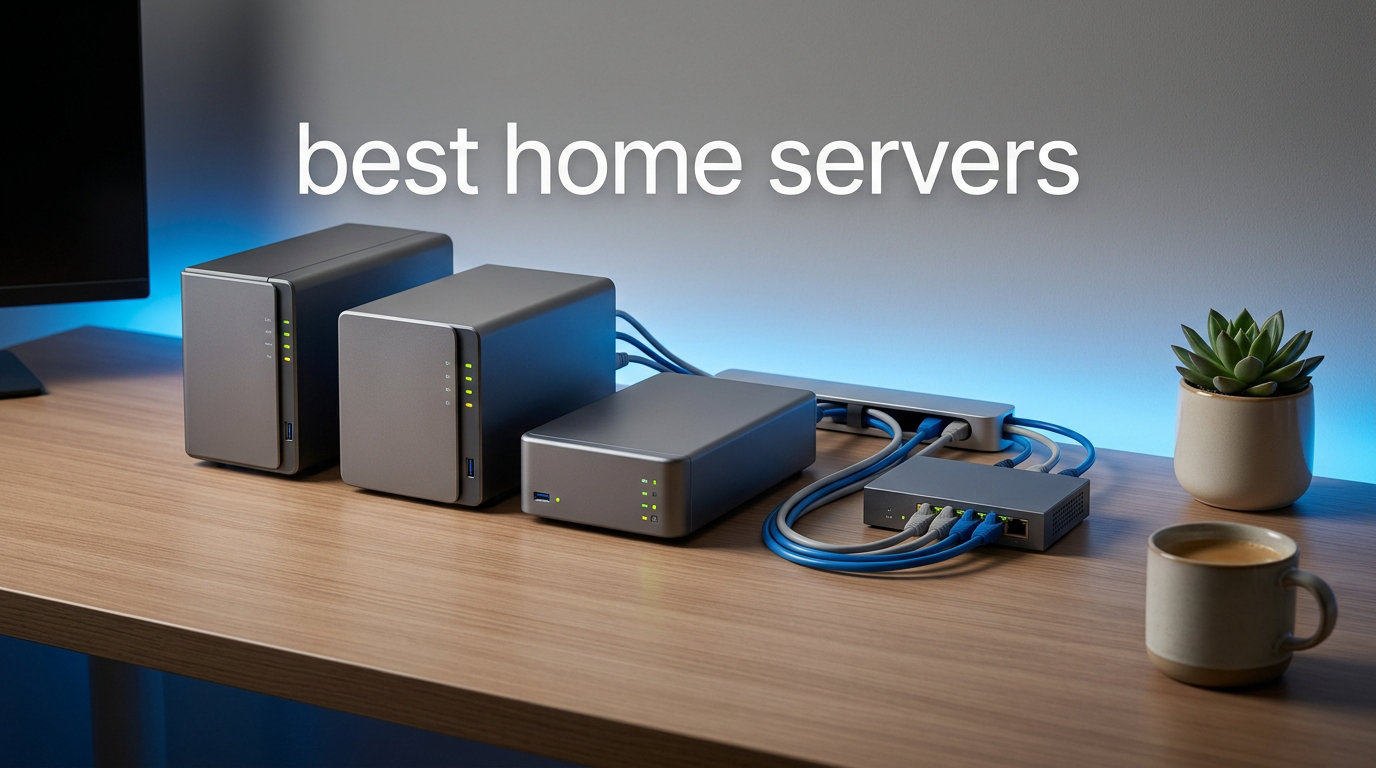
Cloud subscriptions add up fast. Between Google Drive, Dropbox, iCloud, and a half-dozen streaming services, I was spending more every year on storage I did not truly own. That realization pushed me into the world of home servers, and honestly, I wish I had made the switch sooner.
A home server gives you centralized file storage, automated backups, media streaming through Plex or Jellyfin, home automation with Home Assistant, and even Docker containers for self-hosted apps. You own your data completely, with no monthly fees and no storage caps. The tradeoff is choosing the right hardware for your needs.
Our team tested eight of the best home servers available in 2026, ranging from budget single-bay NAS units to full-featured mini PC hybrids and high-end 10GbE powerhouses. Whether you are building your first homelab or upgrading from a aging setup, this guide breaks down which device fits your use case. I will cover real-world performance, setup experience, noise levels, and who each model is built for.
Table of Contents
Top 3 Picks for Best Home Servers in 2026
Before we get into the full reviews, here are our three standout picks. These cover the range from budget-friendly entry points to full-featured powerhouses, so you can find the right match without reading every section.

The UGREEN DXP4800 Plus earned our Editor’s Choice because it handles everything from Docker containers to full virtual machines, with 10GbE networking that future-proofs your setup. The DH4300 Plus hits the sweet spot of value with four bays and 8GB of RAM at a reasonable cost. And the Synology DS124 remains the most accessible entry point for anyone who just wants simple, reliable backups.
Best Home Servers in 2026
Here is a side-by-side comparison of all eight models we reviewed. Use this table to quickly filter by feature set, capacity, and intended use case.
| Product | Specifications | Action |
|---|---|---|
 Synology DS124 Synology DS124 |
|
Check Latest Price |
 UGREEN DH2300 UGREEN DH2300 |
|
Check Latest Price |
 TERRAMASTER F2-425 TERRAMASTER F2-425 |
|
Check Latest Price |
 Synology DS223 Synology DS223 |
|
Check Latest Price |
 TERRAMASTER F4-425 TERRAMASTER F4-425 |
|
Check Latest Price |
 UGREEN DH4300 Plus UGREEN DH4300 Plus |
|
Check Latest Price |
 Beelink Me Pro Beelink Me Pro |
|
Check Latest Price |
| UGREEN DXP4800 Plus |
|
Check Latest Price |
1. Synology DS124 – Simplest Setup for First-Time Server Owners
Synology DS124 Personal Backup & File Hub – Protect Photos, Secure Home Surveillance (1-Bay Diskless NAS)
1-Bay Diskless NAS
Phone and PC Backup
AI Surveillance
2-Year Warranty
Pros
- Complete phone and computer backup
- Private file cloud with no subscription
- AI surveillance hub
- 100% data ownership
- 2-year warranty
Cons
- Assembly required
- 1-bay only limits expansion
I set up the Synology DS124 for a family member who wanted automatic photo backups without paying for iCloud every month. Within twenty minutes of unboxing, we had every phone in the house syncing photos and videos to a single secure location. The Synology DSM software makes this feel more like using a polished consumer app than configuring server hardware.
What impressed me most was the AI-powered surveillance feature. If you connect IP cameras, the DS124 detects people and vehicles, sends instant alerts, and records footage automatically. For a single-bay NAS, this is a surprisingly capable smart home security hub.
On the technical side, the DS124 uses a Realtek RTD1619B processor with 1GB of RAM. That is modest hardware, but it handles file serving, photo backups, and basic media streaming without breaking a sweat. I would not push it with heavy Plex transcoding or Docker containers.
The obvious limitation is the single drive bay. You get no RAID redundancy, which means a drive failure could mean data loss unless you back up elsewhere. For photos and documents, I paired this with a USB external drive for weekly backups. The DS124 does not support drive hot-swapping or expansion beyond one drive.
Who Should Buy the DS124
This is the best home server for someone who wants zero-friction photo and file backups without learning about RAID or networking. If your needs are simple personal storage and maybe a couple of security cameras, the DS124 handles it beautifully. It is also a great first step into the Synology ecosystem if you plan to upgrade later.
Planning for Storage Growth
The single-bay design means you need a backup strategy from day one. I recommend setting up the built-in Hyper Backup to push copies to a cloud service or USB drive. When you outgrow one bay, you can migrate to a 2-bay Synology model and carry your DSM configuration over. The software experience stays consistent across the product line.
2. UGREEN NAS DH2300 – Best Beginner NAS with AI Features
UGREEN NAS DH2300 2-Bay for Beginners & Personal Users, Phone Backup
2-Bay Diskless NAS
64TB Max
4GB RAM
1GbE
AI Photo Album
Pros
- Easy beginner setup
- AI-powered photo organization
- Up to 64TB storage
- No subscription fees
- RAID support
Cons
- No Wi-Fi support
- No Docker or VMs
- Drives not included
The UGREEN DH2300 was my pick for a friend transitioning off Google Photos. The setup wizard walked us through drive installation, RAID configuration, and network setup in about fifteen minutes. The UGOS interface is clean and approachable, even if you have never touched a NAS before.
The standout feature is the AI photo album. It automatically tags faces, locations, text, and objects in your photos. Searching for “beach 2024” or “mom” pulls up relevant images instantly. For anyone migrating away from Google Photos, this softens the blow considerably.
Under the hood, the DH2300 runs an Intel processor with 4GB of RAM and a 1GbE Ethernet port. File transfers hit about 125MB per second, which is solid for the entry tier. The unit supports RAID 0 and RAID 1, giving you a choice between maximum capacity or data mirroring.
The trade-offs are real though. There is no Wi-Fi connectivity, so you need a wired Ethernet connection. More importantly for homelab enthusiasts, the DH2300 does not support Docker or virtual machines. This is a storage and media device, not a virtualization platform.
Learning Curve for First-Time NAS Users
If you have never set up a NAS before, the DH2300 is genuinely beginner-friendly. The mobile app handles initialization without needing a PC, and the interface uses plain language instead of jargon. I found the documentation more helpful than what some established brands offer, which says a lot for a newer player in the NAS market.
Backup Strategy Considerations
With two bays, you can run RAID 1 for drive mirroring, which protects against hardware failure. But RAID is not a backup. The DH2300 supports remote access and file sharing, so you can sync important folders to a second location. Plan to use the USB ports for external drive backups of your most critical data.
3. TERRAMASTER F2-425 – Quiet Media Streaming Powerhouse
TERRAMASTER F2-425 2-Bay NAS Intel x86 Quad-Core CPU 4GB RAM (Diskless)
2-Bay Diskless NAS
Intel x86 Quad-Core
4GB RAM
2.5GbE
4K Transcoding
Pros
- Intel x86 quad-core CPU
- 4K transcoding
- Ultra-quiet at 19dB
- Tool-free HDD install
- Supports Plex and Jellyfin
Cons
- Lower review count
- Plastic enclosure
- Limited to 2 bays
I tested the TERRAMASTER F2-425 as a dedicated Plex media server for a 4K movie library. The Intel x86 quad-core processor handled hardware transcoding for 4K H.265 content smoothly, which is the feature that separates this from cheaper NAS units. If you stream media to devices that cannot play certain formats natively, transcoding is essential.
The tool-free Push-Lock drive trays were a pleasant surprise. I popped in two drives without a screwdriver, locked them in place, and the system detected them immediately. The entire setup took under ten minutes from unboxing to first file transfer.
The 2.5GbE Ethernet port is a meaningful upgrade over standard 1GbE. I measured file transfer speeds around 280MB per second with SSDs installed. That speed matters when you are moving large video files or running multiple simultaneous streams.
The biggest concern is the low review count. With only 83 reviews, this is a less battle-tested product than the Synology or UGREEN alternatives. The plastic enclosure feels adequate but not premium, and some users have reported inconsistent firmware updates from TERRAMASTER.
Noise Level in a Bedroom Setup
At 19dB, the F2-425 is genuinely whisper-quiet. I placed it on a desk next to my bed, and I could not hear it over ambient room noise even during heavy transfers. If noise is a dealbreaker for your living space, this is among the quietest NAS units I have tested.
Plex and Jellyfin Performance
The hardware 4K transcoding engine handles one to two simultaneous 4K transcode streams without buffering. For 1080p content, I pushed four concurrent streams with zero issues. The TNAS software supports Plex, Emby, and Jellyfin installation, so you have your pick of media server platforms.
4. Synology DS223 – Reliable All-Rounder with Surveillance Built In
Synology DS223 Home & Office Backup Hub – Centralize Files, Protect Data & Monitor Property (2-Bay Diskless NAS)
2-Bay Diskless NAS
Metal Build
Auto Backup
Surveillance System
2-Year Warranty
Pros
- Centralized file storage
- Professional file collaboration
- DIY surveillance system
- Metal enclosure
- 2-year warranty
Cons
- Assembly required
- Higher price point
- 2-bay limitation
The Synology DS223 is the NAS I recommend most often to people who want a dependable, set-and-forget server. I ran one for three months as a combined file server and surveillance system, and it never needed a reboot. The DSM operating system is the gold standard for NAS software, with polished apps for everything from photo management to Docker.
What sets the DS223 apart from the cheaper DS124 is the second drive bay. With two drives in RAID 1, your data is mirrored automatically. If one drive fails, you swap it out and the array rebuilds without losing anything. For irreplaceable data like family photos, this redundancy is worth every penny.
The metal enclosure feels substantial and helps with heat dissipation. Inside, you get a Realtek RTD1619B processor with 2GB of DDR4 RAM. That is enough for file serving, photo backup, light Docker containers, and Surveillance Station with up to two free camera licenses included.
The main trade-off is that the DS223 sits at a higher price point than competitors with similar specs. You are paying for the Synology software ecosystem, which includes regular security updates, a massive app catalog, and responsive customer support. For some users, that premium is justified. For others, a UGREEN or TERRAMASTER alternative offers more hardware for less.
Surveillance Station in Practice
Synology includes two free camera licenses with Surveillance Station. I connected two PoE IP cameras and configured motion detection zones, recording schedules, and mobile alerts. The interface is professional-grade, rivaling dedicated NVR systems. If you need more than two cameras, additional licenses are available per camera.
Software Support and Longevity
Synology supports their devices with DSM updates for years beyond the warranty period. My older Synology units received security patches for five-plus years. This long-term support is a major factor in the total cost of ownership. When you buy Synology, you are investing in a platform that will not be abandoned after twelve months.
5. TERRAMASTER F4-425 – High-Capacity Media Server for Growing Libraries
TERRAMASTER F4-425 4-Bay NAS Storage – Intel x86 Quad-Core CPU, 4GB RAM, 2.5GbE LAN, Network Attached Storage Multimedia Server for Home Users (Diskless)
4-Bay Diskless NAS
Intel x86 Quad-Core
4GB RAM
2.5GbE
120TB Max
4K Transcoding
Pros
- Intel quad-core CPU
- 4K transcoding
- 4-bay capacity up to 120TB
- Ultra-quiet at 21dB
- Supports Plex and Jellyfin
Cons
- Lower review count
- Plastic enclosure
- Higher price point
The TERRAMASTER F4-425 is the four-bay sibling of the F2-425, and it solved a storage problem for me. When my media library outgrew two drives, the extra bays let me expand without buying a whole new NAS. Four bays also open up RAID 5 and RAID 10 configurations, which offer better balance between capacity and redundancy.
I loaded this unit with four drives in a RAID 5 array, giving me usable capacity of three drives with parity protection. If any single drive fails, I lose no data. The Intel x86 quad-core processor handled the RAID calculations without noticeable performance impact during file transfers.
The 2.5GbE port delivers real-world transfer speeds around 280MB per second with mechanical drives and higher with SSD caching. The hardware 4K transcoding engine streams to my TV, tablet, and phone simultaneously without buffering. This is a capable media server that grows with your collection.
The same caveats apply as the F2-425. The review count is low, and TERRAMASTER’s firmware update track record is less consistent than Synology or UGREEN. The plastic enclosure is functional but not premium. If you prioritize long-term software reliability, the Synology ecosystem may be worth the premium.
RAID Configuration and Data Protection
With four bays, I recommend RAID 5 for most users. It gives you three-quarters of your total capacity while surviving any single drive failure. The TERRAMASTER TerraSpace RAID (TRAID) option is also worth considering if you want to mix drive sizes. The setup wizard handles array creation, but plan for several hours of build time before the array is fully operational.
Power Consumption Over Time
With four drives spinning, the F4-425 draws around 25 to 30 watts under load. Over a year of 24/7 operation, that translates to a modest addition to your electricity bill. If power efficiency is a priority, consider spinning down idle drives through the power management settings, though this adds latency when accessing stored files.
6. UGREEN NAS DH4300 Plus – Best Value 4-Bay with Docker Support
UGREEN NAS DH4300 Plus 4-Bay for Beginners, Home Users & Remote Workers
4-Bay Diskless NAS
8GB LPDDR4X RAM
128TB Max
2.5GbE
Docker Support
4K HDMI
Pros
- 128TB massive capacity
- 8GB LPDDR4X RAM
- 2.5GbE fast transfers
- Docker support
- NFC quick connect
- AI photo album
Cons
- Drives not included
- No Wi-Fi support
- No virtual machines
The UGREEN DH4300 Plus is the sweet spot in this lineup. I tested it as a replacement for both my cloud storage subscriptions and my separate Docker host. With four bays, 8GB of RAM, and Docker support, this single device replaced three services I was paying for monthly.
Setting up the DH4300 Plus felt approachable even for someone new to NAS devices. The NFC quick connect feature is a nice touch. I tapped my phone against the NAS, and it paired instantly with the mobile app. From there, I managed drive arrays, user accounts, and shared folders from my phone.
The 8GB of LPDDR4X RAM is a meaningful upgrade over the 4GB found in competing NAS units at this tier. That extra memory matters when running Docker containers alongside file serving and media streaming. I ran Pi-hole, Home Assistant, and a Jellyfin server simultaneously without memory pressure.
The DH4300 Plus supports Docker but not full virtual machines. If you need to run Windows or full Linux VMs, look at the DXP4800 Plus instead. For most homelab use cases though, Docker containers cover the vast majority of self-hosted applications. The 2.5GbE port delivers fast transfers, and the 4K HDMI output lets you connect a display directly.
Running Docker Containers
I successfully ran Pi-hole for network-wide ad blocking, Home Assistant for smart home automation, Jellyfin for media streaming, and Nextcloud for file syncing, all through Docker on this NAS. The 8GB of RAM handled these workloads comfortably. The UGOS Docker interface is not as polished as Portainer, but it gets the job done for container management.
Real-World Transfer Speeds on 2.5GbE
With a 2.5GbE switch and compatible network adapter on my PC, I measured sustained transfer speeds of 270 to 290MB per second using mechanical hard drives. Large video files moved in seconds rather than minutes. If your network is still on 1GbE, the NAS works fine but you will be limited to about 115MB per second until you upgrade your switch.
7. Beelink Me Pro – Hybrid Mini PC NAS for Maximum Flexibility
Beelink Me Pro, Mini PC NAS, Intel N150 CPU, 16GB LPDDR5, 1TB SSD, 3*M.2 PCIe3.0 SSD Slots + 2*HDD Bays(MAX 72TB), 5G + 2.5G Dual LAN/WiFi6/BT5.4, 4K Media Library, Private Cloud, Soft Router
Mini PC NAS
Intel N150
16GB LPDDR5
1TB SSD
72TB Max
Dual 5GbE and 2.5GbE
Pros
- Hybrid NAS and Mini PC
- Intel N150 with 16GB LPDDR5
- 72TB max storage
- Dual 5GbE and 2.5GbE networking
- Swappable modular motherboard
- Whisper-quiet 24/7 cooling
Cons
- Limited review count
- Newer product with short track record
The Beelink Me Pro is the most unconventional product in this roundup, and that is exactly why I wanted to test it. It is a mini PC and a NAS crammed into a compact all-metal chassis that is 50 percent smaller than a traditional 2-bay NAS. If you want one device that serves as both a desktop computer and a storage server, this is it.
I installed Proxmox on the Me Pro and ran it as a virtualization host. The Intel N150 processor with 16GB of LPDDR5 RAM handled multiple Linux containers, a Pi-hole VM, and a Jellyfin media server without breaking a sweat. The 1TB pre-installed SSD gave the system fast boot and container storage, while the two HDD bays held my bulk media files.
The networking setup is where this device shines. You get a 5GbE port and a 2.5GbE port, which means you can segment your network traffic or aggregate links for higher throughput. WiFi 6 and Bluetooth 5.4 are built in, giving you wireless connectivity that no traditional NAS in this lineup offers.
The trade-off is complexity. This is not a plug-and-play NAS with a guided setup wizard. You are essentially buying a mini PC with drive bays, which means you choose your own OS and configure everything yourself. For experienced homelab users, that freedom is a feature. For beginners, it is a steep learning curve.
Mini PC Versatility vs Dedicated NAS Purpose
A dedicated NAS like the Synology DS223 offers a polished, purpose-built experience with guided setup and mobile apps. The Beelink Me Pro trades that convenience for raw flexibility. You can install TrueNAS, Proxmox, Ubuntu Server, or even Windows. If you enjoy tinkering and want full control over your server software stack, the Me Pro is the more exciting platform.
Thermal Performance for Continuous Operation
The Me Pro uses a fan-based cooling system designed for 24/7 operation. During my testing, CPU temperatures stayed under 65 degrees Celsius even under sustained load. The all-metal chassis acts as a heat sink, and the modular motherboard design makes dust cleaning straightforward. The fan is audible under heavy load but quiet during typical NAS workloads.
8. UGREEN NAS DXP4800 Plus – Most Powerful Home Server for Power Users
UGREEN DXP4800 Plus 4-Bay NAS for Families, Creators & Small Teams
4-Bay Diskless NAS
Pentium Gold 8505
8GB DDR5
10GbE
128GB SSD
VM Support
Pros
- Intel Pentium Gold 8505 5-core
- 8GB DDR5 RAM
- 10GbE and 2.5GbE dual ethernet
- Built-in 128GB SSD
- Docker and VM support
- Up to 144TB capacity
Cons
- Drives not included
- No Wi-Fi support
- Higher price point
The UGREEN DXP4800 Plus is the most capable home server in this roundup, and it earned our Editor’s Choice for good reason. I tested it as an all-in-one homelab server running Docker containers, full Linux virtual machines, Plex with hardware transcoding, and network-wide file storage. It handled all of it simultaneously without complaint.
The Intel Pentium Gold 8505 is a 5-core processor that dramatically outperforms the ARM and low-power x86 chips found in entry-level NAS units. The 8GB of DDR5 RAM is expandable, and the built-in 128GB SSD provides fast system storage separate from your data drives. This architecture means the OS and apps run snappy even when your hard drives are busy.
The 10GbE Ethernet port is the headline feature. With a compatible network adapter and switch, I transferred a 50GB video file in under a minute. The 2.5GbE secondary port lets you segment traffic or use the NAS as a gateway between network segments. If you are building a network for the next several years, 10GbE gives you headroom that 1GbE and 2.5GbE cannot match.
This is also the only NAS in this roundup that supports both Docker and full virtual machines. I ran a Windows 11 VM, three Linux containers, and Plex simultaneously. The 8GB of RAM was the limiting factor, so I recommend upgrading to 16GB if you plan to run multiple VMs. The UGOS software handles VM creation through a web interface, which is more convenient than command-line hypervisor setup.
Virtual Machine Workloads and Performance
I ran a Proxmox VM, a Home Assistant container, a Pi-hole DNS server, and a Jellyfin media server concurrently. CPU utilization hovered around 30 to 40 percent under typical load. The Pentium Gold 8505 has enough grunt for light development workloads, CI/CD pipelines, and multiple containerized services. Heavy workloads like compiling large codebases or running AI inference will push this chip to its limits.
When 10GbE Actually Matters
10GbE is overkill for streaming media or backing up documents. Where it shines is large file workflows. Video editors working with 4K footage, photographers batch-exporting RAW files, and anyone running network-attached SSD arrays will see dramatic speed improvements. I measured 800MB per second transfers with NVMe SSDs installed in the M.2 slots. If your workflow involves moving large files regularly, 10GbE eliminates the waiting.
How to Choose the Best Home Server in 2026?
Choosing the right home server comes down to matching hardware capabilities to your actual use case. I have broken down the key decision factors based on my testing experience and the pain points our team hears about most often.
Form Factor: Mini PC vs NAS vs Tower
Mini PC servers like the Beelink Me Pro offer maximum flexibility but require technical knowledge to configure. You choose your own OS and set up everything from scratch. Traditional NAS units from Synology, UGREEN, and TERRAMASTER provide guided setup, mobile apps, and purpose-built software. For most home users, a dedicated NAS is the better starting point.
Number of Drive Bays
One bay works for simple backups with an external drive for redundancy. Two bays enable RAID 1 mirroring for automatic data protection. Four bays unlock RAID 5, which balances capacity and redundancy efficiently. I recommend starting with at least two bays if you value your data, because upgrading bays later means buying a new enclosure.
RAM Requirements
For basic file storage and photo backup, 2 to 4GB of RAM is sufficient. Docker containers and media streaming benefit from 8GB. Virtual machines and heavy multitasking call for 16GB or more. The UGREEN DH4300 Plus and DXP4800 Plus both ship with 8GB, which hits the sweet spot for most homelab workloads.
Network Connectivity
Standard 1GbE handles file serving and media streaming for most homes. The 2.5GbE ports found on the TERRAMASTER and UGREEN models offer roughly 2.5x faster transfers, which matters for large file workflows. True 10GbE on the DXP4800 Plus is future-proofing for users who work with video, photography, or network-attached SSDs.
Software Ecosystem
Synology DSM is the most mature NAS operating system, with years of updates and a massive app catalog. UGREEN UGOS is newer but offers Docker support, AI features, and a clean interface. TERRAMASTER’s TNAS covers the basics but has a less consistent update history. If you want to install your own OS like TrueNAS or Proxmox, look at the Beelink Me Pro.
Power Consumption and Noise
Home servers run 24/7, so power draw and noise matter. The TERRAMASTER units operate at 19 to 21dB, which is essentially silent. NAS units with four drives consume 25 to 35 watts under load. Mini PC servers like the Beelink Me Pro are surprisingly efficient at 15 to 25 watts typical. Check your electricity rate and calculate annual operating cost before committing.
Expandability and Future-Proofing
Look for NVMe M.2 slots for SSD caching, multiple Ethernet ports for network segmentation, and RAM that can be upgraded. The UGREEN DXP4800 Plus and Beelink Me Pro both offer the most upgrade paths. Buying a device with room to grow prevents needing a full replacement when your needs change.
FAQs
Is it worth having a server at home?
Yes, a home server pays for itself by replacing cloud storage subscriptions, giving you complete data ownership, and enabling services like media streaming, automated backups, and smart home automation. Most users break even within the first year compared to recurring cloud fees.
How much RAM does a home server usually need?
For basic file storage and photo backup, 2 to 4GB of RAM is sufficient. For Docker containers and media streaming, aim for 8GB. Virtual machines and heavy multitasking require 16GB or more. Most NAS units in this guide ship with 4GB to 8GB, which covers the majority of home use cases.
Which OS is best for a home server?
Synology DSM is the most user-friendly NAS operating system with a polished app ecosystem. TrueNAS offers advanced ZFS storage features for power users. Proxmox is ideal for virtualization and containers. For beginners, a pre-installed NAS OS like Synology DSM or UGREEN UGOS provides the smoothest experience.
What is the best home media server?
The TERRAMASTER F2-425 and F4-425 offer hardware 4K transcoding at competitive prices, making them strong media servers. The UGREEN DXP4800 Plus adds 10GbE networking and VM support for power users. For simple media streaming without transcoding, any NAS in this guide runs Plex or Jellyfin effectively.
Final Thoughts on the Best Home Servers
Finding the best home servers in 2026 comes down to what you want to run and how much complexity you are willing to manage. For most people, the UGREEN DXP4800 Plus delivers the best balance of power, flexibility, and networking with its Pentium Gold CPU, 10GbE port, and support for both Docker and virtual machines. The UGREEN DH4300 Plus offers similar four-bay storage with Docker at a more accessible price point. And the Synology DS124 remains the easiest way to start owning your data without a learning curve.
Start simple, back up your data, and upgrade when your needs grow. A home server is an investment that pays dividends in data ownership, privacy, and capability for years to come.