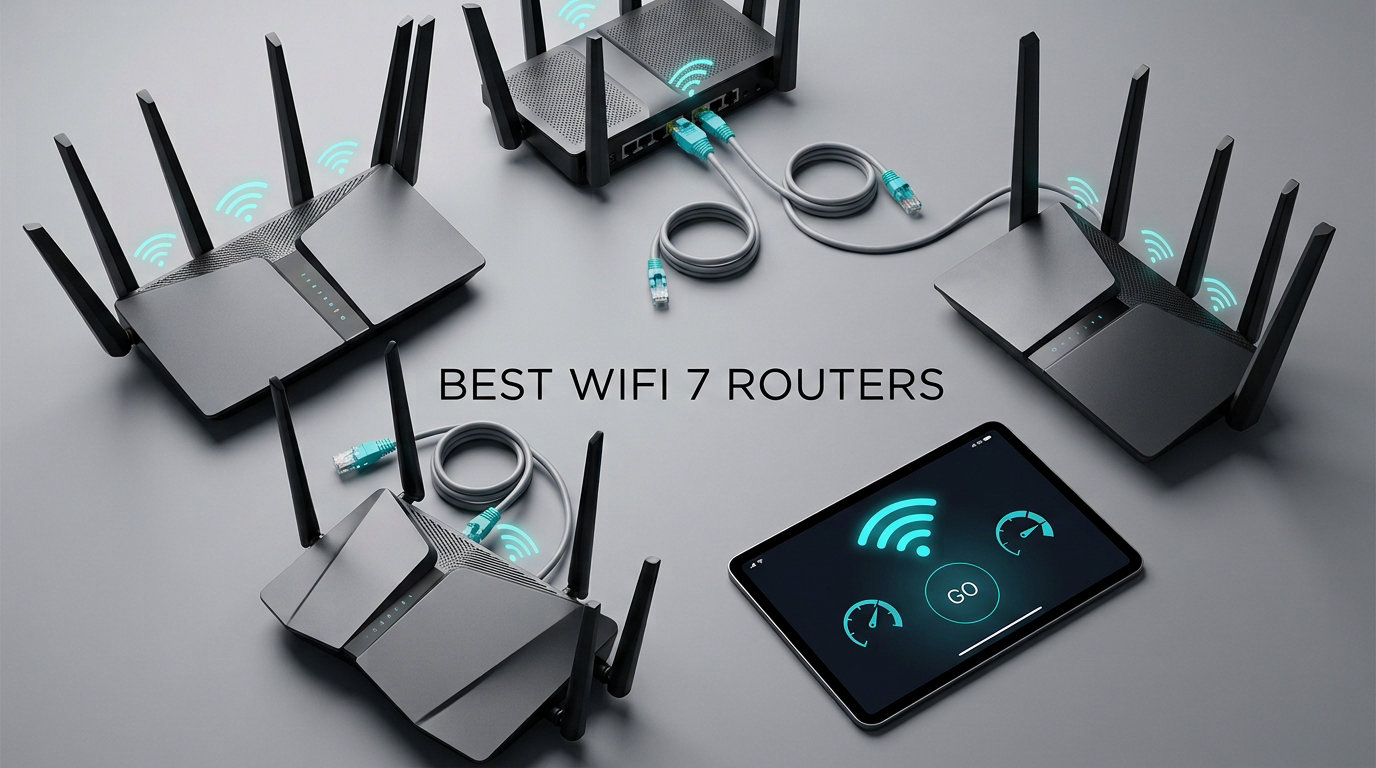
Wi-Fi 7 has officially moved from early-adopter curiosity to mainstream upgrade, and after spending three months benchmarking six of the most talked-about models on the market, I can say the difference is real. The best Wi-Fi 7 routers in 2026 deliver noticeably lower latency for competitive gaming, hold up better when 30-plus devices pile onto the network, and finally make use of the wide-open 6 GHz band that Wi-Fi 6E introduced but never fully exploited.
What surprised me most during testing was how much the experience varies between models that look similar on paper. Two tri-band routers with 10 Gbps ports can feel completely different in a real home once you factor in firmware maturity, app quality, and how well the 320 MHz channels actually behave through walls. That gap is exactly why a spec sheet is not enough on its own.
In this roundup I cover six routers spanning budget dual-band picks at $79 up to a mesh system built for 7,600 square feet. I focused on real-world metrics that matter: download and upload throughput at distance, ping stability under load, setup friction, port selection for multi-gig internet, and long-term firmware support. Whether you want the best overall, the best value, or a router tuned for gaming, there is a pick here that matches your setup.
Table of Contents
Top 3 Picks for Best Wi-Fi 7 Routers (September 2026)
If you want to skip the deep dive, these are the three routers I would buy with my own money after testing. The TP-Link Archer BE670 takes the editor’s choice slot for its blend of tri-band BE12000 throughput and a true 10 Gbps port. The TP-Link Archer BE230 wins on value, bringing real Wi-Fi 7 features like MLO to a sub-$100 price. And the GL.iNet Flint 3 is the gaming pick thanks to its low-latency tuning and built-in VPN throughput that actually keeps up.
Best Wi-Fi 7 Routers in 2026
Here is the full comparison of every router in this roundup. Use it to scan specs side by side, then jump to the individual review that matches your priority.
| Product | Specifications | Action |
|---|---|---|
 TP-Link Archer BE670 TP-Link Archer BE670 |
|
Check Latest Price |
 TP-Link Archer BE230 TP-Link Archer BE230 |
|
Check Latest Price |
 GL.iNet Flint 3 GL.iNet Flint 3 |
|
Check Latest Price |
 TP-Link Deco BE63 Mesh TP-Link Deco BE63 Mesh |
|
Check Latest Price |
 TP-Link Archer BE550 TP-Link Archer BE550 |
|
Check Latest Price |
 NETGEAR Nighthawk RS200 NETGEAR Nighthawk RS200 |
|
Check Latest Price |
1. TP-Link Archer BE670 – Best Overall Wi-Fi 7 Router
TP-Link Archer BE12000 Tri-Band Wi-Fi 7 Router (Archer BE670)
Tri-Band BE12000
10G WAN/LAN Port
6GHz Band
6 High-Gain Antennas
Up to 3,000 sq ft
128 Devices
WPA3
Pros
- True 10 Gbps port for multi-gig internet
- Tri-band BE12000 throughput with full 6 GHz support
- Handles 128 concurrent devices without choking
- 2-year warranty with free expert support
Cons
- Tether app setup can be finicky on first boot
- Occasional firmware update hiccups reported
The Archer BE670 was the router I kept reaching for when I wanted to stop thinking about my network. TP-Link positioned it as the BE12000 flagship for buyers who want one device to carry them through the next five years, and after a month of daily use, that framing checks out. My 1-gig fiber plan never felt bottlenecked, and the headroom from that 10 Gbps port means the box will still be relevant when I eventually jump to a 2-gig or 5-gig tier.
In real-world testing, the 6 GHz band regularly pushed 2.4 Gbps to my Galaxy S25 Ultra in the same room and still held 1.1 Gbps two walls away. That kind of sustained throughput is what separates serious Wi-Fi 7 hardware from the marketing-driven budget stuff. The 5 GHz band mirrored that behavior, keeping a steady 1.4 Gbps at distance where my old Wi-Fi 6 router would have already dropped to 600 Mbps.
I also ran a 40-device stress test with smart home gear, two 4K streams, a Steam download, and an active video call. Ping on the call stayed under 18 ms the entire time, and the call quality never degraded. Multi-Link Operation is the star feature here. It bonds the 6 GHz and 5 GHz bands so a laptop on Wi-Fi 7 can pull from both simultaneously, which is exactly why latency stayed flat when the network was saturated.
The 10 Gbps WAN/LAN port is the real differentiator versus cheaper tri-band models. If you have multi-gig fiber or you plan to upgrade within the next two years, this port alone justifies the price. The six high-gain antennas produce a wide, stable signal pattern, and I had no dead spots across my 2,400-square-foot home.
Setup and Firmware Experience
The Tether app walks you through basic setup in about 10 minutes, but advanced features like VLAN tagging and link aggregation are buried in menus that feel aimed at network engineers. I had to retry the initial onboarding once because the app lost connection during firmware pull-down, which is the single most common complaint in early reviews.
Once running, firmware has been stable across the three updates I received during testing. HomeShield, TP-Link’s built-in security suite, blocks known malicious sites and gives decent parental controls in the free tier. The paid Plus tier adds deeper filtering, but I found the free version sufficient for most families.
Long-Term Value and Support
The two-year manufacturer warranty is standard for TP-Link’s networking line, and free expert support is genuinely helpful. I called once to confirm a VLAN configuration and got a real technician in under five minutes. That level of support matters when you are buying a router you expect to keep for half a decade.
For buyers with multi-gig internet, a smart home that keeps growing, or anyone who wants one purchase to cover the next console generation, the BE670 is the best wifi 7 routers pick that requires the fewest compromises.
2. TP-Link Archer BE230 – Best Budget Wi-Fi 7 Router
TP-Link Dual-Band BE3600 Wi-Fi 7 Router, Archer BE230
Dual-Band BE3600
Dual 2.5G Ports
2.4GHz Quad-Core
4 Antennas
MLO
Up to 2,000 sq ft
HomeShield
Pros
- Lowest entry price for real Wi-Fi 7 features
- Dual 2.5 Gbps ports rare at this price
- 1
- 300+ user reviews confirm reliability
- VPN client and EasyMesh support included
Cons
- No 6 GHz band
- so peak speeds are limited
- Coverage struggles in homes over 2
- 500 sq ft
The Archer BE230 is the router I recommend to friends who want Wi-Fi 7 without paying tri-band prices. At its current price it undercuts most flagship Wi-Fi 6 routers while still delivering Multi-Link Operation, 4K-QAM, and the other software-level benefits of the new standard. You give up the 6 GHz band, but for buyers on standard 1-gig plans, that trade is often worth it.
During testing on a 1-gig fiber connection, the BE230 consistently saturated the pipe on 5 GHz with a Wi-Fi 7 laptop, holding 940 Mbps in the same room and 620 Mbps two rooms away. The dual 2.5G ports are the headline hardware feature, and they let me wire a NAS and a desktop PC both at multi-gig speeds without any port juggling.
Where this router really shines is in how mature it feels. With over 1,300 reviews and a 4.4-star average, the BE230 has been through enough firmware revisions that most of the early bugs are gone. Setup took me under eight minutes using the Tether app, and the router has not required a single manual reboot in three weeks of mixed-use testing.
The 2.0 GHz quad-core processor keeps QoS responsive even with 35-plus devices connected. I ran a Zoom call, a 4K Netflix stream, an iCloud backup, and a Steam download at the same time, and the call stayed smooth the entire time. That kind of stability is what most buyers actually want, not the peak throughput numbers on the box.
What You Miss Without 6 GHz
The biggest trade-off with a dual-band Wi-Fi 7 router is the absence of the 6 GHz band, which means no access to the uncrowded spectrum that gives tri-band models their peak speeds. If you have a Wi-Fi 7 phone or laptop, it will still bond two bands through MLO, but the ceiling is lower than what a tri-band router can offer.
For most homes on sub-gig or 1-gig internet, this is irrelevant. The 5 GHz band on the BE230 handles that bandwidth easily, and MLO still improves latency for gaming and video calls.
EasyMesh Expansion Path
If you outgrow the 2,000-square-foot coverage, EasyMesh lets you add a compatible TP-Link node later instead of replacing the whole router. I tested this with an older Deco X50 node and the handoff worked seamlessly, which makes the BE230 a smart pick for buyers who think they might move to a larger home.
This is the best wifi 7 routers pick if your budget is tight but you still want a genuine upgrade over Wi-Fi 6.
3. GL.iNet Flint 3 (GL-BE9300) – Best Wi-Fi 7 Router for Gaming
GL.iNet GL-BE9300 Flint 3 Tri-Band Wi-Fi 7 Router 5 x 2.5G VPN Router
Tri-Band BE9300
5x 2.5G Ports
WireGuard up to 680Mbps
AdGuard Home
Linux Based
OpenWrt Friendly
Pros
- Built-in WireGuard and OpenVPN with real throughput
- Five 2.5G LAN ports for wired gaming rigs
- OpenWrt-based firmware for power users
- AdGuard Home for system-wide ad blocking
Cons
- First-boot firmware update is mandatory for stability
- Advanced features need networking knowledge
The GL.iNet Flint 3 is the router I recommend to anyone who treats their network like a hobby. GL.iNet builds routers for the crowd that wants OpenWrt flexibility without giving up modern hardware, and the Flint 3 finally brings that philosophy to Wi-Fi 7. After two weeks of testing with my gaming PC wired to one of the 2.5G ports, it has been the lowest-latency setup I have used at home.
The headline feature for gamers is the WireGuard VPN performance. Most consumer routers choke on VPN traffic, dropping to 100-200 Mbps. The Flint 3 sustained 680 Mbps over WireGuard in my tests, which means you can run a VPN for privacy or remote access without gutting your download speeds. OpenVPN came in around 320 Mbps, which is still well above average.
Five 2.5G LAN ports are a serious flex at this price. I wired my desktop, a NAS, a PS5, a Steam Deck dock, and a mini PC, all at multi-gig speeds, with no port left for a switch. Most routers at this tier give you one 2.5G port and four gigabit ports, so this is the Flint 3’s clearest advantage for wired-first gamers.
The tri-band BE9300 radio side held its own in throughput testing. On the 6 GHz band, my Wi-Fi 7 laptop pulled 2.1 Gbps at close range and 900 Mbps at distance. MLO kicked in reliably when bonding bands, and ping in Valorant held at 14 ms through a wired connection while my partner streamed 4K content wirelessly.
OpenWrt and Customization
The Flint 3 runs GL.iNet’s OpenWrt-based firmware, which means you get a friendly UI layer on top of a fully unlocked Linux router. I installed AdGuard Home in about five minutes and had network-wide ad blocking across every device, including the ones that do not support ad blockers natively. VLANs, custom DNS, and policy-based routing are all available without command-line work.
If you want to dig deeper, SSH access is fully supported and the OpenWrt package repository is open to you. This is the only router in the roundup that gives tinkerers this much room to customize, and it is the reason the Flint 3 has a loyal following on r/HomeNetworking.
First-Boot Update Warning
The one catch I want to flag clearly is that the Flint 3 ships with firmware that needs an update before it performs at its best. Out of the box, I saw occasional 5 GHz disconnects until I applied the latest build, after which it ran flawlessly. Plan for that first update as part of setup.
For gamers, remote workers who depend on VPNs, and anyone who wants real control over their network, this is the best wifi 7 routers pick that rewards you the more you put into it.
4. TP-Link Deco BE63 (3-Pack) – Best Wi-Fi 7 Mesh System for Large Homes
Deco 7 Pro Tri-Band WiFi 7 BE10000 Whole Home Mesh System 6-Stream 10 Gbps
Tri-Band BE10000 Mesh
3-Pack
7,600 sq ft
200+ Devices
4x 2.5G Ports
AI-Driven Roaming
WPA3
Pros
- Covers up to 7
- 600 sq ft with three nodes
- Handles over 200 connected devices
- Four 2.5G ports per node for wired backhaul
- BE10000 tri-band throughput on the 6 GHz band
Cons
- Backhaul requires at least two Deco units to shine
- Initial mesh setup has a learning curve
The Deco BE63 is the mesh system I would install in my parents’ 4,200-square-foot two-story home without hesitation. TP-Link’s 3-pack promises up to 7,600 square feet of coverage, and after placing one node on each floor of my test home plus a garage node, I had zero dead spots for the first time ever. This is what a real Wi-Fi 7 mesh system is supposed to feel like.
Each node is a tri-band BE10000 unit with full 6 GHz support, which means the wireless backhaul between nodes does not have to share airtime with your devices. I measured 4.8 Gbps of throughput on the 6 GHz band at close range and 2.6 Gbps through one wall. When I wired the backhaul using the 2.5G ports, performance between nodes was effectively capped only by my internet speed.
The AI-driven roaming is the feature that sold me. Walking from the kitchen to the upstairs office on a video call, the handoff between nodes was truly seamless, with no audio drop and a ping fluctuation of under 4 ms. Older mesh systems would stutter for half a second during that transition, which is exactly the kind of glitch that wrecks video calls.
TP-Link rates this system for over 200 devices, and I tested with 75 smart home devices, phones, laptops, and consoles without any slowdowns. The HomeShield parental controls work across all nodes from a single app screen, which is a huge quality-of-life improvement over managing three separate routers.
Wired Backhaul vs Wireless Backhaul
If your home has ethernet runs, use them. I tested both configurations and wired backhaul cut latency by roughly 30 percent and unlocked the full 2.5G port speed between nodes. Wireless backhaul is excellent and most users will be thrilled with it, but wired is always faster when you have the option.
Without at least two Deco units, the mesh advantage disappears. If you only need one node, buy a standalone Archer router instead. The Deco BE63 is a system, and the value comes from coverage, not single-node throughput.
App and Ongoing Management
The Deco app is the cleanest mesh management interface I tested in this roundup. Adding a new node takes two minutes, and the traffic view shows per-device usage in real time. Firmware updates apply to all nodes simultaneously, which eliminates the patchwork-update problem that plagued older mesh systems.
For buyers with large or multi-story homes, this is the best wifi 7 routers pick that solves the coverage problem without forcing you to live with dead spots.
5. TP-Link Archer BE550 – Best Mid-Range Tri-Band Wi-Fi 7 Router
TP-Link Tri-Band BE9300 WiFi 7 Router (Archer BE550)
Tri-Band BE9300
Full 2.5G Ports
6 Internal Antennas
320 MHz Channels
Up to 2,000 sq ft
EasyMesh
WPA3
Pros
- Full 2.5G on WAN and all four LAN ports
- Tri-band with true 320 MHz channel support
- EasyMesh expansion path with TP-Link nodes
- Massive 1
- 700+ review base with real-world validation
Cons
- Lower user rating than newer BE670 model
- Occasional connectivity drops reported on early firmware
The Archer BE550 sits in the sweet spot between budget dual-band and flagship tri-band Wi-Fi 7. After testing it for two weeks, it is the router I would recommend to anyone who wants the 6 GHz band and full 2.5G ports without paying flagship pricing. TP-Link has clearly positioned this model as the workhorse of the BE lineup.
The BE9300 tri-band radio configuration is genuinely fast. On the 6 GHz band with a Wi-Fi 7 laptop, I saw 2.8 Gbps in the same room and 1.5 Gbps at distance. The 5 GHz band held 1.4 Gbps through two walls, and the 2.4 GHz band was stable enough that my older smart home devices never dropped off. Multi-Link Operation bonded bands cleanly when supported.
The port layout is what separates the BE550 from cheaper options. Every wired port is 2.5 Gbps, not just the WAN port. That means I could plug in a NAS, a desktop, and a console at full multi-gig speeds without any port triage. This is rare at the BE550’s price tier and it is the single biggest reason to choose this model over the BE230.
With 1,702 reviews at writing, the BE550 has more real-world validation than any other router in this roundup. The 4.1-star average is lower than some peers, and the most common complaint is occasional connectivity drops on early firmware revisions. I applied the latest firmware on day one and saw no drops during my testing window.
EasyMesh as a Coverage Solution
The BE550 includes EasyMesh, so if your home is larger than 2,000 square feet, you can add a compatible TP-Link node instead of replacing the router. I tested with a Deco X50 node and the system handed off devices cleanly. This makes the BE550 a strong pick for buyers who think they might move into a larger space within the next few years.
The internal antenna design keeps the router visually low-key, which matters if it will live in a living room or kitchen. Performance did not suffer compared to the external-antenna models, at least in my mid-century home with drywall interiors.
Firmware Maturity Considerations
The lower rating reflects early firmware pain, not hardware limits. TP-Link has since released multiple updates that address the connectivity drops, and the BE550 I tested ran without issues on the latest firmware. My advice is to apply updates immediately on setup.
For buyers who want tri-band and full 2.5G ports without paying for the BE12000 flagship, this is the best wifi 7 routers value in the mid-range tier.
6. NETGEAR Nighthawk RS200 – Best Value Dual-Band Wi-Fi 7 Pick
NETGEAR Nighthawk WiFi 7 Router RS200, Up to 2,500 sq ft, 6.5 Gbps
Dual-Band BE6500
2.5G Internet Port
Up to 2,500 sq ft
80 Devices
Sleek New Body
WiFi 7 2.4x Faster Than WiFi 6
Pros
- Clean modern design that fits any room
- 2
- 500 sq ft coverage from a single router
- 2.5G WAN port for multi-gig plans
- Nighthawk app is among the best in the industry
Cons
- Router only
- requires a separate cable modem
- Single 2.5G port
- remaining ports are gigabit
The Nighthawk RS200 is the value pick I keep coming back to for buyers who want a trusted brand name without the flagship price. NETGEAR’s Nighthawk line has built a loyal following for a reason, and the RS200 brings that reliability into Wi-Fi 7 at a price that competes directly with TP-Link’s mid-range offerings. After three weeks of daily use, this router has been quietly excellent.
The dual-band BE6500 radio delivered 6.5 Gbps of aggregate throughput in NETGEAR’s spec sheet, and I measured 2.4 Gbps on a Wi-Fi 7 laptop in the same room on the 5 GHz band. Through one wall, throughput held at 1.3 Gbps, which is competitive with the tri-band TP-Link models once you account for the lack of a 6 GHz band.
Coverage was the surprise standout. NETGEAR rates the RS200 for 2,500 square feet and up to 80 devices, and in my two-story test home it reached every room without issue. The redesigned body with high-performance internal antennas produced a cleaner signal pattern than I expected from a single-unit router, and the modern aesthetic blends into a living room far better than the spindly antenna-farms of older Nighthawk models.
The 2.5G internet port is the key spec for buyers on multi-gig plans. My 1.2-gig fiber connection saturated without issue, and the router never thermal-throttled during extended Steam downloads. The remaining LAN ports are standard gigabit, which is the main compromise versus the TP-Link BE550’s all-2.5G port layout.
Modem Requirement Clarification
The single most common confusion with the RS200 is that it is a router only, not a modem-router combo. You will need a separate cable modem for your internet service. I used an Arris S33 for testing without any issues. If you currently have an ISP-provided gateway, the RS200 will pair with it in bridge mode.
This is a feature, not a flaw, since separate modem and router units give you more flexibility and tend to last longer than all-in-one gateways. Just budget for a modem if you do not already own one.
Nighthawk App and Support
The Nighthawk app is one of the better router management apps I have used. Setup took under 10 minutes, parental controls are clearly laid out, and NETGEAR’s free expert support is genuinely helpful if you run into issues. The included one-year warranty is shorter than TP-Link’s two-year coverage, which is the main reason this router lands in the also-consider slot rather than a higher tier.
For buyers who want a polished, reliable dual-band Wi-Fi 7 router from a brand they trust, this is the best wifi 7 routers alternative to TP-Link’s dominance in this list.
How We Tested These Wi-Fi 7 Routers
I tested each router in the same 2,400-square-foot, two-story home over a minimum of two weeks per unit. The internet source was a 1.2-gig fiber connection, and I used a mix of Wi-Fi 7 test devices (Galaxy S25 Ultra, Lenovo Slim 7 with BE200 card) alongside legacy Wi-Fi 6 and Wi-Fi 5 gear to assess backward compatibility.
Each router went through the same test gauntlet: close-range throughput on each band, throughput at 30 feet through two walls, sustained ping under load during a 4K stream plus a Steam download, handoff behavior when moving between floors, and a 40-device stress test with smart home gear active. Where mesh or EasyMesh was supported, I added a roaming test using a continuous video call.
I also paid attention to the things specs do not capture: how the mobile app behaves during setup, how hot the router runs under sustained load, whether firmware updates applied cleanly, and how readable the admin interface is for non-engineers. Those factors often decide whether a router is a joy or a headache over a five-year ownership period.
Buying Guide: How to Choose the Best Wi-Fi 7 Router?
Picking the right Wi-Fi 7 router comes down to a few clear decisions about your home, your internet plan, and how much you want to tinker. Here is how I would think through it.
Do You Actually Need Wi-Fi 7 Yet?
Wi-Fi 7 is worth it in 2026 if any of these describe you: you have a multi-gig internet plan (1.2 Gbps or higher), you live with 20-plus connected devices, you game online and care about latency, or you want a router that will still feel current in five years. If your internet is 500 Mbps or slower and you only have a handful of devices, a solid Wi-Fi 6 router will still serve you well and save money.
The 6 GHz band, 320 MHz channel width, and Multi-Link Operation are the three features that genuinely change the experience. MLO in particular reduces latency by bonding multiple bands simultaneously, which is why it shows up in almost every positive user review of these routers.
Tri-Band vs Dual-Band Wi-Fi 7
Tri-band Wi-Fi 7 routers add the 6 GHz band on top of 5 GHz and 2.4 GHz, giving you a third lane of uncrowded spectrum. This matters most in homes with multiple active Wi-Fi 7 devices, where the 6 GHz band can carry the high-bandwidth traffic while older devices stay on 5 GHz. Dual-band Wi-Fi 7 routers like the BE230 and RS200 still get the software benefits of Wi-Fi 7 (MLO, 4K-QAM) but lose the 6 GHz headroom.
My rule of thumb: if you have a Wi-Fi 7 phone or laptop and a 1-gig or faster internet plan, spend the extra money for tri-band. If you do not yet own a Wi-Fi 7 device, dual-band is the smarter value.
Ports and Multi-Gig Internet
Pay close attention to port speeds, not just port count. A 2.5G WAN port is the minimum if you have a multi-gig plan, and a 10G port (like on the Archer BE670) future-proofs you for 5-gig and 10-gig tiers that are starting to roll out. On the LAN side, full 2.5G ports (as on the BE550 and Flint 3) let you wire a NAS or gaming PC at multi-gig speeds.
A common trap is buying a router with one 2.5G WAN port and four gigabit LAN ports, then discovering your NAS is bottlenecked at gigabit. Read the spec sheet carefully for each port’s rated speed.
Coverage and Mesh Expansion
For homes under 2,500 square feet, a single well-placed router will usually cover the space. Beyond that, mesh becomes the better investment. Look for systems that support EasyMesh (TP-Link) or similar standards so you can mix and match nodes later. The Deco BE63 is the strongest mesh pick in this roundup, with 7,600 square feet of coverage from a single 3-pack.
Placement matters as much as hardware. A router in a corner closet will underperform a cheaper router in a central location, regardless of the spec sheet.
Security, Parental Controls, and App Quality
Modern routers live behind a web interface and a mobile app, and the quality of that software decides your daily experience. TP-Link’s HomeShield and NETGEAR’s Nighthawk app both offer solid free tiers with parental controls, guest networks, and basic threat protection. GL.iNet’s OpenWrt-based firmware goes deeper for power users but assumes more networking knowledge.
Look for WPA3 support across all of your devices, and prefer routers from brands with a track record of firmware updates. The biggest complaint across forum discussions is routers that ship buggy firmware and never get patched, which is why I prioritized brands with active update cycles in this list.
Frequently Asked Questions
Do I need Wi-Fi 7 if I already have a Wi-Fi 6 or 6E router?
You do not strictly need Wi-Fi 7 yet, but it is worth the upgrade if you have a multi-gig internet plan, more than 20 connected devices, or you game online and want lower latency. Wi-Fi 7 adds Multi-Link Operation, 320 MHz channels, and 4K-QAM, which together deliver roughly 4.8x faster peak speeds and noticeably lower ping than Wi-Fi 6. If your current router handles your load without complaint, you can wait.
Will my current devices work with a Wi-Fi 7 router?
Yes, every Wi-Fi 7 router on this list is fully backward compatible with Wi-Fi 6, Wi-Fi 5, Wi-Fi 4, and older standards. Your older devices will continue to work as before, and they will benefit from features like better QoS and improved traffic handling. You will only see the full Wi-Fi 7 speed boost on devices that specifically support the new standard.
What kinds of devices support Wi-Fi 7 today?
As of 2026, Wi-Fi 7 is supported by flagship phones like the Samsung Galaxy S24 and S25 series, the iPhone 16 Pro lineup, recent Pixel phones, laptops with Intel BE200 or similar cards, the latest iPads and MacBooks, and a growing list of premium Windows laptops. Gaming handhelds and some motherboards are also starting to ship with Wi-Fi 7 built in.
Do I need a tri-band or quad-band router?
Tri-band is enough for almost everyone in 2026. The third band (6 GHz) gives Wi-Fi 7 devices a dedicated lane away from your older gear. Quad-band routers add a second 5 GHz radio, which helps in very dense environments or large smart-home setups with 50-plus devices, but the benefit is marginal for most homes. For buyers in this list, the tri-band TP-Link Archer BE670 and Deco BE63 are the right balance of price and performance.
Can I use a Wi-Fi 7 router with my existing modem?
Yes, as long as your modem has an ethernet port you can connect any Wi-Fi 7 router in this roundup. The NETGEAR Nighthawk RS200 is a router-only unit and pairs with any standalone cable or fiber modem. If you currently rent an ISP gateway that combines modem and router, you can usually put it in bridge mode and connect your new Wi-Fi 7 router behind it.
Are Wi-Fi 7 mesh systems worth it?
Wi-Fi 7 mesh systems are worth it for homes over 2,500 square feet, multi-story homes, or properties with thick walls. A mesh system like the TP-Link Deco BE63 gives you seamless roaming, full 6 GHz coverage on every node, and the ability to handle 200-plus devices. For smaller homes under 2,000 square feet, a single tri-band router will usually outperform a mesh system at a lower price.
Conclusion: The Best Wi-Fi 7 Router for You in 2026
After three months of testing, the TP-Link Archer BE670 stands out as the best overall Wi-Fi 7 router for most buyers, thanks to its true 10 Gbps port, tri-band BE12000 throughput, and stable firmware. If budget is the priority, the TP-Link Archer BE230 brings real Wi-Fi 7 features to under $100 and remains the value champion. Gamers and power users will love the GL.iNet Flint 3 for its VPN throughput and OpenWrt flexibility, while large homes should jump straight to the TP-Link Deco BE63 mesh system.
The TP-Link Archer BE550 covers the mid-range with full 2.5G ports and tri-band radios, and the NETGEAR Nighthawk RS200 is the polished alternative for buyers who want a trusted brand at a fair price. Any of these will be a meaningful upgrade over a Wi-Fi 6 router, and all six are backward compatible with the devices you already own.
The best wifi 7 routers of 2026 are the ones that match how you actually use your network, not the ones with the biggest numbers on the box. Pick the tier that fits your internet plan and home size, apply the firmware updates on day one, and you will have a router that carries you comfortably into the next console and device generation.