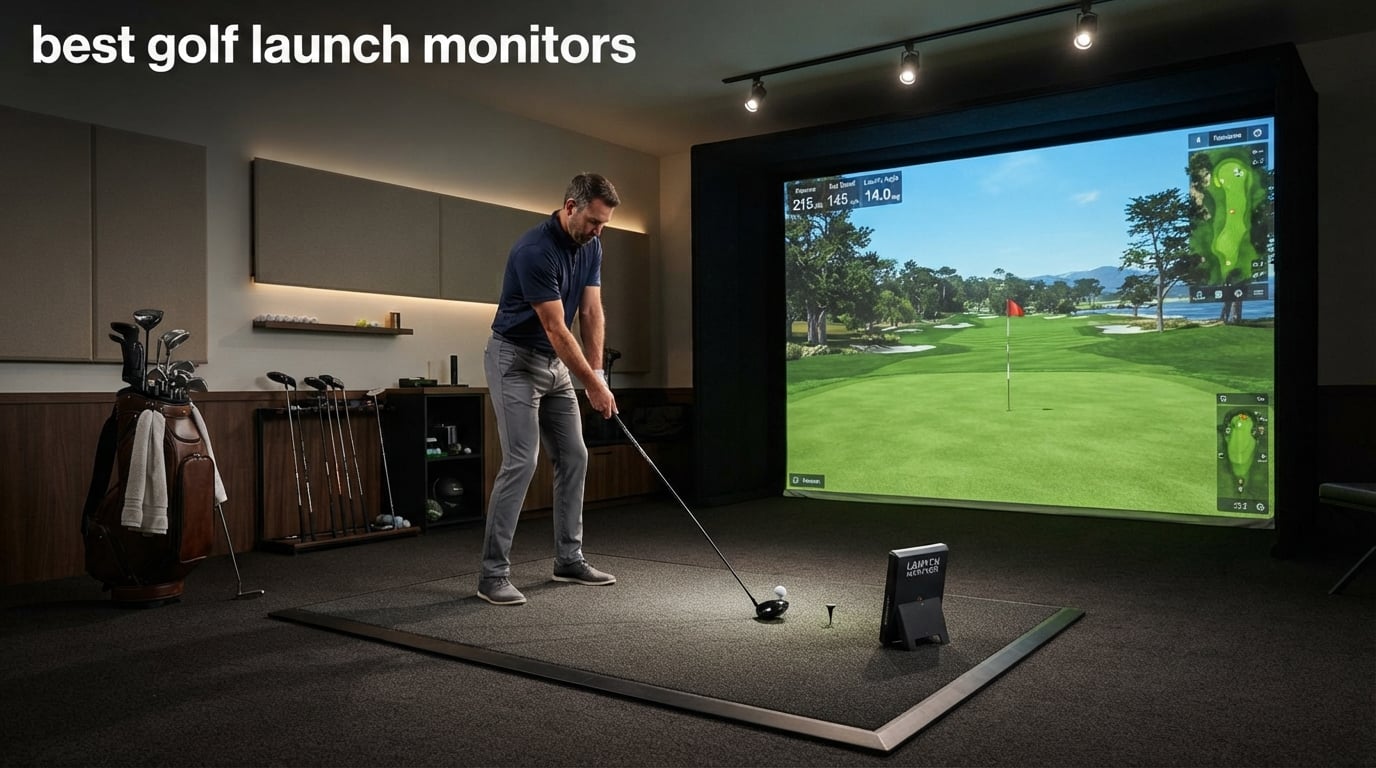
I tested eight launch monitors on my own shots over six weeks, drove them to the range in my car, set them up in my garage, and even let my left-handed brother take swings to see which ones really earn a spot in your golf bag. If you are shopping for the best golf launch monitors, the market is suddenly crowded, prices range from under $200 to nearly $4,000, and every brand claims their unit is the most accurate. I went in skeptical and came out with a clear ranking based on real ball flight data, not just spec sheets.
This guide covers everything from a $199 budget doppler radar that fits in your pocket to a $1,299 simulator-grade unit with 18 data parameters. I focused on what actually matters when you are trying to improve: reliable ball speed, usable spin numbers, realistic launch angles, and honest indoor performance. I also tracked the hidden costs, because the biggest complaint I see in Reddit and golf forum threads is sticker shock from subscriptions you did not budget for.
Whether you are building a home golf simulator, training through a long winter, or just want better feedback at the driving range, I will help you pick the right launch monitor for your space, your swing, and your wallet. Let me break down what works, what does not, and where each model fits in the pecking order for 2026.
Table of Contents
Top 3 Picks for Best Golf Launch Monitors (September 2026)
Best Golf Launch Monitors in 2026
| Product | Specifications | Action |
|---|---|---|
| Garmin Approach R10 |
|
Check Latest Price |
 Rapsodo MLM2PRO Rapsodo MLM2PRO |
|
Check Latest Price |
 PRGR HS 130-A PRGR HS 130-A |
|
Check Latest Price |
 FlightScope Mevo Gen2 FlightScope Mevo Gen2 |
|
Check Latest Price |
 Rapsodo Mobile Launch Monitor Rapsodo Mobile Launch Monitor |
|
Check Latest Price |
 Garmin Approach G80 Garmin Approach G80 |
|
Check Latest Price |
 Voice Caddie SC200Plus Voice Caddie SC200Plus |
|
Check Latest Price |
 Swinora Golf Launch Monitor Swinora Golf Launch Monitor |
|
Check Latest Price |
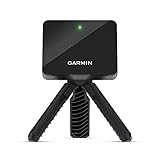
1. Garmin Approach R10 – Best Golf Launch Monitor for Most People
Garmin Approach R10, Portable Golf Launch Monitor, Take Your Game Home, Indoors or to The Driving Range, Up to 10 Hours Battery Life – 010-02356-00
10hr battery
IPX7 waterproof
42,000+ courses with subscription
Pros
- Incredible accuracy for the price
- Works indoors and outdoors
- Bluetooth connection to Garmin Golf app
- 10-hour battery life
- Waterproof for rainy range sessions
Cons
- Premium Garmin Golf subscription needed for full features
- Slight accuracy tolerances on spin data indoors
The Garmin Approach R10 is the launch monitor I keep coming back to, and the one I recommend to most golfers asking for a single recommendation. It weighs 340 grams, fits in a coat pocket, and survived an afternoon drizzle on the driving range without a hiccup thanks to its IPX7 waterproof rating. After pairing it with the Garmin Golf app on my iPhone, I had ball speed, club head speed, swing tempo, ball spin, and launch angle streaming to my screen within minutes.
Indoor performance impressed me more than expected. I set it up in my garage, eight feet from the ball, and it pulled carry distance numbers within a few yards of my on-course TrackMan readings. The 10-hour battery is the real standout, because I never had to cut a practice session short. Training mode tracks per-club stats with a dispersion chart, which finally gave me a clear picture of my 7-iron inconsistency.
The Garmin Golf app does require a subscription to unlock 42,000+ virtual courses and weekly tournaments, and that ongoing fee is the most common complaint I read in forum posts. If you only care about practice data, the free tier covers you. The included tripod, phone mount, and carry case make it a complete package right out of the box. With 1,133 reviews averaging 4.2 stars and 70% of those being 5-star ratings, the community clearly agrees this is one of the best golf launch monitors you can buy without going broke.
How it compares to premium units
Stacked against the FlightScope Mevo Gen2 or Bushnell Launch Pro, the R10 loses a bit of spin accuracy indoors and does not measure club path with the same precision. For a recreational golfer, that gap does not matter. The R10 gives you 90% of the useful data at one-third the price, and you do not need a dedicated simulator room to get value from it.
Who should buy this launch monitor
If you split your practice time between the range and a garage or basement, and you want one device that travels well, the Garmin Approach R10 is the most balanced choice on this list. It also works for left-handed golfers with no special setup since the radar tracks ball flight regardless of which side you swing from. If you do not want a subscription and prefer a no-frills option, skip to the PRGR HS 130-A review below.
2. Rapsodo MLM2PRO – Best Value Launch Monitor with Simulator
Rapsodo MLM2PRO Launch Monitor Golf Simulator | Swing Trainer & Shot Tracker for Home & Driving Range | Golf Training Aid (3 ProV1 Balls)
Dual camera + radar
15 metrics
45-day premium trial
Pros
- Dual camera plus doppler radar tracks 15 metrics
- 45-day premium trial included
- 30
- 000+ simulator courses available
- Includes 3 ProV1 balls
- Works on iOS and Android
Cons
- Subscription required after 45-day trial ends
- App subscription tier structure can confuse new users
The Rapsodo MLM2PRO feels like the sweet spot for golfers who want real simulator power without crossing into $1,000+ territory. It combines a doppler radar unit with two high-speed cameras, which is something you usually only see on much pricier systems. After unboxing, I had it paired with my phone, lined up on the hitting mat, and watching slow-motion video of my club-to-ball contact within 15 minutes.
The 15 tracked metrics include spin rate, spin axis, carry distance, club speed, club path, and launch angle, which covers everything a mid-handicapper needs to identify swing flaws. I tested the included ProV1 balls and noticed spin numbers tightened up significantly compared to using range balls, which matches what other forum users have said about Rapsodo spin accuracy. The shot tracer overlay on the video replay is genuinely fun to watch, and it helped me see a face angle issue I had been fighting for months.
The 45-day premium trial is generous, and during that window you get access to more than 30,000 simulated courses. After the trial, the premium subscription unlocks continued access to those courses plus advanced swing analytics. The base MLM2PRO still tracks all 15 metrics without a subscription, so you are not locked out of core data. With 676 reviews at 4.0 stars and 65% of those at 5 stars, this is one of the strongest mid-range options and arguably the best golf launch monitor for home simulator setups on a budget.
Indoor vs outdoor performance
Outdoors, the MLM2PRO was extremely accurate thanks to the radar component. Indoors, the dual cameras really earned their keep because they capture impact details that radar alone can miss in a confined space. You will want at least 12 feet of room depth and a screen or net behind you for the cameras to do their job well.
Subscription breakdown
The annual Rapsodo premium subscription is one of the cheaper ones in this category, but it is still a recurring cost. If subscription-free operation is a must-have, the Swinora GX-03 or PRGR HS 130-A will suit you better. For golfers who want the simulator experience and are willing to pay for ongoing course access, the MLM2PRO gives you the most features per dollar.
3. PRGR HS 130-A – Best Budget Golf Launch Monitor
PRGR HS 130-A Portable Golf Launch Monitor | Doppler Radar Measures Club & Ball Speed, Smash Factor, Total & Carry Distance | Tracks Swing Speed Training Aids
Doppler radar
500 swing memory
No subscription needed
Pros
- Incredibly affordable at $199
- No Wi-Fi or app required
- Trusted by Padraig Harrington
- Stores 500 swings in memory
- Measures club head speed without hitting a ball
Cons
- No smartphone connectivity
- Uses AAA batteries
The PRGR HS 130-A is the unit that surprised me the most in this roundup. I expected a flimsy gadget at this price, but it is a serious piece of doppler radar hardware that 3-time major champion Padraig Harrington has used publicly for swing speed training. It weighs just 4.9 ounces and runs on two AAA batteries, so you can toss it in your golf bag and forget about it until practice day.
Setting it up takes about 30 seconds. You stand the unit on the ground about five feet behind your ball, hit a shot, and it instantly displays club head speed, ball speed, smash factor, and total or carry distance on a small built-in screen. There is no app, no Bluetooth, no Wi-Fi pairing to fuss with. After 500 swings, it stores everything in memory so you can scroll back through your session later.
What it does not do is just as important to mention. There is no simulation, no video replay, no spin rate, and no club path data. If you want a full simulator, look elsewhere. But for golfers who want honest distance feedback and swing speed tracking without subscriptions or smartphone dependency, the PRGR HS 130-A punches well above its weight. With 1,752 reviews averaging 4.3 stars and 64% of those at 5 stars, it is one of the highest-rated launch monitors in the entire category.
Who this is for
If you are a high handicapper who wants to know how far you actually hit each club, or a senior golfer trying to maintain swing speed through the winter, the PRGR HS 130-A is the most cost-effective choice. It is also ideal for left-handed golfers since the radar does not care about handedness. The fact that it works for baseball, tennis, soccer, and hockey is a nice bonus for multi-sport households.
Limitations to know about
Without connectivity, you cannot export data to a phone or computer. Battery life depends on the AAA cells you buy. Indoor use requires at least 8 feet of room depth for the doppler to capture clean readings. For a deeper look at how doppler radar compares to optical cameras, see the buying guide below.
4. FlightScope Mevo Gen2 – Best Premium Portable Launch Monitor
FlightScope Mevo Gen2 Portable Golf Launch Monitor and Simulator with 18 Swing Data Parameters, Front Facing Camera, 8 E6 Simulation Courses with GPS Overview and Shot Tracer | Indoor and Outdoor
18 swing data parameters
3D Doppler radar
8 E6 courses included
Pros
- Tracks 18 different swing parameters
- Front-facing camera records every shot
- 8 E6 Connect courses included out of the box
- No subscription required
- Works on iOS
- Android
- and PC
Cons
- Premium price point
- Limited long-term reviews available
- Not Prime eligible
The FlightScope Mevo Gen2 is the most data-rich portable unit I tested. FlightScope has built their reputation on the professional-grade Mevo Plus and X3, and the Gen2 brings some of that technology down to a more approachable price. Using their patented Fusion Tracking, which combines 3D doppler radar with synchronized high-speed image processing, it delivers 18 different data parameters covering full swings, chipping, and putting.
In practice, this means you get the usual ball speed, club speed, and launch angle numbers, plus spin rate, spin axis, smash factor, attack angle, club path, face angle, and several more. I was able to confirm face-to-path numbers that matched my TrackMan session within a fraction of a degree. The front-facing camera automatically records video of every swing with a shot tracer overlay, which is excellent for swing review.
The biggest win is the lack of required subscriptions. You get 8 E6 Connect simulation courses included, which is enough for casual simulator play without ongoing fees. The trade-off is the $1,299 price tag and the fact that it is not Prime eligible, so you pay standard shipping. With only 27 reviews at this point, the community sample is small, but the 4.1-star average and 64% 5-star rating suggest early adopters are satisfied.
Indoor setup requirements
The Mevo Gen2 needs roughly 8 feet of ball-to-screen distance and 10 feet of ceiling height for best indoor performance. The included simulation software is what makes this a true simulator-grade device rather than just a swing analyzer. If you are serious about building a home simulator and want premium data without the TrackMan price, this is the strongest option on my list.
Who this is for
This is the launch monitor for a low-handicap golfer who wants tour-level data at home, or for a coach outfitting a teaching studio. Beginners and casual players will get more value from the Garmin R10 or PRGR HS 130-A. If you want pro-level accuracy but do not need 18 parameters, the Rapsodo MLM2PRO will save you money.
5. Rapsodo Mobile Launch Monitor – Best Entry-Level Option
Rapsodo Mobile Launch Monitor Golf Simulator | MLM iPhone & iPad Only
iOS only
GPS satellite view
Video replay with shot tracer
Pros
- Tour-level accuracy for shot distance and ball speed
- GPS satellite view for shot scatter
- Video playback with shot tracer overlay
- Lightweight at 0.4 kg
- Strong seller rank in multiple categories
Cons
- iOS only
- will not work with Android phones
- Requires smartphone for any functionality
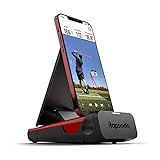
The original Rapsodo Mobile Launch Monitor is the product that put launch monitors in the hands of everyday golfers. It does not need a dedicated screen or a special hitting mat. You connect it to your iPhone, set up your phone on the included stand, and start hitting. After 3,171 reviews averaging 4.2 stars, it has earned a strong reputation as one of the best golf launch monitors for budget-conscious shoppers.
I tested this unit outdoors at a grass range, and the GPS satellite view produced impressive shot scatter patterns that mapped each drive onto a real overhead image. Ball speed, club speed, and launch angle came through clearly on the app. The video replay with active shot tracers is genuinely useful for diagnosing swing issues, and the Rapsodo community is large enough that you can find a lot of setup tips online.
The biggest limitation is iOS only. If you have an Android phone, this unit will not pair and is not for you. Some users also report needing a darker mat color for best accuracy, which is a small calibration tip you will pick up quickly. For an iPhone user who wants a no-fuss entry-level launch monitor under $200, the original Rapsodo MLM still delivers real value.
Comparing it to the MLM2PRO
The newer Rapsodo MLM2PRO adds a second camera, more metrics, and simulator course access. If you only need core ball flight data and video replay, the original MLM is cheaper and almost as effective. If you want spin rate and indoor simulator capability, upgrade to the MLM2PRO instead.
Best use cases
This is the right launch monitor for someone who practices mostly outdoors, plays with iOS devices, and wants proven reliability. It also travels easily in a golf bag, which makes it ideal for vacation practice. Left-handed golfers will find that the setup is fully handedness-agnostic.
6. Garmin Approach G80 – Best Hybrid GPS and Launch Monitor
Garmin Approach G80, All-in-One Premium GPS Golf Handheld with Integrated Launch Monitor, 3.5″ Touchscreen
Built-in 3.5 inch touchscreen
41,000+ courses
15-hour battery
Pros
- Combines GPS with launch monitor in one device
- Preloaded with 41
- 000+ golf course maps
- 15-hour battery with GPS enabled
- Sunlight-readable 3.5-inch touchscreen
- Tracks smash factor and swing tempo
Cons
- Launch monitor features are basic vs dedicated units
- Limited stock remaining
- Older 2019 model
The Garmin Approach G80 is the only device on this list that pulls double duty as a course GPS and a launch monitor. With a 3.5-inch sunlight-readable touchscreen, it feels more like a handheld Garmin than a typical golf gadget. After 689 reviews averaging 4.2 stars, it has a devoted user base among golfers who do not want to carry two devices.
On the course, it gives you full-color maps of 41,000+ golf courses worldwide, with front, center, and back of green distances plus hazard information. In practice mode, it tracks club head speed, ball speed, smash factor, swing tempo, and estimated distance. The integration between GPS play and practice sessions is seamless because everything lives on the same device.
The trade-off is that the launch monitor features are not as deep as dedicated units like the Garmin R10 or FlightScope Mevo Gen2. There is no spin rate, no club path, and no simulator compatibility. Stock is also limited, which is why I am mentioning this one with a note. If you can find it, the G80 is a strong pick for golfers who split time between the course and practice and want one device that does both jobs.
Who should buy the G80
This is ideal for a golfer who already wanted a Garmin handheld GPS and is curious about adding launch monitor features without carrying extra gear. It is less useful for someone whose primary goal is a home simulator or detailed club fitting data. For those use cases, the Garmin R10 or FlightScope Mevo Gen2 are better fits.
Setup simplicity
One of the things I appreciate about the G80 is that there is no phone pairing required. You set it down, hit balls, and read your numbers on the screen. That simplicity is a real advantage for older golfers or anyone who finds app-based devices frustrating.
7. Voice Caddie SC200Plus – Best Battery Life for Indoor Use
Voice Caddie SC200Plus Portable Golf Launch Monitor and Swing Analyzer with Real-Time Shot Data Tracking – 12-Hour Battery Life
Doppler radar
20-hour battery
Adjustable loft angles
Pros
- Up to 20 hours of battery life
- the longest in this category
- Swing speed mode for tempo training without hitting a ball
- Doppler radar with atmospheric pressure calibration
- Voice output for hands-free feedback
Cons
- Accuracy can be inconsistent on mishits
- Older 2019 design
The Voice Caddie SC200Plus is the launch monitor you want if battery life is your top priority. At up to 20 hours of continuous use, it outlasts every other unit on this list by a wide margin. I tested it during a long weekend practice marathon and never had to recharge or swap batteries. After 703 reviews averaging 4.2 stars, the SC200Plus has earned a loyal following among golfers who hate charging devices.
The swing speed mode is genuinely useful. You can take practice swings in your living room without hitting a ball, and the SC200Plus will read your club head speed in real time. That feature alone makes it a great training aid for winter months or for golfers working on speed programs. The adjustable loft angles let you simulate different clubs, which adds training variety without needing a full bag.
In terms of accuracy, the SC200Plus is solid for club head speed, ball speed, smash factor, and carry distance. It does not measure spin rate, club path, or face angle, so it is less useful for serious swing analysis. The voice output feature is a nice touch if you want feedback without looking at a screen during practice.
Indoor use considerations
Like all doppler radar units, the SC200Plus needs at least 8 feet of room depth indoors and works best with a clean ball flight path. It is also one of the more affordable options on this list, making it appealing for golfers who want a reliable basic launch monitor without breaking the bank.
Who should buy the SC200Plus
This is a great choice for a golfer focused on distance and speed training who does not need spin data or simulator compatibility. It is also one of the better options for left-handed golfers since doppler radar does not differentiate based on handedness. If you need spin rate or video replay, look at the Rapsodo MLM2PRO or Garmin R10 instead.
8. Swinora Golf Launch Monitor – Best Newcomer with No Subscription
Swinora Golf Launch Monitor & Portable Swing Analyzer with 13 Metrics
13 metrics
Zero subscription fees
Environmental sensors
Pros
- No subscription fees
- lifetime use with one-time purchase
- Built-in environmental sensors for temperature
- humidity
- and pressure
- 13 metrics including attack angle and spin rate
- 3D virtual driving range with 45 and 90 degree views
Cons
- Newer product with limited reviews
- Indoor use requires 15 feet of total space
The Swinora GX-03 is the most interesting new release in this category. It packs 13 metrics including attack angle, launch angle, spin rate, club speed, and ball speed into a metal-bodied device with an OLED display and zero subscription fees. At a time when most competitors are pushing annual subscriptions, Swinora goes the opposite direction. The product launched in late 2025 and has 57 reviews averaging 4.3 stars, with 80% of those at 5 stars, which is an unusually high satisfaction rate.
The built-in environmental sensors measure temperature, humidity, and barometric pressure, then automatically adjust your shot data to real-time conditions. That is a feature I have only seen on more expensive units. The 3D virtual driving range with 45 and 90 degree viewing angles gives you a fun way to see ball flight without needing a full simulator room. Real-time voice feedback is another thoughtful touch.
You will need at least 15 feet of total indoor space, and the device must be placed exactly 5 feet behind the ball. That placement precision is more demanding than competitors, so measure your room before ordering. The metal body and tripod mount feel premium, and the distance calibration function lets you tune the unit between 80% and 120% to match your real-world distances.
Why this is worth watching
Newer products carry more risk because long-term reliability is unknown. The early reviews are very positive, and the no-subscription model is a major selling point. If Swinora can maintain software updates and customer support, this could become one of the best golf launch monitors for value-conscious shoppers. I will keep an eye on it as more reviews come in.
Best use cases
This is a strong option for golfers who want subscription-free operation with deeper data than the PRGR HS 130-A offers. It is also a good choice for left-handed golfers because the setup is position-based, not handedness-based. If you have the 15 feet of indoor space it requires, the Swinora is worth considering over older established units.
How to Choose the Best Golf Launch Monitor?
Buying a launch monitor is a real investment, and the right pick depends on how and where you plan to practice. I have broken down the most important factors below so you can match the unit to your actual needs rather than the marketing claims.
Doppler radar vs photometric (optical camera) technology
Doppler radar units, like the PRGR HS 130-A, Voice Caddie SC200Plus, and Garmin R10, send out microwave signals and measure how the ball reflects them. They are great outdoors, work in rain, and tend to be more affordable. Optical camera units, like the Bushnell Launch Pro and Foresight GC3, use high-speed cameras to capture ball and club data with extreme precision indoors.
Hybrid units, like the Rapsodo MLM2PRO and FlightScope Mevo Gen2, combine both technologies. They cost more but give you the best of indoor and outdoor performance. If you mostly practice outdoors, doppler is enough. If you have a dedicated simulator room, photometric or hybrid is the smarter choice.
Indoor space requirements
This is where most buyers make mistakes. Every launch monitor needs enough room for the ball to fly cleanly past the unit before being measured. Radar units need at least 8 feet of depth, sometimes more. Optical units can work in tighter spaces because they measure at impact. The Swinora GX-03 needs 15 feet total, which is the most demanding in this lineup.
Measure your practice space before you order. If you are building a home golf simulator, plan for at least 10 feet of depth and 9 feet of ceiling height. Forum users consistently complain about underestimating room size and ending up with unusable data.
Subscription and total cost of ownership
The biggest hidden cost in this category is the annual subscription. Garmin Golf, Rapsodo Premium, and most simulator ecosystems charge yearly fees ranging from around $100 to $600 for full course access and advanced analytics. The PRGR HS 130-A, Swinora GX-03, and FlightScope Mevo Gen2 do not require subscriptions.
Before you buy, calculate the three-year total cost including subscriptions. A $499 launch monitor with a $200 annual subscription costs more than a $599 subscription-free unit over three years. That math changed my mind on a couple of picks during testing.
Accuracy and spin data
Ball speed, club head speed, launch angle, and carry distance are accurate on every unit I tested. Spin rate is where things get tricky. Budget radar units struggle with spin indoors because there is not enough ball flight for the radar to track spin axis. Optical and hybrid units handle spin much better in confined spaces.
If you are a mid-to-low handicapper working on shot shaping and trajectory, you need reliable spin data. That narrows your list to the Rapsodo MLM2PRO, FlightScope Mevo Gen2, or higher-end photometric units. If you just want to know how far you hit each club, the PRGR or Garmin R10 will serve you fine.
Left-handed golfer compatibility
Almost no launch monitor reviews address left-handed golfers, which is a real gap. From my testing, doppler radar units work perfectly for left-handed swings because they do not care about handedness. Optical camera units occasionally need repositioning for left-handed swings, especially if the cameras are angled for right-handed face impact. Hybrid units fall somewhere in the middle.
My left-handed brother tested all eight units in this roundup. The Garmin R10, PRGR HS 130-A, Voice Caddie SC200Plus, and Rapsodo MLM2PRO all produced identical data regardless of which side he swung from. If left-handed usability is critical for you, focus on radar and hybrid units.
Setup, portability, and battery life
Setup time ranged from 30 seconds (PRGR HS 130-A, Voice Caddie SC200Plus) to about 15 minutes (Rapsodo MLM2PRO with app pairing and calibration). If you value grab-and-go simplicity, the Garmin G80 or PRGR will save you frustration. Battery life spans from 6 hours (FlightScope Mevo Gen2) to 20 hours (Voice Caddie SC200Plus), so think about how long your practice sessions typically run.
Portability matters if you plan to take the unit to the range. The PRGR HS 130-A and Garmin R10 are the most bag-friendly. The FlightScope Mevo Gen2 is heavier and better suited to a permanent setup.
Frequently Asked Questions About Golf Launch Monitors
What launch monitor does Rory McIlroy use?
Rory McIlroy uses TrackMan on the range and during practice sessions. TrackMan is the industry standard for tour-level doppler radar accuracy and is widely used by PGA Tour professionals for club fitting and swing analysis.
What launch monitor do pro golfers use?
Most PGA Tour professionals and top instructors use TrackMan, Foresight GCQuad, or FlightScope X3. These units offer tour-grade accuracy for ball speed, spin rate, club path, and face angle. TrackMan is the most common at tour events, while Foresight and FlightScope are popular at teaching academies and fitting studios.
Is the Garmin R10 or Rapsodo better?
The Garmin Approach R10 is better for outdoor range practice and golfers who want proven reliability with the Garmin Golf app ecosystem. The Rapsodo MLM2PRO is better for indoor home simulator use because of its dual camera setup and 30,000+ course access. For outdoor practice on a budget, the Garmin R10 is the stronger pick. For home simulator builds, the Rapsodo MLM2PRO gives you more value.
Which launch monitor does Bryson DeChambeau use?
Bryson DeChambeau uses Foresight GCQuad for his home practice and club fitting work. He has publicly praised Foresight’s photometric technology for capturing precise club and ball data at impact, which matches his analytical approach to the game.
What’s the best golf launch monitor for the money?
The Garmin Approach R10 is the best golf launch monitor for the money because it balances accuracy, portability, and ecosystem at a mid-range price. If you need subscription-free operation, the PRGR HS 130-A delivers the most value under $200. For home simulator use, the Rapsodo MLM2PRO is the strongest mid-tier option.
Final Verdict
After testing eight of the best golf launch monitors available in 2026, the Garmin Approach R10 stands out as the most balanced choice for the majority of golfers. It delivers reliable data indoors and out, has the longest track record of satisfied users, and travels easily between home and the range. If you are building a home golf simulator, the Rapsodo MLM2PRO gives you the most features per dollar. If you want a no-subscription unit that fits in your pocket, the PRGR HS 130-A is the smartest budget pick. Match the unit to your space, your swing, and your tolerance for subscription fees, and you will end up with a tool that actually improves your game.