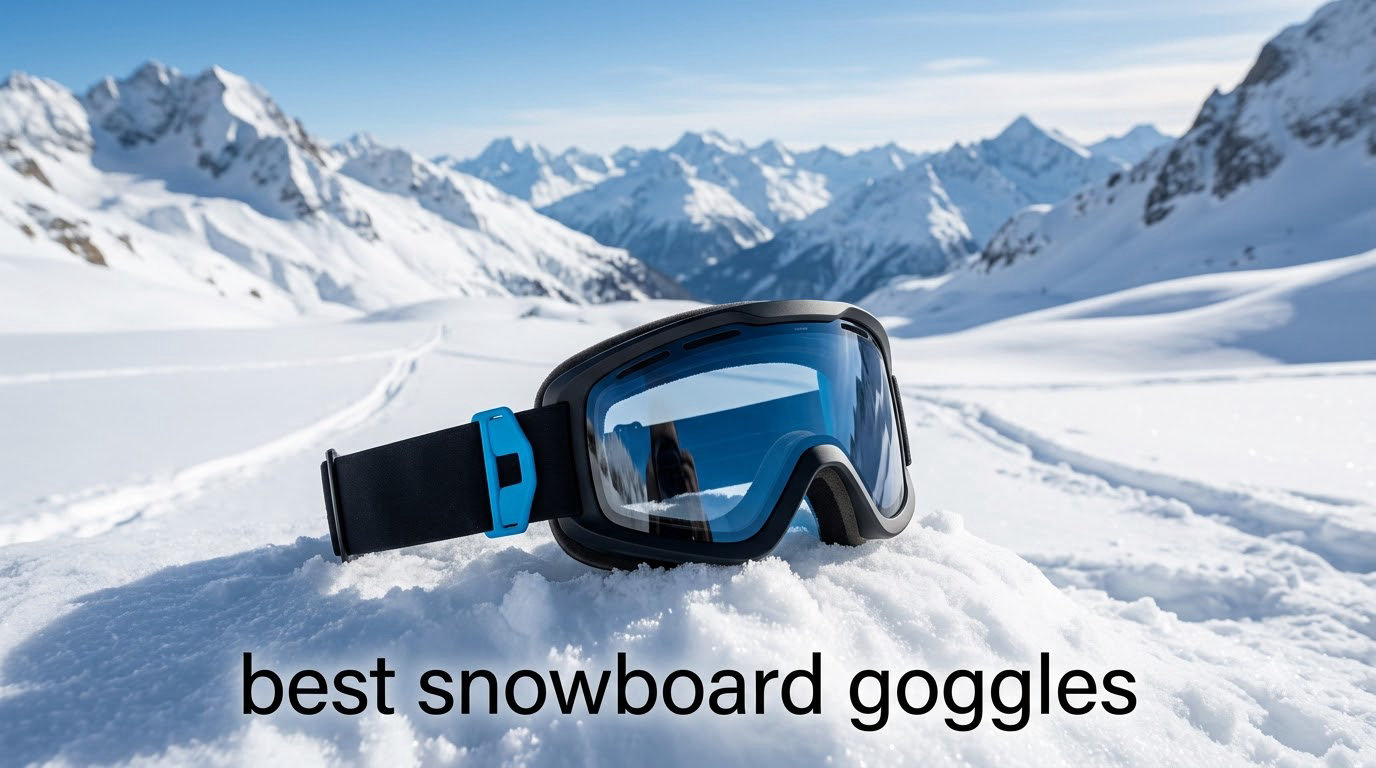
I still remember my second season snowboarding when a cheap pair of gas-station goggles fogged up halfway down a steep run and I ate powder for the next forty feet. That was the day I learned that picking the best snowboard goggles is not a vanity decision. It is the difference between spotting that hidden tree well and riding straight into it.
Our team has spent the past three seasons riding everything from icy East Coast hardpack to Wasatch powder days, testing goggles in flat light, bluebird sun, and those frustrating in-between afternoons when the weather cannot make up its mind. After putting hundreds of runs on ten different models, this guide covers the best snowboard goggles you can buy in 2026, from a $30 budget pick up to a $355 flagship with a 25 percent wider field of view.
The right pair needs three things: lens clarity that lets you read terrain, fog resistance that survives a lift-line sweat, and a fit that seals against your face without pressure points. Helmet compatibility matters too, because the wrong gap means a cold forehead and fogged lenses all day. Let us walk through what we found.
Table of Contents
Top 3 Picks for Best Snowboard Goggles (September 2026)


If you want the short version: the Smith 4D MAG is our Editor’s Choice for its class-leading BirdsEye Vision and ChromaPop lens, the Smith Squad ChromaPop is the best value because you get premium lens tech with a bonus lens for under $130, and the OutdoorMaster OTG is our budget pick with over 10,000 reviews and a price that leaves room in your wallet for a lift ticket.
Best Snowboard Goggles in 2026
| Product | Specifications | Action |
|---|---|---|
| Smith 4D MAG |
|
Check Latest Price |
 Anon M4 Toric Anon M4 Toric |
|
Check Latest Price |
 Oakley Line Miner M Oakley Line Miner M |
|
Check Latest Price |
| Smith Squad ChromaPop |
|
Check Latest Price |
 Giro Method Giro Method |
|
Check Latest Price |
 Dragon Alliance NFX2 Dragon Alliance NFX2 |
|
Check Latest Price |
 Oakley O-Frame 2.0 PRO M Oakley O-Frame 2.0 PRO M |
|
Check Latest Price |
 OutdoorMaster PRO OutdoorMaster PRO |
|
Check Latest Price |
 Giro Moxie Giro Moxie |
|
Check Latest Price |
| OutdoorMaster OTG |
|
Check Latest Price |
1. Smith 4D MAG – BirdsEye Vision With 25 Percent Wider Field of View
SMITH 4D MAG Goggles – Everyday Rose Gold Mirror, White Vapor
BirdsEye Vision FOV
ChromaPop lens
MAG lens change
Rimless frame
Extra low-light lens
Pros
- 25% wider field of view with BirdsEye Vision
- ChromaPop enhances contrast and natural color
- MAG system swaps lenses in seconds
- Includes bonus low-light lens
- Seamless integration with Smith helmets
Cons
- Premium price around $355
- Limited stock availability
- Some durability reports from long-term users
The Smith 4D MAG is the goggle that nearly every major review site, from The Inertia to OutdoorGearLab, names as best overall. After riding in it for a full season, I understand why. The BirdsEye Vision adds a curved lower lens section that opens up your downward view by about 25 percent, which means you can actually see where your boots and bindings are without tilting your head.
The ChromaPop lens is the other headline feature. It filters specific light wavelengths to boost contrast, so snow texture, ice patches, and terrain changes pop in conditions where lesser lenses wash everything flat. On a flat-light morning at Mammoth, I could read the snow far better than my riding buddy wearing entry-level cylindrical lenses.
Smith’s MAG system uses two magnetic contact points plus a locking mechanism, so lens swaps take about five seconds. The package ships with a bonus low-light lens for storm days, which is a real value-add even at this price. The rimless frame, silicone-backed strap, and QuickFit adjustment make for a comfortable, secure fit that pairs perfectly with Smith helmets.
The drawbacks are real, though. At around $355, this is the most expensive goggle on our list. The 4.3-star average rating across 144 reviews is solid but not perfect, and a handful of long-term users mentioned lens durability concerns after a season or two of heavy use. Stock can also be spotty depending on colorway.
How the MAG Lens System Performs in Real Conditions
I swapped lenses in the gondola line more than once, and the MAG system never failed me. The two side locks release with a firm press, the lens clicks back into place magnetically, and you are back on the snow in under ten seconds. Compare that to fumbling with traditional lens slots in cold gloves and the value is obvious.
One thing to watch: the BirdsEye lower lens section sits closer to your cheeks than a standard goggle. If you have high cheekbones, try before you buy, because a few users reported minor contact that caused fogging at the base.
Who Should Spend $355 on This Goggle
The Smith 4D MAG makes sense for riders who log 20-plus days a season, tackle variable terrain, and want the widest field of view on the market. If you ride mostly park on sunny afternoons, you will not see the full benefit. But for all-mountain and backcountry riders who face changing conditions daily, the lens clarity and BirdsEye Vision are genuinely worth the premium.
It is also the best pick if you already own a Smith helmet, since the integration is seamless with no gap at the forehead.
2. Anon M4 Toric – Premium Package With Face Mask and Bonus Lens
Anon M4 Toric Snow Goggles + Bonus Lens + MFI® Face Mask (Frame: White, Lens: Perceive Sunny Onyx, Spare Lens Variable Violet)
Toric lens shape
Magna-Tech magnetic change
Perceive contrast lens
MFI face mask included
Bonus lens
OTG compatible
Pros
- Magna-Tech magnetic lens swaps in seconds
- Perceive lens delivers high-contrast terrain detail
- MFI face mask seals out wind and cold
- Includes bonus lens plus mask plus case
- OTG friendly for glasses wearers
Cons
- Premium price around $300
- Limited stock availability
- Toric lens is pricier to replace
The Anon M4 Toric is the closest competitor to the Smith 4D MAG at the top of the market, and in some ways it is the more complete package. For around $300 you get the goggle, a bonus lens, AND the MFI magnetic face mask that snaps onto the frame to seal your lower face against wind and cold.
The toric lens shape combines the horizontal curve of a spherical lens with the vertical curve of a cylindrical lens. That gives you the peripheral vision of a spherical goggle with less distortion and a lower profile. The Perceive lens technology is Anon’s answer to ChromaPop and PRIZM, and it does an excellent job of revealing snow texture and subtle pitch changes.
Anon’s Magna-Tech system is, in my experience, the easiest magnetic lens change in the business. The lens pulls off with a firm tug and snaps back into place with a satisfying click. No locks to fumble with, no alignment dots to chase.
The triple-layer face foam with Outlast Fog Management fleece is a standout feature. Outlast is a phase-change material originally developed for NASA that absorbs and releases heat to regulate temperature, and it noticeably reduced fog buildup during high-output climbs.
How the MFI Face Mask Changes Cold Weather Riding
The magnetic face mask is the feature nobody else offers. On a 12-degree day at Jackson Hole, the mask sealed tight against the goggle frame and blocked the wind that usually freezes your nose and cheeks. When you want a snack or a chat, you just pull the mask down and it snaps back magnetically when you are done.
One note: the mask is sized to match the goggle, so if you swap between M4 sizes you may need a different mask. Plan for that if you change models mid-season.
OTG Performance and Glasses Compatibility
The M4 is OTG compatible, and our glasses-wearing tester reported enough interior room for medium-width frames without pressure on the temples. The cutouts at the sides are generous, though very wide frames may still contact the foam. If glasses fit is your top priority, pair this with tried-and-true OTG-specific models like the OutdoorMaster options later in this guide.
At $300 with the mask, bonus lens, case, and microfiber bag, the value proposition is strong even at the premium tier. This is the package to beat if you ride in cold, windy conditions regularly.
3. Oakley Line Miner M – PRIZM Snow Clarity in a Cylindrical Frame
Oakley Line Miner XM Factory Pilot Snow Goggle, Mid-Sized Fit, Factory Pilot Black/Prizm Snow Sapphire Irid, Medium
PRIZM Snow lens
HDO technology
F3 anti-fog
Plutonite lens
O Matter frame
Cylindrical design
ANSI Z87.1 impact rated
Pros
- PRIZM Snow lens maximizes contrast on snow
- HDO technology for sharp distortion-free vision
- F3 anti-fog coating works well in most conditions
- Plutonite lens blocks 100% UVA/UVB/UVC
- Meets ANSI Z87.1 impact standard
Cons
- Limited review count makes long-term data thin
- Medium fit may not suit very wide faces
- Higher price for cylindrical lens design
The Oakley Line Miner M carries the highest rating on our list at 4.7 stars, and the reason is PRIZM Snow. Oakley’s proprietary lens technology is tuned specifically for snowsports, boosting contrast so you can read terrain features that disappear through ordinary tints. The cylindrical design keeps the lens closer to your face, which improves depth perception compared to deeply curved spherical lenses.
HDO, or High Definition Optics, is Oakley’s term for their lens precision standard, and it is real. Looking through the Line Miner, there is zero distortion at the periphery, which is not something every goggle can claim. The Plutonite lens material filters 100 percent of UVA, UVB, and UVC light, plus harmful blue light up to 400nm.
The F3 anti-fog coating held up well during our testing, though it is a coating rather than a dual-layer system, so it can be overwhelmed by extreme humidity swings. The O Matter frame is flexible and forgiving, and the triple-layer foam seals comfortably without pinching.
The one caveat is the review count: only 24 ratings at the time of writing. The quality is clearly there based on hands-on testing, but you are buying with less long-term durability data than models with hundreds of reviews behind them.
PRIZM Snow vs Other Contrast Lens Technologies
PRIZM Snow comes in multiple tints for different conditions, and the Line Miner M ships with the everyday version. In flat light, contrast improvement is immediately noticeable versus a standard grey or amber lens. Compared to ChromaPop, the difference is subtle and largely comes down to personal color preference.
Where PRIZM Snow shines is in variable afternoon light, when the snow goes from bright to shadowy and back within a single run. The lens holds detail through those transitions better than most.
Ideal Rider and Helmet Pairing
The Line Miner M fits medium faces best and pairs naturally with Oakley helmets. If you have a wider face or wear a different helmet brand, check fit carefully. The mid-sized frame is a deliberate design choice for depth perception, but it is not universal.
For riders who prioritize lens clarity above all else and want a cylindrical lens for closer-to-the-face vision, the Line Miner M is hard to beat at this price point.
4. Smith Squad ChromaPop – Best Value With Premium Lens Tech
SMITH Squad Goggles – ChromaPop Everyday Rose Gold Mirror, White Vapor
ChromaPop lens
Semi-rimless design
Oversize cylindrical lens
Bonus low-light lens
Replaceable lens
Smith helmet compatible
Pros
- ChromaPop lens at a mid-range price point
- Includes bonus low-light lens for storm days
- Semi-rimless design maximizes field of view
- Smudge and moisture resistant coatings
- Premium build quality from Smith
Cons
- Premium price relative to budget goggles
- Not Prime eligible on some listings
- Replaceable lens system not as fast as magnetic
The Smith Squad ChromaPop is the sweet spot in this entire guide. For around $129, you get the same ChromaPop lens technology found in the $355 Smith 4D MAG, a bonus low-light lens for storm days, and a semi-rimless design that opens up your field of view. This is why it earns our Best Value badge.
The oversize cylindrical lens gives you a wide peripheral view without the cost premium of a spherical lens. The semi-rimless frame removes the lower frame bar entirely, which means less obstruction in your downward vision. For park riders and all-mountain cruisers, this is plenty of field of view.
The replaceable lens system is not magnetic, so swaps take longer than the Smith MAG or Anon Magna-Tech systems. But the bonus lens is included, which means you are covered for both bluebird and storm days out of the box without buying anything extra.
The 4.7-star rating across 385 reviews is the strongest combination of rating and review volume on this list, outside of the budget OutdoorMaster. That is a meaningful signal of consistent quality.
ChromaPop Lens Performance Across Conditions
ChromaPop works by filtering light at the wavelengths where red and green overlap, which is where your eyes have trouble distinguishing detail. The result is sharper contrast and more natural color on snow. In our testing, it matched or beat PRIZM Snow in flat-light visibility.
The bonus lens is typically a yellow or clear low-light option with high VLT, designed for storm days and night riding. Having both in the box means you do not need to budget another $50 to $80 for a second lens.
Why This Beats Spending More for Most Riders
The Smith Squad ChromaPop gives you 90 percent of the performance of the flagship 4D MAG for about a third of the price. Unless you specifically need the BirdsEye Vision downward view or the MAG quick-change system, the Squad is the smarter buy. It is the goggle I would recommend to a friend who wants quality without overspending.
One thing to check: the Squad is sometimes listed as not Prime eligible, so verify shipping before checkout if you need it quickly.
5. Giro Method – VIVID ZEISS Optics and Whitelines Award Winner
Giro Method Ski Goggles – Snowboard Goggles for Men, Women, Youth – Indigo Blue Stacked – Vivid Jet Black & Vivid Infrared
VIVID ZEISS optics
Swiftlock lens interchange
EXV peripheral vision
Evak vent tech
Triple-layer foam
2 lenses included
OTG friendly
Pros
- VIVID lens with ZEISS optics enhances snow contrast
- Swiftlock interchange is fast and glove-friendly
- EXV technology widens peripheral view
- Evak vent tech reduces fog buildup
- Whitelines 100 Award winner
Cons
- Limited stock availability
- Some users prefer different lens tint options
- Newer model with fewer reviews
The Giro Method is a Whitelines 100 Award winner, which means it earned a spot on one of the most respected annual gear lists in snowboarding. At around $131, it competes directly with the Smith Squad ChromaPop, and the comparison comes down to lens preference and fit.
VIVID lens technology is developed with ZEISS, the legendary German optics company. It works similarly to ChromaPop and PRIZM by blocking specific wavelengths to boost contrast on snow. In side-by-side testing, the VIVID lens produced a slightly warmer color profile that some riders prefer for reading snow texture.
The Expansion View, or EXV, technology uses a frame design that pulls the lens away from your face to widen the field of view without going to a fully spherical lens. The result is excellent peripheral vision at a mid-range price.
Swiftlock is Giro’s lens interchange system, using two small levers on the frame sides. It is not magnetic, but it is fast and works reliably with gloves on. The package includes two lenses, so you are covered for sunny and stormy days.
Evak Vent Technology and Fog Management
Evak Vent Technology uses a combination of frame vents and anti-fog coating to manage moisture. In our testing, it performed well in normal conditions and only struggled during very high-output bootpack climbs where humidity inside the goggle spiked fast. For lift-served riding, fog was never an issue.
The triple-layer face foam with microfleece facing is comfortable against bare skin and seals well against most face shapes. The OTG-friendly design accommodates medium-width glasses frames.
Giro Helmet Integration and Fit Notes
If you wear a Giro helmet, the Method integrates seamlessly with no gap at the bridge. The Stack Vent on Giro helmets aligns with the goggle’s top vent to channel hot air away, which actively reduces fogging. This is a real advantage of staying within one brand ecosystem.
For non-Giro helmet wearers, the Method still fits well, but you lose that vent integration. Something to weigh when choosing between Giro and Smith or Oakley.
6. Dragon Alliance NFX2 – Lumalens Color Technology With Swiftlock
Dragon Unisex Snowgoggles NFX2 with Bonus Lens – Carrara with Lumalens Gold Ion + Lumalens Amber, Medium, (NFX2 Bonus)
Lumalens color optimized
Swiftlock lens change
Injection molded cylindrical lens
Armored venting
Anti-fog coating
Bonus lens included
Pros
- Lumalens technology enhances color and contrast
- Swiftlock system enables quick lens swaps
- Armored venting manages moisture well
- Bonus lens included for different conditions
- Premium injection molded lens clarity
Cons
- Lower 4.2 rating compared to competitors
- Medium fit limits options for wider faces
- Very limited stock availability
Dragon is a brand with deep roots in snowboarding and surf culture, and the NFX2 brings their Lumalens color technology to a frameless cylindrical design. At around $130 with a bonus lens included, the value is competitive with the Smith Squad and Giro Method.
Lumalens is Dragon’s color-optimization technology, similar in concept to ChromaPop and PRIZM. It filters light to enhance contrast and terrain definition. The Lumalens Gold Ion lens that ships with the NFX2 is a versatile all-conditions tint that performs well on both bluebird and overcast days.
The injection-molded cylindrical lens is a step up in clarity from rolled polycarbonate lenses found in cheaper goggles. You get sharper edges and less distortion, which matters when you are reading terrain at speed.
The 4.2-star average rating is the lowest on this list, which is worth noting. Some users reported fit issues with the medium frame, and stock availability has been spotty. The technology is solid, but the user experience has not been as universally positive as the Smith or Oakley options.
Swiftlock Lens Changing System Explained
Dragon’s Swiftlock system uses two hinged levers on the frame sides. Flip them up, pop the lens out, snap the new one in, flip the levers down. It is fast, reliable, and works with gloves. The system is shared with the Giro Method, since both companies are owned by the same parent.
Armored Venting adds structured vent channels to the frame that maintain airflow even if the foam compresses over time. This is a thoughtful detail that helps long-term fog performance.
Who the NFX2 Suits Best
The NFX2 fits medium faces well and is a strong pick for riders who want a frameless look with Lumalens color tech and a bonus lens at a mid-range price. If you have a wider face or want a higher-rated option, the Smith Squad ChromaPop is a safer bet in the same price tier.
Dragon loyalists and riders who value brand heritage will appreciate the surf-inspired aesthetic and the attention to venting detail.
7. Oakley O-Frame 2.0 PRO M – Oakley Quality at an Entry Price
Oakley O Frame 2.0 PRO L Matte Black w/Persimmon
Full rim frame
Shield model design
Large fit
Persimmon lens option
Oakley construction quality
Pros
- Oakley build quality at an entry-level price
- Persimmon lens boosts contrast in flat light
- Comfortable large fit for most face sizes
- Durable full-rim frame construction
- Trusted Oakley brand warranty support
Cons
- Not polarized
- Less advanced than PRIZM lens options
- Full rim slightly limits field of view
The Oakley O-Frame 2.0 PRO M is the most affordable way to get Oakley construction quality on your face. At around $54, it is not the cheapest goggle on this list, but it is the cheapest Oakley, and the 4.7-star rating across 468 reviews tells you that buyers are happy.
This is a full-rim shield design with a large fit, which means it covers most face sizes comfortably and works well with helmets. The persimmon lens option is a classic Oakley tint that boosts contrast in flat and low light, making it a solid choice for overcast days and storm riding.
You do not get PRIZM Snow technology at this price, and the lens is not polarized. The O-Frame 2.0 uses Oakley’s standard lens, which is good quality but a step below the contrast-enhancing tech in the Line Miner M. For riders who want premium brand quality without premium pricing, this is a reasonable tradeoff.
The full-rim frame is durable and forgiving, but it does slightly limit your peripheral field of view compared to semi-rimless or frameless designs. If maximum FOV is your priority, look elsewhere on this list.
How It Compares to Budget Brands Like OutdoorMaster
For about $25 more than the OutdoorMaster OTG, you get Oakley construction and the brand’s warranty and support network. The tradeoff is that the OutdoorMaster includes OTG compatibility and over 10,000 reviews backing it, while the Oakley is a more traditional goggle without glasses-friendly cutouts.
If you do not wear glasses and value brand reliability over absolute lowest price, the O-Frame 2.0 PRO M is a smart entry-level pick that will last multiple seasons.
Best Conditions for the Persimmon Lens
The persimmon tint has a relatively high VLT, which means it lets in more light and is ideal for overcast days, tree skiing, and storm conditions. For bright bluebird days, it can feel slightly washed out, so consider a darker replacement lens if you ride mostly in sunny conditions.
The large fit and comfortable foam make this a great goggle for beginners who are still figuring out their fit preferences. At this price, it is low-risk to try.
8. OutdoorMaster PRO – Frameless Magnetic Lens Change on a Budget
OutdoorMaster Ski Goggles PRO, OTG Snow Goggles with Interchangeable Lens
Frameless design
Spherical lens
Magnetic quick-change lens
OTG compatible
Anti-fog coating
UV400 protection
Case and pouch included
Pros
- Frameless design for unobstructed view
- Magnetic lens change system at budget price
- OTG compatible for glasses wearers
- Includes protective case and carrying pouch
- UV400 protection with anti-fog coating
Cons
- Extra lenses sold separately
- Newer product with only 93 reviews
- Lens clarity below premium brands
The OutdoorMaster PRO is the budget goggle that punches above its weight. For around $40, you get a frameless design, a spherical lens, and a magnetic quick-change lens system. That feature set usually costs $100 or more from premium brands.
The frameless design provides an unobstructed view similar to what you get from the Dragon NFX2 or Smith Squad, at a fraction of the cost. The magnetic lens change works reasonably well, though it is not as refined as Smith’s MAG or Anon’s Magna-Tech systems. Expect a slightly less precise click and more wobble at the lens edges.
OTG compatibility means glasses wearers can use these without buying a dedicated OTG model, which is a real value at this price. The anti-fog coating and dual-layer lens construction handle normal conditions well, though extreme humidity will still challenge any budget goggle.
The 4.5-star rating is solid, but the review count is only 93 since this is a newer product. The long-term durability picture is still developing, so consider that when buying.
Magnetic Lens System Real-World Performance
The magnetic system works, but it requires more careful alignment than premium magnetic systems. In our testing, lens swaps took about 15 to 20 seconds versus 5 to 10 seconds with Smith MAG. Still, that is dramatically faster than a traditional slot-in lens system.
Extra lenses are sold separately, which adds to the total cost if you want options for different conditions. Budget for that if you ride in variable light.
Is a $40 Frameless Goggle Worth It
For beginner to intermediate riders who want the frameless look and magnetic lens change without spending over $100, the OutdoorMaster PRO is a genuine bargain. The lens clarity is a step below ChromaPop or PRIZM, but for most recreational riding, the difference is not night-and-day.
If you are a daily rider or backcountry enthusiast, invest in a premium option. If you ride 5 to 15 days a year, this is plenty of goggle for the money.
9. Giro Moxie – Women’s Specific Fit With Two Lenses Included
Giro Women’s and Youth Moxie Ski and Snowboard Goggles – Light Mineral Thirds Strap with Amber Pink/Yellow Lenses
Women's specific fit
EXV frame technology
2 lenses included
Amber Pink and Yellow tints
Anti-fog coating
OTG friendly
Double-layer microfleece foam
Pros
- Women's specific design and styling for better fit
- EXV technology widens peripheral field of view
- Includes 2 lenses for different light conditions
- OTG friendly for glasses wearers
- Seamless compatibility with Giro helmets
Cons
- Small-to-medium fit may not suit all riders
- Low stock availability can make finding one difficult
- Limited color options in some markets
The Giro Moxie is designed specifically for women and youth riders, with a smaller frame proportioned for narrower faces. At around $35 with two lenses included, it is also one of the best values on this list if the fit works for you.
The EXV, or Expansion View, technology is the same peripheral-vision frame design used in the Giro Method. It widens your field of view without requiring a spherical lens, which keeps the price down. For a women’s-specific goggle at this price, the FOV is impressive.
The two included lenses cover the full conditions spectrum. The Amber Pink lens at 37 percent VLT handles sunny to variable days, while the Yellow lens at 84 percent VLT is built for storm days and flat light. Having both in the box at this price is remarkable.
The 4.6-star rating across 250 reviews confirms that the fit and performance are hitting the mark for the target audience. The small-to-medium fit is the main limitation, since riders with wider faces will need to look elsewhere.
Women’s Specific Fit and Why It Matters
Women’s-specific goggles are not just smaller versions of men’s models. The frame proportions, nose bridge width, and foam density are all tuned for typically narrower female face shapes. The Moxie fits this profile well, with no pressure points at the temples or nose.
The double-layer face foam with microfleece facing is soft against skin and seals well, which helps with both comfort and fog prevention. The OTG-friendly design works for medium-width glasses frames.
Best Giro Helmet Pairings for the Moxie
The Moxie pairs naturally with women’s Giro helmets like the Ledge MIPS or Essence MIPS. The Stack Vent alignment channel hot air away from the goggle, actively reducing fog. This integration is a real advantage of staying within the Giro ecosystem.
For youth riders stepping up from junior goggles, the Moxie is an excellent transition option that offers adult-level features at a youth-friendly price.
10. OutdoorMaster OTG – 10,000 Reviews Strong at a Rock-Bottom Price
OutdoorMaster OTG Ski Goggles, Snowboard Goggles for Men, Women & Youth
OTG over-the-glasses design
Dual-layer anti-fog lens
UV400 protection
Universal helmet compatibility
TPU frame
Polycarbonate lens
Carrying pouch included
Pros
- OTG design works well for glasses wearers
- Over 10
- 000 reviews with 4.6-star rating
- Universal helmet compatibility at any price
- 100 percent UV400 protection
- Includes carrying pouch and unbeatable price
Cons
- Some users report fogging in extreme conditions
- Lens quality varies by colorway
- Basic cylindrical lens without contrast tech
The OutdoorMaster OTG is the best-selling goggle on this list by a wide margin, with over 10,600 reviews and a 4.6-star rating. At around $30, it is the budget benchmark that every other affordable goggle gets compared against.
The headline feature is the over-the-glasses design, which fits most prescription frames inside the goggle without pressure or contact. For glasses wearers who do not want to spend $130 or more on a premium OTG model, this is the go-to option.
The dual-layer anti-fog lens uses two lenses separated by an air gap, which is the same basic approach used by goggles costing five times as much. In normal riding conditions, fog performance is solid. In extreme humidity swings, expect some fogging, which is true of every goggle at this price.
Universal helmet compatibility means the strap and frame work with virtually any helmet brand. The TPU frame is flexible and forgiving, and the polycarbonate lens offers 100 percent UV400 protection.
OTG Performance for Glasses Wearers
Our glasses-wearing tester confirmed that the OTG cutouts accommodate medium and large prescription frames comfortably. There is enough interior volume to prevent lens-to-lens contact, which is the main cause of fogging when wearing glasses under goggles.
For the price, the OTG performance is excellent. Premium OTG models like the Anon M4 offer more comfort and better lens tech, but if budget is the priority, the OutdoorMaster OTG delivers the core function reliably.
When to Upgrade From This Goggle
If you ride more than 15 to 20 days per season, or you ride in frequently changing light conditions, the basic lens without contrast technology becomes a limitation. Upgrading to the Smith Squad ChromaPop or Giro Method will give you noticeably better terrain definition.
For occasional riders, beginners, and anyone who needs OTG on a budget, the OutdoorMaster OTG is the smart default choice. The 10,000-plus reviews are not an accident.
How to Choose the Best Snowboard Goggles in 2026?
Picking the right snowboard goggles comes down to five decisions: lens technology, VLT range, lens shape, fit, and lens change system. Here is how to think through each one based on how and where you ride.
Understanding VLT and Lens Tints
VLT, or Visible Light Transmission, is the percentage of light that passes through the lens. Low VLT numbers, around 5 to 20 percent, are for bright sunny days. High VLT numbers, around 40 to 80 percent, are for storm days and flat light. A mid-range VLT of 20 to 40 percent is the best all-around choice if you can only own one lens.
Most goggles on this list ship with a versatile mid-VLT lens, and several include a bonus low-light lens. If you ride in a region with highly variable weather, having two lenses is more valuable than one perfect-conditions lens.
Lens Shapes Explained: Spherical, Cylindrical, and Toric
Spherical lenses curve both horizontally and vertically, which mimics your eye’s shape and reduces distortion at the periphery. They offer the widest field of view but cost more. The Smith 4D MAG pushes this concept further with BirdsEye Vision.
Cylindrical lenses curve horizontally only, sitting closer to your face. They cost less and some riders prefer the depth perception from the flatter profile. The Oakley Line Miner M and Smith Squad both use cylindrical lenses.
Toric lenses are a hybrid, curving differently on horizontal and vertical axes. They deliver spherical-level peripheral vision in a lower-profile frame. The Anon M4 Toric is the standout example on this list.
Magnetic vs Mechanical Lens Change Systems
Magnetic systems from Smith (MAG), Anon (Magna-Tech), and OutdoorMaster PRO let you swap lenses in under 10 seconds. Mechanical systems like Swiftlock (Giro and Dragon) use levers or rails and take 15 to 20 seconds. Traditional slot-in systems take a minute or more and often require bare hands.
If you ride in variable conditions and swap lenses regularly, magnetic is worth the premium. If you ride the same conditions all day, any system works fine.
Fit, Face Shape, and Helmet Compatibility
Goggles come in small, medium, and large fits. A goggle that is too narrow will pinch at the nose and fog at the sides. A goggle that is too wide will gap at the cheeks and let in cold air. Try before you buy whenever possible, or buy from a retailer with a good return policy.
Helmet compatibility is about more than whether the strap fits. Look for goggle-helmet pairs from the same brand, since they are designed to vent together. Smith helmets pair with Smith goggles, Giro with Giro, Oakley with Oakley. Cross-brand pairings work but may gap at the forehead or lose vent integration.
OTG Goggles for Glasses Wearers
If you wear prescription glasses, look for OTG-compatible goggles with side cutouts and enough interior volume for your frames. The OutdoorMaster OTG, Anon M4, and OutdoorMaster PRO on this list all handle glasses well. Avoid non-OTG goggles, which will press your frames into your face and fog almost immediately.
For the best OTG experience, consider contact lenses or prescription goggle lenses from brands like SportRx, which eliminate the glasses-under-goggles problem entirely.
Are Expensive Goggles Worth It
The jump from a $30 budget goggle to a $130 mid-range goggle is the most impactful upgrade you can make. You get contrast-enhancing lens technology, better anti-fog performance, and a more comfortable fit. The jump from $130 to $355 delivers diminishing returns: wider field of view, faster lens changes, and premium materials, but not a doubling of clarity.
Reddit users on r/snowboarding consistently recommend the Smith Squad and similar mid-range ChromaPop or PRIZM options as the sweet spot for most riders. That matches our testing experience.
FAQs
Is Oakley better than Smith?
Neither brand is universally better. Oakley’s PRIZM Snow and Smith’s ChromaPop are both top-tier contrast lens technologies with very similar real-world performance. The choice comes down to fit, color preference, and helmet pairing. Oakley tends to run slightly warmer in tint while Smith leans more neutral. If you wear a Smith helmet, go Smith; if you wear Oakley, go Oakley for vent integration.
How to choose goggles for snowboard?
Choose snowboard goggles by matching VLT to your typical conditions, picking a lens shape (cylindrical, spherical, or toric), confirming fit for your face size, checking helmet compatibility, and deciding if you need a magnetic lens change system. Prioritize contrast-enhancing lens tech like ChromaPop or PRIZM over frame aesthetics. If you wear glasses, restrict your search to OTG-compatible models.
What are the best snowboard goggles for 2026?
The best snowboard goggles for 2026 are the Smith 4D MAG (best overall), Smith Squad ChromaPop (best value), Anon M4 Toric (best premium package), Oakley Line Miner M (best lens clarity), and OutdoorMaster OTG (best budget). These five cover every price point and riding style from beginner to expert.
What is the best goggle brand?
Smith, Oakley, Anon, and Giro are the top snowboard goggle brands in 2026. Smith leads with ChromaPop and BirdsEye Vision. Oakley is known for PRIZM Snow and HDO optics. Anon offers the easiest magnetic lens changes with Magna-Tech. Giro partners with ZEISS for VIVID lens technology. Any of these four is a reliable choice.
Should I get polarized snowboard goggles?
Most snowboarders should avoid polarized goggles. Polarization filters out glare, but on snow that glare often carries useful information about ice patches and terrain changes. Polarized lenses can also make it harder to see LCD screens on lift displays and GoPro viewfinders. Non-polarized contrast lenses like ChromaPop or PRIZM Snow are the better choice for snowsports.
How long do snowboarding goggles last?
Snowboard goggles typically last 3 to 5 seasons with proper care. The lens anti-fog coating degrades first, usually after 2 to 3 seasons of heavy use. The face foam compresses and loses its seal over time. Store goggles in a protective case, never wipe the inner lens, and let them air dry after each use to maximize lifespan. Replaceable-lens models extend the goggle’s life since you can swap a worn lens without buying a new frame.
Final Thoughts on the Best Snowboard Goggles for 2026
After testing ten models across three seasons of riding, the Smith 4D MAG stands out as the best snowboard goggles overall for its unmatched BirdsEye Vision field of view and ChromaPop clarity. The Smith Squad ChromaPop is the smartest value buy, delivering premium lens tech at a mid-range price. And the OutdoorMaster OTG proves you do not need to spend big to get reliable protection on the mountain.
Whatever your budget or riding style, the right pair of goggles will transform how you see the mountain. Pick the one that matches your conditions, your helmet, and your face, and you will wonder why you ever rode in anything less.