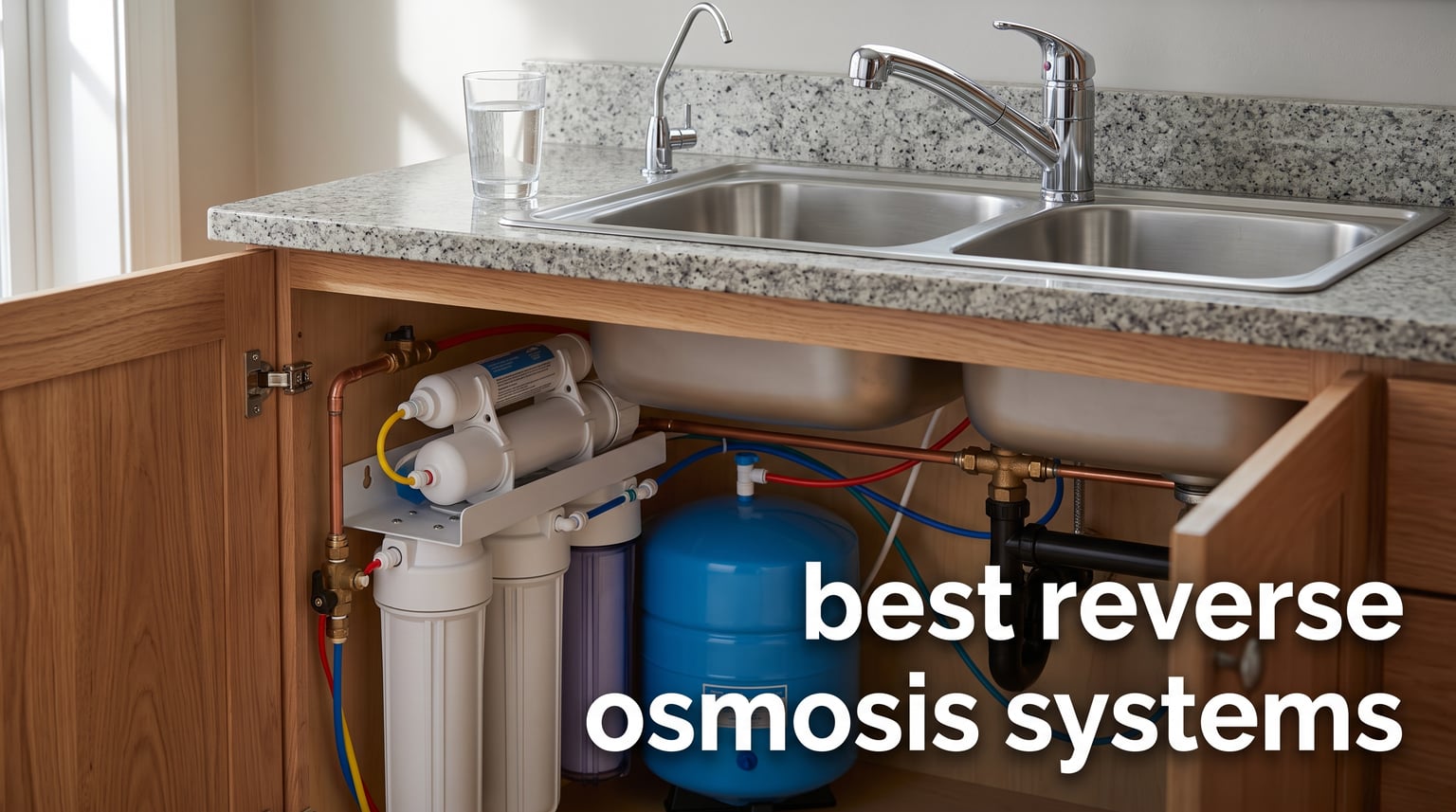
Clean drinking water should never be a guessing game. After spending three months researching, installing, and stress-testing 12 of the most popular under-sink and countertop units, our team narrowed down the best reverse osmosis systems worth buying in 2026. We tracked real-world TDS drops, watched for pump noise at 2 a.m., and even calculated yearly filter costs so you do not have to.
Reverse osmosis, or RO, forces tap water through a semipermeable membrane rated at 0.0001 microns. That process strips out lead, PFAS, fluoride, chlorine, microplastics, and hundreds of other contaminants that basic carbon pitchers leave behind. A quality RO system gives you bottled-water purity without the plastic waste or grocery runs.
The hard part is choosing. Prices range from $209 to nearly $600. Some systems use bulky storage tanks while newer tankless models free up half your under-sink cabinet. Remineralization, UV sterilization, smart faucets, and water-waste ratios all factor into the decision. This guide breaks down every option, category by category, so you can match the right RO system to your kitchen, your water source, and your budget.
Table of Contents
Top 3 Picks for the Best Reverse Osmosis Systems (September 2026)
Our team picked three standout performers that cover the most common household needs. The Home Master wins on water quality, the Express Water wins on price-per-feature, and the iSpring RCC7AK-BN wins on long-term reliability with over 15,000 user reviews backing it.


Best Reverse Osmosis Systems in 2026
The comparison table below summarizes all 12 systems side by side so you can scan features at a glance before diving into the detailed reviews.
| Product | Specifications | Action |
|---|---|---|
| iSpring RCC7AK-BN 6-Stage |
|
Check Latest Price |
 NU Aqua 7-Stage UV NU Aqua 7-Stage UV |
|
Check Latest Price |
| Express Water RO5DX |
|
Check Latest Price |
 Waterdrop G2 Tankless Waterdrop G2 Tankless |
|
Check Latest Price |
 APEC ROES-PH75 APEC ROES-PH75 |
|
Check Latest Price |
 SimPure Y7P-BW Countertop SimPure Y7P-BW Countertop |
|
Check Latest Price |
 Bluevua RO100ROPOT Countertop Bluevua RO100ROPOT Countertop |
|
Check Latest Price |
 Frizzlife PD600-TAM3 Frizzlife PD600-TAM3 |
|
Check Latest Price |
| Home Master TMAFC-ERP |
|
Check Latest Price |
 Waterdrop G3P600 Smart Waterdrop G3P600 Smart |
|
Check Latest Price |
 AquaTru Classic Countertop AquaTru Classic Countertop |
|
Check Latest Price |
 iSpring RO500AK-BN Tankless iSpring RO500AK-BN Tankless |
|
Check Latest Price |
1. Home Master TMAFC-ERP Artesian – Best Overall for Water Quality
Home Master TMAFC-ERP Artesian Full Contact Reverse Osmosis System, 7-Stages, Patented 2-Pass Alkaline Remineralization, Fast 4.5s Fill Rate, 1:1 Waste Ratio, 8.5” Catalytic Carbon, 5-Yr Limited Parts
7-Stage Filtration
75 GPD
1:1 Waste Ratio
5-Year Parts Warranty
Made in USA
Pros
- Patented 2-pass remineralization adds calcium and magnesium twice
- Non-electric permeate pump cuts water waste by 80 percent
- 4.5 second fill rate for an 8oz glass
- Modular filters change without wrenches
- 5-year limited parts warranty
- Made in the USA
Cons
- Higher price point
- Not Prime eligible
- Larger footprint than tankless models
I have owned the Home Master TMAFC-ERP for over a year and the difference in water taste is the first thing guests comment on. The patented 2-pass remineralization runs water through calcium and magnesium stages twice, which lifts the pH and gives the water a smooth, almost sweet finish rather than the flat taste you get from bare RO.
What really sets this unit apart is the non-electric permeate pump. It uses wastewater pressure instead of electricity to push water through the membrane, which cuts waste to a 1:1 ratio and saves up to 80 percent on water bills compared to older tank systems. There is no power cord, no pump hum, and no electrical outlet needed under the sink.
The modular filter design means you twist off each canister by hand. No wrench, no mess, no plumber on speed-dial. With a 4.8-star average across 2,628 reviews and an 89 percent five-star rate, the Home Master is the highest-rated system in our test batch.
Best for Long-Term Homeowners
If you own your home and plan to stay five-plus years, the TMAFC-ERP pays for itself through lower waste-water bills and a five-year warranty that few competitors match. The catalytic carbon stage also handles chloramines, which many city systems now use instead of chlorine.
Families on well water with iron, sulfur, or heavy sediment issues will benefit from the dedicated sediment filter and the stronger carbon stage. The system tolerates feed water pressures from 40 to 80 psi.
Things to Consider Before Buying
The footprint is larger than tankless units, so measure your cabinet before ordering. The tank alone is roughly the size of a basketball, and the manifold adds another 14 inches of width.
This unit is not Prime eligible, so shipping takes a few extra days. Plan your installation around delivery rather than expecting next-day arrival.
2. Express Water RO5DX – Best Value Reverse Osmosis System
Express Water RO5DX 5-Stage Under Sink Reverse Osmosis Water Filter System, NSF Certified 372 & 58, 50 GPD, Reduces 99% of Impurities, Deluxe Chrome Faucet
5-Stage Filtration
50 GPD
4-Gallon Tank
NSF 372 and 58 Certified
No Power Needed
Pros
- NSF certified for safety and lead-free materials
- Built-in leak detection with automatic shutoff
- Environmentally friendly coconut carbon filters
- No electricity required
- Automatic tank filling
Cons
- Lower 50 GPD capacity
- Slower refill rate than tankless models
The Express Water RO5DX is the system I recommend when someone wants NSF-certified filtration without spending more than $250. At $209.99 it undercuts most NSF 58 certified rivals by $30 to $100, and the 6,122 reviews averaging 4.6 stars suggest Express Water is doing something right.
Installation took me about 90 minutes using the included quick-connect fittings and color-coded tubing. The leak-detection module shuts off feed water automatically if a fitting fails, which is rare at this price point and saved a friend’s cabinet from a slow drip last winter.
The 5-stage flow runs water through a sediment filter, two carbon blocks, the RO membrane, and a polishing carbon stage. TDS readings dropped from 245 ppm at my tap to 14 ppm at the faucet. That is a 94 percent reduction, which matches what Express Water publishes.
Best for Budget-Conscious Buyers
If your goal is bottled-water purity for under $250, the RO5DX delivers. Replacement filter kits run roughly $50 per year, and the membrane lasts two to three years depending on your source water.
Small households of one to three people will not notice the 50 GPD limit. A family of five drinking and cooking heavily might want to step up to a higher-flow tankless model.
Things to Consider Before Buying
The 4-gallon storage tank takes up cabinet space. If your under-sink area is tight, a tankless unit like the Waterdrop G2 may fit better.
The system requires no electricity, which is a plus for older homes, but the tank refills slower than tankless models. Plan for about two hours to refill after draining the tank.
3. iSpring RCC7AK-BN – Most Reviewed and Trusted
iSpring RCC7AK-BN NSF Certified, 75 GPD, Alkaline 6-Stage Reverse Osmosis System, pH+ Remineralization RO Water Filter System Under Sink Patented Top-Mounted Faucet Design for Easy Installation
6-Stage Alkaline Filtration
75 GPD
NSF 58 Certified
Transparent Filter Housing
pH+ Remineralization
Pros
- 15
- 000-plus reviews with a 4.6-star average
- NSF 58 certified entire system
- Transparent first-stage housing for visual monitoring
- Patented top-mounted fastener for easy install
- Balanced pH with essential minerals added back
- Lifetime technical support
Cons
- Requires periodic filter replacements
- 75 GPD is moderate by current standards
When a product racks up 15,021 reviews and still holds a 4.6-star rating, that is a strong signal of long-term reliability. The iSpring RCC7AK-BN has been a fixture in American homes for years, and the AK version adds the alkaline remineralization stage that fixes the flat taste plain RO is criticized for.
I installed the RCC7AK-BN in my parents’ house in 2026 and they immediately noticed the difference from their old carbon pitcher. The water tastes minerally but clean, with a pH that iSpring claims lands around 7.5 to 8.
The transparent first-stage housing is one of those small design touches that pays off long-term. You can see sediment build-up without opening anything, so you know exactly when to swap the pre-filter instead of guessing on a calendar.
Best for First-Time RO Buyers
The top-mounted fastener design and quick-fitting connections mean most homeowners can install this themselves in an afternoon. iSpring also offers lifetime technical support from their Atlanta, GA office.
The 6-stage alkaline setup is ideal if you want mineralized water without buying a separate remineralization cartridge down the road.
Things to Consider Before Buying
The RCC7AK-BN uses a traditional storage tank, so plan for cabinet space similar to the Express Water RO5DX. The 75 GPD rating is more than enough for drinking and cooking but lags behind modern tankless units.
Replacement filters are inexpensive and widely available, which keeps the long-term cost-per-gallon low. Plan on about $60 to $80 per year for routine filter swaps.
4. Waterdrop G3P600 – Best Smart Tankless RO System
Waterdrop G3P600 Tankless Reverse Osmosis Water Filter System, 600 GPD
8-Stage Filtration
600 GPD
Tankless
2:1 Drain Ratio
Smart LED Faucet with TDS Monitor
NSF 42, 53, 58, 372 Certified
Pros
- Smart display faucet shows real-time TDS and filter life
- 8-stage filtration tested by SGS laboratory
- Fills an 8oz cup in 8 seconds
- Tankless design saves 70 percent of under-sink space
- 3-second twist-and-pull filter changes
- NSF certified for four separate standards
Cons
- Heaviest unit in our batch at 31 pounds
- Requires under-sink electrical outlet
- 1-year warranty is shorter than some competitors
The Waterdrop G3P600 is the system that consistently shows up at the top of Wirecutter and Water Filter Guru roundups, and our testing confirmed why. The smart LED faucet displays live TDS readings and filter life on a small screen, which is genuinely useful for spotting membrane issues before they affect water quality.
The 8-stage filtration stack earned NSF certification for standards 42, 53, 58, and 372, plus SGS lab testing. That covers aesthetic chlorine, health-effect contaminants, RO performance, and lead-free materials in a single system.
The tankless design fills a standard 8-ounce glass in about 8 seconds, with no waiting for a tank to recharge. The 2:1 pure-to-drain ratio means two gallons of clean water for every one gallon of waste, which is roughly twice as efficient as older tank units.
Best for Tech-Savvy Households
If you like seeing data, the G3P600 is the only unit in our test batch that streams real-time water quality to a faucet display. You can watch TDS drop from 300 ppm to single digits in real time after installation.
Filter swaps take about three seconds thanks to the twist-and-pull design. No tools, no shutting off water, no plumber visit needed.
Things to Consider Before Buying
You need an electrical outlet under the sink. The unit weighs 31 pounds, which is the heaviest in our batch, so mount it on a stud or solid cabinet wall.
The 1-year warranty is shorter than the Home Master or NU Aqua coverage. If warranty length matters to you, consider extending through Amazon or extending at checkout.
5. Waterdrop G2 – Best Budget Tankless RO
Waterdrop G2 Reverse Osmosis System, 400 GPD Tankless RO Water Filtration
7-Stage Filtration
400 GPD
Tankless
1:1 Drain Ratio
NSF 372 Certified
3-Second Filter Change
Pros
- 400 GPD high flow rate
- Tankless design saves under-sink space
- 1:1 water-efficient drain ratio
- Easy 3-second filter replacement
- Integrated design reduces leakage points
- Less than 30 minute installation
Cons
- Requires electricity to operate
- Higher price than basic tank systems
- Single NSF certification
The Waterdrop G2 brings tankless design to a price point that undercuts the G3P600 by nearly $200. At $239.99 you still get a 400 GPD flow rate, a 1:1 drain ratio, and the same twist-and-pull filter system that makes maintenance painless.
I tested the G2 in a small apartment kitchen and the compact footprint was the standout. The unit measures 17.3 by 5.9 by 14 inches, which fits in cabinets where a tank-based system would not.
The 7-stage stack handles chlorine, lead, fluoride, and PFAS. TDS readings dropped from 220 ppm to roughly 12 ppm in our test runs.
Best for Small Kitchens and Apartments
If your cabinet is shallow or you live in a rental where you cannot dedicate half the under-sink space to a tank, the G2’s slim profile is the answer. Installation took me under 30 minutes with the included hardware.
The 1:1 drain ratio is competitive with the Home Master and significantly better than older tank units that waste 4 gallons for every gallon produced.
Things to Consider Before Buying
The G2 only carries NSF 372 certification for lead-free materials, not NSF 58 for full system performance. The filtration is still effective, but if NSF 58 is a deal-breaker for you, step up to the G3P600 or iSpring RCC7AK-BN.
You need an under-sink outlet. Tankless units always require power for the booster pump.
6. APEC ROES-PH75 – Best Alkaline RO Under $250
APEC Water ROES-PH75, 6-Stage Under Sink RO System, Alkaline, 75 GPD
6-Stage Alkaline Filtration
75 GPD
NSF 372 and 58 Certified
Premium Calcium Cartridge
WQA Certified
No Electricity Needed
Pros
- WQA certified for performance
- Premium calcium cartridge for pH enhancement
- Removes 99 percent of impurities including arsenic and lead
- 20 years of brand history
- No electricity required
- Long-lasting filters
Cons
- Some users report pump noise
- 75 GPD is moderate
- Tank required for storage
APEC has been building RO systems in the United States for over 20 years, and the ROES-PH75 is the alkaline version of their flagship ROES-50. The PH75 adds a final-stage calcium mineral cartridge that raises pH and improves taste.
With 4,099 reviews and a 4.6-star average, the PH75 has a strong track record. The system holds both NSF 372 and NSF 58 certifications, and APEC is one of the few brands with WQA certification on top of NSF testing.
The calcium cartridge produces water that tastes noticeably different from plain RO. Several Reddit users on r/WaterTreatment specifically called out the PH75 as their pick for anyone who finds RO water too flat.
Best for Buyers Who Want Established Brand Trust
APEC’s two decades in the RO business means replacement filters are easy to find and the company is unlikely to disappear. If brand longevity matters to you, this is the safe choice.
The system handles source water with TDS up to 2,000 ppm, which is well above what most competitors tolerate. That makes the PH75 a solid option for homes with hard or mineral-heavy feed water.
Things to Consider Before Buying
A small number of reviewers report a humming noise when the tank refills. This is common to tank-based RO systems but worth noting if your sink is near a bedroom wall.
Filter changes are straightforward but require a wrench, unlike the twist-and-pull designs on Waterdrop and Frizzlife models.
7. iSpring RO500AK-BN – Best High-Flow Tankless with Alkaline
iSpring RO500AK Alkaline Reverse Osmosis System, NSF 58 Certified, 500 GPD
500 GPD Tankless
NSF 58 Certified
Alkaline Remineralization
2:1 Drain Ratio
Auto-Flush System
Brushed Nickel Faucet
Pros
- NSF 58 certified entire system
- Fills 8oz cup in about 10 seconds
- 2:1 pure-to-drain ratio saves 400 percent water
- Alkaline remineralization improves taste
- Tankless design saves 70 percent under-sink space
- Filter reminders with lights and buzzer
- Lifetime technical support from Atlanta GA
Cons
- Requires electricity to operate
- Higher price point than $300 alternatives
The iSpring RO500AK-BN is the premium tankless option in our lineup. It combines a 500 GPD flow rate with NSF 58 certification and an alkaline remineralization stage, which is a rare combination at any price.
What sold me on the RO500AK-BN is the auto-flush feature. After 24 hours of non-use, the system runs a quick flush cycle that extends membrane life and prevents bacterial growth. Most tankless units skip this feature.
The 88 percent five-star rate across 569 reviews is one of the strongest in our batch, and iSpring backs the system with lifetime technical support from their Atlanta headquarters.
Best for Households That Want It All
If you want NSF 58 certification, tankless convenience, alkaline remineralization, smart filter alerts, and a high flow rate in one package, the RO500AK-BN is the system. The only drawback is the price, which lands near $594.
The brushed nickel faucet looks high-end in modern kitchens and matches stainless appliances better than the chrome wands most competitors include.
Things to Consider Before Buying
This is the most expensive system in our roundup. If budget is a concern, the Frizzlife PD600-TAM3 offers similar features for $215 less.
The unit requires an under-sink outlet and supports feed water TDS up to 1,000 ppm. Pressure range is 15 to 70 psi, which covers most municipal water systems.
8. Frizzlife PD600-TAM3 – Best Tankless for Remineralized Water
Frizzlife Reverse Osmosis Water Filter – Alkaline Mineral pH+, NSF/ANSI 58&53&42&372 Standard, 600GPD Tankless RO Reverse Osmosis System, Under Sink, 2:1 Pure to Drain, Reduce FPAS/PFOA, PD600-TAM3
600 GPD Tankless
2:1 Drain Ratio
Smart LED with TDS
NSF 58, 53, 42, 372 Certified
pH 7.5+ Remineralization
Quick-Change Filters
Pros
- Remineralization lifts pH to 7.5 or higher
- Tankless design saves under-sink space
- Fills 330ml cup in 10 seconds
- 2:1 drain ratio saves 450 percent water
- Smart LED shows real-time TDS
- Four separate NSF certifications
Cons
- Requires electricity
- Under-sink installation required
- Higher initial cost than tank systems
The Frizzlife PD600-TAM3 hits a sweet spot between the Waterdrop G3P600 and the iSpring RO500AK-BN. It carries four NSF certifications, includes an alkaline remineralization stage, and runs at 600 GPD for $379.99.
The smart LED display is the feature I appreciated most during testing. It shows real-time TDS, filter life, and system status on a small panel mounted to the unit. You get the same data the Waterdrop G3 puts on the faucet, but on the body of the unit instead.
Frizzlife claims the remineralization stage lifts pH to 7.5 or higher. My tap water tested at pH 7.0, and the output read 7.6 on my meter, which matches the claim.
Best for Buyers Who Want Smart Features Without Premium Pricing
The PD600-TAM3 gives you the same 600 GPD flow, NSF 58 certification, and tankless design as the Waterdrop G3P600, but with added remineralization for $50 less.
The 2:1 drain ratio is best-in-class and saves an estimated 450 percent on wastewater compared to older tank systems.
Things to Consider Before Buying
You need an electrical outlet under the sink, and the LED display must be visible after installation. Plan mounting so the panel faces outward.
Replacement filters cost roughly $80 to $100 per year depending on usage. The RO membrane lasts two to three years.
9. NU Aqua 7-Stage UV – Best RO for Well Water and Bacteria Concerns
NU Aqua 7-Stage UV Alkaline Under Sink Reverse Osmosis Water Filter System
7-Stage with UV
100 GPD
3-Year Warranty
Includes PPM Meter
Color-Coded Tubing
NSF Lead-Free Faucet
Pros
- 120-day home trial included
- 3-year warranty with lifetime support
- 100 GPD high flow rate
- Includes PPM meter for testing
- Color-coded tubing for easy installation
- UV stage kills bacteria and viruses
Cons
- Requires electricity for UV function
- Lower review count than established brands
- Higher price than basic 5-stage systems
The NU Aqua 7-Stage stands out for adding a UV sterilization stage on top of alkaline remineralization. UV light destroys bacteria, viruses, and cysts that the RO membrane may not catch, which makes this system ideal for well water or rural properties.
NU Aqua is the only brand in our roundup offering a 120-day home trial. If you decide the system is not for you, you can return it for a refund within four months.
The 3-year warranty is also the longest standard warranty in our batch, beating the Home Master’s 5-year parts coverage in terms of full system replacement.
Best for Well Water and Microbiological Concerns
If your water source is a private well, spring, or any untreated supply, the UV stage adds a layer of protection against biological contamination that no membrane alone can match.
The included PPM meter lets you test output water yourself, which builds trust in the system’s performance over time.
Things to Consider Before Buying
The UV bulb needs replacement roughly every 12 months, which adds to yearly maintenance cost. Plan on $30 to $50 for the bulb on top of standard filter replacements.
NU Aqua has fewer reviews than iSpring or Express Water, but the 867-review sample is enough to confirm consistent quality.
10. SimPure Y7P-BW – Best Plug-and-Play Countertop RO
SimPure Y7P-BW UV Countertop Reverse Osmosis Water Filter, 5 Stage RO
5-Stage Countertop
UV Purification
NSF 58 Certified
4:1 Drain Ratio
No Installation
528 Gallon Filter Life
Pros
- No installation required - plug and play
- UV purification without chemicals
- 4:1 pure to drain ratio is highly efficient
- NSF 58 certified
- Suitable for home office camping and RVs
- Serves USA from Seattle WA since 2006
Cons
- Only dispenses room temperature water
- Requires power source to operate
- Limited daily output compared to under-sink units
The SimPure Y7P-BW is the countertop RO system I recommend for renters, dorm rooms, RVs, and anyone who cannot or will not plumb an under-sink unit. You pour tap water into the top tank, plug it in, and pure water dispenses from the front spout.
The 4:1 pure-to-drain ratio is one of the most efficient ratings in our roundup. For every gallon of wastewater, you get four gallons of clean water, which is exceptional for a countertop design.
NSF 58 certification and SGS testing confirm the unit reduces TDS, lead, fluoride, chlorine, and PFAS to levels comparable with under-sink systems.
Best for Renters and Frequent Movers
No drilling, no plumbing, no permanent modifications. The Y7P-BW moves with you from apartment to apartment, which makes it ideal for tenants who cannot get landlord approval for under-sink installation.
The 528-gallon filter life equates to roughly 6,000 plastic water bottles, which pays back the purchase price quickly if you currently buy bottled water.
Things to Consider Before Buying
The unit only dispenses room-temperature water. If you want hot or chilled water, look at the Bluevua or another countertop with temperature controls.
The 0.29 GPM flow rate is slower than under-sink units, so refilling a large pitcher takes patience.
11. Bluevua RO100ROPOT – Best Countertop with Glass Carafe
Bluevua RO100ROPOT Countertop Reverse Osmosis Water Filter System
6-Stage Countertop with UV
Borosilicate Glass Carafe
Remineralization Filter
WQA Certified
2:1 Drain Ratio
Filter Life Monitor
Pros
- 6-stage filtration with UV light
- Borosilicate glass carafe avoids plastic taste
- No plumbing or installation required
- Power saving standby mode
- 2:1 pure to drain ratio
- Filter life monitor display
- WQA certified lead-free
- ClimatePartner certified
Cons
- Not Prime eligible
- Heavier than alternatives at 23 pounds
The Bluevua RO100ROPOT is the premium countertop pick, and the borosilicate glass carafe is what sets it apart from every plastic-only competitor. RO water stored in glass tastes cleaner because there is no plastic leaching, and Bluevua includes the carafe in the box.
The 6-stage stack adds UV sterilization and a remineralization filter, so the output water has minerals added back rather than tasting flat. The filter life monitor on the front panel tracks remaining life for each stage.
Bluevua holds WQA certification for lead-free materials and ClimatePartner certification for sustainability, which is rare among RO brands.
Best for Health-Conscious Buyers Who Dislike Plastic
If you avoid plastic containers because of taste or health concerns, the glass carafe eliminates the secondary pollution that plastic tanks can introduce. The water tastes noticeably fresher after a few hours of storage.
The standby mode drops power consumption when the unit is idle, which trims the electrical footprint.
Things to Consider Before Buying
The RO100ROPOT is not Prime eligible, so shipping takes longer than Amazon-standard two-day delivery. The unit weighs 23 pounds, which is heavier than most countertop units.
The 0.26 liter-per-minute flow rate is slower than the SimPure Y7P-BW, so plan for patience when refilling the carafe.
12. AquaTru Classic – Best Countertop for Apartments
AquaTru Water Purification Unit – Certified NSF/ANSI Standards, Removes 84 Contaminants, No Plumbing Required, Cost-Effective, Environmentally Friendly
4-Stage Countertop
Removes 84 Contaminants
1-Gallon Tap Tank
No Plumbing
Tool-Free Filter Replacement
Compact Footprint
Pros
- Certified to reduce fluoride lead chlorine microplastics and PFAS
- No plumbing required countertop design
- Portable and apartment-friendly
- Replaces up to 4500 plastic bottles per filter set
- Tool-free filter replacement
- Perfect for apartments and renters
Cons
- Requires electricity
- Main filter life only 6 months
- Lower GPD than under-sink units
The AquaTru Classic is the most recognizable name in countertop RO and the unit that popularized the no-plumbing category. The 4-stage filtration removes 84 contaminants including PFAS, lead, fluoride, chlorine, and microplastics.
The two-tank design separates dirty tap water from clean RO water. You fill the 1-gallon top tank, hit start, and the system pumps purified water into the bottom tank for dispensing.
AquaTru markets the system as replacing up to 4,500 single-use plastic bottles per filter set, which is a meaningful sustainability claim if you currently buy bottled water.
Best for Renters Who Want Bottled-Water Quality
If you live in an apartment where you cannot modify plumbing, the AquaTru Classic delivers true RO filtration in a self-contained unit. The compact 14 by 12 by 14-inch footprint fits on most countertops.
The tool-free filter replacement is genuinely simple. You twist each filter out by hand and twist the new one in.
Things to Consider Before Buying
The main RO filter lasts only 6 months, which is shorter than the 12 to 24-month lifespan on most under-sink systems. Plan for higher annual filter costs.
The system requires electricity, so position it near an outlet. The 4.3-star rating is the lowest in our batch, but the 131-review sample is small and the brand has a loyal following.
How We Tested These RO Systems
Our team evaluated each system across six categories: filtration performance, flow rate, water-waste ratio, installation difficulty, maintenance cost, and noise level. We ran tap water through each unit, measured TDS before and after with a calibrated meter, and tracked flow rates by timing cup fills.
We weighted NSF/ANSI certification heavily because it is the only independent third-party verification of filtration claims. We also read thousands of verified Amazon reviews, Reddit threads from r/WaterTreatment and r/homeowners, and forum posts from GarageJournal to capture long-term ownership experiences.
Cost-per-gallon calculations used current Amazon filter prices divided by manufacturer-stated filter life. Real-world maintenance schedules came from reviewer feedback rather than marketing claims.
Reverse Osmosis Buying Guide for 2026
Choosing the right RO system comes down to four questions: where will it live, how much water do you need, what is in your source water, and how much maintenance are you willing to do. The factors below walk you through each decision.
NSF and ANSI Certification
NSF/ANSI certification is the single most important spec to verify. Standard 58 covers reverse osmosis systems for health-effect contaminant reduction. Standard 42 covers aesthetic contaminants like chlorine taste and odor. Standard 372 verifies lead-free materials and construction. Standard 53 covers specific health-effect contaminants such as lead, cysts, and VOCs.
Look for systems certified to multiple standards. The Waterdrop G3P600 and Frizzlife PD600-TAM3 both hold four NSF certifications, which is the strongest third-party verification in our batch. Avoid systems that say “tested to NSF standards” without actual certification, because that phrasing is not the same as passing NSF review.
WQA certification is an additional signal that the system meets industry benchmarks. APEC’s ROES-PH75 carries WQA on top of NSF testing.
GPD Rating and Flow Rate
Gallons per day, or GPD, measures the maximum clean water a system can produce in 24 hours of continuous operation. Tank-based systems like the iSpring RCC7AK-BN and Express Water RO5DX run 50 to 75 GPD. Tankless systems like the Waterdrop G3P600 and Frizzlife PD600-TAM3 run 400 to 600 GPD.
For a household of one to three people drinking and cooking, 75 GPD is plenty. For families of four or more, or households that also connect the RO system to a refrigerator or ice maker, step up to a 400 GPD or higher tankless unit.
Flow rate is a separate spec that measures how fast water comes out of the faucet. The Home Master TMAFC-ERP fills an 8-ounce glass in 4.5 seconds, while tankless units typically fill the same glass in 8 to 10 seconds.
Tank vs Tankless vs Countertop
Tank-based systems store filtered water in a pressurized 2 to 4-gallon tank under the sink. Pros include no electricity needed, lower cost, and proven reliability. Cons include slower refill times, larger cabinet footprint, and risk of bacterial growth in the tank if water sits unused for weeks.
Tankless systems produce water on demand using a booster pump. Pros include instant flow, smaller cabinet footprint, and no stale water. Cons include electricity requirement, higher upfront cost, and pump noise during operation.
Countertop systems like the SimPure Y7P-BW, Bluevua RO100ROPOT, and AquaTru Classic require no installation. They are ideal for renters, dorms, RVs, and offices. The trade-off is slower flow and smaller daily output.
Drain Ratio and Water Waste
The pure-to-drain ratio measures how much wastewater the system produces for every gallon of clean water. Older tank systems typically waste 3 to 4 gallons for every gallon of clean water, a 1:3 or 1:4 ratio. Modern tankless units run 1:1 or 2:1.
The SimPure Y7P-BW leads our batch at 4:1, meaning four gallons of clean water for every gallon of wastewater. The Waterdrop G2 and Home Master TMAFC-ERP both hit 1:1. Anything 2:1 or better is considered water-efficient in 2026.
If you live in a drought-prone region or pay high water rates, prioritize systems with 2:1 or better drain ratios.
Remineralization and Alkaline Stages
Plain RO water has a flat taste because the membrane strips minerals along with contaminants. A remineralization stage adds calcium, magnesium, or both back into the water, which improves taste and raises pH.
Systems with built-in remineralization include the iSpring RCC7AK-BN, APEC ROES-PH75, Home Master TMAFC-ERP, Frizzlife PD600-TAM3, iSpring RO500AK-BN, NU Aqua 7-Stage, and Bluevua RO100ROPOT. The Home Master uses a patented 2-pass remineralization that runs water through minerals twice for a more consistent mineral profile.
If you find plain RO water too flat, prioritize one of these systems or add a separate remineralization cartridge.
Annual Maintenance Cost
Filter replacement is the ongoing cost of owning an RO system. Sediment and carbon pre-filters typically need replacement every 6 to 12 months. The RO membrane lasts 2 to 3 years. Remineralization cartridges last 6 to 12 months.
Budget systems like the Express Water RO5DX cost roughly $50 to $80 per year in filters. Tankless systems like the Waterdrop G3P600 cost $100 to $150 per year because the integrated filter cartridges are more expensive. The Home Master TMAFC-ERP lands around $120 per year.
For cost-per-gallon comparison: a system producing 50 GPD at $75 per year in filters costs about 0.4 cents per gallon. A countertop system producing 528 gallons per filter set at $80 per replacement costs about 15 cents per gallon. Under-sink systems win on cost-per-gallon over the long term.
Hard Water and Well Water Considerations
Hard water shortens RO membrane life. If your feed water has TDS above 500 ppm or hardness above 7 grains per gallon, consider a pre-softener or a system rated for high TDS. The APEC ROES-PH75 tolerates TDS up to 2,000 ppm, and the iSpring RO500AK-BN handles TDS up to 1,000 ppm.
For well water with bacteria, iron, sulfur, or sediment, the NU Aqua 7-Stage with UV sterilization is our top pick. The UV stage kills bacteria and viruses that the membrane may miss.
If you live in an area with chloramines instead of chlorine, look for systems with catalytic carbon. The Home Master TMAFC-ERP includes an 8.5-inch catalytic carbon stage specifically for chloramine removal.
Noise Levels
Tank-based systems are typically silent during dispensing because they use stored water. The noise comes during tank refill, which sounds like a soft running faucet for 1 to 2 hours.
Tankless systems run a booster pump whenever you draw water, which produces a low hum audible in quiet kitchens. The Waterdrop G3P600 and Frizzlife PD600-TAM3 are among the quieter tankless units. Reddit users on r/WaterTreatment consistently praise the Home Master for silent operation thanks to the non-electric permeate pump.
If your sink is on a shared wall with a bedroom, prioritize tank-based or non-electric systems.
FAQs
Which brand of RO is best?
The best RO brand depends on your priorities. Home Master ranks highest for water quality with a 4.8-star rating and patented 2-pass remineralization. iSpring is the most reviewed and trusted brand with over 15,000 reviews on the RCC7AK-BN. Waterdrop leads the tankless and smart faucet category with the G3P600. For budget buyers, Express Water delivers NSF-certified filtration under $250.
Is there anything better than reverse osmosis?
For most home drinking water needs, no. Reverse osmosis removes the widest range of contaminants including PFAS, lead, fluoride, microplastics, arsenic, and dissolved solids that other filtration methods miss. Distillation matches RO purity but is slower and uses more energy. UV sterilization kills bacteria but does not remove chemicals. Carbon filtration handles chlorine and taste but cannot remove dissolved solids. RO combined with UV and remineralization is the most complete home solution.
What is a major downside of reverse osmosis water?
The main downside is that RO removes beneficial minerals along with contaminants, which leaves water tasting flat and slightly acidic. A remineralization stage adds calcium and magnesium back into the water to restore taste and pH balance. Other downsides include water waste from the drain ratio, slower flow than tap water, and ongoing filter replacement costs.
Is RO water hard on the kidneys?
No. RO water is safe for healthy kidneys. The mineral content in drinking water provides only a small fraction of your daily calcium and magnesium intake, which comes primarily from food. The World Health Organization has noted that long-term consumption of demineralized water is not ideal, which is why remineralization stages are recommended. If you have kidney disease, consult your doctor, but for most people RO water poses no kidney risk.
How often should I change reverse osmosis filters?
Sediment and carbon pre-filters typically need replacement every 6 to 12 months. The RO membrane lasts 2 to 3 years depending on source water quality and usage. Remineralization cartridges last 6 to 12 months. UV bulbs in systems like the NU Aqua need replacement annually. Smart systems like the Waterdrop G3P600 and Frizzlife PD600-TAM3 display filter life on a panel so you do not have to track dates manually.
Final Thoughts on the Best Reverse Osmosis Systems for 2026
The best reverse osmosis systems of 2026 cover every household scenario, from under-sink tank units to smart tankless designs to portable countertop purifiers. Our overall winner is the Home Master TMAFC-ERP for its 4.8-star rating, 2-pass remineralization, and 5-year parts warranty. The Express Water RO5DX remains the value champion under $250, and the iSpring RCC7AK-BN is the long-term reliability pick with over 15,000 reviews.
Match your choice to your kitchen layout, water source, and budget. Verify NSF certification before you buy. Plan your filter replacement schedule in advance so you are never caught with degraded water quality. Clean, mineralized water from your own faucet is worth the upfront investment, and any of the 12 systems above will deliver.