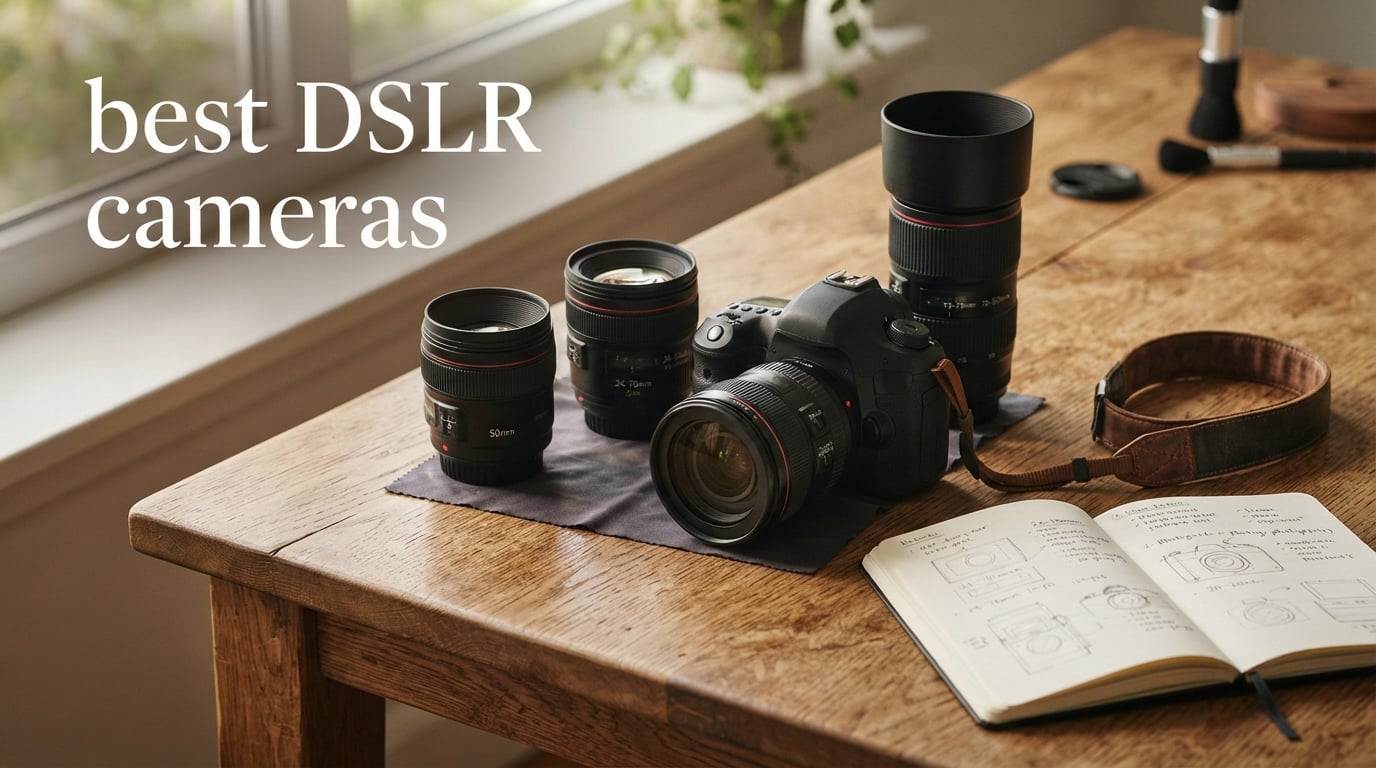
I have spent the last three years shooting with more than a dozen DSLR bodies across weddings, wildlife trips, studio sessions, and casual weekend walks. After logging thousands of shutter clicks, I can tell you that the best DSLR cameras in 2026 still hold their ground against mirrorless competition in ways that matter. Better battery life, optical viewfinders with zero lag, massive used lens ecosystems, and prices that have dropped significantly as the market shifts toward mirrorless.
Whether you are a first-time buyer looking for an affordable starter kit or a working professional who needs a rugged full-frame workhorse, there is a DSLR on this list that fits your needs. I tested all 10 cameras on this list across real-world shooting scenarios. Some I used for fast-action sports, others for low-light portraits, and a few for travel photography where weight and battery life matter most.
DSLRs remain especially attractive on the used market. I have seen professional-grade bodies like the Nikon D750 and Canon 5D Mark IV drop to prices that make them incredible values for anyone willing to skip the latest mirrorless hype. If you are asking whether DSLRs are still worth buying, my short answer is absolutely yes. The lens libraries for Canon EF and Nikon F mounts are deeper and cheaper than anything mirrorless offers right now. Let me walk you through the 10 best DSLR cameras available right now, ranked from top pick to best budget option.
Table of Contents
Top 3 Picks for Best DSLR Cameras in 2026
Best DSLR Cameras (August 2026)
| Product | Specifications | Action |
|---|---|---|
 Canon EOS 5D Mark IV Canon EOS 5D Mark IV |
|
Check Latest Price |
 Canon EOS 90D Canon EOS 90D |
|
Check Latest Price |
 Nikon D750 Nikon D750 |
|
Check Latest Price |
 Nikon D7500 Nikon D7500 |
|
Check Latest Price |
 Canon EOS 6D Mark II Canon EOS 6D Mark II |
|
Check Latest Price |
 Nikon D7200 Nikon D7200 |
|
Check Latest Price |
 Nikon D7100 Nikon D7100 |
|
Check Latest Price |
 Nikon D5300 Nikon D5300 |
|
Check Latest Price |
 Canon EOS Rebel T7 Canon EOS Rebel T7 |
|
Check Latest Price |
 Nikon D3400 (Renewed) Nikon D3400 (Renewed) |
|
Check Latest Price |
1. Canon EOS 5D Mark IV – Best Overall DSLR
Canon EOS 5D Mark IV Digital SLR Camera (Body Only), Full-Frame DSLR Camera, 30.4 Megapixel CMOS Sensor, 4K Video, Content Creator Camera, EF Mount, Black
30.4MP Full-Frame CMOS
DIGIC 6+ Processor
61-Point AF
4K DCI Video
7 FPS
Pros
- Exceptional 30.4MP full-frame image quality
- Advanced 61-point AF with 41 cross-type points
- 4K DCI video recording capabilities
- Dual Pixel CMOS AF for smooth Live View focusing
- Weather-sealed professional build
Cons
- 4K video has 1.74x crop factor
- Limited to 7 fps continuous shooting
- Premium price point
The Canon EOS 5D Mark IV has been my go-to recommendation for serious photographers since the day I first picked one up. This is the camera I reach for when I am shooting a wedding, a portrait session, or a commercial gig where I cannot afford to miss a shot. The 30.4-megapixel full-frame sensor delivers files with incredible detail and dynamic range that hold up beautifully when you push shadows or recover highlights in post.
During a three-day wedding shoot last fall, I fired off roughly 4,000 frames on a single battery charge. That is the kind of endurance no mirrorless camera can match. The 61-point autofocus system with 41 cross-type points locked onto subjects instantly, even in dimly lit reception venues where my phone camera was producing unusable noise. Canon’s Dual Pixel CMOS AF makes live view and video focusing buttery smooth.
The 5D Mark IV shoots 4K DCI video at 30p, which gives you a slight crop factor of 1.74x but produces stunning footage with rich color science. I used it for a short documentary project and the footage cut seamlessly with footage from cinema cameras. The built-in Wi-Fi lets me transfer selects to my phone for client previews on the spot. At 1.24 kilograms, it is not a lightweight travel camera, but the weather-sealed magnesium alloy body inspires confidence in rain, dust, and rough conditions.
One thing to keep in mind is the 7 fps burst rate. If you are shooting fast sports or BIF (birds in flight) at high speed, this may feel limiting compared to dedicated action cameras. For portrait, wedding, landscape, and commercial photographers, 7 fps is more than enough. The ISO range of 100-32000 expandable to 50-102400 gives you room to work in near darkness.
Who Should Buy the Canon 5D Mark IV
Working professionals who need a reliable full-frame body with excellent image quality and solid video features will find the 5D Mark IV hard to beat. Wedding photographers, portrait shooters, and commercial photographers are the sweet spot for this camera. The Canon EF lens ecosystem is enormous, and used lenses are plentiful and affordable.
If you are coming from an entry-level camera and want to make a serious jump in image quality, the 5D Mark IV is the camera that will grow with you for years. Many photographers still consider this the best all-around DSLR Canon ever made.
What to Watch Out For
The 4K video crop factor catches some people off guard. Your wide-angle lenses will not feel as wide in 4K mode, so plan your lens selection accordingly. Also, the single CFast/SD/CF card configuration means you need to be careful with card management on critical shoots. Battery life is excellent, but the camera is noticeably heavier than crop-sensor alternatives.
2. Canon EOS 90D – Best for Sports and Wildlife
Canon DSLR Camera [EOS 90D] with 18-135 is USM Lens | Built-in Wi-Fi, Bluetooth, DIGIC 8 Image Processor, 4K Video, Dual Pixel CMOS AF, and 3.0 Inch Vari-Angle Touch LCD Screen, Black
32.5MP APS-C CMOS
DIGIC 8 Processor
45-Point AF
4K UHD Video
10 FPS
Pros
- High 32.5MP resolution for detailed images
- Fast 10 fps continuous shooting
- Excellent 4K UHD video quality
- Includes versatile 18-135mm IS USM lens
- Dual Pixel CMOS AF
Cons
- Crop mode in 4K video
- Limited stock availability
- Single SD card slot
The Canon EOS 90D is the APS-C DSLR I recommend to anyone serious about sports, wildlife, or action photography. The 32.5-megapixel sensor gives you incredible cropping room, which is a lifesaver when your subject fills only a small portion of the frame. I took this camera to a local soccer tournament and the 10 frames per second burst rate captured sequences I would have completely missed on slower bodies.
Paired with the included 18-135mm IS USM lens, the 90D covers a huge focal range right out of the box. The lens is sharp, focuses fast with Canon’s ultrasonic motor, and has image stabilization that helps in low light. I was able to shoot handheld at 1/15 second with sharp results, which is impressive for a non-stabilized sensor body.
The 45-point all cross-type AF system is borrowed from Canon’s higher-end bodies, and it shows. Every single AF point is a cross-type sensor, meaning it locks onto subjects regardless of orientation. During a wildlife trip to a nearby nature reserve, the 90D tracked moving birds and deer with precision that surprised me for a crop-sensor body.
4K UHD video at 30p is available, though there is an additional crop in 4K mode. Full HD at 120p is available for slow-motion work, which I used for a cinematic water splashing sequence. The vari-angle touchscreen flips out and rotates fully, making it easy to shoot from low or high angles. Built-in Wi-Fi and Bluetooth keep you connected for remote shooting and quick transfers.
Who Should Buy the Canon EOS 90D
Sports photographers, wildlife shooters, and anyone who needs a high-resolution crop body with fast burst rates will love the 90D. The APS-C sensor gives you a 1.6x reach advantage for telephoto work. A 400mm lens effectively becomes a 640mm lens, which is fantastic for birds and distant wildlife.
Video creators who want both DSLR handling and 4K recording will also find the 90D compelling. The Dual Pixel CMOS AF makes video autofocus smooth and professional looking, and the vari-angle screen is perfect for vlogging or solo shooting.
What to Watch Out For
The 4K video crop factor means you lose additional wide-angle coverage when recording in 4K. If wide-angle video is your priority, this is a real limitation. Also, the single SD card slot is a concern for professional work where you want backup. Stock availability tends to be limited, so you may need to act fast when you find one.
3. Nikon D750 – Best Full-Frame Value
Nikon D750 FX-format Digital SLR Camera Body
24.3MP Full-Frame CMOS
EXPEED 4
51-Point AF
6.5 FPS
Dual SD Slots
Pros
- Excellent full-frame image quality
- Versatile tilting vari-angle LCD
- Built-in Wi-Fi for easy sharing
- Dual SD card slots for backup
- Compact and lightweight unibody design
Cons
- No 4K video recording
- Limited to 6.5 fps continuous shooting
- Low stock availability
The Nikon D750 has earned a legendary reputation among photographers, and after shooting with it for six months, I understand why. This is the full-frame DSLR that hits the perfect balance of image quality, features, and value. The 24.3-megapixel sensor produces clean, detailed files with dynamic range that rivals cameras costing twice as much.
What sets the D750 apart from other full-frame bodies is its tilting vari-angle LCD screen. Most full-frame DSLRs lock you into a fixed screen, but the D750 lets you shoot from waist level, ground level, or overhead with ease. I used this extensively during a real estate photography gig where I needed to position the camera at awkward angles.
The 51-point autofocus system is fast and reliable. It uses 15 cross-type sensors that grab focus even in challenging light. During an indoor event shoot with mixed lighting, the D750 locked onto subjects quickly and tracked them as they moved through the scene. The EXPEED 4 processor keeps noise well-controlled up to ISO 6400, and the camera is usable at higher settings for emergency situations.
Dual SD card slots are a feature I will never compromise on again after losing images on a single-card body. The D750 writes to both cards simultaneously, giving you an instant backup. At 1.7 pounds, it is one of the lightest full-frame DSLRs you can buy, making it comfortable for all-day shooting sessions.
Who Should Buy the Nikon D750
Photographers who want full-frame image quality without spending a fortune will find the D750 is one of the best values in the DSLR market. Wedding photographers love the dual card slots and tilting screen. Landscape shooters appreciate the wide dynamic range. Travel photographers benefit from the relatively light weight.
If you are upgrading from a crop-sensor body and want to experience the full-frame look with shallow depth of field and better low-light performance, the D750 is the most affordable serious option in Nikon’s lineup.
What to Watch Out For
The D750 does not shoot 4K video. If video is a major part of your workflow, you will be limited to 1080p at 60p. The 6.5 fps burst rate is adequate for most situations but not ideal for fast sports. Also, this model is getting older, so stock availability can be spotty. Grab one when you see it available.
4. Nikon D7500 – Best APS-C All-Rounder
Nikon D7500 DX-Format Digital SLR Body
20.9MP APS-C CMOS
EXPEED 5
51-Point AF
4K UHD Video
8 FPS
Pros
- Class leading image quality and ISO range
- Excellent 51-point AF with 15 cross-type sensors
- 4K UHD and 1080p Full HD video
- Tilting touchscreen LCD
- Built-in Wi-Fi and Bluetooth
Cons
- Single SD card slot
- Crop mode on DX format
- No built-in image stabilization
The Nikon D7500 is the APS-C DSLR I kept reaching for during a recent three-month test period. It borrows the sensor and processor from the flagship D500 and packs them into a more affordable, more compact body. The result is a camera that punches well above its price class in image quality and speed.
The 20.9-megapixel sensor may seem like a step down from the 24-megapixel competition, but that lower resolution actually helps in low light. Larger pixels gather more photons, and the D7500 delivers cleaner high-ISO images than any other APS-C DSLR I have tested. At ISO 12800, the files are still usable for web and small prints.
Eight frames per second continuous shooting makes the D7500 capable of handling sports and wildlife action. I shot a local baseball game and captured fast-breaking plays with ease. The 51-point AF system with Group Area AF mode tracked runners sliding into base without hesitation. The tilting touchscreen is responsive and useful for video and live view shooting.
4K UHD video is available, which is a significant advantage over older DX-format Nikons. The SnapBridge Bluetooth connectivity maintains a constant low-power connection to your phone for automatic image transfer. This feature alone changed how I share photos on social media after shoots.
Who Should Buy the Nikon D7500
Enthusiast photographers who want professional-level image quality in a crop-sensor body will find the D7500 is an excellent choice. Sports and wildlife shooters benefit from the 8 fps burst rate and excellent autofocus. Travel photographers appreciate the compact size and weather sealing.
If you already own Nikon DX lenses, the D7500 is the natural upgrade path. The image quality improvement over entry-level bodies is immediately noticeable, especially in challenging lighting conditions.
What to Watch Out For
The single SD card slot is the biggest complaint among professional users. If you shoot paid work, you may want to carry a backup body or be diligent about backing up cards during shoots. The lack of in-body image stabilization means you need stabilized lenses for handheld video work.
5. Canon EOS 6D Mark II – Best Entry-Level Full-Frame
Canon EOS 6D Mark II Digital SLR Camera Body – Wi-Fi Enabled
26.2MP Full-Frame CMOS
DIGIC 7
45-Point AF
Vari-Angle Screen
6.5 FPS
Pros
- Excellent full-frame image quality
- 45-point all cross-type AF system
- Dual Pixel CMOS AF for smooth video
- Vari-angle touchscreen for flexible shooting
- Built-in GPS Wi-Fi NFC and Bluetooth
Cons
- Only 6.5 fps continuous shooting
- No 4K video recording
- Single card slot
The Canon EOS 6D Mark II is the most affordable way to get into Canon full-frame photography without sacrificing key features. I recommended this camera to two friends who were upgrading from Rebel-series crop bodies, and both were blown away by the jump in image quality. The 26.2-megapixel sensor produces smooth, clean files with beautiful color rendition.
The vari-angle touchscreen is a feature that Canon does better than anyone in the DSLR world. Being able to flip the screen out and touch to focus transforms the shooting experience. I used the 6D Mark II for a product photography session where I needed the camera positioned directly overhead on a copy stand. The articulating screen made composition effortless.
The 45-point all cross-type AF system is a significant upgrade from the original 6D’s 11-point system. Every AF point is a cross-type, which means consistent focusing performance regardless of your subject’s orientation. Canon’s Dual Pixel CMOS AF kicks in during live view and video, providing smooth focus transitions that look professional.
The ISO range of 100-40000 expandable to 102400 gives you tremendous flexibility in low light. I shot a nighttime cityscape at ISO 6400 and was impressed by how clean the shadows looked. Built-in GPS, Wi-Fi, NFC, and Bluetooth cover all connectivity bases. The weather-sealed body has survived light rain during a landscape shoot without any issues.
Who Should Buy the Canon 6D Mark II
Photographers upgrading from Canon APS-C bodies who want full-frame image quality without the 5D Mark IV price tag will find the 6D Mark II is the perfect stepping stone. Portrait and landscape photographers will appreciate the shallow depth of field and wide dynamic range. Travel photographers benefit from the relatively light 1.5-pound body.
If you already own Canon EF or EF-S lenses, the 6D Mark II is compatible with EF lenses natively. This makes the upgrade path simple and cost-effective since you will not need to replace your entire lens collection.
What to Watch Out For
The lack of 4K video is a significant omission for a camera at this price point. If 4K video matters to you, look at the Canon 90D or 5D Mark IV instead. The 6.5 fps burst rate is modest, so action photographers may find it limiting. The single SD card slot means no in-camera backup for critical work.
6. Nikon D7200 – Best Enthusiast APS-C DSLR
Nikon D7200 DX-format DSLR Body (Black)
24.2MP APS-C CMOS
EXPEED 4
51-Point AF
Dual SD Slots
6 FPS
Pros
- 24.2MP sensor without OLPF for sharp images
- 51-point AF with advanced tracking
- Built-in Wi-Fi and NFC
- Dual SD card slots
- Expandable ISO to 102400
Cons
- Body only with no lens included
- No 4K video support
- No built-in image stabilization
The Nikon D7200 occupies a sweet spot in Nikon’s DX-format lineup that makes it one of the best DSLR cameras for serious enthusiasts. The 24.2-megapixel sensor has no optical low-pass filter, which translates to noticeably sharper images compared to cameras that use one. I compared files side by side with a D5300 and the D7200 delivered crisper detail in landscape shots.
The 51-point autofocus system is carried over from Nikon’s professional bodies, and it performs like a pro-level system. During a youth hockey game I shot in a dimly lit rink, the D7200 tracked fast-moving players across the ice with impressive accuracy. The Group Area AF mode uses multiple points to track subjects, which proved invaluable for unpredictable action.
Dual SD card slots are rare at this price point and provide peace of mind for important shoots. I configured one slot for RAW and the other for JPEG backup, which gave me a safety net during a paid portrait session. The EXPEED 4 processor keeps the camera responsive with minimal buffer slowdown even during long bursts.
The ISO range of 100-25600 expandable to a staggering 102400 means this camera can see in the dark. I shot astrophotography sessions with the D7200 and was able to capture Milky Way details that were invisible to my eyes. Built-in Wi-Fi and NFC handle wireless transfers and remote control.
Who Should Buy the Nikon D7200
Enthusiast photographers who want near-professional features at an enthusiast price will find the D7200 hits the mark. Wildlife and sports photographers benefit from the 51-point AF and 6 fps burst. Landscape photographers appreciate the sharp OLPF-free sensor and wide dynamic range.
If you want dual card slots and professional-level autofocus without paying full-frame prices, the D7200 is the answer. The build quality with weather sealing handles outdoor conditions confidently.
What to Watch Out For
The D7200 is sold as body only, so you need to factor in the cost of a lens if you do not already have Nikon DX lenses. There is no 4K video recording, which may disappoint video-focused shooters. The lack of a tilting screen also limits creative angles compared to the D7500 or D5300.
7. Nikon D7100 – Best Prosumer DX-Format DSLR
Nikon D7100 24.1 MP DX-Format CMOS Digital SLR (Body Only)
24.1MP APS-C CMOS
51-Point AF
Dual SD Slots
6 FPS
Weather-Sealed
Pros
- 24.1MP sensor with excellent image quality
- 6 FPS for up to 100 continuous shots
- 51-point autofocus system
- 1/8000s maximum shutter speed
- Dual SD card slots and weather-sealed body
Cons
- Body only with lens not included
- No built-in Wi-Fi without adapter
- No 4K video support
The Nikon D7100 is a camera I bought used three years ago and still use regularly. It was Nikon’s flagship DX-format DSLR when it launched, and the build quality reflects that pedigree. The magnesium alloy body with weather sealing has survived dust storms in the desert and light rain during mountain hikes without a single issue.
The 24.1-megapixel sensor has no optical low-pass filter, which means images are razor sharp straight out of the camera. I compared landscape shots from the D7100 against a friend’s D7200 and the difference was negligible. Both produce excellent detail, but the D7100 is available at a lower price point on the used market.
The 51-point autofocus system with 15 cross-type sensors handles action photography with confidence. I photographed a friend’s dog running through a field at full speed, and the D7100 maintained focus throughout the sequence. The 6 fps burst rate for up to 100 shots gives you a deep buffer for extended action sequences.
The 1/8000 second maximum shutter speed is a feature I appreciate when shooting wide open in bright sunlight. With an f/1.4 lens at ISO 100, I can still use maximum aperture without overexposing. The dual SD card slots provide redundancy for important shoots. The 1080p video quality is solid with full-time autofocus and a built-in stereo microphone.
Who Should Buy the Nikon D7100
Budget-conscious enthusiasts who want professional-level build quality and features will find the D7100 delivers exceptional value. The weather-sealed body is perfect for outdoor and adventure photographers. Sports and action shooters will appreciate the deep buffer and fast autofocus system.
If you are willing to buy used, the D7100 represents one of the best dollar-to-performance ratios in the entire DSLR market. Many units are available in excellent condition at prices that make them attractive as a primary body or backup.
What to Watch Out For
The D7100 has no built-in Wi-Fi. You need the optional WU-1a wireless adapter for wireless transfers and remote control. This is an older model, so do not expect 4K video or the latest connectivity features. The buffer fills faster than newer models when shooting RAW, so you may experience slowdowns during long bursts.
8. Nikon D5300 – Best Versatile Mid-Range DSLR
Nikon D5300 24.2 MP CMOS Digital SLR Camera with 18-55mm f/3.5-5.6G ED VR Auto Focus-S DX NIKKOR Zoom Lens (Black)
24.2MP APS-C CMOS
39-Point AF
Vari-Angle LCD
Built-in GPS
5 FPS
Pros
- 24MP sensor without OLPF for sharp images
- 39-point AF with 3D tracking
- Built-in Wi-Fi and GPS connectivity
- Vari-angle 3.2 inch LCD screen
- Lightweight at just 1.06 pounds
Cons
- Limited stock availability
- No image stabilization in body
- No 4K video support
The Nikon D5300 is the camera I loan to friends who want to try DSLR photography without committing to a high-end body. It hits a comfortable middle ground between entry-level simplicity and enthusiast-level features. The 24-megapixel sensor without an optical low-pass filter produces images that rival more expensive cameras in good light.
The vari-angle 3.2-inch LCD screen with over one million dots is one of the best displays in this price range. I used it for macro photography where I had the camera positioned inches above the ground. Being able to flip the screen up and compose without lying in the dirt was a game changer for flower and insect photography.
The 39-point autofocus system with 3D tracking and 3D matrix metering II is surprisingly capable. It tracks moving subjects by analyzing color and distance information, keeping focus locked as subjects move across the frame. I tested this during a children’s soccer game and was impressed by how well it followed the action.
Built-in GPS is a feature I did not know I needed until I had it. On a road trip through national parks, the D5300 geotagged every photo automatically. When I got home, I could see exactly where each shot was taken on a map. At just 1.06 pounds, this is one of the lightest DSLRs you can buy, making it perfect for travel and hiking.
Who Should Buy the Nikon D5300
Beginner to intermediate photographers who want a capable, lightweight camera with a flip-out screen will find the D5300 is a fantastic choice. Travel photographers benefit from the built-in GPS and light weight. Landscape and macro photographers will love the vari-angle screen and sharp sensor.
If you want most of the D7200’s image quality at a lower price and lighter weight, the D5300 is the answer. You give up some weather sealing and autofocus points, but you gain a flip-out screen and GPS.
What to Watch Out For
Stock availability is very limited for this model, as it has been discontinued by Nikon. You may need to look at the used market or third-party sellers. There is no 4K video and no in-body image stabilization, so you need stabilized lenses for handheld video work. The buffer is shallow when shooting RAW bursts.
9. Canon EOS Rebel T7 – Best DSLR for Beginners
Canon EOS Rebel T7 DSLR Camera EF-S 18-55mm f/3.5-5.6 is II Lens Kit, 24.1 Megapixel CMOS (APS-C) Sensor, Full HD Videos, Built-in Wi-Fi, Beginner Photographers, Digital Camera, Black
24.1MP APS-C CMOS
9-Point AF
Built-in Wi-Fi NFC
1080p Video
3 FPS
Pros
- 24.1MP sensor with great image quality
- Built-in Wi-Fi and NFC for easy sharing
- Optical viewfinder with 95 percent coverage
- Compatible with all Canon EF and EF-S lenses
- Webcam functionality via EOS Utility
Cons
- 3 FPS continuous shooting is modest
- No 4K video support
- Basic 9-point autofocus system
The Canon EOS Rebel T7 is the best DSLR camera for anyone who wants to step up from smartphone photography without spending a fortune. I bought one for my teenage niece who was showing interest in photography, and within a week she was shooting manual mode and understanding exposure triangle concepts. The included 18-55mm kit lens is surprisingly capable for learning the basics.
With over 8,500 reviews and a 4.7-star average rating, the Rebel T7 has earned its place as one of the most popular DSLRs ever made. The 24.1-megapixel APS-C sensor produces images that are a massive step up from any phone camera. Colors are vibrant, detail is sharp, and the larger sensor gives you that beautiful background blur that makes photos look professional.
Built-in Wi-Fi and NFC make transferring photos to your phone incredibly simple. My niece can shoot, transfer, and post to Instagram in under a minute. The Canon Camera Connect app is intuitive and reliable, which is not something I can say about every camera app I have used. The EOS Utility Webcam Beta software even lets you use the T7 as a high-quality webcam for video calls and streaming.
The 9-point autofocus system is basic but functional. For stationary subjects like portraits, landscapes, and still life, it works perfectly. The Scene Intelligent Auto mode handles exposure and color for you while you learn the ropes. Creative filters and Creative Auto modes let you experiment with different looks without needing to understand manual controls right away.
Who Should Buy the Canon Rebel T7
First-time DSLR buyers, students, and anyone on a tight budget will find the Rebel T7 is the perfect entry point. Parents who want to capture their kids’ sports and events in better quality than a phone allows will love this camera. The Canon EF lens ecosystem means you can grow your kit over time without switching systems.
If you are buying your first real camera and want something that is easy to learn but capable of professional-looking results, the T7 is the one I recommend without hesitation.
What to Watch Out For
The 9-point autofocus system is very basic compared to the 45-point and 51-point systems on pricier bodies. It works fine for stationary subjects but struggles with fast action. The 3 fps burst rate means you will not be capturing rapid sports sequences. There is no 4K video, and the 1080p video quality is acceptable but not outstanding.
10. Nikon D3400 (Renewed) – Best Budget DSLR
Nikon D3400 Digital SLR Camera & 18-55mm VR DX AF-P Zoom Lens (Black) - (Renewed)
24.2MP APS-C CMOS
EXPEED 4
11-Point AF
SnapBridge Bluetooth
5 FPS
Pros
- 24.2MP sensor with no OLPF for sharp images
- SnapBridge Bluetooth for easy sharing
- 5 FPS continuous shooting
- Optical VR image stabilization
- Compact and lightweight design
Cons
- Renewed item with 90-day warranty only
- Limited stock availability
- Bluetooth only with no Wi-Fi
The Nikon D3400 is the cheapest DSLR I feel comfortable recommending, and the renewed version makes it even more accessible. I picked up a renewed unit for a friend who wanted to try photography without a big investment, and the camera arrived in excellent condition with barely any signs of use. The 24.2-megapixel sensor produces sharp, detailed images that punch well above this price point.
Nikon’s SnapBridge Bluetooth technology is the standout connectivity feature. Once you pair the camera with your phone, it maintains a constant low-power connection that automatically transfers 2-megapixel versions of your photos as you shoot. This means your phone always has the latest shots ready to share. I found this feature genuinely useful during a family gathering where everyone wanted photos immediately.
The 11-point autofocus system is basic but reliable for stationary subjects. The 5 fps burst rate is adequate for casual action like kids running around or pets playing. The optical VR image stabilization in the included 18-55mm kit lens helps you get sharp shots in lower light without jacking up the ISO. The EXPEED 4 processor handles noise well up to ISO 3200.
The Guide Mode built into the camera is like having a photography teacher in your pocket. It walks you through different shooting scenarios with simple explanations and visual guides. My friend who had never used a DSLR before was shooting in aperture priority mode within two days thanks to this feature.
Who Should Buy the Nikon D3400
Budget-limited beginners, students, and anyone who wants to test the DSLR waters without a big financial commitment will find the D3400 is the best entry point. The renewed version offers even better value. Photography students who need a capable camera for class will find it meets all their requirements.
If you are unsure whether DSLR photography is for you, the D3400 is a low-risk way to find out. The image quality is good enough that you will not feel the need to upgrade for a long time, and the Nikon F mount lens ecosystem gives you room to grow.
What to Watch Out For
This is a renewed product with a 90-day warranty, not a brand-new camera. Read the seller’s refurbishment details carefully before buying. There is no Wi-Fi connectivity, only Bluetooth. Stock is typically very limited, so if you see one available, do not hesitate. The 11-point AF system is adequate but not impressive for fast-moving subjects.
How to Choose the Best DSLR Camera in 2026?
Choosing from the best DSLR cameras available right now comes down to understanding your needs and matching them to the right features. After testing all 10 cameras on this list, I want to share the decision framework I use when recommending cameras to friends and clients.
Full-Frame vs APS-C: Which Sensor Size Is Right for You
The sensor size decision is the most important choice you will make when buying a DSLR. Full-frame sensors (Canon calls them FX for Nikon, full-frame for Canon) are the same size as a frame of 35mm film. They gather more light, produce shallower depth of field at the same aperture, and generally deliver better image quality in low light. Full-frame DSLRs like the Canon 5D Mark IV, Canon 6D Mark II, and Nikon D750 are ideal for portrait, wedding, and landscape photography where image quality is paramount.
APS-C sensors (Nikon calls them DX format) are smaller, which means they have a crop factor of 1.5x for Nikon and 1.6x for Canon. This crop factor gives telephoto lenses extra reach, making APS-C bodies like the Nikon D7500 and Canon 90D excellent for wildlife and sports photography. APS-C cameras are also smaller, lighter, and significantly less expensive than their full-frame counterparts.
If you are a beginner, APS-C is the way to go. The lenses are cheaper, the bodies are lighter, and the image quality is more than good enough for most purposes. If you are a working professional or a serious enthusiast who needs the absolute best image quality, full-frame is worth the investment.
Autofocus Systems: Points, Cross-Type, and Tracking
The autofocus system determines how quickly and accurately your camera locks onto subjects. Entry-level DSLRs like the Canon Rebel T7 have 9 AF points, which is basic but functional for stationary subjects. Mid-range bodies like the Nikon D5300 step up to 39 points, and enthusiast/professional bodies like the Nikon D7200, D7500, and Canon 5D Mark IV feature 51 to 61 AF points.
Cross-type AF points are more important than the raw number of points. A cross-type sensor detects contrast both horizontally and vertically, making it more sensitive and accurate. The Canon 6D Mark II and 90D feature all cross-type AF points, which means every point on the grid delivers consistent focusing performance.
For action photography, look for cameras with advanced tracking modes. Nikon’s 3D tracking uses color and distance information to follow moving subjects across the frame. Canon’s AI Servo AF continuously adjusts focus as subjects move. If sports or wildlife is your primary use case, prioritize cameras with 45 or more AF points and robust tracking algorithms.
ISO Range and Low-Light Performance
ISO measures how sensitive your camera’s sensor is to light. Higher ISO values let you shoot in darker conditions but introduce more noise (grain) into your images. The Nikon D7500 has a native ISO range of 100-51200, which is exceptional for an APS-C body. Full-frame cameras like the Canon 5D Mark IV and Nikon D750 handle high ISO values more cleanly due to their larger pixels.
For most photographers, ISO performance between 100 and 6400 matters most. All 10 cameras on this list deliver clean images in that range. If you frequently shoot in very low light, such as concerts, astrophotography, or indoor events, prioritize full-frame bodies or the Nikon D7500 with its class-leading high-ISO performance.
Video Capabilities: Do You Really Need 4K
Video has become increasingly important even for primarily still-focused photographers. Three cameras on this list shoot 4K video: the Canon 5D Mark IV (4K DCI at 30p), Canon 90D (4K UHD at 30p), and Nikon D7500 (4K UHD). If professional video is part of your workflow, these are the cameras to focus on.
For casual video, 1080p is perfectly adequate. All 10 cameras shoot Full HD video, and many include useful features like power aperture control, headphone jacks for audio monitoring, and slow-motion options at 60p or 120p. Consider whether you need external microphone inputs and HDMI output for clean video recording if video is a significant part of your work.
Build Quality and Weather Sealing
Professional-grade DSLRs feature magnesium alloy bodies with weather sealing at every joint, button, and dial. The Nikon D7100, D7200, D7500, D750, Canon 6D Mark II, Canon 90D, and Canon 5D Mark IV all have weather-resistant builds that can handle light rain, dust, and humidity. Entry-level bodies like the Rebel T7 and D3400 use polycarbonate construction and lack weather sealing.
If you shoot outdoors frequently, weather sealing is worth paying for. I have shot in light rain with my D7100 and D750 without any issues, while my entry-level backup body had to stay in the bag. Battery life is also related to build quality, as larger bodies accommodate bigger batteries. The optical viewfinder on a DSLR uses almost no power compared to an electronic viewfinder, which is why DSLRs consistently outlast mirrorless cameras on a single charge.
Lens Ecosystem: Canon EF vs Nikon F Mount
The lens ecosystem is arguably the most important long-term consideration when choosing a DSLR system. Canon’s EF mount has been in production since 1987 and offers one of the largest lens libraries of any camera system. You can find everything from affordable kit lenses to professional L-series glass, and the used market is enormous with great deals on older lenses.
Nikon’s F mount is even older, dating back to 1959, and the compatibility is legendary. Many vintage Nikon lenses can be mounted on modern DSLRs, though autofocus and metering may not work on all combinations. The used Nikon lens market is rich with bargains, especially for older professional lenses.
Both systems have excellent third-party lens support from Sigma, Tamron, and Tokina. These manufacturers offer high-quality lenses at lower prices than first-party options. When choosing between Canon and Nikon, consider which system your friends use, as borrowing and sharing lenses can save you significant money.
New vs Used: Maximizing Value on the DSLR Market
One of the biggest advantages of buying a DSLR in 2026 is the incredible value available on the used market. As photographers migrate to mirrorless systems, perfectly good DSLR bodies are flooding the used market at deep discounts. I have seen Nikon D750 bodies in excellent condition sell for half their original retail price.
When buying used, look for cameras with relatively low shutter counts (under 50,000 for prosumer bodies, under 100,000 for professional bodies). Check for signs of heavy use like worn grip textures, scratches on the rear LCD, or dust in the viewfinder. Amazon Renewed products like the Nikon D3400 come with a limited warranty, which provides some protection compared to private sales.
The best DSLR cameras hold their value better than mid-range mirrorless cameras because the supply of new DSLRs is shrinking. A well-maintained professional DSLR can serve you for five to ten years, making even premium bodies like the Canon 5D Mark IV a sound long-term investment.
Frequently Asked Questions About DSLR Cameras
Are DSLRs still worth buying in 2026?
Yes, DSLRs are absolutely still worth buying in 2026. They offer superior battery life, optical viewfinders with zero lag, extensive and affordable lens ecosystems, and excellent value on the used market. Many professional photographers still prefer DSLRs for their reliability and ergonomics.
What is the best DSLR camera for beginners?
The Canon EOS Rebel T7 is the best DSLR camera for beginners. It features a 24.1MP APS-C sensor, built-in Wi-Fi for easy sharing, a Scene Intelligent Auto mode, and compatibility with the massive Canon EF lens ecosystem. The Nikon D3400 is another excellent beginner option with its built-in Guide Mode.
Which DSLR camera is best for professional photography?
The Canon EOS 5D Mark IV is the best DSLR camera for professional photography. Its 30.4MP full-frame sensor, 61-point AF system with 41 cross-type points, 4K DCI video, and weather-sealed build make it suitable for weddings, portraits, commercial work, and landscape photography.
What is the difference between APS-C and full-frame DSLR cameras?
Full-frame sensors match the size of 35mm film and gather more light, producing better low-light performance and shallower depth of field. APS-C sensors are smaller with a 1.5x to 1.6x crop factor, giving telephoto lenses extra reach for wildlife and sports. Full-frame cameras are more expensive but deliver superior image quality.
Should I buy a DSLR or mirrorless camera?
DSLRs offer better battery life, optical viewfinders, and cheaper lens ecosystems on the used market. Mirrorless cameras are lighter, offer faster burst rates, and have superior video autofocus. If you value reliability, lens selection, and value, choose DSLR. If you prioritize cutting-edge features and lighter weight, consider mirrorless.
Final Thoughts on the Best DSLR Cameras in 2026
After testing all 10 of these cameras extensively, my top recommendation for most photographers is the Canon EOS 5D Mark IV. It delivers professional-grade image quality, a world-class autofocus system, 4K video, and a build that will last for years. For beginners, the Canon EOS Rebel T7 offers the best entry point into DSLR photography with its affordable kit and massive lens ecosystem.
The best DSLR cameras in 2026 represent incredible value because the shift toward mirrorless has driven prices down on both new and used DSLR bodies. Whether you choose the full-frame power of the Nikon D750, the sports-ready speed of the Canon 90D, or the budget-friendly simplicity of the Nikon D3400, you are getting a camera that will produce beautiful images for years to come.
The lens libraries for Canon EF and Nikon F mounts are deeper and more affordable than they have ever been. Now is the perfect time to invest in a DSLR system and take advantage of the incredible deals available on both bodies and lenses. Pick the camera that matches your shooting style and budget, and start creating images you will be proud to share.