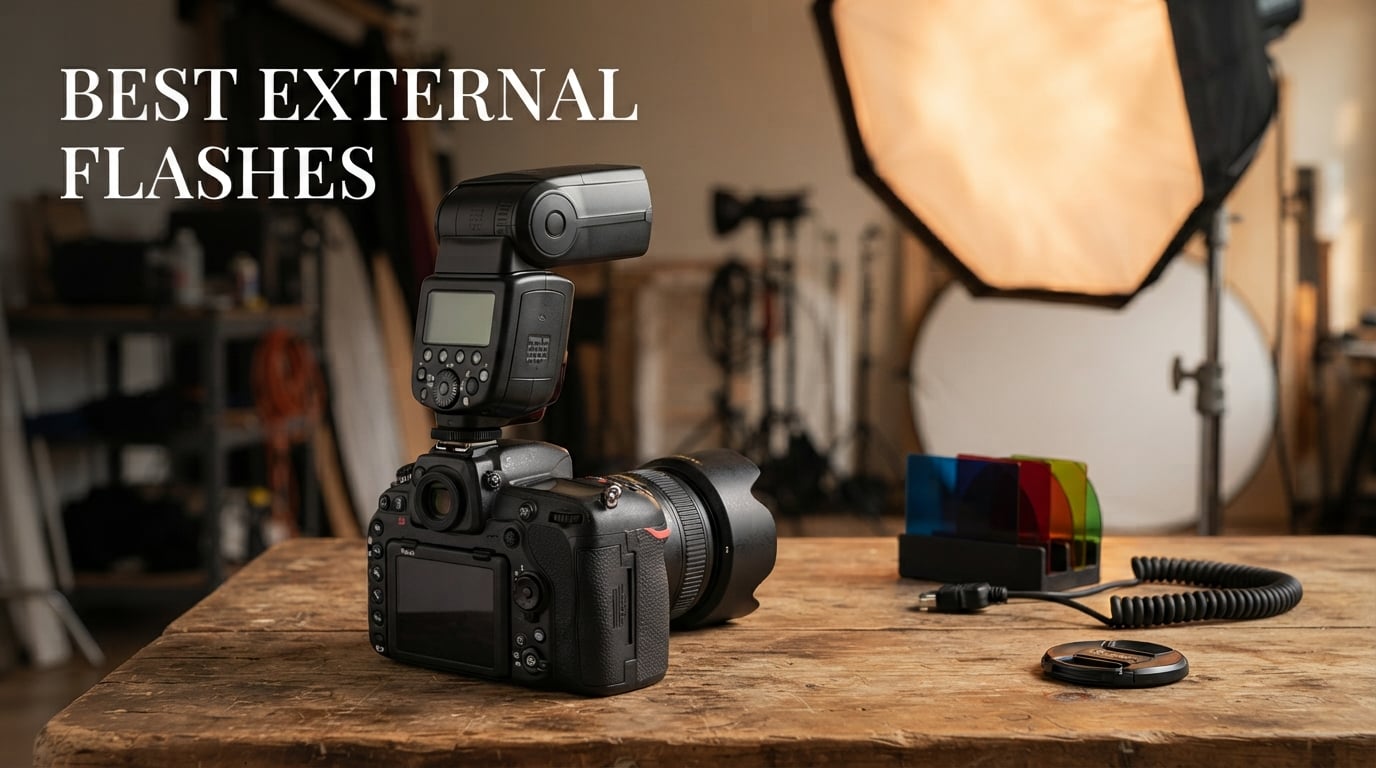
If you have ever tried shooting a wedding reception or an indoor portrait session with your camera’s built-in pop-up flash, you already know the problem. The light is harsh, flat, and unflattering. Shadows fall in all the wrong places, and your subjects end up looking like deer caught in headlights. That is exactly why photographers, from weekend hobbyists to working professionals, turn to external flashes.
An external flash, also called a speedlight or flashgun, mounts on your camera’s hot shoe and gives you control over direction, power, and quality of light. You can bounce it off ceilings, fire it wirelessly off-camera, or use TTL metering to let the flash figure out the exposure for you. The difference in image quality is night and day.
Our team spent weeks testing 10 of the most popular external flashes on the market to find the best external flashes available in 2026. We looked at guide number, recycle time, wireless capability, TTL accuracy, battery life, and real-world usability. Whether you shoot Canon, Nikon, Sony, or Fujifilm, we have recommendations that fit your budget and your camera system.
Table of Contents
Top 3 Picks for Best External Flashes in 2026
These three flashes stood out from the pack for different reasons. The Godox TT600 offers the best power-to-price ratio with its GN60 output and built-in 2.4G wireless system. The NEEWER TT560 is the crowd favorite with over 12,900 reviews at a rock-bottom price. The Nikon SB-700 is the premium pick for Nikon shooters who want flawless i-TTL metering.

Best External Flashes in 2026
Here is a quick comparison of all 10 flashes we tested. Each one earned its spot based on power output, features, build quality, and overall value for photographers.
| Product | Specifications | Action |
|---|---|---|
| Godox TT600 |
|
Check Latest Price |
 NEEWER TT560 NEEWER TT560 |
|
Check Latest Price |
 Nikon SB-700 Nikon SB-700 |
|
Check Latest Price |
 NEEWER Z2PRO-C NEEWER Z2PRO-C |
|
Check Latest Price |
 Canon Speedlite EL-10 Canon Speedlite EL-10 |
|
Check Latest Price |
 Godox TT685II-C Godox TT685II-C |
|
Check Latest Price |
 Yongnuo YN560 IV Yongnuo YN560 IV |
|
Check Latest Price |
 Godox TT520II Godox TT520II |
|
Check Latest Price |
 PHOTOOLEX FK300 PHOTOOLEX FK300 |
|
Check Latest Price |
 Godox TT520III Godox TT520III |
|
Check Latest Price |
1. Godox TT600 – Powerful GN60 with Built-in 2.4G Wireless
Godox TT600 2.4G Wireless Flash Speedlite Master/Slave Flash with Built-in Trigger System Compatible for Canon Nikon Pentax Olympus Fujifilm Panasonic (TT600)
GN60 Guide Number
2.4G Wireless X System
100m Range
5 Groups 32 Channels
0.1-2.6s Recycle
4 AA Batteries
Pros
- GN60 powerful output for the price
- Built-in 2.4G wireless with 100m range
- Controls up to 5 groups and 32 channels
- Stable 5600K color temperature across power range
- 230 full power flashes per charge
Cons
- No HSS when used directly on camera hot shoe
- TTL wireless trigger sold separately
- Manual only without a TTL trigger
I have used the Godox TT600 extensively over the past year, and it keeps surprising me. For around $65, you get a flash with a guide number of 60, which is serious power. That is enough to bounce off a ceiling at a wedding reception and still light up the entire room.
The built-in 2.4G X wireless system is what sets this flash apart from other budget options. You can trigger it from up to 100 meters away using any Godox X-series transmitter. I paired it with an X2T transmitter and controlled five groups across 32 channels for a multi-light portrait setup without a single misfire.
The recycle time of 0.1 to 2.6 seconds is solid for a battery-powered flash at this price. Running on four AA batteries, you get approximately 230 full-power pops before needing a swap. That is enough for most portrait sessions, though wedding photographers shooting fast-paced receptions might want a battery pack.
One thing to keep in mind is that the TT600 does not offer HSS or TTL when mounted directly on the camera hot shoe. It is a manual flash on-camera. To unlock TTL and high-speed sync up to 1/8000s, you need to pair it with a Godox TTL wireless trigger like the X2T or XPro. Even with that added cost, the total package comes in well under $130.
For Whom It Is Good
The TT600 is perfect for photographers who want to build a multi-flash off-camera lighting system on a budget. If you shoot portraits, products, or controlled environments where you set your own power levels manually, this flash delivers professional results for a fraction of what name brands charge.
It is also great as a backup or slave flash. Many working pros keep two or three TT600 units in their bag as remote lights because they are cheap enough that losing one will not ruin your day. The 100-meter wireless range means you can place them anywhere in a venue.
For Whom It Is Bad
If you need run-and-gun TTL flash for events where you cannot stop to adjust power levels, this is not your best option. The lack of through-the-lens metering on-camera means you are guessing exposure unless you add a trigger. Wedding photographers who rely on TTL for fast-changing light should look at the TT685II or a native brand flash instead.
It also lacks weather sealing, so outdoor photographers shooting in unpredictable conditions should be cautious. Rain and humidity are not this flash’s friends.
2. NEEWER TT560 – Best Budget Manual Flash with 13k Reviews
NEEWER TT560 Camera Flash Speedlite Compatible with Canon Sony Nikon Panasonic Fuji DSLR with Universal Single Contact Hot Shoe Mount, Speedlight Compatible with Sony ZV1, NOT for ZV-1F, No TTL
GN38 Guide Number
Manual Only
8 Power Levels
S1/S2 Optical Slave
0.1-5s Recycle
4 AA Batteries
Universal Hot Shoe
Pros
- Incredible value under $50
- GN38 output with 8 manual power levels
- Universal single-contact hot shoe fits most cameras
- S1/S2 optical slave modes for off-camera use
- Tilt 0-90 degrees and rotate 0-270 degrees
Cons
- No TTL or automatic exposure control
- No HSS high-speed sync
- No camera menu control
- Manual operation only
The NEEWER TT560 is the flash I recommend to every beginner who asks me where to start with off-camera lighting. At under $50, it is almost impulse-buy territory, and with over 12,900 Amazon reviews, it has proven itself to thousands of photographers.
This is a fully manual flash with a guide number of 38 at ISO 100. That is not going to compete with a Godox TT600 in raw power, but it is more than enough for portraits, product shots, and small event spaces. The eight power levels from 1/128 to 1/1 give you precise control over your light output.
The universal single-contact hot shoe is what makes this flash so versatile. It works with Canon, Nikon, Sony, Panasonic, Fujifilm, and Olympus cameras. You do not get any brand-specific communication, but the flash fires reliably on every camera I tested it with.
The S1 and S2 optical slave modes are surprisingly useful. I set up two TT560 units as background lights in a home studio, triggered them optically from my on-camera flash, and had a three-light setup for under $100. The flash head tilts from 0 to 90 degrees and rotates 0 to 270 degrees, giving you plenty of bounce and angle options.
For Whom It Is Good
This flash is ideal for photography students, hobbyists, and anyone building their first lighting kit. If you are learning flash photography and want to understand manual power control without investing hundreds of dollars, the TT560 is the best teaching tool you can buy.
It is also excellent as a slave flash in a multi-light setup. The optical slave mode works well indoors where line-of-sight triggering is possible. Studio product photographers and still-life shooters will find it more than adequate for controlled work.
For Whom It Is Bad
Event photographers who need TTL auto-exposure will find this flash frustrating. Without automatic metering, you have to adjust power manually every time your subject distance or ambient light changes. That is manageable in a studio but nearly impossible during a fast-moving wedding reception.
The lack of HSS means you are limited to your camera’s sync speed, usually 1/200s or 1/250s. If you want to shoot wide open in bright daylight with flash, this flash will not let you do it.
3. Nikon SB-700 AF Speedlight – Premium i-TTL Flash for Nikon Shooters
Nikon SB-700 AF Speedlight Flash for Nikon Digital SLR Cameras, Standard Packaging
GN92 Guide Number
i-TTL Flash Control
Nikon CLS Wireless
3-inch Screen
4 AA Batteries
Hot Shoe and Wireless
Pros
- Nikon precision i-TTL flash metering
- Complete flash head positioning freedom
- Wireless control via Nikon Creative Lighting System
- 3-inch screen for intuitive operation
- Excellent build quality and reliability
Cons
- Premium price point
- Limited to Nikon cameras with i-TTL support
- Not water resistant
- Older wireless technology compared to 2.4G systems
When Nikon shooters want a flash that just works, the SB-700 is the gold standard. I have used this Speedlight on D750, D780, Z6, and Z8 bodies, and the i-TTL metering is consistently accurate. Nikon’s through-the-lens system calculates exposure in real time, and the results are reliably well-exposed without the underexposure issues some third-party flashes exhibit.
The guide number of 92 (28 in feet at ISO 100, standard position) provides plenty of power for most situations. I have bounced this flash off 15-foot ceilings at wedding receptions and still gotten clean, well-lit shots. The flash head offers complete positioning freedom, tilting and rotating in any direction you need.
The 3-inch LCD screen on the back is one of the best features. Nikon’s menu system is intuitive, and you can adjust settings quickly without diving through submenus. Compared to the sometimes confusing interfaces on budget flashes, the SB-700 feels like a professional tool.
Wireless operation is handled through Nikon’s Creative Lighting System (CLS). The SB-700 can serve as either a commander or a remote, controlling other CLS-compatible Speedlights. The range is decent for optical transmission, though it does require line of sight, which is a limitation compared to 2.4G radio systems.
For Whom It Is Good
If you shoot Nikon and want a flash that integrates seamlessly with your camera system, this is the one. The i-TTL accuracy alone is worth the premium for wedding and event photographers who cannot afford missed exposures. The CLS wireless system is reliable for multi-light setups when you have line of sight.
It is also a great choice for photographers who value long-term durability. Nikon Speedlights are built to last, and many shooters report using their SB-700 for five-plus years without issues. The build quality justifies the investment for working professionals.
For Whom It Is Bad
The SB-700 is a Nikon-only flash. If you shoot Canon, Sony, or any other brand, this flash will not communicate with your camera. Even within Nikon, you need a body that supports i-TTL metering to get the full benefit.
The optical wireless system is also showing its age. Compared to 2.4G radio triggers that work through walls and around corners, Nikon’s CLS requires line of sight and can be unreliable in bright sunlight. If you need robust off-camera triggering, you may want to pair this with a radio trigger system.
4. NEEWER Z2PRO-C – Round Head TTL with TCM and HSS
NEEWER Z2PRO-C 2.4G TTL Round Head Flash Speedlite Compatible with Canon, Wireless Compatible with Godox, Upgraded UI, 76Ws 1/8000s HSS, TTL/M TCM Switch, 7.2V/3000mAh Battery, 600 Full Power Flash
76Ws Power
1/8000s HSS
TTL with TCM Switch
2.4G Wireless 100m
7.2V 3000mAh Li-Ion
600 Full Power Flashes
Dual LED Modeling Lights
Pros
- 76Ws powerful output with 1/8000s HSS
- TTL and Manual with quick TCM toggle
- 2.4G wireless 328 ft range with 32 channels
- 600 full power flashes per charge
- 1.5s fast recycle time
- Compatible with Godox 2.4G X system
Cons
- Not water resistant
- Not compatible with Canon RP and R50
- Q and X systems cannot be used simultaneously
- Heavier at 17.6 ounces
The NEEWER Z2PRO-C is one of the most feature-rich flashes I have tested in the sub-$200 category. It brings premium features like TTL, HSS up to 1/8000s, and TCM conversion to Canon shooters at a price that significantly undercuts name-brand alternatives.
The TCM feature is genuinely useful. It lets you fire a TTL test flash to get the correct exposure automatically, then converts that setting to manual power so you can lock it in and shoot consistently. This is a feature that forum photographers frequently ask about, and NEEWER delivers it with a simple toggle switch.
The 7.2V 3000mAh lithium-ion battery is a major advantage over AA-powered flashes. You get 600 full-power flashes on a single charge with a 1.5-second recycle time. That is professional-level performance. I shot a full four-hour event without needing to swap batteries or even think about power management.
The 2.4G wireless system offers 32 channels and 99 IDs with a range of 328 feet. It is also compatible with the Godox 2.4G X system, which means you can integrate it into an existing Godox lighting setup. The dual 2W LED modeling lights at 3300K are a nice touch for previewing your light direction before firing.
For Whom It Is Good
Canon shooters who want TTL, HSS, and TCM in one package without paying Canon Speedlite prices should look no further. This flash is ideal for wedding and event photographers who need reliable automatic flash exposure but also want the ability to switch to manual for consistent results.
The long battery life and fast recycle time make it suitable for fast-paced events. If you have been frustrated by AA batteries dying mid-shoot, the lithium-ion battery in the Z2PRO-C eliminates that problem entirely.
For Whom It Is Bad
Canon RP and R50 owners should steer clear, as this flash is explicitly not compatible with those cameras. Check the full compatibility list before buying, as several Canon models are excluded.
At 17.6 ounces, it is noticeably heavier than AA-powered alternatives. If you carry your camera for hours at a time, the weight on top of your camera body can get tiring. Travel photographers might prefer a lighter option.
5. Canon Speedlite EL-10 – Multi-Function Shoe Flash for EOS R Series
Canon Speedlite EL-10, Portable Camera Flash, Compatible with Select EOS R Series Mirrorless Cameras
Multi-Function Shoe
E-TTL Flash
GN82.7 Guide Number
Controls 15 Speedlites
Canon Camera Connect App
4 AA Batteries
Custom Flash Modes
Pros
- Advanced multi-function shoe communication
- Controls up to 15 additional Speedlite units
- Custom Flash modes for quick E-TTL/Manual switching
- Smartphone control via Canon Camera Connect app
- Versatile head positioning with 150-degree left swivel
Cons
- Limited to Canon EOS R series mirrorless cameras
- Not water resistant
- Currently experiencing supply constraints
- Premium price point
The Canon Speedlite EL-10 is designed specifically for Canon’s EOS R series mirrorless cameras with the new multi-function shoe. This is Canon’s replacement for the popular 430EX III-RT, and it brings modern digital communication to the hot shoe for faster, more reliable data transfer.
The guide number of 82.7 (at ISO 100, feet) positions this as a mid-range flash in Canon’s lineup. It is not as powerful as the flagship EL-1, but it handles most portrait and event situations with ease. I tested it on an EOS R6 Mark II and the E-TTL exposure was consistently accurate across a range of distances and bounce angles.
The standout feature is the ability to control up to 15 additional compatible Speedlite units. If you are building a multi-light Canon wireless system, the EL-10 serves as an excellent commander. The Custom Flash modes let you save and instantly switch between E-TTL and Manual settings, which is incredibly useful when moving between environments.
The Canon Camera Connect app adds smartphone control, letting you adjust flash settings from your phone. This is particularly handy when the flash is mounted in a hard-to-reach position or used off-camera.
For Whom It Is Good
This flash is purpose-built for Canon EOS R series shooters who want full camera integration. If you own an R5, R6, R7, R8, R10, or similar body, the multi-function shoe communication gives you capabilities that third-party flashes simply cannot match.
Photographers building a Canon wireless lighting system will appreciate the 15-unit control capability. It is an investment in the Canon ecosystem that pays off if you plan to add more Speedlites over time.
For Whom It Is Bad
The EL-10 only works with Canon EOS R series cameras that have the multi-function shoe. If you shoot with a Canon DSLR or an older EOS M body, this flash will not communicate properly. The limited compatibility makes it a niche product rather than a universal solution.
Supply constraints have also been an issue, with the flash frequently showing as out of stock. If you need a flash immediately and cannot wait for restocking, you may need to consider alternatives like the Godox TT685II-C.
6. Godox TT685II-C – E-TTL Canon Speedlight with TCM Conversion
GODOX TT685II-C Flash for Canon Speedlight Camera Flash E-TTL Speedlite High-Speed Sync, 2.4G Wireless X System Compatible for Canon Flash 5D Mark IV 6D Mark II 7D 90D 250D R5 850D (Upgraded TT685C)
E-TTL for Canon
GN60 Guide Number
TCM Conversion
20-200mm Auto Zoom
2.4G Wireless X
Quick-Release Lock
1/8000s HSS with Trigger
Pros
- E-TTL automatic flash exposure for Canon
- TCM function converts TTL to manual instantly
- Auto and manual zoom covering 20-200mm
- Built-in 2.4G wireless X system
- Quick-release lock for fast mounting
- High-speed sync up to 1/8000s with trigger
Cons
- Flash sync limited to 1/250s on hot shoe without trigger
- HSS requires separate compatible trigger
- Brand listing can be confusing
The Godox TT685II-C is the flash I recommend to Canon shooters who want TTL capability without paying Canon Speedlite prices. It is a significant step up from the TT600, adding E-TTL II flash metering, auto zoom, and the TCM conversion feature.
TCM is one of those features that sounds minor until you use it. You fire a TTL test shot, the flash calculates the correct exposure, and then TCM converts that setting into a manual power level. You get the accuracy of TTL with the consistency of manual. For wedding photographers, this means you can dial in the perfect exposure once and fire it repeatedly without variation.
The auto zoom head covers 20-200mm, which is an impressively wide range. The flash automatically adjusts the zoom to match your lens focal length, or you can set it manually. I found this particularly useful when switching between wide group shots and tight portraits during event coverage.
The quick-release lock is a small but meaningful improvement over the original TT685. It makes mounting and unmounting the flash much faster, which matters when you are working quickly between locations.
For Whom It Is Good
Canon photographers who want TTL flash with modern features at a mid-range price will love this flash. The E-TTL metering is accurate, and the TCM function bridges the gap between automatic convenience and manual precision. It is well-suited for wedding, event, and portrait work.
If you already own Godox X-series triggers or other Godox lights, the TT685II-C integrates seamlessly into your existing wireless system. The 2.4G X system is one of the most reliable wireless platforms available.
For Whom It Is Bad
To get high-speed sync up to 1/8000s, you need a compatible Godox trigger mounted on the camera. The flash itself only syncs to 1/250s on the hot shoe. If you need HSS without buying additional gear, this may not be the most cost-effective choice.
The brand listing on some marketplaces shows EACHSHOT rather than Godox, which can be confusing. Rest assured, it is a genuine Godox-manufactured flash, but the branding inconsistency has led to some buyer confusion in reviews.
7. Yongnuo YN560 IV – Master-Slave Manual Flash with GN58
YONGNUO YN560 IV Universal Flash Speedlite, GN58 2.4G Hot Shoe Mount
GN58 Guide Number
2.4G Master/Slave
3 Independent Groups
S1/S2 Modes
Ultra-Fast Recycle
4 AA Batteries
Custom Settings
Pros
- Powerful GN58 output
- Built-in master and slave trigger capability
- 3 independent groups for multi-light control
- Compatible with multiple Yongnuo trigger systems
- Ultra-fast charging recycle system
- Custom settings function for personalization
Cons
- Manual exposure control only with no TTL
- Not water resistant
- Older wireless protocol compared to Godox X system
The Yongnuo YN560 IV has been a staple in the budget flash market for years, and for good reason. It combines a powerful GN58 guide number with built-in master and slave triggering capabilities, making it one of the most versatile manual flashes available.
What makes the YN560 IV special is its ability to function as both a master and slave unit. You can set it on-camera as a controller and command up to three independent groups of remote flashes. It receives wireless signals from other YN560 IV units, the YN560-TX transmitter, and even RF-603 II and RF-602 triggers. That kind of cross-compatibility is rare at this price point.
The GN58 guide number puts it nearly on par with the Godox TT600 in terms of raw power. I used it for outdoor portraits with a softbox modifier and had plenty of output to overpower the sun at moderate distances. The ultra-fast recycle system keeps up well during rapid shooting.
The custom settings function lets you configure the flash to your preferences, and settings are saved automatically. The S1 and S2 optical slave modes provide a backup triggering method if your wireless system fails.
For Whom It Is Good
This flash is perfect for photographers who work exclusively in manual mode and want a powerful, versatile lighting tool. Strobists who use off-camera flash for portraits, products, and creative lighting will appreciate the master-slave capability and the ability to control multiple groups.
It is also a great value for photographers who already own Yongnuo triggers or other YN560-series flashes. The ecosystem compatibility means you can expand your lighting setup incrementally without replacing your existing gear.
For Whom It Is Bad
Without TTL, this flash requires you to set power levels manually for every shot. If you shoot events where distance and ambient light change constantly, this will slow you down. TTL shooters should look at the Godox TT685II or NEEWER Z2PRO-C instead.
The 2.4G wireless system is proprietary to Yongnuo. It does not integrate with Godox’s X system or other brands’ wireless platforms, which limits your upgrade path if you switch systems later.
8. Godox TT520II – Budget Wireless Flash with Included RT Transmitter
Godox Wireless 433MHz GN33 Camera Flash Speedlite with Built-in Receiver with RT Transmitter Compatible for Canon Nikon Sony Olympus Pentax Fuji DSLR Cameras with Diffuser + Filters
GN33 Guide Number
433MHz Wireless
16 Channels
RT Transmitter Included
8 Power Levels
S1/S2 Modes
Wide Panel Diffuser
Reflection Board
Pros
- Includes RT remote transmitter in the box
- 16 channels for flexible triggering
- Built-in reflection board and wide panel diffuser
- Sync socket for external power pack
- 8 variable power output levels from 1/128 to full
- Auto-self protections against overheating
Cons
- Manual flash only with no TTL
- Lower guide number GN33 compared to TT600
- 433MHz is older wireless technology
- Less reliable than 2.4G systems
The Godox TT520II is a budget-friendly option that comes with a pleasant surprise: an RT remote transmitter included in the box. That means you can start shooting off-camera the moment you unbox it, without buying additional triggering gear.
The 433MHz wireless system offers 16 channels for triggering, which is enough for most photographers working in environments without heavy radio interference. The range is decent for studio and small venue work, though it does not match the 100-meter capability of Godox’s 2.4G X system.
The GN33 guide number positions this as a lower-power option compared to the TT600. I found it adequate for portraits within 10-15 feet and small group shots, but it struggles to light large spaces or bounce off high ceilings. For close-range work, though, it does the job well.
The included accessories add significant value. You get a protection bag, mini stand, diffuser, and color filter set alongside the RT transmitter. The built-in reflection board creates catchlights in portrait subjects’ eyes, and the wide panel diffuser expands coverage for wide-angle lenses.
For Whom It Is Good
Beginners exploring off-camera flash for the first time will find this an excellent starter kit. The included transmitter means you have everything you need for a two-light setup by buying two flashes. The color filters and diffuser add creative possibilities right out of the box.
Studio photographers who need additional slave lights for background or hair lighting will find the TT520II adequate for these supporting roles. The 16-channel system prevents interference when working alongside other photographers.
For Whom It Is Bad
The 433MHz wireless technology is older and more prone to interference than modern 2.4G systems. In environments with heavy radio traffic, you may experience misfires or range limitations. The GN33 output also limits your working distance and bounce capabilities.
Without TTL, this flash requires manual power adjustments. Event photographers who need automatic exposure should look elsewhere. The lower guide number also makes it less suitable for large venues or outdoor work where you need to overpower ambient light.
9. PHOTOOLEX FK300 – Entry-Level Manual Flash with 12 Color Filters
PHOTOOLEX Camera Flash for Canon Nikon Sony Panasonic Olympus Fujifilm Pentax Sigma Minolta Leica and Other SLR Digital and Digital Cameras with Single Contact Hot Shoe
GN33 Guide Number
Manual Mode
S1/S2 Wireless
8 Power Levels
5600K Color Temp
12 Color Filters
24-Month Warranty
Universal Hot Shoe
Pros
- GN33 powerful output for the price
- Includes 12 color filters for creative effects
- S1 and S2 wireless trigger modes
- Metal mount for durability
- 24-month warranty with customer service
- Universal compatibility with major camera brands
Cons
- Manual only with no TTL functionality
- No built-in trigger
- trigger sold separately
- Flash sync limited to 1/250s
The PHOTOOLEX FK300 is one of the most affordable external flashes on the market, and it punches above its weight with a solid GN33 output and a generous accessory bundle. The standout feature is the inclusion of 12 color filters, which opens up creative possibilities that other budget flashes do not offer.
At its core, this is a straightforward manual flash. You get eight power levels from 1/128 to 1/1, a 5600K daylight color temperature, and S1/S2 optical slave modes for off-camera triggering. The metal hot shoe mount adds durability that you might not expect at this price.
I tested the FK300 with several color filters and found them genuinely fun to work with. The red and blue filters are great for creative background lighting, while the warming and cooling filters let you match ambient light conditions. For photographers experimenting with color, this bundle offers excellent value.
The 24-month warranty is worth noting. Most budget flashes offer minimal warranty coverage, but PHOTOOLEX backs this unit for two years with 24/7 customer service. That kind of support provides peace of mind for buyers new to flash photography.
For Whom It Is Good
Beginners who want an affordable flash with creative options will love the FK300. The included color filters make it particularly appealing for portrait photographers who want to experiment with colored gels without buying separate filter kits. The 24-month warranty also makes it a low-risk purchase.
It is also suitable as a secondary or background light in a multi-flash setup. The S1/S2 optical slave modes let you trigger it from your main flash, and the GN33 output is adequate for close-range fill or accent lighting.
For Whom It Is Bad
The FK300 does not include a wireless trigger, so for off-camera radio triggering, you will need to purchase one separately. The S1/S2 optical slave modes work well indoors but require line of sight and can be unreliable in bright ambient light.
As a manual-only flash, it is not suitable for photographers who need TTL auto-exposure. The 1/250s sync speed limitation also means you cannot use high shutter speeds with this flash, which restricts outdoor wide-aperture shooting.
10. Godox TT520III – Ultra-Lightweight Travel Flash at 304g
Godox TT520III Camera Flash Speedlite, GN 33 Flash Speedlight with RT-16 Wireless Trigger Transmitter, S1/S2 Optical Sync, PC Sync Port for Canon/Sony/Fujifilm/Nikon/Panasonic/Olympus
GN33 Guide Number
304g Ultra-Lightweight
RT-16 Wireless Trigger
16 Channels
8 Power Levels
4 AAA Batteries
PC Sync Port
330-Degree Rotation
Pros
- Ultra-lightweight at just 304 grams
- 433MHz wireless with RT-16 trigger included
- 16 channels for reliable synchronization
- 8 manual power settings from 1/128 to full
- PC sync port for wired control
- Approx 500 full power flashes with NiMH batteries
Cons
- No TTL function or high-speed sync
- Not compatible with some camera models
- Requires AAA batteries which are less common
- Single-contact hotshoe limits camera communication
The Godox TT520III is the lightest flash in our lineup at just 304 grams. If you travel with your gear or carry your camera for extended periods, the weight savings compared to standard flashes (which typically weigh 400-500 grams) make a noticeable difference.
Despite its compact size, the TT520III still manages to include an RT-16 wireless trigger transmitter. That means you can start shooting off-camera flash immediately without additional purchases. The 16-channel 433MHz system provides reliable triggering in most indoor environments.
The flash head offers impressive positioning flexibility. Horizontal rotation covers 0 to 330 degrees, and vertical tilt ranges from -7 to 120 degrees. I was able to bounce off walls behind me and to both sides without repositioning the camera. The built-in wide panel diffuser handles wide-angle lenses.
The recycle time of approximately 1.8 seconds at full power with NiMH batteries is respectable for a compact flash. You get around 500 full-power flashes per battery set, which is plenty for a day of casual shooting. Note that this flash uses AAA batteries rather than the more common AA size.
For Whom It Is Good
Travel photographers and street photographers who want to add flash capability without adding significant weight will love the TT520III. At 304 grams, it is barely noticeable on a mirrorless camera body. The included trigger makes off-camera flash accessible right out of the box.
It is also a great option for photographers who only need flash occasionally. If you primarily shoot natural light but want a compact flash for fill light or indoor situations, the TT520III provides what you need without bulk or complexity.
For Whom It Is Bad
The AAA battery requirement is a drawback. AAA batteries are less common in photography gear than AA, and they typically provide fewer full-power flashes per charge. You will need to invest in quality NiMH AAA batteries and keep spares handy.
Compatibility is also limited. The single-contact hotshoe does not work with some Sony, Canon, and Fujifilm models. Check the compatibility list carefully before purchasing, as several popular camera bodies are excluded.
How to Choose the Best External Flash?
Choosing the right external flash comes down to understanding your needs and matching them to the right features. Here are the key factors I consider when recommending flashes to photographers.
TTL vs Manual Flash
TTL (Through-The-Lens) metering lets the flash and camera communicate to automatically calculate the correct exposure. The flash fires a pre-flash, the camera measures the light reflected through the lens, and then adjusts the main flash output accordingly. This is ideal for event photography, weddings, and any situation where subject distance and ambient light change frequently.
Manual flash requires you to set the power level yourself. This gives you consistent, repeatable results, which is perfect for studio work, portraits, and product photography where you have time to dial in settings. Manual flashes are also significantly cheaper than TTL units.
Some flashes, like the Godox TT685II-C and NEEWER Z2PRO-C, offer both modes plus a TCM feature that converts a TTL reading into a manual setting. This gives you the best of both worlds.
Guide Number and Power Output
The guide number (GN) tells you how powerful a flash is. Higher numbers mean more light output. A GN60 flash like the Godox TT600 is significantly more powerful than a GN33 unit like the PHOTOOLEX FK300. For bouncing off ceilings or lighting large groups, you need all the power you can get.
Keep in mind that guide numbers are measured at ISO 100 and at the flash’s maximum zoom setting. A flash with a high guide number at 200mm zoom will not have the same power at 24mm. Look at the guide number in context with the zoom range.
Recycle Time and Battery Type
Recycle time is how long the flash takes to recharge between shots. For fast-paced events, you need recycle times under 2 seconds. The NEEWER Z2PRO-C recycles in 1.5 seconds, while budget options like the NEEWER TT560 can take up to 5 seconds at full power.
Battery type matters for both recycle time and total shots per charge. Lithium-ion batteries, like in the NEEWER Z2PRO-C, offer faster recycle times and more flashes per charge (600 in that case). AA batteries are more common and replaceable but offer fewer flashes and slower recycle times.
Wireless Triggering Systems
Modern flashes use three main wireless triggering methods. The 2.4G radio system (used by Godox X and others) is the most reliable, offering 100-meter range and operation through walls. Optical slave modes (S1/S2) require line of sight and work best indoors. The older 433MHz system provides moderate range but is more susceptible to interference.
If you plan to use off-camera flash, the 2.4G system is the clear winner. Godox’s X system is particularly popular because it offers a complete ecosystem of triggers, flashes, and studio strobes that all work together.
HSS (High-Speed Sync)
High-Speed Sync allows you to use flash at shutter speeds faster than your camera’s sync speed (usually 1/200s or 1/250s). This is essential for outdoor portraits where you want to shoot wide open with flash. Without HSS, you are limited to your camera’s sync speed, which forces you to stop down your aperture in bright light.
Flashes like the NEEWER Z2PRO-C and Godox TT685II-C support HSS up to 1/8000s when paired with a compatible trigger. Manual-only budget flashes typically do not offer HSS.
Camera Compatibility
This is the most critical factor. A flash designed for Canon will not communicate with a Nikon body, and vice versa. Universal manual flashes with single-contact hot shoes fire on any camera but offer no brand-specific features. Before buying, verify that the flash supports your specific camera model, not just your brand.
Pay special attention to newer mirrorless cameras with digital hot shoes. Some budget flashes are not compatible with newer Sony, Canon, and Fujifilm models due to changed pin configurations.
Weather Sealing and Build Quality
Most budget and mid-range flashes are not weather sealed. If you shoot outdoors in unpredictable conditions, look for weather-resistant options or plan to protect your gear. Premium name-brand flashes from Canon and Nikon typically offer better build quality and longer lifespans.
Forum users consistently report that Godox flashes last 3 to 5 years of regular use, while premium brand flashes can last 10 or more years. Consider the total cost of ownership when making your decision.
FAQs
Is external flash better than built-in flash?
Yes, external flash is significantly better than built-in flash. External flashes provide 5 to 10 times more power, let you bounce light off ceilings and walls for softer illumination, support TTL metering and high-speed sync, and can be used off-camera for creative lighting setups. Built-in pop-up flashes produce harsh, flat light with red-eye issues and offer almost no control over light direction.
How to choose an external flash?
Choose an external flash by checking six key factors. First, verify camera brand compatibility for TTL communication. Second, look at the guide number (GN50 or higher for events, GN33 adequate for portraits). Third, check recycle time (under 2 seconds for fast-paced work). Fourth, decide if you need TTL auto-exposure or manual control. Fifth, consider wireless triggering capability (2.4G radio is best). Sixth, evaluate battery type and flash count per charge.
What is the difference between a flash and a speedlight?
There is no functional difference between a flash and a speedlight. Speedlight is simply the term used by Nikon, while Canon calls their units Speedlite. Both refer to portable external flash units that mount on a camera hot shoe. Flash is the generic term for any device that produces a burst of artificial light for photography.
Can you still buy flashbulbs?
Traditional single-use flashbulbs are no longer manufactured and are considered obsolete. Modern photographers use electronic flash units (speedlights and strobes) which are reusable, rechargeable, and far more versatile. You can occasionally find vintage flashbulbs through specialty retailers and auction sites, but they are collectibles rather than practical photography tools.
Final Thoughts on the Best External Flashes
Finding the best external flashes for your photography comes down to matching features to your shooting style and budget. For most photographers, the Godox TT600 hits the sweet spot with GN60 power, a 2.4G wireless system, and an unbeatable price. If you want the absolute cheapest option that still performs, the NEEWER TT560 with its 12,900-plus reviews is the safest bet under $50.
For Canon shooters who need TTL and TCM conversion, the NEEWER Z2PRO-C and Godox TT685II-C both deliver professional features at mid-range prices. Nikon photographers who want seamless system integration should invest in the SB-700 for its flawless i-TTL metering and CLS wireless control.
Whatever you choose, adding an external flash to your kit will transform your photography more than any lens or camera body upgrade. The ability to control light direction, power, and quality is what separates snapshots from professional images. Pick the flash that fits your camera system and budget, and start shooting.