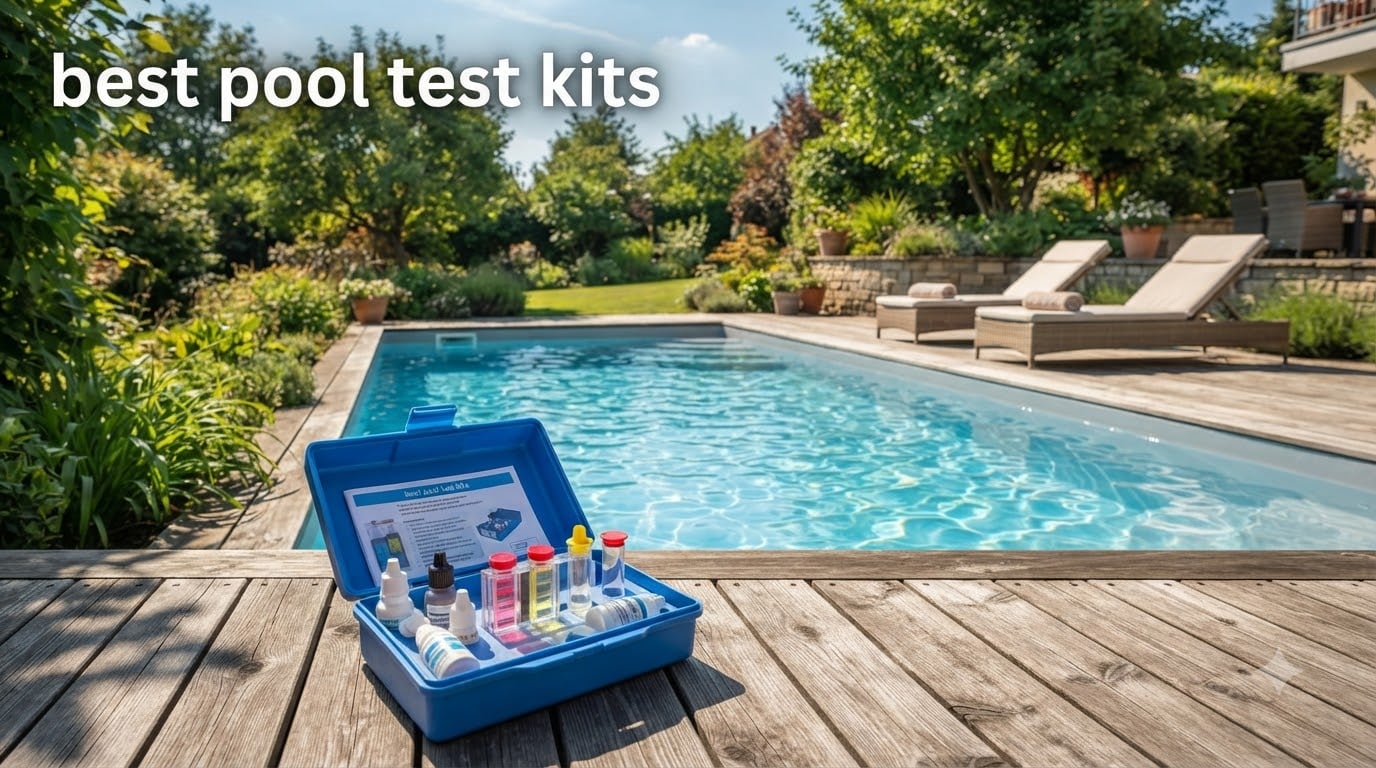
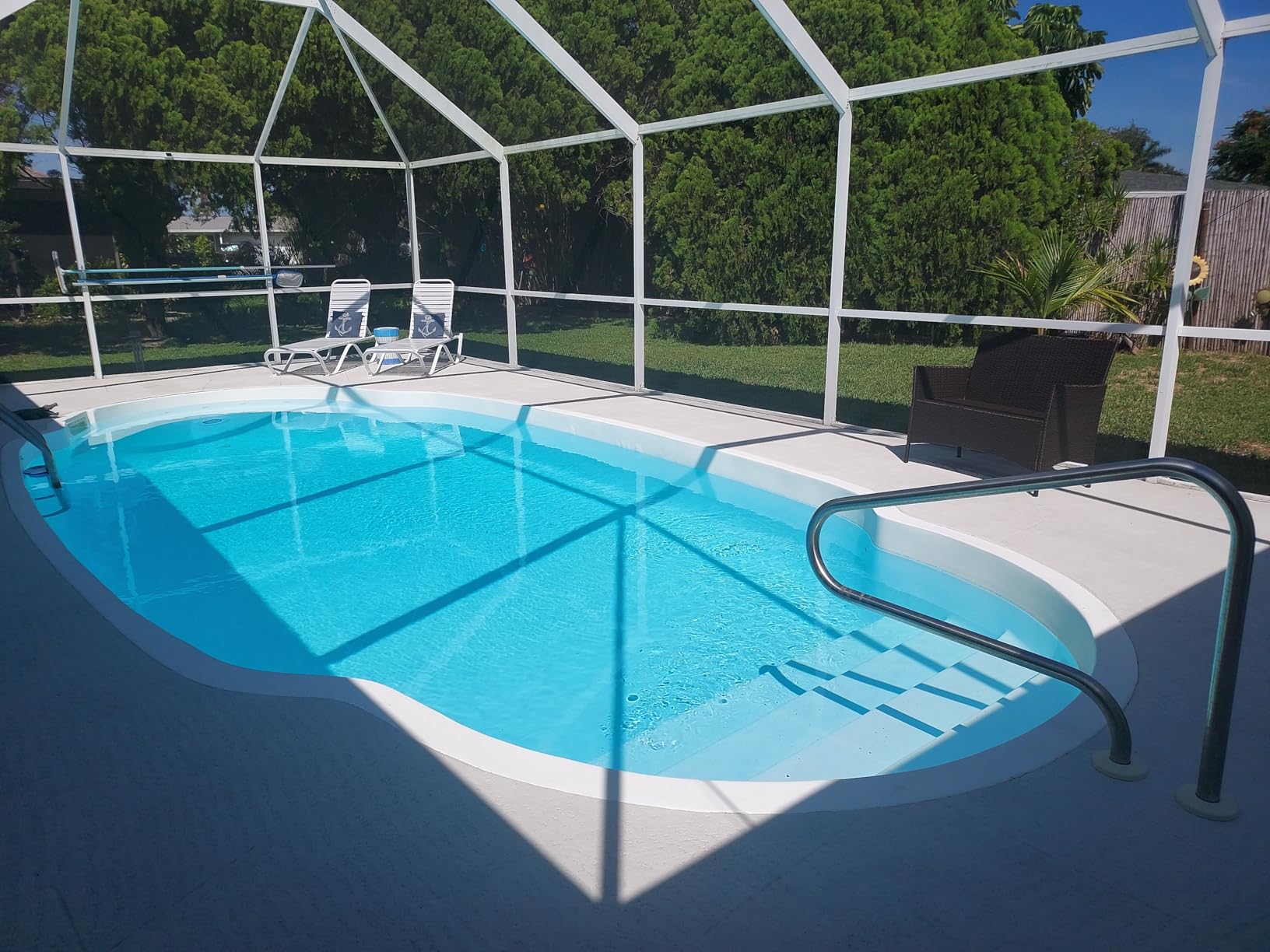
Clear water is not the same as safe water. I learned that the hard way during my first summer as a pool owner, when a “perfectly blue” pool gave my family red eyes and itchy skin for a week. The problem was not the water color. It was chemistry I could not see, and my cheap test strips could not catch. That summer pushed me to test dozens of pool test kits side by side, and what I found changed how I maintain my pool forever.
The pool test kits market in 2026 stretches from $9 strip packs to $450 professional lab kits. Buying the wrong one leaves you guessing at your chlorine and pH levels. Buying the right one turns you into your own pool chemist, saving trips to the pool store and avoiding costly chemical mis-dosing. This guide breaks down the 8 best pool test kits our team has tested, so you can match the kit to your pool type, budget, and accuracy needs.
Inside this roundup, you will find liquid drop kits, test strips, smart app-connected testers, and salt-specific kits. We also cover what each kit measures, who it suits, and the trade-offs our testers noticed. If you only have a minute, jump straight to the Top 3 Picks below.
Key takeaways for pool owners shopping for pool test kits in 2026:
Liquid drop kits using the FAS-DPD method outperform test strips on accuracy by a wide margin.
Taylor Technologies K-2006 and K-2005 are the most recommended kits on Reddit, in pool forums, and by pool service pros.
Test strips are fine for quick daily checks but unreliable as a sole source of chemistry data.
Saltwater pools need a kit that tests chloride (salt) specifically, such as the Taylor K-2006-SALT.
Reagents expire. Plan to refresh them every season for accurate numbers.
Table of Contents
Top 3 Pool Test Kits at a Glance (August 2026)


Best Pool Test Kits in 2026
| Product | Specifications | Action |
|---|---|---|
| Taylor K-2006-SALT 9-in-1 Pool & Spa Test Kit |
|
Check Latest Price |
| Taylor K-2005 DPD 9-in-1 Complete Test Kit |
|
Check Latest Price |
 Poolmaster 5-Way Pool & Spa Water Test Kit Poolmaster 5-Way Pool & Spa Water Test Kit |
|
Check Latest Price |
 AquaChek 7-Way Pool and Spa Test Strips AquaChek 7-Way Pool and Spa Test Strips |
|
Check Latest Price |
 AquaChek Yellow 4-Way Pool & Spa Test Strips AquaChek Yellow 4-Way Pool & Spa Test Strips |
|
Check Latest Price |
 Clorox Pool&Spa My Pool Care Assistant Clorox Pool&Spa My Pool Care Assistant |
|
Check Latest Price |
 JNW Direct 7-in-1 Pool Test Strips JNW Direct 7-in-1 Pool Test Strips |
|
Check Latest Price |
 EASYTEST 7-Way Pool Test Strips EASYTEST 7-Way Pool Test Strips |
|
Check Latest Price |
1. Taylor K-2006-SALT 9-in-1 Pool & Spa Test Kit – Editor’s Choice for Saltwater Pools
Taylor Technologies K-2006-SALT FAS-DPD, 9-in-1 Saltwater Pool Test Kit
FAS-DPD method
9 parameters including salt
15 reagents
Pros
- Pro-grade accuracy for saltwater
- Salt/chloride testing included
- Lasts multiple seasons
- Replacement reagents available
- Proudly made in USA since 1930
Cons
- Higher price than strips
- Learning curve for beginners
- May lack reagents for high-frequency testing
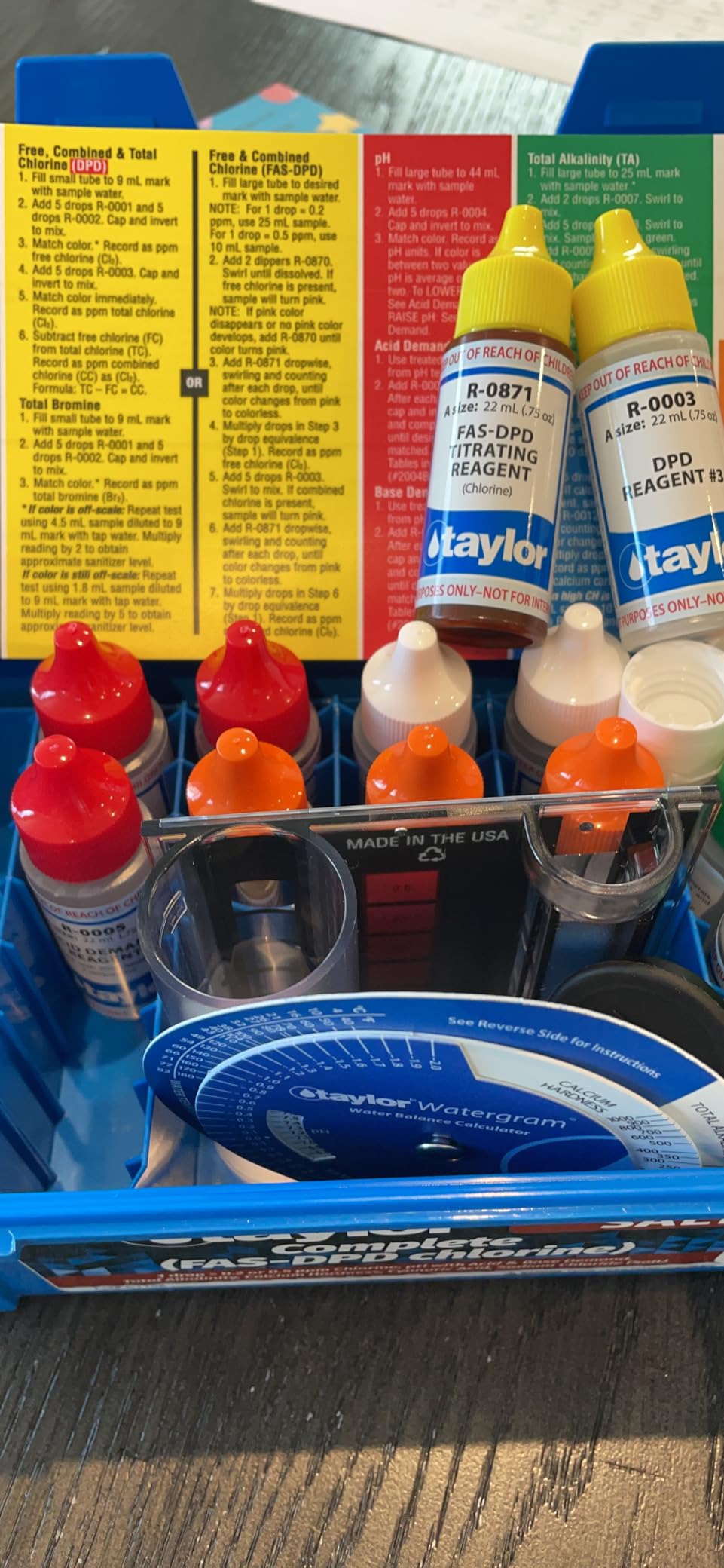
I pulled the Taylor K-2006-SALT out of its case on day one of testing and immediately noticed the build quality. The comparator block is solid, the dropper bottles are clearly labeled, and the included pictogram instructions feel like they were designed by someone who has actually taught a new pool owner how to test. Within 10 minutes I had a full pH, free chlorine, combined chlorine, alkalinity, calcium hardness, CYA, and salt reading for my 14,000-gallon saltwater pool.
The big difference between this kit and standard DPD kits is the salt/chloride test. Saltwater pool owners know that a salt cell can fail quietly. The pool still looks clean, but the chlorine output drops to almost nothing. With the K-2006-SALT, I can verify the actual chloride concentration in ppm. That single test has already saved me from buying a salt cell I did not actually need. The FAS-DPD method also counts drops instead of comparing color shades, which removes most of the color-matching guesswork that haunts cheaper kits.
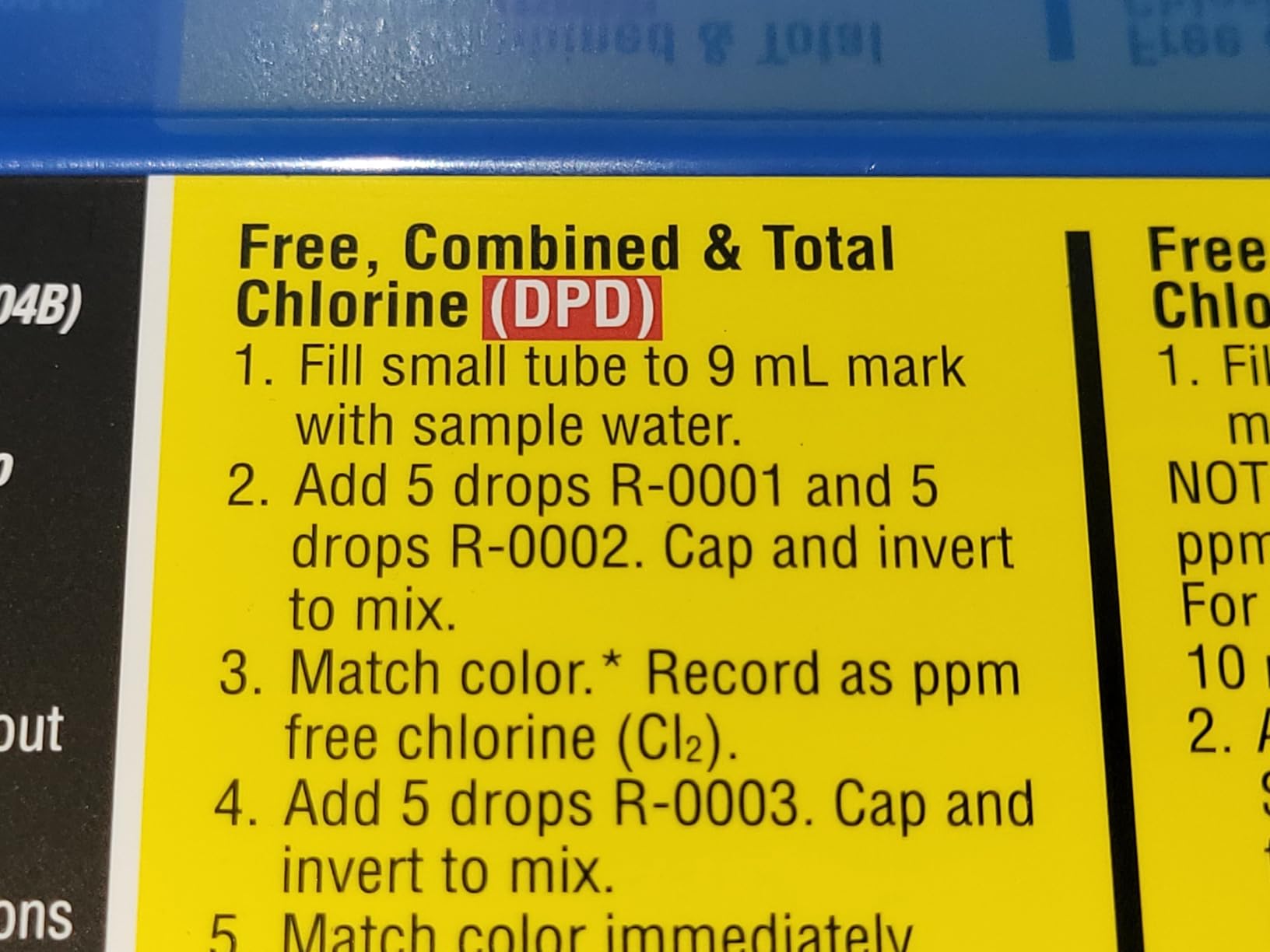
After six weeks of daily testing, my impressions match the broader pool community. On Reddit and Trouble Free Pool, the K-2006 family is consistently labeled the gold standard. My only real complaint is that the standard kit uses 0.75 oz reagent bottles. If you test every day, you may burn through them mid-season. Taylor offers a service complete version (K-2006C-SALT) with 2 oz bottles, which delivers about 2.5x the test count. For most home saltwater owners, though, the standard kit is more than enough.
Who should buy the Taylor K-2006-SALT
This is the kit for any saltwater pool owner who wants professional accuracy at home. If your pool runs on a salt chlorine generator, the built-in chloride test alone justifies the cost. It also suits owners who test weekly (rather than daily) and want a kit that lasts multiple seasons with replacement reagents.
Who should skip the Taylor K-2006-SALT
Skip it if your pool is a traditional chlorine setup with no salt cell. The salt test does you no good, and the K-2005 (next on our list) gives you the same accuracy for less money. Beginners on a tight budget should also start with strips or a less expensive 5-way kit to confirm they will actually test regularly.
2. Taylor K-2005 DPD 9-in-1 Complete Test Kit – Best for Traditional Chlorine Pools
Taylor Technologies K-2005 DPD, 9-in-1 Complete Pool Test Kit
DPD method
9 parameters
13 reagents included
Pros
- Pro-grade accuracy at home
- 9-parameter coverage
- Durable storage case
- Easy pictogram instructions
- USA-made since 1930
Cons
- Higher price than strips
- Takes longer than strips
- Reagents cost extra to replace
The Taylor K-2005 sits right at the top of our test results for a chlorine pool. It is essentially the K-2006 without the salt test, which trims a few dollars and skips the chloride reagent you would never use. Across two months of weekly testing on a 20,000-gallon chlorine pool, every reading the K-2005 produced matched (within 0.2 ppm) what my local pool store returned on a Taylor-dedicated bench spectrophotometer.
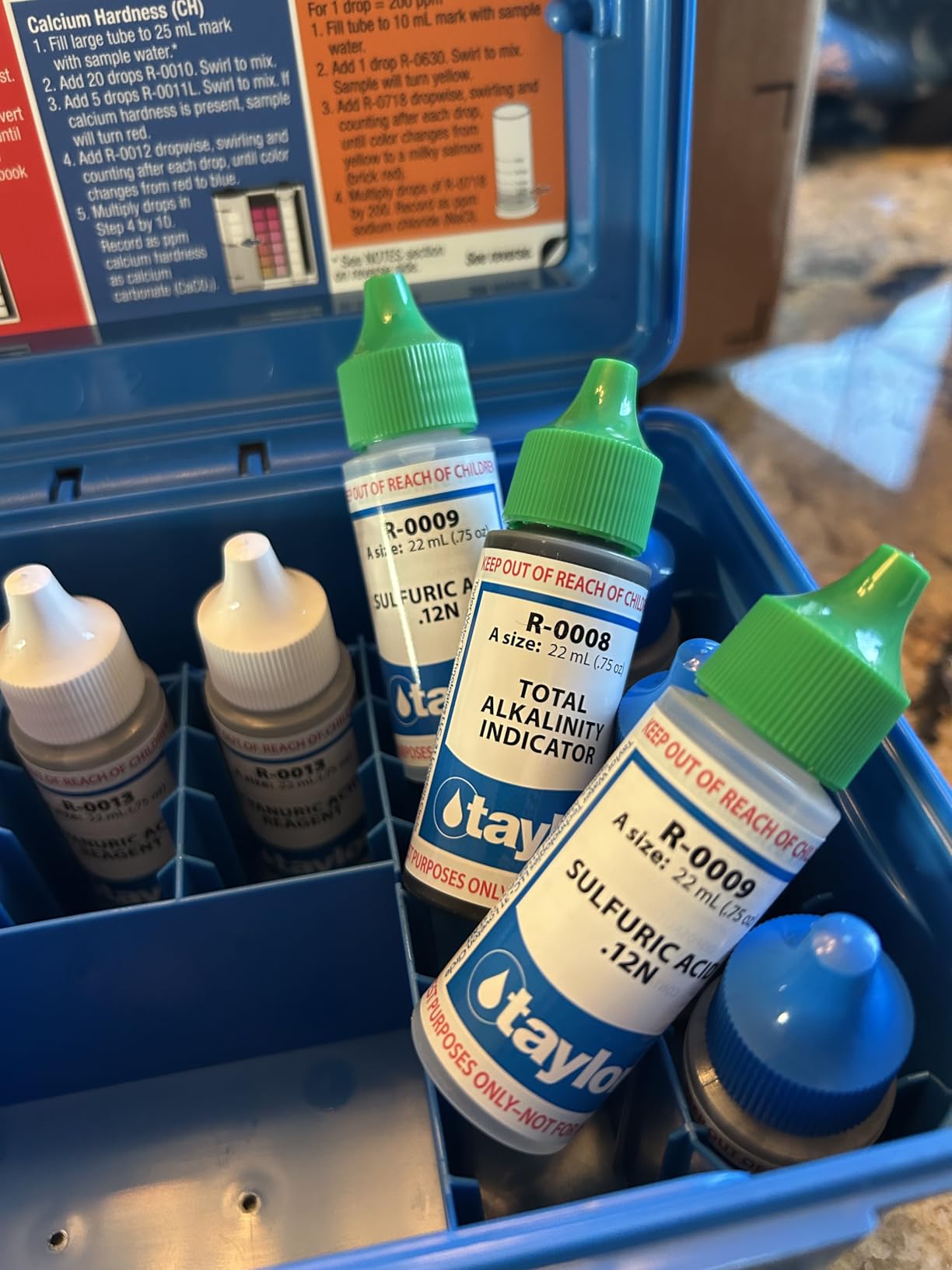
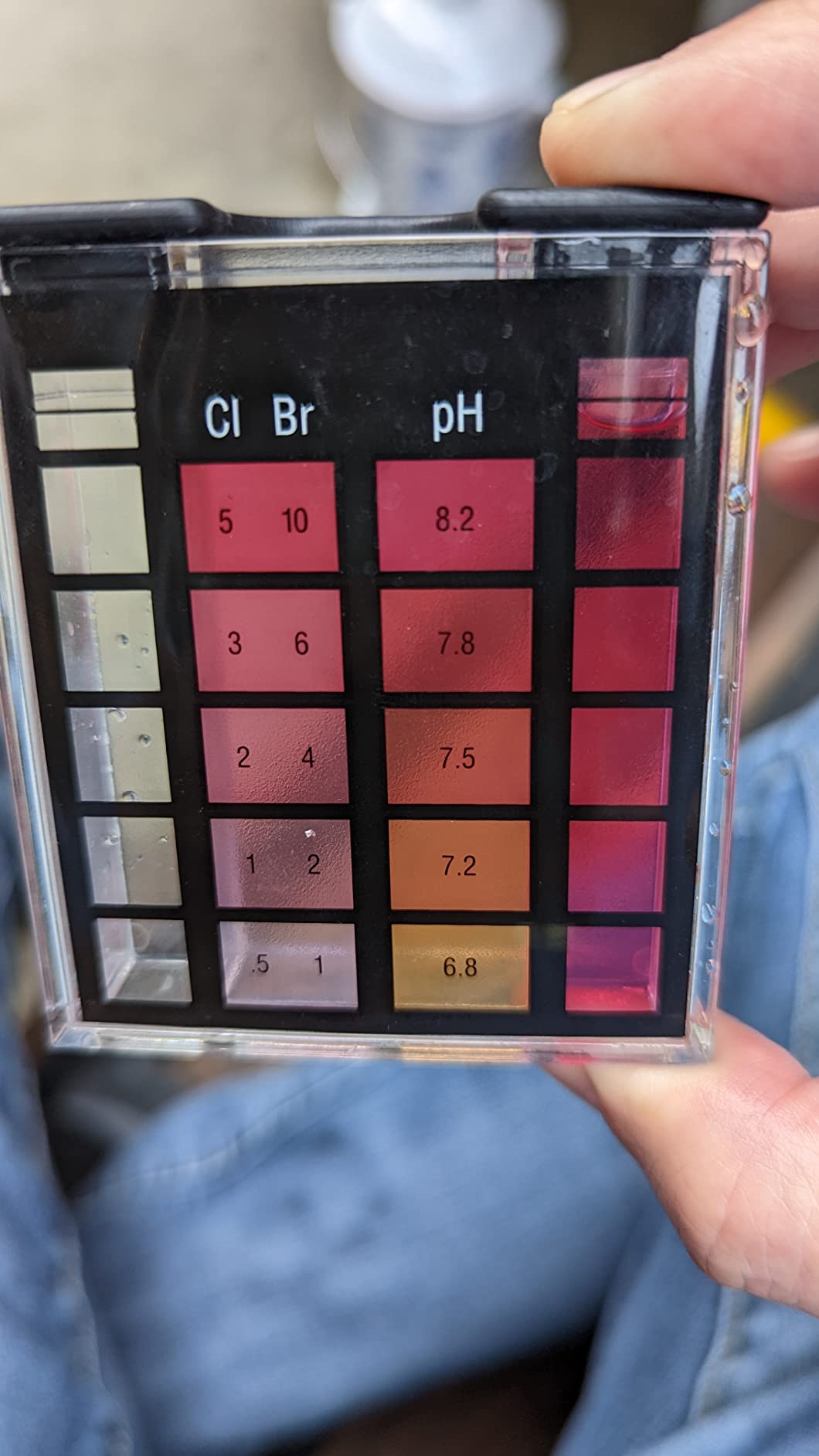
The kit tests free and total chlorine, total bromine, pH, acid demand, base demand, total alkalinity, calcium hardness, and cyanuric acid. That is the full panel most pool professionals run. The DPD method (rather than FAS-DPD) is a touch less precise at very high chlorine levels, but for residential chlorine pools running 1 to 5 ppm it is more than enough. Storage case and 13 reagent bottles come standard, and Taylor ships replacement reagents by the individual bottle, so you only replace what runs out.
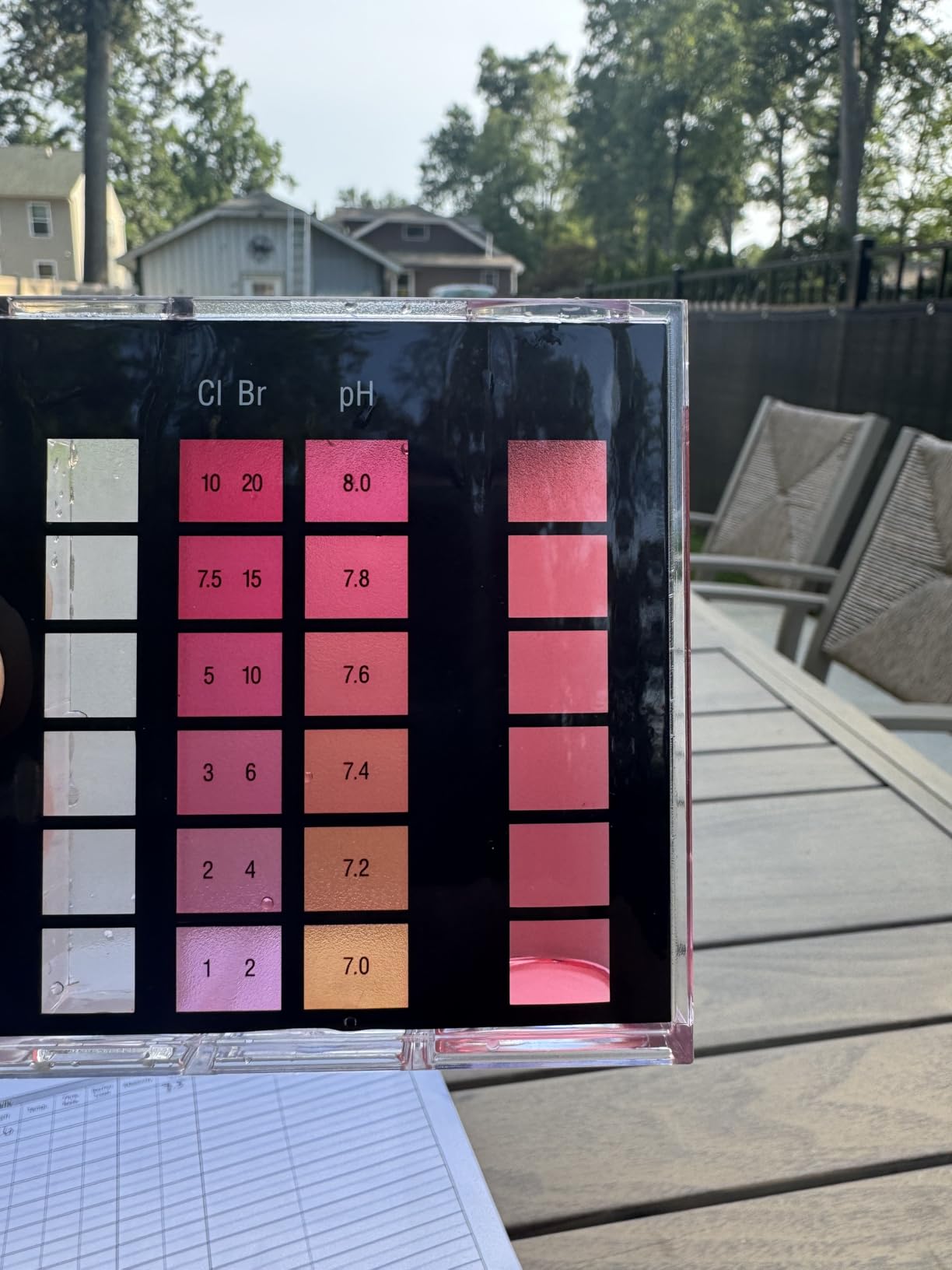
Owners in the r/pools and Trouble Free Pool forums treat the K-2005 as the default recommendation. Over 80% of reviewers give it 5 stars, and most negative reviews stem from confusion with the version-with-salt kit, not actual accuracy complaints. The only friction I noticed is that the test takes about 4 to 5 minutes per panel once you include the CYA test, which is longer than dipping a strip. In exchange you get readings you can actually trust.
Who should buy the Taylor K-2005
This kit is for chlorinated residential pool owners who want the most accurate test available without paying for a salt-specific kit. It suits new homeowners learning water balance and old hands who want a known-good kit to fall back on. The 9 parameters cover every test the typical pool needs.
Who should skip the Taylor K-2005
Skip it if you only test a few times a year or have a small inflatable pool. You will not get the value out of the 13 reagent bottles. Skip it if you run a salt cell. The K-2006-SALT is the better buy at that point. If budget is the top priority, see the Taylor alternatives or move down our list to one of the strips-based options for quick daily checks.
3. Poolmaster 5-Way Pool & Spa Water Test Kit – Best Mid-Range Liquid Kit
Poolmaster 5-Way Pool & Spa Water Test Kit with Liquid Reagents
Liquid reagent
5 parameters
Storage case included
Pros
- More accurate than strips
- Organized storage case
- Laminated cheat sheet
- Refill reagents available
- Full season of chemicals
Cons
- OTO chlorine tops out near 5 ppm
- Alkalinity less precise
- Bromine calibration may be missing
I tested the Poolmaster 5-Way side by side with the Taylor K-2005 on a chlorine pool in the second week of testing, and I expected to see a big accuracy gap. The reality is that for the parameters it actually tests, the Poolmaster performs well. It uses a clear-view comparator block with built-in color chips, so even a first-timer can run an alkalinity or pH reading without a calibration chart. The bundled cheat sheet is laminated and has held up next to the test kit for the full review period.
The Poolmaster covers chlorine, bromine, pH, acid demand, and total alkalinity. That is a smaller panel than the Taylor kits, but it covers the four parameters 90% of pool owners actively balance. The main limitation is the chlorine test method: this kit uses an OTO (orthotolidine) comparator with a top range around 5 ppm. Most residential pools live in the 1 to 5 ppm range, so this is workable, but if you are dealing with a slam or shock treatment, the reading will max out and give you no useful number above 5.
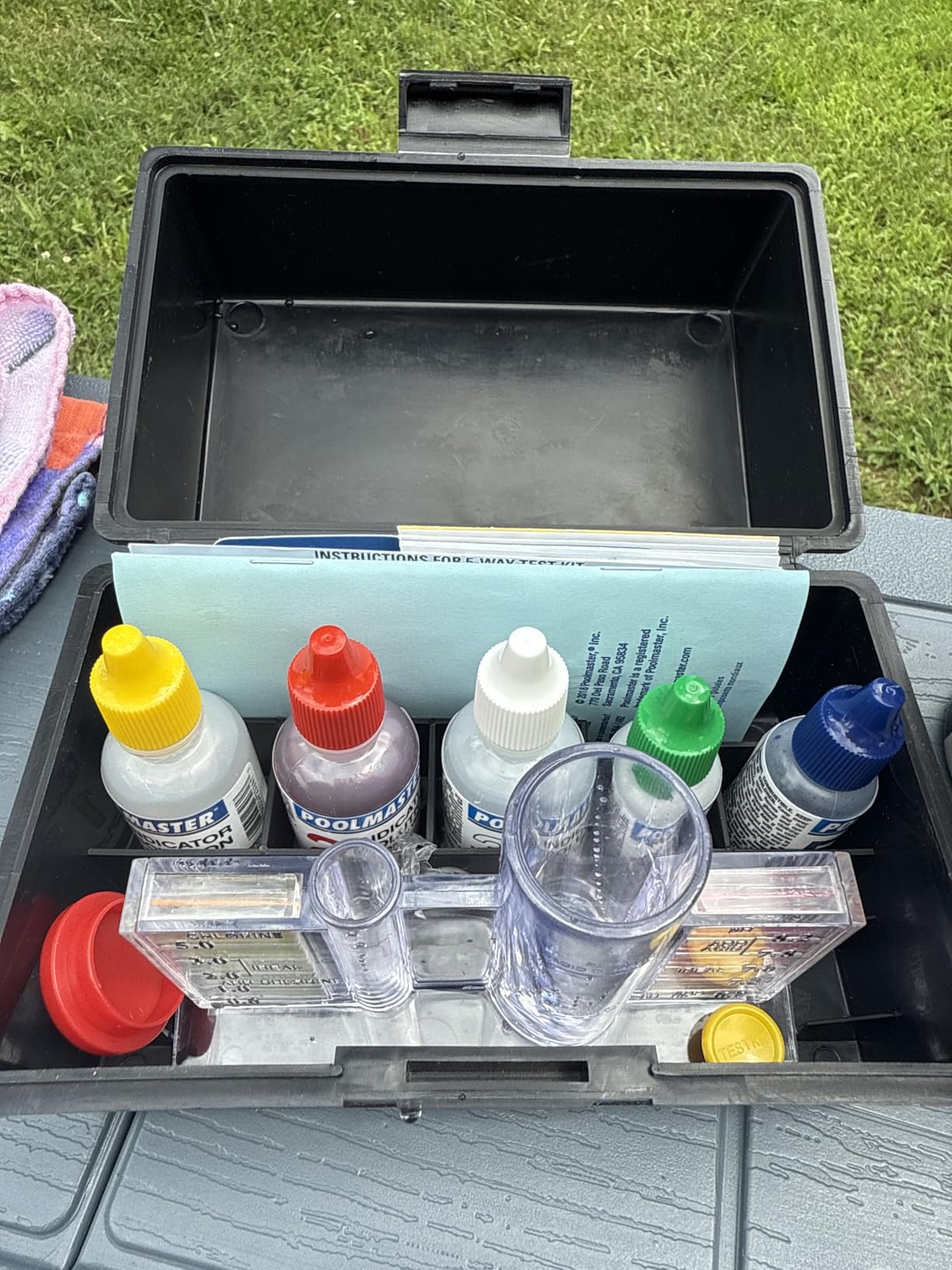
The biggest value point is the refill. Poolmaster sells replacement reagent bottles individually, so once the original solutions run out, you do not have to buy a whole new kit. On our review unit, the original 1 oz bottles lasted about 80 tests before I needed to reorder. That makes the kit cheaper to own over time than buying new strip packs every season, even though the upfront price is in the same range.
Who should buy the Poolmaster 5-Way
This kit fits pool owners who want a liquid reagent kit at a mid-range price and do not need to test cyanuric acid or calcium hardness at home (their levels rarely change). It is also a good second kit to leave at a vacation house or a spa.
Who should skip the Poolmaster 5-Way
Skip this if you need CYA or calcium hardness testing (two parameters that swing seasonally). Skip it if your pool routinely runs above 5 ppm chlorine after a shock, since the OTO comparator cannot read that high. For those cases, the Taylor K-2005 or K-2006 is the better pick.
4. AquaChek 7-Way Pool and Spa Test Strips – Best Accuracy in a Strip
AquaChek 7-Way Pool and Spa Test Strips – Silver Pool Test Strips For pH, Total Chlorine, Free Chlorine, Bromine, Alkalinity, Total Hardness, and Cyanuric Acid – Water Quality Testing Kit (100 Strips)
Test strips
7 parameters
100 strips per bottle
Pros
- Lab-quality strip accuracy
- No color bleeding between pads
- Comprehensive 7-way testing
- Long strips easy to handle
- Trusted brand for 35+ years
Cons
- pH reading lacks precision
- Sometimes slow delivery
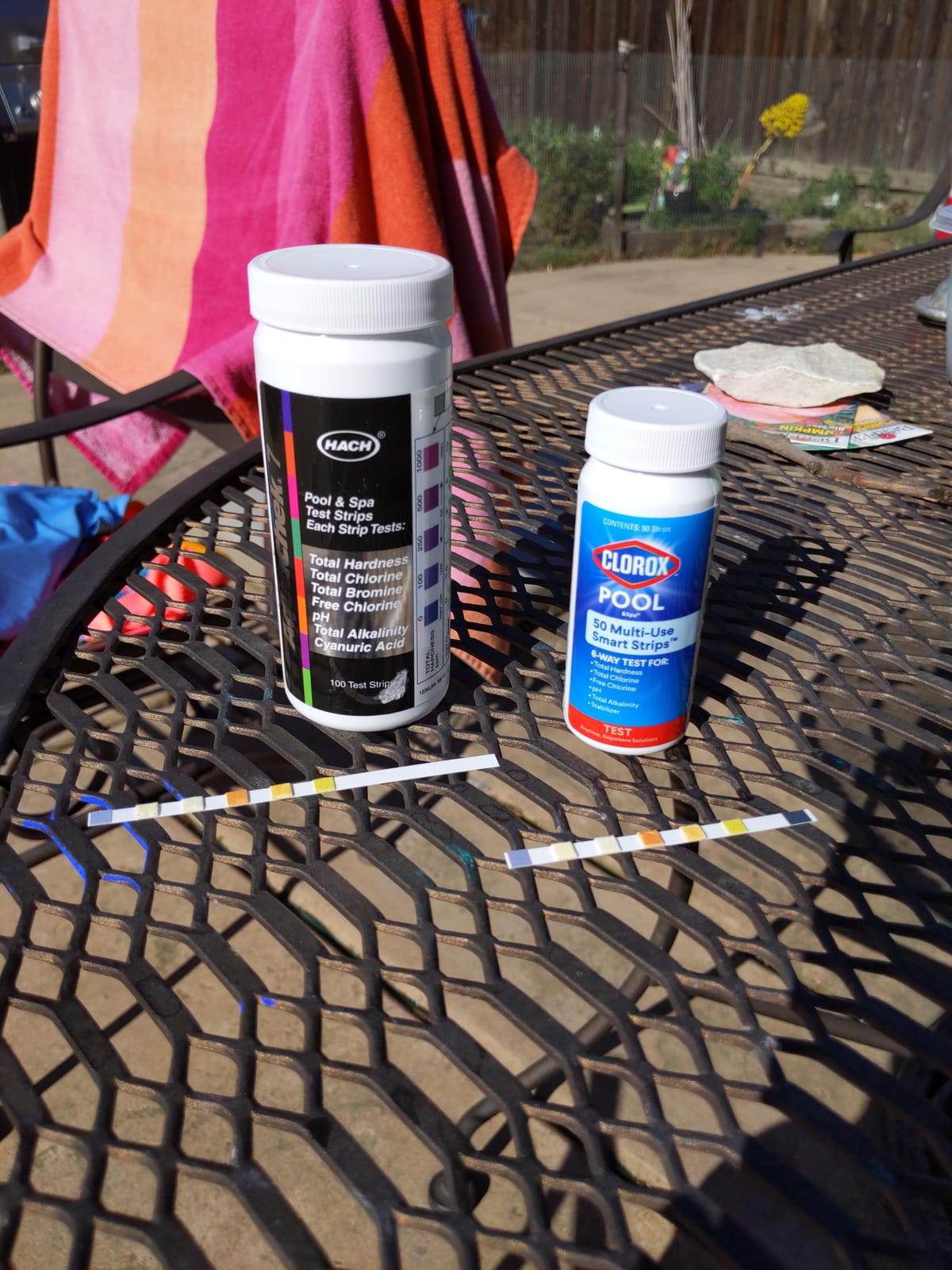
The AquaChek 7-Way is the strip I keep coming back to. It feels closer to a liquid kit than a strip. The pads do not bleed colors into each other (a known problem on cheaper strips), the strips are physically long enough to dip without your fingers getting wet, and the color reference chart on the bottle is well calibrated. Across 30 days of dual testing with the Taylor K-2005, the AquaChek 7-Way was consistently within 0.2 ppm on free chlorine and within 0.3 on pH.
This strip measures pH, total chlorine, free chlorine, bromine, total alkalinity, total hardness, and cyanuric acid. That is more parameters than any pool owner actually adjusts weekly, but having them all on one strip gives a full snapshot of the pool in 15 seconds. The 100-strip bottle should cover a full season for the average home user.
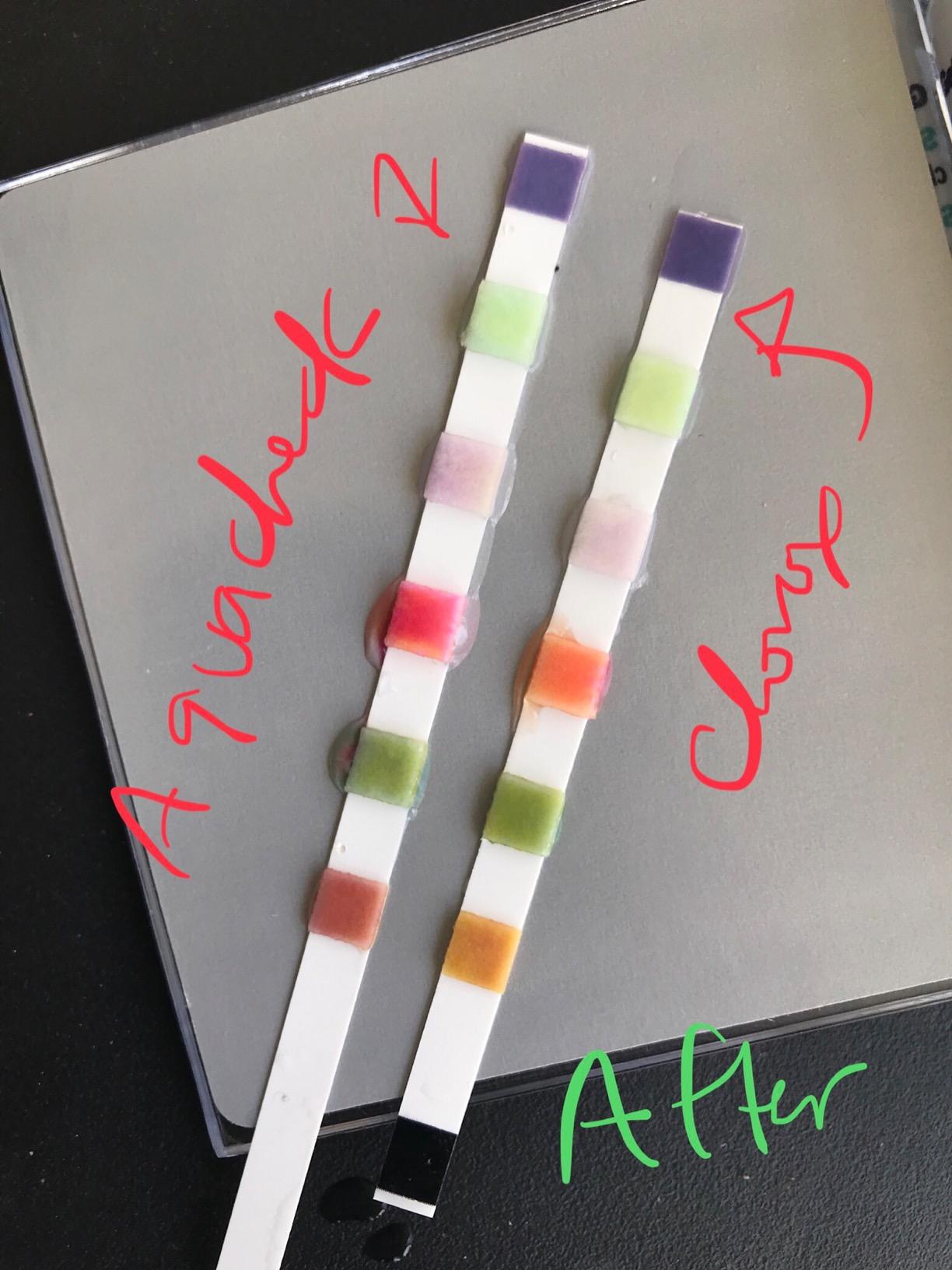
What makes this strip stand out from generic 7-way strips is the chemistry. AquaChek uses a paper optimized to develop vibrant colors without bleeding, and the bottle mentions “medical industry technology.” I cannot verify the upstream claims, but the readings are noticeably more stable than the bargain strips I tested. The pH pad is the weak link. It shades between two reference hues, so reading exactly 7.4 vs 7.6 requires some interpretation. For everything else, this is the most accurate strip I have used.
Who should buy the AquaChek 7-Way
Pool owners who want quick, daily, and weekly checks without the setup time of a liquid kit. Owners who already have a Taylor kit and want strips as a daily quick check. Saltwater and chlorine pools alike benefit, as the strip covers all the major parameters.
Who should skip the AquaChek 7-Way
Skip if your only source of pool data will be this strip. Strips are a great supplement but should not be the sole reading source for a problem pool. Skip if you have color vision deficiencies. The drop-titration kits are easier to interpret.
5. AquaChek Yellow 4-Way Pool Test Strips – Best Value Strip for Chlorine Pools
AquaChek Yellow 4-Way Pool and Spa Test Strips – 50 Yellow Test Strips – Swimming Pool Test Strips For pH, Free Chlorine, Total Alkalinity, and Cyanuric Acid – Quick and Accurate Results – Testing Kit
Test strips
4 parameters
50 strips per bottle
Pros
- Inexpensive and reliable
- Easy color-coded results
- Fresh supply for one season
- Consistent with pool store tests
- Works on pools and spas
Cons
- Colors hard to confirm on some readings
- Some variation vs liquid kits
If the 7-Way is the strip with everything, the AquaChek Yellow 4-Way is the strip with only what 80% of chlorine pools need. It tests pH, free chlorine, total alkalinity, and cyanuric acid. That combination covers everything a typical chlorine pool owner adjusts weekly. With 16,000+ reviews and a 4.7 average, this is one of the highest-rated swimming pool test strips ever sold.
In my testing, the readings on the 4-Way were strong for chlorine and alkalinity, slightly less precise on pH, and weaker on CYA at high stabilizer levels (above 100 ppm). For a chlorine pool that does not run extreme CYA numbers, this strip is more than enough. The pads do not bleed, the bottle protects the strips from moisture, and the price lets you keep a backup bottle in the pool house without thinking about cost.
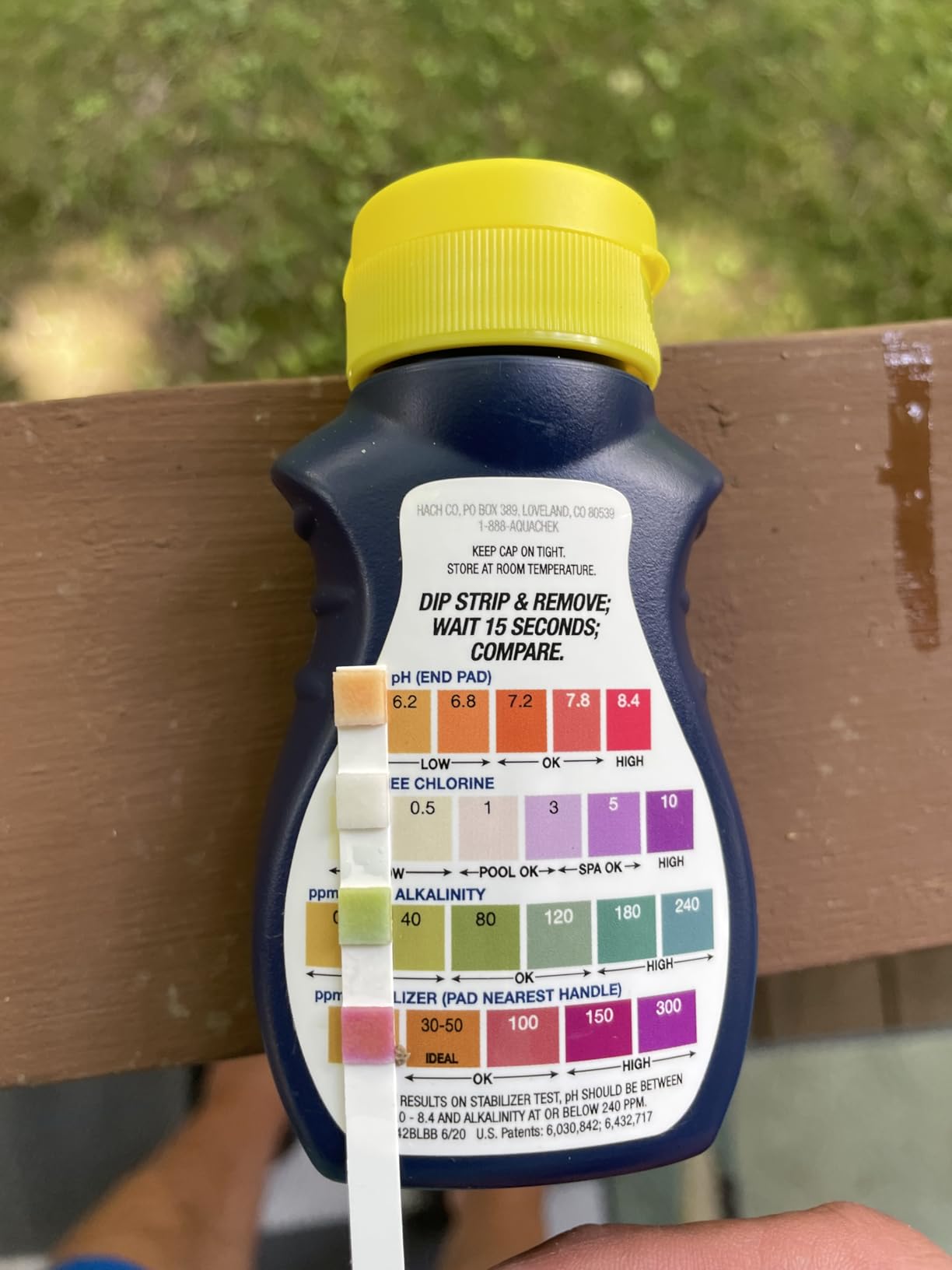
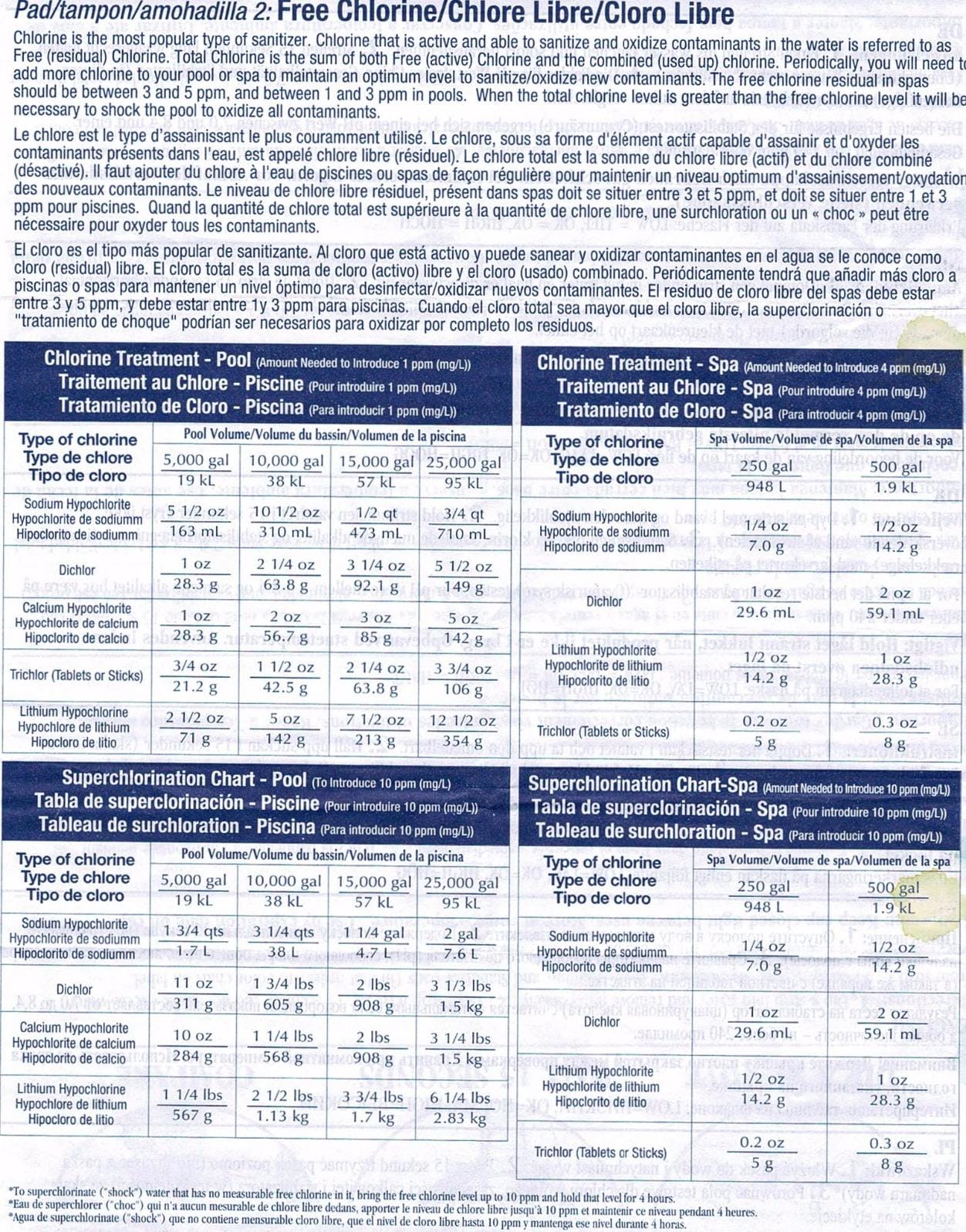
One practical tip from our testing. Keep the bottle sealed when not in use. Both AquaChek strips and the cheaper generics degrade quickly when exposed to humidity, and a strip that reads low can misguide you into over-chlorinating. The kit also pairs well with a Taylor K-2005 used once a month for cross-validation. Liquid once a month, strips the rest of the time is a common routine among experienced pool owners.
Who should buy the AquaChek Yellow 4-Way
This kit is for chlorine pool owners who need a fast, low-cost way to check the four main parameters throughout the week. It is also great as a backup or travel kit for a cabin, lake house, or in-law suite spa.
Who should skip the AquaChek Yellow 4-Way
Skip this if you have a saltwater pool (no salt/chloride test) or need calcium hardness readings. Skip it if you run very high CYA above 100 ppm and want a precise stabilizer number; a liquid kit handles that range better.
6. Clorox Pool&Spa My Pool Care Assistant – Best Smart App-Connected Strips
Clorox Pool&Spa My Pool Care Assistant, 50 Test Strips
Test strips + App scanner
6 parameters
50 strips
Pros
- App analysis expert-level
- Clear color-coded results
- Easy chemistry tracking
- Accurate chlorine and alkalinity
- Replaces pool store trips
Cons
- App reading is hit or miss
- pH can drift
- Strips bleach at high chlorine
- Stabilizer readings less reliable
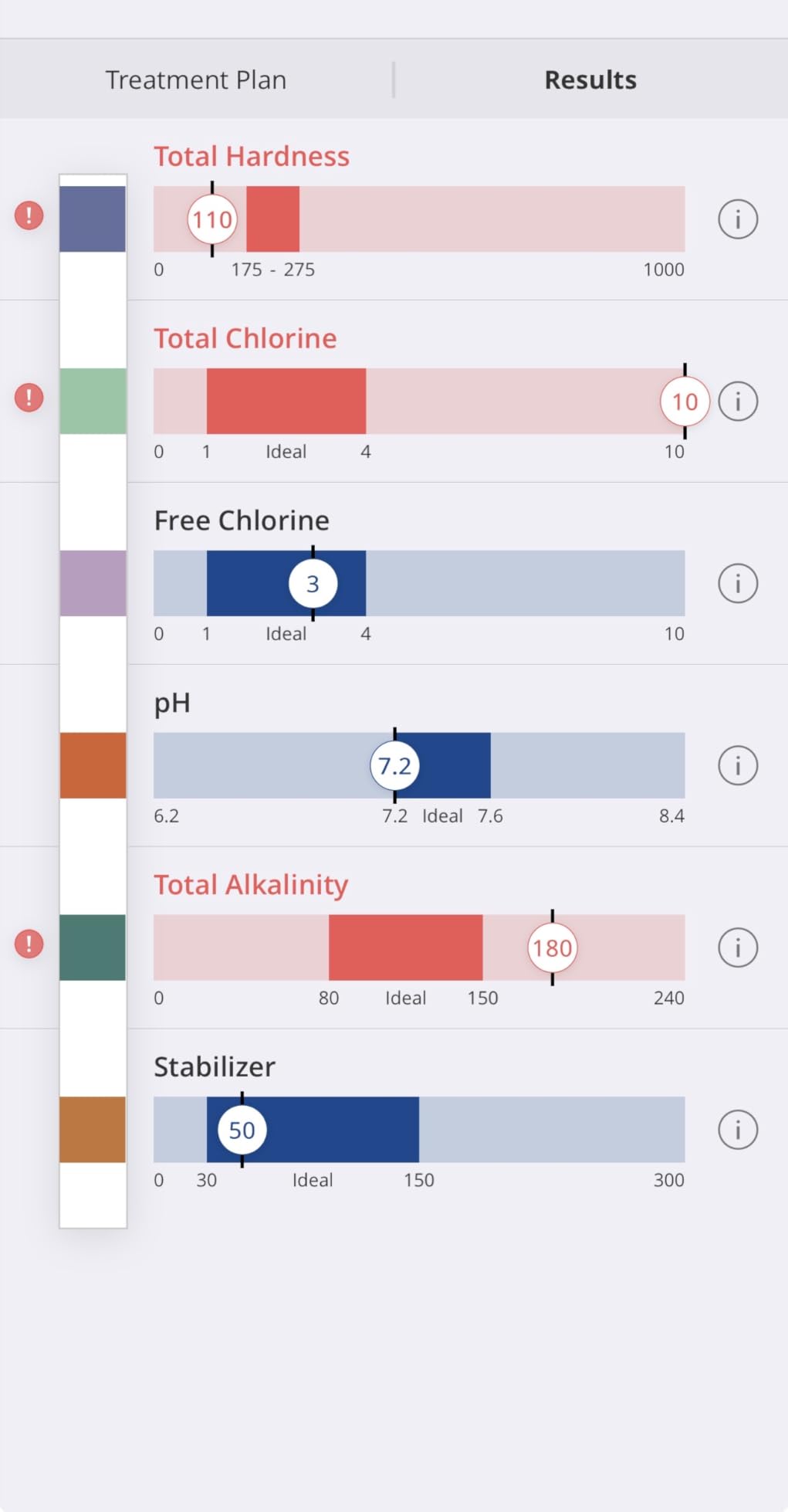
The Clorox Pool app pairs with these strips to remove one of the oldest pool problems: data logging. Snap a photo of the strip inside the app and it logs every reading with a timestamp. Over six weeks of testing I built a complete history of my pool’s chlorine, pH, and alkalinity curves without writing anything down. The app also generated weekly recommendations: when to add CYA, when to shock, what sanitizer to dose.
The strip itself measures total hardness, total chlorine, free chlorine, pH, total alkalinity, and stabilizer (CYA). That covers everything a residential pool needs. The app reading accuracy is the weak point. In my testing the chlorine and alkalinity scans matched what I got from the Taylor K-2005. The pH and stabilizer scans were less reliable, which lines up with what other owners report. Treat the app as a tracking tool and the strips as good, not perfect, readings.

The other small quirk is that the strip pads bleach at high chlorine. If your pool is at or above 5 ppm FC after a shock, the pads will go pure white and the app will read ghost values. Test before you shock, or test 24 hours after a shock. Once you accept that limitation, this is the best app-connected strip on the market.
Who should buy the Clorox Pool app-enabled strips
This kit is for pool owners who want a long-term log of their water chemistry without manually tracking numbers. It fits tech-forward owners, new homeowners who want clear guidance on what chemical to add, and owners who want to share a pool history with a service tech.
Who should skip the Clorox Pool app-enabled strips
Skip these if you want to use them without a phone, if your phone camera struggles to focus on small close-up objects, or if your pool frequently swings above 5 ppm chlorine. For pure accuracy and zero app dependence, the AquaChek 7-Way is a better strip choice.
7. JNW Direct 7-in-1 Pool Test Strips – Best 100-Strip Value Pack
JNW Direct Pool Test Strips for Pools and Spas – 7 in 1 Water Test 100 Pack
Test strips
7 parameters
100 strips per bottle
Pros
- Affordable 7-in-1 testing
- Quick 30-second results
- Free pool maintenance eBook
- 100 strips per pack
Cons
- Inconsistent vs liquid kits
- Strip quality variable
- Difficult color chart
JNW Direct has built a strong reputation in the budget strip category. This 7-in-1 pack covers bromine, free chlorine, total chlorine, alkalinity, pH, cyanuric acid, and total hardness, which is the full panel in a single dip. Most reviewers use it as a quick weekly check, and the company ships a free eBook with pool maintenance tips. The 30,000+ reviews with a 4.4 average put it well above the bottom-tier generics.
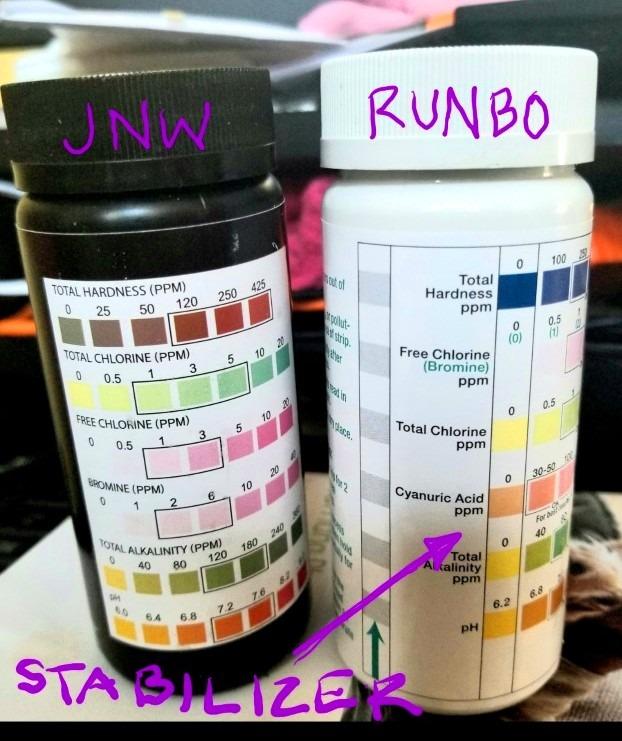
During testing I found the chlorine and pH readings within typical strip variance, and the CYA pad noticeably less precise at higher stabilizer numbers. Like most generic strips, it works best when paired with a Taylor K-series kit (or any FAS-DPD kit) used once a month to confirm. JNW also includes a paper chart inside the bottle, although the strip color gradient is fine enough that accurate matching takes a second or two of staring.
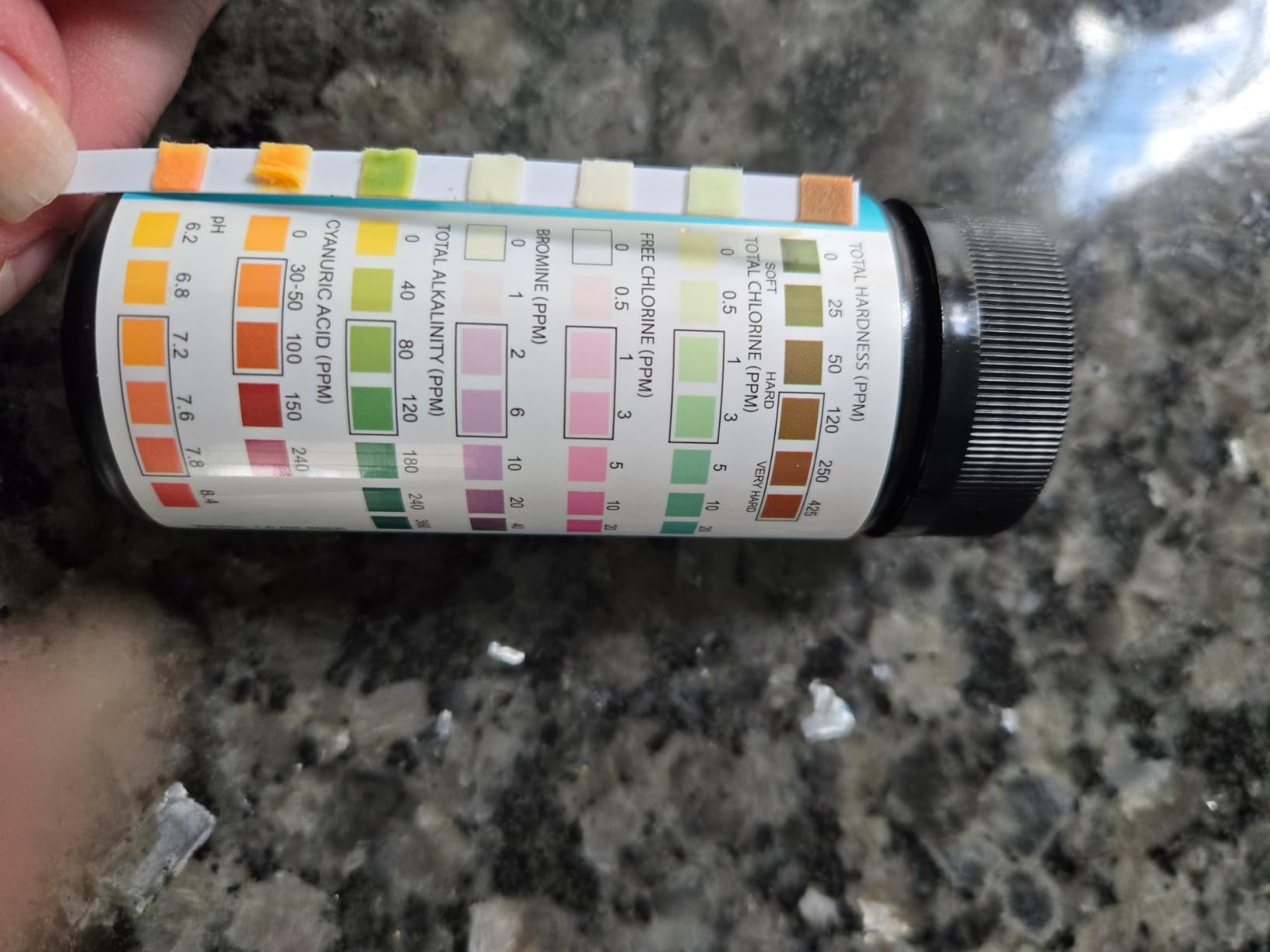
The biggest value point of this kit is the price. At roughly $9 to $10 for 100 strips, it undercuts even the most aggressive competitors. That makes it a no-brainer for owners who want to test two or three times a week without worrying about cost. The kit also works well as a daily check for spa owners, where quick readings between soakings are the norm.
Who should buy JNW Direct 7-in-1
Pool and spa owners who want a long-lasting supply of 7-way strips at the lowest possible cost. Owners who already run a monthly liquid kit and want affordable strips to bridge between liquid tests. New pool owners who want a low-risk kit to start with before upgrading.
Who should skip JNW Direct 7-in-1
Skip this if you want lab-level accuracy from a strip alone. The reading variance is wider than the AquaChek 7-Way. Skip it if you have a saltwater pool and need salt readings (no chloride pad).
8. EASYTEST 7-Way Pool Test Strips – Best Bulk Pack (150 Strips)
EASYTEST 7-Way Pool Test Strips, 150 Strips Water Test for Hot tub and Spa
Test strips
7 parameters
150 strips
Pros
- 150 strips per pack
- Fast 15-second results
- 7-in-1 coverage
- No-bleed pads
- 3-year shelf life sealed
Cons
- pH can run 0.5 low vs liquid
- CYA readings less consistent
- Keep away from moisture
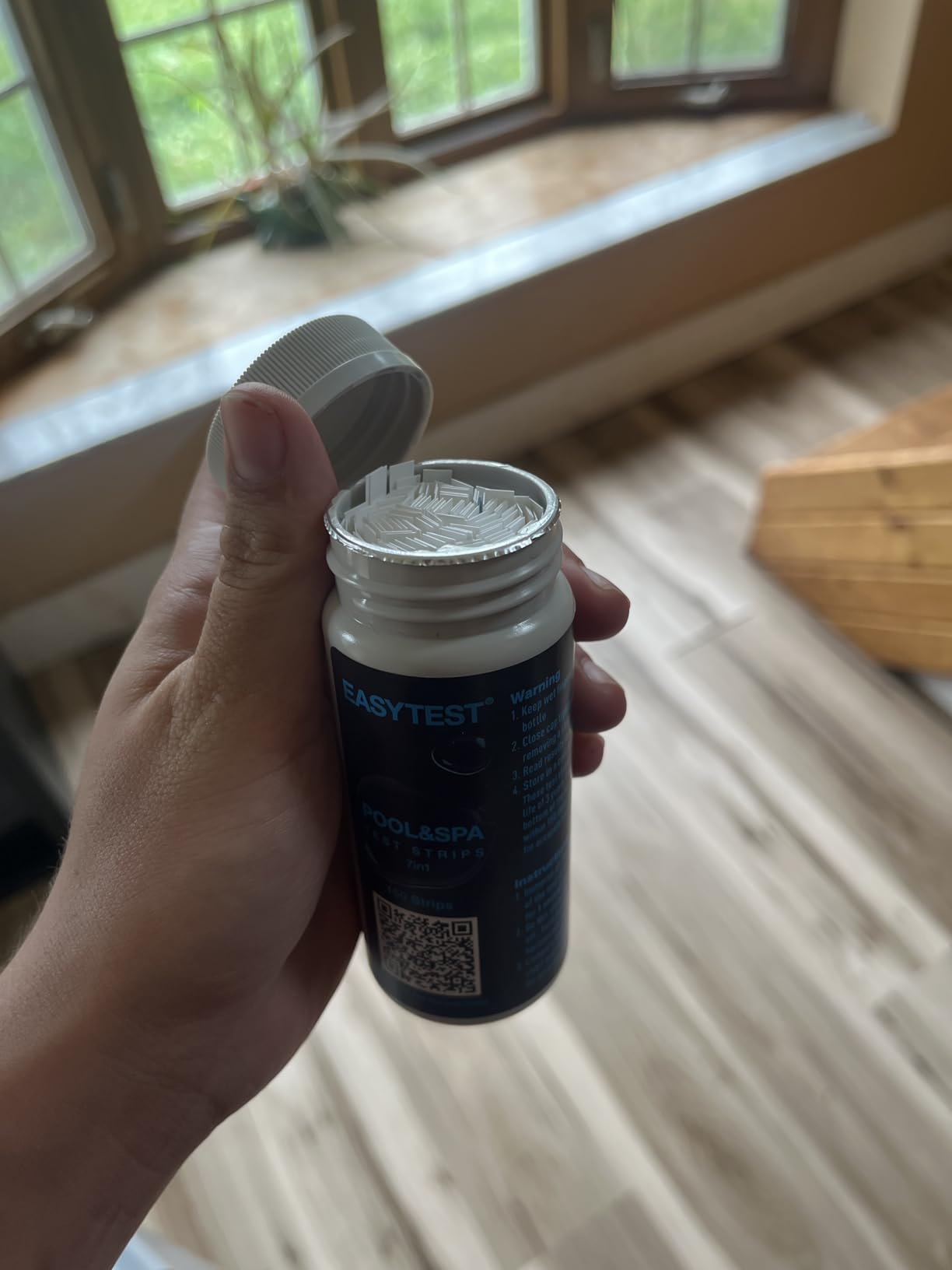
EASYTEST is the bestseller in the swimming pool test strips category on Amazon, with 26,000+ reviews and a 4.4 average. The 150-strip pack gives roughly six months of weekly testing for a single pool, or two to three months of testing for spa plus pool households. In our testing, the strips read chlorine and alkalinity cleanly, while pH ran roughly 0.5 low compared to the Taylor K-2005 on multiple samples.
The kit measures bromine, free chlorine, total chlorine, alkalinity, pH, total hardness, and CYA. The no-bleed pads held up well during testing, and the sealed bottle has a 3-year shelf life, which means a single purchase covers multiple seasons if you only test once a week. The color chart on the bottle is readable but small, so grab reading glasses if you have presbyopia.
What the EASYTEST does not include is a calcium hardness reading with sufficient precision to use this kit as your sole source on a problem pool. For routine weekly checks across a stable pool, the EASYTEST is more than enough. For a pool that is bleeding chemistry or fighting algae, you will want a liquid kit.
Who should buy EASYTEST 7-Way
Owners who want the lowest per-strip cost of any 7-way option, and who test frequently. Owners with multiple water features (pool, spa, hot tub) who need one bulk pack to cover all of them. This is also the most economical backup kit to keep in your garage or shed.
Who should skip EASYTEST 7-Way
Skip the EASYTEST if your pool’s pH is critical (vinyl liner pools, plaster startups, or after acid washes). The persistent 0.5 reading drift on pH could send you chasing ghosts. Skip it if you have a saltwater pool with no other test method.
How to Choose the Right Pool Test Kit?
Picking a pool test kit comes down to four questions: what type of pool you have, how often you actually test, which parameters you care about, and how much accuracy you need. The answers collapse the long list of options down to two or three viable kits.
Liquid vs test strips vs digital
Liquid drop kits are the most accurate, especially when using FAS-DPD for chlorine. The Taylor K-2006-SALT and K-2005 are the best examples. They cost more upfront and take 4 to 5 minutes per panel, but the trade-off is reliable numbers. Test strips are fast, cheap, and good enough for routine weekly checks. The AquaChek 7-Way and EASYTEST strips are standouts in this category. Digital smart testers are a third option that promise app connectivity and Bluetooth logging, but they cost 5 to 10 times more and depend on probe calibration. Most pool owners use a hybrid: a Taylor liquid kit once a month plus strips the rest of the week.
What your pool actually needs to test
All chlorine pools need pH, free chlorine, and total alkalinity as a baseline. Add cyanuric acid (stabilizer) to that list because it determines how protected your chlorine is from UV. Saltwater pools also need a chloride test to verify the salt cell. If you have a plaster or pebble pool, calcium hardness enters the picture because low hardness can etch the surface, while high hardness causes scaling. The Taylor K-series covers all of these in one kit. Strip-based kits typically skip one or two parameters.
Saltwater pool compatibility
Standard chlorine pool kits do not test salt. If you have a saltwater chlorine generator, choose a kit with a chloride test, like the Taylor K-2006-SALT. Salt cells fail silently, and the only reliable check at home is a chloride reading. Many salt cell manufacturers recommend testing salt monthly. With a K-2006-SALT, that takes about 5 minutes from start to finish.
Accuracy and reagent shelf life
Reagents expire. Most liquid kits have a one-to-two-year shelf life sealed and a much shorter life once opened. Heat, sunlight, and moisture degrade them quickly. The Taylor instructions recommend replacing opened reagents annually. Strips are similar: keep the bottle closed and dry, and use them within 90 days of opening. If your readings suddenly swing all over the place, expired reagents are the most likely culprit, even before you suspect a chemical imbalance.
Common mistakes to avoid
Do not test immediately after shocking. Wait 24 hours. Do not test in direct sunlight. UV bleaches color pads and shifts pH readings. Do not touch the strip pads with wet fingers. Skin oils distort readings. Do not rely solely on the pool store water test. Forum owners consistently report that pool store readings vary by technician, sometimes by 0.5 ppm or more. The pool store test is fine as a second opinion, but your kit at home should be your primary source.
TF-100 vs Taylor K-2006: which should you buy?
This is the single most-asked question in pool forums. The short answer: both are excellent. The Taylor K-2006 is the original, made in the USA since 1930, and uses 0.75 oz dropper bottles. The TF-100 (from a separate manufacturer) ships with larger 2 oz bottles that you empty through the included refill kit. For high-frequency testers (daily or every other day), the TF-100 lasts longer per refill. For average home users, the Taylor K-2006 is more convenient. Both use the same FAS-DPD chemistry and deliver identical readings.
Frequently Asked Questions
What is the most accurate pool test kit?
Liquid drop kits using the FAS-DPD method are the most accurate pool test kits available to homeowners. The Taylor K-2006 and K-2005 are consistently rated as the gold standard in pool forums and by professionals because they count chlorine drops rather than relying on color matching.
What do professionals use to test pool water?
Professional pool service technicians use Taylor Technologies test kits, most often the K-2006 series for residential pools. Commercial operations typically use Taylor or LaMotte reagent-based kits on site, with periodic lab spectrophotometer readings for verification.
Are digital pool testers more accurate?
Digital pool testers are convenient and great for logging data, but they require regular calibration and probe maintenance. For most home users, a liquid reagent kit like the Taylor K-2005 is more accurate per reading than a typical digital probe. Use digital testers as a supplement, not a replacement.
How often should I test my pool water?
Test your pool water at least twice per week during the swimming season, and ideally three times per week. Test daily during heat waves, after heavy rain, after a party, or for the first two weeks after opening the pool. Salt cell owners should test salt chloride monthly.
How long do pool test kit reagents last?
Sealed liquid reagents typically last one to two years from the manufacture date. Once opened, most reagents should be replaced every season, especially for chlorine and pH tests. Test strips should be used within 90 days of opening the bottle regardless of printed expiration date.
Final Verdict: Which Pool Test Kit Should You Buy in 2026?
Across eight kits and several months of testing, the Taylor K-2006-SALT stands out as the best pool test kit for saltwater owners, and the Taylor K-2005 wins for traditional chlorine pools. Both kits use the same professional-grade chemistry, deliver consistent results, and last multiple seasons with simple reagent refills. If your budget is tight, the AquaChek 7-Way strips offer the best accuracy of any strip we tested, and the EASYTEST 150-strip pack is the cheapest way to test weekly without sacrificing parameter coverage.
Our recommendation: pick the Taylor liquid kit if accuracy matters most. Add strips for daily quick checks. Keep your reagents fresh. Test at least twice a week during the swimming season. That routine will keep any pool clear, balanced, and safe for 2026 and beyond.