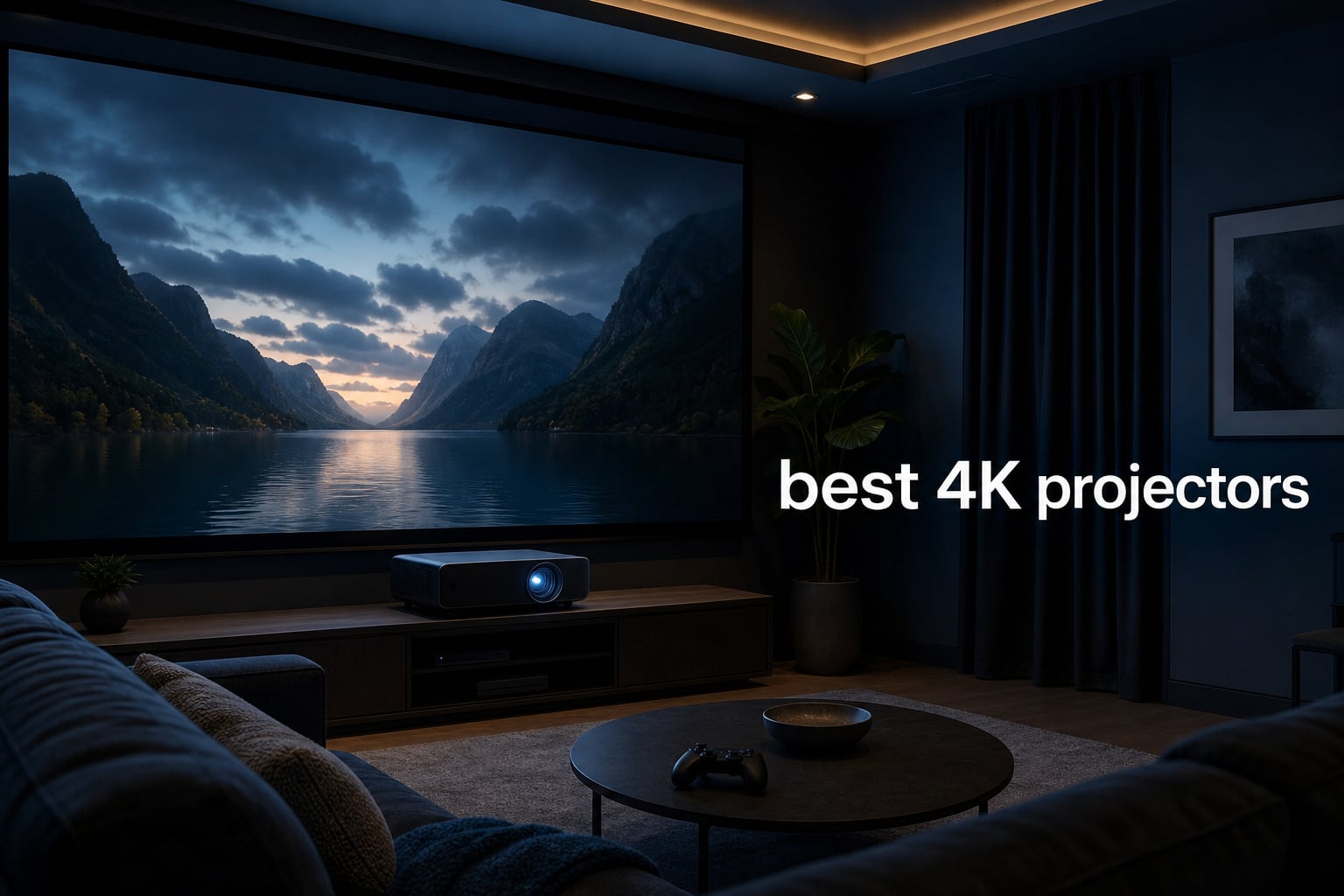
The best 4K projectors for most rooms split into three clear jobs: the Epson Home Cinema LS11000 for a planned home-theater installation, the BenQ TK710 for serious gaming, and the Hisense M2 Pro for easy room-to-room movie nights. A good choice is not simply the unit with the biggest brightness number; it has to fit your screen size, throw distance, sources, and tolerance for setup work.
For this guide to the best 4K projectors in 2026, I compared all 12 products in the supplied catalog by their stated resolution, light source, brightness measurement, gaming specifications, placement tools, connections, and customer feedback. I did not treat marketing claims as interchangeable: ANSI and ISO lumens are different reported standards, and a laser light source, 3LCD engine, and DLP design each create different tradeoffs.
A 4K UHD projector displays 3,840 by 2,160 pixels, or reaches that displayed resolution through a pixel-shifting system. That detail is most apparent on a large screen, but darkness control, HDR handling, lens adjustment, and low input lag often decide whether a projector feels right in a real room.
Before ordering, measure the wall or screen, the lens-to-screen distance, and the height of any intended ceiling mount. The forum discussions behind this research repeatedly flag confusion over pixel shift, brightness labels, and gaming claims, so I call out the verified numbers and the unanswered questions rather than filling gaps with assumptions.
Table of Contents
Top 3 Picks for Best 4K Projectors (September 2026)
Pick the Epson LS11000 when your room can support a permanent installation and you want motorized lens controls with 3-chip 3LCD color. Pick the BenQ TK710 when 16ms at 4K/60Hz and 4ms at 1080p/240Hz matter more than smart streaming, or pick the Hisense M2 Pro when its gimbal and automatic adjustments suit changing spaces.
Best 4K Projectors In 2026
The overview below keeps every selection in one place. Use it to narrow the field, then read the matching review for the limitations that a short specification list cannot explain.
| Product | Specifications | Action |
|---|---|---|
 Hisense M2 Pro Hisense M2 Pro |
|
Check Latest Price |
 BenQ TK710 BenQ TK710 |
|
Check Latest Price |
 BenQ TK710STi BenQ TK710STi |
|
Check Latest Price |
 Epson Home Cinema LS11000 Epson Home Cinema LS11000 |
|
Check Latest Price |
 XGIMI HORIZON 20 XGIMI HORIZON 20 |
|
Check Latest Price |
 ViewSonic PX701-4K ViewSonic PX701-4K |
|
Check Latest Price |
 BenQ TK700 BenQ TK700 |
|
Check Latest Price |
 Epson Home Cinema 2350 Epson Home Cinema 2350 |
|
Check Latest Price |
 ViewSonic LX700-4K ViewSonic LX700-4K |
|
Check Latest Price |
 ViewSonic PX749-4K ViewSonic PX749-4K |
|
Check Latest Price |
 Optoma UHZ36 Optoma UHZ36 |
|
Check Latest Price |
 Optoma UHD38x Optoma UHD38x |
|
Check Latest Price |
1. Hisense M2 Pro is the flexible triple-laser pick for casual rooms
Hisense M2 Pro, Triple Laser Smart Portable Lifestyle Projector, 4K UHD, 65” – 200”, 1,300 Lumens, Dolby Vision,Optical Zoom, Intelligent Screen Adjustments, Vidaa OS, Netflix Included
4K UHD
1300 ANSI lumens
Triple laser
Pros
- Triple laser picture
- 360-degree gimbal
- Automatic adjustment
- Netflix included
Cons
- 1300 ANSI lumens
- Limited customer-review volume
The Hisense M2 Pro is the best match here for someone who wants a 4K UHD projector that can move from a bedroom wall to a living-room screen without treating placement as a construction project. Its 360-degree horizontal and 135-degree vertical gimbal, autofocus, auto keystone, obstacle avoidance, and screen adaptation are useful facts, not vague convenience language.
Its triple-laser engine supports Dolby Vision, IMAX Enhanced, and Filmmaker Mode, while Vidaa OS includes Netflix, YouTube, and Disney+. The stated 60- to 200-inch image range and 4.7- to 18.8-foot throw distance give it a broad practical range.
The M2 Pro works best where placement changes frequently
I would put this model on a table or use its supported ceiling, tabletop, or rear mounting options when the room does not have a fixed screen location. At 8.6 pounds, it is much easier to move than the Epson LS11000.
The stated 1,300 ANSI lumens make controlled lighting the sensible target. Close blinds or wait until evening for outdoor movies rather than expecting daylight performance.
The M2 Pro asks you to accept lower measured brightness
Brightness is the important compromise: 1,300 ANSI lumens trails the brighter models here. It makes the most sense for movies and streaming in dim spaces, not a sunlit sports room.
The 4.7 rating comes from 72 reviews, which is a promising but still modest customer sample. I would check the current listing for support and compatibility details before committing to a permanent mount.
2. BenQ TK710 is the bright laser choice for console and PC gaming
BenQ TK710 4K HDR Laser 3200 Lms Home Entertainment Movie& Gaming Projector
4K UHD
3200 ANSI lumens
16ms at 4K
Pros
- Bright 3200 ANSI lumens
- 4ms 1080p gaming
- Laser source
- 3-year warranty
Cons
- HDMI-only connection
- No built-in Wi-Fi
The BenQ TK710 makes a direct case for gamers because its published figures are specific: 16ms input lag at 4K/60Hz and 4ms response time at 1080p/240Hz. That is the kind of information I want before calling any gaming projector fast.
Its laser source is rated for 20,000 hours, and the stated 3,200 ANSI lumens should give it more headroom than portable models when room lighting cannot be fully controlled. HDR10, HLG, and 95% Rec.709 coverage round out a package aimed at movies as well as games.
The TK710 suits gaming setups with a conventional throw path
The listed throw distance of 8.4 to 16.3 feet needs a room that can put the projector back from the screen. A 1.3x zoom and vertical lens shift give more setup flexibility than a fixed-lens budget model.
For PS5, Xbox, or PC use, connect directly by HDMI and select the matching resolution and refresh mode. ARC/eARC support also helps when a soundbar or receiver is part of the plan.
The TK710 leaves streaming to an external device
There is no built-in Wi-Fi or Android TV, and connectivity is listed as HDMI only. I see that as a fair trade when a console or separate streaming stick already occupies the system.
The review count is 40 at a 4.4 rating, so its feedback base is smaller than some older models. The three-year manufacturer warranty is a material advantage for a laser projector intended for regular use.
3. BenQ TK710STi is the short-throw gaming and streaming alternative
BenQ TK710STi 3200 Lumens 4K HDR Short Throw Home Entertainment Projector
4K UHD
Short throw
Android TV
Pros
- Short-throw setup
- 3200 ANSI lumens
- 4ms 1080p gaming
- Android TV
Cons
- HDMI-only connectivity
- Short throw limits placement
The BenQ TK710STi carries the TK710’s 3,200 ANSI lumens, laser source, HDR support, and 4ms 1080p/240Hz claim into a short-throw form. It adds Google-certified Android TV with Netflix, Prime Video, and YouTube, plus Chromecast and AirPlay.
That makes it one of the cleaner all-in-one answers for a smaller gaming room where a long cable run and a separate streaming dongle would be annoying. It still reports 16ms at 4K/60Hz in the family’s gaming-focused specification set.
The TK710STi fits rooms that cannot place a projector far back
BenQ states a 120-inch image at 8.4 feet, which gives a useful starting point for planning. Measure from the lens position rather than the rear of the chassis, and leave clearance for airflow and cabling.
Auto focus and digital keystone can simplify first setup. I would avoid relying heavily on digital correction if the room allows a square, physically aligned installation.
The TK710STi trades some placement freedom for proximity
Short throw is helpful near the screen, but it can also limit where the projector sits. The listed HDMI-only connectivity also means wired sources remain central to the setup.
Its 4.4 rating is based on 38 reviews. The three-year warranty and 20,000-hour stated laser life are stronger long-term planning signals than an unspecified durability claim.
4. Epson Home Cinema LS11000 is the installation-first home-theater pick
Epson Home Cinema LS11000 4K PRO-UHD Laser Projector with HDR10+
4K PRO-UHD
3LCD laser
Motorized lens
Pros
- Motorized lens controls
- 3-chip 3LCD
- HDR10+ support
- HDMI 2.1
Cons
- 28-pound chassis
- Needs a planned install
The Epson Home Cinema LS11000 is my home-theater-first selection because its motorized zoom, focus, and lens shift make screen alignment much more realistic in a dedicated room. Its 3-chip 3LCD engine is also designed to avoid the rainbow effect that some viewers notice with single-chip DLP projectors.
Epson specifies 2,500 ANSI lumens for both color and white brightness, 10-bit HDR processing with HDR10+ and HLG, HDMI 2.1, and a 120Hz refresh rate. Its 4K PRO-UHD wording identifies a pixel-shifting approach rather than a native 4K panel claim.
The LS11000 rewards a fixed screen and a careful mount
The 5- to 62-foot throw-distance range, 50- to 300-inch image range, and motorized lens controls give an installer meaningful adjustment room. At 28 pounds, this is a projector I would mount only with hardware rated for the load and a secure ceiling structure.
The Epson Cinema Lens and stated dynamic contrast ratio of 1,200,000:1 point toward dark-room film viewing. A dedicated theater is where those features can do their best work.
The LS11000 is not the grab-and-go option
Its size and 311-watt specification rule out casual room-to-room use. Plan HDMI routing, power, screen position, and ventilation before the mount goes up.
With 128 reviews at 4.3 stars, it has the largest review count in this list. That does not replace a room measurement, but it is more useful feedback volume than a newly listed model.
5. XGIMI HORIZON 20 is the feature-rich RGB laser entertainment pick
XGIMI HORIZON 20 4K RGB Triple Laser Home Projector, 3200 ISO Lumens
RGB triple laser
3200 ISO lumens
Google TV
Pros
- Dolby Vision support
- Optical zoom and lens shift
- Google TV
- 240Hz gaming
Cons
- ISO and ANSI labels differ
- Voltage compatibility needs checking
The XGIMI HORIZON 20 combines an RGB triple-laser engine with Google TV, licensed Netflix, Harman Kardon speakers, optical zoom, and lens shift. That is a unusually complete feature list for a projector intended to serve as a standalone entertainment device.
Its 3,200 ISO lumens must not be directly equated with another product’s ANSI-lumen figure because the measurement labels differ. The stated image range is 40 to 300 inches, and the listed throw distance is 1.06 to 5.31 meters.
The HORIZON 20 supports a polished living-room setup
Optical zoom and lens shift are the standout installation aids because they adjust the image without the image-quality compromises associated with heavy digital correction. Built-in Wi-Fi, Bluetooth, HDMI, and USB also make source connections flexible.
For movies, it lists IMAX Enhanced, Dolby Vision, HDR10+, and Filmmaker Mode. For games, it lists VRR, ALLM, 240Hz, and a 1ms response claim at its supported performance mode.
The HORIZON 20 needs voltage verification before purchase
The product data says 220 to 240 volts, so confirm local power compatibility rather than assuming it matches every household outlet. It weighs about 10.8 pounds, which is portable in the broad sense but less convenient than the Hisense.
Customer feedback averages 4.3 from 109 reviews, with the supplied analysis noting a 10% one-star share. I would read recent reviews for software and support experiences before choosing it over a simpler source-only projector.
6. ViewSonic PX701-4K is the established lamp gaming choice
ViewSonic PX701-4K UHD Projector, 3200 Lumens, 240Hz HDR, Auto Keystone DLP
4K DLP
3200 ANSI lumens
4.2ms gaming
Pros
- 4.2ms input lag
- 240Hz mode
- Dual HDMI
- Ceiling mountable
Cons
- Lamp source
- No streaming apps
The ViewSonic PX701-4K is a straightforward DLP projector with 3,200 ANSI lumens, 4K resolution, 240Hz support, and a stated 4.2ms input lag. It is a sensible candidate for someone who wants speed and a high-brightness image without paying for an integrated smart interface.
The 1.1x optical zoom, auto vertical keystone, horizontal and vertical keystone, dual HDMI inputs, and ceiling-mount support make it adaptable to a conventional media room. HDR and HLG support are part of the feature list.
The PX701-4K is practical for multi-source gaming rooms
Dual HDMI means a console and streamer can stay connected without swapping cables. The 240Hz and 4.2ms figures should be read as mode-specific gaming specifications, so check which resolution and refresh setting your device outputs.
At 6.2 pounds, ceiling installation is more manageable than with larger theater projectors. Physical lens alignment still matters more than keystone correction for the sharpest image.
The PX701-4K carries lamp ownership considerations
Its supplied data lists a 6,000-hour operating life, not the 20,000- or 30,000-hour ratings of several laser selections. Customer feedback also flags bulb-longevity concerns, so that is a real limitation to weigh.
There are no built-in streaming apps. With 761 reviews at 4.2 stars, it has the broadest customer feedback base in the group.
7. BenQ TK700 is the focused 4K console-gaming pick
BenQ TK700 4K HDR Home Entertainment Gaming & Movie Projector 4.2ms Latency
4K DLP
3200 ANSI lumens
16ms at 4K
Pros
- 16ms 4K input lag
- 3200 ANSI lumens
- 3D support
- Auto keystone
Cons
- Standard throw
- Fan noise concerns
The BenQ TK700 is a focused answer for console play: it states 16ms input lag at 4K, 3,200 ANSI lumens, HDMI 2.0, and compatibility with PS5 and Xbox Series X. Enhanced Black Details targets the visibility problem that competitive games can create in dark scenes.
It also includes a Dolby Atmos 5W chamber speaker, auto keystone, HDR support, and 3D capability. Those extras make it easier to use immediately, although a separate audio system will still be more appropriate for a larger theater.
The TK700 is for players who prioritize a 4K console signal
Its 16ms figure at 4K is the relevant headline for a current console running 60Hz 4K. I would pair it with a measured screen location and direct HDMI connection rather than depending on wireless accessories.
The 60-inch listed minimum image size means it favors a proper screen or wall area over a tiny improvised image. Its 6.8-pound body is manageable for tabletop use.
The TK700 needs room for a standard throw setup
This is not the short-throw option, so a larger room or rear placement is needed. The customer analysis also mentions fan-noise concerns, a reason to consider distance from the seats and audio volume.
It has a 4.1 rating from 143 reviews. The supplied 4,000-hour light-source figure is another reason to factor long-term lamp ownership into the decision.
8. Epson Home Cinema 2350 is the 3LCD smart-streaming choice
Epson Home Cinema 2350 4K PRO-UHD Smart Streaming Projector with Android TV
4K PRO-UHD
3LCD
2800 ANSI lumens
Pros
- 3-chip 3LCD
- Android TV
- Low-latency mode
- Bluetooth
Cons
- Heavier than rivals
- Android TV feedback is mixed
The Epson Home Cinema 2350 puts 3-chip 3LCD color, Android TV, HDR10, HLG, Bluetooth, and low-latency gaming in one 4K PRO-UHD model. It reports 2,800 lumens of both color and white brightness, an important detail when comparing it with single-number brightness claims.
For buyers worried about DLP rainbowing, this is the alternative I would consider first. The 10W speaker and streaming capability make it more self-contained than a bare display projector.
The Home Cinema 2350 suits mixed movies, games, and streaming
Epson lists a low-latency mode under 20ms, so it is a viable gaming projector for casual and console use. The 40- to 500-inch claimed image range is broad, but room geometry will set the usable limit.
Android TV and Google Assistant reduce the number of boxes needed at the projector. Bluetooth provides a simpler path to compatible external audio.
The Home Cinema 2350 needs realistic smart-interface expectations
The research notes some customer concerns about the Android TV interface. If software speed is central to your viewing, use an external streaming device you already know and update it separately.
At 9 pounds, it is less portable than its compact appearance may suggest. The rating is 4.0 from 173 reviews, giving a meaningful customer sample but not an unqualified endorsement.
9. ViewSonic LX700-4K is the bright laser choice with Xbox features
ViewSonic LX700-4K 4K UHD Laser Gaming Projector 3500 Lumens 240Hz Xbox
4K laser
3500 ANSI lumens
4.2ms gaming
Pros
- 3500 ANSI lumens
- 20k-hour laser
- Xbox optimized
- 360-degree projection
Cons
- Mixed value feedback
- No built-in apps listed
The ViewSonic LX700-4K combines a 3,500-ANSI-lumen laser source with 4.2ms input lag, 240Hz support, Xbox optimization, and dual HDMI inputs. It is a serious option for a bright multipurpose room that also needs fast game modes.
Its laser light source is listed at 20,000 hours, while the claimed 3,000,000:1 contrast ratio, 1.36x optical zoom, and HDR support point toward movie use too. Golf Mode is a niche benefit for a simulator setup.
The LX700-4K covers bright-room gaming and flexible angles
The 3,500 ANSI lumens offer useful output headroom for ambient-light situations, though no projector replaces light control. Its 360-degree projection capability opens unusual placement angles that a fixed-orientation model cannot support.
Use the optical zoom to set image size first, then use horizontal and vertical keystone sparingly. The 30- to 300-inch stated range gives broad screen-size flexibility.
The LX700-4K needs a value comparison against nearby laser models
The supplied review analysis specifically notes customer concern about value, and its 4.0 rating is based on 116 reviews. It is better to compare the placement tools and Xbox-specific features with your actual use than buy solely for the laser label.
No built-in streaming platform is listed in the product data. Plan for a console, stick, or receiver as the media source.
10. ViewSonic PX749-4K is the brightest listed option for lit spaces
ViewSonic PX749-4K 4K UHD Gaming Projector 4000 Lumens 240Hz Xbox HDR
4K DLP
4000 ANSI lumens
4.2ms gaming
Pros
- 4000 ANSI lumens
- 4.2ms input lag
- USB-C input
- Auto keystone
Cons
- DLP rainbow risk
- Smaller review sample
The ViewSonic PX749-4K reports 4,000 ANSI lumens, the highest stated ANSI brightness figure in this lineup. If the projector will share a living room with windows, sports viewing, or modest ambient lighting, that is the specification that gets my attention.
It also reports a 240Hz refresh rate and 4.2ms input lag, with dual HDMI and USB-C inputs. A 1.3x optical zoom, auto vertical keystone, and horizontal and vertical keystone support flexible setup.
The PX749-4K is best where brightness has to work harder
More output helps preserve a watchable image when room light is present, but the screen size should stay realistic for the room. Use shades, a darker screen surface where appropriate, and a direct mounting line for the strongest result.
USB-C is particularly convenient for compatible laptops and mobile work setups. Ceiling mounting is supported, and its 6.6-pound weight makes that simpler than a large theater chassis.
The PX749-4K requires DLP sensitivity and feedback checks
As a DLP projector, it may show rainbow artifacts to viewers who are sensitive to them. If that has bothered you before, a 3LCD option deserves priority.
The rating is 4.0 from 60 reviews, so the feedback base is still developing. Its 4,000-hour stated light-source operating life also differs materially from the laser models’ longer figures.
11. Optoma UHZ36 is the compact long-life laser movie pick
Optoma UHZ36 4K UHD Laser HDR Home Theater Projector – Black
4K laser
3500 lumens
30k-hour source
Pros
- 30k-hour laser source
- 3500 lumens
- Filmmaker Mode
- Compact body
Cons
- Small review sample
- Limited supplied connection detail
The Optoma UHZ36 makes its case through a compact 10.4-pound form, a stated 3,500-lumen output, 4K UHD resolution, HDR support, Filmmaker Mode, and a laser source rated for 30,000 hours. That life rating is the longest stated figure in this selection.
Its listed throw distance spans 3.19 to 34.6 feet, and its image-size range is 28 to 300 inches. This makes it worth considering for a conventional home-cinema installation that needs a relatively compact projector body.
The UHZ36 favors film viewing with long laser-life planning
Filmmaker Mode is the feature I would start with for movies because it is designed around faithful playback rather than aggressive processing. PureEngine and PureMotion are also listed visual-processing features.
The 85-watt specification is lower than some larger models, though total operating behavior depends on use mode. Keep the projector ventilated and follow the manufacturer’s mounting guidance.
The UHZ36 has limited customer feedback in this data set
It has a 4.0 rating from just 19 reviews, which is too small to make strong reliability conclusions. I would treat the 30,000-hour source claim as useful manufacturer data, not a guarantee of ownership experience.
The supplied catalog includes less connection detail here than for several competitors. Confirm inputs, audio routing, and any gaming-specific features against your sources before making it your final choice.
12. Optoma UHD38x is the high-brightness fast-mode option with reservations
Pros
- 4000 lumens
- 4.2ms fast mode
- 240Hz support
- HDR10 and HLG
Cons
- Mixed customer feedback
- Short lamp warranty
The Optoma UHD38x offers 4K UHD, 4,000 lumens, HDR10 and HLG, 240Hz, and a 4.2ms response specification at 1080p. On paper, that is the high-output, fast-mode profile many console and PC players seek.
It also lists a 1,000,000:1 contrast ratio, Enhanced Gaming Mode, and UltraDetail technology. The stated 33- to 300-inch image range and 4- to 32-foot throw range fit conventional-room projection.
The UHD38x works for users who need output and speed
A 4,000-lumen claim makes it a candidate for rooms where some ambient light is unavoidable. The 4.2ms figure applies at 1080p, while 4K gaming should be evaluated using the compatible mode your device will actually run.
Its 240Hz support is most relevant to a capable PC or console setup that can output the matching signal. Use a quality HDMI cable and verify the input setting before judging latency.
The UHD38x has the clearest customer-feedback caution
The 3.7 rating from 152 reviews is the lowest average in this selection, and the supplied analysis reports mixed quality feedback. That does not erase its strengths, but it means I would read the newest customer reports closely.
The stated lamp life is 10,000 hours and the lamp warranty is 90 days. Buyers who want a long listed light-source life may prefer one of the laser models above.
The buying guide starts with your room, not a projector specification
A projector is a screen-size-and-room decision first. Measure the usable screen width, the lens-to-screen distance, seating position, and mount height before comparing features; a projector that cannot make your desired image from the available location is the wrong model regardless of its rating.
Use the maker’s throw-distance calculator for the exact screen size, because the supplied broad ranges do not tell the whole story. Remember that zoom can help with sizing, while physical lens shift can help alignment without reshaping the image.
The resolution label needs a careful reading
Native 4K means the imaging device has a 3,840 by 2,160 pixel structure. Pixel-shift 4K displays the same 4K output resolution by rapidly shifting pixels; it is not automatically poor, but it is a different engineering method and should be described honestly.
The Epson LS11000 and Home Cinema 2350 use 4K PRO-UHD language and specify pixel-shifting technology or a PRO-UHD approach. The supplied listings for BenQ, ViewSonic, Optoma, XGIMI, and Hisense present 3,840 by 2,160 resolution, but shoppers should still read each maker’s resolution wording rather than assuming identical panel architecture.
The brightness number must be read with its measurement label
ANSI lumens are widely used in the catalog, while the XGIMI HORIZON 20 reports ISO lumens. Do not directly convert or rank those labels without a verified standardized comparison; instead, use them as a starting point and consider whether you can darken the room.
For movies in a dedicated theater, black walls, dark paint, and light control often improve perceived contrast more than chasing the largest number. For daytime sports or shared living rooms, the 3,200- to 4,000-ANSI-lumen models offer the clearest stated brightness headroom in this group.
The gaming choice depends on the resolution and refresh mode you use
Input lag is the delay between a button press and the visible result. The BenQ TK710 gives the most complete published pair here: 16ms at 4K/60Hz and 4ms at 1080p/240Hz, while ViewSonic PX701-4K, LX700-4K, and PX749-4K list 4.2ms with 240Hz support.
Those fastest figures are commonly tied to 1080p high-refresh modes, so do not assume they describe 4K/60Hz play. Set the projector and console or PC to the intended output, disable unneeded processing, and then test the exact game genre you play.
The light source changes maintenance expectations
Laser models in this roundup list 20,000 hours for the BenQ TK710, TK710STi, Epson LS11000, and ViewSonic LX700-4K; 25,000 hours for the Hisense M2 Pro; and 30,000 hours for the Optoma UHZ36. These are manufacturer operating-life specifications, not a promise that every ownership experience will match them.
Lamp designs such as the ViewSonic PX701-4K, BenQ TK700, ViewSonic PX749-4K, and Optoma UHD38x list shorter operating-life figures. Their output and gaming features can still suit the right buyer, but lamp-life and warranty terms belong in the planning conversation.
The mounting plan should protect picture geometry and access
Mount a projector only after checking its weight, mounting type, cable path, ventilation clearance, and the lens position required for your screen. The LS11000’s 28-pound mass and motorized lens invite a planned installation, while portable models such as the M2 Pro are more accommodating of tabletop use.
Keystone correction is helpful for temporary setups, but heavy correction can alter the image. I prefer physical alignment, optical zoom, and lens shift where available, then small digital corrections only when the room makes them necessary.
FAQs
What is the best 4K projector for home theater?
The Epson Home Cinema LS11000 is the strongest home-theater fit in this group because it combines a 3-chip 3LCD engine, 4K PRO-UHD pixel shifting, HDR10+ and HLG, HDMI 2.1, and a motorized zoom, focus, and lens-shift system. It makes the most sense in a dedicated room where its 28-pound chassis can be installed securely.
What is the best 4K projector for gaming?
The BenQ TK710 is the most clearly specified gaming choice because it lists 16ms input lag at 4K/60Hz and 4ms response time at 1080p/240Hz. Its 3,200 ANSI lumens and laser source also make it useful for games and movies, but it needs an external streaming device if you want built-in-style apps.
What is the best 4K laser projector?
The best laser choice depends on the room. Choose the Epson LS11000 for a permanent theater installation, the BenQ TK710 for gaming performance, the Hisense M2 Pro for flexible portable placement, or the Optoma UHZ36 when its stated 30,000-hour laser-source rating and compact chassis are the priority.
What is the best 4K projector under $1000?
The supplied product catalog does not support a current recommendation for that budget category without referring to changing retailer information. The ViewSonic PX701-4K and Optoma UHD38x are the lamp-based models here with 4K resolution, high stated brightness, and fast 1080p gaming modes; check the current listing and warranty terms before deciding.
How much does a good 4K projector cost?
A good 4K projector should be judged by the total setup fit rather than one changing figure. Budget for the projector, a suitable screen or wall, cables, mounting hardware if needed, audio, and light control, then compare the published brightness, input-lag mode, throw range, and light-source life against your room.
The best final choice is the projector that matches your room and sources
For a dedicated movie room, the Epson Home Cinema LS11000 gives the strongest installation tools and 3LCD feature set. For fast 4K console gaming, I would begin with the BenQ TK710; for a bright room, compare the ViewSonic PX749-4K, ViewSonic LX700-4K, and Optoma UHD38x by the modes you will really use.
The best 4K projectors in 2026 are not one-size-fits-all devices. Confirm the throw calculation, power compatibility, source connections, light control, and mounting plan, then choose the model whose verified specifications solve those needs rather than the one with the longest feature list.