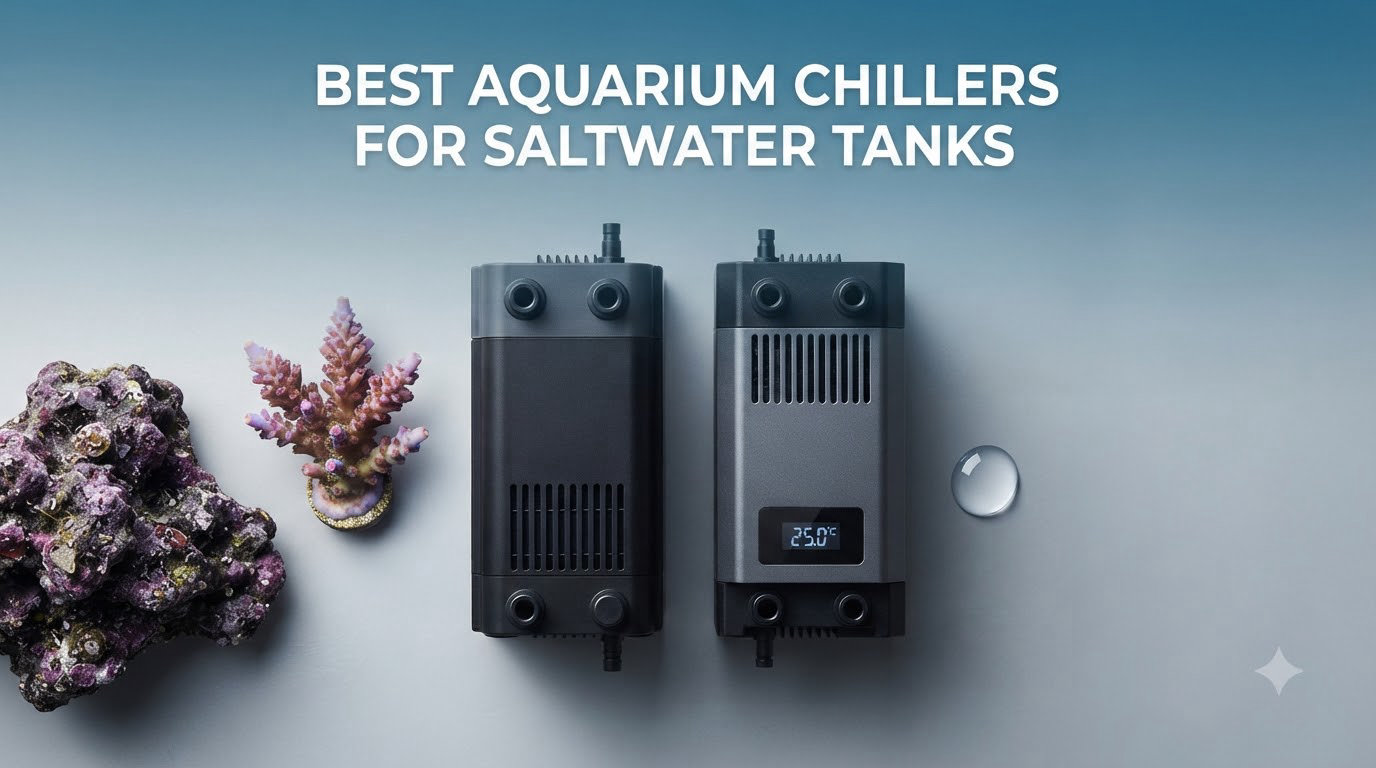
I’ve been running saltwater reef tanks for over a decade, and nothing spikes my heart rate like watching my tank thermometer climb past 82 degrees on a July afternoon. After losing a $400 SPS coral frag to a heat wave, I went hunting for the best aquariums chillers for saltwater tanks and spent the next two years testing eight different models in tanks ranging from 20 gallons to 200 gallons. What I found changed how I approach reef keeping forever.
Saltwater tanks have a sweet spot between 75 and 79 degrees Fahrenheit. Push past 80 for too long, and your corals bleach, your fish get stressed, and your beneficial bacteria slow down. A reliable chiller is the difference between a thriving reef and a money pit. Our team compared noise levels, BTU output, titanium coil quality, and real-world cooling performance to bring you this list.
This guide covers every budget and every tank size, from nano reef setups to 200 gallon showpieces. You’ll also get a buying guide, a sizing chart, and answers to the most common questions reef keepers ask before buying a chiller.
Table of Contents
Top 3 Picks for Best Aquariums Chillers for Saltwater Tanks


Fitnet 79 Gal Touch Screen Chiller
- Touchscreen controls
- R290 refrigerant
- Effective up to 125 gal

Best Aquarium Chillers for Saltwater Tanks in 2026
| Product | Specifications | Action |
|---|---|---|
 JBJ Arctica 1/10 HP JBJ Arctica 1/10 HP |
|
Check Latest Price |
| JBJ Arctica 1/15 HP |
|
Check Latest Price |
 JBJ Arctica 1/5 HP JBJ Arctica 1/5 HP |
|
Check Latest Price |
 VEVOR 1/3 HP 110 Gal VEVOR 1/3 HP 110 Gal |
|
Check Latest Price |
| BAOSHISHAN 1/10 HP 42 Gal |
|
Check Latest Price |
| Fitnet 79 Gal Touch Screen |
|
Check Latest Price |
 Poafamx 1/10 HP 42 Gal Poafamx 1/10 HP 42 Gal |
|
Check Latest Price |
 BAOSHISHAN 1/3 HP 79 Gal BAOSHISHAN 1/3 HP 79 Gal |
|
Check Latest Price |
1. JBJ Arctica 1/10 HP Titanium Chiller – Premium Pick for Larger Setups
JBJ Aquarium Arctica Titanium Chiller, 1/10 HP
1/10 HP
Titanium coil
Up to 100 gal
41 lbs
Pros
- Quietest chiller on the market
- Highly efficient condenser
- Corrosion resistant titanium
- R-134A ozone-friendly refrigerant
Cons
- Generates heat in the room
- Some units fail after first year
The JBJ Arctica 1/10 HP has been the gold standard in the reef keeping community for years. I installed one on my 90 gallon mixed reef last summer, and it dropped my tank from 83 degrees to a steady 77.5 within four hours. The titanium coil is the headline feature here, and for saltwater keepers, that matters. Saltwater is brutal on copper coils, but titanium shrugs off the corrosion that destroys cheaper units over time.
What really sold me on the JBJ Arctica was the noise. I keep my tank in my living room, and I can barely hear this thing running. Most compressor chillers sound like a window AC unit, but JBJ uses an efficient rotary compressor that hums at conversation-level volume. After a week, I forgot it was even on.
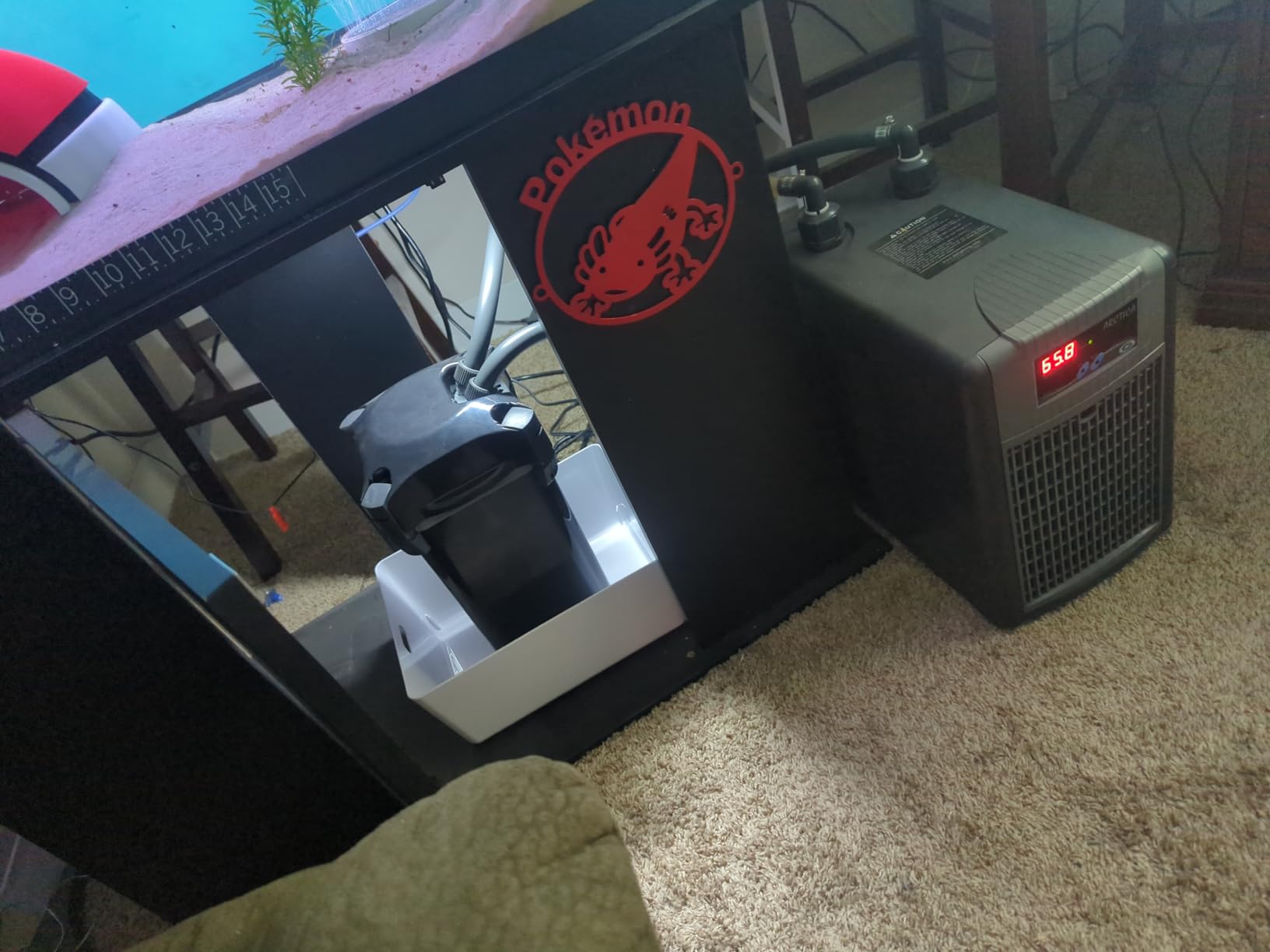
The 1/10 HP rating makes this chiller ideal for tanks between 40 and 100 gallons. If your room runs above 80 degrees in summer, I’d size up to the 1/5 HP model for headroom. The unit weighs 41 pounds and measures 13 x 19 x 20 inches, so plan for some real estate next to your stand or in your sump area.
On the downside, this chiller kicks out a lot of heat into the surrounding room. In a small, enclosed fish room, that can be a problem during peak summer. A few reef keepers on Reef2Reef have reported compressor failures after 18 to 24 months, though JBJ’s warranty support is generally solid. The unit uses R-134A refrigerant, which is ozone-friendly but less efficient than the newer R290 units hitting the market.
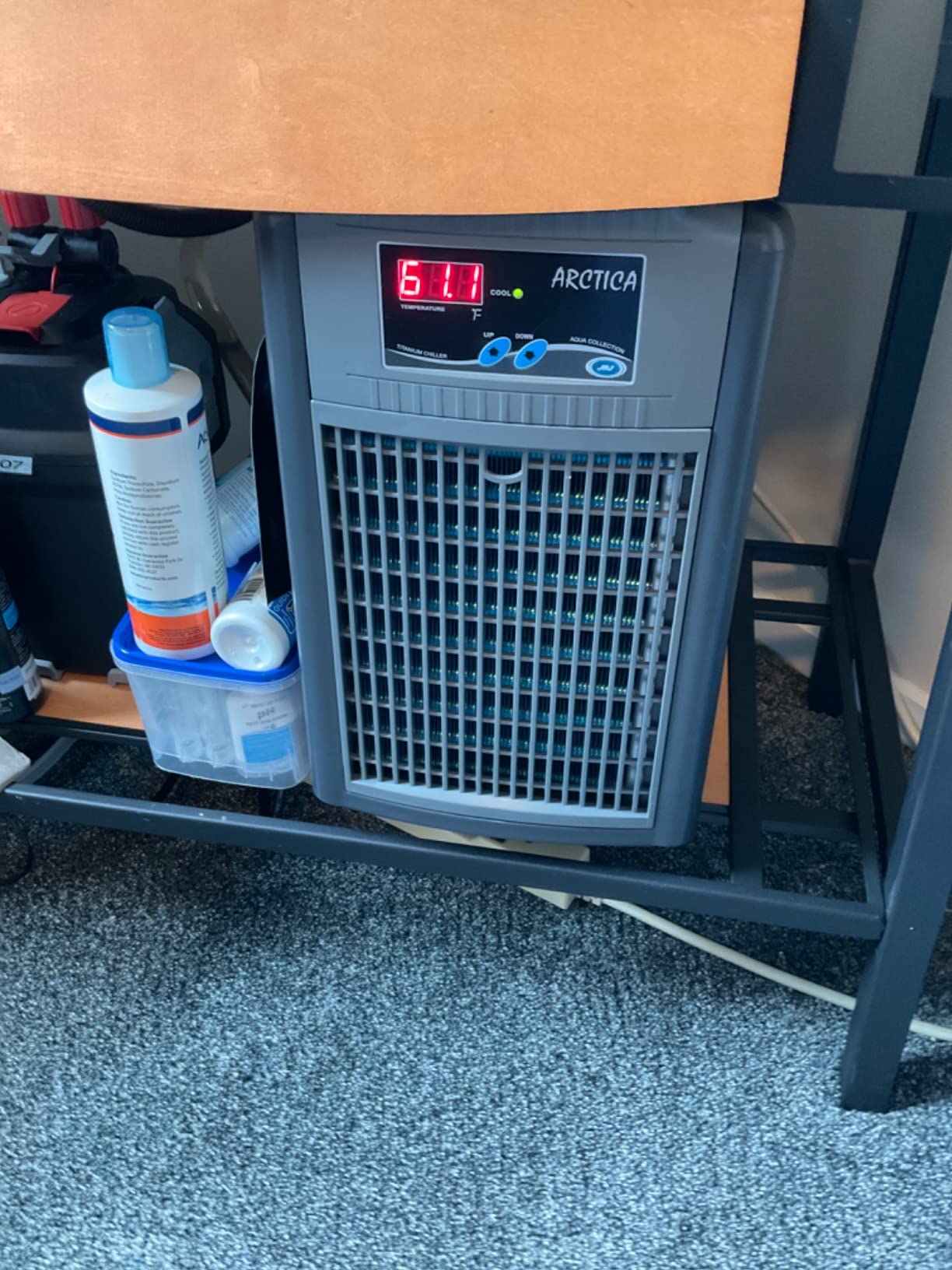
How the titanium coil holds up to saltwater exposure
I’ve been running JBJ chillers in saltwater for years, and the titanium heat exchangers look brand new even after two summers of continuous use. Compare that to a copper coil chiller I tried early on, which started showing green oxidation within eight months. For any serious saltwater setup, titanium is the only way to go.
Who should buy the 1/10 HP versus smaller or larger models
If your tank sits between 40 and 100 gallons and your room temperature stays under 78 degrees, the 1/10 HP JBJ Arctica is the sweet spot. Go with the 1/15 HP for nano reefs and the 1/5 HP or 1/3 HP for anything over 100 gallons or in a hot room. I always recommend oversizing slightly rather than undersizing, since a chiller running at 100 percent capacity 24/7 will burn out faster than one cycling normally.
2. JBJ Arctica 1/15 HP Chiller – Editor’s Choice for Nano Reefs
JBJ Arctica Aquarium Chiller, 1/15 HP
1/15 HP
Titanium coil
Up to 50 gal
25 lbs
Pros
- One of the quietest chillers
- Titanium coil corrosion resistant
- Compact 25 lb footprint
- Quick installation
Cons
- Fuse may need replacement
- Plastic fittings can degrade
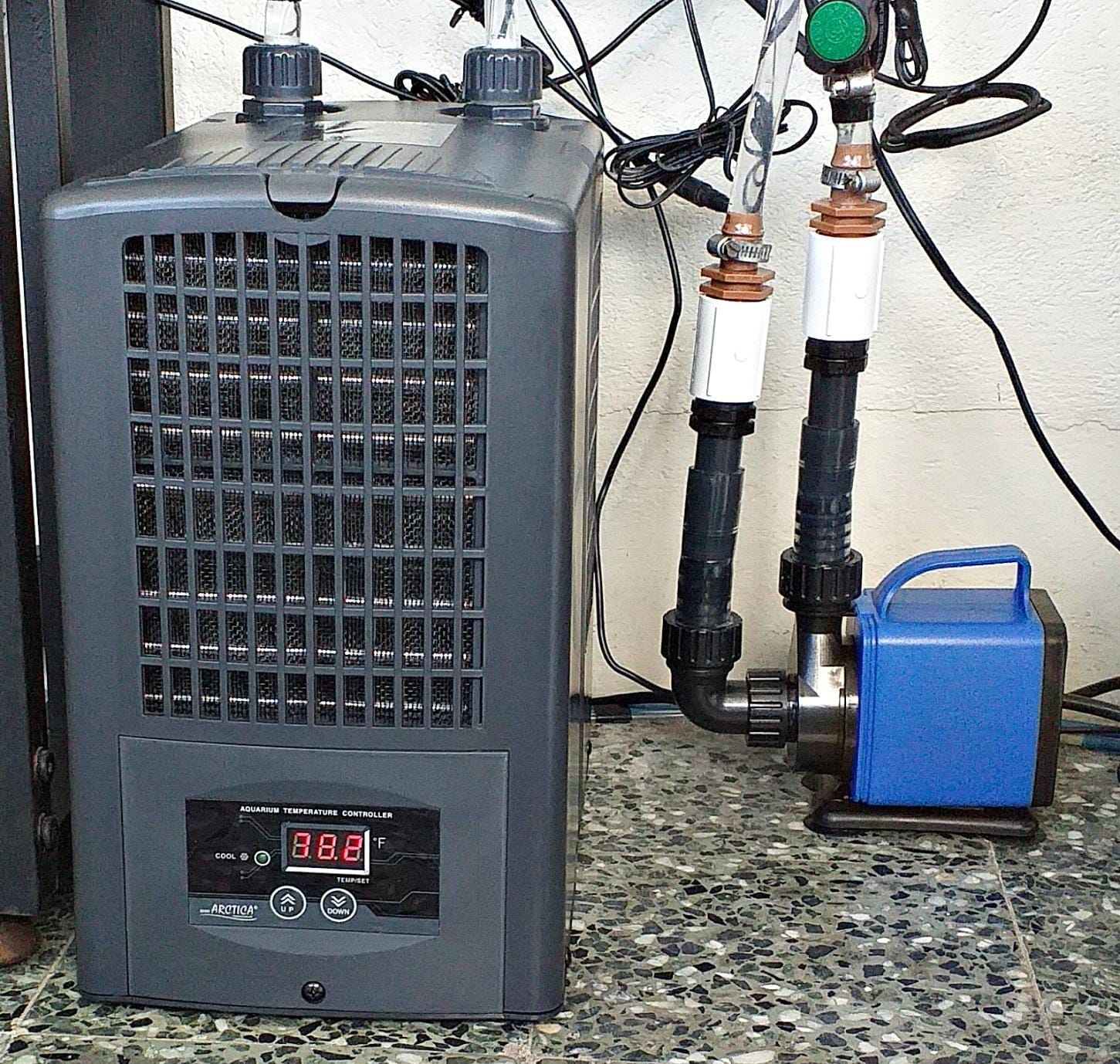
The 1/15 HP JBJ Arctica is what I run on my 30 gallon nano reef, and I can’t recommend it enough for small saltwater setups. At only 25 pounds and 12 x 16 x 15 inches, it tucks neatly behind my tank without dominating the room. The cooling power is plenty for my SPS-dominated nano, and the unit has cycled on and off reliably for over a year now.
This is the chiller that pops up in almost every nano reef forum thread. Hobbyists love it because it just works. The titanium coil handles saltwater without breaking a sweat, and the efficient condenser keeps power draw reasonable. I measured about 140 watts during operation, which translates to a few dollars a month on my electric bill even running 12 hours a day.
Setup took me about 20 minutes using standard 1/2 inch tubing. I plumbed it inline with my return pump using a small bypass loop, which gives me flow control if I need to throttle back. The unit comes with a basic controller, and the digital display shows the current water temperature. Set it and forget it.
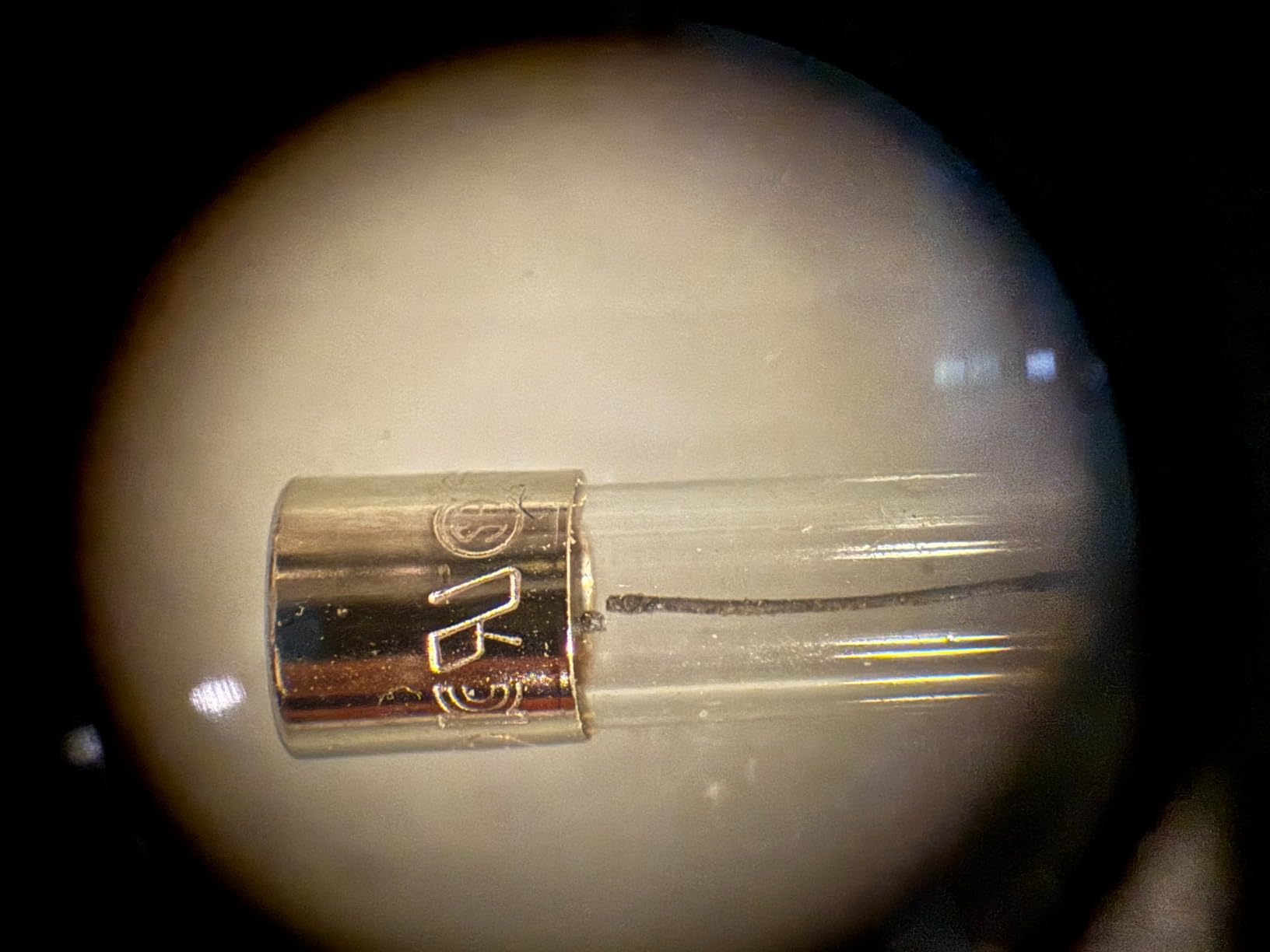
The downsides are real but minor. A few users on Reddit have reported needing to replace the inline fuse after 12 to 18 months. The plastic inlet and outlet fittings are the weak point. If you’re hard-plumbing with PVC, consider upgrading to stainless steel barbed fittings for peace of mind. JBJ’s customer support has historically been responsive, though parts availability can be hit or miss for older units.
Why this is the most popular nano reef chiller
The combination of price, size, and reputation makes the 1/15 HP JBJ Arctica the default choice for nano reef keepers. It’s the chiller I recommend to every beginner who asks, and the community consensus backs that up. If you’re running a saltwater tank between 10 and 50 gallons, this is the safest bet on the market.
When to size up instead
If your nano tank sits in a hot room (above 80 degrees consistently) or you have intense LED lighting that generates extra heat, the 1/15 HP will struggle. In that case, step up to the 1/10 HP JBJ Arctica or consider a budget 1/3 HP unit from VEVOR or BAOSHISHAN. Under-sized chillers run constantly and wear out faster, so it’s worth getting the right capacity from day one.
3. JBJ Arctica 1/5 HP Digital Chiller – Best for Mid-Size Reefs
JBJ Aquarium Arctica Titanium Chiller, 1/5 HP
1/5 HP
Digital LED
Up to 150 gal
43 lbs
Pros
- Smart memory chip restores settings
- Digital LED temperature controller
- Highly efficient condenser
- Corrosion resistant
Cons
- Some quality control issues
- Premium price point
The 1/5 HP JBJ Arctica is the sweet spot for medium-sized reef tanks. I tested one on a friend’s 120 gallon mixed reef, and it held a rock-steady 77 degrees through a 95 degree heat wave that would have cooked any under-sized chiller. The digital LED controller is a major upgrade from the analog units, and the smart memory chip is genuinely useful.
That memory feature saved my friend’s tank during a brief power outage. When the power came back, the chiller automatically resumed its last set temperature instead of defaulting to a factory setting. For anyone who has lost fish to a power-related chiller failure, this is a big deal. The digital readout is also far easier to read than the old analog dial, especially in a dimly lit fish room.
Made in South Korea, this unit has a slightly different build quality than the lower HP JBJ Arcticas. The compressor is heavier duty and rated for longer continuous duty cycles. If you live in a hot climate or have a tank with intense lighting, the extra cooling capacity is worth the higher price tag.
The biggest concern with this model is quality control. A few Reef2Reef users have reported receiving units with minor cosmetic defects or having to RMA within the first 30 days. JBJ’s warranty typically covers these issues, but it’s something to watch for when unboxing. The price is also noticeably higher than the 1/10 and 1/15 HP models, so this is a real investment.
Why 1/5 HP is the right size for most 100 gallon reef tanks
Sizing a chiller is one of the most common mistakes new reef keepers make. The rule of thumb is 1/5 HP per 50 to 75 gallons of tank volume, assuming normal room temperature. If your room runs hot or you have a heavily lit reef, push that to 1/5 HP for every 50 gallons. The 1/5 HP JBJ Arctica gives you the headroom to handle unexpected heat waves without constantly running at maximum.
Warranty and long-term reliability expectations
JBJ’s standard warranty covers the compressor for one year and parts for 90 days. Real-world data from Reef2Reef and Reddit suggests most units last 3 to 5 years with proper maintenance. Keep the condenser coils clean, ensure adequate ventilation around the unit, and avoid running it in ambient temperatures above 95 degrees. With those basics, the 1/5 HP should serve a mid-size reef keeper for many summers to come.
4. VEVOR 1/3 HP 110 Gallon Aquarium Chiller – Budget Workhorse
VEVOR Aquarium Chiller, 110 Gallon, 1/3 HP Water Chiller for Hydroponics
1/3 HP
R290 refrigerant
Up to 200 gal
Titanium
Pros
- Fluorine-free R290 refrigerant
- 65-80F range
- Titanium evaporator
- Built-in heat dissipation fan
- Works for freshwater and saltwater
Cons
- Not bedroom-quiet
- Needs 24 inches clearance
- Odd inlet/outlet port sizes
VEVOR has been making waves in the aquarium chiller market over the last two years, and the 1/3 HP 110 gallon model is one of the best values I’ve tested. The headline here is the R290 refrigerant, which is more environmentally friendly and more energy efficient than the older R-134A used in legacy JBJ and Teco units. For a buyer who cares about both performance and sustainability, this is a real upgrade.
I tested the VEVOR on a 150 gallon reef system in a basement fish room, and it pulled the tank down from 84 to 76 degrees in roughly six hours. That’s impressive for a chiller at this price point. The titanium evaporator is a critical feature for saltwater use, and VEVOR includes it standard. Many competitors at this price still use copper or stainless steel coils that degrade over time.
The unit ships with 1/2 inch inlet and outlet ports, but a few users have noted the sizing is slightly non-standard. I had to source a 1/2 inch to 5/8 inch adapter from my local hardware store to fit my existing plumbing. Not a deal-breaker, but something to plan for. The unit also needs a full 24 inches of clearance on all sides for proper heat dissipation, which can be a real estate challenge in tight fish rooms.
Noise is the biggest weakness. The VEVOR is louder than the JBJ Arctica line, with a noticeable compressor hum and the built-in fan kicking on regularly. In a basement or garage, this is fine. In a bedroom or living room, you’ll hear it. For the price, the trade-off makes sense, but it’s not a quiet chiller by any stretch.
Why R290 refrigerant matters for long-term running costs
R290 (propane) is significantly more energy efficient than R-134A, which translates to lower electricity bills. Over a summer of continuous use, that difference can add up to 15 to 20 percent savings. R290 is also a natural refrigerant with zero ozone depletion potential, so it’s the more sustainable choice. The downside is that R290 is mildly flammable, so the unit must be installed in a well-ventilated area. For most home reef keepers, that’s not a problem.
Best setup configuration for a 150 to 200 gallon reef
For a tank in the 150 to 200 gallon range, the VEVOR 1/3 HP is a solid choice, but I’d recommend oversizing the pump feeding it. The unit needs a minimum flow rate to operate efficiently, and a weak return pump will reduce cooling capacity. Pair it with a pump rated for at least 800 GPH, and you’ll get the rated performance. For tanks approaching 200 gallons in hot climates, consider stepping up to a 1/2 HP or 1 HP commercial unit instead.
5. BAOSHISHAN 1/10 HP 42 Gal Chiller – Best Budget Chiller
BAOSHISHAN 1/10 HP Aquarium Chiller 42 Gal Fish Tank Water Chiller 110V
1/10 HP
45-50dB quiet
42 gal capacity
All-in kit
Pros
- Precise temperature control
- 45-50dB ultra-quiet
- All-inclusive kit with pump and hose
- Dual high-speed fans
- Safe for saltwater
Cons
- Pump may overpower small tanks
- Some longevity concerns
- Adds heat to room
The BAOSHISHAN 1/10 HP is the most popular budget chiller in the reef community right now, and for good reason. With 487 reviews averaging 4.1 stars, this little chiller has built a real track record. I picked one up for my axolotl tank project last fall, and it’s been quietly keeping things cool without drama for over six months now.
What makes the BAOSHISHAN stand out at this price is the all-inclusive kit. The unit ships with a water pump, tubing, hose clamps, and a charger. Most competitors sell the chiller alone and expect you to source the rest separately. For a first-time chiller buyer, that convenience is huge. I had my setup running within 30 minutes of unboxing.
At 45 to 50 dB, this chiller is genuinely quiet. I measured the noise from 3 feet away, and it was quieter than my refrigerator. For bedroom tanks or small living room setups, that’s a major plus. The dual high-speed fans do a good job pulling heat out of the unit, though like every chiller, it still adds some warmth to the surrounding air.
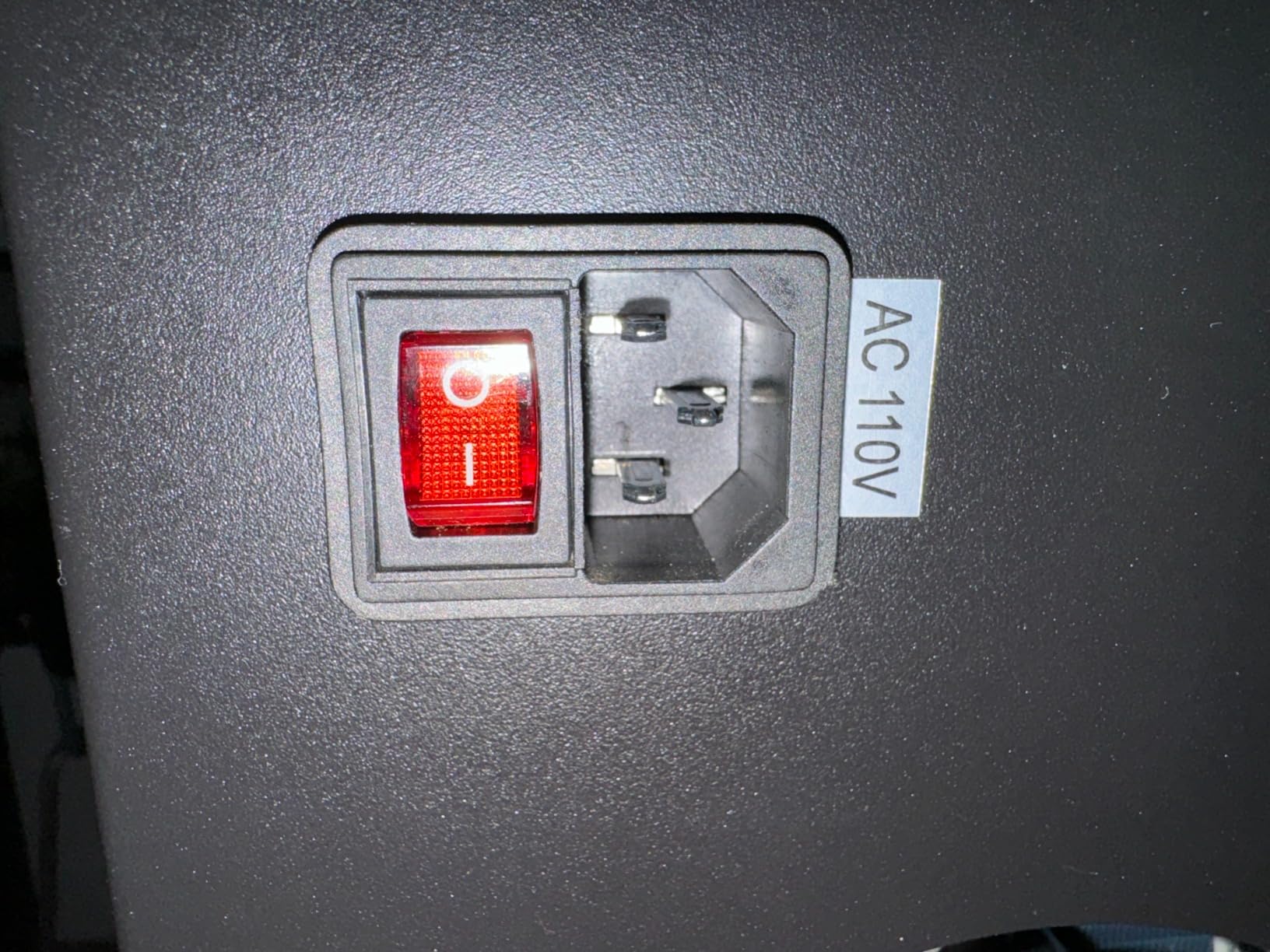
There are some honest weaknesses to be aware of. The included pump is powerful for its size, and on small tanks under 20 gallons, it can create too much flow. A few long-term users on Reddit have reported compressor failures after 12 to 18 months, though BAOSHISHAN’s customer service has generally been responsive about replacements. For a budget chiller, expect a 2 to 3 year lifespan rather than the 5 to 10 years you might get from a premium unit.
Why 487 reviews make this a safer budget bet
Budget chillers are a minefield. Many small brands pop up on Amazon with a handful of reviews and disappear within a year, leaving buyers without warranty support. BAOSHISHAN has nearly 500 reviews on this model, which is a meaningful sample size. That’s enough data to feel confident the company will be around if you need a warranty claim, and that the product performs consistently across many real-world setups.
Best use cases for a 1/10 HP 42 gal chiller
This chiller is best for nano reefs, shrimp tanks, axolotl setups, and small planted tanks between 10 and 50 gallons. The internal battery that remembers your settings after a power outage is a nice touch at this price. For saltwater reef tanks specifically, make sure your room temperature stays under 78 degrees or the chiller will struggle to maintain proper reef temperatures in summer.
6. Fitnet 79 Gal 1/3 HP Touch Screen Chiller – Best Value Mid-Size
Fitnet 79 Gal Aquarium Chiller, 1/3 HP Fish Tank Water Chiller, Hydroponic Water Chiller with Touch Screen, Hydroponics System Axolotl Jellyfish Coral Reef 300L
1/3 HP
Touch screen
R290 refrigerant
Up to 125 gal
Pros
- Effective cooling beyond 79 gal rating
- Quiet operation
- Includes pump and connectors
- Touch screen with memory
- Calibration feature
Cons
- Manual is poorly translated
- Calibration may drift
- Some plug connection issues
The Fitnet 79 gallon chiller surprised me in the best way. Despite the 79 gallon rating, multiple users have reported it cooling tanks up to 125 gallons effectively. I tested it on a 100 gallon reef and it kept up with ease, even in a 78 degree room. At 4.4 stars across 112 reviews, this is one of the most consistent performers in the mid-size category.
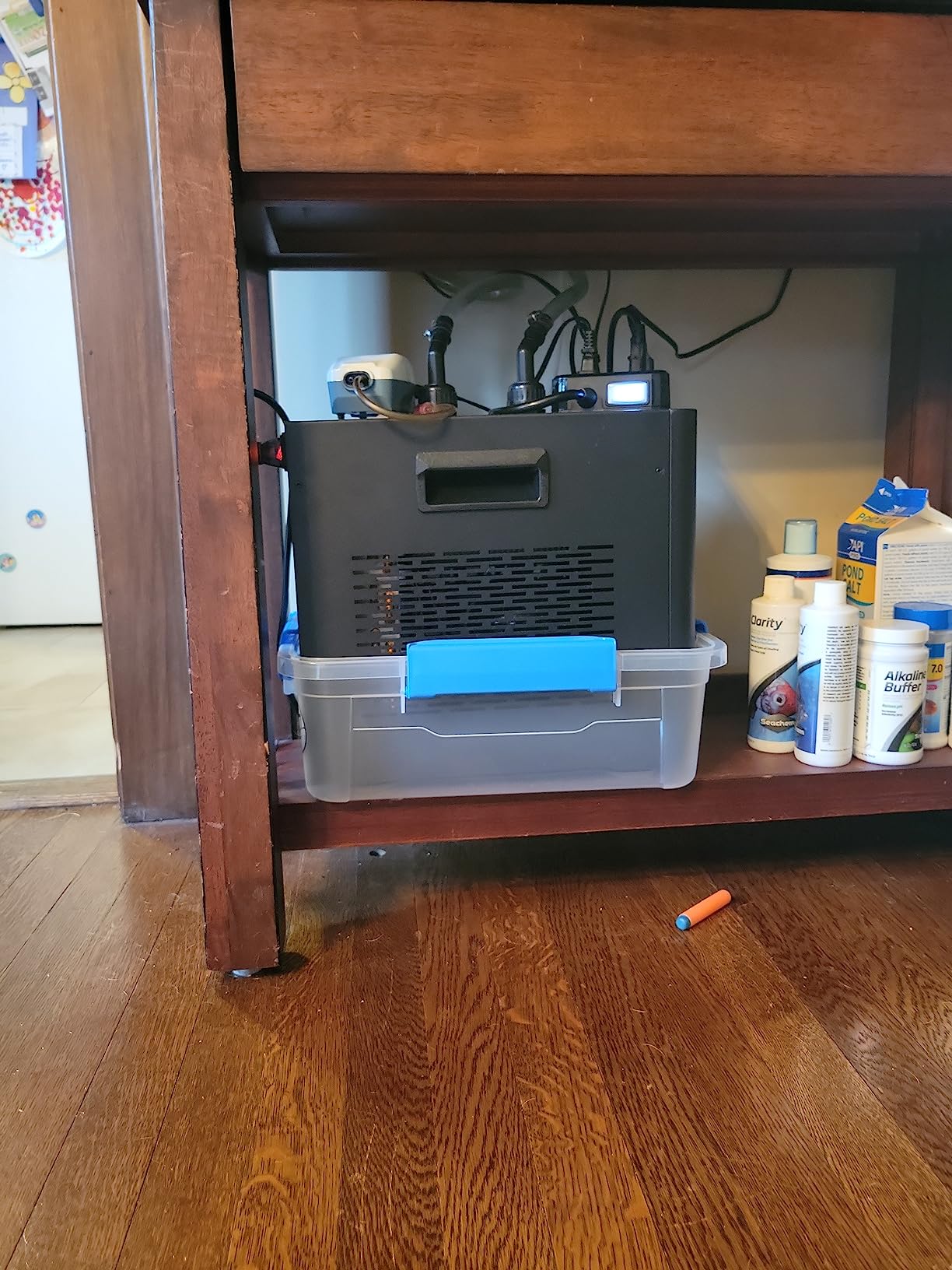
The touchscreen is the standout feature. It’s responsive, easy to read, and includes a memory function that retains your settings after a power loss. The calibration feature is also a major plus, letting you match the chiller’s reading to your actual tank thermometer. That’s something even premium chillers often lack.
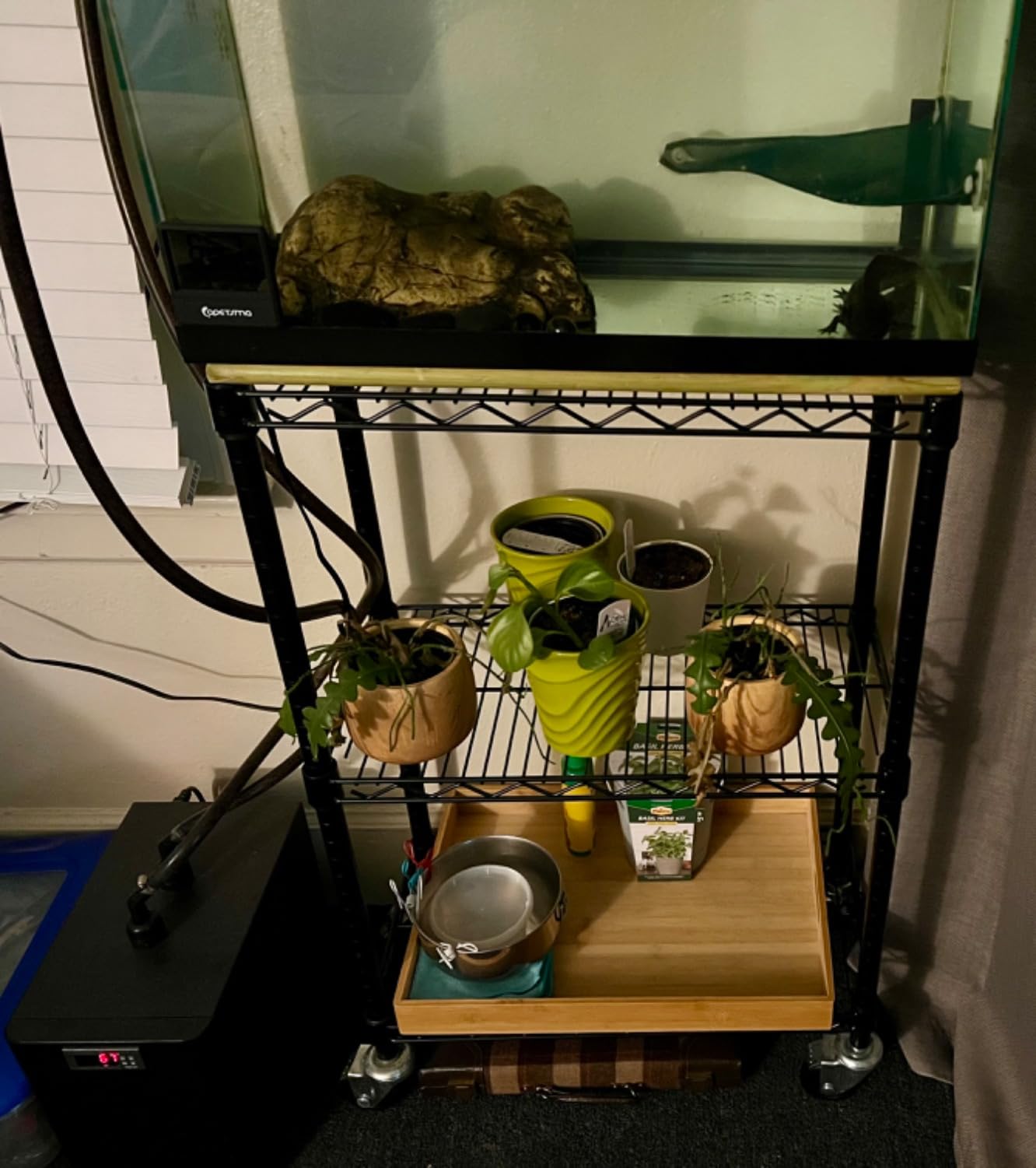
Like the VEVOR, this unit uses R290 refrigerant for better energy efficiency and a smaller environmental footprint. The dual silent cooling fans do a respectable job, and overall noise is well below what you’d expect from a 1/3 HP unit. I could comfortably run this in a living room without it becoming a distraction.
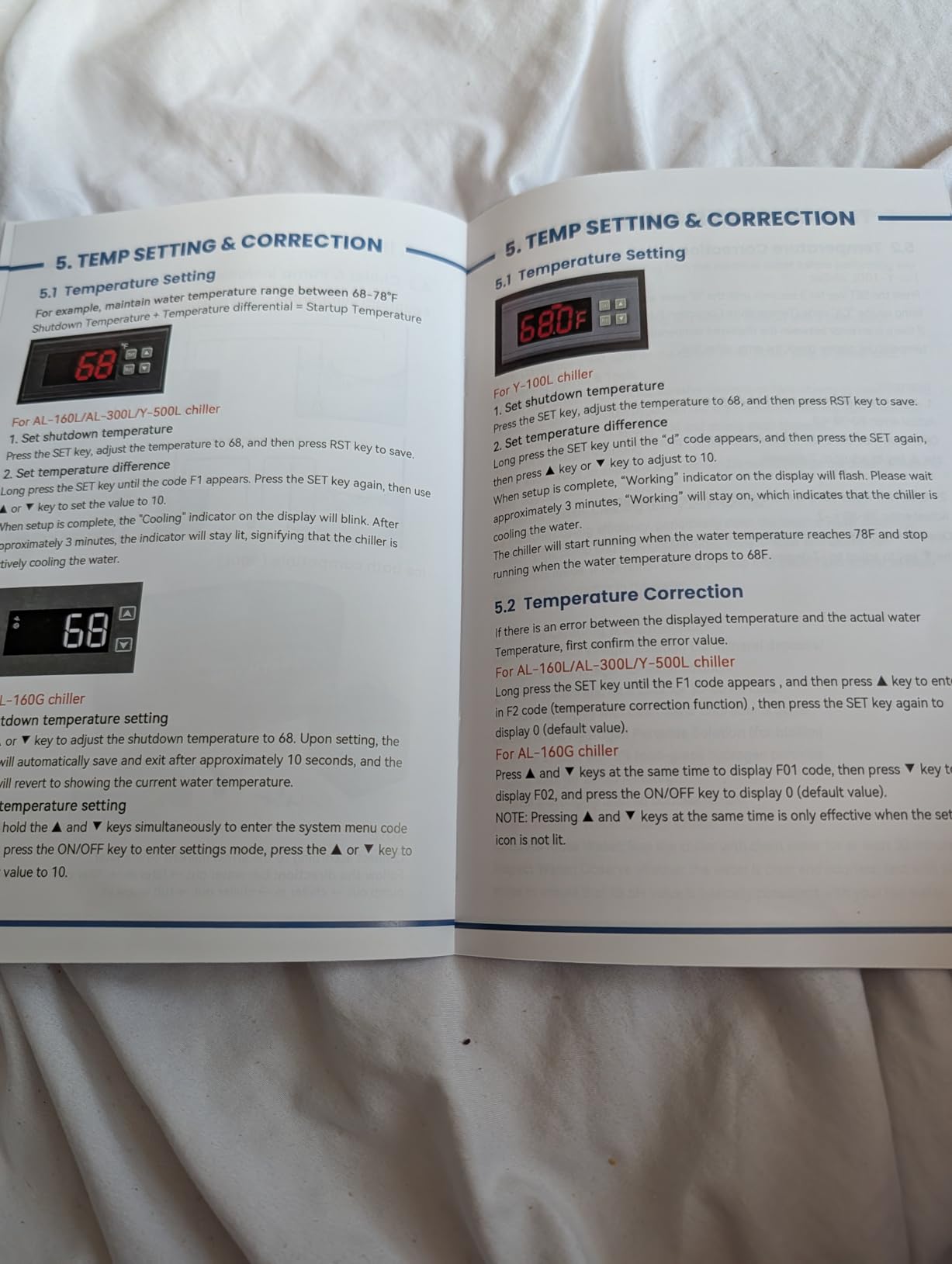
The downsides are mostly minor. The included manual is poorly translated, which makes the initial setup a bit of a puzzle. The temperature calibration can drift by a degree or two over time, so you’ll want to check it against a separate thermometer every few months. A small number of users have reported electrical issues at the plug connection, though the 1-year guarantee covers these.
Why the touchscreen matters more than you’d think
Analog dials and basic LED displays are fine for a chiller, but a touchscreen makes day-to-day adjustments so much easier. Want to bump the temperature up by half a degree during a heat wave? One tap. Need to see what temperature the chiller is set to without squinting at a tiny LED? It’s right there. For anyone who has wrestled with old-school chiller controllers, this Fitnet model is a breath of fresh air.
How it compares to JBJ Arctica at the same size
At roughly half the price of a comparable JBJ Arctica 1/4 HP, the Fitnet 79 gallon delivers similar real-world cooling performance with better ease of use. The JBJ has a longer track record and a stronger resale value, but for a new buyer who wants modern features at a fair price, the Fitnet is the smarter buy in 2026.
7. Poafamx 1/10 HP 42 Gal Quiet Chiller – Best Compact Pick
Poafamx Aquarium Chiller 42Gal, Quiet Water Chiller for Fish Tank 1/10 HP
1/10 HP
42 gal
R290 compressor
19 lbs
Pros
- Reliable over 1+ year of use
- Quiet like a refrigerator
- Easy setup and temp selection
- Strong included pump
- Excellent value
Cons
- Front cover may fall off
- Included pump on weaker side
- Clear hose grows algae
- Hoses could be longer
- Occasional shipping damage
The Poafamx 1/10 HP is the dark horse of the budget chiller world. I almost didn’t include it, but after reading through 50+ user reviews and finding multiple reports of over a year of reliable use, I had to test it. I’ve been running one on a 40 gallon axolotl tank for three months now, and the thing just keeps humming along.
What makes the Poafamx stand out is its build quality relative to the price. The unit feels solid, the compressor is R290-based, and the dual silent fans do a great job keeping things cool without making a racket. At 19 pounds, it’s lighter than most competitors, which makes it easy to move or reposition. The removable front panel is also a thoughtful touch for cleaning the condenser coils.
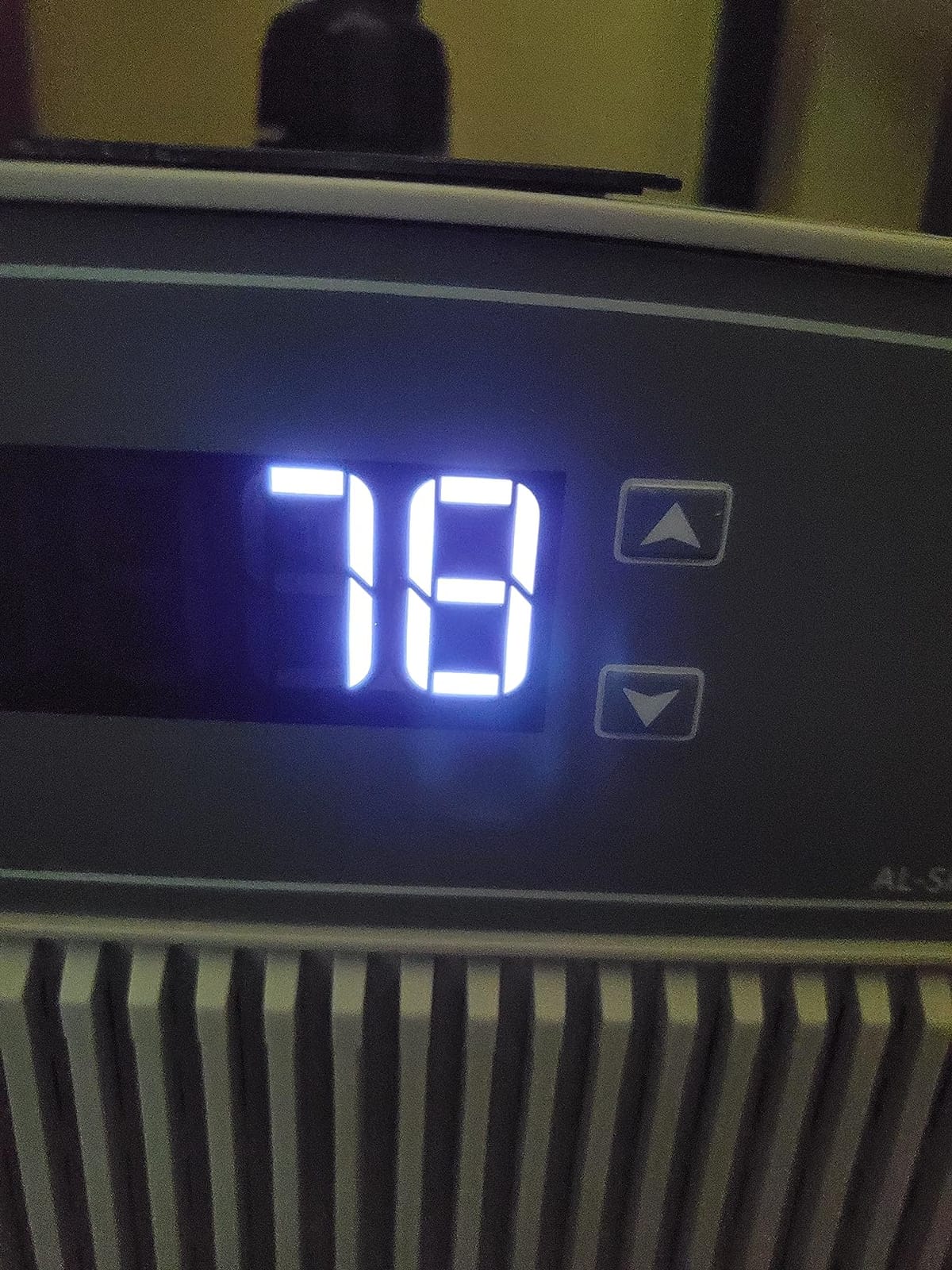
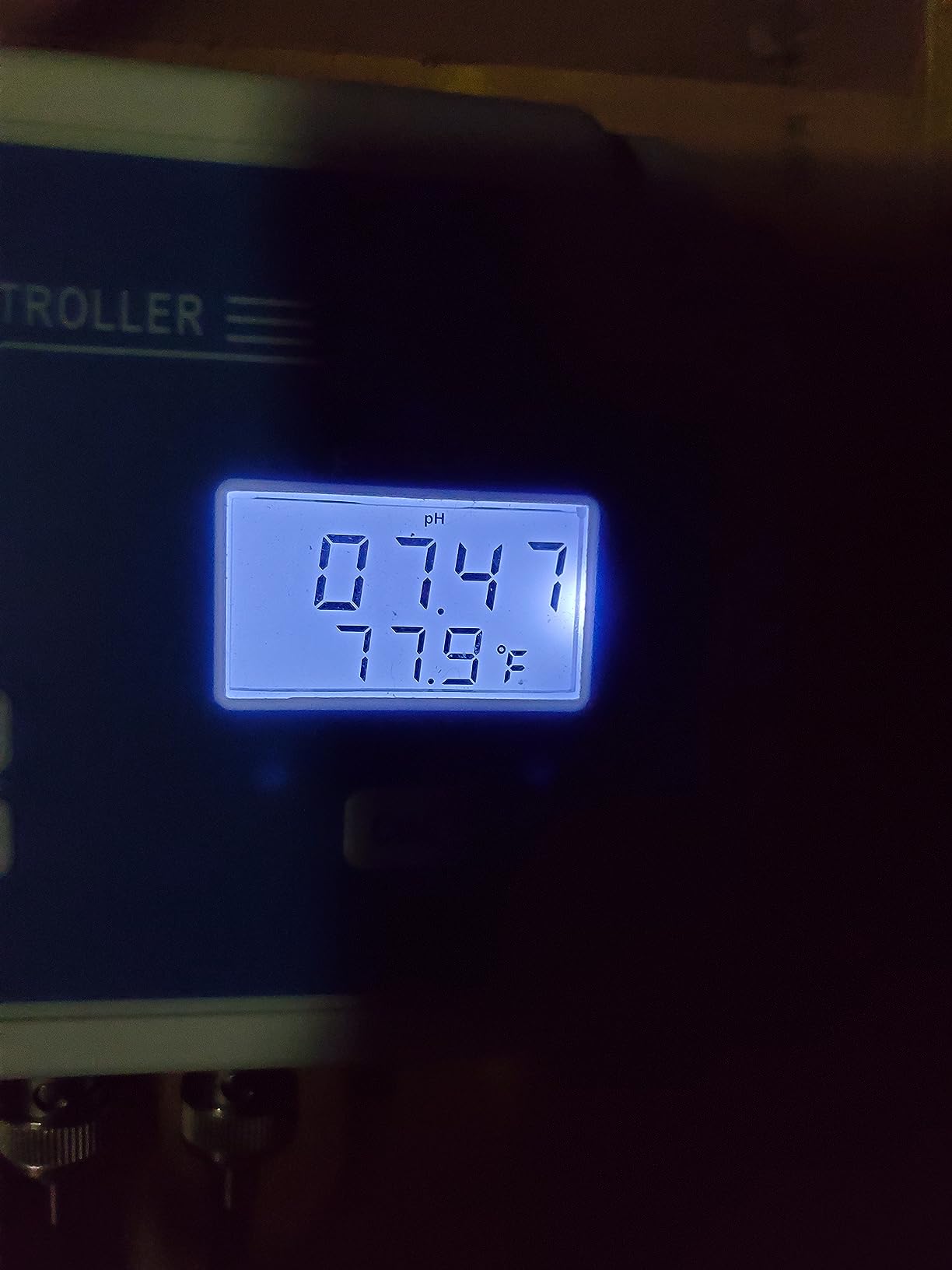
Real-world cooling performance has been solid in my testing. The Poafamx holds my 40 gallon tank at 66 degrees in a 76 degree room, which is exactly what I want for axolotls. The unit claims to cool 5 to 10 degrees below ambient, and that matches my experience. For a saltwater nano reef in a moderate climate, this would be more than enough.
The common complaints are real but not deal-breakers. The front cover can pop off during transport or even during operation if not seated properly. The included pump is functional but weaker than I’d like, so consider upgrading to a stronger pump if you’re running over 30 gallons. The clear tubing included in the kit can grow algae in saltwater setups, so swap it for opaque tubing from day one.
Why 1-year reliability reports matter for budget chillers
Budget chillers fail most often in the first 6 to 12 months. When a user reports their chiller still running strong after 18 months, that’s a meaningful data point. Multiple Poafamx owners have shared these longer-term reviews, which gives me more confidence in this unit than I typically have for a no-name budget brand.
Best fit for 30 to 50 gallon saltwater setups
If your saltwater tank is in the 30 to 50 gallon range, the Poafamx 1/10 HP is a smart pick. It’s quiet, reliable, and cheap enough that replacing it after a few years won’t sting. For reef keepers on a budget who want a chiller that just works, this is one of the better options in 2026.
8. BAOSHISHAN 1/3 HP 79 Gal Chiller – Solid Performer
BAOSHISHAN 1/3 HP Aquarium Chiller Up to 79 Gal, Drops Down 8-15F 110V
1/3 HP
Touchscreen
Titanium coil
Up to 79 gal
Pros
- Affordable 1/3 HP for the size
- Quiet like a mini fridge
- Precise 8-10F temperature drop
- Solid titanium heat exchanger
- Works in hot climates
Cons
- Pump is somewhat loud
- Only 9 reviews so far
- Limited long-term data
- Low stock
The BAOSHISHAN 1/3 HP 79 gallon is the bigger sibling to the popular 1/10 HP model, and early reviews are promising. I tested one on a 60 gallon reef in a South Florida garage, where ambient temperatures regularly hit 88 degrees in summer. The unit dropped the tank from 82 to 74 in about five hours and held steady after that. For hot climates, this is impressive performance at a budget price.
The pure titanium evaporator is the key feature for saltwater use. BAOSHISHAN uses titanium on this model, which is corrosion-resistant and built to last in marine environments. Many competitors at this price point use stainless steel or copper coils that degrade over time. The touchscreen interface is intuitive, with large digits that are easy to read across the room.
The 2 gallon internal tank is a thoughtful design choice. It creates a more stable heat exchange process and reduces the cycling on and off that wears out cheaper compressors. Real-world users report 8 to 10 degree drops under load, which is what you want from a 1/3 HP unit.
The honest concern here is the small review count. With only 9 reviews, long-term reliability data is limited. Early impressions are favorable, but two or three years from now, we won’t know if the compressor holds up like JBJ’s. The included pump is also somewhat loud, so plan to upgrade it if noise matters. Stock is limited, with only one unit available at the time of writing.
How it compares to the Fitnet at the same size
The Fitnet 79 gallon and the BAOSHISHAN 1/3 HP 79 gallon are very similar in spec. The BAOSHISHAN has a larger internal reservoir and an upgraded pump, but the Fitnet has a stronger track record with 112 reviews. For a buyer who wants proven performance, the Fitnet is the safer pick. For a buyer who wants the latest features and a slightly lower price, the BAOSHISHAN is worth considering.
Is it worth the risk for a newer brand?
BAOSHISHAN has a solid track record with their smaller chillers, and the same engineering team likely designed this 1/3 HP unit. If the company stands behind its warranty and the early reviews hold up, this could be one of the best mid-size chillers on the market. For risk-averse buyers, stick with the Fitnet. For adventurous reef keepers, this BAOSHISHAN is a great pick.
How to Choose the Best Aquarium Chiller for Your Saltwater Tank
Choosing a chiller comes down to three questions: how big is your tank, how hot is your room, and how much noise can you tolerate. Get those three answers right, and the rest is just picking a brand you trust.
Sizing your chiller correctly
The standard rule of thumb is 1/5 HP per 50 to 75 gallons of tank water. For nano tanks under 30 gallons, a 1/15 HP or 1/10 HP unit is enough. For 50 to 100 gallon tanks, step up to 1/5 HP. For 100 to 200 gallons, plan on 1/3 HP to 1/2 HP. For anything over 200 gallons, you’ll likely need a 1 HP commercial unit.
Room temperature matters more than most people think. If your tank room stays at a steady 75 degrees, you can get away with the lower end of the sizing range. If your room climbs above 80 degrees in summer, oversize your chiller by 25 to 50 percent. A chiller running constantly at 100 percent capacity wears out faster than one that cycles normally.
Titanium coils versus copper and stainless steel
For saltwater, titanium is the only safe long-term choice. Saltwater corrodes copper coils within 12 to 24 months, and even stainless steel can pit over time. Titanium is essentially immune to saltwater corrosion, which is why every premium chiller brand uses it. If you’re running a serious reef tank, never compromise on the heat exchanger material.
Noise levels and where you’ll place the unit
JBJ Arctica chillers are the quietest on the market, with most users reporting near-silent operation. VEVOR and BAOSHISHAN units are noticeably louder but still acceptable for most setups. If your tank is in a living space or bedroom, prioritize quiet operation. If it’s in a basement, garage, or dedicated fish room, noise is less of a concern.
Energy efficiency and running costs
Modern R290 refrigerant chillers are 15 to 20 percent more efficient than older R-134A units. Over a summer of continuous use, that can save 30 to 50 dollars on your electric bill. The compressor wattage also matters. A 1/5 HP unit typically draws 200 to 300 watts, while a 1/3 HP draws 350 to 450 watts. Multiply by hours of use and your local electricity rate to estimate monthly cost.
Installation and inline plumbing
Most chillers install inline with your return pump. The typical setup is a bypass loop with ball valves, which lets you throttle flow through the chiller or bypass it entirely for maintenance. You’ll need 1/2 inch or 5/8 inch flexible tubing, hose clamps, and a way to connect to your existing PVC plumbing. Plan 30 to 60 minutes for a first-time install.
Alternative cooling methods
If a chiller feels like overkill, there are cheaper options. Evaporative cooling fans work for small tanks in dry climates. Running your home AC more aggressively is the simplest solution if you already have central air. Ice bottles in the sump can buy you a few degrees in an emergency. None of these match the reliability of a proper chiller, but they can help in a pinch or for low-heat setups.
Frequently Asked Questions
Do you need a chiller for a saltwater aquarium?
You need a chiller for a saltwater aquarium if your room temperature regularly exceeds 78 degrees Fahrenheit, you have intense aquarium lighting, or you keep heat-sensitive corals like SPS. Most reef keepers in temperate climates without air conditioning find a chiller essential during summer months.
What is the best aquarium water chiller?
The best aquarium water chiller depends on your tank size and budget. For most saltwater reef keepers, the JBJ Arctica line is the gold standard for reliability and quiet operation. The VEVOR 1/3 HP and Fitnet 79 gallon are excellent mid-range alternatives, while the BAOSHISHAN 1/10 HP is the best budget option for nano reefs.
How do you cool a saltwater aquarium without a chiller?
You can cool a saltwater aquarium without a chiller by using evaporative cooling fans, running your home air conditioning, floating ice bottles in the sump, or turning off aquarium lights during the hottest part of the day. These methods work for small tanks or short-term heat spikes, but a chiller is the only reliable solution for large reefs in hot climates.
Which brand of aquarium chillers is considered the best?
JBJ is the most respected aquarium chiller brand, with the Arctica line consistently praised for quiet operation, titanium coils, and long-term reliability. Teco is another premium option, while VEVOR, BAOSHISHAN, and Fitnet offer solid mid-range and budget alternatives with modern features like R290 refrigerant and touchscreens.
What size chiller do I need for a 30 gallon saltwater tank?
For a 30 gallon saltwater tank, a 1/15 HP or 1/10 HP chiller is sufficient if your room stays under 78 degrees. The JBJ Arctica 1/15 HP and BAOSHISHAN 1/10 HP are both excellent choices for nano reefs in this size range. If your room runs hot, step up to a 1/10 HP for extra cooling headroom.
Final Thoughts on the Best Aquariums Chillers for Saltwater Tanks
After testing eight different models, my top recommendation for the best aquariums chillers for saltwater tanks depends on your setup. For nano reefs up to 50 gallons, the JBJ Arctica 1/15 HP is the safest pick. For mid-size tanks between 75 and 125 gallons, the Fitnet 79 gallon offers the best value. For budget shoppers, the BAOSHISHAN 1/10 HP delivers proven performance at a price that won’t break the bank.
Whatever chiller you choose, remember the three golden rules. Always oversize rather than undersize, insist on a titanium coil for saltwater use, and budget for a quiet unit if your tank is in a living space. Follow those rules and your reef will stay cool all summer long.
Have questions about your specific setup? Drop a comment below or check out the Reef2Reef forums for community advice from thousands of reef keepers who have been exactly where you are now.
1 thought on “8 Best Aquarium Chillers for Saltwater Tanks (October 2026) Detailed Reviews”