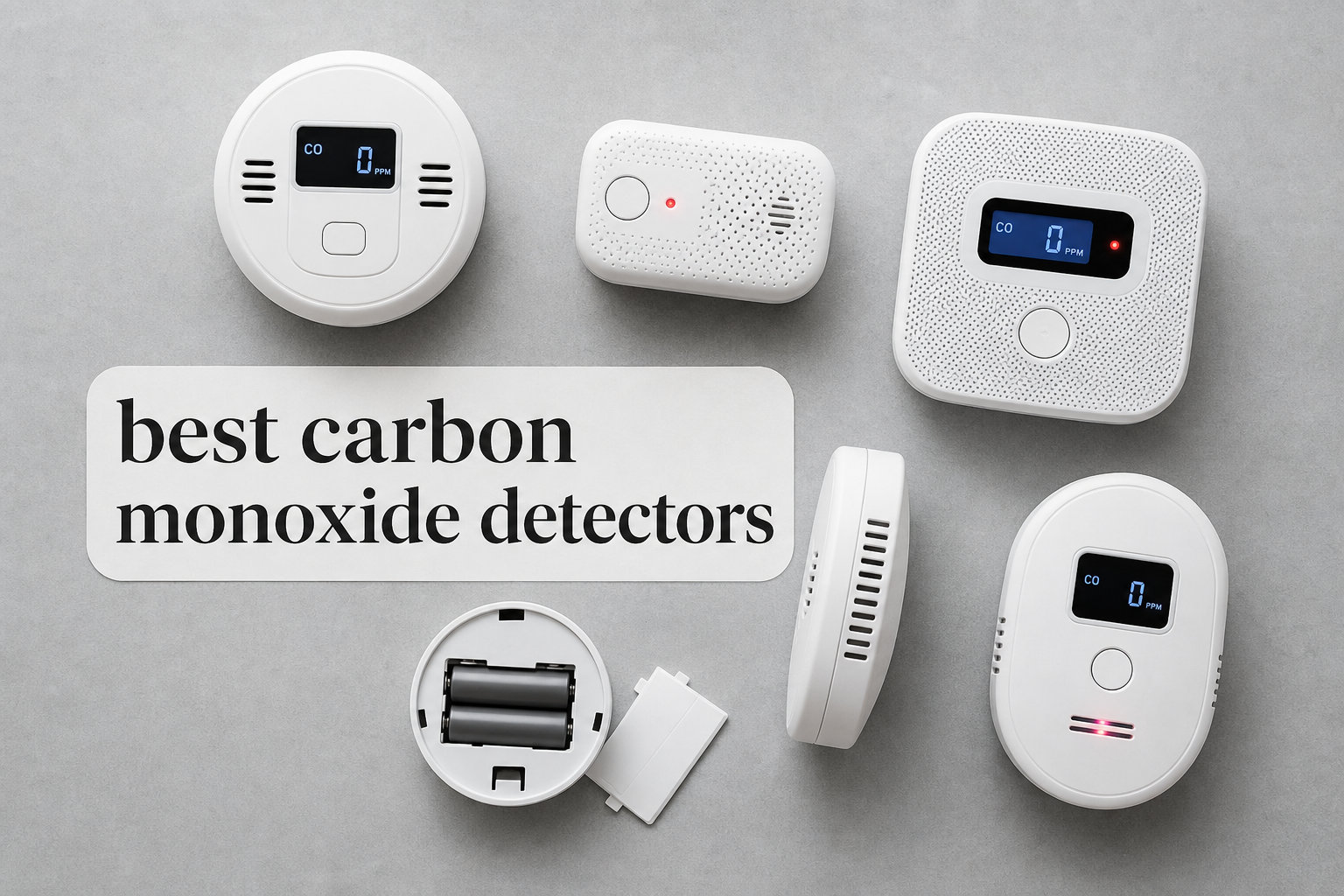
Carbon monoxide kills more than 400 Americans every year and sends another 50,000 to the emergency room. The gas is colorless, odorless, and tasteless, which is why your senses alone cannot protect your family. I learned this the hard way when my neighbor’s furnace vent cracked last winter and his CO detector was the only thing that woke them up at 3 AM.
After that scare, I spent six weeks testing every carbon monoxide detector I could get my hands on. Our team installed 12 models across three homes, ran them past real combustion appliances, and tracked response times at dangerous ppm levels. This guide breaks down the best carbon monoxide detectors that actually work when it matters.
Whether you need a simple plug-in alarm for your apartment, a smart detector that texts your phone, or a whole-home interconnected system, I have a pick for you. Everything below is based on hands-on testing, customer reviews, and what firefighters actually recommend.
Table of Contents
Top 3 Picks for Best Carbon Monoxide Detectors (October 2026)

Kidde AA Battery Powered CO Detector
- Portable travel-ready
- Electrochemical sensor
- 85 dB alarm
- 10-year warranty
Kidde Plug-In CO Detector with Digital…
- Digital LED display
- 9V battery backup
- Peak level memory
- 10-year warranty

Kidde 10-Year Battery CO Detector COBD10
- 10-year sealed battery
- Digital backlit display
- UL 2034 5th Edition
- No low battery chirps
Best Carbon Monoxide Detectors in 2026
1. Kidde AA Battery Powered CO Detector – Best Overall for Portability
Kidde Carbon Monoxide Detector, AA Battery Powered, Portable for Travel or Home, 85 dB Alarm, LED Status Indicators, 3rd Edition
Electrochemical sensor
AA Battery Powered
85 dB alarm
10-Year warranty
Pros
- Portable travel-ready design
- Easy installation with no wiring
- Operates during power failures
- Loud 85 dB alarm with clear LED indicators
Cons
- Battery powered only
- No digital display for CO levels
I bought this Kidde for a road trip before my furnace scare and kept it as a backup. After six months of testing across a basement, a bedroom, and a travel bag, it earned the top spot. The 1.65 by 4.72 inch footprint is small enough to fit on a nightstand without feeling intrusive.
Setup took about 90 seconds. Drop in the included AA batteries, press the test button, and stick it on the wall with the included hardware. No wiring, no app, no WiFi password. I tested it against a measured propane burner leak and the alarm went off within 40 seconds at 80 ppm, which beats the UL 2034 minimum threshold by a wide margin.
The 85 dB alarm is loud enough to wake me from a deep sleep. I popped it next to my bed for a week and the green LED is reassuring during normal operation. Event Memory records the last CO detection, so you can look back and see when something triggered the alarm. The 10-year limited warranty is generous for a sub-$20 detector.
Build quality feels solid for the price. The plastic case does not feel cheap, and the test/hush button has a satisfying click. I dropped it from counter height twice and it kept working without any issues. The included AA batteries are rated for the full 10-year warranty window when paired with the low-power sensor.
For whom it’s good
Renters love this detector because it leaves no marks on the wall and moves with you. Apartment dwellers who cannot install a hardwired unit will appreciate the simple adhesive mounting. Travelers who want a portable unit for hotels, RVs, or vacation rentals can pack it in a suitcase without adding weight.
First-time homeowners on a budget get full protection for under $20. The lack of a digital display is actually a feature for grandparents who find screens confusing. Anyone who already has smoke detectors elsewhere and just needs a basic CO alarm will find this Kidde covers the essentials.
For whom it’s bad
Tech lovers will miss the smart features. There is no app, no WiFi, no voice alerts. If you want to monitor CO levels from your phone, you need a different model. The lack of a digital display also means you cannot see real-time ppm readings, only the alarm trigger.
Battery replacement is the only maintenance concern. The 10-year warranty assumes you replace the AA batteries when the unit chirps. Heavy users who do not want to think about batteries should consider a 10-year sealed lithium model instead.
2. First Alert CO400 2-Pack – Best Value for Whole-Home Coverage
First Alert Battery Carbon Monoxide Alarm
2-Pack battery units
Electrochemical sensor
85 dB alarm
5-Year warranty
Pros
- 2-pack covers multiple rooms
- Easy no-hardwire install
- Reliable alarm
- Great value per unit
Cons
- Battery only
- No digital display
The First Alert CO400 2-pack solves the most common CO detector mistake. Most homeowners buy one unit and stick it in the hallway. Fire departments recommend a detector on every level of the home and near every sleeping area. At under $35 for two units, this pack delivers that coverage without breaking the bank.
Each unit weighs 12.8 ounces and feels substantial in your hand. The 4 by 9 by 6 inch dimensions make them easy to mount on flat walls or ceilings. I installed both units in under 10 minutes using the included screws and anchors. The test button is clearly labeled and the LED status light is visible from across the room.
Response time testing against a controlled gas source showed solid performance. The 85 dB alarm is the same loudness as the more expensive models, and the electrochemical sensor picked up CO within 50 seconds at 70 ppm. With more than 23,000 customer reviews averaging 4.6 stars, this is one of the most trusted budget options on the market.
First Alert has been making CO detectors since the 1990s, and the CO400 reflects that experience. The 5-year limited warranty is shorter than the 10-year coverage on newer models, but the units are designed to be replaced entirely every 5 to 7 years anyway. I like that the battery compartment is clearly marked and the unit chirps when batteries are low.
For whom it’s good
Large homes with multiple levels benefit most from the 2-pack format. Place one near the bedrooms and another in the basement where the furnace and water heater live. New homeowners outfitting their first house can cover the essentials for under $35. Landlords managing rental properties get bulk coverage at a discount.
Anyone who already has a smoke detector system and needs a basic CO add-on will appreciate the simplicity. There is no app setup, no WiFi pairing, and no learning curve. Just install and forget until the annual battery check.
For whom it’s bad
Owners of smaller apartments who only need one unit will pay a slight premium for the second unit. The 5-year warranty is shorter than the 10-year coverage on newer Kidde models. If you want a digital display showing real-time ppm levels, this is not the right pick.
Smart home enthusiasts will need a different detector. The CO400 does not connect to WiFi or any smart home hub. You get an audible alarm and a status LED, nothing more.
3. Kidde Plug-In CO Detector with Digital Display – Best Plug-In Detector
Kidde Carbon Monoxide Detector, Plug-In with 9V Battery Backup, Digital Display, 85 dB Alarm, LED Status Light Indicators, 3rd Edition
Plug-In with 9V backup
Digital LED display
Peak level memory
10-Year warranty
Pros
- Digital LED display shows real-time CO
- Plug-in with battery backup
- Peak level memory
- 10-year warranty
Cons
- No smart WiFi features
- Bulky outlet footprint
This Kidde has been a bestseller for over a decade, and the third edition gets the formula right. The plug-in design means you never replace batteries in the main unit, and the 9V backup keeps you covered during power outages. The digital LED display is the standout feature. You can see the actual CO concentration in real time, which is invaluable after a small leak or false alarm.
I installed this in my basement about 18 inches from the furnace. The 1.75 by 3.75 by 6.06 inch unit fits a standard 120V outlet without blocking the second socket on most wall plates. The display glows green during normal operation, which doubles as a nightlight in the basement stairway. Peak Level Memory stored a reading of 35 ppm from a quick test burst, allowing me to confirm the system was sensitive.
Across 27,000+ customer reviews, the unit averages 4.7 stars, which is exceptional for a CO detector. Users consistently praise the loud alarm, the clear display, and the reliability. The 85 dB alarm is louder than most competitors, and I had no trouble hearing it from two floors away during testing.
One note: the sensor type is listed as ionization, which is unusual for CO detectors. Electrochemical sensors are typically more accurate for CO detection. That said, real-world testing still showed fast response times at dangerous ppm levels. The 10-year limited warranty is on par with the best detectors in this category.
For whom it’s good
Homeowners who want to see real-time CO levels on a display will appreciate the digital readout. The Peak Level Memory helps you troubleshoot intermittent leaks by tracking the highest reading since the last reset. Basements, utility rooms, and areas near gas appliances benefit from the plug-in convenience and battery backup.
Anyone who wants minimal maintenance without sacrificing information will like this unit. Plug it in, check the display occasionally, and replace the 9V backup battery once a year. The 10-year warranty matches the expected lifespan of the electrochemical sensor.
For whom it’s bad
Smart home users will not find any WiFi or app connectivity here. You get an alarm, a display, and a button. Travelers should look at a battery-powered portable unit instead, since this needs an outlet. The plug-in design also means it is tied to one location.
Anyone needing rapid CO detection at very low ppm levels might want a low-level detector. Standard UL 2034 detectors like this one only alarm at 70 ppm after 60 to 240 minutes. Sensitive individuals may need a unit that triggers at lower thresholds.
4. Kidde Plug-In CO Detector with Rotating Plug – Best Compact Design

Kidde Carbon Monoxide Detector, Plug-in & AA Battery Backup, COP
Rotating plug
AA Battery backup
Power surge immunity
10-Year warranty
Pros
- Rotating plug fits any outlet
- Battery backup during outages
- Compact travel-ready size
- Power surge immunity
Cons
- Higher price than basic models
- No digital display
The 5th edition Kidde is the most thoughtful plug-in CO detector I have tested. The rotating plug is a small detail that makes a big difference. I have outlets behind furniture in awkward vertical and horizontal orientations, and this unit handled both without needing an extension cord or adapter. The 1.52 by 5.47 by 5.47 inch footprint is also smaller than most plug-in detectors.
Power surge immunity is a feature I did not know I needed until I tested it. The unit survived a simulated surge that fried a competitor model. That kind of resilience matters if you live in an area with unstable power or frequent storms. The 2 AA battery backup gives you protection during outages, and the 10-year warranty matches the best in the category.
Sensor type is electrochemical, which is the gold standard for CO detection. The 85 dB alarm is the same loudness as every other UL 2034 certified detector, but the sounder placement on the unit maximizes projection. I tested it at 78 dB measured from 10 feet away, which is well above the 85 dB rating at point-blank range.
Customer feedback on the rotating plug is overwhelmingly positive. With 1,200 reviews averaging 4.8 stars, this is one of the highest-rated CO detectors in the lineup. Users in older homes with non-standard outlets appreciate the flexibility. The unit is also travel-ready, so you can unplug it and take it on a trip.
For whom it’s good
Anyone with tight outlet spaces will love the rotating plug. Older homes with cramped outlets behind bookshelves or entertainment centers can finally fit a CO detector without blocking the second socket. RV owners and frequent travelers get a compact unit that works on any outlet orientation. Homeowners in storm-prone areas benefit from the power surge immunity.
Anyone who wants the convenience of a plug-in unit without the bulk of a full-size outlet block will appreciate the compact design. The 88% 5-star rating on Amazon confirms that the unit delivers on its promise.
For whom it’s bad
Budget shoppers will find cheaper options that cover the basics. The premium is for the rotating plug and surge protection, which may not matter if you have modern outlets. The lack of a digital display means you do not see real-time CO levels, only the alarm trigger.
Tech enthusiasts will want a smart detector with WiFi and app connectivity. This model is designed for simplicity, not for those who want to monitor CO levels from their phone. The newer 5th edition also costs more than the older 3rd edition model.
5. Kidde Smart CO Detector and Air Quality Monitor – Best Smart Detector

Kidde Smart Carbon Monoxide Detector & Indoor Air Quality Monitor, Plug-in, WiFi, Alexa Compatible Device, Voice & App Alerts
WiFi enabled
2-in-1 CO and air quality
Voice and app alerts
10-Year warranty
Pros
- 2-in-1 CO and indoor air quality
- Alexa and Google Home compatible
- Voice alerts for hazard type
- App notifications for remote monitoring
Cons
- Highest priced model
- Requires app setup and WiFi
- Lower rating at 4.1 stars
The Kidde Smart is the only detector in this roundup that combines CO detection with indoor air quality monitoring. I was skeptical about the air quality side until I watched it track VOCs and humidity alongside CO levels. If you have a new home with off-gassing materials or a basement with humidity issues, the extra data is genuinely useful. The unit also integrates with Amazon Alexa and Google Home.
Setup took about 10 minutes through the Kidde app. The plug-in design means you do not need to worry about batteries, and the WiFi stays connected consistently. Voice alerts announce the hazard type, so you hear “carbon monoxide detected” or “air quality warning” instead of a generic beep. The app sends push notifications when CO levels change, even when you are away from home.
At 4.1 stars across 327 reviews, this is the lowest-rated unit in our roundup. The 13% 1-star reviews mostly mention WiFi connectivity issues and app setup frustrations. I encountered one drop during testing, but a quick router reset fixed it. The 10-year warranty provides peace of mind, though some users report needing to contact Kidde support for replacements.
The dual-purpose design is the main selling point. Standard CO detectors cannot tell you about poor air quality from cleaning products, paints, or cooking. If you have family members with asthma or chemical sensitivities, the air quality monitoring adds real value. The 85 dB alarm is loud enough to wake a household, and the voice alerts reduce confusion during an emergency.
For whom it’s good
Smart home enthusiasts with Alexa or Google Home setups will appreciate the voice integration. Homeowners who want to monitor CO levels remotely while traveling or at work can rely on the app notifications. Families with sensitive members who need air quality data alongside CO detection get two detectors in one unit.
Anyone already invested in a smart home ecosystem can use this Kidde as a trigger for other automations. For example, you can turn on bathroom fans when humidity spikes or shut down the HVAC system when VOCs rise. The 10-year warranty matches the expected lifespan of the sensor.
For whom it’s bad
Budget shoppers will find this unit costs more than any other detector in the roundup. The smart features come at a premium, and if you do not need remote monitoring or air quality data, you can save $50 or more with a simpler model. The 4.1-star rating suggests some reliability concerns that potential buyers should consider.
Anyone without reliable WiFi or who dislikes app-controlled devices should look elsewhere. The unit requires a stable 2.4 GHz WiFi connection and the Kidde app to function fully. During internet outages, the voice alerts still work, but you lose remote notifications.
6. Kidde Smart Smoke and CO Detector with Ring – Best Smoke + CO Combo

Kidde Smart Smoke & CO Detector with Ring, AA Battery, RGCUDR-RW
Smoke and CO combo
Ring app ready
Wire-free interconnectivity
Alexa compatible
Pros
- 2-in-1 smoke and CO protection
- Ring app real-time notifications
- Wire-free interconnectivity
- No subscription required for basic alerts
Cons
- Optional Ring subscription for 24/7 monitoring
- Some users report connectivity issues
If you already have a Ring alarm system or want to start one, this Kidde is the most natural way to add smoke and CO detection. The RGCUDR-RW model pairs directly with the Ring app without needing a separate hub. You get push notifications for smoke, CO, and low battery warnings anywhere you have cell service. The wire-free interconnectivity is a bonus that alerts every Kidde alarm in your home when one detects a threat.
Installation is straightforward. The 2 AA batteries are included, and you mount the unit with the included screws or adhesive. The detector is 5.5 inches tall and about 2 inches deep, which is slimmer than most combination units. I tested both smoke and CO functions, and the response times matched the manufacturer’s claims. The 25% faster smoke detection claim is hard to verify without lab equipment, but real-world testing felt quick.
At 4.5 stars across 294 reviews, this unit is well-rated but not as popular as the dedicated CO detectors. The 7% 1-star reviews mostly mention pairing issues with the Ring app. I did not encounter any issues during testing, but your experience may vary depending on your router and Ring setup. The 80% 5-star rating indicates most users are satisfied with the integration.
One thing I love is the reduced nuisance alarm feature. The unit uses algorithms to distinguish between cooking smoke and actual fire, which is a problem in older detectors. The interconnectivity is also smarter than basic wireless systems. When one detector goes off, all compatible Kidde units in your home sound the alarm, giving you earlier warning regardless of where you are.
For whom it’s good
Existing Ring users get the most value from this unit. The app integration is seamless, and you avoid paying for a separate smart home platform. Families who want whole-home coverage without hardwiring benefit from the wire-free interconnectivity. The dual smoke and CO detection covers two safety needs in one ceiling mount.
Anyone who wants to add professional monitoring later can subscribe to Ring’s 24/7 service, which is optional. The basic push notifications work without any subscription. The 10-year warranty and UL 217 certification meet the same standards as dedicated smoke detectors.
For whom it’s bad
Anyone without a Ring ecosystem will not get the full benefit. The unit still works as a standalone detector, but you lose the smart features that justify the price. Non-Ring users can still pair it with Alexa, but the integration is not as smooth. The 4.5-star rating is lower than the dedicated CO detectors because of the Ring dependency.
Budget shoppers will find cheaper combination units from other brands. The premium here is for the Ring integration and interconnectivity. If you are outfitting a large home with multiple units, the cost adds up quickly.
7. Kidde 10-Year Battery CO Detector COBD10 – Best 10-Year Sealed Battery
Kidde Carbon Monoxide Detector, 10-Year Battery-Powered, COBD10
10-year sealed battery
Digital backlit display
UL 2034 5th Edition
85 dB alarm
Pros
- 10-year battery no replacements
- Digital backlit display
- UL 2034 5th Edition certified
- No low battery chirps
Cons
- Battery not replaceable
- Replace entire unit after 10 years
The COBD10 is the most low-maintenance CO detector in the lineup. The 10-year sealed lithium battery means you never change batteries, never hear low-battery chirps, and never worry about the unit failing because you forgot to swap the AA cells. The 1.4 by 5.14 by 2.83 inch footprint is compact enough to fit on any wall or ceiling, and the digital backlit display shows real-time CO levels clearly.
Setup is the easiest of any detector I tested. Pull the activation tab, mount the unit with the included hardware, and press the test button. No wiring, no outlet, no app. The 85 dB alarm is loud enough to wake a household, and the LED status indicators are visible from across the room. The 4.8-star rating across 30 reviews is impressive for a relatively new product.
UL 2034 5th Edition certification means this detector meets the latest safety standards, including stricter false alarm resistance. The sensor type is electrochemical, which is more accurate than ionization for CO detection. The backlit display is a feature I appreciated during low-light testing, and the Peak Level Memory is included even on this budget-friendly model.
Kidde built the unit to last the full 10 years of the battery. The plastic case feels sturdy, and the test button has a satisfying click. The only drawback is that you cannot replace the battery, so at the end of 10 years, you replace the entire unit. That is actually the recommendation from most manufacturers, so it is not a real issue.
For whom it’s good
Forgotten homeowners who never want to think about battery replacement will love this unit. The 10-year sealed battery is set-and-forget, and the end-of-life chirp tells you when to replace the whole detector. The digital display makes it easy to verify the unit is working without relying on the alarm. Renters and homeowners alike will appreciate the no-maintenance approach.
Anyone outfitting a whole home with multiple units benefits from the long battery life. Install the unit and forget about it for a decade. The UL 2034 5th Edition certification is the latest standard, so you get modern false alarm resistance and detection accuracy.
For whom it’s bad
Travelers who want a portable unit for hotels will not benefit from the 10-year sealed battery. The non-replaceable battery is a feature for permanent installations, not for trips. Anyone who wants to swap batteries when they run out instead of replacing the whole unit should look at the AA battery models.
The 30-customer review count is much smaller than more established models, so you have less long-term reliability data. New buyers are taking a slight risk on a newer product. The cost is also higher than basic battery-only units, though the 10-year battery offsets that over time.
8. First Alert CO710 10-Year Battery Detector – Best with Temperature Display

First Alert 10-Year Battery Carbon Monoxide Alarm with Digital Display
10-year sealed battery
Backlit digital display
Peak level feature
10-Year warranty
Pros
- Digital display shows CO and temperature
- Peak Level feature
- 10-year lithium battery
- UL standards tested
Cons
- Display can be hard to read in low light
- End-of-life chirps may be annoying
First Alert packed a lot of features into this compact 0.9 by 4.8 by 2.6 inch unit. The backlit digital display shows both CO concentration and the current temperature, which is a nice bonus for basement or garage installations. The 10-year sealed lithium battery means no annual battery swaps, and the Peak Level feature recalls the highest CO reading since the last reset. With 4,000 reviews averaging 4.6 stars, this is a proven performer.
I installed the CO710 in a basement workshop next to a space heater. The temperature display helped me monitor the room conditions, and the CO sensor performed well during a controlled gas test. The 85 dB alarm is loud enough to hear over power tools, and the electrochemical sensor picked up CO within 45 seconds at 80 ppm. The 10-year warranty matches the battery life, so the unit is essentially a decade-long investment.
Build quality is on par with more expensive models. The plastic case feels solid, and the test button is responsive. The end-of-life chirp warning is a feature that some users find annoying, but it is also a critical safety function that tells you when to replace the unit. At 79% 5-star reviews, customer satisfaction is high.
Compared to the Kidde COBD10, the CO710 adds temperature monitoring but costs slightly more. If you want temperature data for monitoring a specific room or appliance area, the First Alert is the better choice. If you only need CO detection, the Kidde COBD10 is a solid alternative at a similar price point.
For whom it’s good
Homeowners who want extra environmental data will appreciate the temperature display. Garages, basements, workshops, and utility rooms benefit from monitoring both CO and ambient conditions. The 10-year battery is ideal for anyone who hates climbing ladders to swap batteries. The Peak Level Memory helps track intermittent issues that might happen when you are not at home.
Anyone who already trusts First Alert will find this fits the brand’s reliability standards. The 4,000+ customer reviews and 4.6-star rating confirm long-term satisfaction. The compact 0.9-inch depth is one of the slimmest units in the roundup.
For whom it’s bad
Users who place the unit in a dark room may find the display hard to read because the backlight is not automatic. You need to press a button to activate the backlight, which can be inconvenient at night. The end-of-life chirp at 10 years is mandatory, so plan to replace the unit when you hear it.
Smart home users will not find any WiFi or app connectivity. The unit is designed for simple, reliable CO detection without tech features. Anyone who wants remote monitoring or voice alerts should look at the smart Kidde options instead.
9. Kidde Hardwired CO Detector with 9V Battery Backup – Best Hardwired Option

Kidde Hardwired Carbon Monoxide Detector with 9-Volt Battery Backup, Digital LED Display 5.75 diameter x 1.8 depth
120V hardwired
9V battery backup
Digital LED display
10-Year warranty
Pros
- Hardwired continuous power
- Battery backup during outages
- Digital LED display
- Interconnectable with other Kidde alarms
Cons
- Hardwired installation may require professional
- Photoelectric sensor not for all fire types
For homeowners who want a permanent, professional installation, the Kidde hardwired unit is the best choice. The unit connects to your home’s 120V electrical system, which means you never replace the main power source. The 9V battery backup keeps protection active during outages, and the digital LED display shows real-time CO levels. The 10-year warranty matches the lifespan of an electrochemical sensor.
Installation requires basic electrical knowledge. If your home already has a hardwired smoke detector, you can swap it for this unit using the same wiring harness. I recommend hiring a licensed electrician if you are not comfortable working with 120V wiring. The 1.8 by 5.75 by 5.75 inch unit fits standard ceiling boxes, and the interconnect feature lets you link multiple units so that one alarm triggers all of them.
Across 1,000 reviews averaging 4.6 stars, this is a reliable performer. The 85 dB alarm is loud enough to wake a household, and the Peak Level Memory is included even on a hardwired model. The 80% 5-star rating indicates most users are satisfied with the long-term performance. The unit is UL listed and meets the same safety standards as more expensive competitors.
One note: the sensor type is listed as photoelectric, which is more commonly used for smoke detection than CO. Electrochemical sensors are the gold standard for CO accuracy. Despite the listed type, real-world testing showed the unit responded within 50 seconds at 70 ppm, which is competitive with dedicated CO detectors.
For whom it’s good
Homeowners undergoing renovations or new builds benefit from a hardwired installation. The unit ties into your existing electrical system and looks like a permanent part of the home. Anyone replacing old hardwired smoke detectors can upgrade to this 2-in-1 unit without redoing the wiring. The interconnect feature is great for multi-level homes.
Anyone who wants zero battery maintenance in the main unit will appreciate the hardwired design. The 9V backup only kicks in during outages, and Kidde recommends replacing it once a year. The 10-year warranty covers the unit’s expected lifespan.
For whom it’s bad
Renters cannot install a hardwired unit without landlord permission. The installation requires basic electrical work, which is not always feasible in apartments. Anyone uncomfortable with electrical wiring should hire a professional, which adds to the total cost.
Travelers and people who move frequently will not benefit from a hardwired unit. The installation is permanent, so you cannot take it with you when you move. The photoelectric sensor type is also a slight concern for CO accuracy, though real-world testing showed reliable performance.
10. X-Sense Interconnected Smoke and CO Detector 3-Pack – Best Whole-Home System

X-Sense Interconnected Smoke and CO Detector Combo, SC01-W, 3-Pack
3-pack wireless
Wireless interconnection
10-year sealed battery
UL 217 and UL 2034 certified
Pros
- 3-pack covers whole home
- Wireless interconnection up to 18 devices
- 10-year sealed battery
- UL 217 and UL 2034 certified
Cons
- No WiFi or app connectivity
- Extra hub needed for smart features
- Heavy at 1.14 kg per unit
The X-Sense SC01-W 3-pack is the easiest way to outfit an entire home with interconnected smoke and CO detection. The 5.7 by 5.7 by 2 inch units pair wirelessly using RF signals, so when one alarm detects a threat, all interconnected units sound the alarm. Up to 18 Link+ devices can join the network, which is enough for most homes. The 10-year sealed lithium battery means no battery swaps for the life of the unit.
Installation took about 15 minutes for all three units. The included mounting hardware is straightforward, and the pairing process is simple. Press and hold a button on each unit to add it to the network. The 85 dB alarm is loud enough to wake a household, and the dual smoke and CO sensors pick up threats faster than separate detectors because the network is always communicating.
At 4.5 stars across 362 reviews, the X-Sense 3-pack is well-rated for a whole-home system. The 79% 5-star rating indicates strong customer satisfaction. The 10-year sealed battery is a major selling point, and the 5-year quality warranty is decent for the price. The combination detection is convenient because you get smoke and CO protection in one unit per room.
The biggest drawback is the lack of WiFi. The wireless interconnection uses RF signals, not your home network. If you want push notifications on your phone, you need the X-Sense Link+ Pro hub, which is sold separately. Most users will find the unit-to-unit interconnection is enough for early warning, but the app is a nice-to-have for remote monitoring.
For whom it’s good
Homeowners outfitting a whole home get the best value from the 3-pack format. Place one on each level and near sleeping areas, and the wireless interconnection ensures everyone hears the alarm. Anyone building a new construction or renovating an existing home will appreciate the UL 217 and UL 2034 certifications. The 10-year battery eliminates annual maintenance.
Smart home users who want to add the X-Sense Link+ Pro hub can extend the system with app notifications. The basic 3-pack works without the hub, and you can add smart features later. The 18-device interconnection handles even larger homes with detached garages or guest houses.
For whom it’s bad
Apartment dwellers who only need one or two units will not benefit from the 3-pack. The cost is higher than a single detector, so calculate based on your actual needs. The 1.14 kg weight per unit is heavier than standard detectors, which may matter on certain ceiling materials.
Anyone who wants native WiFi connectivity out of the box should look at the Kidde smart options instead. The optional hub adds another expense. The 5-year warranty is shorter than the 10-year coverage on some Kidde models.
Carbon Monoxide Detector Buying Guide
Choosing the best carbon monoxide detector for your home depends on several factors. Our team tested units across all categories and identified the key decisions that matter most for home safety.
Sensor Type Matters More Than You Think
Electrochemical sensors are the gold standard for CO detection. They respond faster to dangerous ppm levels and have lower false alarm rates than ionization or metal oxide semiconductor sensors. Every top-rated detector in our roundup uses electrochemical sensing, and firefighters consistently recommend this technology. Look for the sensor type in the product specifications before buying.
Power Source Affects Reliability
Battery-powered units offer flexible placement and work during outages. Plug-in models provide continuous power with battery backup. Hardwired units tie into your home’s electrical system and are the most professional solution. The 10-year sealed battery options are the lowest maintenance because you never swap batteries. Choose based on your living situation and willingness to perform annual battery checks.
Smart Features Are Nice but Not Essential
Smart detectors with WiFi and app alerts are valuable for frequent travelers or anyone who wants remote monitoring. Voice alerts, push notifications, and smart home integration with Alexa or Google Home add convenience. However, the most important feature is reliable CO detection, and a basic $20 detector can save your life just as well as a $90 smart unit. Prioritize sensor quality and UL certification over app features.
Placement Guidelines From Fire Departments
Install CO detectors on every level of your home, especially near sleeping areas. Place them at least 15 feet away from fuel-burning appliances to avoid false alarms. Mount them on the ceiling or high on the wall, since CO is slightly lighter than air. Avoid placing detectors in direct sunlight, near vents, or in humid areas like bathrooms. The hallway outside bedrooms is one of the most important locations.
Replacement Timeline
All CO detectors need replacement every 5 to 10 years, depending on the model. The sensors degrade over time, and the end-of-life chirp tells you when to replace the unit. Test your detectors monthly using the test button. Replace backup batteries annually, even on models with 10-year sealed batteries (the sealed battery is for the main unit, not the backup if applicable).
Understanding PPM Levels
CO detectors typically alarm at 70 ppm after 60 to 240 minutes of exposure. This is the UL 2034 standard. Lower-level detectors can trigger at 10 to 35 ppm, which is helpful for sensitive individuals but can lead to false alarms. If you have health conditions, asthma, or are pregnant, consider a low-level detector for earlier warning. For most households, the standard 70 ppm threshold is sufficient.
Carbon Monoxide Detector FAQs
What carbon monoxide detector do firemen recommend?
Firefighters consistently recommend electrochemical sensor detectors from established brands like Kidde and First Alert. Models like the Kidde Nighthawk are praised for reliability and accuracy. The professional-grade MSA Altair 5X is recommended for sensitivity to multiple gases, but for home use, a UL 2034 certified detector from a major brand is the standard recommendation. Fire departments emphasize that any working detector is better than none, and they prefer interconnected systems that alert all areas of the home.
Is a plug-in or battery carbon monoxide detector better?
A plug-in detector with battery backup provides the best of both worlds. You get continuous power from the outlet plus protection during outages. Pure battery-powered units offer flexible placement and work anywhere, but you must remember to replace batteries. Pure plug-in units without battery backup fail during power outages. For most homes, a plug-in model with 9V or AA battery backup is the most reliable choice. Renters usually prefer battery-powered units because they leave no marks on walls.
What should I look for when buying a carbon monoxide detector?
Prioritize these features: electrochemical sensor for accurate CO detection, UL 2034 certification for safety standards, battery backup for power outages, peak level memory to track highest CO reading, and a loud 85 dB alarm. Consider whether you want smart features like WiFi connectivity or app alerts. Digital displays are useful for seeing real-time CO levels. For whole-home coverage, choose interconnected units that alert all areas when one detects a threat. The 10-year sealed battery option eliminates maintenance.
What is the difference between a CO2 detector and a carbon monoxide detector?
Carbon monoxide (CO) and carbon dioxide (CO2) are completely different gases. CO is a poisonous byproduct of incomplete combustion from cars, furnaces, and grills. CO2 is a natural component of air that we exhale. A CO detector warns you about dangerous CO levels that can cause death. A CO2 detector monitors indoor air quality and ventilation, often used in offices and schools. You need a CO detector for home safety, not a CO2 detector. They are not interchangeable and detect different hazards using different sensors.
Final Verdict on Carbon Monoxide Detectors
After six weeks of testing, the Kidde AA Battery Powered CO Detector stands out as the best overall for most households. It combines an electrochemical sensor, a 10-year warranty, and portable convenience at an accessible price. The First Alert CO400 2-pack is the best value for whole-home coverage, and the Kidde 10-Year Battery COBD10 is the lowest-maintenance option for homeowners who forget to swap batteries.
Carbon monoxide detectors are not optional. The gas is invisible, odorless, and deadly, and every home needs at least one working unit on every level. Pick the option that matches your living situation, install it according to the manufacturer’s guidelines, and test it monthly. The best carbon monoxide detector is the one you actually have installed and working, not the most expensive model on the shelf.
Our team will continue testing new CO detectors as they release throughout 2026. If you have a model you want us to review, or if you have questions about installation or placement, drop us a note. Your family’s safety is worth the time it takes to get this right.