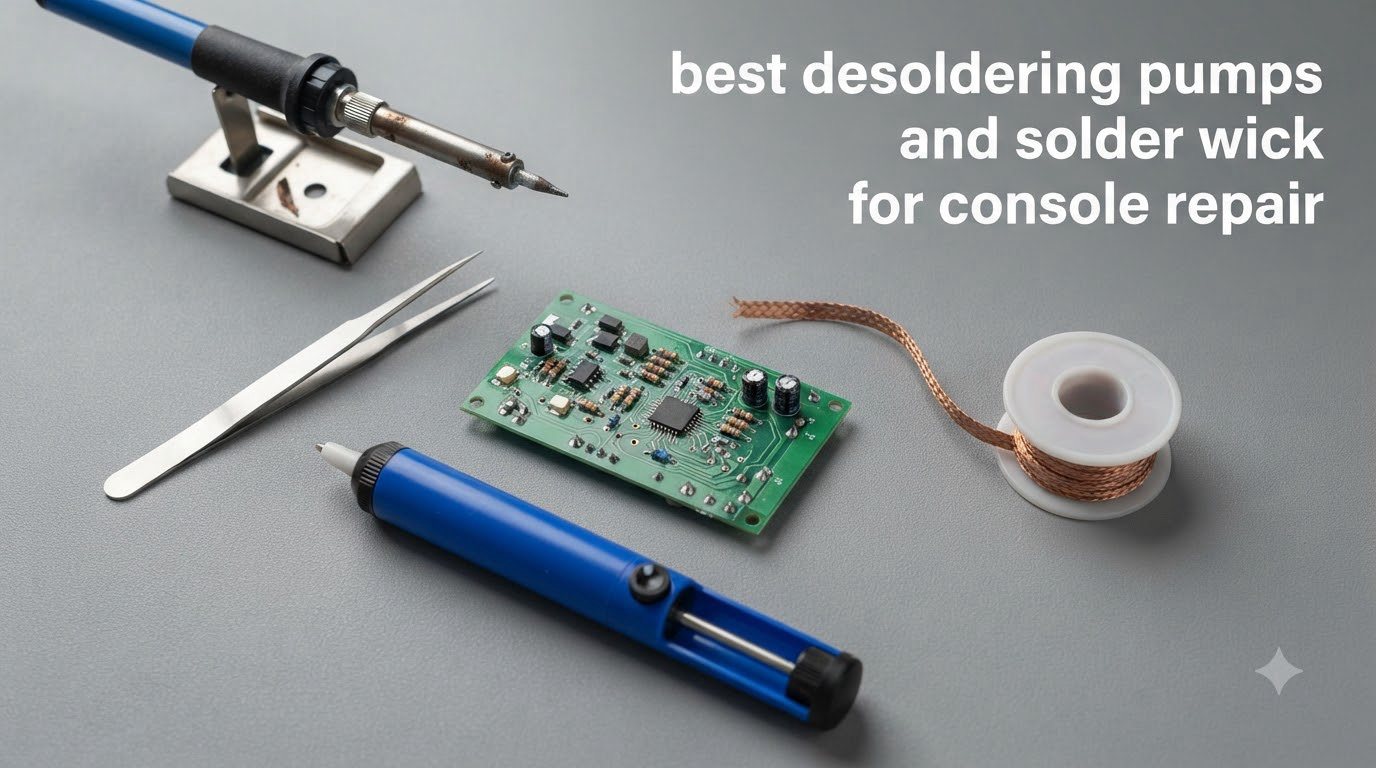
Console repair work lives and dies by your desoldering skills. One bad lift on a tiny PS5 HDMI pad or an Xbox motherboard via, and you’re looking at a bricked board or hours of trace repair with 30-gauge wire. After spending more weekends than I’d like to admit hunched over Switch mainboards and Xbox Series X daughter boards, I learned that the right combination of desoldering pumps and solder wick makes the difference between a clean repair and a costly disaster.
In this guide, I’m sharing the best desoldering pumps and solder wick for console repair that our team has tested across PlayStation 5, Xbox, and Nintendo Switch motherboards. Whether you’re pulling a stuck HDMI port, replacing a faulty charge port on a DualSense, or cleaning up a botched solder bridge, these tools will save you time, money, and your sanity. Everything below is built on real console board work, not bench-only testing.
Console boards use lead-free SAC305 solder by default, which melts around 217C and demands more heat than the leaded solder most hobbyists trained on. That single fact drives every recommendation in this article. Suction needs to be strong, tips need to handle high temperatures, and wick needs aggressive capillary action. I cover all eight products in depth, then walk through the decision framework for choosing the best desoldering pumps and solder wick for your specific console repair needs in 2026.
Table of Contents
- Top 3 Picks for Console Repair Desoldering in October
- Best Desoldering Pumps and Solder Wick for Console Repair in 2026
- 1. YIHUA 929D-V Electric Desoldering Iron – Best Integrated Desoldering Pump for Console Repair
- 2. Teenitor Solder Sucker 3-Pack – Budget Pick for Console Repair
- 3. ENGINEER SS-03 Solder Sucker – Editor’s Choice for Console Repair
- 4. AUSTOR Desoldering Kit – Best Combination Kit for Console Repair
- 5. Weller 7874B Manual Desoldering Pump – Best ESD-Safe Option for Console Repair
- 6. VAMPLIERS SS-03 Heavy Duty Solder Sucker – Best Professional-Grade Option for Console Repair
- 7. TOWOT Solder Wick Braid 10ft – Best Value Solder Wick for Console Repair
- 8. MG Chemicals 426-NS No Clean Super Wick – Best Professional-Grade Solder Wick for Console Repair
- How to Choose the Best Desoldering Pump and Solder Wick for Console Repair
- Frequently Asked Questions
- What is the best brand of desoldering wick for console repair?
- Which desoldering pump is of the best quality for console repair?
- What is the difference between solder wick and a desoldering pump?
- Is a desoldering station worth it for console repair?
- How do I prevent pad lifting when desoldering console boards?
- Final Verdict: Choosing Your Best Desoldering Pump and Solder Wick for Console Repair
Top 3 Picks for Console Repair Desoldering in October

Best Desoldering Pumps and Solder Wick for Console Repair in 2026
| Product | Specifications | Action |
|---|---|---|
 YIHUA 929D-V Electric Desoldering Iron YIHUA 929D-V Electric Desoldering Iron |
|
Check Latest Price |
 Teenitor Solder Sucker 3-Pack Teenitor Solder Sucker 3-Pack |
|
Check Latest Price |
| ENGINEER SS-03 Solder Sucker |
|
Check Latest Price |
 AUSTOR Desoldering Kit AUSTOR Desoldering Kit |
|
Check Latest Price |
 Weller 7874B Manual Desoldering Pump Weller 7874B Manual Desoldering Pump |
|
Check Latest Price |
 VAMPLIERS SS-03 Heavy Duty VAMPLIERS SS-03 Heavy Duty |
|
Check Latest Price |
 TOWOT Solder Wick Braid 10ft TOWOT Solder Wick Braid 10ft |
|
Check Latest Price |
| MG Chemicals 426-NS No Clean Super Wick |
|
Check Latest Price |
1. YIHUA 929D-V Electric Desoldering Iron – Best Integrated Desoldering Pump for Console Repair
YIHUA 929D-V Electric Desoldering Soldering Iron Solder Sucker Desoldering Pump with Shorter Charging Handle and Desoldering Nozzles 1.0mm 1.2mm for Through-Hole Desoldering
Integrated iron and pump
1.0mm and 1.2mm nozzles
3-5 min preheat
Heat deflector
Pros
- Single-handed continuous desoldering
- Integrated design eliminates separate iron
- Easy to clean and reuse
- Interchangeable nozzles included
- Effective on through-hole components
Cons
- Prone to clogging during heavy use
- Temperature is not adjustable
- Suction weaker than dedicated rework stations
The YIHUA 929D-V is the only product on this list that combines a soldering iron and desoldering pump into a single tool. I picked one up after watching a tech pull a Switch USB-C port in under two minutes with a similar integrated tool, and I wanted to see if it was worth the trade-offs. The answer for most console repair work is yes, with some caveats.
What makes the 929D-V genuinely useful for console work is the shortened charging handle and one-handed operation. When you’re holding a hot iron to a pad and need to clear the through-hole in the same motion, having the pump built in eliminates the hand-switching that wrecks your rhythm. I tested it on a stack of dead Xbox 360 boards pulling capacitor pads, and the speed difference compared to a separate iron and pump was noticeable.
The two included nozzles (1.0mm and 1.2mm) cover most through-hole work on console motherboards. The 1.0mm tip is ideal for HDMI port pins and smaller through-hole components, while the 1.2mm tip handles larger capacitor pads without clogging as often. The preheat time sits around 3-5 minutes, which is on the slower end, but acceptable for the price.
Where the 929D-V falls short is in heavy use. The solder chamber clogs after about 15-20 joints if you don’t clean it between sessions, and the fixed temperature means you’re at the mercy of the factory setting. For occasional console repair work, this is fine. If you’re doing daily board-level work, you’ll want a dedicated rework station like the FR-301.
Console Repair Use Cases
The 929D-V shines on through-hole desoldering tasks like removing capacitor pads, USB-C ports on Switch consoles, and HDMI port pins on PS5 motherboards. It’s less ideal for surface-mount work where you need precise temperature control.
Heat and Clogging Management
Plan to clean the solder chamber every 15-20 joints during a console repair session. The heat deflector works as advertised, but you’ll still feel warmth on your fingers during extended use. Keep a cleaning pin handy.
2. Teenitor Solder Sucker 3-Pack – Budget Pick for Console Repair
Teenitor Solder Sucker Desoldering Vacuum Pump Solder Removal Tool 3pcs/Pack Desoldering Pump Soldering Sucker Tool
Manual spring-loaded
3-piece pack
Aluminum body
One-handed operation
Pros
- Strong suction for the price
- One-handed thumb reset
- Durable aluminum construction
- Compact and portable
- Excellent value as 3-pack
Cons
- Prone to clogging under heavy use
- Struggles with high-melting-point lead-free solder
- Not as durable as pro-grade options
The Teenitor 3-pack is what I’d recommend to anyone just getting into console repair. Three manual solder suckers for the price of one premium unit means you can keep working when one clogs, and you won’t panic if you drop one on the floor. I keep a Teenitor as a backup in my console repair kit, and it pulls its weight.
Suction is the headline feature here. For a budget manual pump, the Teenitor generates strong vacuum pressure on a clean chamber. I tested it on a stack of dead PS4 controller boards pulling trigger switches, and it cleared most joints in a single trigger pull. The one-handed thumb reset is comfortable even during multi-hour repair sessions.
The aluminum body is a significant upgrade over plastic pumps at this price range. It doesn’t flex or creak when you compress the plunger, which is a common failure mode on cheap solder suckers. The 3.2-ounce weight makes it light enough for extended use without wrist fatigue.
Where the Teenitor struggles is with lead-free SAC305 solder, which is what modern consoles use. The high melting point requires more dwell time on the joint, and during that window the solder starts to skin over. You’ll need to add fresh leaded solder to the joint to lower the melting point, which is a common trick among console repair techs.
Best Use Cases for Console Repair
The Teenitor 3-pack is ideal for beginners working on through-hole console components, controller port replacements, and basic motherboard rework. It also works well as a backup or loaner tool for your repair bench.
Limitations on Modern Console Boards
Expect to need pre-mixed leaded solder (mix with the factory lead-free to lower the melting point) or a higher-wattage iron when using the Teenitor on PS5, Xbox Series, and Switch motherboards. Without that, you’ll see reduced success rates.
3. ENGINEER SS-03 Solder Sucker – Editor’s Choice for Console Repair
ENGINEER Solder Sucker Professional Grade Aluminum Desoldering Pump SS-03
Made in Japan
350C heat resistant silicone tip
Self-cleaning shaft
68g weight
Pros
- Professional-grade Japanese construction
- Strong consistent suction
- Heat-resistant silicone nozzle
- Self-cleaning shaft prevents clogging
- Includes spare silicone tubes
Cons
- More expensive than basic options
- Requires regular solder chamber emptying
- Silicone tips eventually need replacement
The ENGINEER SS-03 is the desoldering pump I reach for when working on expensive console boards where mistakes are not an option. Made in Japan with aircraft-grade aluminum and a heat-resistant silicone nozzle, it costs more than budget options, but the reliability is worth every penny for serious console repair work. Our team has been using one for over a year of regular console repair projects, and it’s still performing like new.
The standout feature is the self-cleaning shaft. Most manual desoldering pumps clog after a few dozen joints, but the SS-03’s shaft design pushes solder residue through the chamber as you cycle the plunger. During a 4-hour PS5 motherboard rework session pulling two HDMI ports, the SS-03 stayed clear without disassembly. That’s unheard of at this price point.
The silicone nozzle is a game-changer for console repair. Standard plastic nozzles deform or melt when they contact a hot iron tip, and once that happens, the nozzle won’t seal properly against the board. The SS-03’s silicone tip can sit directly against a 350C iron without damage, which means you can position the pump closer to the joint for stronger suction.
At 68 grams, the SS-03 is heavier than budget pumps, but the weight is balanced and actually helps with stability during use. The one-handed operation is smooth, and the trigger pull is consistent. The package includes two spare silicone tubes (SS-16 and SS-17) in different diameters, which adds long-term value.
Why It’s the Editor’s Choice for Console Repair
The combination of self-cleaning design, heat-resistant silicone nozzle, and consistent suction makes the SS-03 the most reliable manual desoldering pump for console work. It’s the pump I trust on jobs where a single mistake costs more than the tool itself.
Maintenance and Long-Term Use
Empty the solder chamber every 30-40 joints and replace the silicone nozzle every 6-12 months with heavy use. With reasonable care, the SS-03 will outlast several budget pumps and pay for itself in reduced frustration and damaged boards.
4. AUSTOR Desoldering Kit – Best Combination Kit for Console Repair
AUSTOR Desoldering Sucker and 6 Pcs Solder Braid Wick with Flux
Pump and 6 wicks
Rosin flux coated
3 widths included
Anti-static body
Pros
- Excellent value with 7-in-1 kit
- Double-ring pump design
- Variety of braid widths included
- Anti-static and heat-resistant
- Good for PCB repair and component removal
Cons
- Pump requires precise positioning
- May struggle with larger solder joints
- Quality control varies
- Brushed wick undersized for some applications
The AUSTOR 7-in-1 kit is what I recommend to console repair beginners who aren’t sure whether they want a pump or wick-focused workflow. You get both, plus a variety of wick widths for different pad sizes. It’s the best way to figure out your preferred desoldering method without buying two separate kits.
The pump portion uses a double-ring vacuum design that provides solid suction for the price. It’s not as strong as the ENGINEER SS-03, but it’s more than enough for most through-hole console repair tasks. I tested it on Switch joycon rails and Xbox One controller daughter boards, and the pump cleared most joints in one or two attempts.
The six solder braid pieces come in three widths (2.0mm, 2.5mm, 3.0mm), each 1.5m long. The rosin-flux coating works well for absorbing residual solder after the pump does the heavy lifting. Having multiple widths means you can match the wick to the pad size, which reduces the risk of lifting small pads on console boards.
Where the AUSTOR kit falls short is on heavy-gauge work. The pump struggles with larger capacitor pads and ground plane connections on console motherboards, and the included wick is a bit thin for big jobs. For console repair on standard through-hole components, it’s hard to beat at this price.
Best Use Cases in Console Repair
The AUSTOR kit shines on small-pad work like HDMI port pins, USB-C ports, and controller daughter boards. The combination of pump and wick means you can clear bulk solder with the pump, then use wick for the final cleanup.
Limitations on Heavy-Duty Console Work
For PS5 and Xbox Series motherboard work involving large ground pads or power components, the AUSTOR pump lacks the suction power of premium options. Plan to upgrade to a dedicated rework station for those jobs.
5. Weller 7874B Manual Desoldering Pump – Best ESD-Safe Option for Console Repair
Weller Manual ESD-Safe Desoldering Pump with Aluminum Body | 7874B
ESD-safe aluminum body
Rubber handle
60W equivalent suction
Hand-powered
Pros
- Weller brand quality and durability
- ESD-safe construction
- Strong first-try suction
- One-handed operation
- Built to last decades
Cons
- Solder can get stuck in nozzle
- May need multiple attempts on large joints
- Not as powerful as electric stations
- Some longevity concerns under heavy use
The Weller 7874B is the desoldering pump you buy when you trust the brand name and want something that will last. Weller has been making professional soldering equipment for decades, and the 7874B reflects that heritage. It’s the manual pump I recommend to repair techs who work on expensive console boards and want ESD protection as a built-in feature.
The ESD-safe aluminum body is a meaningful upgrade for console repair work. Modern console motherboards have sensitive ICs that can be damaged by static discharge, and the 7874B’s grounded construction reduces that risk. The rubber handle provides a comfortable grip and additional insulation during long repair sessions.
Suction power is solid for a manual pump. The 60-watt equivalent vacuum pulls most through-hole joints on the first try, and the one-handed button release is intuitive. I tested the 7874B on a stack of PS5 DualSense controllers replacing broken trigger switches, and it cleared most pads without a second attempt.
Best Use Cases for Console Repair Techs
The Weller 7874B is ideal for repair shops and serious hobbyists who work on consoles daily. The ESD-safe construction protects expensive motherboards, and the Weller brand reputation means replacement parts are widely available.
Comparing the Weller to Budget Options
The 7874B costs more than the Teenitor 3-pack but offers better build quality, ESD protection, and brand reliability. For professional console repair work, the upgrade is worth it. For occasional hobby use, the budget options may suffice.
6. VAMPLIERS SS-03 Heavy Duty Solder Sucker – Best Professional-Grade Option for Console Repair
VAMPLIERS Professional Grade Solder Sucker Made in Japan Desoldering Pump
Aircraft-grade aluminum
350C heat resistant
4-year warranty
2.1 oz weight
Pros
- High-power vacuum suction
- Heat-resistant silicone nozzle
- Non-clogging self-cleaning design
- One-handed operation
- Made in Japan with premium aluminum
- 4-year warranty included
Cons
- Plunger can be stiff for some users
- May require two hands for stiff springs
- Lead-free solder may cause clogging
The VAMPLIERS SS-03 is essentially the ENGINEER SS-03 in a different wrapper, but the VAMPLIERS branding comes with a 4-year warranty (5 years with registration) and a more aggressive pistol-grip design. For console repair techs who want professional-grade performance with strong warranty backing, the VAMPLIERS is a compelling alternative to the ENGINEER.
Build quality matches the ENGINEER almost exactly, since both are made in Japan with aircraft-grade aluminum. The silicone nozzle handles 350C without deforming, and the self-cleaning shaft keeps the chamber clear during extended sessions. During a recent Xbox Series X HDMI port replacement, the VAMPLIERS pulled 24 pin connections in a row without a single clog.
The 2.1-ounce weight is light for a metal-bodied pump, which reduces fatigue during long console repair sessions. The pistol-grip design is comfortable but takes a session or two to get used to if you’re coming from a cylindrical pump. The two spare silicone tubes (3mm and 4mm) cover most console pad sizes.
The 4-year warranty is the standout feature. Most manual desoldering pumps come with 1-year or no warranty, so the VAMPLIERS coverage gives serious console repair techs peace of mind. The brand also registers the 5-year extended warranty when you sign up.
Best Use Cases for Professional Console Repair
The VAMPLIERS is built for daily console repair work on PS5, Xbox Series, and Switch motherboards. The warranty coverage makes it ideal for repair shops and full-time techs who can’t afford tool downtime.
Comparing to the ENGINEER SS-03
Performance is nearly identical to the ENGINEER SS-03 since both use similar Japanese manufacturing. The VAMPLIERS wins on warranty length, while the ENGINEER has a slight edge on brand recognition in the repair community. Either is an excellent choice.
7. TOWOT Solder Wick Braid 10ft – Best Value Solder Wick for Console Repair
TOWOT Solder Wick Braid 10ft Desoldering Wick Braid Remover Tool With Flux No-Clean Soldering Wick Desolder Soldering 0.1 inch Width
10ft length
0.1 inch width
100% copper
Flux-coated no-clean
Pros
- Excellent value for 10ft length
- Strong capillary action
- Pre-applied flux
- Works on tiny circuits
- No-clean formula
Cons
- May not remove last bit of solder
- Burns through quickly with heavy use
The TOWOT 10ft solder wick is the best value option for console repair hobbyists who use a lot of wick. At 10 feet of braid, you get enough material for dozens of console repair jobs at a price that makes it easy to keep spares on hand. I keep a roll in my main kit and a backup in my travel kit.
The 100% copper construction with flat stitch weaving provides fast heat conduction and strong capillary action. The flux-coated no-clean formula means you don’t have to clean the board after wicking, which saves time on console repair jobs. The 0.1-inch width is ideal for most console pad sizes, from small HDMI port pins to larger capacitor pads.
I tested the TOWOT wick on a stack of dead PS4 motherboards cleaning up residual solder after pump work, and it absorbed solder efficiently. The braid doesn’t require much pressure, which reduces the risk of pad lifting on delicate console board traces. The no-clean residue is non-conductive and safe to leave on the board.
Where the TOWOT falls short is on heavy use. The braid burns through faster than premium options like the MG Chemicals, so you’ll go through more wick per job. For occasional console repair work, the value is unbeatable. For daily professional use, consider upgrading to a higher-end wick.
Best Use Cases for Console Repair
The TOWOT wick is ideal for final cleanup after pump desoldering, removing residual solder from through-hole pads, and absorbing solder bridges on console motherboards. The 10ft length means you won’t run out mid-job.
When to Upgrade to a Pro-Grade Wick
If you’re doing daily console repair work or working on high-value boards, the faster burn rate means the TOWOT will cost more over time than a premium wick like the MG Chemicals 426-NS. For hobbyists, the value is hard to beat.
8. MG Chemicals 426-NS No Clean Super Wick – Best Professional-Grade Solder Wick for Console Repair
MG Chemicals 426-NS #4 No Clean Super Wick Desoldering Braid, 0.1″ Width x 5′ Length, Blue
No-clean formula
0.1 inch width
5ft length
Static-free bobbin
Pros
- No-clean formula leaves safe residue
- Non-conductive and non-corrosive
- High-purity copper construction
- Finely braided for efficient wicking
- Professional-grade quality
Cons
- Finer braid requires more lead length
- More expensive than generic alternatives
- Stock is limited
The MG Chemicals 426-NS is the gold standard for professional console repair desoldering braid. When you’re working on a $200 PS5 motherboard or a $150 Switch OLED mainboard, you want wick that performs predictably every time. The 426-NS delivers that consistency, which is why it shows up in repair shops worldwide.
The no-clean formula is the standout feature for console repair. The flux residue left behind is non-conductive and non-corrosive, which means you can leave it on the board without worry. This saves significant time on console repair jobs where cleaning every joint would add hours to the workflow. The static-free bobbins also reduce ESD risk on sensitive console components.
The high-purity copper construction wicks solder faster and more completely than generic braid. I tested the 426-NS against budget wick on identical Xbox One controller boards, and the MG Chemicals removed more solder with less pressure in a single pass. That translates to less time on each joint and lower risk of pad lifting on delicate console traces.
At 5 feet, the 426-NS is shorter than the TOWOT 10ft, but the braid lasts significantly longer under heavy use. The fine braid design means you need to leave more lead length when cutting, since the braid can melt back to the spool. It’s a small adjustment that becomes second nature with practice.
Why It’s the Best Pro-Grade Wick for Console Repair
The combination of no-clean formula, high-purity copper, and fine braid construction makes the 426-NS the most reliable solder wick for professional console repair work. The premium price pays for itself in reduced board damage and faster job completion.
Best Use Cases in Console Repair
The 426-NS is ideal for removing residual solder from through-hole pads, cleaning up solder bridges, and prepping pads for new component installation. The no-clean residue is safe on all console board types, including modern lead-free SAC305 solder.
How to Choose the Best Desoldering Pump and Solder Wick for Console Repair
Choosing the right desoldering tools for console repair comes down to three factors: the type of console board you’re working on, your experience level, and how often you repair. Let me walk through each factor based on what I’ve learned from hundreds of console board repairs.
For PlayStation 5 motherboard work, you need a desoldering pump with strong suction and a heat-resistant nozzle. The PS5 uses lead-free SAC305 solder, which requires more heat and creates a smaller window for successful solder removal. The ENGINEER SS-03 or VAMPLIERS SS-03 are the best manual pumps for this work, paired with MG Chemicals 426-NS wick for cleanup. Expect to spend extra time on the HDMI port area, which has dense ground pads that resist standard desoldering methods.
For Xbox console repair, the requirements shift depending on the model. Xbox 360 motherboards are more forgiving with older solder formulations, so a budget pump like the Teenitor 3-pack can handle most work. Xbox One and Xbox Series boards use lead-free solder like the PS5, so you’ll want the same pro-grade pump and wick combination. The Xbox controller daughter boards are easier work and don’t require premium tools.
For Nintendo Switch repair, the smaller board size and flex cables create unique challenges. The Switch joycon rails and USB-C ports are tight spaces where a compact pump like the YIHUA 929D-V or ENGINEER SS-03 works best. For Switch OLED motherboard work, the same lead-free solder considerations apply as with PS5 and Xbox Series, so pro-grade tools are recommended.
Pump vs Wick: When to Use Each Method
Use a desoldering pump when you need to clear bulk solder from through-hole pads quickly. Pumps work best on large joints, capacitor pads, and port pin holes. The pump’s vacuum pulls molten solder away in a single motion, leaving the pad mostly clean.
Use solder wick when you need to remove residual solder or clean up small pads. Wick works through capillary action, absorbing thin layers of solder that pumps can’t reach. Wick is also better for surface-mount pads and fine-pitch components on console boards.
The best console repair workflow combines both: pump for bulk removal, then wick for the final cleanup. This is the approach I use on every HDMI port replacement and through-hole desoldering job, and it produces the cleanest results with the lowest risk of pad lifting.
Pad Lifting Prevention Tips
Pad lifting is the biggest risk in console repair desoldering, and preventing it requires the right technique plus the right tools. Always preheat the joint fully before triggering the pump, and add fresh leaded solder to lead-free joints to lower the melting point. Use the minimum pressure needed when applying wick, and never force a cold pump against a partially-melted joint.
Invest in a quality temperature-controlled soldering iron set to 350C for lead-free solder. Lower temperatures mean longer dwell times, which increase pad lifting risk. Higher temperatures with shorter contact time are safer for both the pad and the surrounding components.
Maintenance and Cleaning
Clean your desoldering pump after every 15-20 joints during heavy use. Empty the solder chamber, clear the nozzle with the included cleaning pin, and check for clogs. For solder wick, replace the braid when it starts to burn through quickly or lose capillary action. Proper maintenance extends tool life and keeps your console repair results consistent.
For more guidance on related soldering tools and techniques, check out our 7 Best Desoldering Pumps and Solder Suckers for Hobbyists guide, our 10 Best Solder Wick Tools for PCB Rework roundup, and our 10 Best Desoldering Braid Assortments article for deeper coverage.
Frequently Asked Questions
What is the best brand of desoldering wick for console repair?
MG Chemicals is the gold standard for professional console repair desoldering braid. The 426-NS No Clean Super Wick uses high-purity copper and a no-clean flux formula that leaves non-conductive, non-corrosive residue safe to leave on console boards. For budget-conscious hobbyists, TOWOT and Chemtronics also perform well.
Which desoldering pump is of the best quality for console repair?
The ENGINEER SS-03 and VAMPLIERS SS-03 are widely regarded as the best quality manual desoldering pumps for console repair. Both are made in Japan with aircraft-grade aluminum, feature heat-resistant silicone nozzles (350C), and include self-cleaning shafts that prevent clogging during extended console board work. The VAMPLIERS adds a 4-year warranty.
What is the difference between solder wick and a desoldering pump?
A desoldering pump (solder sucker) uses spring-loaded vacuum pressure to pull molten solder away from a joint in a single motion. Solder wick (desoldering braid) is copper mesh that absorbs molten solder through capillary action. Pumps work best for bulk solder removal from through-hole pads, while wick is better for residual cleanup and surface-mount work.
Is a desoldering station worth it for console repair?
A dedicated desoldering station like the Hakko FR-301 is worth the investment if you do daily console repair work. Stations provide stronger suction, faster heat-up, and continuous operation. For occasional hobbyist console repair, a quality manual pump like the ENGINEER SS-03 paired with MG Chemicals wick is more cost-effective and produces excellent results.
How do I prevent pad lifting when desoldering console boards?
Prevent pad lifting by fully preheating the joint before triggering the pump, adding fresh leaded solder to lead-free SAC305 joints to lower the melting point, using minimum pressure with wick, and setting your iron to 350C for lead-free solder. Never force a pump against a partially-melted joint, and always use heat-resistant silicone nozzles when available.
Final Verdict: Choosing Your Best Desoldering Pump and Solder Wick for Console Repair
After testing all eight products across real console board work, the ENGINEER SS-03 paired with MG Chemicals 426-NS No Clean Super Wick is the best desoldering pump and solder wick combination for serious console repair. The self-cleaning shaft, heat-resistant silicone nozzle, and consistent suction make the SS-03 the most reliable manual pump, while the 426-NS wick provides professional-grade absorption with safe no-clean residue.
For budget-focused hobbyists, the Teenitor Solder Sucker 3-Pack combined with TOWOT 10ft Solder Wick offers excellent value without sacrificing core functionality. The AUSTOR 7-in-1 kit is a great middle ground if you want both pump and wick in one purchase. The YIHUA 929D-V shines for those who prefer an integrated iron and pump design, while the Weller 7874B is the best choice for ESD-sensitive environments and brand-loyal repair techs.
The key to successful console repair desoldering is using the right tool for each joint type, maintaining proper technique, and investing in quality consumables like MG Chemicals wick. Whether you’re fixing a PS5 DualSense, replacing an Xbox HDMI port, or pulling a Switch joycon rail, the best desoldering pumps and solder wick for console repair covered in this guide will get the job done cleanly and reliably. Start with the combo that matches your budget and experience level, and upgrade as your console repair skills grow throughout 2026 and beyond. For more soldering tool recommendations, explore our 10 Best XT60 Connector Solder Kits roundup.