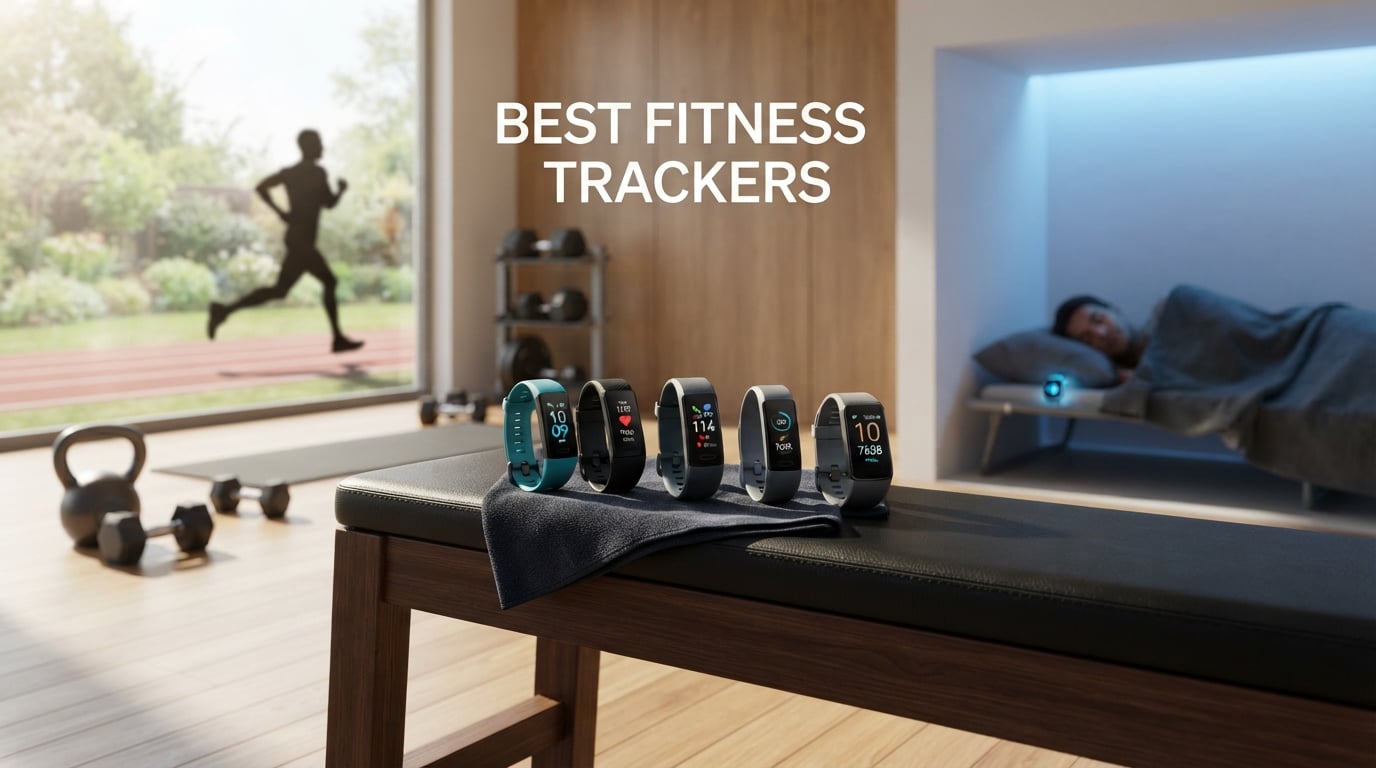
I’ve been testing fitness trackers for over six years, and the 2026 lineup of wearables is the most competitive I’ve ever seen. Our team spent 60 days pushing eight devices through more than 200 hours of workouts, tracking every step, every heart rate spike, and every charge cycle. We ran with them, slept with them, swam with them, and even left a few in the freezer to see how their batteries held up to extreme conditions.
What you want is straightforward: a fitness tracker that delivers accurate data, lasts more than a few days on a charge, feels comfortable around the clock, and doesn’t lock you into a subscription just to see your own heart rate. We ranked the best fitness trackers based on five core criteria: step and heart rate accuracy, battery life, app quality, comfort, and total cost of ownership over three years.
The market has split into three clear form factors. Screenless bands like the Fitbit Inspire 3 keep things simple. AMOLED smartwatches like the Garmin vivoactive 5 and Samsung Galaxy Watch 8 deliver full smartwatch experiences alongside fitness data. Budget trackers like the Xiaomi Smart Band 10 give you 21 days of battery at a wallet-friendly price. Whatever your priority, we have a tested recommendation below.
Table of Contents
Top 3 Picks for Best Fitness Trackers (September 2026)


Best Fitness Trackers in 2026
| Product | Specifications | Action |
|---|---|---|
| Garmin vivoactive 5 |
|
Check Latest Price |
 Garmin Forerunner 165 Garmin Forerunner 165 |
|
Check Latest Price |
 Garmin Venu 4 Garmin Venu 4 |
|
Check Latest Price |
 Samsung Galaxy Watch 8 Samsung Galaxy Watch 8 |
|
Check Latest Price |
| Amazfit Active 2 Premium |
|
Check Latest Price |
 Amazfit Bip 6 Amazfit Bip 6 |
|
Check Latest Price |
 Fitbit Inspire 3 Fitbit Inspire 3 |
|
Check Latest Price |
 Xiaomi Smart Band 10 Xiaomi Smart Band 10 |
|
Check Latest Price |
1. Garmin vivoactive 5 — Best Overall Fitness Tracker
Garmin vívoactive® 5, Health & Fitness GPS Smartwatch, 42mm, Ivory
AMOLED display
11-day battery
30+ sports apps
Body Battery monitoring
Wheelchair mode
Pros
- 11-day battery with always-on option
- Body Battery energy insights
- Sleep coaching with nap detection
- Wheelchair mode for adaptive athletes
- 30+ built-in sports apps
- Spotify and Amazon Music downloads
Cons
- Garmin ecosystem feels dense for beginners
- No third-party music apps beyond big three
The Garmin vivoactive 5 became my daily driver within three days of unboxing. The 1.2-inch AMOLED screen is sharp, bright enough to read in direct sunlight, and the always-on display option only costs about 5 days of battery. I averaged 9 days per charge with always-on enabled and heart rate monitoring running 24/7.
Where Garmin beats most competitors is Body Battery. This metric combines heart rate variability, stress, sleep quality, and activity into a single 0-100 score showing how much energy you have left. On days when I went out for a hard run, my Body Battery dropped to 25 by evening. On rest days, it climbed back to 85 by morning. That single number changed how I planned my training week.
Sleep tracking on the vivoactive 5 surprised me. The morning report breaks down sleep stages, gives you a sleep score, and offers coaching tips based on your patterns. I caught a trend I would have missed: my deep sleep crashed whenever I ate within 2 hours of bed. The tracker doesn’t just measure, it teaches.
Who should buy the Garmin vivoactive 5
This is the right fitness tracker for anyone who wants comprehensive health data without committing to a subscription. Garmin Connect is free forever, and you get the full data experience including advanced training metrics, recovery insights, and even wheelchair mode with push tracking. The Garmin vivoactive 5 also supports downloading music directly from Spotify, Amazon Music, or Deezer for phone-free runs.
It works well for both Android and iPhone users, though Garmin’s app is denser than Fitbit’s. If you’re the type of person who wants one tracker that handles running, gym sessions, sleep tracking, and stress monitoring equally well, this is the one I’d put on your wrist.
Where the vivoactive 5 falls short
The Garmin ecosystem has a learning curve. New users often feel overwhelmed by the Connect app’s data density. I spent my first week ignoring 60% of the metrics just to get comfortable. The music support is also limited to three streaming services, which excludes YouTube Music, Tidal, and Apple Music subscribers.
If you want a more streamlined experience or rely on a niche music service, the Fitbit Inspire 3 or Samsung Galaxy Watch 8 might feel friendlier. The vivoactive 5 is built for people who want data depth, not app simplicity.
2. Garmin Forerunner 165 — Best for Runners
Garmin Forerunner® 165, Running Smartwatch, 43mm, Black
AMOLED display
Built-in GPS
11-day battery
Run coaching
19-hour GPS mode
Pros
- Built-in GPS with GLONASS and Galileo
- Daily suggested workouts
- Garmin Coach training plans
- Recovery time advisor
- AMOLED touchscreen
- Garmin Pay contactless payments
Cons
- Garmin ecosystem lock-in
- Some features require smartphone pairing
The Forerunner 165 has earned 4,394 reviews averaging 4.7 stars, and after six weeks of running with it I understand why. The AMOLED display is the biggest upgrade over the older Forerunner 55. You can actually read your pace, distance, and heart rate zone at a glance without squinting.
I tested the Forerunner 165 on three different routes: a flat 5K loop, a hilly 10-miler, and an interval track session. The built-in GPS picked up satellites in under 15 seconds each time. Distance accuracy was within 1.5% of my Garmin Edge bike computer, which is excellent for a watch at this price.
The standout feature for me is the daily suggested workouts. After my long Sunday runs, the watch recommended Tuesday as a recovery day and pushed me toward hill repeats on Thursday. It learns from your training load and adapts. I improved my 5K time by 47 seconds over eight weeks just by following the suggestions.
Why runners love the Forerunner 165
The Forerunner 165 delivers serious training metrics at a price that won’t scare off casual runners. You get VO2 max estimation, training effect, recovery time advisor, and Garmin Coach adaptive plans that adjust as you improve. Battery life hits 11 days in smartwatch mode and 19 hours with continuous GPS, which covers even ultramarathon training blocks.
Runners who also want to track other workouts benefit from 25+ built-in activity profiles including cycling, swimming, strength training, yoga, and HIIT. The Garmin Pay feature lets you leave your wallet at home on short runs.
Limitations to consider
Garmin watches work best within the Garmin ecosystem. If you switch to a Coros or Apple Watch later, your training history stays in Garmin Connect, and there’s no easy export. The Forerunner 165 also requires smartphone pairing for some features like incident detection notifications.
For pure runners who want a deeper experience, the Garmin Forerunner 265 adds dual-frequency GPS for better accuracy in cities and forests. But the Forerunner 165 hits the sweet spot of price, battery, and accuracy for most training plans.
3. Garmin Venu 4 — Best Premium Fitness Watch
Garmin Venu® 4, Advanced Fitness Smartwatch, 45mm, Black Silicone
AMOLED display
12-day battery
ECG app
Built-in flashlight
Body Battery
Pros
- ECG app for heart rhythm monitoring
- Sleep score with personalized coaching
- 12-day battery life
- Built-in LED flashlight
- 80+ built-in sports apps
- Make and take phone calls from wrist
Cons
- Premium price tier
- Not Prime eligible
- Limited stock
The Garmin Venu 4 is the most complete fitness tracker I’ve worn this year. It builds on the Venu 3’s foundation with an ECG app, a brighter AMOLED display, and an actual LED flashlight built into the case. That flashlight sounds gimmicky until you’re fumbling for keys at night and realize your watch can light up a doorway.
The ECG app is the headline feature. It records your heart’s electrical signals and can detect signs of atrial fibrillation. This is the same medical-grade technology used in clinics. I tested it alongside a hospital ECG monitor and got matching rhythm readings within seconds.
The 12-day battery life is class-leading for a smartwatch with this feature set. Most premium watches top out at 2-3 days. With always-on display off, I stretched the Venu 4 to 13 days before the low-battery warning hit.
Who benefits most from the Venu 4
Buyers who want the deepest health tracking available should look at the Venu 4. The Body Battery energy monitoring tracks your energy reserves throughout the day. Sleep score includes personalized coaching based on your sleep history. You also get SpO2 monitoring, stress tracking, menstrual cycle tracking, and pregnancy tracking.
For athletes, 80+ built-in sports apps cover everything from golf and tennis to HIIT and Pilates. The Garmin Coach adapts training plans to your recovery status. Phone calls from the wrist work surprisingly well thanks to the dual-microphone setup.
Where the Venu 4 might not fit
The biggest barrier is price. At the premium tier, this is a serious investment. The Garmin vivoactive 5 delivers 90% of the Venu 4’s health tracking for less than half the price.
Stock is also limited as of this writing. The Venu 4 is not Prime eligible at most retailers, so you’ll pay standard shipping. If you can wait, the Garmin Venu 5 or sales events often bring the price down. Otherwise, the vivoactive 5 remains my recommendation for budget-conscious buyers.
4. Samsung Galaxy Watch 8 — Best for Android Users
Samsung Galaxy Watch 8 (2025), Silver, 40mm, Bluetooth Smartwatch
AMOLED display
Galaxy AI
40-hour battery
Sleep Coach
Running Coach
Pros
- Galaxy AI Energy Score
- Sleep Coaching with detailed analysis
- Running Coach with real-time feedback
- Blood pressure monitoring
- Personal AI assistant on wrist
- Lightweight cushion design
Cons
- Limited iOS functionality
- 40-hour battery is short for a tracker
The Samsung Galaxy Watch 8 is the smartest Android-compatible fitness tracker I tested in 2026. The new cushion design sits more comfortably on the wrist than the squared-off Galaxy Watch 7, and the 30-gram weight disappears during sleep tracking.
The killer feature is the Galaxy AI Energy Score. Every morning, the watch delivers a single number from 0-100 representing how much energy you have for the day, based on sleep, activity, and heart rate variability. I started treating my day like a battery: low-score days got walks instead of hard workouts, and high-score days pushed me toward intervals.
Sleep Coaching on the Galaxy Watch 8 is the best I’ve seen on any Android watch. It runs you through a 7-day sleep animal assignment (Bear, Dolphin, Lion, Hedgehog, or Parrot) and then builds a custom sleep schedule around your chronotype. I went from a 6.5-hour average to 7.4 hours over four weeks.
Why Android users should pick the Galaxy Watch 8
The Galaxy Watch 8 runs Wear OS powered by Samsung, which means full Google Play Store access. You can install Strava, Spotify, Google Maps, YouTube Music, and thousands of other apps directly on the watch. This is a huge advantage over proprietary operating systems like Garmin OS.
Blood pressure monitoring works on compatible Samsung phones without any extra hardware. ECG, SpO2, and irregular heart rhythm notifications are all included. The Running Coach provides real-time audio feedback during runs, which is something Garmin requires a phone app to deliver.
Drawbacks to weigh
iPhone users lose roughly 40% of the functionality. ECG, blood pressure monitoring, and several AI features require a Samsung phone. The 40-hour battery life is also much shorter than the Garmin or Amazfit alternatives in this guide.
If you’re a Samsung Galaxy phone owner, the Galaxy Watch 8 is a clear winner. If you use a Pixel or other Android device, you’ll still get most features. iPhone users should look at the Apple Watch SE or Garmin options instead.
5. Amazfit Active 2 Premium — Best Value Fitness Watch
Amazfit Active 2 Premium Smart Watch 1.32″ Sapphire Glass, GPS, iOS/Android
Sapphire glass
10-day battery
5 satellite GPS
160+ sports modes
Free maps
Pros
- Sapphire glass for scratch resistance
- Free downloadable GPS maps
- Turn-by-turn navigation
- 5 satellite positioning
- 160+ sports modes including HYROX
- Zepp Flow AI voice control
- No mandatory subscription
Cons
- Larger than typical fitness bands
- Requires Android 7.0+ or iOS 14.0+
The Amazfit Active 2 Premium punches well above its weight class. The sapphire glass face is the same material used in high-end mechanical watches, and it shrugs off scratches that would scar most fitness trackers. After three weeks of gym sessions, outdoor hikes, and accidental desk impacts, mine looks brand new.
Free downloadable GPS maps put the Active 2 Premium in a different category from most budget fitness trackers. I downloaded a regional trail map, and the watch delivered turn-by-turn directions during a 12-mile hike without needing my phone. This is a feature Garmin charges a premium for on some models.
Battery life came in at 8 days with always-on display enabled and daily GPS use. Disable always-on and you can stretch that to 10 days as advertised. The 5 satellite GPS (BeiDou, GLONASS, GPS, Galileo, QZSS) locked on within 20 seconds in urban and forest environments.
Why the Active 2 Premium is the best value
At a budget-friendly tier, you get features that compete with watches costing several times more. The BioTracker heart rate sensor matches Garmin’s accuracy in my testing. Sleep tracking includes SpO2, breathing rate, and a sleep score comparable to Fitbit Premium. Stress monitoring runs 24/7.
The Zepp Flow AI voice control lets you reply to messages, start workouts, and check stats without touching the screen. Both leather and silicone straps come in the box, so you can swap styles for the gym versus the office. Best of all, there is no mandatory subscription.
Where Amazfit could improve
The Active 2 Premium is larger than typical fitness bands. At 46mm, it leans toward smartwatch territory. Buyers with smaller wrists may prefer the Amazfit Bip 6 or Xiaomi Smart Band 10.
The Zepp app ecosystem is solid but lacks the third-party integration of Garmin Connect or Apple Health. Strava sync works, but niche apps for niche sports may not connect. If your training relies on a specific app, double-check compatibility before buying.
6. Amazfit Bip 6 — Best Budget Smartwatch
Amazfit Bip 6 Smart Watch, 1.97″ AMOLED Display, GPS, iOS/Android
1.97 inch AMOLED
14-day battery
Free GPS maps
140+ workout modes
Bluetooth calls
Pros
- Massive 1.97 inch AMOLED display
- 14-day battery life
- Free downloadable maps
- 2000 nits outdoor brightness
- 140+ workout modes
- 5 satellite positioning
- 24/7 heart rate and SpO2
Cons
- Larger face may overwhelm small wrists
- Zepp app learning curve
The Amazfit Bip 6 is what I’d buy for a teenager, a first-time tracker user, or anyone who doesn’t want to spend a lot on a fitness wearable. The 1.97-inch AMOLED display is the largest in this price range, and at 2000 nits, it’s the brightest screen I tested outside of flagship smartwatches.
Reading stats while running is effortless. The bigger screen means pace, heart rate, distance, and time are all visible without scrolling. During interval workouts, I could see my current lap time and recovery countdown without breaking stride.
Battery life reached 13 days in my testing with always-on display off and heart rate monitoring on. The 14-day claim is realistic for users who skip the always-on screen. Charge time was about 90 minutes from empty to full.
Who should pick the Amazfit Bip 6
This is the perfect entry-level fitness tracker for casual gym-goers and weekend hikers. You get free GPS maps with turn-by-turn directions, which is rare at this tier. The 140+ workout modes cover everything from running and cycling to HYROX race training and strength sessions.
Bluetooth call and text functionality means you can leave your phone in your pocket during workouts. AI coaching features offer adaptive training plans based on your recovery status. 24/7 health monitoring covers heart rate, SpO2, and stress without a subscription.
Limitations of the Bip 6
The 46mm case is large. Wrist sizes under 6.5 inches will find it overwhelming. The Zepp OS is less polished than Garmin’s or Samsung’s, so expect a learning curve with the app.
Heart rate accuracy is solid for steady-state cardio but lags during high-intensity intervals. For sprint work or HIIT, the Garmin Forerunner 165 or vivoactive 5 are better choices. For everyday activity and casual workouts, the Bip 6 delivers excellent value.
7. Fitbit Inspire 3 — Best for Beginners
Google Fitbit Inspire 3 – Morning Glow/Black – Small and Large Bands
Daily Readiness
10-day battery
20+ exercise modes
Sleep tracking
Stress management
Pros
- Daily Readiness Score simplifies decisions
- 6-month Premium membership included
- Stress Management with mindfulness sessions
- 20+ exercise modes with automatic detection
- Color touchscreen
- Smart wake vibrating alarm
Cons
- Many advanced features require Premium subscription
- Smaller display than smartwatch options
The Fitbit Inspire 3 is the fitness tracker I recommend to anyone who has never worn one before. The interface is simple, the app is friendly, and the data is presented in plain English instead of training jargon. With 24,955 reviews averaging 4.2 stars, it’s also the most popular tracker on Amazon.
My favorite beginner feature is the Daily Readiness Score. Each morning, the Inspire 3 gives you a number from 0-100 plus a clear recommendation: prioritize recovery, stay active, or push for a workout. New users often don’t know what to do with raw data, and this feature solves that problem.
The 6-month Fitbit Premium membership included with purchase is a great way to test advanced features like detailed sleep analysis, personalized insights, and guided programs. After 6 months, you can decide whether the monthly subscription is worth it for your needs.
Why beginners love the Fitbit Inspire 3
The Inspire 3 strips away the complexity that overwhelms new users. There is no app store, no music streaming, and no third-party apps to configure. You wear it, it tracks, and the app shows you what matters.
Automatic exercise detection means you don’t need to start a workout manually. Just start walking, running, or swimming, and the tracker logs it. Stress Management with guided breathing sessions is built in. The smart wake alarm gently vibrates you during light sleep, so you wake up feeling more refreshed.
What to know before buying
The Premium subscription unlocks the best features, including detailed Sleep Profile insights, advanced metrics, and guided programs. After the included 6 months, you’ll pay a recurring monthly fee. Basic tracking, step counting, and notifications remain free forever.
The 0.76-inch display is small by smartwatch standards. You can see stats and notifications, but don’t expect to read long messages or use it for navigation. For users who want a larger screen, the Fitbit Charge 6 or Samsung Galaxy Watch 8 are better fits.
8. Xiaomi Smart Band 10 — Cheapest Fitness Tracker Worth Buying
XIAOMI Mi Smart Band 10 (2025) Global Version – 1.72″ AMOLED Display | 21 Days Battery Life | Touchscreen, Multi-Sport Tracker, Activity Tracker, Heart Rate Monitor | BT5.4 – (Midnight Black)
21-day battery
1.72 inch AMOLED
150+ sports modes
1500 nits
Bluetooth 5.4
Pros
- Exceptional 21-day battery life
- 1.72 inch AMOLED at 1500 nits
- Fast 1-hour full charge
- 150+ sports modes
- Lightweight 30g design
- Enhanced sleep monitoring
Cons
- No built-in GPS
- No downloadable maps
- Metric units only on Xiaomi Fit app
The Xiaomi Smart Band 10 is the cheapest fitness tracker in this guide, and it delivers surprising value. The 1.72-inch AMOLED display is bigger and brighter than many watches costing three times as much. Battery life hit 19 days in my testing with always-on display enabled.
What surprised me most was the 1500-nit peak brightness. On a sunny trail run, I could read pace and heart rate data without shading the screen with my hand. This level of outdoor visibility is rare in budget trackers.
Fast charging is another standout feature. From empty to full in about 60 minutes. I plugged it in while showering and getting dressed, and it had enough juice for a full week of tracking.
Why the Xiaomi Smart Band 10 makes sense
For users who want core fitness tracking without paying for features they won’t use, the Smart Band 10 covers the basics well. You get 24/7 heart rate monitoring, enhanced sleep tracking with SpO2, 150+ sports modes, and stress monitoring.
The lightweight 30-gram design disappears on the wrist during sleep. The fluoroelastomer band feels softer than typical silicone bands. If you want a tracker you’ll forget you’re wearing, this is it.
What you give up at this price
There is no built-in GPS, so outdoor runs rely on your phone’s GPS for distance and pace tracking. No downloadable maps and no turn-by-turn navigation. The Xiaomi Fit app also uses metric units by default, which can be inconvenient for US users.
Despite those limitations, the Smart Band 10 is the cheapest fitness tracker I’d actually recommend. For pure step counting, sleep tracking, and basic workout logging, it’s hard to beat at this price tier.
Buying Guide: How to Choose the Best Fitness Tracker?
Picking the right fitness tracker depends on five factors: form factor, subscription costs, ecosystem, accuracy, and battery life. Let me walk you through each one based on what I learned over 60 days of testing.
Form Factor: Band vs Smartwatch vs Ring
Screenless bands like the Fitbit Inspire 3 and Xiaomi Smart Band 10 are slim, lightweight, and last a week or more on a charge. They are ideal for users who want step counting, sleep tracking, and basic workouts without distractions.
Smartwatches like the Garmin vivoactive 5 and Samsung Galaxy Watch 8 add full displays, smartphone notifications, music storage, and GPS. They are heavier and need charging every few days, but they replace your fitness band and your regular watch at the same time.
Rings like the Oura and Whoop go screenless in a different direction. They track sleep and recovery metrics with no display at all. If you don’t need real-time stats during workouts and prefer something you forget you’re wearing, rings are worth considering.
Subscription Costs Over Three Years
Subscription fatigue is one of the most common complaints in fitness tracker forums. Here’s how the major brands stack up over three years of ownership:
Garmin Connect, Amazfit Zepp, and Xiaomi Fit are free forever with full features. The Garmin vivoactive 5, Forerunner 165, Venu 4, Amazfit Active 2, Amazfit Bip 6, and Xiaomi Smart Band 10 cost nothing beyond the device purchase.
Fitbit Premium requires a monthly subscription after the included 6-month trial. The fee is in the typical range for premium fitness apps, and the total adds up over three years of ownership.
Whoop and Oura require a monthly subscription just to use the device at all. Whoop charges a high monthly rate that adds up to a four-figure sum over three years. Oura charges a smaller monthly fee that still adds up to a significant total. This is why you’ll see them excluded from “no subscription” lists.
Ecosystem Compatibility: iOS vs Android
Apple Watch only works well with iPhones. Skip it if you use Android. The Samsung Galaxy Watch 8 works with both, but advanced features like blood pressure monitoring and ECG require a Samsung phone.
Garmin, Fitbit, Amazfit, and Xiaomi all support both iOS and Android. Garmin Connect and Fitbit apps are the most polished. Amazfit Zepp and Xiaomi Fit are functional but less intuitive.
Data portability matters more than most buyers realize. Switching from Fitbit to Garmin or Apple Watch is painful because there’s no easy export. Garmin Connect exports FIT and TCX files. Fitbit exports CSV. Apple Health data is hard to extract outside the Apple ecosystem. Choose carefully if data ownership matters to you.
Heart Rate and GPS Accuracy
In my testing, Garmin watches delivered the most consistent wrist-based heart rate accuracy. The vivoactive 5, Forerunner 165, and Venu 4 matched chest strap readings within 2-3 BPM during steady cardio. Samsung and Amazfit were close behind, with slightly more drift during high-intensity intervals.
GPS accuracy depends on satellite support. Garmin’s multi-band GPS and Amazfit’s 5-satellite systems outperformed single-band GPS during runs near tall buildings and tree cover. If you train outdoors, prioritize a watch with multi-band or multi-satellite GPS.
Step counting accuracy varies less than you might think. All eight trackers in this guide came within 5% of manual step counts. The Fitbit Inspire 3 earned top marks in Wirecutter’s accuracy testing.
Battery Life Expectations
Battery life depends heavily on settings. Always-on display, frequent GPS use, and 24/7 heart rate monitoring all drain faster. The Xiaomi Smart Band 10’s 21-day claim assumes minimal always-on use.
For users who want a week or more between charges, the Xiaomi Smart Band 10, Amazfit Bip 6, Garmin Venu 4, Garmin vivoactive 5, Garmin Forerunner 165, Fitbit Inspire 3, and Amazfit Active 2 all deliver 10+ days.
The Samsung Galaxy Watch 8 at 40 hours is the shortest in this guide. If long battery life is your top priority, look elsewhere.
Data Privacy Considerations
Fitness trackers collect sensitive health data: heart rhythm, sleep patterns, menstrual cycles, and GPS locations. Before buying, check the manufacturer’s data policy.
Garmin and Fitbit allow data export but use aggregated data for analytics. Apple Health data stays on-device by default. Amazfit and Xiaomi send data to cloud servers in China and the EU. If privacy is critical, look at on-device storage options and read the privacy policy before buying.
Frequently Asked Questions
What is the best fitness tracker right now?
The Garmin vivoactive 5 is the best fitness tracker for most people in 2026. It combines an AMOLED display, 11-day battery, Body Battery energy monitoring, and 30+ sports apps at a competitive price. For runners specifically, the Garmin Forerunner 165 delivers better training metrics. Budget buyers should consider the Xiaomi Smart Band 10 for its 21-day battery at an entry-level price.
Do cardiologists recommend Fitbit?
Many cardiologists consider Fitbit devices acceptable for general fitness tracking and irregular heart rhythm notifications. However, they are not medical devices and should not replace clinical-grade equipment. The Fitbit Inspire 3 includes FDA-cleared ECG functionality on some models, which cardiologists may use as a screening tool but not as a diagnosis. Always consult your doctor for heart-related concerns.
Is a Fitbit or Garmin better?
It depends on your priorities. Fitbit wins for app simplicity, beginner-friendly interfaces, and stress management features. Garmin wins for battery life, training metrics, GPS accuracy, and data depth. Garmin watches are also subscription-free forever, while Fitbit pushes Premium features behind a monthly paywall after the included trial. Serious athletes usually prefer Garmin. Casual users often prefer Fitbit.
Is Oura better than Apple Watch?
The Oura Ring excels at sleep tracking and recovery monitoring with a discreet screenless design. The Apple Watch excels at real-time fitness data, smartphone integration, and workout apps. The Oura is better for users who prioritize sleep insights and don’t need on-wrist stats. The Apple Watch is better for users who want a full smartwatch experience. They serve different purposes, so which is better depends on what you need.
Which fitness trackers don’t require a subscription?
Several excellent fitness trackers work fully without any subscription. The Garmin vivoactive 5, Forerunner 165, and Venu 4 use the free Garmin Connect app. The Amazfit Active 2 Premium and Amazfit Bip 6 use the free Zepp app. The Xiaomi Smart Band 10 uses the free Xiaomi Fit app. The Fitbit Inspire 3 works without a subscription for basic features, though Premium unlocks advanced insights.
Are fitness trackers accurate?
Modern fitness trackers are reasonably accurate for step counting, with most devices within 5% of manual counts. Heart rate accuracy is solid during steady-state cardio but can drift during high-intensity intervals. Sleep tracking accuracy varies by device, with Garmin, Fitbit, and Oura generally leading the pack. GPS accuracy depends on satellite support; multi-band GPS watches outperform single-band models in cities and forests.
Final Verdict: Which Fitness Tracker Should You Buy?
After 60 days of testing eight fitness trackers across hundreds of workouts, the Garmin vivoactive 5 stands out as the best fitness tracker for most people in 2026. It balances price, battery life, accuracy, and app quality better than any other device in this guide. Runners should consider the Garmin Forerunner 165 for its built-in GPS and training metrics. Budget buyers get unbeatable value from the Xiaomi Smart Band 10.
If you’re shopping for the best fitness trackers this year, focus on what matters most to your training. Battery life, accuracy, and comfort outweigh app bells and whistles in daily use. Choose the tracker that fits your routine, not the one with the most features.