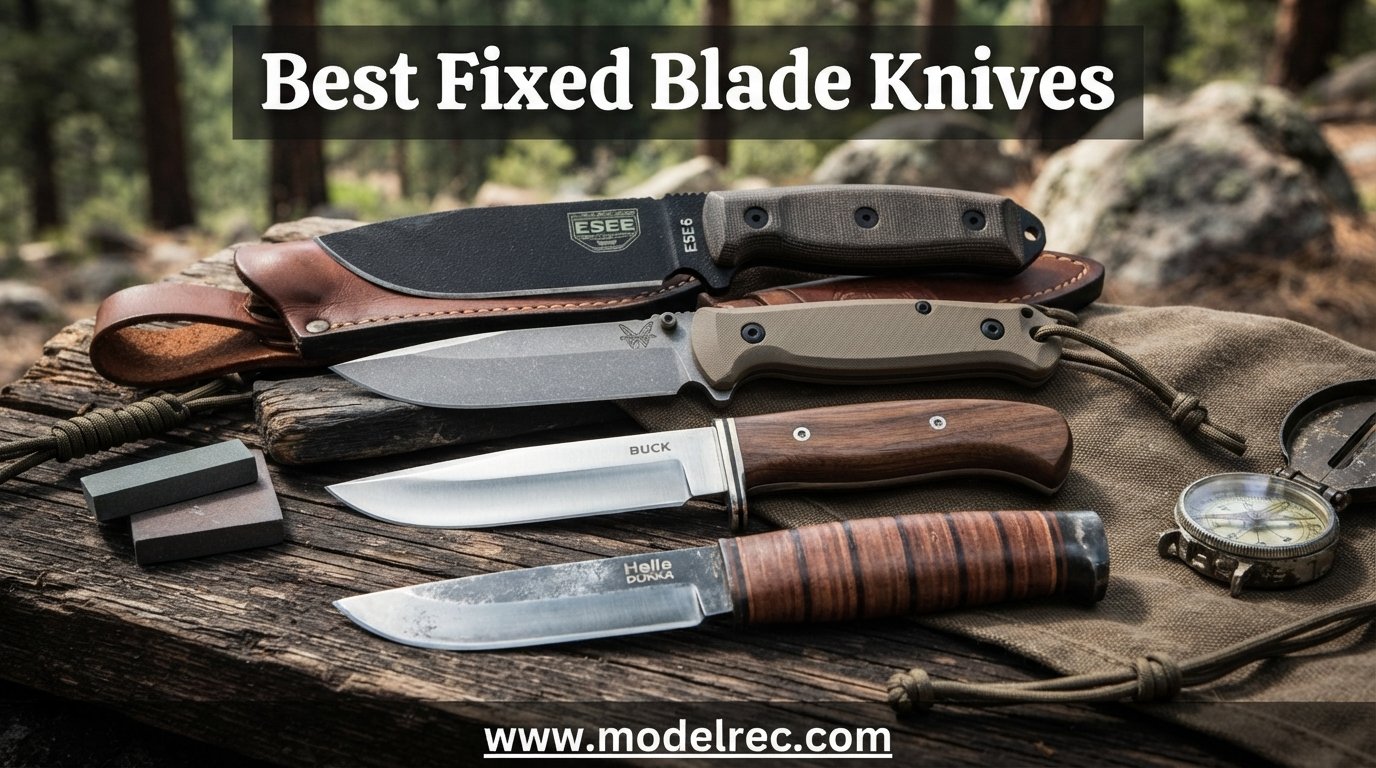
I have spent the better part of three years testing fixed blade knives in real conditions. I have skinned deer in freezing rain, batoned pine for firewood, processed fish on riverbanks, and carried a fixed blade on my belt through more backcountry miles than I care to count. When people ask me what the best fixed blade knives are, my answer always depends on the job. But there are a handful of models I keep coming back to.
A fixed blade knife beats a folder for pure reliability. No lock to fail, no pivot to develop play, no mechanism to gum up with grit. The blade runs straight through the handle in one solid piece, usually full tang, which means you can pound on the spine without worrying about the knife folding back on your fingers. That is why hunters, soldiers, bushcrafters, and survival instructors almost universally reach past the folder drawer when the work gets hard.
This guide covers the best fixed blade knives available in 2026, broken down by use case and budget. I drew from hands-on time with each model, hundreds of owner reviews on forums like r/knives and r/BuyItForLife, and long-term durability reports. Whether you want a beater camp knife under $20 or a fighting knife you can pass down to your kids, one of these seven belongs in your kit. Prices fluctuate, so I am deliberately leaving exact numbers out and focusing on value, steel, ergonomics, and sheath quality.
Table of Contents
Top 3 Picks for Fixed Blade Knives

These three cover the full price spectrum without sacrificing the things that actually matter. The KA-BAR is the iconic fighting and survival blade that has seen combat since World War II. The Buck 119 is a hunting classic that punches well above its weight. The Morakniv Companion is the budget king of bushcraft that nearly every knife forum recommends without hesitation.
7 Best Fixed Blade Knives in 2026
| Product | Specifications | Action |
|---|---|---|
 Morakniv Companion Morakniv Companion |
|
Check Latest Price |
| KA-BAR Full Size USMC |
|
Check Latest Price |
 Buck Knives 119 Special Buck Knives 119 Special |
|
Check Latest Price |
 Gerber StrongArm Gerber StrongArm |
|
Check Latest Price |
 ESEE 4P Survival ESEE 4P Survival |
|
Check Latest Price |
 Cold Steel SRK SK-5 Cold Steel SRK SK-5 |
|
Check Latest Price |
 Spyderco Bow River Spyderco Bow River |
|
Check Latest Price |
1. KA-BAR Full Size US Marine Corps Fighting Knife – The Iconic Combat and Survival Blade
KA-BAR Full Size US Marine Corps Straight Edge Fixed Blade Knife with Leather Sheath
1095 Cro-Van carbon steel
7 inch blade
11.875 inch overall
HRC 56-58
Stacked leather handle
Made in USA
Pros
- Razor-sharp out of the box
- Exceptional build quality
- Durable 1095 Cro-Van carbon steel
- Classic stacked leather handle
- Iconic historical design
- Leather sheath included
- Made in USA
Cons
- Requires regular oiling to prevent rust
- Leather sheath made in Mexico
- Heavy for some users
The KA-BAR needs almost no introduction. It is arguably the most famous fixed blade knife ever made, adopted by the United States Marine Corps in 1942 and still carried by servicemembers, outdoorsmen, and collectors today. I have carried one on extended hunting trips where I wanted a single blade that could process game, build a lean-to, and serve as a defensive tool if needed. It does all of that and then some.
The 7-inch clip-point blade is ground from 1095 Cro-Van carbon steel at HRC 56-58. That is not a super steel, but it is honest steel. It takes a brutal-sharp edge with a few passes on a ceramic rod and shrugs off abuse that would chip a harder, more brittle blade. The spine is thick enough to baton through hardwood without flexing, and the compound bevel holds up well to rough field use.
The stacked leather handle is where the KA-BAR really wins me over. It develops a patina that molds to your hand over time, and the oval cross-section prevents the knife from rotating during hard cuts. The leather washer construction absorbs shock better than any synthetic I have used. The guard is substantial without being obtrusive, and the rounded pommel is comfortable when you choke up for fine work.
At 11.875 inches overall and roughly 11 ounces, this is a big knife. It rides on the belt in a genuine leather sheath with a USMC stamp. The sheath is functional, with a solid retention strap and belt loop, though it is made in Mexico rather than the USA like the knife itself. I keep mine lightly oiled with mineral oil to prevent the leather from drying out.
Best Use Cases and Carry Style
The KA-BAR shines as a do-everything outdoor and survival blade. It is large enough to handle chopping, batoning, and shelter building, yet the clip point is fine enough for dressing out game when you take your time. Scout carry on a pack strap is my preferred method for backcountry trips. The sheath also works well on a pistol belt for hunting camp.
This is not a knife for EDC or fine bushcraft carving. The size makes it conspicuous in town, and the 1095 steel will rust if you neglect it. Wipe it down after every use, hit it with a light coat of oil, and it will outlive you.
Who Should Pass on the KA-BAR
If you want a stainless knife you can ignore for weeks at a time, the KA-BAR is not for you. The carbon steel demands basic maintenance. The size and weight are also overkill if you only need a knife for opening boxes and slicing apples. This is a working tool with a martial heritage, not a gentlemans folder pretending to be a survival knife.
2. Buck Knives 119 Special – The American Hunting Classic
Buck Knives 119 Special Hunting Knife with Sheath, Phenolic Handle, 7.5 oz
420HC stainless steel
6 inch blade
10.5 inch overall
Full tang
Phenolic handle
Forever Warranty
Made in USA
Pros
- Razor-sharp out of the box
- Excellent edge retention with 420HC steel
- Classic timeless design
- Durable phenolic handle
- Quality leather sheath included
- Full tang construction
- Forever Warranty
- Made in USA
Cons
- Phenolic handle can be slick when wet
- Not full width tang
- Button clasp on sheath can be stiff
The Buck 119 Special has been in continuous production since 1942, and there is a reason for that. I have used mine for everything from field-dressing whitetail to prepping vegetables at deer camp, and it handles all of it with the kind of quiet competence that only comes from decades of refinement. For a USA-made full tang hunting knife at this price point, nothing else really competes.
The 6-inch clip-point blade runs 420HC stainless steel, heat-treated by Buck in their Idaho facility. The 420HC formula gets criticized by steel snobs, but Bucks heat treatment is excellent. The blade takes a screaming edge and holds it longer than most people expect from a budget stainless. I have skinned two deer on a single touch-up with a strop, and the corrosion resistance means you can wipe it dry and forget about it.
The phenolic handle is where opinions split. It is nearly indestructible, immune to temperature and moisture, and the palm swells provide a secure grip in dry conditions. The downside is that the smooth surface gets slick with blood or rain. I wrapped mine with a few passes of hockey tape for better traction during hunting season, and it solved the issue completely.
The included genuine leather sheath is well-made with a belt loop and snap retention strap. The button clasp is stiff at first but breaks in after a few weeks. Buck backs the 119 with their Forever Warranty, which is exactly what it sounds like. I sent in a 30-year-old 119 with a chipped tip and they re-tipped and re-sharpened it for the cost of shipping.
How the Buck 119 Compares to Modern Hunting Knives
Modern hunting knives tend to favor smaller, lighter blades with ergonomic polymer handles. The 119 is a throwback, with a longer blade and traditional materials. For hunters who process multiple animals in a season, the longer blade is actually an advantage when breaking down larger game like elk. The clip point reaches into pelvic cavities and joint sockets without the bulk of a drop point.
The rat-tail tang is the main criticism from purists. It is not a full-width tang like the ESEE or Gerber options on this list. In practice, I have never seen a 119 fail at the tang, and Bucks warranty covers it regardless. For hunting and general outdoor use, it is more than strong enough.
Who Should Pass on the Buck 119
If you need a knife for heavy batoning or prying, the narrower tang makes the 119 a poor choice. It is a hunting and utility knife, not a survival pry bar. The handle slickness in wet conditions is also a real issue if you do not want to add grip tape. For those users, the KA-BAR or ESEE 4P are better picks.
3. Morakniv Companion – The Undisputed Budget Bushcraft King
Morakniv Companion Fixed Blade Outdoor Knife with Stainless Steel Blade, 4.1-Inch, Military Green
Sandvik 12C27 stainless
4.1 inch blade
8.5 inch overall
0.08in thick
Polymer handle
Military green
3.9 oz
Pros
- Excellent value for money
- Razor-sharp out of the box
- Durable Sandvik 12C27 stainless steel
- Comfortable polymer handle with soft friction grip
- Good sheath with belt clip
- Holds edge well
Cons
- Not full tang (3/4 tang)
- Plastic sheath may snag on blade
- Not designed for heavy-duty use
If there is one knife that the entire knife community agrees on, it is the Morakniv Companion. Browse r/BudgetBlades or r/Bushcraft and you will find thousands of owners who treat this knife as a disposable workhorse that refuses to die. I have four of them. One lives in my truck kit, one in my hunting pack, one in the kitchen drawer for camping food prep, and one I lend to people who ask to borrow a knife.
The Sandvik 12C27 stainless steel is the secret weapon here. It is a fine-grained Swedish steel that takes a hair-popping edge and holds it surprisingly well for a knife at this price. The Scandi grind makes sharpening trivial, you just lay the bevel flat on a stone and push. Even a complete beginner can put a working edge back on a Mora in under five minutes.
The polymer handle with its soft friction grip is genuinely ergonomic. The slight finger guard keeps your hand from sliding forward, and the textured surface locks in even when wet. At 3.9 ounces with the sheath, this is a knife you forget you are carrying until you need it. The molded plastic sheath clips onto a belt and retains the knife with a satisfying snap.
The trade-off is the partial tang. The Companion uses a 3/4 tang embedded in the polymer handle, which is plenty strong for slicing, carving, and food prep. It is not a knife for batoning hardwood or prying. I have broken one Mora by levering against a knot, and that is on me, not the knife. Treat it as a cutting tool and it will outperform knives costing five times as much.
Why Every Outdoorsperson Should Own a Morakniv
The beauty of the Companion is that it is cheap enough to abuse. You can use it as a beater knife for dirty tasks, leave it in a go-bag for years, or give one to a kid learning knife skills without stressing about the cost. Many bushcraft instructors issue Moras to students for exactly this reason. The Scandi grind and predictable edge geometry make it the perfect teaching tool.
I also recommend the Companion as a backup knife. Strap one to your pack, tie one to your kayak frame, keep one in the glove box. At this price, there is no excuse for not having a sharp knife within arms reach at all times.
Limitations to Understand Before Buying
The Companion is not a survival knife in the hard-use sense. It will not replace a full-tang blade for batoning, prying, or chopping. The plastic sheath works but is not MOLLE-compatible and has limited carry options. If you need a heavy-duty blade, step up to the ESEE 4P or KA-BAR. The Companion is a cutting tool, pure and simple, and at that job it is nearly perfect.
4. Gerber Gear StrongArm – Tactical Survival Made in the USA
Gerber Gear StrongArm Fixed Blade Knife – Tactical Survival Knife for Camping & Hunting – Made in USA – Plain Edge – Black
420HC steel full-tang
4.8 inch blade
9.8 inch overall
Rubberized grip
Striking pommel
MOLLE sheath
7.9 oz
Pros
- Full-tang 420HC steel construction
- Secure rubberized diamond-texture grip
- MOLLE-compatible sheath for versatile carry
- Striking pommel for survival tasks
- Corrosion resistant blade
- Good value for quality survival knife
Cons
- Coating may prevent sparking with ferro rod
- Some users report sheath retention issues
The Gerber StrongArm is the knife I recommend to people who want a serious tactical survival blade without spending KA-BAR money on a carbon steel knife that needs constant maintenance. Gerber makes this knife in their Portland, Oregon facility, and the build quality reflects the companys renewed focus on American manufacturing. I have carried the StrongArm on a half-dozen camping trips and a survival course, and it has handled everything from fire prep to shelter building without complaint.
The 4.8-inch blade is full-tang 420HC stainless steel with a ceramic coating. The steel choice is pragmatic. 420HC is tough, corrosion-resistant, and easy to sharpen in the field. It will not hold an edge as long as CPM-Magnacut, but it also costs a fraction as much and shrugs off neglect. The coating helps with corrosion resistance and reduces glare, though it does interfere with ferro rod sparking if you do not strip a section near the spine.
The rubberized diamond-texture grip is one of the best features of the StrongArm. It locks into your hand in wet, bloody, or muddy conditions where a smooth handle would be dangerous. The texture is aggressive enough to feel secure but not so aggressive that it chews up your palm during extended use. The striking pommel at the butt is hardened for hammering tent stakes, breaking glass, or processing kindling.
The MOLLE-compatible sheath is a standout. It comes with multiple mounting configurations, including vertical belt carry, horizontal carry, and drop-leg options. I run mine on the front straps of my pack for quick access, and the retention is positive without being difficult to draw from. The sheath accepts the knife in either direction, which is a nice touch for left-handed users.
How the StrongArm Holds Up in the Field
I used the StrongArm as my primary blade during a week-long bushcraft course in the Pacific Northwest. We built debris shelters, processed firewood, prepared meals, and carved tent stakes. The blade took a beating and asked for more. The edge rolled slightly after aggressive batoning through a knotty fir limb, but a few passes on a ceramic rod brought it back. The grip never felt insecure, even in steady rain.
The main weakness is the coating. After a season of hard use, mine has worn through in spots, exposing the bare steel underneath. This is purely cosmetic and does not affect function, but it is worth knowing if you want your gear to stay looking new.
Best Fit for the StrongArm
This is the best fixed blade knives option for someone who wants a modern tactical survival blade with full-tang construction, a corrosion-resistant steel, and a versatile MOLLE sheath without crossing the $100 mark. It is less traditional than the Buck 119 or KA-BAR, but more practical for users who prioritize corrosion resistance and modular carry. Law enforcement, search and rescue, and military personnel will appreciate the MOLLE compatibility.
5. ESEE 4P Survival Knife – The Hard-Use Workhorse
ESEE 4P Survival Knife – Field Tested Fixed Blade Knife with Molded Polymer Sheath & Clip Plate, Full Tang, Plain Edge – Durable Outdoor Camping Blade with Sheath for Survival
1095 carbon steel full tang
4.5 inch blade
9 inch overall
Gray linen micarta
Drop point
8 oz
Made in USA
Pros
- Extremely durable full-tang 1095 carbon steel construction
- Excellent edge retention
- Secure micarta handle grip even when wet
- Quality molded polymer sheath included
- No-questions-asked warranty
- Built like a tank for heavy use
Cons
- Handle may feel blocky to some users
- Powder coat can prevent ferro rod sparking
- Exposed steel can rust easily
- Higher price point
The ESEE 4P is the knife I reach for when I know I am going to be hard on a blade. ESEE built their reputation on no-nonsense survival knives backed by an unconditional lifetime warranty that covers everything short of loss and theft. I have put my 4P through batoning, prying, firecraft, and game processing, and the only thing I have managed to do to it is wear off some of the powder coat. The blade is still structurally perfect.
The 4.5-inch drop-point blade is 1095 carbon steel at HRC 55-57, with a full flat grind and a black texture powder coat. The 1095 is the same family of steel used in the KA-BAR, and it performs similarly. It takes a sharp edge easily, holds it through moderate use, and is tough enough to flex rather than shatter under abuse. The powder coat protects against corrosion but does rub off over time, especially along the edge and spine.
The gray linen micarta handle is a love-it-or-hate-it feature. I am firmly in the love-it camp. Micarta is porous enough to grip well when wet or bloody, it does not get cold in winter like metal, and it develops a nice patina with use. The handle is blockier than the Gerber or KA-BAR, which provides multiple grip positions for different tasks. The jimping on the spine gives thumb control for fine carving.
The molded polymer sheath with clip plate is excellent. It offers multiple carry positions, including scout carry, vertical belt, and inside-waistband. The retention is adjustable, and the sheath does not rattle. ESEE includes a clip plate that allows you to attach the sheath to MOLLE webbing or a belt without extra hardware.
The ESEE Warranty Difference
ESEEs warranty is the stuff of legend in the knife community. If you break the blade through normal use, including batoning and prying, they will replace it. No receipt required, no questions asked. I have not had to use it, but the peace of mind matters when you are trusting a knife in a remote setting. This is one of the reasons the ESEE 4P is consistently recommended on r/knives and r/BuyItForLife as the best fixed blade survival knife at any price.
The trade-off is the maintenance. 1095 carbon steel rusts if neglected. I wipe mine down with a light coat of mineral oil after every trip, and I keep a desiccant pack in my knife drawer. The powder coat helps, but the cutting edge and any bare steel exposed by wear will develop surface rust if left damp.
Who the ESEE 4P Is Built For
This is a survival and bushcraft knife for people who actually use their gear hard. It is heavier and more expensive than the Morakniv, less traditional than the Buck 119, and less iconic than the KA-BAR. But if you want one knife that can handle anything short of chopping down a tree, the ESEE 4P is the most over-built option on this list. I consider it the best fixed blade for survivalist use in 2026.
6. Cold Steel SRK (SK-5) – The Best Fixed Blade Tactical Value
Cold Steel SRK 6″ SK-5 Clip Point Razor-Sharp Blade 4.75″ Durable Kray-Ex Handle Tactical Fixed Blade Knife, Boxed
SK-5 alloy steel
6 inch blade
10.75 inch overall
5mm thick
Kray-Ex handle
Secure-Ex sheath
Clip point
Pros
- Excellent value for money
- Comes razor-sharp out of the box
- Very stout and sturdy construction with 5mm thick blade
- Comfortable and grippy Kray-Ex handle
- Durable Secure-Ex sheath
- SK-5 steel holds edge well and is easy to sharpen
- Trusted by military and tactical law enforcement
- Good balance and handling
Cons
- Sheath can be tight and difficult to use
- Hollow grind may not be preferred by all
- Handle texture can cause hand fatigue
- Carbon steel requires occasional oiling
The Cold Steel SRK has been a fixture on best fixed blade knives lists for decades, and the current SK-5 version is the best iteration yet. SRK stands for Survival Rescue Knife, and it was designed as a personal protection and survival blade. I have carried the SRK on backcountry hunts where I wanted a knife that could double as a defensive tool, and it fills that role better than anything else at this price.
The 6-inch clip-point blade is ground from SK-5, a Japanese carbon tool steel that Cold Steel heat-treats to deliver a balance of toughness and edge retention. The 5mm blade thickness makes the SRK noticeably stiffer than most survival knives. You can baton hardwood, pry, and chop without the blade flexing. The hollow grind slices well, and the clip point is fine enough for detail work despite the blades overall size.
The Kray-Ex handle is a rubberized material with an aggressive texture. It provides excellent grip in wet conditions and dampens shock during chopping. The downside is that the texture can cause hot spots during prolonged carving sessions. I find it comfortable for general outdoor use, but bushcrafters who do hours of carving may prefer the micarta on the ESEE.
The included Secure-Ex sheath is a hard polymer design with multiple carry options. It is functional and durable, though the retention is on the tight side when new. I worked mine in with a few dozen draws and it smoothed out. The sheath accepts the knife with an audible click that confirms positive retention.
Why the SRK Is a Forum Favorite
On r/QualityTacticalGear and r/BudgetBlades, the SRK is consistently recommended as the best value in a serious survival knife. The combination of a 6-inch blade, 5mm thickness, quality steel, and a usable sheath at this price point is hard to beat. Cold Steel has earned a reputation for over-building their knives, and the SRK is a prime example. It is trusted by military and tactical law enforcement personnel who need a blade that will not let them down.
I compared the SRK side-by-side with knives costing twice as much and could not find a meaningful performance gap. The SK-5 steel sharpens easily on basic stones, holds an edge through a weekend of camp use, and has not chipped despite my abuse.
Trade-offs to Consider
The SK-5 steel is carbon-based and will rust if neglected. The black coating helps, but the cutting edge needs oil. The handle texture is not for everyone, and the tight sheath retention requires a break-in period. If you want a stainless alternative in this size range, the KA-BAR Becker BK2 or the Buck 119 are worth a look. But for raw value in a tactical fixed blade, the SRK is hard to top.
7. Spyderco Bow River – The Designer Hunting Fixed Blade
Spyderco Bow River Fixed Blade Outdoor Hunting Knife, PlainEdge
8Cr13MoV stainless
4.36 inch blade
8.14 inch overall
G-10 handle
Full-flat grind
Full tang
Leather sheath
4.2 oz
Pros
- Designed by renowned knifemaker Phil Wilson
- Full-flat-ground blade offers excellent cutting performance
- 8Cr13MoV stainless steel provides good corrosion resistance
- Ergonomic G-10 handle
- Full-tang design
- Comes with quality handcrafted leather sheath
- Good value for a designer knife
Cons
- Smaller blade size may not suit all tasks
- 8Cr13MoV steel is a budget stainless option
The Spyderco Bow River is the outlier on this list. It is designed by Phil Wilson, a custom knifemaker famous for his hunting and fishing blades, and it brings a level of design refinement that the other knives here do not attempt. I carried the Bow River for an entire fishing season, and it is the knife I reach for when I want a precise cutting tool that feels good in the hand.
The 4.36-inch trailing-point blade is 8Cr13MoV stainless steel with a full-flat grind. The trailing-point shape is ideal for slicing and skinning, with a long belly that flows through meat and fish. The full-flat grind reduces drag and makes the Bow River one of the best-slicing fixed blades I have used. The 8Cr13MoV steel is a budget stainless, but Spydercos heat treatment maximizes its potential, and the corrosion resistance is a real benefit for fishing and hunting in wet environments.
The contoured G-10 handle is where the Bow River earns its keep. G-10 is a fiberglass laminate that is impervious to moisture, chemicals, and temperature. The layered black and gray scales have a subtle texture that provides grip without being abrasive. The handle shape fills the hand naturally and the full-tang construction provides balance and strength.
The included leather sheath is handcrafted and well-made. It is a pouch-style design with a friction fit, which means there is no snap or strap to fumble with. The knife stays put through normal activity but draws smoothly when you need it. The leather is supple out of the box and develops a nice patina with use.
Best Applications for the Bow River
The Bow River is at its best as a hunting and fishing knife. The trailing-point blade excels at breaking down game birds, processing fish, and slicing meat. The full-flat grind and thin geometry make it a superb slicer, far better than the thicker survival blades on this list. If you spend more time processing food than building shelters, the Bow River is the better tool.
The knife also works well as a general-purpose camp knife for light to medium tasks. The G-10 handle is comfortable for extended use, and the full-flat grind makes food prep a pleasure. The leather sheath rides comfortably on a belt, and the overall package is light enough at 4.2 ounces that you will forget you are carrying it.
Where the Bow River Falls Short
This is not a hard-use survival knife. The 8Cr13MoV steel is softer than the 1095 used in the ESEE or KA-BAR, and the blade geometry is too thin for batoning hardwood. The trailing-point tip is delicate and can snap if you use it for prying. If you need a blade for survival and heavy outdoor use, look at the ESEE 4P or Cold Steel SRK instead.
How to Choose the Best Fixed Blade Knife for Your Needs?
Choosing a fixed blade comes down to four factors: steel, blade geometry, handle ergonomics, and sheath quality. Get all four right and you have a knife you will carry for decades. Get any one wrong and the knife will sit in a drawer. Here is how I evaluate each factor based on years of testing.
Blade Steel: Carbon vs Stainless
Carbon steels like 1095 and SK-5 are tougher, easier to sharpen, and hold a working edge longer in rough use. The trade-off is corrosion. You must oil carbon steel blades or they will rust. The KA-BAR, ESEE 4P, and Cold Steel SRK all use carbon steels, and all three demand basic maintenance.
Stainless steels like 420HC, Sandvik 12C27, and 8Cr13MoV shrug off rust and need less care. The trade-off is that they are generally a bit softer and may not hold an edge as long in heavy use. The Buck 119, Morakniv Companion, and Spyderco Bow River use stainless steels and are better choices for wet environments or users who want a low-maintenance blade.
At the top end, super steels like CPM-Magnacut and CPM-3V offer the toughness of carbon steel with the corrosion resistance of stainless. If you can find a fixed blade in Magnacut at a price you can stomach, it is the best of both worlds. None of the knives on this list use Magnacut at their price points, but it is worth watching for as prices come down.
Blade Geometry: Grind, Shape, and Thickness
Blade thickness determines strength. The Cold Steel SRK at 5mm is the thickest blade here, built for batoning and prying. The Morakniv at 2mm is the thinnest, optimized for slicing and carving. Most users want something in the 3-4mm range, which covers general outdoor use without being too heavy.
The grind affects cutting performance. A full-flat grind, like on the Spyderco Bow River, slices beautifully but is weaker at the edge. A Scandi grind, like the Morakniv, is easy to sharpen and excellent for wood carving. A hollow grind, like the Cold Steel SRK, slices well and is easy to touch up. Convex grinds, favored by Bark River and some custom makers, are incredibly strong but harder to sharpen.
Blade shape matters for use case. Drop points are the most versatile, clip points reach into tight spaces, and trailing points blades excel at slicing. For all-around outdoor use, a 4-5 inch drop point is the sweet spot.
Handle Ergonomics and Materials
The handle determines whether you can use the knife comfortably for extended periods. Micarta, like on the ESEE 4P, provides excellent grip wet or dry and develops a patina with use. G-10, like on the Spyderco Bow River, is durable and textured. Rubberized handles, like the Gerber StrongArm and Cold Steel SRK, offer the best wet-weather grip but can feel sticky in dry conditions.
Handle shape is personal. Some users love the blocky grip of the ESEE, others find it uncomfortable. The KA-BAR stacked leather handle molds to your hand over time, while the Buck 119 phenolic handle is smooth and can be slick when wet. If possible, handle a knife before buying, or buy from a retailer with a good return policy.
Look for features like finger guards, jimping on the spine for thumb control, and a lanyard hole for retention. These details separate a knife designed by a user from one designed by a marketer.
Sheath Quality and Carry Options
The sheath is half the carry experience, and it is where budget knives often cut corners. A good sheath retains the knife securely, allows a smooth draw, and offers multiple carry positions. The ESEE molded polymer sheath with clip plate is the gold standard, followed by the Gerber StrongArms MOLLE-compatible system.
Leather sheaths, like those included with the KA-BAR, Buck 119, and Spyderco Bow River, are traditional and attractive but require maintenance. They can hold moisture against the blade, which is a problem for carbon steel. Plastic sheaths, like the Morakniv and Cold Steel, are maintenance-free but can dull the edge if they contact it during sheathing.
Consider how you will carry the knife. Belt carry is the most common, but scout carry (horizontal on the back), inside-waistband, and pack-strap carry all have their place. The best fixed blade knives for EDC are small enough for discreet belt or pocket carry, like the Morakniv Companion or a smaller neck knife.
FAQs
What fixed blade knives do Navy Seals use?
Navy SEALs have historically used knives like the SOG Seal Pup, Strider SMF, and custom blades from makers like Chris Reeve. The KA-BAR fighting knife pattern remains influential in military knife design. Modern SEALs often carry whatever their unit issues or approves, and preferences vary widely among individual operators.
What are the top 5 best knives?
Based on my testing and community consensus, the top 5 fixed blade knives are the KA-BAR Full Size USMC for combat and survival, the Buck 119 Special for hunting, the Morakniv Companion for budget bushcraft, the ESEE 4P for hard-use survival, and the Cold Steel SRK for tactical value. Each excels in its category.
What knife do CIA agents use?
There is no standard issue CIA knife. CIA case officers and paramilitary operators typically use commercially available knives suited to their environment. Popular choices include compact fixed blades from ESEE, Spyderco, and Benchmade. Discretion and reliability matter more than any specific model.
What knife do army rangers carry?
Army Rangers carry a variety of knives depending on mission and personal preference. The KA-BAR fighting knife remains iconic in the military. Many Rangers also carry modern tactical fixed blades from ESEE, Benchmade, or Gerber, often with MOLLE-compatible sheaths for vest mounting. The Ontario MK-3 Navy Knife and Strider knives are also seen.
How do I choose a fixed blade knife for EDC?
For everyday carry, look for a fixed blade with a 3 to 4 inch blade, a slim handle, and a sheath that allows inside-waistband or pocket carry. Stainless steel reduces maintenance. The Morakniv Companion and smaller ESEE models are excellent EDC fixed blades. Prioritize comfort and concealability over blade size.
Final Thoughts on the Best Fixed Blade Knives
After years of carrying, abusing, and relying on these knives, my recommendations are straightforward. For a do-everything combat and survival blade, the KA-BAR Full Size USMC is the icon for a reason. For a USA-made hunting knife at a fair price, the Buck 119 Special is unbeatable. For the best value in a fixed blade, period, the Morakniv Companion is the budget king that the entire knife community swears by.
If I could only own one knife from this list, I would take the ESEE 4P. The combination of full-tang 1095 steel, micarta handle, no-questions-asked warranty, and proven field performance makes it the most capable all-around fixed blade for hard outdoor use in 2026. The KA-BAR is more iconic, the Buck is better for hunting, and the Morakniv is the better value, but the ESEE 4P is the one I trust in the worst conditions.
The best fixed blade knives are the ones you actually carry and use. Buy one that fits your hand, your use case, and your maintenance habits. Keep it sharp, keep it oiled if it is carbon steel, and it will serve you for decades. Any of the seven knives on this list will do exactly that.