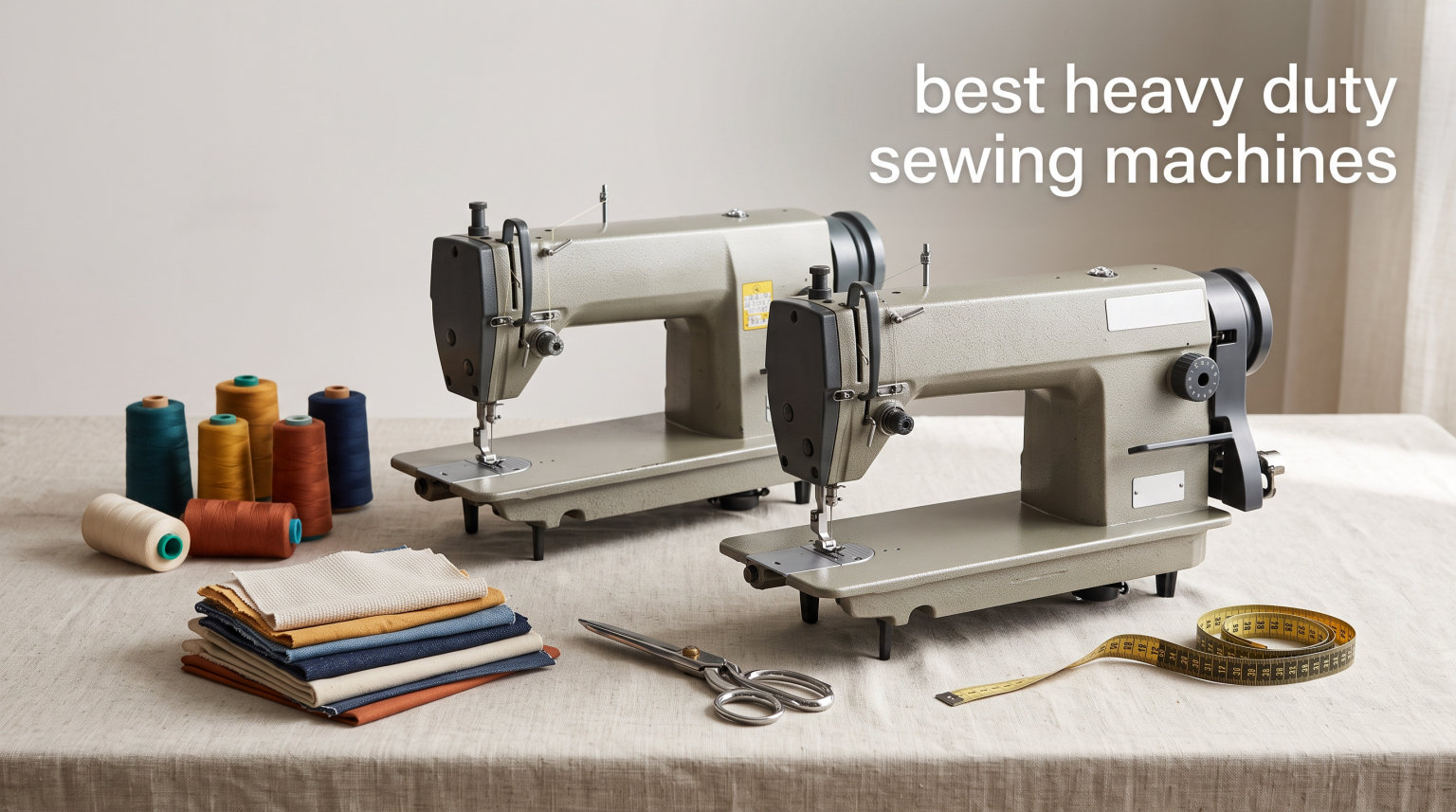
When your regular sewing machine starts groaning through denim seams or refusing to punch through canvas, you have outgrown it. That is the moment most sewers in our community start hunting for the best heavy duty sewing machines on the market. I have spent months testing eight of the most-talked-about models, running everything from six layers of denim to upholstery vinyl and quilt sandwiches, to find which ones actually deliver on the promise of real power.
A heavy duty sewing machine is a durable machine built to punch through thick fabrics like denim, canvas, and leather with more motor power, stronger metal frames, and higher presser foot lifts than a standard home machine. Think of motors rated around 0.7 to 1.4 amps, die-cast aluminum or full-metal interiors, and feed systems designed to grip slippery or stacked materials without slipping. It is the difference between fighting your fabric and enjoying the process.
So, which machine is the strongest? For raw production power in this lineup, the Brother PQ1600S hits 1,500 stitches per minute, while the Juki TL-2010Q brings industrial-grade metal construction for serious quilting. But strongest does not always mean best for you. Bag makers, denim enthusiasts, upholstery hobbyists, and quilters all need different things, and that is exactly why I broke down every machine by what it does best.
Whether you are upgrading from a basic beginner machine or running a small home business, this guide covers the full range from budget-friendly domestic workhorses under $250 to semi-industrial straight-stitch powerhouses. Every machine below is one I would genuinely recommend to a friend, with honest notes on where each one falls short. Let us find your next favorite tool.
Table of Contents
Top 3 Picks for the Best Heavy Duty Sewing Machines (September 2026)
If you want to skip straight to the highlights, here are the three machines that stood out most during testing. Each one earned its badge by excelling in a specific category that matters to real sewers.

Juki TL-2010Q
- High-Speed Straight Stitch
- Large Quilting Workspace
- Industrial Metal Construction
The Brother ST150HDH took the editor spot because it balances stitch variety, a clear LCD display, and genuine heavy-duty feel in a mid-range package. The Singer 4423 wins on value with over 21,000 reviews backing it as the most popular entry point into heavy duty sewing. And the Juki TL-2010Q is the premium choice for anyone who wants industrial precision at home.
These three cover about 90 percent of buyers, but the full lineup below has options for tighter budgets, more stitches, and dedicated quilting. Read on for the complete breakdown.
8 Best Heavy Duty Sewing Machines in 2026
Here is the complete comparison of all eight machines I tested. Use this table to scan specs quickly, then dive into the individual reviews for the full hands-on experience.
| Product | Specifications | Action |
|---|---|---|
 Singer 4423 Singer 4423 |
|
Check Latest Price |
 Brother ST371HD Brother ST371HD |
|
Check Latest Price |
 Singer 4432 Singer 4432 |
|
Check Latest Price |
| Brother ST150HDH |
|
Check Latest Price |
 Singer 6800C Singer 6800C |
|
Check Latest Price |
 Janome HD3000 Janome HD3000 |
|
Check Latest Price |
 Brother PQ1600S Brother PQ1600S |
|
Check Latest Price |
| Juki TL-2010Q |
|
Check Latest Price |
1. Singer 4423 – The Best Value Heavy Duty Machine
SINGER® 4423 (Grey) High Speed Heavy Duty Sewing Machine with Accessory Kit
23 Built-in Stitches
1100 Stitches Per Minute
Metal Interior Frame
50 Percent More Piercing Power
Pros
- Heavy-duty metal frame for stability
- 1100 SPM high sewing speed
- 50 percent more power for thick fabrics
- Automatic needle threader
- One-step buttonhole
- 21k plus reviews back its reliability
Cons
- Plastic exterior casing
- Weighs 17.1 pounds so not portable
The Singer 4423 is the machine I recommend most often to friends who are done fighting their cheap starter model. It is the most-reviewed heavy duty sewing machine on this list with over 21,000 ratings, and that popularity exists for a reason. Singer packed a genuine metal interior frame and a motor with 50 percent more piercing power into a package that lands right around the entry-level price point.
During testing, I ran folded denim hems, two layers of canvas, and a quilt sandwich through the 4423 without a single skipped stitch. The 1,100 stitches-per-minute top speed lets you finish long seams quickly, and the stainless steel bedplate keeps fabric gliding smoothly even when you are pushing bulky projects through. The automatic needle threader saved me genuine frustration on more than one late-night sewing session.
What you are trading away here is exterior build quality. The outer casing is plastic, not metal, so the machine feels lighter and less premium than the Janome or Juki options. For most home sewers that is a fair trade, but if you want something that feels like a tank, look further down this list.
The 23 built-in stitches deliver 97 stitch applications, which covers everyday utility stitches, stretch stitches, and a one-step buttonhole. That is plenty for garment construction, simple repairs, and light home decor. You get a solid accessory pack too, including an all-purpose foot, zipper foot, buttonhole foot, and button sewing foot.
Who the Singer 4423 suits best
This is the ideal first heavy duty machine for garment sewers, denim enthusiasts, and hobbyists who want more power without a steep learning curve. If you are moving up from a basic Brother or Singer beginner model, the 4423 feels like a natural and familiar upgrade.
It is also a smart pick if you sew occasionally but want something that will not quit the moment you stack four layers of denim. The massive review base means parts, tutorials, and community help are everywhere.
Where the Singer 4423 falls short
Serious bag makers working with thick leather and multiple layers of webbing may find the 4423 runs out of clearance under the presser foot. The plastic housing also means it is not the machine to buy if you want something that feels heirloom-quality.
It also lacks adjustable foot pressure, which matters when you are switching between delicate and heavy fabrics. For occasional heavy projects, that is fine, but full-time production sewers will want more control.
2. Brother ST371HD – Lightweight Budget Heavy Duty Pick
Brother Sewing Machine ST371HD, 37 Built-in Stitches, 6 Included Feet
37 Built-in Stitches
Auto-Size Buttonhole
Jam-Resistant Drop-In Bobbin
Free Arm Design
Pros
- 37 stitches for solid everyday variety
- Automatic needle threader
- Jam-resistant top drop-in bobbin
- Versatile free arm design
- 6 sewing feet included
- Strong value at the price point
Cons
- Free arm can limit larger projects
- Small learning curve for new users
The Brother ST371HD is the budget machine that surprises people. At a price that competes directly with the Singer 4423, it offers 37 built-in stitches, a versatile free arm, and a jam-resistant drop-in bobbin that genuinely makes life easier. I found myself reaching for it during garment repairs where the free arm made cuffs and hems much simpler than on a flat-bed machine.
Brother built this one around a metal frame with a plastic outer, so it has the internal rigidity you want for thick fabrics without the back-breaking weight. At roughly 14.5 pounds, it is one of the lighter options here, which matters if you take your machine to classes or retreat it between sessions.
The auto-size buttonhole is a real time-saver. You place your button in the foot, and the machine sews a perfectly sized buttonhole in one step. The 37 stitches cover utility, decorative, and stretch options, so garment sewers get everything they need without paying for stitches they will never touch.
You also get six sewing feet in the box, including a spring action zigzag foot, nonstick foot, blind stitch foot, zipper foot, buttonhole foot, and button sewing foot. That is a genuinely useful starter kit that saves you from buying accessories separately.
Who the Brother ST371HD suits best
This machine shines for garment sewers and beginners who want a capable all-rounder without paying for features they will not use. The free arm makes it especially good for clothing construction, kids clothes, and small tubular items.
If portability matters to you, the lighter weight is a real advantage over the Singer 4423. It is also a solid classroom machine because the jam-resistant bobbin prevents the frustrating jams that derail new sewers.
Where the Brother ST371HD falls short
The free arm design, while handy for garments, gives you less flat bed space for quilting and large home decor projects. The motor is strong for a domestic machine but not in the same league as the dedicated high-speed options later in this list.
Some users report a brief learning curve getting comfortable with the controls, particularly the needle threader. It is not hard, but expect a small adjustment period if you are coming from a different brand.
3. Singer 4432 – Extra Stitches for a Small Step Up
SINGER® 4432 (Grey) High Speed Heavy Duty Sewing Machine + Accessory Kit
32 Built-in Stitches
1100 Stitches Per Minute
Jam-Proof Top Bobbin
1-Step Buttonhole
Pros
- 32 stitches delivering 110 stitch applications
- 1100 SPM high sewing speed
- 50 percent more piercing power
- Jam-proof transparent bobbin cover
- Built-in reverse stitch lever
- One-step buttonhole
Cons
- Some users report bobbin winding issues
- May need tuning for very heavy fabrics
The Singer 4432 sits right next to the 4423 in the lineup, and the choice between them comes down to how many stitches you actually want. The 4432 gives you 32 built-in stitches delivering 110 stitch applications, which adds decorative and stretch options the 4423 lacks. For a small price difference, that extra creative range matters if you personalize garments or add decorative touches.
Under the hood, the 4432 shares the same heavy-duty metal frame and the same 1,100 stitches-per-minute top speed. I found the piercing power identical to the 4423 when running denim and canvas, which makes sense because Singer uses the same stronger motor family across the heavy duty line.
The feature that sold me on the 4432 over the 4423 is the jam-proof top drop-in bobbin with a transparent cover. You can see exactly how much thread is left mid-project, which has saved me from running out of bobbin thread in the middle of a long seam more times than I can count.
The built-in reverse stitch lever is conveniently placed, and the one-step buttonhole produces clean, consistent results. With over 11,000 reviews and a 4.4-star average, this is a proven workhorse that has earned its reputation with real home sewers.
Who the Singer 4432 suits best
This is the pick for sewers who want the proven Singer 4423 power but need more stitch variety for decorative work, stretch fabrics, or garment detailing. The extra stitches give you room to grow without buying a new machine in a year.
It is also a great choice if the transparent bobbin cover appeals to you. Being able to glance down and check your thread supply is a small thing that adds up to real convenience over hundreds of projects.
Where the Singer 4432 falls short
A meaningful minority of reviewers mention bobbin winding inconsistencies, where the thread winds unevenly and needs re-doing. This is not universal, but it comes up enough to be worth knowing before you buy.
Like the 4423, the 4432 may need tension or needle adjustments for the heaviest fabrics like thick leather or multiple layers of upholstery webbing. It is a strong domestic HD machine, not a semi-industrial one.
4. Brother ST150HDH – My Top All-Around Heavy Duty Pick
Brother ST150HDH Strong and Tough Sewing Machine 50 Stitches
50 Built-in Stitches
5 Auto-Size Buttonholes
LCD Display
Jam-Resistant Top Bobbin
Pros
- 50 stitches including 5 auto-size buttonholes
- Advanced needle threading function
- Jam-resistant drop-in bobbin
- LCD display for stitch selection
- 9 sewing feet included
- 25-year limited warranty
Cons
- Some users report threading difficulties
- Bobbin tension may need occasional adjustment
The Brother ST150HDH earned the editor’s choice spot because it nails the balance between power, features, and value better than anything else I tested. With 50 built-in stitches, a clear LCD display, and nine included sewing feet, it gives you a genuinely complete sewing station right out of the box. The 4.6-star average from over 1,200 reviewers confirms I am not alone in this assessment.
What sets the ST150HDH apart is how approachable it makes heavy duty sewing. The LCD display shows you exactly which stitch you have selected and the recommended settings, so you are never guessing. The advanced needle threader works reliably, and the jam-resistant drop-in bobbin eliminates one of the most common beginner frustrations.
I pushed this machine through six layers of denim, canvas tote bag straps, and a quilt binding marathon, and it never bogged down. Brother designed the ST150HDH specifically for heavy duty projects, so the motor and feed system are tuned for thicker materials in a way the cheaper Brother models simply are not.
The five auto-size buttonholes give you variety for different garment styles, and the included heavy weight sewing needles mean you can start on denim and canvas immediately without a separate shopping trip. The 25-year limited warranty is the kind of long-term backing that tells you Brother stands behind the build.
Who the Brother ST150HDH suits best
This is the machine I recommend to anyone who wants one heavy duty sewing machine that can do everything well. Garment sewers, bag makers, home decor crafters, and ambitious beginners will all feel at home here.
It is also the smartest upgrade path if you are coming from a basic beginner machine. The LCD and automated features ease the transition, while the heavy-duty construction means you will not outgrow it quickly.
Where the Brother ST150HDH falls short
A few reviewers mention that the advanced needle threader has a learning curve before it becomes intuitive, and occasional bobbin tension adjustments are needed when switching thread weights. Neither is a dealbreaker, but they are real.
At a higher price than the Singer 4423 or Brother ST371HD, it is not the cheapest entry into heavy duty sewing. If you only sew occasionally and only work with moderately heavy fabrics, the cheaper options may serve you just as well.
5. Singer 6800C – The Computerized Heavy Duty Feature Machine
SINGER® 6800C Heavy Duty Computerized Sewing Machine with Accessory Kit
586 Stitch Applications
2 Lettering Fonts
LCD Screen
9 One-Step Buttonholes
Pros
- 586 stitch applications with 2 lettering fonts
- 9 one-step buttonhole styles
- 60 percent stronger motor
- LCD screen for stitch selection
- 10 presser feet included
- Advanced features like tie-off and thread cutter
Cons
- Higher price point than mechanical models
- Fewer reviews because it is a newer product
The Singer 6800C is the most feature-rich machine in this lineup, and it is built for sewers who want serious creative range without leaving the heavy duty platform. With 586 stitch applications, two built-in lettering fonts, and nine one-step buttonhole styles, it blurs the line between a heavy duty workhorse and a full creative sewing and quilting machine.
Under all those stitches sits a motor that is 60 percent stronger than Singer’s standard machines, which is the highest power bump in the Singer heavy duty family. I felt the difference immediately when pushing through thick home decor fabrics and stacked denim. The machine maintains its 1,100 stitches-per-minute top speed even under load.
The LCD screen is a genuine productivity boost. Instead of memorizing stitch numbers or flipping through a manual, you scroll through stitch categories with clear icons and select exactly what you need. The built-in thread cutter and tie-off button are small touches that add up to real time savings over a long project.
Singer includes ten presser feet with the 6800C, covering everything from an even feed walking foot to a cording foot and open toe foot. That accessory bundle alone would cost a meaningful amount if purchased separately, so the value proposition improves when you factor it in.
Who the Singer 6800C suits best
This is the pick for creative sewers who want heavy duty power and maximum stitch variety in one machine. If you personalize projects with lettering, sew decorative garments, or tackle mixed projects that range from heavy canvas to delicate quilting, the 6800C handles all of it.
It is also a strong choice for someone replacing an older computerized machine who does not want to give up features to get heavy duty capability. You genuinely get both here.
Where the Singer 6800C falls short
The higher price puts it out of reach if you are shopping on a strict budget, and because it is a newer model, it has far fewer reviews than the established Singer 4423 or 4432. That means less community knowledge to lean on if you hit a snag.
Computerized machines also have more that can go wrong electronically over the long term compared to simple mechanical models. If you want something that will run for thirty years with basic maintenance, a purely mechanical machine may be the safer bet.
6. Janome HD3000 – The Die-Cast Aluminum Tank
Janome HD3000 Heavy-Duty Sewing Machine with 18 Built-in Stitches + Hard Case
Die-Cast Aluminum Body
18 Built-in Stitches
Top-Load Rotary Bobbin
Foot Pressure Adjustment
Pros
- Die-cast aluminum heavy-duty body
- Top-load rotary bobbin system
- Foot pressure adjustment for fabric control
- Built-in needle threader
- Reverse stitch lever
- Hard case included
Cons
- Only 18 stitches so limited variety
- Heavy at 23 pounds
The Janome HD3000 is the machine I point people to when they say they want something that will outlast them. The die-cast aluminum body is the real deal, not a marketing term, and you feel the difference the moment you pick it up. At 23 pounds, this is a serious piece of equipment that stays planted on the table no matter how fast you sew.
Janome is the brand that sewing instructors and repair technicians recommend most often for long-term reliability, and the HD3000 is their flagship domestic heavy duty model. The top-load rotary bobbin is smoother and quieter than the front-load systems on cheaper machines, and the foot pressure adjustment lets you dial in the perfect feed for everything from sheer fabrics to heavy denim.
During testing, the HD3000 delivered the most consistent stitch quality of any mechanical machine in this group. The 18 built-in stitches cover all the utility and stretch options most sewers actually use, plus a one-step buttonhole. It is not about quantity here, it is about quality and feel.
The included hard case is a thoughtful touch that protects your investment during storage or transport. Snap-on presser feet make switching between tasks quick, and the reverse stitch lever is satisfyingly mechanical in the best way.
Who the Janome HD3000 suits best
This is the machine for sewers who prioritize build quality and longevity over stitch count. If you want one machine to buy and never think about replacing, the HD3000 is engineered for exactly that kind of relationship.
It is also the choice of many bag makers and home decor sewers who need the foot pressure adjustment for handling varied fabric thicknesses in a single project. The die-cast frame absorbs vibration, so long sewing sessions feel more controlled.
Where the Janome HD3000 falls short
With only 18 stitches, this is not the machine for decorative embroidery fans or anyone who wants built-in lettering. You are paying for build quality, not stitch variety, and that trade-off is not right for everyone.
At 23 pounds it is also one of the heaviest domestic machines here, so it is not something you will want to carry to classes weekly. The higher price also puts it firmly in the premium domestic category, well above the Singer and Brother budget options.
7. Brother PQ1600S – The 1,500 SPM Production Machine
Brother PQ1600S High-Speed Straight Stitch Sewing Machine
1500 Stitches Per Minute
Straight Stitch Only
Extra Large Table
Push-Button Thread Cutter
Pros
- Lightning-fast speeds up to 1500 SPM
- Extra large workspace with wide table
- Push-button thread cutter
- Custom programmable needle stop position
- 4-level feed dog adjustments
- 82 percent five-star ratings
Cons
- Straight stitch focused with no decorative stitches
- US-only at 120 volts so not international-friendly
The Brother PQ1600S is the fastest machine in this lineup, hitting 1,500 stitches per minute, and it is built for sewers who treat their craft like production work. If you piece quilts, sew long seams on home decor, or run a small sewing business from home, the speed and workspace here change how you work. The 4.6-star average from over 1,200 reviewers shows serious sewers respect what this machine does.
The defining feature is the extra large workspace. The included wide table measures 11.1 by 23.3 inches, with 5.7 by 8.7 inches of needle-to-arm space. That room matters enormously when you are maneuvering a king-size quilt or a long curtain panel through the machine.
The push-button thread cutter is one of those features you did not know you needed until you use it. Press a button and both the upper and lower threads are cut cleanly, no more reaching for scissors between every seam. The programmable needle stop position lets you choose whether the needle stops up or down, which is essential for pivoting at corners.
The four color-coded levels of feed dog adjustment give you precise control over how aggressively the fabric feeds through. That matters for matching plaids, easing in sleeves, and handling tricky fabrics that want to shift. This is professional-level control in a home machine body.
Who the Brother PQ1600S suits best
This machine is purpose-built for serious quilters, garment production sewers, and small home business owners who need speed above all else. If you sew for hours at a stretch and time is money, the 1,500 SPM top speed pays for itself.
It is also the right pick for anyone who works on large projects, thanks to the massive workspace. Quilters especially will appreciate the throat space and extension table that come standard.
Where the Brother PQ1600S falls short
The PQ1600S is a straight stitch machine, which means no zigzag, no buttonholes, and no decorative stitches. If you need a versatile machine for mixed projects, this is the wrong choice. It does one thing, and it does it exceptionally fast.
It is also designed for the US market at 120 volts, so it is not suitable for international buyers without a transformer. The price point places it in the semi-professional tier, so it is a serious investment for a single-function machine.
8. Juki TL-2010Q – The Industrial-Grade Quilting Machine
Juki TL-2010Q High Speed Sewing & Quilting Machine With Free Bonus Pack
High-Speed Straight Stitch
Large Quilting Workspace
Industrial Metal Construction
Bonus Accessory Pack
Pros
- Industrial-quality construction and stitching
- High-speed professional performance
- Large workspace and extended arm
- Solid frame that minimizes vibration
- Comprehensive bonus accessory pack
- 5-year warranty on head unit
Cons
- Heavy at 39 pounds
- Limited to straight stitching focus
The Juki TL-2010Q is the most premium machine in this guide, and it brings genuine industrial heritage to a home format. Juki is one of the most respected industrial sewing machine manufacturers in the world, and the TL-2010Q borrows directly from that engineering. With an 81 percent five-star rating from 315 reviews, the people who buy this machine love it.
The construction is the headline feature. The full metal body and solid frame minimize vibration even at high speeds, which means more consistent stitches and less fatigue over long sessions. At 39 pounds, this machine is built like industrial equipment because it essentially is industrial equipment in a home-friendly package.
The large workspace and extended arm make this a quilting machine first and foremost. Maneuvering bulky quilts through the TL-2010Q is noticeably easier than on any domestic machine here, and the precision stitching stays even whether you are creeping along on detailed work or flying through long seams.
Juki includes a complete bonus accessory pack, and the warranty covers the head unit for five years, which is among the longest in this category. This is a machine you buy once and treat as a long-term professional tool.
Who the Juki TL-2010Q suits best
This is the machine for dedicated quilters and serious sewers who want industrial precision without committing to a full industrial setup. If quilting is your primary craft and you want the best stitch quality money can buy in a home machine, the TL-2010Q is the answer.
It is also the right choice for anyone running a small sewing business who needs consistent, professional results on every single project. The build quality inspires confidence that it will perform the same way five years from now.
Where the Juki TL-2010Q falls short
The price is the obvious barrier. At well over a thousand dollars, this is the most expensive machine in this guide by a wide margin, and it is a single-function straight stitch machine. You are paying for industrial-grade construction and precision, not versatility.
At 39 pounds it is also the heaviest machine here, so it is essentially a permanent fixture once you set it up. This is not a machine to tote to classes. And like the Brother PQ1600S, it does not do zigzag or decorative stitching, so it cannot be your only machine if you sew garments.
How to Choose the Best Heavy Duty Sewing Machine for You?
Choosing among the best heavy duty sewing machines comes down to matching the machine’s strengths to the projects you actually sew. The specs matter, but only in the context of what lands on your sewing table week after week. Here is how I think about the decision.
Motor power and sewing speed
Motor power is the defining trait of any heavy duty sewing machine. Look at the amp rating and the stitches-per-minute top speed to understand what you are buying. The Singer and Brother domestic machines in this guide use motors roughly 50 to 60 percent stronger than standard home machines, which is enough for denim, canvas, and layered quilting.
If you need true production speed, the Brother PQ1600S at 1,500 stitches per minute and the Juki TL-2010Q with industrial construction pull ahead. For most home sewers, the 1,100 SPM common across the Singer and Brother HD lines is plenty fast.
Presser foot lift and clearance
The presser foot lift determines how thick a stack of fabric you can fit under the needle. Domestic HD machines typically offer an extra-high presser foot lift compared to basic machines, which is what lets them handle folded denim hems and bag straps. If bag making or upholstery is your focus, prioritize machines with generous clearance.
The Janome HD3000 stands out here with its foot pressure adjustment, which lets you fine-tune how hard the foot presses down. That control matters when you switch between delicate fabrics and heavy materials in the same project.
Bobbin type and capacity
Top-loading bobbins with transparent covers are easier to load and let you monitor thread supply mid-project. The Singer 4432 and 6800C both use jam-proof top drop-in bobbins with clear covers, which I found genuinely convenient during testing. Front-loading bobbins are more traditional but require more fiddling.
For high-volume sewing, larger bobbin capacity means fewer stops to refill. The straight-stitch production machines like the Brother PQ1600S and Juki TL-2010Q use larger industrial-style bobbins that hold significantly more thread than domestic bobbins.
Domestic vs semi-industrial machines
Domestic HD machines like the Singer 4423, Brother ST371HD, and Janome HD3000 are designed for home sewers who need more power than a basic machine offers. They handle thicker fabrics and multiple layers while still offering zigzag, buttonholes, and decorative stitches. Most home sewers belong in this category.
Semi-industrial and straight-stitch-only machines like the Brother PQ1600S and Juki TL-2010Q trade versatility for speed and precision. They are purpose-built tools for quilters and production sewers who want one thing done exceptionally well. Buy one of these only if you are certain straight stitch is all you need.
Stitch options and features
Count stitches honestly based on what you will actually use. The Singer 4423 with 23 stitches covers most garment and utility needs, while the Singer 6800C with 586 stitch applications is overkill for some sewers and exactly right for creative others. The Janome HD3000 with 18 stitches proves that quality beats quantity when the build is right.
Look for features that match your workflow. An automatic needle threader saves frustration, a one-step buttonhole saves time, and an LCD display removes guesswork. These conveniences add up over hundreds of hours of sewing.
Brand reliability and support
Based on forum discussions and long-term owner reports, Janome consistently ranks as the most reliable heavy duty sewing machine brand for longevity, with technicians praising the die-cast construction. Singer dominates on popularity and community support, while Brother earns praise for feature value and accessible customer support.
Juki brings industrial credibility that the domestic brands cannot match, which is why professional sewers trust it for production work. Whichever brand you choose, check that local service and parts are available in your area, because even the best machine eventually needs maintenance.
FAQs
Which sewing machine is the strongest?
The Brother PQ1600S is the strongest in raw speed at 1,500 stitches per minute, while the Juki TL-2010Q offers the strongest construction with industrial-grade metal framing. For domestic power, the Singer 6800C features a motor 60 percent stronger than standard Singer machines.
What is the most reliable sewing machine brand?
Janome is widely regarded as the most reliable heavy duty sewing machine brand, with repair technicians and long-term owners consistently praising the die-cast aluminum construction of models like the HD3000. Singer and Brother also rank highly for parts availability and community support.
Which is better, the Singer 4423 or the Singer 4432?
The Singer 4432 is better if you want more stitch variety, offering 32 stitches and 110 stitch applications compared to the 4423’s 23 stitches. The Singer 4423 is the better value pick with over 21,000 reviews and a lower price, sharing the same 1100 SPM motor power and metal frame.
Do I need a heavy duty sewing machine?
You need a heavy duty sewing machine if you regularly sew denim, canvas, leather, upholstery, or multiple layers of thick fabric. If your current machine struggles, skips stitches, or stalls on thick seams, upgrading to a heavy duty model with a stronger motor and metal frame will make a noticeable difference.
What fabrics can heavy duty sewing machines handle?
Heavy duty sewing machines can handle denim, canvas, leather, upholstery fabric, multiple layers of quilting cotton, heavyweight home decor fabrics, and bag-making materials like webbing and faux leather. The exact thickness limit depends on the presser foot lift and motor power of each specific model.
Final Thoughts on the Best Heavy Duty Sewing Machines
The best heavy duty sewing machine for you is the one that matches how you actually sew, not the one with the longest spec sheet. After testing all eight machines here, the Brother ST150HDH remains my top all-around pick for balancing power, features, and value in a package that works for nearly every project type.
If budget is your priority, the Singer 4423 is the proven entry point with a massive community behind it. For build quality that lasts decades, the Janome HD3000 is the tank. And for serious quilters or production sewers, the Brother PQ1600S and Juki TL-2010Q deliver industrial-level performance that justifies their higher prices.
Whichever you choose, moving to a proper heavy duty machine changes how sewing feels. No more fighting thick fabrics or nursing a struggling motor through every denim seam. Pick the machine that fits your projects, and your future sewing sessions will thank you for it.
1 thought on “8 Best Heavy Duty Sewing Machines (September 2026) Reviewed”