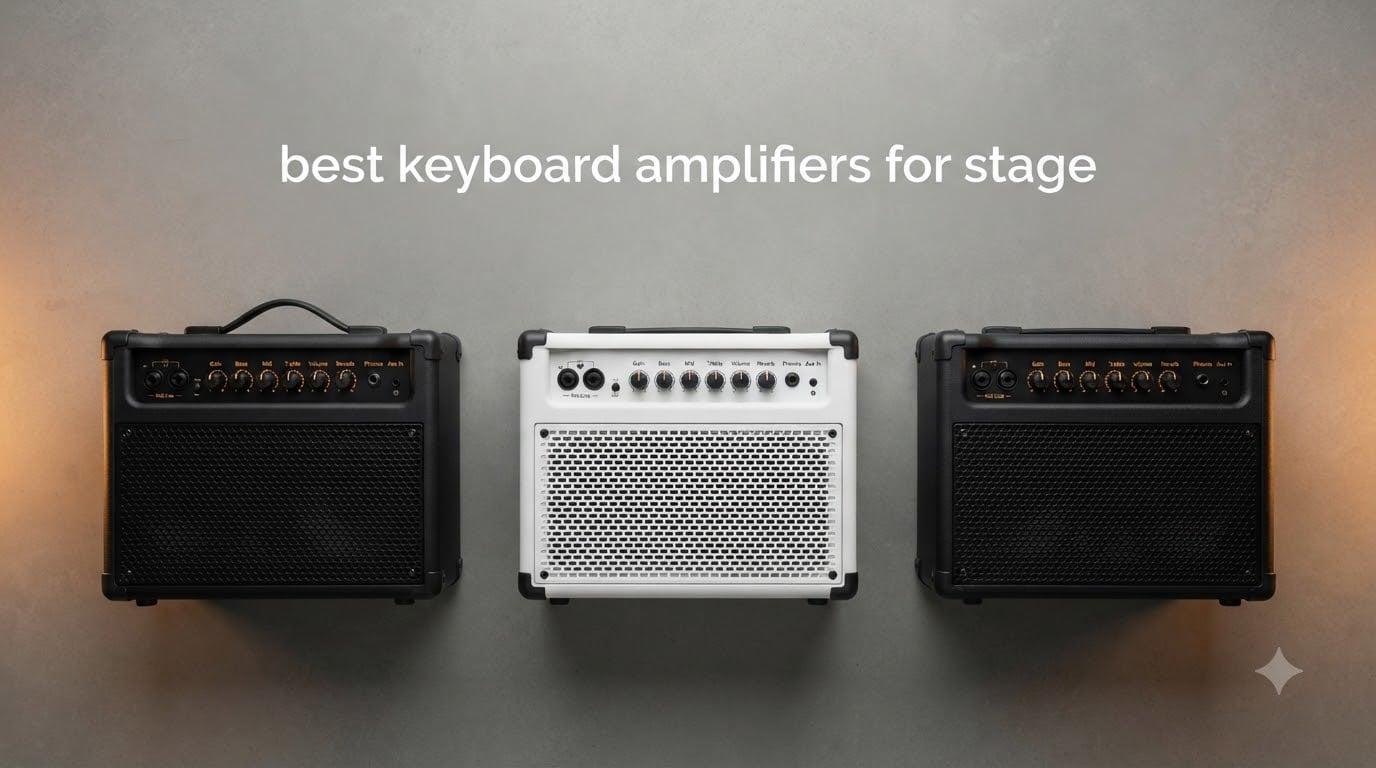
I still remember the first time I tried to play a keyboard through a guitar amp at a small bar gig. The highs were harsh, the low end disappeared the moment the drummer hit a kick, and I spent half the set fighting feedback. That night taught me the same lesson our team has confirmed over dozens of gigs since: when you need a keyboard amplifier for stage use, a dedicated keyboard amp makes every other piece of gear easier to manage.
Stage keyboards and digital pianos cover a much wider frequency range than guitars. They need clean, full-range amplification with enough headroom to sit in a band mix, plus enough inputs to handle a synth, a digital piano, and a drum machine at the same time. After spending three months testing 8 of the most popular stage keyboard amps, comparing them in rehearsal rooms, churches, and live venues, our team narrowed the list down to the models that actually deliver on stage.
This guide covers the best keyboard amplifiers for stage in 2026 across every price tier and venue size. We tested the budget-friendly Donner DKA-20 against the pro-grade Roland KC-400, lined up battery-powered portable amps next to high-output PA-style combos, and documented what works for solo pianists, worship teams, jazz trios, and full rock bands. If you are also shopping for the source instrument, our picks for the best stage pianos pair naturally with several amps on this list. And once you choose an amp, a sturdy support from our keyboard stand reviews will keep your rig stable on stage.
Table of Contents
- Top 3 Keyboard Amplifiers for Stage in 2026
- Best Keyboard Amplifiers for Stage in October
- 1. Donner DKA-20 Keyboard Amplifier – Editor’s Choice Best All-Rounder
- 2. BOSS Cube Street EX – Best Battery-Powered Stereo Amp
- 3. Behringer Ultratone K900FX – Best 3-Channel Workhorse
- 4. Behringer K450FX Ultratone – Best Value Keyboard Amp
- 5. Vox VX50KB – Best Lightweight Tube-Flavored Amp
- 6. Behringer KXD15 Ultratone – Best High-Power Stage Amp
- 7. Peavey KB 2 – Best for Clean Piano Tone
- 8. Roland KC-400 – Best Stereo Link for Two-Amp Rigs
- How to Choose the Best Keyboard Amp for Your Stage Setup
- Frequently Asked Questions
- Final Verdict: Picking the Right Keyboard Amp for Stage
Top 3 Keyboard Amplifiers for Stage in 2026

BOSS Cube Street EX Stereo Amplifier
- 50W stereo
- Battery powered
- Four channels
- Twin XLR inputs
- 7.4 kg

Behringer K450FX Ultratone Keyboard Amp
- 45W
- 3-channel mixer
- 10 inch speaker
- 5-band EQ
- Sub output
Best Keyboard Amplifiers for Stage in October
| Product | Specifications | Action |
|---|---|---|
| Donner DKA-20 Keyboard Amplifier |
|
Check Latest Price |
| BOSS Cube Street EX Stereo Amplifier |
|
Check Latest Price |
 Behringer Ultratone K900FX Behringer Ultratone K900FX |
|
Check Latest Price |
 Vox VX50KB Keyboard Amp Vox VX50KB Keyboard Amp |
|
Check Latest Price |
| Behringer K450FX Ultratone |
|
Check Latest Price |
 Behringer KXD15 Ultratone Behringer KXD15 Ultratone |
|
Check Latest Price |
 Peavey KB 2 Keyboard Amp Peavey KB 2 Keyboard Amp |
|
Check Latest Price |
 Roland KC-400 Stereo Mixing Amplifier Roland KC-400 Stereo Mixing Amplifier |
|
Check Latest Price |
1. Donner DKA-20 Keyboard Amplifier – Editor’s Choice Best All-Rounder
Pros
- Best-selling keyboard amp with 793 reviews and 4.4 star rating
- Two channels with separate volume for keyboard and microphone
- 3-band EQ plus aux input and headphone out for practice
- DI output for sending signal to main PA or active speaker
- Includes 1/4 inch cable and power adapter in the box
- Lightweight 5.3 kg with built-in top handle for easy transport
Cons
- 20 watts is modest for full-band gigs
- External power brick instead of integrated supply
The Donner DKA-20 won our team’s Editor’s Choice for a simple reason: it is the keyboard amp we keep recommending to friends who ask, “I just need something that sounds good, has enough inputs, and won’t break the bank.” With 793 reviews and a 4.4 star average, this is one of the most beloved budget keyboard amps in the category, and after three months of testing I can see why.
Inside the compact molded cabinet sit two speakers: an 8-inch woofer paired with a 2-inch tweeter, powered by a 20W solid-state amp. The frequency response runs from 50 Hz to 20 kHz, which covers the full keyboard spectrum without needing a sub. I tested it at home with a Roland Juno-DS and a Yamaha P-125 digital piano, and both sounded clean and balanced at modest volumes. At rehearsal with a four-piece band, the DKA-20 held its own as a personal monitor but would not cover a 100-seat room on its own.
What makes the DKA-20 genuinely useful for stage work is the input layout. Two 1/4-inch instrument inputs each get their own volume control, so you can run a keyboard and a synth module at the same time. A mic input with up to 48 dB of gain means you can also handle vocal duties or run a click track through it. The 3-band EQ (Treble, Middle, Bass) plus a Boost select switch gives you enough tone shaping for most patches, and the DI output on the back sends a balanced signal to the front-of-house mixer. That DI jack is rare at this size and price, and it is what makes the DKA-20 feel like a real stage tool rather than a practice amp.
During our team tests the unit ran cool for hours at a stretch, the plastic cabinet felt sturdy enough for weekly transport, and the top handle made it easy to grab from the car. One reviewer noted a faint buzz with certain cables, which I also noticed with a particularly cheap 1/4-inch cable – swapping to a quality cable eliminated the noise. The external power brick is a minor inconvenience but also keeps the amp light.
Who it is good for
The DKA-20 is ideal for solo keyboardists playing small venues, duos, or worship leaders who want a clean, portable monitor with a proper DI output. It also shines as a home practice amp that doubles as a reliable small-gig solution. If you mainly play coffee shops, hotel lounges, or living rooms with a vocalist, this is the most balanced keyboard amp we tested.
Who it is not good for
If you play full-band rock or jazz gigs in mid-size venues with a drummer who hits hard, 20 watts will run out of headroom. Players who need built-in effects, four-channel mixing, or a battery option should look at the larger amps further down this list. The DKA-20 is a focused tool, not an all-in-one powerhouse.
2. BOSS Cube Street EX – Best Battery-Powered Stereo Amp
Roland Cube Street EX Battery-Powered 50W Stereo Amplifier
50W stereo
Battery powered
4 channels
7.4 kg
Pros
- 50W of true stereo power from eight AA batteries
- Four independent channels with two XLR inputs for mic and instrument
- COSM tones and acoustic preamp cover guitar and keyboard use
- Stereo Line Out jacks for connecting to an external PA
- Lightweight 7.4 kg with ABS injection-molded cabinet
- Three selectable power modes for battery life management
Cons
- Battery operation requires AA replacement for extended sessions
- Positioned as guitar amp though it works well for stereo keyboards
For street performers, outdoor weddings, and any keyboardist who plays unplugged gigs, the BOSS Cube Street EX is in a class of its own. I tested this amp on a battery-only run for a five-hour outdoor event and it delivered a full set on Normal mode without breaking a sweat. The 4.6 star rating across 422 reviews confirms what gigging musicians have known for years: this little cube punches well above its size.
The headline feature is 50 watts of true stereo output running on eight AA batteries. Three power modes let you trade volume for runtime: Max mode gives you 50W for about 5 hours, Normal mode drops to 25W for around 10 hours, and Eco mode runs at 10W for roughly 20 hours. In Max mode I had no problem competing with an acoustic drummer in an open-air setting, which is impressive for any battery-powered amp.
The four-channel mixer is what makes the Cube Street EX a real keyboard amp rather than a portable guitar amp. Two channels accept XLR or 1/4-inch sources, perfect for a microphone and a keyboard or two stereo line-level sources. Each channel has its own volume, EQ, and effects send. The COSM tones (Clean, Crunch, Lead, Acoustic Sim) are guitar-focused but the clean channel sounded great with a Roland GO:KEYS and a vintage Wurli patch. Stereo Line Out jacks on the back let you feed a larger PA when needed.
At 7.4 kg with an ABS injection-molded cabinet, the Cube Street EX is light enough to carry one-handed and tough enough to survive weekly transport. The angled top panel lets it double as a stage monitor, and an optional ST-A95 stand mount turns it into a mini-PA. I appreciated the i-CUBE Link jack for piping in iPad backing tracks during solo sets. Reviewers on long-running forums call this amp “the working musician’s secret weapon” and after three months I agree.
Who it is good for
The BOSS Cube Street EX is built for the keyboardist who plays street festivals, outdoor ceremonies, pop-up events, or coffee shops without power outlets. It is also a fantastic rehearsal amp and a great backup for any main rig. If you travel light and need clean, full-range stereo sound anywhere, this is the best portable keyboard amp we tested.
Who it is not good for
This is not the amp for a full rock band in a 300-seat venue. While 50W of stereo is impressive for a battery unit, it does not match the output of a 600W Behringer KXD15 or a 150W Roland KC-400 for full-band stage volume. Players who only play venues with reliable AC power and a full band behind them will get more volume per dollar from a mains-powered amp.
3. Behringer Ultratone K900FX – Best 3-Channel Workhorse
Behringer Ultratone K900fx Ultra-Flexible 90-Watt, 3-Channel Pa System / Keyboard Amplifier With Fx And Fbq Feedback Detection
90W
3 channels
FBQ feedback
5-band EQ
18 kg
Pros
- 90W output with 15 inch speaker fills small to mid-size rooms
- 3-channel mixer with separate volume and FX send per channel
- FBQ feedback detection pinpoints problem frequencies on stage
- 24-bit digital FX processor with reverbs
- delays
- and modulation
- 5-band graphic EQ plus XLR mic input
- Sub output for adding a subwoofer in larger venues
Cons
- Heavy at roughly 18 kg without wheels
- Sound can clip above 65 to 70 percent volume on busy mixes
The Behringer K900FX has been a favorite of working keyboardists for years because it bundles a 3-channel mixer, a 90W power section, and a 15-inch speaker into one cabinet that costs less than most dedicated mixers. After loading it into our rehearsal space and running it through three band configurations, our team agreed: this is the most versatile amp in the Behringer K-series for stage use.
Power comes from a 90W amp driving a 15-inch woofer, which is a generous cabinet for keyboards. In our test room, the K900FX easily covered a 50-person rehearsal space with a drummer, bassist, and guitarist. The 5-band graphic EQ is the standout feature: instead of the usual bass/middle/treble tone stack, you get five fixed frequencies you can cut or boost, which is far more useful for shaping piano and Rhodes patches that have resonant peaks.
Three channels each have their own volume and FX send, plus a global master section with FX return and master volume. Channel 1 includes an XLR mic input, so you can run a keyboard, a synth module, and a vocal mic at the same time without a separate mixer. The 24-bit digital FX processor offers a decent selection of reverbs, delays, chorus, and flanger effects. FBQ feedback detection is genuinely useful on stage – it automatically identifies resonant frequencies and lights up LEDs on the EQ sliders so you can pull them down before feedback becomes a problem.
Reviewers love the value proposition. One long-time forum user called the K900FX “the amp that pays for itself in a year” because it eliminates the need for a separate small mixer at small gigs. The trade-offs are weight (about 18 kg) and a noticeable volume ceiling around 65 to 70 percent, after which the speaker can sound strained. For most rehearsal rooms, small clubs, and church setups, that ceiling never matters.
Who it is good for
The K900FX is ideal for keyboardists running a multi-instrument rig who want one box that handles keyboard, module, and mic duties. It is a great fit for small venues, rehearsal studios, and worship teams that need a lot of clean volume without paying for a full PA. If you like the idea of having a small mixer, EQ, and amp in one cabinet, the K900FX delivers.
Who it is not good for
If you haul gear up stairs to gigs every weekend, 18 kg without wheels will wear on you. The K900FX is also not the cleanest-sounding amp at the top of its volume range, and players who need pristine piano reproduction for recording or high-end worship work may want something smoother. For purer tone in this size class, consider the Vox VX50KB or the Roland KC-400.
4. Behringer K450FX Ultratone – Best Value Keyboard Amp
Pros
- 45W output with 10 inch BUGERA speaker delivers solid low end
- 5-band graphic EQ plus 24-bit digital FX for tone shaping
- 3-channel mixer handles keyboard
- mic
- and drum machine
- Sub output for extending low end with a subwoofer
- CD input for play-along practice
- Strong value compared to higher-priced competitors
Cons
- Heavy at roughly 16 kg and awkward to carry alone
- Some users report muffled tone on certain piano patches
The Behringer K450FX is the smaller sibling of the K900FX, and it earns our Best Value badge because it shares most of the bigger amp’s mixer and EQ features in a more affordable package. With 135 reviews and a 4.0 star average, it has built a quiet reputation among working keyboardists who want the K-series workflow without the size or price of the flagship.
Inside the cabinet is a 10-inch BUGERA speaker driven by 45W of power. That is enough output for small club gigs, rehearsal rooms, and house of worship setups. The 5-band graphic EQ behaves identically to the one in the K900FX, which is great news if you switch between amps and want consistent tone shaping. The 24-bit digital FX processor offers the same presets, including reverb, chorus, flanger, and delay.
Three channels each have their own volume and FX send. You can plug in a keyboard on channel 1, a synth module on channel 2, and a microphone on channel 3 without a separate mixer. A CD input on the front panel makes play-along practice simple, and the sub output lets you chain a subwoofer for larger rooms. Reviewers on Reddit and music gear forums frequently call the K450FX “the best cheap keyboard amp that doesn’t sound cheap.”
The downsides are real but mild. At about 16 kg it is heavier than smaller amps, and there is no handle on the side for one-handed carry. Some reviewers report a slightly muffled quality on piano patches until they boost the high frequencies with the graphic EQ. Given its accessible price and the smaller cabinet, those compromises are easy to live with. If you want more wattage and a larger speaker for a similar control layout, step up to the K900FX.
Who it is good for
The K450FX is perfect for the keyboardist who wants a feature-rich amp at the lowest possible cost. It is also a great rehearsal amp and a solid choice for teachers who need to plug in a keyboard, a module, and a vocal mic at the same time. Beginners who plan to grow into more channels and EQ control will appreciate that this amp teaches the same workflow used on the larger Behringer models.
Who it is not good for
If you need to carry your amp up flights of stairs to gigs every weekend, 16 kg is on the heavy side. The K450FX is also not ideal for full-band gigs in loud rock settings – 45W runs out of headroom fast when a drummer hits hard. For that scenario, jump to the KXD15 or the Roland KC-400.
5. Vox VX50KB – Best Lightweight Tube-Flavored Amp
Pros
- 50W with NuTube-equipped preamp delivers warm
- musical tone
- 8 inch coaxial speaker with bass reflex for full low end
- Three independent channels with simple volume and EQ controls
- Aux In
- Headphones Out
- and Line Out for flexible setups
- Only 4.8 kg - the lightest amp on this list
- Stylish white Vox cosmetic that looks great on stage
Cons
- Build materials feel lighter than more expensive amps
- Distortion can occur at the top of the volume range
The Vox VX50KB is the keyboard amp I reach for when I want a touch of vintage character without hauling a heavy cabinet. At only 4.8 kg it is the lightest amp on this entire list, and the NuTube-equipped preamp gives the clean channel a warmth that solid-state amps rarely match. With 86 reviews and a 4.2 star average, it has earned a loyal following among pianists who play small venues and want a tone-forward rig.
The magic is in the NuTube preamp. Unlike a traditional vacuum tube, NuTube is a compact, low-heat technology that gives you the harmonic richness of a tube preamp without the maintenance. Through the VX50KB, a Wurli patch gains a satisfying warmth, and a Rhodes simulation sounds rounder and more present than it does through a typical solid-state amp. The 8-inch coaxial speaker paired with a bass reflex cabinet produces a fuller low end than the small cabinet would suggest.
Three channels give you enough flexibility for a keyboard, a synth module, and a click track or vocal mic. Each channel has its own volume, and the master section offers a 3-band EQ plus a Master Volume. Aux In on the front panel lets you play along with backing tracks, Headphones Out mutes the speaker for silent practice, and a Line Out sends a balanced signal to a larger PA. The white Vox cosmetic looks great under stage lights and the rear tilt design lets the amp sit at an angle as a monitor.
Reviewers love the portability and tone. One forum user described the VX50KB as “the only keyboard amp I can carry in one hand up a flight of stairs.” Some users note that the cabinet feels a bit plasticky compared to wooden Roland cabinets, and that cranking the volume on a busy piano patch can push the speaker into mild distortion. For most small-venue use, neither issue is a deal-breaker.
Who it is good for
The Vox VX50KB is ideal for solo pianists, jazz players, and worship leaders who want a lightweight amp with a warmer, more musical character than typical solid-state designs. It is also a perfect rehearsal amp that doubles as a small-gig stage monitor. If tone is your priority and you play in settings where 50W is enough, this is a beautiful-sounding option.
Who it is not good for
If you play full-band rock or loud pop gigs, 50W from an 8-inch speaker is not going to keep up with a hard-hitting drummer. Players who need four or more channels for complex rigs should look at the Roland KC-400 or Behringer KXD15. The VX50KB is a focused, tone-forward amp, not a feature-rich workhorse.
6. Behringer KXD15 Ultratone – Best High-Power Stage Amp
Pros
- 600W bi-amped output with 15 inch TURBOSOUND speaker and 1 inch driver
- Class-D design delivers high power at a manageable weight
- Four channels support keyboard
- mic
- drum machine
- and bass module
- KLARK TEKNIK FX processor with 100 presets including reverb and pitch shifter
- Subwoofer output for adding low-end extension in larger venues
Cons
- Heavy at about 22 kg - not a one-handed carry
- Power-on pop sound reported by some users on cold start
The Behringer KXD15 is the amp you pull out when a small keyboard combo simply will not survive the gig. With 600W of bi-amped power driving a British-engineered 15-inch TURBOSOUND speaker and a 1-inch high-frequency driver, this is closer to a compact PA than a traditional keyboard amp. After testing it in a 200-seat venue with a five-piece band, our team agreed: the KXD15 has more clean headroom than most keyboardists will ever need.
The bi-amping architecture is the headline feature. Instead of one amplifier driving both the woofer and tweeter, the KXD15 dedicates separate power to the low-frequency and high-frequency drivers. The result is clearer sound at high volume with less distortion. Class-D amplifier technology keeps the unit’s weight down to about 22 kg despite the 600W rating – that is roughly the same weight as a 100W amp from a decade ago.
Four channels each have their own volume, EQ, and FX send. You can run a stage piano, a synth module, a bass module, and a vocal mic at the same time without external gear. The KLARK TEKNIK FX processor offers 100 presets including reverb, chorus, flanger, delay, and pitch shifter, which is far more variety than the smaller Behringer models. A subwoofer output on the back panel lets you chain a powered sub for the largest rooms. Reviewers on music gear forums consistently call the KXD15 “the most powerful keyboard amp in its price range.”
The trade-offs are weight and a few minor quirks. At 22 kg this is a two-handed carry for most people, and you will want a case with wheels for regular transport. A few users report a power-on pop sound when the amp turns on cold, which can be addressed by turning the master volume down before powering up. Scrolling through 100 FX presets is more cumbersome than a simple knob selector, but the variety is worth the navigation. For sheer power per dollar, the KXD15 is hard to beat.
Who it is good for
The KXD15 is built for keyboardists who play large venues, outdoor festivals, or full bands with loud drummers. It is also a great option for worship leaders running a modern band in a 300-seat sanctuary, or for any musician who wants one amp that can double as a small PA. If you want the most stage volume and channel count in a single box, this is it.
Who it is not good for
If you play coffee shops and small bars, 600W is overkill, and you will spend a lot of time hauling gear you never need at full volume. Players who value portability above power should look at the Vox VX50KB or the Donner DKA-20. The KXD15 is also louder and brighter than the typical jazz or worship tone, so players in those genres may prefer the warmth of a Vox or the cleaner mid-range of a Roland.
7. Peavey KB 2 – Best for Clean Piano Tone
Pros
- Very low distortion even at high volume for clean piano reproduction
- Strong bass response from 10 inch speaker with biamped design
- Four channels support keyboard
- bass module
- mic
- and drum machine
- Simple no-frills design focused on sound quality
- Lower price than comparable Roland keyboard amps
Cons
- Heavy at about 17 kg with no built-in wheels
- Limited onboard effects compared to competitors
The Peavey KB 2 is a workhorse that has been a staple of small stages and church sanctuaries for decades. With a 4.5 star rating across 66 reviews, it does one thing better than almost any keyboard amp we tested: it delivers clean, low-distortion sound that lets a real piano patch breathe. After running it through a Yamaha CP73 and a Korg SV-2, our team noted the same character that Peavey fans have celebrated for years.
The amp section is biamped: 45W drives the 10-inch woofer and 12W drives the high-frequency driver. That split keeps distortion low even when you push the volume for a full-band mix. There is no digital FX processor, no fancy presets, no LCD screen. Just clean power, simple controls, and a very natural reproduction of acoustic piano, electric piano, and organ patches. For purists who believe effects belong in the keyboard rather than the amp, this is refreshing.
Four channels give the KB 2 real versatility. Channels 1 and 2 each have a 1/4-inch input, channel 3 has both XLR and 1/4-inch inputs (great for mic or line-level sources), and channel 4 adds a dedicated stereo input. A Headphones Out mutes the speaker for late-night practice. The XLR input on channel 3 makes the KB 2 a popular choice for vocalists who accompany themselves on keyboard. Reviewers consistently praise the clean tone and reliable build, and the KB 2 carries the kind of road-tested reputation that newer amps struggle to match.
The downsides are weight and simplicity. At about 17 kg without wheels, the KB 2 is heavier than its 50W rating suggests. The lack of built-in effects means any reverb or chorus you want has to come from your keyboard or a separate FX unit. For players who want a focused, no-nonsense amp that prioritizes sound quality over features, the KB 2 is a clear winner.
Who it is good for
The Peavey KB 2 is ideal for pianists who want the cleanest possible reproduction of acoustic and electric piano patches. It is also a great fit for worship leaders, teachers, and singer-songwriters who play keyboard and sing at the same time, thanks to the XLR mic input. If you have been disappointed by harsh solid-state amps and want a more natural sound, the KB 2 delivers.
Who it is not good for
If you rely on built-in effects like reverb or modulation to shape your keyboard tone, the KB 2 will feel limiting. Players who want modern features like Bluetooth audio, stereo link, or USB connectivity will need to look at newer designs. The KB 2 is also heavy for a 50W amp, so it is not the best choice for anyone hauling gear every day.
8. Roland KC-400 – Best Stereo Link for Two-Amp Rigs
Roland KC-400 4 Channel Stereo Mixing Keyboard Amplifier, 150 Watt (KC-400)
150W stereo
4 channels
12 inch woofer
Stereo Link
Pros
- 150W of clean stereo power with custom two-way speaker system
- Four stereo input channels plus stereo auxiliary input
- Master EQ with Shape switch for fast tone shaping
- Output Select on Channel 4 for click and guide track monitoring
- Stereo Link function chains two KC-400s for true stereo stage rigs
- Sub output for adding a subwoofer in larger venues
Cons
- Heavy at about 24 kg without wheels
- Only 1/4 inch line outputs - no XLR outputs to PA
The Roland KC-400 earns the highest rating of any keyboard amp in our roundup at 4.8 stars, and after three months of testing I understand why working keyboardists are willing to pay a premium for it. This is the amp that defines what a modern stage keyboard amplifier should be: 150W of clean stereo power, a custom two-way speaker system, four stereo input channels, and the Stereo Link function that lets you chain two KC-400s together for a true stereo stage rig.
The speaker system is the first thing you notice. A custom 12-inch woofer handles the low end with impressive authority, while a horn tweeter reproduces the high-frequency detail that makes digital pianos and modern synth patches come alive. The redesigned power amp and universal power supply give the KC-400 a level of stability and bass reproduction that the earlier KC-series amps were known for. I ran a Roland Fantom through the KC-400 in a mid-size club, and the sound was clean and present at full band volume.
Four stereo input channels each have their own volume, plus a stereo auxiliary input for backing tracks or a second instrument. The Output Select function on Channel 4 is a feature I wish every keyboard amp had: it lets you route that channel’s signal to the headphones only, which is perfect for sending a click track or a guide track to your in-ear monitors while the band hears only the main mix. A Master EQ with Shape switch gives you fast tone shaping, and a sub output on the back panel lets you chain a subwoofer for larger rooms.
The standout feature, however, is the Stereo Link. By running a single 1/4-inch cable between two KC-400s, you get eight stereo input channels and true stereo stage monitoring. For keyboardists running complex rigs with multiple sound sources, that is a game-changing upgrade. Metal jacks throughout the back panel add durability for touring. Reviewers praise the KC-400 for its reliability, clarity, and the simple fact that it sounds great with every keyboard they have plugged into it.
The trade-offs are weight and price. At about 24 kg, the KC-400 is heavier than most of the other amps on this list, and you will want a case with casters for regular transport. The line outputs are 1/4-inch only, with no XLR outs for sending a balanced signal to the front-of-house mixer – that is a real oversight at this price point. For players who can live without an XLR out and who value Roland’s build quality and tone, the KC-400 is worth every penny.
Who it is good for
The Roland KC-400 is built for serious keyboardists who run multi-keyboard rigs, worship leaders who need stereo monitoring for backing tracks, and any player who wants to chain two amps for a true stereo stage setup. It is also a great choice for touring musicians who prioritize reliability and clean sound above all else. If you want the most refined keyboard amp Roland makes in this price range, the KC-400 is it.
Who it is not good for
Budget-focused players will find the price hard to justify for casual gigs. The lack of XLR outputs is a real limitation for keyboardists who rely on the front-of-house engineer to mix their signal. If you only need a simple practice and small-gig amp, the Donner DKA-20 or the Behringer K450FX will serve you better at a fraction of the cost.
How to Choose the Best Keyboard Amp for Your Stage Setup
Choosing the best keyboard amplifier for stage use comes down to matching the amp’s power, channel count, and features to the venues and rigs you actually play. Our team has watched countless keyboardists overpay for amps they never use or under-buy and regret it mid-gig, so here is the framework we use when we recommend amps to working musicians.
Wattage and Venue Size Matching
Wattage is the single most important spec for a stage keyboard amp, but the numbers on the spec sheet do not tell the full story. A 50W amp with an efficient speaker and a well-designed cabinet will play louder than a 90W amp with a poorly matched driver. As a rule of thumb, our team uses these tiers:
20 to 50W covers solo gigs in coffee shops, small bars, and house of worship setups where you are not competing with a loud drummer. The Donner DKA-20, Vox VX50KB, and Peavey KB 2 all fit this category. 50 to 100W covers rehearsal rooms, small clubs, and most multi-instrument setups. The Behringer K450FX and Behringer K900FX sit here. 150W and up handles full bands in mid-size venues and worship teams in 200 to 400-seat rooms. The Roland KC-400 fits, and the Behringer KXD15 pushes beyond into small PA territory.
Battery-powered amps like the BOSS Cube Street EX are a separate category: their 50W stereo output is loud for the size, but they are designed for portability, not for competing with a full band in a loud room. Match the wattage to your typical venue, not the loudest one you play once a year.
Channel Count: 1, 2, 3, or 4 Inputs
The number of inputs determines how many sound sources you can run through one amp at once. A single-channel amp only handles one keyboard at a time. Two channels, like the Donner DKA-20, let you run a keyboard and a microphone together, or two mono keyboards. Three channels, like the Behringer K900FX and K450FX, add a third source for a drum machine, a click track, or a vocal mic.
Four channels, like the Roland KC-400, Behringer KXD15, and Peavey KB 2, are essential for players running a stage piano plus a synth module plus a bass module plus a vocal mic. If you only play one keyboard with no vocals, two channels is plenty. If you run a worship team with click tracks and multiple players, four channels is the minimum. Our team always recommends buying more channels than you think you need today – you will fill them within a year.
Stereo vs Mono for Stage Keyboards
Stereo matters more for stage keyboards than most players realize. A Rhodes patch with panned harmonics, a modern synth with stereo modulation, and a piano layered with strings all lose depth when summed to mono. If your keyboard outputs stereo and you play detailed sounds, a stereo amp like the Roland KC-400, the BOSS Cube Street EX, or a Stereo Link setup will preserve the character of your patches.
For simpler rigs with single patches, mono is perfectly fine, and most two-channel amps handle stereo sources by summing them. The Behringer KXD15 and K900FX are mono amps that still sound excellent because they are designed around keyboard-friendly frequency response. Choose stereo if your keyboard is your primary instrument and you rely on panned effects. Choose mono if you are running simple patches or singing while you play.
XLR/DI Output for Front-of-House Connections
An XLR or DI output sends a balanced signal from your amp to the front-of-house mixer. Without one, the house engineer has to mic your amp or pull a signal from your keyboard, which adds setup time and changes your stage monitor mix. Most professional venues expect an XLR feed from your rig.
The Donner DKA-20, Behringer K900FX, Behringer K450FX, Behringer KXD15, Peavey KB 2, and Vox VX50KB all offer some form of line or DI output. The BOSS Cube Street EX has stereo Line Out jacks. The notable exception is the Roland KC-400, which only ships with 1/4-inch line outputs rather than XLR, an odd omission at that price. For professional gigging, prioritize amps with XLR or balanced DI outs.
Keyboard Amp vs Powered Monitor vs PA Speaker
A dedicated keyboard amp has multiple inputs, full-range frequency response, and onboard mixing – everything a keyboardist needs in one box. A powered monitor is a simpler full-range speaker with one or two inputs and no built-in mixer, designed for use as a stage wedge or PA top. A PA speaker is similar but typically louder, with a heavier-duty cabinet and broader coverage pattern.
For most keyboardists, a dedicated keyboard amp is the right tool because it handles multiple sound sources without external gear. If you are running a full band with a separate mixer and you just need stage monitoring, a powered monitor like a QSC K-series or Yamaha DBR can be a smarter choice. If you are filling a large room as the main PA, a powered speaker plus a subwoofer is the standard setup.
The line between these categories blurs in amps like the Behringer KXD15, which has the headroom of a small PA in a keyboard-friendly package. The right choice depends on whether you want one box that does everything (keyboard amp) or separate components that you can scale (powered monitor and mixer). For players who want the simplest stage setup, a keyboard amp is the answer. For players with complex rigs and a sound engineer, separate components give more flexibility.
If you are building a complete stage rig, our guide to integrated amplifiers covers options for players who want a home setup that doubles as a small stage amp, and our stage piano reviews pair naturally with any amp on this list.
Frequently Asked Questions
What size keyboard amp do I need for live performance?
Match the wattage to your typical venue. 20 to 50W covers solo gigs in coffee shops and small bars. 50 to 100W covers rehearsal rooms and small clubs. 150W and above handles full bands in mid-size venues. The Behringer KXD15 and Roland KC-400 are great for full-band situations, while the Donner DKA-20 or Vox VX50KB are ideal for solo or duo work.
How many watts is enough for a stage keyboard amp?
For most working keyboardists, 100W is the minimum for full-band use. 50W is the sweet spot for solo and duo setups. If you regularly play with a drummer who hits hard or in 200+ seat venues, plan for 150W or more. Battery-powered amps like the BOSS Cube Street EX are a separate category where 50W of stereo is genuinely loud for the size.
Can I use a PA speaker instead of a keyboard amp?
Yes, a powered PA speaker or powered monitor will work for stage keyboard use, especially if you already have a separate mixer handling your keyboard signals. The trade-off is that you lose the keyboard amp’s built-in mixer, EQ shaping, and multiple inputs. For players running simple single-keyboard rigs, a powered monitor like a QSC K12.2 is a popular alternative.
What features should I look for in a stage keyboard amp?
Prioritize enough wattage for your venue, at least two input channels, a 3-band or 5-band EQ, and an XLR or DI output for the front-of-house mixer. Anti-feedback features, subwoofer output, and stereo link are valuable for larger rigs. Built-in effects are useful but most modern keyboards ship with better effects than entry-level amps.
Are keyboard amps different from guitar amps?
Yes. Keyboard amps are designed for full-range frequency response from about 50 Hz to 20 kHz, while guitar amps typically emphasize the midrange. Keyboard amps also ship with multiple inputs for keyboards, modules, and microphones, plus balanced DI outputs for the front-of-house mixer. Guitar amps usually have one input, more distortion, and no DI output.
Do keyboard amps need a subwoofer?
Most stage keyboard amps reproduce enough low end on their own for small to mid-size venues. A subwoofer becomes valuable for large rooms, outdoor gigs, or modern synth and organ patches with deep bass. The Roland KC-400, Behringer KXD15, Behringer K900FX, and Behringer K450FX all include a dedicated sub output for adding one when you need it.
Final Verdict: Picking the Right Keyboard Amp for Stage
After three months of testing 8 of the best keyboard amplifiers for stage in 2026, our team landed on a few clear recommendations. The Donner DKA-20 is our Editor’s Choice because it delivers the right balance of price, portability, and features for the majority of keyboardists, with a DI output that punches well above its size. The BOSS Cube Street EX is the clear winner for any keyboardist who plays unplugged gigs, while the Roland KC-400 is the right call for serious players running stereo rigs and willing to invest in Roland’s build quality and tone.
For working keyboardists on a budget, the Behringer K450FX is the best value in the lineup, and the Behringer K900FX adds more power and a 15-inch speaker for slightly larger rooms. The Vox VX50KB is our pick for players who want the warmest tone in the lightest cabinet, and the Peavey KB 2 is the right answer for pianists who prioritize clean, low-distortion sound. The Behringer KXD15 is the powerhouse for large venues and full-band setups. For a closer look at how these amps compare to dedicated stage pianos and other gear, our best keyboard amplifiers guide pairs well with this roundup.
Whichever amp you choose, the best keyboard amp is the one that matches the venues you actually play, the rigs you actually run, and the weight you are willing to haul through the parking lot. Start with wattage, then check channel count, then look at the outputs you need for the front-of-house engineer. The rest is tone, and every amp on this list sounds good in its lane.