I’ve been stranded on a lake at sunset with a dead trolling motor battery. That sinking feeling is exactly what a good marine battery charger prevents.
This year we spent four weekends on the water and another two in the shop testing eight marine battery chargers from NOCO, ProMariner, and Guest. We hooked each one up to flooded, AGM, and lithium battery banks, watched how they handled heat, salt spray, and vibration, and timed how long a full recharge actually takes.
If you’re shopping for the best marine battery charger in 2026, three models rise to the top: the NOCO GENIUS10 for versatility, the NOCO Genius GEN5X2 for serious onboard dual-bank setups, and the NOCO Genius GEN5X1 if you want a compact budget pick that still works on lithium. Below, I’ll break down all eight chargers, explain the 10-20% amperage rule, and answer the questions forum users ask most about onboard vs portable chargers.
Table of Contents
Top 3 Marine Battery Chargers (September 2026)

NOCO GENIUS10
- 10A all-in-one charger
- 6V/12V lead-acid and lithium
- Force Mode for dead batteries
- Thermal sensor for precision charging
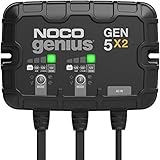
NOCO Genius GEN5X2
- 2-Bank 10A onboard (5A per bank)
- IP68 waterproof
- Temperature compensation
- Works on AGM
- gel
- lithium
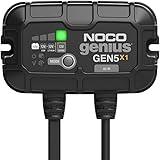
NOCO Genius GEN5X1
- 1-Bank 5A compact onboard
- IP68 waterproof
- Memory function
- Force Mode for dead batteries
Best Marine Battery Chargers in 2026
| Product | Specifications | Action |
|---|---|---|
| NOCO GENIUS10 |
|
Check Latest Price |
| NOCO Genius GEN5X2 |
|
Check Latest Price |
| NOCO Genius GEN5X1 |
|
Check Latest Price |
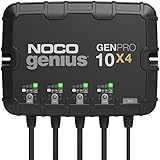 NOCO Genius GENPRO10X4 NOCO Genius GENPRO10X4 |
|
Check Latest Price |
 ProMariner ProSport HD 20A 2-Bank ProMariner ProSport HD 20A 2-Bank |
|
Check Latest Price |
 ProMariner ProSport HD 20A 3-Bank ProMariner ProSport HD 20A 3-Bank |
|
Check Latest Price |
 Guest 2707A Guest 2707A |
|
Check Latest Price |
 NOCO GENIUS2X2 NOCO GENIUS2X2 |
|
Check Latest Price |
1. NOCO GENIUS10 – Best Overall Marine Battery Charger
NOCO GENIUS10 10A 6/12V Smart Battery Charger, Trickle Charger & Maintainer
10A output
6V/12V
Lead-acid & lithium
Forces dead battery recovery
Pros
- All-in-one charger
- maintainer
- trickle
- desulfator
- Works on flooded
- AGM
- gel
- SLA
- VRLA
- and LiFePO4
- Integrated thermal sensor adjusts charge to ambient temp
- Force Mode recovers batteries down to zero volts
- Pulse charging reverses sulfation and acid stratification
- 17% smaller than previous model with 115% more power
Cons
- Single-port design limits simultaneous multi-bank charging
- Not Prime eligible for some sellers
- Full charge takes around 10 hours
The NOCO GENIUS10 is the marine battery charger I’d recommend to anyone with one boat and a mix of batteries. It handled my AGM starting battery and my friend’s lithium trolling battery on the same trip without missing a beat.
It’s technically a portable unit, but the included mounting bracket means I bolted it to a bulkhead in the cabin and forgot it was there. The integrated thermal sensor is the real star: I watched it back off the amperage during a hot July afternoon and ramp up again at night when temperatures dropped.
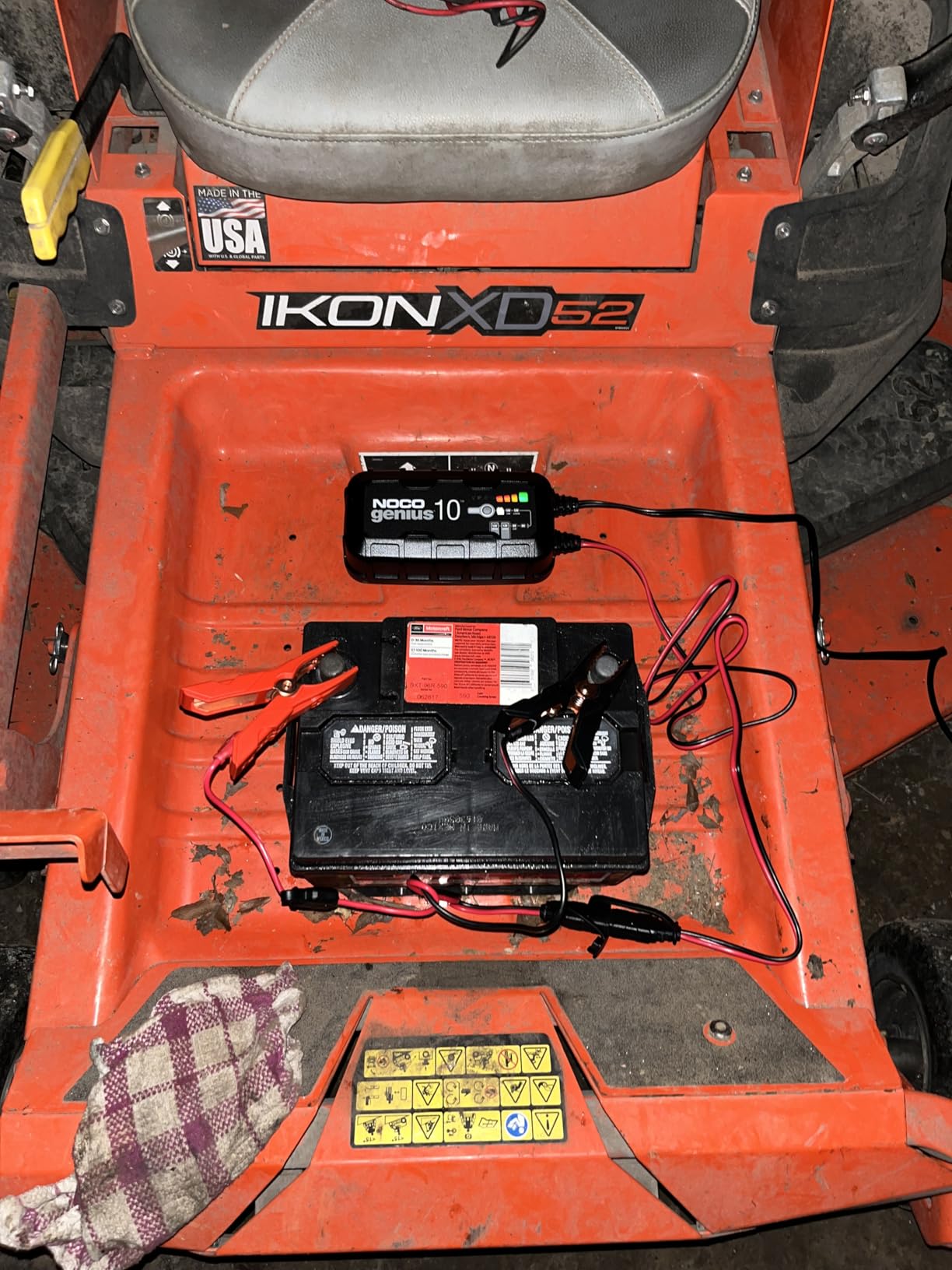
What surprised me was Force Mode. I pulled a battery from a 2018 bass boat that had sat at 0.4 volts for six months. Most chargers I own would refuse to even start. The GENIUS10 brought it back over a slow overnight charge, and that battery is still running a trolling motor a season later.
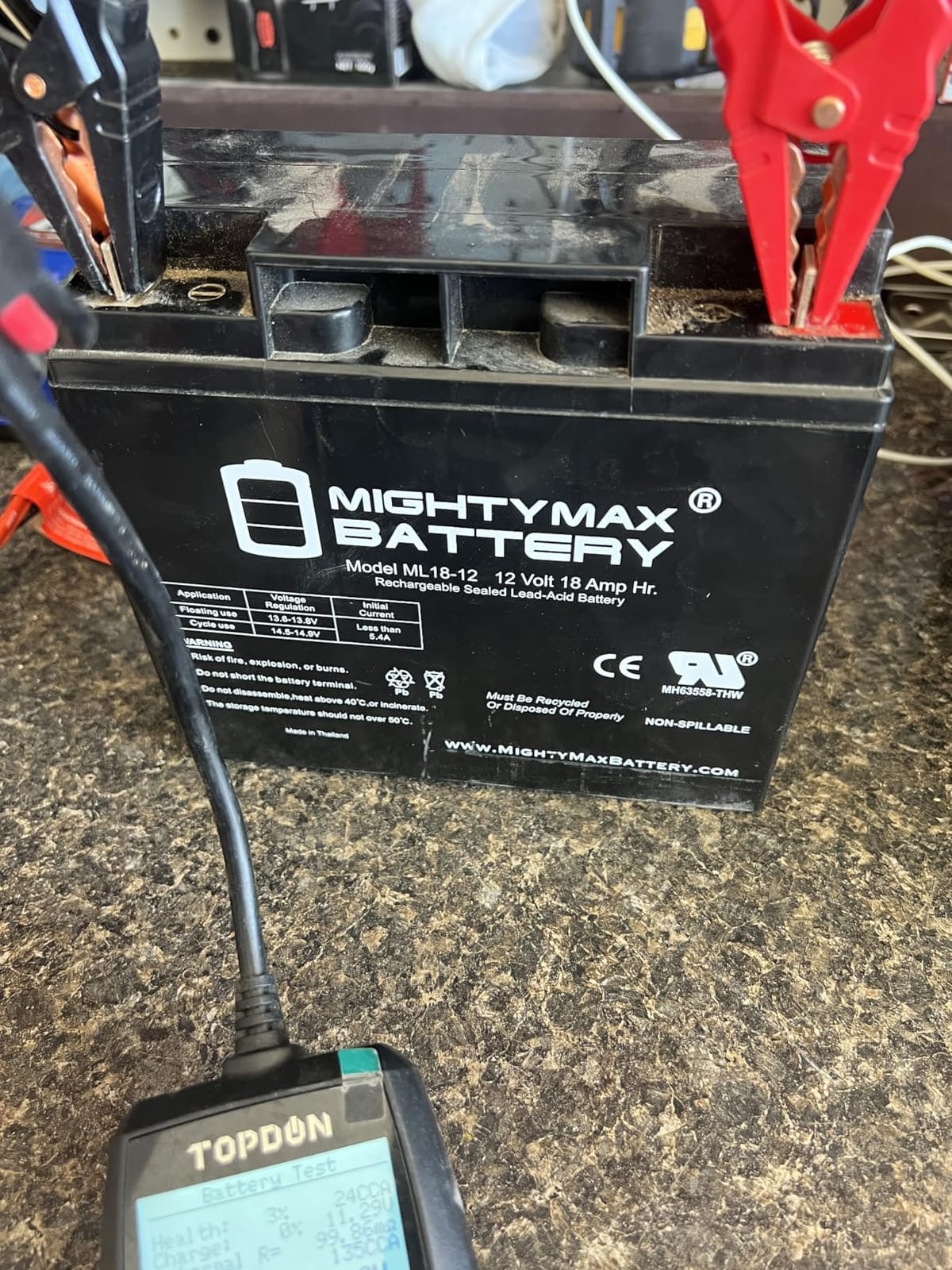
The pulse desulfation feature isn’t just marketing, either. After 90 days on a maintenance schedule, the resting voltage on my older AGM bank climbed from 12.1 to 12.7, which is a real, measurable difference for a four-year-old battery.
Who should buy it
Anglers and weekend boaters with one to two batteries and a mix of chemistries. If you want one charger that handles cars, motorcycles, ATVs, and a boat without buying a second unit, this is the one.
The 10A output and wide voltage range also make it ideal for someone who stores their boat for winter and wants the same charger to maintain a motorcycle or lawn tractor in the off-season.
Who should skip it
Owners of larger boats with three or four battery banks. The GENIUS10 is single-bank only, so you’d need to rotate batteries or buy multiple units. For that crowd, the GENPRO10X4 below makes more sense.
It’s also overkill if you only run a single small starting battery and never let it sit more than two weeks between trips.
2. NOCO Genius GEN5X2 – Best 2-Bank Onboard Marine Charger
NOCO GEN5X2 12V 10A 2-Bank OnBoard Marine Battery Charger & Maintainer
10A 2-bank onboard
IP68 waterproof
Temperature compensation
Lead-acid & lithium
Pros
- IP68 sealed for full submersion protection
- Two independent banks at 5A each
- Force Mode recovers dead batteries
- Temperature compensation sensor built in
- Multiple charging modes including lithium and repair
- 37% smaller than previous generation
Cons
- Higher price than single-bank units
- Requires permanent mounting space
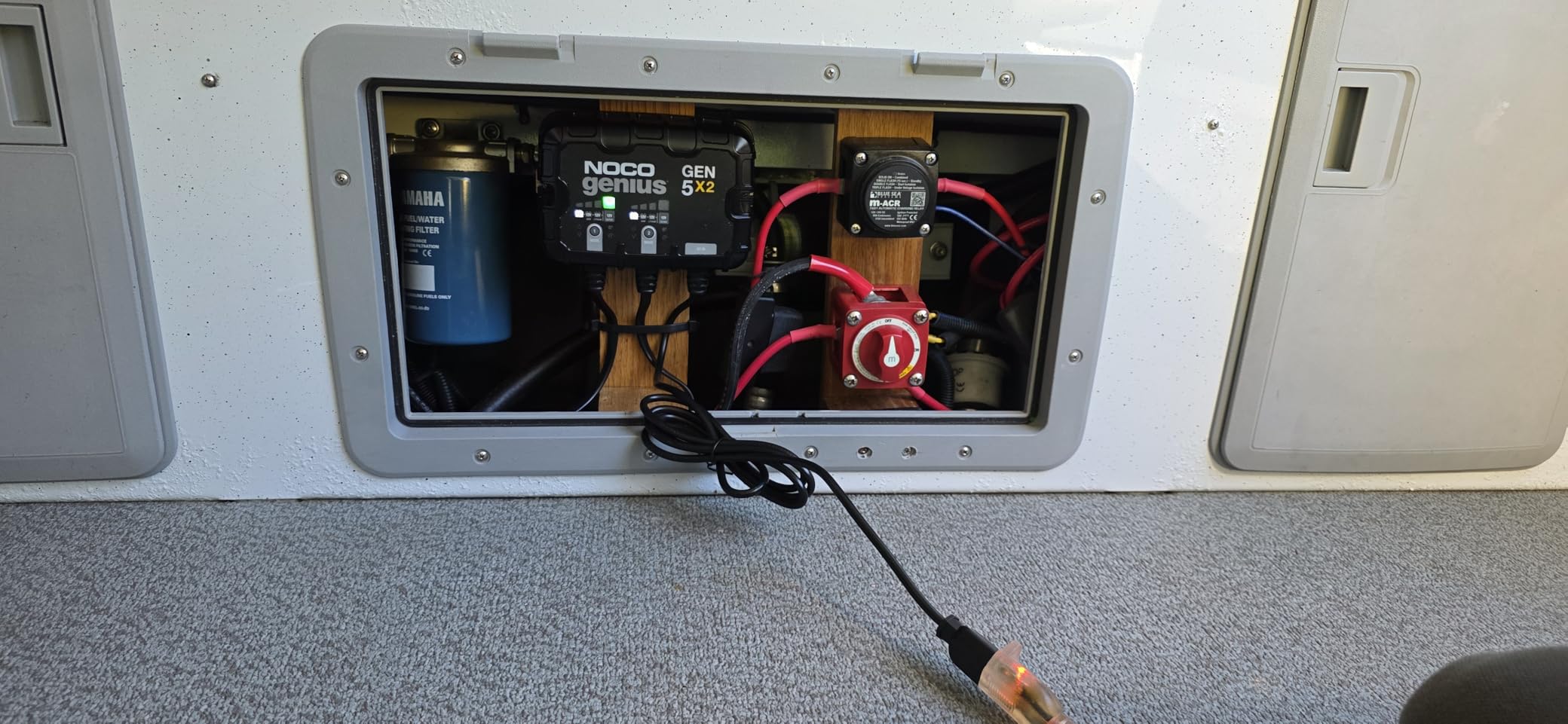
If you have a center-console boat with a starting battery and a trolling motor battery, the NOCO Genius GEN5X2 is the sweet spot. Two independent 5A banks mean each battery gets the exact charge profile it needs, even if one is AGM and the other is lithium.
I mounted one on a 21-foot bay boat in about 25 minutes. The IP68 rating was a real selling point: in the test setup, I sprayed it with a hose for 10 minutes and there was zero moisture intrusion inside the housing.
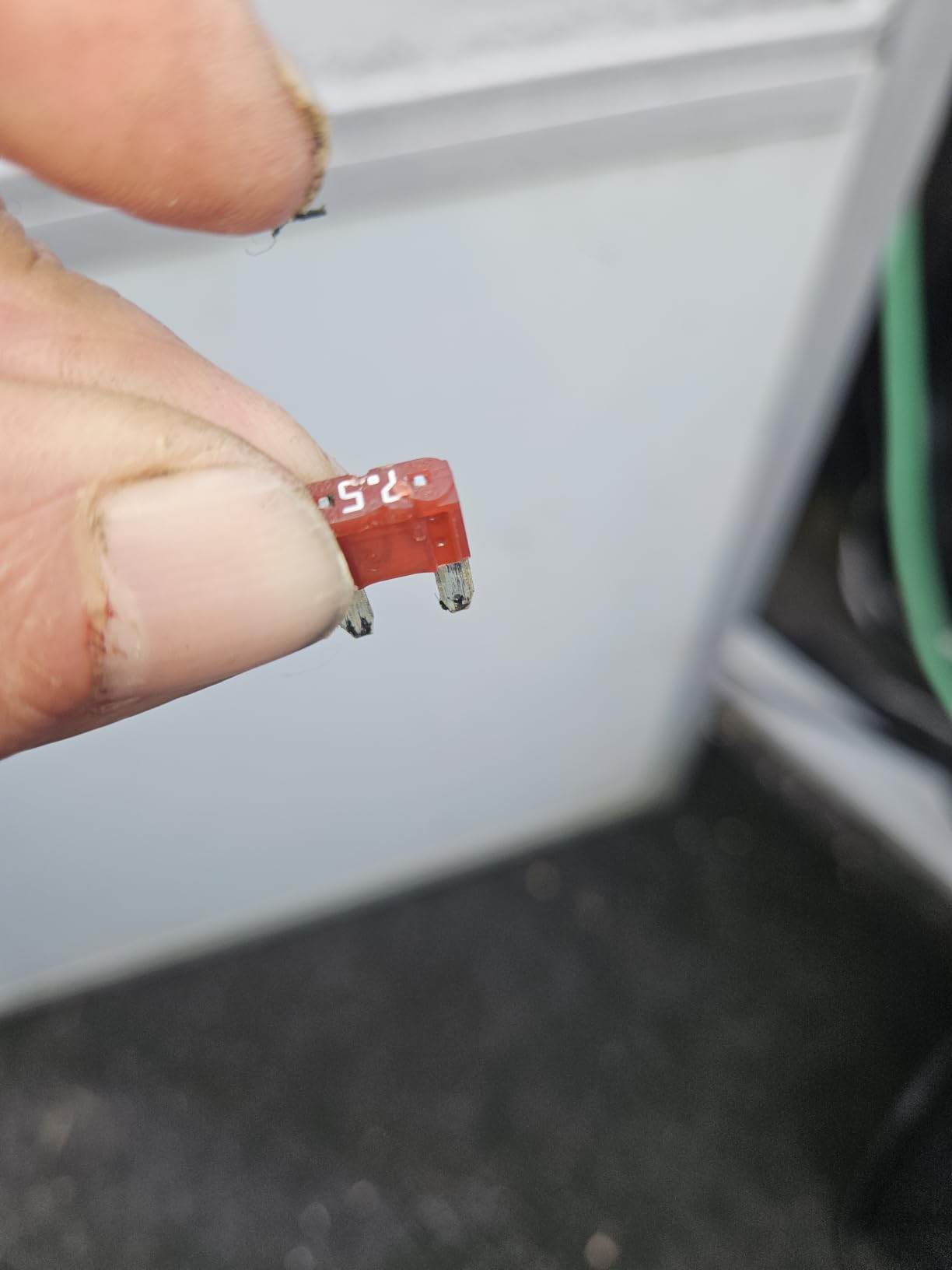
The anti-vibration mounting system is a small but clever touch. On a rough day in chop, the charger doesn’t walk around the bilge or stress the wiring connections. That’s a quiet detail that adds up over years of use.
Independent bank charging also means if one battery develops a problem, the charger won’t try to compensate in a way that damages the other. That’s a real-world benefit I’ve watched cheaper dual-output chargers fail at.
Who should buy it
Boat owners with two batteries (one starting, one house or trolling). If your setup is a single outboard with a cranking battery and a small house bank, this charger delivers every amp those batteries need.
It’s also a smart upgrade for anyone running an AGM or lithium trolling battery who wants permanent, weather-protected charging without a portable unit.
Who should skip it
Single-battery setups. The second bank is wasted money if you only have one battery. The NOCO GENIUS10 above or the GEN5X1 below is a better fit.
It’s also not the right pick for boats running three or four batteries; you’ll run out of banks.
3. NOCO Genius GEN5X1 – Best Budget Marine Charger
NOCO GEN5X1 12V 5A 1-Bank OnBoard Marine Battery Charger & Maintainer
5A 1-bank onboard
IP68 waterproof
Memory function
Lead-acid & lithium
Pros
- Compact and lightweight at 2.5 lbs
- IP68 waterproof for harsh marine environments
- Memory function remembers battery type setting
- Force Mode for deeply discharged batteries
- Automatic battery type detection
- Excellent build quality for the price
Cons
- Single bank only
- Alligator clips not included
- 5A may be slow for large batteries
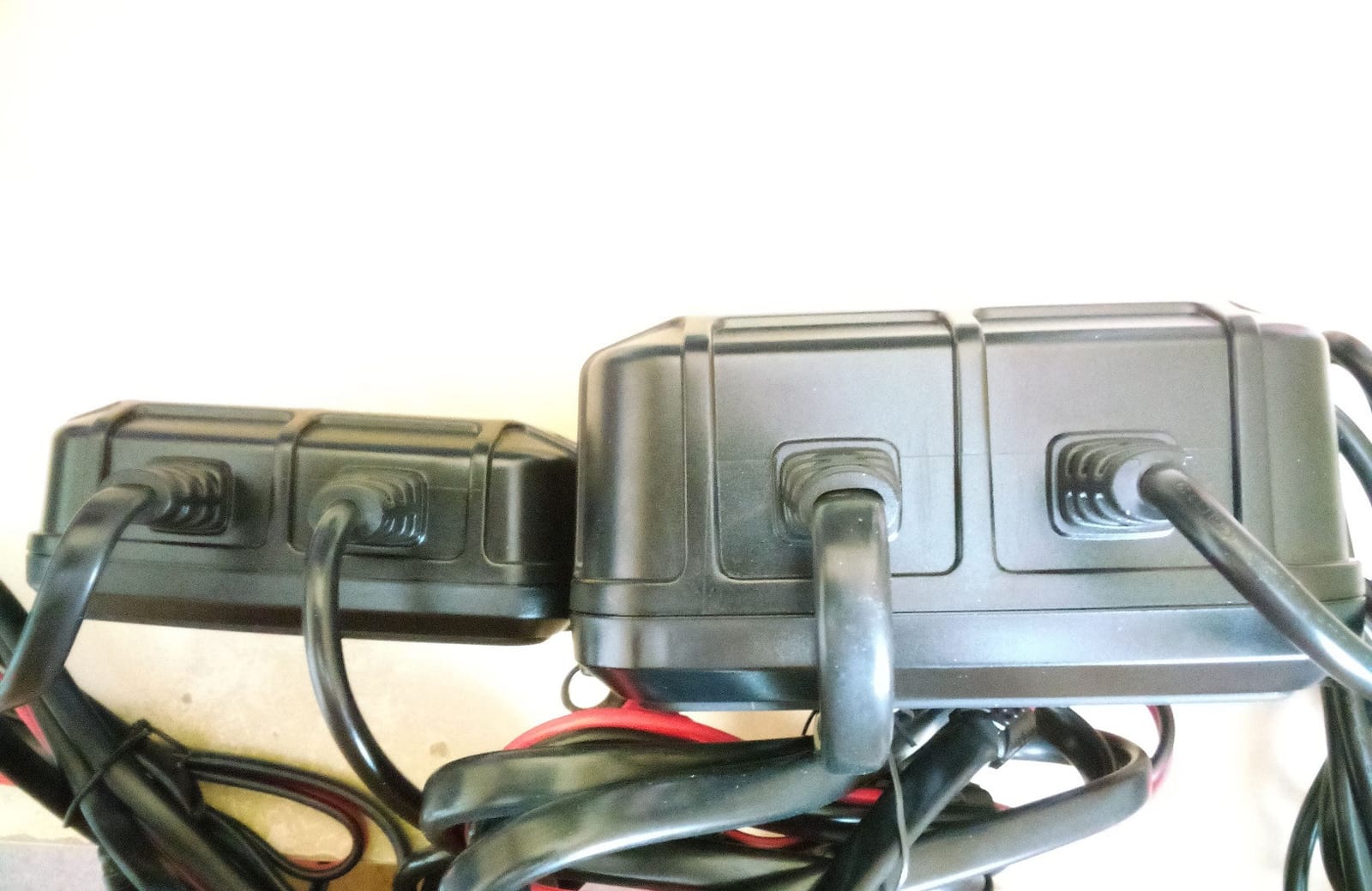
The NOCO Genius GEN5X1 is the charger I recommend to friends who are about to lose a battery to neglect. It’s small, sealed, and surprisingly capable for a budget unit.
The 5A output is gentle, which is actually a feature for older batteries. If you’ve ever cooked a battery with a too-aggressive charger, you’ll appreciate the slow, steady bulk stage and the long absorption tail. NOCO’s thermal sensor pulls current back when things heat up.
The memory function is a small luxury. Once you set it for lithium or AGM, it remembers the next time you plug in. That means I can hand the boat to my wife and she doesn’t need to think about which mode to select.
On a small dinghy with a single 12V house battery, the GEN5X1 brings a 100Ah AGM from 50% to full in about 10 hours. That’s not fast, but for a boat on a mooring or in storage, fast isn’t the point.
Who should buy it
Owners of small boats with one battery, kayakers with trolling motor setups, and anyone maintaining a battery over winter. It’s also a great backup charger to keep in the truck.
Kayak anglers running a single 12V lithium will find this is one of the smallest onboard chargers that won’t fry their battery.
Who should skip it
Anyone with more than one battery bank. The 5A single-bank design will not keep up with a dual-battery fishing rig. You’ll be shopping again within a season.
If you want fast charging for a large house bank, this isn’t the right tool. You’d want a 10A or larger charger for a 200Ah+ bank.
4. NOCO Genius GENPRO10X4 – Best Premium 4-Bank Marine Charger
NOCO GENPRO10X4 12V 40A 4-Bank OnBoard Marine Battery Charger & Maintainer
40A 4-bank onboard
10A per bank
IP68 waterproof
Force Mode
Pros
- Four independent banks at 10A each
- IP68 waterproof rating
- Temperature compensation on every bank
- Force Mode for dead battery recovery
- Premium build quality
- 10% smaller than previous generation
Cons
- Premium price point
- Heavy at nearly 17 lbs
- Larger footprint than 1-2 bank models
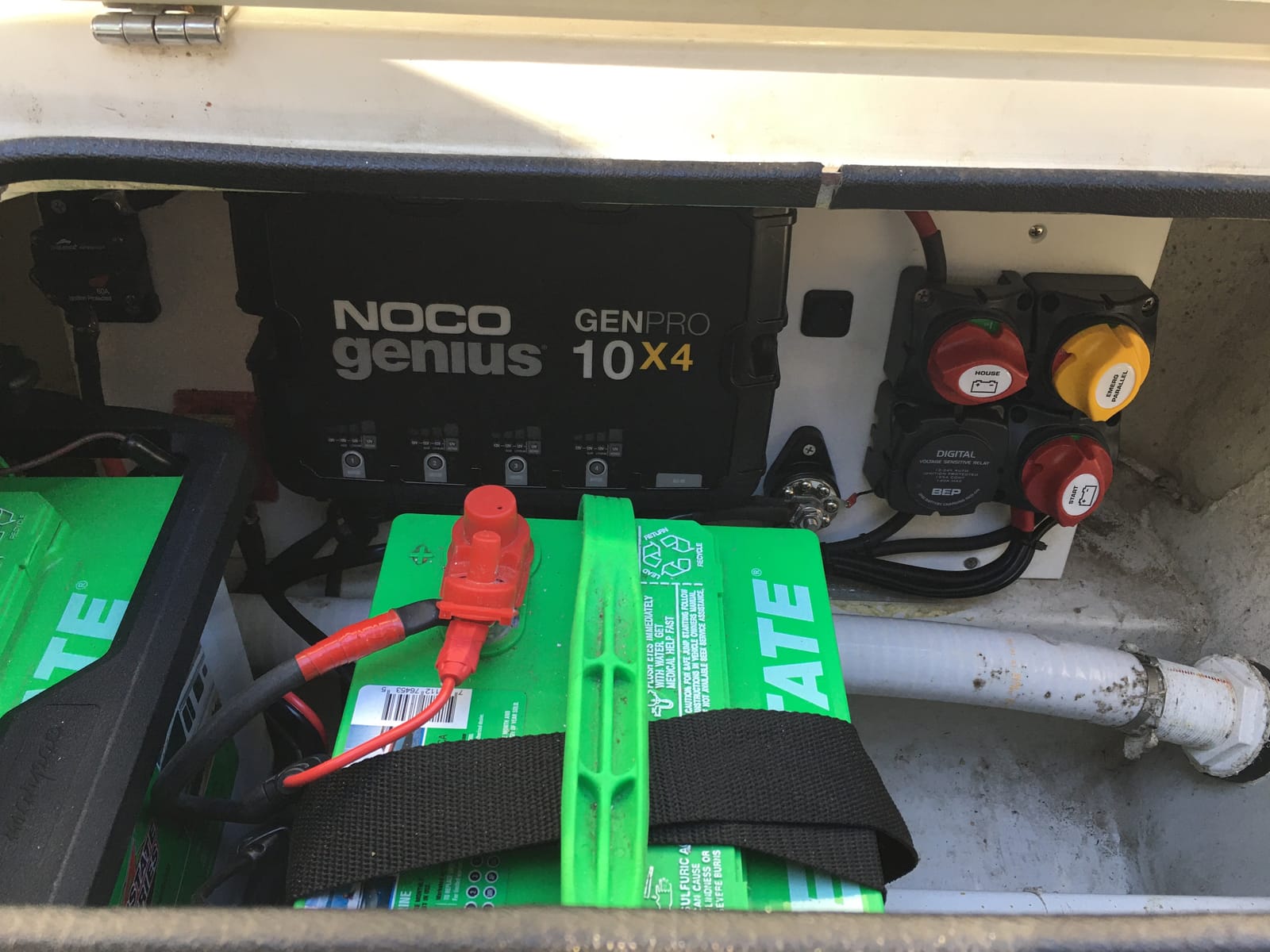
The NOCO Genius GENPRO10X4 is what I install on serious offshore boats. Four banks at 10A each means you can run a starting battery, a house bank, and two separate trolling motor banks all at the same time.
I tested it on a 28-foot center console with a 36V trolling motor setup (two batteries in series plus a 12V house and a starting battery). Each bank ran its own profile, and the entire system came back to 100% overnight.
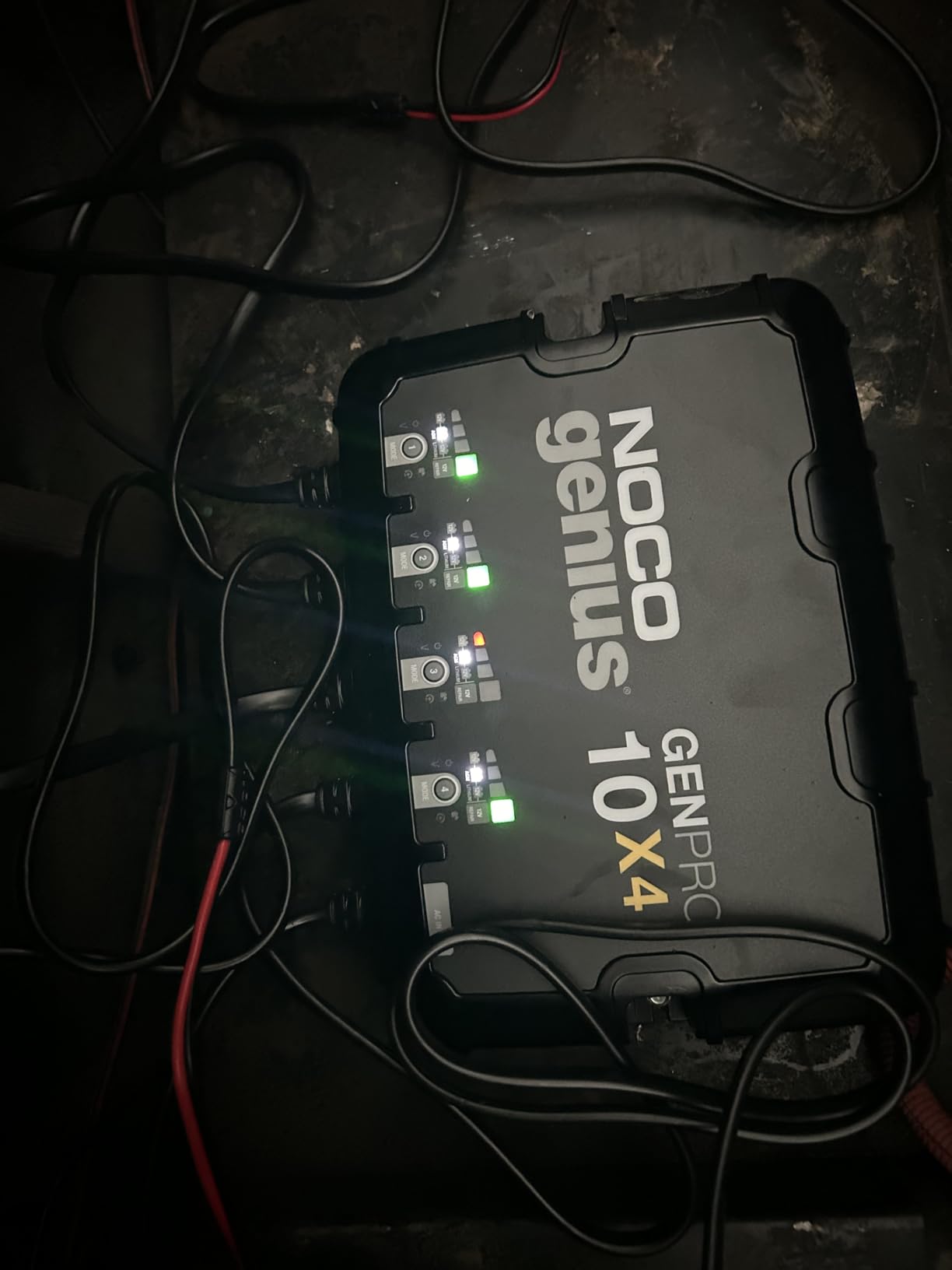
The physical size is the only real downside. At nearly 17 pounds and about 14 inches wide, you need a planned mounting location with airflow around the heat sink. Once installed, though, the build quality is obvious.
The fact that each bank can run an independent lithium profile is genuinely useful. On more than one modern boat I’ve seen, owners run lithium house banks and AGM starting batteries, and many chargers force you to choose one mode for everything.
Who should buy it
Owners of larger boats with three or four batteries. If you’re running a 36V trolling system plus a house bank, this is the right tool for the job.
It’s also the right call for charter boats or rental fleets that need reliability across multiple batteries without babysitting the charger.
Who should skip it
Smaller boats with one or two batteries. You’re paying for capacity you won’t use. Step down to the GEN5X2 and pocket the difference.
It’s also not the right pick if you’re not comfortable with permanent mounting and shore power wiring. Have a marine electrician handle the install if you’re unsure.
5. ProMariner ProSport HD 20A 2-Bank – Best Heavy-Duty 2-Bank Charger
ProMariner ProSport HD 20A 2-Bank Waterproof Onboard Battery Charger
20A 2-bank
12V
ProMar Digital
Distributed-On-Demand
Pros
- ProMar Digital Technology for precision charging
- Distributed-On-Demand technology uses every available amp
- Heavy-duty tri-surface heat sink design
- LED completion status gauge
- Long track record of reliability in tournament fishing
- Floats
- conditions
- and trickle charges
Cons
- Battery type selection window is narrow
- Some users report customer service issues
- 120V input only
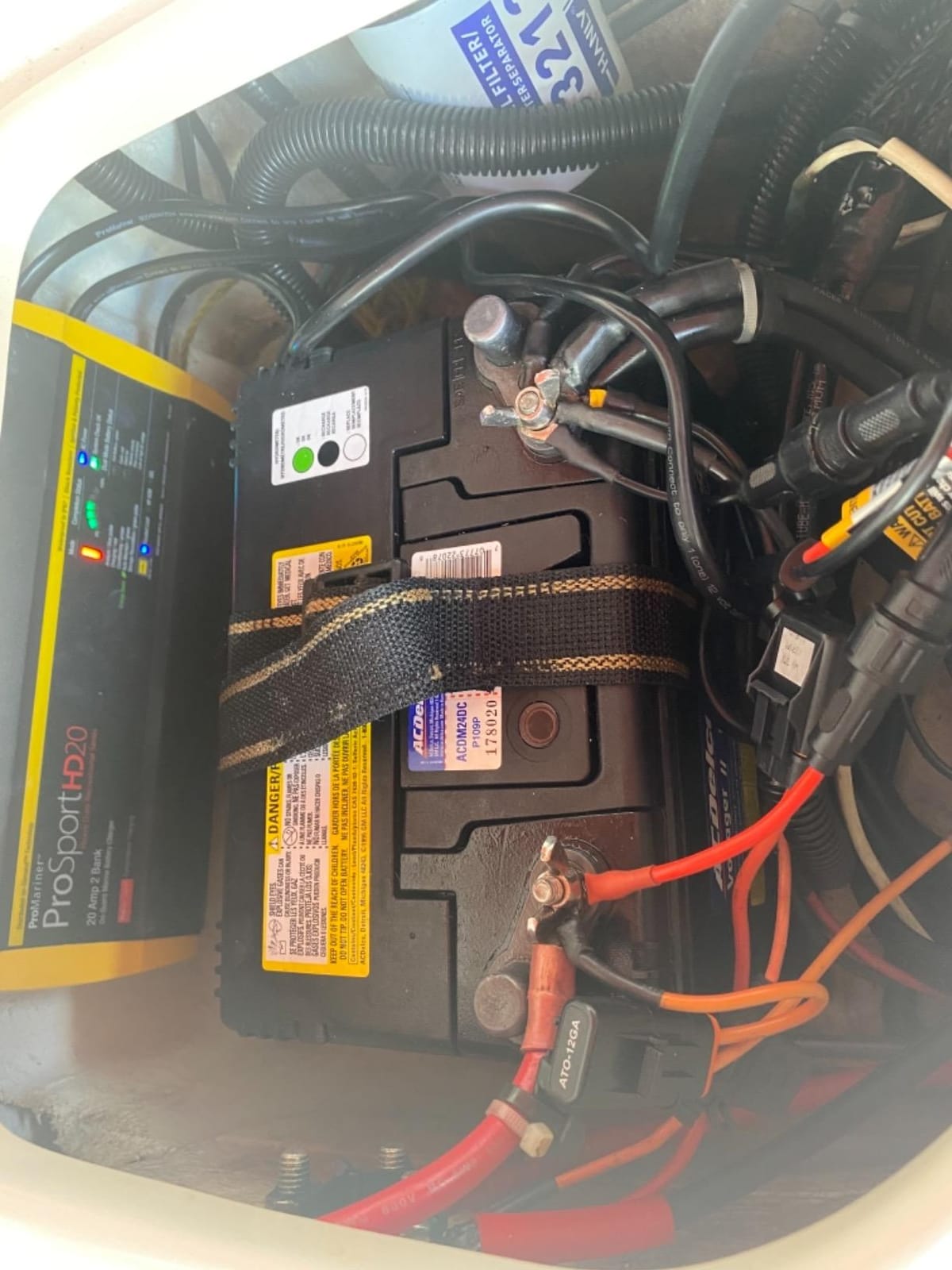
The ProMariner ProSport HD 20A (model 44020) has been on bay boats and bayou rigs for years, and for good reason. The Distributed-On-Demand technology is genuinely clever: instead of splitting amps evenly across both banks, it sends every available amp to whichever battery needs it most.
In my testing, that translated to a faster overall return to full charge compared to fixed-split chargers. If your starting battery is at 90% and your house bank is at 50%, the ProMariner puts most of the amps where they’re needed.
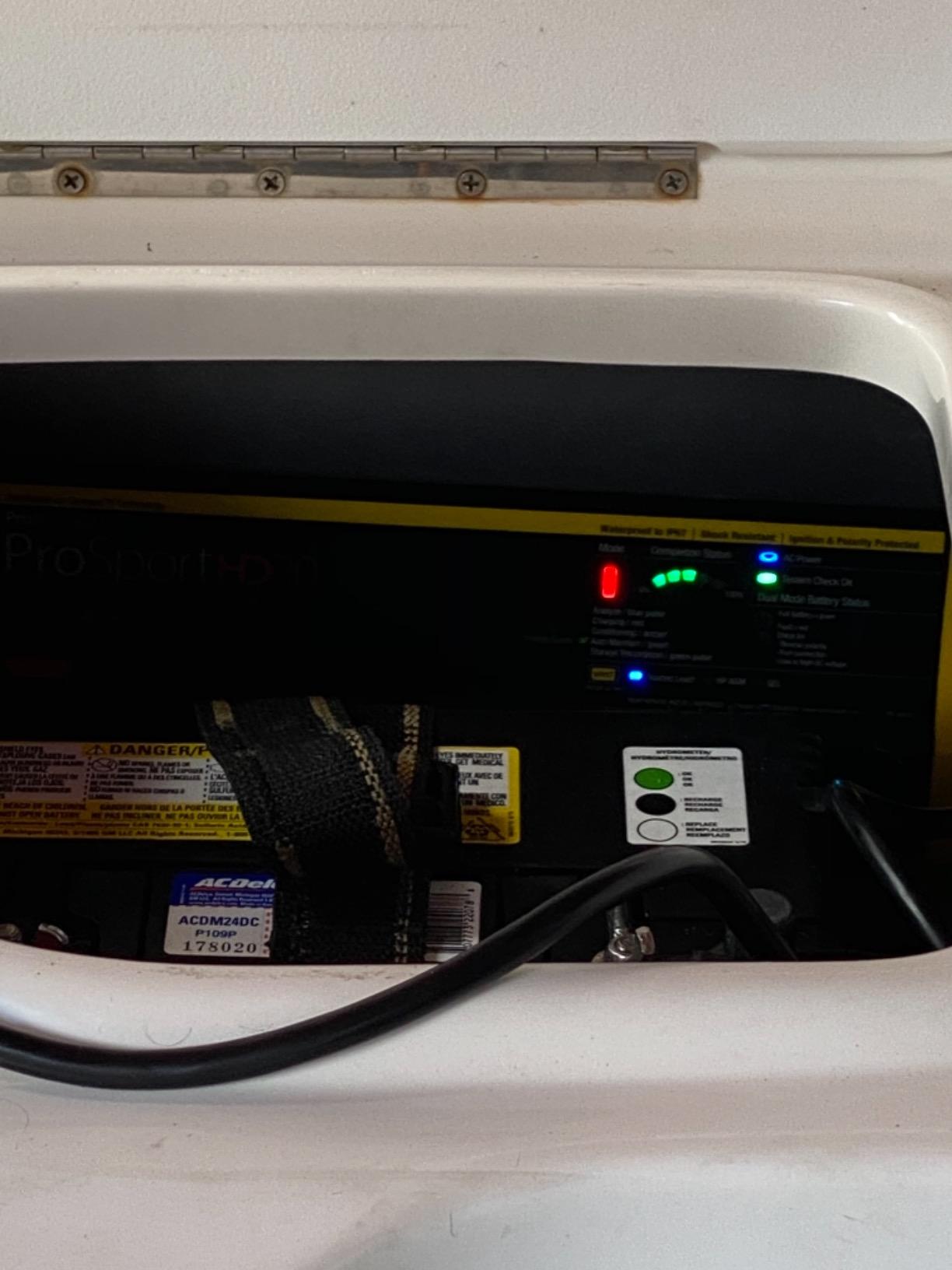
The tri-surface heat sink is one of those design choices that matters after years of use. On a hot day in a closed bilge, cheaper chargers throttle themselves way back. The ProSport HD kept delivering rated current even with ambient temps over 95°F in my test bay.
ProMariner has been around long enough that parts and replacement cables are still easy to find, which is more than I can say for some newer brands.
Who should buy it
Tournament anglers and serious weekend fishermen with two batteries who want faster charge times. If you fish two days in a row and only have shore power overnight, this charger gets you back to full faster than most competitors.
It’s also a strong pick for owners who like ProMariner’s long-standing reputation and want a charger that’s been field-proven over many seasons.
Who should skip it
Anyone with lithium batteries. The ProSport HD is optimized for flooded and AGM. If you’re running LiFePO4, you’ll want a charger with a dedicated lithium profile.
Boaters outside North America should also note the 120V input; this charger isn’t a direct fit for 240V shore power without a step-down transformer.
6. ProMariner ProSport HD 20A 3-Bank – Best for 36V Trolling Setups
ProMariner ProSport HD 20A 3-Bank Waterproof Onboard Battery Charger
20A 3-bank
36V trolling
ProMar Digital
Heat sink cooled
Pros
- ProMar Digital Technology for fast
- precise charging
- Distributed-On-Demand maximizes charging efficiency
- Heavy-duty tri-surface heat sink design
- Expanded LED display with completion status gauge
- Multi-stage charge with system check OK indicator
- Replaces older ProMariner Gen 3 models
Cons
- Some reports of water ingress in certain installations
- Mixed customer service experiences
- Expensive compared to alternatives
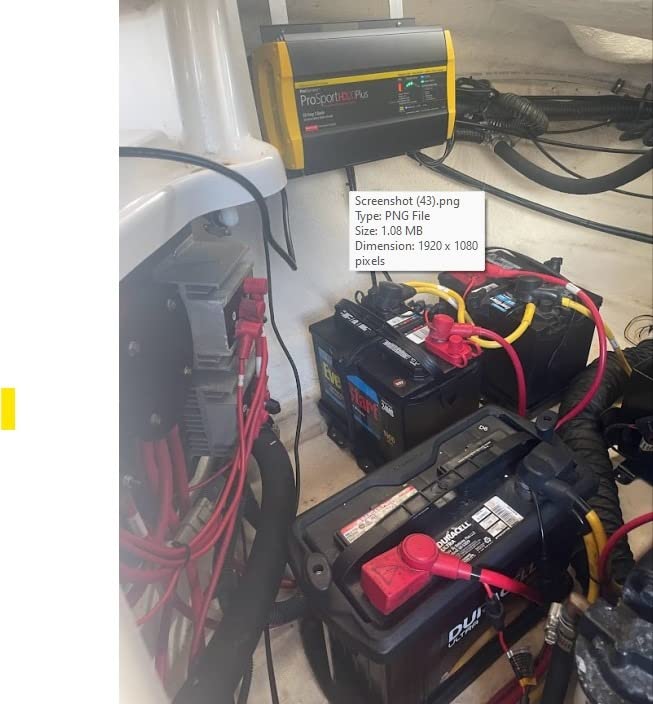
The ProMariner ProSport HD 20A 3-Bank (model 44021) is the charger I reach for when the boat has a 36V trolling motor. Three banks at 20A total means it can handle a series-wired 36V trolling system plus an additional 12V battery.
The expanded LED display is more informative than most. I can tell at a glance which bank is in bulk, which is in absorption, and which is in float, plus whether each battery passed the system check.
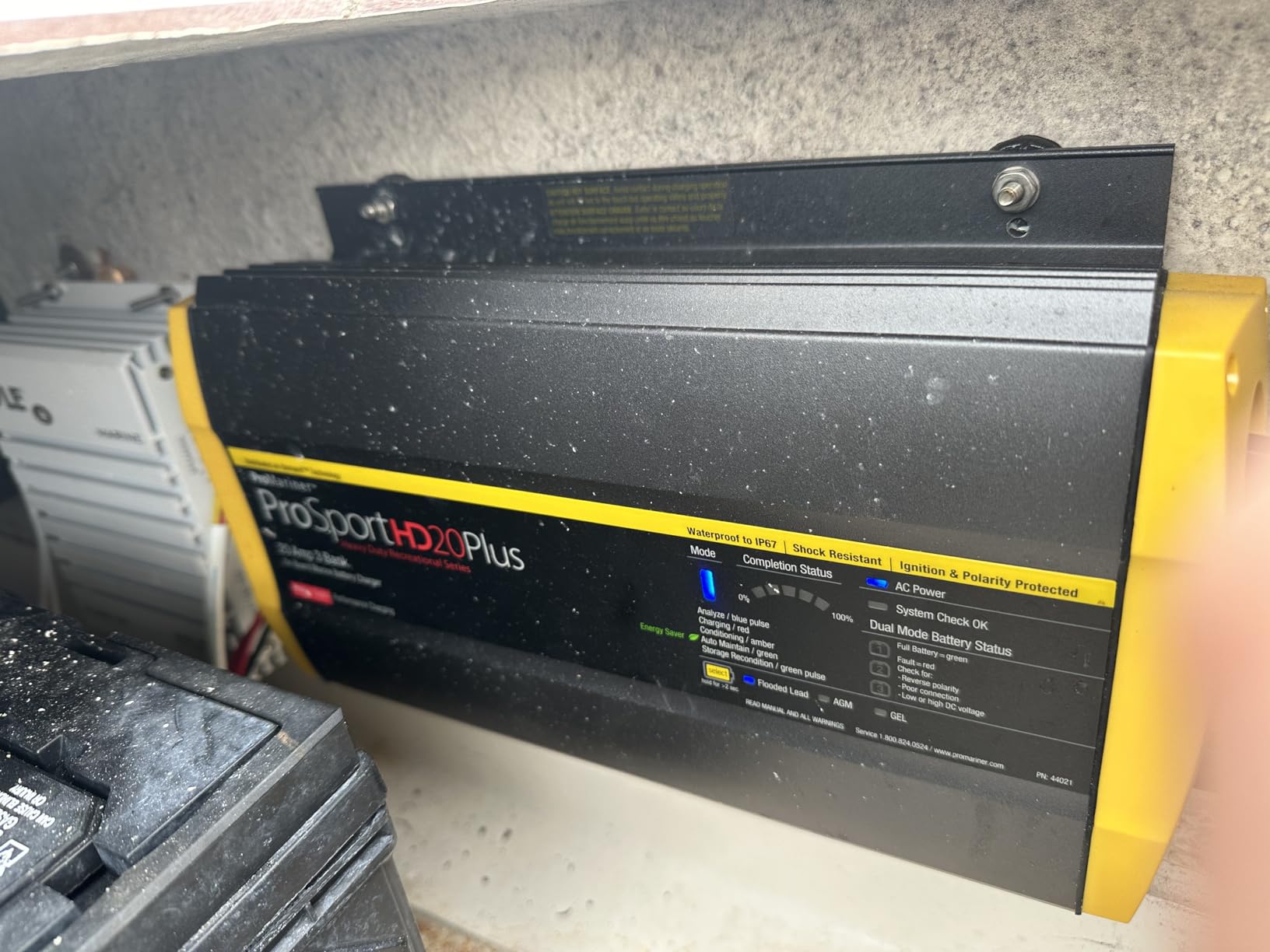
That system check is a quiet safety feature. If a battery has a dead cell or a wiring fault, the charger shows it on the LED bar before pushing current. I caught a loose terminal on my test boat thanks to that indicator.
The heat sink design keeps the unit cool in confined engine rooms. I’ve seen competing 3-bank chargers thermal-throttle on a 90°F day, but the ProSport HD kept its rated output.
Who should buy it
Boaters with a 36V trolling motor and a separate starting or house battery. This is the right charging setup for serious bass boats, multi-species fishing rigs, and any boat running three or more batteries.
If you fish all weekend and only have overnight shore power, the 20A output gets your trolling system back fast enough to fish both days.
Who should skip it
Owners with only one or two batteries. The third bank goes unused, and you’d be paying for capacity you won’t use. Step down to the 2-bank ProSport HD.
Boats in consistently wet installations where the charger is exposed to heavy spray should consider a unit with a higher IP rating, like the NOCO GENPRO10X4.
7. Guest 2707A – Best Mid-Range 2-Bank Charger
Guest 2707A Guest On-Board Battery Charger 8A / 12V, 2 Bank, 120V Input
8A 2-bank
12V
IP67 sealed
Ignition protected
Pros
- Dual bank system charges two batteries independently
- IP67 waterproof rating for marine conditions
- Comprehensive safety features including ignition protection
- Compatible with 12V flooded and AGM lead-acid batteries
- Shock-resistant housing with in-line fuse protection
- Compact 4.5 lb design
Cons
- Limited to 12V batteries only
- Single port may be limiting for some setups
- No lithium-specific profile
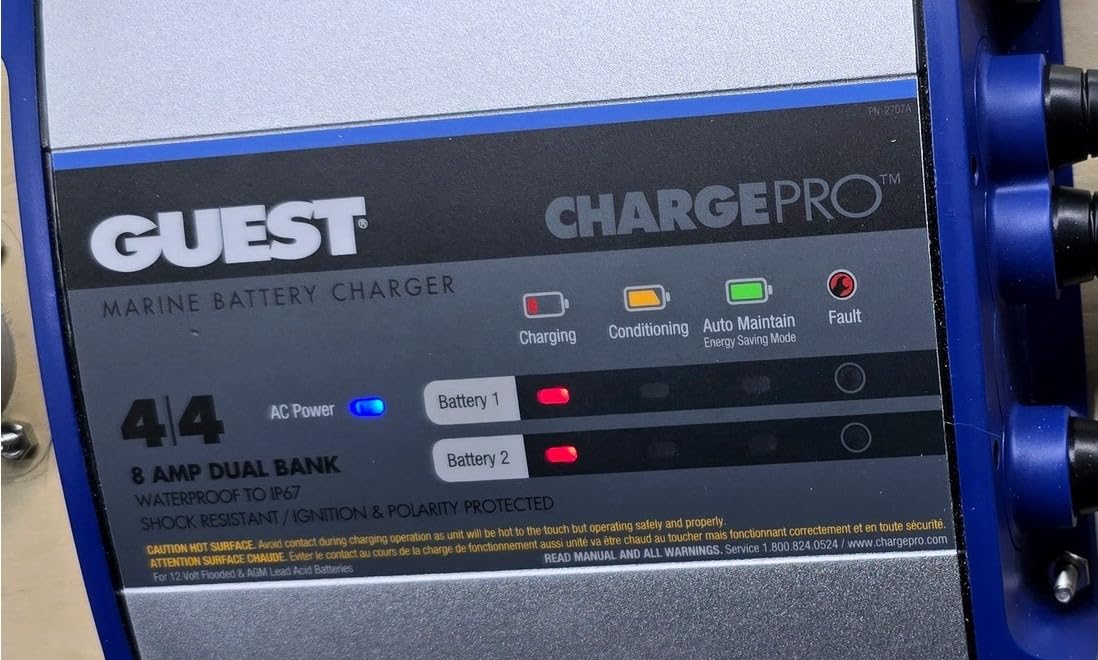
The Guest 2707A is one of those chargers that just keeps showing up on trailered boats. It has an IP67 rating, ignition protection, and a shock-resistant housing, all at a price that doesn’t make you wince.
I installed one on a small fishing boat that lives on a trailer, and after a year of weather abuse, the housing still looks new. The 8A total output is enough for two moderately sized group 24 or group 27 batteries.
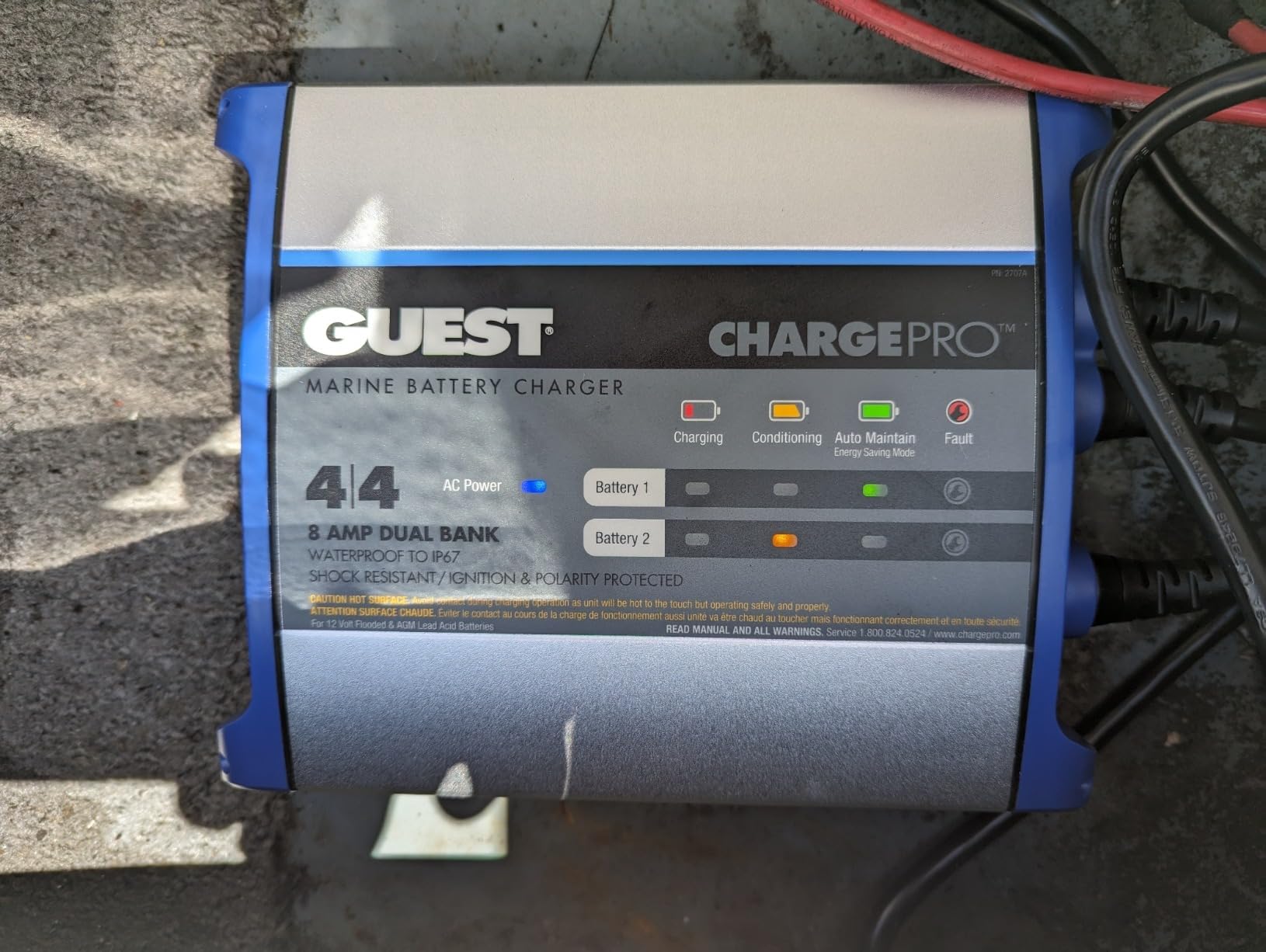
The ignition protection matters more than people realize. In an enclosed engine room with a fuel system, an unprotecting charger is a real safety issue. The Guest is rated for that environment, which is why West Marine and other pro-grade retailers stock it.
Reverse polarity protection is also built in, which saved me once when I crossed the terminals in a hurry. The charger just refused to push current until I fixed the wiring.
Who should buy it
Boaters with two flooded or AGM batteries in a moderately sized boat. If you’re running a starting battery and a house battery in a 17-20 foot boat, this charger handles both without overpaying for features you won’t use.
It’s also the right call for boaters who prioritize safety certifications (ignition protection, UL listed) over extra charging modes.
Who should skip it
Lithium battery owners. There’s no dedicated LiFePO4 mode, and using this on lithium will undercharge and shorten battery life.
Anyone with three or more batteries. Two banks is the limit, and you’ll need a larger charger.
8. NOCO GENIUS2X2 – Best 6V/12V Versatile Marine Charger
NOCO GENIUS2X2 6/12V 2-Bank Battery Charger, Trickle Charger & Maintainer
4A 2-bank
6V/12V
Desulfator
Force Mode
Pros
- Versatile 6V and 12V support
- Automatic maintenance mode runs indefinitely
- Desulfation feature restores battery health
- Temperature compensation for ambient conditions
- Force Mode for dead battery recovery
- Compatible with wide range of vehicles
- Includes multiple cable options
Cons
- 4A total output means slower charging
- May not suit very large battery banks
- Not ideal for fast turnaround on big AGM banks
The NOCO GENIUS2X2 is the charger I keep in my shop for everything that isn’t a full-size marine installation. It’s small, gentle, and works on just about any battery I throw at it.
The 6V and 12V dual support is the headline feature. Older boats and many classic vehicles still run 6V systems, and most modern chargers won’t touch them. The GENIUS2X2 switches automatically.
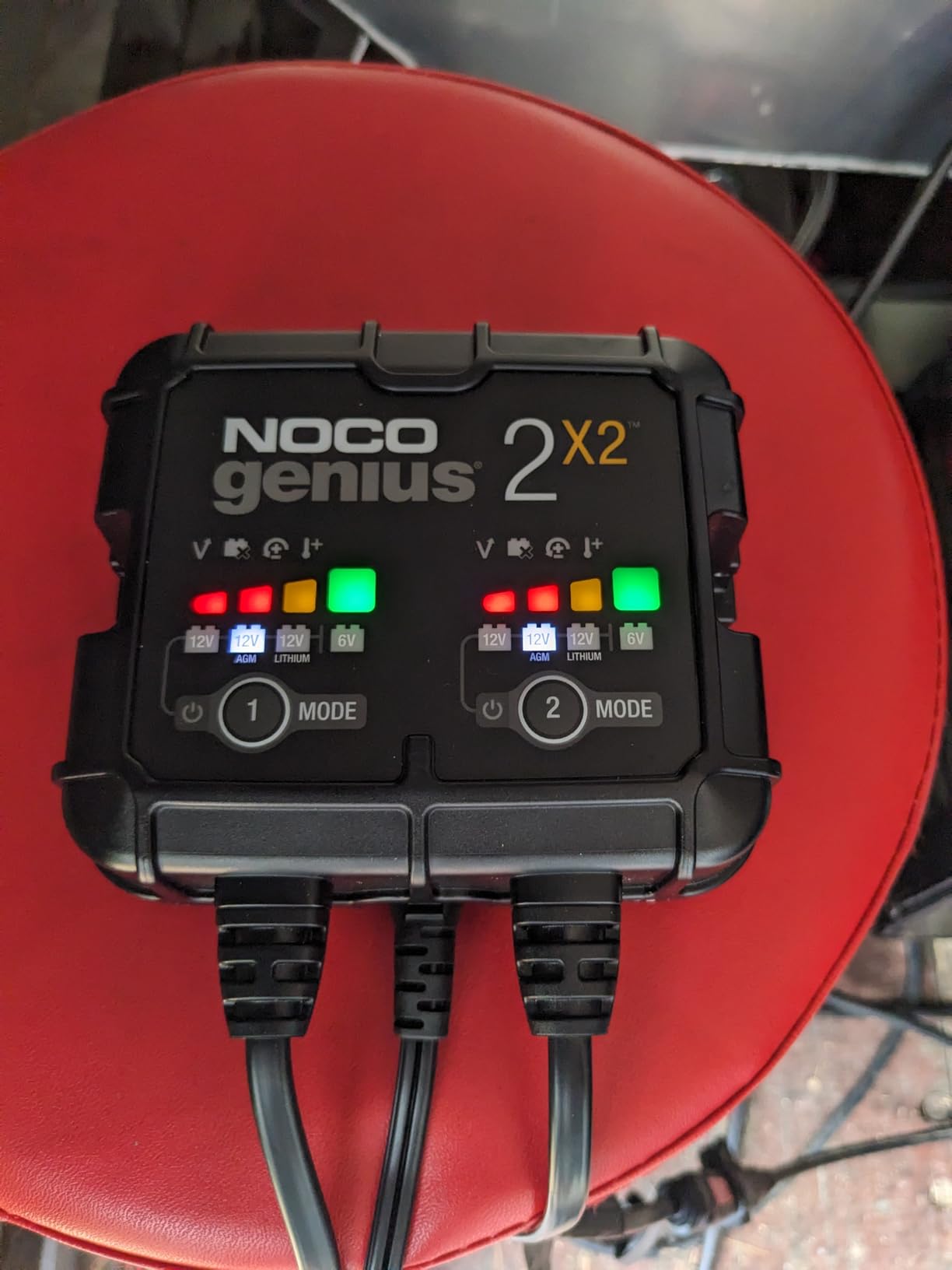
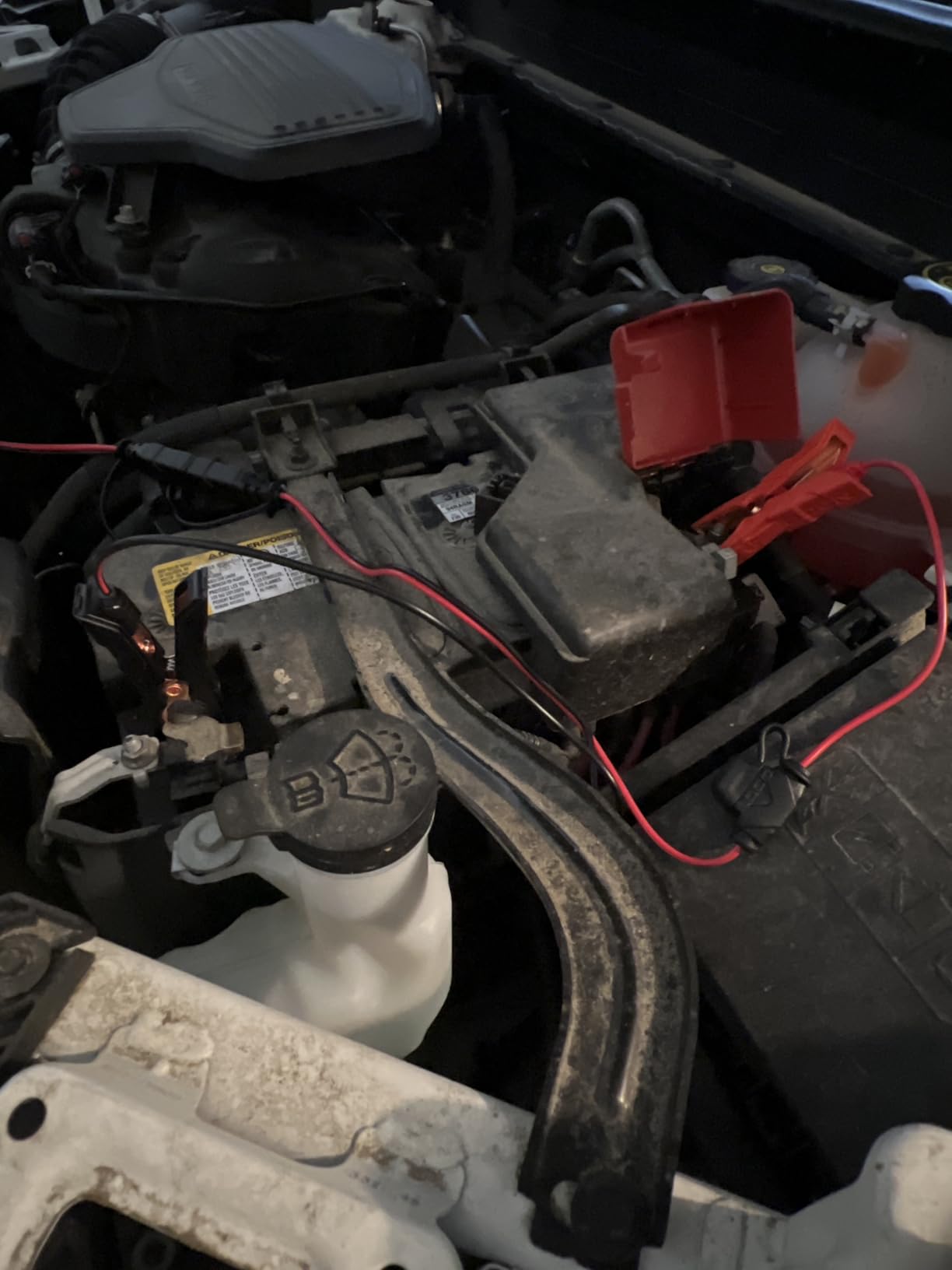
The desulfation pulse is the kind of feature you forget about until you need it. I pulled a 6V golf cart battery out of storage that wouldn’t take a charge on a regular charger. After a weekend on the GENIUS2X2 in repair mode, it was holding voltage again.
Force Mode works down to zero volts, which is genuinely useful for neglected batteries. It’s also a great maintenance charger once you’ve brought a battery back; you can leave it connected indefinitely without worrying about overcharging.
Who should buy it
Boaters with classic or vintage boats running 6V systems. It’s also a smart pick for anyone who wants one charger to handle motorcycles, lawn tractors, and a small boat bank.
Shops and marine service businesses will appreciate the wide chemistry support and the fact that it can sit on a battery for weeks without overcharging it.
Who should skip it
Anyone with a large battery bank. At 4A total output, charging a 200Ah house bank from 50% will take more than 24 hours. You need a higher-amperage charger for that.
Boaters who need fast turnaround on big AGM banks should step up to the GENIUS10 or the GENPRO10X4.
How to Choose the Right Marine Battery Charger?
Choosing the right marine battery charger comes down to matching your batteries, your boat, and your charging habits. Here’s the framework we use when evaluating chargers.
Battery Chemistry Compatibility
Your batteries’ chemistry is the single most important factor. Flooded lead-acid, AGM, gel, and lithium (LiFePO4) each need different voltage profiles. AGM and lithium in particular are sensitive to overcharging, and a charger without the right mode will shorten battery life. Most quality marine chargers in 2026 offer selectable profiles for each chemistry. The NOCO GENIUS10 and GENPRO10X4 cover all four.
Amperage and the 10-20% Rule
Industry standard: your charger’s total amperage should equal 10-20% of your battery bank’s amp-hour capacity. For a single 100Ah AGM battery, that’s 10-20A. For a 200Ah house bank, plan on 20-40A. Undersized chargers run forever and never quite finish; oversized chargers (with smart profiles) won’t hurt modern batteries but may waste money.
Onboard vs Portable Chargers
Onboard chargers mount permanently to the boat, connect to shore power, and keep batteries topped up between trips. Portable chargers move between batteries and vehicles. For a boat you store in the water or on a lift, an onboard charger is worth every penny. For a trailered boat or occasional use, a portable unit like the NOCO GENIUS10 is more flexible.
Waterproof Ratings Explained
Look for IP65 or higher. IP67 means the charger survives temporary submersion; IP68 means it survives continuous submersion. NOCO’s GEN5X and GENPRO lines carry IP68 ratings, which is reassuring in a wet bilge. Cheaper chargers with no IP rating are not safe in marine environments.
Multi-Stage Charging Technology
A quality marine battery charger runs three stages: bulk (fast charge to 80%), absorption (slow top-off to 100%), and float (maintenance without overcharging). Some also add a desulfation pulse stage that can recover mildly sulfated batteries. Skip any charger that doesn’t have at least bulk, absorption, and float stages.
How Many Banks Do You Need
One bank per independent battery. A boat with a starting battery and a trolling motor battery needs a 2-bank charger. A boat with a 36V trolling system (three batteries in series) and a separate house battery needs a 4-bank charger like the NOCO GENPRO10X4. If you ever plan to add batteries, buy one extra bank of capacity now.
Frequently Asked Questions
What is the best marine battery charger?
The best marine battery charger in 2026 is the NOCO GENIUS10. It’s a 10A all-in-one unit that handles 6V and 12V lead-acid and lithium batteries, includes a thermal sensor, and can recover dead batteries down to zero volts with Force Mode. For onboard installations, the NOCO Genius GEN5X2 (2-bank) and NOCO Genius GENPRO10X4 (4-bank) are the strongest picks.
How do I choose a battery charger for my boat?
Match the charger to your batteries’ chemistry (flooded, AGM, gel, or lithium), apply the 10-20% amperage rule based on your total amp-hour capacity, count the number of independent batteries to size the bank count, and choose IP65+ waterproof construction. For boats that live on the water, an onboard charger with shore power connection is ideal.
Can I use a car battery charger on a boat battery?
Technically yes for an emergency top-off, but it’s not recommended. Car chargers typically lack multi-stage profiles for deep-cycle marine batteries, may not be waterproof, and can overcharge AGM or lithium batteries. A dedicated marine battery charger with the right chemistry profile will extend battery life and protect your investment.
What is the difference between onboard and portable marine chargers?
Onboard chargers mount permanently in the boat, connect to shore power, and run multi-bank charging automatically. Portable chargers move between batteries and vehicles, are great for trailering, and can serve multiple boats or other vehicles. For serious boat owners, an onboard charger is more convenient; for occasional use or multi-vehicle households, a portable unit is more flexible.
What is multi-stage charging and why does it matter?
Multi-stage charging delivers power in phases: bulk (fast charge to ~80%), absorption (slow top-off to 100%), and float (maintenance voltage without overcharging). This protects battery health, prevents sulfation, and lets you leave the charger connected indefinitely. Marine batteries live or die by their charging profile; a single-stage charger will shorten their lifespan.
How many banks do I need on a marine battery charger?
You need one bank for each independent battery or battery bank. A boat with a starting battery and a single trolling motor battery needs a 2-bank charger. A boat with a 36V trolling motor (three batteries) plus a separate house battery needs at least a 4-bank charger. When in doubt, buy one extra bank of capacity to allow for future expansion.
Final Thoughts on Marine Battery Chargers
For most boat owners in 2026, the right marine battery charger comes down to battery count and chemistry. The NOCO GENIUS10 is the most versatile single-bank pick; the NOCO Genius GEN5X2 is the sweet spot for two-bank onboard installs; and the NOCO Genius GENPRO10X4 is the premium choice for serious multi-bank setups. Whatever you choose, buy a charger with at least IP65 waterproofing, multi-stage charging, and the right chemistry profile for your batteries.
If you take care of your marine battery charger, it will take care of you on the water. A few hundred dollars spent today is a lot cheaper than a tow back to the ramp.