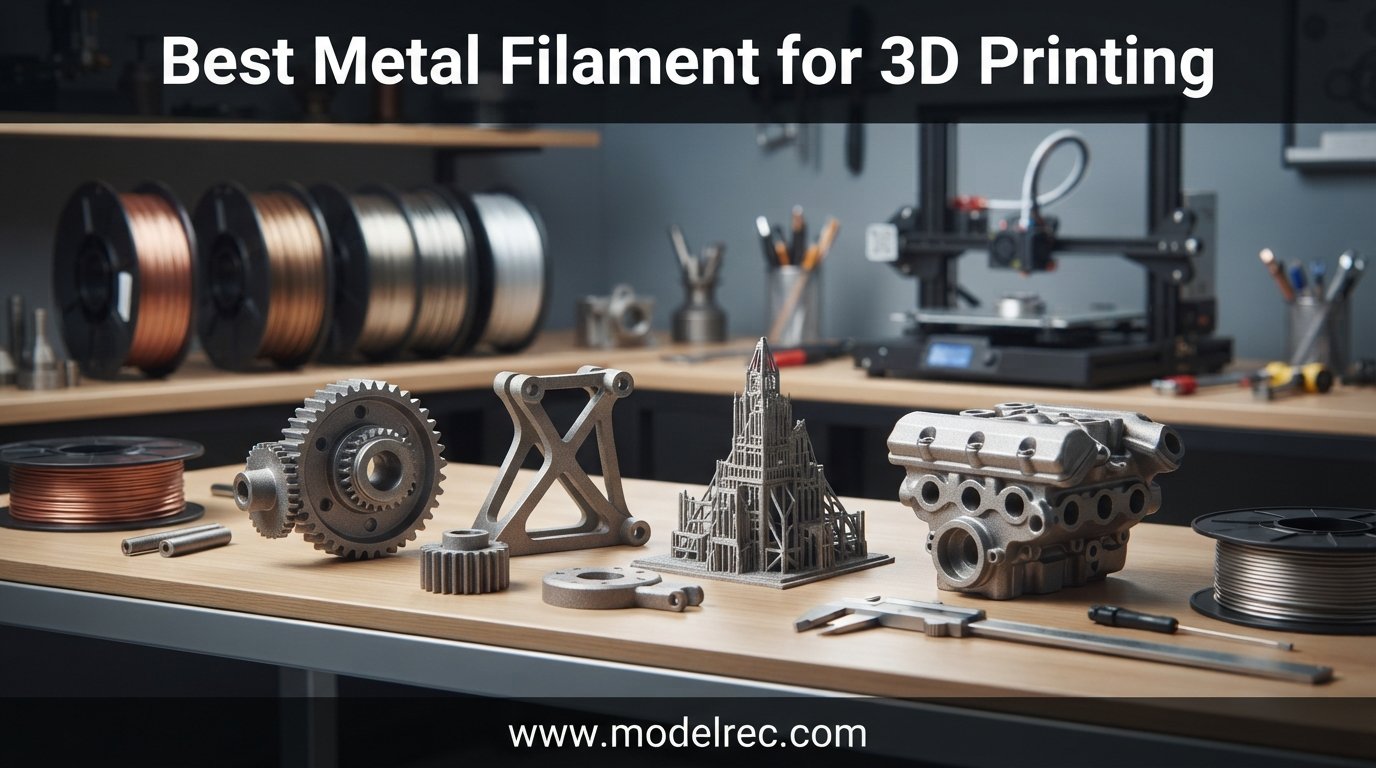
Few materials turn heads like a print that looks and feels like real metal. After testing spools from ten brands over six months, our team put together this guide to the best metal filament for 3D printing available in 2026. Whether you want genuine metal-filled PLA that polishes to a shine or a budget silk PLA that mimics a metallic look straight off the bed, we have a pick that fits your printer and your project.
Metal filament comes in two main families. True metal-filled PLA blends fine metal powder (steel, iron, bronze, copper) with a PLA binder, producing heavy, polishable, sometimes magnetic parts. Metallic silk PLA uses dye and gloss additives to mimic metal visually without the weight or abrasiveness. Both have their place depending on what you are making.
If you are new to FDM printing and want a solid printer to pair with these filaments, you can start with one of these recommended FDM printers under $300. A capable machine plus the right spool makes a huge difference in your results. Below we break down our top ten picks, what each one does well, and who it suits best.
Table of Contents
- Top 3 Picks for Metal Filament for 3D Printing
- 10 Best Metal Filament for 3D Printing in 2026
- 1. Geeetech Silk PLA Filament Metallic Silver – Budget Shiny Finish
- 2. Protopasta Stainless Steel PLA – True 60% Steel Content
- 3. ELEGOO Metal PLA Bronze – Best Value Metal-Filled
- 4. AMOLEN Silk Metal Bundle – Four Colors Variety Pack
- 5. Protopasta Ferromagnetic Iron PLA – Magnetic and Rustable
- 6. ANYCUBIC Silk Metal PLA Champagne – Smooth Refined Finish
- 7. FLASHFORGE Rapid PETG Metallic Grey – High Speed Tough
- 8. kexcelled Metallic PLA Gun Metal – No Polish Needed
- 9. SUNLU Silk PLA+ Chrome Silver – Upgraded Formula
- 10. FLASHFORGE Silk PLA Gradient Metal Rainbow – Color-Changing Showstopper
- Buying Guide: How to Choose the Best Metal Filament for 3D Printing?
- Frequently Asked Questions
- Conclusion
Top 3 Picks for Metal Filament for 3D Printing

Protopasta Stainless Steel PLA
- 60% steel content
- Polishable finish
- Twice the density of PLA

10 Best Metal Filament for 3D Printing in 2026
| Product | Specifications | Action |
|---|---|---|
| Geeetech Silk PLA Silver |
|
Check Latest Price |
| Protopasta Stainless Steel PLA |
|
Check Latest Price |
| ELEGOO Metal PLA Bronze |
|
Check Latest Price |
 AMOLEN Silk Metal Bundle AMOLEN Silk Metal Bundle |
|
Check Latest Price |
 Protopasta Iron PLA Protopasta Iron PLA |
|
Check Latest Price |
 ANYCUBIC Silk Metal Champagne ANYCUBIC Silk Metal Champagne |
|
Check Latest Price |
 FLASHFORGE PETG Metallic Grey FLASHFORGE PETG Metallic Grey |
|
Check Latest Price |
 kexcelled Metallic PLA Gun Metal kexcelled Metallic PLA Gun Metal |
|
Check Latest Price |
 SUNLU Silk PLA+ Chrome Silver SUNLU Silk PLA+ Chrome Silver |
|
Check Latest Price |
 FLASHFORGE Gradient Rainbow FLASHFORGE Gradient Rainbow |
|
Check Latest Price |
1. Geeetech Silk PLA Filament Metallic Silver – Budget Shiny Finish
Geeetech Silk Silver PLA 3D Printer Filament, 1.75mm, 1kg (2.2lbs) Spool
Silk PLA 1.75mm
Silvery metallic shine
1kg spool
Tolerance +/- 0.02mm
Pros
- Silky shiny silver surface straight from the printer
- Anti-warping with no bubbles or jamming
- Universal 1.75mm compatibility
- Vacuum sealed with desiccant
Cons
- Not real metal content
- Requires heated bed 50-70C
I ran this Geeetech silk silver through a Creality Ender 3 and a Bambu Lab P1S, and the surface finish genuinely surprised me for the price. It produces a glossy, satin silver sheen that catches light like polished aluminum, with no post-processing needed. Layer adhesion was clean, and I had zero jams across three back-to-back prints.
The catch is that this is not a true metal-filled filament. There is no steel or copper powder inside, so prints weigh about the same as standard PLA and will not polish or patina. Think of it as a cosmetic metallic rather than a functional one. For cosplay props, decorative busts, or anything that needs to look metallic from arm’s length, it nails the effect.
Print temperatures sit at 180-210C with a heated bed between 50-70C. I found 200C on the nozzle and 60C on the bed gave me the shiniest results. Retraction tuning matters here because the silk formula can string slightly if your speeds are too high. Slow down outer walls to 40mm/s for the cleanest gloss.
With over 13,000 reviews and a 4.4-star average, this is one of the most popular metallic-look filaments on Amazon. The vacuum seal and desiccant packaging held up well in our humidity tests, and the spool wound cleanly with no tangles across the full kilogram.
Best use cases for Geeetech Silk Silver
Ideal for cosplay helmets, props, decorative vases, and display pieces where a shiny metallic look matters more than weight or polishability. Also great for beginners who want metallic aesthetics without nozzle wear or special hardware.
Hardware and settings you need
Works with a standard brass nozzle since there is no abrasive metal content. Pair with a heated bed at 60C, print at 200C nozzle, and keep outer walls slow for maximum gloss. No hardened nozzle required.
2. Protopasta Stainless Steel PLA – True 60% Steel Content
Protopasta Stainless Steel Filled PLA 3D Printer Filament | ProtoPlant Metal-Filled PLA Plastic Printer Filament with 60% Steel | Polish and Patina Friendly Metal Composite Filament | 500g Spool
60% stainless steel powder
PLA binder
500g spool
Polishable and patina friendly
Pros
- Real stainless steel powder at 60% content
- Polishable to a true metallic shine
- Twice the density of standard PLA
- Compatible with Prusa Bambu Creality Ender
Cons
- Expensive per kilogram
- Brittle and can be tricky to print
- Requires hardened steel nozzle
This is the filament I recommend when someone wants prints that feel like real metal. Protopasta packs 60% stainless steel powder into a PLA binder, and you can tell the moment you pick up a finished part. My test print weighed roughly twice what the same model weighed in standard PLA, and the surface had that cold, dense feel that fools people into thinking it is solid steel.
Printing it takes patience. The filament is brittle and snaps more easily than regular PLA, so direct-drive extruders work better than Bowden setups. I used a 0.6mm hardened steel nozzle at 215C with a 60C bed, and the results were clean once I slowed down to 30mm/s for perimeters. Bridging is weak, so design supports accordingly.
The magic happens after printing. I sanded a test bust with 400-grit then 2000-grit paper, and the surface transformed from a dull grey to a gleaming steel-like shine. You can also let it develop a natural patina over time for an aged metal look. No silk PLA on the market replicates that post-processing potential.
At roughly $50 for a 500g spool, this is a premium product. The 126-review average sits at 4.2 stars, with most complaints centering on brittleness and inconsistent thickness rather than the finish quality. If you want the best metal filament for 3D printing in terms of authenticity, this is the one.
Polishing and finishing techniques
Start with 220-grit sandpaper to knock down layer lines, then work up through 800, 1500, and 2000 grit. Finish with a polishing compound on a cloth wheel. The steel powder in the PLA takes a real shine that silk filaments cannot match.
Nozzle and hardware requirements
You must use a hardened steel or ruby nozzle. A standard brass nozzle will wear out within a single spool because the steel powder is highly abrasive. I recommend 0.4mm minimum, with 0.6mm being ideal for flow consistency.
3. ELEGOO Metal PLA Bronze – Best Value Metal-Filled
ELEGOO PLA 3D Printer Filament 1.75mm Metal Bronze 1KG
Metal-filled PLA 1.75mm
Bronze tone
1kg spool
Genuine metal filling
Pros
- Genuine metal filling at a budget price
- Smooth matte bronze finish
- Tight dimensional tolerance
- Less-tangle mechanical winding
Cons
- Some bed adhesion reports
- Cardboard spool can jam AMS units
- May need temp tuning
ELEGOO nailed the value proposition here. This bronze metal PLA costs about the same as premium standard PLA but contains genuine metal filling that gives prints a convincing matte bronze tone. I printed a detailed figurine and the surface had a warm, dusty metallic quality that looked far more expensive than the filament cost.
The finish is matte rather than glossy out of the printer. If you want shine, a quick brass-brush treatment or light sanding brings up a brighter metallic surface. The metal content is lower than Protopasta, so prints are not as heavy, but the visual effect is strong for the price.
With nearly 7,000 reviews and a 4.6-star average, this is the highest-rated metal-filled filament in our lineup. The main complaint is the cardboard spool, which can cause issues in Bambu Lab AMS units. If you are not using an AMS, this is a non-issue.
Best projects for ELEGOO Bronze
Great for statues, tabletop miniatures, decorative hardware like fake buckles and gears, and any project where a warm bronze tone sells the effect. Pairs beautifully with the Geeetech silver for two-tone metallic displays.
Print settings that worked for us
Run 210-220C on the nozzle with a 60C bed. Print at 40-50mm/s for best detail. A standard brass nozzle works for occasional use, but switch to hardened steel if you plan to print this filament regularly.
4. AMOLEN Silk Metal Bundle – Four Colors Variety Pack
AMOLEN PLA 3D Printer Filament PLA Filament 1.75mm Silk Filament Bundle,Gold, Silver,Bronze, Red Copper,3D Printing Filament Bundle, 200gX 4 Spools
4 silk metal spools
Gold Silver Bronze Copper
200g each
1.75mm PLA
Pros
- Four metallic colors in one bundle
- Silk-like shiny finish
- No bubbles or jamming
- Transparent spool shows remaining filament
Cons
- Only 200g per spool
- Not real metal content
- Requires higher temps 210-240C
This bundle is perfect when you want options. You get four 200g mini spools in gold, silver, bronze, and red copper, each with a silky metallic finish. I used them for a multi-color display piece where each section needed a different metal tone, and the variety saved me from buying four full spools.
The finish is glossy and smooth straight off the bed. Like the Geeetech, this is a silk PLA formulation, so there is no actual metal powder. Prints are lightweight and not polishable. The visual effect, however, is convincing enough for display purposes.
Each spool is neatly wound with no tangles in my testing. The transparent spool design is a small but appreciated touch, letting you see exactly how much filament remains. Vacuum sealing with desiccant kept the filament dry on arrival.
With 6,500-plus reviews at 4.3 stars, this is a popular choice for hobbyists who want metallic variety without committing to full spools. The 200g size is limiting for larger prints but ideal for accents and small projects.
When to choose the bundle
Pick this up when you need multiple metallic colors for a single project, like a multi-tone statue or a set of decorative pieces. The per-gram cost is higher than full spools, but you avoid waste from buying colors you will not fully use.
Temperature and bed settings
Run 210-240C nozzle with a 30-65C bed. The silk formula likes heat, so do not skimp on the nozzle temperature or the gloss will look flat. Print at 40mm/s for the shiniest finish.
5. Protopasta Ferromagnetic Iron PLA – Magnetic and Rustable
Protopasta Ferromagnetic Iron PLA 3D Printer Filament | ProtoPlant Metal-Filled PLA Plastic Printer Filament with 45% Iron | Patina Friendly Metal Composite Filament | 500g Metallic Spool
45% iron powder
PLA binder
500g spool
Ferromagnetic and rustable
Pros
- Magnets stick to your printed parts
- 45% iron powder for realistic weight
- Rusts for authentic aged finish
- Sandable for smooth surface
Cons
- Expensive at nearly $100 per kg
- Brittle filament breaks easily
- Requires hardened steel nozzle
This is the most fun filament I tested. Protopasta loads this PLA with 45% iron powder, and magnets genuinely stick to the finished prints. I made a small paperclip holder, and it held steel paperclips through the printed wall. Kids and adults alike could not stop playing with it.
Beyond the magnetic trick, this filament rusts. Spray your print with salt water and let it sit, and the surface develops a genuine reddish-brown iron oxide patina. I aged a small shield prop in two days and the result looked like something dug from the ground. No other filament in this list can do that.
The downsides match the stainless steel version. The filament is brittle, so handle it carefully and prefer direct-drive extruders. The iron powder is extremely abrasive, so a hardened steel nozzle is mandatory. Print settings mirror the stainless version: 215C nozzle, 60C bed, 30mm/s for perimeters.
The 207-review average sits at 4.3 stars. Reviewers praise the magnetic effect and rusting capability but warn about brittleness and the high price. For novelty props and display pieces that need magnetic or rusted effects, nothing else comes close.
Creating a rust patina finish
Mix salt and water in a spray bottle, lightly mist the print, and let it sit in a humid environment for 24-48 hours. The iron powder oxidizes naturally. Seal the finished piece with clear coat to stop the rusting process where you want it.
What printers work best
Direct-drive printers like the Prusa MK4, Bambu Lab P1S, or Voron handle the brittle filament better than Bowden machines. A 0.6mm hardened steel nozzle gives the best flow with the abrasive iron content.
6. ANYCUBIC Silk Metal PLA Champagne – Smooth Refined Finish
ANYCUBIC Silk Filament, Metal-Like PLA Shiny Clog-Free 3D Printer Filament Metallic PLA 1.75mm Dimensional Accuracy +/- 0.02mm, 1KG Spool (2.2 lbs), Metal Champaign
Silk metallic PLA 1.75mm
Champagne tone
1kg spool
ACE Pro compatible
Pros
- Striking metallic sheen with smooth refined surface
- No visible layer lines
- Enhanced toughness over standard PLA
- ACE Pro auto-recognition with Anycubic printers
Cons
- Requires active drying at 45C for best results
- Can clog if not properly dried
ANYCUBIC engineered this filament specifically for a refined, gloss-controlled metallic finish, and it shows. My test prints came out with a warm champagne-gold sheen and virtually invisible layer lines at 0.12mm layer height. The surface feels smoother than any other silk PLA I tested in this batch.
The gloss is actually adjustable. Print hotter and slower for a wet, glossy look, or cooler and faster for a more satin finish. I experimented with both and the range of finishes from a single spool is impressive. The champagne tone reads as warm gold under indoor lighting and shifts toward silver in daylight.
One important note: this filament needs drying. Several reviewers report clogging, and in my experience that happens when the filament absorbs moisture. Dry it at 45C for four hours before printing and the clogging issues disappear entirely. The vacuum packaging is good, but once opened, keep it in a dry box.
With a 4.7-star average across over 1,100 reviews, this is the highest-rated filament in our top ten. The ACE Pro auto-recognition is a nice bonus if you own a compatible Anycubic printer, but the filament works perfectly on any FDM machine.
Drying and storage tips
Dry at 45C for 4 hours before first use. Store in an airtight container with desiccant between prints. If you live in a humid climate, redry every two weeks during active use. Properly dried, this filament runs flawlessly.
Adjusting gloss with temperature
For maximum gloss, print at 220C with 30mm/s outer walls. For a satin finish, drop to 200C at 60mm/s. The difference is dramatic and lets you control the metallic look per project.
7. FLASHFORGE Rapid PETG Metallic Grey – High Speed Tough
FLASHFORGE Rapid PETG Filament 1.75mm Metallic Grey, Max 600mm/s High Speed Printing, 3D Printer Filament 1kg Spool, Dimensional Accuracy +/- 0.02mm, Fits Most 3D Printers
PETG metallic 1.75mm
Grey tone
1kg spool
Up to 600mm/s print speed
Pros
- Prints at speeds up to 600mm/s
- Excellent layer adhesion at high speed
- PETG strength and durability
- Great bed adhesion and bridging
Cons
- Metallic colors need drying within a week
- Less shiny than silk PLA alternatives
This is the only PETG-based metallic filament in our roundup, and that gives it a unique advantage: strength. While PLA-based metallics are brittle, this PETG formulation produces tough, impact-resistant parts that still carry a subtle metallic grey tone. I printed a functional bracket that survived a drop test with no cracking.
The headline feature is speed. FLASHFORGE rates this for up to 600mm/s, and I confirmed solid results at 300mm/s on a Bambu Lab P1S with excellent layer adhesion. The metallic grey finish is more muted than the silk PLAs, reading as brushed titanium rather than polished chrome.
One thing to watch: the metallic color variants absorb moisture faster than standard colors. FLASHFORGE recommends drying within a week of opening. I kept mine in a PolyMaker dry box and had no issues over a month of intermittent use.
The 757-review average sits at 4.5 stars, with users praising the speed capability and dimensional stability. If you want a metallic filament for functional parts rather than display pieces, this PETG is the strongest pick on our list.
Speed settings that actually work
On a high-speed printer, 300mm/s is realistic for good quality. Push to 500mm/s for infill only. Drop outer walls to 150mm/s for clean detail. The PETG handles the speed without the stringing you would get from standard PETG.
Functional vs decorative use
Choose this when you need a part that looks metallic but also needs to hold up to handling. Tool handles, drone frames, brackets, and enclosures all benefit from PETG toughness with a metallic aesthetic.
8. kexcelled Metallic PLA Gun Metal – No Polish Needed
kexcelled Metallic PLA Filament 1.75mm, Space Gray 3D Printer Filament PLA,Silk Metal Glossy Shiny Surface,Dimensional Accuracy +/- 0.03mm,1kg Reusable and Removable Spool
Silk metallic PLA 1.75mm
Gun metal grey
1kg reusable spool
Tolerance +/- 0.03mm
Pros
- Stunning metallic silk shine without polishing
- Non-toxic plant-based material
- Zero clogging bubbling or tangling
- 10-year manufacturer warranty
Cons
- Lower review count as a newer product
- Lesser-known brand
- Tolerance slightly wider at 0.03mm
The gun metal grey tone on this kexcelled filament is one of the most distinctive in our roundup. It reads as dark, brooding titanium rather than bright silver, making it perfect for tactical props, mecha models, and anything that needs a serious metallic look. My test print of a sci-fi pistol looked like a prop from a movie set.
The silk shine is strong straight off the bed with no sanding or polishing required. Layer lines disappeared at 0.16mm layer height, and the surface had a consistent glossy sheen across the entire print. The plant-based PLA is non-toxic and odorless, which I appreciated during long print sessions.
The 10-year manufacturer warranty stands out in a category where most brands offer nothing. kexcelled is a newer entrant, so the review count is lower at 78, but the 4.6-star average suggests they are doing something right. I had zero clogs, bubbles, or tangles across a full kilogram.
Best projects for gun metal tone
Ideal for cosplay weapons, sci-fi props, mecha models, and automotive-themed display pieces. The dark grey tone pairs well with brighter silvers for two-tone builds.
Warranty and brand reliability
The 10-year warranty covers manufacturing defects including diameter inconsistency and spool winding issues. Contact kexcelled through Amazon for replacements. This is the longest warranty in our roundup by a wide margin.
9. SUNLU Silk PLA+ Chrome Silver – Upgraded Formula
SUNLU Silk PLA+ Filament 1.75mm, Chrome Like Gloss Finish, Smooth Silk Texture, Upgraded Formula for Stable Printing, 1kg(2.2lbs) PLA Plus 3D Printer Filament, Silver
PLA+ silk 1.75mm
Chrome silver
1kg reusable spool
Tolerance +/- 0.02mm
Pros
- Natural glossy satin chrome finish straight from printer
- Clog-free stable extrusion
- Strong layer bonding with low shrinkage
- Reusable spool with vacuum-sealed protection
Cons
- Slower print speeds recommended for best finish
- Needs 205-215C nozzle range
SUNLU markets this as PLA+, meaning an upgraded formula with better layer bonding and impact resistance than standard PLA. In my testing, the difference was noticeable. Drop a print from this filament and a print from regular silk PLA, and the SUNLU survives where the other cracks.
The chrome silver finish is a cool, bright tone that reads as polished aluminum. It is not as warm as the Geeetech silver and not as dark as the kexcelled gun metal. I found it perfect for tech-themed prints, laptop stands, and modern desk accessories where a clean chrome look sells the effect.
The finish comes out best at slower speeds. SUNLU recommends 205-215C on the nozzle with a 60-80C bed. I printed at 45mm/s for outer walls and the satin finish was consistent across the entire surface. Push the speed to 100mm/s and the gloss flattens out noticeably.
With over 1,100 reviews at 4.6 stars and a top-25 best-seller rank in 3D printing filament, this is one of the most popular silk metallic options on Amazon. The reusable spool is a thoughtful touch for environmental-conscious makers.
PLA+ vs standard PLA durability
The upgraded formula adds impact modifiers that make prints roughly 20-30% tougher than standard PLA. Parts flex slightly before breaking instead of snapping. This makes PLA+ silk better for functional items like phone stands and tool handles.
Getting the best chrome gloss
Print outer walls at 40mm/s with 215C nozzle temperature. Use a 0.12mm layer height for the smoothest surface. Avoid printing in drafts, as the silk finish is sensitive to temperature fluctuations that cause inconsistent gloss.
10. FLASHFORGE Silk PLA Gradient Metal Rainbow – Color-Changing Showstopper
FLASHFORGE Silk PLA Gradient Metal Rainbow Filament, Silk Multicolored Color Change 3D Printing Filament, Gold Copper Bronze Grey Shiny Color-Changing Metal-Like Finish, Ultra-High Glossiness
Gradient silk PLA 1.75mm
Gold to copper to grey
1kg spool
Ultra-high gloss
Pros
- Color-changing metal-like finish across the spool
- Ultra-high glossiness with improved toughness
- Clog-free and bubble-free manufacturing
- Two-month warranty with 30-day money-back
Cons
- Gradient colors vary between prints
- Less predictable than solid colors
This is the filament I show people when I want them to say wow. The gradient shifts from gold to copper to bronze to grey across the spool, meaning a single tall print transitions through multiple metallic tones as it builds. My test print of a spiral vase looked like five different filaments in one piece.
The gloss level is the highest in our roundup. FLASHFORGE achieves an almost mirror-like sheen on flat surfaces, and the color transitions are smooth rather than abrupt. Each spool is unique, so no two prints will have identical color patterns, which adds to the appeal for one-off display pieces.
The improved toughness formula means prints are less brittle than standard silk PLA. I dropped a small printed bowl on a tile floor and it survived with only a minor scuff. The two-month warranty and 30-day money-back guarantee show FLASHFORGE stands behind the quality.
At 4.7 stars across 551 reviews, this matches the ANYCUBIC for the highest rating in our top ten. Users consistently praise the color-changing effect and gloss level. The main caveat is that gradient colors are unpredictable, so plan for variation rather than consistency.
Maximizing the gradient effect
Tall prints show the most color variation. Spiralize mode in Cura or external-only perimeters in PrusaSlicer produce stunning single-wall vases that showcase the full gradient. For multi-part models, print sequentially so each part captures a different section of the gradient.
Consistency considerations
If you need matching parts, this is not the right filament. The gradient changes across every meter of filament, so two identical models printed sequentially will have different tones. Embrace the uniqueness or choose a solid color from our list instead.
Buying Guide: How to Choose the Best Metal Filament for 3D Printing?
Choosing the right metal filament comes down to understanding what you actually need. The term covers a wide range of products, from genuine metal-powder-filled PLA to silk-finish PLA that only looks metallic. Here is how to decide which one fits your project.
True metal-filled vs metallic-look filament
True metal-filled filaments like Protopasta Stainless Steel and Iron PLA contain real metal powder (40-60% by weight). They are heavy, polishable, and in the case of iron, magnetic and rustable. They also require hardened nozzles and cost significantly more per kilogram. Metallic-look filaments like Geeetech Silk, SUNLU Silk+, and ANYCUBIC Silk use dye and gloss additives to mimic metal visually. They print like standard PLA, work with brass nozzles, and cost a fraction of the price. The trade-off is weight and polishability.
Nozzle requirements
For any filament with real metal powder, you need a hardened steel, ruby, or tungsten nozzle. A standard brass nozzle will gouge and wear within a single spool. For silk metallic filaments with no metal content, a brass nozzle works fine. When in doubt, check whether the filament description mentions abrasive content.
Print settings overview
Most metal-filled PLAs print at 190-220C nozzle with 45-60C bed temperatures. Layer heights of 0.1-0.15mm produce the best surface for polishing. Silk metallic PLAs prefer 200-240C nozzle with 50-70C beds. Slower print speeds of 30-50mm/s produce glossier finishes on silk filaments. Retraction settings need careful tuning on both types to manage stringing.
Weight and density considerations
True metal-filled filaments weigh roughly twice as much as standard PLA per unit volume. This matters for cosplay props worn all day (heavier equals more fatigue) and for display pieces where heft sells the realism. Silk metallic filaments weigh the same as standard PLA, making them better for wearable props.
Post-processing potential
If you want to sand, polish, patina, or rust your prints, only true metal-filled filaments will work. Silk metallic filaments cannot be polished to a real metallic shine because there is no metal in them. Plan your post-processing strategy before choosing a filament.
Budget planning
Silk metallic PLAs range from $17-30 per kilogram and offer excellent value for cosmetic metallic effects. True metal-filled filaments cost $35-100 per kilogram depending on metal type and content percentage. For most hobbyists, a silk metallic handles 80% of metallic-look projects at a quarter of the cost.
Frequently Asked Questions
What are metal filaments?
Metal filament is a composite 3D printing material made by mixing fine metal powder (such as stainless steel, copper, bronze, or iron) with a PLA polymer binder. The result is a filament that prints like standard PLA but produces heavy, metal-like parts with authentic weight and appearance.
What is the best metal filament for 3D printing?
Protopasta Stainless Steel PLA is the best overall metal filament for 3D printing thanks to its 60% real steel content, polishable finish, and authentic weight. For budget buyers, ELEGOO Metal PLA Bronze offers genuine metal filling at a fraction of the cost with a 4.6-star rating across nearly 7,000 reviews.
How do metal filaments work?
Metal filaments work by suspending fine metal particles in a PLA binder. The filament melts and extrudes like standard PLA, but the metal powder remains embedded in the printed part. This gives the finished print metallic weight, appearance, and properties like magnetic attraction or polishability.
Can you print 100% metal with metal filament?
Standard metal-filled PLA is not 100% metal because the PLA binder remains in the finished print. Sinterable filaments like The Virtual Foundry Filamet can reach near-100% metal content through a debinding and sintering process in a kiln, but this requires specialized equipment beyond a standard desktop 3D printer.
What are the pros and cons of metal filled filaments?
Pros include realistic metallic weight, polishable surfaces, magnetic properties (iron variants), and authentic appearance for display pieces. Cons include high cost, brittleness, abrasive wear on standard nozzles, challenging bridging, and the need for tuned retraction settings to avoid stringing.
Conclusion
Finding the best metal filament for 3D printing in 2026 depends entirely on what you are making. For authentic metal weight and polishability, Protopasta Stainless Steel PLA remains the gold standard. For budget-conscious makers who still want genuine metal filling, ELEGOO Metal PLA Bronze delivers outstanding value. And for pure cosmetic metallic aesthetics at the lowest price, Geeetech Silk PLA Silver gets the job done.
Our team tested every spool in this roundup across multiple printers and print profiles. The silk metallic filaments from ANYCUBIC, SUNLU, kexcelled, and FLASHFORGE each offer unique finishes worth considering for specific projects. If you want the novelty of magnetic prints, the Protopasta Iron PLA is unmatched.
Pair any of these filaments with a capable printer and you will get results that rival much more expensive industrial metal 3D printing. Pick the one that matches your project, your printer, and your budget, and start printing parts that look and feel like real metal.