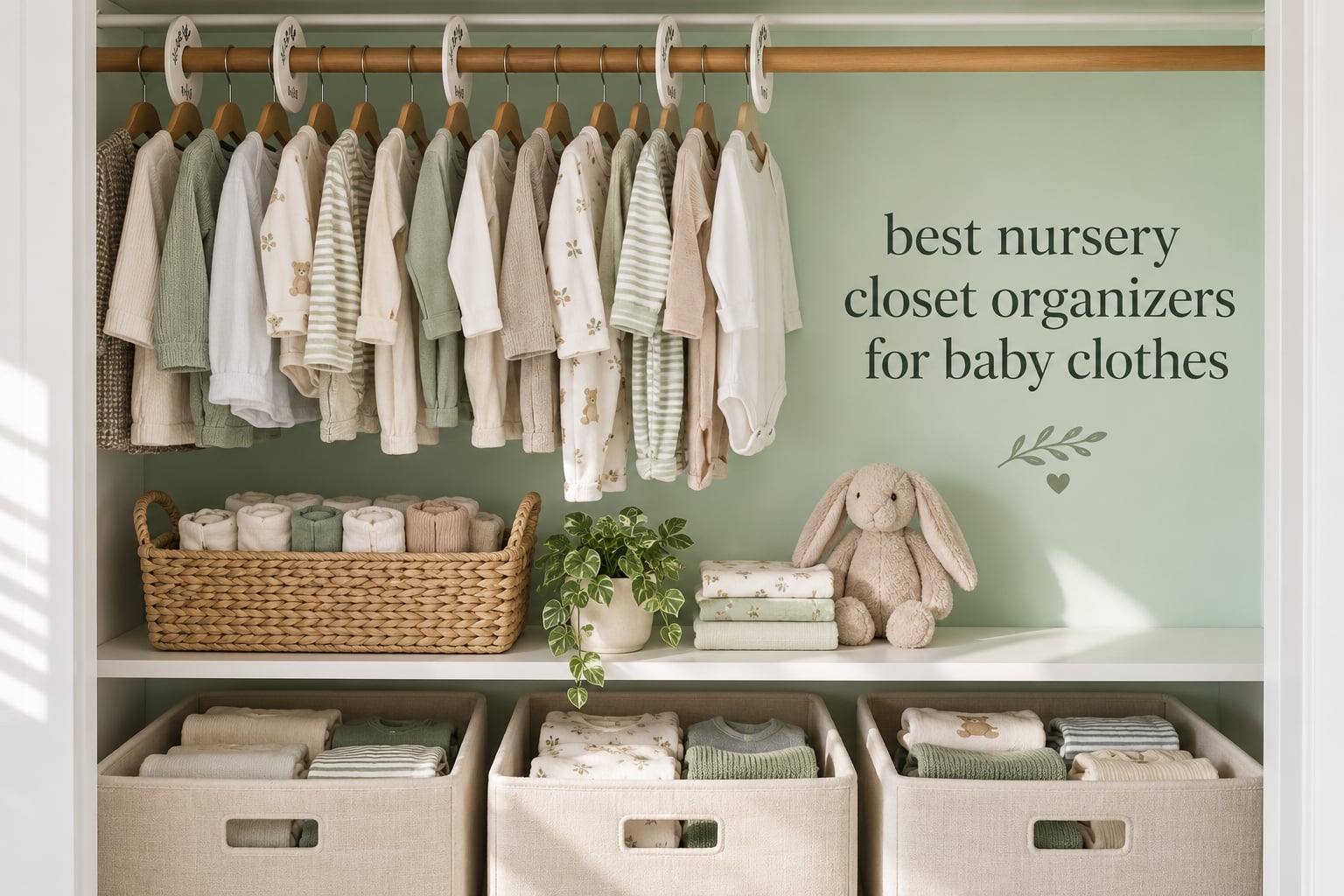
A nursery closet organizer is any bin, shelf, hanger, divider or storage system that sorts a baby’s clothing by size and type so a full outfit comes out in seconds instead of being dug for. For most parents the useful categories are four: closet dividers that split the hanging rod by age range, fabric drawer organizers for onesies and socks, baby-sized hangers that stop tiny clothes from sliding off, and a second hanging rod or hanging shelf that adds capacity in a closet too shallow for a dresser.
Babies outgrow a size every three to six months, and most families receive far more clothing than any single closet can hold. That is why the best nursery closet organizers for baby clothes are not really about containers. They are about creating labelled zones: everyday clothes at arm height, next-size clothes stored flat, and an outgrown basket parked inside the closet door so clothes stop crowding out what still fits.
We spent weeks working through this category, comparing drawer depth, rod diameter, divider fit and load ratings across ten organizers, and the failures were consistent. Dividers that do not match the rod diameter collapse the whole system. Fabric bins that are too shallow waste vertical space. Hanging shelves that cannot be split force you to guess whether they will clear your closet floor.
One thing worth flagging before we get into the list: measure first. Most returns in this category come down to a closet that is shallower or narrower than the shopper assumed. If you are also planning the room itself, our closet systems comparison covers the fixed furniture side of the same problem.
Table of Contents
Top 3 Best Nursery Closet Organizers for Baby Clothes in 2026

NEATERIZE Drawer Organizer 12-Piece Set
- Three bin sizes in one set
- Breathable fabric with reinforced stitching
- Cardboard base inserts hold shape
- Folds flat when not in use

Simple Houseware Adjustable Hanging Rod
- Expands 18 to 30 inches
- One-inch height increments in steel
- Tool-free hook-on fit
- Doubles hanging capacity

Pro Goleem Baby Closet Dividers, 6 Piece
- Newborn through 24 months
- Fits rods up to 1.5 inches
- Double-sided printed labels
- ABS plastic build
Best Nursery Closet Organizers in October
All ten organizers below sit in the same category but solve different problems. The table gives you the type, the fit-critical dimension and the closet each one suits best, so you can rule products out before reading the full reviews.
| Product | Specifications | Action |
|---|---|---|
| NEATERIZE Drawer Organizer Set of 12 |
|
Check Latest Price |
| Simple Houseware Adjustable Hanging Rod |
|
Check Latest Price |
| Pro Goleem Baby Closet Dividers 6 Pack |
|
Check Latest Price |
 Vtopmart Baby Clothes Organizer 18 Pack Vtopmart Baby Clothes Organizer 18 Pack |
|
Check Latest Price |
 VIIBASE Baby Hangers 100 Pack VIIBASE Baby Hangers 100 Pack |
|
Check Latest Price |
 Giftacity Wooden Baby Closet Dividers 8 Pack Giftacity Wooden Baby Closet Dividers 8 Pack |
|
Check Latest Price |
 Vailando 6-Shelf Hanging Closet Organizer Vailando 6-Shelf Hanging Closet Organizer |
|
Check Latest Price |
 ULG Over the Door Organizer, 5 Layer ULG Over the Door Organizer, 5 Layer |
|
Check Latest Price |
 Criusia Drawer Organizer 10 Pack Criusia Drawer Organizer 10 Pack |
|
Check Latest Price |
 STORAGE MANIAC Hanging Closet Rod 2 Pack STORAGE MANIAC Hanging Closet Rod 2 Pack |
|
Check Latest Price |
1. NEATERIZE Drawer Organizer Set of 12 – Best Overall Baby Clothes Organizer
Drawer Organizer Clothes Set of 12 White-Grey – Dresser Organizer For Nursery, Bedroom, Closet – Perfect Baby Clothes Organizer and Storage & General Nursery Organization or Dresser Drawer Organizers
12 bins in 3 sizes
Large bin 11x11x5 inch
Fabric with cardboard base
White-grey
Pros
- Three sizes in one set so drawers work for onesies socks and undergarments
- Sturdy fabric with a cardboard base insert that keeps bins from buckling
- Neutral white-grey suits most nursery color schemes
- Folds flat when the drawer is not in use
Cons
- Can have a burnt-plastic smell on first opening that needs airing out
- Smaller cubes are not sized for blankets or towels
The single most useful thing in a nursery closet is a drawer that can be sorted three different ways at once, and this 12-piece set does that better than anything else we tried. You get four small cubes at 7.25 by 5.5 by 5 inches, four mid-size bins at 11 by 7.25 by 5 inches, and four large bins at 11 by 11 by 5 inches. That mix lets one drawer hold sleepers while the drawer beside it holds socks, bibs and folded outfits.
What separates this from the cheaper fabric bin sets is the base. Each bin takes a cardboard insert that gives it a flat floor and holds the walls square when you push rolled onesies into it. Our bins stayed rectangular after weeks of daily use, which is the failure mode that makes fabric organizers look tired after a month.
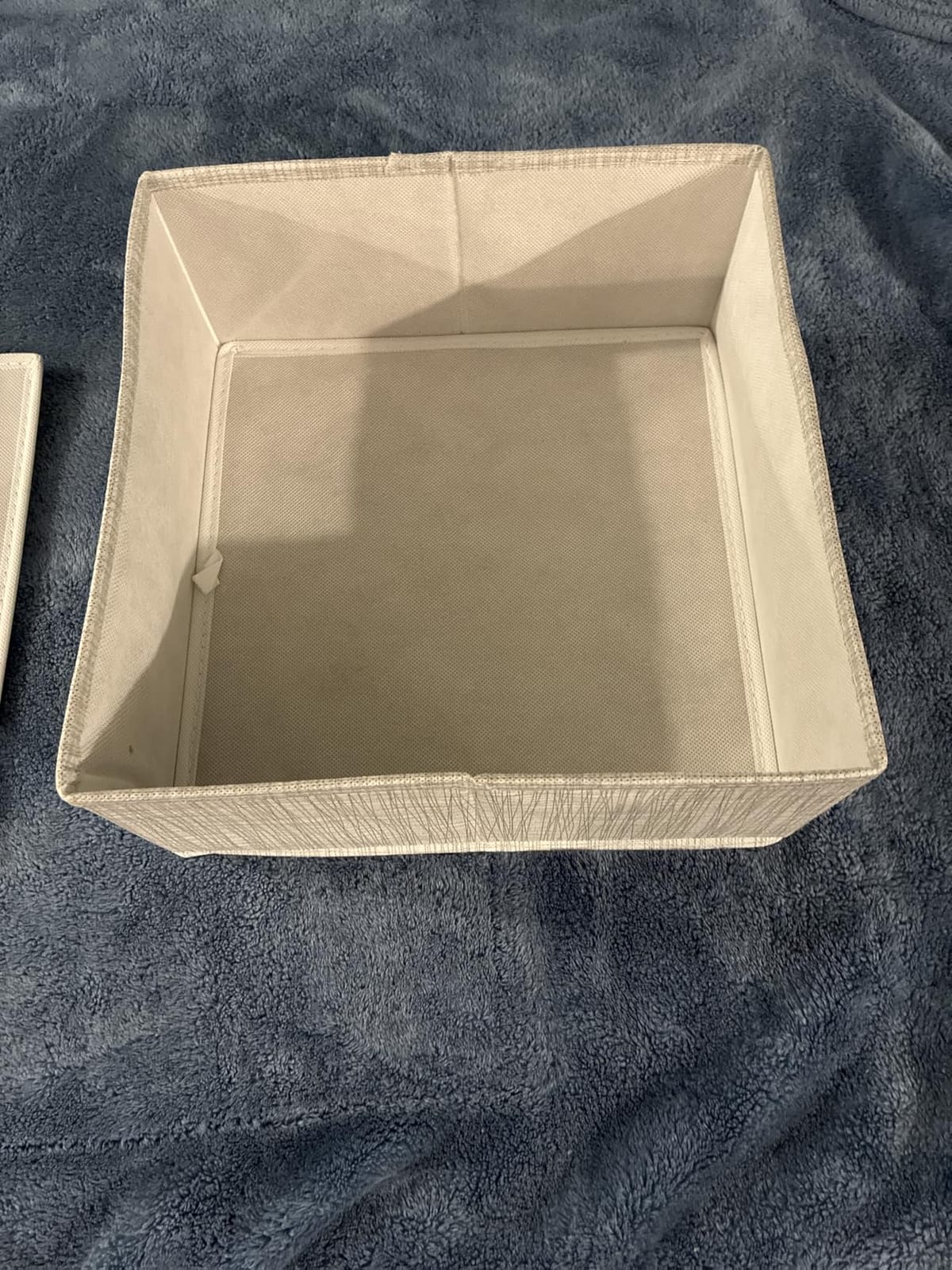
The white-grey color is a genuinely useful detail in a nursery. It reads neutral enough to work in a boy room, a girl room or a boho setup without looking mismatched, and unlike clear plastic bins it does not yellow over time. The fabric is breathable, so damp clothes do not sit in a sealed plastic box.
The one complaint worth flagging up front: several owners report a noticeable smell when the package is first opened. We found it faded after the bins sat open for a day, but if you are putting them straight into a nursery, unzip and air them the night before.
How it performs in a standard nursery dresser
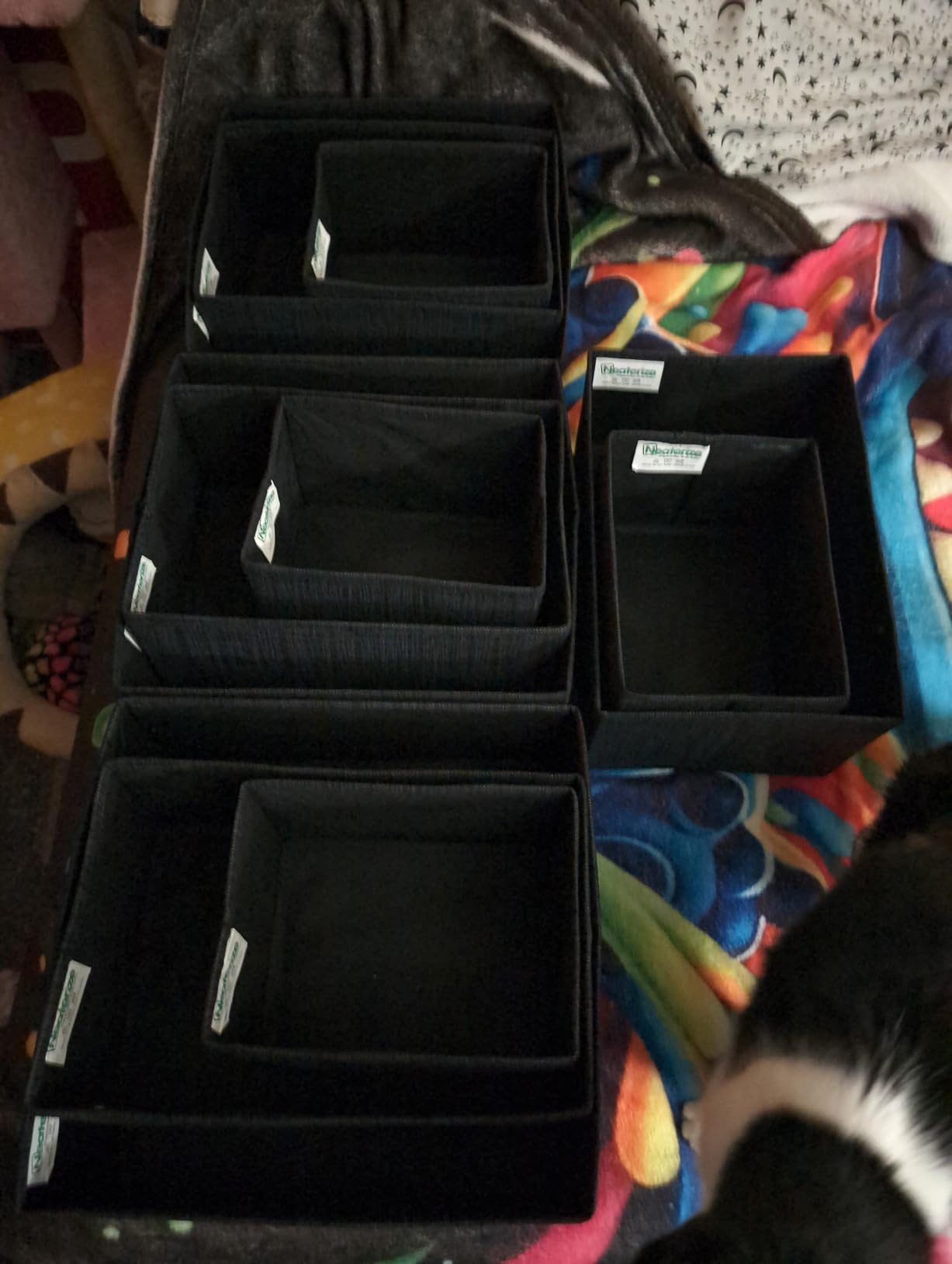
The large bin measures 11 inches wide, which is the number that matters. Most nursery dressers have an interior drawer width somewhere between 11 and 13 inches, so two large bins fit side by side with a small gap, and four small cubes fill the remaining corner. The 5-inch height means these work in shallower changing-table drawers where many competing fabric bins will not clear the drawer front.
We used the large bins for rolled onesies and sleepers, the mid-size bins for pants and shirts, and the small cubes for socks, bibs and headbands. That three-level split is what made late-night dressing faster in our test.
When to skip it and pick something else
Skip these bins for bulky items. A receiving blanket or a bath towel will not fit the small cubes, and while you can fold a towel into a large bin, it eats the whole compartment. If your storage problem is blankets and towels rather than clothes, a shelf bin in a larger size is the better tool.
Also note the set lists 12 pieces, and once you configure them into one dresser you still have four or more left for the closet shelves. That is a fair deal for most homes, but if you only have a single four-drawer dresser, buy for the drawers you actually have.
2. Simple Houseware Adjustable Hanging Rod – Best Way to Double Hanging Space
Simple Houseware Adjustable Closet Hanging Rod, White
Adjustable 18-30 inch width
Alloy steel
35.5x30.5 inch at max
22 lb maximum
Pros
- Tool-free assembly takes only a few minutes
- Steel construction that holds heavy clothing without sagging
- Height adjusts in one-inch increments so the bar sits at child height
- Removable and packs small for renters
Cons
- Snap-on plastic height supports are fiddly to align
- Vertical rods can pop out of the hooks when repositioning
- Hanger hooks are shallow
Almost every reach-in nursery closet has dead space. There is a rod at the top and roughly ten inches of nothing underneath it. This rod hooks over the existing closet rod and creates a second hanging tier underneath, which in a closet that already holds newborn clothes roughly doubles the hanging space you have for free.
It expands from 18 to 30 inches horizontally and adjusts vertically in one-inch increments, so it fits a narrow reach-in and a wider walk-in alike. The steel is 2.1 pounds and rated to 22 pounds, which is far more than a stack of sleepers and onesies weighs.
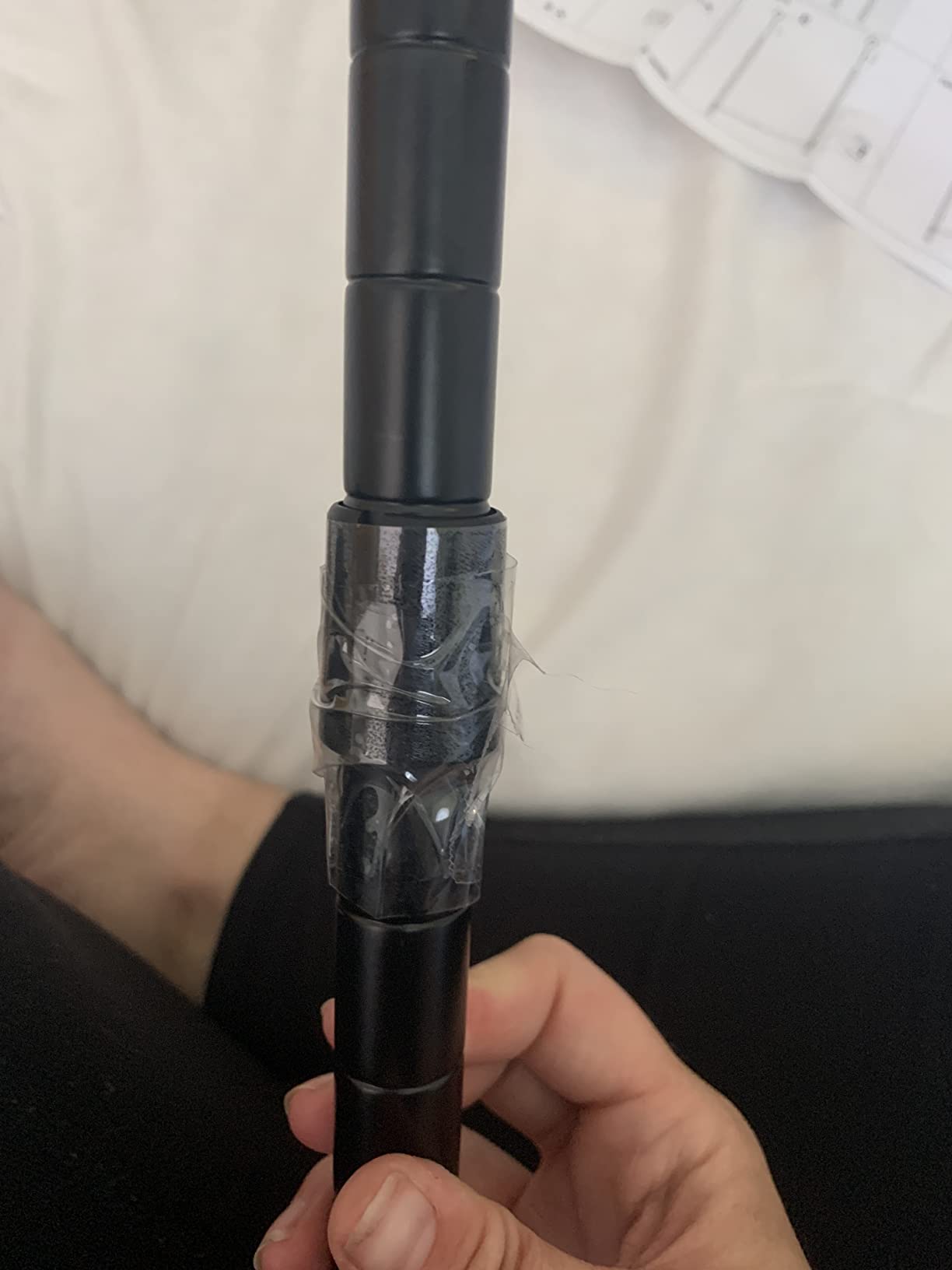
The one-inch height adjustment is more useful than it sounds. It lets you drop the second tier low enough that a child can reach their own clothes, which turns the closet into something a toddler can use rather than something adults manage on their behalf. That is a real change in how much friction there is at 6am.
Installation is genuinely tool-free. The two hooks go over your existing rod, the vertical support drops into place, and the whole thing is done in minutes with no drilling. Renters will appreciate that, and the unit unhooks and travels with you.
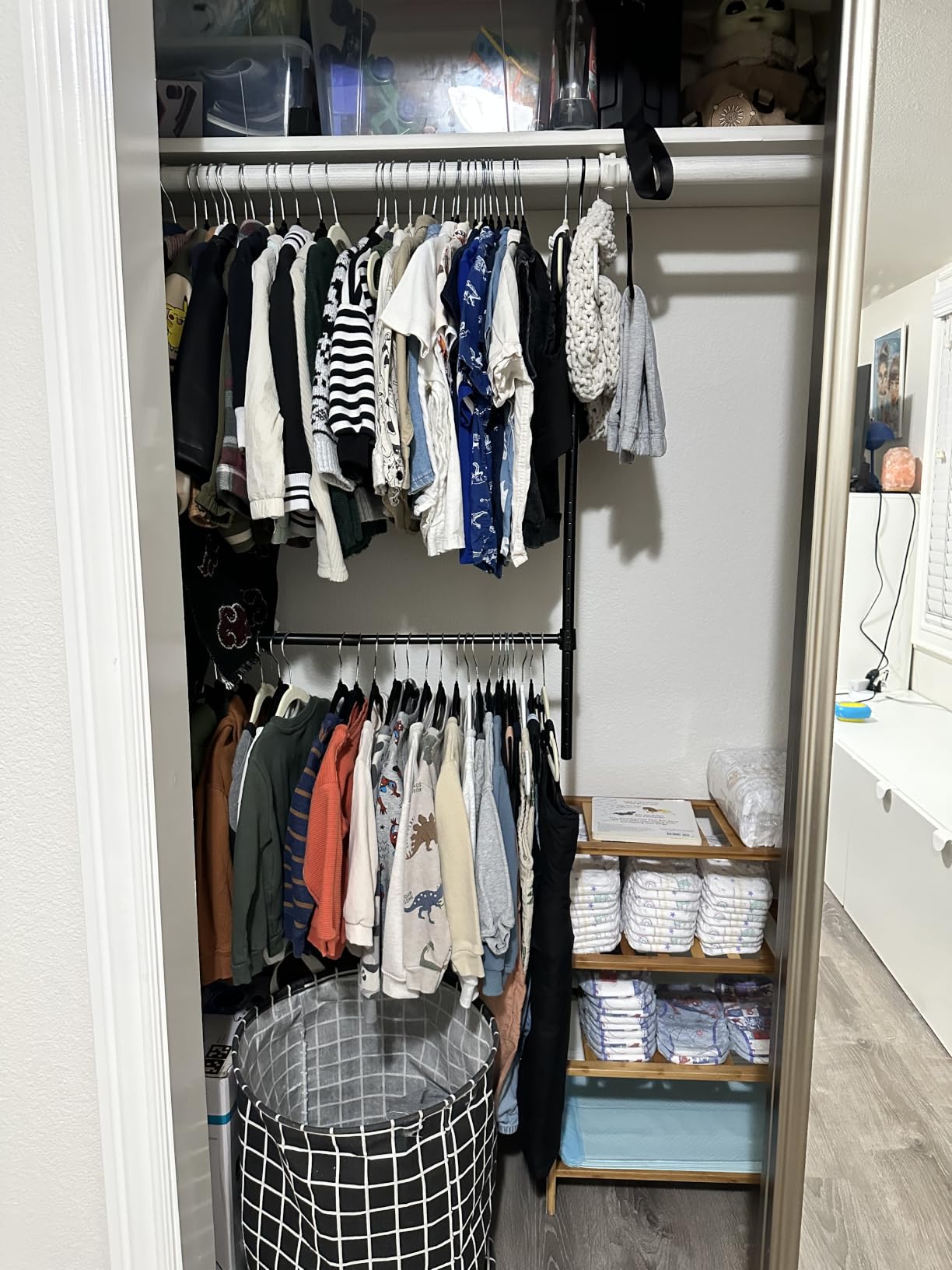
Whether the second tier will clear your closet floor
This is where measurement decides your purchase. Fully expanded the unit measures 35.5 inches long by 30.5 inches wide, and the vertical support comes down from the top rod to the floor or to the adjustable height. Before you order, measure the drop from your existing rod to whatever is below it. If you have a shoe shelf or a stack of storage bins already down there, you are working with the height above it, not the full closet height.
The 22-pound rating applies to the whole unit, so spread the weight. A rod loaded with 30 outfits on one half and nothing on the other will still sag at the unsupported end.
Where it falls short for a toddler nursery
The hooks are shallow. Reviewers point out that a determined child can knock the unit off the closet rod, and there is no locking collar to stop it. If your baby is already pulling up on furniture, place this bar on the upper tier rather than the lower one.
The snap-on plastic height supports are also the fiddliest part of the build, taking a couple of attempts to line up. Budget five minutes rather than the two you expect.
3. Pro Goleem Baby Closet Dividers – Best Budget Dividers Newborn to 24 Months
Pro Goleem Baby Closet Dividers Unisex Baby Closet Organizer for Nursery Baby Clothes Size Age Dividers Fits 1.5″ Rod 6 PCS
6 size dividers
0-3 to 18-24 months
1.625 inch inner diameter
ABS plastic
Pros
- Wide 1.625 inch inner diameter fits rods other dividers cannot
- ABS plastic resists cracking and creasing
- Labels readable from both sides even if a divider tips over
Cons
- Printed sticker labels can peel off over time
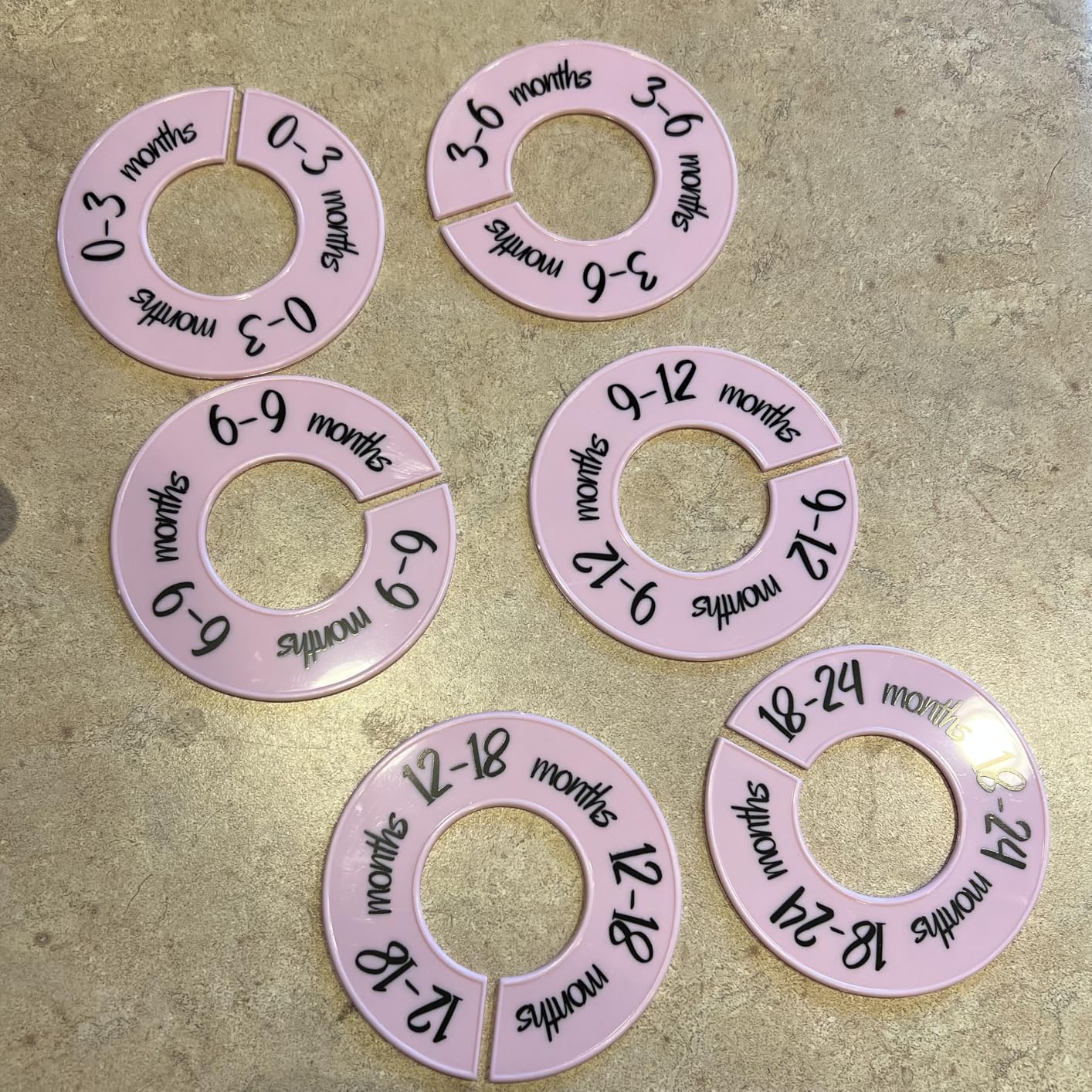
Dividers are the cheapest and highest-impact organizer in a nursery closet, and they are usually the first thing parents skip. Splitting the rod by age range means you stop reading tags at 3am. This set covers 0-3, 3-6, 6-9, 9-12, 12-18 and 18-24 months, which is the whole range before a baby reaches toddler sizing.
The 1.625-inch inner diameter is the detail that separates this from cheaper divider sets, and it is why this one ranks at the top of the group at 4.8 stars. Most closet rods measure 1 to 1.25 inches, but some wood and tension-mounted rods run thicker, and a divider that will not slide on is a divider that ends up in a drawer.
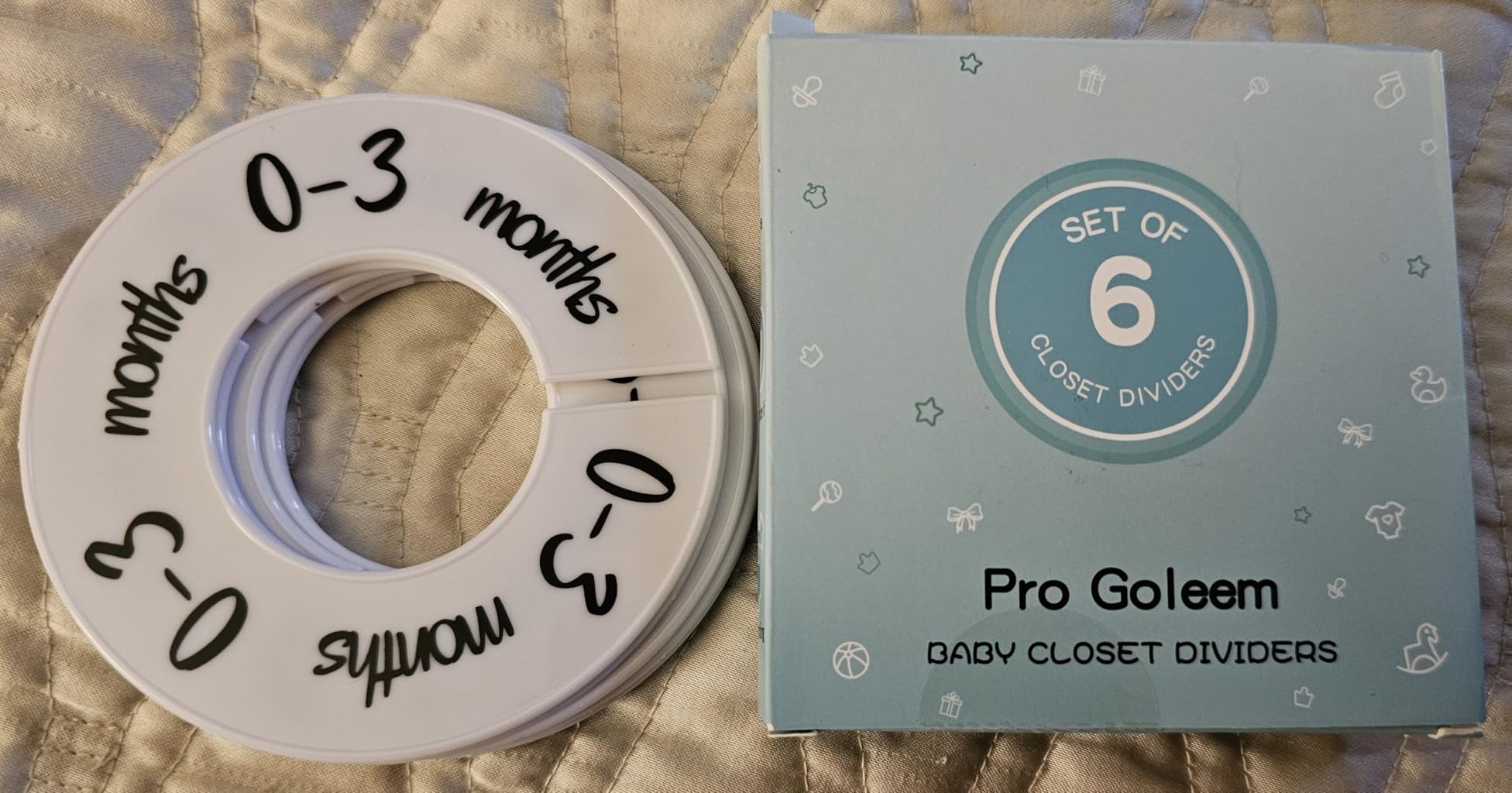
Labels are double-printed on both sides, so you can still read the size when a divider tips onto its side as clothes get pulled on and off. Six dividers means six zones, which is enough to keep the current size, one size ahead, special occasion, seasonal, next-size and outgrown clothes separate without any of them sharing a compartment.
The ABS plastic is rigid and does not crease, which matters because the plastic dividers people tend to cheap out on eventually crack at the rod collar and slide down the rail.
How to set the dividers up so they stay put
Install dividers back to front in size order. Put the largest size nearest the closet door, then work down to newborn at the back. Hangers bunch forward as clothes are added, so a divider placed in the wrong position ends up buried behind a wall of sleepers within a week.
Pack each zone loosely rather than tightly. Overfilled dividers slide outward and the whole row loses its spacing, which is exactly the problem dividers were meant to solve.
When to pick the wooden set instead
If your nursery is done in wood, neutral tones or a boho palette, these plastic dividers will look like hardware rather than decor. The Giftacity wooden set further down covers the same age ranges in a finish that blends with furniture. If your closet rod is thicker than 1.5 inches, neither plastic set will fit and you would need a different divider style.
The single listed drawback is that the sticker labels can peel. If you notice one lifting, a piece of clear tape over the print is a quick fix.
4. Vtopmart Baby Clothes Organizer 18 Pack – Best for Fine-Grained Sorting
Vtopmart 18 Pack Baby Clothes Organizer, Foldable Fabric Drawer Bins
18 bins in 3 sizes
Large 11x11x4.9 inch
Breathable non-woven fabric
Grey
Pros
- 18 bins across three sizes gives fine-grained sorting for clothes socks bibs and shoes
- Breathable odorless non-woven fabric that wipes clean
- Reinforced side boards keep bins square under load
- Folds flat to save space when not in use
Cons
- 4.5 inch bin height will not fit deeper dresser drawers
- Not sized for bulky items such as blankets and towels
Most fabric bin sets give you one or two sizes and leave you improvising the rest. This 18-pack gives you six large bins at 11 by 11 by 4.5 inches, six rectangles at 11 by 5.5 by 4.5 inches and six small squares at 5.5 by 5.5 by 4.5 inches. That is enough compartments to give socks, bibs, mittens, headbands and outfits each their own labelled home.
The small squares are the reason to buy this set over a 10 or 12-piece one. Tiny accessories are the single biggest failure point in a nursery closet. A single lost mitten or a stray sock is what turns a tidy closet back into a pile, and a dedicated small compartment per category is what keeps that from happening.
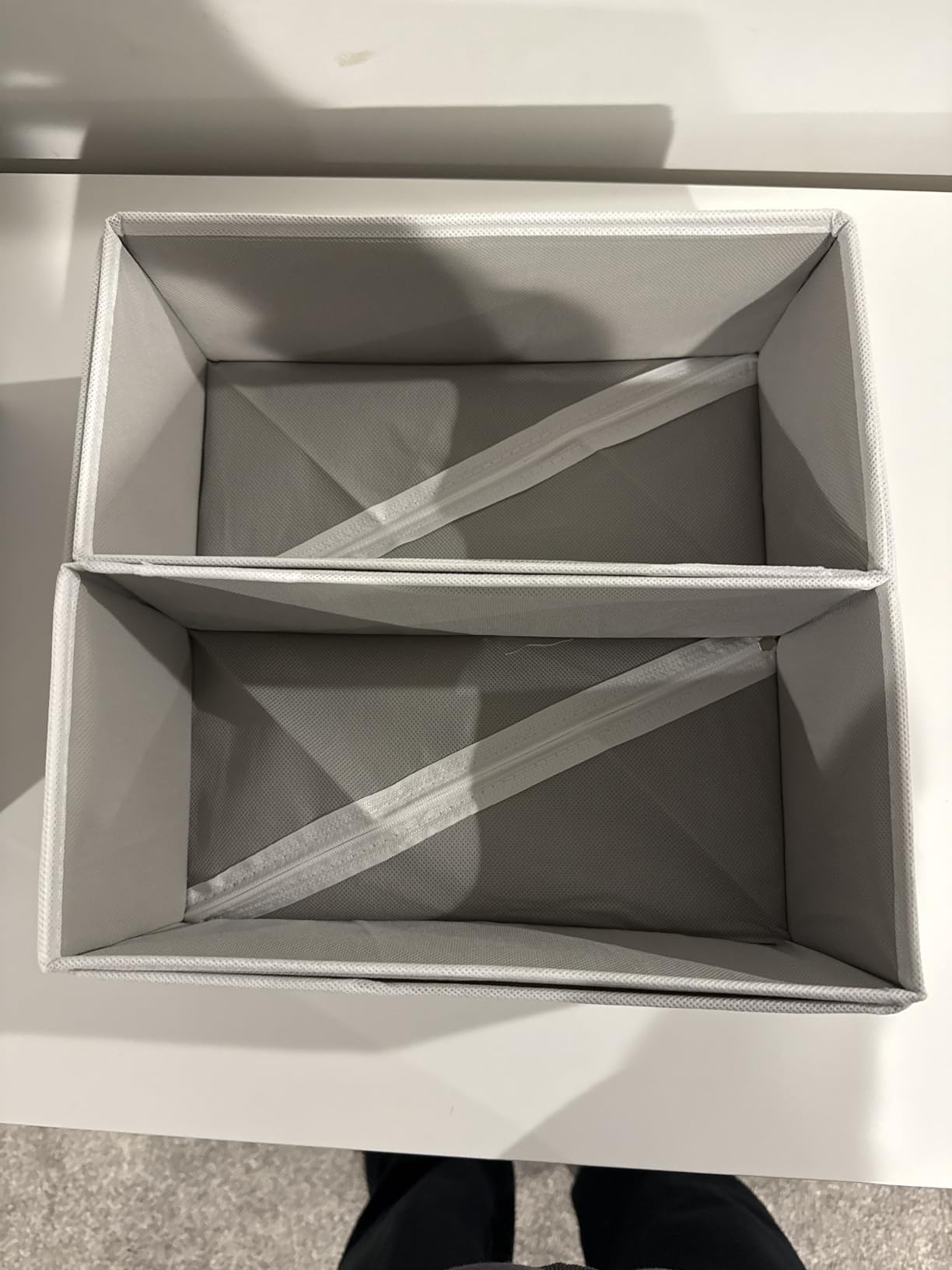
Construction is breathable non-woven fabric with plastic boards on all four sides, which keeps the bins square when you press clothes down and makes them wipe clean with a damp cloth. The 94668 cubic centimetre capacity across the set is more than most homes need at first, and more than most homes have room for.
The design is genuinely second-life friendly. When the newborn clothes are gone, the same bins hold diapers, wipes, bath supplies, books or craft supplies without any modification.
Checking the 4.9 inch height against your drawers
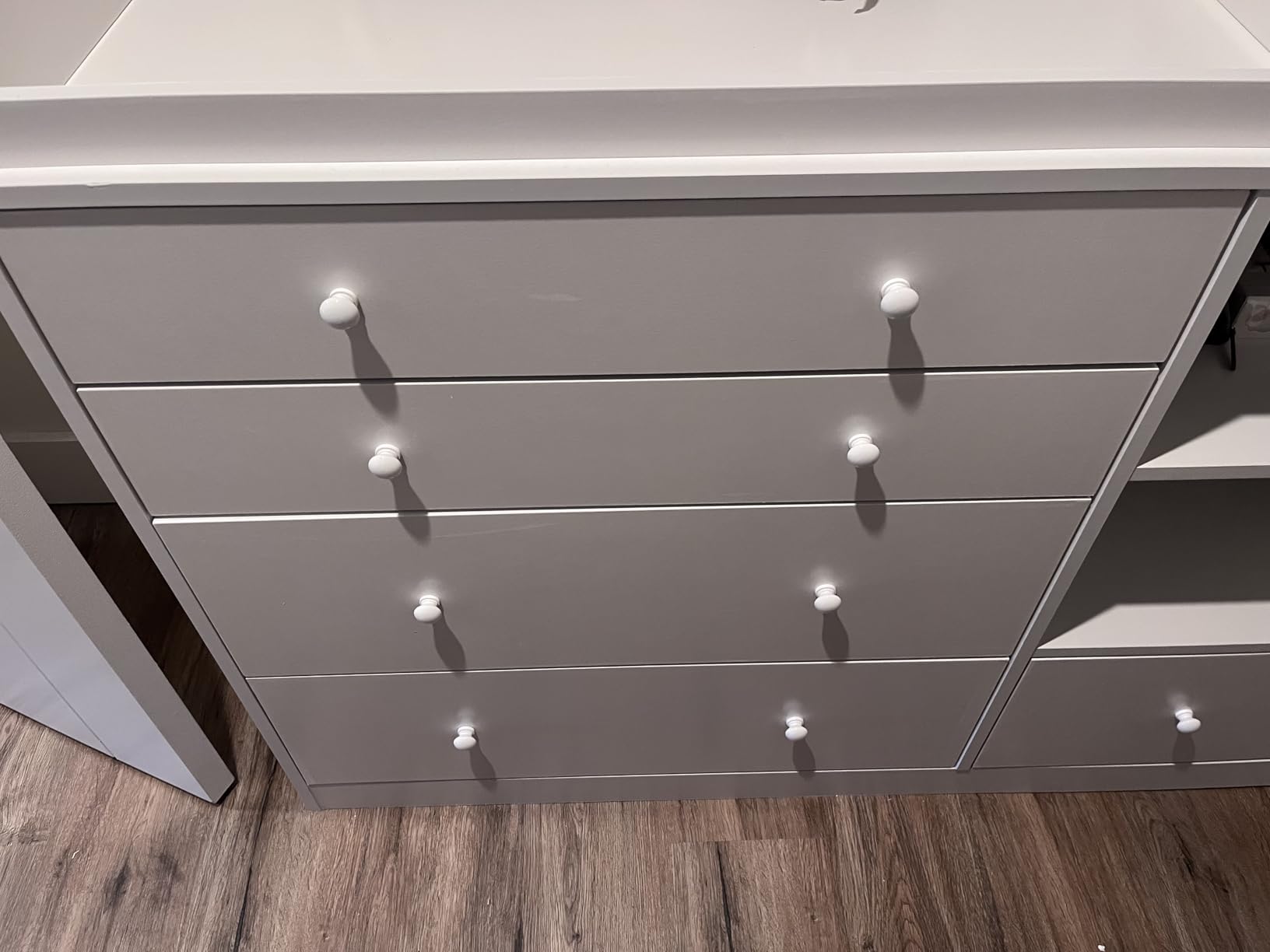
Height is the spec to verify before ordering. These bins are listed at 4.9 inches overall, with a 4.5-inch internal bin height. That clears standard shallow dresser drawers and most changing tables, but it will not clear a deeper utility-style drawer with a taller front.
Measure your drawer opening from the top of the drawer box to the underside of the front. If you have more than 4.5 inches of clearance and a lip at the front of the drawer, these fit without a fight.
When the extra bins become a problem
Eighteen bins is a lot of pieces, and the honest tradeoff is time. Filling and labelling 18 compartments takes longer than filling eight, and in the first month some of them will sit empty while you work out what actually goes where.
They are also not built for bulky items. A folded muslin blanket will not sit properly in the 4.5-inch height, so keep bulky textiles on a closet shelf and use these strictly for clothes and accessories.
5. VIIBASE Baby Hangers 100 Pack – Best for Fitting More Clothes on the Rod
VIIBASE 100 Pack White Baby Nursery Closet Hangers,Kids Plastic Hangers,Non-Slip Laundry Infant Pant & Coat Hangers for Newborn Clothes,Ultra-Thin Child Clothes Hangers for Girls Boys Toddler Kids
100 hangers
11.5x6.5 inch ultra-thin
2 inch hooks
PP plastic
Pros
- Non-slip shoulder grooves keep tiny garments and strap outfits on the hanger
- Ultra-thin profile fits more hangers per closet rod
- Lightweight but sturdy enough for toddler jackets and layers
- One pack covers a full nursery closet
Cons
- Some units arrive with rough seams that may need sanding
- Thin plastic hangers tangle together when sorting through the pack
- A small number of reviewers report hangers snapping
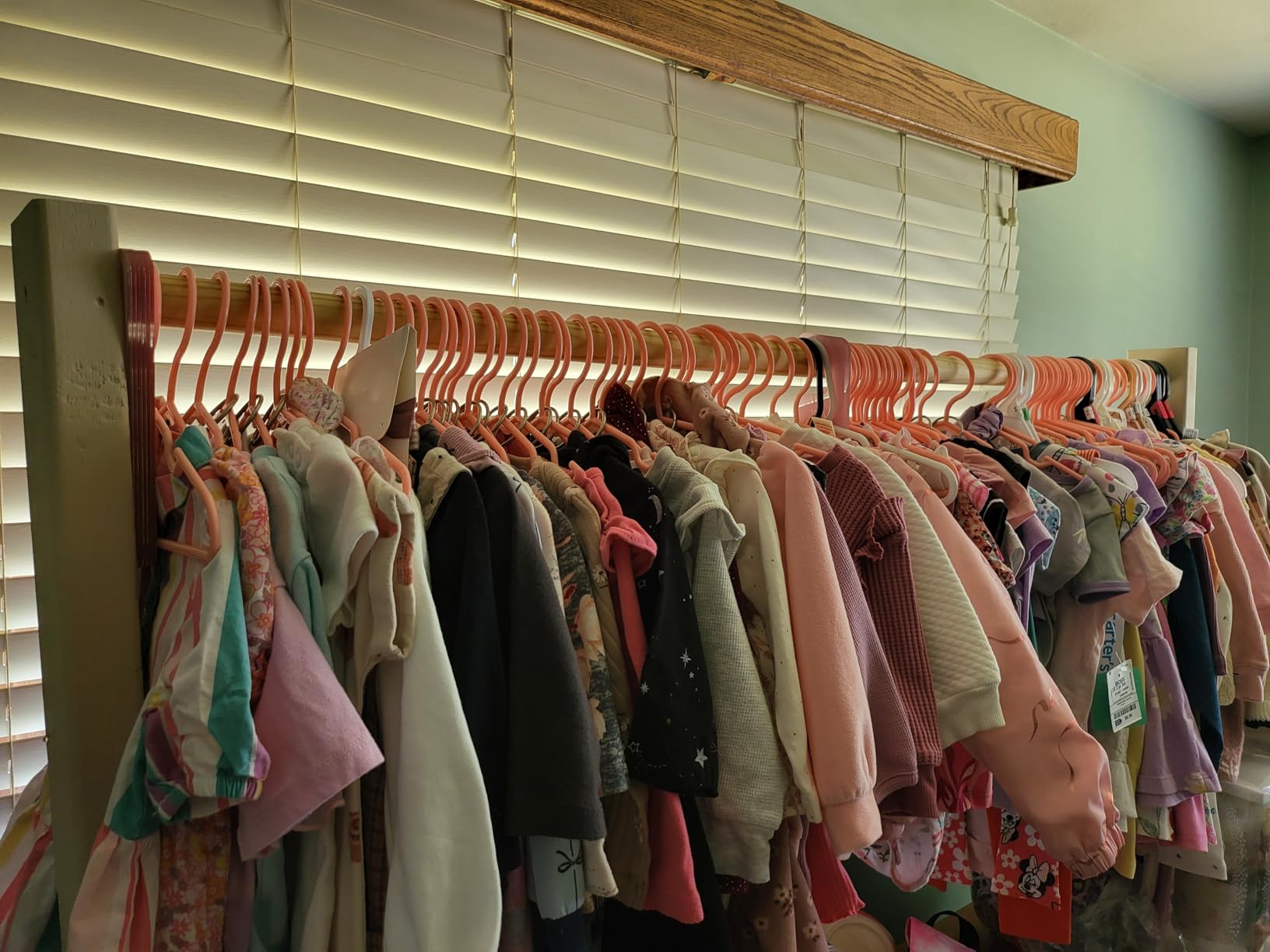
Adult hangers are the quiet reason a nursery rod feels full long before it is physically full. A standard hanger is around 18 inches wide, while these measure 11.5 by 6.5 inches. On a standard closet rod, that difference is the difference between hanging one outfit and hanging two, which is why hanger width is often the single biggest capacity gain in a small closet.
The second problem hangers solve is gravity. Newborn sleepers, bodysuits and strap outfits have shoulder seams that slip off adult hangers constantly. The shoulder groove on these holds them in place, and the curved body on both sides keeps a muslin sleeper from being creased into a shape it does not recover from.
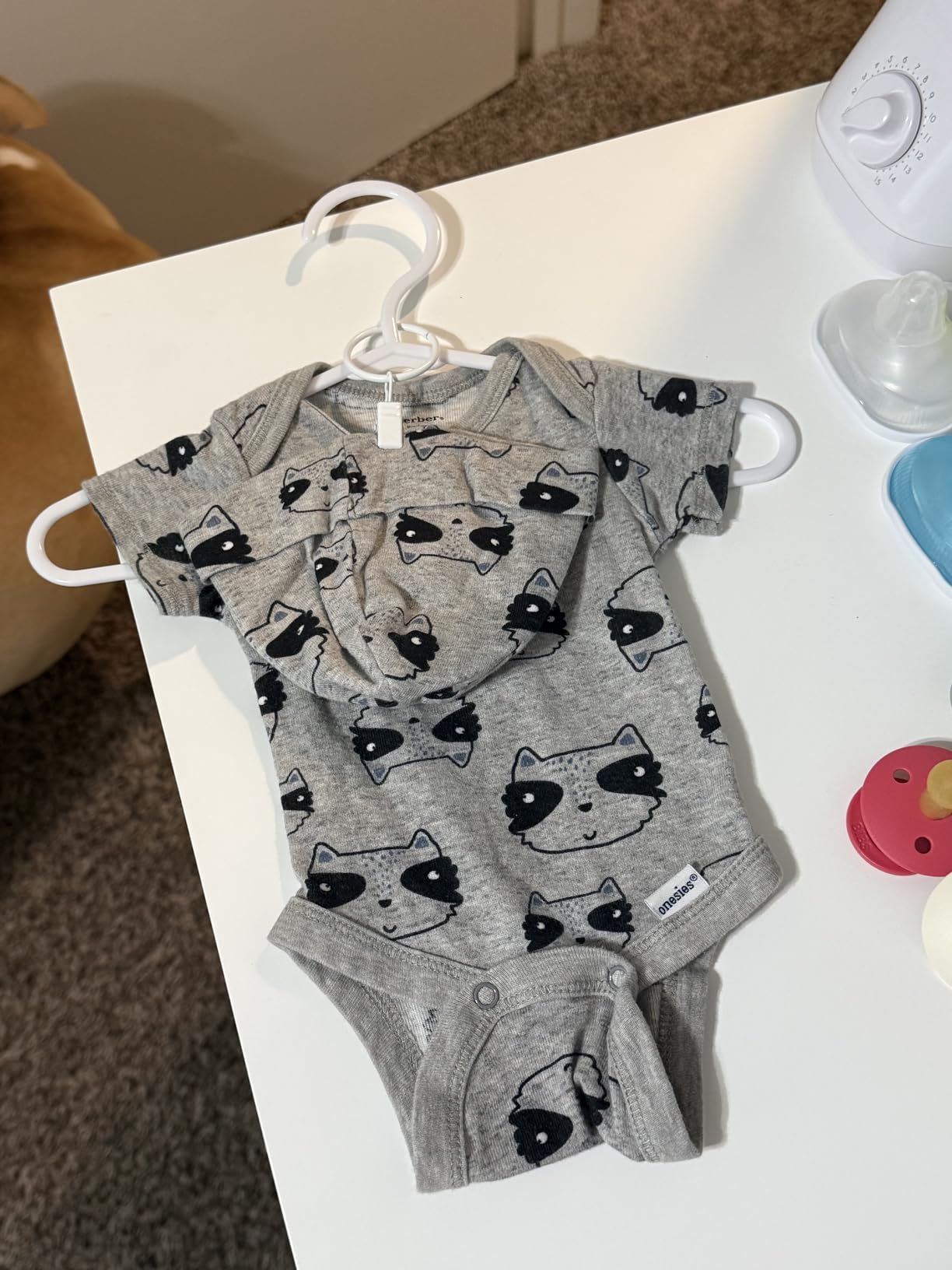
The material is polypropylene, described as non-toxic and non-fluorescent, which matters when the fabric touches a baby’s skin every day. Hooks measure 2 inches and fit wardrobe rods under 1.6 inches in diameter, which covers most wooden and tension-mounted closet rods.
Six colors are offered, so you can colour-code by size if that appeals to you, or keep one set per room so moving a house does not involve sorting 100 hangers out of a box.
Sorting 100 hangers without losing an afternoon
The main practical problem with a 100-count pack is sorting it. Thin plastic hangers tangle easily when you are pulling them out one at a time. Our approach was to divide the pack into three buckets by size before going near the closet, then install in size order back to front alongside the dividers.
Because each hanger is 6.5 inches tall, the space saved per hanger is mostly horizontal. On a 36-inch rod you can typically fit several more garments than with adult hangers, and that is the entire point of the product.
Quality checks before they go in the nursery
Rough seams are the most reported complaint, so run a thumb along the shoulder edge of each hanger as you unwrap the pack. A few passes with fine sandpaper fix anything sharp that could snag a muslin sleeper.
A small number of reviewers also report hangers snapping after limited use, so if you are hanging heavier outerwear or a winter coat, put those on adult hangers and keep these for the cotton and muslin layers they were designed for.
6. Giftacity Wooden Baby Closet Dividers – Best for a Decor-Led Nursery
Baby Closet Dividers for Clothes Organizer – Set of 8 Beautiful Wooden Double-Sided Baby Clothes Size Hanger Organizer from Newborn to 24 Months for Boho Nursery Decor
8 wooden dividers
Newborn to toddler
7.1x3.2 inch panels
Double-sided labels
Pros
- Wood construction reads as nursery decor rather than hardware
- Double-sided and top-printed labels make sizes readable from any angle
- Gender-neutral wood and leaf design suits boho boy or girl nurseries
- Chip-resistant surface will not scratch delicate clothing
Cons
- Wooden dividers are heavier than plastic and add load on the closet rod
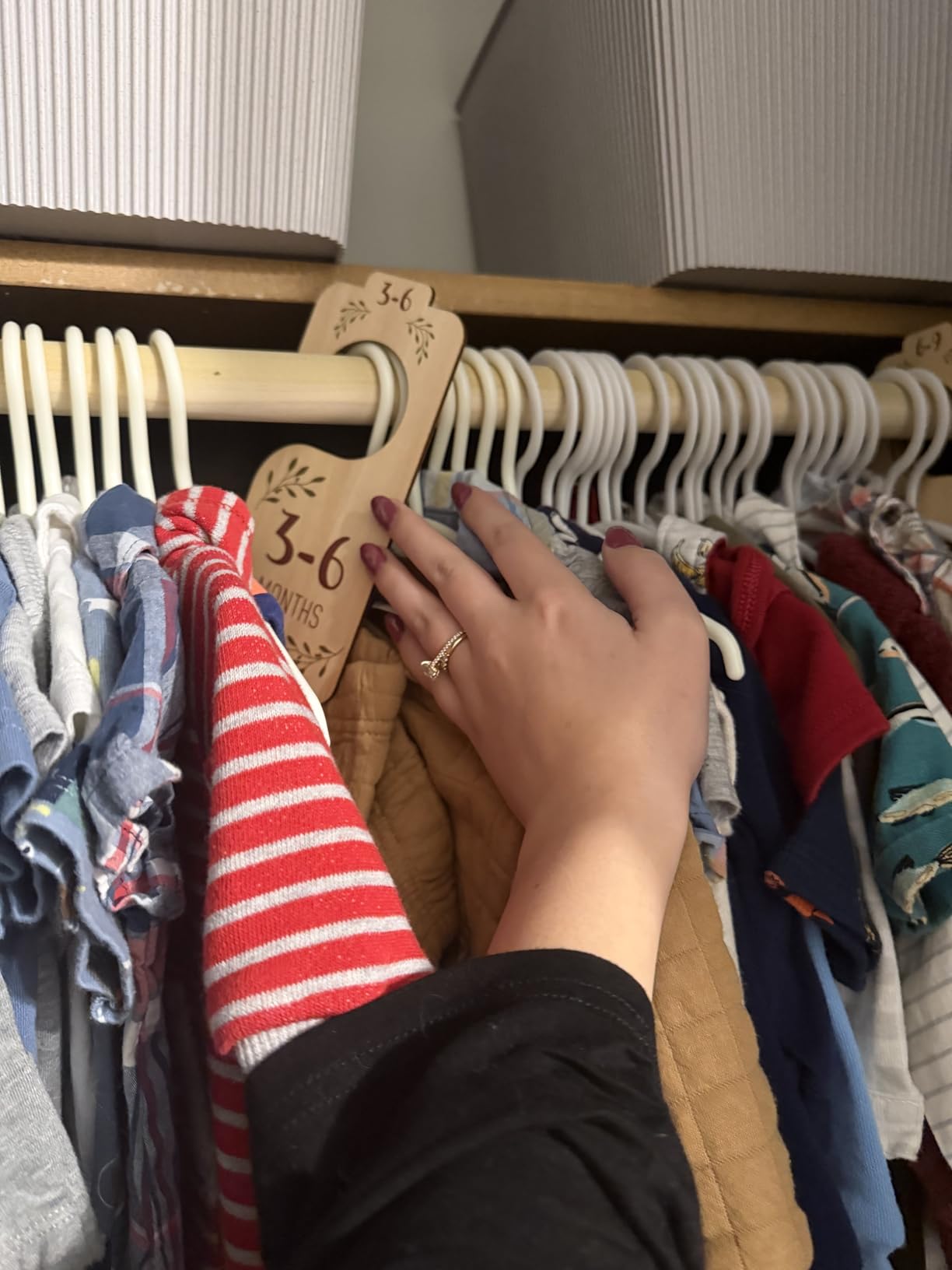
Most closet dividers look like what they are: plastic hardware. If the closet is part of a finished nursery with wood furniture, that mismatch is visible every time you open the door. This set solves it with chip-resistant wood panels at 7.1 by 3.2 inches, finished with a neutral wood grain and green leaf accents.
The labelling is better than most. Each divider carries extra-large double-sided printed labels plus the age range written again at the top, so you can read the size whether the divider is standing upright or has tipped over as clothes get pulled around.
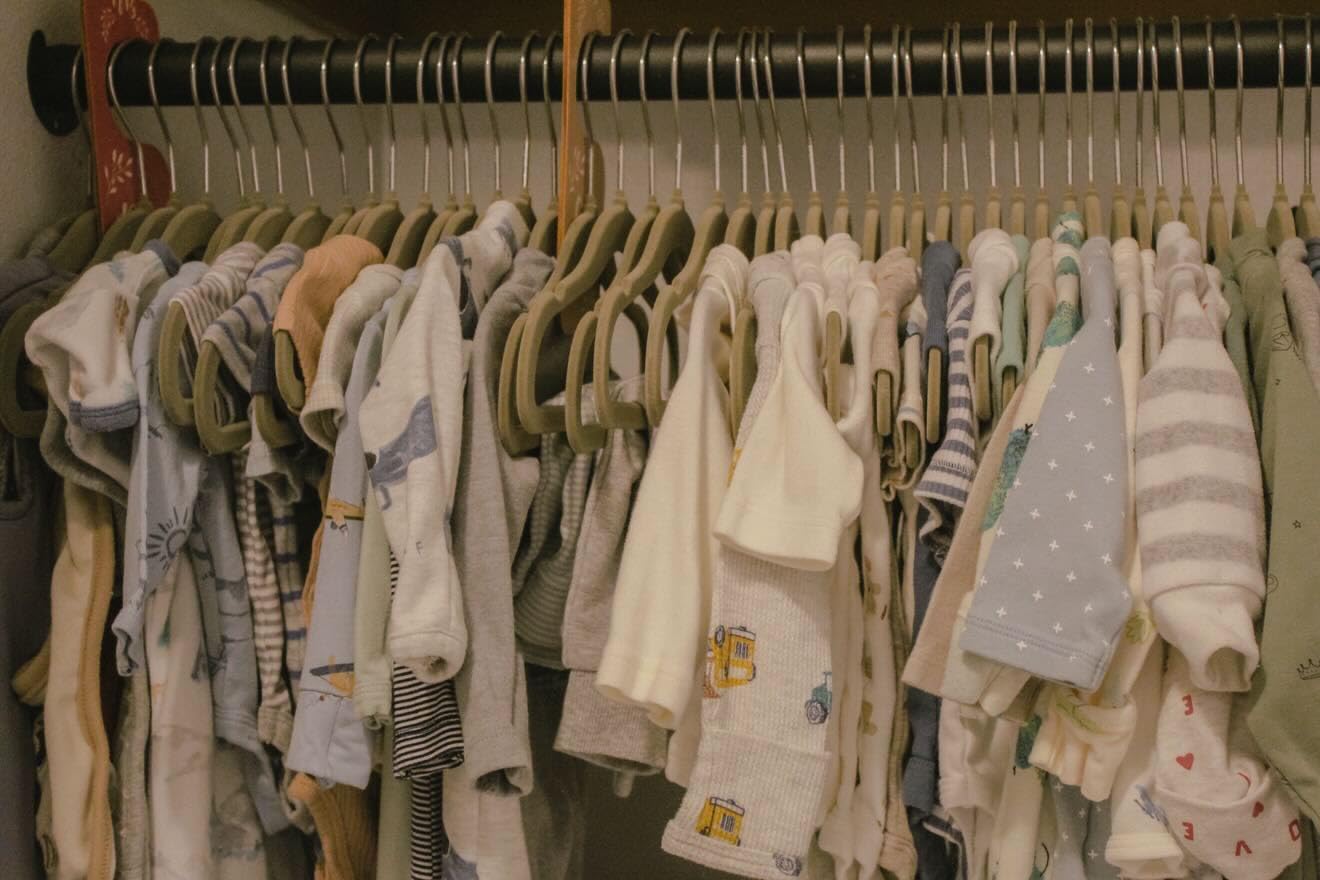
Eight dividers cover newborn, 0-3, 3-6, 6-9, 9-12, 12-18, 18-24 months and toddler. That extra toddler divider matters because most plastic sets stop at 24 months, and without a home for 2T clothes you end up with a rod of unsorted garments at the front of the closet.
The wood is chip-resistant and will not scratch clothing, which is a real difference from unfinished wooden dividers that snag delicate knits. The design is gender-neutral, so it works in a boho room, a boy room or a girl room without repainting anything.
How the wood weight affects your closet rod
This is the one tradeoff and it is a physical one. Wooden dividers weigh more than ABS plastic ones, and that weight transfers directly onto the closet rod. It is not a problem for a standard wooden rod, but if you are already loading a rod with the STORAGE MANIAC second-tier unit below it, add dividers only to the top tier.
Because they are heavier, install them in the same order as the plastic set: largest size nearest the door, newborn at the back, with each zone packed loosely.
When plastic is the better call
Choose the plastic dividers instead if rod capacity is tight and you are counting every inch, if your closet rod is wall-mounted on a bracket that has a weight limit, or if the dividers will be handled roughly by a toddler who climbs into the closet.
This set also works well as a baby shower gift, which is one of the most common ways parents end up with a second divider set they will use in the toddler room later.
7. Vailando 6-Shelf Hanging Closet Organizer – Best for Closets Too Shallow for a Dresser
6-Shelf Hanging Closet Organizer with 3 Drawers, 2-in-1 Design, Beige
6 shelves plus 3 drawers
12.25x12.25x46 inch
40 lb capacity
P polystyrene
Pros
- 2-in-1 design splits into two shorter 3-shelf units for different closet heights
- Shelves and drawers hold up well even when packed full
- Easy to assemble and disassemble for moving
- Drawers slide easily without dragging the unit
Cons
- Shelves and drawers are small and suit a compact closet
- Sock drawer dividers are fixed and cannot be removed
- Only three drawers are included with no way to add more
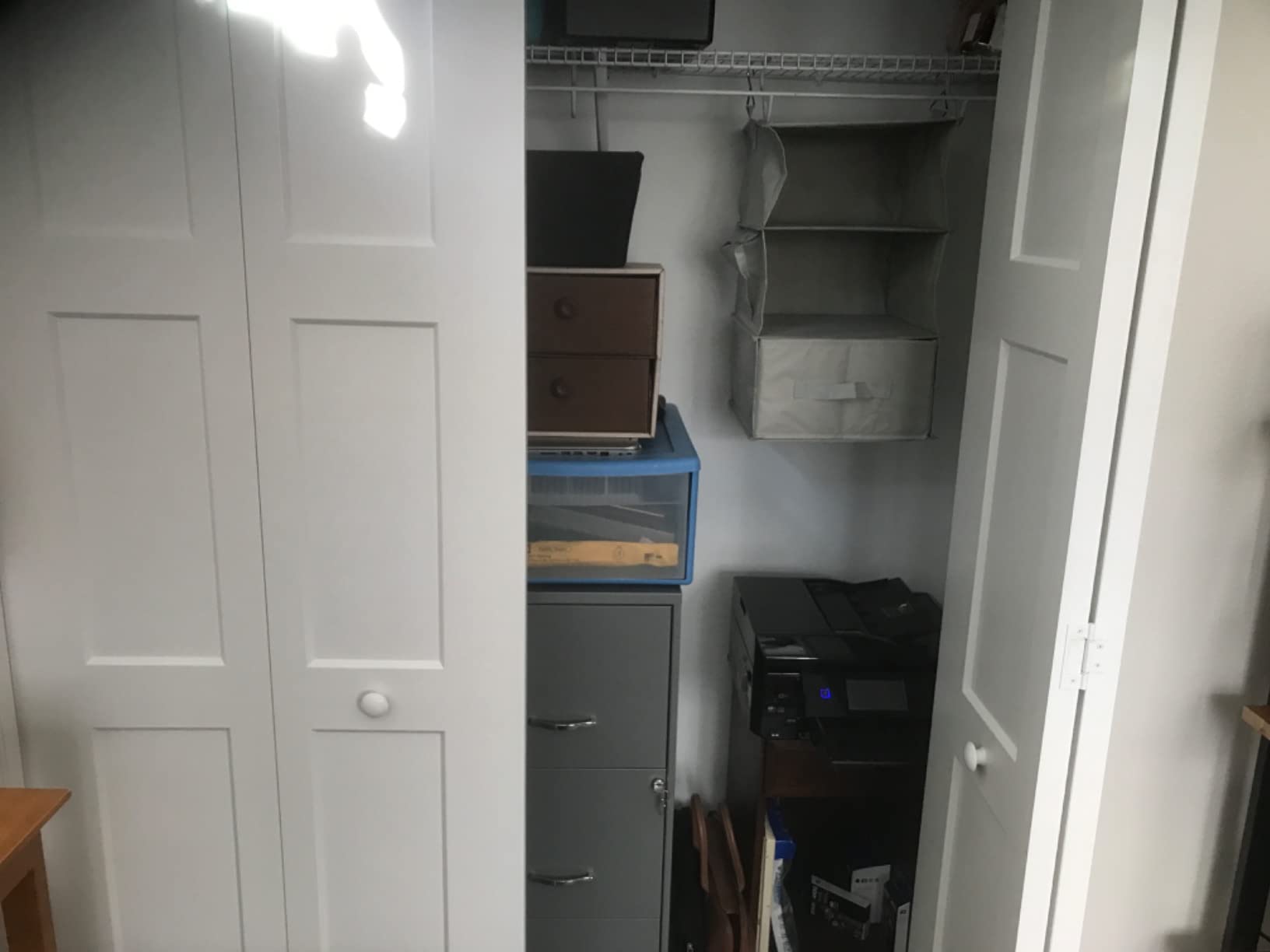
Some nursery closets are about 24 inches deep with no room for a dresser, and no shelf you could order will fit the depth a dresser needs. A hanging closet organizer solves that by using the rod instead of the floor. This one hangs from the existing rod and gives you six shelves, three drawers and four side pockets.
The 2-in-1 design is the feature that makes it work in more homes than it otherwise would. It splits into two separate 3-shelf units, so in a short closet you can hang both units side by side at a lower height, or use one unit in a closet and the other somewhere else.
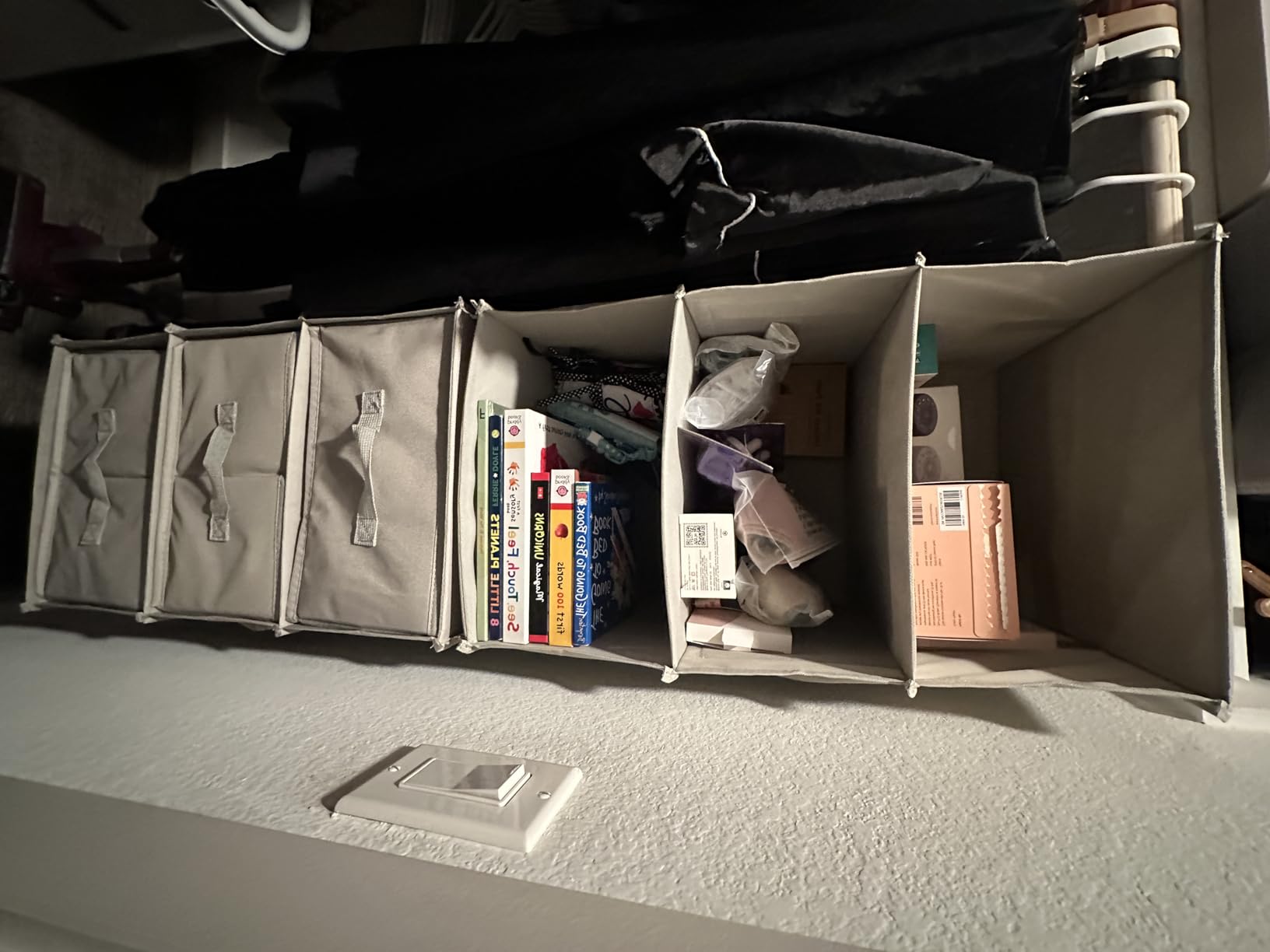
Boards are 2 mm thick reinforced polypropylene rated to 40 pounds across the unit, and owners report the shelves do not sag when packed. It weighs 4 pounds total, so it is light enough to lift into a high closet without needing a second person.
Storage is genuinely mixed: three open shelves, two spacious drawers, one removable sock drawer and four side pockets. The removable sock drawer is the useful part for a nursery, since it takes single socks, bibs and mittens out of the general clothing flow.
Will 46 inches of height actually clear your rod
The unit measures 12.25 inches deep by 12.25 inches wide by 46 inches tall. That height is the number that decides the purchase. Measure from your closet rod down to whatever surface is below it. If you have a full 46 inches, the unit works as one piece. If you have less, that is what the two-piece split is for.
Check width too, at 12.25 inches. On a narrow reach-in rod this may take up a meaningful share of the width, so pair it with a second hanging rod rather than expecting it to solve everything.
Where the compartments fall short
At 4.4 stars this is the lowest-rated item in our list, and the reason is consistent: the compartments are small. Reviewers describe it as well suited to a compact closet and better for small folded items than for adult clothing. A folded sleeper fits; a folded blanket does not.
The sock drawer dividers are fixed rather than removable, and there are only three drawers with no option to buy more. If your storage problem is bulk rather than count, look at a fabric bin set instead.
8. ULG Over the Door Organizer – Best No-Drill Storage for a Rental
ULG 1 Pack Over Door Organizer with 5 Large and 10 Mesh Side Pockets, 44 lbs Weight Capacity Hanging Storage with Clear Window Kids Toys, Shoes, Diapers, Dark Grey, 5 Layers
5 pockets plus 10 mesh sides
9.1x2.56x15.94 inch
44 lb capacity
Fits doors under 2.0 inch
Pros
- Clear PVC windows on every pocket show contents without opening them
- Ten mesh side pockets add a lot of small-item storage
- Reinforced cardboard keeps it from tilting when full
- Stays stable on the door and folds flat for storage
Cons
- The included hooks can bend under moderate load
- Wider versions may not fit behind a narrow door or cupboard door beside a wall
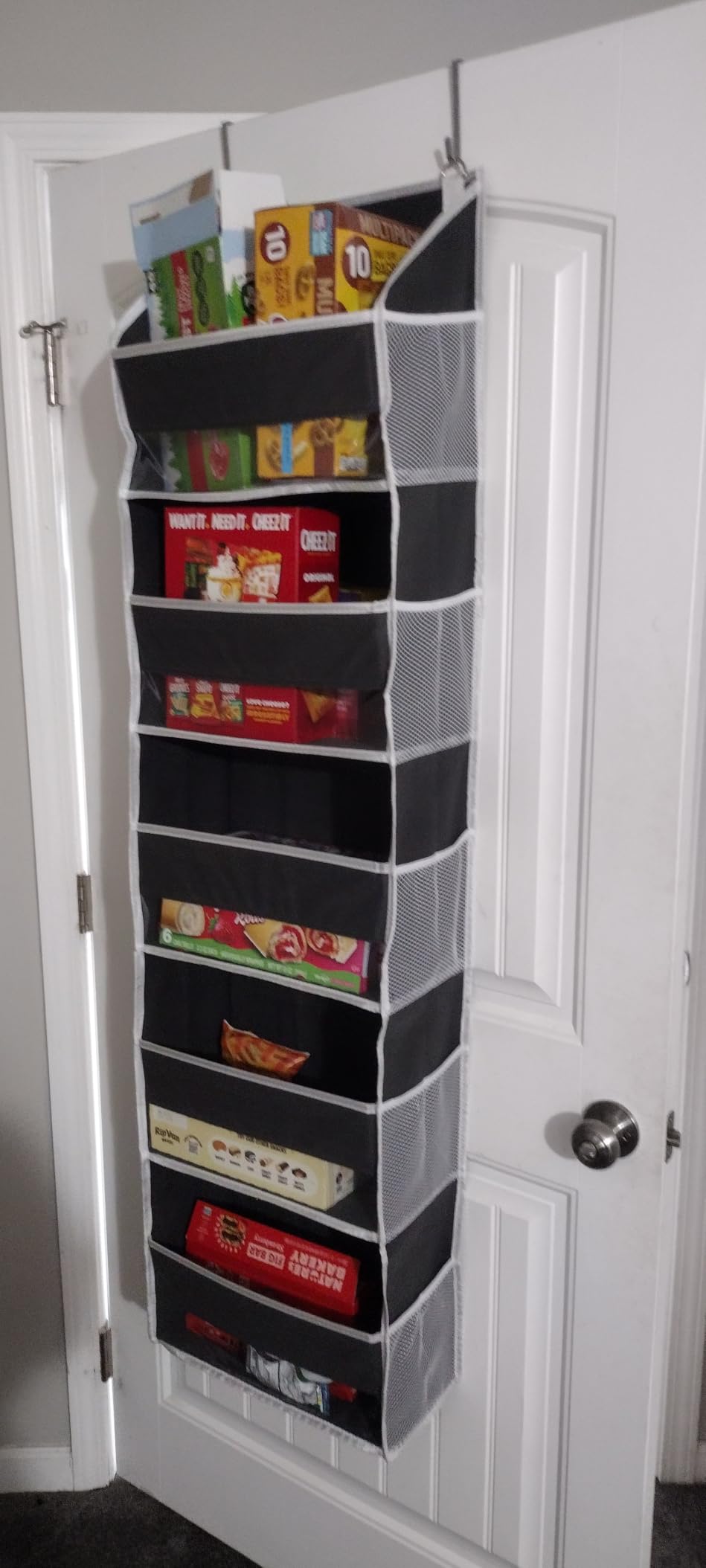
The closet door is the largest unused surface in most nurseries, and an over-the-door organizer turns it into five deep pockets and ten mesh side pockets without a single screw. That no-drill aspect is why this one matters in a rental or a house where you cannot patch the wall later.
Each of the five main pockets measures 14.5 by 6.5 by 6.5 inches, spaced at 4.5 inches apart so taller items do not hit the shelf above. The ten mesh side pockets at 6.5 by 6.5 inches take the small stuff: socks, bibs, muslin cloths, hair ties and pacifier clips.
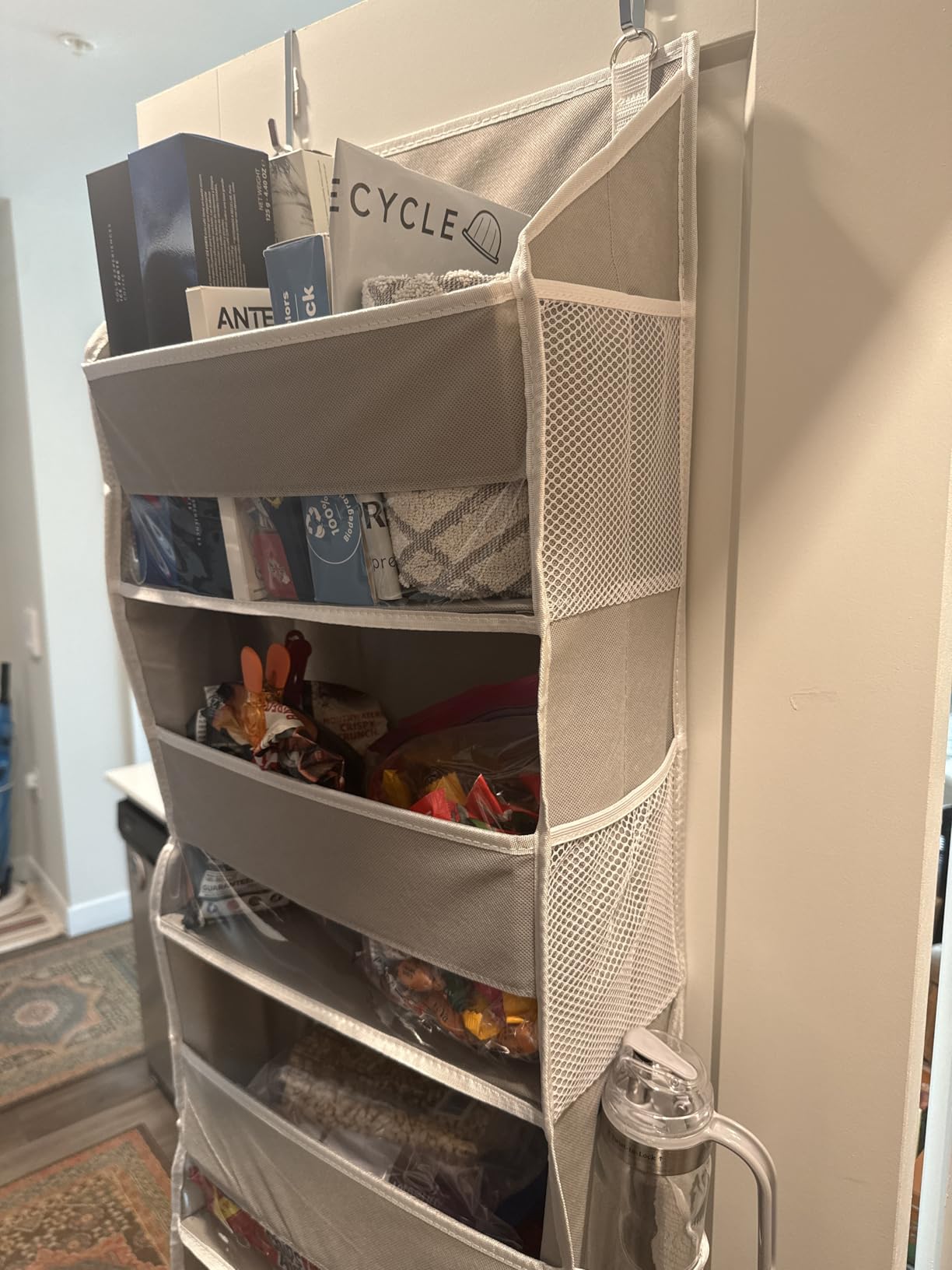
Every pocket has a clear PVC window, which is the feature that keeps it useful six months in. You can see what is in each pocket without pulling anything out, so a folded outfit for a 6am wake-up does not require rearranging four other compartments first.
The unit is rated to 44 pounds and reinforced with cardboard on the front, sides and bottom, so loaded pockets hold their shape instead of bowing outward. It folds flat when you need the door back to normal.
Checking the 2-inch door thickness limit
This organizer fits doors under 2.0 inches thick and hangs from two included metal hooks. Standard interior doors run 1.375 to 1.75 inches, so most are fine, but thick commercial-style doors and some sliding doors are not. Measure your door thickness and the clearance behind it before ordering.
The second measurement is the gap behind the open door. At 2.56 inches deep, the unit needs that much clearance between the door and the wall or a dresser when the door swings open. In a tight room where the door has to open past furniture, that is the reason this will not work.
When the door is the wrong place
If your closet has an over-the-door organizer on it already, or if removing the door is part of your plan, this storage goes with the door and you lose it. Some parents take closet doors off entirely for a finger-pinch-proof open closet, which is a good idea with toddlers but means the over-the-door route is closed to you.
The other real limitation is the hooks. They can flex under moderate load, so distribute weight across all five pockets rather than stacking up folded clothes in the top two.
9. Criusia Drawer Organizer 10 Pack – Best Fabric Bins for Wide Dresser Drawers
Criusia Drawer Organizer Clothes, 10 Pack Dresser Organizer for Baby Clothes, Underwear, Sock- Foldable Closet Organization and Storage Dividers Bins for Nursery, Bedroom (Beige)
10 bins in 3 sizes
Large 11x11x4.5 inch
Odorless fabric with PP board
Beige
Pros
- Sturdy bottom insert panel rather than a zip keeps bins from sagging
- Neat even stitching and taut fabric look better made than cheaper competitors
- Three sizes suit bibs washcloths and burp cloths
- Odorless and easy to wipe clean
- Folds flat for travel or closet storage
Cons
- Not sized for bulky items such as towels and blankets
- Outer shipping bag is flimsy and can split before delivery
The fabric drawer bin category is crowded, and the difference between a good set and a disappointing one comes down to construction. This set uses premium fabric with durable polypropylene boards on the sides and bottom, plus a rigid bottom insert rather than a zip closure, so the bins hold their shape without the sagging centre that develops in zip-front bins.
You get four large bins at 11 by 11 by 4.5 inches, four medium at 11 by 5.5 by 4.5 inches and two small at 5.5 by 5.5 by 4.5 inches. Ten compartments is a more manageable number than eighteen when you are setting up a system you intend to maintain.
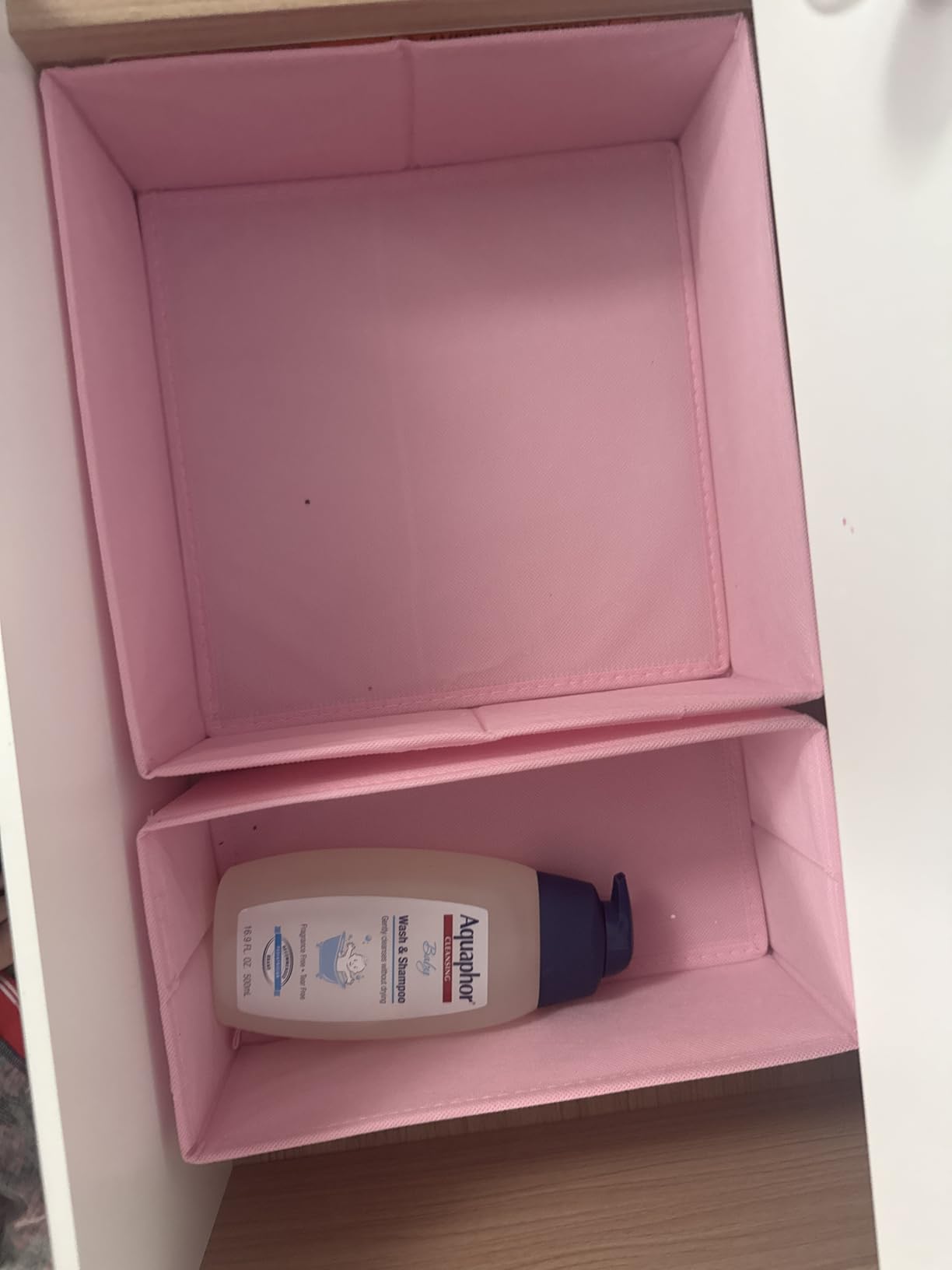
The material is described as odorless, and that is not a throwaway word in a nursery. Newborn clothes live in these bins and then go straight onto a baby’s skin. Beige is the default color here, with six colors and a 21-piece version also available.
Owners consistently single out the stitching and taut fabric as the reason this set outperforms higher-volume competitors. At 2.4 pounds for the full set, it feels substantial without being uncarryable between rooms.
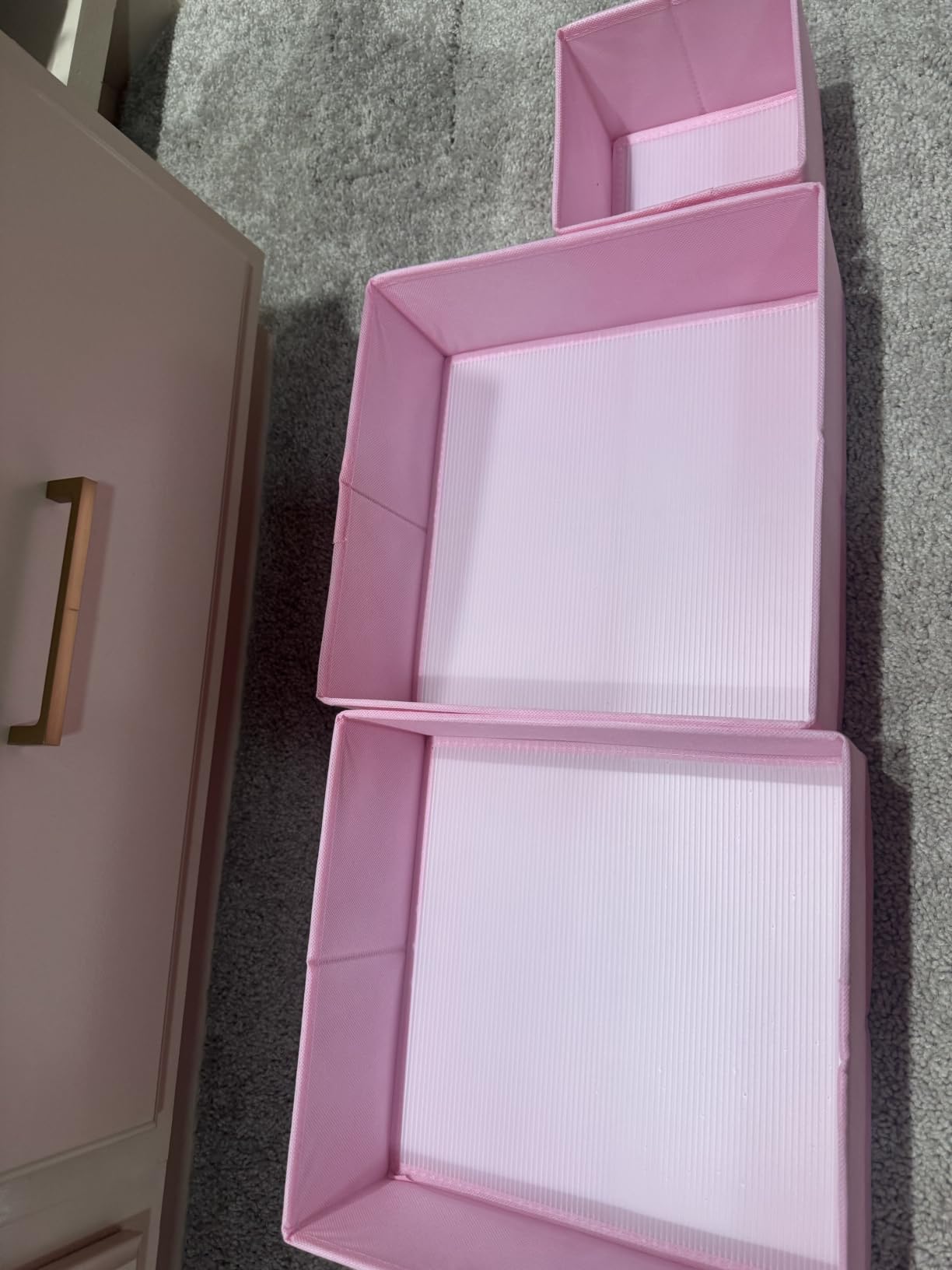
Why the rigid bottom insert matters
Zip-front fabric bins develop a soft, unsupported middle after a few weeks of pushing rolled clothes in. The insert panel in these bins gives a flat floor, which means a rolled sleeper sits in a stable stack rather than sinking and sliding. That is the difference between a drawer that stays tidy and one you re-sort weekly.
Setup is no-tool: open the bin and insert the bottom board. When a size no longer fits the child’s clothes, the bins fold flat into a closet shelf rather than wasting space.
When to buy the larger set instead
Ten bins cover a single dresser well. If you have both a dresser and a changing table, or a dresser and closet shelves, the 18-piece Vtopmart set listed earlier gives you more compartments for the same per-bin approach.
Two practical notes. These are not sized for blankets and towels, so keep bulky textiles elsewhere. And the outer shipping bag is described as flimsy enough to split in transit, so open the package as soon as it arrives and check that all ten pieces are present.
10. STORAGE MANIAC Hanging Closet Rod 2 Pack – Best for Two Closets or Two Heights
STORAGE MANIAC Hanging Closet Rod, Adjustable Width and Height Closet Hanging Organizer, Space-Saving Clothes Hanging Bar, Closet Extender Hanging Rod Double Closet Hanging Rod, 2 Pack Chrome
2 adjustable hanging rods
17-29 inch width
Chrome steel
45 lb capacity
Pros
- Six height settings and a wide width range adapt to different closet dimensions
- Chrome steel holds up to 45 pounds and resists rust
- Tool-free installation that hooks over an existing rod
- Two pack allows two closets or two heights
- Smooth rod surface avoids snagging clothing
Cons
- Adjustment requires lining up several steel pieces before the frame locks
- The minimum width will not fit very narrow closet rods
This is the wider, heavier-duty version of the second-tier rod idea, and the two-pack is what separates it. With two rods you can install one in the nursery closet and one in the toddler’s room, or place two at different heights in the same closet if you want three hanging tiers rather than two.
Adjustment runs from 17 to 29 inches wide and 14.6 to 37.1 inches tall across six height settings, giving you far more range than a fixed-drop rod. Chrome steel is rated to 45 pounds, which is roughly double the rating on the simpler steel extender.
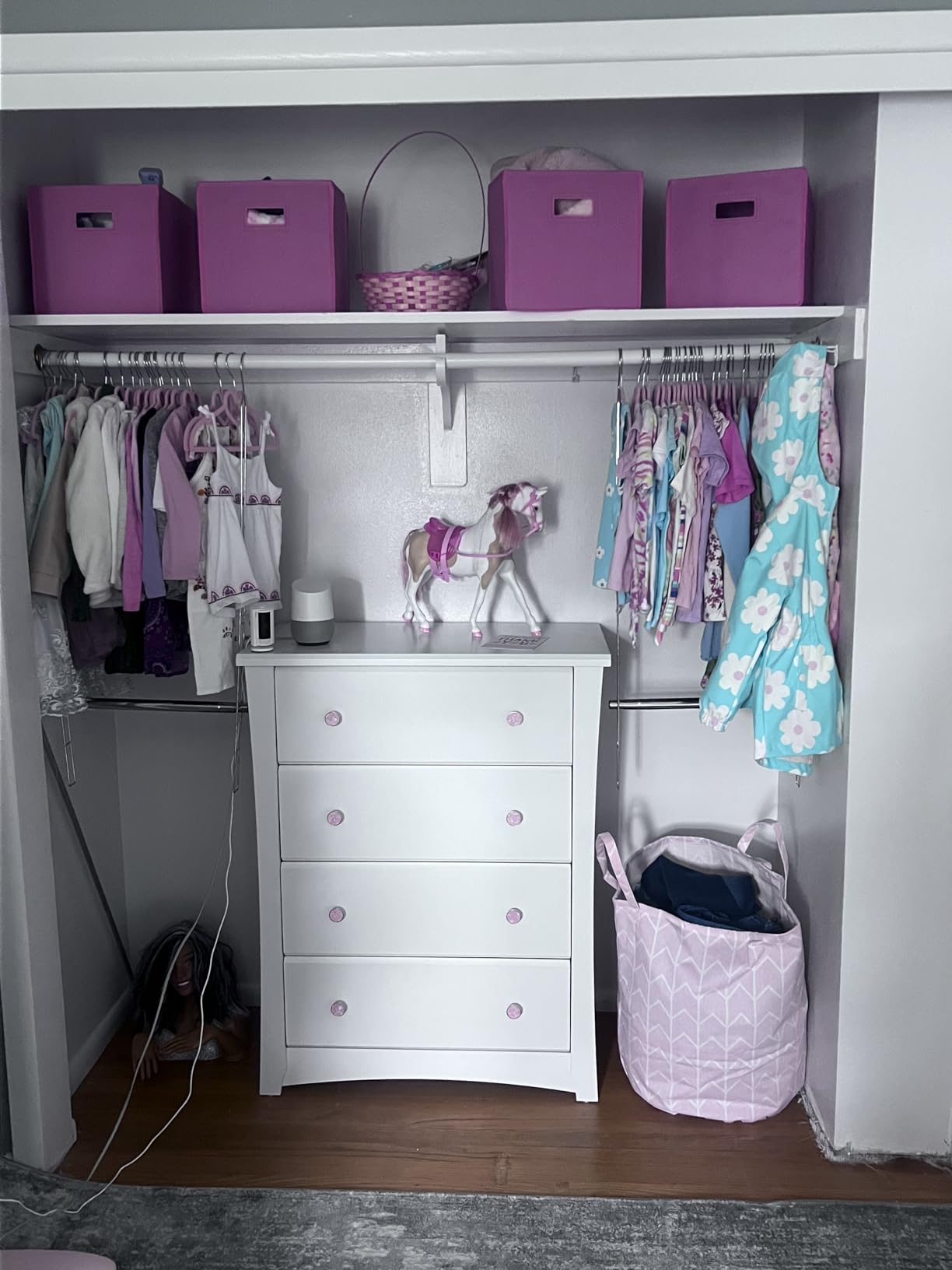
The rod surface is smooth enough that it will not snag knits or leave marks on hanging clothes, which is a detail that matters when you are hanging muslin and cotton next to each other. Fully expanded the unit measures 37.1 by 29 inches.
At 4.4 stars with 4,127 reviews, this one sits at the lower end of our list, and the feedback is consistent: people like the range and the strength, and are less enthusiastic about the assembly process than the cheaper extender.
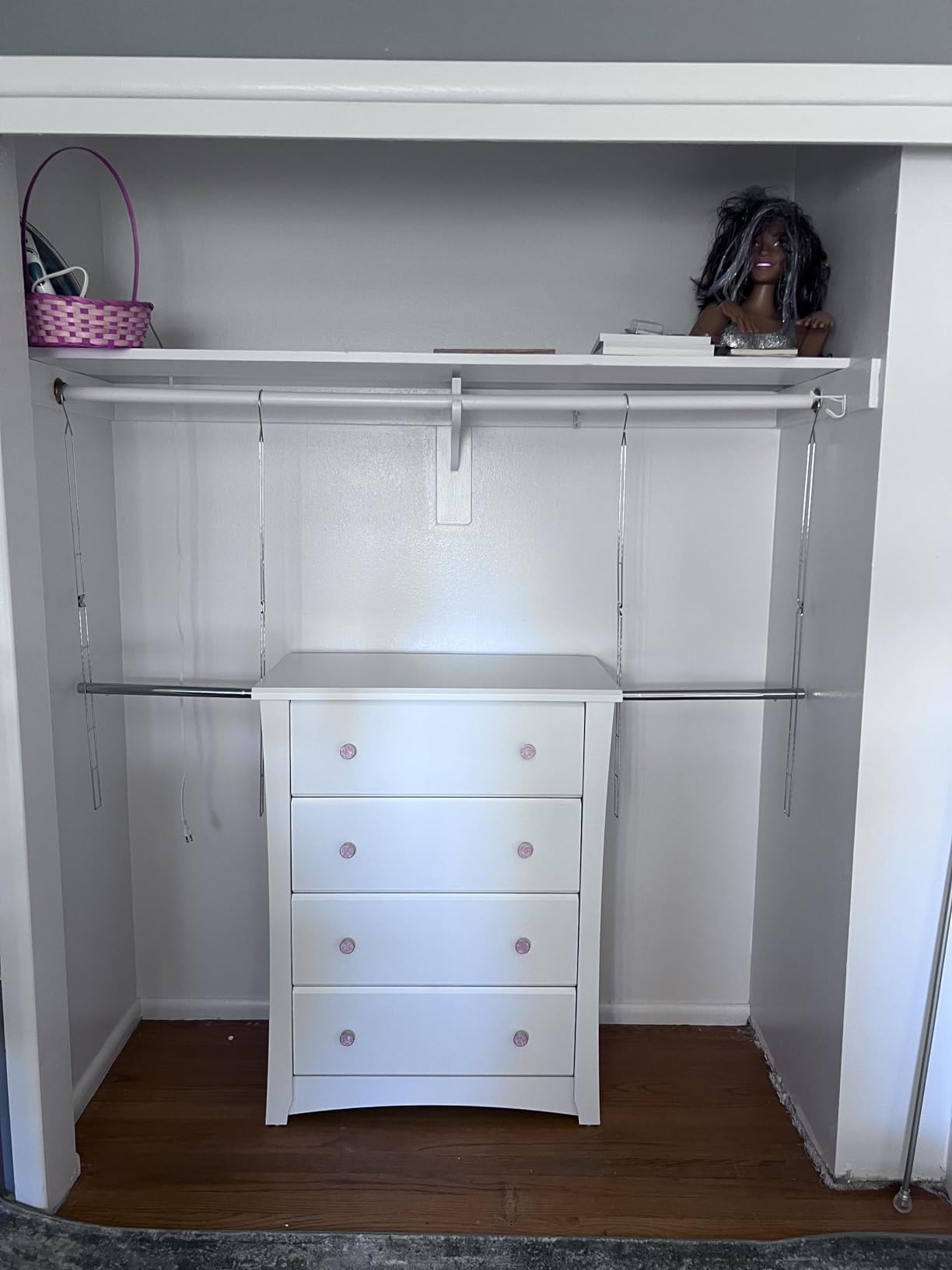
Whether to spend the extra on this over a simpler rod
Choose this one when your weight needs are high, when your closet is deeper than a 30-inch drop allows, or when you want a second tier at a specific height rather than the closest available position. If you are hanging sleepers and onesies and your rod drops under 30 inches, the simpler extender listed earlier does the same job with less assembly.
The 45-pound rating is per rod. A rod holding folded adult jackets plus a full set of baby outerwear will use a meaningful share of that, so spread heavier items across both rods.
Assembly friction and the narrow rod limit
Getting this one built takes more patience than the alternatives. Several steel pieces have to be lined up before the frame locks into place, and reviews describe a few attempts as normal. Set aside ten minutes rather than planning it inside a nap window.
The minimum width is about 1.6 inches at the narrowest setting, so it will not fit a very narrow closet rod. Measure your rod diameter before ordering, because that is the failure point that cannot be worked around after delivery.
How to Choose Nursery Closet Organizers That Fit Your Closet
Every organizer on this list works. What separates a closet that functions from one that becomes a dumping ground is whether the organizers match your closet’s dimensions and your family’s sorting habits. Here is the order we would work through it.
Measure your closet before you order anything
Four measurements decide nearly every purchase in this category. Width across the rod, because it decides whether a second-tier rod or hanging organizer fits at all. Depth from the rod to the wall behind, because that decides whether a dresser or only a hanging unit works. Drop from the rod to the floor or to the shelf below, because that decides whether an adjustable second rod reaches the floor. And door thickness plus the clearance behind an open door, because that decides whether an over-the-door organizer is possible.
The most common mistake is assuming a modular cube wardrobe will fit where a dresser used to sit. Cube units are typically wider and shallower than a dresser but need floor clearance on every side for assembly and stability. If your closet is 36 inches wide, a two-cube-wide unit at 24 inches plus a second one will not fit alongside a dresser, and the second unit has to go elsewhere.
If your closet doors are in the way of the daily routine, closet doors have their own sizing quirks worth checking separately. Our closet door comparison covers that side.
Sort by size first, then by type and season
The ordering matters. If you sort by type first, you rebuild the whole closet every three to six months when sizes change. If you sort by size first, each size jump is a single, localized change: pull one divider, move the clothes forward, pull in the next zone.
Our sequence is: hang by size using dividers, then within each size zone split by type (onesies and sleepers together, separates with bottoms, dresses on their own section) and then by season (current season in front, next season behind). Accessories go into small fabric bins on the closet shelf, never into the hanging zone.
Route organizers by closet type
In a small reach-in closet, the priority is capacity: baby-sized hangers first, because thinner hangers cost nothing in effort and give back rod space, then a second-tier rod if there is vertical dead space, then dividers. Skip the full hanging organizer unless the closet is too shallow for a dresser.
In a walk-in closet, the priority changes. Capacity is not the problem, so dividers plus zones plus an outgrown basket matter more, and a large hanging organizer on one wall keeps overflow off the floor. In a dresser-only setup with no closet at all, fabric drawer organizers and a freestanding garment rack do all the work, and the over-the-door option disappears entirely.
Assign three zones and one outgrown basket
Three zones cover almost every nursery: everyday clothes, special occasion and outerwear, and future sizes stored flat in lidded bins. Add a fourth basket inside the closet door for outgrown clothes so they leave the closet on their own rather than needing a decision each time you open the door.
Label bins with a label maker or printed tape. If a grandparent, sitter or co-parent helps with the baby, labels are the difference between them finding a sleeper at 2am and asking you where it is.
What to skip
A few things come up repeatedly as regrets. Closet organizers advertised for one specific age range that ends before your baby reaches toddler sizing, which leaves a zone unaccounted for exactly when clothes multiply. Clear plastic storage bins with hinged lids for clothing, because they crack, yellow and trap moisture. Over-the-door organizers on a door that has to open past furniture. And any multi-drawer cart placed inside a closet without a clear floor plan, because it reduces the space available for everything else.
If you plan to steam or press clothes regularly, keep the garment care step separate from storage. Our garment steamer comparison covers that, and the storage advice here assumes steamer storage is not competing for the same closet floor.
Safety for a room your baby will pull on
Organizers in a nursery are furniture, and toddlers climb furniture. Anchor any freestanding hanging organizer or shelving unit to the wall with the strap and hardware that ships with it, or place it flush against a wall in a spot your child cannot reach a handhold. Weight the bottom of any hanging unit rather than loading the top shelf, since a top-loaded unit tips forward under its own load.
Check materials. Polypropylene and ABS plastics described as non-toxic are the safer choice for bins and hangers that touch skin and get chewed. Keep small hardware out of toddler reach, and avoid units whose assembly relies on loose clips within reach of a child who is already standing. For rentals, the tension-mounted and hook-on options in this list install without touching the wall at all, which is the simplest way to sidestep the question entirely.
Frequently Asked Questions
What are the best closet organizers for a baby closet?
The most useful four are closet dividers that split the rod by size, fabric drawer organizers for onesies and socks, baby-sized hangers so tiny clothes stop sliding off, and a second hanging rod or hanging shelf that adds capacity in a shallow closet. Start with hangers and dividers because they change how the rod itself works, then add drawer organizers for accessories.
How do I organize a small nursery closet?
Start with capacity before containers. Switch to baby-sized hangers to fit more garments on the rod, add a tension-mounted second rod to use the dead space underneath, then add dividers to sort by size. Keep bulky textiles on shelves and give socks, bibs and mittens small fabric bins so accessories do not disappear back into the hanging zone.
How many baby clothes does a newborn need?
Plan on 7 to 10 onesies, 5 to 7 outfits including sleepers, a handful of pairs of socks and mittens, and one weather-appropriate layer for your climate. Buy slightly more of the size you cannot grow out of quickly, and less of the next size up, since babies outgrow a size every three to six months.
How do you sort baby clothes by size?
Sort by size first and type second. Install dividers back to front in size order, largest nearest the door and newborn at the back, then split each zone by type and season. This order matters because it means a size change only moves one zone rather than rebuilding the entire closet.
What is the best way to store baby clothes in a closet?
Use three zones: everyday clothes on the rod at arm height, special occasion and outerwear on a shelf or in the hanging organizer, and next-size clothes flat in lidded bins. Add a fourth basket inside the door for outgrown clothes so they exit the closet without a decision each time you open it.
Are fabric or plastic bins better for a nursery closet?
Fabric bins suit clothing because they are breathable, wipe clean and fold flat when a size is outgrown. Plastic bins are better for things that need to be sealed, such as toiletries or spare bedding. For clothing, fabric with a rigid bottom insert holds its shape better than zip-front fabric and avoids the yellowing that affects clear plastic.
Our Final Verdict for Baby Clothes Closets in 2026
Start with the NEATERIZE 12-piece drawer organizer set and the Pro Goleem size dividers. Together they cover the two failure points we see most often: a dresser where everything is in one pile, and a rod where nobody can tell which size is which. Add baby-sized hangers if the rod feels full and a tension-mounted second rod if there is dead space underneath it.
Measure your closet before you order, install dividers largest size nearest the door, and give outgrown clothes a basket of their own. That is the whole system, and it will hold through the size jumps that break most nursery closets.