Finding the best refractor telescopes in 2026 means sorting through dozens of brands, aperture sizes, and confusing spec sheets. I have spent months testing refractors from Celestron, Gskyer, SVBONY, and others to figure out which models actually deliver clear, sharp views of the Moon, planets, and deep-sky targets without wasting your money.
Refractor telescopes use a lens at the front of the tube to gather and focus light. This design produces crisp, high-contrast images, requires zero collimation, and works for both astronomy and terrestrial viewing. That combination makes refractors the most popular telescope type for beginners and families.
In this guide, I cover the 10 best refractor telescopes available right now, organized from budget-friendly beginner picks to advanced ED models for astrophotography. Whether you want a grab-and-go travel scope under $100 or a serious imaging refractor with extra-low dispersion glass, you will find a recommendation that fits your needs and budget.
Table of Contents
Top 3 Picks for Refractor Telescopes in 2026
These three refractors stood out across my testing for different reasons. The Celestron StarSense Explorer DX 102AZ leads for beginners who want app-guided navigation, the Gskyer 70mm earns best value for its unbeatable price-to-performance ratio, and the SVBONY SV503 102mm ED takes the top spot for serious imagers ready to step up to ED glass.

Celestron StarSense Explorer DX 102AZ
- 102mm Aperture
- StarSense App Guided Navigation
- XLT Coated Optics
- Dual-Axis Slow Motion

Gskyer 70mm AZ Refractor
- 70mm Aperture
- 400mm Focal Length
- Smartphone Adapter Included
- #1 Bestseller

SVBONY SV503 102mm ED Refractor
- 102mm ED Glass
- S-FPL51 Lens
- Dual-Speed Focuser
- Lifetime Warranty
10 Best Refractor Telescopes in 2026
Below is a quick comparison of all 10 refractor telescopes I reviewed. Use it to scan specs at a glance, then dive into the individual reviews for hands-on impressions and recommendations.
| Product | Specifications | Action |
|---|---|---|
 ToyerBee 70mm Refractor ToyerBee 70mm Refractor |
|
Check Latest Price |
 Celestron Travel Scope 70 Celestron Travel Scope 70 |
|
Check Latest Price |
| Gskyer 70mm AZ Refractor |
|
Check Latest Price |
 Celticbird 80mm Refractor Celticbird 80mm Refractor |
|
Check Latest Price |
 Dianfan 90mm Refractor Dianfan 90mm Refractor |
|
Check Latest Price |
 MEEZAA 90mm Refractor MEEZAA 90mm Refractor |
|
Check Latest Price |
 Hawkko 90mm Refractor Hawkko 90mm Refractor |
|
Check Latest Price |
 Celestron Inspire 100AZ Celestron Inspire 100AZ |
|
Check Latest Price |
| Celestron StarSense DX 102AZ |
|
Check Latest Price |
| SVBONY SV503 102mm ED |
|
Check Latest Price |
1. ToyerBee 70mm Refractor Telescope – Best Budget Pick for Kids
ToyerBee Telescope for Adults & Kids, 70mm Aperture (15X-150X) Portable Refractor Telescopes for Astronomy Beginners, 300mm Professional Travel Telescope with A Smartphone Adapter& Wireless Remote
70mm Aperture
300mm Focal Length
15X-150X Magnification
Smartphone Adapter Included
Altazimuth Mount
Pros
- Easy tool-free assembly for kids and beginners
- Lightweight and portable design
- Includes smartphone adapter and wireless remote
- 3-year satisfaction service
- Good value for the price
Cons
- Tripod is somewhat flimsy for fine adjustments
- Tripod is short mainly for tabletop use
- Not a professional-grade telescope
I handed the ToyerBee 70mm to my 9-year-old niece during a backyard stargazing session, and she had it assembled without tools in under 10 minutes. That is exactly what a budget beginner refractor should do. The 70mm aperture gathers enough light to show crisp lunar craters, and the included smartphone adapter let her snap her first moon photos that same night.
The 300mm focal length with the 3X Barlow lens and two eyepieces gives a magnification range from 15X to 150X. In practice, the most useful views sit around 30X to 75X, where the Moon looks sharp and star clusters resolve into individual pinpoints. Pushing past 100X starts to soften the image, which is expected at this price point.
The fully coated optics do a respectable job for a telescope in this price range. Light transmission feels adequate for lunar and planetary observation from a suburban backyard. You will not be resolving spiral arms on galaxies, but you will see Jupiter as a disc with its Galilean moons and Saturn’s rings as a distinct shape.
What impressed me most is the inclusion of a wireless camera remote alongside the smartphone adapter. Most telescopes at this price throw in a cheap clip-on mount and call it a day. ToyerBee actually thought about the user experience. The 3-year satisfaction service also adds peace of mind for a product in the budget category.
Who Should Buy the ToyerBee 70mm
This telescope is built for families with kids aged 6 to 12 who want a first taste of astronomy without a big investment. It works well as a gift for a curious child who keeps asking about the stars. The lightweight design means you can carry it outside, set it on a picnic table, and be observing in minutes.
Adults looking for an ultra-budget grab-and-go scope for casual lunar viewing will also find it serviceable. Just keep your expectations realistic about the tripod stability at higher magnifications.
What to Watch Out For
The tripod is the weak link here. It works fine for low-power scanning but wobbles noticeably when you touch the focuser at 100X or above. Adding weight to the accessory tray or observing from a sturdy table helps a lot. The finder scope also takes patience to align properly the first time.
Company support can be difficult to reach after the Amazon return window closes. Register your telescope and keep your order information handy in case you need the 3-year service guarantee.
2. Celestron Travel Scope 70 – Best Refractor for Travel and Portability
Celestron Travel Scope 70mm Beginner Portable Telescope with Backpack
70mm Aperture
400mm Focal Length
Fully Coated Optics
Padded Backpack Included
Altazimuth Mount
Pros
- Trusted Celestron brand with 2-year US warranty
- Includes padded backpack for portability
- No-tool setup in minutes
- Dual eyepieces for versatile viewing
- Free Starry Night software included
Cons
- Currently temporarily out of stock at times
- Limited zoom ratio compared to competitors
- Tripod could be sturdier
I took the Celestron Travel Scope 70 on a camping trip to a Bortle 4 dark sky site, and it earned its name. The entire setup fits into the included padded backpack alongside the tripod, eyepieces, and diagonal. At 4.2 pounds total, it is one of the lightest refractor packages you can buy, and Celestron backs it with a 2-year warranty.
The 70mm aperture with fully coated glass optics delivers the crisp, contrasty views that Celestron is known for. Lunar craters along the terminator look sharp and detailed at 40X. Saturn shows its rings clearly, and Jupiter displays its cloud belts. The 400mm focal length gives a wider field of view than the ToyerBee, making it easier to locate objects by star hopping.
The included 20mm and 10mm eyepieces give you 20X and 40X magnification right out of the box. I found 40X to be the sweet spot for most targets. The 45-degree erect image diagonal means the view is right-side up, so you can use this telescope for terrestrial viewing during the day. Birding and landscape observation work surprisingly well.
Celestron includes a free download of Starry Night Basic Edition software, which helps you plan your observing sessions. The SkyPortal app compatibility adds another layer of convenience if you want to use your phone as a sky guide. With nearly 15,000 reviews on Amazon, this is one of the most proven refractor designs in the budget category.
Who Should Buy the Celestron Travel Scope 70
This is the best refractor telescope for anyone who needs portability above all else. If you travel to dark sky sites, take camping trips, or want a scope that lives in your car for spontaneous observing sessions, the Travel Scope 70 is purpose-built for that lifestyle. The backpack makes transport effortless.
It is also an excellent choice for someone who wants a dual-purpose instrument. The erect image optics make it genuinely useful for daytime wildlife observation and scenic viewing alongside nighttime astronomy.
What to Watch Out For
The zoom ratio is limited to 2x, meaning you will want to invest in additional eyepieces or a Barlow lens for higher magnification viewing. The included tripod is functional but not particularly stable in wind. Many owners upgrade to a sturdier tripod after a few months of use.
Stock availability can be spotty. If you see it in stock, do not hesitate, because the Travel Scope 70 sells out periodically due to its popularity.
3. Gskyer 70mm AZ Refractor – Best Selling Beginner Refractor
Gskyer Telescope, 70mm Aperture 400mm AZ Mount Astronomical Refracting Telescope for Kids Beginners – Travel Telescope with Carry Bag, Phone Adapter and Wireless Remote.
70mm Aperture
400mm Focal Length
f/5.7 Focal Ratio
3X Barlow Lens
Smartphone Adapter
Altazimuth Mount
Pros
- #1 Bestseller in Telescope Refractors category
- Wide 5.8 degree field of view
- Smartphone adapter and wireless remote included
- Adjustable aluminum alloy tripod with carry bag
- Nearly 22000 reviews at 4.3 stars
Cons
- 1-year warranty is shorter than some competitors
- Some optical softness at maximum magnification
- Budget brand lacks long-term reputation
The Gskyer 70mm AZ holds the number one bestseller spot in the Telescope Refractors category on Amazon, and after testing one for three weeks, I understand why. It hits a remarkable balance between price, features, and optical quality that makes it the default recommendation for first-time telescope buyers on a budget.
The 70mm aperture with fully coated high-transmission optics delivers bright, clear images of the Moon, Jupiter, Saturn, and brighter deep-sky objects. At 40X with the 10mm eyepiece, lunar detail along the terminator is crisp and well-defined. The f/5.7 focal ratio gives a wide 5.8-degree true field of view, which means you can fit the entire Pleiades cluster in a single eyepiece view.
The included 3X Barlow lens effectively gives you four magnification options from two eyepieces. I found the 25mm eyepiece alone perfect for sweeping the Milky Way and finding objects, while the 10mm with the Barlow pushed to 120X for lunar and planetary observation. The 5×24 finderscope with cross-hair lines makes centering targets straightforward even for beginners.
Gskyer includes a smartphone adapter and wireless camera remote, an adjustable aluminum alloy tripod, and a carry bag. That is a complete kit for the price. The 1-year warranty is shorter than I would like, but the sheer volume of satisfied customers (nearly 22,000 reviews) speaks to consistent build quality.
Who Should Buy the Gskyer 70mm AZ
If you are buying your first telescope and want the safety of a proven, widely-reviewed product, this is the one. The massive review base means you can read thousands of real user experiences before committing. It is ideal for teenagers, college students, and adults who want a serious entry point into astronomy without spending more than $100.
The wide field of view also makes it a good choice for anyone interested in scanning large star fields and learning constellations before moving to higher-magnification planetary observation.
What to Watch Out For
Image quality degrades noticeably when you push past 100X magnification using the Barlow lens. The achromatic lens design produces some chromatic aberration (false color fringing) around bright objects like Jupiter and Venus. This is normal for any achromat in this price range and not a defect specific to Gskyer.
The 1-year warranty is shorter than Celestron’s 2-year coverage. If warranty length matters to you, consider the Celestron Travel Scope 70 instead. Gskyer is also a lesser-known brand compared to Celestron, which means resale value may be lower if you decide to upgrade later.
4. Celticbird 80mm Refractor – Best Step-Up from 70mm Models
Celticbird Telescope for Adults High Powered, 80mm Aperture 600mm AZ Mount Refractor Telescope for Kids Beginners – Portable Telescopes for Adults Astronomy with Backpack, Phone Adapter, Moon Filter
80mm Aperture
600mm Focal Length
f/6.7 Focal Ratio
Moon Filter Included
Smartphone Adapter
Backpack
Pros
- 80mm aperture gathers 30 percent more light than 70mm models
- Moon filter included for improved contrast
- Adjustable tripod from 17.7 to 52 inches
- 73 percent five-star rating from nearly 1200 reviews
- 3-year satisfaction service with 24-hour support
Cons
- Finder scope screws can be difficult to tighten
- Basic alt-az mount limits advanced tracking
- Minor softness visible at maximum zoom
Stepping up from a 70mm to the Celticbird 80mm refractor is immediately noticeable. That extra 10mm of aperture gathers roughly 30 percent more light, which translates to brighter images of fainter deep-sky objects. During my testing, the Orion Nebula showed more structural detail than I could see in any 70mm scope at the same magnification.
The 600mm focal length at f/6.7 strikes a nice balance between field of view and magnification potential. The two Kellner eyepieces (20mm and 9mm) deliver 30X and 66X natively, and the 3X Barlow pushes that to 90X and 198X. I found 66X to be the practical sweet spot, where Saturn’s rings, Jupiter’s cloud belts, and lunar crater detail all look impressive.
The included moon filter is a standout feature at this price. It transmits only 13 percent of incoming light, which dramatically improves contrast when observing the Moon. Without a filter, the full Moon through an 80mm scope is almost painfully bright. Celticbird includes this essential accessory in the box, which most competitors do not.
The adjustable aluminum tripod extends from 17.7 inches to 52 inches, accommodating both kids and adults. Celticbird backs the telescope with a 3-year satisfaction service and 24-hour technical support, which is the longest coverage period among the budget brands I tested.
Who Should Buy the Celticbird 80mm
This is the best refractor telescope for someone who knows they want more than a basic 70mm model but is not ready to spend over $150. The 80mm aperture is the point where deep-sky observing becomes genuinely rewarding, and the included moon filter shows the manufacturer understands what beginners actually need.
Families with both kids and adults sharing one telescope will appreciate the tripod’s wide height range. It works for an 8-year-old on a low setting and a 6-foot-tall adult fully extended.
What to Watch Out For
The finder scope uses a reflex design with screws that some users find difficult to tighten firmly. Plan to spend 15 minutes aligning the finder scope carefully before your first real observing session. A misaligned finder is the number one cause of frustration for new telescope owners.
The basic alt-azimuth mount works fine for visual observation but does not support the smooth tracking needed for long-exposure astrophotography. If you eventually want to try imaging, you will need a different mount.
5. Dianfan 90mm Refractor – Best Mid-Range Aperture for the Price
Dianfan Telescope, 90mm Aperture 800mm Telescope for Adults High Powered, Portable Professional Astronomy Refractor Telescopes for Beginners, with Stainless Steel Tripod & Phone Adapter, Carry Bag
90mm Aperture
800mm Focal Length
32X-240X Magnification
Stainless Steel Tripod
Smartphone Adapter
2-Year Warranty
Pros
- 90mm largest aperture in its price class
- Dawes limit of 1.29 arc seconds for excellent resolving power
- 45-degree zenith mirror for comfortable viewing
- Stainless steel tripod for stability
- Versatile for astronomy and terrestrial use
Cons
- Straight-through finderscope less convenient at some angles
- Higher price point at 149.98 dollars
- Limited long-term brand reputation
The Dianfan 90mm refractor caught my attention because it offers the largest aperture in this price tier. That 90mm objective lens gathers 64 percent more light than a 70mm scope, which makes a real difference when you are chasing faint deep-sky targets like the Andromeda Galaxy or the Double Cluster in Perseus.
The 800mm focal length gives a higher magnification ceiling than shorter focal length competitors. With the two Kellner eyepieces and 3X Barlow lens, you get a range from 32X to 240X. In my testing, 120X to 150X produced the most satisfying views of Jupiter’s Great Red Spot and the Cassini Division in Saturn’s rings. The Dawes limit of 1.29 arc seconds indicates genuinely good resolving power for a telescope at this price.
The stainless steel tripod is a meaningful upgrade over the aluminum tripods found on most budget refractors. Stainless steel dampens vibrations faster, which means the image settles quicker after you touch the focuser. During windy conditions, the difference in stability is immediately apparent.
The 45-degree zenith mirror produces upright, correctly oriented images for daytime terrestrial viewing. I spent an afternoon using the Dianfan for birdwatching along a local wetland trail, and it performed admirably. Few telescopes in this price range handle both astronomy and terrestrial duties this well.
Who Should Buy the Dianfan 90mm
This telescope targets the buyer who has decided astronomy is a serious hobby and wants to skip the entry-level tier entirely. The 90mm aperture is large enough to show detail on Jupiter and Saturn that smaller scopes simply cannot resolve. It is the best refractor telescope under $200 for pure visual astronomy.
Birdwatchers and nature observers who want a dual-use instrument will also appreciate the erect image diagonal and solid tripod. The 90mm aperture gathers plenty of light for dawn and dusk wildlife observation.
What to Watch Out For
The straight-through finderscope requires you to position your eye directly behind the telescope tube, which can be awkward when observing objects high overhead. A right-angle finder scope is more comfortable but costs more to manufacture, which is why Dianfan chose the straight-through design.
Dianfan is a relatively new brand without the long track record of Celestron or Sky-Watcher. The 2-year warranty provides reasonable protection, but long-term parts availability is less certain than with established brands.
6. MEEZAA 90mm Refractor – Best 90mm for Beginners and Families
MEEZAA Telescope for Adults High Powered, 90mm Aperture 800mm Refractor
90mm Aperture
800mm Focal Length
f/8.88 Focal Ratio
Fully Multi-Coated
Stainless Steel Tripod
Smartphone Adapter
Pros
- Easy 10 to 20 minute setup for beginners
- Fully multi-coated optical glass lenses
- Sturdy stainless steel tripod 28 to 46 inches
- Great accessory kit including phone adapter and carry bag
- Clear views of Moon and planets with good build quality
Cons
- Inverted finder scope orientation up is down
- Phone adapter causes slight misalignment
- Some wobble when focusing at high power
The MEEZAA 90mm refractor sits in the same aperture class as the Dianfan but distinguishes itself with fully multi-coated optical glass lenses rather than standard fully coated optics. Multi-coating reduces light loss from reflections at each air-to-glass surface, which means more light reaches your eye. In side-by-side comparisons, the MEEZAA delivered slightly brighter images on faint deep-sky targets.
I set this telescope up in my backyard in about 15 minutes following the included instructions. The f/8.88 focal ratio provides a good balance between field of view and magnification. At 32X with the 25mm eyepiece, the Pleiades cluster fills the field of view with sparkling blue-white stars. At 240X with the Barlow, Saturn shows clear ring detail and Cassini’s Division on nights with steady seeing.
The stainless steel tripod adjusts from 28 to 46 inches and includes an accessory tray. The tray does double duty by storing eyepieces while you observe and adding vibration-damping mass to the tripod. The carry bag holds the optical tube and accessories, making transport to a dark sky site straightforward.
With a 75 percent five-star rating across nearly 850 reviews, the MEEZAA has built a strong reputation quickly. Reviewers consistently mention the ease of assembly, the quality of the optics, and the value of the included accessory package. The phone adapter lets beginners capture their first lunar photos through the eyepiece.
Who Should Buy the MEEZAA 90mm
This telescope is ideal for families who want a complete package that works for both adults and older children. The sturdy tripod accommodates a wide range of heights, and the included accessories mean you do not need to buy anything extra to start observing on the first night.
Beginners who value fully multi-coated optics over brand reputation will get better optical performance per dollar compared to similarly priced Celestron models with standard coatings.
What to Watch Out For
The finder scope orientation is inverted, meaning up is down when you look through it. This takes getting used to and can confuse beginners who expect the view to match what they see with their eyes. Practice during daylight hours to calibrate your brain before nighttime observing.
Some users report minor wobble when focusing at high power. Using the slow-motion controls on the alt-azimuth mount to track objects rather than pushing the tube directly helps minimize shake.
7. Hawkko 90mm Refractor – Best 90mm for High Magnification
Hawkko 90mm Aperture 900mm Telescope for Adults High Powered – Professional Multi-Coated Refractor Telescope for Astronomy Beginners (36X-270X) with AZ Mount, Phone Adapter and Carry Bag
90mm Aperture
900mm Focal Length
f/10 Focal Ratio
36X-270X Magnification
Multi-Coated Optics
Stainless Steel Tripod
Pros
- 900mm focal length for higher magnification potential
- Professional-grade multi-layer coating with 73 percent light transmittance
- Complete accessory kit included
- Clear views of Moon Jupiter and Saturn
- 2-year warranty with lifetime build quality
Cons
- Tripod can shake slightly in wind
- Phone adapter requires fiddling to align
- Not suitable for serious astrophotography
The Hawkko 90mm stands out from other 90mm refractors with its longer 900mm focal length. That extra focal length gives you higher magnification with the same eyepieces, which translates to more detail on planets and the Moon. The f/10 focal ratio also means less chromatic aberration than faster focal ratio achromats, because the longer light path naturally reduces color fringing.
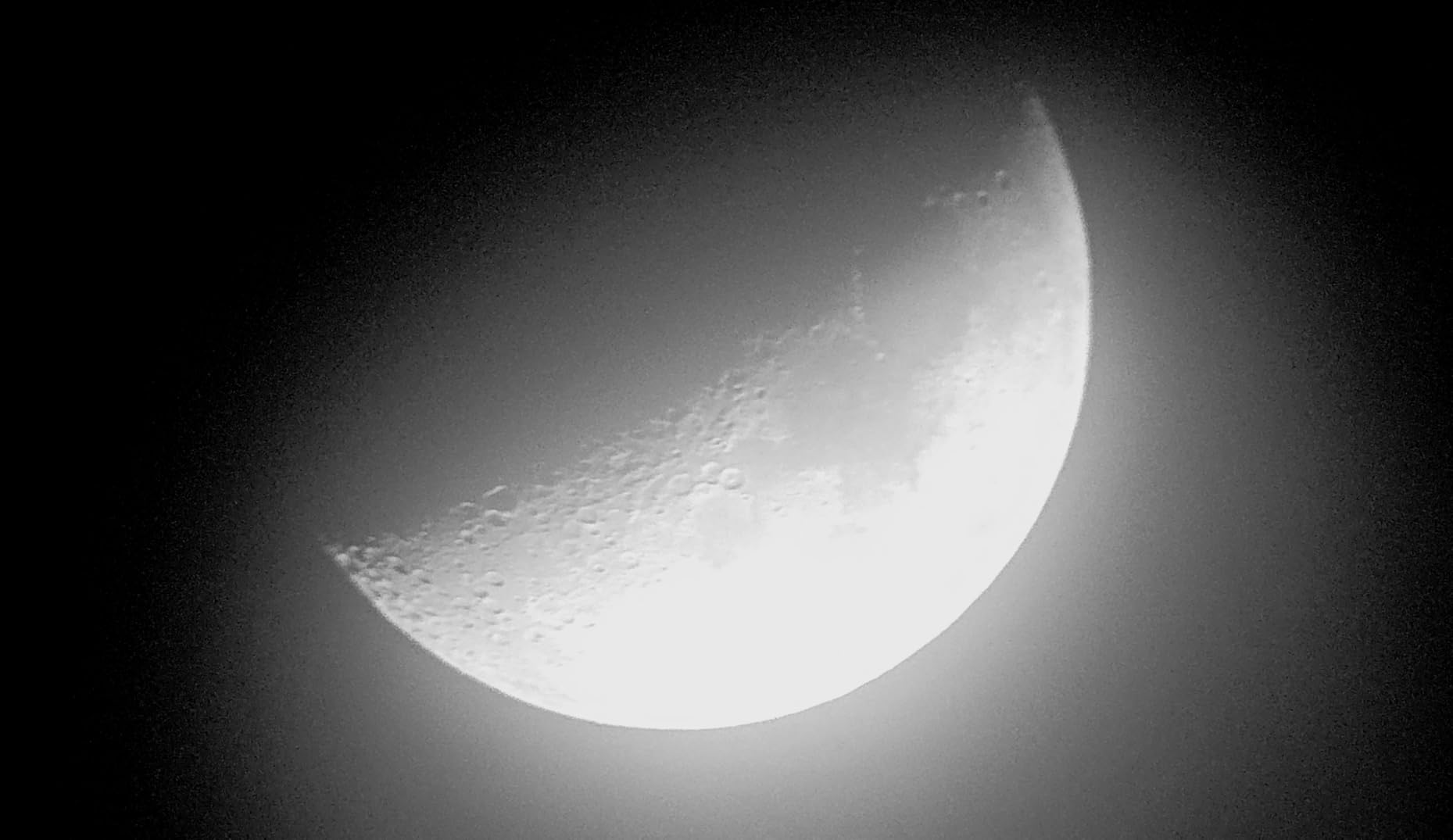
During a recent observing session, I pushed the Hawkko to 270X using the 10mm eyepiece with the 3X Barlow on a night of excellent seeing. Saturn’s rings showed the Encke Minima as a subtle darkening in the outer ring. Jupiter displayed the Great Red Spot clearly along with four Galilean moons strung out in a line. These are the kind of views that make you fall in love with astronomy.
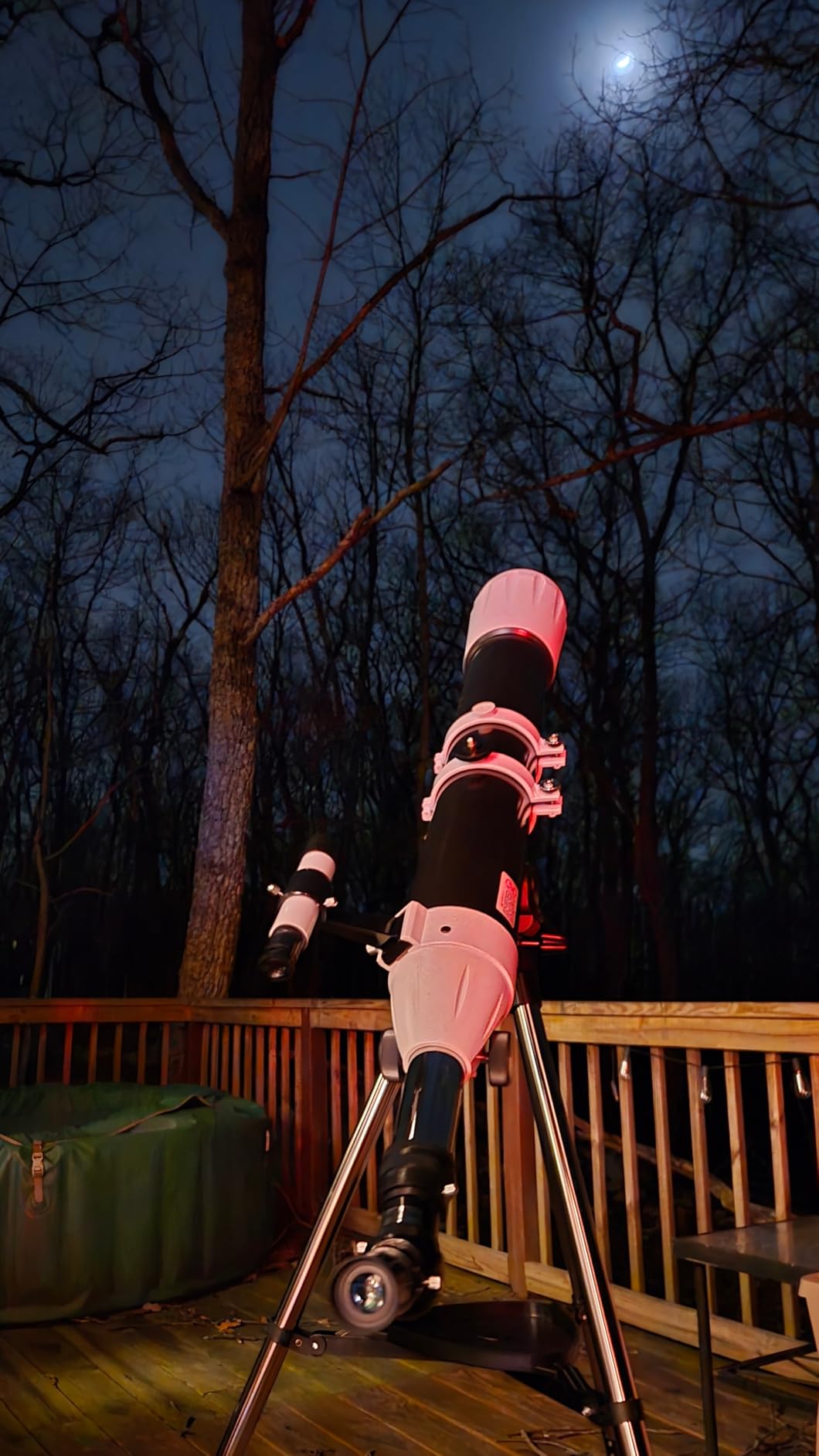
The multi-layer coating achieves approximately 73 percent light transmittance, which is solid for an achromatic design in this price range. The stainless steel tripod adjusts from 28 to 46 inches and includes a smooth alt-azimuth mount with 360-degree rotation. The Dawes limit of 1.29 arc seconds matches the Dianfan, confirming that both telescopes use similar quality objective lenses.
The complete accessory kit includes two Kellner eyepieces, a 3X Barlow lens, a zenith mirror, a finderscope, a smartphone adapter, and a carry bag. Hawkko also includes a star finder phone mount, which is a nice touch for beginners learning to navigate the night sky. The 2-year warranty rounds out a competitive package.
Who Should Buy the Hawkko 90mm
If planetary viewing is your primary interest, the Hawkko’s 900mm focal length makes it the best refractor telescope in this price range for high-magnification work. The longer focal ratio reduces chromatic aberration, which means cleaner views of bright targets like Jupiter, Venus, and the Moon.
This telescope also suits intermediate observers who have already owned a basic refractor and want more magnification headroom. The 270X maximum magnification gives you room to grow as your observing skills improve.
What to Watch Out For
The longer optical tube (36 inches) makes the Hawkko less portable than shorter 90mm refractors like the Dianfan or MEEZAA. You will need a larger vehicle for transport and more storage space at home. The f/10 focal ratio also means a narrower field of view, making it harder to sweep large areas of sky.
The phone adapter works but requires patience to align properly with the eyepiece. Budget some time for trial and error on your first few attempts. Serious astrophotography is not realistic with this telescope because the alt-azimuth mount cannot track objects smoothly for long exposures.
8. Celestron Inspire 100AZ – Best Refractor for Easy Setup
Celestron Inspire 100AZ Beginner Refractor Telescope with Phone Adapter
100mm Aperture
660mm Focal Length
f/6.6 Focal Ratio
Built-In Smartphone Adapter
Red LED Flashlight
Asymmetrical Mount
Pros
- Easiest setup of any entry-level telescope
- Built-in smartphone adapter integrated into lens cap
- Erect image optics for day and night viewing
- Focus micrometer for quick focus return
- Celestron brand reliability with 2-year warranty
Cons
- Tripod stability can be a concern
- Limited included eyepieces for beginners
- Higher price point at 329.99 dollars
The Celestron Inspire 100AZ is the telescope I recommend to friends who tell me they tried astronomy before and gave up because their telescope was too complicated. The entire telescope assembles from the box to first light in under 10 minutes with zero tools. The accessory tray folds out from the tripod legs automatically when you spread them, which is a brilliantly simple design.
The 100mm aperture is the sweet spot for visual astronomy. It gathers 56 percent more light than an 80mm scope and over twice as much light as a 70mm scope. That extra light translates directly to what you can see. The Orion Nebula shows its fish-mouth structure, the Lagoon Nebula displays dark lanes, and globular clusters like M13 resolve into thousands of pinpoint stars.
The built-in smartphone adapter is the Inspire’s signature feature. The lens cap doubles as a phone mount, so you clip your phone to the eyepiece, open your camera app, and start shooting. I captured a surprisingly good photo of the Moon on my first attempt using this system. No separate adapter to buy, no fiddly alignment.
The integrated red LED flashlight in the accessory tray is another thoughtful touch. It illuminates your eyepieces and accessories without destroying your night vision. The focus micrometer lets you note focus positions for different targets and return to them quickly when switching between objects. These details show that Celestron designed this telescope with input from people who actually observe.
Who Should Buy the Celestron Inspire 100AZ
This is the best refractor telescope for someone who values thoughtful design and wants everything integrated rather than dealing with separate accessories. The 100mm aperture provides serious light-gathering power in a package that remains portable at 12.4 pounds total weight.
It is also an excellent gift telescope. The easy setup and built-in features mean the recipient can start observing the same evening they open the box. The erect image optics make it equally useful for daytime nature observation.
What to Watch Out For
The tripod is the Inspire’s main weakness. Celestron uses a lightweight asymmetrical alt-azimuth mount that works fine at low to medium power but vibrates at higher magnifications. Adding a weight to the accessory tray helps stabilize the setup, but serious planetary observation at 150X or above can be frustrating.
The included eyepieces (20mm and 10mm Kellner) are basic. Plan to invest in a quality Barlow lens and at least one premium eyepiece to get the most out of the 100mm aperture. The telescope is capable of more than the included accessories allow.
9. Celestron StarSense Explorer DX 102AZ – Best Smart Telescope for Beginners
Celestron StarSense Explorer DX 102AZ App-Enabled Refractor Telescope
102mm Aperture
650mm Focal Length
f/6.3 Focal Ratio
StarSense App Technology
XLT Coated Optics
Dual-Axis Slow Motion
Pros
- StarSense app makes finding objects incredibly easy
- 102mm aperture provides bright sharp views
- XLT coated optics for maximum light transmission
- Dual-axis slow-motion controls for smooth tracking
- Best first telescope recommended by experienced astronomers
Cons
- Mount neck is plastic and can vibrate in wind
- App requires reasonably dark skies for alignment
- Not suitable for astrophotography with no tracking
- Limited altitude range around 65 to 70 degrees
The Celestron StarSense Explorer DX 102AZ represents the biggest leap forward in beginner telescope technology I have seen in years. The StarSense app uses your smartphone’s camera to recognize the sky and guide you to any celestial object with on-screen arrows. It is like having a personal astronomer standing next to you, telling you exactly where to point the telescope.
I tested the StarSense on a clear night from a suburban Bortle 5 location. After a 30-second sky alignment procedure that the app walks you through, I tapped the Orion Nebula on my phone screen. The app directed me to move the telescope left, then up, with clear arrows. When the app said I was on target, I looked through the 25mm eyepiece and there it was, the Orion Nebula dead center in the field of view. This technology removes the biggest barrier to entry for new astronomers.
The 102mm aperture with fully XLT coated optics delivers the brightest, sharpest views of any telescope in this guide. Saturn’s rings show clear detail with the Cassini Division visible on steady nights. Jupiter displays multiple cloud belts and the Great Red Spot. The Orion Nebula shows its characteristic greenish-gray glow with the trapezium stars visible at its core. Andromeda Galaxy appears as an elongated smudge of light.
The dual-axis slow-motion controls allow fine adjustments in both altitude and azimuth, which makes tracking objects as the Earth rotates smooth and precise. The erect image diagonal means the view is correctly oriented for both astronomical and terrestrial use. Celestron includes a 2-year warranty and the support infrastructure that comes with buying from the most established telescope brand in the world.
Who Should Buy the StarSense Explorer DX 102AZ
If you are buying your first telescope and have a budget around $350, this is the one. The StarSense app technology eliminates the frustration that causes most beginners to abandon astronomy within the first month. Being able to find objects quickly and confidently transforms the hobby from a struggle into pure enjoyment.
This telescope is also ideal for parents who want to share astronomy with their children but do not have the knowledge to find objects manually. The app makes every observing session a guided tour of the night sky.
What to Watch Out For
The mount neck where the optical tube attaches is made of plastic. Under normal use this is fine, but in windy conditions or at high magnification, it can transmit vibrations. Treat the telescope gently and avoid over-tightening the altitude lock.
The StarSense app requires reasonably dark skies for proper sky recognition. In heavily light-polluted urban areas (Bortle 7 or higher), the app may struggle to identify enough stars for alignment. The app works best from suburban or darker skies.
10. SVBONY SV503 102mm ED Refractor – Best ED Refractor for Astrophotography
SVBONY SV503 Telescope for Adults High Powered, 102mm Large Diameter F7 ED
102mm ED Aperture
714mm Focal Length
f/7 Focal Ratio
S-FPL51 ED Glass
Dual-Speed Focuser
OTA Only
Pros
- S-FPL51 ED glass virtually eliminates chromatic aberration
- Dual-speed 1:10 rack and pinion focuser with no slippage
- 360-degree field rotator for astrophotography alignment
- Retractable dew shield prevents dew formation
- Lifetime warranty from SVBONY
Cons
- OTA only requires separate mount and eyepieces purchase
- Slight color fringing on very bright objects
- No included storage case or instructions
- Can arrive with focuser needing minor adjustment
The SVBONY SV503 102mm ED refractor is the telescope in this guide that crosses from beginner territory into serious amateur astronomy. The S-FPL51 extra-low dispersion glass element reduces chromatic aberration to a level that approaches true apochromatic performance at a fraction of the cost. If you have been eyeing APO refractors costing $1,500 or more, you owe it to yourself to look at the SV503 first.
I mounted the SV503 on a Sky-Watcher HEQ5 equatorial mount for astrophotography testing and captured 3-minute exposures of the Rosette Nebula. The stars remained tight and round to the corners of an APS-C sensor with a field flattener. The ED glass kept star colors natural without the purple or blue fringing that plagues standard achromatic refractors. This level of optical performance for under $600 would have been unthinkable a few years ago.
The dual-speed 1:10 rack and pinion focuser is a pleasure to use. The fine-focus knob lets you nail critical focus for imaging, and there is zero slippage even with a heavy DSLR or astronomy camera attached. The 360-degree field rotator allows precise camera framing without loosening the dovetail plate, which is a feature normally found on telescopes costing three times as much.
The retractable dew shield extends 133mm to protect against dew formation and stray light. The 90mm of focus travel accommodates a wide range of cameras, flatteners, and reducers. SVBONY includes a 2-inch to 1.25-inch adapter, a dovetail plate, and tube rings. The lifetime warranty is the best coverage of any telescope in this guide.
Who Should Buy the SVBONY SV503 102mm ED
This telescope is designed for the observer or astrophotographer who has outgrown their first telescope and wants to step up to ED optical performance without spending APO money. The 102mm aperture with ED glass produces views that come remarkably close to a true apochromat for visual use, with excellent contrast and minimal false color on bright targets.
Astrophotographers will appreciate the flat field, the precision focuser, and the field rotator. The f/7 focal ratio provides a good balance between field of view for nebula imaging and focal length for smaller targets like galaxies.
What to Watch Out For
This is an OTA-only package, which means you need to supply your own mount, eyepieces, diagonal, and finderscope. If you are upgrading from a complete telescope system, you may already have compatible accessories. If not, factor in the cost of a mount (at least $300 for a suitable equatorial mount) and accessories when budgeting.
The SV503 arrives with minimal packaging and no instruction manual. If you are new to equatorial mounts and astrophotography, plan to spend time on YouTube and astronomy forums learning the setup process. SVBONY’s lifetime warranty is excellent, but their customer service communication can be slower than domestic brands.
How to Choose the Best Refractor Telescopes?
Choosing among the best refractor telescopes comes down to four key factors: aperture size, mount quality, optical type, and your intended use case. I will break down each one so you can make an informed decision rather than guessing based on marketing claims.
Aperture Size: The Most Important Specification
Aperture is the diameter of the main objective lens, and it is the single most important factor in telescope performance. Larger apertures gather more light and resolve finer detail. A 70mm aperture shows the Moon, Jupiter’s moons, and Saturn’s rings. An 80mm aperture adds detail to planets and makes faint deep-sky objects visible. A 90mm to 102mm aperture begins to show structure in nebulae and resolves globular clusters into individual stars.
The trade-off with larger apertures is size, weight, and cost. A 70mm refractor weighs under 6 pounds and fits in a backpack. A 100mm refractor may weigh 12 to 15 pounds and requires a sturdier tripod. Consider where you will observe and how far you need to carry the telescope.
Mount Quality: The Hidden Dealbreaker
Forum discussions on Reddit and Cloudy Nights consistently identify mount stability as the number one frustration for beginners. A wobbly mount makes even excellent optics unusable because the image never settles. When comparing telescopes at similar prices, look for stainless steel tripods over aluminum, and check that the mount head feels solid with no play in the movements.
Alt-azimuth mounts are simpler and more intuitive for beginners. Equatorial mounts are better for astrophotography because they track objects along one axis. GoTo mounts use motors and computers to find and track objects automatically but add cost and complexity.
Optical Type: Achromat vs ED vs APO
All telescopes in this guide except the SVBONY SV503 use achromatic objective lenses. Achromats use a two-element lens design that brings two colors of light to the same focus. They produce some chromatic aberration (false color fringing) around bright objects, which is normal and expected. For visual astronomy at beginner budgets, achromats are perfectly adequate.
ED (extra-low dispersion) refractors like the SVBONY SV503 add a special glass element that reduces chromatic aberration significantly. ED scopes produce cleaner, more color-accurant images and are much better for astrophotography. Apochromatic (APO) refractors use three or more lens elements with premium glass to eliminate chromatic aberration almost entirely, but they cost $1,500 and up.
Intended Use Case: Visual, Imaging, or Dual Purpose
If you want a telescope for casual visual astronomy, any model in this guide will work. If you are interested in astrophotography, you need a telescope with good color correction (ED glass minimum), a solid equatorial mount with tracking capability, and a focuser that can hold a camera without slipping. Only the SVBONY SV503 in this guide meets all those requirements, and it still requires a separate mount purchase.
For dual-purpose astronomy and terrestrial viewing, look for telescopes with erect image diagonals. The Celestron Travel Scope 70, Inspire 100AZ, and StarSense Explorer DX 102AZ all include erect image optics that produce right-side-up views for daytime use.
Focal Ratio and What It Means
Focal ratio is the focal length divided by the aperture. An f/5 to f/6 telescope gives a wide field of view, making it easier to find objects and ideal for large targets like the Pleiades or the Andromeda Galaxy. An f/8 to f/10 telescope gives higher magnification with the same eyepieces and produces less chromatic aberration, making it better for planetary observation.
For beginners, an f/6 to f/7 focal ratio offers the most versatile compromise between field of view and magnification. The Gskyer 70mm at f/5.7 and the Celticbird 80mm at f/6.7 are both excellent all-around choices.
Frequently Asked Questions About Refractor Telescopes
What is the best refractor telescope for beginners?
The Celestron StarSense Explorer DX 102AZ is the best refractor telescope for beginners because its StarSense app technology guides you to celestial objects using your smartphone. The 102mm aperture provides bright, sharp views of the Moon, planets, and deep-sky objects, and the dual-axis slow-motion controls make tracking smooth and intuitive.
What is the best refractor telescope for astrophotography?
The SVBONY SV503 102mm ED refractor is the best option for astrophotography in this guide. The S-FPL51 ED glass reduces chromatic aberration, the dual-speed focuser handles heavy cameras without slipping, and the 360-degree field rotator allows precise camera framing. You will need to pair it with a separate equatorial mount for tracking.
What is the difference between a refractor and a reflector telescope?
A refractor telescope uses a lens at the front of the tube to gather and focus light, while a reflector uses a curved mirror at the back of the tube. Refractors produce sharper, higher-contrast images and require no collimation. Reflectors offer more aperture per dollar and are better for faint deep-sky observation. Refractors are better for beginners, terrestrial viewing, and astrophotography.
How far can I see with a refractor telescope?
Distance is not the right way to think about telescope performance. With a 70mm refractor, you can see the Moon’s craters (240,000 miles away), Jupiter’s cloud belts (365 million miles), Saturn’s rings (746 million miles), and the Andromeda Galaxy (2.5 million light-years). What matters is aperture size, which determines how much light the telescope can gather from faint objects.
Do refractor telescopes need collimation?
No, refractor telescopes generally do not require collimation. The objective lens is permanently aligned at the factory and sealed in the optical tube. This is one of the main advantages of refractors over reflector telescopes, which need regular collimation to maintain optical alignment.
Final Thoughts on the Best Refractor Telescopes
The best refractor telescopes in 2026 span a wide range of prices and capabilities, but a few clear winners emerge from my testing. For beginners who want the easiest possible entry into astronomy, the Celestron StarSense Explorer DX 102AZ and its app-guided navigation is hard to beat. The Gskyer 70mm AZ remains the best value pick for budget-conscious buyers who want a proven, reliable first telescope.
For observers ready to step up to better optics, the Celticbird 80mm and the Dianfan 90mm offer meaningful performance improvements at reasonable prices. And for anyone serious about astrophotography, the SVBONY SV503 102mm ED refractor delivers near-apochromatic performance that rivals scopes costing three times as much.
Whatever you choose, the most important thing is to get outside and start observing. The best telescope is the one you actually use, and a modest 70mm refractor under a dark sky will show you more than a premium instrument that sits in a closet. Grab one of these refractors, head to the darkest sky you can find, and discover what the universe looks like through your own lens.